EP0783101A2 - Procédé et dispositif de mesure optique de la concentration de poussières fines dans un milieux - Google Patents
Procédé et dispositif de mesure optique de la concentration de poussières fines dans un milieux Download PDFInfo
- Publication number
- EP0783101A2 EP0783101A2 EP96810881A EP96810881A EP0783101A2 EP 0783101 A2 EP0783101 A2 EP 0783101A2 EP 96810881 A EP96810881 A EP 96810881A EP 96810881 A EP96810881 A EP 96810881A EP 0783101 A2 EP0783101 A2 EP 0783101A2
- Authority
- EP
- European Patent Office
- Prior art keywords
- grain size
- measured
- scattered light
- light
- polarizer
- Prior art date
- Legal status (The legal status is an assumption and is not a legal conclusion. Google has not performed a legal analysis and makes no representation as to the accuracy of the status listed.)
- Withdrawn
Links
Images


Classifications
-
- G—PHYSICS
- G01—MEASURING; TESTING
- G01N—INVESTIGATING OR ANALYSING MATERIALS BY DETERMINING THEIR CHEMICAL OR PHYSICAL PROPERTIES
- G01N15/00—Investigating characteristics of particles; Investigating permeability, pore-volume or surface-area of porous materials
- G01N15/02—Investigating particle size or size distribution
- G01N15/0205—Investigating particle size or size distribution by optical means
Definitions
- the invention relates to a method for optical concentration measurement of fine dust in a medium, with a light source and means for measuring scattered light.
- the invention also relates to a device for optical concentration measurement of fine dust according to the preambles of claims 13 and 14.
- a method and a device for the optical measurement of particles suspended in a gas have become known from the applicant's CH-A-536 490. Methods and devices of this type have been in operation and in particular for measuring the concentration of fine dust for many years have proven themselves. In the case of such measurements, the knowledge is used that with fine dusts the intensity of the scattered light is proportional to the dust concentration. However, the scattered light intensity depends not only on the concentration of the particles, but in particular on the size of the particles. If such a measuring device is now calibrated to a certain particle size and if the particle size changes during a process to be monitored, the calibration and thus the device sensitivity also change, which leads to the display of an incorrect concentration value. With many measurements there is now a risk that such size changes of the particles will not be noticed in time and the device will not be recalibrated.
- the invention has for its object to provide a method and a device of the type mentioned, which avoid the difficulty mentioned.
- the method according to the invention is based on the principle that the state of polarization of the light which strikes fine dust is changed by the scattering process and this change is closely linked to the particle size of the fine dust.
- the grain size of a particulate matter to be measured thus changes over time as a result of changing Process conditions, this can be signaled to the operator immediately and he can recreate the device calibration using a gravimetric measurement. A direct correction of the dust concentration is also possible. If the particle size distribution of the fine dust is known when the device according to the invention is started up, it can be included in the later evaluation as a starting value, which increases the reliability of the method. However, knowledge of the grain size distribution is not a prerequisite for the method according to the invention.
- the method according to the invention is particularly suitable for fine dusts in which the refractive index and the shape of the particles are known and are constant over time.
- the method is particularly easy to implement for compact, spherical or approximately spherical particles, but a method is also possible for other particle shapes, for example rods, cuboids or flakes.
- polarized light is supplied to the fine dust with a polarizer arranged in the primary light beam.
- the means for measuring the scattered light can have a photomultiplier known per se or another suitable detector.
- a second polarizer is arranged in the scattered light, which is rotatable and can preferably be locked at different angles.
- a rotating polarizer is also conceivable.
- different scattered light intensities are measured, which are proportional to the dust concentration and which contain information about the particle size of the fine dust.
- a contour line method is particularly suitable for evaluating this information.
- Other methods are also conceivable, for example an equivalent diameter method.
- FIG. 1 shows a measuring cell 7 with a medium 8 in which particles 9 of a fine dust are suspended.
- the medium is preferably a gas stream, but other media, for example a liquid or a solid, are also conceivable.
- the particles 9 can also be droplets of an oil mist.
- a primary light beam 4 is directed onto the measuring cell 7, which is transmitted through a light source 1, an optical system 2, an optical filter 3 and a first polarizer 5 is formed.
- the light source 1 is, for example, a halogen lamp and emits an unpolarized light.
- the optics 2 known per se bundles the light that strikes the measuring cell 7 in the direction of the arrow 6 after passing through the optical filter 3 and the first polarizer 5.
- the polarized light is scattered on the particles 9 and is coupled out in the direction of the arrow 11 at a measurement angle 10 of preferably 90 °.
- the scattered light 18 is focused with optics 12 onto a detector 14.
- a second polarizer 13 is arranged between the optics 12 and the detector 14.
- the scattered light intensity can be measured in the detector 14 and corresponding signals can be fed to a computer 15 through a line 19.
- the computer 15 is connected to a display 17 via a further line 16, for example.
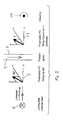
- the first polarizer 5 is preferably inclined at 45 ° to the X axis, the Z axis being defined here by the light beam.
- the measuring cell 7 is supplied with polarized light in a defined manner, the horizontal and vertical polarization being the same.
- the second polarizer 13 is located directly in front of the detector 14, which is a photomultiplier, for example. This second polarizer 13 is rotatable and lockable against the X axis at the angles 90 °, 0 °, 45 ° and 135 °. In these positions of the second polarizer 13, four scattered light intensities I1, I2, I3 and I4 measurable. These measured values are fed to the computer via line 19.
- An internal program of the computer 15 compares the measured intensities with data calculated using scattering theory and uses this comparison to determine statements, for example, about the grain size.
- the concentration of the particles 9 in the medium 8 is determined in a manner known per se based on the device calibration. However, if the grain size changes in the course of time as a result of changing process conditions, such a change is determined in the computer 15 and signaled to the operator via the line 16, for example on a display 17. Due to the change displayed, the operator can recreate the device calibration using a gravimetric measurement. A direct correction of the dust concentration is also possible. If the grain size distribution is known when the device is started up, it can be included in the later evaluation as a starting value, which increases the reliability of the method. However, knowledge of the grain size distribution is not a requirement.
- G. Mie's scattering theory is known for compact, spherical or approximately spherical particles 9.
- the distribution of the grain sizes is preferably approximately a logarithmic normal distribution, characterized by an average grain size d 0 and a width ⁇ .
- the four intensities I are proportional to the dust concentration.
- these intensities I are converted into the polarization ratio p and the linear degree of polarization P lin , which are concentration-independent parameters.
- these two sizes p and P lin are now directly related to the mean grain size and the width of the distribution.
- contour line method described below and the equivalent diameter method are suitable for evaluating the two parameters p and P lin mentioned .
- the contour line method is particularly suitable if the particles 9 are known and the refractive index and the shape are constant. This can be the case, for example, with an oil mist. This procedure enables correction a concentration display with variable grain size and also an explicit determination of an average grain size d 0 and a width ⁇ of the distribution.
- Contour line diagrams of the two parameters p and P lin serve as the basis for an evaluation, as shown for example in FIG. 3.
- lines 20 of the same parameter values are shown as contour lines in a surface which is formed from the mean grain size d 0 and the width of the grain size distribution ⁇ .
- Each point in the contour diagram corresponds to a grain size distribution, characterized by the pair of values d 0 / ⁇ .
- This diagram has a different shape for each particle type and is calculated, for example, for spherical particles using Mie theory.
- the required diagrams are stored in the computer 15 and are available to the evaluation software.
- the values of p and P lin calculated from the intensities I in a manner known per se are transferred by the evaluation software to the corresponding contour lines. Each of the two measured values corresponds to a contour line.
- the intersection of the contour lines gives the grain size distribution d 0 / ⁇ .
- the measured values for oil mist from the complete mixed series of paraffin oil-machine oil (Tellus 32) are entered for each station in FIG.
- the increase in grain size reflects the increase in the viscosity of the mixture.
- the relationship between the measured scattering intensities I and the grain size can be used to determine the time course of the device sensitivity and to correct the calibration value.
- the equivalent diameter method is suitable for evaluating the intensities I. This leads to the approximate determination of the average grain size and to an approximate correction of the concentration display.
- an equivalent grain size is determined from each individual measurement of p and P lin .
- the equivalent grain size serves as an estimate of the real grain size and differs as little as possible from it. It is essential that it can be used in the same form for p and P lin as well as for the scattered light intensity. This means that within certain limits it replaces the real grain size, which does not have to be known. A better estimate of the real grain size can be obtained if the width ⁇ of the distribution is also known.
- This measuring method is also based on the principle that the state of polarization of the light that strikes the particles 9 is changed by the scattering process and this change is linked to the grain size. Changes in the grain size can thus be detected and signaled immediately or used for a direct correction. Measurement errors due to undetected process changes can thus be avoided.
Landscapes
- Chemical & Material Sciences (AREA)
- Dispersion Chemistry (AREA)
- Physics & Mathematics (AREA)
- Health & Medical Sciences (AREA)
- Life Sciences & Earth Sciences (AREA)
- Analytical Chemistry (AREA)
- Biochemistry (AREA)
- General Health & Medical Sciences (AREA)
- General Physics & Mathematics (AREA)
- Immunology (AREA)
- Pathology (AREA)
- Investigating Or Analysing Materials By Optical Means (AREA)
- Organic Low-Molecular-Weight Compounds And Preparation Thereof (AREA)
Applications Claiming Priority (2)
| Application Number | Priority Date | Filing Date | Title |
|---|---|---|---|
| CH1796A CH695710A5 (it) | 1996-01-04 | 1996-01-04 | Verfahren und Einrichtung zur optischen Konzentrationsmessung von Feinstaub in einem Medium. |
| CH17/96 | 1996-01-04 |
Publications (2)
| Publication Number | Publication Date |
|---|---|
| EP0783101A2 true EP0783101A2 (fr) | 1997-07-09 |
| EP0783101A3 EP0783101A3 (fr) | 1998-10-07 |
Family
ID=4177513
Family Applications (1)
| Application Number | Title | Priority Date | Filing Date |
|---|---|---|---|
| EP96810881A Withdrawn EP0783101A3 (fr) | 1996-01-04 | 1996-12-19 | Procédé et dispositif de mesure optique de la concentration de poussières fines dans un milieux |
Country Status (2)
| Country | Link |
|---|---|
| EP (1) | EP0783101A3 (fr) |
| CH (1) | CH695710A5 (fr) |
Cited By (4)
| Publication number | Priority date | Publication date | Assignee | Title |
|---|---|---|---|---|
| DE102005004273A1 (de) * | 2005-01-28 | 2006-08-03 | Anatec As | Meßvorrichtung zur Bestimmung des Staubungsverhaltens von dispersen Systemen |
| US7630074B2 (en) | 2006-09-13 | 2009-12-08 | Robert Bosch Gmbh | Device and method for measuring at least one parameter of particles in a fluid |
| CN104833620A (zh) * | 2015-04-20 | 2015-08-12 | 江苏苏净集团有限公司 | 一种大气颗粒物浓度的监测装置 |
| CN120609717A (zh) * | 2025-08-08 | 2025-09-09 | 西钢集团灯塔矿业有限公司 | 一种矿井下粉尘浓度实时监测方法及系统 |
Families Citing this family (1)
| Publication number | Priority date | Publication date | Assignee | Title |
|---|---|---|---|---|
| EP2848913A1 (fr) | 2013-09-12 | 2015-03-18 | Siemens Schweiz AG | Appareil de détection pour la détermination de particules fines |
Citations (1)
| Publication number | Priority date | Publication date | Assignee | Title |
|---|---|---|---|---|
| CH536490A (de) | 1971-03-29 | 1973-04-30 | Willy Dr Sigrist | Verfahren und Einrichtung zur optischen Messung von in einem Gas suspendierten Teilchen |
Family Cites Families (6)
| Publication number | Priority date | Publication date | Assignee | Title |
|---|---|---|---|---|
| US3499159A (en) * | 1967-01-23 | 1970-03-03 | Xerox Corp | Polychromatic laser aerosol sizing and ranging (plasar) technique |
| US3612689A (en) * | 1967-04-10 | 1971-10-12 | American Standard Inc | Suspended particle concentration determination using polarized light |
| US4134679A (en) * | 1976-11-05 | 1979-01-16 | Leeds & Northrup Company | Determining the volume and the volume distribution of suspended small particles |
| FR2617971B1 (fr) * | 1987-07-10 | 1989-11-10 | Onera (Off Nat Aerospatiale) | Procede et dispositifs de granulometrie optique pour de larges gammes de mesure |
| US4854705A (en) * | 1988-04-05 | 1989-08-08 | Aerometrics, Inc. | Method and apparatus to determine the size and velocity of particles using light scatter detection from confocal beams |
| US4953978A (en) * | 1989-03-03 | 1990-09-04 | Coulter Electronics Of New England, Inc. | Particle size analysis utilizing polarization intensity differential scattering |
-
1996
- 1996-01-04 CH CH1796A patent/CH695710A5/it not_active IP Right Cessation
- 1996-12-19 EP EP96810881A patent/EP0783101A3/fr not_active Withdrawn
Patent Citations (1)
| Publication number | Priority date | Publication date | Assignee | Title |
|---|---|---|---|---|
| CH536490A (de) | 1971-03-29 | 1973-04-30 | Willy Dr Sigrist | Verfahren und Einrichtung zur optischen Messung von in einem Gas suspendierten Teilchen |
Cited By (6)
| Publication number | Priority date | Publication date | Assignee | Title |
|---|---|---|---|---|
| DE102005004273A1 (de) * | 2005-01-28 | 2006-08-03 | Anatec As | Meßvorrichtung zur Bestimmung des Staubungsverhaltens von dispersen Systemen |
| EP1685912A3 (fr) * | 2005-01-28 | 2010-09-22 | AnaTec AS | Dispositif de mesure destiné à la détermination du comportement par rapport à la poussière de systèmes dispersés |
| US7630074B2 (en) | 2006-09-13 | 2009-12-08 | Robert Bosch Gmbh | Device and method for measuring at least one parameter of particles in a fluid |
| CN104833620A (zh) * | 2015-04-20 | 2015-08-12 | 江苏苏净集团有限公司 | 一种大气颗粒物浓度的监测装置 |
| CN104833620B (zh) * | 2015-04-20 | 2018-03-13 | 江苏苏净集团有限公司 | 一种大气颗粒物浓度的监测装置 |
| CN120609717A (zh) * | 2025-08-08 | 2025-09-09 | 西钢集团灯塔矿业有限公司 | 一种矿井下粉尘浓度实时监测方法及系统 |
Also Published As
| Publication number | Publication date |
|---|---|
| CH695710A5 (it) | 2006-07-31 |
| EP0783101A3 (fr) | 1998-10-07 |
Similar Documents
| Publication | Publication Date | Title |
|---|---|---|
| DE2508611C2 (de) | Verfahren zur Bestimmung der charakteristischen Brechkräfte einer Linse und Vorrichtung zur Durchführung desselben | |
| DE69023107T2 (de) | Verfahren und Vorrichtung zur Teilchenanalyse. | |
| DE2747181C2 (de) | Verfahren zur Bestimmung des Gesamtvolumens der in einer Probe suspendierten Teilchen eines bestimmten Größenbereichs | |
| EP0893520B1 (fr) | Procédé pour visualiser les performances des échantillons allongés textiles | |
| DE3007125A1 (de) | Vorrichtung und verfahren zur bestimmung der brechungseigenschaften einer testlinse | |
| DE2832091A1 (de) | Optisches verfahren zur bestimmung der teilchengroesse kolloidaler loesungen und messgeraet zur durchfuehrung des verfahrens | |
| DE102012217419B4 (de) | Analyseverfahren für Röntgenstrahlbeugungsmessdaten | |
| DE69312617T2 (de) | Vorrichtung und Verfahren zur Messung der Verteilung von Partikelgrössen | |
| EP1187786B1 (fr) | Procede et dispositif permettant le nettoyage de fils | |
| EP3814744B1 (fr) | Procede de determination de la distribution de la taille des particules d'un aerosol et appareil de mesure d'aerosol | |
| EP0345562B1 (fr) | Procédé et appareil pour le traitement de données de mesures | |
| DE68920347T2 (de) | Bogenförmige Fotosensorenanordnung. | |
| DE10326152A1 (de) | Verfahren und Vorrichtung zur quantitativen Analyse von Lösungen und Dispersionen mittels Nahinfrarot-Spektroskopie | |
| DE112005000828B4 (de) | Vorrichtung und Verfahren zur Prüfung von Halbleiter-Wafern | |
| EP0783101A2 (fr) | Procédé et dispositif de mesure optique de la concentration de poussières fines dans un milieux | |
| WO2011050932A1 (fr) | Appareil de mesure servant à la mesure, dans un gaz d'échappement, de concentrations en masse de particules dans un gaz à mesurer, en particulier dans un gaz d'échappement de combustion | |
| DE69618801T2 (de) | Vorrichtung und verfahren zur bestimmung der partikelgrösse bei geringer konzentration | |
| DE202008014667U1 (de) | Messgerät | |
| AT397159B (de) | Verfahren zum prüfen einer in einer küvette befindlichen suspension | |
| DE69316502T2 (de) | Verfahren und Vorrichtung zur Schätzung eines Mischungsverhältnis von verschiedenen Pulvergehalten | |
| DE2315511C2 (de) | Verfahren und Gerät zum kontinuierlichen Bestimmen der Feinheit eines pulverförmigen Materials | |
| DE102018125205B4 (de) | Verfahren und Vorrichtung zur Ermittlung des Verschleißgrades einer Spritzdüse | |
| DE4324800C2 (de) | Vorrichtung zur Bestimmung von Fehlern von Oberflächen hoher Güte | |
| DE69407300T2 (de) | Methode und vorrichtung zur konzentrationsmessung einer in einer strömenden flüssigkeit in form einer dispersion anwesenden komponente | |
| DE2528912A1 (de) | Vorrichtung zum messen der konzentration einer trueben loesung |
Legal Events
| Date | Code | Title | Description |
|---|---|---|---|
| PUAI | Public reference made under article 153(3) epc to a published international application that has entered the european phase |
Free format text: ORIGINAL CODE: 0009012 |
|
| AK | Designated contracting states |
Kind code of ref document: A2 Designated state(s): AT CH DE FR GB IT LI |
|
| PUAL | Search report despatched |
Free format text: ORIGINAL CODE: 0009013 |
|
| AK | Designated contracting states |
Kind code of ref document: A3 Designated state(s): AT CH DE FR GB IT LI |
|
| 17P | Request for examination filed |
Effective date: 19990215 |
|
| 17Q | First examination report despatched |
Effective date: 20000914 |
|
| STAA | Information on the status of an ep patent application or granted ep patent |
Free format text: STATUS: THE APPLICATION IS DEEMED TO BE WITHDRAWN |
|
| 18D | Application deemed to be withdrawn |
Effective date: 20020731 |