EP0783111A2 - Steuerungsanordnung für ein elektrisches Heizsystem - Google Patents
Steuerungsanordnung für ein elektrisches Heizsystem Download PDFInfo
- Publication number
- EP0783111A2 EP0783111A2 EP96402729A EP96402729A EP0783111A2 EP 0783111 A2 EP0783111 A2 EP 0783111A2 EP 96402729 A EP96402729 A EP 96402729A EP 96402729 A EP96402729 A EP 96402729A EP 0783111 A2 EP0783111 A2 EP 0783111A2
- Authority
- EP
- European Patent Office
- Prior art keywords
- electricity
- heating system
- sensing
- periods
- display
- Prior art date
- Legal status (The legal status is an assumption and is not a legal conclusion. Google has not performed a legal analysis and makes no representation as to the accuracy of the status listed.)
- Withdrawn
Links
- 238000010438 heat treatment Methods 0.000 title claims abstract description 24
- 230000005611 electricity Effects 0.000 claims abstract description 42
- 238000004891 communication Methods 0.000 claims abstract description 11
- 238000005485 electric heating Methods 0.000 claims abstract description 6
- XLYOFNOQVPJJNP-UHFFFAOYSA-N water Substances O XLYOFNOQVPJJNP-UHFFFAOYSA-N 0.000 description 14
- 230000007935 neutral effect Effects 0.000 description 7
- 230000004048 modification Effects 0.000 description 4
- 238000012986 modification Methods 0.000 description 4
- 230000004044 response Effects 0.000 description 3
- 230000005355 Hall effect Effects 0.000 description 2
- 230000005540 biological transmission Effects 0.000 description 2
- 230000008859 change Effects 0.000 description 2
- 230000003044 adaptive effect Effects 0.000 description 1
- 238000004458 analytical method Methods 0.000 description 1
- 230000008901 benefit Effects 0.000 description 1
- 238000010586 diagram Methods 0.000 description 1
- 239000004973 liquid crystal related substance Substances 0.000 description 1
- 238000005259 measurement Methods 0.000 description 1
- 238000000034 method Methods 0.000 description 1
- 239000004033 plastic Substances 0.000 description 1
- 229920003023 plastic Polymers 0.000 description 1
- 230000008569 process Effects 0.000 description 1
- 230000003442 weekly effect Effects 0.000 description 1
Images
Classifications
-
- G—PHYSICS
- G01—MEASURING; TESTING
- G01R—MEASURING ELECTRIC VARIABLES; MEASURING MAGNETIC VARIABLES
- G01R21/00—Arrangements for measuring electric power or power factor
- G01R21/133—Arrangements for measuring electric power or power factor by using digital technique
- G01R21/1333—Arrangements for measuring electric power or power factor by using digital technique adapted for special tariff measuring
-
- G—PHYSICS
- G01—MEASURING; TESTING
- G01R—MEASURING ELECTRIC VARIABLES; MEASURING MAGNETIC VARIABLES
- G01R22/00—Arrangements for measuring time integral of electric power or current, e.g. electricity meters
Definitions
- This invention relates to electrical control devices for controlling electric heating systems, and is more particularly but not exclusively concerned with electrical control devices for controlling domestic electric hot water or space heating systems.
- multi-tariff supply typically requires a multi-tariff meter, which can be expensive: it is also typically time-based, ie controlled by an electrical or electronic timer, which is relatively inflexible and can easily lose its synchronisation with the intended off-peak switching times.
- an electrical control device for controlling an electric heating system, the device comprising an input for receiving a metered electricity supply; an output for connection to the heating system; switch means connected between the input and the output; communication means for receiving transmitted tariff messages containing data relating to the cost of the electricity being supplied; a control circuit responsive to the communication means to close the switch means during one or more periods when the cost of the electricity is relatively low; manually operable means for closing the switch means; sensing means for sensing the amount of electricity supplied to the heating system, the control circuit being responsive to the sensing means to accumulate the amounts of electricity supplied during one or more of said periods; and display means for producing a display representative of said accumulated amounts.
- the control device since the control device is intended to be used in conjunction with a metered electricity supply, the user's electricity bills remain primarily based on the readings of the already existing (and certified) meter, hereinafter called the primary meter, which is connected in the supply circuit up-circuit of the device: in particular, the primary meter does not need to be changed or modified.
- the control device can control the heating system so that it primarily uses low cost electricity, the metering means meters and displays a representation of the amount of this low cost electricity usage, and the electricity supplier can give the user a discount based on the displayed representation.
- the user nevertheless retains the freedom to switch on the heating system, using the manually operable means, at any time, but usage outside low cost periods does not contribute to the displayed representation of low cost usage, and so does not contribute to the discount.
- the communication means may comprise a radio receiver means for receiving broadcast tariff messages.
- a radio receiver means for receiving broadcast tariff messages.
- tariff changes are signalled by a radio signal.
- Other embodiments are nevertheless possible, for example, where tariff change messages are sent by power line communication or ripple control signals.
- the display means may be arranged to display direct representations of said accumulated amounts, eg in kilowatt hours, in which case it would typically be read by the electricity supplier at the same time that the primary meter is read.
- the display means may be arranged to display representations of said accumulated amounts in encrypted form, in which case the user could send details of the encrypted representations to the electricity supplier, for example once a year, in order to obtain the aforementioned discount.
- the sensing means may simply comprise means for sensing that current is flowing through the device.
- the sensing means may comprise a current sensor, such as a shunt, for producing a signal representative of the magnitude of the current flowing through the device, and may additionally comprise a voltage sensor, such as a potential divider, for producing a signal representative of the electricity supply voltage, the control circuit including analogue-to-digital converter means connected to receive and convert the or each sensor signal into a corresponding digital signal, and being arranged to derive said accumulated amounts from the or each digital signal.
- the control circuit preferably comprises a microprocessor, which may conveniently also serve as part of said analogue-to-digital converter means.
- the control device is advantageously programmable to control the heating system so that it reaches the desired temperature at at least one user-selected time.
- the control circuit is preferably arranged to sense the initial operation of the thermostat on successive days, to calculate therefrom the average time taken by the heating system to reach the desired temperature, and to select the periods for which it closes the switch means in dependence upon the calculated average time.
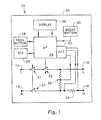
- the electrical control device shown in the drawing is indicated generally at 10, and is intended to control a domestic electric hot water system.
- the device 10 comprises live and neutral input terminals 12, 14 respectively, which are connected in use to receive a metered mains electricity supply, and live output terminals 16,18 respectively which are connected in use to the hot water system, the terminals 12, 14, 16 and 18 being disposed inside a plastics housing 20.
- the live input terminal 12 is connected internally of the housing 20 to the live output terminal 16 via one pole of a manually-operable two-pole switch 21 and a 16 amp switching relay 22, while the neutral input terminal is connected within the housing 20 to the neutral output terminal 18 via the other pole of the switch 21.
- the relay 22 is connected to be operated by a microprocessor 24, which receives inputs from a radio teleswitch receiver 26 of the kind described in our United Kingdom Patent No 2 070 897.
- the microprocessor 24 also receives inputs from a set of manually-operable control/programming buttons 28, from a manually-operable "BOOST" button 30 and from an analogue-to-digital converter 32.
- the analogue-to-digital converter 32 is connected in turn to receive a first analogue input signal representative of the magnitude of the current flowing between the neutral terminals 14, 18, this signal being produced for example by a shunt 34 connected in series between the neutral terminals, and a second analogue input signal representative of the magnitude of the voltage between the output terminals 16, 18, produced for example by a voltage divider 36.
- the analogue-to-digital converter 32 is shown for the sake of clarity as a self-contained item, it can be at least partly constituted by the microprocessor 24, for example as described in relation to the microprocessor 44 of Figure 1 of the aforementioned patent.
- the device 10 is also provided with a liquid crystal display (LCD) 38, which is energised by the microprocessor 24 and can be cycled between a variety of display modes in response to operation of the buttons 28, as will become apparent hereinafter.
- LCD liquid crystal display
- the power supply (not shown) for the electronic circuitry of the device 10 is coupled to the live and neutral input terminals 12, 14, ie up-circuit of the switch 21 and the relay 22.
- the microprocessor 24 is typically initially programmed to assume that the electric heating element in the hot water system will take, say, three hours to produce a full tank of hot water, and that the user will require such a full tank to be available at, say, 7.00 am and 7.00 pm.
- the user can enter the device into its programming mode via one of the buttons 28, whereupon these initially set times are displayed by the LCD 38, and can be changed by the user if desired, using others of the buttons 28.
- the radio teleswitch receiver 26 receives and decodes digital signals broadcast by the BBC by modulating them on its Radio 4 transmission at 198 kHz, these signals being broadcast on behalf of the electricity generating, transmission and distribution companies.
- the digital signals include cost reflective messages (CRMs) indicative of the respective pool price of electricity for each successive half hour period.
- CRMs cost reflective messages
- the microprocessor 24 is programmed to store and analyse the CRMs, which typically exhibit a generally similar pattern of cost variation each day, so as to identify, say, the six CRMs representing the lowest cost half hour periods in, say, the four hours before each of the two target times for a full tank of hot water.
- the microprocessor 24 then closes the relay 22 during each of the six identified periods, so heating the water using the lowest cost electricity.
- the current state of the relay 22, ie whether it is open or closed, is displayed by the LCD 38, although a separate light-emitting diode (LED) or other light-emitting device can be provided for this purpose if desired.
- the thermostat switches off.
- the device 10 senses this via the shunt 34 and the analogue-to-digital converter 32, and the microprocessor 24 calculates the average heating time taken, over several sucessive days or heating cycles, before the thermostat initially switches off. Assuming that this calculation determines that the average heating time is only, say, one and one half hours, the microprocessor 24 modifies the switching pattern of the relay 22 so that it closes during three of the lowest cost half hour periods in, say, the three hours before each of the two target times for a full tank of hot water.
- the adaptive process by which the microprocessor 24 identifies the CRMs representing the lowest cost half hour periods and measures the average heating time to achieve a full tank of hot water is periodically repeated, eg on a weekly basis, so as to continually update the actual heating control profile followed by the device 10.
- the electricity distributor may be willing to offer a discount to the user.
- discount periods are identified by digital signals transmitted with or as part of the CRMs, which signals cause the microprocessor 24 to measure the amount of electricity being used during the discount periods.
- the microprocessor 24 does this by multiplying together the digital current- and voltage-representative signals produced by the analogue-to-digital converter 32, and accumulating the results in a non-volatile memory, eg an EEPROM (not shown).
- the user periodically operates a respective one of the buttons 28, which is arranged to cause the microprocessor 24 to encrypt the total amount of electricity stored in the memory and display the encrypted result.
- the user then conveys the encrypted result to the electricity distributor, eg by post, and the distributor calculates the appropriate discount.
- the "BOOST" button 30 is used.
- the microprocessor 24 is programmed to close the relay for 30 minutes in response to a single operation of the button 30, and for one hour and two hours respectively in response to two and three operations of the button 30 in reasonably rapid succession: a fourth operation, again following rapidly after the third, cancels the operation of the "BOOST" facility.
- the microprocessor 24 does not measure the amount of electricity used during these "BOOST" periods, so that no discount applies to them, unless they happen to overlap periods identified as discount periods, in which case measurement takes place during the overlap period only.
- the switch 21 is used. However, since the power supply for the electronic circuitry of the device 10 is connected up-circuit of the switch 21 and the relay 22, the electronic circuitry continues to operate.
- the shunt 34 can be replaced by another suitable current sensor, such as a current transformer or a Hall effect device, in which case it can be arranged to sense the live current rather than the neutral current.
- the voltage between the output terminals 16, 18 can be assumed to be substantially constant, in which case the voltage divider 36 can simply be omitted.
- the electrical load represented by the hot water system can also be assumed to be substantially constant, in which case the current sensor, whether it be shunt, current transformer or Hall effect device, merely needs to sense whether or not current is flowing at the output terminals of 16, 18 of the device 10, and the analogue to digital converter 32 can be replaced by a simple comparator or other threshold device.
- the radio receiver means may be replaced by alternative communication means for receiving tariff change information, for example, a ripple control or power line communication receiver.
- the microprocessor 24 is arranged to display the amount of low cost, discountable, electricity accumulated in the EEPROM or other non-volatile memory directly, eg in kilowatt hours, either along with an encrypted number which is derived from it and which can be used to verify it, or alone; in the latter case, the electricity distributor would read the displayed amount at the same time that the primary meter is read, typically at least once per year.
- the switch 21 can be omitted, and operation of the "BOOST" button 30 (or of a separate “OFF” button (not shown)) when the relay 22 is already closed can be arranged to open the relay via the microprocessor 24.
- broadcast digital signals can be arranged to define more than one level of discount, and the device 10 can be programmed to identify these levels and accumulate separately the amounts of electricity used at each level.
Landscapes
- Engineering & Computer Science (AREA)
- Power Engineering (AREA)
- Physics & Mathematics (AREA)
- General Physics & Mathematics (AREA)
- Heat-Pump Type And Storage Water Heaters (AREA)
Applications Claiming Priority (2)
| Application Number | Priority Date | Filing Date | Title |
|---|---|---|---|
| GBGB9600160.7A GB9600160D0 (en) | 1996-01-05 | 1996-01-05 | Electrical heating control device |
| GB9600160 | 1996-01-05 |
Publications (2)
| Publication Number | Publication Date |
|---|---|
| EP0783111A2 true EP0783111A2 (de) | 1997-07-09 |
| EP0783111A3 EP0783111A3 (de) | 1997-09-03 |
Family
ID=10786627
Family Applications (1)
| Application Number | Title | Priority Date | Filing Date |
|---|---|---|---|
| EP96402729A Withdrawn EP0783111A3 (de) | 1996-01-05 | 1996-12-13 | Steuerungsanordnung für ein elektrisches Heizsystem |
Country Status (2)
| Country | Link |
|---|---|
| EP (1) | EP0783111A3 (de) |
| GB (1) | GB9600160D0 (de) |
Cited By (2)
| Publication number | Priority date | Publication date | Assignee | Title |
|---|---|---|---|---|
| FR2771536A1 (fr) * | 1997-11-26 | 1999-05-28 | Eric Patrick Joseph Pecout | Dispositif pour informer des abonnes d'un reseau d'alimentation electrique relativement au tarif applicable a leur consommation |
| WO2002056033A1 (es) * | 2001-01-16 | 2002-07-18 | Ortega Murguia Jose Tomas | Sistema ahorrafor de energia electrica |
Family Cites Families (3)
| Publication number | Priority date | Publication date | Assignee | Title |
|---|---|---|---|---|
| US4389577A (en) * | 1982-04-14 | 1983-06-21 | Honeywell Inc. | Apparatus for power load-shedding with auxiliary commandable thermostat |
| FR2581195B1 (fr) * | 1985-04-29 | 1987-11-20 | Merlin Gerin | Systeme numerique de mesure et d'information de la consommation electrique pour tableau electrique d'abonne. |
| GB9313200D0 (en) * | 1993-06-25 | 1993-08-11 | Remote Metering Systems Ltd | Electric supply control |
-
1996
- 1996-01-05 GB GBGB9600160.7A patent/GB9600160D0/en active Pending
- 1996-12-13 EP EP96402729A patent/EP0783111A3/de not_active Withdrawn
Non-Patent Citations (1)
| Title |
|---|
| None |
Cited By (3)
| Publication number | Priority date | Publication date | Assignee | Title |
|---|---|---|---|---|
| FR2771536A1 (fr) * | 1997-11-26 | 1999-05-28 | Eric Patrick Joseph Pecout | Dispositif pour informer des abonnes d'un reseau d'alimentation electrique relativement au tarif applicable a leur consommation |
| WO2002056033A1 (es) * | 2001-01-16 | 2002-07-18 | Ortega Murguia Jose Tomas | Sistema ahorrafor de energia electrica |
| US7582985B2 (en) | 2001-01-16 | 2009-09-01 | Murguia Jose Tomas Ortega | Electrical energy saving system |
Also Published As
| Publication number | Publication date |
|---|---|
| EP0783111A3 (de) | 1997-09-03 |
| GB9600160D0 (en) | 1996-03-06 |
Similar Documents
| Publication | Publication Date | Title |
|---|---|---|
| US4467434A (en) | Solid state watt-hour meter | |
| US4466074A (en) | Power outage timer | |
| US4644320A (en) | Home energy monitoring and control system | |
| US6226600B1 (en) | Programmable electricity consumption monitor | |
| US7043380B2 (en) | Programmable electricity consumption monitoring system and method | |
| US5635895A (en) | Remote power cost display system | |
| US4998024A (en) | Energy controlling system for time shifting electric power use | |
| EP0035025B1 (de) | System zum zentralen auslesen und registrieren des energieverbrauchs der kunden | |
| GB2202973A (en) | Timeswitches | |
| GB2041588A (en) | Apparatus for metering and displaying the cost of electrical energy consumption | |
| AU2007219699C1 (en) | A controllable water heater | |
| US5786683A (en) | Electric supply control | |
| KR101424396B1 (ko) | 스마트 전력 계량기, 이를 이용한 계량시스템 및 그에 의한 계량방법 | |
| US4348730A (en) | System for metering electrical energy with remote time signal correlation | |
| JPS6169332A (ja) | 需要に応答して負荷制御可能な電力量計 | |
| US4377948A (en) | Differential gas pricing apparatus and method | |
| JP4778187B2 (ja) | 電力量計量システム、電子式電力量計、使用電力量表示端末 | |
| JP5416576B2 (ja) | 電気料金体系選択システム | |
| KR19980076985A (ko) | 디지털 적산전력계 및 그 제어방법 | |
| MY116557A (en) | Electronic prepayment type electric watt-hour meter | |
| JP2602097Y2 (ja) | 電気器具電気料金表示器 | |
| JP2949955B2 (ja) | 深夜電力切替装置 | |
| JP2002214257A (ja) | 電子式電力量計 | |
| AU689059B2 (en) | Method and apparatus for electronic meter testing | |
| KR200183283Y1 (ko) | 간이형 전력량 표시장치 |
Legal Events
| Date | Code | Title | Description |
|---|---|---|---|
| PUAI | Public reference made under article 153(3) epc to a published international application that has entered the european phase |
Free format text: ORIGINAL CODE: 0009012 |
|
| AK | Designated contracting states |
Kind code of ref document: A2 Designated state(s): DE ES FR GB IE IT NL |
|
| PUAL | Search report despatched |
Free format text: ORIGINAL CODE: 0009013 |
|
| AK | Designated contracting states |
Kind code of ref document: A3 Designated state(s): DE ES FR GB IE IT NL |
|
| 17P | Request for examination filed |
Effective date: 19980128 |
|
| STAA | Information on the status of an ep patent application or granted ep patent |
Free format text: STATUS: THE APPLICATION IS DEEMED TO BE WITHDRAWN |
|
| 18D | Application deemed to be withdrawn |
Effective date: 20020702 |