EP0783151B1 - Système d'apprentissage delta pour utiliser le conseil d'un expert pour réviser des hiérarchies de pannes dans des systèmes experts diagnostiques - Google Patents
Système d'apprentissage delta pour utiliser le conseil d'un expert pour réviser des hiérarchies de pannes dans des systèmes experts diagnostiques Download PDFInfo
- Publication number
- EP0783151B1 EP0783151B1 EP97100054A EP97100054A EP0783151B1 EP 0783151 B1 EP0783151 B1 EP 0783151B1 EP 97100054 A EP97100054 A EP 97100054A EP 97100054 A EP97100054 A EP 97100054A EP 0783151 B1 EP0783151 B1 EP 0783151B1
- Authority
- EP
- European Patent Office
- Prior art keywords
- fault
- hierarchy
- expert
- hierarchies
- revision
- Prior art date
- Legal status (The legal status is an assumption and is not a legal conclusion. Google has not performed a legal analysis and makes no representation as to the accuracy of the status listed.)
- Expired - Lifetime
Links
Images





Classifications
-
- G—PHYSICS
- G06—COMPUTING OR CALCULATING; COUNTING
- G06N—COMPUTING ARRANGEMENTS BASED ON SPECIFIC COMPUTATIONAL MODELS
- G06N5/00—Computing arrangements using knowledge-based models
- G06N5/02—Knowledge representation; Symbolic representation
- G06N5/022—Knowledge engineering; Knowledge acquisition
- G06N5/025—Extracting rules from data
-
- G—PHYSICS
- G06—COMPUTING OR CALCULATING; COUNTING
- G06N—COMPUTING ARRANGEMENTS BASED ON SPECIFIC COMPUTATIONAL MODELS
- G06N5/00—Computing arrangements using knowledge-based models
- G06N5/01—Dynamic search techniques; Heuristics; Dynamic trees; Branch-and-bound
Definitions
- the present invention relates to a "theory revision" system that identifies a sequence of revisions which produces a theory with highest accuracy and more particularly, to a system that uses a given set of annotated session transcripts and a given set of possible theory-to-theory revision operators to modify a given theory, encoded as a fault hierarchy, to form a new theory that is optimally accurate.
- a theory revision system uses a set, C, of "labeled session transcripts" (each transcript includes answers to the tests posed by the expert system and the correct repair as supplied by a human expert) to modify the incorrect fault hierarchy, to produce a new hierarchy that will be more accurate.
- ARTIFICIAL INTELLIGENCE vol. 35, no. 2, June 1988, pages 197-226, XP000052393 GINSBERG A ET AL: 'AUTOMATIC KNOWLEDGE BASE REFINEMENT FOR CLASSIFICATION SYSTEMS' discloses an automatic knowledge base refinement for classification systems. This refinement is carried out (normally for medical diagnosis) by first selecting which given diagnosis is to be refined, refining rules used to arrive at the diagnosis and then incorporating the refinement with the best results in the knowledge base.
- the present invention uses T to hill climb from the initial fault hierarchy KB 0 , through successive hierarchies, KB 1 ... KB m , with successively higher empirical accuracies over C; the final hierarchy, KB m , is a local optimum in the space defined by the revision operators.
- the present invention must evaluate KB i 's accuracy over C, as well as the accuracy of each KB ' ⁇ N( KB k ).
- this KB* hierarchy becomes the new standard, labeled KB k+1 , and the theory revision process iterates, seeking a neighbor of this KB k+1 , that is more accurate than KB k+1 over the set of examples C , and so forth. Otherwise, if no KB' is more accurate than KB k , the hill climbing process will return this KB k , and terminate.
- Figure 1 illustrates an overall theory revision task that utilizes the present invention.
- Figure 2 illustrates the structure of a fault hierarchy ( KB 0 ) used by one embodiment of the present invention.
- FIG. 3 illustrates the EvalKB and EvalNode Subroutines of one embodiment of the present invention.
- Figure 4 illustrates the AccKB and EvalNode* Subroutines of one embodiment of the present invention.
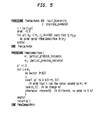
- Figure 5 illustrates the PartialMatch and ProbCorrectPath Subroutines of one embodiment of the present invention.
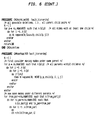
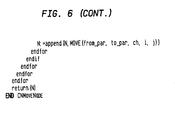
- Figure 6 illustrates the Delta and ComputeBest Subroutines of one embodiment of the present invention.
- Figure 7 illustrates the initial KB before and the subsequent KB after hierarchies used by one embodiment of the present invention.
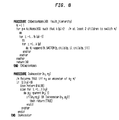
- Figure 8 illustrates the ComputeNeighborhood and associated Subroutines of one embodiment of the present invention.
- Figure 9 illustrates the information required by any single step in the theory revision process.
- Figure 1 illustrates the overall theory revision task.
- a theory revision system 13 Given a knowledge base 11 KB and user feedback (a set of training examples, each a session transcript 12 annotated by a correct answer) a theory revision system 13 produces a new knowledge base KB' which exhibits better performance over the training examples.
- sesssion transcripts 12 are collected after deploying the expert system 14 to field users 15. Each transcript 12 will include answers to the tests requested by the expert system 14 as well as the repair suggested by the expert system 14.
- a domain expert 16 will annotate these transcripts to indicate missing tests and appropriate repairs.
- the theory revision system 13 uses these annotated transcripts as training data to suggest revisions to the knowledge base 11. Finally, the domain expert 16 evaluates these revisions to decide whether to incorporate them into the knowledge base 11 which can then be redeployed.
- a "theory revision” system uses a set of "labeled session transcripts" to modify the incorrect fault hierarchy to produce a new hierarchy that is more accurate. As no efficient algorithm is guaranteed to find the globally-optimal hierarchy, many projects implement their theory revision systems as a hill-climbing process that climbs, in a series of steps, to a hierarchy whose accuracy is locally optimal.
- the theory revision system selects the neighbor KB* ⁇ N(KB) with the highest empirical accuracy and if KB *'s accuracy is greater than KB 's, the theory revision process iterates. It then compares this KB* with each of its neighbors and climbs to any neighbor that is better.
- each c j ⁇ C contains answers to every possible test in KB
- C is typically incomplete, as each ⁇ j contains only a small subset of the test values in KB.
- the theory revision system of the present invention provides a way of evaluating empirical accuracy of a fault hierarchy and each of its neighbors, relative to a given set of labeled session transcripts, even when the transcripts are incomplete.
- Each fault hierarchy KB ⁇ N, E, TS, R, t( ⁇ ) , r( ⁇ ) , child( ⁇ , ⁇ ) ⁇ is a directed-acyclic forest ⁇ N,E ⁇ , whose nodes, N , represent faults, and whose edges, E , connect faults to subordinate faults.
- the arcs under each internal node are ordered; child (n,i) refers to the " i th child of n ".
- the k N ⁇ Z + function map each node to its number of children, and let the 1:N ⁇ Z + function map each node to its number of parents.
- S KB When run, the expert system that uses the KB hierarchy, called S KB , will ask the user a series of questions. These questions correspond to a depth-first, left-to-right, no-backtrack traversal of (part of) the KB structure.
- S KBo begins at the root, and asks the question associated with that node; here "Is T z true?". If the user answers "yes”, S KBo descends to consider Z 's children, in left-to-right order - here next asking "Is T A true?". If the user responds "Yes", S KBo will descend to A's children. If the user answers T C with "No", S KBo will continue to C 's sibling D , and ask about T D .
- each "total problem instance” is an assignment ⁇ : TS ⁇ ⁇ +,- ⁇ that maps each test to one of ⁇ +,- ⁇ , where "+” means the test was confirmed (passed), and "-” means the test was disconfirmed (failed).
- Each such partial instance ⁇ really corresponds to some total instance ⁇ ', where certain test values are not observed.
- the total problem instance ⁇ ' TS ⁇ ⁇ +,- ⁇ is a completion of ⁇ if ⁇ ' agrees with ⁇ whenever ⁇ ( t ) is categorical (i.e., is not "?"): ⁇ ' completes ⁇ iff [ ⁇ ( t ) ⁇ ?
- Complete( ⁇ ) ⁇ ': TS ⁇ ⁇ +,- ⁇
- the ACCKB subroutine illustrated in Figure 4 computes this probability for a partial problem instance ⁇ .
- the first step of Acckb is to call the EvalNode* subroutine ( Figure 4) which differs from the EvalNode subroutine ( Figure 3), in one important way. If the answers for all relevant tests are provided in the training example, the EvalNode* subroutine returns the repair which would be returned by EvalNode (i.e., by S KB ). In this event, AccKB returns 1 or 0 depending on whether EvalNode* has returned the correct repair. However, if EvalNode* encounters a test whose value is not provided in ⁇ , it terminates returning the value '?'. In this event, AccKB invokes the PartialMatch subroutine described in Figure 5.
- H(KB) be the set of all paths in a knowledge base.
- ⁇ is a minimal set of tests and values such that S KB will return the repair r, and removing any single test from ⁇ will result in EvalNode* returning '?'.
- ⁇ T Z /+, T A /+, T C /-, T D /+ ⁇ , r D ⁇ is a path of the knowledge base shown in Figure 2, as is ⁇ T Z /+, T A /-, T B /+, T E /+ ⁇ , r E ⁇ .
- ⁇ T Z /+, T A /+, T B /+, T C /-, T D /+ ⁇ , r D ⁇ is not a path (as it includes the extra test T B ), nor is ⁇ T Z /+, T A /+, T D /+ ⁇ , r D ⁇ (as it is missing test T B ), nor ⁇ T Z /+, T A /-, T C /-, T D /+ ⁇ , r D ⁇ (T A must be + for S KB to return r D ), nor ⁇ T Z /+, T A /+, T C /-, T D /+ ⁇ , r E ⁇ (wrong repair).
- H(KB) will have exactly as many paths as there are leaf nodes. If KB is not a tree but is a DAG (directed acyclic graph), the number of paths (in the worst case) can be exponential in the number of nodes which have multiple parents (for example, node E in Figure 2). Fortunately, in practice, fault hierarchies tend to have few nodes with multiple parents. Note that H(KB) may have multiple paths which have the same repair, either due to KB being a DAG (as opposed to a tree), or due to more than one leaf node having the same repair. H(KB) can be easily computed by beginning at root(KB) and descending KB in a depth-first fashion and keeping track of the nodes visited.
- Figure 7 illustrates the effects of applying the revision operator Add A,B,1 to the fault hierarchy, Kb before . Notice that each operator has an associated operator that can undo the effects of the operator. For instance applying the operator Delete A,B to KB after in Figure 7, will restore the fault hierarchy to Kb before .
- N(KB) ⁇ (KB)
- the CNDeleteLink(KB) subroutine ( Figure 8) is the most straightforward: it accumulates all revisions that delete a link between every parent-node/child-node pair in KB.
- the CNAddLink(KB) subroutine ( Figure 8) accumulates all revisions that add a link from any non-leaf node par to any other node n, provided par is not an existing child of n and provided adding this link does not create a cycle in KB.
- a fault hierarchy is said to have a cycle when its graph structure has a cycle (here there are a set of tests and values such that S KB will never terminate). This acyclicity is confirmed by ensuring that the proposed revision will not result in a link being added from a node to one of its ancestors, as computed by the IsAncestor subroutine ( Figure 8).
- the CNMoveNode(KB) subroutine ( Figure 8) accumulates all revisions that move a node n to any possible position under its parent, as well as revisions which move n to any possible positions under a different non-leaf node, provided this does not result in a cycle ( Figure 8).
- the CNSwitchNodes(KB) ( Figure 8) subroutine accumulates all revisions that interchange the positions of two child nodes under the same parent.
- the Delta algorithm effectively does the above, but reduces the computations involved by noting that each revision constitutes a very small change, while different training examples constitute a big change.
- Delta begins by loading S KB and the first example c 1 . It then proceeds to apply the first revision operator ⁇ 1 ( KB ) and computes the accuracy of ⁇ 1 (KB) on c 1 . Then it undoes ⁇ 1 and applies the next operator ⁇ 2 and proceeds in this manner until all operators have been applied. Finally, it unloads c 1 and loads in the next example c 2 and proceeds similarly. This reduces the computation in loading KB and the c j 's multiple times, without effecting the result.
Landscapes
- Engineering & Computer Science (AREA)
- Theoretical Computer Science (AREA)
- General Engineering & Computer Science (AREA)
- General Physics & Mathematics (AREA)
- Software Systems (AREA)
- Physics & Mathematics (AREA)
- Computing Systems (AREA)
- Data Mining & Analysis (AREA)
- Computational Linguistics (AREA)
- Mathematical Physics (AREA)
- Evolutionary Computation (AREA)
- Artificial Intelligence (AREA)
- Test And Diagnosis Of Digital Computers (AREA)
- Cable Transmission Systems, Equalization Of Radio And Reduction Of Echo (AREA)
- Testing And Monitoring For Control Systems (AREA)
- Devices For Executing Special Programs (AREA)
- Image Analysis (AREA)
- Debugging And Monitoring (AREA)
- Information Retrieval, Db Structures And Fs Structures Therefor (AREA)
Claims (16)
- Un système d'apprentissage DELTA pour utiliser le conseil d'un expert afin de réviser des hiérarchies de pannes d'un système expert de diagnostic comprenant :des moyens d'apprentissage (13) pour adapter une hiérarchie de pannes du système expert en utilisant des données d'exemples de formation ;des moyens formant système expert (14) reliés auxdits moyens d'apprentissage et suscesptibes de recevoir un signal d'entrée issu d'un expert de domaine (16), ledit signal d'entrée comprenant des évaluations desdits moyens d'apprentissage ;des moyens de compilation reliés auxdits moyens formant système expert ;des moyens d'entrée utilisateur (15) pour les données d'exemples de formation reliés auxdits moyens de compilation; etdes moyens de transcription de session (12) reliés entre lesdits moyens d'entrée utilisateur et lesdits moyens d'apprentissage (13) pour être utilisés dans la modification d'une hiérarchie de pannes incorrecte (KB) afin de produire une hiérarchie de pannes révisée plus précise (KB).
- Un système d'apprentissage DELTA pour utiliser le conseil d'un expert afin de réviser des hiérarchies de pannes d'un système expert de diagnostic, tel que revendiqué à la revendication 1, dans lequel lesdits moyens d'apprentissage comprennent :des moyens ComputeNeighborhood pour calculer une série de bases de connaissance (11) qui constitue un voisinage d'une base de connaissance initiale ; etdes moyens ComputeBest pour calculer la base de connaissance optimale à partir du voisinage calculé sur la base des transcriptions de session référencées (12) fournies par lesdits moyens de transcription de session.
- Un système d'apprentissage DELTA pour utiliser le conseil d'un expert afin de réviser des hiérarchies de pannes (KB) d'un système expert de diagnostic, tel que revendiqué à la revendication 2, dans lequel lesdits moyens ComputeNeighborhood utilisent :une pluralité d'opérateurs de révision, chaque opérateur de ladite pluralité d'opérateurs de révision agissant sur la base de connaissance initiale à l'intérieur desdits moyens formant système expert (14) afin de produire la base de connaissance révisée.
- Un système d'apprentissage DELTA pour utiliser le conseil d'un expert afin de réviser des hiérarchies de pannes (KB) d'un système expert de diagnostic, tel que revendiqué à la revendication 3, dans lequel ladite pluralité d'opérateurs de révision comprend :un opérateur d'addition (CNAddLink) ;un opérateur de suppression (CNDeleteLink) ;un opérateur de déplacement (CNMoveNode) ; etun opérateur de commutation (CNSwitchNode).
- Un système d'apprentissage DELTA pour utiliser le conseil d'un expert afin de réviser des hiérarchies de pannes (KB) d'un système expert de diagnostic, tel que revendiqué à la revendication 3 ou 4, dans lequel :ladite pluralité d'opérateurs de révision se déplace à travers un espace de hiérarchie de pannes (KB), chaque opérateur de ladite pluralité d'opérateurs de révision établissant une correspondance entre une certaine hiérarchie et une hiérarchie légèrement différente.
- Un système d'apprentissage DELTA pour utiliser le conseil d'un expert afin de réviser des hiérarchies de pannes (KB) d'un système expert de diagnostic, tel que revendiqué dans une quelconque des revendications 2 à 5, dans lequel lesdits moyens ComputeBest utilisent :des moyens AccKB pour calculer la précision de la base de connaissance (11) pour un exemple de formation, lesdits moyens AccKB comprenant :des moyens EvalNode* pour évaluer un noeud de la base de connaissance (11) par rapport à un exemple de formation incomplet ; etdes moyens PartialMatch pour déterminer une probabilité que la base de connaissance spécifiée retourne une réparation correcte.
- Un système d'apprentissage DELTA pour utiliser le conseil d'un expert afin de réviser des hiérarchies de pannes (KB) d'un système expert de diagnostic, tel que revendiqué à la revendication 6, dans lequel lesdits moyens PartialMatch comprennent :des moyens ProbCorrecPath pour calculer la probabilité qu'une instance de problème π qui fait partie de l'exemple de formation corresponde à une instance de problème πi représentant un certain trajet à travers la hiérarchie de pannes.
- Un système d'apprentissage DELTA pour utiliser le conseil d'un expert afin de réviser des hiérarchies de pannes (KB) d'un système expert de diagnostic, tel que revendiqué dans une quelconque des revendications précédentes, comprenant :des moyens EvalKB pour évaluer une quelconque base de connaissance (11) à partir d'un voisinage sur une collection d'instances de formation complète par simulation dune question de diagnostic et d'une session de réponse.
- Un système d'apprentissage DELTA pour utiliser le conseil d'un expert afin de réviser des hiérarchies de pannes (KB) d'un système expert de diagnostic, tel que revendiqué dans une quelconque des revendications précédentes, comprenant :des moyens EvalKB pour évaluer une quelconque base de connaissance à partir d'un voisinage en démarrant au niveau d'un noeud de base utilisant des informations précédemment enregistrées comprenant des questions avec des réponses jusqu'à ce que l'évaluation se termine avec une réparation recommandée ou que, si aucun diagnostic ne peut être trouvé, l'évaluation se termine avec aucune réparation trouvée.
- Un procédé d'apprentissage mis en oeuvre par ordinateur pour utiliser le conseil d'un expert afin de réviser des hiérarchies de pannes (KB) par adaptation dune hiérarchie de pannes (KB) du système expert en utilisant des donnés d'exemples de formation ; dans lequel des moyens d'apprentissage (13) sont reliés à des moyens formant système expert ; lesdits moyens formant système expert recevant un signal d'entrée issu d'un expert de domaine (16) comprenant des évaluations desdits moyens d'apprentissage et étant reliés à des moyens de compilation reliés à des moyens d'entrées utilisateur reliés à des moyens de transcription de session (12) qui sont reliés auxdits moyens d'apprentissage, et dans lequel l'apprentissage comprend les étapes consistant à :calculer un voisinage de hiérarchie de pannes d'une hiérarchie de pannes initiale en utilisant un sous programme ComputeNeighborhood ; etcalculer une hiérarchie de pannes optimale (KB) à partir du voisinage de hiérarchie de pannes calculé sur la base de transcriptions de session référencée (12) fournies par lesdits moyens de transcription de session en utilisant un sous-programme ComputeBest.
- Un procédé d'apprentissage mis en oeuvre par ordinateur pour utiliser le conseil d'un expert afin de réviser des hiérarchies de pannes d'un système expert de diagnostic, tel que revendiqué à la revendication 13, dans lequel le calcul d'un voisinage de hiérarchie de pannes comprend l'étape consistant à :utiliser une pluralité d'opérateurs de révision, chaque opérateur de ladite pluralité d'opérateurs de révision agissant sur une base de connaissance à l'intérieur desdits moyens formant système expert et produisant une base de connaissance révisée.
- Un procédé d'apprentissage mis en oeuvre par ordinateur pour utiliser le conseil d'un expert afin de réviser des hiérarchies de pannes (KB) d'un système expert de diagnostic, tel que revendiqué à la revendication 14, dans lequel l'utilisation d'une pluralité d'opérateurs de révision comprend les étapes consistant à :utiliser un opérateur d'addition ;utiliser un opérateur de suppression ;utiliser un opérateur de déplacement ; etutiliser un opérateur de commutation.
- Un procédé d'apprentissage mis en oeuvre par ordinateur pour utiliser le conseil d'un expert afin de réviser des hiérarchies de pannes (KB) d'un système expert de diagnostic, tel que revendiqué à la revendication 11 ou 12, dans lequel l'utilisation d'une pluralité d'opérateurs de révision comprend l'étape consistant à :se déplacer à travers un espace de hiérarchie de pannes (KB), chaque opérateur de ladite pluralité d'opérateurs de révision établissant une correspondance entre une certaine hiérarchie de pannes et une hiérarchie de pannes légèrement différente.
- Un procédé d'apprentissage mis en oeuvre par ordinateur pour utiliser l'avis d'un expert afin de réviser des hiérarchies de pannes (KB) d'un système expert de diagnostic, tel que revendiqué à la revendication 11, 12 ou 13, dans lequel ladite étape de calcul de la hiérarchie de pannes optimale comprend en outre les étapes consistant à :calculer la précision empirique de la hiérarchie de pannes (KB) pour un exemple de formation, ladite étape de calcul comprenant en outre les étapes consistant à évaluer la hiérarchie de pannes par rapport à l'exemple de formation et retourner une réparation, et choisir tous les trajets dans la hiérarchie de pannes.
- Un procédé d'apprentissage mis en oeuvre par ordinateur pour utiliser le conseil d'un expert afin de réviser des hiérarchies de pannes (KB) d'un système expert de diagnostic, tel que revendiqué à la revendication 14, comprenant l'étape consistant à :évaluer ladite hiérarchie de pannes en simulant une cession de diagnostic.
- Un procédé d'apprentissage mis en oeuvre par ordinateur pour utiliser le conseil d'un expert afin de réviser des hiérarchies de pannes (KB) d'un système expert de diagnostic, tel que revendiqué à la revendication 14, comprenant les étapes consistant à :évaluer ladite hiérarchie de pannes en démarrant au niveau d'un noeud de base et en posant des questions ; etfixer des réponses auxdites questions à un noeud jusqu'à ce que l'évaluation se termine avec une réparation recommandée.
Applications Claiming Priority (2)
| Application Number | Priority Date | Filing Date | Title |
|---|---|---|---|
| US08/583,249 US5987445A (en) | 1996-01-05 | 1996-01-05 | Delta learning system for using expert advice to revise diagnostic expert system fault hierarchies |
| US583249 | 1996-01-05 |
Publications (2)
| Publication Number | Publication Date |
|---|---|
| EP0783151A1 EP0783151A1 (fr) | 1997-07-09 |
| EP0783151B1 true EP0783151B1 (fr) | 2002-04-24 |
Family
ID=24332316
Family Applications (1)
| Application Number | Title | Priority Date | Filing Date |
|---|---|---|---|
| EP97100054A Expired - Lifetime EP0783151B1 (fr) | 1996-01-05 | 1997-01-03 | Système d'apprentissage delta pour utiliser le conseil d'un expert pour réviser des hiérarchies de pannes dans des systèmes experts diagnostiques |
Country Status (5)
| Country | Link |
|---|---|
| US (1) | US5987445A (fr) |
| EP (1) | EP0783151B1 (fr) |
| AT (1) | ATE216787T1 (fr) |
| DE (1) | DE69712117T2 (fr) |
| ES (1) | ES2176527T3 (fr) |
Families Citing this family (5)
| Publication number | Priority date | Publication date | Assignee | Title |
|---|---|---|---|---|
| US6389406B1 (en) * | 1997-07-30 | 2002-05-14 | Unisys Corporation | Semiotic decision making system for responding to natural language queries and components thereof |
| WO2001065395A1 (fr) * | 2000-03-03 | 2001-09-07 | Vill Ab | Meta-apprentissage a niveau infini par compression |
| AUPR741501A0 (en) * | 2001-09-03 | 2001-09-20 | Guignard, Paul A. | Networked knowledge management and learning |
| US7986827B2 (en) * | 2006-02-07 | 2011-07-26 | Siemens Medical Solutions Usa, Inc. | System and method for multiple instance learning for computer aided detection |
| US9665594B2 (en) * | 2011-01-14 | 2017-05-30 | Apple Inc. | Local backup |
Family Cites Families (3)
| Publication number | Priority date | Publication date | Assignee | Title |
|---|---|---|---|---|
| US5005143A (en) * | 1987-06-19 | 1991-04-02 | University Of Pennsylvania | Interactive statistical system and method for predicting expert decisions |
| US5481649A (en) * | 1993-03-09 | 1996-01-02 | The University Of Tennessee Research Corp. | Method and apparatus using a decision tree in an adjunct system cooperating with another physical system |
| US5787274A (en) * | 1995-11-29 | 1998-07-28 | International Business Machines Corporation | Data mining method and system for generating a decision tree classifier for data records based on a minimum description length (MDL) and presorting of records |
-
1996
- 1996-01-05 US US08/583,249 patent/US5987445A/en not_active Expired - Lifetime
-
1997
- 1997-01-03 ES ES97100054T patent/ES2176527T3/es not_active Expired - Lifetime
- 1997-01-03 DE DE69712117T patent/DE69712117T2/de not_active Expired - Lifetime
- 1997-01-03 AT AT97100054T patent/ATE216787T1/de not_active IP Right Cessation
- 1997-01-03 EP EP97100054A patent/EP0783151B1/fr not_active Expired - Lifetime
Also Published As
| Publication number | Publication date |
|---|---|
| ES2176527T3 (es) | 2002-12-01 |
| US5987445A (en) | 1999-11-16 |
| DE69712117D1 (de) | 2002-05-29 |
| ATE216787T1 (de) | 2002-05-15 |
| EP0783151A1 (fr) | 1997-07-09 |
| DE69712117T2 (de) | 2002-11-28 |
Similar Documents
| Publication | Publication Date | Title |
|---|---|---|
| EP0784267A1 (fr) | Système efficace de révision de théorie commandé par données | |
| Sanil et al. | Models for evolving fixed node networks: Model fitting and model testing | |
| McAllester | Truth Maintenance. | |
| Young et al. | DPOCL: A principled approach to discourse planning | |
| Bareiss et al. | Supporting start-to-finish development of knowledge bases | |
| Mark et al. | Commitment-based software development | |
| EP0783151B1 (fr) | Système d'apprentissage delta pour utiliser le conseil d'un expert pour réviser des hiérarchies de pannes dans des systèmes experts diagnostiques | |
| Singh et al. | Collecting commonsense experiences | |
| Moriconi | A designer/verifier's assistant | |
| Beydoun et al. | Theoretical basis for hierarchical incremental knowledge acquisition | |
| Desmarais et al. | An advice-giving interface based on plan-recognition and user-knowledge assessment | |
| Grahne et al. | On the semantics of belief revision systems | |
| CN116955139A (zh) | 一种测试用例的更新方法、装置、设备及存储介质 | |
| EP0536396A1 (fr) | Procede de reglage automatique de la base de regles d'un systeme expert a l'aide d'un reseau neural et dispositif a cet effet | |
| Potter et al. | A comparison of methods for diagnostic decision making | |
| Huang et al. | Reasoning with inconsistent ontologies: Framework, prototype, and experiment | |
| Fu et al. | Inductive knowledge acquisition for rule-based expert systems | |
| CN117033645B (zh) | 知识图谱补全方法、装置、存储介质及设备 | |
| Peng et al. | A connectionist approach to vertex covering problems | |
| Goodall | Analog/mixed signal fault diagnosis algorithm and tool review | |
| O’Shea | Intelligent systems in education | |
| Domingue | ITSY: an automated programming adviser | |
| Drechsler et al. | Decision diagrams and AND/OR graphs for design automation problems | |
| Devillers et al. | The PEACE SLDS understanding evaluation paradigm of the French MEDIA campaign | |
| JP2001117774A (ja) | 適応化機構を備えたプロダクションシステム |
Legal Events
| Date | Code | Title | Description |
|---|---|---|---|
| PUAI | Public reference made under article 153(3) epc to a published international application that has entered the european phase |
Free format text: ORIGINAL CODE: 0009012 |
|
| AK | Designated contracting states |
Kind code of ref document: A1 Designated state(s): AT BE CH DE ES FR GB IT LI NL SE |
|
| 17P | Request for examination filed |
Effective date: 19980109 |
|
| 17Q | First examination report despatched |
Effective date: 20000317 |
|
| GRAG | Despatch of communication of intention to grant |
Free format text: ORIGINAL CODE: EPIDOS AGRA |
|
| RTI1 | Title (correction) |
Free format text: DELTA LEARNING SYSTEM FOR USING EXPERT ADVICE TO REVISE DIAGNOSTIC EXPERT SYSTEM FAULT HIERARCHIES |
|
| GRAG | Despatch of communication of intention to grant |
Free format text: ORIGINAL CODE: EPIDOS AGRA |
|
| GRAH | Despatch of communication of intention to grant a patent |
Free format text: ORIGINAL CODE: EPIDOS IGRA |
|
| GRAH | Despatch of communication of intention to grant a patent |
Free format text: ORIGINAL CODE: EPIDOS IGRA |
|
| REG | Reference to a national code |
Ref country code: GB Ref legal event code: IF02 |
|
| GRAA | (expected) grant |
Free format text: ORIGINAL CODE: 0009210 |
|
| AK | Designated contracting states |
Kind code of ref document: B1 Designated state(s): AT BE CH DE ES FR GB IT LI NL SE |
|
| REF | Corresponds to: |
Ref document number: 216787 Country of ref document: AT Date of ref document: 20020515 Kind code of ref document: T |
|
| REG | Reference to a national code |
Ref country code: GB Ref legal event code: FG4D |
|
| REG | Reference to a national code |
Ref country code: CH Ref legal event code: EP |
|
| REF | Corresponds to: |
Ref document number: 69712117 Country of ref document: DE Date of ref document: 20020529 |
|
| ET | Fr: translation filed | ||
| REG | Reference to a national code |
Ref country code: CH Ref legal event code: NV Representative=s name: SIEMENS SCHWEIZ AG Ref country code: CH Ref legal event code: AEN Free format text: DAS PATENT IST AUF GRUND DES WEITERBEHANDLUNGSANTRAGS VOM 24.09.2002 REAKTIVIERT WORDEN. |
|
| REG | Reference to a national code |
Ref country code: ES Ref legal event code: FG2A Ref document number: 2176527 Country of ref document: ES Kind code of ref document: T3 |
|
| PGFP | Annual fee paid to national office [announced via postgrant information from national office to epo] |
Ref country code: AT Payment date: 20021219 Year of fee payment: 7 |
|
| PGFP | Annual fee paid to national office [announced via postgrant information from national office to epo] |
Ref country code: SE Payment date: 20030115 Year of fee payment: 7 |
|
| PGFP | Annual fee paid to national office [announced via postgrant information from national office to epo] |
Ref country code: ES Payment date: 20030117 Year of fee payment: 7 |
|
| PGFP | Annual fee paid to national office [announced via postgrant information from national office to epo] |
Ref country code: NL Payment date: 20030120 Year of fee payment: 7 |
|
| PGFP | Annual fee paid to national office [announced via postgrant information from national office to epo] |
Ref country code: BE Payment date: 20030128 Year of fee payment: 7 |
|
| PG25 | Lapsed in a contracting state [announced via postgrant information from national office to epo] |
Ref country code: LI Free format text: LAPSE BECAUSE OF NON-PAYMENT OF DUE FEES Effective date: 20030131 Ref country code: CH Free format text: LAPSE BECAUSE OF NON-PAYMENT OF DUE FEES Effective date: 20030131 |
|
| PLBE | No opposition filed within time limit |
Free format text: ORIGINAL CODE: 0009261 |
|
| STAA | Information on the status of an ep patent application or granted ep patent |
Free format text: STATUS: NO OPPOSITION FILED WITHIN TIME LIMIT |
|
| 26N | No opposition filed |
Effective date: 20030127 |
|
| REG | Reference to a national code |
Ref country code: CH Ref legal event code: PL |
|
| PG25 | Lapsed in a contracting state [announced via postgrant information from national office to epo] |
Ref country code: AT Free format text: LAPSE BECAUSE OF NON-PAYMENT OF DUE FEES Effective date: 20040103 |
|
| PG25 | Lapsed in a contracting state [announced via postgrant information from national office to epo] |
Ref country code: SE Free format text: LAPSE BECAUSE OF NON-PAYMENT OF DUE FEES Effective date: 20040104 |
|
| PG25 | Lapsed in a contracting state [announced via postgrant information from national office to epo] |
Ref country code: ES Free format text: LAPSE BECAUSE OF NON-PAYMENT OF DUE FEES Effective date: 20040105 |
|
| PG25 | Lapsed in a contracting state [announced via postgrant information from national office to epo] |
Ref country code: BE Free format text: LAPSE BECAUSE OF NON-PAYMENT OF DUE FEES Effective date: 20040131 |
|
| BERE | Be: lapsed |
Owner name: *SIEMENS CORPORATE RESEARCH INC. Effective date: 20040131 |
|
| PG25 | Lapsed in a contracting state [announced via postgrant information from national office to epo] |
Ref country code: NL Free format text: LAPSE BECAUSE OF NON-PAYMENT OF DUE FEES Effective date: 20040801 |
|
| EUG | Se: european patent has lapsed | ||
| NLV4 | Nl: lapsed or anulled due to non-payment of the annual fee |
Effective date: 20040801 |
|
| REG | Reference to a national code |
Ref country code: ES Ref legal event code: FD2A Effective date: 20040105 |
|
| REG | Reference to a national code |
Ref country code: GB Ref legal event code: 732E Free format text: REGISTERED BETWEEN 20110303 AND 20110309 |
|
| REG | Reference to a national code |
Ref country code: DE Ref legal event code: R081 Ref document number: 69712117 Country of ref document: DE Owner name: SIEMENS CORP. (N. D. GES. D. STAATES DELAWARE), US Free format text: FORMER OWNER: SIEMENS CORP. RESEARCH, INC., PRINCETON, N.J., US Effective date: 20110214 Ref country code: DE Ref legal event code: R081 Ref document number: 69712117 Country of ref document: DE Owner name: SIEMENS CORP. (N. D. GES. D. STAATES DELAWARE), US Free format text: FORMER OWNER: SIEMENS CORP. RESEARCH, INC., PRINCETON, US Effective date: 20110214 |
|
| REG | Reference to a national code |
Ref country code: FR Ref legal event code: TP Owner name: SIEMENS CORPORATION, US Effective date: 20110927 |
|
| PGFP | Annual fee paid to national office [announced via postgrant information from national office to epo] |
Ref country code: DE Payment date: 20120319 Year of fee payment: 16 |
|
| PGFP | Annual fee paid to national office [announced via postgrant information from national office to epo] |
Ref country code: IT Payment date: 20120125 Year of fee payment: 16 |
|
| PGFP | Annual fee paid to national office [announced via postgrant information from national office to epo] |
Ref country code: GB Payment date: 20130109 Year of fee payment: 17 Ref country code: FR Payment date: 20130129 Year of fee payment: 17 |
|
| PG25 | Lapsed in a contracting state [announced via postgrant information from national office to epo] |
Ref country code: DE Free format text: LAPSE BECAUSE OF NON-PAYMENT OF DUE FEES Effective date: 20130801 |
|
| REG | Reference to a national code |
Ref country code: DE Ref legal event code: R119 Ref document number: 69712117 Country of ref document: DE Effective date: 20130801 |
|
| GBPC | Gb: european patent ceased through non-payment of renewal fee |
Effective date: 20140103 |
|
| REG | Reference to a national code |
Ref country code: FR Ref legal event code: ST Effective date: 20140930 |
|
| PG25 | Lapsed in a contracting state [announced via postgrant information from national office to epo] |
Ref country code: GB Free format text: LAPSE BECAUSE OF NON-PAYMENT OF DUE FEES Effective date: 20140103 Ref country code: FR Free format text: LAPSE BECAUSE OF NON-PAYMENT OF DUE FEES Effective date: 20140131 |
|
| PG25 | Lapsed in a contracting state [announced via postgrant information from national office to epo] |
Ref country code: IT Free format text: LAPSE BECAUSE OF NON-PAYMENT OF DUE FEES Effective date: 20140103 |