EP0783169A2 - Matrice mémoire à masse virtuelle - Google Patents
Matrice mémoire à masse virtuelle Download PDFInfo
- Publication number
- EP0783169A2 EP0783169A2 EP96119168A EP96119168A EP0783169A2 EP 0783169 A2 EP0783169 A2 EP 0783169A2 EP 96119168 A EP96119168 A EP 96119168A EP 96119168 A EP96119168 A EP 96119168A EP 0783169 A2 EP0783169 A2 EP 0783169A2
- Authority
- EP
- European Patent Office
- Prior art keywords
- bit lines
- pair
- control
- transistors
- line
- Prior art date
- Legal status (The legal status is an assumption and is not a legal conclusion. Google has not performed a legal analysis and makes no representation as to the accuracy of the status listed.)
- Granted
Links
Images

Classifications
-
- G—PHYSICS
- G11—INFORMATION STORAGE
- G11C—STATIC STORES
- G11C8/00—Arrangements for selecting an address in a digital store
-
- G—PHYSICS
- G11—INFORMATION STORAGE
- G11C—STATIC STORES
- G11C8/00—Arrangements for selecting an address in a digital store
- G11C8/10—Decoders
-
- G—PHYSICS
- G11—INFORMATION STORAGE
- G11C—STATIC STORES
- G11C17/00—Read-only memories programmable only once; Semi-permanent stores, e.g. manually-replaceable information cards
- G11C17/08—Read-only memories programmable only once; Semi-permanent stores, e.g. manually-replaceable information cards using semiconductor devices, e.g. bipolar elements
- G11C17/10—Read-only memories programmable only once; Semi-permanent stores, e.g. manually-replaceable information cards using semiconductor devices, e.g. bipolar elements in which contents are determined during manufacturing by a predetermined arrangement of coupling elements, e.g. mask-programmable ROM
- G11C17/12—Read-only memories programmable only once; Semi-permanent stores, e.g. manually-replaceable information cards using semiconductor devices, e.g. bipolar elements in which contents are determined during manufacturing by a predetermined arrangement of coupling elements, e.g. mask-programmable ROM using field-effect devices
- G11C17/126—Virtual ground arrays
Definitions
- NOR memory cells with impressed mass are the simplest memory cells in ROM matrix memories. They consist of a MOS transistor in which the information of one bit is stored by the level of the threshold voltage (d. H. in that when a certain potential is applied to the gate between the source and drain, a current flows depending on whether a "0" or a "1" is stored.
- the memory cells are each arranged between two bit lines and are driven line by line by word lines.
- all bit lines are precharged to a potential, e.g. B. on the supply voltage V DD .
- All word lines are at low potential, e.g. B. on the supply voltage V SS .
- the word line on which the cell to be read is located is raised to high potential and the bit line on which the cell to be read is located is lowered to low potential. If the cell contains a MOSFET with a low threshold, this MOSFET becomes conductive and discharges the neighboring bit lines, which were still at high potential, via the bit line lying at low potential. If, on the other hand, the cell contains a MOSFET with a high threshold voltage, the MOSFET remains blocked and the neighboring bit lines do not change their potential.
- the word line on which the cell to be read is located is raised to a substantially lower potential than the precharge potential.
- the bit line on which the cell to be read is located is then lowered to a low potential.
- the word line is also lowered to low potential (V SS ).
- V SS low potential
- the object of the present invention is to provide a matrix memory with which the above-mentioned difficulties are eliminated.
- the entire matrix of memory cells or at least one segment of this matrix is opened instead of a discharge of a single bit line Continuity checked. That is, in principle, it is determined whether a current flow across the matrix memory is possible if the only electrical connection in question comprises a cell to be read (to be checked for the stored information) and otherwise only short-circuited bit lines. All the bit lines except the two bit lines adjacent to the cell to be read are electrically connected to one another, the cell to be read is activated via the relevant word line, and an attempt is made to move from one corner of the matrix or a segment of the matrix of cells to the opposite one Corner to send a stream. In this way, it is checked whether the cell in question is conductive or not.
- control transistors which short-circuit all bit lines with one another except for the two between which the cell to be read is located.
- control transistors can also be replaced by an arrangement of control transistors as a binary decoder, which requires considerably less space, since the number of address lines of the binary decoder is smaller than the number of control lines with which control transistors are arranged between two short-circuiting bit lines , can be controlled individually.
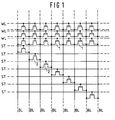
- FIGS. 1 to 3 show different embodiments in the diagram.
- the memory transistors and the control transistors are each field-effect transistors.
- the memory transistors and / or the control transistors can instead be bipolar transistors be.
- the bipolar transistors of the memory cells are switched in the same direction, ie in each row of the cell field, the emitter and collector of adjacent transistors are connected to one another.
- the bipolar transistors are controlled via the base connection.
- FIG. 1 shows a matrix-like arrangement of memory transistors 1.
- the source and drain connections of these memory transistors are each connected to a bit line BL.
- the gate connections are connected line by line to a word line WL.
- the bit lines BL are each shared by two columns of memory transistors.
- control transistors 2 are provided, each of which is connected with source and drain between two adjacent bit lines and whose gate connection is connected to a control line ST. The potentials at the gate for each of these control transistors 2 can be set individually via these control lines ST.
- FIG. 1 is to be understood as a section of a matrix memory according to the invention, which can be extended as far as desired on all sides.
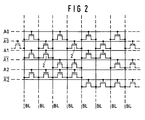
- FIG. 2 shows an alternative embodiment of the arrangement of the control transistors shown in the lower part of FIG. 1.
- This arrangement corresponds to that of a binary decoder.
- the control transistors 2 are arranged in such a way that, in the arrangement diagram, all lines are present in pairs and in one line of such a pair there are control transistors exactly at the points where there are no control transistors in the second line of this pair. A line complementary to this is therefore provided for each line of the arrangement of control transistors.
- the control lines belonging to the respective complementary lines are provided with a dash across the designation. If e.g. B.
- the columns of this arrangement correspond to the outputs of a binary decoder and the control lines to the inputs of this binary decoder.
- a binary decoder is constructed in such a way that a total of 2 n outputs is divided n times so that the subsets of the previous subdivisions are halved in each case.
- B There are e.g. B.
- the sixteen outputs are initially divided into two subsets of eight outputs (number 1 to number 8 and number 9 to number 16), each of these subsets in subsets of four outputs (number 1 to number 4 and number 5 to number 8 or number 9 to number 12 and number 13 to number 16), these subsets further divided into subsets of two exits (numbers 1 and 2, numbers 3 and 4 etc.) and then the fourth and last subdivision into individual outputs.
- a specific output can be addressed by selecting a subset in each of these subdivisions. It is e.g. For example, the fifth output is selected by the first subset of eight outputs (number 1 to number 8) is selected.
- the second subset of four outputs (number 5 to number 8) is selected.
- the first subset of two outputs (numbers 5 and 6) is selected and finally in the last subdivision, the first output is selected in this subset.
- the subset of four columns between bit lines shown on the left is short-circuited with control line A2.
- Control lines A1 short-circuit those bit lines between which the two left columns of a subset of four columns are located.
- the control line A ⁇ 1 ⁇ short-circuits the bit lines between which the right two columns of such a subset of four columns lie.
- the upper control line A0 and the complementary control line each close within these subsets of two columns A ⁇ 0 ⁇ the respective left or right control transistors are conductive, ie the adjacent bit lines are short with one another.
- such an arrangement can in principle be implemented as a binary decoder for any number of bit lines. If the number of columns in which control transistors are to be arranged is between 2 n and 2 n + 1 , the division is made into a subset of 2 n columns and a subset with the remaining number of columns. For the further subdivisions, proceed accordingly, by mentally expanding the respective number to a power of 2, dividing and simply omitting the number of extra columns.
- the entire memory cell array is checked using the reading method described above in order to read out a cell.
- the reading process becomes slow because of the large total capacity and because of the long current path.
- the cell field is divided into small segments, the reading process can be significantly accelerated. Every single one of these segments is designed as a matrix memory as described above, e.g. B. corresponding to the embodiment according to Figure 1 or Figure 2.
- the entire memory is divided into segments again in the form of a matrix. The segments are then arranged row by row and column by column within the matrix. The segments of the same line have the same number of word lines; the segments of the same column have the same number of bit lines.
- the entire segment in which the cell is located is checked for continuity in accordance with the reading method described above. So that a segment can be selected, there are external bit lines between the segments which can be connected to the segment to be selected via selection transistors, for which control lines are also provided.
- FIG. 3 shows such an arrangement in the detail.
- a segment 4 is arranged between two external bit lines BE and two control lines ST0, ST1 for selecting a segment.
- the scheme continues on all sides, which is indicated by the addition of another segment to the right of segment 4.
- the associated memory transistors 1 are located in segment 4 and are arranged here in two cell field halves ZFH.
- the control transistors 2, which in this example are arranged as a binary decoder BD, are located between these cell field halves.
- the word lines WL 0 , ..., WL n , WL n + 1 , ..., WL m leading to the memory transistors are shown in the cell field halves.
- Control lines are used to control the binary decoder BD BA ⁇ 0 ⁇ , BA 0 , BA ⁇ 1 ⁇ , BA 1 available.
- the bit lines belonging to the individual segment are the internal bit lines BI.
- the arrangement here is such that memory transistors 1 and associated control transistors 2 are connected between two adjacent internal bit lines.
- the outermost internal bit lines of the segment are only connected to memory transistors and control transistors on one side. Between these The continuity test is carried out on the outermost internal bit lines BI.
- the external bit lines BE are provided on both sides of the segment 4.
- the field effect transistors, which are provided as selection transistors 3, are turned on via the upper control line ST0. These selection transistors 3 connect an external internal bit line of the segment to an external bit line.
- the external bit lines are preferably connected on two sides to segments via selection transistors. In this way, the segments can be selected with the smallest possible number of external bit lines. In principle, the segments are selected via the associated control lines ST0, ST1 like the activation of memory cells via the word lines.
- each external bit line is used for segments adjacent on both sides.
- different control lines ST0, ST1 are provided for segments adjacent to one another line by line, which select the segments in an alternating sequence.
- the selection transistors 3 provided for the selection of the segment 4 shown in FIG. B. switched on via the upper control line ST0.
- selection transistors which are turned on via the lower control line ST1, so that these two adjacent segments can alternatively be selected and the common external bit line is not used simultaneously by the two adjacent segments.
- the lines of selection transistors 3 provided for the selection of segments are shown in FIG. 3 as segment selection areas SA.
- control transistors and memory transistors of a segment can be arranged analogously to the diagrams in FIGS. 1 and 2 be.
- the control transistors can be arranged between the memory transistors in such a way that, according to FIG. 3, the matrix memory is divided into two cell field halves. A further subdivision of the cell field or of cell field segments into several cell field parts by control transistors arranged between them is also possible.
Landscapes
- Engineering & Computer Science (AREA)
- Microelectronics & Electronic Packaging (AREA)
- Read Only Memory (AREA)
- Static Random-Access Memory (AREA)
- Semiconductor Memories (AREA)
Applications Claiming Priority (2)
| Application Number | Priority Date | Filing Date | Title |
|---|---|---|---|
| DE19600424 | 1996-01-08 | ||
| DE19600424 | 1996-01-08 |
Publications (3)
| Publication Number | Publication Date |
|---|---|
| EP0783169A2 true EP0783169A2 (fr) | 1997-07-09 |
| EP0783169A3 EP0783169A3 (fr) | 1999-03-24 |
| EP0783169B1 EP0783169B1 (fr) | 2003-03-19 |
Family
ID=7782304
Family Applications (1)
| Application Number | Title | Priority Date | Filing Date |
|---|---|---|---|
| EP96119168A Expired - Lifetime EP0783169B1 (fr) | 1996-01-08 | 1996-11-28 | Matrice mémoire à masse virtuelle |
Country Status (6)
| Country | Link |
|---|---|
| US (1) | US5732013A (fr) |
| EP (1) | EP0783169B1 (fr) |
| JP (1) | JPH09198889A (fr) |
| KR (1) | KR970060215A (fr) |
| DE (1) | DE59610239D1 (fr) |
| TW (1) | TW329528B (fr) |
Families Citing this family (16)
| Publication number | Priority date | Publication date | Assignee | Title |
|---|---|---|---|---|
| US6154864A (en) * | 1998-05-19 | 2000-11-28 | Micron Technology, Inc. | Read only memory embedded in a dynamic random access memory |
| US6603693B2 (en) | 2001-12-12 | 2003-08-05 | Micron Technology, Inc. | DRAM with bias sensing |
| US6545899B1 (en) * | 2001-12-12 | 2003-04-08 | Micron Technology, Inc. | ROM embedded DRAM with bias sensing |
| US6747889B2 (en) * | 2001-12-12 | 2004-06-08 | Micron Technology, Inc. | Half density ROM embedded DRAM |
| US20030115538A1 (en) * | 2001-12-13 | 2003-06-19 | Micron Technology, Inc. | Error correction in ROM embedded DRAM |
| US20030185062A1 (en) * | 2002-03-28 | 2003-10-02 | Micron Technology, Inc. | Proximity lookup for large arrays |
| US6785167B2 (en) * | 2002-06-18 | 2004-08-31 | Micron Technology, Inc. | ROM embedded DRAM with programming |
| US6781867B2 (en) | 2002-07-11 | 2004-08-24 | Micron Technology, Inc. | Embedded ROM device using substrate leakage |
| US6865100B2 (en) * | 2002-08-12 | 2005-03-08 | Micron Technology, Inc. | 6F2 architecture ROM embedded DRAM |
| US7174477B2 (en) * | 2003-02-04 | 2007-02-06 | Micron Technology, Inc. | ROM redundancy in ROM embedded DRAM |
| JP3970299B2 (ja) | 2005-11-25 | 2007-09-05 | シャープ株式会社 | 半導体記憶装置 |
| JP4392404B2 (ja) * | 2005-12-07 | 2010-01-06 | シャープ株式会社 | 仮想接地型不揮発性半導体記憶装置 |
| JP4917363B2 (ja) * | 2006-06-20 | 2012-04-18 | シャープ株式会社 | 半導体記憶装置およびそれを備えた電子機器 |
| JP4916785B2 (ja) * | 2006-06-22 | 2012-04-18 | シャープ株式会社 | 半導体記憶装置及びこれを備えた電子機器 |
| WO2008148091A1 (fr) * | 2007-05-25 | 2008-12-04 | Marvell World Trade Ltd. | Architecture de décodeur de lignes de bits du type arbre pour matrice de mémoire du type non-ou |
| US8460947B2 (en) * | 2008-09-24 | 2013-06-11 | Hewlett-Packard Development Company, L.P. | Fluid ejection device and method |
Family Cites Families (5)
| Publication number | Priority date | Publication date | Assignee | Title |
|---|---|---|---|---|
| US4021781A (en) * | 1974-11-19 | 1977-05-03 | Texas Instruments Incorporated | Virtual ground read-only-memory for electronic calculator or digital processor |
| US5027321A (en) * | 1989-11-21 | 1991-06-25 | Intel Corporation | Apparatus and method for improved reading/programming of virtual ground EPROM arrays |
| US5117389A (en) * | 1990-09-05 | 1992-05-26 | Macronix International Co., Ltd. | Flat-cell read-only-memory integrated circuit |
| US5379254A (en) * | 1992-10-20 | 1995-01-03 | National Semiconductor Corporation | Asymmetrical alternate metal virtual ground EPROM array |
| US5663903A (en) * | 1995-07-28 | 1997-09-02 | Utron Technology Inc. | Flat-cell read-only memory |
-
1996
- 1996-11-28 DE DE59610239T patent/DE59610239D1/de not_active Expired - Lifetime
- 1996-11-28 EP EP96119168A patent/EP0783169B1/fr not_active Expired - Lifetime
- 1996-12-20 TW TW085115752A patent/TW329528B/zh active
-
1997
- 1997-01-06 JP JP1009197A patent/JPH09198889A/ja active Pending
- 1997-01-08 KR KR1019970000219A patent/KR970060215A/ko not_active Abandoned
- 1997-01-08 US US08/780,494 patent/US5732013A/en not_active Expired - Lifetime
Non-Patent Citations (3)
| Title |
|---|
| BOAZ EITAN ET AL., IEEE ELECTRON DEVICE LETTERS, vol. 12, 1991, pages 450 - 452 |
| IEDM 91, 1991, pages 311 - 314 |
| VLSITSA, 1993, pages 336 - 338 |
Also Published As
| Publication number | Publication date |
|---|---|
| TW329528B (en) | 1998-04-11 |
| US5732013A (en) | 1998-03-24 |
| JPH09198889A (ja) | 1997-07-31 |
| KR970060215A (ko) | 1997-08-12 |
| DE59610239D1 (de) | 2003-04-24 |
| EP0783169B1 (fr) | 2003-03-19 |
| EP0783169A3 (fr) | 1999-03-24 |
Similar Documents
| Publication | Publication Date | Title |
|---|---|---|
| DE3041176C2 (fr) | ||
| DE2727419C3 (de) | Halbleiterspeichersystem | |
| EP0783169B1 (fr) | Matrice mémoire à masse virtuelle | |
| DE3123611C2 (fr) | ||
| DE3588042T2 (de) | Dynamischer Halbleiterspeicher mit einer statischen Datenspeicherzelle. | |
| DE4036091C2 (de) | Dynamischer Halbleiterspeicher mit wahlfreiem Zugriff | |
| DE3906895C2 (fr) | ||
| DE3939337C2 (fr) | ||
| DE69426355T2 (de) | Umfangreiche Datenbusarchitektur | |
| DE3779705T2 (de) | Integrierte speicherschaltung mit blockadressierung. | |
| DE3048105A1 (de) | Speicher | |
| DE4005462A1 (de) | Zaehlverfahren und zaehlvorrichtung mit permanentspeicher | |
| DE69025297T2 (de) | Integrierte Halbleiterschaltung vom Master-slice-Typ | |
| DE10043440A1 (de) | Magnetoresistiver Speicher und Verfahren zu seinem Auslesen | |
| DE3236729C2 (fr) | ||
| DE69028616T2 (de) | Nichtflüchtiger Halbleiterspeicher in dem Blindzellen verwendet werden, um eine Spannung zu erzeugen, während Daten gelesen werden | |
| DE102007018316B4 (de) | Speichervorrichtung mit gemeinsam genutzter Referenz und entsprechendes Verfahren | |
| DE69120020T2 (de) | Ein Festwertspeicher | |
| EP0078338A1 (fr) | Mémoire TEC | |
| DE10008243B4 (de) | Integrierter Speicher mit Plattenleitungssegmenten | |
| EP0965995A2 (fr) | Circuit et procédé de detection et correction automatique de court-circuits des lignes de bit et lignes de mot | |
| DE3917558A1 (de) | Halbleiterspeichereinrichtung | |
| DE2946633C2 (fr) | ||
| EP1085517B1 (fr) | Circuit mémoire intégré avec au moins deux segments de plaque | |
| EP0882294B1 (fr) | Memoire rom et procede de commande correspondant |
Legal Events
| Date | Code | Title | Description |
|---|---|---|---|
| PUAI | Public reference made under article 153(3) epc to a published international application that has entered the european phase |
Free format text: ORIGINAL CODE: 0009012 |
|
| AK | Designated contracting states |
Kind code of ref document: A2 Designated state(s): DE FR GB IT |
|
| PUAL | Search report despatched |
Free format text: ORIGINAL CODE: 0009013 |
|
| AK | Designated contracting states |
Kind code of ref document: A3 Designated state(s): DE FR GB IT |
|
| 17P | Request for examination filed |
Effective date: 19990903 |
|
| 17Q | First examination report despatched |
Effective date: 20010608 |
|
| RAP1 | Party data changed (applicant data changed or rights of an application transferred) |
Owner name: INFINEON TECHNOLOGIES AG |
|
| GRAG | Despatch of communication of intention to grant |
Free format text: ORIGINAL CODE: EPIDOS AGRA |
|
| GRAG | Despatch of communication of intention to grant |
Free format text: ORIGINAL CODE: EPIDOS AGRA |
|
| GRAH | Despatch of communication of intention to grant a patent |
Free format text: ORIGINAL CODE: EPIDOS IGRA |
|
| GRAH | Despatch of communication of intention to grant a patent |
Free format text: ORIGINAL CODE: EPIDOS IGRA |
|
| GRAA | (expected) grant |
Free format text: ORIGINAL CODE: 0009210 |
|
| AK | Designated contracting states |
Designated state(s): DE FR GB IT |
|
| REG | Reference to a national code |
Ref country code: GB Ref legal event code: FG4D Free format text: NOT ENGLISH |
|
| REF | Corresponds to: |
Ref document number: 59610239 Country of ref document: DE Date of ref document: 20030424 Kind code of ref document: P |
|
| GBT | Gb: translation of ep patent filed (gb section 77(6)(a)/1977) | ||
| ET | Fr: translation filed | ||
| PLBE | No opposition filed within time limit |
Free format text: ORIGINAL CODE: 0009261 |
|
| STAA | Information on the status of an ep patent application or granted ep patent |
Free format text: STATUS: NO OPPOSITION FILED WITHIN TIME LIMIT |
|
| 26N | No opposition filed |
Effective date: 20031222 |
|
| PG25 | Lapsed in a contracting state [announced via postgrant information from national office to epo] |
Ref country code: IT Free format text: LAPSE BECAUSE OF NON-PAYMENT OF DUE FEES;WARNING: LAPSES OF ITALIAN PATENTS WITH EFFECTIVE DATE BEFORE 2007 MAY HAVE OCCURRED AT ANY TIME BEFORE 2007. THE CORRECT EFFECTIVE DATE MAY BE DIFFERENT FROM THE ONE RECORDED. Effective date: 20051128 |
|
| PGFP | Annual fee paid to national office [announced via postgrant information from national office to epo] |
Ref country code: GB Payment date: 20101118 Year of fee payment: 15 |
|
| PGFP | Annual fee paid to national office [announced via postgrant information from national office to epo] |
Ref country code: FR Payment date: 20111130 Year of fee payment: 16 |
|
| PGFP | Annual fee paid to national office [announced via postgrant information from national office to epo] |
Ref country code: DE Payment date: 20120112 Year of fee payment: 16 |
|
| GBPC | Gb: european patent ceased through non-payment of renewal fee |
Effective date: 20121128 |
|
| REG | Reference to a national code |
Ref country code: FR Ref legal event code: ST Effective date: 20130731 |
|
| REG | Reference to a national code |
Ref country code: DE Ref legal event code: R119 Ref document number: 59610239 Country of ref document: DE Effective date: 20130601 |
|
| PG25 | Lapsed in a contracting state [announced via postgrant information from national office to epo] |
Ref country code: DE Free format text: LAPSE BECAUSE OF NON-PAYMENT OF DUE FEES Effective date: 20130601 |
|
| PG25 | Lapsed in a contracting state [announced via postgrant information from national office to epo] |
Ref country code: FR Free format text: LAPSE BECAUSE OF NON-PAYMENT OF DUE FEES Effective date: 20121130 Ref country code: GB Free format text: LAPSE BECAUSE OF NON-PAYMENT OF DUE FEES Effective date: 20121128 |