EP0784918B1 - Crop processor with improved auger cutter teeth - Google Patents
Crop processor with improved auger cutter teeth Download PDFInfo
- Publication number
- EP0784918B1 EP0784918B1 EP97106236A EP97106236A EP0784918B1 EP 0784918 B1 EP0784918 B1 EP 0784918B1 EP 97106236 A EP97106236 A EP 97106236A EP 97106236 A EP97106236 A EP 97106236A EP 0784918 B1 EP0784918 B1 EP 0784918B1
- Authority
- EP
- European Patent Office
- Prior art keywords
- auger
- processor
- crop
- augers
- teeth
- Prior art date
- Legal status (The legal status is an assumption and is not a legal conclusion. Google has not performed a legal analysis and makes no representation as to the accuracy of the status listed.)
- Expired - Lifetime
Links
- 239000002184 metal Substances 0.000 claims description 11
- 239000000463 material Substances 0.000 description 31
- 240000008042 Zea mays Species 0.000 description 6
- 235000005824 Zea mays ssp. parviglumis Nutrition 0.000 description 6
- 235000002017 Zea mays subsp mays Nutrition 0.000 description 6
- 235000005822 corn Nutrition 0.000 description 6
- 239000004459 forage Substances 0.000 description 6
- 238000013461 design Methods 0.000 description 4
- 230000007246 mechanism Effects 0.000 description 4
- 230000009471 action Effects 0.000 description 3
- 238000012545 processing Methods 0.000 description 3
- 241001124569 Lycaenidae Species 0.000 description 2
- 239000002689 soil Substances 0.000 description 2
- 125000006850 spacer group Chemical group 0.000 description 2
- 244000075850 Avena orientalis Species 0.000 description 1
- 235000007319 Avena orientalis Nutrition 0.000 description 1
- 244000025254 Cannabis sativa Species 0.000 description 1
- 240000004658 Medicago sativa Species 0.000 description 1
- 235000017587 Medicago sativa ssp. sativa Nutrition 0.000 description 1
- 240000006394 Sorghum bicolor Species 0.000 description 1
- 235000011684 Sorghum saccharatum Nutrition 0.000 description 1
- 238000009825 accumulation Methods 0.000 description 1
- 230000008859 change Effects 0.000 description 1
- 238000004140 cleaning Methods 0.000 description 1
- 230000006835 compression Effects 0.000 description 1
- 238000007906 compression Methods 0.000 description 1
- 238000001514 detection method Methods 0.000 description 1
- 238000011161 development Methods 0.000 description 1
- 230000003116 impacting effect Effects 0.000 description 1
- 238000000034 method Methods 0.000 description 1
- 238000012986 modification Methods 0.000 description 1
- 230000004048 modification Effects 0.000 description 1
- 238000012544 monitoring process Methods 0.000 description 1
- 230000002093 peripheral effect Effects 0.000 description 1
- 239000011295 pitch Substances 0.000 description 1
- 239000011343 solid material Substances 0.000 description 1
- 238000012546 transfer Methods 0.000 description 1
Images


Classifications
-
- A—HUMAN NECESSITIES
- A01—AGRICULTURE; FORESTRY; ANIMAL HUSBANDRY; HUNTING; TRAPPING; FISHING
- A01D—HARVESTING; MOWING
- A01D43/00—Mowers combined with apparatus performing additional operations while mowing
- A01D43/08—Mowers combined with apparatus performing additional operations while mowing with means for cutting up the mown crop, e.g. forage harvesters
-
- A—HUMAN NECESSITIES
- A01—AGRICULTURE; FORESTRY; ANIMAL HUSBANDRY; HUNTING; TRAPPING; FISHING
- A01D—HARVESTING; MOWING
- A01D34/00—Mowers; Mowing apparatus of harvesters
- A01D34/01—Mowers; Mowing apparatus of harvesters characterised by features relating to the type of cutting apparatus
- A01D34/412—Mowers; Mowing apparatus of harvesters characterised by features relating to the type of cutting apparatus having rotating cutters
- A01D34/42—Mowers; Mowing apparatus of harvesters characterised by features relating to the type of cutting apparatus having rotating cutters having cutters rotating about a horizontal axis, e.g. cutting-cylinders
- A01D34/52—Cutting apparatus
- A01D34/53—Helically shaped cutting members
-
- A—HUMAN NECESSITIES
- A01—AGRICULTURE; FORESTRY; ANIMAL HUSBANDRY; HUNTING; TRAPPING; FISHING
- A01D—HARVESTING; MOWING
- A01D43/00—Mowers combined with apparatus performing additional operations while mowing
- A01D43/08—Mowers combined with apparatus performing additional operations while mowing with means for cutting up the mown crop, e.g. forage harvesters
- A01D43/081—Mowers combined with apparatus performing additional operations while mowing with means for cutting up the mown crop, e.g. forage harvesters specially adapted for ensilage of maize
-
- Y—GENERAL TAGGING OF NEW TECHNOLOGICAL DEVELOPMENTS; GENERAL TAGGING OF CROSS-SECTIONAL TECHNOLOGIES SPANNING OVER SEVERAL SECTIONS OF THE IPC; TECHNICAL SUBJECTS COVERED BY FORMER USPC CROSS-REFERENCE ART COLLECTIONS [XRACs] AND DIGESTS
- Y10—TECHNICAL SUBJECTS COVERED BY FORMER USPC
- Y10S—TECHNICAL SUBJECTS COVERED BY FORMER USPC CROSS-REFERENCE ART COLLECTIONS [XRACs] AND DIGESTS
- Y10S56/00—Harvesters
- Y10S56/01—Crusher
-
- Y—GENERAL TAGGING OF NEW TECHNOLOGICAL DEVELOPMENTS; GENERAL TAGGING OF CROSS-SECTIONAL TECHNOLOGIES SPANNING OVER SEVERAL SECTIONS OF THE IPC; TECHNICAL SUBJECTS COVERED BY FORMER USPC CROSS-REFERENCE ART COLLECTIONS [XRACs] AND DIGESTS
- Y10—TECHNICAL SUBJECTS COVERED BY FORMER USPC
- Y10S—TECHNICAL SUBJECTS COVERED BY FORMER USPC CROSS-REFERENCE ART COLLECTIONS [XRACs] AND DIGESTS
- Y10S56/00—Harvesters
- Y10S56/10—Uneven terrain compensation
Definitions
- This invention relates to a crop processor comprising an auger having flighting therearound, support means for said auger and drive means for rotating said auger.
- auger cutters to cut standing crops has previously been recognized. Such cutters are efficient and generally less susceptible to jamming or plugging than the well-known sickle bar type of cutter.
- Prior art crop processors include many devices showing auger type cutters of various configurations for various purposes.
- a prior art cutter or processor developed especially for use with hay is shown and described in U.S. Patent No. 4,550,554.
- Prior art cutters for hay had cutting and handling disadvantages and also could not adequately cut and handle large crops such as corn.
- auger cutters shown in US Patent No. 4,550,554 comprises helical flanges having teeth cut into the outer peripherical edges of each of the flanges. Such teeth wear down quickly and cannot be replaced.
- Document DE-U-85 26 201.3 discloses an auger having teeth which can be attached to the flanges and replaced. However, this type of teeth is not well adapted for cutting crops and wear down quickly too.
- a principle object of the invention is to provide improved cutting and handling of the crop whether it be hay or corn by utilizing improved cutting mechanisms on an auger cutter.
- said means for attachment of said teeth to said flighting is a bolt having an essentially conical head.
- Fig. 1 is a side view of the crop processor attached to a forage harvester which includes a second crop processor.
- Fig. 2 is a sectional view taken on the line 2-2 of Fig. 1.
- Fig. 3 is a top view of the crop processor.
- Fig. 4 is a rear view of the crop processor showing the discharge openings and the roller elements.
- Fig. 5 is a sectional view of Fig. 3 taken on the line 5-5.
- Fig. 6 is a sectional view taken on the line 6-6 of Fig. 4.
- Fig. 7 is an exploded view of the frame including cover units and baffle plate.
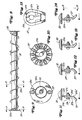
- Fig. 8 is a view of the cutter auger showing the helixes thereon.
- Fig. 9 is a sectional view through line 9-9 of Fig. 8.
- Fig. 10 is a sectional view taken on the line 10-10 of Fig. 8.
- Figs. 11, 12, 13 and 14 show the attachment of the teeth to the flighting of the cutting auger, according to the invention.
- Fig. 15 is a sectional view along line 15 of Fig. 14.
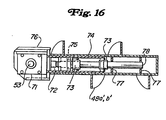
- Fig. 16 is a side view of the power auger assembly.
- a crop processor is shown generally at 10.
- the crop processor includes the auger cutter and the other operating elements of the crop processor.
- the crop processor is shown attached to a prime mover and second processor shown as a forage harvester 11.
- the crop processor 10 includes a support frame 12 shown best in Fig. 7 comprising a rear top rail 13 formed from a rectangular tube and having end plates 18 and 19 and a center plate 17.
- There is a bottom front rail 15 and a front top rail 14 which are an integral part of the frame and are connected by support members 16 between the front top rail 14 and the bottom front rail 15.
- the end plates 18 and 19 are firmly fixed to the support frame 12 at the ends thereof.
- Fig. 7 comprising a rear top rail 13 formed from a rectangular tube and having end plates 18 and 19 and a center plate 17.
- There is a bottom front rail 15 and a front top rail 14 which are an integral part of the frame and are connected by support members 16 between the front top rail 14 and the bottom front rail 15.
- the end plates 18 and 19 are
- FIG. 7 the bearing units 20 and 21 which are fitted into the holes 22 in the end plates 18 and 19. Also shown in Fig. 7 are the conveyor auger bottoms 23, the conveyor cover 24 from rear to the top for the conveyor augers 27, the side plates 24a to close off the exit for the central discharge area. There is also shown the baffle plate 25 in Fig. 7. Fig. 7 shows the support for the drive unit to drive the power discharge units. This plate is numbered 26. The open, generally central discharge area is designated as 30 and is seen very clearly as an open area in Fig. 7.
- a pair of cutting augers shown generally at 31 and 32 extend between the end plates 18 and 19.
- Each auger has a shaft that is journalled at the respective end plate and at the center plate 17 for rotation and is driven by pulleys and drive belts exterior to the end plates shown generally in the enclosures 63 and 64.
- the pulley drive units and the belts associated therewith are not shown in detail but are the kind well known to those skilled in the art.
- the cutter augers have oppositely turned helical flanges 33 and 33a to move the material toward the center or discharge area. There are reversely turned flanges 34 and 34a at or near the discharge area which are turned out of end plates 35 and 35a.
- the cutting augers 31 and 32 are so located that their central axes are parallel to the central axes of the conveying augers and are spaced therefrom so that adequate clearance is provided between the helical flanges of the two sets of augers.
- a plurality of teeth 37 to be further described are attached to and project around the peripheral edges of the flange plates 34, 34a, 35, and 35a.
- the cutter augers are beneath and forward of the conveyor augers during travel of the unit 10 in the cutting and processing of standing crops.
- baffle plate The upper edge of the baffle plate must be placed in close proximity to the cutting auger and the best operation has been with the plate being located not more than 1.27 cm (0.5 inches) from the teeth of the cutting auger, yet not impacting the teeth.
- the baffle plate must also be shaped between the radius of the cutting auger or the conveyor auger for best operation.
- a pair of ground engaging rollers 38 and 38a are each controlled by an independent mechanism which allows each side of the processor to be raised or lowered by some predetermined amount independently of each other. These rollers must have sufficient surface area to support at least a portion of the weight of the processor.
- the processor is raised and lowered by the hydraulic system of the prime mover and in most instances this system will be able to support a portion of the weight of the processor.
- the rollers 38 and 38a have a tapered design which allows the roller to clean itself as it rolls. The tapered design also permits turning corners with a minimum disturbing of the soil. The cleaning action results from new material being picked up, forcing already adhered material to be pushed along the taper and out toward the outward ends of the roller.
- the adhesion between the soil or other material and the roller surface is also weakened by any lateral movement of the processor until the material finally drops off the end.
- the rollers are connected to the bottom support member 16 by plates 42 which permit the pivoting about the center point of the roller 38 as shown in Fig. 6.
- the roller is attached to the plate 42 via bars 42a which are connected to hydraulic cylinders 39 which are connected to switch means 41 in such a manner that when the ground engaging rollers 38 or 38a are on the ground, pressure is applied to the cylinder 39 closing the switch 41.
- This moves front door 43 to the operating position and can inform the operator that the unit is on the ground.
- the height of cut is maintained by this roller switch mechanism acting in conjunction with the hydraulic cylinder 39.
- the tilt and selected cutting height of the processor can be set by the operator from the main control as the speed, crop conditions, and/or contour of the land changes.
- FIG. 6 the door or front cover unit 43.
- This front cover unit 43 is pivotally hinged about the upper main frame 14 and is pivoted by controlling the cylinders 44.
- the height of the front door unit 43 above the ground should be adjusted by the operator to ensure that the grass or material to be cut is bent forward the proper amount just prior to being hit by the teeth of the cutting auger. This height will vary depending upon the nature and density of the crop to be cut.
- the crop moving auger 45 as shown in Fig. 3 has a plurality of smooth flightings attached to it. These flightings are helical flanges 46. These helical flanges may be variable and indeed different conditions may require different pitches per foot along the entire auger length. These flanges are wound to move the crop toward the center from each side.
- this auger 45 may be necessary in order to determine the proper speed that this auger 45 have variable speed drive.
- This auger therefore is driven by a hydraulic drive 47 which can be controlled from the cabin by the operator.
- This auger normally rotates at a much lower speed than the cutting auger. This speed can be controlled and has little relationship to the speed of the crop conveying auger but is closely related to the ground speed of the processor.
- the front door must have an automatic control to ensure that during transport whenever the augers are rotating the front door is closed.
- This automatic door operation can be accomplished by either determining the pressure of the prime mover's hydraulic system with pressure switches or by monitoring the position of the tapered rollers. This latter method is shown in Fig. 6a where the upward movement of the hydraulic cylinder 39 will cause operation of the limit switch 41. Either roller can operate the door based upon whether or not the roller is in a down position. If either roller 38 or 38a is on the ground, this forces the limit switch 41 to be operated and the door is returned to a predetermined operating position. If neither roller of the processor is in contact with the ground, the limit switches 41 are opened and door will automatically be lowered into the transport or safety closed position.
- the push augers or the feed augers 48 which are positioned in the central discharge area 30. These augers may be installed as a removable unit or may be permanently installed in such area. The necessity to force-feed large quantities of material which have been cut by the crop processor into a second processor requires this plurality of feed augers 48. These augers can feed 3.66 m (12 feet) or more of crop material forcefully out of the crop processor into a relatively small exit area.
- These augers serve to compact the material and force the material under extreme pressure from the crop processor into whatever other processor or unit is required to finish the crop processing.
- the material enters from the side of the conveying auger 27 and 27a into the lower feed augers 49a and 49b. These units have their radially turned flanges directed inwardly and upwardly.
- the upper auger 50 acts to both compress the crop between the augers 49a and 49b and to feed the crop to the rear of the crop processor.
- These augers are each placed to form a three sided pattern which terminates at the exit of the processor or the entrance to the next unit.
- This feeding mechanism requires a novel header mounting which will be described more fully later, but one that ensures that the feed augers 49a, 49b and 50 are never more than 7.62 cm (three inches) from the entrance augers or grab rolls of the second crop processor.
- the V-shape of the feed auger unit allows material to enter from either the cutting auger directly or from the cutting auger via the conveyor augers.
- the conveyor augers move the material toward the feed augers and, under pressure, force the material into the V-shape of the feed augers.
- the flighting on the augers is such that the material is moved upwardly and inwardly for compression by auger 50 and movement rearwardly for discharge.
- the power feed augers 49a and 49b in operation are subjected to extreme lateral forces as the large mass of material is fed from the conveying augers into the discharge area. Normal auger mountings failed every time during experimental use and such failure was almost immediate.
- the novel auger module was able to withstand all loads during development.
- the design shown is a modular unit though the entire auger assembly could be one unit.
- the auger assembly consists of flighting 49a'; a slightly heavier than the usual flighting of a conveyor auger, flighting tube 49a, auger support plates 77 and auger support shaft 78.
- a coupler 72 is used to transmit the necessary torque to the auger. Radial loading is absorbed by bearings 73.
- a spacer 75, or a plurality of spacers may be used to transfer the thrust load to either or the gear box 71 and bearings 73.
- Means such as pins not shown, may also be used to retain both bearing 73 and to lock coupler 72 to shaft 78 thereby retaining the auger assembly in position.
- the drive system for these augers consists of a T-shaped gear box 52 attached to a chain box 57a which may contain an overload safety device which can be provided by an overload clutch, of any well known type not shown.
- the lower feed augers 49a and 49b receive their power from the top shaft power source by a belt series to shaft 53.
- Shaft 53 is carried inside of the main support frame 12 to provide protection from wrapping of material on the shaft.
- This air pressure should be released in order for the system to operate efficiently.
- the air pressure is released by providing screen means in the top cover 24 and the sides 24a of the discharge opening.
- the means 24 and 24a are made of a suitably strong screen material which has approximately 50 percent openings and 50 percent material.
- the holes in the material should be small enough so that alfalfa leaves or small parts of oats will not pass through the holes and also provide that the conveyor and feed augers wipe over the screen. This wiping should ensure that the screen will be completely cleaned approximately every three revolutions of the conveyor auger. This provides for both the release of the air and the capture of all of the material.
- the mounting system is best illustrated in Fig. 5.
- the mounting system for this crop processor requires that the head or first crop processor has the ability to tilt relative to the second processor.
- the controls for this tilt are located in the cab, allowing the operator to change the cutting height while moving. It also has been found necessary during tilting of the first processor to prevent any gaps forming between the output means of this processor and the input means to the power source or second processor.
- the mounting system must also provide means to limit movement of the terminal end of the feed augers away from the input side of the second processor.
- the header or first processor as has been previously mentioned must be able to flex up and down on either side with respect to the prime mover and also permit the rollers previously mentioned to travel over a rise in the ground on only one side without stressing the mounting system.
- the mounting system should be such that attachment and removal are easily accomplished.
- the mounting system is provided by having a frame 55 attached to the chopper head or the second processor head by pins 56 at the four corners.
- the axis of rotation between this frame and the header of the second processor is such that it is centered around the upper corner of the lower frame member of the attached second processor.
- the force for rotation is provided by two cylinders 57 which is at the lower point 56. The movement of the cylinders is controlled from the cab and can forcefully tilt the header through the frame member and its connection to the lower support frame member 16.
- the forage harvesters or the second crop harvesters have metal detectors in their chopping unit to stop the forage operation as soon as metal is detected. If metal is detected, the second processor ceases to operate and if material were continued to be fed from the first crop processor, then a jam would occur as there is no place for the cut material to go. In addition, because of the great pressures exerted by the power auger feed system against a fixed surface an intolerable plug would result. To prevent this plugging, a throw out coupler system has been utilized to protect and stop the power input to the second crop processor. The metal detection system is located in the second crop processor and if it senses metal it generates an electrical signal which stops the second crop processor operation. This same electrical signal is connected to the throw out coupler system in the first processor.
- the power source 61 from the prime mover 11 is connected to the first gear box 58 of the crop processor by pto shaft 60. This will permit flexing and relative movement between the prime mover unit and the header or the first crop processor.
- a throw out coupler system 59 is placed between the gear box 58 and the gear box 62 so that the power will immediately be cut by the throw out coupler when the power is cut to the feed system of the prime mover unit.
- the teeth 37 used on this crop processor are unique and are best described with reference to Figs. 11, 12, 13, 14 and 15.
- the teeth incorporate several features to give the teeth long operational life, impact resistance, versatility, etc.
- the tooth of generally horse shoe configuration shown in Fig. 15 in plan view, includes a beveled surface 37a, a hole 37c for mounting the tooth and a flat surface 37b, and the other side is flat surface 37b'.
- a portion of surface 37b' and the bevel surface at the converging end has a layer of hardened material applied to make surface 37b' the wear and self-sharpening characteristics of the tooth.
- the tooth is bent at approximately 45° in the direction of the bevel surface.
- the mounting system for this tooth provides for a plurality of mounting configurations as shown in Figs. 11, 12, 13 and 14.
- the tooth 37 is mounted by bolts 37d and nut 37e through the hole 37c in the tooth 37and the flighting 33a.
- the cutting auger tube 32 is also shown.
- the tooth is viewed from the front as the tooth is ready to cut the crop material.
- the mounting bolts have an angle similar to the bevel 37a to provide a slope surface to prevent sticking of the cut material and reduce wear on the bolt.
- the tooth 37 is designed with a symmetrical pattern. The symmetry results in two cutting edges on each tooth. When one edge is worn down the tooth may simply be reinstalled to a new position on either auger of the machine so that the second cutting edge can be used.
- this tooth can be mounted on the front side or the back side of the flighting as shown in Figs. 11, 12, 13 and 14.
- a lock washer 37f is used to maintain the tooth in a fixed position. This permits any fixed cutting angle to be established as desired due to crop, etc.
- the lock washer in Fig. 14 can be removed from the bolt 37d to permit swinging of the teeth.
- the front side swinging mount as shown in Fig. 11 provides the most aggressive cutting action and is useful in most cutting situations.
- the tooth can also be mounted on the backside of the flange as shown in Figs. 12 and 14; however, in Fig. 12 it must be rigidly mounted. Backside mounting provides a less aggressive action and is utilized in handling tender material. Where the crop material is thicker and more rigid as in the case of corn, front mounting in preferred.
Landscapes
- Life Sciences & Earth Sciences (AREA)
- Environmental Sciences (AREA)
- Harvester Elements (AREA)
- Harvesting Machines For Specific Crops (AREA)
- Combines (AREA)
- Outside Dividers And Delivering Mechanisms For Harvesters (AREA)
Applications Claiming Priority (3)
| Application Number | Priority Date | Filing Date | Title |
|---|---|---|---|
| US07/479,321 US5005342A (en) | 1990-02-13 | 1990-02-13 | Crop processor |
| US479321 | 1990-02-13 | ||
| EP90113193A EP0443079B1 (en) | 1990-02-13 | 1990-07-11 | Improved crop processor |
Related Parent Applications (2)
| Application Number | Title | Priority Date | Filing Date |
|---|---|---|---|
| EP90113193.8 Division | 1990-07-11 | ||
| EP90113193A Division EP0443079B1 (en) | 1990-02-13 | 1990-07-11 | Improved crop processor |
Publications (3)
| Publication Number | Publication Date |
|---|---|
| EP0784918A2 EP0784918A2 (en) | 1997-07-23 |
| EP0784918A3 EP0784918A3 (en) | 1997-10-15 |
| EP0784918B1 true EP0784918B1 (en) | 2002-01-02 |
Family
ID=23903536
Family Applications (2)
| Application Number | Title | Priority Date | Filing Date |
|---|---|---|---|
| EP97106236A Expired - Lifetime EP0784918B1 (en) | 1990-02-13 | 1990-07-11 | Crop processor with improved auger cutter teeth |
| EP90113193A Expired - Lifetime EP0443079B1 (en) | 1990-02-13 | 1990-07-11 | Improved crop processor |
Family Applications After (1)
| Application Number | Title | Priority Date | Filing Date |
|---|---|---|---|
| EP90113193A Expired - Lifetime EP0443079B1 (en) | 1990-02-13 | 1990-07-11 | Improved crop processor |
Country Status (10)
| Country | Link |
|---|---|
| US (1) | US5005342A (da) |
| EP (2) | EP0784918B1 (da) |
| JP (1) | JPH0789785B2 (da) |
| CN (1) | CN1053989A (da) |
| AU (1) | AU627677B2 (da) |
| BR (1) | BR9005191A (da) |
| CA (1) | CA2019449C (da) |
| DE (2) | DE69033341T2 (da) |
| DK (1) | DK303390A (da) |
| ZA (1) | ZA905109B (da) |
Families Citing this family (43)
| Publication number | Priority date | Publication date | Assignee | Title |
|---|---|---|---|---|
| US5309702A (en) * | 1992-08-20 | 1994-05-10 | Lundahl Research, Inc. | Cutting tooth |
| US5305586A (en) * | 1992-08-20 | 1994-04-26 | Lundahl Research, Inc. | Crop processor |
| US5399307A (en) * | 1993-06-18 | 1995-03-21 | Dalton; Robert E. | Methods of compression molding two or more polytetrafluoroethylene resin layers |
| US6058688A (en) * | 1998-05-08 | 2000-05-09 | Deere & Company | Windrower specialty crop platform having right- and left-hand cantilevered augers located beneath a full-length center-feed auger |
| US6125617A (en) * | 1998-09-15 | 2000-10-03 | Gehl Company | Cut crop processing mechanism for a forage harvester incorporating a pivotable auger |
| DE19918551B4 (de) | 1999-04-23 | 2015-04-02 | Deere & Company | Erntemaschine |
| US6561896B1 (en) | 2000-05-22 | 2003-05-13 | David M. Lauer | Auger for combine header |
| DE10130647A1 (de) * | 2001-06-27 | 2003-01-16 | Claas Selbstfahr Erntemasch | Stützradanordnung für eine landwirtschaftliche Arbeitsmaschine |
| US6705067B2 (en) | 2002-07-16 | 2004-03-16 | Case Corporation | Feed conveyor/rock trap and header drive for an agricultural combine |
| US6877303B2 (en) * | 2002-07-19 | 2005-04-12 | Cnh America Llc | Stub auger support used in pickup |
| US6679042B1 (en) | 2002-11-12 | 2004-01-20 | Acco Corporation | Infeed cutter baler having increased throughput |
| US7277785B2 (en) * | 2005-07-15 | 2007-10-02 | Cnh America Llc | Apparatus and method to calibrate a draper on an agricultural header on an agricultural windrower |
| US7483780B2 (en) * | 2005-07-15 | 2009-01-27 | Cnh America Llc | Apparatus and method to calibrate the reel of an agricultural windrower |
| US20070193243A1 (en) | 2006-02-10 | 2007-08-23 | Schmidt James R | Combine Harvester Draper Header Having Flexible Cutterbar |
| US20080271426A1 (en) | 2006-02-10 | 2008-11-06 | Agco Corporation | Draper belt with crop-retaining rib |
| US20080276590A1 (en) | 2006-02-10 | 2008-11-13 | Agco Corporation | Flexible draper and cutter bar with tilt arm for cutterbar drive |
| US20080066316A1 (en) * | 2006-09-15 | 2008-03-20 | Tommy Lee Schwab | Corn stripper |
| US20090266044A1 (en) | 2008-04-25 | 2009-10-29 | Coers Bruce A | Integrated draper belt support and skid shoe in an agricultural harvesting machine |
| EP2312927B1 (en) | 2008-05-09 | 2011-12-28 | Agco Corporation | Center crop deflector for draper header |
| US20090277148A1 (en) | 2008-05-09 | 2009-11-12 | Agco Corporation | Flexible draper and cutter bar having shiftable crop divider with deflector |
| US20090277145A1 (en) | 2008-05-09 | 2009-11-12 | Agco Corporation | Header height control system with multiple potentiometer input |
| EP2315514B1 (en) | 2008-05-09 | 2012-04-25 | Agco Corporation | Adjustable cutterbar travel range for a flexible cutterbar header |
| US20090277144A1 (en) | 2008-05-09 | 2009-11-12 | Agco Corporation | Spring flotation for center deck of draper header |
| US7921627B2 (en) | 2008-05-09 | 2011-04-12 | Agco Corporation | Interlocking belt guards for a draper header |
| US7886511B2 (en) | 2008-05-09 | 2011-02-15 | Agco Corporation | Draper head with flexible cutterbar having rigid center section |
| DE102010021133A1 (de) * | 2010-05-21 | 2011-11-24 | Claas Selbstfahrende Erntemaschinen Gmbh | Landwirtschaftliche Arbeitsmaschine mit Vorsatzgerät |
| US8205421B2 (en) | 2010-06-16 | 2012-06-26 | Agco Corporation | Belt guard crop dam for flexible draper header |
| US7958711B1 (en) | 2010-06-16 | 2011-06-14 | Agco Corporation | Crop deflector for ends of draper belt of flexible draper header |
| US8863489B2 (en) | 2011-03-30 | 2014-10-21 | H & S Manufacturing Co., Inc. | Tine drive cam for windrow merger |
| US8479483B1 (en) | 2011-12-27 | 2013-07-09 | Agco Corporation | Flexible draper head providing reduced crop residue accumulation |
| US9425124B2 (en) | 2012-02-02 | 2016-08-23 | International Business Machines Corporation | Compliant pin fin heat sink and methods |
| US8806844B2 (en) * | 2012-02-24 | 2014-08-19 | Dom, L.L.C. | Flail motor head attachment |
| CN103359419A (zh) * | 2012-03-29 | 2013-10-23 | 张有才 | 一种饲料运输罐 |
| CN104348850B (zh) * | 2013-07-25 | 2017-10-20 | 凌群电脑股份有限公司 | 利用透通技术存取云端数据库数据的系统 |
| US9814181B2 (en) * | 2015-05-08 | 2017-11-14 | Cnh Industrial America Llc | Drive mechanism for augers of an agricultural harvester header |
| US10729070B2 (en) * | 2017-01-25 | 2020-08-04 | Paul Howard Nyboer | Mulching apparatus for a lawnmower |
| CN106993446B (zh) * | 2017-04-18 | 2019-08-23 | 安徽农业大学 | 一种高效秸秆粉碎催腐掩埋还田机 |
| CN109729767B (zh) * | 2019-02-13 | 2024-03-08 | 黑龙江省农业科学院土壤肥料与环境资源研究所 | 一种组合式秸秆粉碎集中深埋犁 |
| EP3909413A1 (de) * | 2020-05-14 | 2021-11-17 | Maschinenfabrik Bermatingen GmbH & Co. KG | Mäh- oder mulchvorrichtung bzw. schneidwerkzeug für eine solche |
| US11266071B1 (en) | 2020-08-27 | 2022-03-08 | H & S Manufacturing Co., Inc. | Windrow merger with active weight transfer system |
| EP4104664A1 (en) | 2021-06-17 | 2022-12-21 | CNH Industrial Belgium N.V. | A belt-type cutting system for cutting crops in a field |
| EP4104662B1 (en) | 2021-06-17 | 2025-04-09 | CNH Industrial Belgium N.V. | Cutting apparatus |
| WO2025051314A1 (de) * | 2023-09-05 | 2025-03-13 | Joanna Zimmermann | Vorrichtung für die ernte stängeligen ernteguts |
Family Cites Families (27)
| Publication number | Priority date | Publication date | Assignee | Title |
|---|---|---|---|---|
| US2517390A (en) * | 1948-12-22 | 1950-08-01 | Int Harvester Co | Auxiliary cutter for harvester platforms |
| US2634567A (en) * | 1950-08-29 | 1953-04-14 | John J Huitema | Stalk shredder |
| US2758435A (en) * | 1954-06-01 | 1956-08-14 | Vernon J Lundell | Crop gathering and chopping device |
| US2725704A (en) * | 1954-12-17 | 1955-12-06 | Deere Mfg Co | Forage harvester having stalk directing means |
| US2863023A (en) * | 1956-01-27 | 1958-12-02 | Gen Electric | Bimetallic strip thermally responsive device |
| US2946170A (en) * | 1957-11-18 | 1960-07-26 | Deere & Co | Conveyor means for corn harvester |
| US3073100A (en) * | 1960-08-15 | 1963-01-15 | Richard O Kingsley | Mower having helical cutter blade |
| US3319408A (en) * | 1964-08-12 | 1967-05-16 | Martin J Landwehr | Reels for farm machinery |
| FR1415334A (fr) * | 1964-12-01 | 1965-10-22 | Int Harvester Co | Andaineuse ayant une plate-forme comportant deux vis transporteuses |
| NL6515224A (da) * | 1965-11-24 | 1967-05-25 | ||
| DE1901155A1 (de) * | 1969-01-10 | 1970-10-22 | Fahr Ag Maschf | Maehdrescher |
| US3862539A (en) * | 1973-07-27 | 1975-01-28 | J L Stevens | Ground clearing attachment for tractors |
| US3919830A (en) * | 1973-11-26 | 1975-11-18 | Jerome J Gerber | Row crop attachment for forage harvesters |
| US4251980A (en) * | 1979-03-26 | 1981-02-24 | Miller Kent A | Cornstalk harvesting and windrow attachment for a corn picker header |
| DE2919123A1 (de) * | 1979-05-11 | 1980-11-20 | Kloeckner Humboldt Deutz Ag | Hoehenfuehrungseinrichtung fuer das hoehenbewegliche arbeitswerkzeug einer landwirtschaftlichen erntemaschine |
| FR2466946A1 (fr) * | 1979-10-12 | 1981-04-17 | Dekerchove Marcel | Tondeuse a gazon |
| US4414792A (en) * | 1982-03-30 | 1983-11-15 | Blackwelders | Height control for agricultural machine |
| DD210514A3 (de) * | 1982-06-03 | 1984-06-13 | Fortschritt Veb K | Einzugseinrichtung fuer axialflussmaehdrescher |
| US4550554A (en) * | 1984-01-03 | 1985-11-05 | Ezra C. Lundahl, Inc. | Crop processor |
| IT8463353U1 (it) * | 1984-03-27 | 1985-09-27 | Storti Ottorino | Elementi di taglio applicabili su coclee trancianti di trasportatrici in particolar modo di materiali filamentosi insilati |
| US4612757A (en) * | 1985-04-12 | 1986-09-23 | Sperry Corporation | Combine header attitude control mechanism |
| AU548518B3 (en) * | 1985-10-28 | 1985-11-28 | Chamberlain John Deere Pty. Ltd. | Improvements in harvesting cutting platforms |
| JPS62118804A (ja) * | 1985-11-20 | 1987-05-30 | 小橋工業株式会社 | 耕うん草刈り装置 |
| US4776153A (en) * | 1986-02-27 | 1988-10-11 | Deere & Company | Automatic height control for a laterally pivoted harvester header |
| ATE130161T1 (de) * | 1988-02-08 | 1995-12-15 | Wieneke Franz | Walzenmäher. |
| DK158869C (da) * | 1988-02-24 | 1995-12-04 | Spragelse Maskinfabrik As | Apparat til slåning af græs og lignende vækster |
| IT215694Z2 (it) * | 1988-07-29 | 1990-10-24 | Seko Spa | Carro trincia miscelatore distributore perfezionato particolarmente per la sfaldatura trinciatura miscelazione e distribuzione di balle cilindriche prismatiche giganti di foraggio e paglia o insilati di erba. |
-
1990
- 1990-02-13 US US07/479,321 patent/US5005342A/en not_active Expired - Fee Related
- 1990-06-20 CA CA002019449A patent/CA2019449C/en not_active Expired - Fee Related
- 1990-06-29 ZA ZA905109A patent/ZA905109B/xx unknown
- 1990-07-02 AU AU58096/90A patent/AU627677B2/en not_active Ceased
- 1990-07-11 EP EP97106236A patent/EP0784918B1/en not_active Expired - Lifetime
- 1990-07-11 DE DE69033341T patent/DE69033341T2/de not_active Expired - Fee Related
- 1990-07-11 EP EP90113193A patent/EP0443079B1/en not_active Expired - Lifetime
- 1990-07-11 DE DE69033890T patent/DE69033890T2/de not_active Expired - Fee Related
- 1990-08-18 JP JP2218013A patent/JPH0789785B2/ja not_active Expired - Lifetime
- 1990-10-16 BR BR909005191A patent/BR9005191A/pt not_active IP Right Cessation
- 1990-12-21 DK DK303390A patent/DK303390A/da not_active Application Discontinuation
-
1991
- 1991-01-16 CN CN91100374A patent/CN1053989A/zh active Pending
Also Published As
| Publication number | Publication date |
|---|---|
| DE69033341T2 (de) | 2000-06-08 |
| EP0443079B1 (en) | 1999-11-03 |
| DK303390A (da) | 1991-08-14 |
| US5005342A (en) | 1991-04-09 |
| ZA905109B (en) | 1991-04-24 |
| DE69033890D1 (de) | 2002-02-07 |
| EP0443079A2 (en) | 1991-08-28 |
| AU5809690A (en) | 1991-08-15 |
| EP0443079A3 (en) | 1995-01-11 |
| JPH03240408A (ja) | 1991-10-25 |
| EP0784918A3 (en) | 1997-10-15 |
| JPH0789785B2 (ja) | 1995-10-04 |
| CA2019449A1 (en) | 1991-08-13 |
| EP0784918A2 (en) | 1997-07-23 |
| DE69033341D1 (de) | 1999-12-09 |
| BR9005191A (pt) | 1991-11-19 |
| CA2019449C (en) | 1999-10-26 |
| DE69033890T2 (de) | 2002-09-05 |
| CN1053989A (zh) | 1991-08-28 |
| DK303390D0 (da) | 1990-12-21 |
| AU627677B2 (en) | 1992-08-27 |
Similar Documents
| Publication | Publication Date | Title |
|---|---|---|
| EP0784918B1 (en) | Crop processor with improved auger cutter teeth | |
| US3971390A (en) | Stone trap for threshing and separating machine | |
| US6430904B1 (en) | Platform auger torque sensing brake activation | |
| CA2306309C (en) | Harvesting machine | |
| US5661961A (en) | Crop processor for round hay balers | |
| EP0244977B1 (en) | Bale shredder | |
| US4657029A (en) | Stone trap for a combine harvester | |
| US4033518A (en) | Forage harvester | |
| EP2710881B1 (en) | Distributor machine | |
| US5305586A (en) | Crop processor | |
| EP0803181B1 (en) | Crop processor apparatus for forage harvester | |
| WO2019053738A1 (en) | SELF-PROPELLED AXIAL FLOWER HARVESTER | |
| US6131837A (en) | Segmented crop processor roll for forage harvester | |
| US5626298A (en) | Tub grinder with rear discharge hammer mill and angled shear plates | |
| US6685120B2 (en) | Hay bale separating apparatus and method | |
| US4078734A (en) | Drive arrangement for field choppers | |
| EP2111739B1 (en) | Combine harvester control | |
| US4003191A (en) | Barrier means in a combine harvesting header | |
| RU2177682C2 (ru) | Пневматический зерноуборочный комбайн | |
| EP1964461B1 (en) | Combine harvester power management control | |
| US4506840A (en) | Baffle means for forage harvesters | |
| US20250216244A1 (en) | Automatic load detection for an agricultural machine and agricultural harvester | |
| JP7666293B2 (ja) | コンバイン | |
| GB2096453A (en) | Straw chopper and spreader assembly | |
| EP0498639B1 (en) | An apparatus for washing or chopping or mixing or dispensing material |
Legal Events
| Date | Code | Title | Description |
|---|---|---|---|
| PUAI | Public reference made under article 153(3) epc to a published international application that has entered the european phase |
Free format text: ORIGINAL CODE: 0009012 |
|
| AC | Divisional application: reference to earlier application |
Ref document number: 443079 Country of ref document: EP |
|
| AK | Designated contracting states |
Kind code of ref document: A2 Designated state(s): BE DE ES FR GB IT SE |
|
| PUAL | Search report despatched |
Free format text: ORIGINAL CODE: 0009013 |
|
| AK | Designated contracting states |
Kind code of ref document: A3 Designated state(s): BE DE ES FR GB IT SE |
|
| 17P | Request for examination filed |
Effective date: 19980408 |
|
| 17Q | First examination report despatched |
Effective date: 20000427 |
|
| GRAG | Despatch of communication of intention to grant |
Free format text: ORIGINAL CODE: EPIDOS AGRA |
|
| GRAG | Despatch of communication of intention to grant |
Free format text: ORIGINAL CODE: EPIDOS AGRA |
|
| GRAH | Despatch of communication of intention to grant a patent |
Free format text: ORIGINAL CODE: EPIDOS IGRA |
|
| GRAH | Despatch of communication of intention to grant a patent |
Free format text: ORIGINAL CODE: EPIDOS IGRA |
|
| GRAA | (expected) grant |
Free format text: ORIGINAL CODE: 0009210 |
|
| REG | Reference to a national code |
Ref country code: GB Ref legal event code: IF02 |
|
| AC | Divisional application: reference to earlier application |
Ref document number: 443079 Country of ref document: EP |
|
| AK | Designated contracting states |
Kind code of ref document: B1 Designated state(s): BE DE ES FR GB IT SE |
|
| PG25 | Lapsed in a contracting state [announced via postgrant information from national office to epo] |
Ref country code: IT Free format text: LAPSE BECAUSE OF FAILURE TO SUBMIT A TRANSLATION OF THE DESCRIPTION OR TO PAY THE FEE WITHIN THE PRE;WARNING: LAPSES OF ITALIAN PATENTS WITH EFFECTIVE DATE BEFORE 2007 MAY HAVE OCCURRED AT ANY TIME BEFORE 2007. THE CORRECT EFFECTIVE DATE MAY BE DIFFERENT FROM THE ONE RECORDED.SCRIBED TIME-LIMIT Effective date: 20020102 Ref country code: BE Free format text: LAPSE BECAUSE OF FAILURE TO SUBMIT A TRANSLATION OF THE DESCRIPTION OR TO PAY THE FEE WITHIN THE PRESCRIBED TIME-LIMIT Effective date: 20020102 |
|
| REF | Corresponds to: |
Ref document number: 69033890 Country of ref document: DE Date of ref document: 20020207 |
|
| PG25 | Lapsed in a contracting state [announced via postgrant information from national office to epo] |
Ref country code: SE Free format text: LAPSE BECAUSE OF FAILURE TO SUBMIT A TRANSLATION OF THE DESCRIPTION OR TO PAY THE FEE WITHIN THE PRESCRIBED TIME-LIMIT Effective date: 20020402 |
|
| ET | Fr: translation filed | ||
| PGFP | Annual fee paid to national office [announced via postgrant information from national office to epo] |
Ref country code: GB Payment date: 20020704 Year of fee payment: 13 |
|
| PG25 | Lapsed in a contracting state [announced via postgrant information from national office to epo] |
Ref country code: ES Free format text: LAPSE BECAUSE OF FAILURE TO SUBMIT A TRANSLATION OF THE DESCRIPTION OR TO PAY THE FEE WITHIN THE PRESCRIBED TIME-LIMIT Effective date: 20020730 |
|
| PLBE | No opposition filed within time limit |
Free format text: ORIGINAL CODE: 0009261 |
|
| STAA | Information on the status of an ep patent application or granted ep patent |
Free format text: STATUS: NO OPPOSITION FILED WITHIN TIME LIMIT |
|
| 26N | No opposition filed | ||
| PG25 | Lapsed in a contracting state [announced via postgrant information from national office to epo] |
Ref country code: DE Free format text: LAPSE BECAUSE OF NON-PAYMENT OF DUE FEES Effective date: 20030201 |
|
| PG25 | Lapsed in a contracting state [announced via postgrant information from national office to epo] |
Ref country code: FR Free format text: LAPSE BECAUSE OF NON-PAYMENT OF DUE FEES Effective date: 20030331 |
|
| REG | Reference to a national code |
Ref country code: FR Ref legal event code: ST |
|
| PG25 | Lapsed in a contracting state [announced via postgrant information from national office to epo] |
Ref country code: GB Free format text: LAPSE BECAUSE OF NON-PAYMENT OF DUE FEES Effective date: 20030711 |
|
| GBPC | Gb: european patent ceased through non-payment of renewal fee |
Effective date: 20030711 |