EP0785171B1 - Trägermaterial für Biomasse bei Verfahren zum Reinigen von Abwasser - Google Patents
Trägermaterial für Biomasse bei Verfahren zum Reinigen von Abwasser Download PDFInfo
- Publication number
- EP0785171B1 EP0785171B1 EP19960810038 EP96810038A EP0785171B1 EP 0785171 B1 EP0785171 B1 EP 0785171B1 EP 19960810038 EP19960810038 EP 19960810038 EP 96810038 A EP96810038 A EP 96810038A EP 0785171 B1 EP0785171 B1 EP 0785171B1
- Authority
- EP
- European Patent Office
- Prior art keywords
- particles
- carrier material
- accordance
- reactor
- bacteria
- Prior art date
- Legal status (The legal status is an assumption and is not a legal conclusion. Google has not performed a legal analysis and makes no representation as to the accuracy of the status listed.)
- Expired - Lifetime
Links
- 239000002351 wastewater Substances 0.000 title claims description 11
- 239000002028 Biomass Substances 0.000 title claims description 7
- 238000000746 purification Methods 0.000 title claims 2
- 239000002245 particle Substances 0.000 claims abstract description 20
- 238000000034 method Methods 0.000 claims abstract description 19
- XLYOFNOQVPJJNP-UHFFFAOYSA-N water Substances O XLYOFNOQVPJJNP-UHFFFAOYSA-N 0.000 claims abstract description 14
- 239000000463 material Substances 0.000 claims abstract description 8
- 239000012876 carrier material Substances 0.000 claims description 30
- 241000894006 Bacteria Species 0.000 claims description 8
- 239000012530 fluid Substances 0.000 claims description 3
- 239000007858 starting material Substances 0.000 claims description 3
- 239000000126 substance Substances 0.000 claims description 3
- 238000001228 spectrum Methods 0.000 claims description 2
- 238000013467 fragmentation Methods 0.000 claims 1
- 238000006062 fragmentation reaction Methods 0.000 claims 1
- 239000011148 porous material Substances 0.000 abstract description 5
- 239000000758 substrate Substances 0.000 abstract description 3
- 230000002906 microbiologic effect Effects 0.000 abstract 1
- 239000011236 particulate material Substances 0.000 abstract 1
- 238000009736 wetting Methods 0.000 abstract 1
- 239000010802 sludge Substances 0.000 description 9
- 239000000725 suspension Substances 0.000 description 9
- QVGXLLKOCUKJST-UHFFFAOYSA-N atomic oxygen Chemical compound [O] QVGXLLKOCUKJST-UHFFFAOYSA-N 0.000 description 8
- 239000001301 oxygen Substances 0.000 description 8
- 229910052760 oxygen Inorganic materials 0.000 description 8
- 239000003570 air Substances 0.000 description 6
- 238000004140 cleaning Methods 0.000 description 5
- 238000009423 ventilation Methods 0.000 description 5
- QGZKDVFQNNGYKY-UHFFFAOYSA-O Ammonium Chemical compound [NH4+] QGZKDVFQNNGYKY-UHFFFAOYSA-O 0.000 description 4
- IJGRMHOSHXDMSA-UHFFFAOYSA-N Atomic nitrogen Chemical compound N#N IJGRMHOSHXDMSA-UHFFFAOYSA-N 0.000 description 4
- 230000008030 elimination Effects 0.000 description 4
- 238000003379 elimination reaction Methods 0.000 description 4
- OKTJSMMVPCPJKN-UHFFFAOYSA-N Carbon Chemical compound [C] OKTJSMMVPCPJKN-UHFFFAOYSA-N 0.000 description 3
- 238000005273 aeration Methods 0.000 description 3
- 239000012620 biological material Substances 0.000 description 3
- 239000007788 liquid Substances 0.000 description 3
- 229910052757 nitrogen Inorganic materials 0.000 description 3
- 230000003647 oxidation Effects 0.000 description 3
- 238000007254 oxidation reaction Methods 0.000 description 3
- 239000002994 raw material Substances 0.000 description 3
- 229910052799 carbon Inorganic materials 0.000 description 2
- 239000004927 clay Substances 0.000 description 2
- 238000009826 distribution Methods 0.000 description 2
- 239000007789 gas Substances 0.000 description 2
- 239000004615 ingredient Substances 0.000 description 2
- 244000005700 microbiome Species 0.000 description 2
- 125000001477 organic nitrogen group Chemical group 0.000 description 2
- 238000003756 stirring Methods 0.000 description 2
- 238000004065 wastewater treatment Methods 0.000 description 2
- 208000012868 Overgrowth Diseases 0.000 description 1
- 238000005299 abrasion Methods 0.000 description 1
- 238000013019 agitation Methods 0.000 description 1
- 239000012080 ambient air Substances 0.000 description 1
- 230000001580 bacterial effect Effects 0.000 description 1
- 230000004071 biological effect Effects 0.000 description 1
- 230000033558 biomineral tissue development Effects 0.000 description 1
- 230000015572 biosynthetic process Effects 0.000 description 1
- 230000015556 catabolic process Effects 0.000 description 1
- 238000010924 continuous production Methods 0.000 description 1
- 238000006731 degradation reaction Methods 0.000 description 1
- 230000001419 dependent effect Effects 0.000 description 1
- 230000008021 deposition Effects 0.000 description 1
- 230000009189 diving Effects 0.000 description 1
- 238000001035 drying Methods 0.000 description 1
- 230000000694 effects Effects 0.000 description 1
- 238000002474 experimental method Methods 0.000 description 1
- 230000002349 favourable effect Effects 0.000 description 1
- 239000000835 fiber Substances 0.000 description 1
- 238000011086 high cleaning Methods 0.000 description 1
- 230000014759 maintenance of location Effects 0.000 description 1
- 238000004519 manufacturing process Methods 0.000 description 1
- 230000004060 metabolic process Effects 0.000 description 1
- NHNBFGGVMKEFGY-UHFFFAOYSA-N nitrate group Chemical group [N+](=O)([O-])[O-] NHNBFGGVMKEFGY-UHFFFAOYSA-N 0.000 description 1
- 229910017464 nitrogen compound Inorganic materials 0.000 description 1
- 150000002830 nitrogen compounds Chemical class 0.000 description 1
- 238000012856 packing Methods 0.000 description 1
- 230000000704 physical effect Effects 0.000 description 1
- 239000008262 pumice Substances 0.000 description 1
- 238000010926 purge Methods 0.000 description 1
- 239000008237 rinsing water Substances 0.000 description 1
- 239000004576 sand Substances 0.000 description 1
- 238000000926 separation method Methods 0.000 description 1
- 239000010801 sewage sludge Substances 0.000 description 1
- 238000007873 sieving Methods 0.000 description 1
- 239000010454 slate Substances 0.000 description 1
- 239000007787 solid Substances 0.000 description 1
- 239000004094 surface-active agent Substances 0.000 description 1
- 230000007704 transition Effects 0.000 description 1
Images


Classifications
-
- C—CHEMISTRY; METALLURGY
- C02—TREATMENT OF WATER, WASTE WATER, SEWAGE, OR SLUDGE
- C02F—TREATMENT OF WATER, WASTE WATER, SEWAGE, OR SLUDGE
- C02F3/00—Biological treatment of water, waste water, or sewage
- C02F3/02—Aerobic processes
- C02F3/08—Aerobic processes using moving contact bodies
- C02F3/085—Fluidized beds
-
- C—CHEMISTRY; METALLURGY
- C02—TREATMENT OF WATER, WASTE WATER, SEWAGE, OR SLUDGE
- C02F—TREATMENT OF WATER, WASTE WATER, SEWAGE, OR SLUDGE
- C02F3/00—Biological treatment of water, waste water, or sewage
- C02F3/02—Aerobic processes
- C02F3/10—Packings; Fillings; Grids
-
- Y—GENERAL TAGGING OF NEW TECHNOLOGICAL DEVELOPMENTS; GENERAL TAGGING OF CROSS-SECTIONAL TECHNOLOGIES SPANNING OVER SEVERAL SECTIONS OF THE IPC; TECHNICAL SUBJECTS COVERED BY FORMER USPC CROSS-REFERENCE ART COLLECTIONS [XRACs] AND DIGESTS
- Y02—TECHNOLOGIES OR APPLICATIONS FOR MITIGATION OR ADAPTATION AGAINST CLIMATE CHANGE
- Y02W—CLIMATE CHANGE MITIGATION TECHNOLOGIES RELATED TO WASTEWATER TREATMENT OR WASTE MANAGEMENT
- Y02W10/00—Technologies for wastewater treatment
- Y02W10/10—Biological treatment of water, waste water, or sewage
Definitions
- the invention relates to a carrier material for biomass in processes for cleaning waste water as well Uses of this substrate.
- the biological wastewater treatment includes several Process with immobilized biomass. With these Procedures performed in "biofilm” reactors become, grow sessile, through ingredients of the Wastewater-fed bacteria on surfaces of Support structures and thus form a biofilm.
- support structures are trickling filters, rotating ones Disc diving body, structured structured packings and fillings or suspensions of granular Carrier material, such as activated carbon, sand, Pumice, expanded slate or expanded clay.
- Granular carrier material is used in procedures with stationary and moving Carrier material used, for example in fixed bed, Fluidized bed, fluidized bed reactors and mixed Reactors.
- Reactors with "carrier biology” are particularly advantageous in slowly growing bacterial populations, as in nitrification (nitrogen oxidation under aerobic Conditions).
- a carrier material with a large one specific surface the surface of the Carrier material is bacteriophilic (the formation of a enabling active biofilms) and mass transfers, for example the oxygen transition between which treating water and the biofilm is good.
- bacteriophilic the formation of a enabling active biofilms
- mass transfers for example the oxygen transition between which treating water and the biofilm is good.
- the Backing material should have high abrasion resistance, there for the removal of deposited suspended matter as well formed excess sludge the fixed bed regularly must be rinsed. Should the fixed bed also be used as Filter media are used, so is a high one Retention required for suspended matter.
- the carrier particles are covered with a biofilm usually without a problem. Assuming this growth so it is the geometric and physical Properties of the particles that are essential Influence on the required reactor size, the required energy expenditure and the possible Elimination performance (C and N elimination, i.e. degradation organic ingredients and nitrogen compounds, especially ammonium). Play these characteristics also an important role in relation to the problem Remove excess sludge from the process, for example by means of sedimentative separation.
- a suspendable Body formed carrier material available that are particularly good for procedures with moving carrier material, especially fluidized bed and Fluid bed process is suitable.
- Requirements of an inexpensive material with the for the intended use of favorable biological properties as well as a trouble-free operation simultaneous high cleaning performance in the foreground This object is defined by what is defined in claim 1 Carrier material released.
- the carrier material for biomass in processes for cleaning waste water comprises a large number of bodies.
- the majority of these carrier bodies are elongated, have rough surfaces and are made by comminution from a starting material which is largely homogeneous and free of pores and whose density is in the range between 1.05 and 1.5 g / cm 3 .
- a majority of the corpuscles which comprise at least about 80 percent by weight of their total amount, can be assigned the following statistical information regarding lengths and widths of the corpuscles: lengths with values of around 0.5 to 20 mm and widths with values of around 0.2 to 3 mm, and an average of the ratio of length to greater width greater than 2.
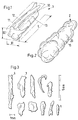
- FIG. 1 shows a carrier body 1, which is a length L, a large width B1 and a small width B2 having.
- the surface 10 is rough; Elements of Surface structures are, for example, comb-like Elevations 11, trough-shaped depressions 12 and tooth-like projections 13. On this rough surface 10 can colonize bacteria and thereby a biofilm 20 - see Fig.2 - train.
- Figure 3 is a selection composed of carrier body 1, with only the drawn outlines of recognizable surface structures are.
- These bodies 1 are rubber particles that pass through Shredding has been made from used car tires are. A large part of the bodies 1 are elongated educated.
- a majority of the body 1, the at least about 80 percent by weight of their total includes the following statistical information regarding the length L and the widths B1 and B2 of the body assignable:
- the length L has values between around 1 and 10 mm on and the widths B1, B2 values between around 0.2 and 3 mm; the average of the ratio of length L to greater width B1 is greater than 2.
- a specifiable spectrum of body sizes can be produced by sieving or other classifying processes.
- a suitable specific surface of the body can be set.
- the specific surface area of a corpuscle 1 (corpuscle volume ⁇ 1 ⁇ 4 ⁇ ⁇ ⁇ B 2 ⁇ L, surface> ⁇ ⁇ B ⁇ L) is f / B, where f is an estimated factor between around 4 and 10 and B is one of the widths B1 and B2 is the mean formed.
- FIG. 4 shows a vessel with a bed 3 of bodies 2, which have accumulated in a liquid 4, in particular water, on the bottom of the vessel. As shown in the experiment, such a bed 3 can easily be whirled up with a stirrer 5. A section 43 of the upper boundary surface 30 of the bed 3 is shown enlarged in FIG. Individual bodies 2 have already been bloated. Thanks to the elongated shape of the bodies 2, the surface 30 of the bed 3 offers many contact surfaces on which the flowing liquid 4 can act. Thanks to the small specific density of the bodies 2 (less than 1.5 g / cm 3 ) there is little resistance to the effects of the flow, so that the bodies 2 can be easily detached and brought into suspension.
- SBBR S equencing B atch B iofilm R eactor
- Trigger device 610 uses a near surface Emptying allowed. After emptying treated Wastewater (via connection 61) and, if necessary, Excess sludge 4 '(over the nozzle 62) is again treating wastewater containing ammonium in the Reactor 6 (via the nozzle 60) fed. This Wastewater supply and subsequent treatment can be done in several phases.
- the first treatment phase can either start with denitrification (namely carbon oxidation using oxygen bound in NO 2 and NO 3 ) or nitrification (oxidation of ammonium NH 4 and organic nitrogen to NO 2 and NO 3 ). It is continued alternately in one or more steps up to the desired cleaning goal of nitrogen elimination.
- Aeration is carried out during the nitrification phase. Process air is supplied via line 65 and aeration elements 66. The aeration additionally causes a swirling of the reactor contents, due to which the carrier bodies remain in suspension.
- nitrification and denitrification alternate, with the feed in each denitrification phase (relatively high concentrations of NO 2 and NO 3 ) or each nitrification phase (relatively high concentrations of ammonium and organic nitrogen), depending on the quality of the wastewater. begins.
- FIGs 7, 8 and 9 relate to continuous Process in which the carrier body 2 is constantly in be held in a suspension.
- the suspension 4 '' by a central Tube 7 and by means of a conveyor propeller 5 'from the Bottom area pumped into the upper region of the reactor 6.
- a ventilation device feed line 65, Distribution pipe 66 'and nozzles 67
- the ventilation can DC current through the central tube or the outer Ring surface with or without agitator support, in counterflow by changing the direction of the agitator.
- the Denitrification is only achieved by agitation carried out.
- the water to be treated is over the Stub 60 fed and the treated water over the Nozzle 61 discharged. Biomass coming out of the reactor 6 is also shipped, can then be separated and can be returned. At the same time Excess sludge deposited and out of the process be removed.
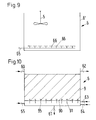
- Fig. 9 shows a highly mixed one Reactor 6 without content.
- a ventilation device 65, 66 cf. Fig.6
- the carrier material according to the invention can also be used for use the fixed bed 9 of a fixed bed reactor 6 - see Fig.10.
- the fixed bed 9 is through an intermediate floor 90 with floor nozzles 91 separated from an upholstery room 95. Rinsing water or Introduce purge air into the upholstery room.
- Other components of the fixed bed reactor 6 are: inlet 60 for the treating water, outlet 61 for the treated water, Outlet 62 for sludge water and feed point 65 for Air or technical oxygen.
- the starting material homogeneous, so that there are carrier bodies, all have the same density. So that the body with Surfaces are wettable, their surfaces must be covered with a Surfactant are treated. So that an overgrowth with bacteria uses, the fresh carrier material must first some Days in contact with water so that substances that inhibit or prevent vegetation from being drained can.
Landscapes
- Life Sciences & Earth Sciences (AREA)
- Biodiversity & Conservation Biology (AREA)
- Microbiology (AREA)
- Hydrology & Water Resources (AREA)
- Engineering & Computer Science (AREA)
- Environmental & Geological Engineering (AREA)
- Water Supply & Treatment (AREA)
- Chemical & Material Sciences (AREA)
- Organic Chemistry (AREA)
- Biological Treatment Of Waste Water (AREA)
- Solid-Sorbent Or Filter-Aiding Compositions (AREA)
Description
- Absetzen von schwerer gewordenen Trägerteilchen, wobei störende Hindernisse für die Bewegung der Teilchen entstehen können.
- Ausscheiden von Trägerteilchen aus dem aktiven Reinigungsprozess.
- Verringerung der Besiedlungsfläche für die Mikroorganismen.
- Fig. 1
- ein Körperchen des erfindungsgemässen Trägermaterials,
- Fig. 2
- ein mit Biomasse bewachsenes Körperchen,
- Fig. 3
- Umrissdarstellungen von Körperchen,
- Fig. 4
- eine Versuchsanordnung,
- Fig. 5
- ein Detail zu Fig.4,
- Fig. 6
- einen Reaktor des SBBR-Typs,
- Fig. 7
- einen Schlaufenreaktor,
- Fig. 8
- einen Wirbelbettreaktor,
- Fig. 9
- einen durchmischten Reaktor und
- Fig. 10
- einen Festbettreaktor
Claims (10)
- Trägermaterial für Biomasse bei Verfahren zum Reinigen von Abwasser, eine Vielzahl von Körperchen (1) umfassend, die mehrheitlich länglich ausgebildet sind, rauhe Oberflächen (10) aufweisen und durch Zerkleinern aus einem Ausgangsstoff hergestellt sind, der weitgehend homogen sowie porenfrei ist und dessen Dichte im Bereich zwischen 1,05 und 1,5 g/cm3 liegt, wobei einer Mehrheit der Körperchen, die mindestens rund 80 Gewichtsprozent derer Gesamtmenge umfasst, folgende statistischen Angaben bezüglich Längen (L) und Breiten (B1, B2) der Körperchen zuordenbar sind: Längen mit Werten von rund 0,5 bis 20 mm und Breiten mit Werten von rund 0,2 bis 3 mm, sowie ein Mittelwert des Verhältnisses von Länge zu grösserer Breite (B1) grösser als 2.
- Trägermaterial nach Anspruch 1, dadurch gekennzeichnet, dass die Dichte des Ausgangsstoffs rund 1,2 g/cm3 beträgt.
- Trägermaterial nach Anspruch 1 oder 2, dadurch gekennzeichnet, dass der Ausgangsstoff ein weitgehend faserfreier Gummi von gebrauchten Autoreifen ist.
- Trägermaterial nach einem der Ansprüche 1 bis 3, dadurch gekennzeichnet, dass das Grössenspektrum der genannten Mehrheit der Körperchen (1) durch folgende Masse charakterisierbar ist: Länge (L) der Körperchen rund 1 bis 5 mm, grössere Breite (B1) rund 0,5 bis 2 mm und kleinere Breite (B2) rund 0,2 bis 2 mm.
- Trägermaterial nach einem der Ansprüche 1 bis 4, dadurch gekennzeichnet, dass die Körperchen (1) mit einem Tensid behandelt sind, das die Benetzbarkeit der Körperchenoberflächen (10) mit Wasser herstellt.
- Verwendung eines Trägermaterials gemäss einem der Ansprüche 1 bis 5, dadurch gekennzeichnet, dass das Material als Träger von sessilen, langsam wachsenden Bakterien dient, die insbesondere eine Nitrifikation oder eine Denitrifikation ausführen können.
- Verwendung eines Trägermaterials nach Anspruch 6, dadurch gekennzeichnet, dass die Bakterien in einem Schlaufenreaktor eingesetzt werden.
- Verwendung eines Trägermaterials nach Anspruch 6, dadurch gekennzeichnet, dass die Bakterien in einem Wirbelbett-/Schwebebettreaktor eingesetzt werden.
- Verwendung eines Trägermaterials nach Anspruch 6, dadurch gekennzeichnet, dass die Bakterien in einem Reaktor des SBR-Typs eingesetzt werden.
- Verwendung eines Trägermaterials nach Anspruch 6, dadurch gekennzeichnet, dass die Bakterien in einem Festbettreaktor oder in einem durchmischten Reaktor eingesetzt werden.
Priority Applications (3)
| Application Number | Priority Date | Filing Date | Title |
|---|---|---|---|
| AT96810038T ATE199883T1 (de) | 1996-01-17 | 1996-01-17 | Trägermaterial für biomasse bei verfahren zum reinigen von abwasser |
| DE59606631T DE59606631D1 (de) | 1996-01-17 | 1996-01-17 | Trägermaterial für Biomasse bei Verfahren zum Reinigen von Abwasser |
| EP19960810038 EP0785171B1 (de) | 1996-01-17 | 1996-01-17 | Trägermaterial für Biomasse bei Verfahren zum Reinigen von Abwasser |
Applications Claiming Priority (1)
| Application Number | Priority Date | Filing Date | Title |
|---|---|---|---|
| EP19960810038 EP0785171B1 (de) | 1996-01-17 | 1996-01-17 | Trägermaterial für Biomasse bei Verfahren zum Reinigen von Abwasser |
Publications (2)
| Publication Number | Publication Date |
|---|---|
| EP0785171A1 EP0785171A1 (de) | 1997-07-23 |
| EP0785171B1 true EP0785171B1 (de) | 2001-03-21 |
Family
ID=8225536
Family Applications (1)
| Application Number | Title | Priority Date | Filing Date |
|---|---|---|---|
| EP19960810038 Expired - Lifetime EP0785171B1 (de) | 1996-01-17 | 1996-01-17 | Trägermaterial für Biomasse bei Verfahren zum Reinigen von Abwasser |
Country Status (3)
| Country | Link |
|---|---|
| EP (1) | EP0785171B1 (de) |
| AT (1) | ATE199883T1 (de) |
| DE (1) | DE59606631D1 (de) |
Families Citing this family (1)
| Publication number | Priority date | Publication date | Assignee | Title |
|---|---|---|---|---|
| CN101462791B (zh) * | 2009-01-16 | 2011-08-17 | 北京中电加美环境工程技术有限责任公司 | 一种用于流动床生物膜处理的悬浮填料 |
Family Cites Families (4)
| Publication number | Priority date | Publication date | Assignee | Title |
|---|---|---|---|---|
| DE2217038A1 (de) * | 1972-04-08 | 1973-10-18 | Burkhard Dr Rer Na Gerstenberg | Tropfkoerperfuellmaterial fuer anlagen zur biologischen abwasserreinigung |
| US4009099A (en) * | 1974-07-12 | 1977-02-22 | Ecolotrol, Inc. | Apparatus and process for removing ammonia nitrogen from waste water |
| DD277066A1 (de) * | 1988-11-16 | 1990-03-21 | Bauakademie Ddr | Tropfkoerper zur biologischen behandlung von abwasser |
| US5439590A (en) * | 1993-05-25 | 1995-08-08 | Envirogen, Inc. | Methods for treating toxic material |
-
1996
- 1996-01-17 EP EP19960810038 patent/EP0785171B1/de not_active Expired - Lifetime
- 1996-01-17 AT AT96810038T patent/ATE199883T1/de not_active IP Right Cessation
- 1996-01-17 DE DE59606631T patent/DE59606631D1/de not_active Expired - Fee Related
Also Published As
| Publication number | Publication date |
|---|---|
| EP0785171A1 (de) | 1997-07-23 |
| DE59606631D1 (de) | 2001-04-26 |
| ATE199883T1 (de) | 2001-04-15 |
Similar Documents
| Publication | Publication Date | Title |
|---|---|---|
| EP0075298B1 (de) | Verfahren und Vorrichtung zur biologischen Reinigung von Abwasser | |
| EP0046901B1 (de) | Verfahren und Vorrichtung zur anaeroben biologischen Reinigung von Abwasser | |
| DE69104629T3 (de) | Methode und reaktor zur reinigung von wasser. | |
| EP0046900B2 (de) | Verfahren und Vorrichtung zur biologischen Reinigung von Abwasser | |
| DE69101540T2 (de) | Reaktor für biologische Oxydation und Reduktion; Verfahren für biologische Filtration und Verfahren zum Spülen des Reaktors. | |
| DE8906830U1 (de) | Biologischer Klärreaktor nach dem aeroben/fakultativen Prinzip | |
| EP0268225B1 (de) | Verfahren und Einrichtung zum biologischen Reinigen von Abwasser | |
| DE4403716C1 (de) | Verfahren und Reaktor zur mikrobiologischen Wasserbehandlung mit hohem Sauerstoffbedarf | |
| EP0880476A1 (de) | Verfahren und anlage zur abwasseraufbereitung | |
| EP0075297B1 (de) | Verfahren zur biologischen Denitrifikation von Abwasser | |
| DE2239205A1 (de) | Verfahren und vorrichtung zur abwasserreinigung | |
| DE19501260C1 (de) | Verfahren und Vorrichtung zur Behandlung von Abwässern | |
| EP0208253B1 (de) | Verfahren und Vorrichtung zur biologischen Reinigung von Abwasser | |
| EP0812807B1 (de) | Verfahren und Reaktor zur kontinuierlichen mikrobiologischen Behandlung von hochbelastetem Abwasser | |
| EP0785171A1 (de) | Trägermaterial für Biomasse bei Verfahren zum Reinigen von Abwasser | |
| DE3439548A1 (de) | Verfahren und vorrichtung zur biologischen behandlung von abwasser | |
| DD241406A1 (de) | Duesenbodenloser rieselfilmreaktor zur kontinuierlichen eliminierung geloester wasserinhaltsstoffe | |
| DE19603959C1 (de) | Verfahren und Vorrichtung zum Behandeln von biologisch belastetem Abwasser, insbesondere von Haushaltsabwasser | |
| AT392636B (de) | Biologisches filter fuer wasserreinigungsanlagen | |
| EP1783102B1 (de) | Verfahren zur mikrobiologischen aeroben Abwasserbehandlung | |
| DE3873511T2 (de) | Abwasserbehandlungsanlage. | |
| EP0486748A1 (de) | Verfahren und Biofilmreaktoren zur biologischen Behandlung von organisch belastetem Abwasser | |
| EP0501355B1 (de) | Verfahren zur anaeroben Wasserbehandlung, insbesondere zur mikrobiellen Nitrateliminierung aus Trinkwasser | |
| DE69924984T2 (de) | Verfahren und anlage zur biologischen reinigung von abwasser | |
| EP1153891B1 (de) | Verfahren und Reaktor zur biologischen und/oder physikalischen Elimination unerwünschter Wasserinhaltsstoffe aus Wasser |
Legal Events
| Date | Code | Title | Description |
|---|---|---|---|
| PUAI | Public reference made under article 153(3) epc to a published international application that has entered the european phase |
Free format text: ORIGINAL CODE: 0009012 |
|
| AK | Designated contracting states |
Kind code of ref document: A1 Designated state(s): AT BE CH DE DK ES FR GB GR IE IT LI LU MC NL PT SE |
|
| AX | Request for extension of the european patent |
Free format text: LT;SI |
|
| 17P | Request for examination filed |
Effective date: 19971222 |
|
| 17Q | First examination report despatched |
Effective date: 19990401 |
|
| GRAG | Despatch of communication of intention to grant |
Free format text: ORIGINAL CODE: EPIDOS AGRA |
|
| GRAG | Despatch of communication of intention to grant |
Free format text: ORIGINAL CODE: EPIDOS AGRA |
|
| GRAH | Despatch of communication of intention to grant a patent |
Free format text: ORIGINAL CODE: EPIDOS IGRA |
|
| GRAH | Despatch of communication of intention to grant a patent |
Free format text: ORIGINAL CODE: EPIDOS IGRA |
|
| GRAA | (expected) grant |
Free format text: ORIGINAL CODE: 0009210 |
|
| AK | Designated contracting states |
Kind code of ref document: B1 Designated state(s): AT CH DE LI NL PT SE |
|
| PG25 | Lapsed in a contracting state [announced via postgrant information from national office to epo] |
Ref country code: NL Free format text: LAPSE BECAUSE OF FAILURE TO SUBMIT A TRANSLATION OF THE DESCRIPTION OR TO PAY THE FEE WITHIN THE PRESCRIBED TIME-LIMIT Effective date: 20010321 Ref country code: FR Free format text: LAPSE BECAUSE OF NON-PAYMENT OF DUE FEES Effective date: 20010321 |
|
| REF | Corresponds to: |
Ref document number: 199883 Country of ref document: AT Date of ref document: 20010415 Kind code of ref document: T |
|
| REG | Reference to a national code |
Ref country code: CH Ref legal event code: EP |
|
| REF | Corresponds to: |
Ref document number: 59606631 Country of ref document: DE Date of ref document: 20010426 |
|
| RAP2 | Party data changed (patent owner data changed or rights of a patent transferred) |
Owner name: VA TECH WABAG AG WINTERTHUR |
|
| PG25 | Lapsed in a contracting state [announced via postgrant information from national office to epo] |
Ref country code: SE Free format text: LAPSE BECAUSE OF FAILURE TO SUBMIT A TRANSLATION OF THE DESCRIPTION OR TO PAY THE FEE WITHIN THE PRESCRIBED TIME-LIMIT Effective date: 20010621 Ref country code: PT Free format text: LAPSE BECAUSE OF FAILURE TO SUBMIT A TRANSLATION OF THE DESCRIPTION OR TO PAY THE FEE WITHIN THE PRESCRIBED TIME-LIMIT Effective date: 20010621 Ref country code: DK Free format text: LAPSE BECAUSE OF FAILURE TO SUBMIT A TRANSLATION OF THE DESCRIPTION OR TO PAY THE FEE WITHIN THE PRESCRIBED TIME-LIMIT Effective date: 20010621 |
|
| NLT2 | Nl: modifications (of names), taken from the european patent patent bulletin |
Owner name: VA TECH WABAG AG WINTERTHUR |
|
| EN | Fr: translation not filed | ||
| NLV1 | Nl: lapsed or annulled due to failure to fulfill the requirements of art. 29p and 29m of the patents act | ||
| PLBE | No opposition filed within time limit |
Free format text: ORIGINAL CODE: 0009261 |
|
| STAA | Information on the status of an ep patent application or granted ep patent |
Free format text: STATUS: NO OPPOSITION FILED WITHIN TIME LIMIT |
|
| PGFP | Annual fee paid to national office [announced via postgrant information from national office to epo] |
Ref country code: IE Payment date: 20020131 Year of fee payment: 7 |
|
| 26N | No opposition filed | ||
| PGFP | Annual fee paid to national office [announced via postgrant information from national office to epo] |
Ref country code: AT Payment date: 20040102 Year of fee payment: 9 |
|
| PGFP | Annual fee paid to national office [announced via postgrant information from national office to epo] |
Ref country code: CH Payment date: 20040106 Year of fee payment: 9 |
|
| PGFP | Annual fee paid to national office [announced via postgrant information from national office to epo] |
Ref country code: DE Payment date: 20040108 Year of fee payment: 9 |
|
| PG25 | Lapsed in a contracting state [announced via postgrant information from national office to epo] |
Ref country code: AT Free format text: LAPSE BECAUSE OF NON-PAYMENT OF DUE FEES Effective date: 20050117 |
|
| PG25 | Lapsed in a contracting state [announced via postgrant information from national office to epo] |
Ref country code: LI Free format text: LAPSE BECAUSE OF NON-PAYMENT OF DUE FEES Effective date: 20050131 Ref country code: CH Free format text: LAPSE BECAUSE OF NON-PAYMENT OF DUE FEES Effective date: 20050131 |
|
| PG25 | Lapsed in a contracting state [announced via postgrant information from national office to epo] |
Ref country code: DE Free format text: LAPSE BECAUSE OF NON-PAYMENT OF DUE FEES Effective date: 20050802 |
|
| REG | Reference to a national code |
Ref country code: CH Ref legal event code: PL |