EP0785444A2 - Détecteur de rayonnement avec une sensibilité accrue - Google Patents
Détecteur de rayonnement avec une sensibilité accrue Download PDFInfo
- Publication number
- EP0785444A2 EP0785444A2 EP97200120A EP97200120A EP0785444A2 EP 0785444 A2 EP0785444 A2 EP 0785444A2 EP 97200120 A EP97200120 A EP 97200120A EP 97200120 A EP97200120 A EP 97200120A EP 0785444 A2 EP0785444 A2 EP 0785444A2
- Authority
- EP
- European Patent Office
- Prior art keywords
- crystal
- end surfaces
- detector
- portions
- axis
- Prior art date
- Legal status (The legal status is an assumption and is not a legal conclusion. Google has not performed a legal analysis and makes no representation as to the accuracy of the status listed.)
- Withdrawn
Links
- 230000005855 radiation Effects 0.000 title claims description 6
- 230000004044 response Effects 0.000 title abstract description 25
- 239000013078 crystal Substances 0.000 claims abstract description 47
- 229910052793 cadmium Inorganic materials 0.000 claims abstract description 5
- BDOSMKKIYDKNTQ-UHFFFAOYSA-N cadmium atom Chemical compound [Cd] BDOSMKKIYDKNTQ-UHFFFAOYSA-N 0.000 claims abstract description 5
- PBYZMCDFOULPGH-UHFFFAOYSA-N tungstate Chemical compound [O-][W]([O-])(=O)=O PBYZMCDFOULPGH-UHFFFAOYSA-N 0.000 claims abstract description 5
- 238000006243 chemical reaction Methods 0.000 claims description 7
- 239000007787 solid Substances 0.000 claims description 6
- XUIMIQQOPSSXEZ-UHFFFAOYSA-N Silicon Chemical compound [Si] XUIMIQQOPSSXEZ-UHFFFAOYSA-N 0.000 claims description 2
- 229910052710 silicon Inorganic materials 0.000 claims description 2
- 239000010703 silicon Substances 0.000 claims description 2
- 229940065285 cadmium compound Drugs 0.000 claims 2
- 150000001662 cadmium compounds Chemical class 0.000 claims 2
- 238000003325 tomography Methods 0.000 abstract description 6
- 230000003287 optical effect Effects 0.000 abstract description 5
- 239000013598 vector Substances 0.000 description 10
- 230000004298 light response Effects 0.000 description 7
- 238000004458 analytical method Methods 0.000 description 5
- 239000000758 substrate Substances 0.000 description 5
- 230000000694 effects Effects 0.000 description 4
- FVAUCKIRQBBSSJ-UHFFFAOYSA-M sodium iodide Chemical compound [Na+].[I-] FVAUCKIRQBBSSJ-UHFFFAOYSA-M 0.000 description 3
- 239000000463 material Substances 0.000 description 2
- 230000004048 modification Effects 0.000 description 2
- 238000012986 modification Methods 0.000 description 2
- 238000004513 sizing Methods 0.000 description 2
- 230000000638 stimulation Effects 0.000 description 2
- 239000011358 absorbing material Substances 0.000 description 1
- 230000001154 acute effect Effects 0.000 description 1
- 238000003491 array Methods 0.000 description 1
- SILMSBFCJHBWJS-UHFFFAOYSA-K bis(germine-1-carbonyloxy)bismuthanyl germine-1-carboxylate Chemical compound [Bi+3].[O-]C(=O)[Ge]1=CC=CC=C1.[O-]C(=O)[Ge]1=CC=CC=C1.[O-]C(=O)[Ge]1=CC=CC=C1 SILMSBFCJHBWJS-UHFFFAOYSA-K 0.000 description 1
- 239000007767 bonding agent Substances 0.000 description 1
- WUKWITHWXAAZEY-UHFFFAOYSA-L calcium difluoride Chemical compound [F-].[F-].[Ca+2] WUKWITHWXAAZEY-UHFFFAOYSA-L 0.000 description 1
- 229910001634 calcium fluoride Inorganic materials 0.000 description 1
- 239000003795 chemical substances by application Substances 0.000 description 1
- 238000002591 computed tomography Methods 0.000 description 1
- 238000001514 detection method Methods 0.000 description 1
- 238000003745 diagnosis Methods 0.000 description 1
- 230000003116 impacting effect Effects 0.000 description 1
- 230000000750 progressive effect Effects 0.000 description 1
- 230000009467 reduction Effects 0.000 description 1
- 239000004065 semiconductor Substances 0.000 description 1
- 235000009518 sodium iodide Nutrition 0.000 description 1
- 230000008646 thermal stress Effects 0.000 description 1
Images


Classifications
-
- G—PHYSICS
- G01—MEASURING; TESTING
- G01T—MEASUREMENT OF NUCLEAR OR X-RADIATION
- G01T1/00—Measuring X-radiation, gamma radiation, corpuscular radiation, or cosmic radiation
- G01T1/16—Measuring radiation intensity
- G01T1/20—Measuring radiation intensity with scintillation detectors
- G01T1/2018—Scintillation-photodiode combinations
- G01T1/20187—Position of the scintillator with respect to the photodiode, e.g. photodiode surrounding the crystal, the crystal surrounding the photodiode, shape or size of the scintillator
-
- G—PHYSICS
- G01—MEASURING; TESTING
- G01T—MEASUREMENT OF NUCLEAR OR X-RADIATION
- G01T1/00—Measuring X-radiation, gamma radiation, corpuscular radiation, or cosmic radiation
- G01T1/16—Measuring radiation intensity
- G01T1/20—Measuring radiation intensity with scintillation detectors
- G01T1/202—Measuring radiation intensity with scintillation detectors the detector being a crystal
Definitions
- the invention relates generally to radiation detectors and relates more particularly to scintillation crystal x-ray detectors of the type used in computer-assisted tomography for medical or other purposes.
- Computer-assisted tomography is used primarily for medical diagnosis to construct an image of internal tissue.
- the object to be examined is placed between an x-ray beam source and a detector device.
- the x-ray beam passes through the tissue to the detector, which gives an electrical output signal indicative of the attenuation of the beam. Differences in tissue structure result in known different degrees of attenuation for the x-ray beam.
- Multiple exposures through progressive "slices" of the tissue in a series of planes and from a scanning through different angles in each plane are made, and the resulting output information from the detector device is sent to a computer for processing by inverse theory to construct an image which can appear on a cathode ray screen or be otherwise processed and depicted.
- the detector device is made up of one or more detector channels.
- a channel is a detector and its associated electronics.
- a detector is made up of a scintillation device for converting the x-radiation to light and an optical conversion device for converting the light to an electrical signal.
- a scintillation device for computer-assisted tomography.
- the scintillation crystal which may be made of cadmium tungstate (CdWO 4 ) converts the x-radiation to visible light, which then travels to the photodetector attached directly to the crystal and is converted to a representative electrical output signal for input to the computer.
- CdWO 4 cadmium tungstate
- the crystals are in the form of small rods with a rectangular cross-section, an example of which is shown in FIGS 1 and 2.
- the detector 10 of FIGS. 1 and 2 features a scintillation crystal 12 having a longitudinal axis 14, an input face 16, an output face 18 opposite the input face 16, end faces 20, and side faces 22.
- the detectors are sandwiched together with their side faces adjacent each other and separated by a collimating wall of x-ray absorbing material which prevents channel cross-talk.
- the output face is bonded by means of a transparent agent directly to a silicon photodiode 24.
- a transparent agent directly to a silicon photodiode 24.
- Examples of such detectors may be found in United States Patents 4,694,177 issued Sept. 15, 1987 to Akai and 4,725,734 issued Feb. 16, 1988 to Nishiki. A discussion of the general design considerations for such detectors may be found in Glasow et al's "Aspects of Semiconductor Current Mode Detectors for X-Ray Computed Tomography" in IEEE Transaction on Nuclear Science, Vol. NS-28, No. 1, February 1981, pp. 563-571.
- a typical presently-used detector crystal is a rectangaloid bar of scintillator material, such as CdWO4, which is 20 mm (millimeters) to 30 mm long, from 0.5 to 2mm wide and 2 mm to 3 mm thick with end faces which are perpendicular to the longitudinal axis of the crystal.
- the thickness of the bars is determined by the amount of the particular scintillator required to absorb the x-ray beam; the width of the bar is determined by the resolution required.
- the length of the channels is determined by the size of the picture, or thickness of the "slice", being taken and the response characteristic or amount of signal deviation allowed.
- a 20mm long useful crystal length is required for a single plane exposure
- a 30mm long crystal may be required to meet the performance requirements.
- the bar is made slightly larger than the photodiode to which it is attached, so that x-rays cannot reach the diode directly and cause unwanted noise in the system.
- the end faces 20 extend typically about 0.5 mm beyond the photodiode 24 and the side faces 22 extend typically about 5% of the width of the crystal 12 over the photodiode 24.
- the useful length for detection can be considered to be about the middle 20 mm of its length.
- the best response of the detector to incident radiation is when the midpoint of the radiation beam is incident at its axial central.
- there are deviations of the midpoint of the beam from the midpoint of the detector perhaps as a result of vibrations, thermal stress-induced misalignments in the equipment, or other factors which may effect the beam direction.
- It is a drawback of present scintillation crystals used in computer-assisted tomography detectors that when the midpoint of the beam is not incident on the crystal precisely at its longitudinal midpoint, the corresponding light output from the crystal to the photodiode may be reduced, thus yielding a signal which includes a false attenuation and can result in the inclusion of erroneous data in the image to be generated.
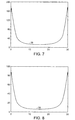
- the curve 25 of FIG. 5 is a graphical representation of the signal strength variation along the longitudinal axis of the crystal 12 of FIGS. 1 and 2 as an x-ray beam of constant intensity is moved along the longitudinal axis from one end of the crystal to the other.
- the abscissa indicates the longitudinal position in millimeters.
- the ordinate indicates an arbitrary magnitude of output signal from the photodiode 24, with the assumption that there are no serious nonlinearities present. It is seen that only about the central two-thirds of the length has a relatively flat response.
- the invention addresses the non-uniform response problem of the detector by redirecting the internally-reflected portion of the light created in the scintillation crystal so that the output response is altered. This is accomplished by beveling the ends of the crystal to form reflective surfaces which are non-perpendicular to the longitudinal axis of the crystal and which redirect the reflected light in the detector to affect the response curve. In this manner, the response can be made more uniform for longitudinally varying x-ray beam positions or can be otherwise altered as desired.
- FIG. 1 is a front view of a prior art detector.
- FIG. 2 is a side view of the detector of FIG. 1
- FIG. 3 is a front view of a novel detector having modified ends in accordance with a preferred embodiment of the present invention.
- FIG. 4 is a side view of the detector of FIG. 3
- FIG. 5 is a graph showing the calculated response curve of the detector of FIGS. 1 and 2.
- FIG. 6 is a graph showing the calculated response curve of the detector of FIGS. 3 and 4.
- FIG. 7 is a graph showing the calculated light output of the detector of FIGS. 3 and 4 which is due to only internally reflected light from the modified ends.
- FIG. 8 is a graph showing the response of the graph of FIG. 7 as adjusted to account for internal reflection losses.
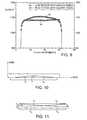
- FIG. 9 is a graph showing data plots comparing the responses of the detector of FIGS. 1 and 2 and the detector of FIGS. 3 and 4.
- FIG. 10 is a front view of the prior art detector of FIGS 1 and 2 showing vectors for calculating the theoretical light response.
- FIG. 11 is a front view of the detector of FIGS. 3 and 4 showing vectors for calculating the theoretical light response attributable to reflections from the modified ends.
- a novel detector 26 shown in FIGS. 3 and 4 comprises a scintillation crystal 28 bonded with a transparent bonding agent to a photodiode substrate 24.
- the crystal 26 is a right rectangaloid which has an input face 16, an output face 18 opposite and parallel to the input face 16, end faces 20, and mutually parallel side faces 22.
- the ends additionally have reflecting bevel surfaces 30.
- the crystal 28 is of cadmium tungstate. It has a thickness "B" of 2.5 cm (centimeters), a length "C” of 30 cm, and a useful length "D" of 20 cm.
- the ends extend beyond the ends of the photodiode substrate 24 by a distance "A" of 0.5 cm.
- the photodiode substrate 24 has a length "E" of 29 cm.
- the width of the crystal 28 is 1.5 cm.
- the width of the photodiode substrate 24 is 10% less than that of the cyrstal 28, so that there is a 5% overhang of the crystal 28 on each side of the photodiode substrate 24
- the bevel surfaces 30 form reflecting facets oriented at 45 degrees to the output face 18 and extending from a shoulder 32 which is 1 mm above and parallel to the output face 18.
- the bevel surfaces 30 result in internal reflection modes in the crystal 26 which flatten out the light response to the photodiode 24, so that more of the length of the crystal may be actively used to receive the beam. This permits the use of shorter crystals, thereby reducing both the cost and size of the detector.
- the light response for the crystal 26 is shown by the curve 34 in the graph of FIG. 6.
- the response curve of the light reflected internally from the modified ends taken alone is represented by the curve 36 which appears in the FIG. 7, in which again the abscissa is the location in millimeters along the rod, while the ordinate is the photodiode output.
- the resulting response curve 38 of FIG. 8 normalized with the ordinate values of the response curve 25 of FIG. 5, is shown as the curve 34 in FIG. 6.
- the curve 40 of FIG. 9 shows a plot of the actual output values for the detector 10 of FIGS. 1 and 2 without the bevel surfaces 32 of the invention as compared to the curve 42 showing the actual output values for the detector 26 of FIGS. 3 and 4 with the bevel surfaces 32 according to the invention.
- the detector crystal 28 of the above embodiment is of cadmium tungstate, it may also be of other suitable scintillating material, such as sodium iodide, calcium fluoride, or bismuth germinate and derive similar benefits from the invention.
- the optical conversion device of the described embodiment is a solid state photodiode, it should be understood that any suitable device for performing the conversion of optical signals to electrical ones could be used.
- the size of the bevel surface effects the output response. Therefore, it should be chosen to effect the response as is desired for a particular application, based on the optical principles involved in the light response analysis described in detail below.
- the bevel surface could conceivably include the entire end faces, if necessary. However, for a bevel surface at 45 degrees, such as for the crystal 28, this would leave a relatively fragile edge at the output face of the crystal. Therefore, the bevel surface is preferably started a small distance up from the output face.
- the bevel surface may be any angular orientation which is non-perpendicular to the longitudinal axis of the crystal in order to effect the desired modification of the response of the detector.
- Such bevel surfaces may be provided at one or both ends which are specifically designed to shape the response a certain way for a particular application, for example where a response other than one optimized for flatness is desired.
- the present invention permits deliberate modification of the response by appropriate orientation and sizing of faceted surfaces at one or both ends of the crystal.
- the appropriate orientation and sizing of such faceted surfaces can be readily established by an analysis of the internal reflections by known analytical techniques such as are described below.
- the light response for the novel detector 26 of FIGS. 3 and 4 can be analyzed as follows:
- V i and V2 The definition of the dot product for the vectors V i and V2 gives the angle " ⁇ " between the vectors.
- ⁇ cos -1 ⁇ (X 2 -CX+D) (X 4 +EX 3 +FX 2 +GH+H) -1/2 ⁇
- G 2CA 2 -1 ⁇ 2CB 2 -2C 2
- a H 1 / 16 B 4 + 1/4 B 2 C 2 + 1/2 B 2 A 2 - 1/2 B 2 AC+A 2 C 2 +A 4 -2A 3 C
- ⁇ COS -1 ⁇ (X 2 -30X + 16.3125
- this graph varies inversely to the original.
- the light intensity is greater at the edges and has a minimum value in the middle exactly the opposite to that of the graph of FIG. 5, thus proving that the angled edges will help reduce the deviation of the output.
- the amount of help depends on what percentage of light impacting on the angled surfaces is actually reflected to the detector. The higher this percentage is, the less deviation there will be in the total output to the detector. If it is assumed that 50% of the light impinging on the beveled surfaces reaches the photodiode 24 of FIGURES 3 and 4, then a response as shown by the curve 38 of FIG. 8 is generated. When this response is combined with the output of the normal detector 10 of FIGS. 1 and 2 as shown by curve 25 of FIG. 5, then the resultant response becomes as is shown by the curve 34 of FIG. 6 for the novel detector 26 of FIGS. 3 and 4.
Landscapes
- Chemical & Material Sciences (AREA)
- Crystallography & Structural Chemistry (AREA)
- Physics & Mathematics (AREA)
- Health & Medical Sciences (AREA)
- Life Sciences & Earth Sciences (AREA)
- General Physics & Mathematics (AREA)
- High Energy & Nuclear Physics (AREA)
- Molecular Biology (AREA)
- Spectroscopy & Molecular Physics (AREA)
- Measurement Of Radiation (AREA)
- Apparatus For Radiation Diagnosis (AREA)
Applications Claiming Priority (2)
| Application Number | Priority Date | Filing Date | Title |
|---|---|---|---|
| US10205 | 1993-01-28 | ||
| US1020596P | 1996-01-18 | 1996-01-18 |
Publications (2)
| Publication Number | Publication Date |
|---|---|
| EP0785444A2 true EP0785444A2 (fr) | 1997-07-23 |
| EP0785444A3 EP0785444A3 (fr) | 2000-01-05 |
Family
ID=21744492
Family Applications (1)
| Application Number | Title | Priority Date | Filing Date |
|---|---|---|---|
| EP97200120A Withdrawn EP0785444A3 (fr) | 1996-01-18 | 1997-01-15 | Détecteur de rayonnement avec une sensibilité accrue |
Country Status (3)
| Country | Link |
|---|---|
| EP (1) | EP0785444A3 (fr) |
| JP (1) | JPH09203781A (fr) |
| CA (1) | CA2194942A1 (fr) |
Cited By (1)
| Publication number | Priority date | Publication date | Assignee | Title |
|---|---|---|---|---|
| EP1387185A1 (fr) * | 2002-07-29 | 2004-02-04 | GE Medical Systems Global Technology Company LLC | Détecteur de rayonnement avec le scintillator formé pour la sensibilité réduite d'erreur |
Families Citing this family (1)
| Publication number | Priority date | Publication date | Assignee | Title |
|---|---|---|---|---|
| US6800858B1 (en) * | 2001-11-02 | 2004-10-05 | Varian Medical Systems Technologies, Inc. | X-ray image acquisition apparatus |
Citations (2)
| Publication number | Priority date | Publication date | Assignee | Title |
|---|---|---|---|---|
| US4694177A (en) | 1984-11-02 | 1987-09-15 | Kabushiki Kaisha Toshiba | Radiation detector having high efficiency in conversion of absorbed X-rays into light |
| US4725734A (en) | 1984-05-10 | 1988-02-16 | Kabushiki Kaisha Toshiba | Radiation-detecting device for computed tomography |
Family Cites Families (3)
| Publication number | Priority date | Publication date | Assignee | Title |
|---|---|---|---|---|
| US4220860A (en) * | 1978-07-24 | 1980-09-02 | Ohio Nuclear, Inc. | Tomographic scanner with cadmium tungstate scintillation crystals |
| EP0378896A3 (fr) * | 1988-11-23 | 1991-05-22 | Picker International, Inc. | Détecteurs de rayonnement |
| US5241180A (en) * | 1992-08-05 | 1993-08-31 | General Electric Company | Radiation detection devices with tapered scintillator crystals |
-
1997
- 1997-01-13 CA CA002194942A patent/CA2194942A1/fr not_active Abandoned
- 1997-01-15 EP EP97200120A patent/EP0785444A3/fr not_active Withdrawn
- 1997-01-20 JP JP9007631A patent/JPH09203781A/ja active Pending
Patent Citations (2)
| Publication number | Priority date | Publication date | Assignee | Title |
|---|---|---|---|---|
| US4725734A (en) | 1984-05-10 | 1988-02-16 | Kabushiki Kaisha Toshiba | Radiation-detecting device for computed tomography |
| US4694177A (en) | 1984-11-02 | 1987-09-15 | Kabushiki Kaisha Toshiba | Radiation detector having high efficiency in conversion of absorbed X-rays into light |
Cited By (2)
| Publication number | Priority date | Publication date | Assignee | Title |
|---|---|---|---|---|
| EP1387185A1 (fr) * | 2002-07-29 | 2004-02-04 | GE Medical Systems Global Technology Company LLC | Détecteur de rayonnement avec le scintillator formé pour la sensibilité réduite d'erreur |
| US6979826B2 (en) | 2002-07-29 | 2005-12-27 | Ge Medical Systems Global Technology Company Llc | Scintillator geometry for enhanced radiation detection and reduced error sensitivity |
Also Published As
| Publication number | Publication date |
|---|---|
| JPH09203781A (ja) | 1997-08-05 |
| EP0785444A3 (fr) | 2000-01-05 |
| CA2194942A1 (fr) | 1997-07-19 |
Similar Documents
| Publication | Publication Date | Title |
|---|---|---|
| US4415808A (en) | Scintillation detector array employing zig-zag plates | |
| CA2742127C (fr) | Systemes de detection multi-ecrans | |
| US4303860A (en) | High resolution radiation detector | |
| US4503332A (en) | Grazing angle detector array | |
| US20200233100A1 (en) | X-Ray Detector With Multi-Layer Dielectric Reflector | |
| JP3332200B2 (ja) | X線ct用放射線検出器 | |
| CN101796428B (zh) | 减小了边缘效应的检测器 | |
| EP2751598B1 (fr) | Détecteur de rayonnement | |
| US6881960B2 (en) | Thick scintillation plate with internal light collimation | |
| US6005908A (en) | X-ray computed tomography apparatus with radiation detector which reduces image unsharpness | |
| US5118934A (en) | Fiber fed x-ray/gamma ray imaging apparatus | |
| JPH0634712Y2 (ja) | X線検出装置 | |
| US6124595A (en) | Gamma ray imaging detector with three dimensional event positioning and method of calculation | |
| EP0710854A2 (fr) | Plaque de scintillation à rayons X utilisant des fibres optiques diagonales | |
| EP3724690B1 (fr) | Scintillateur pixélisé multicouche à facteur de remplissage élargi | |
| US20020003863A1 (en) | X-ray image detecting apparatus | |
| EP1761802B1 (fr) | Detecteur de rayons x avec correction d'effets de dispersion de rayonnement | |
| JP2948264B2 (ja) | X線ct装置用検出器およびその製造方法 | |
| EP0785444A2 (fr) | Détecteur de rayonnement avec une sensibilité accrue | |
| US5763887A (en) | Tailored optical interface for scintillation camera detector | |
| CN1183631A (zh) | 用于x射线断层摄影装置的检测器 | |
| US20090184250A1 (en) | Radiation detector, x-ray ct apparatus, and method for manufacturing radiation detector | |
| JP2851319B2 (ja) | 放射線計測装置の放射線検出部 | |
| GB2144960A (en) | X- or gamma -ray detector array | |
| CN118339621A (zh) | 使用后准直器的检测器的目标准直 |
Legal Events
| Date | Code | Title | Description |
|---|---|---|---|
| PUAI | Public reference made under article 153(3) epc to a published international application that has entered the european phase |
Free format text: ORIGINAL CODE: 0009012 |
|
| AK | Designated contracting states |
Kind code of ref document: A2 Designated state(s): DE FR GB |
|
| RAP1 | Party data changed (applicant data changed or rights of an application transferred) |
Owner name: SAINT-GOBAIN INDUSTRIAL CERAMICS, INC. |
|
| PUAL | Search report despatched |
Free format text: ORIGINAL CODE: 0009013 |
|
| AK | Designated contracting states |
Kind code of ref document: A3 Designated state(s): DE FR GB |
|
| RIC1 | Information provided on ipc code assigned before grant |
Free format text: 7G 01T 1/00 A, 7G 01T 1/202 B, 7G 01T 1/20 B |
|
| 17P | Request for examination filed |
Effective date: 20000705 |
|
| STAA | Information on the status of an ep patent application or granted ep patent |
Free format text: STATUS: THE APPLICATION HAS BEEN WITHDRAWN |
|
| 18W | Application withdrawn |
Withdrawal date: 20010613 |