EP0785908B1 - Methode zur behandlung von flüssigkeiten zur verhinderungdes wachsens von lebenden organismen - Google Patents
Methode zur behandlung von flüssigkeiten zur verhinderungdes wachsens von lebenden organismen Download PDFInfo
- Publication number
- EP0785908B1 EP0785908B1 EP95935649A EP95935649A EP0785908B1 EP 0785908 B1 EP0785908 B1 EP 0785908B1 EP 95935649 A EP95935649 A EP 95935649A EP 95935649 A EP95935649 A EP 95935649A EP 0785908 B1 EP0785908 B1 EP 0785908B1
- Authority
- EP
- European Patent Office
- Prior art keywords
- conduit
- oxidant
- amine source
- active biocidal
- liquid
- Prior art date
- Legal status (The legal status is an assumption and is not a legal conclusion. Google has not performed a legal analysis and makes no representation as to the accuracy of the status listed.)
- Expired - Lifetime
Links
Images

Classifications
-
- C—CHEMISTRY; METALLURGY
- C02—TREATMENT OF WATER, WASTE WATER, SEWAGE, OR SLUDGE
- C02F—TREATMENT OF WATER, WASTE WATER, SEWAGE, OR SLUDGE
- C02F1/00—Treatment of water, waste water, or sewage
- C02F1/50—Treatment of water, waste water, or sewage by addition or application of a germicide or by oligodynamic treatment
-
- C—CHEMISTRY; METALLURGY
- C02—TREATMENT OF WATER, WASTE WATER, SEWAGE, OR SLUDGE
- C02F—TREATMENT OF WATER, WASTE WATER, SEWAGE, OR SLUDGE
- C02F2103/00—Nature of the water, waste water, sewage or sludge to be treated
- C02F2103/02—Non-contaminated water, e.g. for industrial water supply
- C02F2103/023—Water in cooling circuits
Definitions
- the present invention relates to a method of treating a liquid to inhibit the growth of living organisms.
- the invention is particularly useful to prevent biological fouling of circulating water, and is therefore described below with respect to that application, but it will be appreciated that the invention could be used in other applications as well.
- US-A-3328294 discloses a process for control of micro-organisms in process streams. This process employs an amine source and an oxidant.
- US-A-3222276 discloses a bromination process to inhibit growth of living organisms.
- An object of the present invention is to provide a method and apparatus for treating liquids to inhibit growth of living organisms.
- a method of treating a liquid to inhibit growth of living organisms therein by adding to the liquid an active biocidal ingredient formed by mixing an oxidant and an amine source comprising:
- synchronously metering the two dilutions, it is meant metering the amine source and the oxidant to the two water streams in a manner having the same time and molar relation and then metering the two dilutions in a manner also having the same time and molar relation.
- the synchronous metering is effected by venturi pumps but could also be effected in other manners, such as by peristaltic pumps and pulsatile pumps operating with the same time and displacement relationship.
- a method of treating a liquid to inhibit growth of living organisms therein by adding to the liquid an active biocidal ingredient formed by mixing an oxidant and an amine source characterised in:
- the oxidant may be continuously injected into the first stream of water by a first dosing pump conducting the first stream of water through the first conduit and connected to a reservoir of the oxidant.
- the amine source may be continuously injected into the second stream of water by a second dosing pump, synchronously operated with the first dosing pump, conducting the second stream of water through the second conduit and connected to a reservoir of the amine source.
- Both dosing pumps are preferably venturi tubes, peristaltic pumps, high-frequency, low-displacement pulsatile pumps, or the like.
- the concentrated active biocidal ingredient, as produced in situ should have a pH of at least 7.0, more preferably over 9.0, before being injected into the liquid being treated.
- the liquid being treated should preferably have a pH of 5-10.5, more preferably 7-9.
- the active biocidal ingredient produced in situ is injected into the liquid being treated preferably to a concentration of 0.5-300 ppm, more preferably 3-10 ppm, expressed as chlorine.
- the amine source may contain a detergent, surfactant, water treatment chemicals, color, and/or a base, e.g. NaOH or NH 3 OH. Preferably, it has a concentration of 0.1-50%, more preferably 2.5-30%, and could be equimolar to Cl 2 .
- the oxidant has a concentration of 0.3-15%, more preferably 5-15%, expressed as Cl 2 .
- the diluted oxidant has a concentration of 0.1%-2.0%, expressed as Cl 2 .
- apparatus for treating a liquid to inhibit growth of living organisms therein by adding to the liquid a active biocidal ingredient formed by continuously and synchronously mixing an oxidant and an amine source comprising:
- the novel method and apparatus enable the constant ratio of oxidant/amine source to be maintained, thereby avoiding the need to use excess amine source in order to stabilize the reaction product and to maintain a reproducible product containing almost no degradation products.
- the novel method produces an efficient in situ dilution of both the oxidant and the amine source, thereby avoiding the need for pre-dilution of the respective ingredients in water, storing in large tanks, etc.
- the above-described efficient method for producing an active biocidal ingredient allows a comparison to be made between efficacies exhibited by active biocidal ingredients derived from various amine sources and ammonium salts. Such a comparison shows that an active biocidal ingredient derived from ammonium bromide exhibits superior efficacy and faster rate of kill in basic media as compared to active biocidal ingredients derived from other amine sources; and that for treating acidic media, the active biocidal ingredient derived from ammonium carbonate exhibits superior efficacy.
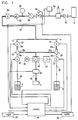
- the apparatus illustrated in Fig. 1 is intended to treat a liquid, such as water in a cooling tower, waste water, or the like, used at a location, schematically indicated at 2 in the drawing, to disinfect that liquid or otherwise to inhibit growth of living organisms in that liquid. This is done by adding to the liquid at location 2 an active biocidal ingredient formed by mixing in situ two solutions, namely an oxidant solution within a reservoir 4, and an amine source solution within a reservoir 6.
- water e.g., tap water is fed from a source 8 via a water pipe 10 through a pair of branch lines 12, 14, connected in parallel to each other, to a common outlet pipe 16 leading to the liquid to be treated at the location 2.
- Each of the two parallel branch lines 12, 14, includes a venturi tube 18, 20 having an inlet port 18a, 20a, connected in the respective branch line 12, 14, and an outlet port 18b, 20b, connected to the common outlet line 16 leading to the liquid to be disinfected.
- Each of the venturi tubes 18, 20, includes a third port 18c, 20c, leading to the reservoir 4, 6, of the respective solution to be added to the water flowing through the outlet line 16.
- the two venturi tubes 18, 20, thus constitute dosing pumps which continuously and synchronously inject both oxidant solution from reservoir 4, and the amine source solution from reservoir 6, into the water from source 8 in the required predetermined proportions.
- These two chemicals continuously and instantaneously react with each other in the outlet pipe 16 so that the reaction product, namely the active biocidal ingredient produced by the reaction of these two chemicals, is immediately and continuously produced in situ as it is introduced into the liquid at the location 2 to be treated.
- the two branch lines 12, 14 for the two venturi tubes 18, 20 include control valves 22, 24, which enable the flow rate of the water to be controlled via the two venturi tubes 18, 20.
- Lines 26, 28 connecting the two reservoirs 4,6 to their respective venturi tubes 18, 20 also include valves, shown at 30, 32, for controlling the dosage of the chemicals into the water passing through the venturi tubes.
- the latter valves also enable the supply of chemicals to be terminated at the end of the introduction of the active biocidal ingredient, so that continued flow of the water via the branch lines 12, 14 and the outlet line 16 will wash away any residue of these chemicals, or their decomposition products, and thereby avoid accumulation of decomposition products which form at the end of each disinfection cycle in the outlet line 16.
- control system 40 The control of the foregoing valves is done by a control system, schematically illustrated by block 40.
- One of the inputs to control system 40 is a light sensor 42 which senses the light from a source 44 passing through a transparent window 46 in the outlet line 16.
- a light sensor 42 which senses the light from a source 44 passing through a transparent window 46 in the outlet line 16.
- an optical property of the water passing through outlet line 16 can be used for continuously monitoring the relative dosage of the two chemicals from sources 4, 6, introduced into the water passing through the two venturi tubes 18, 20, and thereby into the liquid to be disinfected.
- Light sensor 42 would include a filter making it particularly sensitive to the orange color.
- Outlet line 16 may also include a pH sensor 47 for sensing the pH of the concentrated active biocidal ingredient, and controlling the control system 40 in response thereto.
- Control system 40 also controls the supply of the water from source 8 via an electrical valve 48.
- Control system 40 can further control an alarm 50 or other signalling device.
- the illustrated system may further include a timer 52 which is presettable to fix both the times, and the time intervals, during which the active biocidal ingredient is to be applied via the outlet line 16 to the liquid to be disinfected.
- the water supply line 10 from the water source 8 to the two branch lines 12, 14, could include additional control devices.
- additional control devices a manual control valve 53, enabling manual control of the water flow from the source 8; a pressure reducer 54 for reducing the pressure from the source; a pressure sensor 56 which may also be used as an input into the control system 40; a flow meter 58 for indicating the flow rate or flow volume; a pressure gauge 60 for indicating the pressure in line 10; a pressure relief valve 62; and a one-way valve 64.
- the two venturi tubes 18, 20, and their controls are designed so as to synchronously feed the same volumes of solutions from the two sources 4, 6 even though the viscosities of the two solutions may be different.
- the illustrated system operates at a constant predetermined water pressure and at a constant ratio of predetermined dilution of the two solutions to the water passing via the branch lines 12, 14, through the two venturi tubes 18, 20.
- Each of these parameters can be controlled as described above so that the solutions from the two sources 4, 6, are simultaneously and synchronously injected in the desired predetermined proportions with respect to each other, and also with respect to the water flowing through the venturi tubes 18, 20 from the source 8.
- the solution in reservoir 4 is an oxidant
- the solution within reservoir 6 is an amine source.
- the latter is an ammonium salt containing a halide, sulfate, nitrate, carbonate, bromide, or mixtures of any of the ammonium salts, surfactants, detergents, etc., mentioned above.
- the oxidant is preferably sodium hypochlorite.
- the concentrated active biocidal ingredient injected into the liquid should have a pH greater than 7.0, preferably greater than 9.0, and should be injected at a rate to maintain in the concentrated active biocidal ingredient a stable pH of at least 7.0.
- the active biocidal ingredient is normally very non-stable, and upon decomposition there is a sharp decrease in the pH. Accordingly, efficient production of the active biocidal ingredient maintains a stable pH of at least 7.0, preferably greater than 9.0. It delays the decomposition of this otherwise extremely non-stable product at least for 5 minutes and thereby prolongs its efficacy. Stability is maintained under these special dosing conditions even in the presence of a 15% excess of oxidant. (Mole ratio of amine source to chlorine of 1:1.15.)
- the dosing pumps 18, 20, could be other forms of pumps. This is shown in Fig. 2, wherein the venturi pumps 18, 20 are replaced by dosing pumps P 1 , P 2 , which may be peristaltic pumps, pulsatile pumps, and the like.
- the two pumps P 1 , P 2 are also controlled by the control system 40 so as to synchronously meter the liquids from the two reservoirs 4, 6, via feed lines 26, 28, in the same manner as the venturi pumps 18, 20, in the system described above with respect to Fig. 1. All the other elements of the system in Fig. 2 are the same as in Fig. 1 and operate in the same manner.
- the concentrated solutions of the active biocidal ingredient of the following Examples 1-11 were prepared by using apparatus providing a continuous, synchronous production of the active biocidal ingredient in accordance with the above-described method.
- Examples 12-18 compare the "batch formations" in the method of the above-cited European Patent Application No. 92109015.5 with the continuous formations described in the present application.
- the "batch dilution factor" refers to the final dilution of both NaOCl and the ammonium source in the concentrated biocidal solution.
- the decomposition rate of the concentrated active ingredient was monitored in the examples below by measuring the residue of combined chlorine in the concentrate.
- Example 1 A concentrated solution of the active biocidal ingredient was prepared from ammonium chloride (82.9 gr/L) and sodium hypochlorite (10% expressed as Cl 2 ). The rate of decomposition of the concentrated active ingredient was monitored with time as follows: Time (Minute) pH Residual Oxidant expressed as ppm Cl 2 NH 4 + ppm 0 10.49 9200 2400 12 10.39 9600 2500 30 10.34 9500 2500 60 10.27 9200 2500 120 10.16 9000 2500
- Example 2 A concentrated solution of the active biocidal ingredient was prepared from ammonium bromide (152 gr/L) and sodium hypochlorite (10% expressed as Cl 2 ). The rate of decomposition of the concentrated active biocidal ingredient was monitored with time as follows: Time (Minute) pH Residual Oxidant expressed as ppm Cl 2 NH 4 + ppm 0 10.55 7300 1900 11 10.08 6800 1900 22 9.56 6700 1800 43 2.02 1000 1100 Ammonium bromide decomposes much faster than other active ingredients derived from other ammonium salts.
- Example 3 A concentrated solution of the active biocidal ingredient was prepared from ammonium sulfate (102.5 gr/L) and sodium hypochlorite. The rate of decomposition of the concentrated active biocidal ingredient was monitored with time: Time (Minute) pH Residual Oxidant expressed as ppm Cl 2 NH 4 + 0 11.0 9000 2300 14 10.98 10000 2400 38 10.88 8400 2400 150 10.48 - -
- Example 4 A concentrated solution of the active biocidal ingredient was prepared from ammonium hydrogen phosphate (102.4 gr/L) and sodium hypochlorite. The rate of decomposition of the concentrated active biocidal ingredient was monitored with time as follows: Time (Minute) pH Residual Oxidant expressed as ppm Cl 2 NH 4 + 0 9.70 8000 2000 8 9.64 8300 2100 26 9.56 8100 2100 80 9.39 - -
- Example 5 A concentrated solution of the active biocidal ingredient was prepared from ammonium carbonate (74.4 gr/L) and sodium hypochlorite. The rate of decomposition of the concentrated active biocidal ingredient was monitored with time as follows: Time (Minute) pH Residual Oxidant expressed as ppm Cl 2 NH 4 + 0 10.1 8000 2100 17 10.04 8000 2100 16h 9.32 7500 1800 24h 9.00 7000 1600
- Example 6 The efficacy of active biocidal ingredients derived from various ammonium salts against Bacillus in phosphate buffer, pH of the media 7.0 (initial count: 4x10 6 cfu/ml) was tested as follows: Viable Count cfu/ml after Ammonium Salt Dosage ppm expressed as Cl 2 1 min. 1 hr. 3 hr . 5 hr. 23 hr.
- Example 7 The efficacy of active biocidal ingredients derived from various ammonium salts against Bacillus in carbonate buffer, pH of the media 10.0 (initial viable count: 4x10 6 cfu/ml) was tested as follows: Viable Count cfu/ml after Ammonium Salt Dosage ppm expressed as Cl 2 1 min . 1 hr. 3 hr . 5 hr . 23 hr .
- Example 8 Control of mixed cultures of microorganisms in a 2% sizing keto suspension. The pH of the media was 5.5. Ammonium Salt Dosage Expressed as ppm Cl 2 Viable Count cfu/ml after 6 hours (NH 4 ) 2 CO 3 9 . 5 3 x 10 2 NH 4 Br 9.5 7 x 10 3
- Example 9 Control of Legionella Pneumophila in a cooling tower:
- the cooling tower was operated with soft water (see water analysis below).
- the system was treated with phosphonate-polyacrylate as a corrosion inhibitor.
- Microbial analysis of the cooling water total aerobic count:2x10 5 cfu/ml; total anaerobic count: 9x10 3 cfu/ml Legionella Pneumophila: 9x10 3 cfu/ml.
- the deck and basin of the cooling tower were covered with algae.
- the cooling tower was shock dosed with the active biocidal ingredient formed with ammonium sulfate and sodium hypochlorite.
- the quantity 90 ppm (expressed as Cl 2 ) of the active biocidal ingredient were added to the cooling water during 30 minutes, and was left in the water for an additional hour.
- Example 10 The efficacy of the active biocidal ingredient derived from various ammonium salts in a cooling water (pH 9.0) was tested as follows:
- the water taken from a cooling tower, contained a mixture of phosphonate and dispersant as scale and corrosion inhibitors.
- Ammonium Salt Dosage ppm expressed as Cl 2 Viable Count 90 min . cfu/ml after 18 h. (NH 4 ) 2 CO 3 6.0 1x10 5 0 (NH 4 ) 2 HPO 4 6.0 6x10 4 0 NH 4 Br 6.0 6x10 2 0 Control - 1x10 5 3x10 4
- Example 11 A concentrated solution of the active biocidal ingredient was prepared from mixtures of ammonium bromide (152 gr/L)and ammonium sulfate (102.5 gr/L) at the listed molar ratio,and sodium hypochlorite.
- the rate of decomposition of the concentrated active biocidal ingredient was monitored as follows: SO 4 /Br 3:1 SO 4 /Br 1:1 SO 4 /Br 1:3 Time pH Time pH Time pH 0 10.45 0 10.02 0 10.65 12 10.19 12 9.86 12 10.07 32 9.98 30 9.40 30 9.59 48 9.84 48 9.02 48 8.89 58 9.72 58 8.77 59 6.6 62 9.67 62 8.53 61 2.66 126 7.02 71 7.52 71 2.01
- Example 12 An active biocidal ingredient derived from sulfamic acid and NaOCl was prepared as follows:
- batch dilution factor is meant the volume ratio of both the volume of the chlorine source ( ⁇ 10% as Cl 2 ) and of the amine source (equimolar to chlorine) to the volume of water in the concentrated active ingredient.
- continuous synchronous dilution factor is meant the volume ratio of both the chlorine source ( ⁇ 10% as Cl 2 ) and the amine source (equimolar to chlorine) to the volume of water in the continuous synchronous dilution process.
- Example 13 an active biocidal ingredient derived from Hydrazine hydrochloride and NaOCl was prepared as follows.
- Example 14 an active biocidal ingredient derived from NH 4 Br and Ca(OCl) 2 was prepared as follows:
- Example 15 An active biocidal ingredient derived from ammonium bromide mixed with Tween 20 (Polyoxyethylene Sorbitan Monolaurate) and NaOCl was prepared as follows.
- Example 16 An active biocidal ingredient derived from ammonium hydroxide and NaOCl was prepared as follows:
- Example 17 An active biocidal ingredient derived from ammonium hydroxide mixed with SDS, and NaOCl was prepared as follows:
- Example 18 An active biocidal ingredient derived from ammonium bromide and Acumer 2000 (a polyacrylate based dispersant, product of Rohm and Haas) was prepared as follows:
Landscapes
- Life Sciences & Earth Sciences (AREA)
- Hydrology & Water Resources (AREA)
- Engineering & Computer Science (AREA)
- Environmental & Geological Engineering (AREA)
- Water Supply & Treatment (AREA)
- Chemical & Material Sciences (AREA)
- Organic Chemistry (AREA)
- Agricultural Chemicals And Associated Chemicals (AREA)
- Treatment Of Water By Oxidation Or Reduction (AREA)
- Food Preservation Except Freezing, Refrigeration, And Drying (AREA)
Claims (29)
- Methode zur Behandlung einer Flüssigkeit zur Verhinderung des Wachsens von lebenden Organismen darin durch Hinzufügen eines bioziden Wirkstoffs, erzeugt durch Mischen eines Oxidationsmittels und eines Aminausgangsstoffes, zu der Flüssigkeit, umfassend:Herstellen einer verdünnten Lösung des Oxidationsmittels, derart, daß die verdünnte Lösung des Oxidationsmittels eine Konzentration von 0,1 bis 2,0%, ausgedrückt als Cl2, hat, wobei das Oxidationsmittel aus der Gruppe von Natriumhypochlorit und Calciumhypochlorit ausgewählt ist;Herstellen einer verdünnten Lösung des Aminausgangsstoffes, derart, daß der verdünnte Aminausgangsstoff eine Konzentration von 0,1 bis 6,0% hat und äquimolar mit verdünnten Lösungen des Oxidationsmittels ist, wobei der Aminausgangsstoff ein oxidierbares Stickstoffderivat ist, das aus der Gruppe von Ammoniumsalzen, organischen Aminen, Hydrazin, Dimethylhydantoin, Cyanursäure, Benzotriazol, Hexamethylendiamin, Ethylendiamin, Ethanolamin oder Gemischen davon ausgewählt ist;synchrones Abmessen der beiden verdünnten Lösungen in eine Rohrleitung, um darin kontinuierlich entsprechend einem vorausbestimmten Verhältnis zu mischen, um den bioziden Wirkstoff mit hoher Reproduzierbarkeit, Stabilität und Wirksamkeit in situ in der Rohrleitung herzustellen;und kontinuierliches Einspritzen des bioziden Wirkstoffs, wenn er in situ in der Rohrleitung hergestellt wird, direkt von der Rohrleitung in die Flüssigkeit, die behandelt wird.
- Methode gemäß Anspruch 1, wobei die vorausbestimmte verdünnte Lösung des Oxidationsmittels kontinuierlich hergestellt wird, unmittelbar bevor sie synchron mit der vorausbestimmten verdünnten Lösung des Aminausgangsstoffes in die Rohrleitung abgemessen wird.
- Methode gemäß Anspruch 2, wobei die vorausbestimmte verdünnte Lösung des Aminausgangsstoffes kontinuierlich hergestellt wird, unmittelbar bevor sie synchron mit der vorausbestimmten verdünnten Lösung des Oxidationsmittels in die Rohrleitung abgemessen wird.
- Methode zur Behandlung einer Flüssigkeit zur Verhinderung des Wachsens von lebenden Organismen darin durch Hinzufügen eines bioziden Wirkstoffs, erzeugt durch Mischen eines Oxidationsmittels und eines Aminausgangsstoffes, zu der Flüssigkeit, gekennzeichnet durch:kontinuierliches und synchrones Einspritzen einer Menge des Oxidationsmittels in einen ersten Wasserstrom, der durch eine erste Rohrleitung fließt, um darin eine verdünnte Lösung des Oxidationsmittels herzustellen, derart, daß die verdünnte Lösung des Oxidationsmittels eine Konzentration von 0,1 bis 2,0%, ausgedrückt als Cl2, hat, wobei das Oxidationsmittel aus der Gruppe von Natriumhypochlorit und Calciumhypochlorit ausgewählt ist;kontinuierliches und synchrones Einspritzen einer Menge des Aminausgangsstoffes in einen zweiten Wasserstrom, der durch eine zweite Rohrleitung fließt, um darin eine vorausbestimmte verdünnte Lösung des Aminausgangsstoffes herzustellen, derart, daß der verdünnte Aminausgangsstoff eine Konzentration von 0,1 bis 6,0% hat und äquimolar mit verdünnten Lösungen des Oxidationsmittels ist, wobei der Aminausgangsstoff ein oxidierbares Stickstoffderivat ist, das aus der Gruppe von Ammoniumsalzen, organischen Aminen, Hydrazin, Dimethylhydantoin, Cyanursäure, Benzotriazol, Hexamethylendiamin, Ethylendiamin, Ethanolamin oder Gemischen davon ausgewählt ist;kontinuierliches und synchrones Einspritzen des ersten und zweiten Stroms in eine dritte Rohrleitung entsprechend einem vorausbestimmten Verhältnis, um den bioziden Wirkstoff in situ in der dritten Rohrleitung herzustellen;und kontinuierliches Einspritzen des bioziden Wirkstoffs, wenn er in situ in der dritten Rohrleitung hergestellt wird, von der dritten Rohrleitung in die Flüssigkeit, die behandelt wird.
- Methode gemäß Anspruch 4, wobei das Oxidationsmittel durch eine erste Dosierpumpe, verbunden mit einem Reservoir des Oxidationsmittels, kontinuierlich in den ersten Wasserstrom eingespritzt wird.
- Methode gemäß Anspruch 5, wobei der Aminausgangsstoff durch eine zweite Dosierpumpe, verbunden mit einem Reservoir des Aminausgangsstoffes und synchron mit der ersten Dosierpumpe betrieben, kontinuierlich in den zweiten Wasserstrom eingespritzt wird.
- Methode gemäß einem der Ansprüche 1-6, wobei der biozide Wirkstoff, wenn er in situ in der dritten Rohrleitung hergestellt wird, einen pH von mindestens 7,0 hat, bevor er in die Flüssigkeit, die behandelt wird, eingeführt wird.
- Methode gemäß Anspruch 7, wobei der biozide Wirkstoff, wenn er in situ in der dritten Rohrleitung hergestellt wird, einen pH von über 10,0 hat, bevor er in die Flüssigkeit, die behandelt wird, eingeführt wird.
- Methode gemäß einem der Ansprüche 7 oder 8, wobei die Flüssigkeit, die behandelt wird, einen pH von 5-10,5 hat, bevor der biozide Wirkstoff in sie eingespritzt wird.
- Methode gemäß Anspruch 9, wobei die Flüssigkeit, die behandelt wird, einen pH von 7-9 hat, bevor der biozide Wirkstoff in sie eingespritzt wird.
- Methode gemäß einem der Ansprüche 1-10, wobei der biozide Wirkstoff, wenn er in situ in der dritten Rohrleitung hergestellt wird, in die Flüssigkeit, die behandelt wird, bis zu einer Konzentration von 0,5-300 ppm, ausgedrückt als Chlor, eingespritzt wird.
- Methode gemäß Anspruch 11, wobei der biozide Wirkstoff, wenn er in situ in der dritten Rohrleitung hergestellt wird, in die Flüssigkeit, die behandelt wird, bis zu einer Konzentration von 3-10 ppm, ausgedrückt als Chlor, eingespritzt wird.
- Methode gemäß einem der Ansprüche 1-12, wobei der Aminausgangsstoff ein Reinigungsmittel, ein grenzflächenaktives Mittel, eine Wasseraufbereitungschemikalie oder eine Base enthält.
- Methode gemäß einem der Ansprüche 1-13, wobei der Aminausgangsstoff eine Konzentration von 0,1 bis 50% hat.
- Methode gemäß einem der Ansprüche 1-14, wobei der Aminausgangsstoff eine Konzentration von 2,5 bis 30% hat und äquimolar mit Cl2 ist.
- Methode gemäß einem der Ansprüche 1-15, wobei das Oxidationsmittel eine Lösung von Chlor ist und der Aminausgangsstoff eine Lösung, enthaltend einen Überschuß von Base entsprechend mindestens 10% NaOH, ist.
- Methode gemäß einem der Ansprüche 1-16, wobei synchron zu dem Aminausgangsstoff eine Base hinzugefügt wird, um den bioziden Wirkstoff zu stabilisieren.
- Methode gemäß einem der Ansprüche 1-17, wobei das Oxidationsmittel eine Konzentration von 0,1-15%, ausgedrückt als Cl2, hat.
- Methode gemäß Anspruch 18, wobei das Oxidationsmittel eine Konzentration von 5-15%, ausgedrückt als Cl2, hat
- Gerät zur Behandlung einer Flüssigkeit zur Verhinderung des Wachsens von lebenden Organismen darin durch Hinzufügen eines bioziden Wirkstoffs, erzeugt durch kontinuierliches und synchrones Mischen eines Oxidationsmittels und eines Aminausgangsstoffes, zu der Flüssigkeit, umfassend:(a) ein Reservoir des Oxidationsmittels (4);(b) ein Reservoir des Aminausgangsstoffes (6);(c) Mittel zum Herstellen einer vorausbestimmten verdünnten Lösung des Oxidationsmittels;(d) Mittel zum Herstellen einer vorausbestimmten verdünnten Lösung des Aminausgangsstoffes;(e) Mittel zum kontinuierlichen und synchronen Mischen der beiden verdünnten Lösungen in einer Rohrleitung entsprechend einem vorausbestimmten Verhältnis, um den bioziden Wirkstoff in situ in der Rohrleitung herzustellen;(f) und Mittel zum kontinuierlichen Einspritzen des bioziden Wirkstoffs, wenn er in situ in der Rohrleitung hergestellt wird, direkt von der Rohrleitung in die Flüssigkeit, die behandelt wird.
- Gerät gemäß Anspruch 20, wobei:das Mittel (a) eine erste Rohrleitung (12) einschließlich einer ersten Dosierpumpe (18), verbunden mit dem Reservoir (4) des Oxidationsmittels, umfaßt, um das Oxidationsmittel im Verhältnis zu der Fließgeschwindigkeit des Wassers kontinuierlich in einen ersten Wasserstrom zu pumpen;das Mittel (b) eine zweite Rohrleitung (14) einschließlich einer zweiten Dosierpumpe (20), verbunden mit dem Reservoir (6) des Aminausgangsstoffes, umfaßt, um eine Menge des Aminausgangsstoffes entsprechend der Fließgeschwindigkeit des Wassers durch die zweite Rohrleitung (14) kontinuierlich und synchron in einen zweiten Wasserstrom zu pumpen; unddas Mittel (c) eine dritte Rohrleitung (16), verbunden mit der ersten und zweiten Rohrleitung (12, 14) umfaßt, um die zwei verdünnten Lösungen darin zu mischen, um den bioziden Wirkstoff in situ in der dritten Rohrleitung (16) herzustellen, wenn der biozide Wirkstoff kontinuierlich in die Flüssigkeit, die behandelt wird, eingespritzt wird.
- Gerät gemäß Anspruch 21, wobei die Dosierpumpen (18, 20) Venturi-Düsen sind, die ihre jeweiligen Wasserströme durchleiten.
- Gerät gemäß Anspruch 22, wobei jede von der ersten und zweiten Rohrleitung (12, 14) ein Wasserregelventil (22, 24) einschließt, um die Fließgeschwindigkeit des Wassers dadurch zu ihren jeweiligen Venturi-Düsen (18, 20) zu regeln.
- Gerät gemäß einem der Ansprüche 22 oder 23, wobei die Verbindung von jedem der Reservoire (4, 6) zu seiner jeweiligen Venturi-Düse (18, 20) ein Dosierungsregelventil (30, 32) einschließt, um die Fließgeschwindigkeit des Oxidationsmittels und des Aminausgangsstoffes von ihren jeweiligen Reservoiren (4, 6) dadurch zu ihren jeweiligen Venturi-Düsen zu regeln.
- Gerät gemäß Anspruch 21, wobei die Dosierpumpen peristaltische Pumpen sind,
- Gerät gemäß Anspruch 21, Wobei die Dosierpumpen pulsierende Pumpen sind.
- Gerät gemäß Anspruch 21 einschließlich Mittel zum kontinuierlichen Füllen von jedem der Reservoire (4, 6), um ein konstantes Niveau darin zu erhalten.
- Gerät gemäß Anspruch 21, wobei die dritte Rohrleitung einen optischen Meßfühler (42, 46, 44) einschließt, um die optischen Eigenschaften des bioziden Wirkstoffs, erzeugt in situ darin und fließend dadurch zu dem Wasser, das behandelt wird, zu fühlen und die Dosierungspumpen in Reaktion auf die gefühlten optischen Eigenschaften zu regeln.
- Gerät gemäß Anspruch 21, wobei die dritte Rohrleitung (16) einen pH-Meßfühler (47) einschließt, um den pH-Wert des bioziden Wirkstoffs, erzeugt in situ darin und fließend dadurch zu dem Wasser, das behandelt wird, zu fühlen und die Dosierungspumpen (18, 20) in Reaktion auf den gefühlten pH-Wert zu regeln.
Applications Claiming Priority (5)
| Application Number | Priority Date | Filing Date | Title |
|---|---|---|---|
| IL111150A IL111150A (en) | 1994-10-03 | 1994-10-03 | Method of treating liquids to inhibit growth of living organisms |
| IL11115094 | 1994-10-03 | ||
| IL11436895A IL114368A (en) | 1995-06-27 | 1995-06-27 | Method of treating liquids to inhibit growth of living organisms |
| IL11436895 | 1995-06-27 | ||
| PCT/US1995/012322 WO1996010541A1 (en) | 1994-10-03 | 1995-09-26 | Method of treating liquids to inhibit growth of living organisms |
Publications (3)
| Publication Number | Publication Date |
|---|---|
| EP0785908A1 EP0785908A1 (de) | 1997-07-30 |
| EP0785908A4 EP0785908A4 (de) | 1998-02-25 |
| EP0785908B1 true EP0785908B1 (de) | 2001-01-24 |
Family
ID=26322914
Family Applications (1)
| Application Number | Title | Priority Date | Filing Date |
|---|---|---|---|
| EP95935649A Expired - Lifetime EP0785908B1 (de) | 1994-10-03 | 1995-09-26 | Methode zur behandlung von flüssigkeiten zur verhinderungdes wachsens von lebenden organismen |
Country Status (10)
| Country | Link |
|---|---|
| US (2) | US5976386A (de) |
| EP (1) | EP0785908B1 (de) |
| JP (1) | JP3497171B2 (de) |
| CN (1) | CN1162342C (de) |
| AT (1) | ATE198868T1 (de) |
| AU (1) | AU704319B2 (de) |
| CA (1) | CA2200865C (de) |
| DE (1) | DE69519993T2 (de) |
| ES (1) | ES2154740T3 (de) |
| WO (1) | WO1996010541A1 (de) |
Cited By (2)
| Publication number | Priority date | Publication date | Assignee | Title |
|---|---|---|---|---|
| US8747740B2 (en) | 2007-01-25 | 2014-06-10 | Hercules Incorporated | Process and apparatus for generating haloamine biocide |
| US8919388B2 (en) | 2013-01-18 | 2014-12-30 | International Business Machines Corporation | Implementing pre-treatment of water cooling hoses to increase reliability |
Families Citing this family (68)
| Publication number | Priority date | Publication date | Assignee | Title |
|---|---|---|---|---|
| IL98352A (en) * | 1991-06-03 | 1995-10-31 | Bromine Compounds Ltd | Process and compositions for the disinfection of water |
| US9801384B2 (en) | 1992-06-01 | 2017-10-31 | A.Y. Laboratories Ltd. | Method for controlling the production of a biocide |
| EP0785908B1 (de) * | 1994-10-03 | 2001-01-24 | Weinstock, David | Methode zur behandlung von flüssigkeiten zur verhinderungdes wachsens von lebenden organismen |
| US5565109B1 (en) | 1994-10-14 | 1999-11-23 | Lonza Ag | Hydantoin-enhanced halogen efficacy in pulp and paper applications |
| DE19639666C1 (de) * | 1996-09-27 | 1998-06-10 | Alpro Dental Produkte Gmbh | Dosiervorrichtung zur Zugabe von Entkeimungsmittel in eine wassergespeiste Versorgungseinrichtung zur Bereitstellung von entkeimtem Wasser für Verbraucher sowie deren Verwendung |
| US6162371A (en) * | 1997-12-22 | 2000-12-19 | S. C. Johnson & Son, Inc. | Stabilized acidic chlorine bleach composition and method of use |
| KR100339129B1 (ko) * | 1999-12-13 | 2002-05-31 | 심상희 | 알칼리 금속 또는 알칼리 토금속의 차아브롬산염을 이용한미생물 오염제어방법 및 이에 사용되는 오염제어시스템 |
| US6379563B1 (en) * | 2000-01-19 | 2002-04-30 | Albemarle Corporation | Alkylamines as biofilm deactivation agents |
| US6419838B1 (en) * | 2000-01-19 | 2002-07-16 | Albemarle Corporation | Synergistic combinations of oxidizing agents and alkylamines for biofilm control and deactivation |
| AU2001261523B2 (en) * | 2000-05-12 | 2005-11-17 | Caliper Life Sciences, Inc. | Detection of nucleic acid hybridization by fluorescence polarization |
| RU2180323C1 (ru) * | 2000-06-23 | 2002-03-10 | Открытое акционерное общество Научно-производственное объединение "Технолог" | Биоцидный состав для подавления роста сульфатвосстанавливающих бактерий |
| CA2452063A1 (en) * | 2001-06-29 | 2003-01-09 | Lonza Inc. | Mixtures of halogen-generating biocides, halogen stabilizers and nitrogen containing biocides |
| WO2003009919A2 (en) * | 2001-07-25 | 2003-02-06 | Ionics, Incorporated | Method and apparatus for preparing pure water |
| AU2002324310B2 (en) * | 2001-08-06 | 2008-01-24 | A.Y. Laboratories Ltd. | Control of development of biofilms in industrial process water |
| US7052614B2 (en) * | 2001-08-06 | 2006-05-30 | A.Y. Laboratories Ltd. | Control of development of biofilms in industrial process water |
| JP4470121B2 (ja) * | 2001-08-28 | 2010-06-02 | 栗田工業株式会社 | 循環冷却水系の殺菌殺藻方法 |
| ATE334729T1 (de) | 2002-04-24 | 2006-08-15 | Steris Inc | Behandlungssystem und verfahren unter verwendung von aktiviertem oxydierendem dampf |
| US8668779B2 (en) * | 2002-04-30 | 2014-03-11 | Nalco Company | Method of simultaneously cleaning and disinfecting industrial water systems |
| AU2003235891A1 (en) * | 2002-05-10 | 2003-11-11 | Family-Life Co., Ltd | Apparatus for producing sterilized water |
| US20060231505A1 (en) * | 2002-08-22 | 2006-10-19 | Mayer Michael J | Synergistic biocidal mixtures |
| US7008545B2 (en) * | 2002-08-22 | 2006-03-07 | Hercules Incorporated | Synergistic biocidal mixtures |
| US20040084383A1 (en) * | 2002-10-30 | 2004-05-06 | Buckman Laboratories International, Inc. | Method to inhibit growth of microorganisms in aqueous systems and on substrates using a persulfate and a bromide |
| AU2002368355A1 (en) * | 2002-11-12 | 2004-06-03 | Gerhard Kern | Method for reducing deposits in water from pulp, paper or board making machines |
| BR0317589B1 (pt) | 2002-12-20 | 2014-10-14 | Lonza Ag | "método para desintegração da película biológica aderida a substrato em meio aquoso". |
| US7252096B2 (en) * | 2003-04-08 | 2007-08-07 | Nalco Company | Methods of simultaneously cleaning and disinfecting industrial water systems |
| DE602004026852D1 (de) * | 2003-04-24 | 2010-06-10 | Steris Inc | Neutralizationbehandlung von kampstoffen mit aktiviertem dampf |
| US7102052B2 (en) * | 2003-04-24 | 2006-09-05 | Steris Inc | Activated vapor treatment for neutralizing warfare agents |
| EP1711057B1 (de) * | 2004-01-14 | 2016-10-05 | A.Y. Laboratories Ltd. | Biozide |
| EP2286845B1 (de) | 2004-03-05 | 2016-11-16 | Gen-Probe Incorporated | Reagentien und Verfahren zur Deaktivierung von Nukleinsäuren |
| FI20055120A0 (fi) * | 2005-03-16 | 2005-03-16 | Bim Kemi Ab | Menetelmä mikro-organismien kasvun estämiseksi |
| AU2006282973B2 (en) * | 2005-08-26 | 2013-01-10 | Solenis Technologies Cayman, L.P. | A synergistic biocide and process for controlling growth of microorganisms |
| CN101296862B (zh) * | 2005-08-26 | 2011-06-15 | 赫尔克里士公司 | 用于制备协同杀生物剂的方法 |
| PL1928246T3 (pl) * | 2005-08-26 | 2017-04-28 | Solenis Technologies Cayman, L.P. | Synergistyczny biocyd oraz sposób zwalczania wzrostu mikroorganizmów |
| CA2620449C (en) * | 2005-08-26 | 2012-03-27 | Hercules Incorporated | Method and apparatus for producing synergistic biocide |
| JP5213299B2 (ja) * | 2005-10-11 | 2013-06-19 | ソマール株式会社 | スライムコントロール剤の添加方法及び装置 |
| US20070123423A1 (en) * | 2005-11-30 | 2007-05-31 | Cheng Huai N | Solid biocidal compositions and methods of using the same |
| JP4636333B2 (ja) * | 2006-05-31 | 2011-02-23 | ケイ・アイ化成株式会社 | 微生物を殺滅する方法 |
| JP4636334B2 (ja) * | 2006-06-01 | 2011-02-23 | ケイ・アイ化成株式会社 | 微生物を殺滅する方法 |
| US8900641B2 (en) | 2006-12-28 | 2014-12-02 | Nalco Company | Antimicrobial composition |
| US20080156740A1 (en) * | 2006-12-29 | 2008-07-03 | Amit Gupta | Method for producing a stable oxidizing biocide |
| US20080160604A1 (en) * | 2006-12-29 | 2008-07-03 | Amit Gupta | Apparatus for producing a stable oxidizing biocide |
| US20090311164A1 (en) * | 2006-12-29 | 2009-12-17 | Amit Gupta | Method for producing a stable oxidizing biocide |
| US9388044B2 (en) | 2006-12-29 | 2016-07-12 | Nalco Company | Methods for the on-site production of chloramine and uses thereof |
| US20080230094A1 (en) * | 2007-03-23 | 2008-09-25 | Buckman Laboratories International, Inc. | Method to inhibit growth of microorganisms in aqueous systems and on substrates using persulfate and a bromide |
| JP5357440B2 (ja) * | 2008-04-01 | 2013-12-04 | ソマール株式会社 | 有害微生物撲滅剤及びそれを用いた有害微生物撲滅方法 |
| CN102036921B (zh) * | 2008-05-23 | 2016-01-20 | 凯米罗总公司 | 在纸浆和纸处理系统中用于以气相腐蚀性的降低有效控制微生物的化学作用 |
| BRPI0919364A2 (pt) * | 2009-01-08 | 2018-02-27 | Buckman Laboratories Int Inc | método e composição para controlar o crescimento de pelo menos um microorganismo num sistema aquoso |
| JP5592102B2 (ja) * | 2009-03-31 | 2014-09-17 | 株式会社新明和 | 殺菌用の残留有効塩素含有水の製造装置及びその方法 |
| BRPI1013788B1 (pt) * | 2009-06-26 | 2021-02-02 | Solenis Technologies Cayman, L.P | uso de monoclorouréia para tratar águas industriais |
| EP2459492A1 (de) | 2009-07-27 | 2012-06-06 | Lonza Inc. | Stabilisierte aktive halogenlösungen |
| WO2012025228A1 (en) | 2010-08-25 | 2012-03-01 | Ashland Licensing And Intellectual Property Llc. | Method for increasing the advantages of starch in pulped cellulosic material in the production of paper and paperboard |
| US9242880B2 (en) | 2010-12-28 | 2016-01-26 | Nalco Company | Strategy for on-site in situ generation of oxidizing compounds and application of the oxidizing compound for microbial control |
| CN103930619B (zh) | 2011-08-25 | 2016-12-07 | 索理思科技开曼公司 | 增加强度助剂在制造纸和纸板中的优势的方法 |
| JP2014534954A (ja) | 2011-09-30 | 2014-12-25 | ナルコ カンパニー | クロラミンの現場生成方法およびその使用 |
| CN103053613A (zh) | 2011-10-21 | 2013-04-24 | 纳尔科公司 | 通过使用氯-稳定剂混合物的改进的生物控制 |
| US9265259B2 (en) | 2011-10-21 | 2016-02-23 | Nalco Company | Use of sulfamic acid or its salts as stabilizers especially in combination with ammonium salt and/or ammine for bleach or other halogen containing biocides in the paper area |
| JP2013198869A (ja) * | 2012-03-26 | 2013-10-03 | Kurita Water Ind Ltd | 水系の微生物抑制方法 |
| EP2872674A1 (de) | 2012-07-12 | 2015-05-20 | Solenis Technologies Cayman LP | Elektrochemische herstellung von chlorierten harnstoffderivaten |
| NZ706653A (en) * | 2012-10-12 | 2018-09-28 | Buckman Laboratories Int Inc | Method and apparatus for monitoring and controlling exothermic and endothermic chemical reactions |
| JP2014100650A (ja) * | 2012-11-20 | 2014-06-05 | Sumika Enviro-Science Co Ltd | 微生物の増殖抑制方法 |
| DE102013009207A1 (de) * | 2013-05-31 | 2014-12-04 | MEREDOTEC Germany GmbH | Verfahren zum Bereithalten hygienisch einwandfreien Wasservolumens in einem Schwimmbecken |
| US9909219B2 (en) | 2014-04-14 | 2018-03-06 | Ecolab Usa Inc. | Slurry biocide |
| WO2016094591A1 (en) | 2014-12-09 | 2016-06-16 | Miox Corporation | Methods for the direct electrolytic production of stable, high concentration aqueous halosulfamate or halosulfonamide solutions |
| JP5924447B1 (ja) * | 2015-11-18 | 2016-05-25 | Jfeエンジニアリング株式会社 | 船舶 |
| WO2017086407A1 (ja) * | 2015-11-18 | 2017-05-26 | Jfeエンジニアリング株式会社 | 船舶、バラスト水処理装置及びバラスト水処理方法 |
| IT201600092675A1 (it) * | 2016-09-14 | 2018-03-14 | Acel S R L | Impianto di produzione di monoclorammina per trattamento di fluidi |
| EP3807221B1 (de) * | 2018-06-13 | 2023-02-15 | A.Y. Laboratories Ltd. | System und verfahren zur überwachung von mit einem biozid behandelten prozesswasser unter verwendung eines sauerstoffsensors |
| JP7570356B2 (ja) * | 2019-07-01 | 2024-10-21 | エー.ワイ. ラボラトリーズ リミテッド | 殺生物剤を生成するための方法 |
Family Cites Families (15)
| Publication number | Priority date | Publication date | Assignee | Title |
|---|---|---|---|---|
| US3222276A (en) * | 1963-02-06 | 1965-12-07 | Great Lakes Chemical Corp | Bromination process |
| US3322276A (en) * | 1964-04-14 | 1967-05-30 | Ramsey Eng Co | Interface control system for hydroseparators |
| US3328294A (en) * | 1966-09-19 | 1967-06-27 | Mead Corp | Process for control of micro-organisms in process streams |
| SU365150A1 (ru) * | 1970-10-08 | 1973-01-08 | А. А. Закомырдин, Ю. И. Боченин , Е. М. Комарова Всесоюзный научно исследовательский институт ветеринарной санитарии пАГит | Способ получения дезинфекционного аэрозоля |
| US3975271A (en) * | 1972-02-15 | 1976-08-17 | Bernard Saunier | Process for sterilizing water by the combination of chlorine and another halogen |
| US3799396A (en) * | 1972-06-26 | 1974-03-26 | Du Pont | Method for producing a gradient elution |
| DE2624256C2 (de) * | 1976-05-29 | 1978-04-06 | Deutsche Gold- Und Silber-Scheideanstalt Vormals Roessler, 6000 Frankfurt | Verfahren zum Reinigen von ammoniak- bzw. ammoniumsalzhaltigen Abwässern |
| GB1600289A (en) * | 1978-05-31 | 1981-10-14 | Fisons Ltd | Sterilisation of water for nutrient film systems |
| JPS54161592A (en) * | 1978-06-13 | 1979-12-21 | Mitsubishi Gas Chem Co Inc | Marine creature adhesion controlling method |
| US4300909A (en) * | 1980-08-22 | 1981-11-17 | Krumhansl Mark U | Process control |
| US4643835A (en) | 1985-08-28 | 1987-02-17 | Nalco Chemical Company | Asiatic clam control chemical |
| US4872999A (en) * | 1987-07-17 | 1989-10-10 | Nalco Chemical Company | Mixture of halides such as NaOCl and a bromide salt for removal of mussels and barnacles from salt or brackish water |
| CA2056379C (en) * | 1989-06-16 | 2001-01-09 | Thomas C. Kuechler | Biocidal methods and compositions for recirculating water systems |
| IL98352A (en) * | 1991-06-03 | 1995-10-31 | Bromine Compounds Ltd | Process and compositions for the disinfection of water |
| EP0785908B1 (de) * | 1994-10-03 | 2001-01-24 | Weinstock, David | Methode zur behandlung von flüssigkeiten zur verhinderungdes wachsens von lebenden organismen |
-
1995
- 1995-09-26 EP EP95935649A patent/EP0785908B1/de not_active Expired - Lifetime
- 1995-09-26 AT AT95935649T patent/ATE198868T1/de active
- 1995-09-26 JP JP51198296A patent/JP3497171B2/ja not_active Expired - Lifetime
- 1995-09-26 DE DE69519993T patent/DE69519993T2/de not_active Expired - Lifetime
- 1995-09-26 AU AU37581/95A patent/AU704319B2/en not_active Expired
- 1995-09-26 CA CA002200865A patent/CA2200865C/en not_active Expired - Lifetime
- 1995-09-26 CN CNB951954776A patent/CN1162342C/zh not_active Expired - Lifetime
- 1995-09-26 ES ES95935649T patent/ES2154740T3/es not_active Expired - Lifetime
- 1995-09-26 WO PCT/US1995/012322 patent/WO1996010541A1/en not_active Ceased
- 1995-09-26 US US08/809,346 patent/US5976386A/en not_active Expired - Lifetime
-
1999
- 1999-06-07 US US09/327,258 patent/US6132628A/en not_active Expired - Lifetime
Cited By (2)
| Publication number | Priority date | Publication date | Assignee | Title |
|---|---|---|---|---|
| US8747740B2 (en) | 2007-01-25 | 2014-06-10 | Hercules Incorporated | Process and apparatus for generating haloamine biocide |
| US8919388B2 (en) | 2013-01-18 | 2014-12-30 | International Business Machines Corporation | Implementing pre-treatment of water cooling hoses to increase reliability |
Also Published As
| Publication number | Publication date |
|---|---|
| AU3758195A (en) | 1996-04-26 |
| CA2200865A1 (en) | 1996-04-11 |
| JPH10506835A (ja) | 1998-07-07 |
| CN1162342C (zh) | 2004-08-18 |
| EP0785908A4 (de) | 1998-02-25 |
| DE69519993D1 (de) | 2001-03-01 |
| EP0785908A1 (de) | 1997-07-30 |
| WO1996010541A1 (en) | 1996-04-11 |
| CN1161681A (zh) | 1997-10-08 |
| US5976386A (en) | 1999-11-02 |
| JP3497171B2 (ja) | 2004-02-16 |
| HK1002189A1 (en) | 1998-08-07 |
| DE69519993T2 (de) | 2001-06-21 |
| CA2200865C (en) | 2008-11-25 |
| AU704319B2 (en) | 1999-04-22 |
| US6132628A (en) | 2000-10-17 |
| ATE198868T1 (de) | 2001-02-15 |
| ES2154740T3 (es) | 2001-04-16 |
Similar Documents
| Publication | Publication Date | Title |
|---|---|---|
| EP0785908B1 (de) | Methode zur behandlung von flüssigkeiten zur verhinderungdes wachsens von lebenden organismen | |
| CA2418012C (en) | Method and composition for cleaning and maintaining water delivery systems | |
| AU2018202779B2 (en) | Method for controlling the production of a biocide | |
| US8048435B2 (en) | Preparation of concentrated aqueous bromine solutions and biocidal applications thereof | |
| US9388044B2 (en) | Methods for the on-site production of chloramine and uses thereof | |
| EP2760284B1 (de) | Verfahren zur vor-ort-herstellung von chloramin und dessen verwendung | |
| AU2002212955A1 (en) | Method and composition for cleaning and maintaining water delivery systems | |
| EP1373135B1 (de) | Stabilisierte hypobromige säure lösungen | |
| AU2002234828A1 (en) | Stabilised hypobromous acid solutions | |
| HK1002189B (en) | Method of treating liquids to inhibit growth of living organisms | |
| IL114368A (en) | Method of treating liquids to inhibit growth of living organisms | |
| IL111150A (en) | Method of treating liquids to inhibit growth of living organisms | |
| GB2302687A (en) | Bromine stabiliser | |
| HK1120017B (zh) | 杀生物剂和装置 | |
| HK1120017A1 (en) | Biocides and apparatus |
Legal Events
| Date | Code | Title | Description |
|---|---|---|---|
| PUAI | Public reference made under article 153(3) epc to a published international application that has entered the european phase |
Free format text: ORIGINAL CODE: 0009012 |
|
| 17P | Request for examination filed |
Effective date: 19970429 |
|
| AK | Designated contracting states |
Kind code of ref document: A1 Designated state(s): AT BE CH DE ES FR GB IT LI NL |
|
| A4 | Supplementary search report drawn up and despatched |
Effective date: 19980107 |
|
| AK | Designated contracting states |
Kind code of ref document: A4 Designated state(s): AT BE CH DE ES FR GB IT LI NL |
|
| 17Q | First examination report despatched |
Effective date: 19990624 |
|
| GRAG | Despatch of communication of intention to grant |
Free format text: ORIGINAL CODE: EPIDOS AGRA |
|
| GRAG | Despatch of communication of intention to grant |
Free format text: ORIGINAL CODE: EPIDOS AGRA |
|
| GRAH | Despatch of communication of intention to grant a patent |
Free format text: ORIGINAL CODE: EPIDOS IGRA |
|
| GRAH | Despatch of communication of intention to grant a patent |
Free format text: ORIGINAL CODE: EPIDOS IGRA |
|
| GRAA | (expected) grant |
Free format text: ORIGINAL CODE: 0009210 |
|
| AK | Designated contracting states |
Kind code of ref document: B1 Designated state(s): AT BE CH DE ES FR GB IT LI NL |
|
| REF | Corresponds to: |
Ref document number: 198868 Country of ref document: AT Date of ref document: 20010215 Kind code of ref document: T |
|
| REG | Reference to a national code |
Ref country code: CH Ref legal event code: EP |
|
| REF | Corresponds to: |
Ref document number: 69519993 Country of ref document: DE Date of ref document: 20010301 |
|
| ET | Fr: translation filed | ||
| REG | Reference to a national code |
Ref country code: CH Ref legal event code: NV Representative=s name: RITSCHER & SEIFERT |
|
| REG | Reference to a national code |
Ref country code: ES Ref legal event code: FG2A Ref document number: 2154740 Country of ref document: ES Kind code of ref document: T3 |
|
| PLBE | No opposition filed within time limit |
Free format text: ORIGINAL CODE: 0009261 |
|
| STAA | Information on the status of an ep patent application or granted ep patent |
Free format text: STATUS: NO OPPOSITION FILED WITHIN TIME LIMIT |
|
| REG | Reference to a national code |
Ref country code: GB Ref legal event code: IF02 |
|
| 26N | No opposition filed | ||
| REG | Reference to a national code |
Ref country code: GB Ref legal event code: 732E |
|
| REG | Reference to a national code |
Ref country code: CH Ref legal event code: PUE Owner name: A.Y. LABORATORIES LTD. Free format text: WEINSTOCK, DAVID#6547 N. CENTRAL PARK AVENUE#LINCOLNWOOD, IL 60645 (US) $ A.Y. LABORATORIES LTD.#P.O. BOX 20686#TEL AVIV 61206 (IL) -TRANSFER TO- A.Y. LABORATORIES LTD.#P.O. BOX 20686#TEL AVIV 61206 (IL) Ref country code: CH Ref legal event code: NV Representative=s name: RITSCHER & PARTNER AG |
|
| REG | Reference to a national code |
Ref country code: FR Ref legal event code: TP |
|
| REG | Reference to a national code |
Ref country code: ES Ref legal event code: PC2A |
|
| REG | Reference to a national code |
Ref country code: CH Ref legal event code: PFA Owner name: A.Y. LABORATORIES LTD., IL Free format text: FORMER OWNER: A.Y. LABORATORIES LTD., IL |
|
| PGFP | Annual fee paid to national office [announced via postgrant information from national office to epo] |
Ref country code: DE Payment date: 20140922 Year of fee payment: 20 Ref country code: CH Payment date: 20140919 Year of fee payment: 20 |
|
| PGFP | Annual fee paid to national office [announced via postgrant information from national office to epo] |
Ref country code: AT Payment date: 20140911 Year of fee payment: 20 Ref country code: ES Payment date: 20140926 Year of fee payment: 20 Ref country code: FR Payment date: 20140919 Year of fee payment: 20 Ref country code: GB Payment date: 20140919 Year of fee payment: 20 |
|
| PGFP | Annual fee paid to national office [announced via postgrant information from national office to epo] |
Ref country code: NL Payment date: 20140918 Year of fee payment: 20 |
|
| PGFP | Annual fee paid to national office [announced via postgrant information from national office to epo] |
Ref country code: IT Payment date: 20140929 Year of fee payment: 20 |
|
| PGFP | Annual fee paid to national office [announced via postgrant information from national office to epo] |
Ref country code: BE Payment date: 20140919 Year of fee payment: 20 |
|
| REG | Reference to a national code |
Ref country code: DE Ref legal event code: R071 Ref document number: 69519993 Country of ref document: DE |
|
| REG | Reference to a national code |
Ref country code: CH Ref legal event code: PL Ref country code: NL Ref legal event code: MK Effective date: 20150925 |
|
| REG | Reference to a national code |
Ref country code: GB Ref legal event code: PE20 Expiry date: 20150925 |
|
| PG25 | Lapsed in a contracting state [announced via postgrant information from national office to epo] |
Ref country code: GB Free format text: LAPSE BECAUSE OF EXPIRATION OF PROTECTION Effective date: 20150925 |
|
| REG | Reference to a national code |
Ref country code: AT Ref legal event code: MK07 Ref document number: 198868 Country of ref document: AT Kind code of ref document: T Effective date: 20150926 |
|
| REG | Reference to a national code |
Ref country code: ES Ref legal event code: FD2A Effective date: 20160105 |
|
| PG25 | Lapsed in a contracting state [announced via postgrant information from national office to epo] |
Ref country code: ES Free format text: LAPSE BECAUSE OF EXPIRATION OF PROTECTION Effective date: 20150927 |