EP0786250A1 - Haaravivierende Zubereitungen - Google Patents
Haaravivierende Zubereitungen Download PDFInfo
- Publication number
- EP0786250A1 EP0786250A1 EP97100586A EP97100586A EP0786250A1 EP 0786250 A1 EP0786250 A1 EP 0786250A1 EP 97100586 A EP97100586 A EP 97100586A EP 97100586 A EP97100586 A EP 97100586A EP 0786250 A1 EP0786250 A1 EP 0786250A1
- Authority
- EP
- European Patent Office
- Prior art keywords
- acid
- hair
- weight
- preparation according
- alcohol
- Prior art date
- Legal status (The legal status is an assumption and is not a legal conclusion. Google has not performed a legal analysis and makes no representation as to the accuracy of the status listed.)
- Granted
Links
- 239000000203 mixture Substances 0.000 title claims abstract description 20
- 210000004209 hair Anatomy 0.000 title claims description 42
- 150000002148 esters Chemical class 0.000 claims abstract description 14
- 239000013543 active substance Substances 0.000 claims abstract description 6
- 238000002360 preparation method Methods 0.000 claims description 36
- 150000004665 fatty acids Chemical group 0.000 claims description 29
- 238000011282 treatment Methods 0.000 claims description 26
- 239000004480 active ingredient Substances 0.000 claims description 20
- 125000004432 carbon atom Chemical group C* 0.000 claims description 19
- 239000000835 fiber Substances 0.000 claims description 17
- 150000002191 fatty alcohols Chemical class 0.000 claims description 14
- 102000011782 Keratins Human genes 0.000 claims description 5
- 108010076876 Keratins Proteins 0.000 claims description 5
- 238000000034 method Methods 0.000 claims description 5
- 230000001172 regenerating effect Effects 0.000 claims description 2
- 230000003750 conditioning effect Effects 0.000 abstract description 3
- 125000000217 alkyl group Chemical group 0.000 abstract description 2
- PUAQLLVFLMYYJJ-UHFFFAOYSA-N 2-aminopropiophenone Chemical compound CC(N)C(=O)C1=CC=CC=C1 PUAQLLVFLMYYJJ-UHFFFAOYSA-N 0.000 abstract 1
- 239000013011 aqueous formulation Substances 0.000 abstract 1
- 239000000194 fatty acid Substances 0.000 description 34
- 235000014113 dietary fatty acids Nutrition 0.000 description 33
- 229930195729 fatty acid Natural products 0.000 description 33
- 239000002253 acid Substances 0.000 description 28
- -1 ester salts Chemical class 0.000 description 20
- KRKNYBCHXYNGOX-UHFFFAOYSA-N citric acid Chemical compound OC(=O)CC(O)(C(O)=O)CC(O)=O KRKNYBCHXYNGOX-UHFFFAOYSA-N 0.000 description 18
- LFQSCWFLJHTTHZ-UHFFFAOYSA-N Ethanol Chemical compound CCO LFQSCWFLJHTTHZ-UHFFFAOYSA-N 0.000 description 15
- 229920001577 copolymer Polymers 0.000 description 13
- 150000001983 dialkylethers Chemical class 0.000 description 13
- 239000003795 chemical substances by application Substances 0.000 description 12
- 239000000126 substance Substances 0.000 description 10
- PEDCQBHIVMGVHV-UHFFFAOYSA-N Glycerine Chemical compound OCC(O)CO PEDCQBHIVMGVHV-UHFFFAOYSA-N 0.000 description 9
- BTFJIXJJCSYFAL-UHFFFAOYSA-N icosan-1-ol Chemical compound CCCCCCCCCCCCCCCCCCCCO BTFJIXJJCSYFAL-UHFFFAOYSA-N 0.000 description 9
- GLDOVTGHNKAZLK-UHFFFAOYSA-N octadecan-1-ol Chemical compound CCCCCCCCCCCCCCCCCCO GLDOVTGHNKAZLK-UHFFFAOYSA-N 0.000 description 9
- 230000003766 combability Effects 0.000 description 8
- JVTAAEKCZFNVCJ-UHFFFAOYSA-N lactic acid Chemical compound CC(O)C(O)=O JVTAAEKCZFNVCJ-UHFFFAOYSA-N 0.000 description 8
- 239000000047 product Substances 0.000 description 8
- ZQPPMHVWECSIRJ-UHFFFAOYSA-N Oleic acid Natural products CCCCCCCCC=CCCCCCCCC(O)=O ZQPPMHVWECSIRJ-UHFFFAOYSA-N 0.000 description 7
- ZQPPMHVWECSIRJ-MDZDMXLPSA-N elaidic acid Chemical compound CCCCCCCC\C=C\CCCCCCCC(O)=O ZQPPMHVWECSIRJ-MDZDMXLPSA-N 0.000 description 7
- QXJSBBXBKPUZAA-UHFFFAOYSA-N isooleic acid Natural products CCCCCCCC=CCCCCCCCCC(O)=O QXJSBBXBKPUZAA-UHFFFAOYSA-N 0.000 description 7
- 239000003921 oil Substances 0.000 description 7
- 235000019198 oils Nutrition 0.000 description 7
- XLYOFNOQVPJJNP-UHFFFAOYSA-N water Substances O XLYOFNOQVPJJNP-UHFFFAOYSA-N 0.000 description 7
- QLAJNZSPVITUCQ-UHFFFAOYSA-N 1,3,2-dioxathietane 2,2-dioxide Chemical compound O=S1(=O)OCO1 QLAJNZSPVITUCQ-UHFFFAOYSA-N 0.000 description 6
- KBPLFHHGFOOTCA-UHFFFAOYSA-N 1-Octanol Chemical compound CCCCCCCCO KBPLFHHGFOOTCA-UHFFFAOYSA-N 0.000 description 6
- XDOFQFKRPWOURC-UHFFFAOYSA-N 16-methylheptadecanoic acid Chemical compound CC(C)CCCCCCCCCCCCCCC(O)=O XDOFQFKRPWOURC-UHFFFAOYSA-N 0.000 description 6
- OWNRRUFOJXFKCU-UHFFFAOYSA-N Bromadiolone Chemical compound C=1C=C(C=2C=CC(Br)=CC=2)C=CC=1C(O)CC(C=1C(OC2=CC=CC=C2C=1O)=O)C1=CC=CC=C1 OWNRRUFOJXFKCU-UHFFFAOYSA-N 0.000 description 6
- LYCAIKOWRPUZTN-UHFFFAOYSA-N Ethylene glycol Chemical compound OCCO LYCAIKOWRPUZTN-UHFFFAOYSA-N 0.000 description 6
- 235000015165 citric acid Nutrition 0.000 description 6
- GHVNFZFCNZKVNT-UHFFFAOYSA-N decanoic acid Chemical compound CCCCCCCCCC(O)=O GHVNFZFCNZKVNT-UHFFFAOYSA-N 0.000 description 6
- POULHZVOKOAJMA-UHFFFAOYSA-N dodecanoic acid Chemical compound CCCCCCCCCCCC(O)=O POULHZVOKOAJMA-UHFFFAOYSA-N 0.000 description 6
- 239000003925 fat Substances 0.000 description 6
- 235000019197 fats Nutrition 0.000 description 6
- IPCSVZSSVZVIGE-UHFFFAOYSA-N hexadecanoic acid Chemical compound CCCCCCCCCCCCCCCC(O)=O IPCSVZSSVZVIGE-UHFFFAOYSA-N 0.000 description 6
- FUZZWVXGSFPDMH-UHFFFAOYSA-N hexanoic acid Chemical compound CCCCCC(O)=O FUZZWVXGSFPDMH-UHFFFAOYSA-N 0.000 description 6
- WWZKQHOCKIZLMA-UHFFFAOYSA-N octanoic acid Chemical compound CCCCCCCC(O)=O WWZKQHOCKIZLMA-UHFFFAOYSA-N 0.000 description 6
- 239000003531 protein hydrolysate Substances 0.000 description 6
- 230000002195 synergetic effect Effects 0.000 description 6
- 239000004753 textile Substances 0.000 description 6
- WHNWPMSKXPGLAX-UHFFFAOYSA-N N-Vinyl-2-pyrrolidone Chemical compound C=CN1CCCC1=O WHNWPMSKXPGLAX-UHFFFAOYSA-N 0.000 description 5
- 229910019142 PO4 Inorganic materials 0.000 description 5
- 150000001412 amines Chemical group 0.000 description 5
- 230000000694 effects Effects 0.000 description 5
- 230000032050 esterification Effects 0.000 description 5
- 238000005886 esterification reaction Methods 0.000 description 5
- 235000021317 phosphate Nutrition 0.000 description 5
- 229920005862 polyol Polymers 0.000 description 5
- WNWHHMBRJJOGFJ-UHFFFAOYSA-N 16-methylheptadecan-1-ol Chemical compound CC(C)CCCCCCCCCCCCCCCO WNWHHMBRJJOGFJ-UHFFFAOYSA-N 0.000 description 4
- LQJBNNIYVWPHFW-UHFFFAOYSA-N 20:1omega9c fatty acid Natural products CCCCCCCCCCC=CCCCCCCCC(O)=O LQJBNNIYVWPHFW-UHFFFAOYSA-N 0.000 description 4
- LCGLNKUTAGEVQW-UHFFFAOYSA-N Dimethyl ether Chemical compound COC LCGLNKUTAGEVQW-UHFFFAOYSA-N 0.000 description 4
- KFZMGEQAYNKOFK-UHFFFAOYSA-N Isopropanol Chemical compound CC(C)O KFZMGEQAYNKOFK-UHFFFAOYSA-N 0.000 description 4
- 235000021355 Stearic acid Nutrition 0.000 description 4
- XTXRWKRVRITETP-UHFFFAOYSA-N Vinyl acetate Chemical compound CC(=O)OC=C XTXRWKRVRITETP-UHFFFAOYSA-N 0.000 description 4
- 239000000654 additive Substances 0.000 description 4
- 150000001298 alcohols Chemical class 0.000 description 4
- POJWUDADGALRAB-UHFFFAOYSA-N allantoin Chemical compound NC(=O)NC1NC(=O)NC1=O POJWUDADGALRAB-UHFFFAOYSA-N 0.000 description 4
- 229940081733 cetearyl alcohol Drugs 0.000 description 4
- MTHSVFCYNBDYFN-UHFFFAOYSA-N diethylene glycol Chemical compound OCCOCCO MTHSVFCYNBDYFN-UHFFFAOYSA-N 0.000 description 4
- UKMSUNONTOPOIO-UHFFFAOYSA-N docosanoic acid Chemical compound CCCCCCCCCCCCCCCCCCCCCC(O)=O UKMSUNONTOPOIO-UHFFFAOYSA-N 0.000 description 4
- 150000002170 ethers Chemical class 0.000 description 4
- 235000011187 glycerol Nutrition 0.000 description 4
- 239000001257 hydrogen Substances 0.000 description 4
- 229910052739 hydrogen Inorganic materials 0.000 description 4
- SIOLDWZBFABPJU-UHFFFAOYSA-N isotridecanoic acid Chemical compound CC(C)CCCCCCCCCC(O)=O SIOLDWZBFABPJU-UHFFFAOYSA-N 0.000 description 4
- 239000004310 lactic acid Substances 0.000 description 4
- 235000014655 lactic acid Nutrition 0.000 description 4
- QIQXTHQIDYTFRH-UHFFFAOYSA-N octadecanoic acid Chemical compound CCCCCCCCCCCCCCCCCC(O)=O QIQXTHQIDYTFRH-UHFFFAOYSA-N 0.000 description 4
- OQCDKBAXFALNLD-UHFFFAOYSA-N octadecanoic acid Natural products CCCCCCCC(C)CCCCCCCCC(O)=O OQCDKBAXFALNLD-UHFFFAOYSA-N 0.000 description 4
- CNVZJPUDSLNTQU-SEYXRHQNSA-N petroselinic acid Chemical compound CCCCCCCCCCC\C=C/CCCCC(O)=O CNVZJPUDSLNTQU-SEYXRHQNSA-N 0.000 description 4
- 239000010452 phosphate Substances 0.000 description 4
- 229920000151 polyglycol Polymers 0.000 description 4
- 239000010695 polyglycol Substances 0.000 description 4
- 239000008117 stearic acid Substances 0.000 description 4
- HLZKNKRTKFSKGZ-UHFFFAOYSA-N tetradecan-1-ol Chemical compound CCCCCCCCCCCCCCO HLZKNKRTKFSKGZ-UHFFFAOYSA-N 0.000 description 4
- WRIDQFICGBMAFQ-UHFFFAOYSA-N (E)-8-Octadecenoic acid Natural products CCCCCCCCCC=CCCCCCCC(O)=O WRIDQFICGBMAFQ-UHFFFAOYSA-N 0.000 description 3
- QSBYPNXLFMSGKH-UHFFFAOYSA-N 9-Heptadecensaeure Natural products CCCCCCCC=CCCCCCCCC(O)=O QSBYPNXLFMSGKH-UHFFFAOYSA-N 0.000 description 3
- QTBSBXVTEAMEQO-UHFFFAOYSA-N Acetic acid Chemical compound CC(O)=O QTBSBXVTEAMEQO-UHFFFAOYSA-N 0.000 description 3
- 239000005632 Capric acid (CAS 334-48-5) Substances 0.000 description 3
- 239000005635 Caprylic acid (CAS 124-07-2) Substances 0.000 description 3
- UFHFLCQGNIYNRP-UHFFFAOYSA-N Hydrogen Chemical compound [H][H] UFHFLCQGNIYNRP-UHFFFAOYSA-N 0.000 description 3
- 239000005639 Lauric acid Substances 0.000 description 3
- 239000005642 Oleic acid Substances 0.000 description 3
- 235000019482 Palm oil Nutrition 0.000 description 3
- 235000021314 Palmitic acid Nutrition 0.000 description 3
- DNIAPMSPPWPWGF-UHFFFAOYSA-N Propylene glycol Chemical compound CC(O)CO DNIAPMSPPWPWGF-UHFFFAOYSA-N 0.000 description 3
- 150000007513 acids Chemical class 0.000 description 3
- 150000001299 aldehydes Chemical class 0.000 description 3
- 150000008051 alkyl sulfates Chemical class 0.000 description 3
- 239000003093 cationic surfactant Substances 0.000 description 3
- 238000004140 cleaning Methods 0.000 description 3
- 239000002537 cosmetic Substances 0.000 description 3
- MWKFXSUHUHTGQN-UHFFFAOYSA-N decan-1-ol Chemical compound CCCCCCCCCCO MWKFXSUHUHTGQN-UHFFFAOYSA-N 0.000 description 3
- 238000006471 dimerization reaction Methods 0.000 description 3
- 235000013870 dimethyl polysiloxane Nutrition 0.000 description 3
- 150000004820 halides Chemical class 0.000 description 3
- 230000007794 irritation Effects 0.000 description 3
- 125000002496 methyl group Chemical group [H]C([H])([H])* 0.000 description 3
- WQEPLUUGTLDZJY-UHFFFAOYSA-N n-Pentadecanoic acid Natural products CCCCCCCCCCCCCCC(O)=O WQEPLUUGTLDZJY-UHFFFAOYSA-N 0.000 description 3
- 229960002446 octanoic acid Drugs 0.000 description 3
- 239000002540 palm oil Substances 0.000 description 3
- 229920000435 poly(dimethylsiloxane) Polymers 0.000 description 3
- 229920000642 polymer Polymers 0.000 description 3
- 239000003760 tallow Substances 0.000 description 3
- TUNFSRHWOTWDNC-HKGQFRNVSA-N tetradecanoic acid Chemical compound CCCCCCCCCCCCC[14C](O)=O TUNFSRHWOTWDNC-HKGQFRNVSA-N 0.000 description 3
- OBETXYAYXDNJHR-SSDOTTSWSA-M (2r)-2-ethylhexanoate Chemical compound CCCC[C@@H](CC)C([O-])=O OBETXYAYXDNJHR-SSDOTTSWSA-M 0.000 description 2
- ALSTYHKOOCGGFT-KTKRTIGZSA-N (9Z)-octadecen-1-ol Chemical compound CCCCCCCC\C=C/CCCCCCCCO ALSTYHKOOCGGFT-KTKRTIGZSA-N 0.000 description 2
- OYHQOLUKZRVURQ-NTGFUMLPSA-N (9Z,12Z)-9,10,12,13-tetratritiooctadeca-9,12-dienoic acid Chemical compound C(CCCCCCC\C(=C(/C\C(=C(/CCCCC)\[3H])\[3H])\[3H])\[3H])(=O)O OYHQOLUKZRVURQ-NTGFUMLPSA-N 0.000 description 2
- OXEDXHIBHVMDST-UHFFFAOYSA-N 12Z-octadecenoic acid Natural products CCCCCC=CCCCCCCCCCCC(O)=O OXEDXHIBHVMDST-UHFFFAOYSA-N 0.000 description 2
- 229920001817 Agar Polymers 0.000 description 2
- POJWUDADGALRAB-PVQJCKRUSA-N Allantoin Natural products NC(=O)N[C@@H]1NC(=O)NC1=O POJWUDADGALRAB-PVQJCKRUSA-N 0.000 description 2
- CIWBSHSKHKDKBQ-JLAZNSOCSA-N Ascorbic acid Chemical compound OC[C@H](O)[C@H]1OC(=O)C(O)=C1O CIWBSHSKHKDKBQ-JLAZNSOCSA-N 0.000 description 2
- 235000021357 Behenic acid Nutrition 0.000 description 2
- DPUOLQHDNGRHBS-UHFFFAOYSA-N Brassidinsaeure Natural products CCCCCCCCC=CCCCCCCCCCCCC(O)=O DPUOLQHDNGRHBS-UHFFFAOYSA-N 0.000 description 2
- 239000004215 Carbon black (E152) Substances 0.000 description 2
- 241001440269 Cutina Species 0.000 description 2
- 229920000858 Cyclodextrin Polymers 0.000 description 2
- RGHNJXZEOKUKBD-SQOUGZDYSA-N D-gluconic acid Chemical compound OC[C@@H](O)[C@@H](O)[C@H](O)[C@@H](O)C(O)=O RGHNJXZEOKUKBD-SQOUGZDYSA-N 0.000 description 2
- SNPLKNRPJHDVJA-ZETCQYMHSA-N D-panthenol Chemical compound OCC(C)(C)[C@@H](O)C(=O)NCCCO SNPLKNRPJHDVJA-ZETCQYMHSA-N 0.000 description 2
- RTZKZFJDLAIYFH-UHFFFAOYSA-N Diethyl ether Chemical compound CCOCC RTZKZFJDLAIYFH-UHFFFAOYSA-N 0.000 description 2
- ROSDSFDQCJNGOL-UHFFFAOYSA-N Dimethylamine Chemical compound CNC ROSDSFDQCJNGOL-UHFFFAOYSA-N 0.000 description 2
- URXZXNYJPAJJOQ-UHFFFAOYSA-N Erucic acid Natural products CCCCCCC=CCCCCCCCCCCCC(O)=O URXZXNYJPAJJOQ-UHFFFAOYSA-N 0.000 description 2
- 241000206672 Gelidium Species 0.000 description 2
- WQZGKKKJIJFFOK-GASJEMHNSA-N Glucose Natural products OC[C@H]1OC(O)[C@H](O)[C@@H](O)[C@@H]1O WQZGKKKJIJFFOK-GASJEMHNSA-N 0.000 description 2
- ZRALSGWEFCBTJO-UHFFFAOYSA-N Guanidine Chemical compound NC(N)=N ZRALSGWEFCBTJO-UHFFFAOYSA-N 0.000 description 2
- 229920002907 Guar gum Polymers 0.000 description 2
- VVQNEPGJFQJSBK-UHFFFAOYSA-N Methyl methacrylate Chemical compound COC(=O)C(C)=C VVQNEPGJFQJSBK-UHFFFAOYSA-N 0.000 description 2
- CNVZJPUDSLNTQU-UHFFFAOYSA-N Petroselaidic acid Natural products CCCCCCCCCCCC=CCCCCC(O)=O CNVZJPUDSLNTQU-UHFFFAOYSA-N 0.000 description 2
- 108010009736 Protein Hydrolysates Proteins 0.000 description 2
- 235000019486 Sunflower oil Nutrition 0.000 description 2
- GSEJCLTVZPLZKY-UHFFFAOYSA-N Triethanolamine Chemical compound OCCN(CCO)CCO GSEJCLTVZPLZKY-UHFFFAOYSA-N 0.000 description 2
- 235000010419 agar Nutrition 0.000 description 2
- 235000010443 alginic acid Nutrition 0.000 description 2
- 229920000615 alginic acid Polymers 0.000 description 2
- 229960000458 allantoin Drugs 0.000 description 2
- OBETXYAYXDNJHR-UHFFFAOYSA-N alpha-ethylcaproic acid Natural products CCCCC(CC)C(O)=O OBETXYAYXDNJHR-UHFFFAOYSA-N 0.000 description 2
- DTOSIQBPPRVQHS-PDBXOOCHSA-N alpha-linolenic acid Chemical compound CC\C=C/C\C=C/C\C=C/CCCCCCCC(O)=O DTOSIQBPPRVQHS-PDBXOOCHSA-N 0.000 description 2
- 235000020661 alpha-linolenic acid Nutrition 0.000 description 2
- 229940116226 behenic acid Drugs 0.000 description 2
- WQZGKKKJIJFFOK-VFUOTHLCSA-N beta-D-glucose Chemical compound OC[C@H]1O[C@@H](O)[C@H](O)[C@@H](O)[C@@H]1O WQZGKKKJIJFFOK-VFUOTHLCSA-N 0.000 description 2
- 229920003086 cellulose ether Polymers 0.000 description 2
- 239000003240 coconut oil Substances 0.000 description 2
- 235000019864 coconut oil Nutrition 0.000 description 2
- 239000004205 dimethyl polysiloxane Substances 0.000 description 2
- NOPFSRXAKWQILS-UHFFFAOYSA-N docosan-1-ol Chemical compound CCCCCCCCCCCCCCCCCCCCCCO NOPFSRXAKWQILS-UHFFFAOYSA-N 0.000 description 2
- LQZZUXJYWNFBMV-UHFFFAOYSA-N dodecan-1-ol Chemical compound CCCCCCCCCCCCO LQZZUXJYWNFBMV-UHFFFAOYSA-N 0.000 description 2
- 238000004043 dyeing Methods 0.000 description 2
- DPUOLQHDNGRHBS-KTKRTIGZSA-N erucic acid Chemical compound CCCCCCCC\C=C/CCCCCCCCCCCC(O)=O DPUOLQHDNGRHBS-KTKRTIGZSA-N 0.000 description 2
- 125000001033 ether group Chemical group 0.000 description 2
- 238000007046 ethoxylation reaction Methods 0.000 description 2
- 239000004744 fabric Substances 0.000 description 2
- 239000008103 glucose Substances 0.000 description 2
- 239000000665 guar gum Substances 0.000 description 2
- 235000010417 guar gum Nutrition 0.000 description 2
- 229960002154 guar gum Drugs 0.000 description 2
- BXWNKGSJHAJOGX-UHFFFAOYSA-N hexadecan-1-ol Chemical compound CCCCCCCCCCCCCCCCO BXWNKGSJHAJOGX-UHFFFAOYSA-N 0.000 description 2
- 229930195733 hydrocarbon Natural products 0.000 description 2
- VKOBVWXKNCXXDE-UHFFFAOYSA-N icosanoic acid Chemical compound CCCCCCCCCCCCCCCCCCCC(O)=O VKOBVWXKNCXXDE-UHFFFAOYSA-N 0.000 description 2
- 239000004615 ingredient Substances 0.000 description 2
- 239000004816 latex Substances 0.000 description 2
- 229920000126 latex Polymers 0.000 description 2
- KQQKGWQCNNTQJW-UHFFFAOYSA-N linolenic acid Natural products CC=CCCC=CCC=CCCCCCCCC(O)=O KQQKGWQCNNTQJW-UHFFFAOYSA-N 0.000 description 2
- 229960004488 linolenic acid Drugs 0.000 description 2
- 238000004519 manufacturing process Methods 0.000 description 2
- XJRBAMWJDBPFIM-UHFFFAOYSA-N methyl vinyl ether Chemical compound COC=C XJRBAMWJDBPFIM-UHFFFAOYSA-N 0.000 description 2
- 229940043348 myristyl alcohol Drugs 0.000 description 2
- GOQYKNQRPGWPLP-UHFFFAOYSA-N n-heptadecyl alcohol Natural products CCCCCCCCCCCCCCCCCO GOQYKNQRPGWPLP-UHFFFAOYSA-N 0.000 description 2
- 239000002736 nonionic surfactant Substances 0.000 description 2
- ALSTYHKOOCGGFT-MDZDMXLPSA-N oleyl alcohol Chemical compound CCCCCCCC\C=C\CCCCCCCCO ALSTYHKOOCGGFT-MDZDMXLPSA-N 0.000 description 2
- XMLQWXUVTXCDDL-UHFFFAOYSA-N oleyl alcohol Natural products CCCCCCC=CCCCCCCCCCCO XMLQWXUVTXCDDL-UHFFFAOYSA-N 0.000 description 2
- 229940055577 oleyl alcohol Drugs 0.000 description 2
- 229940101267 panthenol Drugs 0.000 description 2
- 235000020957 pantothenol Nutrition 0.000 description 2
- 239000011619 pantothenol Substances 0.000 description 2
- BTSZTGGZJQFALU-UHFFFAOYSA-N piroctone olamine Chemical compound NCCO.CC(C)(C)CC(C)CC1=CC(C)=CC(=O)N1O BTSZTGGZJQFALU-UHFFFAOYSA-N 0.000 description 2
- 229940081510 piroctone olamine Drugs 0.000 description 2
- 229920000036 polyvinylpyrrolidone Polymers 0.000 description 2
- 230000008092 positive effect Effects 0.000 description 2
- 150000003242 quaternary ammonium salts Chemical class 0.000 description 2
- 229920006395 saturated elastomer Polymers 0.000 description 2
- 239000002600 sunflower oil Substances 0.000 description 2
- AQWHMKSIVLSRNY-UHFFFAOYSA-N trans-Octadec-5-ensaeure Natural products CCCCCCCCCCCCC=CCCCC(O)=O AQWHMKSIVLSRNY-UHFFFAOYSA-N 0.000 description 2
- 150000003626 triacylglycerols Chemical class 0.000 description 2
- 235000021122 unsaturated fatty acids Nutrition 0.000 description 2
- 150000004670 unsaturated fatty acids Chemical class 0.000 description 2
- 239000011782 vitamin Substances 0.000 description 2
- 239000000230 xanthan gum Substances 0.000 description 2
- 235000010493 xanthan gum Nutrition 0.000 description 2
- 229920001285 xanthan gum Polymers 0.000 description 2
- 229940082509 xanthan gum Drugs 0.000 description 2
- CFOQKXQWGLAKSK-KTKRTIGZSA-N (13Z)-docosen-1-ol Chemical compound CCCCCCCC\C=C/CCCCCCCCCCCCO CFOQKXQWGLAKSK-KTKRTIGZSA-N 0.000 description 1
- AEPMMTRERWOSHG-HULFFUFUSA-N (1E,3E)-dodeca-1,3-dien-1-ol Chemical compound CCCCCCCC\C=C\C=C\O AEPMMTRERWOSHG-HULFFUFUSA-N 0.000 description 1
- HZYABSBSRWFZEG-BSWSSELBSA-N (1E,3E)-octa-1,3-dien-1-ol Chemical compound CCCC\C=C\C=C\O HZYABSBSRWFZEG-BSWSSELBSA-N 0.000 description 1
- LPGUXCZWQAHKLZ-XBLVEGMJSA-N (1e,3e)-deca-1,3-dien-1-ol Chemical compound CCCCCC\C=C\C=C\O LPGUXCZWQAHKLZ-XBLVEGMJSA-N 0.000 description 1
- MEJYDZQQVZJMPP-ULAWRXDQSA-N (3s,3ar,6r,6ar)-3,6-dimethoxy-2,3,3a,5,6,6a-hexahydrofuro[3,2-b]furan Chemical compound CO[C@H]1CO[C@@H]2[C@H](OC)CO[C@@H]21 MEJYDZQQVZJMPP-ULAWRXDQSA-N 0.000 description 1
- CUXYLFPMQMFGPL-WPOADVJFSA-N (9Z,11E,13E)-octadeca-9,11,13-trienoic acid Chemical compound CCCC\C=C\C=C\C=C/CCCCCCCC(O)=O CUXYLFPMQMFGPL-WPOADVJFSA-N 0.000 description 1
- IKYKEVDKGZYRMQ-PDBXOOCHSA-N (9Z,12Z,15Z)-octadecatrien-1-ol Chemical compound CC\C=C/C\C=C/C\C=C/CCCCCCCCO IKYKEVDKGZYRMQ-PDBXOOCHSA-N 0.000 description 1
- BJEPYKJPYRNKOW-REOHCLBHSA-N (S)-malic acid Chemical compound OC(=O)[C@@H](O)CC(O)=O BJEPYKJPYRNKOW-REOHCLBHSA-N 0.000 description 1
- CQKHFONAFZDDKV-VAWYXSNFSA-N (e)-dodec-1-en-1-ol Chemical compound CCCCCCCCCC\C=C\O CQKHFONAFZDDKV-VAWYXSNFSA-N 0.000 description 1
- MDVPRIBCAFEROC-BQYQJAHWSA-N (e)-oct-1-en-1-ol Chemical compound CCCCCC\C=C\O MDVPRIBCAFEROC-BQYQJAHWSA-N 0.000 description 1
- DJYWKXYRGAMLRE-QXMHVHEDSA-N (z)-icos-9-en-1-ol Chemical compound CCCCCCCCCC\C=C/CCCCCCCCO DJYWKXYRGAMLRE-QXMHVHEDSA-N 0.000 description 1
- TVPWKOCQOFBNML-SEYXRHQNSA-N (z)-octadec-6-en-1-ol Chemical compound CCCCCCCCCCC\C=C/CCCCCO TVPWKOCQOFBNML-SEYXRHQNSA-N 0.000 description 1
- NKJOXAZJBOMXID-UHFFFAOYSA-N 1,1'-Oxybisoctane Chemical compound CCCCCCCCOCCCCCCCC NKJOXAZJBOMXID-UHFFFAOYSA-N 0.000 description 1
- CDXJLTUAWFHXNY-UHFFFAOYSA-N 1-(3-methylbutoxy)octane Chemical compound CCCCCCCCOCCC(C)C CDXJLTUAWFHXNY-UHFFFAOYSA-N 0.000 description 1
- ZVJHJDDKYZXRJI-UHFFFAOYSA-N 1-Pyrroline Chemical compound C1CC=NC1 ZVJHJDDKYZXRJI-UHFFFAOYSA-N 0.000 description 1
- DXJWXUJMLBHMHP-UHFFFAOYSA-N 1-[(2-methylpropan-2-yl)oxy]octane Chemical compound CCCCCCCCOC(C)(C)C DXJWXUJMLBHMHP-UHFFFAOYSA-N 0.000 description 1
- LTSWUFKUZPPYEG-UHFFFAOYSA-N 1-decoxydecane Chemical compound CCCCCCCCCCOCCCCCCCCCC LTSWUFKUZPPYEG-UHFFFAOYSA-N 0.000 description 1
- CDVLDJICOUBXTI-UHFFFAOYSA-N 1-decoxyundecane Chemical compound CCCCCCCCCCCOCCCCCCCCCC CDVLDJICOUBXTI-UHFFFAOYSA-N 0.000 description 1
- CMCBDXRRFKYBDG-UHFFFAOYSA-N 1-dodecoxydodecane Chemical compound CCCCCCCCCCCCOCCCCCCCCCCCC CMCBDXRRFKYBDG-UHFFFAOYSA-N 0.000 description 1
- JOLQKTGDSGKSKJ-UHFFFAOYSA-N 1-ethoxypropan-2-ol Chemical compound CCOCC(C)O JOLQKTGDSGKSKJ-UHFFFAOYSA-N 0.000 description 1
- KUTWKGLRMXBROO-UHFFFAOYSA-N 1-hexoxyoctane Chemical compound CCCCCCCCOCCCCCC KUTWKGLRMXBROO-UHFFFAOYSA-N 0.000 description 1
- XFALGLQQBRKCCV-UHFFFAOYSA-N 1-hexoxyundecane Chemical compound CCCCCCCCCCCOCCCCCC XFALGLQQBRKCCV-UHFFFAOYSA-N 0.000 description 1
- VBICKXHEKHSIBG-UHFFFAOYSA-N 1-monostearoylglycerol Chemical compound CCCCCCCCCCCCCCCCCC(=O)OCC(O)CO VBICKXHEKHSIBG-UHFFFAOYSA-N 0.000 description 1
- DKZRLCHWDNEKRH-UHFFFAOYSA-N 1-nonoxynonane Chemical compound CCCCCCCCCOCCCCCCCCC DKZRLCHWDNEKRH-UHFFFAOYSA-N 0.000 description 1
- BTWPHTDACLVGMG-UHFFFAOYSA-N 1-octoxydecane Chemical compound CCCCCCCCCCOCCCCCCCC BTWPHTDACLVGMG-UHFFFAOYSA-N 0.000 description 1
- BGWLKTKHQMBLFA-UHFFFAOYSA-N 1-undecoxydodecane Chemical compound CCCCCCCCCCCCOCCCCCCCCCCC BGWLKTKHQMBLFA-UHFFFAOYSA-N 0.000 description 1
- TXYKVMGAIGVXFY-UHFFFAOYSA-N 1-undecoxyundecane Chemical compound CCCCCCCCCCCOCCCCCCCCCCC TXYKVMGAIGVXFY-UHFFFAOYSA-N 0.000 description 1
- XUJLWPFSUCHPQL-UHFFFAOYSA-N 11-methyldodecan-1-ol Chemical compound CC(C)CCCCCCCCCCO XUJLWPFSUCHPQL-UHFFFAOYSA-N 0.000 description 1
- CFOQKXQWGLAKSK-UHFFFAOYSA-N 13-docosen-1-ol Natural products CCCCCCCCC=CCCCCCCCCCCCCO CFOQKXQWGLAKSK-UHFFFAOYSA-N 0.000 description 1
- ZEMPKEQAKRGZGQ-AAKVHIHISA-N 2,3-bis[[(z)-12-hydroxyoctadec-9-enoyl]oxy]propyl (z)-12-hydroxyoctadec-9-enoate Chemical compound CCCCCCC(O)C\C=C/CCCCCCCC(=O)OCC(OC(=O)CCCCCCC\C=C/CC(O)CCCCCC)COC(=O)CCCCCCC\C=C/CC(O)CCCCCC ZEMPKEQAKRGZGQ-AAKVHIHISA-N 0.000 description 1
- FLPJVCMIKUWSDR-UHFFFAOYSA-N 2-(4-formylphenoxy)acetamide Chemical compound NC(=O)COC1=CC=C(C=O)C=C1 FLPJVCMIKUWSDR-UHFFFAOYSA-N 0.000 description 1
- JKNCOURZONDCGV-UHFFFAOYSA-N 2-(dimethylamino)ethyl 2-methylprop-2-enoate Chemical compound CN(C)CCOC(=O)C(C)=C JKNCOURZONDCGV-UHFFFAOYSA-N 0.000 description 1
- BEWCNXNIQCLWHP-UHFFFAOYSA-N 2-(tert-butylamino)ethyl 2-methylprop-2-enoate Chemical compound CC(=C)C(=O)OCCNC(C)(C)C BEWCNXNIQCLWHP-UHFFFAOYSA-N 0.000 description 1
- MPNXSZJPSVBLHP-UHFFFAOYSA-N 2-chloro-n-phenylpyridine-3-carboxamide Chemical compound ClC1=NC=CC=C1C(=O)NC1=CC=CC=C1 MPNXSZJPSVBLHP-UHFFFAOYSA-N 0.000 description 1
- YIWUKEYIRIRTPP-UHFFFAOYSA-N 2-ethylhexan-1-ol Chemical compound CCCCC(CC)CO YIWUKEYIRIRTPP-UHFFFAOYSA-N 0.000 description 1
- OSCJHTSDLYVCQC-UHFFFAOYSA-N 2-ethylhexyl 4-[[4-[4-(tert-butylcarbamoyl)anilino]-6-[4-(2-ethylhexoxycarbonyl)anilino]-1,3,5-triazin-2-yl]amino]benzoate Chemical compound C1=CC(C(=O)OCC(CC)CCCC)=CC=C1NC1=NC(NC=2C=CC(=CC=2)C(=O)NC(C)(C)C)=NC(NC=2C=CC(=CC=2)C(=O)OCC(CC)CCCC)=N1 OSCJHTSDLYVCQC-UHFFFAOYSA-N 0.000 description 1
- ZKYCLDTVJCJYIB-UHFFFAOYSA-N 2-methylidenedecanamide Chemical compound CCCCCCCCC(=C)C(N)=O ZKYCLDTVJCJYIB-UHFFFAOYSA-N 0.000 description 1
- LEACJMVNYZDSKR-UHFFFAOYSA-N 2-octyldodecan-1-ol Chemical compound CCCCCCCCCCC(CO)CCCCCCCC LEACJMVNYZDSKR-UHFFFAOYSA-N 0.000 description 1
- RMTFNDVZYPHUEF-XZBKPIIZSA-N 3-O-methyl-D-glucose Chemical compound O=C[C@H](O)[C@@H](OC)[C@H](O)[C@H](O)CO RMTFNDVZYPHUEF-XZBKPIIZSA-N 0.000 description 1
- MXRGSJAOLKBZLU-UHFFFAOYSA-N 3-ethenylazepan-2-one Chemical compound C=CC1CCCCNC1=O MXRGSJAOLKBZLU-UHFFFAOYSA-N 0.000 description 1
- WIGIZIANZCJQQY-UHFFFAOYSA-N 4-ethyl-3-methyl-N-[2-[4-[[[(4-methylcyclohexyl)amino]-oxomethyl]sulfamoyl]phenyl]ethyl]-5-oxo-2H-pyrrole-1-carboxamide Chemical compound O=C1C(CC)=C(C)CN1C(=O)NCCC1=CC=C(S(=O)(=O)NC(=O)NC2CCC(C)CC2)C=C1 WIGIZIANZCJQQY-UHFFFAOYSA-N 0.000 description 1
- LMVLKKWOPCOSTH-UHFFFAOYSA-N 4-methyl-6-(4-methyltridecan-6-yloxy)tridecane Chemical compound CCCCCCCC(CC(C)CCC)OC(CC(C)CCC)CCCCCCC LMVLKKWOPCOSTH-UHFFFAOYSA-N 0.000 description 1
- FHVDTGUDJYJELY-UHFFFAOYSA-N 6-{[2-carboxy-4,5-dihydroxy-6-(phosphanyloxy)oxan-3-yl]oxy}-4,5-dihydroxy-3-phosphanyloxane-2-carboxylic acid Chemical compound O1C(C(O)=O)C(P)C(O)C(O)C1OC1C(C(O)=O)OC(OP)C(O)C1O FHVDTGUDJYJELY-UHFFFAOYSA-N 0.000 description 1
- ZCYVEMRRCGMTRW-UHFFFAOYSA-N 7553-56-2 Chemical compound [I] ZCYVEMRRCGMTRW-UHFFFAOYSA-N 0.000 description 1
- 101100248253 Arabidopsis thaliana RH40 gene Proteins 0.000 description 1
- BVKZGUZCCUSVTD-UHFFFAOYSA-M Bicarbonate Chemical compound OC([O-])=O BVKZGUZCCUSVTD-UHFFFAOYSA-M 0.000 description 1
- 239000004604 Blowing Agent Substances 0.000 description 1
- 229920006051 Capron® Polymers 0.000 description 1
- BVKZGUZCCUSVTD-UHFFFAOYSA-L Carbonate Chemical compound [O-]C([O-])=O BVKZGUZCCUSVTD-UHFFFAOYSA-L 0.000 description 1
- 229920001661 Chitosan Polymers 0.000 description 1
- YASYEJJMZJALEJ-UHFFFAOYSA-N Citric acid monohydrate Chemical compound O.OC(=O)CC(O)(C(O)=O)CC(O)=O YASYEJJMZJALEJ-UHFFFAOYSA-N 0.000 description 1
- 235000013162 Cocos nucifera Nutrition 0.000 description 1
- 244000060011 Cocos nucifera Species 0.000 description 1
- 102000008186 Collagen Human genes 0.000 description 1
- 108010035532 Collagen Proteins 0.000 description 1
- RGHNJXZEOKUKBD-UHFFFAOYSA-N D-gluconic acid Natural products OCC(O)C(O)C(O)C(O)C(O)=O RGHNJXZEOKUKBD-UHFFFAOYSA-N 0.000 description 1
- 208000001840 Dandruff Diseases 0.000 description 1
- FEWJPZIEWOKRBE-JCYAYHJZSA-N Dextrotartaric acid Chemical compound OC(=O)[C@H](O)[C@@H](O)C(O)=O FEWJPZIEWOKRBE-JCYAYHJZSA-N 0.000 description 1
- AQZGPSLYZOOYQP-UHFFFAOYSA-N Diisoamyl ether Chemical compound CC(C)CCOCCC(C)C AQZGPSLYZOOYQP-UHFFFAOYSA-N 0.000 description 1
- 102000016942 Elastin Human genes 0.000 description 1
- 108010014258 Elastin Proteins 0.000 description 1
- 235000013830 Eruca Nutrition 0.000 description 1
- 241000801434 Eruca Species 0.000 description 1
- IAYPIBMASNFSPL-UHFFFAOYSA-N Ethylene oxide Chemical compound C1CO1 IAYPIBMASNFSPL-UHFFFAOYSA-N 0.000 description 1
- 235000010469 Glycine max Nutrition 0.000 description 1
- 102000014171 Milk Proteins Human genes 0.000 description 1
- 108010011756 Milk Proteins Proteins 0.000 description 1
- CHJJGSNFBQVOTG-UHFFFAOYSA-N N-methyl-guanidine Natural products CNC(N)=N CHJJGSNFBQVOTG-UHFFFAOYSA-N 0.000 description 1
- 241000283220 Odobenus rosmarus Species 0.000 description 1
- 235000019483 Peanut oil Nutrition 0.000 description 1
- 241000208181 Pelargonium Species 0.000 description 1
- OFOBLEOULBTSOW-UHFFFAOYSA-N Propanedioic acid Natural products OC(=O)CC(O)=O OFOBLEOULBTSOW-UHFFFAOYSA-N 0.000 description 1
- 235000019484 Rapeseed oil Nutrition 0.000 description 1
- 239000004902 Softening Agent Substances 0.000 description 1
- 229920002125 Sokalan® Polymers 0.000 description 1
- 108010073771 Soybean Proteins Proteins 0.000 description 1
- FEWJPZIEWOKRBE-UHFFFAOYSA-N Tartaric acid Natural products [H+].[H+].[O-]C(=O)C(O)C(O)C([O-])=O FEWJPZIEWOKRBE-UHFFFAOYSA-N 0.000 description 1
- 206010044625 Trichorrhexis Diseases 0.000 description 1
- 235000021307 Triticum Nutrition 0.000 description 1
- 244000098338 Triticum aestivum Species 0.000 description 1
- HCHKCACWOHOZIP-UHFFFAOYSA-N Zinc Chemical compound [Zn] HCHKCACWOHOZIP-UHFFFAOYSA-N 0.000 description 1
- 235000011054 acetic acid Nutrition 0.000 description 1
- 230000002378 acidificating effect Effects 0.000 description 1
- NIXOWILDQLNWCW-UHFFFAOYSA-N acrylic acid group Chemical group C(C=C)(=O)O NIXOWILDQLNWCW-UHFFFAOYSA-N 0.000 description 1
- 230000001476 alcoholic effect Effects 0.000 description 1
- 229940072056 alginate Drugs 0.000 description 1
- 125000001931 aliphatic group Chemical group 0.000 description 1
- BJEPYKJPYRNKOW-UHFFFAOYSA-N alpha-hydroxysuccinic acid Natural products OC(=O)C(O)CC(O)=O BJEPYKJPYRNKOW-UHFFFAOYSA-N 0.000 description 1
- 230000009435 amidation Effects 0.000 description 1
- 238000007112 amidation reaction Methods 0.000 description 1
- 150000001408 amides Chemical group 0.000 description 1
- 150000003868 ammonium compounds Chemical class 0.000 description 1
- 125000000129 anionic group Chemical group 0.000 description 1
- 239000003963 antioxidant agent Substances 0.000 description 1
- 235000006708 antioxidants Nutrition 0.000 description 1
- 238000013459 approach Methods 0.000 description 1
- 235000010323 ascorbic acid Nutrition 0.000 description 1
- 239000011668 ascorbic acid Substances 0.000 description 1
- 229960005070 ascorbic acid Drugs 0.000 description 1
- 235000013871 bee wax Nutrition 0.000 description 1
- 235000015278 beef Nutrition 0.000 description 1
- 239000012166 beeswax Substances 0.000 description 1
- 238000004061 bleaching Methods 0.000 description 1
- HOWJQLVNDUGZBI-UHFFFAOYSA-N butane;propane Chemical compound CCC.CCCC HOWJQLVNDUGZBI-UHFFFAOYSA-N 0.000 description 1
- UTOVMEACOLCUCK-PLNGDYQASA-N butyl maleate Chemical compound CCCCOC(=O)\C=C/C(O)=O UTOVMEACOLCUCK-PLNGDYQASA-N 0.000 description 1
- 235000013877 carbamide Nutrition 0.000 description 1
- BVKZGUZCCUSVTD-UHFFFAOYSA-N carbonic acid Chemical class OC(O)=O BVKZGUZCCUSVTD-UHFFFAOYSA-N 0.000 description 1
- 150000004649 carbonic acid derivatives Chemical class 0.000 description 1
- 239000004359 castor oil Substances 0.000 description 1
- 235000019438 castor oil Nutrition 0.000 description 1
- 229960000541 cetyl alcohol Drugs 0.000 description 1
- 229940074979 cetyl palmitate Drugs 0.000 description 1
- 229920001436 collagen Polymers 0.000 description 1
- 150000001875 compounds Chemical class 0.000 description 1
- 239000012141 concentrate Substances 0.000 description 1
- 239000007859 condensation product Substances 0.000 description 1
- 239000013256 coordination polymer Substances 0.000 description 1
- 239000000490 cosmetic additive Substances 0.000 description 1
- 235000012343 cottonseed oil Nutrition 0.000 description 1
- 239000002385 cottonseed oil Substances 0.000 description 1
- 229940097362 cyclodextrins Drugs 0.000 description 1
- 239000003599 detergent Substances 0.000 description 1
- AQEFLFZSWDEAIP-UHFFFAOYSA-N di-tert-butyl ether Chemical compound CC(C)(C)OC(C)(C)C AQEFLFZSWDEAIP-UHFFFAOYSA-N 0.000 description 1
- 150000005690 diesters Chemical class 0.000 description 1
- 229940008099 dimethicone Drugs 0.000 description 1
- VAYGXNSJCAHWJZ-UHFFFAOYSA-N dimethyl sulfate Chemical compound COS(=O)(=O)OC VAYGXNSJCAHWJZ-UHFFFAOYSA-N 0.000 description 1
- SWSQBOPZIKWTGO-UHFFFAOYSA-N dimethylaminoamidine Natural products CN(C)C(N)=N SWSQBOPZIKWTGO-UHFFFAOYSA-N 0.000 description 1
- 238000009826 distribution Methods 0.000 description 1
- 229960000735 docosanol Drugs 0.000 description 1
- 239000000975 dye Substances 0.000 description 1
- 230000009982 effect on human Effects 0.000 description 1
- 229920002549 elastin Polymers 0.000 description 1
- 238000007786 electrostatic charging Methods 0.000 description 1
- 239000003623 enhancer Substances 0.000 description 1
- 231100000584 environmental toxicity Toxicity 0.000 description 1
- JBKVHLHDHHXQEQ-UHFFFAOYSA-N epsilon-caprolactam Chemical compound O=C1CCCCCN1 JBKVHLHDHHXQEQ-UHFFFAOYSA-N 0.000 description 1
- 125000004185 ester group Chemical group 0.000 description 1
- 125000001495 ethyl group Chemical group [H]C([H])([H])C([H])([H])* 0.000 description 1
- 239000002979 fabric softener Substances 0.000 description 1
- 235000007983 food acid Nutrition 0.000 description 1
- 230000037406 food intake Effects 0.000 description 1
- 235000012631 food intake Nutrition 0.000 description 1
- 238000009472 formulation Methods 0.000 description 1
- 125000000524 functional group Chemical group 0.000 description 1
- LQJBNNIYVWPHFW-QXMHVHEDSA-N gadoleic acid Chemical compound CCCCCCCCCC\C=C/CCCCCCCC(O)=O LQJBNNIYVWPHFW-QXMHVHEDSA-N 0.000 description 1
- 239000000174 gluconic acid Substances 0.000 description 1
- 235000012208 gluconic acid Nutrition 0.000 description 1
- ZEMPKEQAKRGZGQ-XOQCFJPHSA-N glycerol triricinoleate Natural products CCCCCC[C@@H](O)CC=CCCCCCCCC(=O)OC[C@@H](COC(=O)CCCCCCCC=CC[C@@H](O)CCCCCC)OC(=O)CCCCCCCC=CC[C@H](O)CCCCCC ZEMPKEQAKRGZGQ-XOQCFJPHSA-N 0.000 description 1
- 229940075529 glyceryl stearate Drugs 0.000 description 1
- 150000002357 guanidines Chemical class 0.000 description 1
- 210000003780 hair follicle Anatomy 0.000 description 1
- PXDJXZJSCPSGGI-UHFFFAOYSA-N hexadecanoic acid hexadecyl ester Natural products CCCCCCCCCCCCCCCCOC(=O)CCCCCCCCCCCCCCC PXDJXZJSCPSGGI-UHFFFAOYSA-N 0.000 description 1
- 150000002431 hydrogen Chemical class 0.000 description 1
- 238000005984 hydrogenation reaction Methods 0.000 description 1
- 125000002887 hydroxy group Chemical group [H]O* 0.000 description 1
- 229910052740 iodine Inorganic materials 0.000 description 1
- 239000011630 iodine Substances 0.000 description 1
- 229940031726 laureth-10 Drugs 0.000 description 1
- 239000004611 light stabiliser Substances 0.000 description 1
- 239000000944 linseed oil Substances 0.000 description 1
- 235000021388 linseed oil Nutrition 0.000 description 1
- 230000014759 maintenance of location Effects 0.000 description 1
- VZCYOOQTPOCHFL-UPHRSURJSA-N maleic acid Chemical compound OC(=O)\C=C/C(O)=O VZCYOOQTPOCHFL-UPHRSURJSA-N 0.000 description 1
- 239000011976 maleic acid Substances 0.000 description 1
- 239000001630 malic acid Substances 0.000 description 1
- 235000011090 malic acid Nutrition 0.000 description 1
- 150000004702 methyl esters Chemical class 0.000 description 1
- 125000005527 methyl sulfate group Chemical group 0.000 description 1
- 235000021239 milk protein Nutrition 0.000 description 1
- 239000000178 monomer Substances 0.000 description 1
- 239000012170 montan wax Substances 0.000 description 1
- 229940049292 n-(3-(dimethylamino)propyl)octadecanamide Drugs 0.000 description 1
- NZXVYLJKFYSEPO-UHFFFAOYSA-N n-[3-(dimethylamino)propyl]-16-methylheptadecanamide Chemical compound CC(C)CCCCCCCCCCCCCCC(=O)NCCCN(C)C NZXVYLJKFYSEPO-UHFFFAOYSA-N 0.000 description 1
- WWVIUVHFPSALDO-UHFFFAOYSA-N n-[3-(dimethylamino)propyl]octadecanamide Chemical compound CCCCCCCCCCCCCCCCCC(=O)NCCCN(C)C WWVIUVHFPSALDO-UHFFFAOYSA-N 0.000 description 1
- 229930014626 natural product Natural products 0.000 description 1
- BARWIPMJPCRCTP-CLFAGFIQSA-N oleyl oleate Chemical compound CCCCCCCC\C=C/CCCCCCCCOC(=O)CCCCCCC\C=C/CCCCCCCC BARWIPMJPCRCTP-CLFAGFIQSA-N 0.000 description 1
- 239000003605 opacifier Substances 0.000 description 1
- 230000001151 other effect Effects 0.000 description 1
- 239000003346 palm kernel oil Substances 0.000 description 1
- 235000019865 palm kernel oil Nutrition 0.000 description 1
- 239000000312 peanut oil Substances 0.000 description 1
- 230000035515 penetration Effects 0.000 description 1
- 239000002304 perfume Substances 0.000 description 1
- NBIIXXVUZAFLBC-UHFFFAOYSA-K phosphate Chemical compound [O-]P([O-])([O-])=O NBIIXXVUZAFLBC-UHFFFAOYSA-K 0.000 description 1
- ACVYVLVWPXVTIT-UHFFFAOYSA-N phosphinic acid Chemical compound O[PH2]=O ACVYVLVWPXVTIT-UHFFFAOYSA-N 0.000 description 1
- 150000003013 phosphoric acid derivatives Chemical group 0.000 description 1
- 239000000419 plant extract Substances 0.000 description 1
- 229920000223 polyglycerol Polymers 0.000 description 1
- 229920001522 polyglycol ester Polymers 0.000 description 1
- 150000003077 polyols Chemical class 0.000 description 1
- 239000001267 polyvinylpyrrolidone Substances 0.000 description 1
- 235000013855 polyvinylpyrrolidone Nutrition 0.000 description 1
- FGVVTMRZYROCTH-UHFFFAOYSA-N pyridine-2-thiol N-oxide Chemical compound [O-][N+]1=CC=CC=C1S FGVVTMRZYROCTH-UHFFFAOYSA-N 0.000 description 1
- 229960002026 pyrithione Drugs 0.000 description 1
- DQAKJEWZWDQURW-UHFFFAOYSA-N pyrrolidonecarboxylic acid Chemical class OC(=O)N1CCCC1=O DQAKJEWZWDQURW-UHFFFAOYSA-N 0.000 description 1
- 150000003856 quaternary ammonium compounds Chemical class 0.000 description 1
- 210000004761 scalp Anatomy 0.000 description 1
- HFHDHCJBZVLPGP-UHFFFAOYSA-N schardinger α-dextrin Chemical compound O1C(C(C2O)O)C(CO)OC2OC(C(C2O)O)C(CO)OC2OC(C(C2O)O)C(CO)OC2OC(C(O)C2O)C(CO)OC2OC(C(C2O)O)C(CO)OC2OC2C(O)C(O)C1OC2CO HFHDHCJBZVLPGP-UHFFFAOYSA-N 0.000 description 1
- 239000002453 shampoo Substances 0.000 description 1
- 238000007493 shaping process Methods 0.000 description 1
- 210000003491 skin Anatomy 0.000 description 1
- 239000002904 solvent Substances 0.000 description 1
- 229940001941 soy protein Drugs 0.000 description 1
- 239000003549 soybean oil Substances 0.000 description 1
- 235000012424 soybean oil Nutrition 0.000 description 1
- 230000003068 static effect Effects 0.000 description 1
- 125000001424 substituent group Chemical group 0.000 description 1
- 230000008961 swelling Effects 0.000 description 1
- 239000011975 tartaric acid Substances 0.000 description 1
- 235000002906 tartaric acid Nutrition 0.000 description 1
- 229920001897 terpolymer Polymers 0.000 description 1
- 239000002562 thickening agent Substances 0.000 description 1
- 210000001519 tissue Anatomy 0.000 description 1
- VZCYOOQTPOCHFL-UHFFFAOYSA-N trans-butenedioic acid Natural products OC(=O)C=CC(O)=O VZCYOOQTPOCHFL-UHFFFAOYSA-N 0.000 description 1
- LDHQCZJRKDOVOX-UHFFFAOYSA-N trans-crotonic acid Natural products CC=CC(O)=O LDHQCZJRKDOVOX-UHFFFAOYSA-N 0.000 description 1
- 238000005809 transesterification reaction Methods 0.000 description 1
- 150000005691 triesters Chemical class 0.000 description 1
- 150000003672 ureas Chemical class 0.000 description 1
- 235000013311 vegetables Nutrition 0.000 description 1
- 235000013343 vitamin Nutrition 0.000 description 1
- 229930003231 vitamin Natural products 0.000 description 1
- 229940088594 vitamin Drugs 0.000 description 1
- 239000001993 wax Substances 0.000 description 1
- 230000003313 weakening effect Effects 0.000 description 1
- 210000002268 wool Anatomy 0.000 description 1
- PICXIOQBANWBIZ-UHFFFAOYSA-N zinc;1-oxidopyridine-2-thione Chemical compound [Zn+2].[O-]N1C=CC=CC1=S.[O-]N1C=CC=CC1=S PICXIOQBANWBIZ-UHFFFAOYSA-N 0.000 description 1
Classifications
-
- A—HUMAN NECESSITIES
- A61—MEDICAL OR VETERINARY SCIENCE; HYGIENE
- A61K—PREPARATIONS FOR MEDICAL, DENTAL OR TOILETRY PURPOSES
- A61K8/00—Cosmetics or similar toiletry preparations
- A61K8/18—Cosmetics or similar toiletry preparations characterised by the composition
- A61K8/30—Cosmetics or similar toiletry preparations characterised by the composition containing organic compounds
- A61K8/40—Cosmetics or similar toiletry preparations characterised by the composition containing organic compounds containing nitrogen
- A61K8/41—Amines
- A61K8/416—Quaternary ammonium compounds
-
- A—HUMAN NECESSITIES
- A61—MEDICAL OR VETERINARY SCIENCE; HYGIENE
- A61K—PREPARATIONS FOR MEDICAL, DENTAL OR TOILETRY PURPOSES
- A61K8/00—Cosmetics or similar toiletry preparations
- A61K8/18—Cosmetics or similar toiletry preparations characterised by the composition
- A61K8/30—Cosmetics or similar toiletry preparations characterised by the composition containing organic compounds
- A61K8/40—Cosmetics or similar toiletry preparations characterised by the composition containing organic compounds containing nitrogen
- A61K8/42—Amides
-
- A—HUMAN NECESSITIES
- A61—MEDICAL OR VETERINARY SCIENCE; HYGIENE
- A61Q—SPECIFIC USE OF COSMETICS OR SIMILAR TOILETRY PREPARATIONS
- A61Q5/00—Preparations for care of the hair
- A61Q5/12—Preparations containing hair conditioners
Definitions
- the invention relates to finishing preparations containing so-called esterquats and alkylamidoamines.
- the mixture of active ingredients has synergistic properties and shows good biodegradability.
- the combination of the active ingredients, for example in human hair, results in excellent combability with increased dry volume and reduced electrostatic charging of the hair.
- Today human hair is treated in a variety of ways with hair cosmetic preparations. These include cleaning the hair and bleaching, dyeing and shaping the hair with waving agents, tinting agents and styling preparations. Both the use of shampoos and the decorative design of the hairstyle, for example by dyeing or perming, are interventions that influence the natural structure and properties of the hair. After such a treatment, for example, the wet and dry combability of the hair, the hold and the The fullness of the hair may be unsatisfactory or the hair may have an increased split ends.
- Textiles and textile fabrics are constantly exposed to external influences during processing, use and regular cleaning. The associated changes result in a weakening of the softness of the tissue and a less soft feel. There is therefore also a market need for finishing agents for textile fibers that give the fabrics an improved soft feel.
- cationic surfactants have in principle proven to be suitable active ingredients for conditioning agents.
- esterquats in softening agents
- DE-A1-41 38 630 describes acidic hair care products with fatty acid trialkanolamine ester salts as the active ingredient.
- the synergistic addition of alkylamidoamines is not mentioned in this application.
- esterquats are also mentioned in DE-A1-43 09 568.
- the publication describes the use of esterquats in hair care products together with polyhydroxy fatty acid amides. A synergistic effect is not mentioned.
- DE-C1-44 02 852 teaches the use of esterquats in connection with dirt-removing polymers in detergent mixtures for the manufacture of fabric softeners.
- the use of alkylamidoamines to improve the conditioning properties and to reduce the amount of active ingredient is not proposed.
- EP-B1-0 292 481 teaches the use of quaternary ammonium salts together with alkylamidoamines in hair treatment agents. Neither is in this publication suggests or suggests the use of the esterquats according to the invention, nor does the publication indicate that there is a synergistic effect.
- the invention therefore relates to aqueous preparations for finishing fiber treatment, characterized in that they contain an active ingredient combination consisting of 0.01 to 30% by weight of esterquats and 0.01 to 30% by weight of alkylamidoamines, in each case based on the total composition, contain.
- esterquats according to the invention are known substances which can be obtained by the relevant methods of preparative organic chemistry.
- the quaternized fatty acid triethanolamine ester salts have the formula (I) in which R 1 CO stands for an acyl radical with 6 to 22 carbon atoms, R 2 and R 3 independently of one another for hydrogen or R 1 CO, R 4 for an alkyl radical with 1 to 4 carbon atoms or a (CH 2 CH 2 O) q H- Group, m, n and p in total stands for 0 or numbers from 1 to 12, q for numbers from 1 to 12 and X for halide, alkyl sulfate or alkyl phosphate.
- R 1 CO stands for an acyl radical with 6 to 22 carbon atoms
- R 2 and R 3 independently of one another for hydrogen or R 1 CO
- R 4 for an alkyl radical with 1 to 4 carbon atoms or a (CH 2 CH 2 O) q H- Group
- m, n and p in total stands for 0 or numbers from 1 to 12
- X for halide, alky
- ester quats which can be used in the context of the invention are products based on caproic acid, caprylic acid, capric acid, lauric acid, myristic acid, palmitic acid, isostearic acid, stearic acid, oleic acid, elaidic acid, arachic acid, behenic acid and erucic acid and their technical mixtures, such as they occur, for example, in the pressure splitting of natural fats and oils.
- the fatty acids and the triethanolamine can be used in a molar ratio of 1.1: 1 to 3: 1 to produce the quaternized esters.
- an application ratio of 1.2: 1 to 2.2: 1, preferably 1.5: 1 to 1.9: 1 has proven to be particularly advantageous.
- the preferred esterquats are technical mixtures of mono-, di- and triesters with an average degree of esterification of 1.5 to 1.9 and are derived from technical C 16/18 - tallow or palm fatty acid (iodine number 0 to 40).
- quaternized fatty acid triethanolamine ester salts of the formula (I) have proven to be particularly advantageous in which R 1 CO for an acyl radical having 16 to 18 carbon atoms, R 2 for R 1 CO, R 3 for hydrogen, R 4 for a methyl group , m, n and p is 0 and X is methyl sulfate.
- quaternized ester salts of fatty acids with diethanolalkylamines of the formula (II) are also suitable as esterquats, in which R 1 CO for an acyl radical with 6 to 22 carbon atoms, R 2 for hydrogen or R 1 CO, R 4 and R 5 independently of one another for alkyl radicals with 1 to 4 carbon atoms, m and n in total for 0 or numbers from 1 to 12 and X represents halide, alkyl sulfate or alkyl phosphate.
- ester quats in which R 1 CO for an acyl radical with 6 to 22 carbon atoms, R 2 for hydrogen or R 1 CO, R 4 , R 6 and R 7 independently of one another for alkyl radicals with 1 to 4 carbon atoms, m and n in total for 0 or numbers from 1 to 12 and X represents halide, alkyl sulfate or alkyl phosphate.
- esterquats of the formulas (II) and (III) .
- the esterquats are usually commercially available in the form of 50 to 90% by weight alcoholic solutions, which can be diluted with water if required.
- the substances described with the formulas I to III are naturally individual substances, and mixtures of these substances can generally also be considered for use according to the invention. It is also possible, where appropriate, to use the technical mixtures of substances which are obtainable in a changing composition due to the manufacturing process.
- the active ingredient mixture contains alkylamidoamines of the general formula as a synergistic component.
- R 1 CO stands for an aliphatic, linear or branched acyl radical with 6 to 22 carbon atoms and 0, 1, 2 or 3 double bonds, which as a rule originates from a naturally occurring or synthetically produced fatty acid.
- R 2 and R 3 represent the same or different alkyl radicals, which may optionally carry functional groups such as hydroxyl groups, ester groups, amine, amide or other polar substituents, but generally unsubstituted hydrocarbon radicals, which at most have one or more branches, are preferred are.
- short-chain hydrocarbon radicals having 1 to 6 carbon atoms are particularly preferred, ethyl and methyl radicals being very particularly preferred according to the invention.
- n is an integer from 1 to 10, values for n from 2 to 7, in particular from 2 to 4, being preferred.
- the alkylaminoamines are usually produced by amidation of natural or synthetic fatty acids and fatty acid cuts with dialkylaminoamines.
- Typical examples of such fatty acids are caproic acid, caprylic acid, 2-ethylhexanoic acid, capric acid, lauric acid, isotridecanoic acid, myristic acid, palmitic acid, palmoleic acid, stearic acid, isostearic acid, oleic acid, elaidic acid, petroselinic acid, linoleic acid, linolenic acid, arenachic acid, and eradic acid, eradic acid, gaducinic acid, eradic acid, gadic acid and eradic acid, gaducic acid, eradic acid, gadic acid and eradic acid, gadic acid and giric acid, gadic acid and gic acid, as well as aric acid, gadic acid and giric acid, gic acid and aric acid, gic acid
- the fatty acid cuts which are obtainable from coconut oil or palm oil are usually particularly preferred; the use of stearic acid is generally particularly preferred.
- the preparation according to the invention can contain the two active ingredient components in different amounts.
- 0.1 to 20% by weight of ester quats can be present in addition to 0.1 to 20% by weight of alkylamide amine, but it is preferred to add 0.5 to 15% by weight of ester quats in addition to 0.5 to 15% by weight.
- -% to use alkylamidoamine for fiber treatment for example in the textile sector.
- the active ingredients for textile treatment are usually used in concentrations of 5 to 15% by weight.
- Active substance concentrations (based on the individual components) of 0.1 to 7% by weight, preferably 0.2 to 5% by weight and particularly preferably 0.3 to 3% by weight, are generally used here. Particularly good results can be achieved with active substance concentrations of 0.2 to 2% by weight.
- the use of the preparations according to the invention on keratin fibers, in particular on human hair, is not limited to the use of the active compounds in low concentrations.
- Concentrates can also be used in which the active ingredients are present in proportions of 2 to 20% by weight, preferably 3 to 14% by weight and in particular 5 to 12% by weight.
- Esterquats and alkylamidoamines are usually contained in a weight ratio of 20 to 1 to 1 to 20, in particular 10 to 1 to 1 to 10, in the preparation according to the invention. Depending on the desired effect, a mixing ratio of 5: 1 to 1: 5 or even 3: 1 to 1: 3 may be preferred.
- the pH of the preparation according to the invention is preferably between 2 and 7, values from 2.5 to 5.5, in particular from 3 to 5, being particularly preferred. Virtually anyone can adjust this pH acid used for cosmetic purposes can be used.
- Food acids are usually used.
- Edible acids are understood to mean those acids that are ingested as part of normal food intake and have positive effects on the human organism. Edible acids are, for example, acetic acid, lactic acid, tartaric acid, citric acid, malic acid, ascorbic acid and gluconic acid. In the context of the invention, the use of citric acid and lactic acid is particularly preferred.
- fatty alcohols with 8 to 22 carbon atoms can also be present in the fiber treatment agent according to the invention.
- the fatty alcohols used can be saturated or unsaturated and linear or branched.
- the fatty alcohols are preferably derived from fatty acids, and it can usually be assumed that they are obtained from the esters of the fatty acids by reduction.
- fatty alcohols which are obtainable from the esterification and reduction of naturally occurring fatty acids is particularly preferred.
- fatty alcohol cuts which are produced by reducing naturally occurring triglycerides such as beef tallow, palm oil, peanut oil, rapeseed oil, cottonseed oil, soybean oil, sunflower oil and linseed oil or fatty acid esters formed from their transesterification products with corresponding alcohols, and thus represent a mixture of different fatty alcohols.
- the ricine alcohol, the elaidyl alcohol or the pelargonium alcohol can be used according to the invention.
- the fatty alcohols are usually used in amounts of from 0.01 to 15% by weight, preferably from 0.1 to 10% by weight and particularly preferably from 0.3 to 6% by weight, based on the preparation as a whole.
- alkoxylation products can also be used in amounts of 0.1 to 15% by weight, in particular the ethoxylation products of the fatty alcohols having 8 to 22 carbon atoms.
- the preparations according to the invention can optionally also contain one or more further nonionic surfactants.
- Typical examples are alkylphenol polyglycol ethers, fatty acid polyglycol esters, fatty acid amide polyglycol ethers, fatty amine polyglycol ethers, alkoxylated triglycerides, alk (en) yl oligoglucosides, fatty acid N-alkyl glucamides, protein hydrolyzates (especially vegetable products based on soy), polyol fatty acid orbital esters, polyol fatty acid sorbates, sugar ester.
- the nonionic surfactants contain polyglycol ether chains, they can have a conventional, but preferably a narrow, homolog distribution.
- additives selected from the group of dialkyl ethers can be used as additives.
- Those dialkyl ethers which contain a total of between 12 and 36 carbon atoms are preferably used. In a particularly preferred embodiment, those dialkyl ethers are used which have a total of between 12 and 24 carbon atoms.
- dialkyl ethers used according to the invention preferably contain only one ether group, but both symmetrical and asymmetrical dialkyl ethers can be used.
- Symmetrical linear dialkyl ethers are, for example, di-n-octyl ether, di-n-decyl ether, di-n-nonyl ether, di-n-undecyl ether and di-n-dodecyl ether.
- asymmetrical dialkyl ethers can also be used.
- Unsymmetrical ethers are characterized in that the alkyl radicals of the dialkyl ether are different. These include, for example, the n-hexyl-n-octyl ether, n-octyl-n-decyl ether, n-decyl-n-undecyl ether, n-undecyl-n-dodecyl ether and the n-hexyl-n-undecyl ether.
- dialkyl radicals of the dialkyl ethers can not only be linear and identical or different, dialkyl ethers whose alkyl radicals have one or more branches can also be used according to the invention. It is irrelevant whether the branches appear in one or both alkyl residues.
- Symmetrical dialkyl ethers with branched alkyl radicals are, for example, di-tert-butyl ether, di-isopentyl ether, di-3-ethyldecyl ether.
- Unsymmetrical dialkyl ethers with the structure mentioned here are tert-butyl-n-octyl ether, isopentyl-n-octyl ether or 2-methyl-pentyl-n-octyl ether.
- the di-alkyl ethers can optionally be present in the preparations according to the invention in amounts of 0.1 to 5% by weight, preferably 0.5 to 3% by weight.
- Another group of substances which gives the preparation according to the invention advantageous properties in terms of care and cosmetic effects are the monoesters of fatty acids with alcohols having 6 to 24 carbon atoms.
- This group of substances concerns the products of the esterification of fatty acids with 8 to 24 carbon atoms such as, for example, caproic acid, caprylic acid, 2-ethylhexanoic acid, capric acid, lauric acid, isotridecanoic acid, myristic acid, palmitic acid, palmoleic acid, stearic acid, isostearic acid, oleic acid, elaidic acid, Petroselinic acid, linoleic acid, linolenic acid, elaeostearic acid, arachic acid, gadoleic acid, behenic acid and erucic acid and their technical mixtures, which, for example in the pressure splitting of natural fats and oils, in the reduction of aldehydes from Roelen's oxosynthesis or
- the preparations according to the invention can in principle be used for the care treatment of all fibers; promises special success however, the use with fibers that are natural products or are obtained from such.
- fibers containing keratin, such as wool or silk can be successfully treated.
- the use of the preparations according to the invention is not restricted to textile fibers, but is also particularly suitable for the treatment of human hair.
- the preparations according to the invention are formulated, for example, as a so-called hair conditioner or as a hair treatment.
- Hair rinses are generally formulated in such a way that the active ingredients are rinsed out with water or an at least predominantly water-containing agent after the desired exposure time.
- the contact time with the hair is usually short.
- Hair treatments contain the active ingredient combination in a higher concentration than hair rinses and are intended for the treatment of badly damaged hair.
- the exposure time can be short, for example in the order of the exposure time of hair rinses, but it can also be up to 20 minutes depending on the degree of damage to the hair.
- the hair treatments according to the invention are generally rinsed out with water or an at least predominantly water-containing agent after the exposure time, but can also be left on the hair.
- the preparations according to the invention can furthermore contain all the additives customary for the particular intended use. Particularly when used for hair treatment, these can be cosmetic additives which have a cleaning, nourishing or other effect on the hair's external appearance. Such additives which do not have a direct effect on the hair, but otherwise have a positive effect on the scalp or, for example, the hair follicles, can also be present in the preparation according to the invention.
- Another object of the invention is the use of an aqueous preparation for advanced fiber treatment, characterized in that it contains an active ingredient combination consisting of 0.01 to 30% by weight of esterquats and 0.01 to 30% by weight of alkylamidoamines, each based on the entire composition.
- the invention also relates to a process for the care treatment of fibers, in that the preparation according to the invention is applied to the fiber in concentrated or in dilute form.
- the preparation according to the invention is preferably used in the form described in a process for the regenerative treatment of human hair.
- Hair conditioners INCI name (1) Tego Amid® S18 1.20 Stearamidopropyl dimethylamine Foryl® 100 0.30 Laureth-10 Lanette® O 3.0 Cetearyl alcohol Dehyquart® AU 56 0.40 Distearoylethylammonium methosulfate Citric acid to pH 3.5 Citric acid water ad 100 (2) Tego Amid® D5040 1.60 Cocamidopropyl dimethylamine Cremephor® RH40 0.60 PEG-40 Hydrogenated Castor Oil Lanette® O 3.50 Cutina® CP 1.40 Cetyl palmitate Dehyquart® F75 0.50 Distearoylethylammonium Methosulfate + Cetearyl Alcohol Conservation qs Lactic acid to pH 3.5 Lactic acid II.
Landscapes
- Health & Medical Sciences (AREA)
- Life Sciences & Earth Sciences (AREA)
- Animal Behavior & Ethology (AREA)
- General Health & Medical Sciences (AREA)
- Public Health (AREA)
- Veterinary Medicine (AREA)
- Birds (AREA)
- Epidemiology (AREA)
- Dermatology (AREA)
- Cosmetics (AREA)
Abstract
Description
- Die Erfindung betrifft avivierende Zubereitungen enthaltend sogenannte Esterquats und Alkylamidoamine. Das Wirkstoffgemisch weist synergistische Eigenschaften auf und zeigt eine gute biologische Abbaubarkeit. Die Kombination der Wirkstoffe bewirkt beispielsweise beim menschlichen Haar eine hervorragende Naßkämmbarkeit bei gleichzeitig erhöhtem Trockenvolumen und verringerter elektrostatischer Aufladungsbereitschaft der Haare.
- Menschliches Haar wird heute in vielfältiger Weise mit haarkosmetischen Zubereitungen behandelt. Dazu gehören etwa die Reinigung der Haare sowie das Bleichen, Färben und Verformen der Haare mit Wellmitteln, Tönungsmitteln und Stylingpräparaten. Sowohl der Gebrauch von Shampoos als auch die dekorative Gestaltung der Frisur beispielsweise durch Färben oder Dauerwellen sind Eingriffe, die die natürliche Struktur und die Eigenschaften der Haare beeinflussen. So können anschließend an eine solche Behandlung beispielsweise die Naß- und Trockenkämmbarkeit des Haares, der Halt und die Fülle des Haares unbefriedigend sein oder die Haare einen erhöhten Spliß aufweisen.
- Es hat daher nicht an Ansätzen gefehlt, die Haare mit entsprechenden Wirkstoffen nachzubehandeln, um die erwähnten Umstände in ihrem Ausmaß zu mildern oder zu beseitigen. In der Regel wurden dazu kationische Tenside herangezogen, häufig in Kombination mit weiteren Hilfsstoffen. Eine solche Nachbehandlung wird vorzugsweise in Form einer Spülung oder Haarkur angewandt, die als Wirkstoff beispielsweise quartäre Ammoniumsalze oder spezielle Polymere beinhaltet. Dieses aus dem Stand der Technik weithin bekannte Vorgehen ist jedoch bislang in mehrfacher Hinsicht unbefriedigend.
- Textilien und textile Gewebe sind während ihrer Verarbeitung, beim Gebrauch sowie der regelmäßigen Reinigung ständig belastenden äußeren Einflüssen ausgesetzt. Die damit einhergehenden Veränderungen bewirken ein Nachlassen der Weichheit des Gewebes und einen weniger weichen Griff. Es besteht also auch ein Marktbedürfnis nach Avivagemitteln für textile Fasern, die den Geweben einen verbesserten Weichgriff verleihen. Auch hier haben sich kationische Tenside prinzipiell als geeignete Wirkstoffe für Avivagemittel erwiesen.
- Die üblicherweise bislang als kationische Tenside eingesetzten quartären Ammoniumverbindungen sind aber nur unzureichend biologisch abbaubar und teilweise ökotoxisch, so daß ihr Einsatz aus ökologischen Gründen möglichst verringert werden sollte. Weiterhin besitzen diese Ammoniumverbindungen ein zum Teil erhebliches Irritationspotential für die Haut.
- Es bestand daher Bedarf nach Faserbehandlungsmitteln, die eine avivierende Wirkung aufweisen und deren Inhaltsstoffe gute biologische Abbaubarkeit sowie ein möglichst geringes oder kein Irritationspotential und eine geringe Ökotoxizität aufweisen. Weiterhin sollen die in solchen Mitteln eingesetzten Inhaltsstoffe in möglichst geringen Mengen eine ausreichende Wirksamkeit entfalten, um Anwender und Umwelt zu schonen.
- Überraschend wurde nun gefunden, daß die Kombination aus sogenannten Esterquats und Alkylamidoaminen eine hervorragende faseravivierende Wirkung zeigt und durch synergistische Effekte zu einer Einsparung an Wirkstoffen führt. Die Behandlung menschlicher Haare mit den erfindungsgemäßen Mitteln, die eine solche Wirkstoffkombination enthalten, führt zu einer guten Naß- sowie vorteilhaften Trockenkämmbarkeit bei gleichzeitig gutem Frisurenhalt und geringer Neigung zu statischer Aufladung. Gleichzeitig zeichnen sich diese beiden Wirkstoffgruppen durch gute biologlische Abbaubarkeit und ein geringes Irritationspotential aus.
- Die Verwendung von Esterquats in Avivagemitteln ist bekannt. So beschreibt beispielsweise die DE-A1-41 38 630 saure Haarpflegemittel mit Fettsäuretrialkanolaminestersalzen als Wirkstoff. Der synergistisch wirkende Zusatz von Alkylamidoaminen wird in dieser Anmeldung nicht erwähnt.
- Die Avivageeigenschaften von Esterquats werden ebenso in der DE-A1-43 09 568 erwähnt. Die Druckschrift beschreibt den Einsatz von Esterquats in Haarpflegemitteln zusammen mit Polyhydroxyfettsäureamiden. Eine synergistische Wirkung wird nicht erwähnt.
- Die DE-C1-44 02 852 lehrt den Einsatz von Esterquats in Verbindung mit schmutzablösenden Polymeren in Detergensgemischen zur Herstellung von Wäscheweichspülern. Die Verwendung von Alkylamidoaminen zur Verbesserung der avivierenden Eigenschaften sowie zur Verringerung der Wirkstoffmenge wird nicht vorgeschlagen.
- Die EP-B1-0 292 481 lehrt die Verwendung quartärer Ammoniumsalze zusammen mit Alkylamidoaminen in Haarbehandlungsmitteln. Weder wird in dieser Druckschrift die Verwendung der erfindungsgemäßen Esterquats vorgeschlagen oder nahegelegt, noch ist der Druckschrift ein Hinweis auf die Existenz eines synergistischen Effekts zu entnehmen.
- Gegenstand der Erfindung sind daher wäßrige Zubereitungen zur avivierenden Faserbehandlung, dadurch gekennzeichnet, daß sie eine Wirkstoffkombination, bestehend aus 0,01 bis 30 Gew.-% Esterquats und 0,01 bis 30 Gew.-% Alkylamidoaminen, jeweils bezogen auf die gesamte Zusammensetzung, enthalten.
- Bei den erfindungsgemäßen Esterquats handelt es sich um bekannte Stoffe, die man nach den einschlägigen Methoden der präparativen organischen Chemie erhalten kann. In diesem Zusammenhang sei auf die Internationale Patentanmeldung WO 91/01295 verwiesen, nach der man Triethanolamin in Gegenwart von unterphosphoriger Säure mit Fettsäuren partiell verestert, Luft durchleitet und anschließend mit Dimethylsulfat oder Ethylenoxid quaterniert. Stellvertretend für den umfangreichen Stand der Technik sei an dieser Stelle auf die Druckschriften US 3,915,867, US 4,370,272, EP-A2 0 239 910, EP-A2 0 293 955 A2, EP-A2 0 295 739 und EP-A2 0 309 052 verwiesen. Übersichten zu diesem Thema sind beispielsweise von R.Puchta et al. in Tens.Surf.Det., 30, 186 (1993), M.Brock in Tens. Surf Det., 30, 394 (1993) und R.Lagerman et al. in J.Am.Oil.Chem.Soc., 71, 97 (1994) erschienen.
- Die quaternierten Fettsäuretriethanolaminestersalze haben die Formel (I),

- Typische Beispiele für Esterquats, die im Sinne der Erfindung Verwendung finden können, sind Produkte auf Basis von Capronsäure, Caprylsäure, Caprinsäure, Laurinsäure, Myristinsäure, Palmitinsäure, Isostearinsäure, Stearinsäure, Ölsäure, Elaidinsäure, Arachinsäure, Behensäure und Erucasäure sowie deren technische Mischungen, wie sie beispielweise bei der Druckspaltung natürlicher Fette und Öle anfallen.
- Vorzugsweise werden technische C12/14- und C12/18-Kokosfettsäuren und insbesondere teilgehärtete C16/18-Talg- bzw. Palmfettsäuren sowie elaidinsäurereiche C16/18-Fettsäureschnitte eingesetzt.
- Zur Herstellung der quaternierten Ester können die Fettsäuren und das Triethanolamin im molaren Verhältnis von 1,1 : 1 bis 3 : 1 eingesetzt werden. Im Hinblick auf die anwendungstechnischen Eigenschaften der Esterquats hat sich ein Einsatsverhältnis von 1,2 : 1 bis 2,2 : 1, vorzugsweise 1,5 : 1 bis 1,9 : 1 als besonders vorteilhaft erwiesen. Die bevorzugten Esterquats stellen technische Mischungen von Mono-, Di- und Triestern mit einem durchschnittlichen Veresterungsgrad von 1,5 bis 1,9 dar und leiten sich von technischer C16/18- Talg- bzw. Palmfettsäure (Iodzahl 0 bis 40) ab.
- Aus anwendungstechnischer Sicht haben sich quaternierte Fettsäuretriethanolamin-estersalze der Formel (I) als besonders vorteilhaft erwiesen, in der R1CO für einen Acylrest mit 16 bis 18 Kohlenstoffatomen, R2 für R1CO, R3 für Wasserstoff, R4 für eine Methylgruppe, m, n und p für 0 und X für Methylsulfat steht.
- Neben den quaternierten Fettsäuretriethanolaminestersalzen kommen als Esterquats ferner auch quaternierte Estersalze von Fettsäuren mit Diethanolalkylaminen der Formel (II) in Betracht,

- Als weitere Gruppe geeigneter Esterquats sind schließlich die quaternierten Estersalze von Fettsäuren mit 1,2-Dihydroxypropyldialkylaminen der Formel (III) zu nennen,
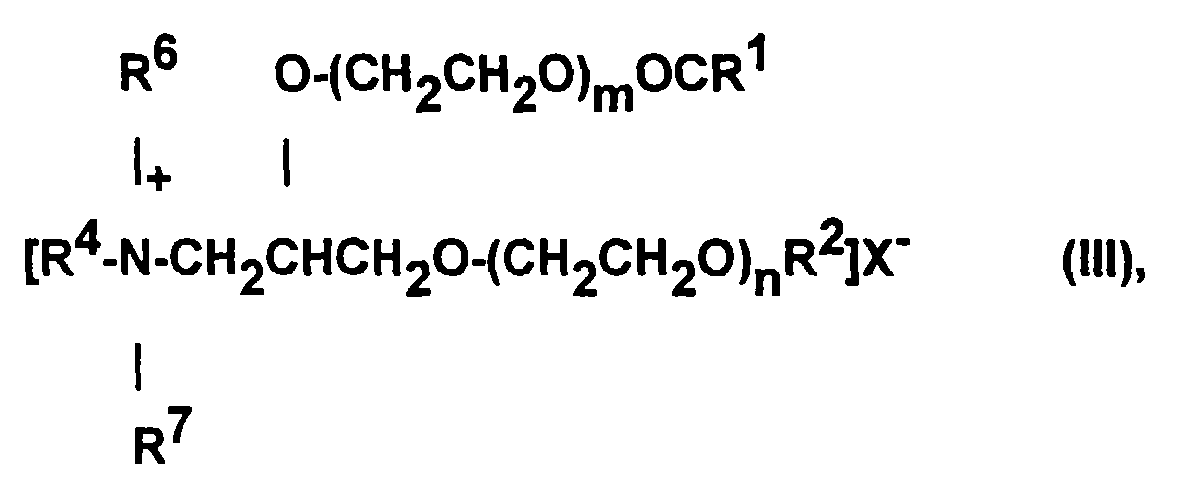
- Hinsichtlich der Auswahl der bevorzugten Fettsäuren und des optimalen Veresterungsgrades gelten die für (I) genannten Beispiele auch für die Esterquats der Formeln (II) und (III). Üblicherweise gelangen die Esterquats in Form 50 bis 90 Gew.- %iger alkoholischer Lösungen in den Handel, die bei Bedarf problemlos mit Wasser verdünnt werden können.
- Die anhand der Formeln I bis III beschriebenen Substanzen stellen naturgemäß Einzelstoffe dar, wobei für den erfindungsgemäßem Einsatz in der Regel auch Gemische dieser Stoffe infrage kommen können. Ebenso möglich ist gegebenenfalls der Einsatz der technischen Stoffgemische, wie sie aufgrund der Herstellungsverfahren in wechselnder Zusammensetzung erhältlich sind.
- Neben den Esterquats enthält das Wirkstoffgemisch Alkylamidoamine der allgemeinen Formel

- Hierbei steht R 1 CO für einen aliphatischen, linearen oder verzweigten Acylrest mit 6 bis 22 Kohlenstoffatomen und 0, 1, 2 oder 3 Doppelbindungen, der in der Regel aus einer natürlich vorkommenden oder synthetisch hergestellten Fettsäure stammt.
- R 2 und R 3 stellen gleiche oder unterschiedliche Alkylreste dar, die gegebenenfalls funktionelle Gruppen wie Hydroxygruppen, Estergruppen, Amin-, Amid- oder sonstige polare Substituenten tragen können, wobei jedoch in der Regel unsubstituierte Kohlenwasserstoffreste, die allenfalls eine oder mehrere Verzweigungen aufweisen, bevorzugt sind. Insbesondere bevorzugt sind jedoch kurzkettige Kohlenwasserstoffreste mit 1 bis 6 C-Atomen, wobei Ethyl- und Methylreste erfindungsgemäß ganz besonders bevorzugt sind.
- Die Zahl n ist eine ganze Zahl von 1 bis 10, wobei Werte für n von 2 bis 7, insbesondere von 2 bis 4 bevorzugt sind.
- Die Alkylaminoamine werden üblicherweise durch Amidierung natürlicher oder synthetischer Fettsäuren und Fettsäureschnitte mit Dialkylaminoaminen hergestellt. Typische Beispiele für solche Fettsäuren sind Capronsäure, Caprylsäure, 2-Ethylhexansäure, Caprinsäure, Laurinsäure, Isotridecansäure, Myristinsäure, Palmitinsäure, Palmoleinsäure, Stearinsäure, Isostearinsäure, Ölsäure, Elaidinsäure, Petroselinsäure, Linolsäure, Linolensäure, Elaeostearinsäure, Arachinsäure, Gadoleinsäure, Behensäure und Erucasäure sowie deren technische Mischungen, die z.B. bei der Druckspaltung von natürlichen Fetten und Ölen, bei der Reduktion von Aldehyden aus der Roelen'schen Oxosynthese oder der Dimerisierung von ungesättigten Fettsäuren anfallen.
- Besonders bevorzugt sind üblicherweise die Fettsäureschnitte, welche aus Cocosöl oder Palmöl erhältlich sind; insbesondere bevorzugt ist in der Regel der Einsatz von Stearinsäure.
- Die erfindungsgemäße Zubereitung kann je nach Einsatzzweck die beiden Wirkstoffkomponenten in unterschiedlichen Mengen enthalten. So können beispielsweise 0,1 bis 20 Gew.-% Esterquats neben 0,1 bis 20 Gew.-% Alkylamidamin vorliegen, wobei es jedoch bevorzugt ist, 0,5 bis 15 Gew.-% Esterquats neben 0,5 bis 15 Gew.-% Alkylamidoamin zur Faserbehandlung beispielsweise im textilen Bereich einzusetzen. Üblicherweise werden die Wirkstoffe zur Textilbehandlung jedoch in Konzentrationen von 5 bis 15 Gew.-% eingesetzt.
- Bei der Behandlung keratinischer Fasern, insbesondere von menschlichem Haar, können weitaus geringere Konzentrationen zum Erfolg führen. Hier werden in der Regel Wirkstoffkonzentrationen (bezogen auf die Einzelkomponenten) von 0,1 bis 7 Gew.-%, bevorzugt 0,2 bis 5 Gew.-% und insbesondere bevorzugt 0,3 bis 3 Gew.-%, eingesetzt. Besonders gute Ergebnisse lassen sich bei Wirkstoffkonzentrationen von 0,2 bis 2 Gew.-% erzielen. Die Anwendung der erfindungsgemäßen Zubereitungen an keratinischen Fasern, insbesondere an menschlichen Haaren, ist jedoch nicht auf den Einsatz der Wirkstoffe in geringer Konzentration limitiert. Es können ebenso Konzentrate zur Anwendung kommen, in denen die Wirkstoffe jeweils in Anteilen von 2 bis 20 Gew.-%, bevorzugt 3 bis 14 Gew.-% und insbesondere in 5 bis 12 Gew.-%, vorliegen.
- Üblicherweise sind Esterquats und Alkylamidoamine in einem Gewichtsverhältnis von 20 zu 1 bis 1 zu 20, insbesondere von 10 zu 1 bis 1 zu 10, in der erfindungsgemäßen Zubereitung enthalten. Je nach gewünschtem Effekt kann ein Mischungsverhältnis von 5:1 bis 1:5 oder sogar von 3:1 bis 1:3 bevorzugt sein.
- Der pH-Wert der erfindungsgemäßen Zubereitung liegt bevorzugt zwischen 2 und 7, wobei Werte von 2,5 bis 5,5, insbesondere von 3 bis 5 besonders bevorzugt sind. Zur Einstellung dieses pH-Wertes kann praktisch jede für kosmetische Zwecke verwendbare Säure verwendet werden. Üblicherweise werden Genußsäuren verwendet. Unter Genußsäuren werden solche Säuren verstanden, die im Rahmen der üblichen Nahrungsaufnahme aufgenommen werden und positive Auswirkungen auf den menschlichen Organismus haben. Genußsäuren sind beispielsweise Essigsäure, Milchsäure, Weinsäure, Zitronensäure, Äpfelsäure, Ascorbinsäure und Gluconsäure. Im Rahmen der Erfindung ist die Verwendung von Zitronensäure und Milchsäure besonders bevorzugt.
- Neben den Esterquats und den Alkylamidoaminen können im erfindungsgemäßen Mittel zur Faserbehandlung noch Fettalkohole mit 8 bis 22 C-Atomen enthalten sein.
- Die eingesetzten Fettalkohole können gesättigt oder ungesättigt und linear oder verzweigt sein. Einsetzbar im Sinne der Erfindung sind beispielsweise Decanol, Octanol, Octenol, Dodecenol, Decenol, Octadienol, Dodecadienol, Decadienol, Oleylalkohol, Erucaalkohol, Ricinolalkohol, Stearylalkohol, Isostearylalkohol, Palmitylalkohol, Laurylalkohol, Myristylalkohol, Arachidylalkohol, Caprylalkohol, Caprinalkohol, Linoleylalkohol, Linolenylalkohol und Behenylalkohol, sowie deren Guerbetalkohole, wobei diese Aufzählung beispielhaften und nicht limitierenden Charakter haben soll.
- Der Darstellungsweg des Fettalkohols spielt für den erfindungsgemäßen Einsatz keine Rolle. Die Fettalkohole stammen jedoch bevorzugt von Fettsäuren ab, wobei üblicherweise von einer Gewinnung aus den Estern der Fettsäuren durch Reduktion ausgegangen werden kann.
- Besonders bevorzugt ist der Einsatz solcher Fettalkohole, die aus der Veresterung und Reduktion natürlich vorkommender Fettsäuren erhältlich sind.
- Erfindungsgemäß einsetzbar sind ebenfalls solche Fettalkoholschnitte, die durch Reduktion natürlich vorkommender Triglyceride wie Rindertalg, Palmöl, Erdnußöl, Rüböl, Baumwollsaatöl, Sojaöl, Sonnenblumenöl und Leinöl oder aus deren Umesterungsprodukten mit entsprechenden Alkoholen entstehenden Fettsäureestern erzeugt werden, und somit ein Gemisch von unterschiedlichen Fettalkoholen darstellen.
- Im Sinne der Erfindung können auch solche gesättigten oder ungesättigten Fettalkohole zum Einsatz kommen, die aus der Veresterung und Reduktion von Derivaten natürlich vorkommender Fettsäuren erhältlich sind. So sind beispielsweise der Ricinenalkohol, der Elaidylalkohol oder der Pelargonalkohol erfindungsgemäß einsetzbar.
- Die Fettalkohole werden üblicherweise in Mengen von 0,01 bis 15 Gew.-%, bevorzugt von 0,1 bis 10 Gew.-% und besonders bevorzugt von 0,3 bis 6 Gew.-%, bezogen auf die gesamte Zubereitung, eingesetzt.
- Neben den beschriebenen Fettalkoholen können auch deren Alkoxylierungsprodukte in Mengen von 0,1 bis 15 Gew.-% zum Einsatz kommen, insbesondere die Ethoxylierungsprodukte der Fettalkohole mit 8 bis 22 C-Atomen. Besonders bevorzugt ist hierbei der Einsatz von ethoxylierten, unverzweigten Fettalkoholen mit 8 bis 20 C-Atomen, wie sie aus der Reduktion und anschließenden Ethoxylierung natürlich vorkommender Fette und Öle wie beispielsweise Kokosöl, Palmöl, Palmkernöl oder Sonnenblumenöl erhältlich sind.
- Die erfindungsgemäßen Zubereitungen können gegebenenfalls noch ein oder mehrere weitere nichtionische Tenside enthalten. Typische Beispiele sind Alkylphenolpolyglycolether, Fettsäurepolyglycolester, Fettsäureamidpolygylcolether, Fettaminpolyglycolether, alkoxylierte Triglyceride, Alk(en)yloligoglucoside, Fettsäure-N-alkylglucamide, Proteinhydrolysate (insbesondere pflanzliche Produkte auf Sojabasis), Polyolfettsäureester, Zuckerester, Sorbitanester und Polysorbate. Sofern die nichtionischen Tenside Polyglycoletherketten enthalten, können sie eine konventionelle, vorzugsweise jedoch eine eingeengte Homologenverteilung aufweisen.
- Weiterhin sind als Zusatzstoffe solche ausgewählt aus der Gruppe der Dialkylether in Sinne der Erfindung einsetzbar. Bevorzugt werden solche Dialkylether verwendet, die insgesamt zwischen 12 und 36 C-Atomen enthalten. In einer besonders bevorzugten Ausführungsform werden solche Dialkylether eingesetzt, die insgesamt zwischen 12 und 24 C-Atomen aufweisen.
- Die erfindungsgemäß eingesetzten Dialkylether enthalten bevorzugt nur eine Ethergruppe, wobei jedoch sowohl symmetrische als auch unsymmetrische Dialkylether zum Einsatz kommen können.
- Symmetrische lineare Dialkylether sind beispielsweise Di-n-octylether, Di-n-decylether, Di-n-nonylether, Di-n-undecylether und Di-n-dodecylether.
- Außer den symmetrischen, linearen Dialkylethern können auch unsymmetrische Dialkylether zum Einsatz gelangen. Unsymmetrische Ether sind dadurch gekennzeichnet, daß die Alkylreste des Dialkylethers unterschiedlich sind. Hierzu gehören beispielsweise der n-Hexyl-n-octylether, n-Octyl-n-decylether, n-Decyl-n-undecylether, n-Undecyl-n-dodecylether und der n-Hexyl-n-Undecylether.
- Die Alkylreste der Dialkylether können nicht nur linear und identisch oder verschieden sein, es können erfindungsgemäß ebenso Dialkylether eingesetzt werden, deren Alkylreste eine oder mehrere Verzweigungen aufweisen. Hierbei ist es unerheblich, ob die Verzweigungen in einem oder in beiden Alkylresten auftreten. Symmetrische Dialkylether mit verzweigten Alkylresten sind z.B. Di-tert-butylether, Di-iso-pentylether, Di-3-ethyldecylether. Beispiele für unsymmetrische Dialkylether mit der hier angesprochenen Struktur sind tert.-Butyl-n-octylether, iso-Pentyl-n-octylether oder 2-Methyl-pentyl-n-octylether.
- Die Di-Alkylether können gegebenenfalls in den erfindungsgemäßen Zubereitungen in Mengen von 0,1 bis 5 Gew.-%, bevorzugt 0,5 bis 3 Gew.-%, vorhanden sein.
- Eine weitere Substanzgruppe, die der erfindungsgemäßen Zubereitung vorteilhafte Eigenschaften in Bezug auf Pflegewirkung und kosmetischen Effekt verleiht, sind die Monoester der Fettsäuren mit Alkoholen mit 6 bis 24 C-Atomen. Bei dieser Stoffgruppe handelt es sich um die Produkte der Veresterung von Fettsäuren mit 8 bis 24 C-Atomen wie beispielsweise Capronsäure, Caprylsäure, 2-Ethylhexansäure, Caprinsäure, Laurinsäure, Isotridecansäure, Myristinsäure, Palmitinsäure, Palmoleinsäure, Stearinsäure, Isostearinsäure, Ölsäure, Elaidinsäure, Petroselinsäure, Linolsäure, Linolensäure, Elaeostearinsäure, Arachinsäure, Gadoleinsäure, Behensäure und Erucasäure sowie deren technische Mischungen, die z.B. bei der Druckspaltung von natürlichen Fetten und Ölen, bei der Reduktion von Aldehyden aus der Roelen'schen Oxosynthese oder der Dimerisierung von ungesättigten Fettsäuren anfallen, mit Alkoholen wie beispielsweise Capronalkohol, Caprylalkohol, 2-Ethylhexylalkohol, Caprinalkohol, Laurylalkohol, Isotridecylalkohol, Myristylalkohol, Cetylalkohol, Palmoleylalkohol, Stearylalkohol, Isostearylalkohol, Oleylalkohol, Elaidylalkohol, Petroselinylalkohol, Linolylalkohol, Linolenylalkohol, Elaeostearylalkohol, Arachylalkohol, Gadoleylalkohol, Behenylalkohol, Erucylalkohol und Brassidylalkohol sowie deren technische Mischungen, die z.B. bei der Hochdruckhydrierung von technischen Methylestern auf Basis von Fetten und Ölen oder Aldehyden aus der Roelen'schen Oxosynthese sowie als Monomerfraktion bei der Dimerisierung von ungesättigten Fettalkoholen anfallen. Die Fettsäuremonoester können in Mengen von 0,1 bis 5 Gew.-%, bevorzugt 0,8 bis 3 Gew.-%, bezogen auf die gesamte Zubereitung, in den Zubereitungen vorhanden sein.
- Die erfindungsgemäßen Zubereitungen können grundsätzlich zur pflegenden Behandlung aller Fasern eingesetzt werden; besonderen Erfolg verspricht jedoch der Einsatz bei Fasern, die Naturprodukte darstellen oder aus einem solchen gewonnen werden. Insbesondere lassen sich keratinhaltige Fasern wie beispielsweise Wolle oder Seide erfolgreich behandeln. Die Anwendung der erfindungsgemäßen Zubereitungen ist jedoch nicht auf Textilfasern beschränkt, sondern eignet sich insbesondere auch zur Behandlung menschlicher Haare.
- Zu diesem Zweck werden die erfindungsgemäßen Zubereitungen beispielsweise als sogenannte Haarspülung oder als Haarkur formuliert. Haarspülungen werden in der Regel so formuliert, daß ein Ausspülen der Wirkstoffe nach der gewünschten Einwirkzeit mit Wasser oder einem zumindest überwiegend wasserhaltigen Mittel vorgesehen ist. Die Kontaktzeit mit dem Haar ist in der Regel kurz. Haarkuren enthalten die Wirkstoffkombination in einer höheren Konzentration als Haarspülungen und sind zur Behandlung stark geschädigten Haares vorgesehen. Die Einwirkzeit kann kurz sein, beispielsweise in der Größenordnung der Einwirkzeit von Haarspülungen, sie kann jedoch auch je nach Grad der Schädigung des Haares bis zu 20 Minuten betragen. Auch die erfindungsgemäßen Haarkuren werden in der Regel nach Ablauf der Einwirkzeit mit Wasser oder einem zumindest überwiegend wasserhaltigen Mittel ausgespült, können jedoch auch auf dem Haar belassen werden. Die Anwendung dieser Zubereitungen bewirkt einen avivierenden Effekt am menschlichen Haar, der sich in einer verbesserten Naßkämmbarkeit, einer erhöhten Trockenkämmarbeit sowie einem guten Frisurenhalt äußert. Während die Verbesserung der Naßkämmbarkeit, d.h. eine Erniedrigung der Naßkämmarbeit, in allen Fällen gewünscht wird, sind die Verhältnisse bei der Trockenkämmbarkeit komplizierter. Niedrige Kämmarbeits-Werte charakterisieren zwar eine Verbesserung der Kämmbarkeit; wird die Kämmarbeit aber zu sehr erniedrigt, so verliert das Haar Fülle und Halt, so daß sich in Extremfall bestimmte Frisuren nicht mehr aufbauen lassen. Daher kann, vor allem bei komplexeren Frisuren, eine in bestimmten Grenzen erhöhte Trockenkämmarbeit durchaus erwünscht sein, um den Halt der Frisur zu verbessern.
- Weiterhin können die erfindungsgemäßen Zubereitungen alle für den jeweiligen Verwendungszweck üblichen Zusätze enthalten. Insbesondere bei der Verwendung zur Haarbehandlung können dies kosmetische Zusätze sein, die eine reinigende, pflegende oder in anderer Weise das äußere Erscheinungsbild des Haares ändernde Wirkung entfalten. Auch solche Zusätze die keine direkte Einwirkung auf das Haar, ansonsten jedoch eine positive Wirkung auf die Kopfhaut oder beispielsweise die Haarfollikel entfalten, können in der erfindungsgemäßen Zubereitung enthalten sein.
- Weitere übliche Bestandteile der erfindungsgemäßen Zubereitungen können sein:
- Anionische, zwitterionische, amphotere und nichtionische Polymere wie beispielsweise Vinylacetat/Crotonsäure-Copolymere, Polydimethylsiloxane,
Vinylpyrrolidon/Vinylacrylat-Copolymere, Vinylacetat/Butylmaleat/Isobornyl-acrylat-Copolymere, Methylvinylether/Maleinsäureanhydrid-Copolymere und deren Ester, unvernetzte und mit Polyolen vernetzte Polyacrylsäuren, Acryl-amidopropyl-trimethylammoniumchlorid/Acrylat-Copolymere,
Octylacrylamid/Methyl-methacrylat/tert.Butylaminoethylmethacrylat/2-Hydroxypropylmethacrylat-Copolymere, Polyvinylpyrrolidon, Vinylpyrrolidon/Vinylacetat-Copoly-mere, Vinylpyrrolidon/Dimethylaminoethylmethacrylat/Vinylcaprolactam-Terpolymere sowie gegebenfalls derivatisierte Celluloseether. - Quarternierte Amine wie Methyl-1-alkylamidoethyl-2-alkylimidazolinium-methosulfat
- Verdickungsmittel wie Agar-Agar, Guar-Gum, Alginate und Xanthan-Gum,
- Strukturanten wie Glucose und Maleinsäure,
- Proteinhydrolysate, insbesondere Elastin-, Kollagen-, Keratin-, Milcheiweiß-, Sojaprotein- und Weizenproteinhydrolysate, deren Kondensationsprodukte mit Fettsäuren sowie quaternisierte Proteinhydrolysate,
- Parfümöle, Dimethylisosorbid und Cyclodextrine,
- Lösungsvermittler, wie Ethanol, Isopropanol, Ethylenglykol, Propylenglykol, Glycerin und Diethylenglykol,
- Farbstoffe,
- Antischuppenwirkstoffe wie Piroctone Olamine und Zink Omadine,
- weitere Substanzen zur Einstellung des pH-Wertes
- Wirkstoffe wie Panthenol, Allantoin, Pyrrolidoncarbonsäuren, Pflanzenextrakte und Vitamine,
- Lichtschutzmittel,
- Konsistenzgeber wie Zuckerester, Polyolester oder Polyolalkylether,
- Fette und Wachse, wie Walrat, Bienenwachs, Montanwachs und Paraffine,
- Fettsäurealkanolamide,
- Quell- und Penetrationsstoffe wie Glycerin, Propylenglykolmonoethylether, Carbonate, Hydrogencarbonate, Guanidine, Harnstoffe sowie primäre, sekundäre und tertiäre Phosphate,
- Trübungsmittel wie Latex,
- Perlglanzmittel wie Ethylenglykolmono- und -distearat,
- Treibmittel wie Propan-Butan-Gemische, N2O, Dimethylether, CO2 und Luft sowie
- Antioxidantien.
- Ein weiterer Gegenstand der Erfindung ist die Verwendung einer wäßrigen Zubereitung zur avivierenden Faserbehandlung, dadurch gekennzeichnet, daß sie eine Wirkstoffkombination, bestehend aus 0,01 bis 30 Gew.-% Esterquats und 0,01 bis 30 Gew.-% Alkylamidoaminen, jeweils bezogen auf die gesamte Zusammensetzung, enthält.
- Ebenfalls Gegenstand der Erfindung ist ein Verfahren zur pflegenden Behandlung von Fasern, indem die erfindungsgemäße Zubereitung in konzentrierter oder in verdünnter Form auf die Faser aufgebracht wird. Bevorzugt wird die erfindungsgemäße Zubereitung jedoch in der beschriebenen Form in einem Verfahren zur regenerierenden Behandlung menschlicher Haare eingesetzt.
- Die folgenden Beispiele sollen den Gegenstand der Erfindung näher erläutern ohne ihn darauf einzuschränken.
- Alle Angaben verstehen sich als Gewichtsteile Aktivsubstanz
I. Haarspülungen INCI-Bezeichnung (1) Tego Amid® S18 1,20 Stearamidopropyl-dimethylamine Foryl® 100 0,30 Laureth-10 Lanette® O 3,0 Cetearyl Alkohol Dehyquart® AU 56 0,40 Distearoylethylammonium Methosulfate Citronensäure auf pH 3.5 Citric Acid Wasser ad 100 (2) Tego Amid® D5040 1,60 Cocamidopropyl-dimethylamine Cremephor® RH40 0,60 PEG-40 Hydrogenated Castor Oil Lanette® O 3,50 Cutina® CP 1,40 Cetyl Palmitat Dehyquart® F75 0,50 Distearoylethylammonium Methosulfate + Cetearyl Alcohol Konservierung q.s. Milchsäure auf pH 3,5 Lactic Acid II. Haarkuren (3) Tego Amid® S18 0,90 Dehyquart® F 30 0,80 Cetearyl Alcohol + Dipalmitoylethylammonium Methosulfate Tego Care® 450 0,30 Polyglycerol Methylglucose Distearat Lanette® O 5,20 Cetiol® OE 1.0 Dicapryl Ether Eutanol® G 0,80 Octyldodecanol Konservierung q.s. Citronensäure auf pH 3,5 Wasser ad 100 (4) Emulgade® PL 1618 0,60 Cetearyl Alcohol + Cetearyl Polyglucosid Mackine® 401 1.0 Isostearamidopropyl Dimethylamine Dehyquart® AU46 0,50 Dipalmitoylethylammonium Methosulfate DC® 200 0,80 Dimethicone Rewoquat® W75 1.0 Methyl-1-alkylamidoethyl-2-alkylimid-azolinium Methosulfat Lanette® O 3.60 Cutina® GMS 0,60 Glyceryl Stearate Chitosan 0,2 Konservierung q.s. Citronensäure auf pH 3,5 Wasser ad 100 - Die Wirksamkeit der erfindungsgemäßen Zubereitungen wurde anhand der folgenden Rezepturen untersucht:
A B C Eumulgin® B2 0,40 0,40 0,40 Stenol® 1618 3,0 3,0 3,0 TEGO® Amid S18 1,0 0,5 Dehyquart® AU 46 - 1,11 0,55 Citronensäure 0,17 - 0,085 - Anhand der Rezepturen wurden die Naßkämmarbeit sowie die Trockenkämmarbeit bestimmt.
Tabelle 2 Naßkämmarbeit Rezeptur Naßkämmarbeit vorher [mJ] Naßkämmarbeit nachher [mJ] Differenz [%] A 62,2 17,5 72 B 57,3 16,3 72 C 60,1 16,4 73 Tabelle 3 Trockenkämmarbeit Rezeptur Trockenkämmarbeit vorher [mJ] Trockenkämmarbeit nachher [mJ] Differenz [%] A 8,5 4,1 49 B 8,1 4,1 50 C 8,3 4,9 59
Claims (11)
- Wäßrige Zubereitung zur avivierenden Faserbehandlung, dadurch gekennzeichnet, daß sie eine Wirkstoffkombination, bestehend aus 0,01 bis 30 Gew.-% Esterquats und 0,01 bis 30 Gew.-% Alkylamidoaminen, jeweils bezogen auf die gesamte Zusammensetzung, enthält.
- Zubereitung nach Anspruch 1, dadurch gekennzeichnet, daß die Wirkstoffkombination 0,1 bis 7 Gew.-% Esterquats zusammen mit 0,1 bis 7 Gew.-% Alkylamidoaminen enthält.
- Zubereitung nach einem der Ansprüche 1 oder 2, dadurch gekennzeichnet, daß die Esterquats und die Alkylamidoamine in einem Gewichtsverhältnis von 20 zu 1 bis 1 zu 20, insbesondere von 10 zu 1 bis 1 zu 10, im Wirkstoffgemisch enthalten sind.
- Zubereitung nach einem der Ansprüche 1 bis 3, dadurch gekennzeichnet, daß das Alkylamidoamin einen linearen Fettsäurerest mit 8 bis 22 C-Atomen, bevorzugt mit 14 bis 20 C-Atomen aufweist.
- Zubereitung nach einem der Ansprüche 1 bis 4, dadurch gekennzeichnet, daß sie einen pH-Wert zwischen 2 und 7, insbesondere von 2,5 bis 5,5 aufweist.
- Zubereitung nach einem der Ansprüche 1 bis 5, dadurch gekennzeichnet, daß sie zusätzlich einen Fettalkohol mit 8 bis 22 C-Atomen enthält.
- Zubereitung nach einem der Ansprüche 1 bis 6, dadurch gekennzeichnet, daß sie als Haarspülung formuliert ist.
- Zubereitung nach einem der Ansprüche 1 bis 7, dadurch gekennzeichnet, daß sie als Haarkur formuliert ist.
- Verwendung einer wäßrigen Zubereitung nach einem der Ansprüche 1 bis 8 zur avivierenden Faserbehandlung.
- Verwendung nach einem der Anspruch 9, dadurch gekennzeichnet, daß die Zubereitung zur Behandlung von Fasern keratinischer, insbesondere menschlicher, Natur eingesetzt wird.
- Verfahren zur regenerierenden Behandlung menschlicher Haare, dadurch gekennzeichnet, daß eine Zubereitung nach einem der Ansprüche 1 bis 8 auf das Haar aufgebracht wird.
Applications Claiming Priority (2)
| Application Number | Priority Date | Filing Date | Title |
|---|---|---|---|
| DE19602242 | 1996-01-23 | ||
| DE19602242A DE19602242A1 (de) | 1996-01-23 | 1996-01-23 | Haaravivierende Zubereitungen |
Publications (2)
| Publication Number | Publication Date |
|---|---|
| EP0786250A1 true EP0786250A1 (de) | 1997-07-30 |
| EP0786250B1 EP0786250B1 (de) | 2003-04-02 |
Family
ID=7783413
Family Applications (1)
| Application Number | Title | Priority Date | Filing Date |
|---|---|---|---|
| EP97100586A Revoked EP0786250B1 (de) | 1996-01-23 | 1997-01-16 | Haaravivierende Zubereitungen |
Country Status (3)
| Country | Link |
|---|---|
| EP (1) | EP0786250B1 (de) |
| AT (1) | ATE235886T1 (de) |
| DE (2) | DE19602242A1 (de) |
Cited By (18)
| Publication number | Priority date | Publication date | Assignee | Title |
|---|---|---|---|---|
| WO1998035652A1 (de) * | 1997-02-15 | 1998-08-20 | Wella Aktiengesellschaft | Haarpflegemittel |
| WO1999018178A1 (de) * | 1997-10-06 | 1999-04-15 | Cognis Deutschland Gmbh | Detergensgemische |
| WO1999011224A3 (de) * | 1997-09-02 | 1999-05-20 | Schwarzkopf Gmbh Hans | Verwendung einer wirkstoffkombination und mittel zum schutz von keratinischen fasern |
| DE19904513A1 (de) * | 1999-02-04 | 2000-08-10 | Cognis Deutschland Gmbh | Detergensgemische |
| WO2001047489A1 (de) * | 1999-12-24 | 2001-07-05 | Cognis Iberia, S.L. | Transparente avivagemittel |
| WO2001090476A1 (de) * | 2000-05-19 | 2001-11-29 | Cognis Iberia, S.L. | Hochgeschwindigkeits-spinnfaserpräparationen |
| EP1254656A1 (de) * | 2001-04-30 | 2002-11-06 | Cognis Iberia, S.L. | Verwendung von kationischen Zubereitungen |
| EP1254653A1 (de) * | 2001-04-30 | 2002-11-06 | Cognis Iberia, S.L. | Verwendung von kationischen Zubereitungen |
| US6514918B1 (en) | 2000-08-18 | 2003-02-04 | Johnson & Johnson Consumer Companies, Inc. | Viscous, mild, and effective cleansing compositions |
| EP1300131A1 (de) * | 2001-10-06 | 2003-04-09 | Cognis Iberia, S.L. | Haarbehandlungsmittel |
| WO2004000258A1 (de) * | 2002-06-19 | 2003-12-31 | Cognis Iberia, S.L. | Hochviskose ölhaltige zubereitungen |
| EP1148867B2 (de) † | 1999-02-04 | 2007-10-03 | Wella Aktiengesellschaft | Haarpflegemittel |
| EP1883691A2 (de) * | 2005-05-18 | 2008-02-06 | Stepan Company | Festkörperarme, hochviskose weichspülmittel und herstellungsverfahren dafür |
| WO2012062519A1 (de) * | 2010-11-10 | 2012-05-18 | Evonik Goldschmidt Gmbh | Zusammensetzung enthaltend mischungen von isostearinsäureamid, glycerinester und wasser |
| FR2984163A1 (fr) * | 2011-12-19 | 2013-06-21 | Oreal | Composition cosmetique comprenant une cellulose hydrophobiquement modifiee, et un agent tensioactif cationique de type sel d'ammonium quaternaire contenant une ou plusieurs fonctions esters. |
| WO2014206920A1 (en) | 2013-06-26 | 2014-12-31 | Kao Corporation S.A. | Hair conditioner |
| DE102021204835A1 (de) | 2021-05-12 | 2022-11-17 | Beiersdorf Aktiengesellschaft | Haar-kosmetische Zubereitung zur Konditionierung der Haare I |
| DE102021204836A1 (de) | 2021-05-12 | 2022-11-17 | Beiersdorf Aktiengesellschaft | Haar-kosmetische Zubereitung zur Konditionierung der Haare II |
Families Citing this family (6)
| Publication number | Priority date | Publication date | Assignee | Title |
|---|---|---|---|---|
| DE19652299C2 (de) * | 1996-12-16 | 1998-10-08 | Henkel Kgaa | Verwendung von Esterquats |
| DE19751588C1 (de) * | 1997-11-21 | 1999-04-15 | Goldwell Gmbh | Haarbehandlungsmittel |
| DE19902528A1 (de) * | 1999-01-22 | 2000-08-03 | Goldwell Gmbh | Haarbehandlungsmittel |
| EP1929992A1 (de) * | 2006-12-05 | 2008-06-11 | KPSS-Kao Professional Salon Services GmbH | Konditionierungsmittel für Keratinfasern |
| EP1929993A3 (de) * | 2006-12-05 | 2008-12-24 | KPSS-Kao Professional Salon Services GmbH | Zusammensetzung zum Konditionieren von Keratinfasern |
| DE102008030136A1 (de) | 2008-06-27 | 2009-12-31 | Beiersdorf Ag | Haarkonditionierende Zubereitung mit einer besonderen Mischung kationischer Konditioniermittel |
Citations (5)
| Publication number | Priority date | Publication date | Assignee | Title |
|---|---|---|---|---|
| WO1988003016A1 (en) * | 1986-10-23 | 1988-05-05 | Stevens Frank H | Particulate emulsifiable hair conditioning composition |
| US4976956A (en) * | 1989-07-24 | 1990-12-11 | Helene Curtis, Inc. | Method and composition to impart improved conditioning properties to the hair |
| EP0423894A2 (de) * | 1989-10-16 | 1991-04-24 | Colgate-Palmolive Company | Weichspülerzusammensetzungen und Verfahren zu deren Herstellung und Verwendung |
| EP0636356A1 (de) * | 1993-07-27 | 1995-02-01 | Stepan Company | Haarkonditioniermittel, die Carbonsäure-Esterderivate von Alkanolaminen enthalten |
| US5525245A (en) * | 1994-12-21 | 1996-06-11 | Colgate-Palmolive Company | Clear, concentrated liquid fabric softener compositions |
-
1996
- 1996-01-23 DE DE19602242A patent/DE19602242A1/de not_active Withdrawn
-
1997
- 1997-01-16 AT AT97100586T patent/ATE235886T1/de not_active IP Right Cessation
- 1997-01-16 DE DE59709657T patent/DE59709657D1/de not_active Revoked
- 1997-01-16 EP EP97100586A patent/EP0786250B1/de not_active Revoked
Patent Citations (6)
| Publication number | Priority date | Publication date | Assignee | Title |
|---|---|---|---|---|
| WO1988003016A1 (en) * | 1986-10-23 | 1988-05-05 | Stevens Frank H | Particulate emulsifiable hair conditioning composition |
| EP0292481A1 (de) * | 1986-10-23 | 1988-11-30 | Frank H Stevens | Teilchenförmiges emulgierbares haarkonditioniermittel. |
| US4976956A (en) * | 1989-07-24 | 1990-12-11 | Helene Curtis, Inc. | Method and composition to impart improved conditioning properties to the hair |
| EP0423894A2 (de) * | 1989-10-16 | 1991-04-24 | Colgate-Palmolive Company | Weichspülerzusammensetzungen und Verfahren zu deren Herstellung und Verwendung |
| EP0636356A1 (de) * | 1993-07-27 | 1995-02-01 | Stepan Company | Haarkonditioniermittel, die Carbonsäure-Esterderivate von Alkanolaminen enthalten |
| US5525245A (en) * | 1994-12-21 | 1996-06-11 | Colgate-Palmolive Company | Clear, concentrated liquid fabric softener compositions |
Cited By (29)
| Publication number | Priority date | Publication date | Assignee | Title |
|---|---|---|---|---|
| WO1998035652A1 (de) * | 1997-02-15 | 1998-08-20 | Wella Aktiengesellschaft | Haarpflegemittel |
| WO1999011224A3 (de) * | 1997-09-02 | 1999-05-20 | Schwarzkopf Gmbh Hans | Verwendung einer wirkstoffkombination und mittel zum schutz von keratinischen fasern |
| WO1999018178A1 (de) * | 1997-10-06 | 1999-04-15 | Cognis Deutschland Gmbh | Detergensgemische |
| US6494920B1 (en) | 1999-02-04 | 2002-12-17 | Cognis Deutschland Gmbh & Co. Kg | Detergent mixtures |
| DE19904513A1 (de) * | 1999-02-04 | 2000-08-10 | Cognis Deutschland Gmbh | Detergensgemische |
| EP1148867B2 (de) † | 1999-02-04 | 2007-10-03 | Wella Aktiengesellschaft | Haarpflegemittel |
| WO2001047489A1 (de) * | 1999-12-24 | 2001-07-05 | Cognis Iberia, S.L. | Transparente avivagemittel |
| US8765154B2 (en) | 1999-12-24 | 2014-07-01 | Cognis Ip Management Gmbh | Transparent softening agents |
| WO2001090476A1 (de) * | 2000-05-19 | 2001-11-29 | Cognis Iberia, S.L. | Hochgeschwindigkeits-spinnfaserpräparationen |
| US6514918B1 (en) | 2000-08-18 | 2003-02-04 | Johnson & Johnson Consumer Companies, Inc. | Viscous, mild, and effective cleansing compositions |
| WO2002087536A1 (de) * | 2001-04-30 | 2002-11-07 | Cognis Iberia, S.L. | Verwendung von kationischen zubereitungen |
| WO2002087538A1 (de) * | 2001-04-30 | 2002-11-07 | Cognis Iberia, S.L. | Verwendung von kationischen zubereitungen |
| EP1254653A1 (de) * | 2001-04-30 | 2002-11-06 | Cognis Iberia, S.L. | Verwendung von kationischen Zubereitungen |
| EP1254656A1 (de) * | 2001-04-30 | 2002-11-06 | Cognis Iberia, S.L. | Verwendung von kationischen Zubereitungen |
| EP1300131A1 (de) * | 2001-10-06 | 2003-04-09 | Cognis Iberia, S.L. | Haarbehandlungsmittel |
| WO2003030843A3 (de) * | 2001-10-06 | 2003-08-21 | Cognis Iberia Sl | Haarbehandlungsmittel |
| WO2004000258A1 (de) * | 2002-06-19 | 2003-12-31 | Cognis Iberia, S.L. | Hochviskose ölhaltige zubereitungen |
| EP1374846A1 (de) * | 2002-06-19 | 2004-01-02 | Cognis Iberia, S.L. | Hochviskose ölhaltige Zubereitungen |
| EP1883691A2 (de) * | 2005-05-18 | 2008-02-06 | Stepan Company | Festkörperarme, hochviskose weichspülmittel und herstellungsverfahren dafür |
| WO2012062519A1 (de) * | 2010-11-10 | 2012-05-18 | Evonik Goldschmidt Gmbh | Zusammensetzung enthaltend mischungen von isostearinsäureamid, glycerinester und wasser |
| US9616007B2 (en) | 2010-11-10 | 2017-04-11 | Evonik Degussa Gmbh | Composition comprising mixtures of isostearamide, glycerol ester and water |
| FR2984163A1 (fr) * | 2011-12-19 | 2013-06-21 | Oreal | Composition cosmetique comprenant une cellulose hydrophobiquement modifiee, et un agent tensioactif cationique de type sel d'ammonium quaternaire contenant une ou plusieurs fonctions esters. |
| WO2014206920A1 (en) | 2013-06-26 | 2014-12-31 | Kao Corporation S.A. | Hair conditioner |
| EP2818155A1 (de) | 2013-06-26 | 2014-12-31 | Kao Corporation, S.A. | Haarspülung |
| JP2016523872A (ja) * | 2013-06-26 | 2016-08-12 | カオウ コーポレイション エス.エー.Kao Corporation S.A. | ヘアコンディショナー |
| DE102021204835A1 (de) | 2021-05-12 | 2022-11-17 | Beiersdorf Aktiengesellschaft | Haar-kosmetische Zubereitung zur Konditionierung der Haare I |
| DE102021204836A1 (de) | 2021-05-12 | 2022-11-17 | Beiersdorf Aktiengesellschaft | Haar-kosmetische Zubereitung zur Konditionierung der Haare II |
| EP4091676A1 (de) | 2021-05-12 | 2022-11-23 | Beiersdorf AG | Haar-kosmetische zubereitung zur konditionierung der haare ii |
| EP4094751A1 (de) | 2021-05-12 | 2022-11-30 | Beiersdorf AG | Haar-kosmetische zubereitung zur konditionierung der haare i |
Also Published As
| Publication number | Publication date |
|---|---|
| DE19602242A1 (de) | 1997-07-24 |
| EP0786250B1 (de) | 2003-04-02 |
| ATE235886T1 (de) | 2003-04-15 |
| DE59709657D1 (de) | 2003-05-08 |
Similar Documents
| Publication | Publication Date | Title |
|---|---|---|
| EP0786250B1 (de) | Haaravivierende Zubereitungen | |
| DE602005003389T2 (de) | Haarpflegemittel enthaltend eine Dicarbonsäure und Edetinsäure | |
| DE4342075B4 (de) | Haarpflegezusammensetzung | |
| EP0746308B1 (de) | Emulsionen | |
| DE69827871T2 (de) | Wässrige, kosmetische Zusammensetzung,enthaltend stabil gelöste Harnsäure, und ein wasserlösliches Polymer, und Verfahren zum stabilen Lösen von Harnsäure in einer wässrigen, kosmetischen Zusammensetzung | |
| DE202017101868U1 (de) | Zusammensetzung zur Haarverfestigung und Mittel zum Festigen von Haaren mit ausgezeichneten Eigenschaften | |
| DE202016008131U1 (de) | Zusammensetzung zur Haarverfestigung und deren Anwendung zum Festigen der Haare | |
| EP0754443A2 (de) | Haarbehandlungsmittel sowie Verfahren zu dessen Herstellung | |
| EP1009367B1 (de) | Verwendung einer wirkstoffkombination und mittel zum schutz von keratinischen fasern | |
| DE602004007464T3 (de) | Haarkosmetik | |
| EP3233025B1 (de) | Haarbehandlungsmittel, enthaltend mindestens ein saures protein sowie mindestens ein salz | |
| DE4309568A1 (de) | Detergensgemische mit verbesserten Avivageeigenschaften | |
| DE112004000731B4 (de) | Reinigungszusammensetzung | |
| EP1156774B2 (de) | Zubereitungen zur behandlung keratinischer fasern | |
| DE60304247T2 (de) | Zusammensetzung zum Färben von menschlichen Haaren | |
| EP0662815B1 (de) | Haarbehandlungsmittel | |
| EP1059910A2 (de) | Mittel und verfahren zur behandlung keratinischer fasern | |
| EP1154752B1 (de) | Zubereitungen zur behandlung keratinischer fasern | |
| DE102021214287A1 (de) | "Haarbehandlungsmittel mit verbesserter Pflegewirkung" | |
| DE102020206651A1 (de) | Haarzusammensetzungen, umfassend Haarkonditionierungsmittel auf Glucosebasis und ein Proteolipid | |
| DE102010062612A1 (de) | Haarbehandlungsmittel | |
| DE69515955T3 (de) | Säurefarbstoff enthaltende Zusammensetzungen | |
| EP1021164B1 (de) | Kosmetische mittel | |
| EP0672407B1 (de) | Verwendung der Diacetylweinsäureester von Fettsäureglyceriden als Haarkonditioniermittel | |
| US20240156703A1 (en) | Compositions and methods for treating keratin fibers |
Legal Events
| Date | Code | Title | Description |
|---|---|---|---|
| PUAI | Public reference made under article 153(3) epc to a published international application that has entered the european phase |
Free format text: ORIGINAL CODE: 0009012 |
|
| 17P | Request for examination filed |
Effective date: 19970530 |
|
| AK | Designated contracting states |
Kind code of ref document: A1 Designated state(s): AT BE CH DE DK ES FI FR GB GR IT LI NL PT SE |
|
| 17Q | First examination report despatched |
Effective date: 20010608 |
|
| GRAG | Despatch of communication of intention to grant |
Free format text: ORIGINAL CODE: EPIDOS AGRA |
|
| GRAG | Despatch of communication of intention to grant |
Free format text: ORIGINAL CODE: EPIDOS AGRA |
|
| GRAG | Despatch of communication of intention to grant |
Free format text: ORIGINAL CODE: EPIDOS AGRA |
|
| GRAH | Despatch of communication of intention to grant a patent |
Free format text: ORIGINAL CODE: EPIDOS IGRA |
|
| GRAH | Despatch of communication of intention to grant a patent |
Free format text: ORIGINAL CODE: EPIDOS IGRA |
|
| GRAA | (expected) grant |
Free format text: ORIGINAL CODE: 0009210 |
|
| AK | Designated contracting states |
Designated state(s): AT BE CH DE DK ES FI FR GB GR IT LI NL PT SE |
|
| PG25 | Lapsed in a contracting state [announced via postgrant information from national office to epo] |
Ref country code: NL Free format text: LAPSE BECAUSE OF FAILURE TO SUBMIT A TRANSLATION OF THE DESCRIPTION OR TO PAY THE FEE WITHIN THE PRESCRIBED TIME-LIMIT Effective date: 20030402 Ref country code: IT Free format text: LAPSE BECAUSE OF FAILURE TO SUBMIT A TRANSLATION OF THE DESCRIPTION OR TO PAY THE FEE WITHIN THE PRE;WARNING: LAPSES OF ITALIAN PATENTS WITH EFFECTIVE DATE BEFORE 2007 MAY HAVE OCCURRED AT ANY TIME BEFORE 2007. THE CORRECT EFFECTIVE DATE MAY BE DIFFERENT FROM THE ONE RECORDED.SCRIBED TIME-LIMIT Effective date: 20030402 Ref country code: GB Free format text: LAPSE BECAUSE OF FAILURE TO SUBMIT A TRANSLATION OF THE DESCRIPTION OR TO PAY THE FEE WITHIN THE PRESCRIBED TIME-LIMIT Effective date: 20030402 Ref country code: FR Free format text: LAPSE BECAUSE OF FAILURE TO SUBMIT A TRANSLATION OF THE DESCRIPTION OR TO PAY THE FEE WITHIN THE PRESCRIBED TIME-LIMIT Effective date: 20030402 Ref country code: FI Free format text: LAPSE BECAUSE OF FAILURE TO SUBMIT A TRANSLATION OF THE DESCRIPTION OR TO PAY THE FEE WITHIN THE PRESCRIBED TIME-LIMIT Effective date: 20030402 |
|
| REG | Reference to a national code |
Ref country code: GB Ref legal event code: FG4D Free format text: NOT ENGLISH |
|
| REG | Reference to a national code |
Ref country code: CH Ref legal event code: EP |
|
| REF | Corresponds to: |
Ref document number: 59709657 Country of ref document: DE Date of ref document: 20030508 Kind code of ref document: P |
|
| PG25 | Lapsed in a contracting state [announced via postgrant information from national office to epo] |
Ref country code: SE Free format text: LAPSE BECAUSE OF FAILURE TO SUBMIT A TRANSLATION OF THE DESCRIPTION OR TO PAY THE FEE WITHIN THE PRESCRIBED TIME-LIMIT Effective date: 20030702 Ref country code: PT Free format text: LAPSE BECAUSE OF FAILURE TO SUBMIT A TRANSLATION OF THE DESCRIPTION OR TO PAY THE FEE WITHIN THE PRESCRIBED TIME-LIMIT Effective date: 20030702 Ref country code: GR Free format text: LAPSE BECAUSE OF FAILURE TO SUBMIT A TRANSLATION OF THE DESCRIPTION OR TO PAY THE FEE WITHIN THE PRESCRIBED TIME-LIMIT Effective date: 20030702 Ref country code: DK Free format text: LAPSE BECAUSE OF FAILURE TO SUBMIT A TRANSLATION OF THE DESCRIPTION OR TO PAY THE FEE WITHIN THE PRESCRIBED TIME-LIMIT Effective date: 20030702 |
|
| NLV1 | Nl: lapsed or annulled due to failure to fulfill the requirements of art. 29p and 29m of the patents act | ||
| GBV | Gb: ep patent (uk) treated as always having been void in accordance with gb section 77(7)/1977 [no translation filed] |
Effective date: 20030402 |
|
| PG25 | Lapsed in a contracting state [announced via postgrant information from national office to epo] |
Ref country code: ES Free format text: LAPSE BECAUSE OF FAILURE TO SUBMIT A TRANSLATION OF THE DESCRIPTION OR TO PAY THE FEE WITHIN THE PRESCRIBED TIME-LIMIT Effective date: 20031030 |
|
| PLBQ | Unpublished change to opponent data |
Free format text: ORIGINAL CODE: EPIDOS OPPO |
|
| PLBI | Opposition filed |
Free format text: ORIGINAL CODE: 0009260 |
|
| PG25 | Lapsed in a contracting state [announced via postgrant information from national office to epo] |
Ref country code: LI Free format text: LAPSE BECAUSE OF NON-PAYMENT OF DUE FEES Effective date: 20040131 Ref country code: CH Free format text: LAPSE BECAUSE OF NON-PAYMENT OF DUE FEES Effective date: 20040131 Ref country code: BE Free format text: LAPSE BECAUSE OF NON-PAYMENT OF DUE FEES Effective date: 20040131 |
|
| PLAX | Notice of opposition and request to file observation + time limit sent |
Free format text: ORIGINAL CODE: EPIDOSNOBS2 |
|
| 26 | Opposition filed |
Opponent name: L'OREAL Effective date: 20031229 |
|
| EN | Fr: translation not filed | ||
| PLAX | Notice of opposition and request to file observation + time limit sent |
Free format text: ORIGINAL CODE: EPIDOSNOBS2 |
|
| BERE | Be: lapsed |
Owner name: *HENKEL K.G.A.A. Effective date: 20040131 |
|
| PLBB | Reply of patent proprietor to notice(s) of opposition received |
Free format text: ORIGINAL CODE: EPIDOSNOBS3 |
|
| REG | Reference to a national code |
Ref country code: CH Ref legal event code: PL |
|
| PGFP | Annual fee paid to national office [announced via postgrant information from national office to epo] |
Ref country code: AT Payment date: 20050112 Year of fee payment: 9 |
|
| PGFP | Annual fee paid to national office [announced via postgrant information from national office to epo] |
Ref country code: DE Payment date: 20050113 Year of fee payment: 9 |
|
| RDAF | Communication despatched that patent is revoked |
Free format text: ORIGINAL CODE: EPIDOSNREV1 |
|
| RDAG | Patent revoked |
Free format text: ORIGINAL CODE: 0009271 |
|
| STAA | Information on the status of an ep patent application or granted ep patent |
Free format text: STATUS: PATENT REVOKED |
|
| 27W | Patent revoked |
Effective date: 20050724 |
|
| PLAB | Opposition data, opponent's data or that of the opponent's representative modified |
Free format text: ORIGINAL CODE: 0009299OPPO |