EP0786278A2 - Dispositif mobile utilisé, en particulier, à des fins d'exercices ou de traitements médicaux - Google Patents
Dispositif mobile utilisé, en particulier, à des fins d'exercices ou de traitements médicaux Download PDFInfo
- Publication number
- EP0786278A2 EP0786278A2 EP96710017A EP96710017A EP0786278A2 EP 0786278 A2 EP0786278 A2 EP 0786278A2 EP 96710017 A EP96710017 A EP 96710017A EP 96710017 A EP96710017 A EP 96710017A EP 0786278 A2 EP0786278 A2 EP 0786278A2
- Authority
- EP
- European Patent Office
- Prior art keywords
- foot
- bearing
- elements
- seat
- movement
- Prior art date
- Legal status (The legal status is an assumption and is not a legal conclusion. Google has not performed a legal analysis and makes no representation as to the accuracy of the status listed.)
- Granted
Links
- 241001465754 Metazoa Species 0.000 claims description 9
- 238000002347 injection Methods 0.000 claims description 2
- 239000007924 injection Substances 0.000 claims description 2
- 239000003381 stabilizer Substances 0.000 claims description 2
- 241000270666 Testudines Species 0.000 description 4
- 238000004519 manufacturing process Methods 0.000 description 3
- 230000009286 beneficial effect Effects 0.000 description 2
- 230000036421 sense of balance Effects 0.000 description 2
- 230000001225 therapeutic effect Effects 0.000 description 2
- 208000012639 Balance disease Diseases 0.000 description 1
- 208000004067 Flatfoot Diseases 0.000 description 1
- 235000004443 Ricinus communis Nutrition 0.000 description 1
- 240000000528 Ricinus communis Species 0.000 description 1
- 230000009193 crawling Effects 0.000 description 1
- 230000006735 deficit Effects 0.000 description 1
- 230000007976 developmental deficit Effects 0.000 description 1
- 208000037265 diseases, disorders, signs and symptoms Diseases 0.000 description 1
- 230000005484 gravity Effects 0.000 description 1
- 239000002184 metal Substances 0.000 description 1
- 238000000034 method Methods 0.000 description 1
- 230000001737 promoting effect Effects 0.000 description 1
- 230000037047 psychomotor activity Effects 0.000 description 1
Images

Classifications
-
- A—HUMAN NECESSITIES
- A63—SPORTS; GAMES; AMUSEMENTS
- A63B—APPARATUS FOR PHYSICAL TRAINING, GYMNASTICS, SWIMMING, CLIMBING, OR FENCING; BALL GAMES; TRAINING EQUIPMENT
- A63B26/00—Exercising apparatus not covered by groups A63B1/00 - A63B25/00
- A63B26/003—Exercising apparatus not covered by groups A63B1/00 - A63B25/00 for improving balance or equilibrium
-
- A—HUMAN NECESSITIES
- A63—SPORTS; GAMES; AMUSEMENTS
- A63H—TOYS, e.g. TOPS, DOLLS, HOOPS OR BUILDING BLOCKS
- A63H7/00—Toy figures led or propelled by the user
-
- A—HUMAN NECESSITIES
- A63—SPORTS; GAMES; AMUSEMENTS
- A63B—APPARATUS FOR PHYSICAL TRAINING, GYMNASTICS, SWIMMING, CLIMBING, OR FENCING; BALL GAMES; TRAINING EQUIPMENT
- A63B2208/00—Characteristics or parameters related to the user or player
- A63B2208/12—Characteristics or parameters related to the user or player specially adapted for children
Definitions
- the invention relates to a movable device, in particular for medical exercise and treatment purposes.
- the invention also seeks to remedy this in another area, namely movable toys, including those in the form of an animal.
- movable toys including those in the form of an animal.
- Such toys are known in many forms.
- this can be achieved in particular by trying to imitate the movement of the imitated, stylized animal as realistically as possible, insofar as this is possible within the framework of the mechanics that can be used.
- the lifelike movement should be initiated through the participation of the child who is in the seat of the toy.
- this goal is not or only very inadequately achieved with known toys.
- such toys are constructed in such a way that, although they have a seat for the child, they have castors etc. on the bottom. possess, through which a movement can be brought about by the child when it is supported with its feet from the floor.
- Such a toy is described for example in DE 295 15 785 U1. A movement that comes even close to that of the stylized animal is not achieved with such a toy.
- the invention is therefore based on the problem of specifying a device which can be used in particular for psychomotor exercises.
- a movable device in particular for medical exercise and treatment purposes, is provided with a seat accommodating a person, below which a plurality of foot elements that can be placed on the bottom are movably mounted in a seat-side bearing receptacle, which has at least one first bearing element protruding into the bearing recess ,
- the at least one second support element formed on the foot element is releasably supported, so that the substantially vertically movable foot element and thus its base contact surface can be pivoted forward in the movement direction of the toy in a position detached from the ground with the engagement of the two support elements, the foot element when the ground contact surface is placed on the ground by releasing the engagement, the foot element can be moved essentially vertically upward, and is guided in the bearing receptacle in such a way that the vertical movement during the contact a movement component in the running direction (A) is issued.
- the device according to the invention is characterized by a special form of arrangement and storage of the foot elements. Depending on the number of foot elements provided, these can each be moved between a first and a second position, with the device alone in a first, unloaded position in which the foot element is detached from the floor and, for example, when four such foot elements are provided the two foot elements on one side is mounted, the unloaded foot elements in this position be pivoted at the front.
- the device is tilted due to a change in weight, which is done solely by the person seated on the seat, and the previously freely suspended, forward-pivoting foot elements are placed on the floor, these are particularly advantageous due to the special type of storage in the Bearing receptacles are swiveled forward to the point of contact with the floor contact surface, which gives the seat and thus the person sitting or standing on it a movement component in the direction of travel, ie the vertical movement of the foot in the bearing receptacle leads the seat to the front.
- the foot elements located on the other side of the device which is exemplarily equipped with four foot elements, are detached from the floor and hang freely, which means that they are now also pivoted forward and a renewed movement cycle is possible by shifting weight further to the other side.
- a device is thus created which requires a different form of movement, which likewise requires participation, namely a shifting of the weight of the person.
- the toy according to the invention for psychomotor exercises in order to eliminate any existing deficits. This is because a weight shift is always required to move the device forward. For therapeutic purposes, it is thus particularly advantageously possible to position the person on the seat, for example standing, kneeling or sitting, in order to then move the device forward by appropriate movements. Especially among children, the acceptance for carrying out the required movement becomes greater if the device is designed in the form of a stylized animal, possibly provided with appropriate accessories, since the play instinct is then awakened and the whole course of movement takes on a play character. The type of movement is particularly beneficial for practicing and promoting the balancing behavior that is important from a medical point of view, so that exercises that are sensible in terms of psychomotor activity can be carried out. In addition, use in the disabled area as well as in rehabilitation measures is possible.
- the device is designed as an animal figure and used as a pure toy, a movement approximating the actual imitated animal is possible because, for example, if four foot elements, each in the form of two side pairs, are provided, a turtle-like crawling or wobbling movement is possible .
- a caterpillar-like movement is possible because the tilting of the Toys "is necessary in order to partially bring the foot elements into or out of their ground contact position and to realize a step forward. This results in the imitation of natural movement, which can be realized much more similar to the model than in previously known games the case is.
- two or four foot elements can be provided, so that the toy can be tilted from left to right.
- the foot elements are tiltably mounted in a direction that is essentially perpendicular to the direction of movement of the device, which results in a different type of balance shift is required.
- the bearing receptacles are arranged at an angle to one another such that at substantially Foot elements arranged next to one another perpendicular to the running direction when the foot element (s) on one side is put under load, the foot element (s) on the other side assume the position detached from the floor.
- the angular arrangement of the bearing mounts on the seat ensures with particular advantage that when the device seat is tilted to one side, the foot elements of the other side are automatically raised so that they can swing into the forward-facing position due to the engagement of the two Support elements.
- the up to then free foot elements are loaded, so that advantageously the opposite foot elements can assume the corresponding, curved forward position.
- the size of the foot elements or their shape can be varied accordingly, since depending on the angular position and thus the position of the bearing receptacle carrying the free foot element when the other bearing receptacle is loaded, the ground clearance of the freely suspended one is reduced Foot element changes.
- the foot elements can be pivoted about a substantially horizontal axis, the foot elements being pivotable about a substantially horizontal axis, the bearing receptacles being designed or arranged on the seat such that at stress-related placement of at least one foot element, at least one other foot element assumes the position detached from the floor.
- the bearing receptacles being designed or arranged on the seat such that at stress-related placement of at least one foot element, at least one other foot element assumes the position detached from the floor.
- the ground contact surfaces are essentially flat and are at an angle to the ground in the position detached from the ground.
- the planar design enables a relatively secure stand, in particular if only two foot elements arranged one behind the other or next to one another are provided, the stand being carried out in each case on a loaded foot element.
- the corresponding angular position of the ground contact surface to the ground or to the center of gravity of the foot element furthermore advantageously determines the path that can be covered by the foot element or by the respective movement sequence.
- the first and / or the second support element are designed as a protrusion protruding into the recess.
- the foot-side support element itself possibly the projection, is preferably elongated, essentially rectilinear and extends at least over half the width of the foot element, so that it is ensured that a safe engagement is always possible.
- the support element on the foot element side possibly the projection, is assigned a plurality, preferably three, bearing element first receiving elements, possibly projections.
- the foot elements and the seat can be detachably connected to one another, which is advantageous both from a manufacturing point of view and from a handling and shipping point of view, it is further provided on the basis of the invention that the bearing-side first bearing element, possibly the projection, or the like as a resilient hook. is formed, which of course can also be the case if a plurality of first support elements are provided. Because with the design as a resilient hook, which ultimately prevents the foot element from detaching from the bearing holder, since it limits its movement when the foot element hangs freely downwards, it is particularly advantageous to spring back the foot element the hook into and out of engagement with the bearing recess.
- the resilient hook is arranged directly on the underside of the seat and forms a wall or side that delimits the bearing holder.
- the seat and also the foot elements can be designed as one-piece elements, in particular they can be made of plastic, in particular can be injection molded. A wooden or metal version is also conceivable.
- the invention it is possible on the basis of the invention to have at least two foot elements one behind the other in the running direction or next to one another perpendicular to the running direction to arrange. If two or more foot elements are arranged one behind the other in the running direction, so that a tilting movement from front to back and vice versa is required to initiate a forward movement, a sufficiently stable stand can be achieved in particular if the floor contact surface of the foot element is flat and even. If two foot elements are arranged next to each other perpendicular to the running direction, movement is possible especially when flat foot elements are used, but in this case it can be provided to increase the stability that at least one stabilizer element that is in constant contact with the ground is provided, what for example as a bottom-mounted role or the like. can be realized.
- foot elements arranged in pairs next to one another can be provided, so that in the case of an animal replica the device can take the form of a turtle, for example.
- the foot elements or the foot elements of one side are, if necessary arranged in pairs next to one another, are pivoted forward by a greater angle in the direction of movement than that or the foot elements on the other side.
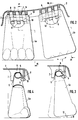
- Fig. 1 shows a device 1 which can be produced, for example, from plastic, consisting of a seat 2 which, for receiving a child, both sitting, standing, kneeling, etc. Below the seat 2, a head element 3 is initially arranged which, like the seat 2, is designed accordingly for the stylization of a turtle. Furthermore, four foot elements 4 are provided, the storage of which will be described in more detail with reference to FIGS.
- the device 1 can be moved forward along the arrow A, for which purpose the seat 2 can be tilted about the axis defined by the arrow A by correspondingly shifting the weight of the child thereon, as will now be described.
- Fig. 2 shows the seat 2 in section. Below the seat 2 are, cf. Figures 3 and 4, bearing receptacles 5 are formed, in which the upper ends 6 of the foot elements 4 are mounted.
- the bearing receptacles 5 comprise side arms 7, to which the side arms 8 which limit the bearing receptacles are assigned opposite.
- a total of four side arms 7 projecting from the underside of the seat 2 are provided. Between each two side arms 7, a side arm 8 is provided on the opposite bearing receiving side.
- Each side arm 8 is provided at its lower end with a support element 9 in the form of a hook which projects into the bearing receptacle 5.
- the foot element 4 is arranged in the bearing receptacle 5 in such a way that it is essentially vertically movable and at the same time pivotable. This makes it possible to assume the different positions shown in FIG. 2. 2 shows, the left foot element 4a is placed on the floor. Specifically, this means that a child accommodated in seat 2 would have shifted his weight to this side. In this case, it corresponds to that shown in FIG. 4 State, the foot element 4a is pressed up in the bearing holder. A support element 10 formed on the foot element 4a in the form of the projection shown is out of engagement with the support element 9 assigned to it. In this position, the top of the foot element 4a lies against the seat-side limiting projections 11, as shown in FIG. 2.
- FIG. 2 The second possible end position of a foot element is shown in FIG. 2 with respect to foot element 4b.
- This is unloaded due to the tilting of the seat 2 and can assume its lower position within the bearing seat 5, as shown in FIG. 3.
- the foot element sinks and slides downward in the bearing receptacle 5, this movement being limited by the bearing element 9, which comes into engagement with the bearing element 10 of the foot element 4b in a certain position.
- This means that a further vertical movement downwards is no longer possible.
- the front-side support of the foot element 4b causes it to pivot forward in the direction of movement, as indicated by the arrow B in FIG. 3.
- This forward movement is limited when the foot element 4b is supported in the upper region 6 on the rear side arms 7 of the bearing receptacle 5 and can therefore no longer be pivoted forward.
- This storage position is also shown in the view in FIG. 2.
- the foot element in the unloaded position is also laterally pivoted or tilted, which is useful for the tilting movement described below and used for the forward movement.
- the angular arrangement of the bearing receptacles and thus the foot elements also contributes to this, as can be seen from FIG. 2, because it ensures that the unloaded foot elements can be detached from the floor and can swing forward.
- the foot element 4b is in the freely movable position shown in FIG. 3. If the child now shifts his weight to the side of the foot element 4b, this is placed on the floor with its floor contact surface 12 and fixed there. If the weight is shifted further, the foot element in the bearing receptacle is guided essentially vertically upward, or the bearing receptacle is pressed downward with respect to the now fixed foot element. The foot element 4b is guided with its upper region 6 in the bearing receptacle 5 and the bearing arms 7 in such a way that the foot element is pressed forward during this movement, i.e. it is pivoted forward about the lower ground contact point.
- the upper region 6 of the foot element and thus the seat carrying the child is pivoted forwards in the direction of movement about the base-side attachment point, as shown by the dash-dotted line in FIG. 4, which shows the state before attachment to the floor, i.e. the one in FIG. 3 shown.
- the foot element 4b in this case is released from the attached position shown in FIG. 4 and slides down within the bearing receptacle 5 until the bearing elements 9, 10 are engaged and the pivoting movement (arrow B) in the forward direction from the rear side arms 7 of the bearing receptacle 5 are limited so that the foot element 4b in turn assumes the position shown in FIG. 3.
Landscapes
- Health & Medical Sciences (AREA)
- General Health & Medical Sciences (AREA)
- Physical Education & Sports Medicine (AREA)
- Rehabilitation Tools (AREA)
- Toys (AREA)
- Finger-Pressure Massage (AREA)
- Invalid Beds And Related Equipment (AREA)
- Surgical Instruments (AREA)
Applications Claiming Priority (2)
| Application Number | Priority Date | Filing Date | Title |
|---|---|---|---|
| HU9600170 | 1996-01-26 | ||
| HU9600170A HU219513B (hu) | 1996-01-26 | 1996-01-26 | Lépegető játékeszköz |
Publications (3)
| Publication Number | Publication Date |
|---|---|
| EP0786278A2 true EP0786278A2 (fr) | 1997-07-30 |
| EP0786278A3 EP0786278A3 (fr) | 1998-03-11 |
| EP0786278B1 EP0786278B1 (fr) | 2001-07-11 |
Family
ID=89993660
Family Applications (1)
| Application Number | Title | Priority Date | Filing Date |
|---|---|---|---|
| EP96710017A Expired - Lifetime EP0786278B1 (fr) | 1996-01-26 | 1996-11-09 | Dispositif mobile utilisé, en particulier, à des fins d'exercices ou de traitements médicaux |
Country Status (5)
| Country | Link |
|---|---|
| EP (1) | EP0786278B1 (fr) |
| AT (1) | ATE202946T1 (fr) |
| DE (2) | DE19646366C2 (fr) |
| HU (1) | HU219513B (fr) |
| TW (1) | TW343930B (fr) |
Citations (1)
| Publication number | Priority date | Publication date | Assignee | Title |
|---|---|---|---|---|
| DE29515785U1 (de) | 1995-10-05 | 1995-12-07 | BIG-Spielwarenfabrik Dipl.-Ing. Ernst A. Bettag, 90765 Fürth | Aufsitz-Rutschspielfahrzeug |
Family Cites Families (2)
| Publication number | Priority date | Publication date | Assignee | Title |
|---|---|---|---|---|
| US1984591A (en) * | 1932-05-05 | 1934-12-18 | Marziani Joseph | Exercising and amusement device |
| DE938055C (de) * | 1949-12-08 | 1956-01-19 | Erich Hahmann Dr | Durch Verschwenken der Beine eines oder mehrerer Beinpaare vorwaerts bewegbares Spielzeugreittier |
-
1996
- 1996-01-26 HU HU9600170A patent/HU219513B/hu not_active IP Right Cessation
- 1996-11-09 DE DE19646366A patent/DE19646366C2/de not_active Expired - Fee Related
- 1996-11-09 EP EP96710017A patent/EP0786278B1/fr not_active Expired - Lifetime
- 1996-11-09 AT AT96710017T patent/ATE202946T1/de not_active IP Right Cessation
- 1996-11-09 DE DE59607271T patent/DE59607271D1/de not_active Expired - Fee Related
-
1997
- 1997-01-25 TW TW086100828A patent/TW343930B/zh active
Patent Citations (1)
| Publication number | Priority date | Publication date | Assignee | Title |
|---|---|---|---|---|
| DE29515785U1 (de) | 1995-10-05 | 1995-12-07 | BIG-Spielwarenfabrik Dipl.-Ing. Ernst A. Bettag, 90765 Fürth | Aufsitz-Rutschspielfahrzeug |
Also Published As
| Publication number | Publication date |
|---|---|
| DE59607271D1 (de) | 2001-08-16 |
| DE19646366A1 (de) | 1997-07-31 |
| DE19646366C2 (de) | 2002-05-16 |
| EP0786278A3 (fr) | 1998-03-11 |
| HUP9600170A1 (en) | 1997-11-28 |
| EP0786278B1 (fr) | 2001-07-11 |
| HU9600170D0 (en) | 1996-03-28 |
| TW343930B (en) | 1998-11-01 |
| HU219513B (hu) | 2001-04-28 |
| ATE202946T1 (de) | 2001-07-15 |
Similar Documents
| Publication | Publication Date | Title |
|---|---|---|
| DE1603165A1 (de) | Geraet zur Unterhaltung,insbesondere Spielzeug | |
| DE2351965A1 (de) | Als skilauflehrvorrichtung verwendbare, mit rollen versehene brettspielzeugeinheit | |
| DE2629170A1 (de) | Aus einzelteilen zusammensetzbare puppe | |
| DE2612724A1 (de) | Spielzeugzubehoer zur verwendung mit einer puppe | |
| DE2625851C3 (de) | Einrichtung zur Simulation einer Gehbewegung auf einer Unterlage fur eine Spielzeugfigur mit Beinen | |
| EP0786278B1 (fr) | Dispositif mobile utilisé, en particulier, à des fins d'exercices ou de traitements médicaux | |
| DE881101C (de) | Bewegungs-UEbungsgeraet fuer Kleinkinder | |
| DE2028850A1 (de) | Spielgerat | |
| AT409338B (de) | Baukastensystem zum aufbau einer raumstruktur | |
| DE583827C (de) | Laufende Spielfiguren mit Beinbewegungen durch Beinsterne | |
| DE3203460C2 (de) | Spielzeugfiguren-Gruppe unter Verwendung mehrerer Spielzeugfiguren | |
| DE29918681U1 (de) | Kinderschaukel | |
| DE6758C (de) | Verbesserungen an Kinderstühlen | |
| DE10154910B4 (de) | Spielgerät für Kinder | |
| DE29516845U1 (de) | Faltbarer Spielzeug-Einkaufswagen | |
| DE345226C (de) | Spielzeug, bestehend aus Turngeraeten und Puppen | |
| DE20118516U1 (de) | Spielgerät für Kinder | |
| DE150616C (fr) | ||
| DE1603530A1 (de) | Puppe mit innerhalb eines Halbkugelbereichs beweglichen und einstellbaren Armen | |
| DE7118085U (de) | Mehrfach-Turn- und Spielgerät für Kinder | |
| DE2457773A1 (de) | Schaukelpferd | |
| DE202011000200U1 (de) | Pädagogisches Spielzeug | |
| CH271399A (de) | Fahrbare Spielfigur. | |
| DD269098A1 (de) | Turn- und gymnastikgeraet, insbesondere fuer vorschuleinrichtungen | |
| CH696580A5 (de) | Spielgerät zum Ausbalancieren. |
Legal Events
| Date | Code | Title | Description |
|---|---|---|---|
| PUAI | Public reference made under article 153(3) epc to a published international application that has entered the european phase |
Free format text: ORIGINAL CODE: 0009012 |
|
| AK | Designated contracting states |
Kind code of ref document: A2 Designated state(s): AT BE CH DE DK ES FI FR GB GR IE IT LI LU NL PT SE |
|
| PUAL | Search report despatched |
Free format text: ORIGINAL CODE: 0009013 |
|
| AK | Designated contracting states |
Kind code of ref document: A3 Designated state(s): AT BE CH DE DK ES FI FR GB GR IE IT LI LU NL PT SE |
|
| 17P | Request for examination filed |
Effective date: 19980818 |
|
| 17Q | First examination report despatched |
Effective date: 19991202 |
|
| GRAG | Despatch of communication of intention to grant |
Free format text: ORIGINAL CODE: EPIDOS AGRA |
|
| GRAG | Despatch of communication of intention to grant |
Free format text: ORIGINAL CODE: EPIDOS AGRA |
|
| GRAH | Despatch of communication of intention to grant a patent |
Free format text: ORIGINAL CODE: EPIDOS IGRA |
|
| GRAH | Despatch of communication of intention to grant a patent |
Free format text: ORIGINAL CODE: EPIDOS IGRA |
|
| GRAA | (expected) grant |
Free format text: ORIGINAL CODE: 0009210 |
|
| AK | Designated contracting states |
Kind code of ref document: B1 Designated state(s): AT BE CH DE DK ES FI FR GB GR IE IT LI LU NL PT SE |
|
| PG25 | Lapsed in a contracting state [announced via postgrant information from national office to epo] |
Ref country code: NL Free format text: LAPSE BECAUSE OF FAILURE TO SUBMIT A TRANSLATION OF THE DESCRIPTION OR TO PAY THE FEE WITHIN THE PRESCRIBED TIME-LIMIT Effective date: 20010711 Ref country code: IT Free format text: LAPSE BECAUSE OF FAILURE TO SUBMIT A TRANSLATION OF THE DESCRIPTION OR TO PAY THE FEE WITHIN THE PRE;WARNING: LAPSES OF ITALIAN PATENTS WITH EFFECTIVE DATE BEFORE 2007 MAY HAVE OCCURRED AT ANY TIME BEFORE 2007. THE CORRECT EFFECTIVE DATE MAY BE DIFFERENT FROM THE ONE RECORDED.SCRIBED TIME-LIMIT Effective date: 20010711 Ref country code: IE Free format text: LAPSE BECAUSE OF FAILURE TO SUBMIT A TRANSLATION OF THE DESCRIPTION OR TO PAY THE FEE WITHIN THE PRESCRIBED TIME-LIMIT Effective date: 20010711 Ref country code: FI Free format text: LAPSE BECAUSE OF FAILURE TO SUBMIT A TRANSLATION OF THE DESCRIPTION OR TO PAY THE FEE WITHIN THE PRESCRIBED TIME-LIMIT Effective date: 20010711 |
|
| REF | Corresponds to: |
Ref document number: 202946 Country of ref document: AT Date of ref document: 20010715 Kind code of ref document: T |
|
| REG | Reference to a national code |
Ref country code: CH Ref legal event code: EP |
|
| REF | Corresponds to: |
Ref document number: 59607271 Country of ref document: DE Date of ref document: 20010816 |
|
| REG | Reference to a national code |
Ref country code: IE Ref legal event code: FG4D Free format text: GERMAN |
|
| PG25 | Lapsed in a contracting state [announced via postgrant information from national office to epo] |
Ref country code: SE Free format text: LAPSE BECAUSE OF FAILURE TO SUBMIT A TRANSLATION OF THE DESCRIPTION OR TO PAY THE FEE WITHIN THE PRESCRIBED TIME-LIMIT Effective date: 20011011 Ref country code: PT Free format text: LAPSE BECAUSE OF FAILURE TO SUBMIT A TRANSLATION OF THE DESCRIPTION OR TO PAY THE FEE WITHIN THE PRESCRIBED TIME-LIMIT Effective date: 20011011 Ref country code: DK Free format text: LAPSE BECAUSE OF FAILURE TO SUBMIT A TRANSLATION OF THE DESCRIPTION OR TO PAY THE FEE WITHIN THE PRESCRIBED TIME-LIMIT Effective date: 20011011 |
|
| PG25 | Lapsed in a contracting state [announced via postgrant information from national office to epo] |
Ref country code: GR Free format text: LAPSE BECAUSE OF FAILURE TO SUBMIT A TRANSLATION OF THE DESCRIPTION OR TO PAY THE FEE WITHIN THE PRESCRIBED TIME-LIMIT Effective date: 20011012 |
|
| PG25 | Lapsed in a contracting state [announced via postgrant information from national office to epo] |
Ref country code: LU Free format text: LAPSE BECAUSE OF NON-PAYMENT OF DUE FEES Effective date: 20011109 Ref country code: AT Free format text: LAPSE BECAUSE OF NON-PAYMENT OF DUE FEES Effective date: 20011109 |
|
| GBT | Gb: translation of ep patent filed (gb section 77(6)(a)/1977) |
Effective date: 20011025 |
|
| PG25 | Lapsed in a contracting state [announced via postgrant information from national office to epo] |
Ref country code: LI Free format text: LAPSE BECAUSE OF NON-PAYMENT OF DUE FEES Effective date: 20011130 Ref country code: CH Free format text: LAPSE BECAUSE OF NON-PAYMENT OF DUE FEES Effective date: 20011130 Ref country code: BE Free format text: LAPSE BECAUSE OF NON-PAYMENT OF DUE FEES Effective date: 20011130 |
|
| NLV1 | Nl: lapsed or annulled due to failure to fulfill the requirements of art. 29p and 29m of the patents act | ||
| ET | Fr: translation filed | ||
| REG | Reference to a national code |
Ref country code: GB Ref legal event code: IF02 |
|
| PG25 | Lapsed in a contracting state [announced via postgrant information from national office to epo] |
Ref country code: ES Free format text: LAPSE BECAUSE OF FAILURE TO SUBMIT A TRANSLATION OF THE DESCRIPTION OR TO PAY THE FEE WITHIN THE PRESCRIBED TIME-LIMIT Effective date: 20020131 |
|
| PLBE | No opposition filed within time limit |
Free format text: ORIGINAL CODE: 0009261 |
|
| STAA | Information on the status of an ep patent application or granted ep patent |
Free format text: STATUS: NO OPPOSITION FILED WITHIN TIME LIMIT |
|
| BERE | Be: lapsed |
Owner name: SPORTS UNLIMITED SPORTARTIKEL-VERTRIEB UND BERATU Effective date: 20011130 |
|
| 26N | No opposition filed | ||
| REG | Reference to a national code |
Ref country code: CH Ref legal event code: PL |
|
| PGFP | Annual fee paid to national office [announced via postgrant information from national office to epo] |
Ref country code: GB Payment date: 20031114 Year of fee payment: 8 |
|
| PGFP | Annual fee paid to national office [announced via postgrant information from national office to epo] |
Ref country code: FR Payment date: 20031120 Year of fee payment: 8 |
|
| PGFP | Annual fee paid to national office [announced via postgrant information from national office to epo] |
Ref country code: DE Payment date: 20031124 Year of fee payment: 8 |
|
| PG25 | Lapsed in a contracting state [announced via postgrant information from national office to epo] |
Ref country code: GB Free format text: LAPSE BECAUSE OF NON-PAYMENT OF DUE FEES Effective date: 20041109 |
|
| PG25 | Lapsed in a contracting state [announced via postgrant information from national office to epo] |
Ref country code: DE Free format text: LAPSE BECAUSE OF NON-PAYMENT OF DUE FEES Effective date: 20050601 |
|
| GBPC | Gb: european patent ceased through non-payment of renewal fee |
Effective date: 20041109 |
|
| PG25 | Lapsed in a contracting state [announced via postgrant information from national office to epo] |
Ref country code: FR Free format text: LAPSE BECAUSE OF NON-PAYMENT OF DUE FEES Effective date: 20050729 |
|
| REG | Reference to a national code |
Ref country code: FR Ref legal event code: ST |