EP0786283B1 - NOX-cleaning paving block - Google Patents
NOX-cleaning paving block Download PDFInfo
- Publication number
- EP0786283B1 EP0786283B1 EP97100554A EP97100554A EP0786283B1 EP 0786283 B1 EP0786283 B1 EP 0786283B1 EP 97100554 A EP97100554 A EP 97100554A EP 97100554 A EP97100554 A EP 97100554A EP 0786283 B1 EP0786283 B1 EP 0786283B1
- Authority
- EP
- European Patent Office
- Prior art keywords
- surface layer
- cleaning
- weight
- paving block
- parts
- Prior art date
- Legal status (The legal status is an assumption and is not a legal conclusion. Google has not performed a legal analysis and makes no representation as to the accuracy of the status listed.)
- Expired - Lifetime
Links
Images


Classifications
-
- B—PERFORMING OPERATIONS; TRANSPORTING
- B01—PHYSICAL OR CHEMICAL PROCESSES OR APPARATUS IN GENERAL
- B01J—CHEMICAL OR PHYSICAL PROCESSES, e.g. CATALYSIS OR COLLOID CHEMISTRY; THEIR RELEVANT APPARATUS
- B01J21/00—Catalysts comprising the elements, oxides, or hydroxides of magnesium, boron, aluminium, carbon, silicon, titanium, zirconium, or hafnium
- B01J21/06—Silicon, titanium, zirconium or hafnium; Oxides or hydroxides thereof
- B01J21/063—Titanium; Oxides or hydroxides thereof
-
- E—FIXED CONSTRUCTIONS
- E01—CONSTRUCTION OF ROADS, RAILWAYS, OR BRIDGES
- E01C—CONSTRUCTION OF, OR SURFACES FOR, ROADS, SPORTS GROUNDS, OR THE LIKE; MACHINES OR AUXILIARY TOOLS FOR CONSTRUCTION OR REPAIR
- E01C5/00—Pavings made of prefabricated single units
-
- B—PERFORMING OPERATIONS; TRANSPORTING
- B01—PHYSICAL OR CHEMICAL PROCESSES OR APPARATUS IN GENERAL
- B01D—SEPARATION
- B01D53/00—Separation of gases or vapours; Recovering vapours of volatile solvents from gases; Chemical or biological purification of waste gases, e.g. engine exhaust gases, smoke, fumes, flue gases, aerosols
- B01D53/34—Chemical or biological purification of waste gases
- B01D53/74—General processes for purification of waste gases; Apparatus or devices specially adapted therefor
- B01D53/86—Catalytic processes
- B01D53/88—Handling or mounting catalysts
- B01D53/885—Devices in general for catalytic purification of waste gases
-
- C—CHEMISTRY; METALLURGY
- C04—CEMENTS; CONCRETE; ARTIFICIAL STONE; CERAMICS; REFRACTORIES
- C04B—LIME, MAGNESIA; SLAG; CEMENTS; COMPOSITIONS THEREOF, e.g. MORTARS, CONCRETE OR LIKE BUILDING MATERIALS; ARTIFICIAL STONE; CERAMICS; REFRACTORIES; TREATMENT OF NATURAL STONE
- C04B28/00—Compositions of mortars, concrete or artificial stone, containing inorganic binders or the reaction product of an inorganic and an organic binder, e.g. polycarboxylate cements
- C04B28/02—Compositions of mortars, concrete or artificial stone, containing inorganic binders or the reaction product of an inorganic and an organic binder, e.g. polycarboxylate cements containing hydraulic cements other than calcium sulfates
-
- C—CHEMISTRY; METALLURGY
- C04—CEMENTS; CONCRETE; ARTIFICIAL STONE; CERAMICS; REFRACTORIES
- C04B—LIME, MAGNESIA; SLAG; CEMENTS; COMPOSITIONS THEREOF, e.g. MORTARS, CONCRETE OR LIKE BUILDING MATERIALS; ARTIFICIAL STONE; CERAMICS; REFRACTORIES; TREATMENT OF NATURAL STONE
- C04B41/00—After-treatment of mortars, concrete, artificial stone or ceramics; Treatment of natural stone
- C04B41/009—After-treatment of mortars, concrete, artificial stone or ceramics; Treatment of natural stone characterised by the material treated
-
- C—CHEMISTRY; METALLURGY
- C04—CEMENTS; CONCRETE; ARTIFICIAL STONE; CERAMICS; REFRACTORIES
- C04B—LIME, MAGNESIA; SLAG; CEMENTS; COMPOSITIONS THEREOF, e.g. MORTARS, CONCRETE OR LIKE BUILDING MATERIALS; ARTIFICIAL STONE; CERAMICS; REFRACTORIES; TREATMENT OF NATURAL STONE
- C04B41/00—After-treatment of mortars, concrete, artificial stone or ceramics; Treatment of natural stone
- C04B41/45—Coating or impregnating, e.g. injection in masonry, partial coating of green or fired ceramics, organic coating compositions for adhering together two concrete elements
- C04B41/50—Coating or impregnating, e.g. injection in masonry, partial coating of green or fired ceramics, organic coating compositions for adhering together two concrete elements with inorganic materials
- C04B41/5025—Coating or impregnating, e.g. injection in masonry, partial coating of green or fired ceramics, organic coating compositions for adhering together two concrete elements with inorganic materials with ceramic materials
- C04B41/5041—Titanium oxide or titanates
-
- C—CHEMISTRY; METALLURGY
- C04—CEMENTS; CONCRETE; ARTIFICIAL STONE; CERAMICS; REFRACTORIES
- C04B—LIME, MAGNESIA; SLAG; CEMENTS; COMPOSITIONS THEREOF, e.g. MORTARS, CONCRETE OR LIKE BUILDING MATERIALS; ARTIFICIAL STONE; CERAMICS; REFRACTORIES; TREATMENT OF NATURAL STONE
- C04B41/00—After-treatment of mortars, concrete, artificial stone or ceramics; Treatment of natural stone
- C04B41/60—After-treatment of mortars, concrete, artificial stone or ceramics; Treatment of natural stone of only artificial stone
- C04B41/61—Coating or impregnation
- C04B41/65—Coating or impregnation with inorganic materials
-
- E—FIXED CONSTRUCTIONS
- E01—CONSTRUCTION OF ROADS, RAILWAYS, OR BRIDGES
- E01C—CONSTRUCTION OF, OR SURFACES FOR, ROADS, SPORTS GROUNDS, OR THE LIKE; MACHINES OR AUXILIARY TOOLS FOR CONSTRUCTION OR REPAIR
- E01C1/00—Design or layout of roads, e.g. for noise abatement, for gas absorption
- E01C1/005—Means permanently installed along the road for removing or neutralising exhaust gases
-
- E—FIXED CONSTRUCTIONS
- E04—BUILDING
- E04B—GENERAL BUILDING CONSTRUCTIONS; WALLS, e.g. PARTITIONS; ROOFS; FLOORS; CEILINGS; INSULATION OR OTHER PROTECTION OF BUILDINGS
- E04B5/00—Floors; Floor construction with regard to insulation; Connections specially adapted therefor
- E04B5/44—Floors composed of stones, mortar, and reinforcing elements
-
- B—PERFORMING OPERATIONS; TRANSPORTING
- B01—PHYSICAL OR CHEMICAL PROCESSES OR APPARATUS IN GENERAL
- B01D—SEPARATION
- B01D2259/00—Type of treatment
- B01D2259/45—Gas separation or purification devices adapted for specific applications
- B01D2259/4591—Construction elements containing cleaning material, e.g. catalysts
-
- B—PERFORMING OPERATIONS; TRANSPORTING
- B01—PHYSICAL OR CHEMICAL PROCESSES OR APPARATUS IN GENERAL
- B01J—CHEMICAL OR PHYSICAL PROCESSES, e.g. CATALYSIS OR COLLOID CHEMISTRY; THEIR RELEVANT APPARATUS
- B01J29/00—Catalysts comprising molecular sieves
-
- B—PERFORMING OPERATIONS; TRANSPORTING
- B01—PHYSICAL OR CHEMICAL PROCESSES OR APPARATUS IN GENERAL
- B01J—CHEMICAL OR PHYSICAL PROCESSES, e.g. CATALYSIS OR COLLOID CHEMISTRY; THEIR RELEVANT APPARATUS
- B01J35/00—Catalysts, in general, characterised by their form or physical properties
- B01J35/30—Catalysts, in general, characterised by their form or physical properties characterised by their physical properties
- B01J35/34—Mechanical properties
- B01J35/38—Abrasion or attrition resistance
-
- C—CHEMISTRY; METALLURGY
- C04—CEMENTS; CONCRETE; ARTIFICIAL STONE; CERAMICS; REFRACTORIES
- C04B—LIME, MAGNESIA; SLAG; CEMENTS; COMPOSITIONS THEREOF, e.g. MORTARS, CONCRETE OR LIKE BUILDING MATERIALS; ARTIFICIAL STONE; CERAMICS; REFRACTORIES; TREATMENT OF NATURAL STONE
- C04B2111/00—Mortars, concrete or artificial stone or mixtures to prepare them, characterised by specific function, property or use
- C04B2111/00474—Uses not provided for elsewhere in C04B2111/00
- C04B2111/00612—Uses not provided for elsewhere in C04B2111/00 as one or more layers of a layered structure
-
- Y—GENERAL TAGGING OF NEW TECHNOLOGICAL DEVELOPMENTS; GENERAL TAGGING OF CROSS-SECTIONAL TECHNOLOGIES SPANNING OVER SEVERAL SECTIONS OF THE IPC; TECHNICAL SUBJECTS COVERED BY FORMER USPC CROSS-REFERENCE ART COLLECTIONS [XRACs] AND DIGESTS
- Y10—TECHNICAL SUBJECTS COVERED BY FORMER USPC
- Y10T—TECHNICAL SUBJECTS COVERED BY FORMER US CLASSIFICATION
- Y10T428/00—Stock material or miscellaneous articles
- Y10T428/24—Structurally defined web or sheet [e.g., overall dimension, etc.]
- Y10T428/24355—Continuous and nonuniform or irregular surface on layer or component [e.g., roofing, etc.]
-
- Y—GENERAL TAGGING OF NEW TECHNOLOGICAL DEVELOPMENTS; GENERAL TAGGING OF CROSS-SECTIONAL TECHNOLOGIES SPANNING OVER SEVERAL SECTIONS OF THE IPC; TECHNICAL SUBJECTS COVERED BY FORMER USPC CROSS-REFERENCE ART COLLECTIONS [XRACs] AND DIGESTS
- Y10—TECHNICAL SUBJECTS COVERED BY FORMER USPC
- Y10T—TECHNICAL SUBJECTS COVERED BY FORMER US CLASSIFICATION
- Y10T428/00—Stock material or miscellaneous articles
- Y10T428/24—Structurally defined web or sheet [e.g., overall dimension, etc.]
- Y10T428/24355—Continuous and nonuniform or irregular surface on layer or component [e.g., roofing, etc.]
- Y10T428/24372—Particulate matter
-
- Y—GENERAL TAGGING OF NEW TECHNOLOGICAL DEVELOPMENTS; GENERAL TAGGING OF CROSS-SECTIONAL TECHNOLOGIES SPANNING OVER SEVERAL SECTIONS OF THE IPC; TECHNICAL SUBJECTS COVERED BY FORMER USPC CROSS-REFERENCE ART COLLECTIONS [XRACs] AND DIGESTS
- Y10—TECHNICAL SUBJECTS COVERED BY FORMER USPC
- Y10T—TECHNICAL SUBJECTS COVERED BY FORMER US CLASSIFICATION
- Y10T428/00—Stock material or miscellaneous articles
- Y10T428/24—Structurally defined web or sheet [e.g., overall dimension, etc.]
- Y10T428/24355—Continuous and nonuniform or irregular surface on layer or component [e.g., roofing, etc.]
- Y10T428/24372—Particulate matter
- Y10T428/24421—Silicon containing
-
- Y—GENERAL TAGGING OF NEW TECHNOLOGICAL DEVELOPMENTS; GENERAL TAGGING OF CROSS-SECTIONAL TECHNOLOGIES SPANNING OVER SEVERAL SECTIONS OF THE IPC; TECHNICAL SUBJECTS COVERED BY FORMER USPC CROSS-REFERENCE ART COLLECTIONS [XRACs] AND DIGESTS
- Y10—TECHNICAL SUBJECTS COVERED BY FORMER USPC
- Y10T—TECHNICAL SUBJECTS COVERED BY FORMER US CLASSIFICATION
- Y10T428/00—Stock material or miscellaneous articles
- Y10T428/24—Structurally defined web or sheet [e.g., overall dimension, etc.]
- Y10T428/24355—Continuous and nonuniform or irregular surface on layer or component [e.g., roofing, etc.]
- Y10T428/24372—Particulate matter
- Y10T428/24421—Silicon containing
- Y10T428/2443—Sand, clay, or crushed rock or slate
-
- Y—GENERAL TAGGING OF NEW TECHNOLOGICAL DEVELOPMENTS; GENERAL TAGGING OF CROSS-SECTIONAL TECHNOLOGIES SPANNING OVER SEVERAL SECTIONS OF THE IPC; TECHNICAL SUBJECTS COVERED BY FORMER USPC CROSS-REFERENCE ART COLLECTIONS [XRACs] AND DIGESTS
- Y10—TECHNICAL SUBJECTS COVERED BY FORMER USPC
- Y10T—TECHNICAL SUBJECTS COVERED BY FORMER US CLASSIFICATION
- Y10T428/00—Stock material or miscellaneous articles
- Y10T428/24—Structurally defined web or sheet [e.g., overall dimension, etc.]
- Y10T428/24479—Structurally defined web or sheet [e.g., overall dimension, etc.] including variation in thickness
-
- Y—GENERAL TAGGING OF NEW TECHNOLOGICAL DEVELOPMENTS; GENERAL TAGGING OF CROSS-SECTIONAL TECHNOLOGIES SPANNING OVER SEVERAL SECTIONS OF THE IPC; TECHNICAL SUBJECTS COVERED BY FORMER USPC CROSS-REFERENCE ART COLLECTIONS [XRACs] AND DIGESTS
- Y10—TECHNICAL SUBJECTS COVERED BY FORMER USPC
- Y10T—TECHNICAL SUBJECTS COVERED BY FORMER US CLASSIFICATION
- Y10T428/00—Stock material or miscellaneous articles
- Y10T428/24—Structurally defined web or sheet [e.g., overall dimension, etc.]
- Y10T428/24942—Structurally defined web or sheet [e.g., overall dimension, etc.] including components having same physical characteristic in differing degree
- Y10T428/2495—Thickness [relative or absolute]
-
- Y—GENERAL TAGGING OF NEW TECHNOLOGICAL DEVELOPMENTS; GENERAL TAGGING OF CROSS-SECTIONAL TECHNOLOGIES SPANNING OVER SEVERAL SECTIONS OF THE IPC; TECHNICAL SUBJECTS COVERED BY FORMER USPC CROSS-REFERENCE ART COLLECTIONS [XRACs] AND DIGESTS
- Y10—TECHNICAL SUBJECTS COVERED BY FORMER USPC
- Y10T—TECHNICAL SUBJECTS COVERED BY FORMER US CLASSIFICATION
- Y10T428/00—Stock material or miscellaneous articles
- Y10T428/249921—Web or sheet containing structurally defined element or component
- Y10T428/249953—Composite having voids in a component [e.g., porous, cellular, etc.]
- Y10T428/249967—Inorganic matrix in void-containing component
-
- Y—GENERAL TAGGING OF NEW TECHNOLOGICAL DEVELOPMENTS; GENERAL TAGGING OF CROSS-SECTIONAL TECHNOLOGIES SPANNING OVER SEVERAL SECTIONS OF THE IPC; TECHNICAL SUBJECTS COVERED BY FORMER USPC CROSS-REFERENCE ART COLLECTIONS [XRACs] AND DIGESTS
- Y10—TECHNICAL SUBJECTS COVERED BY FORMER USPC
- Y10T—TECHNICAL SUBJECTS COVERED BY FORMER US CLASSIFICATION
- Y10T428/00—Stock material or miscellaneous articles
- Y10T428/249921—Web or sheet containing structurally defined element or component
- Y10T428/249953—Composite having voids in a component [e.g., porous, cellular, etc.]
- Y10T428/249967—Inorganic matrix in void-containing component
- Y10T428/24997—Of metal-containing material
-
- Y—GENERAL TAGGING OF NEW TECHNOLOGICAL DEVELOPMENTS; GENERAL TAGGING OF CROSS-SECTIONAL TECHNOLOGIES SPANNING OVER SEVERAL SECTIONS OF THE IPC; TECHNICAL SUBJECTS COVERED BY FORMER USPC CROSS-REFERENCE ART COLLECTIONS [XRACs] AND DIGESTS
- Y10—TECHNICAL SUBJECTS COVERED BY FORMER USPC
- Y10T—TECHNICAL SUBJECTS COVERED BY FORMER US CLASSIFICATION
- Y10T428/00—Stock material or miscellaneous articles
- Y10T428/25—Web or sheet containing structurally defined element or component and including a second component containing structurally defined particles
- Y10T428/256—Heavy metal or aluminum or compound thereof
Definitions
- the present invention relates to an NO x -cleaning paving block, and more particularly to an NO x -cleaning paving block which has an enhanced NO x -cleaning capability due to an increased efficiency of fixing NO x from the air and an increased pluvial NO x -cleaning efficiency, thus helping to protect the environment, and is provided with a non-slip property, wear resistance and further a very decorative property.
- Known NO x concentration-lowering materials include metal oxides, of which titanium dioxide is known to have a strong photocatalytic action. Research into removing NO x through the use of the strong photocatalytic action of titanium dioxide has attracted increasing interest in recent years, and removal of NO x by the external walls of buildings constructed of sheets or panels incorporating titanium oxide is nearing the commercial stage.
- JP-A-07331120 is disclosed a coating for removing nitrogen oxide which contains titania fine powder and can be applied to various surfaces including vehicles, road surfaces of parking lots, guard rails, pedestrian crossings, outer walls of buildings and bridges.
- EP-A-0614682 discloses a method for removing low-concentration pollutants such as nitrogen oxides in the environmental atmosphere and pollutants such as volatile organic chlorine compounds in water.
- the purifying material used in this method is based mainly on titanium dioxide or a mixture of titanium dioxide and activated charcoal and is molded by means of a synthetic resin to a sheet or panel, which are disposed in the outdoors like on exterior walls of buildings.
- a paving block formed of a combination of a dough comprising cement, titanium dioxide powder and sand, and a concrete base is a NO x -cleaning paving block (interlocking block) which efficiently removes NO x without suffering from impairment of the catalytic property of titanium dioxide, and has an excellent non-slip property and wear resistance suitable for paving purposes, and further a very decorative property.
- the NO x -cleaning paving block has been studied from various aspects in order to increase its performance, with the findings that:
- the NO x -cleaning paving block according to the present invention is characterized by comprising a surface layer which contains titanium dioxide and is layered on a concrete-made base layer, and is further characterized by comprising a surface layer which contains 100 parts by weight of cement, 5-50 parts by weight of titanium oxide powder and 100-700 parts by weight of sand and is layered on a concrete-made base layer according to a preferred embodiment thereof, wherein the concrete-made base layer provides the NO x -cleaning paving block according to the present invention with durability.
- the NO x -cleaning paving block according to the present invention changes NO x to nitrate ions by the action of titanium oxide.
- the NO x -cleaning paving block according to the present invention can be satisfactorily used for paving purposes.
- the NO x -cleaning paving block according to a preferred embodiment of the present invention is characterized by the asperities on the surface layer containing a titanium oxide, specifically titanium dioxide, which are formed with taps. This characteristic aspect of the preferred embodiment of the present invention enhances the NO x -cleaning capability, anti-slip property and decorative property.
- the NO x -cleaning paving block according to another preferred embodiment of the present invention contains an adsorbing material in the surface layer, not only the NO x adsorbed thereon during the day is removed by decomposition by sunlight (specifically ultraviolet light) during the day, but also NO x is adsorbed on the adsorbing material even during the night and decomposed by ultraviolet light during the day, thus removing the NO x .
- the photocatalytic efficiency can be increased by increasing the available surface area by setting the void volume of the surface layer of the NO x -cleaning paving block to 10-40% or higher and the water permeability thereof to 0.01 cm/sec. or higher. Further, when the NO x -cleaning paving block according to the present invention has an increased water permeability, the pluvial cleaning effect is also increased. Accordingly, there is provided a highly economical, NO x -cleaning paving block.
- NO x -cleaning means "removing NO x by decomposition by the catalytic action of titanium dioxide under irradiation with light such as sunlight”.
- Embodiments of the NO x -cleaning paving block according to the present invention include the preferred embodiments as defined in the claims, without being limited thereto.
- the NO x -cleaning paving block according to the present invention is characterized by comprising a surface layer which contains titanium dioxide, and is further characterized by comprising a surface layer which contains 100 parts by weight of cement, 5-50 parts by weight of titanium oxide powder and 100-700 parts by weight of sand according to a preferred embodiment thereof, wherein the titanium oxide changes NO x to nitrate ions. Since the nitrate ions are stabilized by being neutralized with the alkaline components of the concrete, the environment is satisfactorily protected. Since the slippery property of the titanium dioxide powder is suppressed by the addition of sand to the surface layer, the surface layer has an excellent anti-slip property. The surface layer has an excellent anti-slip property and durability due to the incorporation of cement and sand. As a result, the NO x -cleaning paving block according to the present invention can be satisfactorily used for paving purposes.
- the NO x -cleaning paving block according to a preferred embodiment of the present invention is characterized by the asperities on the surface layer containing a titanium oxide, specifically titanium dioxide, which are formed with taps. This characteristic aspect of the preferred embodiment of the present invention enhances the NO x -cleaning capability, anti-slip property and decorative property.
- the NO x -cleaning paving block according to another preferred embodiment of the present invention contains an adsorbing material in the surface layer, not only the NO x adsorbed thereon during the day is removed by decomposition by sunlight (specifically ultraviolet light) during the day, but also NO x is adsorbed on the adsorbing material even during the night and decomposed by ultraviolet light during the day, thus removing the NO x .
- the photocatalytic efficiency can be increased by increasing the available surface area by setting the void volume of the surface layer of the NO x -cleaning paving block to 10-40% and the water permeability thereof to 0.01 cm/sec. or higher. Further, when the NO x -cleaning paving block according to the present invention has a high water permeability, the pluvial cleaning effect is also increased. Accordingly, there is provided a highly economical, NO x -cleaning paving block.
- the thickness of the surface layer is 2-15 mm, and preferably 2-10 mm.
- the present invention is attempted to be carried out, if the thickness of the surface layer exceeds 15 mm, then sunlight is hard to penetrate into the interior of the surface layer with the result of decreasing the action on the titanium dioxide, and thus it is useless to provide the titanium dioxide layer with a larger thickness.
- the NO x -cleaning efficiency is reduced, and further the durability is impaired when the thickness is smaller than 2 mm.
- the particle size of the sand which can be used according to the present invention preferably ranges from 1.2 to 5 mm.
- the presence of a mixture of cement and titanium oxide powder as the binding material in an excess proportion relative to the sand results in a lower void volume.
- the effective void volume is 10-40%, though preferably is 15-30%.
- the void volume is smaller than 10%, a sufficient available surface area cannot be provided, and thus the NO x -cleaning efficiency is reduced.
- the void volume exceeds 40%, though the NO x -cleaning efficiency is increased, the strength is reduced, and thus durability required as a paving block is not ensured.
- the ratio between the sand and the binding material is preferably such that the binding material is present in a proportion of 18-100% by weight of the sand.
- the NO x -cleaning efficiency can be increased by providing a photoreflective layer beneath the surface layer. It is desirable to compose the photoreflective layer with a mixture of cement and white particles or a white pigment, such as titanium dioxide. Furthermore, the surface of the surface layer can be made uneven to increase the light absorbability and the area of contact with the air, and further the anti-slip property. The unevenness can be established by providing a form for forming the blocks with asperities or by grinding.
- the grinding can be performed with a diamond blade or another tool, or by any appropriate processing such as sand blasting.
- the asperities can be zigzagged, corrugated or trapezoid in cross section.
- the asperities can be formed by tapping the surface layer to roughen the surface. As a result, the surface layer has a very rough surface with large asperities.
- the surface layer can be finished so as to have a rough surface by tapping it with many projections from a surface-roughening tool, which is described later, on the mortar-made surface layer, for example; the surface of the surface layer can be made uneven by other methods as well, thereby increasing the light absorbability and the area of contact with the air, and further improving the anti-slip property.
- the surface of the surface layer can be decorated as desired provided that the effects described above are not impaired.
- the blocks are placed on carriages and tapped from above with a vertically reciprocating (over a span of 3 cm for example), surface-roughening tool having downward-pointing projections a required number of times (1-10) while horizontally reciprocating the carriages.
- the surface layer which has an uneven surface provided by surface-roughening processing which includes tapping on the surface layer in this way, is highly aesthetically pleasing and decorative.
- the unevenness of the surface of the surface layer preferably measures 2-7 mm in depth, with a preferable crest spacing of 4-10 mm.
- the mortar which can be used according to the present invention to compose the surface layer preferably consists of 100 parts by weight of cement, 5-50 parts by weight of titanium dioxide powder and 100-700 parts by weight of sand, and the NO x removed by the action of titanium dioxide is converted into nitrate ions which are then stabilized by neutralization by the alkaline components of the concrete, thus helping to protect the environment.
- the incorporation of sand minimizes the slipperiness of the titanium dioxide powder and thus provides the block with anti-slip property.
- cement and aggregate are contained, the anti-slip property and the durability are at adequate levels for paving purposes.
- the proportion of titanium dioxide which can be used according to the present invention to compose the surface layer, though depending on the types, particle sizes, etc. of the used titanium dioxide, is 5-50 parts by weight and preferably 10-50 parts by weight in terms of titanium dioxide powder, per 100 parts by weight of cement. More preferably, the titanium dioxide powder comprises 20-50 parts by weight.
- the proportion of titanium dioxide powder in the surface layer according to the present invention is lower than 5 parts by weight per 100 parts by weight of cement, the NO x -cleaning efficiency of the surface layer is impaired, whereas not only the anti-slip property is reduced, but also the wear resistance is impaired when the proportion exceeds 50 parts by weight.
- the proportion of the sand is 100-700 parts by weight, and preferably 100-400 parts by weight per 100 parts of cement.
- the surface layer according to the present invention preferably has the composition consisting of 10-50 parts by weight, more preferably 20-50 parts by weight, of titanium dioxide powder and 100-400 parts by weight of sand per 100 parts by weight of cement.
- the NO x -cleaning paving block which is used according to the present invention can be prepared by any appropriate method, including a method by which a concrete dough is charged into a form and levelled, and a surface layer-forming dough is then placed on the concrete dough for forming a laminate ( cf . Japanese Unexamined Patent Application Disclosure HEI 3-169901, lines 14-19 in the left column on page 1).
- the concrete-made base layer and the surface layer can be separately formed and set, and then combined, though the former method is preferable.
- the block base layer which is used according to the present invention is a concrete-made base layer.
- the concrete-made base layer is prepared with a dough of cement and aggregate.
- the base layer-forming aggregate can be any of the materials which are conventionally used in the technical field concerned, including sand, natural stones, gravel, crushed stones, etc.
- the cement does not need to be restricted to any particular type, and includes normal Portland cement, high early strength Portland cement, moderate heat Portland cement, super high early strength portland cement, sulfate-resistant Portland cement, white Portland cement, Portland blast furnace cement, fly ash cement, silica cement, alumina cement, superfast-setting cement, etc.
- the surface layer which is layered on the block base layer is preferably made of mortar comprising cement, titanium dioxide powder and aggregate, wherein the cement which is used in the mortar can be any of Portland cement, high early strength cement, white cement, alumina cement and the like. White cement is preferable for its enhanced photoreflectivity.
- the titanium dioxide can be of either rutile or anatase crystal structure, and preferably is anatase-type titanium dioxide for its higher activity.
- the sand used in the surface layer can be either natural sand or artificial sand.
- the sand can be replaced by one or more selected from a group of granite, quartzite, lightweight aggregate, glass grains and silica sand.
- the particle size of these materials is desired to be from 1.2 to 5 mm.
- light-transmittable aggregate which can be glass beads, glass powder, silica sand or the like, preferably with a particle size of 1-6 mm in diameter; when the light-transmittable aggregate used has a larger particle size, the strength decreases due to the increased proportion of the cement-free portions, whereas the light transmittability is impaired when the light-transmittable aggregate used has a smaller particle size.
- the proportion relative to the total amount of the aggregate preferably is 10-50% by weight, more preferably 15-50% by weight, and even more preferably 20-50% by weight.
- the proportion of the light-transmittable aggregate is lower than 10% by weight, the light-transmitting effect is not produced, whereas the proportion of the sand is reduced and eventually the block has a lower strength if the proportions is higher than 50% by weight.
- the light-transmittable aggregate available for use has a wide range of particle size or grain size, which is appropriately selected depending on the use.
- the surface layer can contain an adsorbing material which can be any conventional catalytic carrier.
- a particularly preferable material is zeolite, a conventional carrier which has a number of uses and has been confirmed to have a high adsorbing effect.
- the zeolite can be either naturally occurring zeolite or artificial zeolite.
- Arduinite a zeolite mineral which is represented by the chemical formula: (Ca, K 2 , Na 2 ) (AlSi 5 O 12 ) ⁇ 7H 2 O, contains water of crystallization.
- the water of crystallization is present as molecules of water; the structure is not destroyed even after having been dehydrated, and the spaces from which the molecules of water have been removed become voids. It has been reported that the voids adsorb gas, for which the mineral has an adsorbing action.
- Clay minerals which have water of crystallization as well, are effective as the adsorbing material.
- the clay available for use can be any, and includes Nenme clay and Kibushi clay, for example.
- Magadiite (Na 2 Si 14 O 29 ⁇ nH 2 O) is also effective as the adsorbing material.
- Magadiite is a clay mineral-resembling, hydrated sodium silicate of a laminar crystal structure which is, however, free from aluminum.
- petalite can used as the adsorbing material according to the present invention as well.
- Petalite is a white or gray mineral which resembles quartz in appearance, and mineralogically is a silicate mineral (Li 2 OAl 2 O 3 ⁇ 8SiO 2 ) which belongs to the feldspar family. Petalite contains a smaller proportion of impurities and is found in a larger quantity than other lithium minerals.
- Petalite is a conventional ceramic raw material used for many uses, and is further capable of adsorbing NO and HO 2 gas.
- petalite is characterized by contributing to the increased strength, particularly bending strength of products containing it.
- the adsorbing material which can be selected from a variety of candidates, can be incorporated in the surface layer in an appropriate proportion which allows NO and NO 2 gas to be adsorbed; the proportion can be determined as desired, by a simple test, with consideration given to the cost, the quantitative correlation between the cement and titanium dioxide, the strength, the N x -cleaning efficiency, etc.
- the adsorbing material is mixed into the surface layer in a proportion of 5-30 parts by weight, preferably approximately 7-25 parts by weight per 100 parts by weight of the surface layer except water.
- proportion of the adsorbing material is lower than 5 parts by weight, the adsorbing effect is insufficient, and the adsorbing performance is imperfect during the night free of sunlight.
- proportions which exceed 30 parts by weight the cost increases, and the quantities of cement and titanium dioxide relatively decrease, thus lowering the strength and the NO x -cleaning efficiency.
- the present invention also allows a photoreflective layer to be provided beneath the surface layer to increase the NO x -cleaning efficiency.
- the photoreflective layer is desirable to be composed of a mixture of cement and white particles or a white pigment, such as titanium dioxide.
- FIG. 10(a) projections 13 are placed on the surface 12 of a surface-roughening plate 11 in order or in a random fashion. As illustrated in Fig. 10(b) and Fig.
- each projection 13 is shaped as a pointed end 14 with which the surface of each NO x -cleaning block is tapped to cut into the surface in order to form predetermined hollows, thereby roughening the surface.
- the hollows are desirable to be 2 mm or more in depth when the anti-slip property and the NO x -cleaning capability are considered.
- Fig. 11(a) projections 15 are placed on the surface 12 of the surface-roughening plate 11 in order or in a random fashion.
- the tip of each projection 15 is shaped as a pointed end 16 such as tip of a Phillips screwdriver, with which the surface of each NO x -cleaning block is tapped to cut into the surface in order to form predetermined hollows, thereby roughening the surface.
- projections 17 are placed on the surface 12 of a surface-roughening plate 15 in order in the direction of width.
- the tip of each projection 17 is shaped as a pointed end 18 with which the surface of each NO x -cleaning block is tapped to cut into the surface in order to form predetermined hollows, thereby roughening the surface.
- the surface roughening treatment is preferably performed after a curing period of 2-7 days, more preferably 3-5 days, and even more preferably 3 days following the formation of the block.
- the degree of surface roughness is insufficient, and this results in not only failure to increase the anti-slip property and the surface area, but also in a larger number of times the surface-roughening tool must be cleaned to remove the visible grime thereon, thus impairing the operational efficiency.
- the cement in the surface layer excessively sets, and this makes it difficult to form satisfactory hollows in the surface-roughening step.
- the number of times the tapping is conducted with a surface-roughening tool is not particularly restricted provided that the hollows are properly formed, and is appropriately determined depending on the degree of cure of the surface of the NO x -cleaning block.
- the block When the block is prepared using a concrete-made base layer according to the present invention, the block is provided with durability, and the nitrate ions resulting from the NO x are neutralized by the alkaline components of the concrete.
- the use of glass or silica glass as the sand provides the block with a highly light-transmittable property in addition to an anti-slip property and wear resistance. It is also possible according to the present invention to allow ultraviolet light to penetrate into the depths of the surface layer by replacing part of the sand in the surface layer by light-transmittable aggregate. In addition, the unevenness of the surface allows light to strike thereon from all directions.
- the surface roughness provided by tapping the surface results in an increased anti-slip property, and further allows light to strike on the surface from all directions, thereby enhancing the NO x -cleaning capability and improving the aesthetically pleasing and decorative property.
- the surface roughness of the NO x -cleaning block is efficiently accomplished only by tapping the surface with simple means such a surface-roughening tool with many projections, as described above.
- the adsorbing material which is contained in the surface layer of the NO x -cleaning block adsorbs and removes NO x produced during the night.
- the NO x produced during the night is decomposed and removed by exposure to ultraviolet light of sunlight during the day.
- the void volume of the surface layer set to 10-40% and the water permeability coefficient set to 0.01 cm/sec. or higher increase the available surface area and the photocatalytic efficiency; the increase in the water permeability coefficient results in a higher degree of cleaning effectiveness.
- the dough for forming a concrete-made base layer was charged into a 10 x 20-cm form and formed into figures while vibrating, after which the dough for forming a surface layer was placed on the base layer and covered with a die plate, and then subjected to vibration under pressure (pressure: 0.25 kg/cm 2 , number of vibrations: 3,140 r.p.m., amplitude of vibration: 1.4 mm; and vibration time under pressure: 3 sec.), followed by curing, to prepare Test specimens 1-4 which were 20 cm long, 10 cm wide and 8 cm thick, corresponding to Samples 1-4, respectively.
- vibration under pressure pressure: 0.25 kg/cm 2 , number of vibrations: 3,140 r.p.m., amplitude of vibration: 1.4 mm; and vibration time under pressure: 3 sec.
- Fig. 1 is a perspective view illustrative of one of the blocks prepared as described above.
- the block 1 has a base layer 2 on which a 7-mm-thick surface layer 3 is layered. The results obtained are listed in Table 1.
- the anti-slip properties of the paving blocks were measured according to ASTM E303.
- the method defined there is designed so as to rub a rubber slider mounted on one end of a pendulum arm against the surface to be tested and to measure the energy lost at that time; the measurement is required to be equal to or larger than 65 BPM.
- the wear resistance test (labeling test) conducted was designed so that falling, rotating (200 r.p.m.) wheels (outer diameter: 205 mm, and width: 100 mm) half of which each had twelve chains with ten links came into contact with a horizontally reciprocating (66 times per min.) test specimen to cut into and wear the surface, and the amount of wear (unit: g per cm 2 ) was measured.
- Test specimen Cement sand ratio (wt. ratio)
- Slip resistance (BPM) Labelling test (g/cm 2 ) Remarks 1 1 : 3 85 1.5 Wet state (slip occurs unless BPM is 65 or more) 2 1 : 2 78 1.5 3 1 : 1 72 2.0 4 1 : 0 56 4.0
- Test specimen 5 having a 1-to-3 cement-to-sand ratio was prepared in the same manner as in Example 1, except for using, as the die plate with an uneven surface layer, a die plate 4 having a surface 5 trapezoid in cross section which was illustrated in the perspective view of Fig. 2, instead of plate used in Example 1.
- the block represented by Test specimen 5 is illustrated in the cross sectional view of Fig. 5.
- Test specimen 5 obtained had both a high anti-slip property and light transmittability, and efficiently removed NO x .
- Test specimens 6 and 7 both having the same 1-to-3 cement-to-sand ratio as Test specimen 1 were prepared by using a die plate 6 and a die plate 8 which had a corrugated surface 7 illustrated in the perspective view of Fig. 3 and a zigzagged surface 9 illustrated in the perspective view of Fig. 4, respectively, instead of the plate 4 having the surface 5 trapezoid in cross section which was illustrated in Fig. 2.
- the obtained blocks are illustrated in the cross sectional views of Fig. 6 and Fig. 7. All the blocks prepared had the excellent effects of the present invention.
- Test specimen 8 having a 1-to-3 cement-to-sand ratio was prepared in the same manner as in Example 1, except for using 100 parts by weight of glass grains instead of the sand to prepare the dough for forming a surface layer.
- Test specimen 8 obtained had both a high anti-slip property and light transmittability, and efficiently removed NO x .
- Test specimen 9 having a 1-to-1 cement-to-sand ratio was prepared in the same manner as in Example 1, except for using 100 parts by weight of silica sand instead of the sand to prepare the dough for forming a surface layer.
- Test specimen 9 obtained had both a high anti-slip property and light transmittability, and efficiently removed NO x .
- Test specimen 10 was prepared in the same manner as in Example 4, except for roughening the surface of the surface layer by sand blasting. Test specimen 10 obtained had both a high anti-slip property and light transmittability, and efficiently removed NO x .
- a dough for forming a concrete-made base layer 100 parts by weight of Portland cement, 25 parts by weight of water and 300 parts by weight of crushed stones were combined and kneaded.
- 600 parts by weight of crushed sand, an artificial sand, 30 parts by weight of titanium dioxide, 100 parts by weight of Portland cement and 25 parts by weight of water were combined and kneaded.
- the dough for forming a concrete-made base layer was charged into a 10 x 20-cm form and formed into a figure while vibrating, after which the dough for forming a surface layer was placed on the base layer and covered with a die plate, and then subjected to vibration under pressure in the same manner as in Example 1.
- a paving block was obtained after curing.
- the resulting block comprising the 7-cm-thick base layer and the 1-cm-thick surface layer, had a base-layer void volume of 26%, a surface-layer void volume of 20%, and a water permeability of 0.10 cm/sec.; the block further had both a high anti-slip property exemplified by 87 BPM and a high cleaning effect, and efficiently removed NO x .
- the dough for forming a concrete-made base layer was charged into 10 x 20-cm forms and formed into figures while vibrating, after which the four types of dough for forming surface layers were placed on the respective base layers and covered with die plates, and then subjected to vibration under pressure (pressure: 0.25 kg/cm 2 , number of vibrations: 3,140 r.p.m., amplitude of vibration: 1.4 mm; and vibration time under pressure: 3 sec.) in the same manner as in Example 1, followed by curing and surface-roughening processing.
- vibration under pressure pressure: 0.25 kg/cm 2 , number of vibrations: 3,140 r.p.m., amplitude of vibration: 1.4 mm; and vibration time under pressure: 3 sec.
- the surface-roughening processing was conducted with a surface-roughening tool (shown in Table 3) with many nail-like projections (made of steel, ⁇ 4 mm) spaced every 2.5 cm which was moved vertically over a span of 3 cm (6 times/min.) and horizontally over a span of 5 cm (twice/min.) while horizontally moving the blocks at a speed of up to 3 m/min.
- the resulting blocks 20 cm long, 10 cm wide and 7 cm thick were used as the test specimens.
- Comparative Examples were prepared in the same manner as the above, but without conducting any surface-roughening processing after curing.
- One of the resulting blocks is illustrated in the perspective view of Fig. 9.
- the illustrated block comprises a base layer 2 on which a surface layer 3 having a thickness of 7 mm is layered. The results obtained are listed in Table 3.
- the anti-slip properties of the paving blocks were measured according to ASTM E303.
- the method defined there is designed so as to rub a rubber slider mounted on one end of a pendulum arm against the surface to be tested and to measure the energy lost at that time; the measurement is required to be equal to or larger than 65 BPM.
- the wear resistance test (labeling test) conducted was designed so that falling, rotating (200 r.p.m.) wheels (outer diameter: 205 mm, and width: 100 mm) half of which each had twelve chains with ten links came into contact with a horizontally reciprocating (66 times per min.) test specimen to cut into and wear the surface, and the amount of wear (unit: g per cm 2 ) was measured.
- the NO x -cleaning capability was expressed as NO x -removal coefficient, a ratio of the NO x concentration at the entrance and that at the exit of a vessel which held 20 cm 2 of a sample under ultraviolet irradiation, which was measured while streaming air having a NO x content of 1 ppm therethrough.
- Example 7 had a high anti-slip property due to the incorporation of Portland cement.
- NO x -cleaning capability was enhanced.
- Example 8 also had a high anti-slip property and further an even more excellent NO x -cleaning capability due to the incorporation of white cement. This is believed as the result of the incorporation of white cement and the uneven pattern resulting from tapping. It is apparent that both Example 9 and Example 10, prepared by using the surface-roughening tools illustrated in Fig. 10, Fig. 11 and Fig. 12, had satisfactory NO x -cleaning capabilities.
- Example 9 The procedures described in Example 9 were followed, except that the surface-roughening processing was conducted after a curing period of 2 days or 7 days.
- the surface-roughening processing was conducted after a curing period of 2 days, the required number of taps was decreased, but the product must be allowed to stand for a while after the surface-roughening processing.
- the surface-roughening tool used had visible grime.
- Example 7 The procedures described in Example 7 were followed, except that the surface layer was prepared using white cement instead of Portland cement, and additionally contained 160 parts by weight of zeolite, and the surface-roughening processing was carried out as described in Example 7.
- the addition of the adsorbing material allowed the NO x adsorbed during the night to be cleaned off during the day, thus enhancing the NO x -cleaning capability.
- the surface-roughening processing contributed to a higher anti-slip property.
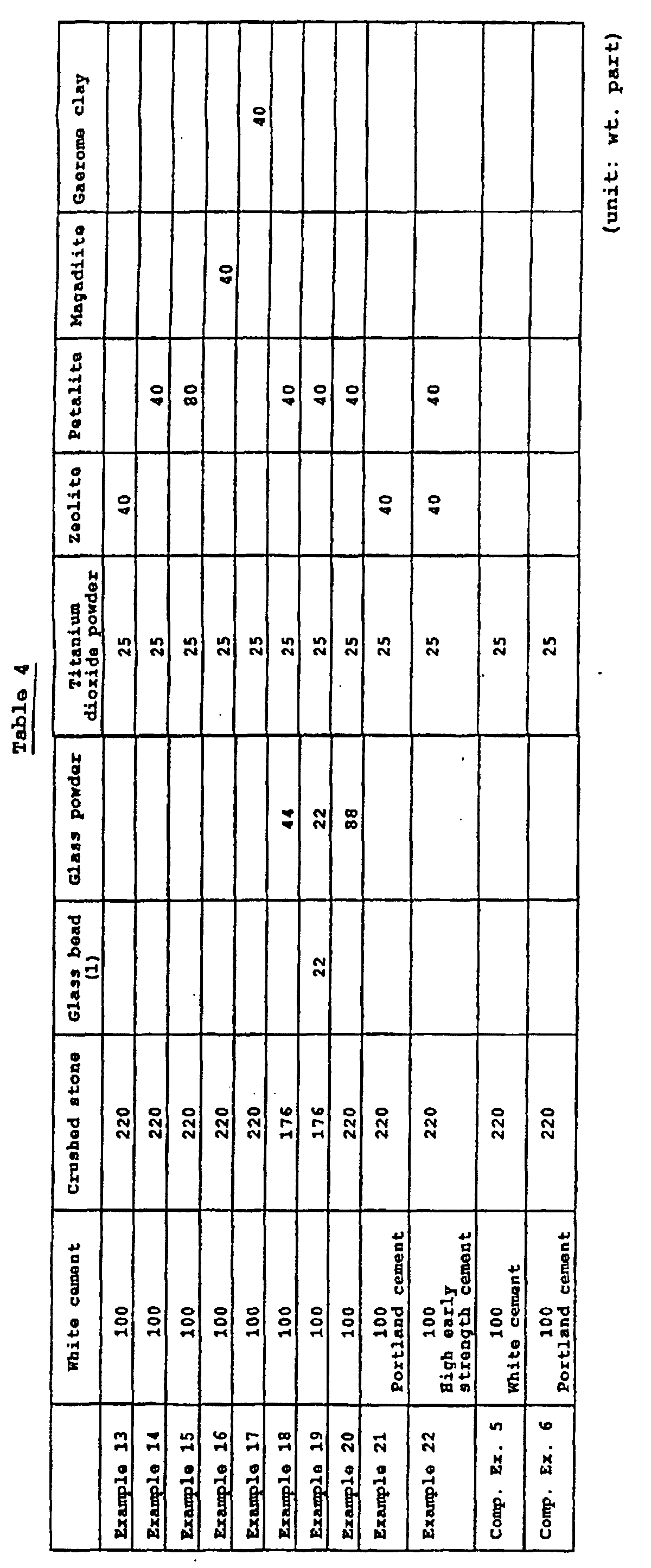
- a block base layer 100 parts by weight of Portland cement, 195 parts by weight of crushed stones, 240 parts by weight of sand and 31 parts by weight of water were combined and kneaded to prepare dough, and the dough was charged into a 10 x 20-cm form which was then vibrated to form a concrete-made base layer on which one of 12 types of dough formulations for forming surface layers was placed to form each of the test specimens designated as Examples 13-22 and Comparative Examples 5-6 in Table 4. The NO removal coefficients of the test specimens were measured after curing.
- the test was conducted by placing a test specimen in a gastight vessel through the inlet of which a stream of a simulation gas containing 1 ppm of NO gas supplied. The concentration of NO in the gas leaving through the exit was measured to determine the NO removal coefficient. The test was conducted over 24 hours, and the average of the removal coefficients measured every ten minutes was recorded as the test result.
- Test 1 was conducted with three 10-watt ultraviolet lamp remaining on continuously over the 24 hours.
- Test 2 was conducted while switching on or off the ultraviolet lamps every two hours. Accordingly, the lamps were glowing for 12 hours throughout the 24-hour test period.
- Examples 13-22 incorporating the adsorbing materials are capable of cleaning off more NO x than the Comparative Examples. Particularly, white cement contributed to a higher NO x removal coefficient than Portland cement. Even in Test 2 in which the lamps were switched on and off, more NO x was removed; this effect was particularly significant when glass powder was added.
- the high-performance NO x -cleaning blocks described above had substantially the same bending strength as well.
Landscapes
- Chemical & Material Sciences (AREA)
- Engineering & Computer Science (AREA)
- Ceramic Engineering (AREA)
- Structural Engineering (AREA)
- Materials Engineering (AREA)
- Organic Chemistry (AREA)
- Chemical Kinetics & Catalysis (AREA)
- Inorganic Chemistry (AREA)
- Architecture (AREA)
- Civil Engineering (AREA)
- Environmental & Geological Engineering (AREA)
- General Chemical & Material Sciences (AREA)
- Oil, Petroleum & Natural Gas (AREA)
- Analytical Chemistry (AREA)
- Biomedical Technology (AREA)
- Health & Medical Sciences (AREA)
- Physics & Mathematics (AREA)
- Electromagnetism (AREA)
- Road Paving Structures (AREA)
- Curing Cements, Concrete, And Artificial Stone (AREA)
- Solid-Sorbent Or Filter-Aiding Compositions (AREA)
- Detergent Compositions (AREA)
- Floor Finish (AREA)
Abstract
Description
| Test specimen | Cement : sand ratio (wt. ratio) | Slip resistance (BPM) | Labelling test (g/cm2) | |
| 1 | 1 : 3 | 85 | 1.5 | Wet state (slip occurs unless BPM is 65 or more) |
| 2 | 1 : 2 | 78 | 1.5 | |
| 3 | 1 : 1 | 72 | 2.0 | |
| 4 | 1 : 0 | 56 | 4.0 |

| Type | Formulation | Surface-roughing tool | Slip resistance (BPM) | NOx removal coefficient (%) | |
| Wet state | Dry state | ||||
| Comp. Ex. 1 | 1 | Not used | 66 | 74 | 65 |
| Example 7 | 1 | Fig. 10 | 71 | 80 | 68 |
| Comp. Ex. 2 | 2 | Not used | 68 | 77 | 79 |
| Example 8 | 2 | Fig. 10 | 72 | 87 | 84 |
| Comp. Ex. 3 | 3 | Not used | 70 | 84 | 76 |
| Example 9-1 | 3 | Fig. 10 | 72 | 91 | 79 |
| Example 9-2 | 3 | Fig. 11 | 73 | 91 | 80 |
| Comp. Ex. 4 | 4 | Not used | 68 | 80 | 84 |
| Example 10-1 | 4 | Fig. 10 | 70 | 88 | 88 |
| Example 10-2 | 4 | Fig. 12 | 73 | 86 | 88 |
| NO removal coefficient (%) | | ||
| Test | |||
| 1 | Test 2 | (Kgf / cm2) | |
| Example 13 | 81 | 53 | 65 |
| Example 14 | 81 | 54 | 73 |
| Example 15 | 84 | 58 | - |
| Example 16 | 82 | 55 | 63 |
| Example 17 | 83 | 56 | 64 |
| Example 18 | 82 | 55 | - |
| Example 19 | 81 | 56 | - |
| Example 20 | 84 | 55 | - |
| Example 21 | 77 | 43 | - |
| Example 22 | 78 | 43 | - |
| Comp. Ex. 5 | 77 | 42 | 63 |
| Comp. Ex. 6 | 72 | 38 | - |
Claims (16)
- A paving block comprising a surface layer on a concrete-made base layer,
characterized in that
the surface layer contains 100 parts by weight of cement, 5-50 parts by weight of NOx-cleaning titanium dioxide powder and 100-700 parts by weight of sand. - An NOx-cleaning paving block as claimed in Claim 1, wherein the surface layer contains an adsorbing material.
- An NOx-cleaning paving block as claimed in Claim 2, wherein the adsorbing material is contained in the surface layer at a weight ratio of 5-30 to 100 parts by weight of a total composition of the surface layer except water.
- An NOx-cleaning paving block as claimed in Claims 2 or 3, wherein one or more of zeolite, Magadiite and clay is used as the adsorbing material.
- An NOx-cleaning paving block as claimed in Claims 2 or 3, wherein petalite is used as the adsorbing material.
- An NOx-cleaning paving block as claimed in any of Claims 1 to 5, wherein the thickness of the surface layer is 2-15 mm.
- An NOx-cleaning paving block as claimed in any of Claims 1 to 6, wherein at least part of the sand comprises glass grains or silica sand.
- An NOx-cleaning paving block as claimed in any of Claims 1 to 7, wherein 10-50% of the sand has been replaced by glass beads and/or glass powder having a particle size of 1-6 mm.
- An NOx-cleaning paving block as claimed in any of Claims 1 to 8, wherein the surface layer has a void volume of 10-40% and a water permeability of 0.01 cm/sec. or higher.
- An NOx-cleaning paving block as claimed in Claim 1, wherein a titanium dioxide-containing mortar-made surface layer is layered on the block base layer and then cured, and the surface of the mortar-made surface layer is then roughened with taps of many projections from a surface-roughening tool.
- An NOx-cleaning paving block as claimed in Claim 10, wherein the surface layer additionally contains an adsorbing material.
- An NOx-cleaning paving block as claimed in Claim 11, wherein the adsorbing material is contained in the surface layer at a weight ratio of 5-30 to 100 parts by weight of a total composition of the surface layer except water.
- An NOx-cleaning paving block as claimed in Claims 11 or 12, wherein one or more of zeolite, Magadiite and clay is used as the adsorbing material.
- An NOx-cleaning paving block as claimed in Claims 11 or 12, wherein petalite is used as the adsorbing material.
- An NOx-cleaning paving block as claimed in any of Claims 10 to 14, wherein the thickness of the surface layer is 2-15 mm.
- An NOx-cleaning paving block as claimed in any of Claims 10 to 15, wherein the surface layer has a void volume of 10-40% and a water permeability of 0.01 cm/sec. or higher.
Applications Claiming Priority (12)
| Application Number | Priority Date | Filing Date | Title |
|---|---|---|---|
| JP1001096 | 1996-01-24 | ||
| JP1001096 | 1996-01-24 | ||
| JP10010/96 | 1996-01-24 | ||
| JP126659/96 | 1996-05-22 | ||
| JP8126659A JP2988376B2 (en) | 1996-01-24 | 1996-05-22 | NOx purification block for paving |
| JP12665996 | 1996-05-22 | ||
| JP20676496A JP3732279B2 (en) | 1996-08-06 | 1996-08-06 | NOx purification block for paving |
| JP206764/96 | 1996-08-06 | ||
| JP20676496 | 1996-08-06 | ||
| JP25135996A JP3319301B2 (en) | 1996-09-24 | 1996-09-24 | NOx purification block with roughened surface |
| JP251359/96 | 1996-09-24 | ||
| JP25135996 | 1996-09-24 |
Publications (2)
| Publication Number | Publication Date |
|---|---|
| EP0786283A1 EP0786283A1 (en) | 1997-07-30 |
| EP0786283B1 true EP0786283B1 (en) | 2003-01-02 |
Family
ID=27455299
Family Applications (1)
| Application Number | Title | Priority Date | Filing Date |
|---|---|---|---|
| EP97100554A Expired - Lifetime EP0786283B1 (en) | 1996-01-24 | 1997-01-15 | NOX-cleaning paving block |
Country Status (6)
| Country | Link |
|---|---|
| US (1) | US5861205A (en) |
| EP (1) | EP0786283B1 (en) |
| KR (1) | KR100439136B1 (en) |
| AT (1) | ATE230296T1 (en) |
| DE (1) | DE69718080T2 (en) |
| DK (1) | DK0786283T3 (en) |
Cited By (3)
| Publication number | Priority date | Publication date | Assignee | Title |
|---|---|---|---|---|
| WO2008075973A1 (en) * | 2006-12-20 | 2008-06-26 | Larry Arthur Bellamy | Stratifield cementitious composite |
| WO2014118371A1 (en) | 2013-02-03 | 2014-08-07 | Joma International A/S | A catalytic substrate surface containing particles |
| EP2233456B2 (en) † | 2009-03-24 | 2015-05-06 | Dyckerhoff AG | Method for producing of photocatalytically activated components made of a matrix bound with a mineral binding agent |
Families Citing this family (61)
| Publication number | Priority date | Publication date | Assignee | Title |
|---|---|---|---|---|
| IT1286492B1 (en) † | 1996-08-07 | 1998-07-15 | Italcementi Spa | HYDRAULIC BINDER WITH IMPROVED COLOR CONSTANCE PROPERTIES |
| JP3428381B2 (en) * | 1996-08-16 | 2003-07-22 | 三菱マテリアル株式会社 | NOx purification pavement structure |
| US6699577B2 (en) * | 1998-07-29 | 2004-03-02 | Ishihara Sangyo Kaisha, Ltd. | Air purification-functioning road and method for purifying polluted air over road |
| NL1011322C1 (en) * | 1999-02-17 | 2000-08-18 | Johannes Franciscus Reijnen | Zeolite-containing concrete products. |
| KR100414149B1 (en) * | 2001-01-12 | 2004-01-07 | 주식회사 삼한 씨원 | Manufacturing method of Photocatalytic action clay brick |
| WO2003095074A1 (en) * | 2002-05-08 | 2003-11-20 | Donald Lawrence Lush | Air purifying composition |
| EP1642643B1 (en) * | 2004-09-29 | 2010-11-24 | Eurovia | Coating composition for sound-absorbing and pollution-abating facings |
| EP1652827A1 (en) * | 2004-10-27 | 2006-05-03 | Eurovia | Depolluting device for confined spaces |
| GB0507663D0 (en) * | 2005-04-15 | 2005-05-25 | Marley Building Materials Ltd | Concrete roof tiles and wall cladding elements |
| US7922950B2 (en) * | 2006-03-14 | 2011-04-12 | 3M Innovative Properties Company | Monolithic building element with photocatalytic material |
| ITMI20061594A1 (en) | 2006-08-08 | 2008-02-09 | Italcementi Spa | NEW CEMENT MADE PREFABRICATED ARTICLES WITH PHOTOCATALYTIC ACTIVITY |
| WO2008019806A1 (en) * | 2006-08-13 | 2008-02-21 | Reinhard Boller | Paving stone |
| CA2685607C (en) | 2007-05-10 | 2012-09-25 | Halliburton Energy Services, Inc. | Methods for stimulating oil or gas production |
| DE202008001836U1 (en) * | 2008-02-08 | 2008-04-17 | Boller, Reinhard, Dipl.-Ing. | Paving stone and surface attachment |
| US8266747B1 (en) | 2008-06-24 | 2012-09-18 | Nomaco Inc. | Mattress side/edge support system |
| ES2331169B1 (en) * | 2008-12-10 | 2010-09-17 | Pavimentos De Tudela, S.L | Slab FOR PAVEMENTS AND PROCEDURE FOR OBTAINING THE SAME. |
| NL1036721C2 (en) * | 2009-03-17 | 2010-09-20 | Jakob Gerrit Hendrik Pannekoek | DEVICE FOR THE PRODUCTION OF ROAD CAB COVERING. |
| EP2236476A1 (en) | 2009-03-31 | 2010-10-06 | Shell Internationale Research Maatschappij B.V. | Process for preparing slurry |
| US8561236B2 (en) * | 2009-06-22 | 2013-10-22 | Nomaco Inc. | Stepped-edge and side-support members, assemblies, systems, and related methods, particularly for bedding and seating |
| US8684626B2 (en) * | 2009-08-07 | 2014-04-01 | Pacific Interlock Pavingstone, Inc. | Permeable paver and manufacturing method therefor |
| US7927037B2 (en) * | 2009-08-07 | 2011-04-19 | Pacific Interlock Pavingstone, Inc. | Permeable paver and manufacturing method therefor |
| US8894319B1 (en) * | 2009-08-07 | 2014-11-25 | Pacific Interlock Pavingstone, Inc. | Permeable paving slab and paver and manufacturing method therefor |
| US8646136B2 (en) * | 2009-08-27 | 2014-02-11 | Nomaco Inc. | Assemblies, systems, and related methods employing interlocking components to provide at least a portion of an encasement, particularly for bedding and seating applications |
| US8375493B2 (en) | 2009-08-27 | 2013-02-19 | Sealy Technology Llc | One piece foam mattress core encasement |
| US8813845B2 (en) | 2009-08-31 | 2014-08-26 | Halliburton Energy Services, Inc. | Polymeric additives for enhancement of treatment fluids comprising viscoelastic surfactants and methods of use |
| US8881820B2 (en) | 2009-08-31 | 2014-11-11 | Halliburton Energy Services, Inc. | Treatment fluids comprising entangled equilibrium polymer networks |
| US8887809B2 (en) | 2009-08-31 | 2014-11-18 | Halliburton Energy Services, Inc. | Treatment fluids comprising transient polymer networks |
| ES2335262B1 (en) * | 2009-11-20 | 2010-12-22 | Ceracasa, S.A | CERAMIC ENAMEL COMPOSITION. |
| US20110179579A1 (en) * | 2010-01-27 | 2011-07-28 | Nomaco Inc. | Expandable edge-support members, assemblies, and related methods, suitable for bedding and seating applications and innersprings |
| PL2354108T3 (en) | 2010-01-28 | 2016-10-31 | Binding agent compound for photocatalytically active components and coatings | |
| US8905135B2 (en) | 2010-03-24 | 2014-12-09 | Halliburton Energy Services, Inc. | Zero shear viscosifying agent |
| USD677097S1 (en) | 2010-05-06 | 2013-03-05 | Nomaco, Inc. | Slotted side support |
| KR101012457B1 (en) | 2010-05-20 | 2011-02-08 | 궁전콘크리트(주) | Manufacturing method of eco-friendly concrete block having water permeability and water retention and concrete block manufactured therefrom |
| USD694042S1 (en) | 2010-08-17 | 2013-11-26 | Nomaco Inc. | Side support |
| USD694554S1 (en) | 2010-08-17 | 2013-12-03 | Nomaco Inc. | Side support |
| USD695550S1 (en) | 2010-08-17 | 2013-12-17 | Nomaca Inc. | Side support |
| USD692689S1 (en) | 2010-08-17 | 2013-11-05 | Nomaco Inc. | Side support |
| WO2012104582A1 (en) | 2011-01-31 | 2012-08-09 | Halliburton Energy Services Inc. | Increasing fracture complexity in ultra-low permeable subterranean formation using degradable particulate |
| USD673801S1 (en) | 2011-08-03 | 2013-01-08 | Nomaco Inc. | Mattress bed encasement |
| USD673800S1 (en) | 2011-08-03 | 2013-01-08 | Nomaco Inc. | Mattress bed encasement |
| USD675051S1 (en) * | 2011-09-30 | 2013-01-29 | Nomaco Inc. | Edge support cushion |
| AU2013206165B2 (en) * | 2012-06-14 | 2019-01-17 | Island Block & Paving Pty Ltd | Bricks and blocks |
| EP2674410B1 (en) * | 2012-06-15 | 2021-01-20 | Lithonplus GmbH & Co. KG | Infrared reflective concrete product |
| US8955588B2 (en) | 2012-09-10 | 2015-02-17 | Halliburton Energy Services, Inc. | Electron-poor orthoester for generating acid in a well fluid |
| CA2845980C (en) * | 2013-03-13 | 2021-06-22 | D&D Emulsions, Inc. | Embedding photocatalytic titanium dioxide in asphalt surfaces to reduce pollutants via photocatalytic reactions |
| US9493378B2 (en) * | 2013-03-13 | 2016-11-15 | Pavement Technology, Inc. | Method of embedding photocatalytic titanium dioxide in concrete structures to reduce pollutants via photocatalytic reactions |
| KR102124188B1 (en) * | 2013-03-13 | 2020-06-26 | 삼성전자주식회사 | Electronic device and method for processing image |
| US10407351B2 (en) | 2013-03-13 | 2019-09-10 | Pavement Technology, Inc. | Method of dispersing anatase titanium dioxide for penetration in concrete structures to reduce pollutants |
| CN104056545A (en) * | 2013-03-21 | 2014-09-24 | 陈颖通 | Chain boiler low temperature plasma denitration catalyst module |
| USD737074S1 (en) | 2013-07-03 | 2015-08-25 | Nomaco Inc. | Foam cushion base |
| USD740053S1 (en) | 2013-07-03 | 2015-10-06 | Nomaco Inc. | Foam cushion base |
| EA201600237A1 (en) * | 2013-09-05 | 2016-10-31 | Тун Абдул Разак Ресерч Сентер | RUBBER ELEMENT OF THE CONSTRUCTION INTRODUCED INTO A BRICK OR STONE WALL FROM A REINFORCED CONCRETE TO PROTECT AGAINST DAMAGES CAUSED BY SEISMIC ACTIVITY |
| DE102014200016A1 (en) * | 2014-01-03 | 2015-07-09 | Harzer Betonwarenwerk Hoym Rolf Pöthmann GmbH & Co. KG | Concrete block |
| IT201700097630A1 (en) * | 2017-08-30 | 2019-03-02 | Italcementi Spa | Process for the preparation of photocatalytic blocks / slabs / blocks and relative blocks / plates / photocatalytic blocks |
| KR102086710B1 (en) | 2018-02-19 | 2020-03-09 | 주식회사 데코페이브 | UV irradiating Lamp Apparatus for Promoting Photocatalyst Road |
| KR20190099671A (en) | 2018-02-19 | 2019-08-28 | 주식회사 데코페이브 | Vehicle having Photocatalyst Air Cleaning System, and Method of Air Cleaning using Running of such Vehicle |
| KR102079708B1 (en) | 2018-02-19 | 2020-02-20 | 주식회사 데코페이브 | Method and System for Air Cleaning at Bus Station and Bus Road Using Photocatalyst Concrete Panel and Block Pavement |
| KR102288943B1 (en) * | 2019-12-12 | 2021-08-12 | 경기대학교 산학협력단 | Composite, porous, permeable block for atmospheric purification based on power plants byproducts with improved strength, ductility and durability |
| DE102020122516B4 (en) | 2020-08-28 | 2026-01-08 | Godelmann Gmbh & Co. Kg | Concrete block and surface covering |
| KR102201399B1 (en) * | 2020-09-03 | 2021-01-11 | 김광일 | Air Purification and Water Storage Function Sidewalk Blocks |
| CN115196992B (en) * | 2022-08-16 | 2023-04-25 | 湖南科技大学 | A kind of preparation method of self-cleaning mortar |
Family Cites Families (14)
| Publication number | Priority date | Publication date | Assignee | Title |
|---|---|---|---|---|
| US4218260A (en) * | 1976-11-19 | 1980-08-19 | Institut Fur Privatwirtschaft Gschwend & Stadler | Reflective concrete body, process for the manufacture and utilization of the same |
| JPH0653212B2 (en) * | 1986-10-28 | 1994-07-20 | 株式会社荏原総合研究所 | Method for decomposing and removing nitrous oxide in gas mixture |
| JPH0616813B2 (en) * | 1987-12-10 | 1994-03-09 | 国立公害研究所長 | Ventilation gas purification method in road tunnel |
| JPH03169901A (en) | 1989-11-27 | 1991-07-23 | Mitsubishi Materials Corp | Water-permeable pavement block and manufacturing method therefor |
| DE4013720C2 (en) * | 1990-04-28 | 1994-05-19 | Huels Chemische Werke Ag | Process for recycling used DeNOx catalysts |
| CA2119377A1 (en) * | 1991-09-18 | 1993-04-01 | Cassius W. Leys | One coat protective system for a surface |
| US5409681A (en) * | 1991-11-27 | 1995-04-25 | Babcock-Hitachi Kabushiki Kaisha | Catalyst for purifying exhaust gas |
| JPH06315614A (en) * | 1993-03-11 | 1994-11-15 | Agency Of Ind Science & Technol | Method for removing contaminants and cleaning material |
| DE69421734T2 (en) * | 1993-03-11 | 2000-07-13 | Agency Ind Science Techn | Pollutant removal procedures |
| JP3123330B2 (en) * | 1993-03-24 | 2001-01-09 | 日本ゼオン株式会社 | Method for removing malodorous substances or growth promoting substances and apparatus for removing them |
| TW307064B (en) * | 1993-09-08 | 1997-06-01 | Advanced Micro Devices Inc | |
| US5445437A (en) * | 1994-04-25 | 1995-08-29 | Adamson; Darrel M. | Concrete grooving apparatus and method |
| JPH07331120A (en) * | 1994-06-10 | 1995-12-19 | Hitachi Ltd | Paint for removing nitrogen oxides and method of using the same |
| US5494513A (en) * | 1995-07-07 | 1996-02-27 | National Research Council Of Canada | Zeolite-based lightweight concrete products |
-
1997
- 1997-01-15 DE DE69718080T patent/DE69718080T2/en not_active Expired - Lifetime
- 1997-01-15 DK DK97100554T patent/DK0786283T3/en active
- 1997-01-15 EP EP97100554A patent/EP0786283B1/en not_active Expired - Lifetime
- 1997-01-15 AT AT97100554T patent/ATE230296T1/en active
- 1997-01-23 KR KR1019970001878A patent/KR100439136B1/en not_active Expired - Lifetime
- 1997-01-24 US US08/789,204 patent/US5861205A/en not_active Expired - Lifetime
Cited By (4)
| Publication number | Priority date | Publication date | Assignee | Title |
|---|---|---|---|---|
| WO2008075973A1 (en) * | 2006-12-20 | 2008-06-26 | Larry Arthur Bellamy | Stratifield cementitious composite |
| US8323782B2 (en) | 2006-12-20 | 2012-12-04 | Larry Arthur Bellamy | Stratified cementitious composite |
| EP2233456B2 (en) † | 2009-03-24 | 2015-05-06 | Dyckerhoff AG | Method for producing of photocatalytically activated components made of a matrix bound with a mineral binding agent |
| WO2014118371A1 (en) | 2013-02-03 | 2014-08-07 | Joma International A/S | A catalytic substrate surface containing particles |
Also Published As
| Publication number | Publication date |
|---|---|
| KR19980023926A (en) | 1998-07-06 |
| DE69718080T2 (en) | 2003-10-30 |
| EP0786283A1 (en) | 1997-07-30 |
| DE69718080D1 (en) | 2003-02-06 |
| KR100439136B1 (en) | 2004-09-16 |
| US5861205A (en) | 1999-01-19 |
| ATE230296T1 (en) | 2003-01-15 |
| DK0786283T3 (en) | 2003-05-05 |
Similar Documents
| Publication | Publication Date | Title |
|---|---|---|
| EP0786283B1 (en) | NOX-cleaning paving block | |
| EP0919667B1 (en) | NOx REMOVING PAVEMENT STRUCTURE | |
| KR101012457B1 (en) | Manufacturing method of eco-friendly concrete block having water permeability and water retention and concrete block manufactured therefrom | |
| KR102177170B1 (en) | Heat resistant paving block for pedestrians and vehicles having improved durability and resistance against atmospheric pollution | |
| KR101801552B1 (en) | Paving concrete block and fabrication method thereof | |
| KR101034565B1 (en) | Method of manufacturing interlocking block in which anion is generated and interlocking block manufactured therefrom | |
| KR101806208B1 (en) | Environmentally-friendly concrete block and fabrication method thereof | |
| CN1989299A (en) | High durability photocatalytic paving for reducing urban polluting agents | |
| CN112048962A (en) | Permeable concrete road capable of purifying automobile exhaust and construction method thereof | |
| JP2008248656A (en) | Multifunctional water retaining material and multifunctional water retaining pavement body using this material | |
| KR20190014396A (en) | Blocks recycled from wastes generated during stone processing and their manufacturing methods | |
| JP3653523B2 (en) | Carbonated cured body | |
| Jana | Concrete scaling–a critical review | |
| JP3732279B2 (en) | NOx purification block for paving | |
| WO2018134334A1 (en) | Process for obtaining a porous material from powder materials, a porous material and use thereof for the capture of atmospheric particulate matter and organic contaminants | |
| KR100951413B1 (en) | Non-stain and non-cement concrete composition and constructing method of concrete pavement using the same | |
| KR100874676B1 (en) | Pitcher sidewalk block using eco-friendly materials | |
| JP3319301B2 (en) | NOx purification block with roughened surface | |
| JP3763352B2 (en) | Roughened NOx purification block and method for producing the same | |
| JPH10291849A (en) | Cement-based hydraulic composition having NOx purification function | |
| JP2003026486A (en) | Porous concrete body with cleaning function | |
| JP4228247B2 (en) | Improved hazardous substance removing member and method of manufacturing the same | |
| KR100794223B1 (en) | Road paving composition based on volcanic debris and road paving method using same | |
| JP2005187324A (en) | Carbonated cured body | |
| Yang et al. | Photocatalytic NOx removal and self-cleaning performance of polymeric carbon nitride functionalized alkali-activated slag composites |
Legal Events
| Date | Code | Title | Description |
|---|---|---|---|
| PUAI | Public reference made under article 153(3) epc to a published international application that has entered the european phase |
Free format text: ORIGINAL CODE: 0009012 |
|
| 17P | Request for examination filed |
Effective date: 19970214 |
|
| AK | Designated contracting states |
Kind code of ref document: A1 Designated state(s): AT BE CH DE DK ES FI FR GB GR IE IT LI LU MC NL PT SE |
|
| AX | Request for extension of the european patent |
Free format text: AL;LT;LV;SI |
|
| 17Q | First examination report despatched |
Effective date: 20011026 |
|
| GRAG | Despatch of communication of intention to grant |
Free format text: ORIGINAL CODE: EPIDOS AGRA |
|
| GRAG | Despatch of communication of intention to grant |
Free format text: ORIGINAL CODE: EPIDOS AGRA |
|
| GRAH | Despatch of communication of intention to grant a patent |
Free format text: ORIGINAL CODE: EPIDOS IGRA |
|
| GRAH | Despatch of communication of intention to grant a patent |
Free format text: ORIGINAL CODE: EPIDOS IGRA |
|
| GRAA | (expected) grant |
Free format text: ORIGINAL CODE: 0009210 |
|
| AK | Designated contracting states |
Kind code of ref document: B1 Designated state(s): AT BE CH DE DK ES FI FR GB GR IE IT LI LU MC NL PT SE |
|
| PG25 | Lapsed in a contracting state [announced via postgrant information from national office to epo] |
Ref country code: LI Free format text: LAPSE BECAUSE OF FAILURE TO SUBMIT A TRANSLATION OF THE DESCRIPTION OR TO PAY THE FEE WITHIN THE PRESCRIBED TIME-LIMIT Effective date: 20030102 Ref country code: GR Free format text: LAPSE BECAUSE OF FAILURE TO SUBMIT A TRANSLATION OF THE DESCRIPTION OR TO PAY THE FEE WITHIN THE PRESCRIBED TIME-LIMIT Effective date: 20030102 Ref country code: FI Free format text: LAPSE BECAUSE OF FAILURE TO SUBMIT A TRANSLATION OF THE DESCRIPTION OR TO PAY THE FEE WITHIN THE PRESCRIBED TIME-LIMIT Effective date: 20030102 Ref country code: CH Free format text: LAPSE BECAUSE OF FAILURE TO SUBMIT A TRANSLATION OF THE DESCRIPTION OR TO PAY THE FEE WITHIN THE PRESCRIBED TIME-LIMIT Effective date: 20030102 |
|
| REF | Corresponds to: |
Ref document number: 230296 Country of ref document: AT Date of ref document: 20030115 Kind code of ref document: T |
|
| REG | Reference to a national code |
Ref country code: GB Ref legal event code: FG4D Free format text: 20030102 |
|
| REG | Reference to a national code |
Ref country code: CH Ref legal event code: EP |
|
| PG25 | Lapsed in a contracting state [announced via postgrant information from national office to epo] |
Ref country code: MC Free format text: LAPSE BECAUSE OF NON-PAYMENT OF DUE FEES Effective date: 20030131 |
|
| REG | Reference to a national code |
Ref country code: IE Ref legal event code: FG4D |
|
| REF | Corresponds to: |
Ref document number: 69718080 Country of ref document: DE Date of ref document: 20030206 Kind code of ref document: P |
|
| PG25 | Lapsed in a contracting state [announced via postgrant information from national office to epo] |
Ref country code: SE Free format text: LAPSE BECAUSE OF FAILURE TO SUBMIT A TRANSLATION OF THE DESCRIPTION OR TO PAY THE FEE WITHIN THE PRESCRIBED TIME-LIMIT Effective date: 20030402 Ref country code: PT Free format text: LAPSE BECAUSE OF FAILURE TO SUBMIT A TRANSLATION OF THE DESCRIPTION OR TO PAY THE FEE WITHIN THE PRESCRIBED TIME-LIMIT Effective date: 20030402 |
|
| REG | Reference to a national code |
Ref country code: DK Ref legal event code: T3 |
|
| REG | Reference to a national code |
Ref country code: CH Ref legal event code: PL |
|
| PG25 | Lapsed in a contracting state [announced via postgrant information from national office to epo] |
Ref country code: ES Free format text: LAPSE BECAUSE OF FAILURE TO SUBMIT A TRANSLATION OF THE DESCRIPTION OR TO PAY THE FEE WITHIN THE PRESCRIBED TIME-LIMIT Effective date: 20030730 |
|
| ET | Fr: translation filed | ||
| PLBE | No opposition filed within time limit |
Free format text: ORIGINAL CODE: 0009261 |
|
| STAA | Information on the status of an ep patent application or granted ep patent |
Free format text: STATUS: NO OPPOSITION FILED WITHIN TIME LIMIT |
|
| 26N | No opposition filed |
Effective date: 20031003 |
|
| REG | Reference to a national code |
Ref country code: FR Ref legal event code: CL |
|
| NLUE | Nl: licence registered with regard to european patents |
Effective date: 20040406 |
|
| REG | Reference to a national code |
Ref country code: GB Ref legal event code: 732E |
|
| REG | Reference to a national code |
Ref country code: FR Ref legal event code: PLFP Year of fee payment: 19 |
|
| REG | Reference to a national code |
Ref country code: FR Ref legal event code: PLFP Year of fee payment: 20 |
|
| PGFP | Annual fee paid to national office [announced via postgrant information from national office to epo] |
Ref country code: NL Payment date: 20160120 Year of fee payment: 20 Ref country code: LU Payment date: 20160125 Year of fee payment: 20 |
|
| PGFP | Annual fee paid to national office [announced via postgrant information from national office to epo] |
Ref country code: DK Payment date: 20160120 Year of fee payment: 20 Ref country code: IE Payment date: 20160122 Year of fee payment: 20 Ref country code: IT Payment date: 20160127 Year of fee payment: 20 Ref country code: DE Payment date: 20160120 Year of fee payment: 20 |
|
| PGFP | Annual fee paid to national office [announced via postgrant information from national office to epo] |
Ref country code: FR Payment date: 20160121 Year of fee payment: 20 Ref country code: BE Payment date: 20160120 Year of fee payment: 20 Ref country code: AT Payment date: 20160121 Year of fee payment: 20 Ref country code: GB Payment date: 20160120 Year of fee payment: 20 |
|
| REG | Reference to a national code |
Ref country code: DE Ref legal event code: R071 Ref document number: 69718080 Country of ref document: DE |
|
| REG | Reference to a national code |
Ref country code: DK Ref legal event code: EUP Effective date: 20170115 |
|
| REG | Reference to a national code |
Ref country code: NL Ref legal event code: MK Effective date: 20170114 |
|
| REG | Reference to a national code |
Ref country code: GB Ref legal event code: PE20 Expiry date: 20170114 |
|
| REG | Reference to a national code |
Ref country code: IE Ref legal event code: MK9A |
|
| REG | Reference to a national code |
Ref country code: AT Ref legal event code: MK07 Ref document number: 230296 Country of ref document: AT Kind code of ref document: T Effective date: 20170115 |
|
| PG25 | Lapsed in a contracting state [announced via postgrant information from national office to epo] |
Ref country code: GB Free format text: LAPSE BECAUSE OF EXPIRATION OF PROTECTION Effective date: 20170114 Ref country code: IE Free format text: LAPSE BECAUSE OF EXPIRATION OF PROTECTION Effective date: 20170115 |