EP0786468A2 - Réagents supports solides pour la synsthèse directe de 3'-polynucléotides marqués - Google Patents
Réagents supports solides pour la synsthèse directe de 3'-polynucléotides marqués Download PDFInfo
- Publication number
- EP0786468A2 EP0786468A2 EP97101131A EP97101131A EP0786468A2 EP 0786468 A2 EP0786468 A2 EP 0786468A2 EP 97101131 A EP97101131 A EP 97101131A EP 97101131 A EP97101131 A EP 97101131A EP 0786468 A2 EP0786468 A2 EP 0786468A2
- Authority
- EP
- European Patent Office
- Prior art keywords
- support
- synthesis
- μmol
- nitrogen
- polynucleotide
- Prior art date
- Legal status (The legal status is an assumption and is not a legal conclusion. Google has not performed a legal analysis and makes no representation as to the accuracy of the status listed.)
- Granted
Links
- 238000003786 synthesis reaction Methods 0.000 title claims abstract description 97
- 230000015572 biosynthetic process Effects 0.000 title claims abstract description 95
- 108091033319 polynucleotide Proteins 0.000 title claims abstract description 67
- 102000040430 polynucleotide Human genes 0.000 title claims abstract description 67
- 239000002157 polynucleotide Substances 0.000 title claims abstract description 67
- 239000003153 chemical reaction reagent Substances 0.000 title claims abstract description 31
- 239000007787 solid Substances 0.000 title claims abstract description 31
- 239000004793 Polystyrene Substances 0.000 claims abstract description 29
- 229920002223 polystyrene Polymers 0.000 claims abstract description 29
- IJGRMHOSHXDMSA-UHFFFAOYSA-N nitrogen Substances N#N IJGRMHOSHXDMSA-UHFFFAOYSA-N 0.000 claims abstract description 24
- QJGQUHMNIGDVPM-UHFFFAOYSA-N nitrogen group Chemical group [N] QJGQUHMNIGDVPM-UHFFFAOYSA-N 0.000 claims abstract description 19
- OKTJSMMVPCPJKN-UHFFFAOYSA-N Carbon Chemical compound [C] OKTJSMMVPCPJKN-UHFFFAOYSA-N 0.000 claims abstract description 17
- 125000000217 alkyl group Chemical group 0.000 claims abstract description 16
- 150000001875 compounds Chemical class 0.000 claims abstract description 16
- 229910052757 nitrogen Inorganic materials 0.000 claims abstract description 16
- 239000001257 hydrogen Substances 0.000 claims abstract description 14
- 229910052739 hydrogen Inorganic materials 0.000 claims abstract description 14
- 125000002103 4,4'-dimethoxytriphenylmethyl group Chemical group [H]C1=C([H])C([H])=C(C([H])=C1[H])C(*)(C1=C([H])C([H])=C(OC([H])([H])[H])C([H])=C1[H])C1=C([H])C([H])=C(OC([H])([H])[H])C([H])=C1[H] 0.000 claims abstract description 13
- 125000002887 hydroxy group Chemical group [H]O* 0.000 claims abstract description 13
- 229910052799 carbon Inorganic materials 0.000 claims abstract description 11
- UFHFLCQGNIYNRP-UHFFFAOYSA-N Hydrogen Chemical compound [H][H] UFHFLCQGNIYNRP-UHFFFAOYSA-N 0.000 claims abstract description 7
- QVGXLLKOCUKJST-UHFFFAOYSA-N atomic oxygen Chemical compound [O] QVGXLLKOCUKJST-UHFFFAOYSA-N 0.000 claims abstract description 7
- 239000001301 oxygen Substances 0.000 claims abstract description 7
- 229910052760 oxygen Inorganic materials 0.000 claims abstract description 7
- 150000002431 hydrogen Chemical class 0.000 claims abstract description 6
- 238000000034 method Methods 0.000 claims description 23
- 125000005647 linker group Chemical group 0.000 claims description 20
- 239000002253 acid Substances 0.000 claims description 8
- 239000002777 nucleoside Substances 0.000 claims description 6
- 125000000325 methylidene group Chemical group [H]C([H])=* 0.000 claims description 5
- 150000003833 nucleoside derivatives Chemical class 0.000 claims description 5
- 239000000178 monomer Substances 0.000 claims description 3
- 230000001590 oxidative effect Effects 0.000 claims description 2
- 230000002194 synthesizing effect Effects 0.000 claims description 2
- WGTODYJZXSJIAG-UHFFFAOYSA-N tetramethylrhodamine chloride Chemical group [Cl-].C=12C=CC(N(C)C)=CC2=[O+]C2=CC(N(C)C)=CC=C2C=1C1=CC=CC=C1C(O)=O WGTODYJZXSJIAG-UHFFFAOYSA-N 0.000 claims 1
- -1 e.g. Chemical group 0.000 abstract description 32
- QEVGZEDELICMKH-UHFFFAOYSA-L 2-(carboxylatomethoxy)acetate Chemical class [O-]C(=O)COCC([O-])=O QEVGZEDELICMKH-UHFFFAOYSA-L 0.000 abstract description 7
- YMWUJEATGCHHMB-UHFFFAOYSA-N Dichloromethane Chemical compound ClCCl YMWUJEATGCHHMB-UHFFFAOYSA-N 0.000 description 67
- WFDIJRYMOXRFFG-UHFFFAOYSA-N Acetic anhydride Chemical compound CC(=O)OC(C)=O WFDIJRYMOXRFFG-UHFFFAOYSA-N 0.000 description 42
- WEVYAHXRMPXWCK-UHFFFAOYSA-N Acetonitrile Chemical compound CC#N WEVYAHXRMPXWCK-UHFFFAOYSA-N 0.000 description 42
- 239000000243 solution Substances 0.000 description 37
- 108091034117 Oligonucleotide Proteins 0.000 description 32
- OISVCGZHLKNMSJ-UHFFFAOYSA-N 2,6-dimethylpyridine Chemical compound CC1=CC=CC(C)=N1 OISVCGZHLKNMSJ-UHFFFAOYSA-N 0.000 description 26
- 238000003776 cleavage reaction Methods 0.000 description 24
- 239000005289 controlled pore glass Substances 0.000 description 24
- 238000003556 assay Methods 0.000 description 23
- OKKJLVBELUTLKV-UHFFFAOYSA-N Methanol Chemical compound OC OKKJLVBELUTLKV-UHFFFAOYSA-N 0.000 description 21
- 238000011068 loading method Methods 0.000 description 21
- 230000007017 scission Effects 0.000 description 20
- 150000001412 amines Chemical class 0.000 description 19
- ZMANZCXQSJIPKH-UHFFFAOYSA-N Triethylamine Chemical compound CCN(CC)CC ZMANZCXQSJIPKH-UHFFFAOYSA-N 0.000 description 18
- ABZLKHKQJHEPAX-UHFFFAOYSA-N tetramethylrhodamine Chemical compound C=12C=CC(N(C)C)=CC2=[O+]C2=CC(N(C)C)=CC=C2C=1C1=CC=CC=C1C([O-])=O ABZLKHKQJHEPAX-UHFFFAOYSA-N 0.000 description 17
- XLYOFNOQVPJJNP-UHFFFAOYSA-N water Substances O XLYOFNOQVPJJNP-UHFFFAOYSA-N 0.000 description 17
- 239000000047 product Substances 0.000 description 16
- JGFZNNIVVJXRND-UHFFFAOYSA-N N,N-Diisopropylethylamine (DIPEA) Chemical compound CCN(C(C)C)C(C)C JGFZNNIVVJXRND-UHFFFAOYSA-N 0.000 description 14
- JUJWROOIHBZHMG-UHFFFAOYSA-N Pyridine Chemical compound C1=CC=NC=C1 JUJWROOIHBZHMG-UHFFFAOYSA-N 0.000 description 14
- MCTWTZJPVLRJOU-UHFFFAOYSA-N 1-methyl-1H-imidazole Chemical compound CN1C=CN=C1 MCTWTZJPVLRJOU-UHFFFAOYSA-N 0.000 description 13
- HPYNZHMRTTWQTB-UHFFFAOYSA-N dimethylpyridine Natural products CC1=CC=CN=C1C HPYNZHMRTTWQTB-UHFFFAOYSA-N 0.000 description 13
- HEDRZPFGACZZDS-UHFFFAOYSA-N Chloroform Chemical compound ClC(Cl)Cl HEDRZPFGACZZDS-UHFFFAOYSA-N 0.000 description 12
- CSNNHWWHGAXBCP-UHFFFAOYSA-L Magnesium sulfate Chemical compound [Mg+2].[O-][S+2]([O-])([O-])[O-] CSNNHWWHGAXBCP-UHFFFAOYSA-L 0.000 description 12
- NQRYJNQNLNOLGT-UHFFFAOYSA-N Piperidine Chemical compound C1CCNCC1 NQRYJNQNLNOLGT-UHFFFAOYSA-N 0.000 description 12
- HEDRZPFGACZZDS-MICDWDOJSA-N Trichloro(2H)methane Chemical compound [2H]C(Cl)(Cl)Cl HEDRZPFGACZZDS-MICDWDOJSA-N 0.000 description 12
- 239000000203 mixture Substances 0.000 description 12
- FEMOMIGRRWSMCU-UHFFFAOYSA-N ninhydrin Chemical compound C1=CC=C2C(=O)C(O)(O)C(=O)C2=C1 FEMOMIGRRWSMCU-UHFFFAOYSA-N 0.000 description 12
- JLCPHMBAVCMARE-UHFFFAOYSA-N [3-[[3-[[3-[[3-[[3-[[3-[[3-[[3-[[3-[[3-[[3-[[5-(2-amino-6-oxo-1H-purin-9-yl)-3-[[3-[[3-[[3-[[3-[[3-[[5-(2-amino-6-oxo-1H-purin-9-yl)-3-[[5-(2-amino-6-oxo-1H-purin-9-yl)-3-hydroxyoxolan-2-yl]methoxy-hydroxyphosphoryl]oxyoxolan-2-yl]methoxy-hydroxyphosphoryl]oxy-5-(5-methyl-2,4-dioxopyrimidin-1-yl)oxolan-2-yl]methoxy-hydroxyphosphoryl]oxy-5-(6-aminopurin-9-yl)oxolan-2-yl]methoxy-hydroxyphosphoryl]oxy-5-(6-aminopurin-9-yl)oxolan-2-yl]methoxy-hydroxyphosphoryl]oxy-5-(6-aminopurin-9-yl)oxolan-2-yl]methoxy-hydroxyphosphoryl]oxy-5-(6-aminopurin-9-yl)oxolan-2-yl]methoxy-hydroxyphosphoryl]oxyoxolan-2-yl]methoxy-hydroxyphosphoryl]oxy-5-(5-methyl-2,4-dioxopyrimidin-1-yl)oxolan-2-yl]methoxy-hydroxyphosphoryl]oxy-5-(4-amino-2-oxopyrimidin-1-yl)oxolan-2-yl]methoxy-hydroxyphosphoryl]oxy-5-(5-methyl-2,4-dioxopyrimidin-1-yl)oxolan-2-yl]methoxy-hydroxyphosphoryl]oxy-5-(5-methyl-2,4-dioxopyrimidin-1-yl)oxolan-2-yl]methoxy-hydroxyphosphoryl]oxy-5-(6-aminopurin-9-yl)oxolan-2-yl]methoxy-hydroxyphosphoryl]oxy-5-(6-aminopurin-9-yl)oxolan-2-yl]methoxy-hydroxyphosphoryl]oxy-5-(4-amino-2-oxopyrimidin-1-yl)oxolan-2-yl]methoxy-hydroxyphosphoryl]oxy-5-(4-amino-2-oxopyrimidin-1-yl)oxolan-2-yl]methoxy-hydroxyphosphoryl]oxy-5-(4-amino-2-oxopyrimidin-1-yl)oxolan-2-yl]methoxy-hydroxyphosphoryl]oxy-5-(6-aminopurin-9-yl)oxolan-2-yl]methoxy-hydroxyphosphoryl]oxy-5-(4-amino-2-oxopyrimidin-1-yl)oxolan-2-yl]methyl [5-(6-aminopurin-9-yl)-2-(hydroxymethyl)oxolan-3-yl] hydrogen phosphate Polymers Cc1cn(C2CC(OP(O)(=O)OCC3OC(CC3OP(O)(=O)OCC3OC(CC3O)n3cnc4c3nc(N)[nH]c4=O)n3cnc4c3nc(N)[nH]c4=O)C(COP(O)(=O)OC3CC(OC3COP(O)(=O)OC3CC(OC3COP(O)(=O)OC3CC(OC3COP(O)(=O)OC3CC(OC3COP(O)(=O)OC3CC(OC3COP(O)(=O)OC3CC(OC3COP(O)(=O)OC3CC(OC3COP(O)(=O)OC3CC(OC3COP(O)(=O)OC3CC(OC3COP(O)(=O)OC3CC(OC3COP(O)(=O)OC3CC(OC3COP(O)(=O)OC3CC(OC3COP(O)(=O)OC3CC(OC3COP(O)(=O)OC3CC(OC3COP(O)(=O)OC3CC(OC3COP(O)(=O)OC3CC(OC3COP(O)(=O)OC3CC(OC3CO)n3cnc4c(N)ncnc34)n3ccc(N)nc3=O)n3cnc4c(N)ncnc34)n3ccc(N)nc3=O)n3ccc(N)nc3=O)n3ccc(N)nc3=O)n3cnc4c(N)ncnc34)n3cnc4c(N)ncnc34)n3cc(C)c(=O)[nH]c3=O)n3cc(C)c(=O)[nH]c3=O)n3ccc(N)nc3=O)n3cc(C)c(=O)[nH]c3=O)n3cnc4c3nc(N)[nH]c4=O)n3cnc4c(N)ncnc34)n3cnc4c(N)ncnc34)n3cnc4c(N)ncnc34)n3cnc4c(N)ncnc34)O2)c(=O)[nH]c1=O JLCPHMBAVCMARE-UHFFFAOYSA-N 0.000 description 11
- 125000003088 (fluoren-9-ylmethoxy)carbonyl group Chemical group 0.000 description 10
- LFQSCWFLJHTTHZ-UHFFFAOYSA-N Ethanol Chemical compound CCO LFQSCWFLJHTTHZ-UHFFFAOYSA-N 0.000 description 10
- 239000002904 solvent Substances 0.000 description 10
- KRKNYBCHXYNGOX-UHFFFAOYSA-N citric acid Chemical compound OC(=O)CC(O)(C(O)=O)CC(O)=O KRKNYBCHXYNGOX-UHFFFAOYSA-N 0.000 description 9
- 239000000975 dye Substances 0.000 description 9
- 125000006239 protecting group Chemical group 0.000 description 9
- 239000006260 foam Substances 0.000 description 8
- VHUUQVKOLVNVRT-UHFFFAOYSA-N Ammonium hydroxide Chemical compound [NH4+].[OH-] VHUUQVKOLVNVRT-UHFFFAOYSA-N 0.000 description 7
- VYPSYNLAJGMNEJ-UHFFFAOYSA-N Silicium dioxide Chemical compound O=[Si]=O VYPSYNLAJGMNEJ-UHFFFAOYSA-N 0.000 description 7
- 239000000908 ammonium hydroxide Substances 0.000 description 7
- 235000011114 ammonium hydroxide Nutrition 0.000 description 7
- 229940043379 ammonium hydroxide Drugs 0.000 description 7
- 150000002148 esters Chemical class 0.000 description 7
- 238000002372 labelling Methods 0.000 description 7
- 238000012986 modification Methods 0.000 description 7
- UMJSCPRVCHMLSP-UHFFFAOYSA-N pyridine Natural products COC1=CC=CN=C1 UMJSCPRVCHMLSP-UHFFFAOYSA-N 0.000 description 7
- 239000011541 reaction mixture Substances 0.000 description 7
- KDYFGRWQOYBRFD-UHFFFAOYSA-L succinate(2-) Chemical compound [O-]C(=O)CCC([O-])=O KDYFGRWQOYBRFD-UHFFFAOYSA-L 0.000 description 7
- ASOKPJOREAFHNY-UHFFFAOYSA-N 1-Hydroxybenzotriazole Chemical compound C1=CC=C2N(O)N=NC2=C1 ASOKPJOREAFHNY-UHFFFAOYSA-N 0.000 description 6
- 238000005160 1H NMR spectroscopy Methods 0.000 description 6
- VHYFNPMBLIVWCW-UHFFFAOYSA-N 4-Dimethylaminopyridine Chemical compound CN(C)C1=CC=NC=C1 VHYFNPMBLIVWCW-UHFFFAOYSA-N 0.000 description 6
- 229910052943 magnesium sulfate Inorganic materials 0.000 description 6
- 239000000463 material Substances 0.000 description 6
- 230000004048 modification Effects 0.000 description 6
- 239000012044 organic layer Substances 0.000 description 6
- 239000000523 sample Substances 0.000 description 6
- HPALAKNZSZLMCH-UHFFFAOYSA-M sodium;chloride;hydrate Chemical class O.[Na+].[Cl-] HPALAKNZSZLMCH-UHFFFAOYSA-M 0.000 description 6
- GLGNXYJARSMNGJ-VKTIVEEGSA-N (1s,2s,3r,4r)-3-[[5-chloro-2-[(1-ethyl-6-methoxy-2-oxo-4,5-dihydro-3h-1-benzazepin-7-yl)amino]pyrimidin-4-yl]amino]bicyclo[2.2.1]hept-5-ene-2-carboxamide Chemical compound CCN1C(=O)CCCC2=C(OC)C(NC=3N=C(C(=CN=3)Cl)N[C@H]3[C@H]([C@@]4([H])C[C@@]3(C=C4)[H])C(N)=O)=CC=C21 GLGNXYJARSMNGJ-VKTIVEEGSA-N 0.000 description 5
- IWZSHWBGHQBIML-ZGGLMWTQSA-N (3S,8S,10R,13S,14S,17S)-17-isoquinolin-7-yl-N,N,10,13-tetramethyl-2,3,4,7,8,9,11,12,14,15,16,17-dodecahydro-1H-cyclopenta[a]phenanthren-3-amine Chemical compound CN(C)[C@H]1CC[C@]2(C)C3CC[C@@]4(C)[C@@H](CC[C@@H]4c4ccc5ccncc5c4)[C@@H]3CC=C2C1 IWZSHWBGHQBIML-ZGGLMWTQSA-N 0.000 description 5
- 125000003277 amino group Chemical group 0.000 description 5
- 230000008901 benefit Effects 0.000 description 5
- 125000004432 carbon atom Chemical group C* 0.000 description 5
- 238000004440 column chromatography Methods 0.000 description 5
- 229940125758 compound 15 Drugs 0.000 description 5
- 238000005859 coupling reaction Methods 0.000 description 5
- 125000002924 primary amino group Chemical group [H]N([H])* 0.000 description 5
- 239000000741 silica gel Substances 0.000 description 5
- 229910002027 silica gel Inorganic materials 0.000 description 5
- YBRBMKDOPFTVDT-UHFFFAOYSA-N tert-butylamine Chemical compound CC(C)(C)N YBRBMKDOPFTVDT-UHFFFAOYSA-N 0.000 description 5
- YBJHBAHKTGYVGT-ZKWXMUAHSA-N (+)-Biotin Chemical compound N1C(=O)N[C@@H]2[C@H](CCCCC(=O)O)SC[C@@H]21 YBJHBAHKTGYVGT-ZKWXMUAHSA-N 0.000 description 4
- QFLWZFQWSBQYPS-AWRAUJHKSA-N (3S)-3-[[(2S)-2-[[(2S)-2-[5-[(3aS,6aR)-2-oxo-1,3,3a,4,6,6a-hexahydrothieno[3,4-d]imidazol-4-yl]pentanoylamino]-3-methylbutanoyl]amino]-3-(4-hydroxyphenyl)propanoyl]amino]-4-[1-bis(4-chlorophenoxy)phosphorylbutylamino]-4-oxobutanoic acid Chemical compound CCCC(NC(=O)[C@H](CC(O)=O)NC(=O)[C@H](Cc1ccc(O)cc1)NC(=O)[C@@H](NC(=O)CCCCC1SC[C@@H]2NC(=O)N[C@H]12)C(C)C)P(=O)(Oc1ccc(Cl)cc1)Oc1ccc(Cl)cc1 QFLWZFQWSBQYPS-AWRAUJHKSA-N 0.000 description 4
- 238000006243 chemical reaction Methods 0.000 description 4
- 230000008878 coupling Effects 0.000 description 4
- 238000010168 coupling process Methods 0.000 description 4
- 102000039446 nucleic acids Human genes 0.000 description 4
- 108020004707 nucleic acids Proteins 0.000 description 4
- 150000007523 nucleic acids Chemical class 0.000 description 4
- 239000002245 particle Substances 0.000 description 4
- 239000011148 porous material Substances 0.000 description 4
- 238000004007 reversed phase HPLC Methods 0.000 description 4
- 108010062513 snake venom phosphodiesterase I Proteins 0.000 description 4
- 125000001424 substituent group Chemical group 0.000 description 4
- 239000000758 substrate Substances 0.000 description 4
- VMHLLURERBWHNL-UHFFFAOYSA-M Sodium acetate Chemical compound [Na+].CC([O-])=O VMHLLURERBWHNL-UHFFFAOYSA-M 0.000 description 3
- 238000002835 absorbance Methods 0.000 description 3
- 125000002947 alkylene group Chemical group 0.000 description 3
- 238000004458 analytical method Methods 0.000 description 3
- 239000012300 argon atmosphere Substances 0.000 description 3
- 230000002255 enzymatic effect Effects 0.000 description 3
- 150000008300 phosphoramidites Chemical class 0.000 description 3
- 238000000746 purification Methods 0.000 description 3
- 238000011160 research Methods 0.000 description 3
- 239000001022 rhodamine dye Substances 0.000 description 3
- 239000007858 starting material Substances 0.000 description 3
- PIYNUZCGMLCXKJ-UHFFFAOYSA-N 1,4-dioxane-2,6-dione Chemical compound O=C1COCC(=O)O1 PIYNUZCGMLCXKJ-UHFFFAOYSA-N 0.000 description 2
- LOSXTWDYAWERDB-UHFFFAOYSA-N 1-[chloro(diphenyl)methyl]-2,3-dimethoxybenzene Chemical compound COC1=CC=CC(C(Cl)(C=2C=CC=CC=2)C=2C=CC=CC=2)=C1OC LOSXTWDYAWERDB-UHFFFAOYSA-N 0.000 description 2
- HZAXFHJVJLSVMW-UHFFFAOYSA-N 2-Aminoethan-1-ol Chemical compound NCCO HZAXFHJVJLSVMW-UHFFFAOYSA-N 0.000 description 2
- VKIGAWAEXPTIOL-UHFFFAOYSA-N 2-hydroxyhexanenitrile Chemical compound CCCCC(O)C#N VKIGAWAEXPTIOL-UHFFFAOYSA-N 0.000 description 2
- 102000002260 Alkaline Phosphatase Human genes 0.000 description 2
- 108020004774 Alkaline Phosphatase Proteins 0.000 description 2
- CURLTUGMZLYLDI-UHFFFAOYSA-N Carbon dioxide Chemical compound O=C=O CURLTUGMZLYLDI-UHFFFAOYSA-N 0.000 description 2
- 108090000790 Enzymes Proteins 0.000 description 2
- 102000004190 Enzymes Human genes 0.000 description 2
- OAKJQQAXSVQMHS-UHFFFAOYSA-N Hydrazine Chemical compound NN OAKJQQAXSVQMHS-UHFFFAOYSA-N 0.000 description 2
- TWRXJAOTZQYOKJ-UHFFFAOYSA-L Magnesium chloride Chemical compound [Mg+2].[Cl-].[Cl-] TWRXJAOTZQYOKJ-UHFFFAOYSA-L 0.000 description 2
- BAVYZALUXZFZLV-UHFFFAOYSA-N Methylamine Chemical compound NC BAVYZALUXZFZLV-UHFFFAOYSA-N 0.000 description 2
- 238000005571 anion exchange chromatography Methods 0.000 description 2
- 125000004429 atom Chemical group 0.000 description 2
- 229960002685 biotin Drugs 0.000 description 2
- 235000020958 biotin Nutrition 0.000 description 2
- 239000011616 biotin Substances 0.000 description 2
- 150000001642 boronic acid derivatives Chemical class 0.000 description 2
- 235000011089 carbon dioxide Nutrition 0.000 description 2
- 230000004700 cellular uptake Effects 0.000 description 2
- UXTMROKLAAOEQO-UHFFFAOYSA-N chloroform;ethanol Chemical compound CCO.ClC(Cl)Cl UXTMROKLAAOEQO-UHFFFAOYSA-N 0.000 description 2
- 229940125773 compound 10 Drugs 0.000 description 2
- 238000001212 derivatisation Methods 0.000 description 2
- 150000001990 dicarboxylic acid derivatives Chemical class 0.000 description 2
- JXTHNDFMNIQAHM-UHFFFAOYSA-N dichloroacetic acid Chemical compound OC(=O)C(Cl)Cl JXTHNDFMNIQAHM-UHFFFAOYSA-N 0.000 description 2
- VHJLVAABSRFDPM-QWWZWVQMSA-N dithiothreitol Chemical compound SC[C@@H](O)[C@H](O)CS VHJLVAABSRFDPM-QWWZWVQMSA-N 0.000 description 2
- 238000001704 evaporation Methods 0.000 description 2
- 230000008020 evaporation Effects 0.000 description 2
- 239000007850 fluorescent dye Substances 0.000 description 2
- 150000004676 glycans Chemical class 0.000 description 2
- 238000010438 heat treatment Methods 0.000 description 2
- 229920000592 inorganic polymer Polymers 0.000 description 2
- ZLVXBBHTMQJRSX-VMGNSXQWSA-N jdtic Chemical compound C1([C@]2(C)CCN(C[C@@H]2C)C[C@H](C(C)C)NC(=O)[C@@H]2NCC3=CC(O)=CC=C3C2)=CC=CC(O)=C1 ZLVXBBHTMQJRSX-VMGNSXQWSA-N 0.000 description 2
- MHCFAGZWMAWTNR-UHFFFAOYSA-M lithium perchlorate Chemical compound [Li+].[O-]Cl(=O)(=O)=O MHCFAGZWMAWTNR-UHFFFAOYSA-M 0.000 description 2
- 229910001486 lithium perchlorate Inorganic materials 0.000 description 2
- 239000012299 nitrogen atmosphere Substances 0.000 description 2
- 238000002515 oligonucleotide synthesis Methods 0.000 description 2
- 230000003647 oxidation Effects 0.000 description 2
- 238000007254 oxidation reaction Methods 0.000 description 2
- 239000012071 phase Substances 0.000 description 2
- 229920001282 polysaccharide Polymers 0.000 description 2
- 239000005017 polysaccharide Substances 0.000 description 2
- 230000008569 process Effects 0.000 description 2
- 230000002441 reversible effect Effects 0.000 description 2
- PYWVYCXTNDRMGF-UHFFFAOYSA-N rhodamine B Chemical compound [Cl-].C=12C=CC(=[N+](CC)CC)C=C2OC2=CC(N(CC)CC)=CC=C2C=1C1=CC=CC=C1C(O)=O PYWVYCXTNDRMGF-UHFFFAOYSA-N 0.000 description 2
- 239000006228 supernatant Substances 0.000 description 2
- 239000000725 suspension Substances 0.000 description 2
- 150000003536 tetrazoles Chemical class 0.000 description 2
- YNJBWRMUSHSURL-UHFFFAOYSA-N trichloroacetic acid Chemical compound OC(=O)C(Cl)(Cl)Cl YNJBWRMUSHSURL-UHFFFAOYSA-N 0.000 description 2
- 125000002221 trityl group Chemical group [H]C1=C([H])C([H])=C([H])C([H])=C1C([*])(C1=C(C(=C(C(=C1[H])[H])[H])[H])[H])C1=C([H])C([H])=C([H])C([H])=C1[H] 0.000 description 2
- UVNPEUJXKZFWSJ-LMTQTHQJSA-N (R)-N-[(4S)-8-[6-amino-5-[(3,3-difluoro-2-oxo-1H-pyrrolo[2,3-b]pyridin-4-yl)sulfanyl]pyrazin-2-yl]-2-oxa-8-azaspiro[4.5]decan-4-yl]-2-methylpropane-2-sulfinamide Chemical compound CC(C)(C)[S@@](=O)N[C@@H]1COCC11CCN(CC1)c1cnc(Sc2ccnc3NC(=O)C(F)(F)c23)c(N)n1 UVNPEUJXKZFWSJ-LMTQTHQJSA-N 0.000 description 1
- HNSDLXPSAYFUHK-UHFFFAOYSA-N 1,4-bis(2-ethylhexyl) sulfosuccinate Chemical compound CCCCC(CC)COC(=O)CC(S(O)(=O)=O)C(=O)OCC(CC)CCCC HNSDLXPSAYFUHK-UHFFFAOYSA-N 0.000 description 1
- BMVXCPBXGZKUPN-UHFFFAOYSA-N 1-hexanamine Chemical compound CCCCCCN BMVXCPBXGZKUPN-UHFFFAOYSA-N 0.000 description 1
- FALRKNHUBBKYCC-UHFFFAOYSA-N 2-(chloromethyl)pyridine-3-carbonitrile Chemical compound ClCC1=NC=CC=C1C#N FALRKNHUBBKYCC-UHFFFAOYSA-N 0.000 description 1
- KJJPLEZQSCZCKE-UHFFFAOYSA-N 2-aminopropane-1,3-diol Chemical compound OCC(N)CO KJJPLEZQSCZCKE-UHFFFAOYSA-N 0.000 description 1
- 125000001731 2-cyanoethyl group Chemical group [H]C([H])(*)C([H])([H])C#N 0.000 description 1
- COCMHKNAGZHBDZ-UHFFFAOYSA-N 4-carboxy-3-[3-(dimethylamino)-6-dimethylazaniumylidenexanthen-9-yl]benzoate Chemical compound C=12C=CC(=[N+](C)C)C=C2OC2=CC(N(C)C)=CC=C2C=1C1=CC(C([O-])=O)=CC=C1C(O)=O COCMHKNAGZHBDZ-UHFFFAOYSA-N 0.000 description 1
- 108091027075 5S-rRNA precursor Proteins 0.000 description 1
- ZCYVEMRRCGMTRW-UHFFFAOYSA-N 7553-56-2 Chemical compound [I] ZCYVEMRRCGMTRW-UHFFFAOYSA-N 0.000 description 1
- JQTRZMDYCYLHBT-UHFFFAOYSA-N 9h-fluoren-9-ylmethyl n-[6-hydroxy-5-(hydroxymethyl)hexyl]carbamate Chemical compound C1=CC=C2C(COC(=O)NCCCCC(CO)CO)C3=CC=CC=C3C2=C1 JQTRZMDYCYLHBT-UHFFFAOYSA-N 0.000 description 1
- 229920000936 Agarose Polymers 0.000 description 1
- 0 C[C@@](C(*)(CC*CC12CC1)*=C)[N+]2[O-] Chemical compound C[C@@](C(*)(CC*CC12CC1)*=C)[N+]2[O-] 0.000 description 1
- KXDHJXZQYSOELW-UHFFFAOYSA-M Carbamate Chemical compound NC([O-])=O KXDHJXZQYSOELW-UHFFFAOYSA-M 0.000 description 1
- 239000004971 Cross linker Substances 0.000 description 1
- 241000271527 Crotalus adamanteus Species 0.000 description 1
- 238000001712 DNA sequencing Methods 0.000 description 1
- 230000006820 DNA synthesis Effects 0.000 description 1
- 229920002307 Dextran Polymers 0.000 description 1
- KCXVZYZYPLLWCC-UHFFFAOYSA-N EDTA Chemical compound OC(=O)CN(CC(O)=O)CCN(CC(O)=O)CC(O)=O KCXVZYZYPLLWCC-UHFFFAOYSA-N 0.000 description 1
- 241000588724 Escherichia coli Species 0.000 description 1
- AFVFQIVMOAPDHO-UHFFFAOYSA-N Methanesulfonic acid Chemical compound CS(O)(=O)=O AFVFQIVMOAPDHO-UHFFFAOYSA-N 0.000 description 1
- NUGPIZCTELGDOS-QHCPKHFHSA-N N-[(1S)-3-[4-(3-methyl-5-propan-2-yl-1,2,4-triazol-4-yl)piperidin-1-yl]-1-pyridin-3-ylpropyl]cyclopentanecarboxamide Chemical compound C(C)(C)C1=NN=C(N1C1CCN(CC1)CC[C@@H](C=1C=NC=CC=1)NC(=O)C1CCCC1)C NUGPIZCTELGDOS-QHCPKHFHSA-N 0.000 description 1
- 229910019142 PO4 Inorganic materials 0.000 description 1
- 108010010677 Phosphodiesterase I Proteins 0.000 description 1
- 229920003171 Poly (ethylene oxide) Polymers 0.000 description 1
- 239000012507 Sephadex™ Substances 0.000 description 1
- 229920002472 Starch Polymers 0.000 description 1
- DTQVDTLACAAQTR-UHFFFAOYSA-N Trifluoroacetic acid Chemical compound OC(=O)C(F)(F)F DTQVDTLACAAQTR-UHFFFAOYSA-N 0.000 description 1
- 239000007983 Tris buffer Substances 0.000 description 1
- XSQUKJJJFZCRTK-UHFFFAOYSA-N Urea Chemical compound NC(N)=O XSQUKJJJFZCRTK-UHFFFAOYSA-N 0.000 description 1
- 230000002378 acidificating effect Effects 0.000 description 1
- 125000003545 alkoxy group Chemical group 0.000 description 1
- 150000003973 alkyl amines Chemical class 0.000 description 1
- 125000003282 alkyl amino group Chemical group 0.000 description 1
- PNEYBMLMFCGWSK-UHFFFAOYSA-N aluminium oxide Inorganic materials [O-2].[O-2].[O-2].[Al+3].[Al+3] PNEYBMLMFCGWSK-UHFFFAOYSA-N 0.000 description 1
- 229910000323 aluminium silicate Inorganic materials 0.000 description 1
- 150000001408 amides Chemical class 0.000 description 1
- 230000003321 amplification Effects 0.000 description 1
- 230000000692 anti-sense effect Effects 0.000 description 1
- 125000003118 aryl group Chemical group 0.000 description 1
- 239000011324 bead Substances 0.000 description 1
- 230000000975 bioactive effect Effects 0.000 description 1
- 239000004202 carbamide Substances 0.000 description 1
- 230000003197 catalytic effect Effects 0.000 description 1
- 229920002678 cellulose Polymers 0.000 description 1
- 239000001913 cellulose Substances 0.000 description 1
- WORJEOGGNQDSOE-UHFFFAOYSA-N chloroform;methanol Chemical compound OC.ClC(Cl)Cl WORJEOGGNQDSOE-UHFFFAOYSA-N 0.000 description 1
- HVYWMOMLDIMFJA-DPAQBDIFSA-N cholesterol group Chemical group [C@@H]1(CC[C@H]2[C@@H]3CC=C4C[C@@H](O)CC[C@]4(C)[C@H]3CC[C@]12C)[C@H](C)CCCC(C)C HVYWMOMLDIMFJA-DPAQBDIFSA-N 0.000 description 1
- 230000000295 complement effect Effects 0.000 description 1
- 230000006835 compression Effects 0.000 description 1
- 238000007906 compression Methods 0.000 description 1
- 239000000356 contaminant Substances 0.000 description 1
- 238000007796 conventional method Methods 0.000 description 1
- 230000001419 dependent effect Effects 0.000 description 1
- 230000001066 destructive effect Effects 0.000 description 1
- 238000001514 detection method Methods 0.000 description 1
- 238000011161 development Methods 0.000 description 1
- 229960005215 dichloroacetic acid Drugs 0.000 description 1
- 238000010828 elution Methods 0.000 description 1
- 230000006862 enzymatic digestion Effects 0.000 description 1
- 238000005530 etching Methods 0.000 description 1
- 238000001914 filtration Methods 0.000 description 1
- 239000012467 final product Substances 0.000 description 1
- 230000005021 gait Effects 0.000 description 1
- 238000010353 genetic engineering Methods 0.000 description 1
- 239000011521 glass Substances 0.000 description 1
- 238000004128 high performance liquid chromatography Methods 0.000 description 1
- 238000009396 hybridization Methods 0.000 description 1
- 125000004435 hydrogen atom Chemical group [H]* 0.000 description 1
- 238000011534 incubation Methods 0.000 description 1
- 229910003480 inorganic solid Inorganic materials 0.000 description 1
- 239000000543 intermediate Substances 0.000 description 1
- PNDPGZBMCMUPRI-UHFFFAOYSA-N iodine Chemical compound II PNDPGZBMCMUPRI-UHFFFAOYSA-N 0.000 description 1
- 229910052740 iodine Inorganic materials 0.000 description 1
- 239000011630 iodine Substances 0.000 description 1
- 230000002427 irreversible effect Effects 0.000 description 1
- 150000002540 isothiocyanates Chemical class 0.000 description 1
- 239000007791 liquid phase Substances 0.000 description 1
- 229910001629 magnesium chloride Inorganic materials 0.000 description 1
- 235000019341 magnesium sulphate Nutrition 0.000 description 1
- 239000011159 matrix material Substances 0.000 description 1
- 229910044991 metal oxide Inorganic materials 0.000 description 1
- 150000004706 metal oxides Chemical class 0.000 description 1
- 125000000956 methoxy group Chemical group [H]C([H])([H])O* 0.000 description 1
- 238000002156 mixing Methods 0.000 description 1
- 239000003607 modifier Substances 0.000 description 1
- 125000004108 n-butyl group Chemical group [H]C([H])([H])C([H])([H])C([H])([H])C([H])([H])* 0.000 description 1
- 229910000480 nickel oxide Inorganic materials 0.000 description 1
- 125000004433 nitrogen atom Chemical group N* 0.000 description 1
- 238000003199 nucleic acid amplification method Methods 0.000 description 1
- 239000012038 nucleophile Substances 0.000 description 1
- 125000003835 nucleoside group Chemical group 0.000 description 1
- 229920000620 organic polymer Polymers 0.000 description 1
- 239000007800 oxidant agent Substances 0.000 description 1
- GNRSAWUEBMWBQH-UHFFFAOYSA-N oxonickel Chemical compound [Ni]=O GNRSAWUEBMWBQH-UHFFFAOYSA-N 0.000 description 1
- NBIIXXVUZAFLBC-UHFFFAOYSA-K phosphate Chemical compound [O-]P([O-])([O-])=O NBIIXXVUZAFLBC-UHFFFAOYSA-K 0.000 description 1
- 239000010452 phosphate Substances 0.000 description 1
- 125000006245 phosphate protecting group Chemical group 0.000 description 1
- OJMIONKXNSYLSR-UHFFFAOYSA-N phosphorous acid Chemical compound OP(O)O OJMIONKXNSYLSR-UHFFFAOYSA-N 0.000 description 1
- XKJCHHZQLQNZHY-UHFFFAOYSA-N phthalimide Chemical group C1=CC=C2C(=O)NC(=O)C2=C1 XKJCHHZQLQNZHY-UHFFFAOYSA-N 0.000 description 1
- 229920002401 polyacrylamide Polymers 0.000 description 1
- 229920001223 polyethylene glycol Polymers 0.000 description 1
- 229920000642 polymer Polymers 0.000 description 1
- 229920001296 polysiloxane Polymers 0.000 description 1
- 229920002451 polyvinyl alcohol Polymers 0.000 description 1
- 235000019422 polyvinyl alcohol Nutrition 0.000 description 1
- 239000005373 porous glass Substances 0.000 description 1
- 239000000843 powder Substances 0.000 description 1
- 150000003139 primary aliphatic amines Chemical class 0.000 description 1
- 238000012545 processing Methods 0.000 description 1
- 230000035484 reaction time Effects 0.000 description 1
- 239000012048 reactive intermediate Substances 0.000 description 1
- 230000009257 reactivity Effects 0.000 description 1
- 150000004760 silicates Chemical class 0.000 description 1
- 239000000377 silicon dioxide Substances 0.000 description 1
- 235000012239 silicon dioxide Nutrition 0.000 description 1
- 239000001632 sodium acetate Substances 0.000 description 1
- 235000017281 sodium acetate Nutrition 0.000 description 1
- 239000007790 solid phase Substances 0.000 description 1
- 238000010532 solid phase synthesis reaction Methods 0.000 description 1
- 238000010561 standard procedure Methods 0.000 description 1
- 239000008107 starch Substances 0.000 description 1
- 235000019698 starch Nutrition 0.000 description 1
- 239000000126 substance Substances 0.000 description 1
- 229940014800 succinic anhydride Drugs 0.000 description 1
- 229940124530 sulfonamide Drugs 0.000 description 1
- 150000003456 sulfonamides Chemical class 0.000 description 1
- 229920002994 synthetic fiber Polymers 0.000 description 1
- 150000003626 triacylglycerols Chemical class 0.000 description 1
- OHSJPLSEQNCRLW-UHFFFAOYSA-N triphenylmethyl radical Chemical compound C1=CC=CC=C1[C](C=1C=CC=CC=1)C1=CC=CC=C1 OHSJPLSEQNCRLW-UHFFFAOYSA-N 0.000 description 1
- LENZDBCJOHFCAS-UHFFFAOYSA-N tris Chemical compound OCC(N)(CO)CO LENZDBCJOHFCAS-UHFFFAOYSA-N 0.000 description 1
Images

Classifications
-
- C—CHEMISTRY; METALLURGY
- C07—ORGANIC CHEMISTRY
- C07H—SUGARS; DERIVATIVES THEREOF; NUCLEOSIDES; NUCLEOTIDES; NUCLEIC ACIDS
- C07H21/00—Compounds containing two or more mononucleotide units having separate phosphate or polyphosphate groups linked by saccharide radicals of nucleoside groups, e.g. nucleic acids
-
- Y—GENERAL TAGGING OF NEW TECHNOLOGICAL DEVELOPMENTS; GENERAL TAGGING OF CROSS-SECTIONAL TECHNOLOGIES SPANNING OVER SEVERAL SECTIONS OF THE IPC; TECHNICAL SUBJECTS COVERED BY FORMER USPC CROSS-REFERENCE ART COLLECTIONS [XRACs] AND DIGESTS
- Y02—TECHNOLOGIES OR APPLICATIONS FOR MITIGATION OR ADAPTATION AGAINST CLIMATE CHANGE
- Y02P—CLIMATE CHANGE MITIGATION TECHNOLOGIES IN THE PRODUCTION OR PROCESSING OF GOODS
- Y02P20/00—Technologies relating to chemical industry
- Y02P20/50—Improvements relating to the production of bulk chemicals
- Y02P20/55—Design of synthesis routes, e.g. reducing the use of auxiliary or protecting groups
-
- Y—GENERAL TAGGING OF NEW TECHNOLOGICAL DEVELOPMENTS; GENERAL TAGGING OF CROSS-SECTIONAL TECHNOLOGIES SPANNING OVER SEVERAL SECTIONS OF THE IPC; TECHNICAL SUBJECTS COVERED BY FORMER USPC CROSS-REFERENCE ART COLLECTIONS [XRACs] AND DIGESTS
- Y10—TECHNICAL SUBJECTS COVERED BY FORMER USPC
- Y10S—TECHNICAL SUBJECTS COVERED BY FORMER USPC CROSS-REFERENCE ART COLLECTIONS [XRACs] AND DIGESTS
- Y10S435/00—Chemistry: molecular biology and microbiology
- Y10S435/81—Packaged device or kit
Definitions
- This invention relates generally to solid support reagents useful for the synthesis of functionlized polynucleotides. More particularly, the invention relates to synthesis supports useful for the direct synthesis of polynucleotides having a label located at the 3'-end and methods utilizing such reagents.
- polynucleotide probes DNA/RNA amplification methods, automated DNA sequencing, and bioactive antisense and triplex synthetic reagents
- One particularly useful polynucleotide modification is the introduction of a label at the 3'-end of the oligonucleotide.
- Such 3'-labeling of synthetic polynucleotides can be most readily accomplished in one of two ways.
- a primary aliphatic amine is introduced at the 3'-end of a polynucleotide, and subsequent to polynucleotide synthesis, the amino group is reacted with labels containing an electrophilic moiety, e.g., isothiocyanates or activated esters, e.g., NHS-esters.
- a label is directly incorporated into the polynucleotide during or prior to synthesis.
- the most effective and convenient method for introducing a label at the 3'-end of a synthetic polynucleotide is to use a direct labeling method utilizing an appropriately functionalized synthesis support because, (i) direct methods do not require a post-synthesis reaction step, thereby simplifying the synthesis of 3'-labeled polynucleotides; and (ii) direct methods avoid the problems associated with the low reaction yield ( ⁇ 60%) typically encountered when an amino-labeled oligonucleotide is reacted with a label, e.g., a dye-NHS-ester label, namely: (a) purification of the labeled oligonucleotide away from excess label; (b) purification of the labeled oligonucleotide away from unlabeled oligonucleotide; (c) increased costs associated with the low product yield caused by throwing away the large fraction of unlabeled oligonucleotides; and (d) irreversible capping of the 3'
- the present invention is directed towards our discovery of a diglycolate-based synthesis support useful for the direct synthesis of 3'-labeled polynucleotides.
- a synthesis support comprising a compound of the formula: where T is an acid-cleavable hydroxyl protecting group, e.g., 4,4'-dimethoxytrityl; L 1 is a linker for connecting a 3'-terminal nitrogen to carbon; L 2 and L 3 are linkers for connecting oxygen and carbon; W is a solid support; L 4 is a linker for connecting the solid support to nitrogen; R 1 and R 2 are nitrogen substituents individually selected from the group consisting of hydrogen, lower alkyl, nitrogen protecting group, or label; and R 3 through R 7 are carbon substituents individually selected from the group consisting of hydrogen or lower alkyl.
- T is an acid-cleavable hydroxyl protecting group, e.g., 4,4'-dimethoxytrityl
- L 1 is a linker for connecting a 3'-terminal nitrogen to carbon
- L 2 and L 3 are linkers for connecting oxygen and carbon
- W is a solid support
- L 4 is a linker for connecting the
- W is CPG and L 4 has the structure
- W is nonswellable polystyrene and L 4 is methylene.
- the synthesis supports of the invention have the structure where DMT is 4,4'-dimethoxytrityl and W is polystyrene.
- the synthesis supports of the invention have the structure where DMT is 4,4'-dimethoxytrityl and W is CPG.
- the synthesis supports of the invention have the structure where DMT is 4,4'-dimethoxytrityl and W is polystyrene.
- the synthesis supports of the invention have the structure where DMT is 4,4'-dimethoxytrityl and W is CPG.
- the present invention includes methods for synthesizing a polynucleotide having a label or a nitrogen at the 3'-end utilizing conventional synthesis techniques in combination with the above-described synthesis supports.
- the methods include the steps of (i) providing a synthesis support as described above; (ii) treating the synthesis support with acid to remove the acid-cleavable hydroxyl protecting group; (iii) adding a protected nucleoside monomer and a weak acid, thereby forming a linkage; (iv) capping the unreacted sites on the solid support; (v) adding an oxidizing reagent; and (vi) repeating the above steps until polynucleotide-chain elongation is complete.
- the product is then cleaved from the solid support using a cleavage reagent and the polynucleotide is deprotected.
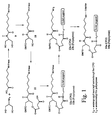
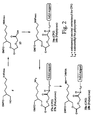
- FIGS. 1, 2, and 3 schematically depict the synthesis of preferred synthesis supports of the present invention.
- the present invention is directed towards an improved diglycolate-based synthesis support useful for the synthesis of 3'-labeled polynucleotides.
- the synthesis supports of the invention have the following generalized structure, where T is an acid-cleavable hydroxyl protecting group; L 1 is a linker for connecting a 3'-terminal nitrogen to carbon; L 2 and L 3 are linkers for connecting oxygen and carbon; W is a solid support; L 4 is a linker for connecting the solid support to nitrogen; R 1 and R 2 are nitrogen substituents individually including hydrogen, lower alkyl, nitrogen protecting group, or label; R 3 through R 7 are carbon substituents individually including hydrogen or lower alkyl; and W is a solid support.
- the synthesis supports of the present invention provide several important advantages over current succinate-based synthesis supports used for the synthesis of polynucleotides.
- One particularly important advantage of the instant supports is that once synthesized, a 3'-labeled polynucleotide may be cleaved from the solid supports using relatively mild cleavage reagents, i.e., cleavage reagents which are weaker nucleophiles than ammonium hydroxide.
- exemplary mild cleavage reagents include ethanolamine, methylamine/ammonium hydroxide mixtures, and mixtures of t-butylamine/water/methanol (1:2:1), e.g., see U.S. Patent no.
- a second significant advantage of the present invention is that, even while using mild cleavage reagents, the cleavage reaction is substantially faster than that observed using conventional methods and reagents, i.e., ammonium-hydroxide-based reagents in combination with succinate-based synthesis supports.
- a third advantage of the supports of the instant invention is that high product yields may be obtained without mannual intervention or harsh cleavage conditions.
- the polynucleotide-containing synthesis support is manually removed from the reaction cartridge, transferred to a glass vial, cleavage reagent is added, and the suspension is cooked at approximately 85 0 C for several hours.
- An undesirable consequence of using this harsh cleavage protocol is that contaminants present in the solid support are extracted into the cleavage solution, thereby compromising the purity of the product oligonucleotide.
- oligonucleotide or “polynucleotide” as used herein refer to oligomers of natural or modified nucleosides or of non-nucleosidic analogs linked by phosphodiester bonds or analogs thereof ranging in size from a few monomeric units, e.g., 2-5, to several hundred monomeric units.
- label refers generally to any 3'-modifications of the polynucleotide including modifications which (i) facilitate detection, e.g., dyes, enzymes, spin-labels, or the like; (ii) facilitate capture of the polynucleotide to a solid substrate, e.g., biotin, haptens, and the like; (iii) affect solubility or modify cellular uptake, e.g., PEG, cholesteryl, triglycerides, and the like; and (iv) introduce moieties that participate in chemical reactions, e.g., psoralens, EDTA, phosphate, nucleic acid cleaving reagents, and the like.
- modifications which (i) facilitate detection, e.g., dyes, enzymes, spin-labels, or the like; (ii) facilitate capture of the polynucleotide to a solid substrate, e.g., biotin, haptens,
- W is a solid support on which the polynucleotide synthesis takes place.
- W can have a variety of forms and compositions, however, the solid support should be (i) substantially insoluble in polynucleotide synthesis reagents, (ii) chemically stable to polynucleotide synthesis reagents, (iii) capable of chemical derivatization, (iv) provide the desired oligonucleotide loading, (v) have adequate compression strength to withstand elevated pressure encountered during processing, and, (vi) available in a desirable particle size range and distribution.
- polynucleotide synthesis reagents refers to solvents and reagents typically used in the polynucleotide synthesis process, e.g., iodine, methylene chloride, acetonitrile, tetrazole, n-methylimidazole, pyridine, acetic anhydride, lutidine, trifluroacetic acid, and the like.
- W is an inorganic polymer.
- inorganic polymers can be employed in the present invention and these include, for example, silica, porous glass, aluminosilicates, borosilicates, metal oxides such as alumina and nickel oxide, various clays, and the like.
- the inorganic solid substrate is controlled pore glass (CPG).
- CPG controlled pore glass
- Controlled pore glass consists of uniformly milled and screened particles of almost pure silica that are honeycombed with pores of a controlled size. It is manufactured from a borosilicate material that has been specially heat treated to separate the borates from the silicates.
- the pores are formed by removing the borates by an acidic etching process, their size being dependent on the nature of the heating process. More preferably, the CPG is in the form of 150 ⁇ m diameter particles having 500 ⁇ pores, e.g., Users Manual Model 392 and 394 Polynucleotide Synthesizers , pages 6-5 through 6-9, Applied Biosystems, Ver. 2.00, Doc. Rev. A, Part No. 902351 (1992), Applied Biosystems Division of The Perkin-Elmer Corporation, Foster City, CA (ABD).
- CPG supports with amino-terminated linkers such as the L 4 --NH moiety in the present invention is well known in the art of polynucleotide synthesis, e.g., Gait, Editor, Oligonucleotide Synthesis , pages 45-49 (IRL Press, 1984), and in fact, CPG beads derivatized with an alkyl amine having a primary amino loading of about 100 mmol/g are commercially available (Pierce Chemical Company, Rockford, IL). Briefly, in the case of alkyl amino substrates, the CPG is derivatized by reacting a suspension of CPG particles with an aminoalkyltrimethoxysilane reagent, filtered, and dried.
- a second preferred solid substrate is non-swellable porous polystyrene, e.g., U.S. Patent No. 5,047,524 which is incorporated herein by reference in its entirety.
- non-swellable means that the porous polystyrene material remains substantially mechanically rigid, in particular, does not appreciably increase in volume, when exposed to polynucleotide synthesis reagents.
- porous means that the non-swellable polystyrene contains pores having substantially uniform diameters in the range of between 100 and 4000 ⁇ .
- the polystyrene support is amino-derivatized by standard procedures, e.g., Wallace et al., pages 638-639 in Scouten ed., Solid Phase Biochemistry (John Wiley & Sons, 1980); Wright et al. Tet . Lett ., 34: 3373-3376 (1993); Bayer et al, U.S. Pat. No. 4,908,405, incorporated herein by reference; Applied Biosystems Research News, Model 390Z, February 1994. Briefly, in one preferred procedure, hydroxymethylpthalimide is reacted with the polystyrene support with a catalytic amount of methylsulfonic acid to form pthalimidomethyl polystyrene.
- aminomethylated polystyrene is then treated with hydrazine to remove the pthalimide protecting group to give aminomethylated polystyrene.
- amino loading varies from 10 to 60 ⁇ moles of amino functionality per gram of non-swellable porous polystyrene.
- the loading level can be controlled by adjusting the concentrations of the reagents and reaction times.
- a recently developed alternative polystyrene derivatizing chemistry replaces the terminal amino group with a free hydroxyl group by attaching several polyoryethylene residues or chains having free hydroxyl groups available for coupling with the polynucleotide, e.g., Bayer and Rapp, U.S. Pat. No. 4,908,405; Gao et al., Tetrahedron Lett ., 32(40):5477-5480 (1991).
- W is a non-polystyrene organic polymer support.
- the polymer support can be derived from naturally occurring materials which are synthetically modified, and/or synthetic materials. Of particular interest are polysaccharides, particularly crosslinked polysaccharides, such as agarose, which is available as SepharoseTM, dextran, which is available as SephadexTM, cellulose, starch, and the like. Other suitable materials include polyacrylamides, polyvinyl alcohols, silicones, TeflonsTM, and the like.
- T refers generally to an acid-cleavable hydroxyl protecting group.
- T is the triphenylmethyl radical and its electron-donating-substituted derivatives, where, as used herein, the term "electron-donating" denotes the tendency of a substituent to release valence electrons to neighboring atoms in the molecule of which it is a part, i.e., it is electropositive with respect to neighboring atoms.
- electron-donating substituents include amino, lower alkyl having between 1 and 8 carbon atoms, lower aryl having between 1 and 8 carbon atoms, alkoxy having from 1 to 8 carbon atoms, and the like. More preferably, the electron-donating substituents are methoxy.
- trityls include 4,4'-dimethoxytrityl (i.e. bis(p-anisyl)phenylmethyl), monomethoxytrityl, ⁇ -naphthyldiphenylmethyl, tri(p-methoxyphenyl)methyl, and the like. Attachment and cleavage conditions for these and other trityls can be found in Greene and Wuts, Protective Groups in Organic Synthesis , 2nd Edition (John Wiley, New York:, 1991).
- Linkers L 1 , L 2 , L 3 , and L 4 are linking moieties which serve to link various elements of the compounds of the invention. Specifically, L 1 serves to link the 3'-terminal nitrogen of the synthetic polynucleotide to the polynucleotide itself, L 2 and L 3 serve to link carbon and oxygen, and L 4 serves to link the solid support to nitrogen.
- linkers L 1 through L 4 are additional purpose of linkers L 1 through L 4 in order (i) to reduce the extent to which the label interferes with hybridization of the polynucleotide to a complementary target, (ii) to reduce the extent to which the label and/or solid support interferes with the synthesis of the polynucleotide, and (iii) to protect the integrity of the label during polynucleotide synthesis.
- lower alkyl denotes straight-chain, branched-chain, and cyclized alkyl groups containing from 1 to 10 carbon atoms
- lower alkylene oxide denotes straight-chain, branched-chain, and cyclized alkylene oxide groups containing from 2 to 10 carbon atoms, e.g., polyethylene oxide.
- L 1 is n-butyl or n-hexylamide
- L 2 and L 3 are each methylene
- W is polystyrene
- L 4 is methylene
- W is CPG
- L 4 is aminopropylsuccinylhexylamine.
- linker L 3 is a moiety having an internal cleavage site which when cleaved provides an additional site for labeling an oligonucleotide once it has been cleaved from the support.
- An exemplary moiety useful for this purpose is a moiety containing a disulfide bond which when cleaved with dithiothreitol (DTT) forms an -SH moiety.
- DTT dithiothreitol
- a particularly preferred L 3 moiety has the structure ⁇ CH 2 ⁇ S ⁇ S ⁇ CH 2 ⁇
- R 3 -R 7 are carbon substituents.
- R 3 -R 7 are separately lower alkyl or hydrogen. More preferably, R 3 -R 7 are hydrogen.
- R 1 and R 2 are nitrogen substituents which can vary greatly depending on the nature of the desired final product. It will be appreciated that because R 1 and R 2 are not central features of the invention and provide a generic function, R 1 can have a wide variety of forms. R 1 and R 2 are chosen so that the bonded nitrogen atom is chemically stable during synthesis and subsequent oligonucleotide cleavage. Moreover, R 1 and R 2 are themselves stable to standard polynucleotide synthesis reagents.
- R 1 and R 2 should not substantially interfere with the nitrogen reactivity.
- one of R 1 and R 2 is preferably lower alkyl, hydrogen, or a nitrogen protecting group, e.g., FMOC, tBOC, or other like nitrogen protecting groups. Most preferably, one of R 1 and R 2 is hydrogen.
- R 1 or R 2 are labels introduced prior to polynucleotide synthesis as part of a direct labeling method
- the label should be stable in the presence of DNA synthesis reagents and mild cleavage reagents.
- labels include fluorophores, enzymes, biotin, intercalators, cross-linkers, nucleic acid cleaving reagents, modifiers of cellular uptake, and the like.
- the label is a rhodamine dye, e.g., tetramethylrhodamine.
- the phosphoramidite method of polynucleotide synthesis is the preferred method because of its efficient and rapid coupling and the stability of the starting materials.
- the synthesis is performed with the growing polynucleotide chain attached to a solid support, so that excess reagents, which are in the liquid phase, can be easily removed by filtration, thereby eliminating the need for purification steps between cycles.
- the solid support is treated with acid, e.g., trichloroacetic acid, to remove the hydroxyl protecting group T, freeing the hydroxyl for a subsequent coupling reaction.
- acid e.g., trichloroacetic acid
- An activated intermediate is then formed by simultaneously adding the protected phosphoramidite nucleoside monomer and a weak acid, e.g., tetrazole, and the like, to the reaction.
- the weak acid protonates the nitrogen of the phosphoramidite forming a reactive intermediate. Nucleoside addition is complete within 30 s.
- a capping step is performed which terminates any polynucleotide chains that did not undergo nucleoside addition.
- Capping is preferably done with acetic anhydride and 1-methylimidazole.
- the internucleotide linkage is then converted from the phosphite to the more stable phosphotriester by oxidation using iodine as the preferred oxidizing agent and water as the oxygen donor.
- the hydroxyl protecting group is removed with a protic acid, e.g., trichloroacetic acid or dichloroacetic acid, and the cycle is repeated until chain elongation is complete.
- the polynucleotide chain is cleaved from the support using a base, e.g., ammonium hydroxide or t-butyl amine.
- a base e.g., ammonium hydroxide or t-butyl amine.
- the cleavage reaction also removes any phosphate protecting groups, e.g., cyanoethyl.
- the protecting groups on the exocyclic amines of the bases are removed by treating the polynucleotide solution in base at an elevated temperature, e.g., 55 °C.
- the support was washed with DMF (3 X 10 mL), CH 3 CN (2 X 10 mL) and CH 2 Cl 2 (1 X 10 mL) and dried under high vacuum overnight. A ninhydrin assay showed 6 ⁇ mol/g amine remained on the support.
- the support was capped with acetic anhydride/lutidine in THF (10% solution, 5 mL) and 1-methylimidazol in THF (16% solution, 5 mL) for 2 h at room temperature.
- Support 12a was washed with CH 3 CN (3 X 10 mL) and CH 2 Cl 2 (1 X 10 mL) then treated with 20% piperidine in DMF (3 X 10 mL, 10 min each wash) to remove the Fmoc protecting group giving support 13a .
- the removal of the Fmoc group was monitored by measuring the UV absorbance of the solution at 302 nm.
- Support 13a was washed with DMF (3 X 10 mL), CH 3 CN (2 X 10 mL) and CH 2 Cl 2 (1 X 10 mL) and dried under vacuum overnight.
- the support (500 mg, 16 ⁇ mol) was then treated with TAMRA-NHS ester (ABD, p/n 400981) (26 mg, 49 ⁇ mol) and Et 3 N (10.1 mg, 100 ⁇ mol) in DMF (5 mL) for 42 h on a shaker to give dye-labeled support 14a .
- the support was washed with DMF (3 X 10 mL), CH 3 CN (2 X 10 mL) and CH 2 Cl 2 (1 X 10 mL) and dried under high vacuum for 24 h. Ninhydrin assay showed 1 ⁇ mol/g amine left.
- the support was then capped with an acetic anhydride/lutidine mixture dissolved in THF (10% solution, 5 mL) and 1-methylimidazol in THF (16% solution, 5 mL) for 1 h and, washed with CH 3 CN (3 X 10 mL), CH 2 Cl 2 (2 X 10 mL) and dried under high vacuum for 24 h.
- the trityl cation assay showed a final loading of 30.3 ⁇ mol/g.
- High cross linked polystyrene 1000 ⁇ , 10 ⁇ mol/g amine loading, 2 g, 20 ⁇ mol, (ABD)
- compound 11 from Example 1 (34 mg, 40 ⁇ mol), 1-hydroxybenzotriazole (5.5 mg, 40 ⁇ mol), (2-(1H-benzotriazol-1-yl)-1,1,3,3-tetramethyluronium hexafluorophosphate (15 mg, 40 ⁇ mol), and diisopropylethylamine (8 mg, 60 ⁇ mol) in DMF (10 mL) on a wrist-action shaker for 4 h at room temperature.
- the support was washed with DMF (3 X 10 mL), CH 3 CN (2 X 10 mL) and CH 2 Cl 2 (1 X 10 mL) and dried under high vacuum overnight.
- a ninhydrin assay showed 0.6 ⁇ mol/g amine left on the support.
- the support was capped with acetic anhydride/lutidine in THF (10% solution, 5 mL) and 1-methylimidazol in THF (16% solution, 5 mL) for 2 h at room temperature.
- Support 12b was washed with CH 3 CN (3 X 10 mL) and CH 2 Cl 2 (1 X 10 mL). Trityl cation assay gave 9 ⁇ mol/g loading of compound 11 on the polystyrene support.
- Support 12b was then treated with 20% piperidine in DMF (3 X 10 mL, 10 min each wash) to remove the Fmoc protecting group to give support 13b .
- the removal of the Fmoc group was monitored by measuring the UV absorbance of the solution at 302 nm.
- Support 13b was washed with DMF (3 X 10 mL), CH 3 CN (2 X 10 mL) and CH 2 Cl 2 (1 X 10 mL), and dried under vacuum overnight.
- the support (1 g, 9 umol) was then treated with TAMRA-NHS ester (15 mg, 28.5 ⁇ mol) and Et 3 N (8.6 mg, 85 ⁇ mol) in DMF (10 mL) at room temperature for 36 h on a shaker to give support 14b .
- the support was washed with DMF (3 X 10 mL), CH 3 CN (2 X 10 mL) and CH 2 Cl 2 (1 X 10 mL) and dried under high vacuum for 24 h.
- a ninhydrin assay indicated less than 0.5 ⁇ mol/g amine remaining.
- the support was then capped with acetic anhydride/lutidine in THF (10% solution, 5 mL) and 1-methylimidazol in THF (16% solution, 5 mL) for 1 h and then washed with CH 3 CN (3 X 10 mL), CH 2 Cl 2 (2 X 10 mL) and dried under high vacuum for 24 h.
- the trityl cation assay showed a final loading of 8.8 ⁇ mol/g.
- the reaction mixture was diluted with CHCl 3 (30 mL) and washed with 5% aqueous citric acid (1 X 50 mL) and saturated brine (2 X 50 mL). The organic layer was dried (MgSO 4 ) and evaporated to give a foam.
- the product was purified by column chromatography on silica gel eluting with a CHCl 3 -EtOH gradient (2-10% EtOH). Appropriate fractions were combined and evaporated to give compound 15 as a colorless foam (354 mg, 60%).
- the support was washed with DMF (3 X 10 mL), CH 3 CN (2 X 10 mL) and CH 2 Cl 2 (1 X 10 mL) and dried under high vacuum overnight.
- a ninhydrin assay showed 3 ⁇ mol/g amine left on the support.
- the trityl cation assay gave 37.5 ⁇ mol/g loading of compound 15 on the CPG support.
- the support was capped with acetic anhydride/lutidine in THF (10% solution, 5 mL) and 1-methylimidazol in THF (16% solution, 5 mL) for 2 h at room temperature.
- Support 16a was washed with CH 3 CN (3 X 10 mL) and CH 2 Cl 2 (1 X 10 mL) then treated with 20% piperidine in DMF (3 X 10 mL, 10 min each wash) to remove the Fmoc protecting group giving support 17a containing a free amino group. The removal of the Fmoc group was monitored by measuring the UV absorbance of the solution at 302 nm. Support 17a was washed with DMF (3 X 10 mL), CH 3 CN (2 X 10 mL) and CH 2 Cl 2 (1 X 10 mL), and dried under vacuum overnight.
- Support 17a (500 mg, 19 umol) was then treated with TAMRA-NHS ester (30 mg, 57 ⁇ mol) and Et 3 N (13.1 mg, 130 ⁇ mol) in DMF (5 mL) for 42 h on a shaker to afford dye labeled support 18a .
- the support was washed with DMF (3 X 10 mL), CH 3 CN (2 X 10 mL) and CH 2 Cl 2 (1 X 10 mL) and dried under high vacuum for 24 h.
- a ninhydrin assay indicated 1 ⁇ mol/g amine was left on the support.
- the support was then capped with acetic anhydride/lutidine in THF (10% solution, 5 mL) and 1-methylimidazol in THF (16% solution, 5 mL) for 1 h and then washed with CH 3 CN (3 X 10 mL), CH 2 Cl 2 (2 X 10 mL) ad dried under high vacuum for 24 h.
- the trityl cation assay showed a final loading of 36 ⁇ mol/g.
- High cross linked polystyrene 1000 ⁇ , 10 ⁇ mol/g amine loading, 2 g, 20 ⁇ mol
- compound 15 32 mg, 40 ⁇ mol
- 1-hydroxybenzotriazole 5.5 mg, 40 ⁇ mol
- (2-(1H-benzotriazol-1-yl)-1,1,3,3-tetramethyluronium hexafluorophosphate 15 mg, 40 ⁇ mol
- diisopropylethylamine 8 mg, 60 ⁇ mol
- the support was washed with DMF (3 X 10 mL), CH 3 CN (2 X 10 mL) and CH 2 Cl 2 (1 X 10 mL) and dried under high vacuum overnight.
- a ninhydrin assay showed 0.5 ⁇ mol/g amine left on the support.
- the support was capped with acetic anhydride/lutidine in THF (10% solution, 5 mL) and 1-methylimidazol in THF (16% solution, 5 mL) for 2 h at room temperature.
- Support 16b was washed with CH 3 CN (3 X 10 mL) and CH 2 Cl 2 (1 X 10 mL). Trityl cation assay gave 9 ⁇ mol/g loading of compound 15 on the polystyrene support.
- Support 16b was treated with 20% piperidine in DMF (3 X 10 mL, 10 min each wash) to remove the Fmoc protecting group giving support 17b .
- Support 17b was washed with DMF (3 X 10 mL), CH 3 CN (2 X 10 mL) and CH 2 Cl 2 (1 X 10 mL) and, dried under vacuum for overnight.
- Support 17b (1 g, 9 ⁇ mol) was treated with TAMRA-NHS ester (15 mg, 28.5 ⁇ mol) and Et 3 N (8.6 mg, 85 ⁇ mol) in DMF (10 mL) at room temperature for 36 h on a shaker to give support 18b .
- the support was washed with DMF (3 X 10 mL), CH 3 CN (2 X 10 mL) and CH 2 Cl 2 (1 X 10 mL) and dried under high vacuum for 24 h.
- a ninhydrin assay showed less than 0.5 ⁇ mol/g amine left.
- the support was capped with acetic anhydride/lutidine in THF (10% solution, 5 mL) and 1-methylimidazol in THF (16% solution, 5 mL) for 1 h and then washed with CH 3 CN (3 X 10 mL), CH 2 Cl 2 (2 X 10 mL) and dried under high vacuum for 24 h.
- the trityl cation assay showed a final loading of 8.7 ⁇ mol/g.
- the reaction mixture was diluted with CH 2 Cl 2 (30 mL) and washed with 5% aqueous citric acid (1 X 50 mL) and saturated brine (2 X 50 mL). The organic layer was dried (MgSO 4 ) and evaporated to give a foam.
- the product was purified by column chromatography on silica gel eluting with a CHCl 3 -EtOH gradient (2-10% EtOH). Appropriate fractions were combined and evaporated to give compound 19 as a colorless foam (260 mg, 56%).
- the support was washed with DMF (3 X 8 mL), CH 3 CN (2 X 8 mL) and CH 2 CL 2 (1 X 8 mL) and dried under high vacuum for overnight.
- a ninhydrin assay showed 3 ⁇ mol/g amine left on the support.
- the trityl cation assay gave 29 ⁇ mol/g loading of compound 19 on the CPG support.
- the support was capped with acetic anhydride/lutidine in THF (10% solution, 3 mL) and 1-methylimidazol in THF (16% solution, 3 mL) for 2 h at room temperature.
- Support 20a was washed with CH 3 CN (3 X 8 mL) and CH 2 CL 2 (1 X 8 mL) then treated with 20% piperidine in DMF (3 X 5 mL, 10 min each wash) to remove the Fmoc protecting group giving support 21a containing a free amino group.
- Support 21a was washed with DMF (3 X 8 mL), CH 3 CN (2 X 8 mL) and CH 2 CL 2 (1 X 8 mL), and dried under vacuum overnight.
- Support 21a (500 mg, 15 ⁇ mol) was then treated with TAMRA-NHS ester (24 mg, 45 ⁇ mol) and Et 3 N (11 mg, 110 ⁇ mol) in DMF (5 mL) for 42 h on a shaker resulting in dye labeled support 22a .
- Support 22a was washed with DMF (3 X 8 mL), CH 3 CN (2 X 8 mL) and CH 2 CL 2 (1 X 8 mL) and dried under high vacuum for 24 h.
- a ninhydrin assay showed 1.2 ⁇ mol/g amine left on the support.
- the support was capped with acetic anhydride/lutidine in THF (10% solution, 3 mL) and 1-methylimidazol in THF (16% solution, 3 mL) for 1 h and then washed with CH 3 CN (3 X 8 mL), CH 2 CL 2 (2 X 8 mL) and dried under high vacuum for 24 h.
- the trityl cation assay showed a final loading of 28 ⁇ mol/g.
- High cross linked polystyrene 1000 ⁇ 10 ⁇ mol/g amine loading, 1 g, 10 ⁇ mol
- compound 19 17 mg, 20 ⁇ mol
- 1-hydroxybenzotriazole 3 mg, 20 ⁇ mol
- (2-(1H-benzotriazol-1-yl)-1,1,3,3-tetramethyluronium hexafluorophosphate 8 mg, 20 ⁇ mol
- diisopropylethylamine 8 mg, 60 ⁇ mol
- the support was washed with DMF (3 X 10 mL), CH 3 CN (2 X 10 mL) and CH 2 Cl 2 (1 X 10 mL) and dried under high vacuum overnight.
- a ninhydrin assay showed 0.5 ⁇ mol/g amine left on the support.
- the support was capped with acetic anhydride/lutidine in THF (10% solution, 5 mL) and 1-methylimidazol in THF (16% solution, 5 mL) for 2 h at room temperature.
- Support 20b was washed with CH 3 CN (3 X 10 mL) and CH 2 Cl 2 (1 X 10 mL). Trityl cation assay gave 9.2 ⁇ mol/g loading of compound 19 on the polystyrene support.
- Support 20b was treated with 20% piperidine in DMF (3 X 10 mL, 10 min each wash) to remove the Fmoc protecting group to give support 21b .
- Support 21b was washed with DMF (3 X 10 mL), CH 3 CN (2 X 10 mL) and CH 2 Cl 2 (1 X 10 mL) and, dried under vacuum overnight.
- Support 21b (1 g, 9.2 umol) was treated with TAMRA-NHS ester (15 mg, 28.5 ⁇ mol) and Et 3 N (8.6 mg, 85 ⁇ mol) in DMF (10 mL) at room temperature for 36 h on a shaker to give support 22b .
- the support was washed with DMF (3 X 10 mL), CH 3 CN (2 X 10 mL) and CH 2 Cl 2 (1 X 10 mL) and dried under high vacuum for 24 h.
- a ninhydrin assay indicated less than 0.5 ⁇ mol/g amine left on the support.
- the support was capped with acetic anhydride/lutidine in THF (10% solution, 5 mL) and 1-methylimidzol in THF (16% solution, 5 mL) for 1 h and then washed with CH 3 CN (3 X 10 mL), CH 2 Cl 2 (2 X 10 mL) and dried under high vacuum for 24 h.
- the trityl cation assay showed a final loading of 8.8 ⁇ mol/g.
- Doubled dye labeled oligonucleotides were synthesized using TAMRA-labeled supports 14a , 14b , 18a , 18b , and 22a , DNA FastPhosphoramidites and the fluorescent dye amidites FAM-, TET-, HEX- in 40-1000 nmol scale, where "FAM refers” to 6-carboyfluorescein, “TET” refers to 6-carboxy-4,7,2',7'-tetrachlorofluorescein, and "HEX” refers to 6-carboxy-4,7,2',4',5',7'-hexachlorofluorescein. Automated oligonucleotide synthesis was performed on an Applied Biosystems Model 394 DNA/RNA synthesizer (ABD) according to the general procedures described in the operators manual.
- ABS Applied Biosystems Model 394 DNA/RNA synthesizer
- the oligonucleotide sequence 5'>FAM-TCA CAG TCT GAT CTC GAT-TAMRA ⁇ 3' was synthesized in 0.2 ⁇ mol scale by using TAMRA labeled supports 18a and 22a , DNA FastPhosphoramidites (User Bulletin number 85, 1994, Applied Biosystems Division) and FAM amidite (User Bulletin number 78, 1994, Applied Biosystems Division).
- the standard 0.2 ⁇ mol synthesis cycle was slightly modified by extending the coupling time of FAM-amidite by an additional 120 s (User Bulletin number 78, 1994, Applied Biosystems Division).
- oligonucleotides were autocleaved from the support by treating the support with a mixture of MeOH:t-BuNH 2 :H 2 O(1:1:2), e.g., U.S. Patent # 5,231,191, such patent incorporated herein by reference in its entirety, using a 1 h autocleavage procedure ("END CE procedure") as described in the operators manual for the Applied Biosystems Model 394 DNA/RNA synthesizer. Base protecting groups were removed by heating the mixture at 85 °C for 1 h or at 65 °C for 3 h. More than 99% of oligonucleotides were cleaved from each of the supports.
- END CE procedure 1 h autocleavage procedure
- oligonucleotide sequence mentioned above was also synthesized on the 394 DNA/RNA synthesizer in 40 nanomole scale using TAMRA labeled support 18b , DNA FastPhosphoramidites (User Bulletin number 85, 1994, Applied Biosystems Division) and FAM amidite (User Bulletin number 78, 1994, Applied Biosystems Division).
- the standard 40 nanomol synthesis cycle was slightly modified by extending coupling time of FAM by additional 120 sec (User Bulletin number 78, 1994, Applied Biosystems Division). More than 99% of oligonucleotides were cleaved from each of the supports.
- TAMRA labeled supports 14a and 14b were also used for the synthesis of the above mentioned oligonucleotide in 0.2 ⁇ mol scale as described above.
- the oligonucleotides were cleaved from the supports by 2 h autocleavage protocol (END RNA) as described in operators manual for the 394 DNA/RNA using MeOH:t-BuNH 2 :H 2 O (1:1:2). More than 92% of the oligonucleotide was cleaved from the support in 2 h.
- END RNA 2 h autocleavage protocol
- oligonucleotide could be cleaved from the support and base deprotected by treating the support bound oligonucleotide in 1 mL of MeOH:t-BuNH 2 :H 2 O (1:1:2) at 85 °C for 1 h. More than 99% of oligonucleotides were cleaved from each of the supports.
- the solid support matrix, CPG or polystyrene, did not make any difference in the rate of cleavage of oligonucleotide from the support.
- the crude yield of the above mentioned oligonucleotides was 25-30 ODU at 0.2 ⁇ mol scale and 7-10 ODU at 40 nanomol scale.
- the crude oligonucleotides were analysed by both reverse phase and anion exchange HPLC.
- the reverse phase HPLC system used to analyze the oligonucleotide products was as follows: Perkin Elmer Series 200 solvent delivery system equipped with ABI 783A programable detector, Perkin Elmer ISS200 autosampler and PE Nelson 900 series data system, RP-18 reverse phase column (220 X 4.6 mm, Applied Biosystems Division), solvent A: 0.1 M triethylammonium acetate, solvent B: CH 3 CN, gradient: 8-20% B in 24 min, 20-40% B in 10 min, 40-8% B in 2 min, 8% B for 7 min, flow rate: 1 mL/min, detector: 260 nm.
- the anion exchange HPLC system used to analyze the oligonucleotide products was as follows: Perkin Elmer Series 200 solvent delivery system equipped with ABI 783A programable detector, Perkin Elmer ISS200 autosampler and PE Nelson 900 series data system, Nucleopac PA-100 column (250 X 4 mm, Dionex Corporation); solvent A: 20 mM LiClO 4 and 20 mM NaOAc in H 2 O:CH 3 CN (9:1, pH 6.5); solvent B: 600 mM LiClO 4 and 20 mM NaOAc in H 2 O:CH 3 CN (9:1, pH 6.5); flow rate 1 mL/min; gradient: 0-60% B in 40 min; detector, 260 nm.
- Snake venom phosphodiesterase crotalus adamanteus
- alkaline phosphodiesterase E. coli
- Snake venom phosphodiesterase was obtained as powder which was dissolved in water at 1 mg/mL.
- a digest cocktail 55 ⁇ L for each sample was prepared by mixing the following reagents: water (44 ⁇ L), 1 M MgCl 2 (0.8 ⁇ L), 0.5 M Tris buffer, pH 7.5 (3.5 ⁇ L), alkaline phosphatase (4.0 ⁇ L) and snake venom phosphodiesterase (2.4 ⁇ L).
- oligoribonucleotide was dissolved in digest cocktail and heated at 37 °C for 8 h. After incubation, 3 M sodium acetate (7 ⁇ L) and ethanol (155 ⁇ L) were added to each sample. Each sample was vortexed, cooled on dry ice for 10 min and then centrifuged for 10 min. The supernatants were carefully transferred to a set of new tubes and ethanol (452 ⁇ L) was added to each sample. The samples were vortexed and cooled on dry ice for 10 min and centrifuged for 10 min. The supernatants were carefully transferred to a set of new tubes. Samples were evaporated to dryness under vacuum. Each sample was dissolved in water (60 ⁇ L) and analyzed by reverse phase HPLC as described below.
- the gradient was 100% A for 5 min, 100-90% A in 30 min, 90-0% A in 30 min, 100% B for 5 min, 0-100% A in 2 min, 100% A for 15 min with flow rate 0.5 mL/min.
- the order of elution was dC, dG, T, dA, 6-carboxyfluorescein-(6-hydroxyhexylamide), thymidine-TAMRA linker conjugate.
- the enzymatic digestion study gave expected nucleoside composition and did not show any base modification.
Landscapes
- Chemical & Material Sciences (AREA)
- Organic Chemistry (AREA)
- Life Sciences & Earth Sciences (AREA)
- Biochemistry (AREA)
- Molecular Biology (AREA)
- Health & Medical Sciences (AREA)
- Engineering & Computer Science (AREA)
- Biotechnology (AREA)
- General Health & Medical Sciences (AREA)
- Genetics & Genomics (AREA)
- Saccharide Compounds (AREA)
- Investigating Or Analysing Biological Materials (AREA)
- Organic Low-Molecular-Weight Compounds And Preparation Thereof (AREA)
Applications Claiming Priority (2)
| Application Number | Priority Date | Filing Date | Title |
|---|---|---|---|
| US08/593,031 US5736626A (en) | 1996-01-29 | 1996-01-29 | Solid support reagents for the direct synthesis of 3'-labeled polynucleotides |
| US593031 | 1996-01-29 |
Publications (3)
| Publication Number | Publication Date |
|---|---|
| EP0786468A2 true EP0786468A2 (fr) | 1997-07-30 |
| EP0786468A3 EP0786468A3 (fr) | 2000-07-05 |
| EP0786468B1 EP0786468B1 (fr) | 2004-10-13 |
Family
ID=24373080
Family Applications (1)
| Application Number | Title | Priority Date | Filing Date |
|---|---|---|---|
| EP97101131A Expired - Lifetime EP0786468B1 (fr) | 1996-01-29 | 1997-01-24 | Réactifs sur supports solides pour la synsthèse directe de 3'-polynucléotides marqués |
Country Status (6)
| Country | Link |
|---|---|
| US (1) | US5736626A (fr) |
| EP (1) | EP0786468B1 (fr) |
| JP (2) | JP4127870B2 (fr) |
| AU (1) | AU704180B2 (fr) |
| CA (1) | CA2195256C (fr) |
| DE (1) | DE69731132T2 (fr) |
Cited By (11)
| Publication number | Priority date | Publication date | Assignee | Title |
|---|---|---|---|---|
| WO2000050432A3 (fr) * | 1999-02-22 | 2001-02-01 | Perkin Elmer Corp | Methodes et compositions destinees a la synthese d'oligonucleotides marques et d'analogues sur supports solides |
| EP1186613A1 (fr) * | 2000-09-08 | 2002-03-13 | Roche Diagnostics GmbH | Réactif nouveau pour le marquage d'acides nucléiques |
| EP1185544A4 (fr) * | 1999-05-24 | 2002-07-17 | Invitrogen Corp | Procede de deblocage d'oligonucleotides marques |
| US6743585B2 (en) | 1999-09-16 | 2004-06-01 | Agilent Technologies, Inc. | Methods for preparing conjugates |
| US9688758B2 (en) | 2012-02-10 | 2017-06-27 | Genentech, Inc. | Single-chain antibodies and other heteromultimers |
| US9994646B2 (en) | 2009-09-16 | 2018-06-12 | Genentech, Inc. | Coiled coil and/or tether containing protein complexes and uses thereof |
| US10106600B2 (en) | 2010-03-26 | 2018-10-23 | Roche Glycart Ag | Bispecific antibodies |
| US10106612B2 (en) | 2012-06-27 | 2018-10-23 | Hoffmann-La Roche Inc. | Method for selection and production of tailor-made highly selective and multi-specific targeting entities containing at least two different binding entities and uses thereof |
| US10633457B2 (en) | 2014-12-03 | 2020-04-28 | Hoffmann-La Roche Inc. | Multispecific antibodies |
| US11421022B2 (en) | 2012-06-27 | 2022-08-23 | Hoffmann-La Roche Inc. | Method for making antibody Fc-region conjugates comprising at least one binding entity that specifically binds to a target and uses thereof |
| US11618790B2 (en) | 2010-12-23 | 2023-04-04 | Hoffmann-La Roche Inc. | Polypeptide-polynucleotide-complex and its use in targeted effector moiety delivery |
Families Citing this family (55)
| Publication number | Priority date | Publication date | Assignee | Title |
|---|---|---|---|---|
| US5605798A (en) | 1993-01-07 | 1997-02-25 | Sequenom, Inc. | DNA diagnostic based on mass spectrometry |
| US6043353A (en) * | 1995-12-22 | 2000-03-28 | University Technologies International, Inc. | Reusable solid support for oligonucleotide synthesis, process for production thereof and process for use thereof |
| WO1997023497A1 (fr) * | 1995-12-22 | 1997-07-03 | University Technologies International Inc. | Bras de liaison pour la synthese d'oligonucleotides sur un support solide et procede pour le former |
| ES2215241T3 (es) | 1996-11-06 | 2004-10-01 | Sequenom, Inc. | Procedimiento de espectrometria de masa. |
| US6133436A (en) | 1996-11-06 | 2000-10-17 | Sequenom, Inc. | Beads bound to a solid support and to nucleic acids |
| DE69738206T2 (de) * | 1996-11-06 | 2008-07-17 | Sequenom, Inc., San Diego | DNA-Diagnostik mittels Massenspektrometrie |
| US6583168B1 (en) | 1997-11-25 | 2003-06-24 | Applera Corporation | Sulfonated diarylrhodamine dyes |
| US7715989B2 (en) * | 1998-04-03 | 2010-05-11 | Elitech Holding B.V. | Systems and methods for predicting oligonucleotide melting temperature (TmS) |
| US6949367B1 (en) | 1998-04-03 | 2005-09-27 | Epoch Pharmaceuticals, Inc. | Modified oligonucleotides for mismatch discrimination |
| US7045610B2 (en) * | 1998-04-03 | 2006-05-16 | Epoch Biosciences, Inc. | Modified oligonucleotides for mismatch discrimination |
| US6683173B2 (en) | 1998-04-03 | 2004-01-27 | Epoch Biosciences, Inc. | Tm leveling methods |
| US7094943B2 (en) | 1998-04-27 | 2006-08-22 | Hubert Köster | Solution phase biopolymer synthesis |
| US7135564B1 (en) * | 1998-07-02 | 2006-11-14 | University Technologies International Inc. | Reusable solid support for oligonucleotide synthesis |
| US6432642B1 (en) * | 1999-01-15 | 2002-08-13 | Pe Corporation (Ny) | Binary probe and clamp composition and methods for a target hybridization detection |
| US6194563B1 (en) | 1999-03-26 | 2001-02-27 | Vysis, Inc. | Solid phase nucleic acid labeling by transamination |
| EP1944310A3 (fr) | 2000-03-01 | 2008-08-06 | Epoch Biosciences, Inc. | Oligonucléotides modifiées pour discrimination de désadaptation |
| EP1995330A1 (fr) | 2000-03-01 | 2008-11-26 | Epoch Biosciences, Inc. | Oligonucléotides modifiées pour discrimination de désadaptation |
| US7019129B1 (en) | 2000-05-09 | 2006-03-28 | Biosearch Technologies, Inc. | Dark quenchers for donor-acceptor energy transfer |
| US6887664B2 (en) | 2000-06-06 | 2005-05-03 | Applera Corporation | Asynchronous primed PCR |
| US6932943B1 (en) | 2001-01-26 | 2005-08-23 | Third Wave Technologies | Nucleic acid synthesizers |
| US20030072689A1 (en) * | 2001-08-15 | 2003-04-17 | Third Wave Technologies, Inc. | Polymer synthesizer |
| US7435390B2 (en) * | 2001-01-26 | 2008-10-14 | Third Wave Technologies, Inc. | Nucleic acid synthesizers |
| US6681773B2 (en) | 2001-02-28 | 2004-01-27 | Chase Medical, Inc. | Kit and method for use during ventricular restoration |
| US20030082547A1 (en) | 2001-08-27 | 2003-05-01 | Ewing Gregory J. | Non-fluorescent quencher compounds and biomolecular assays |
| AU2002351193A1 (en) * | 2001-11-28 | 2003-06-10 | Mj Bioworks Incorporated | Parallel polymorphism scoring by amplification and error correction |
| JP4942484B2 (ja) * | 2003-10-28 | 2012-05-30 | エポック・バイオサイエンシーズ・インコーポレイテッド | 改良された感度および低バックグラウンドを備えるハイブリダイゼーションによるdna検出のための蛍光プローブ |
| JP4945129B2 (ja) * | 2004-01-27 | 2012-06-06 | 株式会社キラルジェン | フルオラス担体およびそれを用いたオリゴヌクレオチド誘導体の製造方法 |
| US20050208199A1 (en) * | 2004-03-18 | 2005-09-22 | Julia Golova | Methods and compositions for synthesis of 3'-aminolinkers |
| CA2560945C (fr) * | 2004-04-01 | 2013-06-18 | Bio-Rad Laboratories, Inc. | Amplification quantitative a l'aide d'une sonde etiquetee et activite exonuclease 3'-5' |
| EP2409980B1 (fr) | 2005-04-14 | 2015-06-03 | Applied Biosystems, LLC | Oligonucléotides modifiés en 3' contenant des dérivés de la nucléobase pseudoisocytosine et leurs applications en tant qu'amorces ou sondes |
| US7584947B2 (en) * | 2005-05-20 | 2009-09-08 | The Boeing Company | Reconfigurable workpiece support fixture |
| US8133701B2 (en) * | 2006-12-05 | 2012-03-13 | Sequenom, Inc. | Detection and quantification of biomolecules using mass spectrometry |
| US7902345B2 (en) * | 2006-12-05 | 2011-03-08 | Sequenom, Inc. | Detection and quantification of biomolecules using mass spectrometry |
| WO2009032781A2 (fr) | 2007-08-29 | 2009-03-12 | Sequenom, Inc. | Méthodes et compositions s'appliquant à une amplification en chaîne par polymèrase universelle spécifique de la taille |
| EP2268608A4 (fr) | 2008-04-01 | 2012-01-11 | Biosearch Technologies Inc | Sondes de désactiveur-fluorophore sombres d acide nucléique stabilisé |
| US9534255B2 (en) * | 2008-12-17 | 2017-01-03 | Life Technologies Corporation | Methods, compositions, and kits for detecting allelic variants |
| US20100279295A1 (en) * | 2009-03-18 | 2010-11-04 | Sequenom, Inc. | Use of thermostable endonucleases for generating reporter molecules |
| EP3249053A1 (fr) | 2009-03-27 | 2017-11-29 | Life Technologies Corporation | Procédés, compositions et kits de détection de variants alléliques |
| US8394948B2 (en) * | 2009-09-30 | 2013-03-12 | Glen Research Corporation | Reagents utilizing a serinol scaffold for labeling synthetic oligonucleotides |
| CA2817448C (fr) | 2010-12-23 | 2019-01-22 | F. Hoffmann-La Roche Ag | Agent de liaison |
| WO2012085064A1 (fr) | 2010-12-23 | 2012-06-28 | Roche Diagnostics Gmbh | Détection d'un polypeptide à modification post-translationnelle par un agent de liaison bivalent |
| US9085800B2 (en) | 2011-03-23 | 2015-07-21 | Elitech Holding B.V. | Functionalized 3-alkynyl pyrazolopyrimidine analogues as universal bases and methods of use |
| US8969003B2 (en) | 2011-03-23 | 2015-03-03 | Elitech Holding B.V. | Functionalized 3-alkynyl pyrazolopyrimidine analogues as universal bases and methods of use |
| ES2537189T3 (es) | 2011-05-24 | 2015-06-03 | Elitech Holding B.V. | Detección de estafilococos áureos resistentes a la meticilina |
| EP2736916B1 (fr) | 2011-07-26 | 2019-05-22 | ELITechGroup, Inc. | Phosphoramidites à liants à la rainure mineure et leurs méthodes d'utilisation |
| WO2014164874A2 (fr) | 2013-03-13 | 2014-10-09 | Becton, Dickinson And Company | Procédés et compositions utilisables en vue de la modulation de l'efficacité d'amplification |
| WO2014159063A1 (fr) | 2013-03-14 | 2014-10-02 | Elitech Holding B.V. | Analogues de 3-alcynyl pyrazolopyrimidines fonctionnalisés utilisés en tant que bases universelles et procédés d'utilisation |
| US9328384B2 (en) | 2013-05-13 | 2016-05-03 | Elitechgroup B.V. | Droplet digital PCR with short minor groove probes |
| WO2016094607A2 (fr) | 2014-12-12 | 2016-06-16 | Elitechgroup B.V. | Procédés et compositions pour la détection de bactéries résistant aux antibiotiques |
| EP3230467A1 (fr) | 2014-12-12 | 2017-10-18 | ELITechGroup B.V. | Procédés et compositions pour la détection de bactéries résistant aux antibiotiques |
| US10941435B2 (en) | 2016-06-23 | 2021-03-09 | Life Technologies Corporation | Methods and compositions for detecting or measuring caspases or apoptosis |
| US10738346B2 (en) | 2017-03-09 | 2020-08-11 | Elitechgroup, Inc. | Nitrodiarylethenes as fluorescence quenchers for nucleic acid probes |
| US10677728B2 (en) | 2017-08-17 | 2020-06-09 | Elitechgroup B.V. | Duplex stabilizing fluorescence quenchers for nucleic acid probes |
| US11155713B2 (en) | 2018-05-29 | 2021-10-26 | Elitechgroup, Inc. | Carborhodamine compounds and methods of preparation thereof |
| CN115850350A (zh) * | 2022-12-22 | 2023-03-28 | 苏州泓迅生物科技股份有限公司 | 一种氨解液及氨解方法 |
Citations (6)
| Publication number | Priority date | Publication date | Assignee | Title |
|---|---|---|---|---|
| US4415732A (en) | 1981-03-27 | 1983-11-15 | University Patents, Inc. | Phosphoramidite compounds and processes |
| US4458066A (en) | 1980-02-29 | 1984-07-03 | University Patents, Inc. | Process for preparing polynucleotides |
| US4908405A (en) | 1985-01-04 | 1990-03-13 | Ernst Bayer | Graft copolymers of crosslinked polymers and polyoxyethylene, processes for their production, and their usage |
| US5047524A (en) | 1988-12-21 | 1991-09-10 | Applied Biosystems, Inc. | Automated system for polynucleotide synthesis and purification |
| US5141813A (en) | 1989-08-28 | 1992-08-25 | Clontech Laboratories, Inc. | Multifunctional controlled pore glass reagent for solid phase oligonucleotide synthesis |
| US5231191A (en) | 1987-12-24 | 1993-07-27 | Applied Biosystems, Inc. | Rhodamine phosphoramidite compounds |
Family Cites Families (3)
| Publication number | Priority date | Publication date | Assignee | Title |
|---|---|---|---|---|
| US4965349A (en) * | 1987-12-24 | 1990-10-23 | Applied Biosystems, Inc. | Method of synthesizing oligonucleotides labeled with ammonia-labile groups on solid phase supports |
| US5451463A (en) * | 1989-08-28 | 1995-09-19 | Clontech Laboratories, Inc. | Non-nucleoside 1,3-diol reagents for labeling synthetic oligonucleotides |
| US5552471A (en) * | 1994-08-17 | 1996-09-03 | The Perkin-Elmer Corporation | Solid support reagents for the synthesis of 3'-Nitrogen containing polynucleotides |
-
1996
- 1996-01-29 US US08/593,031 patent/US5736626A/en not_active Expired - Lifetime
-
1997
- 1997-01-15 AU AU10169/97A patent/AU704180B2/en not_active Ceased
- 1997-01-16 CA CA002195256A patent/CA2195256C/fr not_active Expired - Fee Related
- 1997-01-24 EP EP97101131A patent/EP0786468B1/fr not_active Expired - Lifetime
- 1997-01-24 DE DE69731132T patent/DE69731132T2/de not_active Expired - Lifetime
- 1997-01-28 JP JP02732697A patent/JP4127870B2/ja not_active Expired - Fee Related
-
2008
- 2008-03-31 JP JP2008094303A patent/JP2008247908A/ja not_active Withdrawn
Patent Citations (7)
| Publication number | Priority date | Publication date | Assignee | Title |
|---|---|---|---|---|
| US4458066A (en) | 1980-02-29 | 1984-07-03 | University Patents, Inc. | Process for preparing polynucleotides |
| US4415732A (en) | 1981-03-27 | 1983-11-15 | University Patents, Inc. | Phosphoramidite compounds and processes |
| US4908405A (en) | 1985-01-04 | 1990-03-13 | Ernst Bayer | Graft copolymers of crosslinked polymers and polyoxyethylene, processes for their production, and their usage |
| US5231191A (en) | 1987-12-24 | 1993-07-27 | Applied Biosystems, Inc. | Rhodamine phosphoramidite compounds |
| US5047524A (en) | 1988-12-21 | 1991-09-10 | Applied Biosystems, Inc. | Automated system for polynucleotide synthesis and purification |
| US5141813A (en) | 1989-08-28 | 1992-08-25 | Clontech Laboratories, Inc. | Multifunctional controlled pore glass reagent for solid phase oligonucleotide synthesis |
| US5401837A (en) | 1989-08-28 | 1995-03-28 | Clontech Laboratories, Inc. | Method for labeling the 3' terminus of a synthetic oligonucleotide using a unique multifunctional controlled pore glass (MF-CPG) reagent in solid phase oligonucleotide synthesis |
Cited By (23)
| Publication number | Priority date | Publication date | Assignee | Title |
|---|---|---|---|---|
| US6255476B1 (en) | 1999-02-22 | 2001-07-03 | Pe Corporation (Ny) | Methods and compositions for synthesis of labelled oligonucleotides and analogs on solid-supports |
| US6316610B2 (en) | 1999-02-22 | 2001-11-13 | Pe Corporation (Ny) | Labelled oligonucleotides synthesized on solid-supports |
| US6525183B2 (en) | 1999-02-22 | 2003-02-25 | Pe Corporation (Ny) | Multiple-labelled oligonucleotides synthesized on solid-supports |
| AU773864B2 (en) * | 1999-02-22 | 2004-06-10 | Applied Biosystems, Llc | Methods and compositions for synthesis of labelled oligonucleotides and analogs on solid-supports |
| US6835827B2 (en) | 1999-02-22 | 2004-12-28 | Applera Corporation | Labelled oligonucleotides synthesized on solid-supports |
| WO2000050432A3 (fr) * | 1999-02-22 | 2001-02-01 | Perkin Elmer Corp | Methodes et compositions destinees a la synthese d'oligonucleotides marques et d'analogues sur supports solides |
| US8524882B2 (en) | 1999-05-24 | 2013-09-03 | Life Technologies Corporation | Method for deblocking of labeled oligonucleotides |
| US9085797B2 (en) | 1999-05-24 | 2015-07-21 | Life Technologies Corporation | Method for deblocking of labeled oligonucleotides |
| EP1185544A4 (fr) * | 1999-05-24 | 2002-07-17 | Invitrogen Corp | Procede de deblocage d'oligonucleotides marques |
| US6593464B1 (en) | 1999-05-24 | 2003-07-15 | Invitrogen Corporation | Method for deblocking of labeled oligonucleotides |
| US8093372B2 (en) | 1999-05-24 | 2012-01-10 | Life Technologies Corporation | Method for deblocking of labeled oligonucleotides |
| US6743585B2 (en) | 1999-09-16 | 2004-06-01 | Agilent Technologies, Inc. | Methods for preparing conjugates |
| US6875850B2 (en) | 2000-09-08 | 2005-04-05 | Roche Diagnostics Operations, Inc. | Reagent for labelling nucleic acids |
| EP1186613A1 (fr) * | 2000-09-08 | 2002-03-13 | Roche Diagnostics GmbH | Réactif nouveau pour le marquage d'acides nucléiques |
| US9994646B2 (en) | 2009-09-16 | 2018-06-12 | Genentech, Inc. | Coiled coil and/or tether containing protein complexes and uses thereof |
| US10106600B2 (en) | 2010-03-26 | 2018-10-23 | Roche Glycart Ag | Bispecific antibodies |
| US11618790B2 (en) | 2010-12-23 | 2023-04-04 | Hoffmann-La Roche Inc. | Polypeptide-polynucleotide-complex and its use in targeted effector moiety delivery |
| US9688758B2 (en) | 2012-02-10 | 2017-06-27 | Genentech, Inc. | Single-chain antibodies and other heteromultimers |
| US10106612B2 (en) | 2012-06-27 | 2018-10-23 | Hoffmann-La Roche Inc. | Method for selection and production of tailor-made highly selective and multi-specific targeting entities containing at least two different binding entities and uses thereof |
| US11407836B2 (en) | 2012-06-27 | 2022-08-09 | Hoffmann-La Roche Inc. | Method for selection and production of tailor-made highly selective and multi-specific targeting entities containing at least two different binding entities and uses thereof |
| US11421022B2 (en) | 2012-06-27 | 2022-08-23 | Hoffmann-La Roche Inc. | Method for making antibody Fc-region conjugates comprising at least one binding entity that specifically binds to a target and uses thereof |
| US10633457B2 (en) | 2014-12-03 | 2020-04-28 | Hoffmann-La Roche Inc. | Multispecific antibodies |
| US11999801B2 (en) | 2014-12-03 | 2024-06-04 | Hoffman-La Roche Inc. | Multispecific antibodies |
Also Published As
| Publication number | Publication date |
|---|---|
| DE69731132T2 (de) | 2005-09-08 |
| EP0786468A3 (fr) | 2000-07-05 |
| CA2195256C (fr) | 2002-05-28 |
| AU1016997A (en) | 1997-08-28 |
| JPH09208595A (ja) | 1997-08-12 |
| JP2008247908A (ja) | 2008-10-16 |
| EP0786468B1 (fr) | 2004-10-13 |
| US5736626A (en) | 1998-04-07 |
| AU704180B2 (en) | 1999-04-15 |
| DE69731132D1 (de) | 2004-11-18 |
| JP4127870B2 (ja) | 2008-07-30 |
| CA2195256A1 (fr) | 1997-07-30 |
Similar Documents
| Publication | Publication Date | Title |
|---|---|---|
| EP0786468B1 (fr) | Réactifs sur supports solides pour la synsthèse directe de 3'-polynucléotides marqués | |
| JP3073735B2 (ja) | オリゴヌクレオチド合成用担体 | |
| US5419966A (en) | Solid support for synthesis of 3'-tailed oligonucleotides | |
| US5902878A (en) | Modified phosphoramidite process for the production of modified nucleic acids | |
| US5112962A (en) | Labile anchors for solid phase polynucleotide synthesis | |
| US5013830A (en) | Compounds for the cleavage at a specific position of RNA, oligomers employed for the formation of said compounds, and starting materials for the synthesis of said oligomers | |
| US5580731A (en) | N-4 modified pyrimidine deoxynucleotides and oligonucleotide probes synthesized therewith | |
| US5451463A (en) | Non-nucleoside 1,3-diol reagents for labeling synthetic oligonucleotides | |
| KR101032008B1 (ko) | 폴리뉴클레오티드 표지 시약 | |
| US4780504A (en) | Supports useful in solid phase synthesis of oligonucleotides | |
| EP0547142A1 (fr) | Synthese sur support solide d'oligonucleotides places en queue en position 3' par l'intermediaire d'une molecule de liaison | |
| EP1186613B1 (fr) | Réactif nouveau pour le marquage d'acides nucléiques | |
| JP2002537401A (ja) | 固体支持体上での標識化オリゴヌクレオチドおよびアナログの合成のための方法および組成物 | |
| EP1366057A2 (fr) | Reactifs de clivage et de deprotection d'oligonucleotides | |
| US5625052A (en) | Method for preparing 3'-nitrogen containing polynucleotides | |
| JPH0665280A (ja) | 蛍光標識化合物、その調製法および使用 | |
| US6043353A (en) | Reusable solid support for oligonucleotide synthesis, process for production thereof and process for use thereof | |
| US5688940A (en) | Linker for immobilization, modification and subsequent release of oligomers with a terminal hydroxyl group | |
| US7164014B2 (en) | Protected linker compounds | |
| US7329515B2 (en) | Solid support for the synthesis of 3′-amino oligonucleotides | |
| Piel et al. | Synthesis of the oligodeoxyribonucleotide, d (CpTpGpGpApTpCpCpApG), and its substrate activity with the restriction endonuclease, BamHI | |
| WO2004035600A1 (fr) | Methode de fabrication de conjugues d'oligonucleotides etiquetes | |
| AU2002306655A1 (en) | Reagents for oligonucleotide cleavage and deprotection |
Legal Events
| Date | Code | Title | Description |
|---|---|---|---|
| PUAI | Public reference made under article 153(3) epc to a published international application that has entered the european phase |
Free format text: ORIGINAL CODE: 0009012 |
|
| AK | Designated contracting states |
Kind code of ref document: A2 Designated state(s): CH DE FR GB IT LI NL SE |
|
| PUAL | Search report despatched |
Free format text: ORIGINAL CODE: 0009013 |
|
| AK | Designated contracting states |
Kind code of ref document: A3 Designated state(s): CH DE FR GB IT LI NL SE |
|
| 17P | Request for examination filed |
Effective date: 20000817 |
|
| RAP1 | Party data changed (applicant data changed or rights of an application transferred) |
Owner name: PE CORPORATION (NY) |
|
| 17Q | First examination report despatched |
Effective date: 20010716 |
|
| RAP1 | Party data changed (applicant data changed or rights of an application transferred) |
Owner name: APPLERA CORPORATION |
|
| GRAP | Despatch of communication of intention to grant a patent |
Free format text: ORIGINAL CODE: EPIDOSNIGR1 |
|
| GRAS | Grant fee paid |
Free format text: ORIGINAL CODE: EPIDOSNIGR3 |
|
| GRAA | (expected) grant |
Free format text: ORIGINAL CODE: 0009210 |
|
| AK | Designated contracting states |
Kind code of ref document: B1 Designated state(s): CH DE FR GB IT LI NL SE |
|
| PG25 | Lapsed in a contracting state [announced via postgrant information from national office to epo] |
Ref country code: NL Free format text: LAPSE BECAUSE OF FAILURE TO SUBMIT A TRANSLATION OF THE DESCRIPTION OR TO PAY THE FEE WITHIN THE PRESCRIBED TIME-LIMIT Effective date: 20041013 Ref country code: LI Free format text: LAPSE BECAUSE OF FAILURE TO SUBMIT A TRANSLATION OF THE DESCRIPTION OR TO PAY THE FEE WITHIN THE PRESCRIBED TIME-LIMIT Effective date: 20041013 Ref country code: CH Free format text: LAPSE BECAUSE OF FAILURE TO SUBMIT A TRANSLATION OF THE DESCRIPTION OR TO PAY THE FEE WITHIN THE PRESCRIBED TIME-LIMIT Effective date: 20041013 |
|
| REG | Reference to a national code |
Ref country code: GB Ref legal event code: FG4D |
|
| REG | Reference to a national code |
Ref country code: CH Ref legal event code: EP |
|
| REF | Corresponds to: |
Ref document number: 69731132 Country of ref document: DE Date of ref document: 20041118 Kind code of ref document: P |
|
| PG25 | Lapsed in a contracting state [announced via postgrant information from national office to epo] |
Ref country code: SE Free format text: LAPSE BECAUSE OF FAILURE TO SUBMIT A TRANSLATION OF THE DESCRIPTION OR TO PAY THE FEE WITHIN THE PRESCRIBED TIME-LIMIT Effective date: 20050113 |
|
| NLV1 | Nl: lapsed or annulled due to failure to fulfill the requirements of art. 29p and 29m of the patents act | ||
| REG | Reference to a national code |
Ref country code: CH Ref legal event code: PL |
|
| PLBE | No opposition filed within time limit |
Free format text: ORIGINAL CODE: 0009261 |
|
| STAA | Information on the status of an ep patent application or granted ep patent |
Free format text: STATUS: NO OPPOSITION FILED WITHIN TIME LIMIT |
|
| ET | Fr: translation filed | ||
| 26N | No opposition filed |
Effective date: 20050714 |
|
| REG | Reference to a national code |
Ref country code: GB Ref legal event code: 732E Free format text: REGISTERED BETWEEN 20090514 AND 20090520 |
|
| REG | Reference to a national code |
Ref country code: GB Ref legal event code: 732E Free format text: REGISTERED BETWEEN 20100121 AND 20100127 |
|
| REG | Reference to a national code |
Ref country code: FR Ref legal event code: TP Ref country code: FR Ref legal event code: CD |
|
| PGFP | Annual fee paid to national office [announced via postgrant information from national office to epo] |
Ref country code: IT Payment date: 20120124 Year of fee payment: 16 |
|
| PG25 | Lapsed in a contracting state [announced via postgrant information from national office to epo] |
Ref country code: IT Free format text: LAPSE BECAUSE OF NON-PAYMENT OF DUE FEES Effective date: 20130124 |
|
| REG | Reference to a national code |
Ref country code: FR Ref legal event code: PLFP Year of fee payment: 20 |
|
| PGFP | Annual fee paid to national office [announced via postgrant information from national office to epo] |
Ref country code: FR Payment date: 20151208 Year of fee payment: 20 |
|
| PGFP | Annual fee paid to national office [announced via postgrant information from national office to epo] |
Ref country code: DE Payment date: 20160119 Year of fee payment: 20 |
|
| PGFP | Annual fee paid to national office [announced via postgrant information from national office to epo] |
Ref country code: GB Payment date: 20160120 Year of fee payment: 20 |
|
| REG | Reference to a national code |
Ref country code: DE Ref legal event code: R071 Ref document number: 69731132 Country of ref document: DE |
|
| REG | Reference to a national code |
Ref country code: GB Ref legal event code: PE20 Expiry date: 20170123 |
|
| PG25 | Lapsed in a contracting state [announced via postgrant information from national office to epo] |
Ref country code: GB Free format text: LAPSE BECAUSE OF EXPIRATION OF PROTECTION Effective date: 20170123 |