EP0786688A2 - Support pour cadres de diapositives et dispositif pour leur lecture - Google Patents
Support pour cadres de diapositives et dispositif pour leur lecture Download PDFInfo
- Publication number
- EP0786688A2 EP0786688A2 EP97100199A EP97100199A EP0786688A2 EP 0786688 A2 EP0786688 A2 EP 0786688A2 EP 97100199 A EP97100199 A EP 97100199A EP 97100199 A EP97100199 A EP 97100199A EP 0786688 A2 EP0786688 A2 EP 0786688A2
- Authority
- EP
- European Patent Office
- Prior art keywords
- original
- original holder
- image
- holder device
- images
- Prior art date
- Legal status (The legal status is an assumption and is not a legal conclusion. Google has not performed a legal analysis and makes no representation as to the accuracy of the status listed.)
- Withdrawn
Links
- 230000000994 depressogenic effect Effects 0.000 claims description 3
- 239000012858 resilient material Substances 0.000 claims description 2
- 230000004044 response Effects 0.000 claims description 2
- 230000003287 optical effect Effects 0.000 abstract description 6
- 230000004888 barrier function Effects 0.000 abstract 1
- 238000000034 method Methods 0.000 description 23
- 230000008569 process Effects 0.000 description 16
- 239000011521 glass Substances 0.000 description 5
- 239000004925 Acrylic resin Substances 0.000 description 3
- 229920000178 Acrylic resin Polymers 0.000 description 3
- 238000001514 detection method Methods 0.000 description 3
- 238000010586 diagram Methods 0.000 description 2
- 230000004075 alteration Effects 0.000 description 1
- 239000000470 constituent Substances 0.000 description 1
- 230000001678 irradiating effect Effects 0.000 description 1
- 239000000463 material Substances 0.000 description 1
- 238000012986 modification Methods 0.000 description 1
- 230000004048 modification Effects 0.000 description 1
- 238000009966 trimming Methods 0.000 description 1
Images






Classifications
-
- H—ELECTRICITY
- H04—ELECTRIC COMMUNICATION TECHNIQUE
- H04N—PICTORIAL COMMUNICATION, e.g. TELEVISION
- H04N1/00—Scanning, transmission or reproduction of documents or the like, e.g. facsimile transmission; Details thereof
- H04N1/387—Composing, repositioning or otherwise geometrically modifying originals
- H04N1/3872—Repositioning or masking
- H04N1/3873—Repositioning or masking defined only by a limited number of coordinate points or parameters, e.g. corners, centre; for trimming
- H04N1/3875—Repositioning or masking defined only by a limited number of coordinate points or parameters, e.g. corners, centre; for trimming combined with enlarging or reducing
-
- G—PHYSICS
- G03—PHOTOGRAPHY; CINEMATOGRAPHY; ANALOGOUS TECHNIQUES USING WAVES OTHER THAN OPTICAL WAVES; ELECTROGRAPHY; HOLOGRAPHY
- G03B—APPARATUS OR ARRANGEMENTS FOR TAKING PHOTOGRAPHS OR FOR PROJECTING OR VIEWING THEM; APPARATUS OR ARRANGEMENTS EMPLOYING ANALOGOUS TECHNIQUES USING WAVES OTHER THAN OPTICAL WAVES; ACCESSORIES THEREFOR
- G03B21/00—Projectors or projection-type viewers; Accessories therefor
- G03B21/54—Accessories
- G03B21/64—Means for mounting individual pictures to be projected, e.g. frame for transparency
-
- G—PHYSICS
- G03—PHOTOGRAPHY; CINEMATOGRAPHY; ANALOGOUS TECHNIQUES USING WAVES OTHER THAN OPTICAL WAVES; ELECTROGRAPHY; HOLOGRAPHY
- G03B—APPARATUS OR ARRANGEMENTS FOR TAKING PHOTOGRAPHS OR FOR PROJECTING OR VIEWING THEM; APPARATUS OR ARRANGEMENTS EMPLOYING ANALOGOUS TECHNIQUES USING WAVES OTHER THAN OPTICAL WAVES; ACCESSORIES THEREFOR
- G03B27/00—Photographic printing apparatus
- G03B27/32—Projection printing apparatus, e.g. enlarger, copying camera
- G03B27/52—Details
- G03B27/62—Holders for the original
- G03B27/6271—Holders for the original in enlargers
- G03B27/6278—Handling single frame negatives
-
- H—ELECTRICITY
- H04—ELECTRIC COMMUNICATION TECHNIQUE
- H04N—PICTORIAL COMMUNICATION, e.g. TELEVISION
- H04N1/00—Scanning, transmission or reproduction of documents or the like, e.g. facsimile transmission; Details thereof
- H04N1/387—Composing, repositioning or otherwise geometrically modifying originals
- H04N1/3877—Image rotation
-
- H—ELECTRICITY
- H04—ELECTRIC COMMUNICATION TECHNIQUE
- H04N—PICTORIAL COMMUNICATION, e.g. TELEVISION
- H04N1/00—Scanning, transmission or reproduction of documents or the like, e.g. facsimile transmission; Details thereof
- H04N1/04—Scanning arrangements, i.e. arrangements for the displacement of active reading or reproducing elements relative to the original or reproducing medium, or vice versa
- H04N1/10—Scanning arrangements, i.e. arrangements for the displacement of active reading or reproducing elements relative to the original or reproducing medium, or vice versa using flat picture-bearing surfaces
- H04N1/1013—Scanning arrangements, i.e. arrangements for the displacement of active reading or reproducing elements relative to the original or reproducing medium, or vice versa using flat picture-bearing surfaces with sub-scanning by translatory movement of at least a part of the main-scanning components
- H04N1/1017—Scanning arrangements, i.e. arrangements for the displacement of active reading or reproducing elements relative to the original or reproducing medium, or vice versa using flat picture-bearing surfaces with sub-scanning by translatory movement of at least a part of the main-scanning components the main-scanning components remaining positionally invariant with respect to one another in the sub-scanning direction
-
- H—ELECTRICITY
- H04—ELECTRIC COMMUNICATION TECHNIQUE
- H04N—PICTORIAL COMMUNICATION, e.g. TELEVISION
- H04N2201/00—Indexing scheme relating to scanning, transmission or reproduction of documents or the like, and to details thereof
- H04N2201/04—Scanning arrangements
- H04N2201/0402—Arrangements not specific to a particular one of the scanning methods covered by groups H04N1/04 - H04N1/207
- H04N2201/0404—Scanning transparent media, e.g. photographic film
- H04N2201/0406—Scanning slides
-
- H—ELECTRICITY
- H04—ELECTRIC COMMUNICATION TECHNIQUE
- H04N—PICTORIAL COMMUNICATION, e.g. TELEVISION
- H04N2201/00—Indexing scheme relating to scanning, transmission or reproduction of documents or the like, and to details thereof
- H04N2201/04—Scanning arrangements
- H04N2201/0402—Arrangements not specific to a particular one of the scanning methods covered by groups H04N1/04 - H04N1/207
- H04N2201/0416—Performing a pre-scan
-
- H—ELECTRICITY
- H04—ELECTRIC COMMUNICATION TECHNIQUE
- H04N—PICTORIAL COMMUNICATION, e.g. TELEVISION
- H04N2201/00—Indexing scheme relating to scanning, transmission or reproduction of documents or the like, and to details thereof
- H04N2201/04—Scanning arrangements
- H04N2201/0402—Arrangements not specific to a particular one of the scanning methods covered by groups H04N1/04 - H04N1/207
- H04N2201/0422—Media holders, covers, supports, backgrounds; Arrangements to facilitate placing of the medium
Definitions
- the present invention relates to an original holder device applied for a flat bed-type image reading apparatus that reads an image set in a planar arrangement, and more specifically to an original holder device on which a plurality of originals can be mounted.
- the invention also pertains to an image reading apparatus using the same.
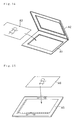
- Fig. 14 shows a holder-type device that has a lower frame A1 and an upper frame A2 which can be freely closed and opened to enable an original A3, such as a film, to be interposed between the lower frame A1 and the upper frame A2.
- Fig. 15 shows a tray-type device that has a transparent glass plate A5 to which an original A6 is stuck.
- the holder-type devices are generally used for scanners having a smaller scanning area, while the tray-type devices are suitable for those having a greater scanning area.
- the tray-type devices are also preferable for reading a plurality of originals concurrently. In this case, a plurality of originals A6a, A6b,... are applied on the glass plate A5 by a tape or the like as shown in Fig. 16.
- the conventional tray-type original holder device for holding a plurality of originals has the following problems; that is, it is rather difficult to appropriately position the originals and adjust the angles thereof, and the procedure of applying the originals with a tape is labor- and time-consuming. Namely the procedure of applying originals on the glass plate worsens the whole working efficiency.
- the object of the present invention is thus to simplify a procedure of positioning originals and adjusting angles thereof as well as setting originals, thereby improving the whole working efficiency.
- an original holder device applicable for a flat bed-type image reading apparatus that reads an image set in a planar arrangement.
- the original holder device of the present invention includes: an original holder for holding an original; and a base member having a plurality of openings arranged in a plane to receive the original holder.
- an original holder with an original held therein are set in the respective openings of the base member.
- This structure does not require any time-consuming process of positioning the original and adjusting the angles thereof.
- the structure of the invention does not require any specific operation for applying the original, but simply sets the original in the original holder. This improves the working efficiency for setting an original in the original holder device.
- each opening preferably has a depressed step part, on which the original holder is mounted, and a click part made of a resilient material for securely holding and supporting the original holder.
- the original holder may has a substantially square external shape.
- the substantially square external shape of the original holder enables the original holder to be set in two or more different directions into the opening of the original holder device.
- each original holder includes an identification zone representing identification information for the original set in original holder.
- This structure is hereinafter referred to as the first applicable structure.
- identification information for an original set in the original holder device is obtained by reading the identification zone arranged in each original holder.
- the original holder preferably has a substantially square external shape and includes a plurality of the identification zones that have a rotational symmetry by integral multiples of 90 degrees.
- the substantially square external shape of the original holder enables the original holder to be set in two or more different directions into the opening of the original holder device.
- a plurality of identification zones are symmetrically arranged at integral multiples of 90 degrees. Even when the originals are set in different directions into the respective openings, one detection unit is sufficient for detecting the plurality of identification zones to obtain the required identification information. This simplifies the structure of the image reading apparatus.
- the identification information may be expressed by existence or non-existence of a through hole made in said identification zone.
- the identification information preferably represents a direction of each original set in the original holder device.
- This structure is hereinafter referred to as the second applicable structure.
- the present invention is also directed to an image reading apparatus for receiving an original holder device of the basic structure.
- the image reading apparatus of the invention includes: first scanning means for sequentially reading originals held by originals holders set in the original holder device in an optical manner with a first resolution; display means for displaying images on a screen; first display control means for enabling images of the originals read by the first scanning means to be all displayed on the screen of the display means; selection means for selecting one original image among all the original images displayed on the screen of the display means in response to a use's operation; second scanning means for optically reading an original held by the original holder corresponding to the selected original image with a second resolution that is higher than the first resolution; and second display control means for enabling an image of the original read by the second scanning means to be displayed on the screen of the display means.
- the first display control means enables images for all the original holders set in the original holder device to be displayed on the screen of the display means with a low resolution.
- the second display control means enables an image of the original corresponding to the selected original image to be displayed on the screen of the display means with a high resolution.
- the images displayed by the first display control means are read by the first scanning means, whereas the image displayed by the second display control means is read by the second scanning means.
- the former corresponds to a rough scan, and the latter to a main scan.
- an cage reading apparatus for receiving an original holder device of the first applicable structure includes: scanning means for sequentially reading originals held by originals holders set in the original holder device in an optical manner as well as for optically reading the identification zone; and means for discriminating each image of said original read by said scanning means, based on the identification information of said identification zone read by said scanning means.
- This structure allows the scanning means to read images of the original as well as the identification information on the original. This further simplifies the structure of the image reading apparatus.
- an image reading apparatus for receiving an original holder device of the second applicable structure includes: scanning means for sequentially reading originals held by originals holders set in the original holder device in an optical manner as well as for optically reading the identification Zone; and means for changing direction of each image of the original read by the scanning means to an upright orientation, based on the identification information read by the scanning means.
- This structure allows the scanning means to read images of the originals as well as the identification information on the originals, and changes the direction of each original image read by the scanning means to an upright orientation in accordance with the identification information. This enables the image of the original to be consistently displayed upright, irrespective of the direction of setting the original into the opening of the original holder device.
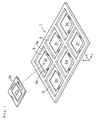
- Fig. 1 is a perspective view illustrating an original holder device in accordance with one embodiment of the present invention.
- the original holder device includes an original tray 1 and a plurality of original holders 10 set in the original tray 1.
- the original tray 1 has a rectangular plate-like framework having first through sixth openings 3a, 3b, 3c, 3d, 3e, and 3f formed therein.
- the first through the sixth openings 3a through 3f have an identical shape and configuration and respectively receive the original holders 10 therein.
- the original tray 1 is typically composed of an acrylic resin.
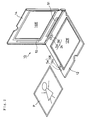
- Fig. 2 is a perspective view showing the appearance of the original holder 10 in an open state
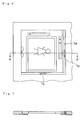
- Figs. 3A-3C are plan, front and side views illustrating the appearance of the original holder 10 in a closed state.
- each original holder 10 includes a lower frame 12 and an upper frame 14 which can be freely opened and closed. Windows 12W and 14W are formed inside the respective frames 12 and 14.
- An original P is placed between the lower frame 12 and the upper frame 14 of the original holder 10 to be observable through the windows 12W and 14W, while the periphery of the original P is securely held between the lower frame 12 and the upper frame 14.
- Both the lower frame 12 and the upper frame 14 are typically made of an acrylic resin.
- the original holder 10 in the closed state has a substantially square external shape.
- the frame work 12 of the original holder 10 has a first identification hole unit 24 and a second identification hole unit 26 that are used for identifying the direction of the original holder 10 set into the original tray 1 and the type of the original P held by the original holder 10.
- the first identification hole unit 24 and the second identification hole unit 26 are arranged at symmetrical positions when the original holder 10 is rotated by 90 degrees around a central axis perpendicular to the surface of the original holder 10.
- Each of the identification hole units 24 and 26 has two different aperture zones Sa and Sb as shown in Fig. 2.
- the first aperture zone Sa near a click 7a in each opening 3a-3f represents the direction of the original holder 10 in the original tray 1.
- the side of the first identification hole unit 24 of the original holder 10 is at the front when the original tray 1 is inserted into a scanner in the longitudinal direction of the original tray 1 (that is, the direction x in Fig. 1).
- the second aperture zone Sb represents the type of the original P held by the original holder 10. In case that an aperture is formed in the second aperture zone Sb, this represents a film original of 4" ⁇ 5" in size. In case that no aperture is formed in the second aperture zone Sb, on the other hand, this represents six 35mm-film originals.
- the first identification hole unit 24 has apertures formed in both the first aperture zone Sa and the second aperture zone Sb, while the second identification hole unit 26 has an aperture formed only in the second aperture zone Sb.
- a plurality of apertures may be formed in each of the first and second aperture zones Sa and Sb.
- the identification information that is, the direction of the original holder 10 set into the original tray 1 and the type of the original P held by the original holder 10
- the arrangement of a plurality of apertures coded in accordance with the combination of the apertures may be expressed by the arrangement of a plurality of apertures coded in accordance with the combination of the apertures.
- the upper frame 14 has transparent slits 51 and 53 that enable a scanner to read identification information represented by the first identification hole unit 24 and the second identification hole unit 26 in an optical manner while the upper frame 14 and the lower frame 12 are in the closed state.
- the following describes a typical procedure of setting the original P into the original holder 10 thus constructed. While the upper frame 14 of the original holder 10 is open, the original P is placed along a step at the periphery of the window 12W of the lower frame 12. At this moment, the original P is placed in such a manner that the top edge of the original P is set on the side of the first identification hole unit 24, that is, on the side of the axis along which the lower frame 12 and the upper frame 14 are joined with each other. The upper frame 14 is then closed. This procedure enables the original P to be set in a fixed direction relative to the original holder 10.
- Fig. 4 is a plan view illustrating the original tray 1.
- the first through the sixth openings 3a through 3f formed in the original tray 1 respectively have depressed, stepped parts 5.
- Each stepped part 5 has a substantially square shape and makes the area of each opening on its rear or bottom side smaller than the area of the opening on its front or upper side, so as to enable the original holder 10 therein.
- Each of the first through the sixth openings 3a through 3f has two clicks 7a and 7b as shown in Fig. 5.
- the clicks 7a and 7b are formed integrally with the main body of the original tray 1 and composed of the same acrylic resin to have a resilient force. Referring to the plan view of Fig. 6 and the cross sectional view of Fig. 7 taken on the line A-A', the clicks 7a and 7b press the original holder 10 received in each of the openings 3a through 3f from two different directions.
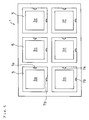
- Fig. 8 is a plan view illustrating the original tray 1, wherein original holders are set in all the first through the sixth openings 3a through 3f of the original tray 1.
- original holders there are various types of original holders: those for holding only one original as shown in the left column of the drawing (that is, the original holders 10 discussed above); those for holding two originals as shown in the central column of the drawing; and those for holding three or more originals as shown in the right column of the drawing.
- the original holders of any type have a substantially square external shape and enable originals to be readily set in the openings of the original holders.
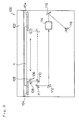
- Fig. 9 is a side view schematically illustrating an internal structure of the flat bed-type scanner 100.
- the flat bed-type scanner 100 has a cover 102. After the cover 102 is opened, the original tray 1 is placed face downward on a tray table 104.
- a scanning head 106 is arranged below the original tray 1 set at the predetermined position.
- the scanning head 106 includes two fluorescent lamps 108 and 109 working as a light source for irradiating the original tray 1 with rays.
- the rays emitted from the fluorescent lamps 108 and 109 are reflected by the original P that is held by the original holder 10 set in the original tray 1, and enter line CCDs (charge-coupled devices) 118 with RGB filters via folded mirrors 110 to 112, a lens 114, and another folded mirror 116 to be converted to electrical signals.
- the image of the original P on the original tray 1 is accordingly captured as multi-tone electrical signals.
- the line CCDs 118 not only receive the image of the original P but optically read the arrangement of the apertures in the first identification hole unit 24 (or alternatively the second identification hole unit 26) of the original holder 10 set in the original tray 1.
- the line CCDs captures an image in a primary scanning direction while the scanning head 106 moves in a secondary scanning direction.
- identification information represented by the first identification hole units 24 (or alternatively the second identification hole units 26) of the two original holders 10 in the left column of the drawing are read by the line CCDs 118.
- the flat bed-type scanner 100 includes a CPU 151, a bus line 153, and the following constituents connected to the CPU 151 via the bus line 153:
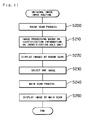
- the CPU 151 of the flat bed-type scanner 100 executes an original image input routine shown in the flowchart of Fig. 11.
- the CPU 151 When the program enters the original image input routine of Fig. 11, the CPU 151 first carries out a rough scan process, that is, scans originals set in the original tray 1 with a low resolution, at step S200.
- the rough scan process is implemented automatically. While the scanning head 106 moves in the secondary scanning direction from the position y1 to the position y2 and then to the position y3, the identification hole unit reading element 177 reads the first identification hole unit 24 (or alternatively the second identification hole unit 26) of each original holder 10 set in the original tray.
- the CPU 151 determines the type of the original held by each original holder, based on the identification information of the identification hole unit 24 or 26, and detects the positions where the originals exist.
- the positions of the originals set in the respective original holders 10 can be detected according to the types of the originals thus determined, since the number of originals and their positions are determined in advance corresponding to each type of the original.
- the CPU 151 then drives the scanning head 106 via the secondary scanning control unit 179 according to the results of detection, and scans the originals held by the respective original holders with a low resolution.
- the CPU 151 determines the direction of setting the original holders 10 based on the identification information of the identification hole unit 24 or 26, and carries out image processing, that is, changes the directions of the images corresponding to the respective original holders 10 read by the rough scan process to an upright orientation.
- the original P set in the original holder 10 is arranged in a fixed direction relative to the original holder 10.
- the determination of the direction, in which each original holder 10 is set, based on the identification information of the identification hole units 24 and 26 determines the direction of the original P in the original tray 1.
- the image of each original P read by the rough scan process is rotated according to the requirement, based on the direction of the original P thus determined. This procedure enables all the images of the originals set in the respective original holders 10 to be arranged in an upright orientation.
- the program then proceeds to step S220, at which the processed images are all displayed on the CRT display 159.
- the CPU 151 determines that the image which has been read by the rough scan process and is located in the first opening 3a is arranged in an upright orientation. In this state, the image is directly displayed on the CRT display 159 without any rotational motion.
- the original holder 10 is set in the second opening 3b of the original tray 1 to make the second identification hole unit 26 thereof located at the position y1 in the secondary scanning direction as shown in Fig.
- the CPU 151 determines that the image which has been read by the rough scan process and is located in the second opening 3b is arranged at an angle of 90 degrees in the clockwise direction. In this state, the image is rotated counterclockwise by the angle of 90 degrees and then displayed on the CRT display 159.
- Fig. 12 shows an example of a display on the screen of the CRT display 159 after the processing of step S220.
- all the images of the originals held by the original holders 10 set in the original tray 1 are displayed in an upright orientation.
- the respective images have relatively low resolutions and enable the operator to roughly understand the images.
- the CRT 151 carries out a main scan process for the selected image at step S240.
- the main scan process scans and reads the original held by the original holder 10 corresponding to the selected image with a high resolution.
- the image obtained by the main scan process is then shown on the CRT display 159 at step S250.
- the image obtained by the main scan process is also rotated according to the requirement, so that the image of the selected original P is arranged in an upright orientation.
- Fig. 13 shows an example of a display on the screen of the CRT display 159 after the processing of step S250. Each selected image is enlarged and displayed in an upright orientation with a high resolution.
- the program then goes to END and exits from this routine.
- the selected image is enlarged on the screen of the CRT display 159 after the processing of step S230. This enables the operator to give a required instruction for the set-up operation, such as trimming, with respect to the selected image.
- the program proceeds to the main scan process of step S240.
- the original image input routine discussed above reads the information on the first and the second identification hole units 24 and 26 of the original holders 10 set in the original tray 1, so as to automatically determine the types of the originals and their positions and setting directions for all the originals held in the original tray 1. Only one rough scan accordingly obtains the required information on the originals, and automatically reads the originals on the specific setting conditions in accordance with the information thus obtained. Compared with the conventional structure that requires a rough scan for each image after a rough scan on the whole original tray, the structure of the embodiment simplifies the procedure of image input.
- the original holders 10 with the originals P held therein are set in the respective openings 3a through 3f of the original tray 1.
- This structure does not require any time-consuming process of positioning the originals and adjusting the angles thereof.
- the structure of the embodiment does not require any specific operation for applying the originals on the glass plate, but simply sets each original P in the original holder 10. This improves the working efficiency for setting a plurality of originals in the original holder device.
- Each original holder 10 of the embodiment has a substantially square external shape, which allows the direction of the original to be freely determined when the original is set in any of the first through the sixth openings 3a through 3f.
- the original holder device of the embodiment has the plurality of identification hole units 24 and 26 that are symmetrical at the integral multiples of 90 degrees. Even when the originals are set in different directions into the respective openings, one detection unit (that corresponds to the scanning system for reading the image in the above embodiment) is sufficient for detecting the plurality of identification hole units 24 and 26. This further simplifies the structure of the flat bed-type scanner 100.
- the identification information of the identification hole units 24 and 26 is optically read by the scanning system that scans the image of the original P.
- the identification information may, however, be read in a different may.
- pins may be formed on the original tray 1 to mechanically read the arrangement of the apertures in the identification hole units 24 and 26.
- the original P is set in a fixed direction relative to the original holder 10.
- the original P may be set to the original holder 10 in the direction that is determined according to the type of the original. This alternative structure is described briefly.
- the originals in rectangular shape include those having images of an upright orientation along the width and those having images of an upright orientation along the length.
- the original P is set into the original holder 10 in the state shown in Fig. 2, that is, in the manner that makes the top side of the original P close to one identification hole unit (for example, the first identification hole unit 24).
- the original P is set into the original holder 10 in the manner that makes the top side of the original P close to the other identification hole unit (for example, the second identification hole unit 26).
- Each original holder 10 is then set into the original tray 1 in the manner that makes the top side and the bottom side of each original P in the original holder 10 perpendicular to the primary scanning direction and enables the top side of the original P to be scanned first in the secondary scanning direction by the flat bed-type scanner 100. This corresponds to the direction 'x' in the drawing of Fig. 1.
- This structure enables the image of each original set on the original tray 1 to be scanned consistently in an upright orientation.
- the arrangement of the first identification hole unit 24 or the second identification hole unit 26 read for each original holder 10 is used to identify whether the original P in the original holder 10 has images of an upright orientation along the length or along the width. Based on this identification, the image of the original P in each original holder 10 is scanned along the length or along the width. This results in displaying images of the scanned area in an upright orientation.
Landscapes
- Physics & Mathematics (AREA)
- General Physics & Mathematics (AREA)
- Engineering & Computer Science (AREA)
- Multimedia (AREA)
- Signal Processing (AREA)
- Facsimile Scanning Arrangements (AREA)
- Facsimiles In General (AREA)
- Holders For Sensitive Materials And Originals (AREA)
Applications Claiming Priority (4)
| Application Number | Priority Date | Filing Date | Title |
|---|---|---|---|
| JP2048896 | 1996-01-10 | ||
| JP20488/96 | 1996-01-10 | ||
| JP8353525A JPH09252381A (ja) | 1996-01-10 | 1996-12-16 | 原稿載置装置および画像読取装置 |
| JP353525/96 | 1996-12-16 |
Publications (2)
| Publication Number | Publication Date |
|---|---|
| EP0786688A2 true EP0786688A2 (fr) | 1997-07-30 |
| EP0786688A3 EP0786688A3 (fr) | 1997-10-15 |
Family
ID=26357451
Family Applications (1)
| Application Number | Title | Priority Date | Filing Date |
|---|---|---|---|
| EP97100199A Withdrawn EP0786688A3 (fr) | 1996-01-10 | 1997-01-08 | Support pour cadres de diapositives et dispositif pour leur lecture |
Country Status (2)
| Country | Link |
|---|---|
| EP (1) | EP0786688A3 (fr) |
| JP (1) | JPH09252381A (fr) |
Cited By (13)
| Publication number | Priority date | Publication date | Assignee | Title |
|---|---|---|---|---|
| AU711331B2 (en) * | 1995-06-05 | 1999-10-14 | Canon Kabushiki Kaisha | Image positioning system |
| EP0961471A3 (fr) * | 1998-05-27 | 2001-08-22 | Eastman Kodak Company | Masque pour la numérisation de film de petit format |
| WO2002061670A1 (fr) * | 2001-01-31 | 2002-08-08 | Siemens Aktiengesellschaft | Procede et systeme de traitement d'informations representees sur des supports d'informations |
| WO2002082179A1 (fr) * | 2001-04-03 | 2002-10-17 | Pikselitehdas Oy | Support d'archivage |
| GB2379573A (en) * | 2001-07-24 | 2003-03-12 | Hewlett Packard Co | Scanner transparency adapter |
| US6678075B1 (en) * | 2000-06-07 | 2004-01-13 | Mustek Systems Inc. | Slide securing device for flatbed scanning system |
| GB2395389A (en) * | 2002-10-18 | 2004-05-19 | Hewlett Packard Development Co | Image scanner with repeated scan of zoomed image area. |
| WO2008057747A1 (fr) * | 2006-10-27 | 2008-05-15 | Hewlett-Packard Development Company, L.P. | Modèle pour transparent avec repères de cadre pour alignement de balayages multiples permettant d'éliminer des rayures et autres imperfections |
| DE102010007530A1 (de) * | 2010-02-11 | 2011-08-11 | ROTH + WEBER GmbH, 57520 | Vorrichtung zum Reproduzieren von auf Vorlagen befindlichen Abbildungen |
| US8102457B1 (en) | 1997-07-09 | 2012-01-24 | Flashpoint Technology, Inc. | Method and apparatus for correcting aspect ratio in a camera graphical user interface |
| US8127232B2 (en) | 1998-12-31 | 2012-02-28 | Flashpoint Technology, Inc. | Method and apparatus for editing heterogeneous media objects in a digital imaging device |
| US9224145B1 (en) | 2006-08-30 | 2015-12-29 | Qurio Holdings, Inc. | Venue based digital rights using capture device with digital watermarking capability |
| CN109656018A (zh) * | 2018-12-17 | 2019-04-19 | 中国科学院长春光学精密机械与物理研究所 | 一种阵列式光学器件及其安装支架 |
Families Citing this family (1)
| Publication number | Priority date | Publication date | Assignee | Title |
|---|---|---|---|---|
| JP3665210B2 (ja) * | 1998-12-04 | 2005-06-29 | 大日本スクリーン製造株式会社 | 画像入力システム |
Family Cites Families (5)
| Publication number | Priority date | Publication date | Assignee | Title |
|---|---|---|---|---|
| GB963654A (en) * | 1962-05-15 | 1964-07-15 | Maurice David Mindel | Improvements in or relating to mounts for colour transparencies |
| DE3314437A1 (de) * | 1983-04-21 | 1984-10-25 | Agfa-Gevaert Ag, 5090 Leverkusen | Verfahren zur abtastung der bildlage von dia-filmbildern |
| NL8400180A (nl) * | 1984-01-19 | 1985-08-16 | Wouden & Partners B V V D | Projektiehouder. |
| US4652733A (en) * | 1984-10-15 | 1987-03-24 | At&T Company | Technique for cataloging pictorial and/or written database information on video tape or disk |
| JP2522743B2 (ja) * | 1992-06-09 | 1996-08-07 | スライデックス株式会社 | 画像フィルムを透視可能に収納するフィルム収納シ―ト |
-
1996
- 1996-12-16 JP JP8353525A patent/JPH09252381A/ja active Pending
-
1997
- 1997-01-08 EP EP97100199A patent/EP0786688A3/fr not_active Withdrawn
Non-Patent Citations (1)
| Title |
|---|
| None |
Cited By (20)
| Publication number | Priority date | Publication date | Assignee | Title |
|---|---|---|---|---|
| AU711331B2 (en) * | 1995-06-05 | 1999-10-14 | Canon Kabushiki Kaisha | Image positioning system |
| US8970761B2 (en) | 1997-07-09 | 2015-03-03 | Flashpoint Technology, Inc. | Method and apparatus for correcting aspect ratio in a camera graphical user interface |
| US8102457B1 (en) | 1997-07-09 | 2012-01-24 | Flashpoint Technology, Inc. | Method and apparatus for correcting aspect ratio in a camera graphical user interface |
| EP0961471A3 (fr) * | 1998-05-27 | 2001-08-22 | Eastman Kodak Company | Masque pour la numérisation de film de petit format |
| US8972867B1 (en) | 1998-12-31 | 2015-03-03 | Flashpoint Technology, Inc. | Method and apparatus for editing heterogeneous media objects in a digital imaging device |
| US8127232B2 (en) | 1998-12-31 | 2012-02-28 | Flashpoint Technology, Inc. | Method and apparatus for editing heterogeneous media objects in a digital imaging device |
| US6678075B1 (en) * | 2000-06-07 | 2004-01-13 | Mustek Systems Inc. | Slide securing device for flatbed scanning system |
| USRE42823E1 (en) | 2000-06-07 | 2011-10-11 | Transpacific Optics Llc | Slide securing device for flatbed scanning sysem |
| WO2002061670A1 (fr) * | 2001-01-31 | 2002-08-08 | Siemens Aktiengesellschaft | Procede et systeme de traitement d'informations representees sur des supports d'informations |
| WO2002082179A1 (fr) * | 2001-04-03 | 2002-10-17 | Pikselitehdas Oy | Support d'archivage |
| GB2379573A (en) * | 2001-07-24 | 2003-03-12 | Hewlett Packard Co | Scanner transparency adapter |
| US6989918B2 (en) | 2001-07-24 | 2006-01-24 | Hewlett-Packard Development Company, L.P. | Transparency adapter with light table |
| GB2379573B (en) * | 2001-07-24 | 2005-06-29 | Hewlett Packard Co | Transparency adapter with light table |
| GB2395389B (en) * | 2002-10-18 | 2006-02-01 | Hewlett Packard Development Co | Imaging system and method |
| GB2395389A (en) * | 2002-10-18 | 2004-05-19 | Hewlett Packard Development Co | Image scanner with repeated scan of zoomed image area. |
| US9224145B1 (en) | 2006-08-30 | 2015-12-29 | Qurio Holdings, Inc. | Venue based digital rights using capture device with digital watermarking capability |
| WO2008057747A1 (fr) * | 2006-10-27 | 2008-05-15 | Hewlett-Packard Development Company, L.P. | Modèle pour transparent avec repères de cadre pour alignement de balayages multiples permettant d'éliminer des rayures et autres imperfections |
| US8964272B2 (en) | 2006-10-27 | 2015-02-24 | Hewlett-Packard Development Company, L.P. | Transparency template |
| DE102010007530A1 (de) * | 2010-02-11 | 2011-08-11 | ROTH + WEBER GmbH, 57520 | Vorrichtung zum Reproduzieren von auf Vorlagen befindlichen Abbildungen |
| CN109656018A (zh) * | 2018-12-17 | 2019-04-19 | 中国科学院长春光学精密机械与物理研究所 | 一种阵列式光学器件及其安装支架 |
Also Published As
| Publication number | Publication date |
|---|---|
| EP0786688A3 (fr) | 1997-10-15 |
| JPH09252381A (ja) | 1997-09-22 |
Similar Documents
| Publication | Publication Date | Title |
|---|---|---|
| EP0786688A2 (fr) | Support pour cadres de diapositives et dispositif pour leur lecture | |
| US20020130979A1 (en) | Projection-type display device and software program | |
| JPH08154154A (ja) | 画像読み取り装置 | |
| US5708515A (en) | Image information processing apparatus including area image sensor operable as electronic camera and image scanner | |
| JP2735697B2 (ja) | 画像入力装置 | |
| US7310172B2 (en) | Adapter for viewing and scanning images residing on transparent media | |
| US6842265B1 (en) | Method and apparatus for controlling image orientation of scanner apparatus | |
| JP2633850B2 (ja) | 入力画像の色分解走査の方法および装置 | |
| JPH08204914A (ja) | イメージスキャナとその画像読込み方法 | |
| JPH07193690A (ja) | 画像読取装置 | |
| JPH10262147A (ja) | 画像読取り装置 | |
| JPH01229559A (ja) | 原稿読取装置 | |
| JP3541137B2 (ja) | 画像分割入力方法 | |
| JPH06309427A (ja) | 画像入力編集装置 | |
| JP3665210B2 (ja) | 画像入力システム | |
| JP2025170516A (ja) | 文書読取装置および読取アタッチメント | |
| JPH0433189B2 (fr) | ||
| JP2868703B2 (ja) | 原稿保持装置 | |
| US6778261B2 (en) | Film fixing instrument | |
| JPH10341319A (ja) | 画像読取装置 | |
| JPH0681217B2 (ja) | 画像読取装置 | |
| JP3078348U (ja) | 書画カメラ内蔵液晶プロジェクタ用原稿台アダプタ | |
| JP2911134B2 (ja) | 原稿読取装置 | |
| JP2012015700A (ja) | 原稿読取装置及び画像形成装置 | |
| JPS62293879A (ja) | 原稿サイズ自動入力方式 |
Legal Events
| Date | Code | Title | Description |
|---|---|---|---|
| PUAI | Public reference made under article 153(3) epc to a published international application that has entered the european phase |
Free format text: ORIGINAL CODE: 0009012 |
|
| AK | Designated contracting states |
Kind code of ref document: A2 Designated state(s): DE FR GB |
|
| PUAL | Search report despatched |
Free format text: ORIGINAL CODE: 0009013 |
|
| AK | Designated contracting states |
Kind code of ref document: A3 Designated state(s): DE FR GB |
|
| 17P | Request for examination filed |
Effective date: 19980115 |
|
| 17Q | First examination report despatched |
Effective date: 20000119 |
|
| STAA | Information on the status of an ep patent application or granted ep patent |
Free format text: STATUS: THE APPLICATION IS DEEMED TO BE WITHDRAWN |
|
| 18D | Application deemed to be withdrawn |
Effective date: 20000530 |