EP0786915A2 - Dispositif d'identification d'un abonné/terminal mobile - Google Patents
Dispositif d'identification d'un abonné/terminal mobile Download PDFInfo
- Publication number
- EP0786915A2 EP0786915A2 EP97300381A EP97300381A EP0786915A2 EP 0786915 A2 EP0786915 A2 EP 0786915A2 EP 97300381 A EP97300381 A EP 97300381A EP 97300381 A EP97300381 A EP 97300381A EP 0786915 A2 EP0786915 A2 EP 0786915A2
- Authority
- EP
- European Patent Office
- Prior art keywords
- mobile
- subscriber
- mobile network
- network
- chip
- Prior art date
- Legal status (The legal status is an assumption and is not a legal conclusion. Google has not performed a legal analysis and makes no representation as to the accuracy of the status listed.)
- Granted
Links
Images






Classifications
-
- H—ELECTRICITY
- H04—ELECTRIC COMMUNICATION TECHNIQUE
- H04W—WIRELESS COMMUNICATION NETWORKS
- H04W8/00—Network data management
- H04W8/18—Processing of user or subscriber data, e.g. subscribed services, user preferences or user profiles; Transfer of user or subscriber data
- H04W8/183—Processing at user equipment or user record carrier
Definitions
- the present invention relates to a subscriber / mobile terminal identifying device.
- the subscriber / mobile terminal identifying device carries in general an identification (ID) number for identifying the mobile subscriber and/or the mobile terminal and also an authentication program for authenticating the mobile subscriber and/or the mobile terminal.
- ID identification
- this identifying device there are a memory device such as a ROM (Read Only Memory) accommodated in the mobile terminal housing and a SIM (Subscriber Identity Module) which is typically an IC card with CPU, detachable from the mobile terminal body. Since the ROM is mounted and fixed in the mobile terminal housing, the subscriber number stored in the ROM will be always coupled with the mobile terminal. Whereas, according to the SIM, the subscriber number can be separated from the mobile terminal and can be carried with the mobile subscriber (card roaming).
- the SIM is mostly constituted by the IC card with CPU, whose physical standard and electrical characteristics are internationally defined, or by an IC device.
- the card roaming can be executed between the mobile networks adopting the same communication method but cannot be executed between the mobile networks adopting different communication methods such as PDC (Personal Digital Cellular) method which is Japanese standard communication method and GSM (Global System for Mobile communications) which is European standard communication method, respectively.
- PDC Personal Digital Cellular
- GSM Global System for Mobile communications
- the present invention relates to a subscriber/mobile terminal identifying device attachable to and detachable from mobile terminals, and provided with an identification number for identifying a mobile subscriber or a mobile terminal.
- the device includes a plurality of memory areas corresponding to a plurality of mobile networks adopting communication methods different from each other, respectively so that the mobile subscriber or the mobile terminal can be identified in the plurality of mobile networks.
- the same identification number for identifying the mobile subscriber or the mobile terminal is stored in all the plurality of memory areas.
- the present invention provides a subscriber/mobile terminal identifying device whereby the card roaming in mobile networks adopting a communication method different from that in the home network can be easily executed.
- the device includes an authentication program with a format belonging to a home mobile network, and a conversion program for converting the format from the format belonging to the home mobile network into a format belonging to a visited mobile network.
- the device further includes means for distinguishing a communication method adopted in a mobile network in which the mobile subscriber is locating, based upon information given from a mobile terminal to which the device is attached, and means for allowing execution of the conversion program when the distinguished communication method belongs to the visited mobile network and for inhibiting the execution of the conversion program when the distinguished communication method belongs to the home mobile network.
- the device includes a first authentication program with a format belonging to a home mobile network, and a second authentication program with a format belonging to a visited mobile network.
- the device further includes means for distinguishing a communication method adopted in a mobile network in which the mobile subscriber is locating, based upon information given from a mobile terminal to which the device is attached, and means for selecting the second authentication program when the distinguished communication method belongs to the visited mobile network and for selecting the first authentication program when the distinguished communication method belongs to the home mobile network.
- authentication of the mobile subscriber or the mobile terminal can be easily executed in the different communication method's mobile networks by means of the single subscriber/ mobile terminal identifying device.
- the plurality of memory areas are mounted in a plurality of IC devices physically separated with each other, respectively, or in a single IC device.
- the single IC device may contain a plurality of IC chips physically separated with each other and the plurality of memory areas are mounted in the plurality of IC chips, respectively, or the single IC device may contain a single IC chip and the plurality of memory areas are mounted in this IC chip.
- Fig. 1 shows a whole constitution of a communication system of an embodiment according to the present invention.
- Fig. 2 schematically shows a mechanical structure of IC devices illustrated in Fig. 1.
- Fig. 3 schematically shows a mechanical structure of the remaining IC device illustrated in Fig. 1.
- Fig. 4 shows a file configuration example of a data memory area of an IC chip illustrated in Fig. 2.
- Fig. 5 shows an another file configuration example of a data memory area of the IC chip illustrated in Fig. 2.
- Fig. 6 shows a further file configuration example of a data memory area of the IC chip illustrated in Fig. 2.
- Fig. 7 shows a file configuration example of a data memory area of the IC chip illustrated in Fig. 3.
- Fig. 8 shows a still further file configuration example of a data memory area of the IC chip illustrated in Fig. 2.
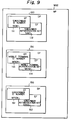
- Fig. 9 shows an another file configuration example of a data memory area of the IC chip illustrated in Fig. 2.
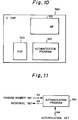
- Fig. 10 shows an example of the IC chip with the file configuration illustrated in Fig. 7.
- Fig. 11 shows an input/output structure of an authentication program illustrated in Fig. 10.
- Fig. 12 shows an input/output structure of a FCP illustrated in Fig. 10.
- Fig. 13 shows an another example of the IC chip with the file configuration illustrated in Fig. 7.
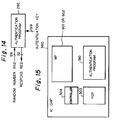
- Fig. 14 shows an input/output structure of an authentication program illustrated in Fig. 13.
- Fig. 15 shows an example of the IC chip with the file configuration illustrated in Fig. 8 or Fig. 9.
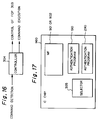
- Fig. 16 shows an input/output structure of a controller illustrated in Fig. 15.
- Fig. 17 shows an another example of the IC chip with the file configuration illustrated in Fig. 8 or Fig. 9.
- Fig. 18 shows an input/output structure of a selector illustrated in Fig. 17.
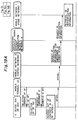
- Fig. 19 constituted by combining Figs. 19A and 19B shows an example of the identification and authentication operations at roaming by using an IC device provided with the IC chip illustrated in Fig. 10.
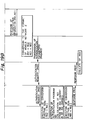
- Fig. 20 constituted by combining Figs. 20A and 20B shows an example of the identification and authentication operations at roaming by using an IC device provided with the IC chip illustrated in Fig. 15.
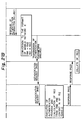
- Fig. 21 constituted by combining Figs. 21A and 21B shows an example of the identification and authentication operations at roaming by using an IC device provided with the IC chip illustrated in Fig. 17.
- reference numerals 1, 2 and N denote first, second and Nth mobile networks which respectively adopt different communication methods
- 9 denotes an interworking apparatus provided at the network side for roaming among these mobile networks adopting the different communication methods
- 10 denotes a mobile terminal using the communication method belonging to the first mobile network
- 20 denotes a mobile terminal using the communication method belonging to the second mobile network 2
- 100, 200, 300, 400 and 900 denote IC devices which are freely attachable to and detachable from the mobile terminals, respectively.
- the IC device 100 is the conventional IC device and has the specification for the communication method belonging to the first mobile network 1. This IC device 100 is utilized by a user subscribed to the first mobile network 1 when this user accesses to this first mobile network 1 or to a mobile network adopting the same communication method as that of the first mobile network 1.
- the IC device 200 is also the conventional IC device and has the specification for the communication method belonging to the second mobile network 2. This IC device 200 is utilized by a user subscribed to the second mobile network 2 when this user accesses to this second mobile network 2 or to a mobile network adopting the same communication method as that of the second mobile network 2.
- the IC device 300 is provided according to the present invention. This IC device 300 is utilized by a user subscribed to the first mobile network 1 when this user accesses (roams) to the second mobile network 2.
- the IC device 400 is also provided according to the present invention. This IC device 400 is utilized by a user subscribed to the first mobile network 1 when this user accesses to the first mobile network 1 and also when the user accesses (roams) to the second mobile network 2.
- the IC device 900 is provided according to the present invention. This IC device 900 is utilized by a user subscribed to the first mobile network 1 when this user accesses to the first mobile network 1 and also when the user accesses (roams) to the second mobile network 2.
- a subscriber / mobile terminal identifying device provided for a mobile subscriber who made a subscriber contract with the first mobile network 1 and, as an additional service, made a roaming contract with the second mobile network 2 (hereinafter called as a roaming-contracted subscriber).
- the IC device which may be typically constituted by a smart card accommodates an IC chip and its basement.
- the IC chip mainly consists of a CPU and at least one memory.
- the basement is a card type base for mounting the IC chip.
- the shape of the basement and the position for mounting the IC device on the basement are defined by the international standard (ISO-7816). However, all the IC devices for the various mobile networks will not completely correspond to ISO-7816 as in the present invention.
- the IC device is constituted by a 8 bits CPU and at least one memory with a capacity of several kilo bytes.
- the bit number and memory capacity may be optionally increased in future.
- Fig. 2 schematically shows a mechanical structure example of the IC devices 100, 200, 300 or 900 shown in Fig. 1.
- the IC devices 100, 200, 300 and 900 have IC chips 160, 260, 360 and 960 and basements 170, 270, 370 and 970, respectively.
- Fig. 3 schematically shows a mechanical structure example of the IC device 400 shown in Fig. 1.
- the IC device 400 has two IC chips 160 and 360 mounted on a common card type basement 470. Since these IC chips have the same configurations as the IC chip 160 on the IC device 100 and the IC chip 360 on the IC device 300, the same reference numerals are given, respectively. As shown in Fig. 3, these two IC chips 160 and 360 are mounted at the respective end portions on the same surface of the basement 470 so that the mounted positions of these IC chips are symmetry with respect to the center point of the basement 470.
- the IC chips 160 and 360 are mounted at the positions with the same space D 1 from the respective side edges of the basement and with the same space D 2 from the respective end edges of the basement. It is possible to mount the two IC chips 160 and 360 on the opposite surfaces of the basement 470, respectively. By inverting the inserting direction of the former IC device 400 into the mobile terminal or by turning over the inserting surface of the latter IC device 400, it is possible to commonly use these IC devices 400 for both the mobile terminals 10 and 20.
- the IC device 400 provides the similar function as that of the two IC devices 100 and 300.
- Table 1 shows the IC chips mounted on the respective IC devices.
- Table 1 IC device IC chip 100 160 200 260 300 360 400 160 and 360 900 960
- Each of the IC chips has a program memory area for storing operation programs and a data memory area for storing data.
- Typical configuration of the memory areas in the IC chip applied for the IC device is defined by the ISO and thus the following description will use the terms defined in the ISO.
- each of the memory areas in the IC chip has a multi-layered file structure constituted by a plurality of EFs (Elementary Files) for storing data, at least one DF (Dedicated File) for managing for example security information of the EFs, and a MF (Master File) for managing all the file in the IC chip.
- the one DF will generally manage the plurality of EFs.
- the DF is prepared for every application of the IC device.
- Actual file configuration of the memory areas in the IC chip mounted on the IC device will be determined, based upon this file structure, in accordance with the communication methods belonging to the first mobile network 1 and to the second mobile network 2.
- Figs. 4 and 5 show conventional file configuration examples of the data memory area of the IC chip 160 mounted on the IC device 100 which is conformed to the communication method belonging to the first mobile network 1
- Fig. 6 shows a conventional file configuration example of the data memory area of the IC chip 260 mounted on the IC device 200 which is conformed to the communication method belonging to the second mobile network 2.
- the first mobile network 1 adopts the communication method for managing both the mobile subscriber and the mobile terminal by means of IC device, such as the PDC method
- the second mobile network 2 adopts the communication method for managing only the mobile subscriber by means of the IC device, such as the GSM method.
- the IC chip 160 in the IC device 100 has EF 111 for storing a subscriber ID (identification) number SIDN1 1 , EF 112 for storing a subscriber authentication key SAK1 1 , EF 113 for storing a mobile terminal ID number MTIDN 1 and EF 114 for storing a mobile terminal authentication key MTAK 1 , which are given at the first mobile network system 1.
- the IC chip 160 also has DF 110 for managing these EFs and, MF 101 for managing all files in this IC chip 160. As shown in the example of Fig.
- the configuration of the IC chip 160 may be modified so that DF 120 manages the EF 111 for storing the subscriber ID number SIDN1 1 and the EF 112 for storing the subscriber authentication key SAK1 1 , and that DF 130 manages the EF 113 for storing the mobile terminal ID number MTIDN 1 and the EF 114 for storing the mobile terminal authentication key MTAK 1 .
- all files in the IC chip 160 are managed by MF 102.
- the IC chip 260 in the IC device 200 has EF 141 for storing a subscriber ID number SIDN2 1 and EF 142 for storing a subscriber authentication key SAK2 1 , which are given at the second mobile network system 2.
- the IC chip 260 also has DF 140 for managing these EFs and MF 201 for managing all files in this IC chip 260.
- the mobile terminal ID number MTIDN 1 for the first mobile network 1 and the subscriber ID number SIDN2 1 for the second mobile network 2 use the same data space (same memory space). Also, the subscriber authentication key SAK1 1 and the mobile terminal authentication key MTAK 1 for the first mobile network 1 have 64 bits width, and the subscriber authentication key SAK2 1 for the second mobile network 2 has 128 bits width.
- Fig. 7 shows a file configuration example of the data memory area of the IC chip 360 mounted on the IC device 300 or 400
- Figs. 8 and 9 show file configuration examples of the data memory area of the IC chip 960 mounted on the IC device 900, according to the present invention.
- the IC chip 360 in the IC device 300 or 400 has EF 151 for storing a subscriber ID number which is the same value as that of the mobile terminal ID number MTIDN 1 given at the first mobile network 1 (home network) to the roaming-contracted subscriber, and EF 152 for storing a subscriber authentication key SAK2 1 given at the second mobile network system 2.
- the IC chip 360 also has DF 150 for managing these EFs, and MF 301 for managing all files in this IC chip 360.
- a number which is the same as the mobile terminal ID number MTIDN 1 given to the roaming-contracted subscriber at the home network is stored in the memory area EF 151 as the subscriber ID number managed by the DF 150 which is conformed with the communication method in the second mobile network 2 (visited network).
- the interworking apparatus 9 having the similar function for roaming among the mobile networks adopting the different communication methods.
- An example of such interworking apparatus is described in EP application No.96112977.2 (not yet published) filed on August 13, 1996 by the same applicant as this application.
- a number obtained by modifying, in accordance with the network ID number or the country number, the subscriber ID number SIDN1 1 which is given to the roaming-contracted subscriber at the home network can be stored in the memory area EF 151 as the subscriber ID number managed by the DF 150.
- the subscriber ID number and the mobile terminal ID number will contain the country number or the manufacturer's code.
- these country number and the manufacturer's code may be omitted. In the latter case, a number which is the same as the subscriber ID number SIDN1 1 will be stored in the memory area EF 151 as the subscriber ID number managed by the DF 150.
- the subscriber authentication key SAK2 1 managed by the DF 150 can be provided by the interworking apparatus 9 or by the first mobile network 1.
- the subscriber authentication key SAK2 1 is provided based upon the subscriber authentication key SAK1 1 and the mobile terminal authentication key MTAK 1 given at first the mobile network 1.
- the IC chip 960 in the IC device 900 has the DF 110 which contains the EFs 111 to 114 shown in Fig. 4, the DF 150 which contains the EFs 151 and 152 shown in Fig. 7, and MF 901 for managing all files in this IC chip 960.
- a number which is the same as the mobile terminal ID number MTIDN 1 given to the roaming-contracted subscriber at the home network and stored in the EF 113 managed by the DF 110 is also stored in the memory area EF 151 as the subscriber ID number managed by the DF 150 which is conformed to the communication method in the second mobile network 2.
- the IC chip 960 in the IC device 900 has the DF 120 which contains the EFs 111 and 112 shown in Fig. 5, the DF 130 which contains the EFs 113 and 114 shown in Fig. 5, the DF 150 which contains the EFs 151 and 152 shown in Fig. 7, and MF 902 for managing all files in this IC chip 960.
- a number which is the same as the mobile terminal ID number MTIDN 1 given to the roaming-contracted subscriber at the home network and stored in the EF 113 managed by the DF 130 is also stored in the memory area EF 151 as the subscriber ID number managed by the DF 150 which is conformed to the communication method in the second mobile network 2.
- Fig. 10 shows an example of the IC chip 360 with respect to the IC devices 300 and 400.
- the IC chip 360 has, other than the above-mentioned MF 301, an authentication program 190 and a FCP (Format Conversion Program) 303 for executing the conversion of data format between the first and second mobile networks 1 and 2.
- FCP Form Conversion Program
- the authentication program 190 is made to execute the authentication operation in accordance with the communication method belonging to the first mobile network 1. As shown in Fig. 11, an authentication key of 64 bits width and a random number RN1 of 64 bits width are input into or selected for this authentication program 190 and a response RE1 of 64 bits width is output from the program 190.
- This authentication program 190 is the same as that in the IC chip 160.
- the FCP 303 contains, as shown in Fig. 12, a first conversion function 303a for converting a random number RN2 of 128 bits width to the random number RN1 of 64 bits width, and a second conversion function 303b for converting the response RE1 of 64 bits width to a response RE2 of 32 bits width.
- a first conversion function 303a for converting a random number RN2 of 128 bits width to the random number RN1 of 64 bits width
- a second conversion function 303b for converting the response RE1 of 64 bits width to a response RE2 of 32 bits width.
- Fig. 13 shows an another example of the IC chip 360 with respect to the IC devices 300 and 400.
- the IC chip 360 has, other than the above-mentioned MF 301, an authentication program 290.
- the authentication program 290 is made to execute the authentication operation in accordance with the communication method belonging to the second mobile network 2. As shown in Fig. 14, an authentication key of 128 bits width and a random number RN2 of 128 bits width are input into or selected for this authentication program 290 and a response RE2 of 32 bits width is output from the program 290.
- This authentication program 290 is the same as that in the IC chip 260.
- the IC chip 360 has at least one of the authentication program 190 and the authentication program 290.
- the FCP 303 is necessarily accompanied with the authentication program 190.
- Fig. 15 shows an example of the IC chip 960 with respect to the IC device 900.
- the IC chip 960 has, other than the above-mentioned MF 901 or MF 902, the authentication program 190, the FCP 303 for executing the conversion of data format between the first and second mobile networks 1 and 2, and a controller 304 for distinguishing the communication method belonging to the visited network to provide a control signal.
- the controller 304 is, as shown in Fig. 16, made to distinguish the network in which the roaming-contracted subscriber is locating from the first and second mobile networks 1 and 2 based upon the detected command provided from the mobile terminal to the IC chip 960, and to control the conversion operation of the FCP 303 in accordance with the distinguished result.
- the command used for distinction is for example the selection command of the DF, code of the authentication command, parameter(s) accompanied with the authentication command or the length of the authentication command.
- Fig. 17 shows an another example of the IC chip 960 with respect to the IC device 900.
- the IC chip 960 has, other than the above-mentioned MF 901 or MF 902, the authentication program 190, the authentication program 290, and a selector 305 for distinguishing the communication method belonging to the visited network to select one of the authentication programs 190 and 290.
- the selector 305 is, as shown in Fig. 18, made to distinguish the network in which the roaming-contracted subscriber is locating from the first and second mobile networks 1 and 2 based upon the detected command provided from the mobile terminal to the IC chip 960, and to select one of the authentication programs in accordance with the distinguished result.
- the command used for distinction is for example the selection command of the DF, code of the authentication command, parameter(s) accompanied with the authentication command or the length of the authentication command.
- Table 2 shows the aforementioned file configurations and programs in the respective IC chips 160, 260, 360 and 960.
- Table 2 IC chip file configuration program 160 MF 101 or MF 102 190 260 MF 201 290 360 MF 301 (190 + 303) or 290 960 MF 901 or MF 902 (190 + 303 + 304) or (190 + 290 + 305)
- Fig. 19 shows an example of the identification and authentication operations at roaming by using the IC device 300 or 400 with the IC chip 360 illustrated in Fig. 10.
- the roaming-contracted subscriber In order to access in the second mobile network 2 (visited network), the roaming-contracted subscriber will first mount the IC device 300 or 400 to the mobile terminal 20. Thus, the mobile terminal 20 transmits a command for selecting the DF 150 (ID of the DF 150) which is conformed to the second mobile network 2 to the IC chip 360 of the mounted IC device. As a result, the IC chip 360 actually selects the DF 150. Then, the mobile terminal 20 requests, to the IC chip 360, to get the subscriber ID number stored in the EF 151 which is managed by the DF 150.
- the subscriber ID number stored in the EF 151 which is the same as the mobile terminal ID number MTIDN 1 given to the roaming-contracted subscriber at the home network, is read out and transmitted from the IC chip 360 to the second mobile network 2 via the mobile terminal 20.
- the subscriber ID number is constituted by the country number with respect to the mobile subscriber, the network number of the home network and the subscriber number. Since the subscriber ID number MTIDN 1 is one given by the system of the first mobile network 1, the second mobile network 2 can judge, based upon its country number and network number, that this mobile subscriber is a visiting subscriber from another network.
- the second mobile network 2 presents the subscriber ID number MTIDN 1 and requests (interrogates) to obtain the authentication information with respect to this roaming-contracted subscriber to the interworking apparatus among different communication method's networks 9.
- This authentication information request has the format belonging to the second mobile network 2.
- the interworking apparatus 9 converts the format of this authentication information request accompanied with the presented subscriber ID number MTIDN 1 into the format belonging to the first mobile network 1 and then transmits it to the first mobile network 1.
- the first mobile network 1 thus retrieves an authentication information of the roaming-contracted subscriber in accordance with the presented subscriber ID number MTIDN 1 . According to this retrieval, the authentication information containing the random number RN1 and the response RE1 are obtained. Since the subscriber authentication key SAK2 1 of this roaming-contracted subscriber, used in the second mobile network 2 was decided based upon the subscriber authentication key SAK1 1 and the mobile terminal authentication key MTAK 1 used in the first mobile network 1, the first mobile network 1 can know this subscriber authentication key SAK2 1 and therefore can calculate the response RE1.
- the obtained authentication information has the format belonging to the first mobile network 1, and therefore it is necessary to convert it into the format belonging to the second mobile network 2 at the interworking apparatus 9 or at the first mobile network 1 before transmission to the second mobile network 2.
- this conversion is executed by using conversion functions in the interworking apparatus 9.
- One of the conversion functions is a function for converting the random number RN1 of 64 bits width to a random number RN2 of 128 bits width.
- This function is inverse to the first conversion function 303a in the FCP 303 shown in Fig. 12.
- the other one of the conversion functions is that for converting the response RE1 of 64 bits width to a response RE2 of 32 bits width.
- the latter function is the same as the second conversion function 303b in the FCP 303.
- the subscriber authentication parameters RN2 and RE2 thus converted to the format belonging to the second mobile network 2 are transmitted from the interworking apparatus 9 to the second mobile network 2.
- the second mobile network 2 informs the random number RN2 to the IC chip 360 via the mobile terminal 20 and instructs the IC chip 360 to execute the authentication operation.
- the first conversion function 303a in the FCP 303 converts the random number RN2 to the random number RN1 in the format belonging to the first mobile network 1.
- the converted random number RN1 is then delivered to the authentication program 190.
- the authentication program 190 calculates a response RE1 based upon the delivered random number RN1 and the subscriber authentication key SAK2 1 stored in the EF 152 which is managed by the DF 150.
- the second conversion function 303b in the FCP 303 converts the response RE1 to the response RE2 in the format belonging to the second mobile network 2.
- the calculated and converted response RE2 is transmitted to the second mobile network 2 via the mobile terminal 20.
- the transmitted response RE2 is collated with the response from the interworking apparatus 9 and accordingly the authentication of the roaming-contracted subscriber is completed.
- Fig. 20 shows an example of the identification and authentication operations at roaming by using the IC device 900 with the IC chip 960 illustrated in Fig. 15.
- the roaming-contracted subscriber In order to access in the second mobile network 2 (visited network), the roaming-contracted subscriber will first mount the IC device 900 to the mobile terminal 20. Thus, the mobile terminal 20 transmits a command for selecting the DF 150 (ID of the DF 150) which is conformed to the second mobile network 2 to the IC chip 960 of the mounted IC device.
- the controller 304 in the IC chip 960 distinguishes that the visiting network is the second mobile network 2 or the network adopting the same communication method as the second mobile network 2, and controls so that the FCP 303 executes the conversion operation. Also, the IC chip 960 selects the DF 150.
- the mobile terminal 20 requests, to the IC chip 960, to get the subscriber ID number stored in the EF 151 which is managed by the DF 150.
- the subscriber ID number stored in the EF 151 which is the same as the mobile terminal ID number MTIDN 1 given to the roaming-contracted subscriber at the home network, is read out and transmitted from the IC chip 960 to the mobile terminal 20.
- Subsequent operations of the IC chip 960 are completely the same as those of the IC chip 360 described with reference to Fig. 19.
- the mobile terminal 10 transmits a selection command for the DF 110 or for the DFs 120 and 130 to the IC chip 960.
- the controller 304 in the IC chip 960 distinguishes that this network is the first mobile network 1 or the network adopting the same communication method as the first mobile network 1, and controls so that the FCP 303 will not execute the conversion operation.
- the IC chip 960 selects the DF 110 or the DFs 120 and 130.
- the IC chip 960 can be used not only in the second mobile network 2 (visited network) but also in the first mobile network 1 (home network) in contrast with the IC chip 360.
- the controller 304 distinguishes the network in which the roaming-contracted subscriber is accessing from the first and second mobile networks 1 and 2, and controls the conversion operation of the FCP 303 in accordance with the distinguished result. If it is distinguished that the roaming-contracted subscriber is in the first mobile network 1, since the authentication program 190 can be used without conversion, the conversion operation of the FCP 303 is stopped so as to execute no conversion of the random number and the response. If it is distinguished that the roaming-contracted subscriber is visiting in the second mobile network 2, the conversion operation described with reference to Fig. 19 is executed.
- Fig. 21 shows an example of the identification and authentication operations at roaming by using the IC device 900 with the IC chip 960 illustrated in Fig. 17.
- the roaming-contracted subscriber In order to access in the second mobile network 2 (visited network), the roaming-contracted subscriber will first mount the IC device 900 to the mobile terminal 20. Thus, the mobile terminal 20 transmits a command for selecting the DF 150 (ID of the DF 150) which is conformed to the second mobile network 2 to the IC chip 960 of the mounted IC device.
- the selector 305 in the IC chip 960 distinguishes that the visiting network is the second mobile network 2 or the network adopting the same communication method as the second mobile network 2, and selects the authentication program 290. Also, the IC chip 960 selects the DF 150.
- the mobile terminal 20 requests, to the IC chip 960, to get the subscriber ID number stored in the EF 151 which is managed by the DF 150.
- the subscriber ID number stored in the EF 151 which is the same as the mobile terminal ID number MTIDN 1 given to the roaming-contracted subscriber at the home network, is read out and transmitted from the IC chip 960 to the second mobile network 2 via the mobile terminal 20.
- the subscriber ID number is constituted by the country number with respect to the mobile subscriber, the network number of the home network and the subscriber number. Since the subscriber ID number MTIDN 1 is one given by the system of the first mobile network 1, the second mobile network 2 can judge, based upon its country number and network number, that this mobile subscriber is a visiting subscriber from another network.
- the second mobile network 2 presents the subscriber ID number MTIDN 1 and requests (interrogates) to obtain the authentication information with respect to this roaming-contracted subscriber to the interworking apparatus among different communication method's networks 9.
- This authentication information request has the format belonging to the second mobile network 2.
- the interworking apparatus 9 converts the format of this authentication information request accompanied with the presented subscriber ID number MTIDN 1 into the format belonging to the first mobile network 1 and then transmits it to the first mobile network 1.
- the first mobile network 1 thus retrieves an authentication information of the roaming-contracted subscriber in accordance with the presented subscriber ID number MTIDN 1 . According to this retrieval, the authentication information containing the random number RN1 and the response RE1 are obtained. Since the subscriber authentication key SAK2 1 of this roaming-contracted subscriber, used in the second mobile network 2 was decided based upon the subscriber authentication key SAK1 1 and the mobile terminal authentication key MTAK 1 used in the first mobile network 1, the first mobile network 1 can know this subscriber authentication key SAK2 1 and therefore can calculate the response RE1.
- the obtained authentication information has the format belonging to the first mobile network 1, and therefore it is necessary to convert it into the format belonging to the second mobile network 2 at the interworking apparatus 9 or at the first mobile network 1 before transmission to the second mobile network 2.
- this conversion is executed by using conversion functions in the interworking apparatus 9.
- One of the conversion functions is a function for converting the random number RN1 of 64 bits width to a random number RN2 of 128 bits width.
- This function is inverse to the first conversion function 303a in the FCP 303 shown in Fig. 12.
- the other one of the conversion functions is that for converting the response RE1 of 64 bits width to a response RE2 of 32 bits width.
- the latter function is the same as the second conversion function 303b in the FCP 303.
- the subscriber authentication parameters RN2 and RE2 thus converted to the format belonging to the second mobile network 2 are transmitted from the interworking apparatus 9 to the second mobile network 2.
- the second mobile network 2 informs the random number RN2 to the IC chip 960 via the mobile terminal 20 and instructs the IC chip 960 to execute the authentication operation.
- the authentication program 290 calculates a response RE2 based upon the random number RN2 and the subscriber authentication key SAK2 1 stored in the EF 152 which is managed by the DF 150.
- the calculated response RE2 is transmitted to the second mobile network 2 via the mobile terminal 20.
- the transmitted response RE2 is collated with the response from the interworking apparatus 9 and accordingly the authentication of the roaming-contracted subscriber is completed.
- the mobile terminal 10 transmits a selection command for the DF 110 or for the DFs 120 and 130 to the IC chip 960.
- the selector 305 in the IC chip 960 distinguishes that this network is the first mobile network 1 or the network adopting the same communication method as the first mobile network 1, and selects the authentication program 190. Also, the IC chip 960 selects the DF 110 or the DFs 120 and 130.
- the IC chip 960 can be used not only in the second mobile network 2 (visited network) but also in the first mobile network 1 (home network) in contrast with the IC chip 360.
- the selector 305 distinguishes the network in which the roaming-contracted subscriber is accessing from the first and second mobile networks 1 and 2, and selects the authentication program in accordance with the distinguished result. If it is distinguished that the roaming-contracted subscriber is in the first mobile network 1, the authentication program 190 is selected. If it is distinguished that the roaming-contracted subscriber is visiting the second mobile network 2, the authentication program 290 is selected.
- the roaming-contracted subscriber can access to the second mobile network 2 (visited network) with the communication method different from that adopted by the first mobile network 1 (home network) without modifying the mobile terminal 20.
- identification and authentication of the subscriber and therefore roaming communication can be executed in the different communication method's mobile networks by means of a single subscriber/ mobile terminal identifying device. Also, since there is a single subscriber or mobile terminal number among the different communication method's mobile networks, data space for the ID number can be effectively utilized. Furthermore, since the difference of the communication methods is absorbed at the subscriber side by means of the subscriber/ mobile terminal identifying device, the roaming communication can be carried out without modifying the mobile terminal of the visited network.
Landscapes
- Engineering & Computer Science (AREA)
- Databases & Information Systems (AREA)
- Computer Networks & Wireless Communication (AREA)
- Signal Processing (AREA)
- Mobile Radio Communication Systems (AREA)
Applications Claiming Priority (3)
| Application Number | Priority Date | Filing Date | Title |
|---|---|---|---|
| JP27388/96 | 1996-01-23 | ||
| JP2738896 | 1996-01-23 | ||
| JP2738896 | 1996-01-23 |
Publications (3)
| Publication Number | Publication Date |
|---|---|
| EP0786915A2 true EP0786915A2 (fr) | 1997-07-30 |
| EP0786915A3 EP0786915A3 (fr) | 1998-08-05 |
| EP0786915B1 EP0786915B1 (fr) | 2004-12-29 |
Family
ID=12219683
Family Applications (1)
| Application Number | Title | Priority Date | Filing Date |
|---|---|---|---|
| EP19970300381 Expired - Lifetime EP0786915B1 (fr) | 1996-01-23 | 1997-01-21 | Dispositif d'identification d'un abonné/terminal mobile |
Country Status (2)
| Country | Link |
|---|---|
| EP (1) | EP0786915B1 (fr) |
| DE (1) | DE69732054T2 (fr) |
Cited By (12)
| Publication number | Priority date | Publication date | Assignee | Title |
|---|---|---|---|---|
| WO1999025140A1 (fr) * | 1997-11-07 | 1999-05-20 | Swisscom Ag | Carte d'identification et procede d'identification |
| WO2000038440A1 (fr) * | 1998-12-21 | 2000-06-29 | Kent Ridge Digital Labs | Reseau de communications mobiles |
| DE19923174C1 (de) * | 1999-05-20 | 2000-11-23 | Sonera Smartring Gmbh | Verfahren zur gesicherten Übermittlung von geschützten Daten |
| EP1059822A3 (fr) * | 1999-06-07 | 2001-01-17 | Nokia Mobile Phones Ltd. | Equipement mobile et réseaux permettant la sélection entre caractéristiques dépendants de la carte USIM/SIM |
| US6353641B2 (en) | 1997-07-29 | 2002-03-05 | Alcatel | Method and circuit arrangement to reduce a DC-offset |
| WO2002078380A1 (fr) * | 2001-03-26 | 2002-10-03 | Ktfreetel Co., Ltd. | Terminal cdma destine a fournir un service d'itinerance a un abonne au service gsm dans une zone de service cdma |
| WO2004030389A1 (fr) * | 2002-09-30 | 2004-04-08 | Nokia Corporation | Terminal, dispositif et procedes destines a un reseau de communications |
| DE19850306B4 (de) * | 1998-10-30 | 2005-01-13 | T-Mobile Deutschland Gmbh | Teilnehmeridentitätsmodul für Mobilfunksysteme |
| EP1590775A1 (fr) * | 2003-01-28 | 2005-11-02 | Giesecke & Devrient GmbH | Support de données |
| WO2006011038A1 (fr) * | 2004-07-19 | 2006-02-02 | Nokia Corporation | Terminal mobile, procede et progiciel permettant de stocker et d'extraire des parametres de reseau |
| US7430604B2 (en) | 2000-02-24 | 2008-09-30 | Nokia Corporation | Method and equipment for accessing a telecommunication network |
| US8184602B2 (en) | 2004-04-28 | 2012-05-22 | Nokia Corporation | System and associated terminal, method, and computer program product for configuring and updating service access points and providing service content in the mobile domain |
Families Citing this family (1)
| Publication number | Priority date | Publication date | Assignee | Title |
|---|---|---|---|---|
| EP2096884A1 (fr) | 2008-02-29 | 2009-09-02 | Koninklijke KPN N.V. | Réseau de télécommunication et procédé d'accès de réseau en fonction du temps |
Citations (1)
| Publication number | Priority date | Publication date | Assignee | Title |
|---|---|---|---|---|
| EP0673178A2 (fr) | 1994-03-17 | 1995-09-20 | Kokusai Denshin Denwa Co., Ltd | Méthode d'authentification pour communications mobiles |
Family Cites Families (2)
| Publication number | Priority date | Publication date | Assignee | Title |
|---|---|---|---|---|
| DE4118993A1 (de) * | 1991-06-08 | 1992-12-10 | Aeg Mobile Communication | Mobiltelefonanordnung |
| GB2280085A (en) * | 1993-06-25 | 1995-01-18 | Vodafone Ltd | Cellular telephone systems |
-
1997
- 1997-01-21 DE DE1997632054 patent/DE69732054T2/de not_active Expired - Fee Related
- 1997-01-21 EP EP19970300381 patent/EP0786915B1/fr not_active Expired - Lifetime
Patent Citations (1)
| Publication number | Priority date | Publication date | Assignee | Title |
|---|---|---|---|---|
| EP0673178A2 (fr) | 1994-03-17 | 1995-09-20 | Kokusai Denshin Denwa Co., Ltd | Méthode d'authentification pour communications mobiles |
Cited By (22)
| Publication number | Priority date | Publication date | Assignee | Title |
|---|---|---|---|---|
| US6353641B2 (en) | 1997-07-29 | 2002-03-05 | Alcatel | Method and circuit arrangement to reduce a DC-offset |
| US6976171B1 (en) | 1997-11-07 | 2005-12-13 | Swisscom Mobile Ag | Identification card and identification procedure |
| WO1999025140A1 (fr) * | 1997-11-07 | 1999-05-20 | Swisscom Ag | Carte d'identification et procede d'identification |
| DE19850306B4 (de) * | 1998-10-30 | 2005-01-13 | T-Mobile Deutschland Gmbh | Teilnehmeridentitätsmodul für Mobilfunksysteme |
| WO2000038440A1 (fr) * | 1998-12-21 | 2000-06-29 | Kent Ridge Digital Labs | Reseau de communications mobiles |
| DE19923174C1 (de) * | 1999-05-20 | 2000-11-23 | Sonera Smartring Gmbh | Verfahren zur gesicherten Übermittlung von geschützten Daten |
| EP1059822A3 (fr) * | 1999-06-07 | 2001-01-17 | Nokia Mobile Phones Ltd. | Equipement mobile et réseaux permettant la sélection entre caractéristiques dépendants de la carte USIM/SIM |
| US6591116B1 (en) | 1999-06-07 | 2003-07-08 | Nokia Mobile Phones Limited | Mobile equipment and networks providing selection between USIM/SIM dependent features |
| CN100393150C (zh) * | 1999-06-07 | 2008-06-04 | 诺基亚有限公司 | 在用户卡相关特性之间提供选择的移动式设备与网络 |
| US7430604B2 (en) | 2000-02-24 | 2008-09-30 | Nokia Corporation | Method and equipment for accessing a telecommunication network |
| US8095671B2 (en) | 2000-02-24 | 2012-01-10 | Nokia Corporation | Method and equipment for accessing a telecommunication network |
| US8364831B2 (en) | 2000-02-24 | 2013-01-29 | Nokia Corporation | Method and equipment for accessing a telecommunication network |
| US7043238B2 (en) | 2001-03-26 | 2006-05-09 | Ktfreetel Co., Ltd. | CDMA terminal for providing roaming service to GSM service subscriber in CDMA service area |
| WO2002078380A1 (fr) * | 2001-03-26 | 2002-10-03 | Ktfreetel Co., Ltd. | Terminal cdma destine a fournir un service d'itinerance a un abonne au service gsm dans une zone de service cdma |
| WO2004030389A1 (fr) * | 2002-09-30 | 2004-04-08 | Nokia Corporation | Terminal, dispositif et procedes destines a un reseau de communications |
| CN100413356C (zh) * | 2002-09-30 | 2008-08-20 | 诺基亚有限公司 | 用于通信网络的终端、设备及方法 |
| US10492061B2 (en) | 2002-09-30 | 2019-11-26 | Nokia Technologies Oy | Terminal, device and methods for a communication network |
| EP1590775A1 (fr) * | 2003-01-28 | 2005-11-02 | Giesecke & Devrient GmbH | Support de données |
| US8184602B2 (en) | 2004-04-28 | 2012-05-22 | Nokia Corporation | System and associated terminal, method, and computer program product for configuring and updating service access points and providing service content in the mobile domain |
| US8768326B2 (en) | 2004-04-28 | 2014-07-01 | Nokia Corporation | System and associated terminal, method, and computer program product for configuring and updating service access points and providing service content in the mobile domain |
| WO2006011038A1 (fr) * | 2004-07-19 | 2006-02-02 | Nokia Corporation | Terminal mobile, procede et progiciel permettant de stocker et d'extraire des parametres de reseau |
| US7596226B2 (en) | 2004-07-19 | 2009-09-29 | Nokia Corporation | Mobile terminal, method and computer program product for storing and retrieving network parameters |
Also Published As
| Publication number | Publication date |
|---|---|
| EP0786915A3 (fr) | 1998-08-05 |
| EP0786915B1 (fr) | 2004-12-29 |
| DE69732054T2 (de) | 2005-06-02 |
| DE69732054D1 (de) | 2005-02-03 |
Similar Documents
| Publication | Publication Date | Title |
|---|---|---|
| US8761832B2 (en) | Method and apparatus for controlling the UICC application file | |
| US6591116B1 (en) | Mobile equipment and networks providing selection between USIM/SIM dependent features | |
| EP0786915B1 (fr) | Dispositif d'identification d'un abonné/terminal mobile | |
| US6463095B1 (en) | IC card radio modem and communication system using the same for communicating with a plurality of different infrastructures | |
| WO1998024257A1 (fr) | Utilisation de deux cartes de module d'identification d'abonne avec le meme numero nris d'abonne mobile | |
| JP4195156B2 (ja) | 通信システムと端末に組み合わせた、遠隔用途アクセス用icカードと、icカードによる遠隔用途アクセス方法 | |
| KR100735341B1 (ko) | 가입자 식별 모듈의 데이터 리드 속도 개선 방법 및 장치 | |
| JP3296230B2 (ja) | 加入者/移動機識別装置 | |
| US6415160B1 (en) | Device for managing data in a mobile telephone | |
| US6275943B1 (en) | Procedure for carrying out checking functions relating to safety management in a mobile communication network and/or in a wireless local network | |
| JP3676172B2 (ja) | 移動通信システムでのデータ転送及び永久識別子処理の方法 | |
| KR100986835B1 (ko) | 대용량 스마트 카드를 이용한 개인 정보 관리 서비스 제공방법 및 장치 | |
| KR100375286B1 (ko) | 통신 장치, 통신 시스템, 통신 방법, 및 기억 매체 | |
| JP6010637B2 (ja) | スマートカードのパーソナライゼーション | |
| KR100574558B1 (ko) | 이동통신 단말기의 접속제어 방법 및 접속제어 시스템 | |
| EP0951193A2 (fr) | Procédé d'identification d'un utilisateur d'un téléphone portable dans un système de communication mobile | |
| JP7255253B2 (ja) | 電子情報記憶媒体、通信機器及び通信システム | |
| JP4109959B2 (ja) | 中継装置及びその制御方法、並びに制御プログラム及び記憶媒体 | |
| EP1675418B1 (fr) | Procédé et dispositif de commande de synchronisation de données entre l'équipement d'utilisateur et la carte d'authentification d'utilisateur | |
| KR100413220B1 (ko) | 메뉴 방식에 의해 부가 서비스 설정이 가능한 gsmsim 수용 cdma 단말기 및 그 설정 방법과, 그서비스를 제공하는 로밍 서비스 시스템 | |
| JP2022050940A (ja) | ドライバプログラム、及びトランザクション仲介方法 | |
| JP7538473B2 (ja) | 電子情報記憶媒体、情報処理方法、及びプログラム | |
| KR100951949B1 (ko) | 스마트 카드에서의 데이터베이스 관리 시스템을 이용한정보 관리 방법 및 장치 | |
| KR100957638B1 (ko) | 스마트 카드에서의 정보 관리 방법 및 장치 | |
| JP3866093B2 (ja) | 無線通信システム |
Legal Events
| Date | Code | Title | Description |
|---|---|---|---|
| PUAI | Public reference made under article 153(3) epc to a published international application that has entered the european phase |
Free format text: ORIGINAL CODE: 0009012 |
|
| 17P | Request for examination filed |
Effective date: 19970214 |
|
| AK | Designated contracting states |
Kind code of ref document: A2 Designated state(s): DE GB |
|
| PUAL | Search report despatched |
Free format text: ORIGINAL CODE: 0009013 |
|
| AK | Designated contracting states |
Kind code of ref document: A3 Designated state(s): DE GB |
|
| 17Q | First examination report despatched |
Effective date: 20030528 |
|
| GRAP | Despatch of communication of intention to grant a patent |
Free format text: ORIGINAL CODE: EPIDOSNIGR1 |
|
| GRAS | Grant fee paid |
Free format text: ORIGINAL CODE: EPIDOSNIGR3 |
|
| GRAA | (expected) grant |
Free format text: ORIGINAL CODE: 0009210 |
|
| AK | Designated contracting states |
Kind code of ref document: B1 Designated state(s): DE GB |
|
| REG | Reference to a national code |
Ref country code: GB Ref legal event code: FG4D |
|
| PGFP | Annual fee paid to national office [announced via postgrant information from national office to epo] |
Ref country code: DE Payment date: 20050115 Year of fee payment: 9 |
|
| PGFP | Annual fee paid to national office [announced via postgrant information from national office to epo] |
Ref country code: GB Payment date: 20050119 Year of fee payment: 9 |
|
| REF | Corresponds to: |
Ref document number: 69732054 Country of ref document: DE Date of ref document: 20050203 Kind code of ref document: P |
|
| PLBE | No opposition filed within time limit |
Free format text: ORIGINAL CODE: 0009261 |
|
| STAA | Information on the status of an ep patent application or granted ep patent |
Free format text: STATUS: NO OPPOSITION FILED WITHIN TIME LIMIT |
|
| 26N | No opposition filed |
Effective date: 20050930 |
|
| PG25 | Lapsed in a contracting state [announced via postgrant information from national office to epo] |
Ref country code: GB Free format text: LAPSE BECAUSE OF NON-PAYMENT OF DUE FEES Effective date: 20060121 |
|
| PG25 | Lapsed in a contracting state [announced via postgrant information from national office to epo] |
Ref country code: DE Free format text: LAPSE BECAUSE OF NON-PAYMENT OF DUE FEES Effective date: 20060801 |
|
| GBPC | Gb: european patent ceased through non-payment of renewal fee |
Effective date: 20060121 |