EP0786919A1 - Datenverarbeitungsverfahren zum effizienten Transport von Multimediapaketen über einem konventionellen digitalen Paketvermittlungsnetzwerk - Google Patents
Datenverarbeitungsverfahren zum effizienten Transport von Multimediapaketen über einem konventionellen digitalen Paketvermittlungsnetzwerk Download PDFInfo
- Publication number
- EP0786919A1 EP0786919A1 EP96480010A EP96480010A EP0786919A1 EP 0786919 A1 EP0786919 A1 EP 0786919A1 EP 96480010 A EP96480010 A EP 96480010A EP 96480010 A EP96480010 A EP 96480010A EP 0786919 A1 EP0786919 A1 EP 0786919A1
- Authority
- EP
- European Patent Office
- Prior art keywords
- atm
- trailer
- data
- payload
- length
- Prior art date
- Legal status (The legal status is an assumption and is not a legal conclusion. Google has not performed a legal analysis and makes no representation as to the accuracy of the status listed.)
- Withdrawn
Links
- 238000003672 processing method Methods 0.000 title claims abstract description 18
- 238000012546 transfer Methods 0.000 claims abstract description 8
- 238000000034 method Methods 0.000 claims description 46
- 230000008569 process Effects 0.000 claims description 20
- 230000000903 blocking effect Effects 0.000 claims description 10
- 230000006978 adaptation Effects 0.000 claims description 8
- 230000005540 biological transmission Effects 0.000 claims description 6
- 230000011218 segmentation Effects 0.000 claims description 5
- 238000012360 testing method Methods 0.000 description 20
- 230000008901 benefit Effects 0.000 description 6
- 230000008859 change Effects 0.000 description 4
- 102100024538 Cdc42 effector protein 1 Human genes 0.000 description 3
- 101000762448 Homo sapiens Cdc42 effector protein 1 Proteins 0.000 description 3
- 101000941711 Homo sapiens Centriolin Proteins 0.000 description 3
- 101100476985 Schizosaccharomyces pombe (strain 972 / ATCC 24843) sdu1 gene Proteins 0.000 description 3
- 230000006854 communication Effects 0.000 description 3
- 230000004048 modification Effects 0.000 description 3
- 238000012986 modification Methods 0.000 description 3
- 238000012545 processing Methods 0.000 description 3
- 238000004891 communication Methods 0.000 description 2
- 238000005538 encapsulation Methods 0.000 description 2
- 238000005516 engineering process Methods 0.000 description 2
- 101100011863 Arabidopsis thaliana ERD15 gene Proteins 0.000 description 1
- 101150021084 CID2 gene Proteins 0.000 description 1
- 102100024492 Cdc42 effector protein 2 Human genes 0.000 description 1
- 102000001690 Factor VIII Human genes 0.000 description 1
- 108010054218 Factor VIII Proteins 0.000 description 1
- 101000762417 Homo sapiens Cdc42 effector protein 2 Proteins 0.000 description 1
- 101000745836 Homo sapiens Centrosome-associated protein CEP250 Proteins 0.000 description 1
- 101100191082 Saccharomyces cerevisiae (strain ATCC 204508 / S288c) GLC7 gene Proteins 0.000 description 1
- 101100274406 Schizosaccharomyces pombe (strain 972 / ATCC 24843) cid1 gene Proteins 0.000 description 1
- 230000004931 aggregating effect Effects 0.000 description 1
- 230000002776 aggregation Effects 0.000 description 1
- 238000004220 aggregation Methods 0.000 description 1
- 238000004364 calculation method Methods 0.000 description 1
- 239000002131 composite material Substances 0.000 description 1
- 238000010276 construction Methods 0.000 description 1
- 230000001934 delay Effects 0.000 description 1
- 238000010586 diagram Methods 0.000 description 1
- 238000013213 extrapolation Methods 0.000 description 1
- 230000006872 improvement Effects 0.000 description 1
- 230000006855 networking Effects 0.000 description 1
- 230000035755 proliferation Effects 0.000 description 1
- 230000011664 signaling Effects 0.000 description 1
Images





Classifications
-
- H—ELECTRICITY
- H04—ELECTRIC COMMUNICATION TECHNIQUE
- H04L—TRANSMISSION OF DIGITAL INFORMATION, e.g. TELEGRAPHIC COMMUNICATION
- H04L12/00—Data switching networks
- H04L12/54—Store-and-forward switching systems
- H04L12/56—Packet switching systems
- H04L12/5601—Transfer mode dependent, e.g. ATM
-
- H—ELECTRICITY
- H04—ELECTRIC COMMUNICATION TECHNIQUE
- H04Q—SELECTING
- H04Q11/00—Selecting arrangements for multiplex systems
- H04Q11/04—Selecting arrangements for multiplex systems for time-division multiplexing
- H04Q11/0428—Integrated services digital network, i.e. systems for transmission of different types of digitised signals, e.g. speech, data, telecentral, television signals
- H04Q11/0478—Provisions for broadband connections
-
- H—ELECTRICITY
- H04—ELECTRIC COMMUNICATION TECHNIQUE
- H04L—TRANSMISSION OF DIGITAL INFORMATION, e.g. TELEGRAPHIC COMMUNICATION
- H04L12/00—Data switching networks
- H04L12/54—Store-and-forward switching systems
- H04L12/56—Packet switching systems
- H04L12/5601—Transfer mode dependent, e.g. ATM
- H04L2012/5638—Services, e.g. multimedia, GOS, QOS
- H04L2012/5646—Cell characteristics, e.g. loss, delay, jitter, sequence integrity
- H04L2012/5652—Cell construction, e.g. including header, packetisation, depacketisation, assembly, reassembly
Definitions
- This invention deals with digital networks and more particularly with a data processing method for efficiently transporting fixed or variable length multimedia data packets over packet switching networks.
- B-ISDN Broadband Integrated Services Digital Network
- bit packets may either be of fixed length (like in the so-called Asynchronous Transfer Mode (ATM) where the packets, also called cells, are all of a conventional fixed length), or be variable length.
- ATM Asynchronous Transfer Mode
- the basic advantage of packet switching techniques over circuit switching techniques is to allow a statistical multiplexing of different types of data over a link, which optimizes the transmission bandwidth.
- the present invention shall try to keep this advantage under various circumstances.
- packet switching techniques including Frame Relay
- ATM does handle all the different kinds of communication traffic, including voice, data, image, video, high quality sound and many others, and it can be used in both the LAN (Local Area Network) and the WAN (Wide Area Network) network environments.
- LAN Local Area Network
- WAN Wide Area Network
- ATM does not handle voice as efficiently as does an isochronous network, it does not either handle video as easily as isochronous transfer does, it may not always handle data as effectively or efficiently as a Packet Transfer Mode or Frame Relay system do, and it is likely to be problematic in any high error rate environment, but it however offers a tremendous advantage over other networks since it enables combining all these kind of multimedia data for transport over the same network. This means that instead of having a proliferation of many specialized kinds of equipment for different functions we can have a single type of equipment and network which will do everything.
- VC virtual channels
- the cell header contains an identifier that links the cell to the correct path towards its destination. Cells on a particular virtual channel always follow the same path through the network and are delivered to the destination in the same order in which they are received.
- ATM is designated so that simple hardware based logic elements may be employed at each node to perform the switching.
- AAL ATM Adaptation Layer
- the ATM cell switching network only checks cell headers for errors and simply discards cells in error.
- the adaptation function AAL is external to the switching network and depends somewhat on the type of traffic, but for data traffic it usually checks for errors in data frames received and in case of error found, then it discards the whole frame. At no time does the ATM network attempt to recover from errors by the re-transmission of information.
- This function is up to the end user devices and depends on the type of traffic being carried and the adaptation layer being used. For instance, end user equipments have been specified for recovering discarded voice data through so-called interpolation/ extrapolation techniques.
- ATM Asynchronous Transfer Mode
- PBX Private Branch Exchange
- GSM Global System for Mobile
- the data packets to be transported over ATM cells (a 48 data bytes long payload + a 5 bytes long header) shall bear 32 bytes or 20 bytes payload data. Therefore, one data packet provided to the ATM network port would not fill-up an ATM cell payload field.
- AAL ATM Adapter Layer
- the current International Telecommunication Union (ITU) standards do not specifically address the problem of aggregating composite short packets which could be of variable length, within an ATM cell in such a manner that the ATM Adaptation Layer at the receiving end of the network can easily retreive the individual packets from the incoming ATM cell stream.
- ITU International Telecommunication Union
- One object of this invention is to provide a data processing method for efficiently transporting fixed or variable length multimedia data packets over a digital packet switching network.
- Another object of this invention is to provide a data processing method for transporting fixed or variable length data packets, provided either directly or through so-called Access Networks, over an ATM network, by efficiently feeding said data packets into conventional ATM cells.
- Another object of this invention is to provide a data processing method for transporting fixed or variable length data packets into conventional ATM cells with minimum delay.
- a further object of this invention is to minimize delays and optimize the bandwidth exploitation by enabling to vehiculate user data packets by using either so-called blocking techniques or so-called multiplexing techniques, or both, on the same network.
- Still another object of the invention is to provide a method for efficiently transporting fixed or variable length data packets over an ATM network based on applying the standardized ATM Adapter Layer type 5 (AAL5) and therefore fitting to currently existing ATM network hardware.
- AAL5 ATM Adapter Layer type 5
- This invention provides a data processing method for efficiently transporting multimedia packets of fixed and/or variable length over a digital packet switching network made to vehiculate fixed length packets, said method including, on the transmit side, concatenating said multimedia data packets, issued from one or several users, and appending said concatenated data packets with a subheader or trailer which trailer concatenates User Channel Identifications (CIDs) and User Data Length(s) (UDLs) values of the respective concatenated data packets, whereby a global payload is defined, for being transported over the network.
- CIDs User Channel Identifications
- UDLs User Data Length
- FIG. 1 represents an ATM network wherein the invention could be implemented.
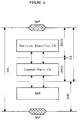
- FIG. 2 is a presentation of the layer structure of the ATM Adapter layer 5 as defined in the International Telecommunications Union (ITU) Standards applied by the invention.
- ITU International Telecommunications Union
- Figure 3 is the CPCS-PDU format for the AAL Type 5.
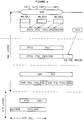
- Figure 4 is a schematic representation of the invention method as applied in accordance with the Standards (Functional model for the AAL type 5).
- Figure 5 is a schematic representation of the format of the CPCS layer payload in accordance with the invention.
- Figure 6 (including Fig.6A and 6B) and Figure 7 are flowcharts for implementing the invention on the transmit side of an ATM network.
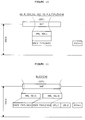
- Figure 8 is a representation of the International Telecommunications Standard Functional Mode for the AAL type 5 on the receiver's side.
- Figure 9 is a flowchart for implementing the invention on the receive side of an ATM network.
- Figures 10 through 13 are schematic representations of various combinations of user data payloads appicable to the invention.
- FIG. 1 is a block diagram representing an ATM network with attachment to conventional equipments made to vehiculate and process voice information of either GSM nature or originating in fixed stations.
- voice is just given for illustration purposes and to simplify the description of the preferred embodiment of this invention. It should by no means be considered as limiting the invention which applies equally, for instance, to multimedia including also voice or image data.
- the network of Figure 1 is represented as including three intermediate nodes labelled Node 1, Node 2 and Node 3, and at the edge of the network, two access nodes labelled Node A and Node B. These nodes are interconnected by lines or trunks labelled TK1, TK2, TK3, ...etc , in figure 1.
- a PBX(A) is attached to Access Node A while a PBX(B) is attached to Access Node B.
- Said PBXs serve n telephone sets each, which sets are labelled TA1, TA2, ..., TAn and TB1, TB2, ..., TBn respectively.
- Voice Servers functions are provided within Nodes A and B respectively to enable compressing voice data and lead to efficient bandwidth exploitation within the network.
- GSM Base Station connected to Node A, said Base Station is serving mobile stations MS1, MS2,.. and thus enabling the transportation of GSM compressed data over the ATM network as needed.
- the PBXs and GSM Base Station could be attached to the ATM network through Packet Switching Access Nodes or be attached directly (see dashed lines in figure 1).
- the data flowing within the ATM network, both through the network nodes and trunks may derive from image or video origin as well, which have not been represented in figure 1 for symplifying the drawings.
- the data are conventionally arranged into so called ATM cells, each including a 48 bytes long payload with a 5 bytes long header.
- An ATM cell is therefore of a predefined fixed length.
- the data provided to the network ports, say access Node A may be, and often are, in the form of variable length often shorter than the conventional ATM cell payload.
- Said variable length packets may have to follow several paths.
- the ATM network is organized to include several Virtual Channels (VC) over a given Virtual Path (VP) along the network trunks.
- VC Virtual Channels
- VP Virtual Path
- Data from different users each defined by a specific Channel Identification (CID) may be fed to the same Virtual Channel and therefore may be aggregated through a multiplexing operation. But one may also block multiple variable length compressed voice packets from same user.
- CID Channel Identification
- This invention reaches both goals by providing a method for organizing user data aggregation or concatenation and processing, for fitting perfectly with the International Telecommunications Union Standards as applied in the currently operating ATM networks and more particularly fitting with the ATM Adaptation Layer type 5 (AAL5).
- AAL5 ATM Adaptation Layer type 5
- AAL type 5 The structure of said AAL type 5 is represented in figure 2. This figure defines the various sublayers between two Service Access Points (SAP).
- An original Convergence Sublayer (CS) has been divided into a Service Specific Convergence Sublayer (SSCS) and a Common Part Convergence Sublayer (CPCS).
- SSCS Service Specific Convergence Sublayer
- CPCS Common Part Convergence Sublayer
- a third sublayer is defined for Segmentation and Reassembly (SAR).
- SAR Segmentation and Reassembly
- the various sublayers cooperate to provide the AAL type 5 services from top down on the sender side and from bottom to top on the receiver side. Sending shall imply segmentation while receiving implies reassembling data.
- the AAL5 defined hardware shall provide a packet structured as represented in figure 3.
- the CPCS Protocol Data Unit payload (CPCS-PDU) used to carry the CPS-SDU (or user data) is, as required, padded with a zero to 3 bytes long field followed by CPCS-PDU trailer.
- the CPCS-PDU trailer includes :
- FIG. 4 gives a schematic representation of the AAL and ATM layers operating according to this invention. Let's assume there are n Connection End Points labelled CEP1, CEP2, ..., CEPn entries to a Service Access Point (SAP).
- the Service Specific Convergence Sublayer operates to concatenate the corresponding variable length packets or Service Data Units labelled AAL SDU1, AAL SDU2,..., AAL SDUn from the Connection End Points, into an SSCS PDU Payload. While figure 4 does not show it explicitely, in the preferred embodiment of this invention, this is performed by starting each new AAL SDU concatenation on a 4 bytes (i.e 32 bits) boundary following the end of the previous AAL SDU concatenated.
- the concatenated AAL SDUs define the SSCS PDU (Protocol Data Unit) payload which is encapsulated or appended with an SSCS Trailer (or Subheader).
- the SSCS Trailer Offset which is 4-bits long, shall be used to compute the offset to the beginning of the SSCS trailer.
- the value of this offset is defined as a multiple of four bytes and assumes that the SSCS trailer starts on a 32 bit (i.e 4 bytes) alignment. In other words, the beginning of the SSCS trailer is located at the end of the CPCS-SDU justified on the next 32nd bit boundary.
- the STO field shall also be used to indicate that the data are processed in accordance with this invention.
- the SSCS PDU payload appended with the subheader define the CPCS PDU payload or CPCS-SDU as detailed in figure 5.
- the SSCS payloads are derived from the various AAL SDUs (i.e AAL SDU1, AAL SDU2, ...., AAL SDUn) padded with a zero to three bytes long PAD to enable the above mentionned concatenation to start on a 32 bits boundary.
- the SSCS trailer is constructed by concatenating CID1, UDL1; CID2, UDL2; ....; CIDn, UDLn.
- DCID Default Channel ID
- DUDL User Data Length
- a protocol to change default values is defined in the CID 255. This protocol uses two messages, one being a Request to change default value and the other being an acknowledgement. During the time window between transmission of request to change and reception of a corresponding acknowledgement, the transmit side of the network considers that it has no more default value. The explicit CID and UDL are then used in the SSCS Trailer and data transmission continues. The traffic may therefore remain uninterrupted in between.
- channel ID field shall not be present under the following conditions:
- UDL User Data Length
- BER Basic Encoding Rule
- the coding ranges from zero to 129, are used for defining the User Data Length.
- the Basic Encoding Rules are also applied as follows :
- the process is then ready for segmentation by the conventional Segmentation and Reassembly (SAR) layer of the AAL type 5.
- SAR Segmentation and Reassembly
- the SAR SDU as provided by the CPCS layer, defines a global payload which is then segmented into 48-bytes long SAR PDU payloads each providing an ATM cell payload for the ATM layer. Each cell payload need then only be conventionally encapsulated with the 5-bytes long ATM header to provide an ATM cell.
- said second trailer may just require the so-called STO indications, whereby the resulting global payload thus generated is ready for being forwarded over the network.
- each ATM cell shall contain one or several AAL SDUs or portions of these.
- the last ATM cell shall include the SSCS trailer followed by padding bits if required and the conventional AAL5 Trailer including the conventional CRC 32 for validity checking purposes.
- AAL SDU1,...AAL SDUn the user data
- AAL SDUi+1 the next block (i.e AAL SDUi+1) shall be aligned on a multiple of 32 bits following the beginning of AAL SDUi concatenation. If required, padding bits shall be inserted at the end of AALSDUi.
- figure 6 is the flowchart for building up the SSCS Trailer (i.e see transmit side of the user-to-user communication process).
- the considered SSCS Trailer byte (also called “octet") CO(I) to transmit is equal to the Channel Identification and I is increased by one unit (step 4).
- the process waits then for the next AAL SDU (step 5). But should the answer to the test of step 3 be negative, then still anoyher test is performed to check whether the considered User Data Length is smaller than the decimal value 129 (step 6).
- theconsidered trailer byte to transmit (CO(I)) is made to provide the the value of the User Data Length (step 7) and I is increased by one unit.
- the trailer byte to transmit is made equal to 129 and is followed by to subsequent bytes (i.e. CO(I+1) and CO(I+2)) defining the User Data Length(steps 8 and 9). Accordingly, I is increased by three units. The process goes then to step 5 waiting for the next incoming AAL SDU.
- step 2 the byte CO(I) is coded according to the considered Channel Identification 5CID(N)) (step 10) and a new test is performed on the User Data Length versus the default fot the corresponding channel as identified (step 11).
- this test should this test be positive, I is increased by one unit and the process goes again to step 5 waiting for the next AAL SDU to come. Otherwise another test is performed (step 12) to check whether the considered User Data Length is than the decimal value 129. If this is true, then the User Data Length is coded with the next byte (step 13), I is increased by two units and the process goes to step 5.
- step 14 the byte CO(I+1) is coded at 129 (step 14) and the next two bytes are used to code the considered User Data Length (UDL(N)) (step 15), I is increased by four units and the process goes to step 5 waiting for the next AAL SDU to come.
- UDL(N) User Data Length
- the timer is always checked versus the above mentioned time threshold. If the timer did not yet reach the predefined threshold then the process loops back to fetching the newt AAL SU and go through the whole above described trailer process. Otherwise, if the timer expired, then a new test is performed (see step 16 in figure 7).
- the standard functional model for the receiver side of the AAL type 5 is schematically represented in figure 8. Again, no modification is required to reassembling layers operations including SAR and CPCS operations. Therefore, the received ATM cells payloads are concatenated into a CPCS SDU and forwarded to the SSCS layer as an SSCS PDU payload with an SSCS PDU Trailer or subheader if the STO field content is not null. The remaining process shall then be performed at the SSCS layer level to reconstruct and identify the various AAL SDUs to be forwarded to users or eventually to another network.
- the SSCS layer operations may be performed according to the flowchart of figure 9 bearing in mind that all payloads have been concatenated at the beginning of the considered frame, with channel IDs and Unit Data Lengths being defined in the SSCS trailer. Accordingly the algorithm should focus on processing the SSCS Trailer attached to the SSCS PDU payload eventually padded, scanning this trailer byte by byte.
- the process starts with setting the counter N indicating the number of concatenated AAL SDUs to one and then checking whether the STO field content is null. If this is the case, then the Channel ID looked for is equal to the default Channel ID and the User Data Length is equal to the CPCS PDU length. The process then is completed.
- CO(i) Control Octet
- the process checks whether CO(i+1) exists, i.e. whether i+1 is smaller or equal to k, (step 7). If not then the scanning of the SSCS Trailer ends after setting the Channel Identification equal to the considered byte CO(I) value and the value of the User Data Length equal to the default User Data Length selected for the considered Channel ID (step 8). Otherwise, CO(i+1) is read and checked versus the value 129 (step 9). If CO(i+1) is higher than 129, the byte CO(i) provides the CID(N) and the current User Data Length is set to the predefined default value for the considered channel (step 10). Then i and N are both increased by one unit and the process loops back to step 1 for fetching the next CO(i).
- a new test is performed to check whether CO(i+1) is equal to 129. If this is the case, then the User Data Length is represented by the two next consecutive bytes, CO(i+1) and CO(i+2) within the SSCS Trailer (step 13); i is increased by four units, N is increased by one unit and the process loops back to step 1. On the contrary, should the result of the test performed at step 12 be negative, CO(i+1) provides the value of the User Data Length (UDL(N)) (step 14). Then i is increased by two units, N is increased by one unit and the system loops back to step 1.
- the invention applies to various combinations of users, i.e. by performing so-called “blocking” function or so-called “multiplexing” function.
- blocking function one concatenates several AAL SDU from one user in one AAL PDU ; while by the multiplexing function, one multiplexes several data streams from different AAL users in one ATM connection. Each data stream is then identified by a specific Connection End Point (CEP).
- CEP Connection End Point
- FIGS 10 through 13 show the four possible combinations associated to blocking and multiplexing functions.
- CEP1 can then either be the only CEP of the SAP or be the default of the SAP.
- CEP1 can either be the CEP of the SAP or be the default CEP of the SAP.
- a UDL field is needed to identify the length of each user data block or packet.
- a multiplexing function When a multiplexing function is performed, multiple AAL SDUs from different CEPs are transported in multiple AAL PDUs.
- a CID field is needed to identify the Channel ID associated to each CEP.
- a CID field and a UDL field are both needed to identify the Channel ID associated to each CEP and the User Data Length for each user data block.
- the Basic Encoding Rule for the SSCS Trailer and STO field defines for each AAL PDU which function (blocking, multiplexing or both blocking and multiplexing, or none of these) is performed.
- this method is very flexible and does not require any coupling between the two peer AAls to specify which function is used.
Landscapes
- Engineering & Computer Science (AREA)
- Computer Networks & Wireless Communication (AREA)
- Signal Processing (AREA)
- Data Exchanges In Wide-Area Networks (AREA)
Priority Applications (4)
| Application Number | Priority Date | Filing Date | Title |
|---|---|---|---|
| EP96480010A EP0786919A1 (de) | 1996-01-23 | 1996-01-23 | Datenverarbeitungsverfahren zum effizienten Transport von Multimediapaketen über einem konventionellen digitalen Paketvermittlungsnetzwerk |
| KR1019960047066A KR100222222B1 (ko) | 1996-01-23 | 1996-10-21 | 종래의 디지탈 패킷 교환 망에서 멀티미디어 패킷을 효율적으로 전송하기 위한 데이타 처리 방법 |
| JP33816196A JPH09233127A (ja) | 1996-01-23 | 1996-12-18 | マルチメディアデータパケットを効率的にトランスポートするデータ処理の方法 |
| US08/782,694 US5930265A (en) | 1996-01-23 | 1997-01-16 | Data processing method for efficiently transporting multimedia packets over a conventional digital packet switching network |
Applications Claiming Priority (1)
| Application Number | Priority Date | Filing Date | Title |
|---|---|---|---|
| EP96480010A EP0786919A1 (de) | 1996-01-23 | 1996-01-23 | Datenverarbeitungsverfahren zum effizienten Transport von Multimediapaketen über einem konventionellen digitalen Paketvermittlungsnetzwerk |
Publications (1)
| Publication Number | Publication Date |
|---|---|
| EP0786919A1 true EP0786919A1 (de) | 1997-07-30 |
Family
ID=8225436
Family Applications (1)
| Application Number | Title | Priority Date | Filing Date |
|---|---|---|---|
| EP96480010A Withdrawn EP0786919A1 (de) | 1996-01-23 | 1996-01-23 | Datenverarbeitungsverfahren zum effizienten Transport von Multimediapaketen über einem konventionellen digitalen Paketvermittlungsnetzwerk |
Country Status (4)
| Country | Link |
|---|---|
| US (1) | US5930265A (de) |
| EP (1) | EP0786919A1 (de) |
| JP (1) | JPH09233127A (de) |
| KR (1) | KR100222222B1 (de) |
Cited By (7)
| Publication number | Priority date | Publication date | Assignee | Title |
|---|---|---|---|---|
| GB2322516A (en) * | 1997-02-21 | 1998-08-26 | Northern Telecom Ltd | Multimedia switching system |
| GB2322515A (en) * | 1997-02-21 | 1998-08-26 | Northern Telecom Ltd | Adaptation layer switching |
| GB2332333A (en) * | 1997-12-09 | 1999-06-16 | Sony Uk Ltd | ATM S&R circuit |
| WO2000021253A1 (en) * | 1998-10-06 | 2000-04-13 | Nokia Networks Oy | A data segmentation method in a telecommunications system |
| EP1104207A1 (de) * | 1999-11-23 | 2001-05-30 | Lucent Technologies Inc. | Paketdatenübertragung in einem mobilen Telecommunicationsystem |
| US6891831B1 (en) | 1999-10-05 | 2005-05-10 | Nokia Corporation | Data transmission method |
| US7929558B2 (en) | 2005-12-01 | 2011-04-19 | Electronics And Telecommunications Research Institute | Method for buffering receive packet in media access control for sensor network and apparatus for controlling buffering of receive packet |
Families Citing this family (32)
| Publication number | Priority date | Publication date | Assignee | Title |
|---|---|---|---|---|
| JP3510634B2 (ja) * | 1996-12-26 | 2004-03-29 | 株式会社エヌ・ティ・ティ・ドコモ | データ伝送方法 |
| JP2871650B2 (ja) * | 1997-04-17 | 1999-03-17 | 日本電気株式会社 | データ伝送システム |
| US6229823B1 (en) * | 1997-08-01 | 2001-05-08 | Paradyne Corporation | System and method for the compression of proprietary encapsulations |
| US6504840B1 (en) * | 1997-09-24 | 2003-01-07 | Net Insight Ab | Method, system and apparatus for transferring information between nodes in a circuit switched time division multiplexed method |
| JPH11145963A (ja) * | 1997-11-07 | 1999-05-28 | Fujitsu Ltd | 基地局上位装置 |
| US6256323B1 (en) | 1997-12-08 | 2001-07-03 | Cisco Technology, Inc. | Method and apparatus for efficiently transporting asynchronous characters over an ATM network |
| US6477164B1 (en) * | 1998-03-27 | 2002-11-05 | Clarent Corporation | System and method for real-time data and voice transmission over an internet network |
| JP3635926B2 (ja) * | 1998-05-14 | 2005-04-06 | Kddi株式会社 | 網接続装置 |
| JP2000022707A (ja) * | 1998-07-03 | 2000-01-21 | Fujitsu Ltd | データ伝送方法、およびデータ伝送システム |
| US6438131B1 (en) * | 1998-07-28 | 2002-08-20 | Lucent Technologies Inc. | Low-overhead service specific convergence layer for voice and telephony over packet-based systems |
| DE19845038A1 (de) * | 1998-09-30 | 2000-04-06 | Siemens Ag | Verfahren zum Anschließen von Kommunikationsendgeräten an eine Vermittlungsanlage über ein Kommunikationsnetz |
| KR100619598B1 (ko) * | 1998-10-01 | 2006-12-01 | 엘지전자 주식회사 | 이동통신시스템에서의 신호 포맷방법 |
| EP1011289A1 (de) * | 1998-12-15 | 2000-06-21 | Siemens Aktiengesellschaft | Verfahren zur Datenübermittlung über ein paket-orientiertes Kommunikationsnetz |
| US6400720B1 (en) * | 1999-06-21 | 2002-06-04 | General Instrument Corporation | Method for transporting variable length and fixed length packets in a standard digital transmission frame |
| KR100417825B1 (ko) * | 1999-12-27 | 2004-02-05 | 엘지전자 주식회사 | 비동기 전송모드 교환기에서 지에스엠피 메시지 압축 방법 |
| US6445696B1 (en) * | 2000-02-25 | 2002-09-03 | Network Equipment Technologies, Inc. | Efficient variable rate coding of voice over asynchronous transfer mode |
| CN1324864C (zh) * | 2000-04-07 | 2007-07-04 | 诺基亚有限公司 | 固定大小的协议数据单元经过透明无线链路控制的传输 |
| KR100404188B1 (ko) * | 2000-08-19 | 2003-11-01 | 엘지전자 주식회사 | 래디오 링크 콘트롤(rlc)에서 프로토콜 데이터 유닛(pdu) 생성 방법 |
| KR100447162B1 (ko) * | 2000-08-19 | 2004-09-04 | 엘지전자 주식회사 | 래디오 링크 콘트롤(rlc)에서 프로토콜 데이터 유닛(pdu) 정보의 길이 지시자(li) 처리방법 |
| US7411962B2 (en) | 2000-12-18 | 2008-08-12 | Wintegra Ltd. | Method and apparatus for dynamic bandwidth allocation for voice and data multiplexing over AAL-2 connections |
| US8009667B1 (en) * | 2001-01-16 | 2011-08-30 | Wi—LAN, Inc. | Packing source data packets into transporting packets with fragmentation |
| US20030009583A1 (en) * | 2001-05-02 | 2003-01-09 | Mtel Limited | Protocol for accelerating messages in a wireless communications environment |
| US7272663B2 (en) | 2001-08-28 | 2007-09-18 | International Business Machines Corporation | Method and system for delineating data segments subjected to data compression |
| US7124202B2 (en) * | 2001-11-13 | 2006-10-17 | Intel Corporation | System and method for aggregating channel segment ID's into a first section and data segments into a second section |
| KR20040046351A (ko) * | 2002-11-27 | 2004-06-05 | (주)텔리언 | 복합 트래픽 처리기능을 갖는 패킷 포워딩 장치 |
| JP3891145B2 (ja) | 2003-05-16 | 2007-03-14 | ソニー株式会社 | 無線通信装置、無線通信方法及びプログラム |
| US8644341B1 (en) * | 2003-09-26 | 2014-02-04 | Sigma Designs Israel S.D.I. Ltd | MAC structure with packet-quasi-static blocks and ARQ |
| WO2005053170A2 (en) * | 2003-11-24 | 2005-06-09 | Interdigital Technology Corporation | Method and apparatus for compiling a protocol data unit |
| KR100633102B1 (ko) * | 2004-01-27 | 2006-10-12 | 삼성전자주식회사 | 단일세션을 이용하는 패킷을 병합전송하는 무선 네트워크단말장치 및 그 전송방법 |
| KR100889866B1 (ko) * | 2004-06-14 | 2009-03-24 | 엘지전자 주식회사 | 무선 프로토콜 계층의 데이터 송수신 시스템에서 전송데이터 유닛 처리 방법 |
| US8705550B2 (en) * | 2005-08-08 | 2014-04-22 | Qualcomm Incorporated | Device interface architecture and protocol |
| KR100789770B1 (ko) * | 2005-12-01 | 2007-12-28 | 한국전자통신연구원 | 센서 네트워크용 매체접근제어에서의 수신 패킷의 버퍼링방법 및 버퍼링 제어장치 |
Citations (3)
| Publication number | Priority date | Publication date | Assignee | Title |
|---|---|---|---|---|
| US5164938A (en) * | 1991-03-28 | 1992-11-17 | Sprint International Communications Corp. | Bandwidth seizing in integrated services networks |
| WO1995017789A1 (en) * | 1993-12-20 | 1995-06-29 | At & T Corp. | Atm networks for narrow band communications |
| WO1995034977A1 (en) * | 1994-06-13 | 1995-12-21 | Telefonaktiebolaget Lm Ericsson | Method and switch node for switching stm cells in a circuit emulated atm switch |
Family Cites Families (3)
| Publication number | Priority date | Publication date | Assignee | Title |
|---|---|---|---|---|
| US5422882A (en) * | 1993-12-20 | 1995-06-06 | At&T Corp. | ATM networks for narrow band communications |
| US5644568A (en) * | 1995-03-15 | 1997-07-01 | Motorola, Inc. | Method and apparatus for organizing and recovering information communicated in a radio communication system |
| US5774469A (en) * | 1996-04-01 | 1998-06-30 | Telefonaktiebolaget Lm Ericsson | Combined minicell alignment and header protection method and apparatus |
-
1996
- 1996-01-23 EP EP96480010A patent/EP0786919A1/de not_active Withdrawn
- 1996-10-21 KR KR1019960047066A patent/KR100222222B1/ko not_active Expired - Fee Related
- 1996-12-18 JP JP33816196A patent/JPH09233127A/ja active Pending
-
1997
- 1997-01-16 US US08/782,694 patent/US5930265A/en not_active Expired - Lifetime
Patent Citations (3)
| Publication number | Priority date | Publication date | Assignee | Title |
|---|---|---|---|---|
| US5164938A (en) * | 1991-03-28 | 1992-11-17 | Sprint International Communications Corp. | Bandwidth seizing in integrated services networks |
| WO1995017789A1 (en) * | 1993-12-20 | 1995-06-29 | At & T Corp. | Atm networks for narrow band communications |
| WO1995034977A1 (en) * | 1994-06-13 | 1995-12-21 | Telefonaktiebolaget Lm Ericsson | Method and switch node for switching stm cells in a circuit emulated atm switch |
Non-Patent Citations (1)
| Title |
|---|
| "ITU-T Recommendation I.363: B-ISDN ATM ADAPTATION LAYER (AAL) SPECIFICATION", March 1993, INTERNATIONAL TELECOMMUNICATION UNION, XP002007642 * |
Cited By (11)
| Publication number | Priority date | Publication date | Assignee | Title |
|---|---|---|---|---|
| GB2322516A (en) * | 1997-02-21 | 1998-08-26 | Northern Telecom Ltd | Multimedia switching system |
| GB2322515A (en) * | 1997-02-21 | 1998-08-26 | Northern Telecom Ltd | Adaptation layer switching |
| GB2332333A (en) * | 1997-12-09 | 1999-06-16 | Sony Uk Ltd | ATM S&R circuit |
| GB2332333B (en) * | 1997-12-09 | 2003-01-15 | Sony Uk Ltd | An ATM re-assembly circuit and method |
| WO2000021253A1 (en) * | 1998-10-06 | 2000-04-13 | Nokia Networks Oy | A data segmentation method in a telecommunications system |
| US7359403B1 (en) | 1998-10-06 | 2008-04-15 | Nokia Corporation | Data segmentation method in a telecommunications system |
| US7873075B2 (en) | 1998-10-06 | 2011-01-18 | Nokia Corporation | Data segmentation method in a telecommunications system |
| US6891831B1 (en) | 1999-10-05 | 2005-05-10 | Nokia Corporation | Data transmission method |
| EP1104207A1 (de) * | 1999-11-23 | 2001-05-30 | Lucent Technologies Inc. | Paketdatenübertragung in einem mobilen Telecommunicationsystem |
| US6956870B1 (en) | 1999-11-23 | 2005-10-18 | Lucent Technologies Inc. | Data packet length indication for mobile telecommunications systems |
| US7929558B2 (en) | 2005-12-01 | 2011-04-19 | Electronics And Telecommunications Research Institute | Method for buffering receive packet in media access control for sensor network and apparatus for controlling buffering of receive packet |
Also Published As
| Publication number | Publication date |
|---|---|
| KR970060784A (ko) | 1997-08-12 |
| US5930265A (en) | 1999-07-27 |
| JPH09233127A (ja) | 1997-09-05 |
| KR100222222B1 (ko) | 1999-10-01 |
Similar Documents
| Publication | Publication Date | Title |
|---|---|---|
| US5930265A (en) | Data processing method for efficiently transporting multimedia packets over a conventional digital packet switching network | |
| US6075798A (en) | Extended header for use in ATM adaptation layer type 2 packets | |
| US5550819A (en) | Method of transferring structured data of constant bit rate traffic in an ATM network | |
| US5936967A (en) | Multi-channel broadband adaptation processing | |
| US6219339B1 (en) | Method and apparatus for selectively discarding packets | |
| EP0915634B1 (de) | Rufzulassungssteuerung in einem Sprachpaketsystem | |
| US5481544A (en) | Multi-channel broadband adaptation processing | |
| EP0995277B1 (de) | Verfahren und gerät zur verminderung der varianz der zeitverzögerung durch zeitverschachtelte übertragungen | |
| US6512773B1 (en) | System and method for transporting information over a communication channel | |
| US5953339A (en) | Logical link connection server | |
| US6282196B1 (en) | Dynamic build-out approach for use in packet voice systems | |
| US6289016B1 (en) | Method for eliminating misconcatenation of partial packets in AAL2 and partial packet with channel identifier | |
| JP3766693B2 (ja) | 電気通信システム | |
| GB2327557A (en) | Telecommunications system | |
| US6256323B1 (en) | Method and apparatus for efficiently transporting asynchronous characters over an ATM network | |
| US5606552A (en) | Broadband adaptation processing | |
| WO1997038549A1 (en) | Method and apparatus for forward error correction of transmitted digital signals in networks | |
| US7324527B1 (en) | Method for connecting communications terminals to a exchange via a communications network | |
| US6813259B1 (en) | Method and apparatus for minimizing delay variance via time divided transmissions | |
| FI101921B (fi) | ATM-virtuaalikanavien toteuttaminen pakettiverkossa | |
| EP0781008A1 (de) | Verfahren und System zur Kombination von Verbindungen über ein ATM-Netzwerk | |
| US6965565B1 (en) | System and method for communicating an event status across a data channel | |
| KR970002722B1 (ko) | Atm 통신방식의 sar 수신처리장치 | |
| KR100221330B1 (ko) | 에이에이엘 계층의 분할 및 재결합이들 셀 제거에 의한 잔여 대역폭의 효율적 이용방법 | |
| US6694472B1 (en) | Error correction for frames carried over multiple networks |
Legal Events
| Date | Code | Title | Description |
|---|---|---|---|
| PUAI | Public reference made under article 153(3) epc to a published international application that has entered the european phase |
Free format text: ORIGINAL CODE: 0009012 |
|
| AK | Designated contracting states |
Kind code of ref document: A1 Designated state(s): DE FR GB |
|
| RBV | Designated contracting states (corrected) |
Designated state(s): DE FR GB |
|
| 17P | Request for examination filed |
Effective date: 19971001 |
|
| STAA | Information on the status of an ep patent application or granted ep patent |
Free format text: STATUS: THE APPLICATION IS DEEMED TO BE WITHDRAWN |
|
| 18D | Application deemed to be withdrawn |
Effective date: 20010801 |