EP0787294B2 - Prüfung von rohren - Google Patents
Prüfung von rohren Download PDFInfo
- Publication number
- EP0787294B2 EP0787294B2 EP95934248A EP95934248A EP0787294B2 EP 0787294 B2 EP0787294 B2 EP 0787294B2 EP 95934248 A EP95934248 A EP 95934248A EP 95934248 A EP95934248 A EP 95934248A EP 0787294 B2 EP0787294 B2 EP 0787294B2
- Authority
- EP
- European Patent Office
- Prior art keywords
- pipe
- wave
- ring
- excitation
- exciter
- Prior art date
- Legal status (The legal status is an assumption and is not a legal conclusion. Google has not performed a legal analysis and makes no representation as to the accuracy of the status listed.)
- Expired - Lifetime
Links
Images

Classifications
-
- G—PHYSICS
- G10—MUSICAL INSTRUMENTS; ACOUSTICS
- G10K—SOUND-PRODUCING DEVICES; METHODS OR DEVICES FOR PROTECTING AGAINST, OR FOR DAMPING, NOISE OR OTHER ACOUSTIC WAVES IN GENERAL; ACOUSTICS NOT OTHERWISE PROVIDED FOR
- G10K11/00—Methods or devices for transmitting, conducting or directing sound in general; Methods or devices for protecting against, or for damping, noise or other acoustic waves in general
- G10K11/004—Mounting transducers, e.g. provided with mechanical moving or orienting device
-
- G—PHYSICS
- G01—MEASURING; TESTING
- G01N—INVESTIGATING OR ANALYSING MATERIALS BY DETERMINING THEIR CHEMICAL OR PHYSICAL PROPERTIES
- G01N29/00—Investigating or analysing materials by the use of ultrasonic, sonic or infrasonic waves; Visualisation of the interior of objects by transmitting ultrasonic or sonic waves through the object
- G01N29/22—Details, e.g. general constructional or apparatus details
- G01N29/223—Supports, positioning or alignment in fixed situation
-
- G—PHYSICS
- G01—MEASURING; TESTING
- G01N—INVESTIGATING OR ANALYSING MATERIALS BY DETERMINING THEIR CHEMICAL OR PHYSICAL PROPERTIES
- G01N2291/00—Indexing codes associated with group G01N29/00
- G01N2291/04—Wave modes and trajectories
- G01N2291/042—Wave modes
- G01N2291/0425—Parallel to the surface, e.g. creep waves
-
- G—PHYSICS
- G01—MEASURING; TESTING
- G01N—INVESTIGATING OR ANALYSING MATERIALS BY DETERMINING THEIR CHEMICAL OR PHYSICAL PROPERTIES
- G01N2291/00—Indexing codes associated with group G01N29/00
- G01N2291/04—Wave modes and trajectories
- G01N2291/048—Transmission, i.e. analysed material between transmitter and receiver
-
- G—PHYSICS
- G01—MEASURING; TESTING
- G01N—INVESTIGATING OR ANALYSING MATERIALS BY DETERMINING THEIR CHEMICAL OR PHYSICAL PROPERTIES
- G01N2291/00—Indexing codes associated with group G01N29/00
- G01N2291/10—Number of transducers
- G01N2291/106—Number of transducers one or more transducer arrays
-
- G—PHYSICS
- G01—MEASURING; TESTING
- G01N—INVESTIGATING OR ANALYSING MATERIALS BY DETERMINING THEIR CHEMICAL OR PHYSICAL PROPERTIES
- G01N2291/00—Indexing codes associated with group G01N29/00
- G01N2291/26—Scanned objects
- G01N2291/263—Surfaces
- G01N2291/2634—Surfaces cylindrical from outside
Definitions
- the present invention is concerned with the inspection of elongate members generally, but especially pipes, rods, beams, struts and other structural members in order to ascertain their condition, especially whether or not they are subject to fatigue, corrosion or erosion.
- the invention will be particularly described with reference to its industrial application for inspecting pipes but this is not to be construed as a limit of its application.
- an apparatus for inspecting a pipe in accordance with claim 1.
- the wave will be an axisymmetric Lamb wave.
- the excitation assembly is preferably composed of a first and a second excitation ring which can be secured to the exterior of the pipe wall and controlled to propagate axi-symmetric Lamb along the pipe.
- the first excitation ring propagated many modes of axi-symmetric Lamb waves in both the forward and reverse directions along the pipe.
- the signals received by the receiving means using such a simple excitation assembly are extremely difficult to analyse usefully.
- the assembly advantageous includes second and third excitation rings, each of a construction similar to the first excitation ring.
- the first, second and third excitation rings cooperate to suppress all but a single axi-symmetric mode propagating in a single "forward" direction. If only a single extra excitation ring is included in the excitation assembly the reverse direction propagating waves or the unwanted modes can be suppressed by cooperation of the excitation rings in the assembly.
- the pipe can be inspected by means of a single axi-symmetric mode Lamb wave propagating in one direction thereby greatly simplifying the analysis of the waveform received by the receiving means.
- the axi-symmetric unidirectionally propagating Lamb wave can be received by a receiving means of similar construction to the excitation assembly at a position longitudinally remote from the excitation assembly.
- a more convenient and economic receiving means can be provided by wave exciter/transducers of the excitation assembly.
- the waveform received will be a reflection from a structure in the pipe wall.
- the reflected wave will have been altered by any structure in the pipe wall; such structures may include cracks or deformations which can thus be detected by analysis of the received waveform.
- the apparatus according to the invention may be used as a permanent installation for frequent or continuous inspection of the pipe condition.
- the apparatus can be adapted to be readily mounted and dismounted for intermittent pipe inspection.
- the preferred operating frequency of the Lamb wave will depend upon the size of the pipe but will ordinarily be in the range 10kHz to 500kHz. Preferably the fastest propagating mode of Lamb wave will be selected for the inspection.
- Each excitation ring may be comprised of a plurality of exciters equally spaced from each adjacent exciter and clamped against a wall of the pipe by the clamping means.
- Each exciter can act as a wave receiver by converting the mechanical force of the wave passing through the pipe to an electrical signal.
- the exciter will in some cases be a transducer.
- an excitation ring comprising a plurality of wave exciter/transducers equiangularly spaced around the pipe under inspection where each exciter is in communication with a corresponding channel of the analysing means so that non-axisymmetric modes of the waves can be received for analysis.
- a receiver assembly may be controlled to receive only a single mode of the propagating wave traveling in a single direction.
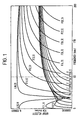
- Figure 1 shows that at a desired operating frequency of 70 kHz the fastest propagation mode in a 76.2mm diameter pipe with a wall thickness of 5.5mm is the L(0,2) mode as opposed to the L(0,1) mode and it is this Lamb wave mode which is used to inspect the pipe.
- the L(0,1) and L(0,2) wave modes are differently propagating axi-symmetric wave modes. The difference between them is in the distribution of displacements and stresses through the pipe.
- the terminology is more fully explained in the article by M.G. Silk and K.F. Bainton in the journal "Ultrasonics" of January 1979 at pp 11-19 and entitled The propagation in metal tubing of ultrasonic wave modes equivalent to Lamb waves.
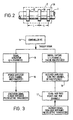
- Figure 2 shows a length of the pipe 1 to which a Lamb wave excitation assembly 2 of the apparatus is clamped.
- the excitation assembly 2 comprises a first excitation ring 3A (which is shown in more detail in figure 6) a second excitation ring 3B, and a third excitation ring 3C.
- Each ring is of similar construction to the ring 3A shown in figure 6.
- the excitation rings 3A, 3B, 3C are each comprised of a set or belt of symmetrically deployed Lamb wave exciter/transducers 5, typically 16 for a 3 inch diameter pipe and 32 for a 6 inch diameter pipe.
- the minimum number of Lamb wave exciters required in a ring is related to the highest order non-axisymmetric mode in the dispersion diagram at the highest frequency present in the excitation signal. If this mode order is say 13 then the minimum number of elements is 14.
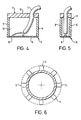
- Each Lamb wave exciter comprises a high impedance piezoelectric element 6 and is illustrated in detail in figures 4 and 5 or 11.
- each of the Lamb wave exciters is pressed into operative engagement with the surface of the pipe 1 by a clamping means which for this example of the apparatus applies a load of 40 N to every one of the exciters.
- This arrangement provides sufficient coupling between the pipe 1 and the exciters 5 to make a coupling fluid unnecessary.
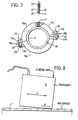
- FIG. 7 An example of a suitable clamping means is shown in figure 7.
- This clamping means consists of a ring 19 having an internal aperture 20.
- Spacer means such as three radially extending screws (not shown) are located at 120° intervals around the ring 19. The screws are adjustable to engage the pipe wall and support the ring coaxially around the pipe so that it is spaced from the pipe. This minimises contact with the pipe, and hence minimises any damping of the desired waves and also reduces any wave reflection caused by the clamping means.
- a plurality of radially extending through holes 21 are equiangularly spaced around the ring 19. Sufficient through holes 21 are provided to enable the required number of Lamb wave exciters 5 to be mounted one in each through hole 21.
- Each Lamb wave exciter 5 is mounted on the end of an elongate push rod 22.
- the push rod 22 is slidably received into an externally threaded sleeve 23 so that a compression coil spring 24 acting between the sleeve 23 and an abutment 25 on the rod 22 tends to project the rod 22 longitudinally.
- the Lamb wave exciter 5 is installed in the clamping means by screwing the sleeve 23 into the intemally threaded hole 21 so that the Lamb wave exciter 5 is pressed against the exterior of the wall of the pipe 1 by the action of the spring 24.
- the load can be adjusted by screwing and unscrewing the sleeve 23.
- the ring 19 is split radially into one or more separable parts 19a, 19b.
- the two parts 19a, 19b are joined together by two hinge and bolt assemblies generally designated at 26a and 26b.
- Each hinge and bolt assembly comprises a pair of brackets 27a, 27b.
- the bracket 27a being mounted on a first part of the ring 19 adjacent where the ring is split, and each bracket 27b being similarly mounted upon the other ring part 19b.
- Brackets 27a has a through hole 28 in it which extends tangentially to the ring and is of sufficient diameter for an allen key bolt 29 to be received through it.
- the through hole 28 is not threaded.
- Each bracket 27b also includes a tangentially extending aperture into which the bolt 29 is received.
- the bolt 29 screws into a pivot pin 30 mounted to extend parallel to the axis of the ring 19. The aperture in each bracket 27b allows the bolt 29 to pivot when it is screwed into the pivot pin 30.
- the bracket 27a in the assembly 26b differs from the one in the assembly 26a in that the bracket 27a consists of two forks which allow the bolt 29 to be swung out from the bracket when loosened so allowing the ring parts 19a, 19b to be hinged apart around the pivot pin 27b in the other of the brackets.
- mounting means is the hinged split ring described, it is possible to use a simple ring slipped onto the end of the pipe or a split ring without the hinge and bolt assemblies described but with simple bolt together brackets, overlocking fastenings, buckle and belt type fastenings and a wide range of other mechanisms.
- the ring shaped mounting means is preferred but any structure which will take up a ring like shape and provide support for the Lamb wave exciters may be suitable, for example, a polygonal structure or an articulated belt structure.
- the piezoelectric element 6 is elongate and polarised so that it expands and contracts along its length. Elements of this type are known for use as strain gauges.
- the element 6 has a backing structure comprising a casing 7, fabricated from Tufnel, in the base of which it is housed
- the casing has upright opposing side walls 8 and end walls 9 and a sealing cover 10.
- a thin face plate shim 13 is secured against the face of the piezoelectric element 6 to provide a wear plate which protects the piezoelectric element 6 so as to freely transmit forces from the pipe to the piezoelectric element:
- the shim 13 must be sufficiently thin that its shear stiffness is high enough not to interfere with the coupling of the piezoelectric element 6 with the pipe 1.
- the shim is of 0.06mm thick steel or brass and may be electrically insulated from the piezoelectric element at the bondline between them.
- the shim 13 may be of a non-conducting material to electrically insulate the piezoelectric element 5.
- the chamber 12 is filled with tungsten loaded epoxy which is a lossy material serving the purposes of protecting the gauge and electrical connections, providing flexural stiffness so that the very brittle piezoelectric element 6 is not damaged when pressed against a rough pipe surface and it damps out reverberations so that the transducer outputs a faithful reproduction of an excitation signal applied to it or, when used as a receiver, it generates a voltage corresponding to a wave passing it.
- the lossy material provides means to accommodate pipe surface roughness and to damp out reverberations.
- Figure 9 diagrammatically shows a shear polarised piezo electric transducer 6A which may be used in preference to the expansion type piezo electric transducer 6.
- the face engaging the pipe wall moves in one direction only parallel to the pipe axis and so exerts a force in the same direction over its full length.
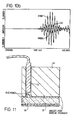
- Figures 10a and 10b illustrate the improvement achieved in signal clarity when a shear polarised transducer is used.
- Figure 10a shows the received signal obtained with a single shear polarised transducer loaded at three different positions along its length. It can be seen that the magnitude of the response is similar at the three positions and, crucially the phase is the same.
- Figure 10b shows the result of a similar experiment with an expansion type transducer where clear phase changes can be seen. The experiments were with a single transducer instead of a ring so that a significant amplitude of non axially symmetric modes can be seen.
- Figure 11 shows a second embodiment of a single Lamb wave exciter for use in an excitation ring.
- the shear polarised piezoelectric element 6A as described above is adhesively bonded to a rigid block 31.
- the rigid block 31 is made of steel and the bonding is achieved by an epoxy cement.
- a face shim 32 which may be made of brass, is bonded to the face of the piezoelectric element 6A.
- a passage 33 is formed through the backing block 31 and provides protective support for the electrical connections to the piezo electric element 6A.
- the rigid block backing structure can usefully back the expansion type piezoelectric element.
- Each Lamb wave exciter ring 3 is controlled via the instrumentation shown in figure 3 so that each of the exciters 6 in any one exciter ring 3 act in phase.
- the instrumentation comprises a computer, which in this case is a personal computer 14 which computes the necessary excitation signals for each exciter ring 3A, 3B, 3C.
- the excitation signals are then fed to a multichannel signal generator 15 which in the embodiment described has three channels to supply signals to each of the excitation rings 3A, 3B, 3C.
- the signal generator 15 will have sufficient channels to supply as many excitation rings as are desired. More than three rings may be desired in some circumstances, e.g., to amplify the desired single mode Lamb wave.
- the excitation signals are then fed to an amplifier 16 which amplifies each channel of the excitation signals separately and applies them to the excitation rings 3 so that the excitation assembly generates a signal L(0,2) axi-symmetric mode Lamb wave propagating in one direction down the pipe.
- modes other than the L (0,2) mode may be employed.
- exciter rings 3 may be employed in order to suppress undesired axi-symmetric modes and to limit the propagation of the desired mode to one direction.
- three rings are employed, successive rings being separated by a distance L as shown in Fig 2.
- m may be set to a larger integer.
- the signal applied to the first exciter ring 3A is a toneburst centred on the desired frequency (commonly around 70 kHz) enclosed in a Hanning or Gaussian window to limit the bandwidth.
- the signal applied to the middle exciter ring 3B is the sum of the signals applied to rings 3A and 3C.
- This arrangement suppresses the undesired mode in both directions at the centre frequency of the input toneburst, but not at the other frequencies present in the signal. If the desired mode is non dispersive (ie its velocity does not vary with frequency) then propagation of this mode in the backward direction is suppressed at all frequencies present in the input toneburst. However, if the mode is dispersive then suppression in the backward direction is only achieved at the centre frequency. In this case, it is desirable to modify the signal applied to the third ring 3C.
- the excitation signal applied to the first ring is x(t) and the Fourier transform of this signal is X( ⁇ ))e i ⁇ t .
- T ⁇ ⁇ - L g ⁇ and L is the spacing between the exciter rings.
- the signal applied to ring 3B will again be the sum of the signals applied to rings 3A and 3C.
- a similar procedure may used in reception to improve the analysis of received signals comprising a dispersive mode.
- Additional excitation rings may also be useful for increasing the amplitude of the desired single axi-symmetric mode in the forward direction.
- the excitation elements also serve as receivers, thus a Lamb wave that has been propagated down the pipe 1 and reflected back up the pipe 1 disturbs the piezoelectric elements of each Lamb wave exciter in the exciter rings 3. This disturbance causes the piezoelectric elements to generate a voltage signal which is applied to the instrumentation shown on the right in figure 3. Thus each exciter ring 3 generates a corresponding signal.
- Each of these signals is fed, one each to each one of an array 17 of high bypass filters and then to a receiver amplifier 18 before being supplied to a digital to analogue converter 19 and then to the computer 14 for analysis.
- the high bypass filters may be set at 10kHz.
- the signals received at each ring may be processed in software using an analysis similar to that used to produce the excitation signals for single mode, single direction propagation.
- the output of this processing is a signal comprising a single, axi-symmetric mode generated by reflections from features in the pipe. It is also possible to employ one receiver channel per Lamb wave exciter/transducer, rather than one per ring. If this is done it is possible to employ a more sophisticated analysis to determine the amplitudes of other, non-axisymmetric modes present in the reflected signal which may be produced by mode conversion at features in the pipe.
- Alleyn D One way of carrying out this analysis is described in: Alleyn D.
- Figure 8 diagrams an expansion type piezoelectric transducer element 6 in which the clamping load is applied to the front edge of the transducer element.
Landscapes
- Physics & Mathematics (AREA)
- Health & Medical Sciences (AREA)
- Life Sciences & Earth Sciences (AREA)
- Chemical & Material Sciences (AREA)
- Analytical Chemistry (AREA)
- Biochemistry (AREA)
- General Health & Medical Sciences (AREA)
- General Physics & Mathematics (AREA)
- Immunology (AREA)
- Pathology (AREA)
- Engineering & Computer Science (AREA)
- Acoustics & Sound (AREA)
- Multimedia (AREA)
- Investigating Or Analyzing Materials By The Use Of Ultrasonic Waves (AREA)
- Examining Or Testing Airtightness (AREA)
- Investigating Or Analyzing Materials By The Use Of Magnetic Means (AREA)
- Joints Allowing Movement (AREA)
- Road Paving Structures (AREA)
- Supports For Pipes And Cables (AREA)
- Lasers (AREA)
Claims (16)
- Vorrichtung zum Prüfen eines Rohrs, dadurch gekennzeichnet, dass eine Erregervorrichtung mindestens einen ersten Erregerring (3A) und einen zweiten Erregerring (3B) aufweist, die an ein Rohr (1) anklemmbar sind, wobei jeder Erregerring (3A,3B) aufweist: winklig beabstandete Wellenerreger (5), die eine der folgenden Wellen in einer einzelnen Richtung entlang eines Rohrs ausbreiten können:(a) eine axial symmetrische Einmoden-Lamb-Welle,(b) eine Ein-Torsions-Moden-Welle,(c) eine Ein-Biege-Moden-Welle,und eine zum Empfangen der Wellen geeignete Empfängereinrichtung (5) und eine Analyseeinrichtung (17,18), die zum Analysieren der empfangenen Welle zwecks Feststellens des Zustands des Rohrs geeignet ist.
- Vorrichtung nach Anspruch 1, bei der die Erregervorrichtung am Äußeren einer Rohrwand befestigt werden kann und zur Ausbreitung der Wellen entlang des Rohrs (1) gesteuert werden kann.
- Vorrichtung nach Anspruch 1 oder Anspruch 2, bei der die Erregervorrichtung einen dritten Erregerring (3C) aufweist, die in Zusammenarbeit mit dem ersten Erregerring (3A) und dem dritten Erregerring (3B) derart gesteuert werden, dass die Ausbreitung ungewünschter Moden der Wellen und die Ausbreitung der Wellen in Umkehrrichtung entlang des Rohrs unterdrückt werden.
- Vorrichtung nach einem der vorhergehenden Ansprüche, bei der mindestens einer der Erregerringe (3) als Empfängereinrichtung wirkt.
- Vorrichtung nach einem der vorhergehenden Ansprüche, bei der jeder Erregerring (3) mehrere Wellenerreger (5) aufweist, die in gleichwinkliger Abstandsbeziehung gehalten sind, um mittels einer Klemmvorrichtung an einer Rohrwand anzugreifen.
- Vorrichtung nach Anspruch 5, bei der die Klemmvorrichtung einen Ring (19) mit hinreichendem Innendurchmesser, um bei Anklemmung an die Rohrwand von dieser beabstandet zu sein, und mehrere Abstandshaltervorrichtungen aufweist, die zwischen dem Ring (19) und der Rohrwand in Eingriff bringbar sind, um den Ring in koaxial beabstandeter Beziehung um die Rohrwand zu befestigen, und die Wellenerreger (5) gleichwinklig beabstandet um den Ring derart angeordnet sind, dass sie an der Rohrwand angreifen.
- Vorrichtung nach Anspruch 6, bei der bei Betrieb die Klemmvorrichtung einen gleichförmigen Druck auf jeden Wellenerreger (5) ausübt, um jeden Wellenerreger mit gleicher Kraft gegen die Rohrwand zu drücken.
- Vorrichtung nach einem der Ansprüche 5 bis 7, bei der der Ring (19) radial derart geschlitzt ist, dass er um das Rohr herum angeordnet werden kann.
- Vorrichtung nach einem der Ansprüche 6 bis 8, bei der Instrumente vorgesehen sind, um die Wellenerreger (5) in jedem einzelnen Ring so zu steuern, dass die phasengleich arbeiten.
- Vorrichtung nach einem der vorhergehenden Ansprüche, bei der mehrere Wellenerreger/Transducer (5) gleichwinklig beabstandet um das zu prüfende Rohr derart angeordnet sind, dass jeder Erreger (5) mit einem entsprechenden Kanal der Analyseeinrichtung verbunden ist, so dass nicht achsensymmetrische Moden der Wellen zur Analyse empfangen werden können.
- Vorrichtung nach einem der Ansprüche 5 bis 10, bei der der Erreger ein Lamb-Wellenerreger mit einem piezoelektrischen Element (6) ist, das derart polarisiert ist, dass es sich beim Anlegen einer Spannung an seine Flächen deformiert, und das eine Stützstruktur aufweist, an der die Klemmvorrichtung angreifen kann.
- Vorrichtung nach Anspruch 11, bei der das piezoelektrische Element (6) ein scherpolarisiertes piezoelektrisches Element (6A) ist.
- Vorrichtung nach Anspruch 11 oder 12, bei der die Stützstruktur als starrer Stützblock (31) vorgesehen ist.
- Vorrichtung nach Anspruch 11 bis 12, bei der die Rohrangriffsfläche des piezoelektrischen Elements (6) durch eine an ihr befestigte Flächen-Zwischenscheibe (13,32) geschützt ist.
- Verfahren zum Prüfen eines Rohrs, gekennzeichnet durch die folgenden Schritte:Anklemmen mindestens eines ersten Rings (3A) aus winklig beabstandeten Wellenerregern und eines zweiten Rings (3B) aus winklig beabstandeten Wellenerregern an das Rohr zwecks Ausgebens einer der folgenden Wellen:(a) eine axial symmetrische Einmoden-Lamb-Welle, oder(b) eine Ein-Torsions-Moden-Welle,(c) eine Ein-Biege-Moden-Welle,in einer Richtung entlang des Rohrs, und des Empfangens der ausgegebenen Welle und des Analysierens der Welle zwecks Feststellens, welche Strukturen in dem Rohr vorhanden sind, um dadurch den Zustand des Rohrs festzustellen.
- Verfahren nach Anspruch 15, mit den Schritten
des Ausbreitens einer achssymmetrischen Lamb-Welle in dem Rohr,
des Unterdrückens sämtlicher Moden der Lamb-Welle, die sich in beiden Längsrichtungen entlang des Rohrs ausbreiten, mit Ausnahme einer einzigen Mode, und
des Unterdrückens der Ausbreitung jeder Lamb-Welle in einer Längsrichtung des Rohrs,
um eine achssymmetrische Einmoden-Lamb-Welle in einer Längsrichtung entlang des Rohrs auszugeben.
Applications Claiming Priority (5)
| Application Number | Priority Date | Filing Date | Title |
|---|---|---|---|
| GB9421187A GB9421187D0 (en) | 1994-10-20 | 1994-10-20 | Inspection of pipes |
| GB9421187 | 1994-10-20 | ||
| GBGB9517794.5A GB9517794D0 (en) | 1994-10-20 | 1995-08-31 | Inspection of pipes |
| GB9517794 | 1995-08-31 | ||
| PCT/GB1995/002482 WO1996012951A1 (en) | 1994-10-20 | 1995-10-20 | Inspection of pipes |
Publications (3)
| Publication Number | Publication Date |
|---|---|
| EP0787294A1 EP0787294A1 (de) | 1997-08-06 |
| EP0787294B1 EP0787294B1 (de) | 2002-04-10 |
| EP0787294B2 true EP0787294B2 (de) | 2006-12-13 |
Family
ID=26305840
Family Applications (1)
| Application Number | Title | Priority Date | Filing Date |
|---|---|---|---|
| EP95934248A Expired - Lifetime EP0787294B2 (de) | 1994-10-20 | 1995-10-20 | Prüfung von rohren |
Country Status (7)
| Country | Link |
|---|---|
| US (1) | US6148672A (de) |
| EP (1) | EP0787294B2 (de) |
| JP (1) | JP3732513B2 (de) |
| AT (1) | ATE216079T1 (de) |
| DE (1) | DE69526361T3 (de) |
| GB (2) | GB9517794D0 (de) |
| WO (1) | WO1996012951A1 (de) |
Families Citing this family (45)
| Publication number | Priority date | Publication date | Assignee | Title |
|---|---|---|---|---|
| US6715354B2 (en) | 1998-02-24 | 2004-04-06 | Massachusetts Institute Of Technology | Flaw detection system using acoustic doppler effect |
| US6728515B1 (en) | 2000-02-16 | 2004-04-27 | Massachusetts Institute Of Technology | Tuned wave phased array |
| US6360609B1 (en) | 2000-02-23 | 2002-03-26 | Massachusetts Institute Of Technology | Method and system for interpreting and utilizing multimode dispersive acoustic guided waves |
| GB2371623B (en) | 2001-01-26 | 2004-07-14 | David Nathaniel Alleyne | Inspection of non axi-symmetric elongate bodies |
| US6799466B2 (en) * | 2001-03-22 | 2004-10-05 | The Regents Of The University Of California | Guided acoustic wave inspection system |
| US6568271B2 (en) * | 2001-05-08 | 2003-05-27 | Halliburton Energy Services, Inc. | Guided acoustic wave sensor for pipeline build-up monitoring and characterization |
| US6666095B2 (en) | 2001-11-30 | 2003-12-23 | The Regents Of The University Of California | Ultrasonic pipe assessment |
| US6925881B1 (en) | 2002-01-17 | 2005-08-09 | Southwest Research Institute | Time shift data analysis for long-range guided wave inspection |
| US7474966B2 (en) * | 2002-01-23 | 2009-01-06 | Expro Meters. Inc | Apparatus having an array of piezoelectric film sensors for measuring parameters of a process flow within a pipe |
| AU2003287644A1 (en) * | 2002-11-12 | 2004-06-03 | Cidra Corporation | An apparatus having an array of clamp on piezoelectric film sensors for measuring parameters of a process flow within a pipe |
| US6920792B2 (en) * | 2003-05-05 | 2005-07-26 | John H. Flora | Transducer guided wave electromagnetic acoustic |
| US6766693B1 (en) * | 2003-06-04 | 2004-07-27 | Southwest Research Institute | Averaged guided wave inspection technology for ribbon cable |
| JP3747921B2 (ja) | 2003-06-20 | 2006-02-22 | 株式会社日立製作所 | ガイド波を用いた非破壊検査装置及び非破壊検査方法 |
| US7663969B2 (en) * | 2005-03-02 | 2010-02-16 | Baker Hughes Incorporated | Use of Lamb waves in cement bond logging |
| US7367239B2 (en) * | 2004-03-23 | 2008-05-06 | Cidra Corporation | Piezocable based sensor for measuring unsteady pressures inside a pipe |
| WO2007009097A1 (en) | 2005-07-13 | 2007-01-18 | Cidra Corporation | Method and apparatus for measuring parameters of a fluid flow using an array of sensors |
| US7647829B2 (en) * | 2005-11-28 | 2010-01-19 | Westinghouse Electric Co. Llc | Steam generator nondestructive examination method |
| GB2437547B (en) * | 2006-04-28 | 2010-07-14 | Genesis Oil And Gas Consultant | Method and apparatus for inspecting pipes |
| NO327139B1 (no) * | 2006-05-30 | 2009-05-04 | Clampon As | Fremgangsmate og system for bestemmelse av tap i materialtykkelse i en fast struktur |
| JP5105851B2 (ja) * | 2006-12-15 | 2012-12-26 | 株式会社日立エンジニアリング・アンド・サービス | 超音波探触子 |
| US20080236286A1 (en) * | 2007-03-29 | 2008-10-02 | Clive Chemo Lam | Non-destructive tubular testing |
| GB0716047D0 (en) * | 2007-08-16 | 2007-09-26 | Welding Inst | Acoustic transducer assembley |
| US7963165B2 (en) | 2007-09-25 | 2011-06-21 | Los Alamos National Security, Llc | Non-contact feature detection using ultrasonic Lamb waves |
| JP5531376B2 (ja) * | 2007-10-31 | 2014-06-25 | 株式会社日立パワーソリューションズ | 非破壊検査装置及び非破壊検査方法 |
| DE102008002394A1 (de) * | 2008-04-01 | 2009-10-22 | Ge Sensing & Inspection Technologies Gmbh | Universeller Prüfkopf zur zerstörungsfreien Ultraschalluntersuchung und zugehöriges Verfahren |
| JP5391375B2 (ja) * | 2009-01-28 | 2014-01-15 | 国立大学法人 名古屋工業大学 | 板厚測定方法および板厚測定装置 |
| US10212527B2 (en) | 2010-03-22 | 2019-02-19 | Gregory C. Burnett | Pipe calibration system for omnidirectional microphones |
| GB2482300A (en) | 2010-07-28 | 2012-02-01 | Guided Ultrasonics Ltd | Processing signals acquired during guided wave testing |
| US9031246B2 (en) | 2010-08-12 | 2015-05-12 | Aliphcom | Calibration system with clamping system |
| CA2816935C (en) | 2010-11-05 | 2020-05-05 | National Research Council Of Canada | Ultrasonic transducer assembly and system for monitoring structural integrity |
| US9958417B2 (en) | 2012-06-11 | 2018-05-01 | Arise Global Pte. Ltd | Non-traversing tube inspection system |
| WO2014190268A1 (en) * | 2013-05-24 | 2014-11-27 | The Penn State Research Foundation | Flexural modes in non-destructive testing and inspection |
| JP5884993B2 (ja) * | 2013-09-12 | 2016-03-15 | 横河電機株式会社 | 超音波配管測定装置 |
| US10261053B2 (en) * | 2013-12-17 | 2019-04-16 | Ontario Power Generation Inc. | Ultrasound inspection |
| GB2526174A (en) * | 2014-03-09 | 2015-11-18 | Dov Furman | Wide bandwidth GW probe for tube and pipe inspection system |
| GB2524991A (en) * | 2014-04-08 | 2015-10-14 | A3 Monitoring Ltd | Device for inspecting a structure |
| US10119942B2 (en) | 2015-02-13 | 2018-11-06 | Fbs, Inc. | Medium-range magnetostrictive ultrasonic guided wave scanner systems and methods |
| US9915632B2 (en) | 2015-04-06 | 2018-03-13 | Fbs, Inc. | Long-range magnetostrictive ultrasonic guided wave scanner system and method |
| EP3151037A1 (de) | 2015-09-30 | 2017-04-05 | Services Pétroliers Schlumberger | Systeme und verfahren zur auswertung von ringförmigem material mittels strahlformung aus akustischen arrays |
| GB2568273B (en) | 2017-11-10 | 2020-04-01 | Guided Ultrasonics Ltd | Ultrasonic transducer |
| CN108776178A (zh) * | 2018-05-14 | 2018-11-09 | 南京航空航天大学 | 一种用于激发管道扭转导波的电磁超声换能器及其工作方法 |
| CA3110818A1 (en) | 2018-08-30 | 2020-03-05 | Atomic Energy Of Canada Limited / Energie Atomique Du Canada Limitee | Continuous wave ultrasound or acoustic non-destructive testing |
| CN109900807A (zh) * | 2019-04-16 | 2019-06-18 | 中北大学 | 一种塑料管道钢质龙骨的超声定位装置 |
| GB202009926D0 (en) | 2020-06-29 | 2020-08-12 | Plant Integrity Ltd | Ultrasonic guided wave transducer assembly and clamping mechanism |
| CN113406206B (zh) * | 2021-06-25 | 2022-06-14 | 中国船舶重工集团公司第七一九研究所 | 内置的管道损伤检测系统及其检测方法 |
Family Cites Families (11)
| Publication number | Priority date | Publication date | Assignee | Title |
|---|---|---|---|---|
| FR2285188A1 (fr) * | 1974-09-23 | 1976-04-16 | Masao Inoue | Generateur de vibrations utilisant des plaques perforees ou non |
| US4041773A (en) * | 1975-10-08 | 1977-08-16 | W. C. Lamb | Ultrasonic inspection apparatus for well operations |
| US4404853A (en) * | 1981-03-12 | 1983-09-20 | Livingston Waylon A | Method and apparatus for ultrasonic testing of tubular goods |
| US4660419A (en) * | 1983-10-03 | 1987-04-28 | Trw Inc. | Reference standard for calibration of ultrasonic arrays |
| FR2554163B1 (fr) * | 1983-11-02 | 1986-02-07 | Electricite De France | Couronne de support d'instrumentation pour rotors de machines tournantes de grande puissance, et procede pour la rapporter sur un arbre de rotor |
| ES2088409T3 (es) * | 1989-01-13 | 1996-08-16 | Mannesmann Ag | Procedimiento para la deteccion de deficiencias en piezas de trabajo oblongas. |
| US5520061A (en) * | 1989-03-14 | 1996-05-28 | Enprotech Corporation | Multiple axis transducer mounting collar |
| US5007291A (en) * | 1989-10-05 | 1991-04-16 | Scan Systems, Inc. | Ultrasonic inspection apparatus with centering means for tubular members |
| US5156636A (en) * | 1990-11-26 | 1992-10-20 | Combustion Engineering, Inc. | Ultrasonic method and apparatus for measuring outside diameter and wall thickness of a tube and having temperature compensation |
| US5581037A (en) * | 1992-11-06 | 1996-12-03 | Southwest Research Institute | Nondestructive evaluation of pipes and tubes using magnetostrictive sensors |
| US5767410A (en) * | 1996-03-19 | 1998-06-16 | Combustion Engineering, Inc. | Lamb wave ultrasonic probe for crack detection and measurement in thin-walled tubing |
-
1995
- 1995-08-31 GB GBGB9517794.5A patent/GB9517794D0/en active Pending
- 1995-10-20 GB GB9705752A patent/GB2308191B/en not_active Expired - Lifetime
- 1995-10-20 DE DE69526361T patent/DE69526361T3/de not_active Expired - Lifetime
- 1995-10-20 EP EP95934248A patent/EP0787294B2/de not_active Expired - Lifetime
- 1995-10-20 JP JP51372596A patent/JP3732513B2/ja not_active Expired - Lifetime
- 1995-10-20 US US08/836,375 patent/US6148672A/en not_active Expired - Lifetime
- 1995-10-20 WO PCT/GB1995/002482 patent/WO1996012951A1/en not_active Ceased
- 1995-10-20 AT AT95934248T patent/ATE216079T1/de active
Non-Patent Citations (1)
| Title |
|---|
| W.Mohr, H. Licht, and P. Höller: "Zur Prüfung dünnwandiger Rohre mit geführten Ultraschallwellen", Materialprüfung 17 (1975), Nr.7 Juli, pages 240 - 241 † |
Also Published As
| Publication number | Publication date |
|---|---|
| GB2308191A (en) | 1997-06-18 |
| US6148672A (en) | 2000-11-21 |
| EP0787294A1 (de) | 1997-08-06 |
| GB9705752D0 (en) | 1997-05-07 |
| ATE216079T1 (de) | 2002-04-15 |
| DE69526361D1 (de) | 2002-05-16 |
| WO1996012951A1 (en) | 1996-05-02 |
| GB2308191B (en) | 1998-08-19 |
| JP3732513B2 (ja) | 2006-01-05 |
| DE69526361T2 (de) | 2003-01-02 |
| JPH10507530A (ja) | 1998-07-21 |
| DE69526361T3 (de) | 2007-06-28 |
| GB9517794D0 (en) | 1995-11-01 |
| EP0787294B1 (de) | 2002-04-10 |
Similar Documents
| Publication | Publication Date | Title |
|---|---|---|
| EP0787294B1 (de) | Prufung von rohren | |
| Alleyne et al. | The excitation of Lamb waves in pipes using dry-coupled piezoelectric transducers | |
| Croxford et al. | The use of non-collinear mixing for nonlinear ultrasonic detection of plasticity and fatigue | |
| US4062227A (en) | CW ultrasonic bolt tensioning monitor | |
| CN100394174C (zh) | 使用导波的非破坏性检查装置及非破坏性检查方法 | |
| Kwun et al. | Experimental observation of elastic‐wave dispersion in bounded solids of various configurations | |
| Khalili et al. | Relative ability of wedge-coupled piezoelectric and meander coil EMAT probes to generate single-mode Lamb waves | |
| US5841031A (en) | Method and apparatus for evaluation and inspection of composite-repaired structures | |
| Alleyne et al. | The inspection of chemical plant pipework using Lamb waves: Defect sensitivity and field experience | |
| EP3844530A1 (de) | Dauerstrich-ultraschall- oder akustische zerstörungsfreie prüfung | |
| GB2023820A (en) | Methods and apparatus for investigating an elongate body anchored in surrounding material | |
| JP3735006B2 (ja) | 非線形超音波を用いた内部微視亀裂検出方法及び装置 | |
| US5569854A (en) | Apparatus and method for transmitting and receiving ultrasonic waves having an acoustoelectric, ultrasonic transducer | |
| GB2311610A (en) | Piezoelectric element for the inspection of pipes | |
| US6584848B1 (en) | Non-destructive evaluation method employing dielectric electrostatic ultrasonic transducers | |
| Holé et al. | Single transducer generation of unipolar pressure waves | |
| Vogelaar et al. | Pipe Attrition Acoustic Locater (PAAL) from multi-mode dispersion analysis | |
| Green Jr | Emerging technologies for NDE of aging aircraft structures | |
| Auribault et al. | Study of surface acoustic waves guided by a metallic cylindrical wedge using laser-ultrasonic techniques | |
| Buck et al. | Rayleigh waves for continuous monitoring of a propagating crack front | |
| Kang et al. | Wideband electromagnetic dynamic acoustic transducer as a standard acoustic source for air-coupled ultrasonic sensors | |
| Konovalov et al. | Generating short pulses at the output of an emission–reception system when the emitter is excited with pulses with a special shape | |
| JP2002328120A (ja) | 超音波探触子および超音波探傷方法 | |
| Shin et al. | Observation of Lamb Wave Mode Conversion on an Aluminum Plate | |
| Hay et al. | Interfacing guided-wave ultrasound with wireless technology |
Legal Events
| Date | Code | Title | Description |
|---|---|---|---|
| PUAI | Public reference made under article 153(3) epc to a published international application that has entered the european phase |
Free format text: ORIGINAL CODE: 0009012 |
|
| 17P | Request for examination filed |
Effective date: 19970513 |
|
| AK | Designated contracting states |
Kind code of ref document: A1 Designated state(s): AT BE CH DE DK ES FR GR IE IT LI LU NL PT SE |
|
| 17Q | First examination report despatched |
Effective date: 20000331 |
|
| GRAG | Despatch of communication of intention to grant |
Free format text: ORIGINAL CODE: EPIDOS AGRA |
|
| GRAG | Despatch of communication of intention to grant |
Free format text: ORIGINAL CODE: EPIDOS AGRA |
|
| GRAH | Despatch of communication of intention to grant a patent |
Free format text: ORIGINAL CODE: EPIDOS IGRA |
|
| GRAH | Despatch of communication of intention to grant a patent |
Free format text: ORIGINAL CODE: EPIDOS IGRA |
|
| GRAA | (expected) grant |
Free format text: ORIGINAL CODE: 0009210 |
|
| RBV | Designated contracting states (corrected) |
Designated state(s): AT BE CH DE DK ES FR GR IE IT LI LU NL PT SE |
|
| AK | Designated contracting states |
Kind code of ref document: B1 Designated state(s): AT BE CH DE DK ES FR GR IE IT LI LU NL PT SE |
|
| PG25 | Lapsed in a contracting state [announced via postgrant information from national office to epo] |
Ref country code: NL Free format text: LAPSE BECAUSE OF FAILURE TO SUBMIT A TRANSLATION OF THE DESCRIPTION OR TO PAY THE FEE WITHIN THE PRESCRIBED TIME-LIMIT Effective date: 20020410 Ref country code: LI Free format text: LAPSE BECAUSE OF FAILURE TO SUBMIT A TRANSLATION OF THE DESCRIPTION OR TO PAY THE FEE WITHIN THE PRESCRIBED TIME-LIMIT Effective date: 20020410 Ref country code: IT Free format text: LAPSE BECAUSE OF FAILURE TO SUBMIT A TRANSLATION OF THE DESCRIPTION OR TO PAY THE FEE WITHIN THE PRE;WARNING: LAPSES OF ITALIAN PATENTS WITH EFFECTIVE DATE BEFORE 2007 MAY HAVE OCCURRED AT ANY TIME BEFORE 2007. THE CORRECT EFFECTIVE DATE MAY BE DIFFERENT FROM THE ONE RECORDED.SCRIBED TIME-LIMIT Effective date: 20020410 Ref country code: GR Free format text: LAPSE BECAUSE OF FAILURE TO SUBMIT A TRANSLATION OF THE DESCRIPTION OR TO PAY THE FEE WITHIN THE PRESCRIBED TIME-LIMIT Effective date: 20020410 Ref country code: CH Free format text: LAPSE BECAUSE OF FAILURE TO SUBMIT A TRANSLATION OF THE DESCRIPTION OR TO PAY THE FEE WITHIN THE PRESCRIBED TIME-LIMIT Effective date: 20020410 Ref country code: BE Free format text: LAPSE BECAUSE OF FAILURE TO SUBMIT A TRANSLATION OF THE DESCRIPTION OR TO PAY THE FEE WITHIN THE PRESCRIBED TIME-LIMIT Effective date: 20020410 Ref country code: AT Free format text: LAPSE BECAUSE OF FAILURE TO SUBMIT A TRANSLATION OF THE DESCRIPTION OR TO PAY THE FEE WITHIN THE PRESCRIBED TIME-LIMIT Effective date: 20020410 |
|
| REF | Corresponds to: |
Ref document number: 216079 Country of ref document: AT Date of ref document: 20020415 Kind code of ref document: T |
|
| REG | Reference to a national code |
Ref country code: CH Ref legal event code: EP |
|
| REG | Reference to a national code |
Ref country code: IE Ref legal event code: FG4D |
|
| REF | Corresponds to: |
Ref document number: 69526361 Country of ref document: DE Date of ref document: 20020516 |
|
| PG25 | Lapsed in a contracting state [announced via postgrant information from national office to epo] |
Ref country code: SE Free format text: LAPSE BECAUSE OF FAILURE TO SUBMIT A TRANSLATION OF THE DESCRIPTION OR TO PAY THE FEE WITHIN THE PRESCRIBED TIME-LIMIT Effective date: 20020710 Ref country code: PT Free format text: LAPSE BECAUSE OF FAILURE TO SUBMIT A TRANSLATION OF THE DESCRIPTION OR TO PAY THE FEE WITHIN THE PRESCRIBED TIME-LIMIT Effective date: 20020710 Ref country code: DK Free format text: LAPSE BECAUSE OF FAILURE TO SUBMIT A TRANSLATION OF THE DESCRIPTION OR TO PAY THE FEE WITHIN THE PRESCRIBED TIME-LIMIT Effective date: 20020710 |
|
| ET | Fr: translation filed | ||
| NLV1 | Nl: lapsed or annulled due to failure to fulfill the requirements of art. 29p and 29m of the patents act | ||
| ET | Fr: translation filed | ||
| REG | Reference to a national code |
Ref country code: CH Ref legal event code: PL |
|
| PG25 | Lapsed in a contracting state [announced via postgrant information from national office to epo] |
Ref country code: LU Free format text: LAPSE BECAUSE OF NON-PAYMENT OF DUE FEES Effective date: 20021020 |
|
| PG25 | Lapsed in a contracting state [announced via postgrant information from national office to epo] |
Ref country code: IE Free format text: LAPSE BECAUSE OF NON-PAYMENT OF DUE FEES Effective date: 20021021 |
|
| PG25 | Lapsed in a contracting state [announced via postgrant information from national office to epo] |
Ref country code: ES Free format text: LAPSE BECAUSE OF FAILURE TO SUBMIT A TRANSLATION OF THE DESCRIPTION OR TO PAY THE FEE WITHIN THE PRESCRIBED TIME-LIMIT Effective date: 20021030 |
|
| PLBQ | Unpublished change to opponent data |
Free format text: ORIGINAL CODE: EPIDOS OPPO |
|
| PLBI | Opposition filed |
Free format text: ORIGINAL CODE: 0009260 |
|
| PLBF | Reply of patent proprietor to notice(s) of opposition |
Free format text: ORIGINAL CODE: EPIDOS OBSO |
|
| 26 | Opposition filed |
Opponent name: MANNESMANNROEHREN-WERKE AG Effective date: 20030109 |
|
| PLBF | Reply of patent proprietor to notice(s) of opposition |
Free format text: ORIGINAL CODE: EPIDOS OBSO |
|
| PLAX | Notice of opposition and request to file observation + time limit sent |
Free format text: ORIGINAL CODE: EPIDOSNOBS2 |
|
| REG | Reference to a national code |
Ref country code: IE Ref legal event code: MM4A |
|
| PLBB | Reply of patent proprietor to notice(s) of opposition received |
Free format text: ORIGINAL CODE: EPIDOSNOBS3 |
|
| PLAB | Opposition data, opponent's data or that of the opponent's representative modified |
Free format text: ORIGINAL CODE: 0009299OPPO |
|
| PLBQ | Unpublished change to opponent data |
Free format text: ORIGINAL CODE: EPIDOS OPPO |
|
| R26 | Opposition filed (corrected) |
Opponent name: MANNESMANNROEHREN-WERKE AG Effective date: 20030109 |
|
| PUAH | Patent maintained in amended form |
Free format text: ORIGINAL CODE: 0009272 |
|
| STAA | Information on the status of an ep patent application or granted ep patent |
Free format text: STATUS: PATENT MAINTAINED AS AMENDED |
|
| 27A | Patent maintained in amended form |
Effective date: 20061213 |
|
| AK | Designated contracting states |
Kind code of ref document: B2 Designated state(s): AT BE CH DE DK ES FR GR IE IT LI LU NL PT SE |
|
| REG | Reference to a national code |
Ref country code: ES Ref legal event code: FD2A Effective date: 20021021 |
|
| ET3 | Fr: translation filed ** decision concerning opposition | ||
| PGFP | Annual fee paid to national office [announced via postgrant information from national office to epo] |
Ref country code: FR Payment date: 20141031 Year of fee payment: 20 Ref country code: DE Payment date: 20141024 Year of fee payment: 20 |
|
| REG | Reference to a national code |
Ref country code: DE Ref legal event code: R071 Ref document number: 69526361 Country of ref document: DE |