EP0787804A2 - Verfahren zur Synthese von löslichen, rekombinanten Proteinen aus Bakterienzellen - Google Patents
Verfahren zur Synthese von löslichen, rekombinanten Proteinen aus Bakterienzellen Download PDFInfo
- Publication number
- EP0787804A2 EP0787804A2 EP97101265A EP97101265A EP0787804A2 EP 0787804 A2 EP0787804 A2 EP 0787804A2 EP 97101265 A EP97101265 A EP 97101265A EP 97101265 A EP97101265 A EP 97101265A EP 0787804 A2 EP0787804 A2 EP 0787804A2
- Authority
- EP
- European Patent Office
- Prior art keywords
- protein
- ifnγ
- synthesis
- over
- soluble
- Prior art date
- Legal status (The legal status is an assumption and is not a legal conclusion. Google has not performed a legal analysis and makes no representation as to the accuracy of the status listed.)
- Granted
Links
Images
Classifications
-
- C—CHEMISTRY; METALLURGY
- C07—ORGANIC CHEMISTRY
- C07K—PEPTIDES
- C07K14/00—Peptides having more than 20 amino acids; Gastrins; Somatostatins; Melanotropins; Derivatives thereof
- C07K14/435—Peptides having more than 20 amino acids; Gastrins; Somatostatins; Melanotropins; Derivatives thereof from animals; from humans
- C07K14/52—Cytokines; Lymphokines; Interferons
- C07K14/555—Interferons [IFN]
- C07K14/57—IFN-gamma
-
- C—CHEMISTRY; METALLURGY
- C12—BIOCHEMISTRY; BEER; SPIRITS; WINE; VINEGAR; MICROBIOLOGY; ENZYMOLOGY; MUTATION OR GENETIC ENGINEERING
- C12P—FERMENTATION OR ENZYME-USING PROCESSES TO SYNTHESISE A DESIRED CHEMICAL COMPOUND OR COMPOSITION OR TO SEPARATE OPTICAL ISOMERS FROM A RACEMIC MIXTURE
- C12P21/00—Preparation of peptides or proteins
- C12P21/02—Preparation of peptides or proteins having a known sequence of two or more amino acids, e.g. glutathione
Definitions
- Soluble, recombinant proteins are usually produced from bacteria in such a way that an expression plasmid is expressed, the protein is isolated and purified.
- Such methods are known for a wide variety of proteins.
- the plasmid PKK 233-2 is constructed for the expression of interferon- ⁇ in E. coli (E. Ammann and J. Brosius; Gene 40 , 1985, 1893 to 1900).
- This plasmid has an inducible trc promoter, a multiple cloning site that contains the start codon (ATG) and terminators for the RNA polymerase.
- interferon- ⁇ 10L An identical method is known from DE 40 36 856.4.
- This document also describes, among other things, a method for producing a shortened interferon- ⁇ variant (interferon- ⁇ 10L).
- an appropriate expression plasmid is again assumed.
- This plasmid is also expressed in bacterial cells (E. coli) at a rate of 30% of the total protein.
- E. coli bacterial cells
- Over 90% of this interferon- ⁇ is in the form of insoluble, so-called "inclusionbodies”.
- the bacterial cells are broken open after successful expression and the "inclusionbodies" are freed from soluble bacterial proteins by repeated washing.
- the breakup is preferably carried out mechanically, in particular by ultrasound.
- inclusion bodies are then brought into solution by means of a denaturation step and subsequently subjected to a renaturation step.
- the renaturation step is necessary because when the proteins are produced from the inclusion bodies, the protein obtained is not in the biologically active form.
- the renaturation step is intended to fold back into the biologically active form.
- the method features stated in claim 1 are adhered to exactly and exactly. Only by combining the individual process features a) to e) is it ensured that the proteins from the protein supernatant, i.e. can be obtained from a protein solution. It is essential for the process parameters that the cell culture is grown up to an OD 600 nm of 0.4 to 0.6 and that cooling then takes place in a certain, defined period of time (15-40 min.) To a certain, defined temperature ( 20 to 26 ° C). This cooling in connection with the very low inductor concentration (10 to 55 ⁇ M) ensures that after an induction phase at 20 to 26 ° C from 3.5 to 6.5 hours, 20 to 60% of the protein is in soluble form. the rest precipitates in "inclusionbodies".
- the protein is isolated and purified in such a way that fractionation takes place first.
- the bacterial cells are broken down as known after the expression phase (e.g. by Ultrasound) and the cell lysate with buffer.
- a protein supernatant and inclusion bodies can then be obtained by centrifugation. Only this protein supernatant is used for further processing.
- the supernatant is subjected to a high purification. This can be done, for example, by stirring the protein supernatant with a cation exchange material. This causes the protein to bind to the cation exchanger.
- the cation-exchange material loaded with protein can be washed with phosphate buffer and the protein can be eluted, for example, with saline in a buffer. Ammonium sulfate precipitation and gel filtration can then be connected for high purification.
- the process according to the invention is particularly suitable for the production of interferon- ⁇ and its derivatives and that this process can be used not only to obtain interferon- ⁇ in the active and highly pure form described above, but also variants thereof which, e.g. are shortened by 10 amino acids or variants which have a disulfide bridge.
- interferon- ⁇ can be obtained in a reduced form from "inclusionbodies”.
- the method according to the invention is thus not only distinguished by the fact that proteins can be obtained in pure form with a high yield, but this method obviously also enables the expression of proteins which were previously not possible using the method with the "inclusion bodies".
- interferon- ⁇ The process according to the invention is described in detail below with reference to the production of interferon- ⁇ .
- the method is not limited to interferon- ⁇ , but is basically applicable to all soluble proteins that express from bacterial cells.
- E.coli cells JM 105 with an expression plasmid which contains the complete gene for IFN ⁇ behind the trc promoter are raised to an OD 600 nm of 0.5 at 37 ° C.
- a 500 ml was started Batch YT medium inoculated with 5 ml of an overnight culture mentioned above.
- the cell culture is cooled to 25 ° C. in a 30-minute phase.
- the synthesis of IFN ⁇ is induced by the addition of 50 ⁇ M IPTG final concentration.
- the induction phase is carried out at a temperature of 25 ° C over a period of 5 hours. After this induction phase, 20 to 60% of the IFN ⁇ remains as a soluble protein, the rest of the IFN ⁇ is precipitated in the form of "inclusion bodies".
- the bacterial cells are collected in the form of the cell pellet by centrifugation (15 min; 6000 rpm in a JA 15 rotor). The cells are washed in 200 ml PBS buffer (phosphate buffered saline) or Na phosphate buffer pH 7.0 by resuspending. By repeated centrifugation as above, a washed cell pellet is obtained, which is either immediately used in the cleaning process or stored at -70 ° C.
- PBS buffer phosphate buffered saline
- Na phosphate buffer pH 7.0 Na phosphate buffer pH 7.0
- the washed cell pellet is taken up in 15 ml of PBS or Na phosphate buffer and the cells are opened by ultrasound (5 ⁇ 10 seconds with cooling on ice). 15 ml of buffer are added to the cell lysate and the diluted cell lysate is fractionated by centrifugation (30 min; 10,000 rpm; 7A 20 rotor) to form a soluble protein supernatant (fraction I) and a cell lysate pellet which contains the inclusion bodies.
- the elution of the protein was followed by an OD 280/260 mm measurement.
- the two fractions with the highest OD, usually the first two eluates, are pooled to fraction II.
- This cleaning step is very efficient because of the high IP (isoelectric point of the IFN ⁇ of more than 10).
- the purity of the IFN ⁇ is increased from approximately 5% to more than 90%.
- Fraction II (4 ml) is brought to an AS saturation of 70% by the slow addition of 440 mg of finely ground ammonium sulfate (AS). After approximately 12 hours at 4 ° C, the precipitated IFN ⁇ is collected as an AS pellet by centrifugation (30 minutes at 10,000 rpm; JA 20 rotor). The pellet is taken up in 1 ml of buffer (fraction III).
- 1 ml fraction is sterilized (0.2 ⁇ M pore size) and fractionated in different sample sizes (200 ⁇ l - 1 ml) using a TSKG 200 column.
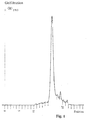
- This gel filtration step results (FIG. 1) in a symmetrical distribution of the IFN ⁇ protein and uses calibration proteins to indicate that the IFN ⁇ is present as a homodimeric protein.
- SDS gel An SDS gel electrophoresis analysis (SDS gel) shows a degree of purity of more than 95%. Although a somewhat faster migration behavior is observed in direct comparison with the corresponding IFN ⁇ from "Inclusionbodies", which indicates a minimal shortening by a few amino acids, the soluble IFN ⁇ can be obtained with this procedure as an overall intact protein. The specific antiviral activity of the soluble IFN ⁇ with 2 x 10 7 n / mg protein corresponds to that of the IFN ⁇ from "Inclusionbodies".
- the advantage of this method is that the IFN ⁇ protein folds into the spatial structure in the bacterial cell; there is no evidence of an inhomogeneous structural population for this protein.
- a variant of IFN ⁇ that has been shortened by 10 amino acids and a variant that inserted two cysteines in this way can also be used that an internal disulfide bridge can form, be synthesized and highly purified.
- the yield in the purification process is up to 50% for all examined IFN ⁇ proteins and thus stands out from the 10% yield for IFN ⁇ , which has to be extracted from the "inclusionbodies” and folded in vitro in the test tube into the correct spatial structure. Approximately 4 mg of highly pure soluble IFN ⁇ can be obtained from 4 g of cell pellet.
- the soluble IFN ⁇ with a disulfide bridge can be purified and maintained as both a reducted and an oxidized protein.
- the corresponding IFN ⁇ from "Inclusionbodies" can only be obtained in oxidized form.
- the soluble IFN ⁇ according to the invention is therefore not antigen at least or at least less than the "inclusion body" IFN ⁇ .
Landscapes
- Chemical & Material Sciences (AREA)
- Life Sciences & Earth Sciences (AREA)
- Organic Chemistry (AREA)
- Health & Medical Sciences (AREA)
- Zoology (AREA)
- Proteomics, Peptides & Aminoacids (AREA)
- Engineering & Computer Science (AREA)
- Wood Science & Technology (AREA)
- General Health & Medical Sciences (AREA)
- Genetics & Genomics (AREA)
- Biochemistry (AREA)
- Molecular Biology (AREA)
- Medicinal Chemistry (AREA)
- Toxicology (AREA)
- Gastroenterology & Hepatology (AREA)
- Biotechnology (AREA)
- Chemical Kinetics & Catalysis (AREA)
- General Chemical & Material Sciences (AREA)
- Microbiology (AREA)
- Biophysics (AREA)
- Bioinformatics & Cheminformatics (AREA)
- General Engineering & Computer Science (AREA)
- Preparation Of Compounds By Using Micro-Organisms (AREA)
- Peptides Or Proteins (AREA)
- Micro-Organisms Or Cultivation Processes Thereof (AREA)
Abstract
Description
- Lösliche, rekombinante Proteine werden im Regelfall aus Bakterien hergestellt, in der Weise, daß ein Expressionsplasmid exprimiert, das Protein isoliert und gereinigt wird. Derartige Verfahren sind für die verschiedensten Proteine bekannt. Z.B wird für die Expression von Interferon-γ in E.coli das Plasmid PKK 233-2 konstruiert (E. Ammann und J. Brosius; Gene 40, 1985, 1893 bis 1900). Dieses Plasmid besitzt einen induzierbaren trc Promotor, eine multiple Cloningsite, die das Startcodon (ATG) enthält sowie Terminatoren für die RNA-Polymerase.
- Ein identisches Verfahren ist aus der DE 40 36 856.4 bekannt. In diesem Dokument ist u.a. auch ein Verfahren zum Herstellen einer verkürzten Interferon-γ Variante (Interferon-γ 10L) beschrieben. Auch hierbei wird wiederum von einem entsprechenden Expressionsplasmid ausgegangen. Auch dieses Plasmid wird in Bakterienzellen (E.coli) mit einer Rate von 30 % des totalen Proteins exprimiert. Zu über 90 % liegt dabei dieses Interferon-γ in Form von unlöslichen, sog. "Inclusionbodies" vor. Für die Reinigung dieses Interferon-γ werden dabei die Bakterienzellen nach erfolgreicher Expression aufgebrochen und die "Inclusionbodies" durch mehrfaches Waschen von löslichen bakteriellen Proteinen befreit. Das Aufbrechen wird bevorzugt mechanisch, insbesondere durch Ultraschall, vorgenommen. Die "Inclusionbodies" werden dann durch einen Denaturierungsschritt in Lösung gebracht und nachfolgend einem Renaturierungsschritt unterzogen. Der Renaturierungsschritt ist deshalb erforderlich, weil bei der Herstellung der Proteine aus den "Inclusionbodies" das erhaltene Protein nicht in der biologisch aktiven Form vorliegt. Durch den Renaturierungsschritt soll wieder eine Faltung in die biologisch aktive Form erfolgen.
- Nachteilig bei diesen Verfahren des Standes der Technik ist jedoch, daß zum einen die Ausbeute bei der Herstellung der Proteine aus den "Inclusionbodies" sehr gering ist (z.B. beim vorstehend beschriebenen Verfahren ca. 10 %) und daß es sich zum anderen gezeigt hat, daß durch den Renaturierungsschritt nicht immer gewährleistet ist, daß das Protein wieder in seine biologisch aktive Form vollständig zurückgefaltet wird. Es hat sich herausgestellt, daß bei den Proteinen, die aus den "Inclusionbodies" gewonnen werden, zumeist eine inhomogene Strukturpopulation für das Protein vorliegt.
- Ausgehend hiervon ist es die Aufgabe der vorliegenden Erfindung, das vorstehend beschriebene Verfahren in der Weise zu verbessern, daß zum einen eine deutliche Steigerung der Ausbeute erreicht wird und daß das Protein möglichst in seiner aktiven Form isoliert wird, ohne daß eine Rückfaltung erforderlich ist.
- Die Aufgabe wird durch die kennzeichnenden Merkmale des Anspruches 1 gelöst. Die Unteransprüche zeigen vorteilhafte Weiterbildungen auf.
- Überraschenderweise hat sich gezeigt, daß es durch die genannte Einhaltung der Verfahrensparameter nach Anspruch 1 bei der Exprimierung der Plasmide möglich ist, das Protein in einer Lösung zu erhalten. Nach der Induktionsphase verbleiben 20-60 % des Proteins als lösliches Protein, nur der Rest ist in Form von "Inclusionbodies" präzipitiert. Bei den Verfahren des Standes der Technik präzipitieren zumeist mehr als 95 % des Proteins in Form von "Inclusionbodies". Der Vorteil dieses Verfahrens liegt darin, daß die Faltung des Proteins, z.B. des Interferon-γ, in die räumliche Struktur in der Bakterienzelle selbst abläuft. Bei diesen Verfahren ist somit nicht, wie bei den Verfahren des Standes der Technik, ein Denaturierungs- und Renaturierungsschritt erforderlich, da sich die räumliche Struktur in der Bakterienzelle selbst bildet. Eine unvollständige Rückfaltung ist deshalb ausgeschlossen. Besonders hervorzuheben ist bei diesem Verfahren, daß sich damit nicht nur ein Protein in der aktiven Form in homogener Weise bildet, sondern auch die Ausbeute bei diesem Verfahren, z.B. für Interferon-γ, bei 50 % im Gegensatz zu ca. 10 % bei den Verfahren des Standes der Technik liegt.
- Für das erfindungsgemäße Verfahren ist es wichtig, daß die im Anspruch 1 angeführten Verfahrensmerkmale genau und exakt eingehalten werden. Nur durch die Kombination der einzelnen Verfahrensmerkmale a) bis e) ist es gewährleistet, daß die Proteine aus dem Proteinüberstand, d.h. aus einer Proteinlösung, gewonnen werden können. Wesentlich bei den Verfahrensparametern ist, daß die Zellkultur bis zu einer OD 600 nm von 0,4 bis 0,6 angezogen wird und daß dann eine Abkühlung in einer bestimmten, definierten Zeitspanne (15-40 Min.) auf eine bestimmte, definierte Temperatur (20 bis 26°C) erfolgt. Diese Abkühlung in Verbindung mit der sehr niedrigen Induktorkonzentration (10 bis 55 µM) gewährleistet, daß nach einer Induktionsphase bei 20 bis 26°C von 3,5 bis 6,5 Std. 20 bis 60 % des Proteins in löslicher Form vorliegen. der Rest präzipitiert in "Inclusionbodies".
- Ausführliche Untersuchungen haben gezeigt, daß z.B. bei Temperaturen von 37°C während der Induktionsphase mehr als 95 % des Proteins zu "Inclusionbodies" präzipitieren. Offensichtlich hat somit die Temperaturabsenkung in Verbindung mit der niedrigen Induktor-Konzentration eine entscheidende Bedeutung beim erfindungsgemäßen Verfahren.
- Die Isolierung und Reinigung des Proteins wird dabei so vorgenommen, daß zuerst eine Fraktionierung erfolgt. Dazu werden die Bakterienzellen nach der Expressionsphase wie bekannt aufgebrochen (z.B. durch Ultraschall) und das Zellysat mit Puffer aufgenommen. Durch Zentrifugieren kann dann ein Proteinüberstand und "Inclusionbodies" erhalten werden. Für die weitere Aufarbeitung wird nur noch dieser Proteinüberstand verwendet. Der Überstand wird dabei einer Hochreinigung unterzogen. Dies kann z.B. so durchgeführt werden, daß der Proteinüberstand mit einem Kationenaustauschermaterial gerührt wird. Dadurch erfolgt eine Bindung des Proteins an den Kationenaustauscher. Das mit Protein beladene Kationenaustauschermaterial kann mit Phosphat-Puffer gewaschen und das Protein z.B. mit Kochsalzlösung in einem Puffer eluiert werden. Zur Hochreinigung kann dann noch eine Ammoniumsulfatfällung und eine Gelfiltration angeschlossen werden.
- In zahlreichen Versuchen hat es sich herausgebildet, daß es günstig ist, wenn das Verfahren unter Einhaltung folgender Parameter durchgeführt wird:
- Verfahrensschritt a); OD 600 nm von 0,45 bis 0,55 bei 35 bis 38°C, besonders bevorzugt von 0,5 bei 37°C.
- Verfahresschritt b); Zeitspanne 25 bis 35 Min., besonders bevorzugt 30 Min.; Abkühlung auf 24 bis 26°C, besonders bevorzugt 25°C;
- Verfahrensschritt c); Zugabe von 10 bis 50 µM, besonders bevorzugt von 50 µM Induktor; und
- Verfahrensschritt d); Induktionsphase bei 24 bis 26°C von 3,5 bis 5,5 Std., besonders bevorzugt bei 25°C über 5 Std.
- Es hat sich gezeigt, daß das erfindungsgemäße Verfahren besonders zur Herstellung von Interferon-γ und seinen Derivaten geeignet ist und daß mit diesem Verfahren nicht nur Interferon-γ in der vorstehend beschriebenen aktiven und hochreinen Form gewonnen werden kann, sondern auch Varianten davon, die z.B. um 10 Aminosäuren verkürzt sind oder auch Varianten, die eine Disulfidbrücke aufweisen. Hier sowohl in reduzierter als auch in oxidierter Form. Aus der Literatur ist bisher noch nicht bekannt, daß aus "Inclusionbodies" Interferon-γ in reduzierter Form gewonnen werden kann. Das erfindungsgemäße Verfahren zeichnet sich somit nicht nur dadurch aus, daß Proteine mit hoher Ausbeute in reiner Form erhalten werden können, sondern dieses Verfahren ermöglicht offensichtlich auch die Exprimierung von Proteinen, wie sie bisher über das Verfahren mit den "Inclusionbodies" nicht möglich waren.
- Das erfindungsgemäße Verfahren wird nachfolgend ausführlich anhand der Herstellung von Interferon-γ beschrieben. Wie vorstehend erläutert, ist das Verfahren jedoch nicht auf Interferon-γ beschränkt, sondern ist grundsätzlich auf alle löslichen Proteine, die aus Bakterienzellen exprimieren, anwendbar.
- E.coli Zellen (JM 105) mit einem Expressionsplasmid, das das komplette Gen für IFNγ hinter dem trc-Promotor enthält, werden bis zu einer OD 600 nm von 0,5 bei 37°C hochgezogen. Gestartet wurde ein 500 ml Ansatz YT Medium, der mit 5 ml einer oben genannten Übernacht-Kultur angeimpft wurde.
- Die Zellkultur wird in einer 30-Minuten-Phase auf 25°C abgekühlt. Die Synthese des IFNγ wird durch die Zugabe von 50 µM IPTG Endkonzentration induziert. Die Induktionsphase wird bei einer Temperatur von 25°C über einen Zeitraum von 5 Stunden durchgeführt. Nach dieser Induktionsphase verbleiben 20 bis 60 % des IFNγ als ein lösliches Protein, der Rest des IFNγ ist in Form von "Inclusionbodies" präzipitiert.
- Die Bakterienzellen werden nach der 5-stündigen Expressionsphase durch Zentrifugation (15 Min.; 6000 rpm in einem JA 15 Rotor) in Form des Zellpellets gesammelt. Die Zellen werden in 200 ml PBS Puffer (Phosphat Buffered Saline) oder Na-Phosphatpuffer pH 7,0 durch Resuspendieren gewaschen. Durch erneute Zentrifugation wie oben wird ein gewaschenes Zellpellet gewonnen, das entweder gleich in der Reinigung verwertet oder bei -70°C gelagert wird.
- Das gewaschene Zellpellet wird in 15 ml PBS oder Na-Phosphat-Puffer aufgenommen und die Zellen durch Ultraschall geöffnet (5 x 10 Sek. unter Kühlung auf Eis). Zum Zellysat werden 15 ml Puffer hinzugegeben und das verdünnte Zellysat durch Zentrifugation (30 Min; 10000 rpm; 7A 20 Rotor) fraktioniert zu einem löslichen Proteinüberstand (Fraktion I) und einem Zellysatpellet, das die "Inclusionbodies" enthält.
- In die Fraktion I werden vorsichtig 1 ml einer im gleichen Puffer äquilibrierten SP-Sepharose (mit einer Kationenbindung von 20 mg Protein) gerührt. NAch 30 Minuten auf Eis wird 10 Minuten bei 3500 rpm zentrifugiert. Das SP-Sepharosepellet, an das IFNγ gebunden ist, wird in 2 sukzessiven Waschschritten mit je 15 ml Puffer von E.coli Proteinen befreit. Das gebundene IFNγ wird mit 2 ml 1 M NaCl voll im Puffer eluiert und durch Zentrifugation vom SP-Sepharosematerial abgetrennt. Die Elutionsschritte werden zweimal wiederholt, bis sichergestellt ist, daß alles IFNγ vom SP-Sepharosematerial eluiert wurde. Die Elution des Proteins wurde durch eine OD 280/260 mm-Messung verfolgt. Die beiden Fraktionen mit der höchsten OD, normalerweise die beiden ersten Eluate, werden zur Fraktion II vereinigt. Dieser Reinigungsschritt ist wegen des hohen IP (isoelektrischer Punkt des IFNγ von mehr als 10) sehr effizient. In diesem Batchverfahren wird die Reinheit des IFNγ von ungefähr 5 % auf mehr als 90 % erhöht.
- Fraktion II (4 ml) wird durch die langsame Zugabe von 440 mg fein zerriebenem Ammoniumsulfat (AS) auf eine AS-Sättigung von 70 % gebracht. Nach ungefähr 12 Stunden bei 4°C wird das präzipitierte IFNγ durch Zentrifugation (30 Minuten bei 10000 rpm; JA 20 Rotor) als ein AS-Pellet gesammelt. Das Pellet wird in 1 ml Puffer aufgenommen (Fraktion III).
- 1 ml Fraktion wird sterifiltriert (0,2 µM Porengröße) und in unterschiedlicher Probengröße (200 µl - 1 ml) mit Hilfe einer TSKG 200 Säule fraktioniert. Dieser Gelfiltrationsschritt ergibt (Figur 1) eine symmetrische Verteilung des IFNγ Proteins und zeigt mit Hilfe von Eichproteinen an, daß das IFNγ als ein homodimeres Protein vorliegt.
- Eine SDS-Gelelektrophorese-Analyse (SDS-Gel) ergibt einen Reinheitsgrad von mehr als 95 %. Obwohl im direkten Vergleich mit dem entsprechenden IFNγ aus "Inclusionbodies" ein etwas schnelleres Wanderungsverhalten beobachtet wird, das auf eine minimale Verkürzung um wenige Aminosäuren hindeutet, kann das lösliche IFNγ mit dieser Prozedur als ein insgesamt intaktes Protein gewonnen werden. Die spezifische antivirale Aktivität des löslichen IFNγ mit 2 x 10⁷ n/mg Protein entspricht dem des IFNγ aus "Inclusionbodies".
- Der Vorteil dieses Verfahrens liegt darin, daß die Faltung des IFNγ Proteins in die räumliche Struktur in der Bakterienzelle abläuft; es gibt keinen Hinweis auf eine inhomogene Strukturpopulation für dieses Protein. Mit dem gleichen Ansatz kann auch eine Variante des IFNγ, die um 10 Aminosäuren verkürzt wurde, und eine Variante, der zwei Cysteine so eingefügt werden, daß sich eine interne Disulfidbrücke ausbilden kann, synthetisiert und hochgereinigt werden.
- Die Ausbeute im Reinigungsverfahren liegt bei bis zu 50 % für alle untersuchten IFNγ Proteine und hebt sich damit von den 10 %igen Ausbeute für IFNγ ab, das aus den "Inclusionbodies" herausgelöst und in vitro im Reagenzglas in die richtige räumliche Struktur gefaltet werden muß. Aus 4 g Zellpellet können ungefähr 4 mg hochreines lösliches IFNγ gewonnen werden.
- Das lösliche IFNγ mit einer Disulfidbrücke kann sowohl als ein redulziertes als auch ein oxidiertes Protein gereinigt und gehalten werden. Das entsprechende IFNγ aus "Inclusionbodies" kann nur in oxidierter Form gewonnen werden.
- Es ist davon auszugehen, daß das in vitro gefaltete IFNγ strukturell inhomogen ist, das lösliche IFNγ homogen vorliegt.
- Für einen klinischen Einsatz ist deshalb das lösliche, erfindungsgemäße IFNγ gar nicht oder zumindest weniger antigen als das "Inclusionbody" IFNγ.
Claims (9)
- Verfahren zur Herstellung von löslichen, rekombinanten Proteinen aus Bakterien, bei denen das Plasmid das vollständige Gen hinter einem Promotor enthält, wobei dieses Plasmid exprimiert und das erhaltene Protein isoliert und gereinigt wird,
dadurch gekennzeichnet, daßa) die Zellkultur bis zu einer OD 600 nm von 0,4 bis 0,6 hochgezogen;b) die Zellkultur über eine Zeitspanne von 15 bis 40 Minuten auf 20 bis 26°C abgekühlt;c) die Synthese durch Zugabe von 10 bis 55 µM eines Induktors induziert;d) die Induktionsphase bei einer Temperatur von 20 bis 26°C über eine Zeitspanne von 3,5 bis 6,5 Stunden durchgeführt; unde) die erhaltenen Zellpellets in einem Puffer aufgenommen in "Inclusionbodies" und einen Proteinüberstand aufgetrennt und daß das Protein ausschließlich aus dem Proteinüberstand isoliert wird. - Verfahren nach Anspruch 1,
dadurch gekennzeichnet, daß die Zellkulturen (Verfahrensschritt a)) bis zu einer OD von 0,45 bis 0,55 bei 35 bis 38°C hochgezogen werden. - Verfahren nach Anspruch 1 oder 2,
dadurch gekenzeichnet, daß die Zellkulturen (Verfahrensschritt b)) über eine Zeitspanne von 25 bis 35 Min. auf 24 bis 26°C abgekühlt werden. - Verfahren nach mindestens einem der Ansprüche 1 bis 3,
dadurch gekennzeichnet, daß die Synthese (Verfahrensschritt c)) durch Zugabe von 10 bis 50 µM eines Induktors (Endkonzentration) induziert wird. - Verfahren nach mindestens einem der Ansprüche 1 bis 4,
dadurch gekennzeichnet, daß die Induktionsphase (Verfahrensschritt d)) bei einer Temperatur von 24 bis 26°C über eine Zeitspanne von 3,5 bis 5,5 Std. durchgeführt wird. - Verfahren nach mindestens einem der Ansprüche 1 bis 5,
dadurch gekennzeichnet, daß als Bakterien E.coli Zellen eingesetzt werden. - Verfahren nach mindestens einem der Ansprüche 1 bis 6,
dadurch gekennzeichnet, daß als Gen das komplette Gen für IFNγ eingesetzt wird. - Verfahren nach mindestens einem der Ansprüche 1 bis 7,
dadurch gekennzeichnet, daß als Promotor ein trc Promotor eingesetzt wird - Verfahren nach mindestens einem der Ansprüche 1 bis 8,
dadurch gekennzeichnet, daß als Induktor IPTG eingesetzt wird.
Applications Claiming Priority (2)
| Application Number | Priority Date | Filing Date | Title |
|---|---|---|---|
| DE19604583A DE19604583C2 (de) | 1996-02-08 | 1996-02-08 | Verfahren zur Synthese von löslichen, rekombinanten Proteinen aus Bakterienzellen |
| DE19604583 | 1996-02-08 |
Publications (3)
| Publication Number | Publication Date |
|---|---|
| EP0787804A2 true EP0787804A2 (de) | 1997-08-06 |
| EP0787804A3 EP0787804A3 (de) | 1999-04-14 |
| EP0787804B1 EP0787804B1 (de) | 2005-03-23 |
Family
ID=7784858
Family Applications (1)
| Application Number | Title | Priority Date | Filing Date |
|---|---|---|---|
| EP97101265A Expired - Lifetime EP0787804B1 (de) | 1996-02-08 | 1997-01-28 | Verfahren zur Synthese von löslichen, rekombinanten Proteinen aus Bakterienzellen |
Country Status (7)
| Country | Link |
|---|---|
| US (1) | US5756311A (de) |
| EP (1) | EP0787804B1 (de) |
| AT (1) | ATE291622T1 (de) |
| CA (1) | CA2197037A1 (de) |
| CZ (1) | CZ287035B6 (de) |
| DE (2) | DE19604583C2 (de) |
| IL (1) | IL120067A (de) |
Cited By (1)
| Publication number | Priority date | Publication date | Assignee | Title |
|---|---|---|---|---|
| EP2183359A4 (de) * | 2007-08-27 | 2010-11-03 | Univ Colorado | Verbesserte verfahren zur proteinproduktion |
Families Citing this family (4)
| Publication number | Priority date | Publication date | Assignee | Title |
|---|---|---|---|---|
| IN187900B (de) * | 2000-02-01 | 2002-07-20 | Torrent Pharmaceuticals Ltd | |
| US6469145B1 (en) * | 2000-06-26 | 2002-10-22 | The United States Of America As Represented By The Secretary Of The Army | One-step purification process for organophosphorus hydrolase enzyme |
| US6982080B2 (en) * | 2002-03-15 | 2006-01-03 | Wyeth | Hydroxyethyl starch—containing polypeptide compositions |
| DK2794427T4 (da) | 2011-12-21 | 2021-11-01 | Delica Ag | Kapsel, kapsellegeme, fremgangsmåde og system til tilberedning af en drik |
Family Cites Families (3)
| Publication number | Priority date | Publication date | Assignee | Title |
|---|---|---|---|---|
| DE3723992A1 (de) * | 1987-07-20 | 1989-02-02 | Boehringer Mannheim Gmbh | Verfahren zur herstellung von proteinen in loeslicher form |
| DE4036856C1 (de) * | 1990-11-19 | 1992-05-27 | Fraunhofer-Gesellschaft Zur Foerderung Der Angewandten Forschung Ev, 8000 Muenchen, De | |
| US5639635A (en) * | 1994-11-03 | 1997-06-17 | Genentech, Inc. | Process for bacterial production of polypeptides |
-
1996
- 1996-02-08 DE DE19604583A patent/DE19604583C2/de not_active Expired - Fee Related
-
1997
- 1997-01-24 IL IL12006797A patent/IL120067A/xx not_active IP Right Cessation
- 1997-01-28 EP EP97101265A patent/EP0787804B1/de not_active Expired - Lifetime
- 1997-01-28 AT AT97101265T patent/ATE291622T1/de not_active IP Right Cessation
- 1997-01-28 DE DE59712237T patent/DE59712237D1/de not_active Expired - Lifetime
- 1997-02-05 CZ CZ1997347A patent/CZ287035B6/cs not_active IP Right Cessation
- 1997-02-07 CA CA002197037A patent/CA2197037A1/en not_active Abandoned
- 1997-02-10 US US08/798,337 patent/US5756311A/en not_active Expired - Lifetime
Non-Patent Citations (1)
| Title |
|---|
| AMMANN E., BROSIUS J., GENE., vol. 40, 1985, pages 1893 - 1900 |
Cited By (1)
| Publication number | Priority date | Publication date | Assignee | Title |
|---|---|---|---|---|
| EP2183359A4 (de) * | 2007-08-27 | 2010-11-03 | Univ Colorado | Verbesserte verfahren zur proteinproduktion |
Also Published As
| Publication number | Publication date |
|---|---|
| ATE291622T1 (de) | 2005-04-15 |
| DE59712237D1 (de) | 2005-04-28 |
| CZ287035B6 (en) | 2000-08-16 |
| CA2197037A1 (en) | 1997-08-09 |
| IL120067A (en) | 2005-09-25 |
| CZ34797A3 (en) | 1997-09-17 |
| IL120067A0 (en) | 1997-04-15 |
| DE19604583C2 (de) | 1999-11-18 |
| EP0787804B1 (de) | 2005-03-23 |
| US5756311A (en) | 1998-05-26 |
| EP0787804A3 (de) | 1999-04-14 |
| DE19604583A1 (de) | 1997-08-14 |
Similar Documents
| Publication | Publication Date | Title |
|---|---|---|
| DE3486425T2 (de) | Wachstumshormon-Analoga, pharmazeutische und veterinäre Zusammensetzungen, die diese enthalten, sowie Methoden für ihre Herstellung | |
| DE3689845T2 (de) | Rekombinanter fibroblast-wachstumsfaktor. | |
| EP0099084B1 (de) | Verfahren zur Herstellung von Interferon und Expressionsvektoren dafür | |
| DE69424545T2 (de) | Verfahren zur herstellung von immunoglobulin g konzentrat | |
| DE3785864T2 (de) | Verfahren zur Herstellung von menschlichem Epidermalwachstumsfaktor und dessen Analogen. | |
| DE69417765T2 (de) | Verfahren zur reinigung von polypeptiden | |
| DE69824039T2 (de) | Heterodimäre fusionsproteine zur verwendung für gezielte immuntherapie und allgemeine immunerregung | |
| DE69233008T2 (de) | Fusionierung von Peptiden und Proteinen mit Thioredoxin und thioredoxin-ähnlichen Molekülen | |
| DE3486474T2 (de) | Produkte und Methoden für die Herstellung einer heterodimerer menschlicher LH mit einem Met42 Val55 alpha Untereinheit | |
| DE69533443T2 (de) | Die herstellung von biologisch aktiven, rekombinanten und neurotrophem protein | |
| DE3880440T2 (de) | Verfahren zur herstellung von apoaequorin. | |
| EP0288809A1 (de) | Bifunktionelle Proteine | |
| DE69329031T2 (de) | Das dorsalgewebe beeinflussender faktor | |
| CH656388A5 (de) | Dns-sequenzen und rekombinante expressionsvektoren zur mikrobiellen herstellung von human-fibroblasten-interferon. | |
| DD299318A5 (de) | Gereinigter ziliarer neurotrophischer faktor | |
| DE3856203T2 (de) | Produktion von gereinigtem, biologisch aktivem, bakteriell hergestelltem human-csf-1 | |
| DE69229068T2 (de) | Verfahren zur Reinigung von menschlichem Albumin | |
| DE60127561T2 (de) | Phagen-abhängige superproduktion biologisch aktiver proteine und peptide | |
| EP0787804B1 (de) | Verfahren zur Synthese von löslichen, rekombinanten Proteinen aus Bakterienzellen | |
| EP1904522B1 (de) | Verfahren zur reinigung von g-csf | |
| CH633019A5 (de) | Verfahren zur herstellung einer serum-albumin-fraktion. | |
| DE3515336C2 (de) | Verfahren zur Herstellung und Reinigung von â-Interferon | |
| DE69124561T2 (de) | Methode zur reinigung von polypeptiden | |
| DE3788170T2 (de) | Methode zur Reinigung und Isolierung von zwei ionischen Formen von Somatomedin. | |
| DE3645095C2 (de) | Antikörper |
Legal Events
| Date | Code | Title | Description |
|---|---|---|---|
| PUAI | Public reference made under article 153(3) epc to a published international application that has entered the european phase |
Free format text: ORIGINAL CODE: 0009012 |
|
| 17P | Request for examination filed |
Effective date: 19970128 |
|
| AK | Designated contracting states |
Kind code of ref document: A2 Designated state(s): AT BE CH DE DK ES FI FR GB GR IE IT LI LU MC NL PT SE |
|
| PUAL | Search report despatched |
Free format text: ORIGINAL CODE: 0009013 |
|
| RHK1 | Main classification (correction) |
Ipc: C12N 15/23 |
|
| AK | Designated contracting states |
Kind code of ref document: A3 Designated state(s): AT BE CH DE DK ES FI FR GB GR IE IT LI LU MC NL PT SE |
|
| 17Q | First examination report despatched |
Effective date: 20020417 |
|
| RAP1 | Party data changed (applicant data changed or rights of an application transferred) |
Owner name: FRAUNHOFER-GESELLSCHAFT ZUR FOERDERUNG DERANGEWAND |
|
| GRAP | Despatch of communication of intention to grant a patent |
Free format text: ORIGINAL CODE: EPIDOSNIGR1 |
|
| GRAS | Grant fee paid |
Free format text: ORIGINAL CODE: EPIDOSNIGR3 |
|
| GRAA | (expected) grant |
Free format text: ORIGINAL CODE: 0009210 |
|
| AK | Designated contracting states |
Kind code of ref document: B1 Designated state(s): AT BE CH DE DK ES FI FR GB GR IE IT LI LU MC NL PT SE |
|
| PG25 | Lapsed in a contracting state [announced via postgrant information from national office to epo] |
Ref country code: NL Free format text: LAPSE BECAUSE OF FAILURE TO SUBMIT A TRANSLATION OF THE DESCRIPTION OR TO PAY THE FEE WITHIN THE PRESCRIBED TIME-LIMIT Effective date: 20050323 Ref country code: IT Free format text: LAPSE BECAUSE OF FAILURE TO SUBMIT A TRANSLATION OF THE DESCRIPTION OR TO PAY THE FEE WITHIN THE PRE;WARNING: LAPSES OF ITALIAN PATENTS WITH EFFECTIVE DATE BEFORE 2007 MAY HAVE OCCURRED AT ANY TIME BEFORE 2007. THE CORRECT EFFECTIVE DATE MAY BE DIFFERENT FROM THE ONE RECORDED.SCRIBED TIME-LIMIT Effective date: 20050323 Ref country code: IE Free format text: LAPSE BECAUSE OF FAILURE TO SUBMIT A TRANSLATION OF THE DESCRIPTION OR TO PAY THE FEE WITHIN THE PRESCRIBED TIME-LIMIT Effective date: 20050323 Ref country code: FI Free format text: LAPSE BECAUSE OF FAILURE TO SUBMIT A TRANSLATION OF THE DESCRIPTION OR TO PAY THE FEE WITHIN THE PRESCRIBED TIME-LIMIT Effective date: 20050323 |
|
| REG | Reference to a national code |
Ref country code: GB Ref legal event code: FG4D Free format text: NOT ENGLISH |
|
| REG | Reference to a national code |
Ref country code: CH Ref legal event code: NV Representative=s name: PA ALDO ROEMPLER Ref country code: CH Ref legal event code: EP |
|
| GBT | Gb: translation of ep patent filed (gb section 77(6)(a)/1977) |
Effective date: 20050323 |
|
| REG | Reference to a national code |
Ref country code: IE Ref legal event code: FG4D Free format text: GERMAN |
|
| REF | Corresponds to: |
Ref document number: 59712237 Country of ref document: DE Date of ref document: 20050428 Kind code of ref document: P |
|
| PG25 | Lapsed in a contracting state [announced via postgrant information from national office to epo] |
Ref country code: GR Free format text: LAPSE BECAUSE OF FAILURE TO SUBMIT A TRANSLATION OF THE DESCRIPTION OR TO PAY THE FEE WITHIN THE PRESCRIBED TIME-LIMIT Effective date: 20050623 Ref country code: DK Free format text: LAPSE BECAUSE OF FAILURE TO SUBMIT A TRANSLATION OF THE DESCRIPTION OR TO PAY THE FEE WITHIN THE PRESCRIBED TIME-LIMIT Effective date: 20050623 |
|
| PG25 | Lapsed in a contracting state [announced via postgrant information from national office to epo] |
Ref country code: ES Free format text: LAPSE BECAUSE OF FAILURE TO SUBMIT A TRANSLATION OF THE DESCRIPTION OR TO PAY THE FEE WITHIN THE PRESCRIBED TIME-LIMIT Effective date: 20050704 |
|
| NLV1 | Nl: lapsed or annulled due to failure to fulfill the requirements of art. 29p and 29m of the patents act | ||
| PG25 | Lapsed in a contracting state [announced via postgrant information from national office to epo] |
Ref country code: PT Free format text: LAPSE BECAUSE OF FAILURE TO SUBMIT A TRANSLATION OF THE DESCRIPTION OR TO PAY THE FEE WITHIN THE PRESCRIBED TIME-LIMIT Effective date: 20050907 |
|
| REG | Reference to a national code |
Ref country code: IE Ref legal event code: FD4D |
|
| PLBE | No opposition filed within time limit |
Free format text: ORIGINAL CODE: 0009261 |
|
| STAA | Information on the status of an ep patent application or granted ep patent |
Free format text: STATUS: NO OPPOSITION FILED WITHIN TIME LIMIT |
|
| PG25 | Lapsed in a contracting state [announced via postgrant information from national office to epo] |
Ref country code: MC Free format text: LAPSE BECAUSE OF NON-PAYMENT OF DUE FEES Effective date: 20060131 Ref country code: LU Free format text: LAPSE BECAUSE OF NON-PAYMENT OF DUE FEES Effective date: 20060131 Ref country code: BE Free format text: LAPSE BECAUSE OF NON-PAYMENT OF DUE FEES Effective date: 20060131 |
|
| 26N | No opposition filed |
Effective date: 20051227 |
|
| EN | Fr: translation not filed | ||
| BERE | Be: lapsed |
Owner name: FRAUNHOFER-GESELLSCHAFT ZUR FORDERUNG DER ANGEWAND Effective date: 20060131 |
|
| PG25 | Lapsed in a contracting state [announced via postgrant information from national office to epo] |
Ref country code: SE Free format text: LAPSE BECAUSE OF FAILURE TO SUBMIT A TRANSLATION OF THE DESCRIPTION OR TO PAY THE FEE WITHIN THE PRESCRIBED TIME-LIMIT Effective date: 20050623 |
|
| REG | Reference to a national code |
Ref country code: CH Ref legal event code: PCAR Free format text: ALDO ROEMPLER PATENTANWALT;BRENDENWEG 11 POSTFACH 154;9424 RHEINECK (CH) |
|
| PG25 | Lapsed in a contracting state [announced via postgrant information from national office to epo] |
Ref country code: FR Free format text: LAPSE BECAUSE OF FAILURE TO SUBMIT A TRANSLATION OF THE DESCRIPTION OR TO PAY THE FEE WITHIN THE PRESCRIBED TIME-LIMIT Effective date: 20050323 |
|
| PGFP | Annual fee paid to national office [announced via postgrant information from national office to epo] |
Ref country code: CH Payment date: 20100125 Year of fee payment: 14 |
|
| PGFP | Annual fee paid to national office [announced via postgrant information from national office to epo] |
Ref country code: GB Payment date: 20100121 Year of fee payment: 14 Ref country code: AT Payment date: 20100120 Year of fee payment: 14 |
|
| PGFP | Annual fee paid to national office [announced via postgrant information from national office to epo] |
Ref country code: DE Payment date: 20100326 Year of fee payment: 14 |
|
| REG | Reference to a national code |
Ref country code: CH Ref legal event code: PL |
|
| GBPC | Gb: european patent ceased through non-payment of renewal fee |
Effective date: 20110128 |
|
| PG25 | Lapsed in a contracting state [announced via postgrant information from national office to epo] |
Ref country code: CH Free format text: LAPSE BECAUSE OF NON-PAYMENT OF DUE FEES Effective date: 20110131 Ref country code: LI Free format text: LAPSE BECAUSE OF NON-PAYMENT OF DUE FEES Effective date: 20110131 |
|
| PG25 | Lapsed in a contracting state [announced via postgrant information from national office to epo] |
Ref country code: AT Free format text: LAPSE BECAUSE OF NON-PAYMENT OF DUE FEES Effective date: 20110128 Ref country code: GB Free format text: LAPSE BECAUSE OF NON-PAYMENT OF DUE FEES Effective date: 20110128 |
|
| REG | Reference to a national code |
Ref country code: DE Ref legal event code: R119 Ref document number: 59712237 Country of ref document: DE Effective date: 20110802 |
|
| PG25 | Lapsed in a contracting state [announced via postgrant information from national office to epo] |
Ref country code: DE Free format text: LAPSE BECAUSE OF NON-PAYMENT OF DUE FEES Effective date: 20110802 |