EP0788090A2 - Transcription des données des signaux vocaux avec des segments des environnements acoustiquement différents - Google Patents
Transcription des données des signaux vocaux avec des segments des environnements acoustiquement différents Download PDFInfo
- Publication number
- EP0788090A2 EP0788090A2 EP97300290A EP97300290A EP0788090A2 EP 0788090 A2 EP0788090 A2 EP 0788090A2 EP 97300290 A EP97300290 A EP 97300290A EP 97300290 A EP97300290 A EP 97300290A EP 0788090 A2 EP0788090 A2 EP 0788090A2
- Authority
- EP
- European Patent Office
- Prior art keywords
- speech
- computing
- data
- classes
- class
- Prior art date
- Legal status (The legal status is an assumption and is not a legal conclusion. Google has not performed a legal analysis and makes no representation as to the accuracy of the status listed.)
- Granted
Links
- 238000013518 transcription Methods 0.000 title claims description 6
- 230000035897 transcription Effects 0.000 title claims description 6
- 238000000034 method Methods 0.000 claims abstract description 48
- 230000011218 segmentation Effects 0.000 claims abstract description 14
- 238000004422 calculation algorithm Methods 0.000 claims abstract description 10
- 239000013598 vector Substances 0.000 claims description 62
- 238000012549 training Methods 0.000 claims description 24
- 230000008569 process Effects 0.000 claims description 4
- 230000001131 transforming effect Effects 0.000 claims description 4
- 230000009466 transformation Effects 0.000 claims 2
- 238000012360 testing method Methods 0.000 description 10
- 238000009826 distribution Methods 0.000 description 7
- 238000010586 diagram Methods 0.000 description 6
- 239000000203 mixture Substances 0.000 description 3
- 230000008859 change Effects 0.000 description 2
- 230000006872 improvement Effects 0.000 description 2
- 238000003780 insertion Methods 0.000 description 2
- 230000037431 insertion Effects 0.000 description 2
- 239000012141 concentrate Substances 0.000 description 1
- 230000003993 interaction Effects 0.000 description 1
- 238000012986 modification Methods 0.000 description 1
- 230000004048 modification Effects 0.000 description 1
- 238000013139 quantization Methods 0.000 description 1
- 238000011160 research Methods 0.000 description 1
Images


Classifications
-
- G—PHYSICS
- G10—MUSICAL INSTRUMENTS; ACOUSTICS
- G10L—SPEECH ANALYSIS TECHNIQUES OR SPEECH SYNTHESIS; SPEECH RECOGNITION; SPEECH OR VOICE PROCESSING TECHNIQUES; SPEECH OR AUDIO CODING OR DECODING
- G10L15/00—Speech recognition
- G10L15/20—Speech recognition techniques specially adapted for robustness in adverse environments, e.g. in noise, of stress induced speech
Definitions
- the present invention relates to the transcription of data that includes speech in one or more environments and non-speech data.
- Speech recognition is an important aspect of furthering man-machine interaction.
- the end goal in developing speech recognition systems is to replace the keyboard interface to computers with voice input.
- several systems have been developed; however, these systems typically concentrate on improving the transcription error rate on relatively clean data in a controlled and steady-state environment, i.e., the speaker would speak relatively clearly in a quiet environment. Though this is not an impractical assumption for applications such as transcribing dictation, there are several real-world situations where these assumptions are not valid, i.e., the ambient conditions are noisy or change rapidly or both.
- a speech recognition system designed to decode clean speech could be used to decode these different classes of data, but would result in a very high error rate when transcribing all data classes other than clean speech. For instance, if this system were used to decode a segment with pure music, it would produce a string of words whereas there is in fact no speech in the input, leading to a high insertion error rate.
- One way to solve this problem is to use a "mumble-word" model in the speech-recognizer. This mumble-model is designed so that it matches the noise-like portion of the acoustic input, and hence can eliminate some of the insertion errors. However, the amount of performance improvement obtained by this technique is limited.
- a method for transcribing a segment of data that includes speech in one or more environments and non-speech data comprising: inputting the data to a segmenter and producing a series of segments, each segment being given a type-ID selected from a predetermined set of classes; transcribing each type-ID'ed segment using a specific system created for that type.
- a system for transcribing a segment of data that includes speech in one or more environments and non-speech data comprising: means for inputting the data to a segmenter and producing a series of segments, each segment being given a type-ID selected from a predetermined set of classes; means for transcribing each type-ID'ed segment using a specific system created for that type.
- the first step is to automatically identify each of the distinct classes in the input, and then to use a different speech-recognizer to transcribe each of the classes of the input data. This significantly improves the performance on all data classes.
- each data class is transcribed by a system that is made up specifically for it.
- These systems are made by transforming the training data on which the speech-recognition system is trained, so that it matches the acoustic environment of the class.
- the main characteristic of telephone speech is that it is band-limited from 300-3700 Hz, whereas the clean training data has a higher bandwidth. So in order to transform the training data to better match the telephone-quality speech, the training data is band- limited to 300-3700 Hz, and the speech-recognition system is trained using this transformed data.
- pure music is added to the clean training data and the speech-recognition system is trained on the music-corrupted training data.
- Preferred embodiments of the present invention provide a technique to improve the recognition accuracy when transcribing speech data that contains data from a wide range of environments, as for example broadcast news shows.
- This segmentation procedure does not require a script for the speech data and is hence unsupervised.
- Broadcast news shows typically contain data from a variety of sources in different environments.
- a broad (and the most important) categorization of speech data yields the following classes: clean speech, speech corrupted by noise (for broadcast news this could be music playing in the background), pure noise (or music) with no speech, interviews conducted over the telephone, and finally speech in a non-stationary noisy environment.
- speech recognition systems are trained on clean speech; however, if this system is used to decode the data from the other classes, it results in very poor recognition performance.
- different classes of data are first automatically identified, and then each class is transcribed by a system that is made specifically for it.
- a segmentation algorithm that is based on making up an acoustic model that characterizes the data in each class, and then using a dynamic programming algorithm (the viterbi algorithm) to automatically identify segments that belong to each class.
- the acoustic models are made in a certain feature space, and the invention also describes different feature spaces for use with different classes.
- Broadcast news shows typically contain data from a variety of sources in different environments, and a broad categorization of these types is as follows: clean speech, speech corrupted by music playing in the background, pure music with no speech, interviews conducted over the telephone, and finally speech in a non-stationary noisy environment. It is possible to further differentiate sub-categories in the above categories, for instance, the clean speech class could be further categorized based on the speaker identity, or alternate types of microphones etc. However, the above described categories are the most important in the sense that the above categorization is sufficient to provide a significant performance improvement.
- the input speech is converted to a stream of feature vectors in time, S 1 ,....,S T and the objective now is to assign each feature vector to one of the classes mentioned earlier.
- successive feature vectors are extracted from the input at very short time intervals (10 ms or so)
- it is likely that a contiguous segment of feature vectors would be assigned the same tag.
- this constraint i.e. that the length of a contiguous set of feature vectors that are assigned the same tag is at least larger than a certain minimum length.
- training data is labelled, i.e., every one of the stream of feature vectors representing the training data has been tagged with a class id, and further, that there is sufficient data for each class to enable a model to be made for the class.
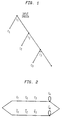
- One of the problems here is to find a feature vector based on which different classes can be easily differentiated, and this feature vector may be different from that used for the speech recognition process. It may also be the case that different feature vectors are needed to isolate different classes. For such circumstances, it is easier to organize the segmentation in the hierarchy of a tree as shown in Fig. 1, where data from a single class is identified at each level of the tree. This also allows for the possibility of using different feature vectors at different levels in the tree. For instance, in Fig. 1, the feature vector f 1 is used to identify segments that belong to class c 1 , f 2 is used to identify segments belonging to class c 2 and so on.
- the upper path in the model corresponds to the input data belonging to the specified class, and the probability distribution of the arcs c 1 - c n is given by M c .
- the lower path corresponds to the input data not belonging to the specified class, and the probability distribution of the arcs C ⁇ 1 - C ⁇ M is given by M c - .
- the minimum lengths of the two paths, N and M constrain the number of contiguous feature vectors that are assigned either to the class or not to the class to be greater than M and N, respectively.
- the viterbi algorithm is used to trace a path through the trellis corresponding to the model in Fig. 2, and to assign a class-ID c or c ⁇ to contiguous sets of the input feature vectors.
- Fig. 1 To deal with broadcast news, the first level of the tree in Fig. 1 was used to isolate pure music segments from the remainder of the data. Note that so far, we have not specified the feature vector f- that is to be used in the procedure described above. There are several features that characterize music, and any one of these, or a combination, could be used to form the feature vector f 1 of Fig. 1.
- a window of the input speech is taken every 10 ms (referred to as a frame) and a feature vector is produced for every frame.
- the first step in the process of extracting a feature vector is the computation of the energy or the log of the energy in logarithmically spaced frequency bands.
- One of the characteristics of music is that it tends to have approximately equal energy in each band.
- one feature that could be used to characterize music is the variance of the energy across the different bands in a frame.
- Another feature that tends to distinguish music from speech is the behavior of the pitch of the signal.
- the pitch for a speech signal tends to show a large variation about the mean value, whereas the pitch for a music signal tends to be relatively constant in time.
- a third possibility for a feature is the cepstra, or a linear combination of the cepstra for several frames.
- the cepstra are obtained by applying the Discrete Fourier Transform to a vector whose elements comprise the energies in the log-spaced frequency bands).
- Yet another possibility is to start with a combination of the above features and then compute a linear discriminant (see P.O. Duda and P.E. Hart, Pattern Classification and Scene Analysis, Wylie, N.Y., 1973) to separate out music and speech (as there are only two classes that need to be distinguished, only one discriminant vector can be found that separates the two classes maximally).
- Fig. 1 After the pure music segments have been removed, the next level in Fig. 1 separates telephone speech from regular speech.
- telephone speech is characterized by having a bandwidth of 300-3700 Hz, whereas regular clean speech has a much larger bandwidth (eg. 0-8000 Hz).
- the ratio of energy in the 300-3700 Hz frequency band, to the energy outside this band could be used as a feature that would help to isolate telephone and regular speech.
- Alternate or additional possibilities include the cepstra, and linear discriminants, as mentioned above for the case of pure music.
- the third level in the tree of Fig. 1 isolates clean speech from speech in a noisy background.
- One of the features that characterizes speech is a large variation in its energy across time, whereas noisy speech shows much less of a variation.
- a possible feature for separating clean and noisy speech is the variance of the energy across time.
- alternate or additional possibilities include the cepstra and linear discriminants.
- the clean speech segments have been identified, it is possible to try and classify them further by the identity of the speaker, or the type of microphone being used, etc.
- the segmentation procedure used here is identical to that used in the earlier hierarchy of the tree, with the difference that the split at this stage is no longer binary. For instance, if it is desired to categorize the clean speech as one of speakers A, B, C or an unknown speaker, then the hierarchy of the tree would be as shown in Fig. 3, and the underlying HMM would be as shown in Fig. 4.
- the arcs labelled a 1 -a m have a probability distribution that characterizes speaker A
- b 1 -b n have a probability distribution that characterizes speaker B
- d 1 -d P have a probability distribution that characterizes the unknown speaker, that represents a speaker-independent model.
- the model for each speaker is made up by combining a number of sub-models where each sub-model characterizes the pronunciation of a phonetic class by the speaker. For instance, if there are K phonetic classes, each speaker model M s is composed of a mixture of sub-models (an example of a sub- model is a Gaussian), each sub-model corresponding to a phonetic class.
- the input speech is first viterbi aligned (see A.J. Viterbi, "Error Bounds for Convolutional Codes and An Asymptotically Optimal Decoding Algorithm", IEEE Trans. on Info. Theory, vol IT-13, pp. 260-69, April 1967) against the given script using a speaker independent model in order to assign a phonetic tag to each feature vector and to isolate regions of silence.
- the task of the segmenter now is to assign a speaker id tag to the speech segments between two silence regions, given the phonetic tag of every feature vector in the segment.
- the acoustic model for assigning a speaker id tag to the segment between two consecutive silence regions is shown in FIG. 4a.
- the length of the segment between the two silences is M
- the phonetic tags assigned to the feature vectors are j 1 ,....,j M .
- the likelihood of a feature vector is computed given the sub-model of the speakers corresponding to the phonetic class that was assigned to the feature vector, for instance j 1 , is the segment, and a j1 , b j1 ,....,u j1 represent the sub-models of the various speakers for the phonetic class j 1 .
- the next step is to transcribe each segment with a speech recognizer that was made specifically for it.
- These systems are made by transforming the training data on which the speech-recognition system is trained, so that it matches the acoustic environment of the class.
- the main characteristic of telephone speech is that it is band-limited from 300-3700 Hz, whereas the clean training data has a higher bandwidth. So in order to transform the training data to better match the telephone-quality speech, the training data is band- limited to 300-3700 Hz, and the speech-recognition system is trained using this transformed data.
- pure music is added to the clean training data and the speech-recognition system is trained on the music-corrupted training data.
- FIG. 5 is a block diagram of a system in accordance with the present invention.
- the invention can be implemented on a general purpose computer programmed to provide the functional blocks shown in FIG. 5.
- the input data which can include clean speech, music-corrupted speech, pure music and/or telephone speech
- the segmenter segments the input data into segments classified as one of the foregoing types of input data.
- Each segment is then directed to a decoder corresponding to the its type: telephone speech segments to telephone speech decoder 502; clean speech to clean speech decoder 506; and music corrupted speech to music corrupted speech decoder 508.
- Each of decoders 502, 506 and 508 produces a decoded output of the input segment, and these outputs are presented as the decoded output of the system. In the case of pure music, no decoded output is in fact produced, since no speech data is contained therein for decoding.
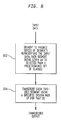
- FIG. 6 shows a flow diagram of an embodiment of the present invention. Again, these steps can implemented on a general purpose computer programmed in accordance with the details set forth herein.
- the first step of the process as shown in FIG. 6 is to provide input data that may contain pure music, music corrupted speech, telephone speech and/or clean speech.
- This input is segmented in step 602 to produce a series of segments representing the input data, each segment being given an ID selected from a predetermined set of ID's: pure music, music corrupted speech, telephone speech and/or clean speech.
- the segments are then decoded and transcribed in step 604 using a particular decoding means tailored to the particular type of data. The result of this operation is presented as the decoded output.
- a preferred embodiment of the present invention allows for the segmentation of speech utterances on the basis of the speaker.
- the method can segment input speech according to the identity of the speakers. It is not necessary that the speakers be known in advance. The number of speakers may also be unknown. If the channel or the background noise changes (i.e. music appears), the method can also segment accordingly.
- this aspect of the invention allows unsupervised segmentation of speech utterances on the basis of the speaker channel and background. It does not require any a-priori information about the signal, but can easily use any such information. It is a fast method which does not require any actual speech recognition phase in order to make a decision.
- This aspect of the invention also regroups the different segments which present the same characteristics (i.e. same speaker through same channel and with similar background), so that systems can be trained on line to the specificity of each class of segments.
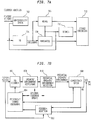
- Figure 7(a) illustrates a method corresponding to this embodiment of the present invention that allows the addition of new codebooks to an existing system.
- the admissibility check 702 selects feature vectors that are not confusable with existing codebooks.
- the feature vectors are then vector quantized at step 704, and the resulting codebooks passed to blocks 706 and 708, where the means and variances are computed, respectively.
- the means and variances are then stored at block 710.
- An account of all feature vectors that are outside the means and variances of a particular codebook are maintained in scores block 712. If the number such vectors exceeds a predetermined threshold, the feature vector is discarded.
- Figure 7(b) describes the procedure for testing. Each frame is decoded at step 802 with the set of codebooks currently existing, using input from block 804.
- a set of histograms is then generated at block 806, and these histograms are used to select a codebook at step 810.
- the histograms represent the number of feature vectors in the test speech that match-up with each codebook.
- the potential codebook is checked for consistency (ratios of distances to codewords to the variances of these codewords) at step 808. If the selection is acceptable, the frames are tagged by a codebook index. It is optional to use the data to update the associated frames. In general, stability suggests not to use more than 10 seconds worth of data to define a codebook. If the consistency test fails, a new codebook is added to the set using admissible frames at step 812.
- the method not only segments the files when there is a change of speaker, but it can also regroup segments associated with a particular speaker (or under similar conditions).
- codebooks can be built with pure speech, pure music and different types of music plus speech.
- the feature vectors are the MEL cepstra, delta and delta-delta (including C0 (energy)). They are 39 dimension vectors.
- the features are usually computed on frames of 30ms with shifts of 10ms. Note that it is purely a function of the speech recognizer for which model prefetching is implemented. If other feature vectors (like LPC cepstra) are used, the feature vector used by the segmenter can be LPC cepstra. However, the efficiency of the segmenter depends on the set of features used. Of course, it is always possible to use different feature sets for the recognizer and the segmenter.
- the segmenter system stores a minimum of information about each type of segment: for example, a codebook of 65 codewords (although the number of codewords is not critical), their variances and some optional scores obtained during enrolment. In particular, it is not necessary to store the training utterances.
- the system can tag the associated frames accordingly.
- Segmentation is performed using a generalized vector quantization algorithm.
- the feature vectors selected as admissible are clustered in a set of, for example, 65 codewords.
- the variance of each cluster is also stored.
- some additional scores are stored for each codeword, including, the number of feature vectors associated with this codeword while being far apart from it.
- Two distances can be used: a Mahalanobis distance which is a euclidian distance with weights that are the inverse of the variances of each dimension of the feature vector (These weights can be decided a-priori based on the data used to train the speech recognition application or on the fly on the training and/or testing data), or a probabilistic distance where the distance is the log-likelihood of the Gaussian associated with the codeword (same means and variances).
- 10 seconds of speech are used for training.
- Feature vectors are considered admissible if they are not confusable with existing codewords. This means that some vectors too close to existing codewords are rejected during clustering. If this is not done, instabilities will occur due to overlapping of clusters.
- the feature vectors are obtained from the acoustic front-end. After about three seconds of speech, a candidate tag will begin to emerge. After about 5 to 10 seconds, a final decision is made.
- the testing is implemented as a generalized VQ decoder. On a frame by frame basis, it identifies the closest codebook (or ranks the N closest). A histogram is then created which counts how many frames have selected each codebook. The codebook which was most often selected identifies the potential tag.
- the segmenter checks if the potential tag is a consistent choice. If it is not, a new codebook is added using admissible frames. The consistency is checked based on different tests. Firstly, the histogram is inspected. A clear maxima indicates a good chance that the choice is correct. If a set of competing codebooks emerges, tests on the variances are more critical. The test of variances are defined as follows: for each feature vector, its distance to the selected codeword or the competing codewords are compared to their associated variances. If the distances are too large given the associated scores, the codebook is rejected. If no codebook is eventually accepted, none is identified and a new codebook must be built. If one codebook remains acceptable, then it identifies the tag.
Landscapes
- Engineering & Computer Science (AREA)
- Computational Linguistics (AREA)
- Health & Medical Sciences (AREA)
- Audiology, Speech & Language Pathology (AREA)
- Human Computer Interaction (AREA)
- Physics & Mathematics (AREA)
- Acoustics & Sound (AREA)
- Multimedia (AREA)
- Information Retrieval, Db Structures And Fs Structures Therefor (AREA)
- Telephonic Communication Services (AREA)
Applications Claiming Priority (2)
| Application Number | Priority Date | Filing Date | Title |
|---|---|---|---|
| US595722 | 1996-02-02 | ||
| US08/595,722 US6067517A (en) | 1996-02-02 | 1996-02-02 | Transcription of speech data with segments from acoustically dissimilar environments |
Publications (3)
| Publication Number | Publication Date |
|---|---|
| EP0788090A2 true EP0788090A2 (fr) | 1997-08-06 |
| EP0788090A3 EP0788090A3 (fr) | 1998-08-19 |
| EP0788090B1 EP0788090B1 (fr) | 2003-06-25 |
Family
ID=24384411
Family Applications (1)
| Application Number | Title | Priority Date | Filing Date |
|---|---|---|---|
| EP97300290A Expired - Lifetime EP0788090B1 (fr) | 1996-02-02 | 1997-01-17 | Transcription des données des signaux vocaux avec des segments des environnements acoustiquement différents |
Country Status (3)
| Country | Link |
|---|---|
| US (1) | US6067517A (fr) |
| EP (1) | EP0788090B1 (fr) |
| DE (1) | DE69722980T2 (fr) |
Cited By (4)
| Publication number | Priority date | Publication date | Assignee | Title |
|---|---|---|---|---|
| WO2001003113A1 (fr) * | 1999-07-01 | 2001-01-11 | Koninklijke Philips Electronics N.V. | Traitement robuste de la parole a partir de modeles de parole bruitee |
| WO2003094151A1 (fr) * | 2002-05-06 | 2003-11-13 | Prous Science S.A. | Procede de reconnaissance vocale |
| GB2430073A (en) * | 2005-09-08 | 2007-03-14 | Univ East Anglia | Analysis and transcription of music |
| CN1949364B (zh) * | 2005-10-12 | 2010-05-05 | 财团法人工业技术研究院 | 语音识别的前级检测系统与方法 |
Families Citing this family (71)
| Publication number | Priority date | Publication date | Assignee | Title |
|---|---|---|---|---|
| US5258855A (en) * | 1991-03-20 | 1993-11-02 | System X, L. P. | Information processing methodology |
| US6683697B1 (en) * | 1991-03-20 | 2004-01-27 | Millenium L.P. | Information processing methodology |
| US5897616A (en) | 1997-06-11 | 1999-04-27 | International Business Machines Corporation | Apparatus and methods for speaker verification/identification/classification employing non-acoustic and/or acoustic models and databases |
| US6377921B1 (en) * | 1998-06-26 | 2002-04-23 | International Business Machines Corporation | Identifying mismatches between assumed and actual pronunciations of words |
| US6260014B1 (en) * | 1998-09-14 | 2001-07-10 | International Business Machines Corporation | Specific task composite acoustic models |
| US6324510B1 (en) * | 1998-11-06 | 2001-11-27 | Lernout & Hauspie Speech Products N.V. | Method and apparatus of hierarchically organizing an acoustic model for speech recognition and adaptation of the model to unseen domains |
| US7006967B1 (en) * | 1999-02-05 | 2006-02-28 | Custom Speech Usa, Inc. | System and method for automating transcription services |
| JP2000259198A (ja) * | 1999-03-04 | 2000-09-22 | Sony Corp | パターン認識装置および方法、並びに提供媒体 |
| US6577999B1 (en) * | 1999-03-08 | 2003-06-10 | International Business Machines Corporation | Method and apparatus for intelligently managing multiple pronunciations for a speech recognition vocabulary |
| US6332122B1 (en) | 1999-06-23 | 2001-12-18 | International Business Machines Corporation | Transcription system for multiple speakers, using and establishing identification |
| US7689416B1 (en) * | 1999-09-29 | 2010-03-30 | Poirier Darrell A | System for transferring personalize matter from one computer to another |
| US7016835B2 (en) * | 1999-10-29 | 2006-03-21 | International Business Machines Corporation | Speech and signal digitization by using recognition metrics to select from multiple techniques |
| US6834308B1 (en) * | 2000-02-17 | 2004-12-21 | Audible Magic Corporation | Method and apparatus for identifying media content presented on a media playing device |
| US20020055844A1 (en) * | 2000-02-25 | 2002-05-09 | L'esperance Lauren | Speech user interface for portable personal devices |
| DE60128372T2 (de) * | 2000-07-31 | 2008-01-10 | Eliza Corp., Beverly | Verfahren und system zur verbesserung der genauigkeit in einem spracherkennungssystem |
| US6990446B1 (en) * | 2000-10-10 | 2006-01-24 | Microsoft Corporation | Method and apparatus using spectral addition for speaker recognition |
| US6876966B1 (en) * | 2000-10-16 | 2005-04-05 | Microsoft Corporation | Pattern recognition training method and apparatus using inserted noise followed by noise reduction |
| US7003455B1 (en) * | 2000-10-16 | 2006-02-21 | Microsoft Corporation | Method of noise reduction using correction and scaling vectors with partitioning of the acoustic space in the domain of noisy speech |
| JP3467469B2 (ja) * | 2000-10-31 | 2003-11-17 | Necエレクトロニクス株式会社 | 音声復号装置および音声復号プログラムを記録した記録媒体 |
| US6605768B2 (en) * | 2000-12-06 | 2003-08-12 | Matsushita Electric Industrial Co., Ltd. | Music-signal compressing/decompressing apparatus |
| US6826241B2 (en) | 2001-02-21 | 2004-11-30 | Motorola, Inc. | Apparatus and method for filtering maximum-length-code signals in a spread spectrum communication system |
| US6985858B2 (en) * | 2001-03-20 | 2006-01-10 | Microsoft Corporation | Method and apparatus for removing noise from feature vectors |
| US7363278B2 (en) | 2001-04-05 | 2008-04-22 | Audible Magic Corporation | Copyright detection and protection system and method |
| US7953219B2 (en) * | 2001-07-19 | 2011-05-31 | Nice Systems, Ltd. | Method apparatus and system for capturing and analyzing interaction based content |
| US8972481B2 (en) | 2001-07-20 | 2015-03-03 | Audible Magic, Inc. | Playlist generation method and apparatus |
| US6959276B2 (en) * | 2001-09-27 | 2005-10-25 | Microsoft Corporation | Including the category of environmental noise when processing speech signals |
| US7117148B2 (en) | 2002-04-05 | 2006-10-03 | Microsoft Corporation | Method of noise reduction using correction vectors based on dynamic aspects of speech and noise normalization |
| US7319959B1 (en) * | 2002-05-14 | 2008-01-15 | Audience, Inc. | Multi-source phoneme classification for noise-robust automatic speech recognition |
| US20030220784A1 (en) * | 2002-05-24 | 2003-11-27 | International Business Machines Corporation | System and method for automated voice message transcription and delivery |
| US20040006628A1 (en) * | 2002-07-03 | 2004-01-08 | Scott Shepard | Systems and methods for providing real-time alerting |
| US20040006481A1 (en) * | 2002-07-03 | 2004-01-08 | Daniel Kiecza | Fast transcription of speech |
| US20040021765A1 (en) * | 2002-07-03 | 2004-02-05 | Francis Kubala | Speech recognition system for managing telemeetings |
| US20040083090A1 (en) * | 2002-10-17 | 2004-04-29 | Daniel Kiecza | Manager for integrating language technology components |
| US8335683B2 (en) * | 2003-01-23 | 2012-12-18 | Microsoft Corporation | System for using statistical classifiers for spoken language understanding |
| WO2004090870A1 (fr) * | 2003-04-04 | 2004-10-21 | Kabushiki Kaisha Toshiba | Procede et dispositif pour le codage ou le decodage de signaux audio large bande |
| US7596494B2 (en) * | 2003-11-26 | 2009-09-29 | Microsoft Corporation | Method and apparatus for high resolution speech reconstruction |
| US7725314B2 (en) * | 2004-02-16 | 2010-05-25 | Microsoft Corporation | Method and apparatus for constructing a speech filter using estimates of clean speech and noise |
| DE102004017486A1 (de) * | 2004-04-08 | 2005-10-27 | Siemens Ag | Verfahren zur Geräuschreduktion bei einem Sprach-Eingangssignal |
| US8204884B2 (en) * | 2004-07-14 | 2012-06-19 | Nice Systems Ltd. | Method, apparatus and system for capturing and analyzing interaction based content |
| US20060288402A1 (en) * | 2005-06-20 | 2006-12-21 | Nokia Corporation | Security component for dynamic properties framework |
| US20070239444A1 (en) * | 2006-03-29 | 2007-10-11 | Motorola, Inc. | Voice signal perturbation for speech recognition |
| KR100883652B1 (ko) * | 2006-08-03 | 2009-02-18 | 삼성전자주식회사 | 음성 구간 검출 방법 및 장치, 및 이를 이용한 음성 인식시스템 |
| US7885813B2 (en) * | 2006-09-29 | 2011-02-08 | Verint Systems Inc. | Systems and methods for analyzing communication sessions |
| US8006314B2 (en) | 2007-07-27 | 2011-08-23 | Audible Magic Corporation | System for identifying content of digital data |
| US8219404B2 (en) * | 2007-08-09 | 2012-07-10 | Nice Systems, Ltd. | Method and apparatus for recognizing a speaker in lawful interception systems |
| US8249870B2 (en) * | 2008-11-12 | 2012-08-21 | Massachusetts Institute Of Technology | Semi-automatic speech transcription |
| WO2010066269A1 (fr) * | 2008-12-10 | 2010-06-17 | Agnitio, S.L. | Procédé de confirmation de l'identité d'un locuteur, support lisible par ordinateur et ordinateur associés |
| EP2328363B1 (fr) | 2009-09-11 | 2016-05-18 | Starkey Laboratories, Inc. | Système de classification des sons pour appareils auditifs |
| US8554562B2 (en) * | 2009-11-15 | 2013-10-08 | Nuance Communications, Inc. | Method and system for speaker diarization |
| US8718290B2 (en) | 2010-01-26 | 2014-05-06 | Audience, Inc. | Adaptive noise reduction using level cues |
| US9378754B1 (en) | 2010-04-28 | 2016-06-28 | Knowles Electronics, Llc | Adaptive spatial classifier for multi-microphone systems |
| US9564148B2 (en) * | 2010-05-18 | 2017-02-07 | Sprint Communications Company L.P. | Isolation and modification of audio streams of a mixed signal in a wireless communication device |
| US8812310B2 (en) * | 2010-08-22 | 2014-08-19 | King Saud University | Environment recognition of audio input |
| US8442825B1 (en) | 2011-08-16 | 2013-05-14 | The United States Of America As Represented By The Director, National Security Agency | Biomimetic voice identifier |
| KR101482148B1 (ko) * | 2011-12-23 | 2015-01-14 | 주식회사 케이티 | 개인화된 발음열을 이용한 그룹 매핑 데이터 생성 서버, 음성 인식 서버 및 방법 |
| US9026065B2 (en) * | 2012-03-21 | 2015-05-05 | Raytheon Company | Methods and apparatus for resource sharing for voice and data interlacing |
| US9081778B2 (en) | 2012-09-25 | 2015-07-14 | Audible Magic Corporation | Using digital fingerprints to associate data with a work |
| US9508345B1 (en) | 2013-09-24 | 2016-11-29 | Knowles Electronics, Llc | Continuous voice sensing |
| US9953634B1 (en) | 2013-12-17 | 2018-04-24 | Knowles Electronics, Llc | Passive training for automatic speech recognition |
| US9437188B1 (en) | 2014-03-28 | 2016-09-06 | Knowles Electronics, Llc | Buffered reprocessing for multi-microphone automatic speech recognition assist |
| US9858922B2 (en) | 2014-06-23 | 2018-01-02 | Google Inc. | Caching speech recognition scores |
| US9299347B1 (en) * | 2014-10-22 | 2016-03-29 | Google Inc. | Speech recognition using associative mapping |
| US9786270B2 (en) | 2015-07-09 | 2017-10-10 | Google Inc. | Generating acoustic models |
| US10229672B1 (en) | 2015-12-31 | 2019-03-12 | Google Llc | Training acoustic models using connectionist temporal classification |
| US20180018973A1 (en) | 2016-07-15 | 2018-01-18 | Google Inc. | Speaker verification |
| US10706840B2 (en) | 2017-08-18 | 2020-07-07 | Google Llc | Encoder-decoder models for sequence to sequence mapping |
| US10586529B2 (en) * | 2017-09-14 | 2020-03-10 | International Business Machines Corporation | Processing of speech signal |
| CN109545229B (zh) * | 2019-01-11 | 2023-04-21 | 华南理工大学 | 一种基于语音样本特征空间轨迹的说话人识别方法 |
| KR20200140571A (ko) * | 2019-06-07 | 2020-12-16 | 삼성전자주식회사 | 데이터 인식 방법 및 장치 |
| CN111883159B (zh) * | 2020-08-05 | 2024-12-17 | 龙马智芯(珠海横琴)科技有限公司 | 语音的处理方法及装置 |
| US12321846B2 (en) * | 2020-12-09 | 2025-06-03 | International Business Machines Corporation | Knowledge distillation using deep clustering |
Family Cites Families (6)
| Publication number | Priority date | Publication date | Assignee | Title |
|---|---|---|---|---|
| US4430726A (en) * | 1981-06-18 | 1984-02-07 | Bell Telephone Laboratories, Incorporated | Dictation/transcription method and arrangement |
| ES2128390T3 (es) * | 1992-03-02 | 1999-05-16 | At & T Corp | Metodo de adiestramiento y dispositivo para reconocimiento de voz. |
| US5333275A (en) * | 1992-06-23 | 1994-07-26 | Wheatley Barbara J | System and method for time aligning speech |
| EP0645757B1 (fr) * | 1993-09-23 | 2000-04-05 | Xerox Corporation | Filtre sémantique de cooccurrence pour la reconnaissance de la parole et pour utilisations dans la transcription de signaux |
| JP2986345B2 (ja) * | 1993-10-18 | 1999-12-06 | インターナショナル・ビジネス・マシーンズ・コーポレイション | 音声記録指標化装置及び方法 |
| US5625748A (en) * | 1994-04-18 | 1997-04-29 | Bbn Corporation | Topic discriminator using posterior probability or confidence scores |
-
1996
- 1996-02-02 US US08/595,722 patent/US6067517A/en not_active Expired - Lifetime
-
1997
- 1997-01-17 DE DE69722980T patent/DE69722980T2/de not_active Expired - Lifetime
- 1997-01-17 EP EP97300290A patent/EP0788090B1/fr not_active Expired - Lifetime
Non-Patent Citations (2)
| Title |
|---|
| "Pattern Classification and Scene Analysis", 1973, WYLIE, NEW YORK |
| VITERBI A.J.: "Error Bounds for Convolutional Codes and an Asymptotically Optimum Decoding Algorithm", IEEE TRANSACTIONS ON INFORMATION THEORY, vol. IT-13, no. 2, April 1967 (1967-04-01), pages 260 - 269, XP000760906 |
Cited By (4)
| Publication number | Priority date | Publication date | Assignee | Title |
|---|---|---|---|---|
| WO2001003113A1 (fr) * | 1999-07-01 | 2001-01-11 | Koninklijke Philips Electronics N.V. | Traitement robuste de la parole a partir de modeles de parole bruitee |
| WO2003094151A1 (fr) * | 2002-05-06 | 2003-11-13 | Prous Science S.A. | Procede de reconnaissance vocale |
| GB2430073A (en) * | 2005-09-08 | 2007-03-14 | Univ East Anglia | Analysis and transcription of music |
| CN1949364B (zh) * | 2005-10-12 | 2010-05-05 | 财团法人工业技术研究院 | 语音识别的前级检测系统与方法 |
Also Published As
| Publication number | Publication date |
|---|---|
| DE69722980T2 (de) | 2004-05-19 |
| US6067517A (en) | 2000-05-23 |
| EP0788090B1 (fr) | 2003-06-25 |
| DE69722980D1 (de) | 2003-07-31 |
| EP0788090A3 (fr) | 1998-08-19 |
Similar Documents
| Publication | Publication Date | Title |
|---|---|---|
| EP0788090B1 (fr) | Transcription des données des signaux vocaux avec des segments des environnements acoustiquement différents | |
| EP0533491B1 (fr) | Reconnaissance de mots clefs dans la parole continue utilisant deux modèles de Markov cachés | |
| US5862519A (en) | Blind clustering of data with application to speech processing systems | |
| US6434520B1 (en) | System and method for indexing and querying audio archives | |
| EP2048656B1 (fr) | Reconnaissance du locuteur | |
| Holmes et al. | Probabilistic-trajectory segmental HMMs | |
| US6539352B1 (en) | Subword-based speaker verification with multiple-classifier score fusion weight and threshold adaptation | |
| JP3037864B2 (ja) | 音声コード化装置及び方法 | |
| Akbacak et al. | Environmental sniffing: noise knowledge estimation for robust speech systems | |
| EP1465154B1 (fr) | Méthode pour la reconnaissance de parole utilisant l'inférence variationelle avec des modèles d'espace à états changeants | |
| US7689419B2 (en) | Updating hidden conditional random field model parameters after processing individual training samples | |
| US7627473B2 (en) | Hidden conditional random field models for phonetic classification and speech recognition | |
| US7315819B2 (en) | Apparatus for performing speaker identification and speaker searching in speech or sound image data, and method thereof | |
| Nishida et al. | Speaker model selection based on the Bayesian information criterion applied to unsupervised speaker indexing | |
| US20060129392A1 (en) | Method for extracting feature vectors for speech recognition | |
| Rose | Word spotting from continuous speech utterances | |
| JP4696418B2 (ja) | 情報検出装置及び方法 | |
| Unnibhavi et al. | LPC based speech recognition for Kannada vowels | |
| Navrátil | Automatic language identification | |
| Furui | Generalization problem in ASR acoustic model training and adaptation | |
| US20030182110A1 (en) | Method of speech recognition using variables representing dynamic aspects of speech | |
| EP0177854B1 (fr) | Système de reconnaissance de mot clef utilisant des chaînes d'éléments de langage | |
| Holmes | Modelling segmental variability for automatic speech recognition | |
| Kumar et al. | Robust detection of vowel onset and end points | |
| JP5136621B2 (ja) | 情報検索装置及び方法 |
Legal Events
| Date | Code | Title | Description |
|---|---|---|---|
| PUAI | Public reference made under article 153(3) epc to a published international application that has entered the european phase |
Free format text: ORIGINAL CODE: 0009012 |
|
| AK | Designated contracting states |
Kind code of ref document: A2 Designated state(s): DE GB |
|
| PUAL | Search report despatched |
Free format text: ORIGINAL CODE: 0009013 |
|
| AK | Designated contracting states |
Kind code of ref document: A3 Designated state(s): DE GB |
|
| RHK1 | Main classification (correction) |
Ipc: G10L 5/06 |
|
| 17P | Request for examination filed |
Effective date: 19990130 |
|
| 17Q | First examination report despatched |
Effective date: 20010928 |
|
| RIC1 | Information provided on ipc code assigned before grant |
Free format text: 7G 10L 15/20 A |
|
| GRAH | Despatch of communication of intention to grant a patent |
Free format text: ORIGINAL CODE: EPIDOS IGRA |
|
| RIC1 | Information provided on ipc code assigned before grant |
Free format text: 7G 10L 15/20 A, 7G 10L 17/00 B |
|
| GRAH | Despatch of communication of intention to grant a patent |
Free format text: ORIGINAL CODE: EPIDOS IGRA |
|
| GRAA | (expected) grant |
Free format text: ORIGINAL CODE: 0009210 |
|
| AK | Designated contracting states |
Designated state(s): DE GB |
|
| REG | Reference to a national code |
Ref country code: GB Ref legal event code: FG4D |
|
| REF | Corresponds to: |
Ref document number: 69722980 Country of ref document: DE Date of ref document: 20030731 Kind code of ref document: P |
|
| PLBE | No opposition filed within time limit |
Free format text: ORIGINAL CODE: 0009261 |
|
| STAA | Information on the status of an ep patent application or granted ep patent |
Free format text: STATUS: NO OPPOSITION FILED WITHIN TIME LIMIT |
|
| 26N | No opposition filed |
Effective date: 20040326 |
|
| REG | Reference to a national code |
Ref country code: GB Ref legal event code: 746 Effective date: 20071206 |
|
| PGFP | Annual fee paid to national office [announced via postgrant information from national office to epo] |
Ref country code: DE Payment date: 20160129 Year of fee payment: 20 |
|
| PGFP | Annual fee paid to national office [announced via postgrant information from national office to epo] |
Ref country code: GB Payment date: 20160125 Year of fee payment: 20 |
|
| REG | Reference to a national code |
Ref country code: DE Ref legal event code: R071 Ref document number: 69722980 Country of ref document: DE |
|
| REG | Reference to a national code |
Ref country code: GB Ref legal event code: PE20 Expiry date: 20170116 |
|
| PG25 | Lapsed in a contracting state [announced via postgrant information from national office to epo] |
Ref country code: GB Free format text: LAPSE BECAUSE OF EXPIRATION OF PROTECTION Effective date: 20170116 |