EP0789018A1 - Hydrierung von halonitroaromatischen Verbindungen - Google Patents
Hydrierung von halonitroaromatischen Verbindungen Download PDFInfo
- Publication number
- EP0789018A1 EP0789018A1 EP97101412A EP97101412A EP0789018A1 EP 0789018 A1 EP0789018 A1 EP 0789018A1 EP 97101412 A EP97101412 A EP 97101412A EP 97101412 A EP97101412 A EP 97101412A EP 0789018 A1 EP0789018 A1 EP 0789018A1
- Authority
- EP
- European Patent Office
- Prior art keywords
- formula
- haloaromatic
- iron
- weight
- halonitroaromatic
- Prior art date
- Legal status (The legal status is an assumption and is not a legal conclusion. Google has not performed a legal analysis and makes no representation as to the accuracy of the status listed.)
- Withdrawn
Links
- 150000001875 compounds Chemical class 0.000 title claims description 26
- 238000005984 hydrogenation reaction Methods 0.000 title description 2
- XEEYBQQBJWHFJM-UHFFFAOYSA-N Iron Chemical compound [Fe] XEEYBQQBJWHFJM-UHFFFAOYSA-N 0.000 claims abstract description 34
- -1 aromatic nitro compound Chemical class 0.000 claims abstract description 26
- 229910052742 iron Inorganic materials 0.000 claims abstract description 17
- 125000003118 aryl group Chemical group 0.000 claims abstract description 15
- 229910000564 Raney nickel Inorganic materials 0.000 claims abstract description 14
- 125000000217 alkyl group Chemical group 0.000 claims abstract description 10
- 238000009903 catalytic hydrogenation reaction Methods 0.000 claims abstract description 9
- NPXOKRUENSOPAO-UHFFFAOYSA-N Raney nickel Chemical compound [Al].[Ni] NPXOKRUENSOPAO-UHFFFAOYSA-N 0.000 claims abstract description 7
- 229910052739 hydrogen Inorganic materials 0.000 claims abstract description 7
- NGNBDVOYPDDBFK-UHFFFAOYSA-N 2-[2,4-di(pentan-2-yl)phenoxy]acetyl chloride Chemical compound CCCC(C)C1=CC=C(OCC(Cl)=O)C(C(C)CCC)=C1 NGNBDVOYPDDBFK-UHFFFAOYSA-N 0.000 claims abstract description 6
- 229910052801 chlorine Inorganic materials 0.000 claims abstract description 6
- 125000003917 carbamoyl group Chemical group [H]N([H])C(*)=O 0.000 claims abstract description 5
- 238000004519 manufacturing process Methods 0.000 claims abstract description 4
- 125000004423 acyloxy group Chemical group 0.000 claims abstract description 3
- 125000003545 alkoxy group Chemical group 0.000 claims abstract description 3
- 125000004390 alkyl sulfonyl group Chemical group 0.000 claims abstract description 3
- 125000003435 aroyl group Chemical group 0.000 claims abstract description 3
- 125000005333 aroyloxy group Chemical group 0.000 claims abstract description 3
- 125000004391 aryl sulfonyl group Chemical group 0.000 claims abstract description 3
- 125000004104 aryloxy group Chemical group 0.000 claims abstract description 3
- 125000001589 carboacyl group Chemical group 0.000 claims abstract description 3
- 125000006297 carbonyl amino group Chemical group [H]N([*:2])C([*:1])=O 0.000 claims abstract description 3
- 125000002485 formyl group Chemical group [H]C(*)=O 0.000 claims abstract description 3
- 125000002924 primary amino group Chemical group [H]N([H])* 0.000 claims abstract description 3
- 125000005236 alkanoylamino group Chemical group 0.000 claims abstract 2
- 238000000034 method Methods 0.000 claims description 24
- 150000001412 amines Chemical class 0.000 claims description 19
- 239000003054 catalyst Substances 0.000 claims description 18
- 239000007868 Raney catalyst Substances 0.000 claims description 10
- 239000000460 chlorine Substances 0.000 claims description 9
- ZAMOUSCENKQFHK-UHFFFAOYSA-N Chlorine atom Chemical compound [Cl] ZAMOUSCENKQFHK-UHFFFAOYSA-N 0.000 claims description 8
- UFHFLCQGNIYNRP-UHFFFAOYSA-N Hydrogen Chemical compound [H][H] UFHFLCQGNIYNRP-UHFFFAOYSA-N 0.000 claims description 8
- 125000004432 carbon atom Chemical group C* 0.000 claims description 7
- 125000005843 halogen group Chemical group 0.000 claims description 7
- 125000001424 substituent group Chemical group 0.000 claims description 7
- 229910052782 aluminium Inorganic materials 0.000 claims description 6
- XAGFODPZIPBFFR-UHFFFAOYSA-N aluminium Chemical compound [Al] XAGFODPZIPBFFR-UHFFFAOYSA-N 0.000 claims description 6
- 239000001257 hydrogen Substances 0.000 claims description 6
- 229910052799 carbon Inorganic materials 0.000 claims description 5
- LFQSCWFLJHTTHZ-UHFFFAOYSA-N Ethanol Chemical compound CCO LFQSCWFLJHTTHZ-UHFFFAOYSA-N 0.000 claims description 4
- 238000002360 preparation method Methods 0.000 claims description 4
- 125000004397 aminosulfonyl group Chemical group NS(=O)(=O)* 0.000 claims description 3
- 125000001931 aliphatic group Chemical group 0.000 claims description 2
- 125000005144 cycloalkylsulfonyl group Chemical group 0.000 claims description 2
- 125000002887 hydroxy group Chemical group [H]O* 0.000 claims description 2
- 239000003973 paint Substances 0.000 claims 1
- 238000006243 chemical reaction Methods 0.000 abstract description 7
- 125000004453 alkoxycarbonyl group Chemical group 0.000 abstract description 2
- 125000005161 aryl oxy carbonyl group Chemical group 0.000 abstract description 2
- 150000004982 aromatic amines Chemical class 0.000 abstract 1
- 125000005239 aroylamino group Chemical group 0.000 abstract 1
- 125000000623 heterocyclic group Chemical group 0.000 abstract 1
- QTBSBXVTEAMEQO-UHFFFAOYSA-N Acetic acid Chemical compound CC(O)=O QTBSBXVTEAMEQO-UHFFFAOYSA-N 0.000 description 24
- OKKJLVBELUTLKV-UHFFFAOYSA-N Methanol Chemical compound OC OKKJLVBELUTLKV-UHFFFAOYSA-N 0.000 description 18
- IJGRMHOSHXDMSA-UHFFFAOYSA-N Atomic nitrogen Chemical compound N#N IJGRMHOSHXDMSA-UHFFFAOYSA-N 0.000 description 16
- PXHVJJICTQNCMI-UHFFFAOYSA-N Nickel Chemical compound [Ni] PXHVJJICTQNCMI-UHFFFAOYSA-N 0.000 description 16
- HEMHJVSKTPXQMS-UHFFFAOYSA-M Sodium hydroxide Chemical compound [OH-].[Na+] HEMHJVSKTPXQMS-UHFFFAOYSA-M 0.000 description 15
- 239000000203 mixture Substances 0.000 description 14
- 239000000243 solution Substances 0.000 description 10
- XLYOFNOQVPJJNP-UHFFFAOYSA-N water Substances O XLYOFNOQVPJJNP-UHFFFAOYSA-N 0.000 description 10
- 239000002585 base Substances 0.000 description 9
- 238000004128 high performance liquid chromatography Methods 0.000 description 9
- 229910052757 nitrogen Inorganic materials 0.000 description 8
- UHOVQNZJYSORNB-UHFFFAOYSA-N monobenzene Natural products C1=CC=CC=C1 UHOVQNZJYSORNB-UHFFFAOYSA-N 0.000 description 6
- 150000002828 nitro derivatives Chemical class 0.000 description 6
- 238000003756 stirring Methods 0.000 description 6
- 239000002253 acid Substances 0.000 description 5
- 239000000843 powder Substances 0.000 description 5
- 239000000047 product Substances 0.000 description 5
- 239000002904 solvent Substances 0.000 description 5
- KONNKNHQEUEYPZ-UHFFFAOYSA-N 5-(2-chloro-5-nitroanilino)-2-(2,4,6-trichlorophenyl)-4h-pyrazol-3-one Chemical compound [O-][N+](=O)C1=CC=C(Cl)C(NC=2CC(=O)N(N=2)C=2C(=CC(Cl)=CC=2Cl)Cl)=C1 KONNKNHQEUEYPZ-UHFFFAOYSA-N 0.000 description 4
- 229910000831 Steel Inorganic materials 0.000 description 4
- WYURNTSHIVDZCO-UHFFFAOYSA-N Tetrahydrofuran Chemical compound C1CCOC1 WYURNTSHIVDZCO-UHFFFAOYSA-N 0.000 description 4
- 125000000753 cycloalkyl group Chemical group 0.000 description 4
- 238000005695 dehalogenation reaction Methods 0.000 description 4
- 229910052759 nickel Inorganic materials 0.000 description 4
- 239000003960 organic solvent Substances 0.000 description 4
- 239000007787 solid Substances 0.000 description 4
- 239000010959 steel Substances 0.000 description 4
- XEKOWRVHYACXOJ-UHFFFAOYSA-N Ethyl acetate Chemical compound CCOC(C)=O XEKOWRVHYACXOJ-UHFFFAOYSA-N 0.000 description 3
- ZMXDDKWLCZADIW-UHFFFAOYSA-N N,N-Dimethylformamide Chemical compound CN(C)C=O ZMXDDKWLCZADIW-UHFFFAOYSA-N 0.000 description 3
- 150000008044 alkali metal hydroxides Chemical class 0.000 description 3
- 125000002837 carbocyclic group Chemical group 0.000 description 3
- 150000001805 chlorine compounds Chemical class 0.000 description 3
- 239000000725 suspension Substances 0.000 description 3
- 0 *c(cc1)c(*)cc1[N+]([O-])=O Chemical compound *c(cc1)c(*)cc1[N+]([O-])=O 0.000 description 2
- KFZMGEQAYNKOFK-UHFFFAOYSA-N Isopropanol Chemical compound CC(C)O KFZMGEQAYNKOFK-UHFFFAOYSA-N 0.000 description 2
- NBIIXXVUZAFLBC-UHFFFAOYSA-N Phosphoric acid Chemical compound OP(O)(O)=O NBIIXXVUZAFLBC-UHFFFAOYSA-N 0.000 description 2
- 150000007513 acids Chemical class 0.000 description 2
- 229910001854 alkali hydroxide Inorganic materials 0.000 description 2
- 229910045601 alloy Inorganic materials 0.000 description 2
- 239000000956 alloy Substances 0.000 description 2
- 125000003277 amino group Chemical group 0.000 description 2
- 150000001555 benzenes Chemical class 0.000 description 2
- 239000006227 byproduct Substances 0.000 description 2
- 150000001721 carbon Chemical group 0.000 description 2
- 150000001735 carboxylic acids Chemical class 0.000 description 2
- 229910017052 cobalt Inorganic materials 0.000 description 2
- 239000010941 cobalt Substances 0.000 description 2
- GUTLYIVDDKVIGB-UHFFFAOYSA-N cobalt atom Chemical compound [Co] GUTLYIVDDKVIGB-UHFFFAOYSA-N 0.000 description 2
- 238000001816 cooling Methods 0.000 description 2
- XBDQKXXYIPTUBI-UHFFFAOYSA-N dimethylselenoniopropionate Natural products CCC(O)=O XBDQKXXYIPTUBI-UHFFFAOYSA-N 0.000 description 2
- 238000001914 filtration Methods 0.000 description 2
- 125000002496 methyl group Chemical group [H]C([H])([H])* 0.000 description 2
- 125000001624 naphthyl group Chemical class 0.000 description 2
- BASFCYQUMIYNBI-UHFFFAOYSA-N platinum Chemical compound [Pt] BASFCYQUMIYNBI-UHFFFAOYSA-N 0.000 description 2
- 150000003254 radicals Chemical class 0.000 description 2
- 239000007858 starting material Substances 0.000 description 2
- YLQBMQCUIZJEEH-UHFFFAOYSA-N tetrahydrofuran Natural products C=1C=COC=1 YLQBMQCUIZJEEH-UHFFFAOYSA-N 0.000 description 2
- 125000003837 (C1-C20) alkyl group Chemical group 0.000 description 1
- XNWFRZJHXBZDAG-UHFFFAOYSA-N 2-METHOXYETHANOL Chemical compound COCCO XNWFRZJHXBZDAG-UHFFFAOYSA-N 0.000 description 1
- OKTJSMMVPCPJKN-UHFFFAOYSA-N Carbon Chemical compound [C] OKTJSMMVPCPJKN-UHFFFAOYSA-N 0.000 description 1
- VYZAMTAEIAYCRO-UHFFFAOYSA-N Chromium Chemical compound [Cr] VYZAMTAEIAYCRO-UHFFFAOYSA-N 0.000 description 1
- ZAFNJMIOTHYJRJ-UHFFFAOYSA-N Diisopropyl ether Chemical compound CC(C)OC(C)C ZAFNJMIOTHYJRJ-UHFFFAOYSA-N 0.000 description 1
- SNRUBQQJIBEYMU-UHFFFAOYSA-N Dodecane Natural products CCCCCCCCCCCC SNRUBQQJIBEYMU-UHFFFAOYSA-N 0.000 description 1
- FXHOOIRPVKKKFG-UHFFFAOYSA-N N,N-Dimethylacetamide Chemical compound CN(C)C(C)=O FXHOOIRPVKKKFG-UHFFFAOYSA-N 0.000 description 1
- KJTLSVCANCCWHF-UHFFFAOYSA-N Ruthenium Chemical compound [Ru] KJTLSVCANCCWHF-UHFFFAOYSA-N 0.000 description 1
- KXKVLQRXCPHEJC-UHFFFAOYSA-N acetic acid trimethyl ester Natural products COC(C)=O KXKVLQRXCPHEJC-UHFFFAOYSA-N 0.000 description 1
- 230000002378 acidificating effect Effects 0.000 description 1
- 230000003213 activating effect Effects 0.000 description 1
- 150000001298 alcohols Chemical class 0.000 description 1
- 239000003513 alkali Substances 0.000 description 1
- 229910000288 alkali metal carbonate Inorganic materials 0.000 description 1
- 150000008041 alkali metal carbonates Chemical class 0.000 description 1
- 229910000147 aluminium phosphate Inorganic materials 0.000 description 1
- 150000001408 amides Chemical class 0.000 description 1
- 239000011260 aqueous acid Substances 0.000 description 1
- 239000007864 aqueous solution Substances 0.000 description 1
- 150000005840 aryl radicals Chemical class 0.000 description 1
- 125000005421 aryl sulfonamido group Chemical group 0.000 description 1
- 150000003842 bromide salts Chemical class 0.000 description 1
- 239000003153 chemical reaction reagent Substances 0.000 description 1
- 229910052804 chromium Inorganic materials 0.000 description 1
- 239000011651 chromium Substances 0.000 description 1
- 238000004140 cleaning Methods 0.000 description 1
- 238000011109 contamination Methods 0.000 description 1
- 125000000582 cycloheptyl group Chemical group [H]C1([H])C([H])([H])C([H])([H])C([H])([H])C([H])(*)C([H])([H])C1([H])[H] 0.000 description 1
- 125000000113 cyclohexyl group Chemical group [H]C1([H])C([H])([H])C([H])([H])C([H])(*)C([H])([H])C1([H])[H] 0.000 description 1
- 125000001511 cyclopentyl group Chemical group [H]C1([H])C([H])([H])C([H])([H])C([H])(*)C1([H])[H] 0.000 description 1
- 125000002704 decyl group Chemical group [H]C([H])([H])C([H])([H])C([H])([H])C([H])([H])C([H])([H])C([H])([H])C([H])([H])C([H])([H])C([H])([H])C([H])([H])* 0.000 description 1
- 125000003438 dodecyl group Chemical group [H]C([H])([H])C([H])([H])C([H])([H])C([H])([H])C([H])([H])C([H])([H])C([H])([H])C([H])([H])C([H])([H])C([H])([H])C([H])([H])C([H])([H])* 0.000 description 1
- 239000003814 drug Substances 0.000 description 1
- 238000001035 drying Methods 0.000 description 1
- 230000000694 effects Effects 0.000 description 1
- 239000000839 emulsion Substances 0.000 description 1
- 150000002148 esters Chemical class 0.000 description 1
- 150000002170 ethers Chemical class 0.000 description 1
- 125000001495 ethyl group Chemical group [H]C([H])([H])C([H])([H])* 0.000 description 1
- 229910052736 halogen Inorganic materials 0.000 description 1
- 125000004051 hexyl group Chemical group [H]C([H])([H])C([H])([H])C([H])([H])C([H])([H])C([H])([H])C([H])([H])* 0.000 description 1
- 125000004435 hydrogen atom Chemical group [H]* 0.000 description 1
- 150000007529 inorganic bases Chemical class 0.000 description 1
- 229910052500 inorganic mineral Inorganic materials 0.000 description 1
- 150000004694 iodide salts Chemical class 0.000 description 1
- 229960004592 isopropanol Drugs 0.000 description 1
- 239000011707 mineral Substances 0.000 description 1
- UFWIBTONFRDIAS-UHFFFAOYSA-N naphthalene-acid Natural products C1=CC=CC2=CC=CC=C21 UFWIBTONFRDIAS-UHFFFAOYSA-N 0.000 description 1
- 229910000510 noble metal Inorganic materials 0.000 description 1
- 125000002347 octyl group Chemical group [H]C([*])([H])C([H])([H])C([H])([H])C([H])([H])C([H])([H])C([H])([H])C([H])([H])C([H])([H])[H] 0.000 description 1
- 125000000913 palmityl group Chemical group [H]C([*])([H])C([H])([H])C([H])([H])C([H])([H])C([H])([H])C([H])([H])C([H])([H])C([H])([H])C([H])([H])C([H])([H])C([H])([H])C([H])([H])C([H])([H])C([H])([H])C([H])([H])C([H])([H])[H] 0.000 description 1
- 125000001997 phenyl group Chemical group [H]C1=C([H])C([H])=C(*)C([H])=C1[H] 0.000 description 1
- 229910052697 platinum Inorganic materials 0.000 description 1
- 238000001556 precipitation Methods 0.000 description 1
- 235000019260 propionic acid Nutrition 0.000 description 1
- 125000001436 propyl group Chemical group [H]C([*])([H])C([H])([H])C([H])([H])[H] 0.000 description 1
- IUVKMZGDUIUOCP-BTNSXGMBSA-N quinbolone Chemical compound O([C@H]1CC[C@H]2[C@H]3[C@@H]([C@]4(C=CC(=O)C=C4CC3)C)CC[C@@]21C)C1=CCCC1 IUVKMZGDUIUOCP-BTNSXGMBSA-N 0.000 description 1
- 230000036633 rest Effects 0.000 description 1
- 229910052703 rhodium Inorganic materials 0.000 description 1
- 239000010948 rhodium Substances 0.000 description 1
- MHOVAHRLVXNVSD-UHFFFAOYSA-N rhodium atom Chemical compound [Rh] MHOVAHRLVXNVSD-UHFFFAOYSA-N 0.000 description 1
- 229910052707 ruthenium Inorganic materials 0.000 description 1
- 239000000126 substance Substances 0.000 description 1
- 150000003464 sulfur compounds Chemical class 0.000 description 1
- 238000003786 synthesis reaction Methods 0.000 description 1
- 125000001973 tert-pentyl group Chemical group [H]C([H])([H])C([H])([H])C(*)(C([H])([H])[H])C([H])([H])[H] 0.000 description 1
- 150000003568 thioethers Chemical class 0.000 description 1
- 238000005406 washing Methods 0.000 description 1
Classifications
-
- C—CHEMISTRY; METALLURGY
- C07—ORGANIC CHEMISTRY
- C07C—ACYCLIC OR CARBOCYCLIC COMPOUNDS
- C07C209/00—Preparation of compounds containing amino groups bound to a carbon skeleton
- C07C209/30—Preparation of compounds containing amino groups bound to a carbon skeleton by reduction of nitrogen-to-oxygen or nitrogen-to-nitrogen bonds
- C07C209/32—Preparation of compounds containing amino groups bound to a carbon skeleton by reduction of nitrogen-to-oxygen or nitrogen-to-nitrogen bonds by reduction of nitro groups
- C07C209/36—Preparation of compounds containing amino groups bound to a carbon skeleton by reduction of nitrogen-to-oxygen or nitrogen-to-nitrogen bonds by reduction of nitro groups by reduction of nitro groups bound to carbon atoms of six-membered aromatic rings in presence of hydrogen-containing gases and a catalyst
- C07C209/365—Preparation of compounds containing amino groups bound to a carbon skeleton by reduction of nitrogen-to-oxygen or nitrogen-to-nitrogen bonds by reduction of nitro groups by reduction of nitro groups bound to carbon atoms of six-membered aromatic rings in presence of hydrogen-containing gases and a catalyst by reduction with preservation of halogen-atoms in compounds containing nitro groups and halogen atoms bound to the same carbon skeleton
-
- C—CHEMISTRY; METALLURGY
- C07—ORGANIC CHEMISTRY
- C07D—HETEROCYCLIC COMPOUNDS
- C07D231/00—Heterocyclic compounds containing 1,2-diazole or hydrogenated 1,2-diazole rings
- C07D231/02—Heterocyclic compounds containing 1,2-diazole or hydrogenated 1,2-diazole rings not condensed with other rings
- C07D231/10—Heterocyclic compounds containing 1,2-diazole or hydrogenated 1,2-diazole rings not condensed with other rings having two or three double bonds between ring members or between ring members and non-ring members
- C07D231/14—Heterocyclic compounds containing 1,2-diazole or hydrogenated 1,2-diazole rings not condensed with other rings having two or three double bonds between ring members or between ring members and non-ring members with hetero atoms or with carbon atoms having three bonds to hetero atoms with at the most one bond to halogen, e.g. ester or nitrile radicals, directly attached to ring carbon atoms
- C07D231/44—Oxygen and nitrogen or sulfur and nitrogen atoms
- C07D231/52—Oxygen atom in position 3 and nitrogen atom in position 5, or vice versa
Definitions
- the invention relates to a process for the preparation of haloaromatic amines by catalytic hydrogenation of the corresponding nitro compounds with iron-containing Raney nickel.
- sulfides of platinum, rhodium, ruthenium or cobalt (US-A-3,350,450) or sulfided or sulfited noble metal carbon contacts (US-A-3,761,425, US-A-3,929,891) are used as catalysts.
- WO-A-89/07096 the dehalogenation of such compounds is prevented by using a chromium-containing Raney cobalt catalyst, for which, however, complex process steps or parameters lead to unsatisfactory space-time yields.
- DD-A-159 875 i.a. Haloaromatic amines obtained by catalytic hydrogenation of the corresponding nitro compounds with Raney nickel as a catalyst. However, the proportion of dehalogenation products is still very high in this procedure.
- a haloaromatic amine is understood to mean a compound which bears at least one amino group on the C atoms of an aromatic carbocyclic ring and carries at least one halogen atom on the C atoms of the same ring or on the C atoms of other carbocyclic aromatic rings.
- Halonitroaromatic compound is understood in the context of this application to mean the corresponding nitro compound.
- Suitable carbocyclic aromatic rings are in particular optionally further substituted benzene or naphthalene rings.
- halonitroaromatic compounds are nitroaromatic bromides, iodides and chlorides. Nitroaromatic chlorides are particularly preferred.
- the aromatic radical A can carry further substituents such as, for example, hydroxyl, alkyl, alkoxy, aryloxy, aryl, formyl, alkanoyl, cycloalkanoyl, aroyl, alkanoyloxy, cycloalkanoyloxy, aroyloxy, alkylsulfonyl, cycloalkylsulfonyl, arylsulfonyl, alkanoyamamino, cycloalkoanulfonyl, cycloalkoanulfonyl Arylsulfonamido, alkoxycarbonyl, cycloalkoxycarbonyl, Aryloxycarbonyl, carbamoyl, sulfamoyl, alkyl, aryl or heterocyclyl aminocarbonyl or carbonylamino and substituted amino.
- substituents such as, for example, hydroxyl, alkyl, alkoxy, aryloxy,
- alkyl groups in the list of the above-mentioned substituents can be unbranched or branched, unsubstituted or substituted C 1 -C 20 alkyl groups.
- alkyl groups are: methyl, ethyl, propyl, 2-methoxypropyl, 1,1-dimethylpropyl, hexyl, octyl, 2-ethylhexyl, decyl, dodecyl, hexadecyl etc.
- Unsubstituted or substituted C 5 -C 7 cycloalkyls such as cyclopentyl, cyclohexyl, cycloheptyl etc. are preferred as cycloalkyl groups.
- the aryl radicals are preferably carbocyclic, unsubstituted or substituted C 8 -C 10 aromatics such as phenyl or naphthyl.
- Carbamoyl or sulfamoyl groups can be unsubstituted or substituted, alkyl, cycloalkyl and aryl being mentioned as possible substituents.
- the substituted amino groups can carry one or two alkyl, cycloalkyl, aryl or heterocyclic radicals.
- the aromatic radical is preferably an optionally substituted benzene or naphthalene radical, in particular a benzene radical.
- the aromatic radical A preferably carries one or two of the abovementioned substituents on the aromatic ring on which the NO 2 group is located, in addition to the halogen atom (s) which may be present.
- the aromatic radical A with two halogen atoms is, for example to call.
- iron-containing Raney nickel catalysts are used as catalysts. These catalysts can be prepared by the customary methods for preparing Raney catalysts (H. Adkins et. Al. Org. Syntheses, Coll. Vol. III, 180 (1955)). An alloy is usually produced from approximately 50% by weight of aluminum and various proportions of nickel and iron. The majority of the aluminum is leached out of the crushed alloy by means of aqueous sodium hydroxide solution in the heat, thus activating the catalyst. According to the invention, the activated catalysts contain 1 to 10%, preferably 3 to 8% residual aluminum, 5 to 30%, preferably 10 to 20% iron and the rest of nickel (as contents in the dry matter). The amount of catalysts to be used is in principle not critical.
- the preparation of 2-amino-6-chlorophenylalkylsulfanes from the corresponding nitro compounds is preferably excluded from the process according to the invention, provided that it is carried out by catalytic hydrogenation without the addition of a further sulfur compound in the presence of a solvent.
- the process according to the invention is generally carried out in an organic solvent.
- organic solvents which may be mentioned are aliphatic, water-miscible alcohols having 1 to 4 carbon atoms, such as methanol, ethanol, 2-methoxyethanol or iso-propanol. Methanol is particularly preferred.
- the process according to the invention can also be carried out in a mixture of organic solvent and water. It is advantageous if the water content is less than 50% by weight, preferably less than 10% by weight.
- the organic solvent can also be used in a mixture with other co-solvents.
- co-solvents are, for example, dimethylformamide, dimethylacetamide and tetrahydrofuran.
- solvents can also be used.
- examples include esters such as methyl or ethyl acetate or ethers such as tetrahydrofuran or diisopropyl ether.
- the solubility of poorly soluble halonitroaromatic compounds bearing an acidic hydrogen atom can be improved by adding a base to the reaction.
- a base such as alkali metal hydroxide or alkali metal carbonate is preferred.
- alkali hydroxide is preferred.
- Alkali hydroxide can be added as an aqueous solution.
- Another preferred group of bases are the alkali alcoholates of lower aliphatic alcohols, optionally as a solution in the corresponding alcohol.
- the amount of the bases to be added is variable within wide limits in the abovementioned cases. It is particularly advantageous to use a base amount of 50 to 120 mol%, based on the halonitroaromatic compound, preferably 75 to 110 mol%, particularly preferably 90 to 110 mol%.
- Suitable acids are, for example, simple mineral acids such as HCl, H 2 SO 4 or H 3 PO 4 or simple carboxylic acids such as acetic acid, propionic acid, etc. Simple carboxylic acids and phosphoric acid are preferred.
- the amount of acid to be added should be chosen in accordance with the base overdose so that the remaining amount of base is in a range from 50 to 120 mol%, based on the halogen aromatic compound, preferably 75 to 110 mol%, particularly preferably 90 to 110 mol%.
- the process according to the invention is preferably carried out at a slight excess pressure of hydrogen.
- the process according to the invention is generally carried out at room temperature or at only a slightly elevated temperature.
- the process according to the invention can be carried out continuously, semi-continuously or batchwise.
- An exemplary embodiment is as follows: the halonitroaromatic compound, the solvent and, if appropriate, the base are placed in an autoclave, the iron-containing Raney nickel catalyst is added after stirring and hydrogen is forced on, for example 5-10 bar.
- the mixture is hydrogenated to constant pressure, aerated, the catalyst is filtered off and the product is preferably isolated by precipitation with aqueous acid.
- the amines produced by the process according to the invention are used to produce photographic couplers.
- the amine is reacted with an acid chloride to form an amide.
- an acid chloride to form an amide.
- Important photographic couplers that can be prepared from the amines of the formula II produced according to the invention are, for example, the following:
- couplers are preferably used in photographic emulsions or elements.
Landscapes
- Chemical & Material Sciences (AREA)
- Organic Chemistry (AREA)
- Chemical Kinetics & Catalysis (AREA)
- Organic Low-Molecular-Weight Compounds And Preparation Thereof (AREA)
- Low-Molecular Organic Synthesis Reactions Using Catalysts (AREA)
Abstract
Verfahren zur Herstellung von haloaromatischen Aminen durch katalytische Hydrierung der entsprechenden halonitroaromatischen Verbindungen, dadurch gekennzeichnet, daß man als Katalysator eisenhaltigen Raney-Nickel einsetzt, wobei die hergestellten haloaromatischen Amine zur Synthese von photographischen Kupplern, nutzbar in photographischen Emulsionen oder Elementen, eingesetzt werden können.
Description
- Die Erfindung betrifft ein Verfahren zur Herstellung von haloaromatischen Aminen durch katalytische Hydrierung der entsprechenden Nitroverbindungen mit eisenhaltigem Raney-Nickel.
- Probleme, die bei der Herstellung von haloaromatischen Aminen durch katalytische Hydrierung aus den entsprechenden Nitroverbindungen auftreten, betreffen beispielsweise die zu schwache Katalysator-Aktivität oder -Selektivität, was zu einer unvollständigen Umsetzung des eingesetzten Eduktes oder zu substantiellen Anteilen an unerwünschten Enthalogenierungsprodukten als Nebenprodukten führt. Verunreinigungen durch Nebenprodukte und gegebenenfalls nicht umgesetztes Edukt machen zusätzliche Reinigungsschritte notwendig, was in der Regel mit enormen zusätzlichem Aufwand verbunden ist.
- Hohe Reinheitsanforderungen werden insbesondere an die zur Herstellung von Pharmazeutika und photographischen Chemikalien verwendeten haloaromatischen Amine gestellt.
- Im Stand der Technik sind bereits zahlreiche Wege beschritten worden, um haloaromatische Amine unter Erhalt des Halogenatoms aus der entsprechenden Nitroverbindung mittels katalytischer Hydrierung bereitzustellen.
- Zur Erreichung dieses Zwecks werden beispielsweise Sulfide von Platin, Rhodium, Ruthenium oder Kobalt (US-A-3.350.450) oder sulfidierte oder sulfitierte Edelmetallkohlekontakte (US-A-3.761.425, US-A-3.929.891) als Katalysator eingesetzt. In WO-A-89/07096 wird die Enthalogenierung derartiger Verbindungen durch Verwendung eines chromhaltigen Raney-Kobalt-Katalysators verhindert, wofür jedoch aufwendige Verfahrensschritte bzw. -parameter zu unbefriedigenden Raum-Zeit-Ausbeuten führen. In DD-A-159 875 werden u.a. haloaromatische Amine durch katalytische Hydrierung der entsprechenden Nitroverbindungen mit Raney-Nickel als Katalysator erhalten. Jedoch ist bei dieser Verfahrensweise der Anteil an Enthalogenierungsprodukten noch sehr hoch.
- Es wurde nun ein Verfahren zur Herstellung von haloaromatischen Aminen durch katalytische Hydrierung der entsprechenden halonitroaromatischen Verbindungen gefunden, das dadurch gekennzeichnet ist, daß man als Katalysator eisenhaltiges Raney-Nickel einsetzt.
- Unter einem haloaromatischen Amin wird im Rahmen dieser Anmeldung eine Verbindung verstanden, die mindestens eine Aminogruppe an den C-Atomen eines aromatischen carbocyclischen Ringes trägt und mindestens ein Halogenatom an den C-Atomen desselben Ringes oder an den C-Atomen anderer carbocyclischer aromatischer Ringe trägt. Unter halonitroaromatischer Verbindung wird im Rahmen dieser Anmeldung die entsprechende Nitroverbindung verstanden.
- Als carbocyclische aromatische Ringe kommen insbesondere gegebenenfalls weiter substituierte Benzol- oder Naphthalinringe in Frage.
- Bevorzugte halonitroaromatische Verbindungen sind nitroaromatische Bromide, Iodide sowie Chloride. Besonders bevorzugt sind nitroaromatische Chloride.
- Die in dem erfindungsgemäßen Verfahren bevorzugt einzusetzenden halonitroaromatischen Verbindungen bzw. die dabei erhaltenen entsprechenden haloaromatischen Amine entsprechen den Formeln (I) bzw. (II)
A-NO2 (I)
A-NH2 (II),
worin - A
- ein gegebenenfalls substituierter aromatischer Rest ist, der an die NO2-Gruppe in Formel (I) bzw. die NH2-Gruppe in Formel (II) durch ein Kernkohlenstoffatom eines aromatischen Ringes gebunden ist
- Der aromatische Rest A kann weitere Substituenten tragen wie beispielsweise Hydroxy, Alkyl, Alkoxy, Aryloxy, Aryl, Formyl, Alkanoyl, Cycloalkanoyl, Aroyl, Alkanoyloxy, Cycloalkanoyloxy, Aroyloxy, Alkylsulfonyl, Cycloalkylsulfonyl, Arylsulfonyl, Alkanoylamino, Cycloalkanoylamino, Aroylamino, Alkylsulfonamido, Cycloalkylsulfonamido, Arylsulfonamido, Alkoxycarbonyl, Cycloalkoxycarbonyl, Aryloxycarbonyl, Carbamoyl, Sulfamoyl, Alkyl-, Aryl- oder Heterocyclyl-aminocarbonyl oder -carbonylamino und substituiertes Amino.
- Die Alkylgruppen in der Liste der obengenannten Substituenten können unverzweigte oder verzweigte, unsubstituierte oder substituierte C1-C20-Alkyl-gruppen sein. Beispiele solcher Alkylgruppen sind: Methyl, Ethyl, Propyl, 2-Methoxypropyl, 1,1-Dimethylpropyl, Hexyl, Octyl, 2-Ethylhexyl, Decyl, Dodecyl, Hexadecyl etc.
- Als Cycloalkylgruppen sind unsubstituierte oder substituierte C5-C7-Cycloalkyle bevorzugt wie Cyclopentyl, Cyclohexyl, Cycloheptyl usw. Die Arylreste sind vorzugsweise carbocyclische, unsubstituierte oder substituierte C8-C10-Aromaten, wie Phenyl oder Naphthyl. Carbamoyl- oder Sulfamoyl-Gruppen können unsubstituiert oder substituiert sein, wobei als mögliche Substituenten Alkyl, Cycloalkyl und Aryl zu nennen sind. Die substituierten Aminogruppen können ein oder zwei Alkyl-, Cycloalkyl-, Aryl- oder heterocyclische Reste tragen.
- Als besonders bevorzugte Substituenten des aromatischen Restes A sind die nachfolgenden zu nennen:


- Der aromatische Rest ist vorzugsweise ein gegebenenfalls substituierter Benzol- oder Naphthalinrest, insbesondere ein Benzolrest.
- Der aromatische Rest A trägt an dem aromatischen Ring, an dem die NO2-Gruppe sitzt, neben dem oder den gegebenenfalls vorhandenen Halogenatom(en) vorzugsweise noch ein bis zwei der oben genannten Substituenten. Als aromatischer Rest A mit zwei Halogenatomen ist beispielsweise

- Bevorzugte halonitroaromatische Verbindungen der Formel I entsprechen den Formeln Ia, Ib oder Ic und bevorzugte haloaromatische Amine der Formel II entsprechen den Formeln IIa, IIb oder IIc,


- R1
- für Wasserstoff oder Chlor steht,
- n
- für 1 oder 2 steht und
- R2
- die Bedeutung der möglichen Substituenten für A annehmen kann, wobei für n = 2 R2 auch unterschiedliche Bedeutungen besitzen kann.
- Besonders bevorzugte Reste für R2 sind


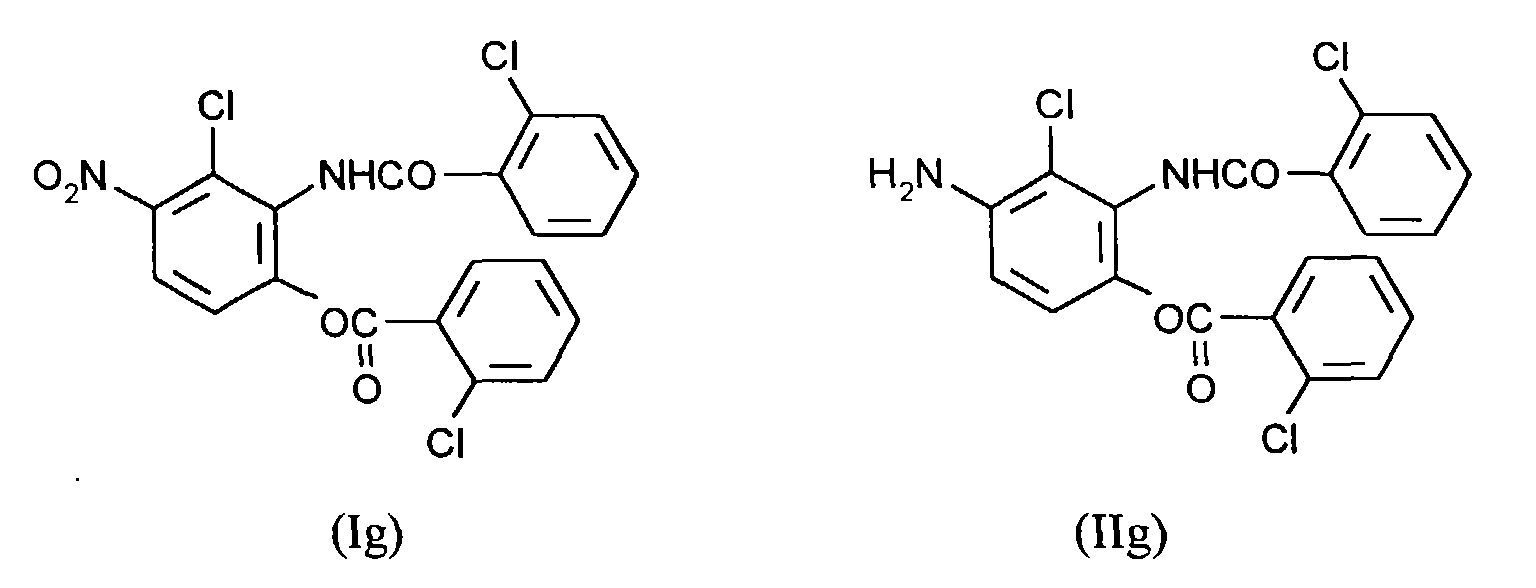
- Besonders bevorzugte halonitroaromatische Verbindungen entsprechen einer Verbindung der Formeln (Id) bis (Ig) und die entsprechenden haloaromatischen Amine entsprechen einer Verbindung der Formeln (IId) bis (IIg):

- R1
- Wasserstoff oder insbesondere Chlor bedeutet,
- Als Katalysatoren werden erfindungsgemäß eisenhaltige Raney-Nickelkatalysatoren eingesetzt. Diese Katalysatoren können nach den üblichen Methoden zur Präparation von Raney-Katalysatoren hergestellt werden (H. Adkins et. al. Org. Syntheses, Coll. Vol. III, 180 (1955)). Üblicherweise stellt man eine Legierung aus ca. 50 Gew.-% Aluminium und verschiedenen Anteilen an Nickel und Eisen her. Aus der zerkleinerten Legierung wird der größte Teil des Aluminiums durch wäßrige Natronlauge in der Hitze ausgelaugt und so der Katalysator aktiviert. Erfindungsgemäß enthalten die aktivierten Katalysatoren 1 bis 10 %, bevorzugt 3 bis 8 % Restaluminium, 5 bis 30 %, bevorzugt 10 bis 20 % Eisen und den Rest an Nickel (als Gehalte in der Trockenmasse). Die Menge der einzusetzenden Katalysatoren ist im Prinzip unkritisch. Zu geringe Mengen ergeben jedoch zu lange Hydrierzeiten während zu große Mengen unwirtschaftlich sind. Erfindungsgemäß setzt man beispielsweise 0,1 bis 20 Gew.-% an Katalysatortrockenmasse, bezogen auf halonitroaromatische Verbindung, bevorzugt 0,5 bis 15 Gew.-%, besonders bevorzugt 1 bis 10 Gew.-% ein.
- Vorzugsweise ist von dem erfindungsgemäßen Verfahren die Herstellung von 2-Amino-6-Chlorphenyl-alkylsulfanen aus den entsprechenden Nitroverbindungen ausgenommen, sofern sie durch katalytische Hydrierung ohne Zusatz einer weiteren Schwefelverbindung in Gegenwart eines Lösungsmittels erfolgt.
- Das erfindungsgemäße Verfahren wird im allgemeinen in einem organischen Lösungsmittel durchgeführt. Als organische Lösungsmittel sind beispielsweise aliphatische mit Wasser mischbare Alkohole mit 1 bis 4 C-Atomen wie Methanol, Ethanol, 2-Methoxyethanol oder iso-Propanol zu nennen. Besonders bevorzugt ist Methanol.
- Das erfindungsgemäße Verfahren kann auch in einem Gemisch aus organischem Lösungsmittel und Wasser durchgeführt werden. Dabei ist es vorteilhaft wenn der Wassergehalt kleiner als 50 Gew.-%, bevorzugt kleiner als 10 Gew.-% ist.
- Das organische Lösungsmittel kann auch im Gemisch mit weiteren Co-Solventien eingesetzt werden. Solche Co-Solventien sind beispielsweise Dimethylformamid, Dimethylacetamid sowie Tetrahydrofuran.
- Auch andere Lösungsmittel können verwendet werden. Zu nennen sind beispielsweise Ester wie Methyl- oder Ethylacetat oder Ether wie Tetrahydrofuran oder Diisopropylether.
- Die Löslichkeit schwer löslicher halonitroaromatischer Verbindungen, die ein acides Wasserstoffatom tragen, kann dadurch verbessert werden, daß man der Reaktion eine Base zugibt. Bevorzugt ist der Zusatz einer anorganischen Base wie Alkalihydroxid oder Alkalicarbonat. Bevorzugt ist der Zusatz von Alkalihydroxid. Der Zusatz von Alkalihydroxid kann als wäßrige Lösung erfolgen. Eine weitere bevorzugte Gruppe von Basen sind die Alkalialkoholate von niederen aliphatischen Alkoholen gegebenenfalls als Lösung in dem entsprechenden Alkohol.
- Für die Durchführung des erfindungsgemäßen Verfahrens ist es jedoch nicht zwingend erforderlich, daß die gesamte halonitroaromatische Verbindung vollständig gelöst ist. Dementsprechend ist die Menge der gegebenenfalls zuzusetzenden Basen in den obengenannten Fällen in weiten Grenzen variabel. Besonders vorteilhaft ist eine Basenmenge von 50 bis 120 mol-%, bezogen auf die halonitroaromatische Verbindung, bevorzugt von 75 bis 110 mol-%, besonders bevorzugt von 90 bis 110 mol-% anzuwenden.
- Erfindungsgemäß ist es möglich, eine Überdosierung von Base durch den Zusatz geringer Mengen Säure abzustumpfen. Als Säuren kommen beispielsweise einfache Mineralsäuren wie HCl, H2SO4 oder H3PO4 oder einfache Carbonsäuren wie Essigsäure, Propionsäure usw. in Frage. Bevorzugt sind einfache Carbonsäuren und Phosphorsäure.
- Die Menge an zuzusetzender Säure ist entsprechend der Überdosierung der Base so zu wählen, daß die verbleibende Basemenge in einem Bereich von 50 bis 120 mol-%, bezogen auf die halogenaromatische Verbindung, bevorzugt 75 bis 110 mol-%, besonders bevorzugt 90 bis 110 mol-% liegt.
- Der Einsatz von Basen wie oben beschrieben ist besonders bevorzugt wenn halonitroaromatische Verbindungen der Formel (Id) bis (Ig) eingesetzt werden.
- Das erfindungsgemäße Verfahren wird vorzugsweise bei geringem Überdruck an Wasserstoff durchgeführt. Vorteilhaft ist ein Bereich von 0,1 bis 30 bar, bevorzugt 0,5 bis 15 bar H2 Überdruck.
- Das erfindungsgemäße Verfahren wird in der Regel bei Raumtemperatur oder bei nur leicht erhöhter Temperatur durchgeführt. Vorteilhaft ist ein Bereich von 20 bis 80°C, bevorzugt 25 bis 60°C, besonders bevorzugt 25 bis 45°C.
- Bevorzugt ist es weiterhin, das erfindungsgemäße Verfahren einstufig d.h. ohne Unterbrechung zur Zwischendosierung von Reagenzien durchzuführen.
- Das erfindungsgemäße Verfahren kann kontinuierlich, halbkontinuierlich oder diskontinuierlich durchgeführt werden. Eine beispielhafte Ausführungsform ist die folgende: Man legt in einem Autoklaven die halonitroaromatische Verbindung, das Lösungsmittel und gegebenenfalls die Base vor, gibt nach Verrühren den eisenhaltigen Raney-Nickel Katalysator zu und drückt Wasserstoff beispielsweise 5-10 bar auf. In exothermer Reaktion hydriert man bis zur Druckkonstanz, belüftet, filtriert den Katalysator ab und isoliert das Produkt vorzugsweise durch Fällen mit wäßriger Säure.
- An dem erfindungsgemäßen Verfahren ist ausgesprochen überraschend, daß der Einsatz des eisenhaltigen Raney-Nickel Katalysators eine derart starke Verminderung der Enthalogenierung im Vergleich zum Stand der Technik (Raney-Ni) bewirkt.
- Die nach dem erfindungsgemäßen Verfahren hergestellten Amine, vorzugsweise die der Formel II, werden zur Herstellung von photographischen Kupplern verwendet. Dazu wird das Amin mit einem Säurechlorid zu einem Amid umgesetzt. Zahlreiche Beispiele sind dafür in der Literatur bekannt (siehe z.B. US-A- 4 443 536 und die dort in Spalte 1, Zeile 36 bis Spalte 2, Zeile 18 zitierte Literatur).
- Als bevorzugte Säurechloride können beispielsweise

- Wichtige photografische Kuppler, die aus den erfindungsgemäß hergestellten Aminen der Formel II hergestellt werden können, sind beispielsweise die folgenden:

- Diese Kuppler werden vorzugsweise in photografischen Emulsionen oder Elementen eingesetzt.
- Die nachfolgenden Beispiele erläutern die Erfindung, ohne sie jedoch darauf einzuschränken.
- In einem Stahlautoklaven wurden 100 Gew.-Teile an 3-(5-Nitro-2-chlorophenylamino)-1-(2,4,6-trichlorphenyl)-2-pyrazolin-5-on der Formel (Ib), worin R3 für Cl steht (Gehalt laut HPLC: 95 %), 366 Gew.-Teile technisches Methanol, 17,5 Gew.-Teile 50 % wäßrige Natronlauge und 6,2 Gew.-Teile 50 % wäßriges Raney-Nickel/Eisen der Zusammensetzung 80,5 % Nickel, 14,2 % Eisen und 5,0 % Aluminium vorgelegt und nach Inertisieren mit Stickstoff mit 5 bar H2 bei Umgebungstemperatur unter Rühren begast. Es setzte eine exotherme Reaktion ein. Durch Kühlung wurde die Temperatur bei 30°C gehalten. Nach 7 Stunden wurde entspannt, mit Stickstoff inertisiert, der Katalysator durch Filtration abgetrennt und die klare Reaktionslösung bei 25 bis 30°C in eine Mischung aus 835 Gew.-Teilen Wasser und 20,2 Gew.-Teilen Essigsäure eingetragen. Die entstandene Suspension wurde auf 0°C unter Rühren gekühlt, und filtriert. Der zurückbleibende Feststoff wurde mit 800 Gew.-Teilen Wasser gewaschen, trockengesaugt und im Vakuum bei 50°C getrocknet. Man erhielt 91,0 g eines sehr hellbeigen feinen Pulvers. Die HPLC-Analyse ergab einen Gehalt von 99,7 %. Entchlorierte Verbindungen wurden im HPLC nicht gefunden (d.h. Gehalt <0,1 %). Somit betrug die Ausbeute 98,5 % der Theorie.
- In einem Stahlautoklaven wurden 100 Gew.-Teile an 3-(5-Nitro-2-chlorophenylamino)-1-(2,4,6-trichlorphenyl)-2-pyrazolin-5-on der Formel (Ib), worin R3 = Cl (Gehalt laut HPLC 95 %), 314 Gew.-Teile Methanol, 19,0 Gew.-Teile 50 % wäßrige Natronlauge, 1,4 Gew.-Teile Essigsäure und 10,7 Gew.-Teile 50 % wäßriges Raney-Nickel/Eisen der gleichen Zusammensetzung wie im Beispiel 1 vorgelegt. Nach Inertisieren mit Stickstoff wurde mit 5 bar H2 unter Rühren begast. Man hielt die Temperatur 4 Stunden bei maximal 30°C, entspannte, inertisierte mit Stickstoff, Filtrierte den Katalysator ab und gab die filtrierte Lösung in eine Mischung aus 716 Gew.-Teilen Wasser und 17,3 Gew.-Teilen Essigsäure. Nach dem Abkühlen auf 0°C isolierte man den Feststoff durch Filtrieren und Waschen mit 680 Gew.-Teilen Wasser. Nach dem Trocknen erhielt man 105,7 g eines fast farblosen feinen Pulvers. Die HPLC-Analyse analog Beispiel 1 ergab einen Gehalt von 100,0 %. Entchlorierte Verbindungen wurden nicht gefunden. Die Ausbeute betrug somit 98,4 % der Theorie.
- In einem Stahlautoklaven wurden 100 Gew.-Teile an 3-(5-Nitro-2-chlorophenylamino)-1-(2,4,6-trichlorphenyl)-2-pyrazolin-5-on der Formel (Ib), worin R3 = Cl einer weniger guten Qualität (Gehalt laut HPLC: 76 %) 352 Gew.-Teile Methanol, 17,4 Gew.-Teile 50 % wäßrige Natronlauge, 1,4 Gew.-Teile Essigsäure und 12,0 Gew.-Teile 50 % wäßriges Raney-Nickel/Eisen der Zusammensetzung, 80,3 % Nickel, 13,7 % Eisen und 5,7 % Aluminium vorgelegt. Nach dem Inertisieren mit Stickstoff wurde mit 5 bar H2 unter Rühren begast. Man hielt die Temperatur 2 h 45 min bei max. 30°C, entspannte, inertisierte mit Stickstoff, filtrierte den Katalysator ab, und ließ die klare Lösung bei Raumtemperatur in eine Mischung aus 800 Gew.-Teilen Wasser und 15,9 Gew.-Teilen Essigsäure einlaufen. Die so erhaltene Suspension wurde unter Rühren auf 0°C abgekühlt. Der Feststoff wurde abgesaugt, mit 830 Gew.-Teilen Wasser gewaschen und im Vakuum bei 50°C getrocknet. Man erhielt 76,5 g eines nahezu farblosen feinen Pulvers. Die HPLC-Analyse analog Beispiel 1 ergab einen Gehalt von 99,9 %. Entchlorierte Verbindungen wurden nicht nachgewiesen. Die Ausbeute betrug somit 99,7 % der Theorie.
- In einem Stahlautoklaven wurden 100 Gew.-Teile an 3-(5-Nitro-2-chlorophenylamino)-1-(2,4,6-trichlorphenyl)-2-pyrazolin-5-on der Formel (Ib), worin R3 = Cl (Gehalt laut HPLC: 92 %), 440 Gew.-Teile Methanol, 19,0 Gew.-Teile 50 % wäßrige Natronlauge, 1,4 Gew.-Teile Essigsäure und 15,0 Gew.-Teile des 50 % wäßrigen Raney-Nickel/Eisens der gleichen Zusammensetzung wie in Beispiel 3 vorgelegt, nach dem Inertisieren mit Stickstoff wurde mit 10 bar H2 bei max. 32°C begast. Nach 2 Stunden wurde entspannt, mit Stickstoff inertisiert und der Katalysator abfiltriert. Die klare Lösung wurde in eine Mischung aus 870 Gew.-Teile Wasser und 19,8 Gew.-Teile Essigssäure gegeben. Nach dem Abkühlen der Suspension saugte man den Feststoff ab, wusch mit 800 Gew.-Teilen Wasser und trocknete im Vakuum bei 50°C. Man erhielt 73,6 g eines sehr hellbeigen Pulvers. Die HPLC-Analyse analog Beispiel 1 ergab einen Gehalt von 99,4 %. Als entchloriertes Produkt wurde 0,3 % der Verbindung der Formel

- Andere entchlorierte Verbindungen wurden nicht nachgewiesen. Das ergab eine Ausbeute von 98,3 % der Theorie.
- Bei sonst gleicher Umsetzung jedoch unter Verwendung eines eisenfreien Raney-Nickel-Katalysators analog DD-A 159 875, Bsp. 5 wurden nur 73,1 g eines beigen feinen Pulvers erhalten, das sehr viel mehr enthalogenierte Produkte enthielt (siehe Tabelle).


Claims (10)
- Verfahren zur Herstellung von haloaromatischen Aminen durch katalytische Hydrierung der entsprechenden halonitroaromatischen Verbindungen, dadurch gekennzeichnet, daß man als Katalysator eisenhaltiges Raney-Nickel einsetzt.
- Verfahren gemäß Anspruch 1, dadurch gekennzeichnet, daß die halonitroaromatische Verbindung der Formel (I) und das entsprechende haloaromatische Amin der Formel (II) entsprechen
A-NO2 (I)
A-NH2 (II),
worinA ein gegebenenfalls substituierter aromatischer Rest ist, der an die NO2-Gruppe in Formel (I) bzw. die NH2-Gruppe in Formel (II) durch ein Kernkohlenstoffatom eines aromatischen Ringes gebunden istund wobei mindestens ein Kernkohlenstoffatom eines aromatischen Ringes des Restes A durch mindestens ein Halogenatom substituiert ist. - Verfahren gemäß Anspruch 1, dadurch gekennzeichnet, daß der aromatische Rest A einen Substituenten aus folgender Reihe trägt


- Verfahren gemäß Anspruch 1, dadurch gekennzeichnet, daß die halonitroaromatische Verbindung der Formel (I) den Formeln Ia, Ib oder Ic und bevorzugte haloaromatische Amine der Formel II den Formeln IIa, IIb oder IIc, entsprechen

 R1 für Wasserstoff oder Chlor steht,n für 1 oder 2 steht undR2 Hydroxy, Alkyl, Alkoxy, Aryloxy, Aryl, Formyl, Alkanoyl, Cycloalkanoyl, Aroyl, Alkanoyloxy, Cycloalkanoyloxy, Aroyloxy, Alkylsulfonyl, Cycloalkylsulfonyl, Arylsulfonyl, Alkanoylamino, Cycloalkanoylamino, Aroylamino, Alkylsulfonamido, Cycloalkylsulfonamido, Arylsulfonamido, Alkoxycarbonyl, Cycloalkoxycarbonyl, Aryloxycarbonyl, Carbamoyl, Sulfamoyl, Alkyl-, Aryl- oder Heterocyclyl-aminocarbonyl oder -carbonylamino und substituiertes Amino bedeutet.
- Verfahren gemäß Anspruch 4, dadurch gekennzeichnet, daß R2 für einen der folgenden Reste steht:


- Verfahren gemäß Anspruch 1, dadurch gekennzeichnet, daß die halonitroaromatische Verbindung einer der Formeln (Id) bis (Ig) und das haloaromatische Amin einer der Formeln (IId) bis (IIg) entsprechen
 R1 Wasserstoff oder insbesondere Chlor bedeutet,


- Verfahren gemäß Anspruch 1, dadurch gekennzeichnet, daß man die katalytische Hydrierung in einem aliphatischen mit Wasser mischbaren Alkohol mit 1 bis 4 C-Atomen durchführt.
- Verfahren gemäß Anspruch 1, dadurch gekennzeichnet, daß ein eisenhaltiger Raney-Nickel-Katalysator mit einem Gehalt von 1 bis 10 % Aluminium und 5 bis 30 % Eisen eingesetzt wird.
- Verwendung eines gemäß einem der Ansprüche 1 bis 8 hergestellten haloaromatischen Amins zur Herstellung eines Farbküpplers, dadurch gekennzeichnet, das man das Amin mit einem Säurechlorid umsetzt.
- Verwendung gemäß Anspruch 9, dadurch gekennzeichnet, daß als Säurechlorid


Applications Claiming Priority (2)
| Application Number | Priority Date | Filing Date | Title |
|---|---|---|---|
| DE19604988A DE19604988A1 (de) | 1996-02-12 | 1996-02-12 | Hydrierung von halonitroaromatischen Verbindungen |
| DE19604988 | 1996-02-12 |
Publications (1)
| Publication Number | Publication Date |
|---|---|
| EP0789018A1 true EP0789018A1 (de) | 1997-08-13 |
Family
ID=7785114
Family Applications (1)
| Application Number | Title | Priority Date | Filing Date |
|---|---|---|---|
| EP97101412A Withdrawn EP0789018A1 (de) | 1996-02-12 | 1997-01-30 | Hydrierung von halonitroaromatischen Verbindungen |
Country Status (4)
| Country | Link |
|---|---|
| US (1) | US5801284A (de) |
| EP (1) | EP0789018A1 (de) |
| JP (1) | JPH09227483A (de) |
| DE (1) | DE19604988A1 (de) |
Cited By (2)
| Publication number | Priority date | Publication date | Assignee | Title |
|---|---|---|---|---|
| WO2002055476A1 (en) * | 2001-01-16 | 2002-07-18 | Degussa Ag | Process for the preparation of substituted amines by hydrogenation of substituted organic nitro compounds |
| CN109225261A (zh) * | 2018-10-22 | 2019-01-18 | 广西博测检测技术服务有限公司 | 一种雷尼镍-铁催化剂的制备方法及其应用于染料废水的脱色方法 |
Families Citing this family (1)
| Publication number | Priority date | Publication date | Assignee | Title |
|---|---|---|---|---|
| CN103130676B (zh) * | 2011-11-25 | 2015-03-11 | 沈阳感光化工研究院 | 2-(3,4-二氯苯甲酰胺基)-4-氯-5-氨基苯酚的制备方法 |
Citations (10)
| Publication number | Priority date | Publication date | Assignee | Title |
|---|---|---|---|---|
| US3350450A (en) | 1963-08-12 | 1967-10-31 | Uniroyal Inc | Process of preparing aromatic amines by the catalytic hydrogenation of aromatic nitro compounds |
| US3761425A (en) | 1971-02-19 | 1973-09-25 | Hoechst Ag | Process for preparing sulfided platinum on carbon catalysts |
| US3929891A (en) | 1971-02-08 | 1975-12-30 | Hoechst Ag | Reduction of halonitroaromates using sulfited platinum on carbon catalysts |
| JPS5373528A (en) * | 1976-12-10 | 1978-06-30 | Kawaken Fine Chem Co Ltd | Preparation of halogenated aromatic primary amine |
| DE2713374A1 (de) * | 1977-03-25 | 1978-09-28 | Bayer Ag | Raney-nickel-eisen-katalysator |
| EP0073636A1 (de) * | 1981-08-25 | 1983-03-09 | EASTMAN KODAK COMPANY (a New Jersey corporation) | Fotografische Elemente, die Ballastgruppen aufweisende Kuppler enthalten |
| DD159875A1 (de) | 1981-06-24 | 1983-04-13 | Erwin Pasbrig | Verfahren zur herstellung von ch-aciden substituierten aromatischen aminoverbindungen |
| US4443536A (en) | 1981-08-25 | 1984-04-17 | Eastman Kodak Company | Nondiffusible photographic couplers and photographic elements and processes employing same |
| WO1989007096A1 (en) | 1988-02-03 | 1989-08-10 | Eastman Kodak Company | Hydrogenation of halonitroaromatic compounds |
| EP0647472A1 (de) * | 1993-10-07 | 1995-04-12 | Rhone-Poulenc Chimie | Raney Katalysator Zusammensetzung für die Hydrogenierung von Halonitroaromatischen Verbindungen und Verfahren zur Verwendung derselben |
Family Cites Families (1)
| Publication number | Priority date | Publication date | Assignee | Title |
|---|---|---|---|---|
| DE159875C (de) * |
-
1996
- 1996-02-12 DE DE19604988A patent/DE19604988A1/de not_active Withdrawn
-
1997
- 1997-01-30 EP EP97101412A patent/EP0789018A1/de not_active Withdrawn
- 1997-02-05 US US08/795,985 patent/US5801284A/en not_active Expired - Fee Related
- 1997-02-07 JP JP9040159A patent/JPH09227483A/ja active Pending
Patent Citations (10)
| Publication number | Priority date | Publication date | Assignee | Title |
|---|---|---|---|---|
| US3350450A (en) | 1963-08-12 | 1967-10-31 | Uniroyal Inc | Process of preparing aromatic amines by the catalytic hydrogenation of aromatic nitro compounds |
| US3929891A (en) | 1971-02-08 | 1975-12-30 | Hoechst Ag | Reduction of halonitroaromates using sulfited platinum on carbon catalysts |
| US3761425A (en) | 1971-02-19 | 1973-09-25 | Hoechst Ag | Process for preparing sulfided platinum on carbon catalysts |
| JPS5373528A (en) * | 1976-12-10 | 1978-06-30 | Kawaken Fine Chem Co Ltd | Preparation of halogenated aromatic primary amine |
| DE2713374A1 (de) * | 1977-03-25 | 1978-09-28 | Bayer Ag | Raney-nickel-eisen-katalysator |
| DD159875A1 (de) | 1981-06-24 | 1983-04-13 | Erwin Pasbrig | Verfahren zur herstellung von ch-aciden substituierten aromatischen aminoverbindungen |
| EP0073636A1 (de) * | 1981-08-25 | 1983-03-09 | EASTMAN KODAK COMPANY (a New Jersey corporation) | Fotografische Elemente, die Ballastgruppen aufweisende Kuppler enthalten |
| US4443536A (en) | 1981-08-25 | 1984-04-17 | Eastman Kodak Company | Nondiffusible photographic couplers and photographic elements and processes employing same |
| WO1989007096A1 (en) | 1988-02-03 | 1989-08-10 | Eastman Kodak Company | Hydrogenation of halonitroaromatic compounds |
| EP0647472A1 (de) * | 1993-10-07 | 1995-04-12 | Rhone-Poulenc Chimie | Raney Katalysator Zusammensetzung für die Hydrogenierung von Halonitroaromatischen Verbindungen und Verfahren zur Verwendung derselben |
Non-Patent Citations (1)
| Title |
|---|
| DATABASE WPI Section Ch Week 7831, Derwent World Patents Index; Class E14, AN 78-56085A, XP002030999 * |
Cited By (3)
| Publication number | Priority date | Publication date | Assignee | Title |
|---|---|---|---|---|
| WO2002055476A1 (en) * | 2001-01-16 | 2002-07-18 | Degussa Ag | Process for the preparation of substituted amines by hydrogenation of substituted organic nitro compounds |
| CN109225261A (zh) * | 2018-10-22 | 2019-01-18 | 广西博测检测技术服务有限公司 | 一种雷尼镍-铁催化剂的制备方法及其应用于染料废水的脱色方法 |
| CN109225261B (zh) * | 2018-10-22 | 2021-09-14 | 广西博测检测技术服务有限公司 | 一种雷尼镍-铁催化剂的制备方法及其应用于染料废水的脱色方法 |
Also Published As
| Publication number | Publication date |
|---|---|
| DE19604988A1 (de) | 1997-08-14 |
| JPH09227483A (ja) | 1997-09-02 |
| US5801284A (en) | 1998-09-01 |
Similar Documents
| Publication | Publication Date | Title |
|---|---|---|
| EP0784049A1 (de) | Verfahren zur Herstellung von gegebenenfalls substituierten 4-Aminodiphenylaminen | |
| DE2503187B2 (de) | Verfahren zur Herstellung durch Chlor meta-substituierte Aniline | |
| DE60001686T2 (de) | Verfahren zum Herstellen von substituierten 3-Hydroxybuttersäureester | |
| DE68905595T2 (de) | Verfahren zur katalytischen hydrierung von aromatischen halogennitroverbindungen. | |
| EP0165564B1 (de) | Verfahren zur Herstellung von 4-Acylamino-2-alkylamino-phenylethern | |
| EP0678502A1 (de) | Verfahren zur Herstellung von Glykoloylaniliden | |
| EP0847990A1 (de) | 4-(C1-C4)-Alkoxy-3-pyrrolin-2-on-1-yl-essigsäuren, deren Herstellung und Verwendung zur Synthese von 4-Hydroxy-2-oxo-pyrrolidin-1-yl-acetamid | |
| DE68922714T2 (de) | Verfahren zur Herstellung von 2-Phenylbenzotriazolen. | |
| EP0380712A1 (de) | Verfahren zur Herstellung von 2,6-Dichlordiphenylaminessigsäurederivaten | |
| EP0818436B1 (de) | Verfahren zur Herstellung von 4-Hydroxyanilinen | |
| DE2609530C2 (de) | Verfahren zur Herstellung von Hydrazobenzolen | |
| DE3104643A1 (de) | Verfahren zur herstellung von gegebenenfalls p-chlorsubstituiertem 2,6-diaminotoluol | |
| DE19604988A1 (de) | Hydrierung von halonitroaromatischen Verbindungen | |
| DE2447824A1 (de) | Herstellung von c tief 1 -c tief 7 aliphatischen hydrocarbylestern von n- eckige klammer auf 2,6-di(c tief 1 -c tief 7 -alkyl)phenyl eckige klammer zu alpha-aminocarbonsaeuren | |
| EP0368008A1 (de) | Fluor enthaltende Phenole | |
| DE69706580T2 (de) | Verfahren zur Herstellung von Nabumeton | |
| DE2328757C3 (de) | Verfahren zur Herstellung von Aminen | |
| CH633003A5 (de) | Verfahren zur herstellung von benzotriazolen. | |
| EP0206147A2 (de) | Verfahren zur Herstellung von 4,4'-Dinitrodibenzylen | |
| EP1254096B1 (de) | Verfahren zur herstellung von 2,3,5,6-tetrahalogen-xylylidenverbindungen | |
| EP0422366B1 (de) | Verfahren zur Herstellung N-substituierter Pyrrolidin-2-one | |
| EP1309538A2 (de) | Verfahren zur herstellung von trifluorethoxysubstituierten benzoesäuren | |
| EP0570817B1 (de) | Verfahren zur Herstellung von 5-Chloroxindol | |
| EP0285109B1 (de) | Verfahren zur Herstellung von 2-Amino-4-acylaminophenylethern | |
| EP0391205A1 (de) | Verfahren zur Herstellung von 2-Chlor-5-aminomethylpyridin |
Legal Events
| Date | Code | Title | Description |
|---|---|---|---|
| PUAI | Public reference made under article 153(3) epc to a published international application that has entered the european phase |
Free format text: ORIGINAL CODE: 0009012 |
|
| AK | Designated contracting states |
Kind code of ref document: A1 Designated state(s): BE CH DE ES FR GB IE IT LI NL |
|
| 17P | Request for examination filed |
Effective date: 19980213 |
|
| 17Q | First examination report despatched |
Effective date: 19980320 |
|
| STAA | Information on the status of an ep patent application or granted ep patent |
Free format text: STATUS: THE APPLICATION IS DEEMED TO BE WITHDRAWN |
|
| 18D | Application deemed to be withdrawn |
Effective date: 20010320 |