EP0789632B1 - Verfahren zum verbessern der elektrostatischen ladung auf pulvern - Google Patents
Verfahren zum verbessern der elektrostatischen ladung auf pulvern Download PDFInfo
- Publication number
- EP0789632B1 EP0789632B1 EP95938731A EP95938731A EP0789632B1 EP 0789632 B1 EP0789632 B1 EP 0789632B1 EP 95938731 A EP95938731 A EP 95938731A EP 95938731 A EP95938731 A EP 95938731A EP 0789632 B1 EP0789632 B1 EP 0789632B1
- Authority
- EP
- European Patent Office
- Prior art keywords
- powder
- charge
- powders
- charging
- coating
- Prior art date
- Legal status (The legal status is an assumption and is not a legal conclusion. Google has not performed a legal analysis and makes no representation as to the accuracy of the status listed.)
- Expired - Lifetime
Links
- 239000000843 powder Substances 0.000 title claims description 163
- 238000000034 method Methods 0.000 title claims description 35
- 238000000576 coating method Methods 0.000 claims description 50
- 239000011248 coating agent Substances 0.000 claims description 44
- 239000003795 chemical substances by application Substances 0.000 claims description 20
- 239000000203 mixture Substances 0.000 claims description 18
- RTZKZFJDLAIYFH-UHFFFAOYSA-N Diethyl ether Chemical compound CCOCC RTZKZFJDLAIYFH-UHFFFAOYSA-N 0.000 claims description 6
- 230000001939 inductive effect Effects 0.000 claims description 6
- 229920001281 polyalkylene Polymers 0.000 claims description 4
- GLDOVTGHNKAZLK-UHFFFAOYSA-N octadecan-1-ol Polymers CCCCCCCCCCCCCCCCCCO GLDOVTGHNKAZLK-UHFFFAOYSA-N 0.000 claims description 3
- 229920001515 polyalkylene glycol Polymers 0.000 claims description 3
- 238000009313 farming Methods 0.000 claims 1
- 238000007600 charging Methods 0.000 description 54
- 239000002245 particle Substances 0.000 description 32
- 230000006698 induction Effects 0.000 description 24
- 229920005989 resin Polymers 0.000 description 21
- 239000011347 resin Substances 0.000 description 21
- 230000005684 electric field Effects 0.000 description 15
- 239000000463 material Substances 0.000 description 13
- 238000010586 diagram Methods 0.000 description 10
- 150000002500 ions Chemical class 0.000 description 10
- 238000012360 testing method Methods 0.000 description 9
- 239000000758 substrate Substances 0.000 description 7
- 238000005507 spraying Methods 0.000 description 6
- 238000012546 transfer Methods 0.000 description 6
- 239000011230 binding agent Substances 0.000 description 5
- 230000008021 deposition Effects 0.000 description 5
- 238000013459 approach Methods 0.000 description 4
- 230000001419 dependent effect Effects 0.000 description 4
- 230000000694 effects Effects 0.000 description 4
- 238000005516 engineering process Methods 0.000 description 4
- 239000002184 metal Substances 0.000 description 4
- 229910052751 metal Inorganic materials 0.000 description 4
- 239000004033 plastic Substances 0.000 description 4
- 229920003023 plastic Polymers 0.000 description 4
- 229920001187 thermosetting polymer Polymers 0.000 description 4
- 238000013461 design Methods 0.000 description 3
- 230000001965 increasing effect Effects 0.000 description 3
- 239000012212 insulator Substances 0.000 description 3
- 238000012986 modification Methods 0.000 description 3
- 230000004048 modification Effects 0.000 description 3
- 239000000049 pigment Substances 0.000 description 3
- 229920001225 polyester resin Polymers 0.000 description 3
- 239000004645 polyester resin Substances 0.000 description 3
- 238000011084 recovery Methods 0.000 description 3
- 230000000717 retained effect Effects 0.000 description 3
- 239000007921 spray Substances 0.000 description 3
- 229920005992 thermoplastic resin Polymers 0.000 description 3
- 239000013543 active substance Substances 0.000 description 2
- 239000000919 ceramic Substances 0.000 description 2
- 239000002131 composite material Substances 0.000 description 2
- 239000004020 conductor Substances 0.000 description 2
- 230000003247 decreasing effect Effects 0.000 description 2
- 238000007599 discharging Methods 0.000 description 2
- 239000012777 electrically insulating material Substances 0.000 description 2
- 238000007786 electrostatic charging Methods 0.000 description 2
- 239000003822 epoxy resin Substances 0.000 description 2
- 239000000945 filler Substances 0.000 description 2
- 239000011521 glass Substances 0.000 description 2
- 238000002156 mixing Methods 0.000 description 2
- 230000007935 neutral effect Effects 0.000 description 2
- 230000035515 penetration Effects 0.000 description 2
- 239000004014 plasticizer Substances 0.000 description 2
- 229920000647 polyepoxide Polymers 0.000 description 2
- 238000002360 preparation method Methods 0.000 description 2
- 238000004064 recycling Methods 0.000 description 2
- 230000002829 reductive effect Effects 0.000 description 2
- 238000011160 research Methods 0.000 description 2
- 230000000284 resting effect Effects 0.000 description 2
- 235000011888 snacks Nutrition 0.000 description 2
- 239000003381 stabilizer Substances 0.000 description 2
- 239000004925 Acrylic resin Substances 0.000 description 1
- 229920000178 Acrylic resin Polymers 0.000 description 1
- 241000234282 Allium Species 0.000 description 1
- 235000002732 Allium cepa var. cepa Nutrition 0.000 description 1
- 235000002568 Capsicum frutescens Nutrition 0.000 description 1
- 239000004677 Nylon Substances 0.000 description 1
- 239000002202 Polyethylene glycol Substances 0.000 description 1
- 239000004809 Teflon Substances 0.000 description 1
- 229920006362 Teflon® Polymers 0.000 description 1
- BZHJMEDXRYGGRV-UHFFFAOYSA-N Vinyl chloride Chemical compound ClC=C BZHJMEDXRYGGRV-UHFFFAOYSA-N 0.000 description 1
- 239000000654 additive Substances 0.000 description 1
- 230000001680 brushing effect Effects 0.000 description 1
- 238000010888 cage effect Methods 0.000 description 1
- 230000003047 cage effect Effects 0.000 description 1
- 230000015556 catabolic process Effects 0.000 description 1
- 239000012461 cellulose resin Substances 0.000 description 1
- 235000013351 cheese Nutrition 0.000 description 1
- 239000008199 coating composition Substances 0.000 description 1
- 238000011109 contamination Methods 0.000 description 1
- 230000008094 contradictory effect Effects 0.000 description 1
- 238000007796 conventional method Methods 0.000 description 1
- 229920001577 copolymer Polymers 0.000 description 1
- 238000005260 corrosion Methods 0.000 description 1
- 238000011161 development Methods 0.000 description 1
- 238000007598 dipping method Methods 0.000 description 1
- 238000009503 electrostatic coating Methods 0.000 description 1
- 239000003623 enhancer Substances 0.000 description 1
- 150000002170 ethers Chemical class 0.000 description 1
- 230000004927 fusion Effects 0.000 description 1
- 239000006115 industrial coating Substances 0.000 description 1
- 238000009434 installation Methods 0.000 description 1
- 239000011810 insulating material Substances 0.000 description 1
- 230000000670 limiting effect Effects 0.000 description 1
- 238000005259 measurement Methods 0.000 description 1
- 239000000155 melt Substances 0.000 description 1
- 238000002844 melting Methods 0.000 description 1
- 230000008018 melting Effects 0.000 description 1
- 150000002739 metals Chemical class 0.000 description 1
- 229920001778 nylon Polymers 0.000 description 1
- 239000003973 paint Substances 0.000 description 1
- 230000036961 partial effect Effects 0.000 description 1
- 229920006122 polyamide resin Polymers 0.000 description 1
- 229920001223 polyethylene glycol Polymers 0.000 description 1
- 229920013716 polyethylene resin Polymers 0.000 description 1
- 239000004848 polyfunctional curative Substances 0.000 description 1
- 229920000642 polymer Polymers 0.000 description 1
- 229920005672 polyolefin resin Polymers 0.000 description 1
- 229920001343 polytetrafluoroethylene Polymers 0.000 description 1
- 239000004810 polytetrafluoroethylene Substances 0.000 description 1
- 238000002203 pretreatment Methods 0.000 description 1
- 230000002035 prolonged effect Effects 0.000 description 1
- 230000001737 promoting effect Effects 0.000 description 1
- 150000003242 quaternary ammonium salts Chemical class 0.000 description 1
- 230000002285 radioactive effect Effects 0.000 description 1
- 238000012552 review Methods 0.000 description 1
- 239000007787 solid Substances 0.000 description 1
- 239000002904 solvent Substances 0.000 description 1
- 229920001169 thermoplastic Polymers 0.000 description 1
- 239000004416 thermosoftening plastic Substances 0.000 description 1
- 238000011144 upstream manufacturing Methods 0.000 description 1
- 125000000391 vinyl group Chemical group [H]C([*])=C([H])[H] 0.000 description 1
- 229920002554 vinyl polymer Polymers 0.000 description 1
- 238000009736 wetting Methods 0.000 description 1
Images
Classifications
-
- B—PERFORMING OPERATIONS; TRANSPORTING
- B05—SPRAYING OR ATOMISING IN GENERAL; APPLYING FLUENT MATERIALS TO SURFACES, IN GENERAL
- B05B—SPRAYING APPARATUS; ATOMISING APPARATUS; NOZZLES
- B05B7/00—Spraying apparatus for discharge of liquids or other fluent materials from two or more sources, e.g. of liquid and air, of powder and gas
- B05B7/14—Spraying apparatus for discharge of liquids or other fluent materials from two or more sources, e.g. of liquid and air, of powder and gas designed for spraying particulate materials
- B05B7/1404—Arrangements for supplying particulate material
- B05B7/1472—Powder extracted from a powder container in a direction substantially opposite to gravity by a suction device dipped into the powder
-
- B—PERFORMING OPERATIONS; TRANSPORTING
- B05—SPRAYING OR ATOMISING IN GENERAL; APPLYING FLUENT MATERIALS TO SURFACES, IN GENERAL
- B05B—SPRAYING APPARATUS; ATOMISING APPARATUS; NOZZLES
- B05B5/00—Electrostatic spraying apparatus; Spraying apparatus with means for charging the spray electrically; Apparatus for spraying liquids or other fluent materials by other electric means
- B05B5/08—Plant for applying liquids or other fluent materials to objects
- B05B5/087—Arrangements of electrodes, e.g. of charging, shielding, collecting electrodes
-
- B—PERFORMING OPERATIONS; TRANSPORTING
- B05—SPRAYING OR ATOMISING IN GENERAL; APPLYING FLUENT MATERIALS TO SURFACES, IN GENERAL
- B05B—SPRAYING APPARATUS; ATOMISING APPARATUS; NOZZLES
- B05B5/00—Electrostatic spraying apparatus; Spraying apparatus with means for charging the spray electrically; Apparatus for spraying liquids or other fluent materials by other electric means
- B05B5/16—Arrangements for supplying liquids or other fluent material
- B05B5/1683—Arrangements for supplying liquids or other fluent material specially adapted for particulate materials
-
- B—PERFORMING OPERATIONS; TRANSPORTING
- B05—SPRAYING OR ATOMISING IN GENERAL; APPLYING FLUENT MATERIALS TO SURFACES, IN GENERAL
- B05D—PROCESSES FOR APPLYING FLUENT MATERIALS TO SURFACES, IN GENERAL
- B05D1/00—Processes for applying liquids or other fluent materials
- B05D1/02—Processes for applying liquids or other fluent materials performed by spraying
- B05D1/04—Processes for applying liquids or other fluent materials performed by spraying involving the use of an electrostatic field
- B05D1/06—Applying particulate materials
-
- Y—GENERAL TAGGING OF NEW TECHNOLOGICAL DEVELOPMENTS; GENERAL TAGGING OF CROSS-SECTIONAL TECHNOLOGIES SPANNING OVER SEVERAL SECTIONS OF THE IPC; TECHNICAL SUBJECTS COVERED BY FORMER USPC CROSS-REFERENCE ART COLLECTIONS [XRACs] AND DIGESTS
- Y10—TECHNICAL SUBJECTS COVERED BY FORMER USPC
- Y10S—TECHNICAL SUBJECTS COVERED BY FORMER USPC CROSS-REFERENCE ART COLLECTIONS [XRACs] AND DIGESTS
- Y10S524/00—Synthetic resins or natural rubbers -- part of the class 520 series
- Y10S524/904—Powder coating compositions
Definitions
- the present invention relates to a process for improving the electrostatic charge developed on organic powders for powder coating applications according to claims 1 to 3.
- Powder coating as a separate technology, developed as a result of a number of clear advantages over other methods of coating such as brushing, dipping and conventional spraying. These include the inherent advantages due to the absence of solvent (safer, less harmful to the environment, less expensive, cleaner working environment) as well as decreasing the time taken for the coating process to produce an article ready for use. Control of the coating thickness and the ability to produce a high quality finish from a single application treatment are also possible with this method.
- Powder coating technology is based on the principle of electrostatic charging and presently available practical methods of charging are classified into a corona charging system, a tribo-electric charging system or a hybrid system.
- a corona charging system a tribo-electric charging system or a hybrid system.
- Each system has evolved from the earliest corona charging system which is little more than a hollow barrel through which powder is pneumatically conveyed, with charging of the powder being accomplished by ionic attachment at the barrel, or gun exit.
- the basic corona charging system involves charging by ionic bombardment using an ion source such as a high voltage corona electrode or radioactive element. This method is used quite often to apply charge to highly insulating materials such as plastics. It can be very inefficient when applying electrostatic charge to powders since many of the ions produced do not contribute to the charging of particles but alight elsewhere, for example, on the workpiece itself in a powder coating operation. In some of the worst cases, charging efficiencies of less than 1% had been quoted in corona powder coating equipment.
- powder is conveyed from a hopper through feed hoses to a spray gun.
- a sharp pointed electrode in the gun is connected to a high voltage generator and the combination of electrode geometry and high voltage (up to 100 kV in some guns) creates an electric field in excess of the local breakdown strength of the surrounding gas, which is usually air.
- a corona discharge is generated and free ions are formed in front of the charging electrode.
- Powder particles are conveyed through this space charge region and are charged by ionic attachment. The particles follow the air-flow pattern and those that are sufficiently charged are deposited onto the workpiece, which is generally held at ground potential.
- the polarity of the charging electrode can be reversed to create either a positive or negative charge on the particle, with a negative charge being generally preferred due to the larger numbers of ions being produced.
- the charging efficiency of this system is very poor since only a small fraction (- 0.5%) of the ions produced by the corona contributes to the charge on the powder.
- the majority of the ions produced by the corona gun do not attach to the sprayed powder particles but travel as 'free ions' to the workpiece where they accumulate rapidly within the deposited powder layer.
- the onset of back-ionization essentially limits the useful coating thickness that can be applied using corona charging powder coating equipment.
- corona guns are not suited for applications requiring penetration into cavities and corners. This is due to all the voltage which appears at the external high voltage electrode being dropped between the gun head and the grounded workpiece with subsequent little, or no, penetration of the field associated with this voltage into cavities and recesses. These areas then approximate enclosed Faraday cages. Under these conditions internal coating will only be achieved by pneumatically conveying the particles into such areas, which can be difficult to achieve while simultaneously ensuring good coating uniformity elsewhere.
- tribo-electric guns With tribo-electric guns the free ion current is eliminated or considerably reduced and, as there is no applied electric field, the particles are directed onto the workpiece by a combination of the air flow and the field produced by the charged powder cloud. Due to these factors, back ionization does not occur for 10 to 20 seconds in tribo-electric systems and it is easier to obtain heavy or thick films with this system. A further advantage is the ability of the system to coat inside cavities, small complex parts and products with sharp corners, etc. Furthermore, frictional charging not only overcomes the Faraday cage effect and reduces back ionization, but facilitates gun design to accommodate spray heads that accept different types of nozzles.
- a still further disadvantage is that the particle size distribution of the powder has a significant effect on tribo charging and its efficiency.
- a typical powder for coating contains a combination of small, medium and large particles, ranging from sub-micron size up to greater than 80 microns in diameter. It is known that within such systems hi-polar charging of the powder can occur, with smaller particles more likely to charge to a negative polarity.
- the efficiency of charging is a function of the diameter of the particle and as a result the smallest particles are not electrostatically attracted to the workpiece resulting in preferential deposition of the mid-size range particles. Thus transfer efficiency is reduced and so too the overall operational efficiency of the system due to the increasing buildup of deposits in the guns and powder collecting and recycling equipment. Fluidizing problems in the feed hopper can also occur.
- hybrid guns which contain both of the aforementioned methods i.e., corona charging and triboelectrification in one gun, in an attempt to combine the advantages of both systems.
- this approach does not remove the main inherent disadvantages of both guns - poor powder charging and transfer efficiency.
- the coating efficiency is about 70-75% at best using presently available materials for practical industrial purposes. Any non-deposited powder will be wasted or must be recovered by use of special recovery equipment and reused by adding it in small portions to virgin powder or by recycling it to the resin preparation step. Manufacturers of powder coatings claim that it is possible to achieve 97-98% usage of powders, citing this as an incentive for switching from wet spray systems where any overspray is wasted. A flaw in this argument is that to achieve such high usage dedicated recycle equipment must be operated on an exclusive basis on each line, whereby it is not easy to change the type or hue of the coating material. Thus, the installation cost of the recovery apparatus and the awkward scheduling of its operation and the time required for the recovery add to the total cost.
- EP-A-0 640 883 (priority: 23.08.93, publication date 01.03.95) describes polyalkylene ethers and polyalkylene glycols as charge enhancer on chargeable resin powders.
- a further object of the invention is provide a method of electrostatically charging a powder for use in powder coating applications which is free from the aforementioned shortcomings.
- a further object of the invention is provide a method for charging powders which allows an electrostatic charge to be developed on the powder in a reliable and repeatable manner.
- Another object is to provide a method which can accurately and reliably control the quantity and polarity of electrostatic charge developed and thus insure the coating of all areas of a workpiece to any required thickness.
- Another object of the invention is to provide a process for applying a charge to thermoplastic and thermosetting resins which are used in powder coating operations.
- Another object is to improve the electrostatic charge on powders by incorporating an electrostatic property modifying agent in, or on, the surface of the resin.
- a still further object is to provide a process for applying electrostatically charged powders as a coating on solid objects.
- the process of the invention imparts an electrostatic charge to organic powders to render them useful for powder coating applications, and involves forming a blend of the powders and a polyalkylene ether, polyalkylene glycol or polyethoxylated stearyl alcohol as an electrostatically active modifying agent, and subjecting the blend to electrically inductive/conductive conditions, wherein the blended have powders a resistivity of from about 10 9 to about 10 13 ohm.meters at 20 percent relative humidity.
- induction or “inductive” as used throughout the specification and appended claims, encompasses both induction and conduction electrostatic charging.
- the resinous powder composition comprises (i) a thermosetting or thermoplastic resin and (ii) an electrostatically active modifying agent incorporated in, or on, the resin.
- the modifying agent employed is one which does not alter the melt or durability characteristics of the resin powder.
- the modifying agent is also useful in promoting the ease with which the charge is imparted and retained regardless of the size of the powder particle.
- the present invention provides a method of electrostatically charging a powder for use in powder coating, free from the above-mentioned conventional shortcomings which allows an electrostatic charge to be efficiently and uniformly developed on the powder in a reliable and repeatable manner and which, furthermore, can accurately and reliably control the quantity and polarity of electrostatic charge developed (thus the ability to coat all areas of a workpiece evenly to any required thickness).
- the objectives of the present invention can be achieved by placing the modified powder in an area where an electric field is present, in such a manner as to allow electric charge to flow onto the powder particles which, by modification with an electrostatically active agent, are sufficiently conducting to facilitate electrical conduction.
- This property of the powder is characterized by its resistivity (surface or bulk) and generally speaking the lower the resistivity of the powder the easier it is to place an electrostatic charge on it by induction.
- the powder is then pneumatically transported to the workpiece.
- the charge on the powder will decay once deposited with the rate of decay increasing with decreasing resistivity. It is very important that the powder remains attached to the workpiece long enough for the workpiece to be transported to the curing oven. If the charge decays too quickly, this can not be guaranteed.
- powder particles with resistivities below the lower limit set forth above are not retained on the workpiece or substrate long enough to establish adhesion, while at a resistivity above the upper limit the process is difficult to control.
- a second method involves spraying the charged powder onto a grounded, heated workpiece.
- the temperature of the workpiece is such as to ensure partial melting of the powder particles as they alight on it, thus the adhesion to the workpiece is due to the wetting of the piece by the melted powder and not to electrostatic forces.
- a third method involves a slightly different, but no less important, application of electrostatic powder spraying: the finishing of electrically insulating materials such as plastics or ceramics.
- powder charging and spraying is similar to that in the conventional finishing of conducting, grounded workpieces but the electrostatic assist to ensure deposition and even coating is achieved in a different manner.
- a fourth method involves a key discovery made during the intensive research leading to this invention,
- the ideal solution to the dichotomous requirements of low resistivity for efficient charging and high resistivity for adequate adhesion can best be met by designing a powder which has a resistivity which is, in the broadest sense, situation dependent, this is to say, a resistivity which is a function of the prevailing conditions at the charging station and at the workpiece.
- modifying agents electrostatic property modifying agents
- the resin powder composition for electrostatic coating comprises a thermosetting or thermoplastic resin and from 0.01% to 20% by weight of an electrostatic property modifying agent.
- This composition may further contain a curing agent, a pigment, a metal powder filler, a flow controlling agent, a plasticizer or a stabilizer.
- the thermosetting resin may be a conventional type such as an epoxy resin, a polyester resin or an acrylic resin.
- thermoplastic resin may be a vinyl chloride resin, a polyamide resin, a cellulose resin, a polyolefin resin, a polyethylene resin, a polyester resin or a nylon resin. The resin may be used alone or in combination as a mixture.
- the electrostatic property modifying agent as the essential component of the present invention is a polyalkylene ether, a polyethylene glycol, and a polyethoxylated stearyl alcohol.
- the resin powder composition of the present invention may be readily prepared in accordance with a conventional method.
- the binder resin and the modifying agent may be heated, melted and kneaded by means of a conventional mixing machine such as a single screw or multi-screw extruder, a Banbury mixer or heat rolls, then cooled and pulverized to obtain a powder.
- a conventional mixing machine such as a single screw or multi-screw extruder, a Banbury mixer or heat rolls
- Any method commonly employed for the preparation of a powder mixture such as any method for mixing a binder resin powder and a powder of an electrostatic property modifying agent.
- the ratio of particle diameters (volume mean) needs to be greater than 10:1, the binder resin being the larger.
- the particle size of the resin powder for coating according to the present invention is preferably within a range of from about 10 to about 250 microns.
- the resin powder coating composition of the present invention may further contain in addition to the above components, a hardener, a pigment, a metal powder, a filler, a flow controlling agent, a plasticizer, a stabilizer and other additives, as the case requires.
- the resin coating powder of the present invention may be applied to substrates made of metals, ceramics, plastics, etc. by a powder coating apparatus which is also disclosed.
- Various primers may be applied to such substrates, or various other pretreatments may be applied to such substrates.
- the preferred embodiments of the powder coating apparatus of the present invention will now be described, but the invention is not limited to the described configuration.
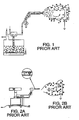
- Figure 1 is a schematic diagram showing the basic corona charging principle while figure 2 depicts the principle of tribo charging.
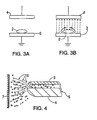
- FIG 3 (a) illustrates this effect by showing a large particle between two parallel electrodes. In the figure there is no power applied to the electrodes and therefore no charge on the particle. In Figure 3(b) a potential is applied to the electrodes and electrostatic charge flows from the lower electrode across the surface of the particle and the particle becomes charged. If the particle was removed from the lower electrode and removed from the system, the charge would be retained by it. It is now charged by induction.
- the particle was constructed not from an electrically conductive or partially conductive material but from from a insulator such as Teflon, the electrostatic charge from the lower plate would not be able to flow across the particle surface and therefore it would not acquire a charge.
- induction can be applied to cases where the object becoming charged is either in contact with the ground electrode or the high voltage electrode.
- induction is used where the object is in contact with ground and “conduction” where the object is in contact with the high voltage source. The situation is symmetrical and so is the magnitude of the charge attained.
- the important parameters with induction/conduction charging are the charging and discharging rates. These are governed by the electrical conductivity of the material. The more resistive a material is, the more time it requires to achieve maximum charge levels. For example, a metal which is highly conductive will acquire charge by induction within a fraction of a microsecond. A doped polymer may requre several seconds.
- the induction/conduction charging of the powder will be achieved at the charge transfer platform, which is one of the key areas of the invention.
- the exact design will be varied according to use. To illustrate, the platform for coating a large and heavy piece conveyed by a track would in no way resemble the platform for fuse boxes suspended from an overhead conveyor.
- the charge platform can be incorporated either in the gun head or upstream of the gun such that the powder is charged in advance of ejection rather that at the point of ejection.
- FIG. 3(a) is a schematic diagram representing an object (2) resting on a plate (3) between a neutral electrical field.
- Figure 3(b) is a schematic diagram depicting an electrical field applied between the plates of Figure 3(a) by raising the upper plate (12) to a high voltage wherein induced charge flows onto the surface of the object.
- Figure 4 illustrates an alternative induction coating system.
- the powder is pneumatically transferred to a region of high electric field at the gun head (5) where it acquires charge by induction.
- the charged powder (6) is transferred to the workpiece (7) by a combination of electric field and air flow.
- the introduction of a counter electrode may intensify the field at this point and improve charging of increased intensity is required. The effect and the necessity of such an electrode can be determined through analysis of the field geometry.
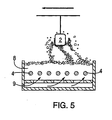
- Figure 5 illustrates an alternative method of coating items using an induction/conduction charging technique.
- the object (2) to be coated is suspended above a fluidized bed (8).
- the powder in the bed is charged by contact with high voltage electrodes (4) buried in the powder bulk.
- the powder coating is transferred to the workpiece by a combination of fluidized air (9) and the electrostatic attraction forces.
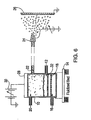
- Figure 6 is one representation of the basic design for a powder induction charging system. It shows a fluidized bed type electrostatic charger and powder applicator. Powder is fed continuously to an electrically insulated bed or zone(10) from powder reservoir (not shown) through port (12). The whole bed can sit on a vibrating table (14) which helps loosen the powder in the bed. Fluidizing air (16) is fed to beneath the air distributor plate (18) and transport air enters the bed near the top in a radial direction from (20) positioned directly opposite exit port (22) to nozzle (24) which directs the powder to the substrate (26). An electric field is set up across the bed, the electrodes being a high voltage electrode (28) supplied by an extra high tension source (30).
- the lower electrode is formed by the upper layers of the fluidized powder, in contact with a sintered grounded grid (32). Charge is induced on the powder as it enters the bed and once carried upwards and out of the bed by the fluidizing and transport air, this charge is locked on the powder until it reaches the workpiece. An electric field created between the high voltage nozzle of the applicator and the grounded workpiece assists in the transport and deposition of the charged powder.
- Evlast 1000/1W104 a commercially supplied white polyester resin powder manufactured by EVTECH Co. of North Carolina, USA, was used in this test example.
- the resistivity of the powder at 20% relative humidity was determined to be 1.5 X 10 15 ohm.meters.
- the resistivity was measured using a powder resistivity measurement cell developed by Wolfson Electrostatics, University of Victoria, UK.
- the resistivity of the test powder at 20% relative humidity was determined to be 1 x 10 11 ohm.meters.
- the volume average diameter of the test powder was determined to be 40 microns.
- a feed of 4g.min- 1 of the test powder was supplied to an apparatus similar to that shown in Figure 6. Once a sufficient reservoir of powder was present in the bed, the fluidizing air and transport air supplies were opened and adjusted so that steady state conditions were reached, that is, exactly as much powder left the bed through the nozzle as entered in the feed. Once these conditions had been reached, a voltage of 20 kV was applied to the upper electrode. The gap between the upper-electrode and the grounded plate was 10 cm, thus a minimum electric field of 2 kV cm -1 was set up across the bed.
- a conductive target plate (test workpiece) of approximately 100 cm 2 was placed 30 cm directly in front of the nozzle.
- the target plate was grounded via an electrometer which was capable of measuring the amount of charge flowing to the plate.
- Powder was collected on the plate for 20 seconds, beginning 5 seconds after the voltage was applied. In this time 1.1g of powder was collected on the plate, to which 9.4 x 10 -8 Coulombs of charge had flown. This indicates that a charge of almost 1 x 10- 4 Coulombs per kilogram has been applied to the powder by induction charging. Such specific charge levels are sufficient for good powder adhesion. All of the powders adhered to the plate for at least 2 minutes after the spraying had ceased.
- Scotchkote 213 a commercially supplied fusion bonded epoxy resin powder manufactured by the 3 M of Minnesota, USA was used in this test sample.
- this powder was dry mixed with 20g of antistat. The powders were blended together in a Waring blender until an ordered mixture was obtained. Before and after modification, the resistivity of the binder resin and composite powder was determined to be 3 x 10 14 ohm.meters and 1.2 x 10 9 ohm. meters respectively at 20% relative humidity. The volume average diameter of the test powder measured at 25um.
- a feed of 3g.min -1 of the test powder was supplied to the apparatus in a similar manner to Example 1. Again, an attainment of steady state conditions, a voltage of 20 kV was applied to the upper electrode. This time the target plate was heated to a surface temperature of 115°C and powder was sprayed onto the plate for 30 seconds. During this time 1.35g of powder was transferred to the plate and a charge of 5.5 x 10- 7 Coulombs flowed to the plate. All of the powder adhered to the plate with the layer in contact with it fusing.
- the present invention finds applications in other industrial coating areas.
- the material to be applied can be charged by induction/conduction and that the flow characteristics of the material are suitable, the use of induction/conduction as a method of charging has advantages in number of industrial applications.
Landscapes
- Application Of Or Painting With Fluid Materials (AREA)
- Electrostatic Spraying Apparatus (AREA)
- Paints Or Removers (AREA)
Claims (3)
- Verfahren zum Anbringen von elektrostatischer Ladung an organischen Pulvern, um sie für Pulverbeschichtungszwecke brauchbar zu machen, wobei die Pulver mit einem Polyalkylenether als elektrostatisch aktivem Modifikator zur Verbesserung der Ladung an den Pulvern gemischt werden und das Gemisch elektrostatisch induktiven oder leitenden Bedingungen ausgesetzt wird, wobei die Pulver einen spezifischen Widerstand von etwa 109 bis etwa 1013 Ωm bei einer relativen Feuchtigkeit von etwa 20 % haben.
- Verfahren zum Anbringen von elektrostatischer Ladung an organischen Pulvern, um sie für Pulverbeschichtungszwecke brauchbar zu machen, wobei die Pulver mit einem Polyalkylenglykol als elektrostatisch aktivem Modifikator zur Verbesserung der Ladung an den Pulvern gemischt werden und das Gemisch elektrostatisch induktiven oder leitenden Bedingungen ausgesetzt wird, wobei die Pulver einen spezifischen Widerstand von etwa 109 bis etwa 1013 Ωm bei einer relativen Feuchtigkeit von etwa 20 % haben.
- Verfahren zum Anbringen von elektrostatischer Ladung an organischen Pulvern, um sie für Pulverbeschichtungszwecke brauchbar zu machen, wobei die Pulver mit einem polyethoxylierten Stearylalkohol als elektrostatisch aktivem Modifikator zur Verbesserung der Ladung an den Pulvern gemischt werden und das Gemisch elektrostatisch induktiven oder leitenden Bedingungen ausgesetzt wird, wobei die Pulver einen spezifischen Widerstand von etwa 109 bis etwa 1013 Ωm bei einer relativen Feuchtigkeit von etwa 20 % haben.
Applications Claiming Priority (3)
| Application Number | Priority Date | Filing Date | Title |
|---|---|---|---|
| US08/320,892 US5585426A (en) | 1994-10-05 | 1994-10-05 | Process for imparting an electrostatic charge to powders to render them useful for coating application |
| US320892 | 1994-10-05 | ||
| PCT/US1995/013095 WO1996011068A1 (en) | 1994-10-05 | 1995-10-03 | Process for improving the electrostatic charge on powders and the use of such powders for coating applications |
Publications (3)
| Publication Number | Publication Date |
|---|---|
| EP0789632A1 EP0789632A1 (de) | 1997-08-20 |
| EP0789632A4 EP0789632A4 (de) | 2001-04-18 |
| EP0789632B1 true EP0789632B1 (de) | 2004-06-30 |
Family
ID=23248269
Family Applications (1)
| Application Number | Title | Priority Date | Filing Date |
|---|---|---|---|
| EP95938731A Expired - Lifetime EP0789632B1 (de) | 1994-10-05 | 1995-10-03 | Verfahren zum verbessern der elektrostatischen ladung auf pulvern |
Country Status (10)
| Country | Link |
|---|---|
| US (1) | US5585426A (de) |
| EP (1) | EP0789632B1 (de) |
| CN (1) | CN1121280C (de) |
| AU (1) | AU683781B2 (de) |
| BR (1) | BR9509259A (de) |
| DE (1) | DE69533228D1 (de) |
| RU (1) | RU2162375C2 (de) |
| TW (1) | TW360698B (de) |
| WO (1) | WO1996011068A1 (de) |
| ZA (1) | ZA958403B (de) |
Families Citing this family (28)
| Publication number | Priority date | Publication date | Assignee | Title |
|---|---|---|---|---|
| DE59611483D1 (de) * | 1995-10-28 | 2008-09-25 | Basf Coatings Ag | Verlaufmittel für pulverlacke |
| JPH09295464A (ja) * | 1996-04-30 | 1997-11-18 | Pioneer Electron Corp | 熱転写受像シート作製用粉体塗工装置およびそれを使用した熱転写受像シートの製造方法ならびに熱転写受像シート |
| FI111816B (fi) * | 1996-09-19 | 2003-09-30 | Metso Paper Inc | Menetelmä ja laite, jolla siirretään lisämateriaalia liikkuvan materiaalirainan pintaan |
| FI111475B (fi) | 1997-09-24 | 2003-07-31 | Metso Paper Inc | Menetelmä ja sovitelma sumun ja pölyn hallitsemiseksi paperin ja kartongin valmistuksessa ja jälkikäsittelyssä |
| FI105052B (fi) * | 1998-07-08 | 2000-05-31 | Valmet Corp | Menetelmä paperin valmistamiseksi, sovitelma menetelmän toteuttamiseksi ja menetelmän avulla valmistettu paperituote |
| GB0011284D0 (en) * | 2000-05-11 | 2000-06-28 | Univ Belfast | Coating process |
| AU2001292823A1 (en) * | 2000-09-20 | 2002-04-02 | World Properties Inc. | Electrostatic deposition of high temperature, high performance thermoplastics |
| US7105201B2 (en) * | 2002-07-26 | 2006-09-12 | H.B. Fuller Licensing & Financing, Inc. | Versatile processes for preparing and using novel composite particles in powder coating compositions |
| DE10306887A1 (de) * | 2003-02-18 | 2004-08-26 | Daimlerchrysler Ag | Verfahren zur Beschichtung von Partikeln für generative rapid prototyping Prozesse |
| US7122585B2 (en) * | 2003-05-13 | 2006-10-17 | Rohm And Haas Company | Coating powders, methods of manufacture thereof, and articles formed therefrom |
| US7223445B2 (en) * | 2004-03-31 | 2007-05-29 | Eastman Kodak Company | Process for the deposition of uniform layer of particulate material |
| US7259109B2 (en) * | 2004-09-22 | 2007-08-21 | Intel Corporation | Electrospray and enhanced electrospray deposition of thin films on semiconductor substrates |
| JP2008545897A (ja) * | 2005-06-07 | 2008-12-18 | エス.シー. ジョンソン アンド サン、インコーポレイテッド | 表面上の染みを消す方法 |
| US20070277849A1 (en) | 2006-06-06 | 2007-12-06 | Shah Ketan N | Method of neutralizing a stain on a surface |
| US8557758B2 (en) | 2005-06-07 | 2013-10-15 | S.C. Johnson & Son, Inc. | Devices for applying a colorant to a surface |
| US7862848B2 (en) * | 2005-08-03 | 2011-01-04 | The University Of Western Ontario | Direct coating solid dosage forms using powdered materials |
| US20080191378A1 (en) * | 2007-02-14 | 2008-08-14 | Brian Paul | Microsphere reinforcement of composite materials |
| CN101204694B (zh) * | 2007-12-10 | 2010-04-14 | 浙江万马电缆股份有限公司 | 电缆阻水层静电喷涂方法 |
| RU2428402C2 (ru) * | 2009-09-29 | 2011-09-10 | Юрий Ехилевич Польский | Способ диспергирования нано- и микрочастиц, их закрепление на поверхности полимера и устройство его реализующее |
| RU2417846C1 (ru) * | 2009-11-09 | 2011-05-10 | Инновационно-технический центр Общество с ограниченной ответственностью "СИТИС" | Устройство трибостатической электризации |
| NL2004623C2 (en) * | 2010-04-28 | 2011-10-31 | Heller Design B V De | Method and use of a binder for providing a metallic coat covering a surface. |
| JP5787223B2 (ja) | 2011-09-20 | 2015-09-30 | いすゞ自動車株式会社 | 静電塗装方法及び静電塗装用ガン |
| JP5854322B2 (ja) * | 2011-11-30 | 2016-02-09 | いすゞ自動車株式会社 | 静電塗装方法 |
| US9751107B2 (en) | 2012-03-21 | 2017-09-05 | Valspar Sourcing, Inc. | Two-coat single cure powder coating |
| PL2828008T5 (pl) * | 2012-03-21 | 2025-11-17 | Swimc Llc | Sposób powlekania proszkowego |
| CA2865562C (en) | 2012-03-21 | 2021-01-12 | Valspar Sourcing, Inc. | Two-coat single cure powder coating |
| CN102698942A (zh) * | 2012-06-20 | 2012-10-03 | 无锡科信威电子有限公司 | 一种透镜喷涂工艺 |
| CN110838174A (zh) * | 2019-11-18 | 2020-02-25 | 四川长虹电器股份有限公司 | 一种面向透明物体的3d扫描方法 |
Family Cites Families (11)
| Publication number | Priority date | Publication date | Assignee | Title |
|---|---|---|---|---|
| US4013615A (en) * | 1973-05-14 | 1977-03-22 | Tekkosha Co., Ltd. | Electrostatic spray coating powder pigment composition and process for producing the same |
| US4040993A (en) * | 1976-02-25 | 1977-08-09 | Westinghouse Electric Corporation | Low dissipation factor electrostatic epoxy wire coating powder |
| JPS6038699B2 (ja) * | 1977-09-14 | 1985-09-02 | 富士ゼロックス株式会社 | 静電荷像現像剤 |
| EP0024067B1 (de) * | 1979-02-15 | 1983-03-02 | Foseco International Limited | Bekleidung von wegwerf-substraten, welche in kontakt mit geschmolzenem metall sind |
| JPS55111950A (en) * | 1979-02-22 | 1980-08-29 | Fuji Xerox Co Ltd | Static charge image developer |
| JPS5688470A (en) * | 1979-12-21 | 1981-07-17 | Somar Corp | Epoxy resin composition for powder paint |
| NL8104307A (nl) * | 1981-09-18 | 1983-04-18 | Oce Nederland Bv | Gekleurd tonerpoeder, een werkwijze voor zijn bereiding alsmede een werkwijze voor het met dit poeder ontwikkelen van beelden. |
| DE3730473A1 (de) * | 1987-09-11 | 1989-03-30 | Brennenstuhl Kg Hugo | Verfahren zum beschichten von gegenstaenden |
| US4997704A (en) * | 1989-06-02 | 1991-03-05 | Technetics Corporation | Plasma-arc ceramic coating of non-conductive surfaces |
| RU2002520C1 (ru) * | 1990-08-14 | 1993-11-15 | Инженерный центр "Машиностроитель" Министерства образовани Украины | Способ получени покрытий |
| JP3373610B2 (ja) * | 1993-08-23 | 2003-02-04 | オリヱント化学工業株式会社 | 帯電性樹脂粉体及びその関連技術 |
-
1994
- 1994-10-05 US US08/320,892 patent/US5585426A/en not_active Expired - Fee Related
-
1995
- 1995-10-03 EP EP95938731A patent/EP0789632B1/de not_active Expired - Lifetime
- 1995-10-03 DE DE69533228T patent/DE69533228D1/de not_active Expired - Lifetime
- 1995-10-03 WO PCT/US1995/013095 patent/WO1996011068A1/en not_active Ceased
- 1995-10-03 CN CN95196055A patent/CN1121280C/zh not_active Expired - Fee Related
- 1995-10-03 AU AU39998/95A patent/AU683781B2/en not_active Ceased
- 1995-10-03 RU RU97107484/12A patent/RU2162375C2/ru not_active IP Right Cessation
- 1995-10-03 BR BR9509259A patent/BR9509259A/pt not_active IP Right Cessation
- 1995-10-05 ZA ZA958403A patent/ZA958403B/xx unknown
- 1995-11-06 TW TW084110977A patent/TW360698B/zh active
Also Published As
| Publication number | Publication date |
|---|---|
| BR9509259A (pt) | 1998-11-03 |
| DE69533228D1 (de) | 2004-08-05 |
| CN1121280C (zh) | 2003-09-17 |
| US5585426A (en) | 1996-12-17 |
| CN1162935A (zh) | 1997-10-22 |
| AU683781B2 (en) | 1997-11-20 |
| AU3999895A (en) | 1996-05-02 |
| ZA958403B (en) | 1996-05-08 |
| EP0789632A4 (de) | 2001-04-18 |
| TW360698B (en) | 1999-06-11 |
| WO1996011068A1 (en) | 1996-04-18 |
| EP0789632A1 (de) | 1997-08-20 |
| RU2162375C2 (ru) | 2001-01-27 |
Similar Documents
| Publication | Publication Date | Title |
|---|---|---|
| EP0789625B1 (de) | Vorrichtung und verfahren zur beschichtung von substraten mit durch induktion geladenen harzpulverpartikeln | |
| US5585426A (en) | Process for imparting an electrostatic charge to powders to render them useful for coating application | |
| MXPA97002463A (en) | Apparatus for covering substrates with inductivame loaded powder resin particles | |
| EP1042075B1 (de) | Pulverbeschichtungsverfahren | |
| US5731043A (en) | Triboelectric coating powder and procees for coating wood substrates | |
| AU2003296642B2 (en) | Powder coating apparatus and process | |
| KR20040017224A (ko) | 마찰정전기적으로 하전된 유동층으로 분말 코팅하는 방법 | |
| US5756164A (en) | Triboelectric coating powder and process | |
| CA2201878C (en) | Process for imparting an electrostatic charge to powders to render them useful for coating applications | |
| IL117020A (en) | Process for imparting an electrostatic charge to powders and rendering them useful for coating applications | |
| Knobbe | Tribo or Corona? Here's How to Decide |
Legal Events
| Date | Code | Title | Description |
|---|---|---|---|
| PUAI | Public reference made under article 153(3) epc to a published international application that has entered the european phase |
Free format text: ORIGINAL CODE: 0009012 |
|
| 17P | Request for examination filed |
Effective date: 19970502 |
|
| AK | Designated contracting states |
Kind code of ref document: A1 Designated state(s): CH DE ES FR GB IE IT LI NL SE |
|
| RAP1 | Party data changed (applicant data changed or rights of an application transferred) |
Owner name: ENEXUS CORPORATION |
|
| A4 | Supplementary search report drawn up and despatched |
Effective date: 20010307 |
|
| AK | Designated contracting states |
Kind code of ref document: A4 Designated state(s): CH DE ES FR GB IE IT LI NL SE |
|
| RIC1 | Information provided on ipc code assigned before grant |
Free format text: 7B 05D 1/04 A, 7B 05D 1/06 B, 7B 05D 7/00 B, 7C 09D 5/03 B |
|
| RTI1 | Title (correction) |
Free format text: PROCESS FOR IMPROVING THE ELECTROSTATIC CHARGE ON POWDERS |
|
| GRAG | Despatch of communication of intention to grant |
Free format text: ORIGINAL CODE: EPIDOS AGRA |
|
| 17Q | First examination report despatched |
Effective date: 20020521 |
|
| GRAG | Despatch of communication of intention to grant |
Free format text: ORIGINAL CODE: EPIDOS AGRA |
|
| GRAH | Despatch of communication of intention to grant a patent |
Free format text: ORIGINAL CODE: EPIDOS IGRA |
|
| GRAS | Grant fee paid |
Free format text: ORIGINAL CODE: EPIDOSNIGR3 |
|
| GRAA | (expected) grant |
Free format text: ORIGINAL CODE: 0009210 |
|
| AK | Designated contracting states |
Kind code of ref document: B1 Designated state(s): CH DE ES FR GB IE IT LI NL SE |
|
| PG25 | Lapsed in a contracting state [announced via postgrant information from national office to epo] |
Ref country code: NL Free format text: LAPSE BECAUSE OF FAILURE TO SUBMIT A TRANSLATION OF THE DESCRIPTION OR TO PAY THE FEE WITHIN THE PRESCRIBED TIME-LIMIT Effective date: 20040630 Ref country code: LI Free format text: LAPSE BECAUSE OF FAILURE TO SUBMIT A TRANSLATION OF THE DESCRIPTION OR TO PAY THE FEE WITHIN THE PRESCRIBED TIME-LIMIT Effective date: 20040630 Ref country code: IT Free format text: LAPSE BECAUSE OF FAILURE TO SUBMIT A TRANSLATION OF THE DESCRIPTION OR TO PAY THE FEE WITHIN THE PRE;WARNING: LAPSES OF ITALIAN PATENTS WITH EFFECTIVE DATE BEFORE 2007 MAY HAVE OCCURRED AT ANY TIME BEFORE 2007. THE CORRECT EFFECTIVE DATE MAY BE DIFFERENT FROM THE ONE RECORDED.SCRIBED TIME-LIMIT Effective date: 20040630 Ref country code: FR Free format text: LAPSE BECAUSE OF FAILURE TO SUBMIT A TRANSLATION OF THE DESCRIPTION OR TO PAY THE FEE WITHIN THE PRESCRIBED TIME-LIMIT Effective date: 20040630 Ref country code: CH Free format text: LAPSE BECAUSE OF FAILURE TO SUBMIT A TRANSLATION OF THE DESCRIPTION OR TO PAY THE FEE WITHIN THE PRESCRIBED TIME-LIMIT Effective date: 20040630 |
|
| REG | Reference to a national code |
Ref country code: GB Ref legal event code: FG4D Ref country code: CH Ref legal event code: EP |
|
| REG | Reference to a national code |
Ref country code: IE Ref legal event code: FG4D |
|
| REF | Corresponds to: |
Ref document number: 69533228 Country of ref document: DE Date of ref document: 20040805 Kind code of ref document: P |
|
| PG25 | Lapsed in a contracting state [announced via postgrant information from national office to epo] |
Ref country code: SE Free format text: LAPSE BECAUSE OF FAILURE TO SUBMIT A TRANSLATION OF THE DESCRIPTION OR TO PAY THE FEE WITHIN THE PRESCRIBED TIME-LIMIT Effective date: 20040930 |
|
| PG25 | Lapsed in a contracting state [announced via postgrant information from national office to epo] |
Ref country code: DE Free format text: LAPSE BECAUSE OF FAILURE TO SUBMIT A TRANSLATION OF THE DESCRIPTION OR TO PAY THE FEE WITHIN THE PRESCRIBED TIME-LIMIT Effective date: 20041001 |
|
| PG25 | Lapsed in a contracting state [announced via postgrant information from national office to epo] |
Ref country code: IE Free format text: LAPSE BECAUSE OF NON-PAYMENT OF DUE FEES Effective date: 20041004 |
|
| PG25 | Lapsed in a contracting state [announced via postgrant information from national office to epo] |
Ref country code: ES Free format text: LAPSE BECAUSE OF FAILURE TO SUBMIT A TRANSLATION OF THE DESCRIPTION OR TO PAY THE FEE WITHIN THE PRESCRIBED TIME-LIMIT Effective date: 20041011 |
|
| PGFP | Annual fee paid to national office [announced via postgrant information from national office to epo] |
Ref country code: GB Payment date: 20041224 Year of fee payment: 10 |
|
| NLV1 | Nl: lapsed or annulled due to failure to fulfill the requirements of art. 29p and 29m of the patents act | ||
| REG | Reference to a national code |
Ref country code: CH Ref legal event code: PL |
|
| PLBE | No opposition filed within time limit |
Free format text: ORIGINAL CODE: 0009261 |
|
| STAA | Information on the status of an ep patent application or granted ep patent |
Free format text: STATUS: NO OPPOSITION FILED WITHIN TIME LIMIT |
|
| 26N | No opposition filed |
Effective date: 20050331 |
|
| EN | Fr: translation not filed | ||
| REG | Reference to a national code |
Ref country code: IE Ref legal event code: MM4A |
|
| PG25 | Lapsed in a contracting state [announced via postgrant information from national office to epo] |
Ref country code: GB Free format text: LAPSE BECAUSE OF NON-PAYMENT OF DUE FEES Effective date: 20051003 |
|
| GBPC | Gb: european patent ceased through non-payment of renewal fee |
Effective date: 20051003 |
|
| REG | Reference to a national code |
Ref country code: GB Ref legal event code: 728V |
|
| REG | Reference to a national code |
Ref country code: GB Ref legal event code: S28 Effective date: 20080810 |