EP0789708B1 - Multifunktionelle molekuläre komplexe für den gen-transfer in zellen - Google Patents
Multifunktionelle molekuläre komplexe für den gen-transfer in zellen Download PDFInfo
- Publication number
- EP0789708B1 EP0789708B1 EP95935213A EP95935213A EP0789708B1 EP 0789708 B1 EP0789708 B1 EP 0789708B1 EP 95935213 A EP95935213 A EP 95935213A EP 95935213 A EP95935213 A EP 95935213A EP 0789708 B1 EP0789708 B1 EP 0789708B1
- Authority
- EP
- European Patent Office
- Prior art keywords
- nucleic acid
- bis
- group
- molecular complex
- thioglucoside
- Prior art date
- Legal status (The legal status is an assumption and is not a legal conclusion. Google has not performed a legal analysis and makes no representation as to the accuracy of the status listed.)
- Expired - Lifetime
Links
Classifications
-
- C—CHEMISTRY; METALLURGY
- C07—ORGANIC CHEMISTRY
- C07K—PEPTIDES
- C07K14/00—Peptides having more than 20 amino acids; Gastrins; Somatostatins; Melanotropins; Derivatives thereof
- C07K14/005—Peptides having more than 20 amino acids; Gastrins; Somatostatins; Melanotropins; Derivatives thereof from viruses
-
- A—HUMAN NECESSITIES
- A61—MEDICAL OR VETERINARY SCIENCE; HYGIENE
- A61K—PREPARATIONS FOR MEDICAL, DENTAL OR TOILETRY PURPOSES
- A61K47/00—Medicinal preparations characterised by the non-active ingredients used, e.g. carriers or inert additives; Targeting or modifying agents chemically bound to the active ingredient
- A61K47/50—Medicinal preparations characterised by the non-active ingredients used, e.g. carriers or inert additives; Targeting or modifying agents chemically bound to the active ingredient the non-active ingredient being chemically bound to the active ingredient, e.g. polymer-drug conjugates
- A61K47/51—Medicinal preparations characterised by the non-active ingredients used, e.g. carriers or inert additives; Targeting or modifying agents chemically bound to the active ingredient the non-active ingredient being chemically bound to the active ingredient, e.g. polymer-drug conjugates the non-active ingredient being a modifying agent
- A61K47/54—Medicinal preparations characterised by the non-active ingredients used, e.g. carriers or inert additives; Targeting or modifying agents chemically bound to the active ingredient the non-active ingredient being chemically bound to the active ingredient, e.g. polymer-drug conjugates the non-active ingredient being a modifying agent the modifying agent being an organic compound
- A61K47/543—Lipids, e.g. triglycerides; Polyamines, e.g. spermine or spermidine
-
- A—HUMAN NECESSITIES
- A61—MEDICAL OR VETERINARY SCIENCE; HYGIENE
- A61K—PREPARATIONS FOR MEDICAL, DENTAL OR TOILETRY PURPOSES
- A61K47/00—Medicinal preparations characterised by the non-active ingredients used, e.g. carriers or inert additives; Targeting or modifying agents chemically bound to the active ingredient
- A61K47/50—Medicinal preparations characterised by the non-active ingredients used, e.g. carriers or inert additives; Targeting or modifying agents chemically bound to the active ingredient the non-active ingredient being chemically bound to the active ingredient, e.g. polymer-drug conjugates
- A61K47/51—Medicinal preparations characterised by the non-active ingredients used, e.g. carriers or inert additives; Targeting or modifying agents chemically bound to the active ingredient the non-active ingredient being chemically bound to the active ingredient, e.g. polymer-drug conjugates the non-active ingredient being a modifying agent
- A61K47/54—Medicinal preparations characterised by the non-active ingredients used, e.g. carriers or inert additives; Targeting or modifying agents chemically bound to the active ingredient the non-active ingredient being chemically bound to the active ingredient, e.g. polymer-drug conjugates the non-active ingredient being a modifying agent the modifying agent being an organic compound
- A61K47/554—Medicinal preparations characterised by the non-active ingredients used, e.g. carriers or inert additives; Targeting or modifying agents chemically bound to the active ingredient the non-active ingredient being chemically bound to the active ingredient, e.g. polymer-drug conjugates the non-active ingredient being a modifying agent the modifying agent being an organic compound the modifying agent being a steroid plant sterol, glycyrrhetic acid, enoxolone or bile acid
-
- C—CHEMISTRY; METALLURGY
- C12—BIOCHEMISTRY; BEER; SPIRITS; WINE; VINEGAR; MICROBIOLOGY; ENZYMOLOGY; MUTATION OR GENETIC ENGINEERING
- C12N—MICROORGANISMS OR ENZYMES; COMPOSITIONS THEREOF; PROPAGATING, PRESERVING, OR MAINTAINING MICROORGANISMS; MUTATION OR GENETIC ENGINEERING; CULTURE MEDIA
- C12N15/00—Mutation or genetic engineering; DNA or RNA concerning genetic engineering, vectors, e.g. plasmids, or their isolation, preparation or purification; Use of hosts therefor
- C12N15/09—Recombinant DNA-technology
- C12N15/63—Introduction of foreign genetic material using vectors; Vectors; Use of hosts therefor; Regulation of expression
- C12N15/64—General methods for preparing the vector, for introducing it into the cell or for selecting the vector-containing host
-
- C—CHEMISTRY; METALLURGY
- C12—BIOCHEMISTRY; BEER; SPIRITS; WINE; VINEGAR; MICROBIOLOGY; ENZYMOLOGY; MUTATION OR GENETIC ENGINEERING
- C12N—MICROORGANISMS OR ENZYMES; COMPOSITIONS THEREOF; PROPAGATING, PRESERVING, OR MAINTAINING MICROORGANISMS; MUTATION OR GENETIC ENGINEERING; CULTURE MEDIA
- C12N15/00—Mutation or genetic engineering; DNA or RNA concerning genetic engineering, vectors, e.g. plasmids, or their isolation, preparation or purification; Use of hosts therefor
- C12N15/09—Recombinant DNA-technology
- C12N15/87—Introduction of foreign genetic material using processes not otherwise provided for, e.g. co-transformation
-
- A—HUMAN NECESSITIES
- A61—MEDICAL OR VETERINARY SCIENCE; HYGIENE
- A61K—PREPARATIONS FOR MEDICAL, DENTAL OR TOILETRY PURPOSES
- A61K48/00—Medicinal preparations containing genetic material which is inserted into cells of the living body to treat genetic diseases; Gene therapy
-
- C—CHEMISTRY; METALLURGY
- C12—BIOCHEMISTRY; BEER; SPIRITS; WINE; VINEGAR; MICROBIOLOGY; ENZYMOLOGY; MUTATION OR GENETIC ENGINEERING
- C12N—MICROORGANISMS OR ENZYMES; COMPOSITIONS THEREOF; PROPAGATING, PRESERVING, OR MAINTAINING MICROORGANISMS; MUTATION OR GENETIC ENGINEERING; CULTURE MEDIA
- C12N2760/00—MICROORGANISMS OR ENZYMES; COMPOSITIONS THEREOF; PROPAGATING, PRESERVING, OR MAINTAINING MICROORGANISMS; MUTATION OR GENETIC ENGINEERING; CULTURE MEDIA ssRNA viruses negative-sense
- C12N2760/00011—Details
- C12N2760/16011—Orthomyxoviridae
- C12N2760/16022—New viral proteins or individual genes, new structural or functional aspects of known viral proteins or genes
Definitions
- the present invention is in the field of methods for the transfer of genetic information, e.g., foreign DNA, into target cells, especially eukaryotic cells.
- the present invention relates to nonviral gene carriers comprising multifunctional molecular conjugates which include, inter alia, lipopolyamines of a particular configuration, a component which promotes endosome disruption, and, optionally, a receptor specific binding component.
- multifunctional molecular conjugates which include, inter alia, lipopolyamines of a particular configuration, a component which promotes endosome disruption, and, optionally, a receptor specific binding component.
- viral vectors of various types have been successfully utilized for the insertion of selected foreign genetic information into a target cell, and in the case of eukaryotic cells, for incorporation of that genetic information into the genome of the cell.
- These viral vector systems have relied upon the molecular machinery of the virus, evolved over time to surmount the significant problems facing a virus in attempting to invade, i.e., infect a cell.
- the efficiency of such viral vectors there has been continued concern regarding the safety of using viruses, particularly from the standpoint of undesired side effects.
- non-viral gene delivery systems that are as efficient as viral vectors, but with an improved safety profile.
- Nonviral vectors or carriers of the type with which the present invention is concerned, will thus have to overcome the same obstacles as a viral vector.
- the problems faced by such carriers include persistence in the biophase of the organism for a sufficient time to reach the target cell; recognition of the target cell and means for mediating transport of the genetic material through the cell membrane and into the cytoplasm of the cell; avoidance of degradation within the cell by the reticuloendothelial system; and transport to and through the nuclear membrane into the nucleus of the cell where transcription of the genetic material can take place.
- the present invention comprises a multifunctional complex, i.e. , a molecular conjugate of various ligands intended to surmount specific obstacles.
- the transfer of genetic material into cells is the basis of a number of processes now widely accepted in the areas of molecular biology, gene therapy and genetic immunization. Transfer of the genetic information encoded in DNA to cells where it expresses identified individual proteins, has permitted investigation of the function of such proteins on a cellular level, and of the underlying cell physiology. Genetic material has also been transferred into cells to introduce proteins that are absent due to an inherent genetic flaw in the cell that expresses an inactive protein or else prevents expression of the protein altogether. The transfer of genetic material into cells can be used to prevent the expression of proteins in those cells through the well-known antisense effect of complementary DNA or RNA strands.
- Exogenous, i.e. , foreign genetic material can permit cells to synthesize significant amounts of proteins that are not available by other means in practical economic terms. These proteins of interest can be grown in a variety of host cells such as yeast, bacterial or mammalian cells. Genetic material can also be used to provide protective immune responses in vivo by injection of DNA that encodes immunogenic proteins, i . e ., ones that can stimulate the desired immune response. The in vivo introduction of exogenous genetic material into cells also has potential utility in applications for the alleviation, treatment or prevention of metabolic, tumoral or infectious disorders by the same mechanisms enumerated above.
- genetic material can be introduced systemically through an intravenous or intraperitoneal injection for in vivo applications, or can be introduced to the site of action by direct injection into that area.
- DNA by itself, injected into various tissues, will enter cells and produce a protein that will elicit an immune response. See, e.g. , P.Atanasiu et al ., Academy des Sciences (Paris) 254, 4228-30 (1962); M.A.Israel et al., J. Virol.
- Another approach in the art to delivery of genetic material to target cells is one that takes advantage of natural receptor-mediated endocytosis pathways that exist in such cells.
- Several cellular receptors have been identified heretofore as desirable agents by means of which it is possible to achieve the specific targeting of drugs, and especially macromolecules and molecular conjugates serving as carriers of genetic material of the type with which the present invention is concerned.
- These cellular receptors allow for specific targeting by virtue of being localized to a particular tissue or by having an enhanced avidity for, or activity in a particular tissue. See, e.g. , J.L.Bodmer and R.T.Dean, Meth. Enzymol. , 112, 298-306 (1985). This affords the advantages of lower doses or significantly fewer undesirable side effects.
- the asialoglycoprotein receptor is an extracellular receptor with a high affinity for galactose, especially tri-antennary oligosaccharides, i.e. , those with three somewhat extended chains or spacer arms having terminal galactose residues; see, e.g ., H.F.Lodish, TIBS , 16, 374-77 (1991).
- This high affinity receptor is localized to hepatocytes and is not present in Kupffer cells; allowing for a high degree of selectivity in delivery to the liver.
- An alternative method of providing cell-selective binding is to attach an entity with an ability to bind to the cell type of interest; commonly used in this respect are antibodies which can bind to specific proteins present in the cellular membranes or outer regions of the target cells.
- Alternative receptors have also been recognized as useful in facilitating the transport of macromolecules, such as biotin and folate receptors; see P.S.Low, M.A.Horn and P.F.Heinstein, World Patent Application WO 90/12095, published 18 October 1990; P.S.Low, M.A.Horn and P.F.Heinstein, World Patent Application WO 90/12096, published 18 October 1990; P.S.Low, M.A.Horn and P.F.Heinstein, US Patent 5,108,921 , April 28, 1992; C.P.Leamon and P.S.Low, Proc.
- the method consists of attaching a glycoprotein, asialoorosomucoid, to poly-lysine to provide a hepatocyte selective DNA carrier.
- the function of the poly-lysine is to bind to the DNA through ionic interactions between the positively charged (cationic) amino groups of the lysines and the negatively charged (anionic) phosphate groups of the DNA.
- Orosomucoid is a glycoprotein which is normally present in human serum. Removal of the terminal sialic acid (N-acetyl neuraminic acid) from the branched oligosaccharides exposes terminal galactose oligosaccharides, for which hepatocyte receptors have a high affinity, as already described.
- the protein After binding to the asialoglycoprotein receptor on hepatocytes, the protein is taken into the cell by endocytosis into a pre-lysosomal endosome.
- the DNA ionically bound to the poly-lysine-asialoorosomucoid carrier, is also taken into the endosome.
- Additional work using this delivery system e . g ., that done by J.M.Wilson, M.Grossman, J.A.Cabrera, C.H.Wu and G.Y.Wu, J. Biol. Chem, 267, 11483-11489 (1992), has found that partial hepatectomy improves the persistence of the expression of the DNA delivered into the hepatocytes.
- asialoglycoprotein is not required to achieve binding to the asialoglycoprotein receptor; this binding can also be accomplished with high affinity by the use of small, synthetic molecules having a similar configuration.
- the carbohydrate portion can be removed from an appropriate glycoprotein and be conjugated to other macromolecules; see, e.g. , S.J.Wood and R.Wetzel, Bioconj. Chem. , 3, 391-396 (1992). By this procedure the cellular receptor binding portion of the glycoprotein is removed, and the specific portion required for selective cellular binding can be transferred to another molecule.
- Thiopropionate and thiohexanoate glycosidic derivatives of galactose have been prepared and linked to L-lysyl-L-lysine to form a synthetic tri-antennary galactose derivative.
- a bisacridine spermidine derivative containing this synthetic tri-antennary galactose has been used to target DNA to hepatocytes; see F.C.Szoka, Jr and J.Haensler, World Pat Application WO 93/19768 , published 14 October 1993; and J.Haensler and F.C.Szoka,Jr., Bioconj. Chem., 4, 85-93 (1993) .
- the transferrin receptor has also been used to target DNA to erythroblasts, K562 macrophages and ML-60 leukemic cells; see E.Wagner, M.Zenke, M.Cotten, H.Beug and M.L.Birnstiel, Proc. Nat. Acad. Sci. USA , 87, 3410-3414 (1990); M.Zenke, P.Steinlein, E.Wagner, M.Cotten, H.Beug and M.L.Birnstiel, Proc. Nat . Acad. Sci .
- poly-lysine to facilitate DNA entry into cells is significantly enhanced if the poly-lysine is chemically modified with hydrophobic appendages; see X.Zhou and L.Huang, Biochim. Biophys. Acta , 1189, 195-203 (1994); complexed with cationic lipids; see K.D.Mack, R.Walzem and J.B.Zeldis, Am. J. Med. Sci. , 307, 138-143 (1994) or associated with viruses. Many viruses infect specific cells by receptor mediated binding and insertion of the viral DNA/RNA into the cell; and thus this action of the virus is similar to the facilitated entry of DNA described above.
- Replication-incompetent adenovirus has been used to enhance the entry of transferrin-poly-lysine complexed DNA into cells; see D.T.Curiel, S.Agarwal, E.Wagner and M.Cotten, Proc. Nat. Acad. Sci. USA, 88, 8850-8854 (1991); E.Wagner, K.Zatloukal, M.Cotten, H.Kirlappos, K.Mechtler, D.T.Curiel and M.L.Birnstiel, Proc. Nat. Acad. Sci.
- the adenovirus enhances the entry of the poly-lysine-transferrin-DNA complex when covalently attached to the poly-lysine and when attached through an antibody binding site. There does not need to be a direct attachment of the adenovirus to the poly-lysine-transferrin-DNA complex, and it can facilitate the entry of the complex when present as a simple mixture.
- the poly-lysine transferrin-DNA complex provides receptor specific binding to the cells and is internalized into endosomes along with the DNA. Once inside the endosomes, the adenovirus facilitates entry of the DNA/transferrin-poly-lysine complex into the cell by disruption of the endosomal compartment with subsequent release of the DNA into the cytoplasm.
- Replication-incompetent adenovirus has also been used to enhance the entry of uncomplexed DNA plasmids into cells without the benefit of the cell receptor selectivity conferred by the poly-lysine-transferrin complex; see K.Yoshimura, M.A.Rosenfeld, P.Seth and R.G.Crystal, J. Biol. Chem ., 268, 2300-2303 (1993).
- Synthetic peptides such as the N-terminus region of the influenza hemagglutinin protein are known to destabilize membranes and are known as fusogenic peptides.
- Conjugates containing the influenza fusogenic peptide coupled to polylysine together with a peptide having a branched tri-lysine amino terminus ligand ending with four galactosyl residues have been prepared as facilitators of DNA entry into hepatocytes; see C.Plank, K.Zatlouhal, M.Cotten, K.Mechtler and E.Wagner, Bioconj. Chem. , 3,533 -539 (1992).
- conjugates combine the asialoglycoprotein receptor mediated binding conferred by the tetra-galactose peptide, the endosomal disrupting abilities of the influenza fusogenic peptide, and the DNA binding of the poly-lysine. These conjugates deliver DNA into the cell by a combination of receptor mediated uptake and internalization into endosomes. This internalization is followed by disruption of the endosomes by the influenza fusogenic peptide to release the DNA into the cytoplasm.
- influenza fusogenic peptide can be attached to poly-lysine and mixed with the transferrin-poly-lysine complex to provide a similar DNA carrier selective for cells carrying the transferrin receptor; see E.Wagner, C.Plank, K.Zatloukal, M.Cotten and M.L.Birnstiel, Proc. Nat. Acad. Sci. USA , 89, 7934-7938 (1992).
- Synthetically designed peptides can also be used; for example the "GALA" peptides [N.K.Subbarao, R.A.Parente, F.C.Szoka,Jr, L.Nadasdi and K.Pongracz, J. Biol.
- Poly-lysine is not unique in providing a polycationic framework for the entry of DNA into cells.
- DEAE-dextran has also been shown to be effective in promoting RNA and DNA entry into cells; see R.Juliano and E. Mayhew, Exp. Cell. Res. 73, 3-12 (1972); and E. Mayhew and R.Juliano, Exp. Cell. Res . 77, 409-414 (1973).
- a dendritic cascade co-polymer of ethylenediamine and methyl acrylate has been shown to be useful in providing a carrier of DNA which facilitates entry into cells; see J.Haensler and F.C.Szoka,Jr:, Bioconj.
- Positively charged liposomes have also been widely used as carriers of DNA which facilitate entry into cells; see, e.g., F.C.Szoka,Jr. and J.Haensler, World Pat Application WO 93/19768 , published 14 October 1993; R.J.Debs and N.Zhu, World Patent Application WO 93/24640 , published 9 December 1993; P.L.Felgner, R.Kumar, C.Basava, R.C.Border and J.-Y.Hwang-Felgner, World Patent Application WO 91/16024 , published 31 October 1991; P.L.Felgner and G.M.Ringold, Nature , 337, 387-388 (1989); J.K.Rose, L.Buonocore and M.A.Whitt, BioTechniques , 10, 520-525 (1991); C.F.Bennett, M.Y.Chiang, H.Chan, J.E.E.Schoemaker and C
- pH sensitive liposomes see C.-J.Chu, J.Dijkstra, M.-Z.Lai, K.Hong and F.C.Szoka,Jr., Pharm. Res., 7, 824-854 (1990); J.-Y.Legendre and F.C.Szoka,Jr., Pharm. Res., 9, 1253-1242 (1992).
- a poly-cationic lipid has been prepared by coupling dioctadecylamidoglycine and dipalmitoyl phosphatidylethanolamine to a 5-carboxyspermine; see J.-P.Behr, B.Demeniex, J.-P.Loeffler and J.Perez-Mutul, Proc. Nat. Acad. Sci. USA , 86, 6982-6986 (1989); F.Barthel, J.-S.Remy, J.-P.Loeffler and J.P.Behr, DNA and Cell Biol. , 12, 553-560 (1993); J.-P.Loeffler and J.-P.Behr, Meth. Enzymol.
- Combinations of lipids have been used to facilitate the transfer of nucleic acids into cells.
- US Patent 5,283,185 there is disclosed such a method which utilizes a mixed lipid dispersion of a cationic lipid with a co-lipid in a suitable solvent.
- the lipid has a structure which includes a lipophilic group derived from cholesterol, a linker bond, a linear alkyl spacer arm, and a cationic amino group; and the co-lipid is phosphatidylcholine or phosphatidylethanolamine.
- Macrophages have receptors for both mannose and mannose-6-phosphate which can bind to and internalize molecules displaying these sugars.
- the molecules are internalized by endocytosis into a pre-lysosomal endosome. This internalization has been used to enhance entry of oligonucleotides into macrophages using bovine serum albumin modified with mannose-6-phosphate and linked to an oligodeoxynucleotide by a disulfide bridge to a modified 3' end; see E.Bonfils, C.Depierreux, P.Midoux, N.T.Thuong, M.Monsigny and A.C.Roche, Nucl. Acids Res. 20, 4621-4629 (1992).
- oligodeoxynucleotides modified at the 3' end with biotin were combined with mannose-modified streptavidin, and were also found to have facilitated entry into macrophages; see E.Bonfils, C.Mendes, A.C.Roche, M.Monsigny and P.Midoux, Bioconj. Chem ., 3, 277-284 (1992).
- the present invention relates to a multifunctional molecular complex for the transfer of a nucleic acid composition to a target cell comprising in any functional combination: A) said nucleic acid; B) a delivery vehicle, referred to herein as the "transfer moiety", comprising a) one or more cationic polyamine components bound to said nucleic acid, each comprising from three to twelve nitrogen atoms; b) one or more endosome membrane disruption promoting components attached to a nitrogen atom of the cationic polyamine component, through an alkyl, carboxamide, carbamate, thiocarbamate, or carbamoyl bridging group, comprising i) at least one lipophilic long chain alkyl group, ii) a fusogenic peptide comprising spike glycoproteins of enveloped animal viruses, or iii) cholic acid, cholesteryl, or derivatives thereof; and optionally C) one or more receptor specific binding components which are ligands for natural receptors of said target cell, attached through an
- a multifunctional molecular complex for transferring a nucleic acid composition to a target cell, the multifunctional molecular complex comprising:
- At least one of the R 3 groups may have the formula -B-(CR 1 R 2 ) j -C(R) 3 , wherein B is absent.
- j is 8 to 18.
- j is 8 to 12.
- At least one of the R 3 groups may have the formula -(CR 1 R 2 ) j' -X(R 4 )R, where X is N(R) and R 4 is independently selected from the group consisting of (i) fusogenic peptides comprising spike glycoproteins of enveloped animal viruses, and (ii) cholic acid and derivatives thereof selected from the group consisting of 3 ⁇ , 7 ⁇ , 12 ⁇ -trihydroxy-5 ⁇ -cholan-24-oic ester and amide.
- j' is 2 to 4.
- At least one of the R 3 groups may have the formula -(CR 1 R 2 ) j' -X(R 4 )R, where X is O or S, and R 4 is independently selected from the group consisting of (i) fusogenic peptides comprising spike glycoproteins of enveloped animal viruses, and (ii) a cholesteryl group and derivatives thereof selected from the group consisting of cholest-5-en-3'- ⁇ -carbonate, - ⁇ -carbamate, and - ⁇ -methylenecarboxamide.
- R, R 1 and R 2 may each be hydrogen, wherever they occur, m may be 3 or 4, n may be 1 to 6, j' may be an integer from 2 to 4 inclusive, and R 4 may be cholest-5-en-3'- ⁇ -carbonate, - ⁇ -carbamate, or - ⁇ -methylenecarboxamide.
- the group from which R 3 may be selected further comprises groups having the formula -B-(R 5 )R, and at least one of the R 3 groups has the formula -B-(R 5 )R;
- B is a bridging group independently selected from groups (i) through (v) inclusive as defined in claim 1;
- R is independently selected from the group consisting of hydrogen and C 1-6 alkyl or is absent;
- R 5 is a receptor specific binding component independently selected from the group consisting of:
- At least one of the R 3 groups may have the formula -(CR 1 R 2 ) j' -N(R 5 )R, where j' is 1 to 6.
- Two of the R 3 groups may have the formula -(CR 1 R 2 ) j' -N(R 5 )R.
- At least one of the R 3 groups thereof may have the formula -B-(CR 1 R 2 ) j -C(R) 3 , where B is absent, R, R 1 and R 2 are each hydrogen wherever they occur, m is 3 or 4, n is 1 to 6 and j is an integer from 8 to 18 inclusive.
- the transfer moiety may be selected from the group consisting of:
- the transfer moiety may be selected from the group consisting of:
- the transfer moiety is selected from the group consisting of:
- the multifunctional molecular complex may further comprise different cationic polyamine components.
- the multifunctional molecular complex may further comprise a first cationic polyamine component having an endosome membrane disruption promoting component attached thereto and a second cationic polyamine component having a receptor specific binding component attached thereto.
- the nucleic acid composition may be a nucleic acid molecule that comprises a nucleotide sequence that encodes a peptide or protein, or serves as a template for a nucleic acid molecule.
- the nucleic acid composition may be a plasmid.
- a pharmaceutical composition comprising a multifunctional molecular complex as described above, or a pharmaceutically acceptable salt or ester thereof, and a pharmaceutically acceptable carrier.
- a multifunctional molecular complex as described above for the manufacture of a pharmaceutical composition for the transfer of the nucleic acid composition in the complex to target cells of an individual.
- a multifunctional molecular complex as defined above for the manufacture of a self-assembling delivery system for the transfer of a nucleic acid composition to target cells of an individual.
- a self-assembling delivery system for the transfer of a nucleic acid composition to a target cell comprising the following separate components capable of being brought together and chemically joined into a molecular complex by simple mixing: A) said nucleic acid to be transferred; and B) a transfer moiety as defined above.
- the method comprises the step of contacting said target cells with a multifunctional molecular complex which includes said nucleic acid composition, as detailed further above, thereby transferring to said cells, a nucleic acid molecule that comprises a nucleotide sequence that either encodes a desired peptide or protein, or serves as a template for functional nucleic acid molecules.
- the desired protein or functional nucleic acid molecule may be any product of industrial, commercial or scientific interest, e .
- the target cells are typically cultures of host cells comprising microoganism cells such as bacteria and yeast, but may also include plant and mammalian cells.
- the cell cultures are maintained in accordance with fermentation techniques well known in the art, which maximize production of the desired protein or functional nucleic acid molecule, and the fermentation products are harvested and purified by known methods.
- the method comprises the step of contacting cells of said individual with a multifunctional molecular complex which includes said nucleic acid composition, as detailed further above, thereby administering to the cells, a nucleic acid molecule that comprises a nucleotide sequence that either encodes a desired peptide or protein, or serves as a template for functional nucleic acid molecules.
- the nucleic acid molecule is administered free from retroviral particles.
- the desired protein may either be a protein which functions within the individual or serves to initiate an immune response.
- the nucleic acid molecule may be administered to the cells of said individual on either an in vivo or ex vivo basis, i .
- the contact with the cells of the individual may take place within the body of the individual in accordance with the procedures which are most typically employed, or the contact with the cells of the individual may take place outside the body of the individual by withdrawing cells which it is desired to treat from the body of the individual by various suitable means, followed by contacting of said cells with said nucleic acid molecule, followed in turn by return of said cells to the body of said individual.
- the method comprises the step of contacting cells of said individual with a multifunctional molecular complex which includes a nucleic acid composition, as detailed further above, thereby administering to the cells, a nucleic acid molecule that comprises a nucleotide sequence that encodes a peptide which comprises at least an epitope identical to, or substantially similar to an epitope displayed on said pathogen as antigen, and said nucleotide sequence is operatively linked to regulatory sequences.
- the nucleic acid molecule is capable of being expressed in the cells of the individual.
- the methods comprise the step of contacting cells of said individual with a multifunctional molecular complex which includes a nucleic acid composition, as detailed further above, thereby administering to cells of the individual, a nucleic acid molecule that comprises a nucleotide sequence that encodes a peptide that comprises at least an epitope identical to or substantially similar to an epitope displayed on a hyperproliferative disease-associated protein or an autoimmune disease-associated protein, respectively, and is operatively linked to regulatory sequences.
- the nucleic acid molecule being capable of being expressed in the cells.
- nucleic acid composition a nucleic acid composition which includes a nucleic acid composition, as detailed further above, thereby administering to cells of said individual, a nucleic acid molecule that comprises a nucleotide sequence which restores the activity of an absent, defective or inhibited gene, or which encodes a protein that produces a therapeutic effect in the individual, and is operatively linked to regulatory sequences; the nucleic acid molecule being capable of being expressed in said cells.
- kits which comprise a container comprising a nucleic acid composition, and a container comprising a transfer moiety.
- excipients, carriers, preservatives and vehicles such as solvents.
- a multifunctional molecular complex for the transfer of a nucleic acid composition to a target cell, which provides for a high level of transfection and expression of the nucleic acid molecules in the target, i.e. , host cell.
- This multifunctional molecular complex comprises essentially the combination of two key elements, (I) the nucleic acid which it is desired to transfer to the target cell, and (II) the transfer moiety, which complexes with the nucleic acid molecule, and comprises several components whose function is i) to locate the desired target cell within the body of an individual by means of a receptor specific binding component responsive to a specific receptor on the membrane surface of said target cell; ii) to overcome the incompatibility arising from the hydrophilic nature of the nucleic acid molecule and the lipophilic nature of the cell membrane so that the former can pass through the latter; and iii) to prevent degradation of the nucleic acid molecule in a lysosome of said target cell, by disrupting the pre-lysosome, endosome formation stage, which is accomplished by means of an endosome membrane disrupting component which permits the multifunctional molecular complex to escape from an endosome formed as a result of the target cell's process of endocytosis or pinocytosis
- the components of the transfer moiety are as follows: A) a cationic polyamine component bound to said nucleic acid composition, comprising from three to twelve nitrogen atoms; B) an endosome membrane disruption promoting component comprising at least one lipophilic long chain alkyl group attached to a nitrogen atom of said polyamine, or a shorter alkyl bridging group having a terminal carboxyl, amino, hydroxyl or sulfhydryl group to which there is attached a fusogenic peptide, or cholic acid or cholesteryl or derivative; and optionally C) one or more receptor specific binding components which are ligands for natural receptors of said target cell, attached to a shorter alkyl bridging group attached to a further nitrogen atom of said polyamine, through said terminal group thereof.
- the transfer moiety is represented as one or more independently selected cationic polyamine components of the formula (1): NR(R 3 )-[-(CR 1 R 2 ) m -N(R 3 )-] n -(CR 1 R 2 ) m -NR(R 3 ) wherein:
- nucleic acid composition any one or more of the group of compounds in which one or more molecules of phosphoric acid are combined with carbohydrate, i.e., pentose or hexose, molecules, which are in turn combined with bases derived from purine, e.g., adenine, and from pyrimidine, e.g. thymine.
- nucleic acid molecules include genomic deoxyribonucleic acid (DNA) and genomic ribonucleic acid (RNA), as well as the several different forms of the latter, e.g.
- mRNA messenger RNA
- tRNA transfer RNA
- rRNA ribosomal RNA
- cDNA complementary DNA
- the nucleic acid compositions used in the present invention may be either single-stranded or double-stranded, may be linear or circular, e.g. , a plasmid, and are either oligo- or polynucleotides. They may comprise as few as 15 bases or base pairs, or may include as many as 20 thousand bases or base pairs (20kb). Since the transfer moiety is employed on a pro rata basis when added to the nucleic acid composition, practical considerations of physical transport will largely govern the upper limit on the size of nucleic acid compositions which can be utilized.
- nucleic acid compositions used in the present invention can also include synthetic compositions, i.e ., nucleic acid analogs. These have been found to be particularly useful in antisense methodology, which is the complementary hybridization of relatively short oligonucleotides to single-stranded RNA or single-stranded DNA, such that the normal, essential functions of these intracellular nucleic acids are disrupted. See, e.g ., Cohen, Oligonucleotides: Antisense Inhibitors of Gene Expression, CRC Press, Inc., Boca Raton, Fla. (1989).
- the size, nature and specific sequence of the nucleic acid composition to be transferred to the target cell can be optimized for the particular application for which it is intended, and such optimization is well within the skill of the artisan in this field.
- the nature of the target cells within the individual into which it is desired to transfer a nucleic acid composition may have a significant bearing on the choice of the particular multifunctional molecular complex of the present invention.
- nucleic acid molecules to target cells by injecting them intramuscularly to evoke an immune response
- this transfer can be effected by use of a multifunctional molecular complex of the present invention, as defined above, comprising a cationic polyamine to which is attached, as the endosome membrane disruption promoting component, a lipophilic long chain alkyl group as defined above.
- the target cells are hepatocytes
- transfer of the desired nucleic acid composition is readily effected by use of the multifunctional molecular complex of the present invention wherein there is attached to the cationic polyamine a receptor specific binding component which will permit discrimination among body cells, comprising, e.g ., N 2 ,N 6 -bis( ⁇ -3'-propionyl galactosyl- ⁇ 1-4-thioglucoside)lysine, or N 2 ,N 6 -bis( ⁇ 1-3'-propionyl galactosyl- ⁇ 1-4-thioglucoside)lysyl-N 6 -( ⁇ -3'-propionyl galactosyl- ⁇ 1 -4-thioglucoside)lysine.
- a receptor specific binding component which will permit discrimination among body cells, comprising, e.g ., N 2 ,N 6 -bis( ⁇ -3'-propionyl galactosyl- ⁇ 1-4-thioglucoside)lysine,
- nucleic acid composition to be transferred to a target cell in accordance with the present invention must have an appropriate open reading frame and promoter to express a protein, as well as any other regulatory sequences which may be appropriate to expression.
- Nucleic acid compositions to be delivered by means of the methods of the present invention can be designed and constructed so as to be appropriate for the particular application desired, all of which is well within the ordinary skill of the artisan in this field.
- the nucleic acid molecules which are delivered to cells using the multifunctional molecular complex of the present invention may serve as: 1) genetic templates for proteins that function as prophylactic and/or therapeutic immunizing agents; 2) replacement copies of defective, missing or non-functioning genes; 3) genetic templates for therapeutic proteins; 4) genetic templates for antisense molecules and as antisense molecules per se; or 5) genetic templates for ribozymes.
- nucleic acid molecules which encode proteins preferably comprise the necessary regulatory sequences for transcription and translation in the target cells of the individual animal to which they are delivered.
- nucleic acid molecules which serve as templates for antisense molecules and ribozymes
- nucleic acid molecules are preferably linked to regulatory elements necessary for production of sufficient copies of the antisense and ribozyme molecules encoded thereby respectively.
- the nucleic acid molecules are free from retroviral particles and are preferably provided as DNA in the form of plasmids.
- the core, or backbone of the transfer moiety is the cationic polyamine, containing between 3 and 12 amines. There may be more than one of these cationic polyamine components, whose function is to overcome the incompatibility arising from the hydrophilic nature of the nucleic acid molecule and the lipophilic nature of the cell membrane, although this by itself will not permit the former to pass through the latter.
- the cationic groups of the polyamine bind to the anionic groups of the nucleic acid through ionic bonding, thus neutralizing those charges and also serving as a point of attachment for the complex.
- One ⁇ g of DNA contains 3.1 nanomoles of phosphate anionic charges, assuming a mean molecular weight of 325 for a nucleotide sodium salt.
- the transfer moiety of the present invention will not become effective in achieving transfer of the nucleic acid composition until the anionic charges of said nucleic acid are substantially neutralized by the cationic charges of the polyamine component of the transfer moiety.
- a single cationic polyamine can be employed which, conceptually, balances the anionic charges of the nucleic acid in a more or less stoichiometric fashion, although it will be understood that, as a practical matter, it will be necessary to employ amounts of cationic polyamine which are significantly in excess of the stoichimetric amount, because of the presence of competing binding sites in target and other cells, whose existence is well known to the artisan and which competitively prevent or otherwise interfere with the binding of the polyamine to the nucleic acid as desired. It is also contemplated that more than one such cationic polyamine can be employed, in which case each polyamine chain or piece is smaller than the corresponding nucleic acid to which it will become bound.
- the total size or length of these individual cationic polyamine components should together be substantially the same size or length as the nucleic acid component, in order for neutralization of the anionic charges of the nucleic acid to take place. Again, it will be understood that for practical reasons, a signficant excess of cationic polyamine components, over the amount of nucleic acid component present, will be necessary.
- Using more than one cationic polyamine component permits flexibility with respect to the types of groups that are attached thereto. For example, one cationic polyamine component may carry a particular endosome membrane disruption promoting component, while another cationic polyamine component carries a receptor specific binding component, or perhaps a different endosome membrane disruption promoting component. The total number of such cationic polyamine components is variable, and will depend not only on the size or length of the nucleic acid component, but on the number and type of groups attached thereto as well.
- Transfer efficiency i . e ., transfection
- the amount of transfer moiety must be selected with this in mind, and the actual amount chosen will depend on the charge density thereof, which can be calculated by means well known in the art.
- the triamine, tetraamine, pentaamine and higher polyamine components of the transfer moiety must be cationic in order to be functional, as explained above. This can be accomplished by the simple expedient of making an acid addition salt, e.g ., the hydrochloride salt, where ammonium chloride units are formed. It may also be the case that the cationic form of the polyamine is formed under conditions of physiologic pH, in which case it is not necessary to form the cation directly. Thus, the term "cationic polyamine" is intended to include both of these possibilities.
- the number of amine groups that it is desired to have present in the polyamine will depend to some extent on the mode of administration of the multifunctional molecular complex that is used. For example, it is contemplated that for intramuscular administration, it is preferred to have from 3 to 5 amine groups in the polyamine; whereas, for systemic injection, e.g ., intravenous injection, it is preferred to have from 5 to 8 amine goups in the polyamine. For in vitro applications generally, it is preferred to have from 5 to 8 amine groups in the polyamine.
- the next component of the transfer moiety is the endosome membrane disruption promoting component, which is required to be present.
- This can either comprise one or more lipophilic long chain alkyl groups attached through one or more of the nitrogen atoms of said polyamine, or can comprise a bridging group "B", e.g., a shorter alkyl linking moiety, optionally with a terminal amino, hydroxyl or sulfhydryl group, through which there is attached a fusogenic peptide, or cholic acid or cholesteryl or derivative compound.
- the lipophilic long chain alkyl group is defined by the formula: -B-(CR 1 R 2 ) j -C(R) 3 , where B is a bridging group as defined; R, R 1 and R 2 are each independently selected from the group consisting of hydrogen and C 1-6 alkyl; and j is an integer from 6 to 24 inclusive, preferably 8 to 18, more preferably 8 to 12 inclusive.
- the group "-B-” may be absent, i.e. , a single bond, where R 3 is the endosome membrane disruption promoting component comprising a lipophilic long chain alkyl group as defined under "a)" above.
- the group “-B-” may also be a bridging element which is a member independently selected from the group consisting of:
- the bridging group "B" is required to be present, and will be a member independently selected from the group i) through v) above. This selection will be dependent upon the required or desired type of chemical linkage to be present.
- members i) and iv) are carboxamide linkages
- members ii) and iii) are carbamate, thiocarbamate, or carbamoyl linkages, depending upon whether "Z" is O, S or absent, respectively.
- the linkages will be oxy, thio, amino, or alkylene, depending upon whether "X" is O, S, N(R), or absent, respectively.
- the endosome membrane disruption promoting component may have a carbonyl, amino, or some other terminal group, which can determine the choice of bridging member to be used. All such choices, however, are well within the skill of the artisan in this field.
- the bridging group can be an alkylene linking moiety used primarily for steric considerations.
- the other bridging groups may also be desirable for imparting various physical and chemical, as well as configurational properties to the multifunctional molecular complex of the present invention.
- the polyethylene glycol group can be especially useful in this regard.
- C 1-6 alkyl refers to straight and branched chain alkyl groups including, but not limited to methyl, ethyl, propyl, isopropyl, n -butyl, iso -butyl, sec -butyl, t -butyl, and n -pentyl.
- R, R 1 and R 2 are all hydrogen, and, as indicated that j be an integer from 8 to 18 inclusive. There must be at least one of these lipophilic long chain alkyl groups present, but preferably there are no more than three such groups present. It is preferred to have only one such group.
- examples of preferred transfer moieties for use in a complex of the present invention, where the endosome membrane disruption promoting component is a lipophilic long chain alkyl group as described above are N 4 -octylspermidine, N 4 -dodecylspermidine, N 4 -octadecylspermidine, N 4 -octylspermine, N 4 -dodecylspermine, and N 4 -octadecylspermine.
- the endosome membrane disruption promoting component can also comprise a shorter alkyl bridging group, optionally having a terminal carboxyl, amino, hydroxyl or sulfhydryl group through which there is attached a fusogenic peptide, or cholesterol or derivative compound.
- a component may be represented by the formula -B-(R 4 )R, where the B group is -(CR 1 R 2 ) j' -X-, where R 1 and R 2 are each independently selected from the group consisting of hydrogen and C 1-6 alkyl; j' is an integer from 1 to 8 inclusive, preferably 2 to 4 inclusive; X is O, S, N(R), or absent.
- R 1 and R 2 each be hydrogen, and as indicated, that j' be 2 to 4, while X is defined as N(R).
- the shorter alkyl bridging group will preferably be ethyl, n -propyl, or n -butyl, and will have a terminal amino group to which is attached the fusogenic peptide, or cholic acid or cholesteryl or derivative compound, which comprises the endosome membrane disruption promoting component.
- Members iii) and iv) provide the same terminal linkage variants, while adding to the alkyl bridging moiety a polyethylene glycol bridging moiety of variable size, i.e. , number of repeating ethylene oxide monomer units, depending upon the definitions of "1" and "p".
- the fusogenic peptide which functions as an endosome membrane disruption promoting component comprises the spike glycoproteins of enveloped animal viruses known in the art.
- Membrane fusion whether planar or annular, comprises the stages of initial approach, coalescence, and separation. Fusion reactions are rapid, highly specific, and non-leaky.
- the membrane proteins of enveloped animal viruses comprise glycoproteins which span the bilayer of the virus membrane and have the bulk of their mass externally, and non-spanning, nonglycosylated proteins associated with the inner bilayer surface. The glycoproteins form radial projections on the surface of the virus membrane, and these spike glycoproteins play a key role in virus entry into host cells. Spike glycoproteins are among the best-characterized virus membrane proteins.
- the spike glycoproteins are responsible for attachment of the virus particle to the cell surface, and for penetration of the nucleocapsid into the cytosol, where, after endocytosis of the virus particle, the spike glycoproteins play a role in fusion with the limiting membrane of the endosome, whereby the nucleocapsid reenters the cytosol.
- the spike glycoproteins take on a specialized character, e.g ., in orthomyxoviruses, where one is a neuraminidase and another is a haemagglutinin.
- fusogenic peptides and homologues derived from spike glycoproteins of enveloped viruses include the following peptide sequences reading from N-terminus to C-terminus:
- fusogenic peptides could be used in a complex of the invention including peptides functionally equivalent to those described but having one or more amino acid additions, deletions, or substitutions, especially those having conserved amino acid substitutions.
- cholic acid and derivatives which function as endosome membrane disruption promoting components comprise compounds of the formula (2): where:
- cholesteryl and derivatives which function as endosome membrane disruption promoting components comprise compounds of the formula (3): where:
- the complex comprise a receptor specific binding component which helps effect transfer of nucleic acid compositions to target cells, especially eukaryotic cells, by taking advantage of the natural receptor-mediated endocytosis pathways which exist in those cells.
- the receptor specific binding component is thus a ligand for the natural receptor, and can thus assist in binding of the multifunctional molecular complex to the target cell. Endocytosis or pinocytosis will then take place whereby the entire complex is transferred into the target cell, enclosed in an endosome.
- the receptor specific binding component serves the important function of allowing the multifunctional molecular complex of the present invention to be targeted to specific cell populations, e.g., hepatocytes.
- the binding component facilitates location of the desired target cells within the body of the animal to which the complex is being administered, with subsequent attachment of the complex to the target cells.
- the receptor specific binding component there will also be present on the multifunctional molecular complex an endosome membrane disruption promoting component, as defined further above. Accordingly, once the binding component has located the desired target cell within the individual, and attached the complex to said cell by binding to said receptor, the complex will be transferred into said cell by endocytosis, whereupon it will be enclosed within an endosome. At this point, the endosome membrane disruption promoting component assumes its important role by disrupting said membrane, allowing escape of the complex into the cytoplasm of said cell.
- the multifunctional molecular complex of the present invention would suffer the same fate, were it not for the presence of the endosome membrane disruption promoting component. This component permits the complex to escape from the endosome, whereupon it can migrate into the nucleus of the target cell, and release the nucleic acid composition, whose genetic information can then be transcribed within said nucleus. Although the precise mechanisms which make up these steps and pathways are not well understood, expression of the nucleic acid molecule contained in the multifunctional molecular complex does take place, as is demonstrated in the working examples further below.
- the receptor specific binding component may be represented by the formula: -B-(R 5 )R, where R is independently hydrogen or C 1-6 alkylor is absent; B may be, inter alia , -(CR 1 R 2 ) j' -X-, where R 1 and R 2 are as defined above, X is N(R), and j' is an integer from 1 to 6 inclusive, preferably 2 to 4 inclusive; and R 5 is a receptor specific binding component independently selected from the group consisting of:
- examples of preferred transfer moieties of the present invention where the receptor specific binding component is a,galactosyl group as described above, are N 2 -octyl-N 4 -(5-( ⁇ -3'-propionyl galactosyl- ⁇ 1"-4'-thioglucoside) amino) pentylspermidine; N 2 -dodecyl-N 4 -(5-( ⁇ -3'-propionyl galactosyl- ⁇ 1"-4'-thioglucoside)amino)pentylspermidine; N 6 -octadecyl-N 4 -(5-( ⁇ -3'-propionyl galactosyl- ⁇ 1"-4'-thioglucoside) amino) pentyl spermidine; N 6 -octyl-N 4 -(5-[N 2' ,N 6' -bis( ⁇ 1-3'--
- target cells are contacted with a multifunctional molecular complex which includes said nucleic acid composition.
- the target cells have been isolated from an individual, and all of the cells are thus of the same type, and it is not necessary, therefore, for the complex to include a receptor specific binding component.
- a microorganism culture is maintained under fermentation conditions, and a protein product is expressed by the microorganism as a result of the transfer thereto of nucleic acid compositions using the multifunctional molecular complex of the present invention. The protein product is isolated and purified.
- a single type of target cell is involved, so that it is not necessary that a receptor specific binding component be present.
- This method provides for transfer to target cells of a nucleic acid molecule that comprises a nucleotide sequence that either encodes a desired peptide or protein, or serves as a template for functional nucleic acid molecules.
- the desired protein or functional nucleic acid molecule may be any product of industrial, commercial or scientific interest, e.g. , therapeutic agents including vaccines; foodstuffs and nutritional supplements; compounds of agricultural significance such as herbicides and plant growth regulants, insecticides, miticides, rodenticides, and fungicides; compounds useful in animal health such as parasiticides including nematocides; and so forth.
- the target cells are typically cultures of host cells comprising microoganism cells such as bacteria and yeast, but may also include plant and mammalian cells. The cell cultures are maintained in accordance with fermentation techniques well known in the art, which maximize production of the desired protein or functional nucleic acid molecule, and the fermentation products are harvested and purified by known methods.
- nucleic acid composition comprises a nucleotide sequence that either encodes a desired peptide or protein, or serves as a template for functional nucleic acid molecules.
- the nucleic acid molecule is administered free from retroviral particles.
- the desired protein may either be a protein which functions within the individual or serves to initiate an immune response.
- the nucleic acid molecule may be administered to the cells of said individual on either an in vivo or ex vivo basis, i.e. , the contact with the cells of the individual may take place within the body of the individual in accordance with the procedures which are most typically employed, or the contact with the cells of the individual may take place outside the body of the individual by withdrawing cells which it is desired to treat from the body of the individual by various suitable means, followed by contacting of said cells with said nucleic acid molecule, followed in turn by return of said cells to the body of said individual.
- the method of transferring a nucleic acid composition to the cells of an individual as described herein includes particularly a method of immunizing an individual against a pathogen.
- the nucleic acid composition administered to said cells comprises a nucleotide sequence that encodes a peptide which comprises at least an epitope identical to, or substantially similar to an epitope displayed on said pathogen as antigen, and said nucleotide sequence is operatively linked to regulatory sequences.
- the nucleic acid molecule must, of course, be capable of being expressed in the cells of the individual.
- the method of transferring a nucleic acid composition to the cells of an individual described herein further includes methods of immunizing an individual against a hyperproliferative disease or an autoimmune disease.
- the nucleic acid composition which is administered to the cells of the individual comprises a nucleotide sequence that encodes a peptide that comprises at least an epitope identical to or substantially similar to an epitope displayed on a hyperproliferative disease-associated protein or an autoimmune disease-associated protein, respectively, and is operatively linked to regulatory sequences.
- the nucleic acid molecule must be capable of being expressed in the cells of the individual.
- nucleic acid composition a nucleic acid composition
- a nucleic acid molecule that comprises a nucleotide sequence which restores the activity of an absent, defective or inhibited gene, or which encodes a protein that produces a therapeutic effect in said individual, and is operatively linked to regulatory sequences; the nucleic acid molecule being capable of being expressed in said cells.
- the present invention provides pharmaceutical compositions which comprise the multifunctional molecular complex including a nucleic acid composition, as well as pharmaceutically acceptable salt and ester forms of said molecular complex, together with a pharmaceutically acceptable carrier.
- kits which comprise a container comprising a nucleic acid composition, and a container comprising a transfer moiety, as described herein.
- excipients, carriers, preservatives and vehicles such as solvents.
- the present invention provides compositions which prophylactically and/or therapeutically immunize an individual against a pathogen or abnormal, disease-related cell.
- the genetic material encodes a peptide or protein that shares at least an epitope with an immunogenic protein found on the pathogen or cells to be targeted.
- the genetic material is expressed by the individual's cells and serves as an immunogenic target against which an immune response is elicited.
- the resulting immune response is broad based: in addition to a humoral immune response, both arms of the cellular immune response are elicited.
- the methods described herein are useful for conferring prophylactic and therapeutic immunity.
- a method of immunizing includes both methods of protecting an individual from pathogen challenge, or occurrence or proliferation of specific cells, as well as methods of treating an individual suffering from pathogen infection, hyperproliferative disease or autoimmune disease.
- these methods are useful to elicit broad immune responses against a target protein, i.e. proteins specifically associated with pathogens or the individual's own "abnormal" cells.
- the present invention is also useful in combating hyperproliferative diseases and disorders such as cancer, by eliciting an immune response against a target protein that is specifically associated with the hyperproliferative cells.
- the present invention is further useful in combating autoimmune diseases and disorders by eliciting an immune response against a target protein that is specifically associated with cells involved in the autoimmune condition.
- compositions for introducing nucleic acid molecules into the cells of an individual which are exogenous copies of genes which either correspond to defective, missing, non-functioning or partially functioning genes in the individual, or which encode therapeutic proteins, i.e ., proteins whose presence in the individual will eliminate a deficiency in the individual and/or whose presence will provide a therapeutic effect on the individual.
- therapeutic proteins i.e ., proteins whose presence in the individual will eliminate a deficiency in the individual and/or whose presence will provide a therapeutic effect on the individual.
- the term "desired protein” is intended to refer to peptides and proteins encoded by gene constructs used in the present invention, which either act as target proteins for an immune response, or as a therapeutic or compensating protein in gene therapy regimens.
- DNA or RNA that encodes a desired protein is introduced into the cells of an individual where it is expressed, thus producing the desired protein.
- the nucleic acid composition e.g. , DNA or RNA encoding the desired protein is linked to regulatory elements necessary for expression in the cells of the individual. Regulatory elements for DNA expression include a promoter and a polyadenylation signal. In addition, other elements, such as a Kozak region, may also be included in the nucleic acid composition.
- nucleic acid composition refers to the DNA or RNA, or other nucleic acid molecule that comprises a nucleotide sequence which encodes the desired protein, and which includes initiation and termination signals operably linked to regulatory elements including a promoter and polyadenylation signal capable of directing expression in the cells of the individual to which the construct is administered.
- the term "expressible form” refers to gene constructs which contain the necessary regulatory elements operably linked to a coding sequence that encodes a target protein, such that when present in the cell of the individual, the coding sequence will be expressed.
- the term “genetic vaccine” refers to a pharmaceutical preparation that comprises a nucleic acid composition that comprises a nucleotide sequence that encodes a target protein, including pharmaceutical preparations useful to invoke a therapeutic immune response.
- genetic therapeutic refers to a pharmaceutical preparation that comprises a nucleic acid composition that comprises a nucleotide sequence that encodes a therapeutic or compensating protein.
- a genetic therapeutic may encode antisense sequences which inhibit undesired gene expression.
- genetic therapeutics may encode ribozymes.
- target protein refers to a protein against which an immune response can be elicited.
- the target protein is an immunogenic protein which shares at least an epitope with a protein from the pathogen or undesirable cell-type, such as a cancer cell or a cell involved in autoimmune disease, against which immunization is required.
- the immune response directed against the target protein will protect the individual against, and treat the individual for, the specific infection or disease with which the target protein is associated.
- the term “sharing an epitope” refers to proteins which comprise at least one epitope that is identical to or substantially similar to an epitope of another protein.
- substantially similar epitope is meant to refer to an epitope that has a structure which is not identical to an epitope of a protein, but nonetheless invokes a cellular or humoral immune response which cross reacts to that protein.
- therapeutic protein is meant to refer to proteins whose presence confers a therapeutic benefit to the individual.
- the term "compensating protein” is meant to refer to proteins whose presence compensates for the absence of a fully functioning endogenously produced protein, due to an absent, defective, non-functioning or partially functioning endogenous gene.
- a nucleic acid composition used in the present invention which includes the nucleotide sequence encoding the desired protein operably linked to regulatory elements, may remain present in the cell as a functioning extrachromosomal molecule, or it may integrate into the cell's chromosomal DNA.
- DNA may be introduced into cells where it remains as separate genetic material in the form of a plasmid.
- linear DNA which can integrate into the chromosome may be introduced into the target cell.
- reagents which promote DNA integration into chromosomes may be added. DNA sequences which are useful to promote integration may also be included in the DNA molecule.
- RNA may be administered to the cell.
- nucleic acid composition as a linear minichromosome including a centromere, telomeres and an origin of replication.
- DNA construct nucleic acid composition
- nucleotide sequence nucleotide sequence
- the regulatory elements necessary for gene expression of a DNA molecule include: a promoter, an initiation codon, a stop codon, and a polyadenylation signal.
- enhancers are often required for gene expression. It is necessary that these elements be operably linked to the sequence that encodes the desired proteins and that the regulatory elements are operable in the individual to whom they are administered.
- Initiation codons and stop codon are generally considered to be part of a nucleotide sequence that encodes the desired protein. However, it is necessary that these elements be functional in the individual to whom the gene construct is administered. The initiation and termination codons must be in frame with the coding sequence. Promoters and polyadenylation signals used must also be functional within the cells of the individual.
- promoters useful with the nucleic acid compositions used in the present invention, especially in the production of a genetic vaccine for humans include but are not limited to, promoters from Simian Virus 40 (SV40), Mouse Mammary Tumor Virus (MMTV) promoter, Human Immunodeficiency Virus (HIV) such as the HIV Long Terminal Repeat (LTR) promoter, Moloney virus, ALV, Cytomegalovirus (CMV) such as the CMV immediate early promoter, Epstein Barr Virus (EBV), Rous Sarcoma Virus (RSV), as well as promoters from human genes such as human Actin, human Myosin, human Hemoglobin, human muscle creatine and human metalothionein.
- SV40 Simian Virus 40
- MMTV Mouse Mammary Tumor Virus
- HIV Human Immunodeficiency Virus
- LTR HIV Long Terminal Repeat
- ALV a virus
- CMV Cytomegalovirus
- EBV Epstein Barr Virus
- RSV
- polyadenylation signals useful with the nucleic acid compositions used in the present invention, especially in the production of a genetic vaccine for humans include but are not limited to, SV40 polyadenylation signals and LTR polyadenylation signals.
- the SV40 polyadenylation signal which is in pCEP4 plasmid (Invitrogen, San Diego CA), referred to as the SV40 polyadenylation signal may be used.
- enhancers may be selected from the group including but not limited to: human Actin, human Myosin, human Hemoglobin, human muscle creatine, and viral enhancers such as those from CMV, RSV and EBV.
- Nucleic acid compositions can be provided with mammalian origin of replication in order to maintain the construct extrachromosomally and produce multiple copies of the construct in the cell.
- Plasmids pCEP4 and pREP4 from Invitrogen contain the Epstein Barr virus origin of replication and nuclear antigen EBNA-1 coding region, which produces high copy episomal replication without integration.
- constructs with origins of replication including the necessary antigen for activation are preferred.
- the nucleic acid composition contains nucleotide sequences that encode a target protein and further include genes for proteins which enhance the immune response against such target proteins.
- genes for proteins which enhance the immune response against such target proteins are those which encode cytokines and lymphokines such as ⁇ -interferon, ⁇ -interferon, platelet derived growth factor (PDGF), GC-SF, GM-CSF, TNF, epidermal growth factor (EGF), IL-1, IL-2, IL-4, IL-6, IL-8, IL-10 and IL-12.
- PDGF platelet derived growth factor
- GC-SF GC-SF
- GM-CSF TNF
- EGF epidermal growth factor
- IL-1 IL-1
- IL-2 IL-2
- IL-4 epidermal growth factor
- IL-8 IL-10 and IL-12.
- the gene for GM-CSF be included in nucleic acid compositions used in immunizing compositions.
- An additional element may be added to the nucleic acid composition which serves as a target for cell destruction, if it is desirable to eliminate the cells receiving the nucleic acid composition for any reason.
- a herpes thymidine kinase (tk) gene in an expressible form can be included in the nucleic acid composition.
- the drug gangcyclovir can then be administered to the individual and that drug will cause the selective killing of any cell producing tk, thus providing the means for the selective destruction of cells containing the nucleic acid composition.
- regulatory sequences may be selected which are well suited for gene expression in cells into which the construct is transferred. Moreover, codons may be selected which are most efficiently transcribed in the target cell.
- codons may be selected which are most efficiently transcribed in the target cell.
- Nucleic acid compositions can be tested for expression levels in vitro by using tissue culture of cells of the same type as those to be treated. For example, if the genetic vaccine is to be administered to human muscle cells, muscle cells grown in culture, such as solid muscle tumor cells of rhabdomyosarcoma, may be used as an in vitro model to measure expression level.
- the nucleic acid compositions used in the present invention are not incorporated within retroviral particles.
- the nucleic acid compositions are taken up by the cell without retroviral particle-mediated insertion, such as that which occurs when retrovirus particles with retroviral RNA, infects a cell.
- the term “free from retroviral particles” is meant to refer to nucleic acid compositions that are not incorporated within retroviral particles.
- dissociated from an infectious agent is meant to refer to genetic material which is not part of a viral, bacterial or eukaryotic vector, either active, inactivated, living or dead, that is capable of infecting a cell.
- the nucleic acid compositions constitute less than a complete, replicatable viral genome such that upon introduction into the cell, the nucleic acid composition possesses insufficient genetic information to direct production of infectious viral particles.
- incomplete viral genome is meant to refer to a nucleic acid composition which contains less than a complete genome such that incorporation of such a nucleic acid composition into a cell does not constitute introduction of sufficient genetic information for the production of infectious virus.
- an attenuated viral vaccine may be delivered as a nucleic acid composition which contains enough genetic material to allow for production of viral particles. Delivery of the attenuated vaccine as a nucleic acid composition allows production of large quantities of safe, pure, and active immunizing product.
- the present invention may be used to immunize an individual against all pathogens such as viruses, prokaryotic and pathogenic eukaryotic organisms such as unicellular pathogenic organisms and multicellular parasites.
- the present invention is particularly useful to immunize an individual against those pathogens which infect cells and which are not encapsulated, such as viruses, and prokaryotes such as Gonorrhoea , Listeria and Shigella .
- the present invention is also useful for immunizing an individual against protozoan pathogens, including any stage in their life cycle in which they are intracellular pathogens.
- intracellular pathogen is meant to refer to a virus or pathogenic organism that, during at least part of its reproductive or life cycle, exists within a host cell and therein produces or causes to be produced, pathogenic proteins.
- Table 1 provides a listing of some of the viral families and genera for which vaccines according to the present invention can be made.
- DNA constructs that comprise DNA sequences which encode the peptides that comprise at least an epitope identical or substantially similar to an epitope displayed on a pathogen antigen, such as those antigens listed in said table, are useful in vaccines.
- the present invention is also useful to immunize an individual against other pathogens including prokaryotic and eukaryotic protozoan pathogens as well as multicellular parasites such as those listed in Table 2.
- nucleic acid composition used in the genetic vaccine can include genetic material which encodes many pathogen antigens. For example, several viral genes may be included in a single construct, thereby providing multiple targets.
- multiple inoculants which can be delivered to different cells in an individual can be prepared to collectively include, in some cases, a complete or, more preferably, an incomplete, e.g ., nearly complete set of genes in the vaccine.
- a complete set of viral genes may be administered using two constructs which each contain a different half of the genome which are administered at different sites.
- an immune response may be invoked against each antigen without the risk of an infectious virus being assembled. This allows for the introduction of more than a single antigen target and can eliminate the requirement that protective antigens be identified.
- hyperproliferative diseases are meant to refer to those diseases and disorders characterized by hyperproliferation of cells.
- hyperproliferative diseases include all forms of cancer and psoriasis.
- nucleic acid composition that includes a nucleotide sequence which encodes an immunogenic "hyperproliferating cell"-associated protein into the cells of an individual, results in the production of those proteins in the vaccinated cells of an individual.
- hyperproliferative-associated protein is meant to refer to proteins that are associated with a hyperproliferative disease.
- a nucleic acid composition that includes a nucleotide sequence which encodes a protein that is associated with a hyperproliferative disease is administered to an individual.
- the hyperproliferative-associated protein In order for the hyperproliferative-associated protein to be an effective immunogenic target, it must be a protein that is produced exclusively or at higher levels in hyperproliferative cells as compared to normal cells.
- Target antigens include such proteins, fragments thereof and peptides which comprise at least an epitope found on such proteins.
- a hyperproliferative-associated protein is the product of a mutation of a gene that encodes a protein. The mutated gene encodes a protein which is nearly identical to the normal protein except it has a slightly different amino acid sequence which results in a different epitope not found on the normal protein.
- target proteins include those which are proteins encoded by oncogenes such as myb , myc , fyn , and the translocation genes bcr / abl , ras, src, P53, neu, trk and EGRF.
- target proteins for anti-cancer treatments and protective regimens include variable regions of antibodies made by B cell lymphomas, and variable regions of T cell receptors of T cell lymphomas which, in some embodiments, are also used as target antigens for autoimmune diseases.
- Other tumor-associated proteins can be used as target proteins, such as proteins which are found at higher levels in tumor cells, including the protein recognized by monoclonal antibody 17-1A and folate binding proteins.
- the present invention may be used to immunize an individual against one or more of several forms of cancer
- the present invention is particularly useful to prophylactically immunize an individual who is predisposed to develop a particular cancer or who has had cancer and is therefore susceptible to a relapse.
- Developments in genetics and biotechnology, as well as epidemiology, allow for the determination of probability and risk assessment for the development of cancer in an individual.
- those individuals who have already developed cancer and who have been treated to remove the cancer, or are otherwise in remission are particularly susceptible to relapse and reoccurrence.
- such individuals can be immunized against the cancer that they have been diagnosed as having had in order to combat such a recurrence.
- individuals once it is known that individuals have had a type of cancer and are at risk of a relapse, they can be immunized in order to prepare their immune systems to combat any future appearance of the cancer.
- nucleic acid compositions serves as an immunotherapeutic, directing and promoting the immune system of the individual to combat hyperproliferative cells that produce the target protein.
- T cell mediated autoimmune diseases include Rheumatoid arthritis (RA), multiple sclerosis (MS), Sjogren's syndrome, sarcoidosis, insulin dependent diabetes mellitus (IDDM), autoimmune thyroiditis, reactive arthritis, ankylosing spondylitis, scleroderma, polymyositis, dermatomyositis, psoriasis, vasculitis, Wegener's granulomatosis, Crohn's disease and ulcerative colitis.
- RA Rheumatoid arthritis
- MS multiple sclerosis
- Sjogren's syndrome sarcoidosis
- IDM insulin dependent diabetes mellitus
- autoimmune thyroiditis reactive arthritis
- ankylosing spondylitis scleroderma
- polymyositis polymyositis
- dermatomyositis psoriasis
- vasculitis vasculitis
- Wegener's granulomatosis Crohn'
- TCRs T cell receptors
- TCRs TCRs which are involved in the disease
- TCRs include V ⁇ -7 and V ⁇ -10.
- vaccination with a nucleic acid composition that encodes at least one of these proteins will elicit an immune response that will target T cells involved in MS. See: Wucherpfennig, K.W., et al. , 1990 Science 248 :1016-1019; Oksenberg, J.R., et al ., 1990 Nature 345 :344-346; each of which is incorporated herein by reference.
- TCRs In scleroderma, several specific variable regions of TCRs which are involved in the disease have been characterized. These TCRs include V ⁇ -6, V ⁇ -8, V ⁇ -14 and V ⁇ -16, V ⁇ -3C, V ⁇ -7, V ⁇ -14, V ⁇ -15, V ⁇ -16, V ⁇ -28 and V ⁇ -12.
- vaccination with a nucleic acid composition that encodes at least one of these proteins will elicit an immune response that will target T cells involved in scleroderma.
- a synovial biopsy can be performed. Samples of the T cells present can be taken and the variable region of those TCRs identified using standard techniques. Genetic vaccines can be prepared using this information.
- B cell mediated autoimmune diseases include Lupus (SLE), Grave's disease, myasthenia gravis, autoimmune hemolytic anemia, autoimmune thrombocytopenia, asthma, cryoglobulinemia, primary biliary sclerosis and pernicious anemia.
- SLE Lupus
- Grave's disease myasthenia gravis
- autoimmune hemolytic anemia autoimmune thrombocytopenia
- asthma cryoglobulinemia
- primary biliary sclerosis pernicious anemia.
- Each of these diseases is characterized by antibodies which bind to endogenous antigens and initiate the inflammatory cascade associated with autoimmune diseases. Vaccination against the variable region of such antibodies would elicit an immune response including CTLs to eliminate those B cells that produce the antibody.
- variable region of the antibodies involved in the autoimmune activity must be identified.
- a biopsy can be performed and samples of the antibodies present at a site of inflammation can be taken.
- the variable region of those antibodies can be identified using standard techniques. Genetic vaccines can be prepared using this information.
- one antigen is believed to be DNA.
- a vaccine can be prepared which includes nucleic acid compositions that encode the variable region of such anti-DNA antibodies found in the sera.
- variable regions of both TCRs and antibodies are well known.
- the DNA sequence encoding a particular TCR or antibody can generally be found following well known methods such as those described in Kabat, et al. 1987 Sequence of Proteins of Immunological Interest U.S. Department of Health and Human Services, Bethesda MD, which is incorporated herein by reference.
- a general method for cloning functional variable regions from antibodies can be found in Chaudhary, V.K., et al ., 1990 Proc. Natl. Acad. Sci. USA 87 :1066, which is incorporated herein by reference.
- the nucleic acid compositions contain either compensating genes or genes that encode therapeutic proteins.
- compensating genes include a gene which encodes dystrophin or a functional fragment, a gene to compensate for the defective gene in patients suffering from cystic fibrosis, a gene to compensate for the defective gene in patients suffering from ADA, and a gene encoding Factor VIII.
- genes encoding therapeutic proteins include genes which encodes erythropoietin, interferon, LDL receptor, GM-CSF, IL-2, IL-4 and TNF.
- nucleic acid compositions which encode single chain antibody components which specifically bind to toxic substances can be administered.
- the dystrophin gene is provided as part of a mini-gene and used to treat individuals suffering from muscular dystrophy.
- a mini-gene which contains coding sequence for a partial dystrophin protein is provided.
- Dystrophin abnormalities are responsible for both the milder Becker's Muscular Dystrophy (BMD) and the severe Duchenne's Muscular Dystrophy (DMD).
- BMD Becker's Muscular Dystrophy
- DMD Duchenne's Muscular Dystrophy
- DMD Duchenne's Muscular Dystrophy
- genes encoding IL-2, IL-4, interferon or TNF are delivered to tumor cells which are either present or removed and then reintroduced into an individual.
- a gene encoding ⁇ -interferon is administered to an individual suffering from multiple sclerosis.
- Antisense molecules and ribozymes may also be delivered to the cells of an individual by introducing a nucleic acid composition which acts as a template for copies of such active agents. These agents inactivate or otherwise interfere with the expression of genes that encode proteins whose presence is undesirable. Nucleic acid compositions which contain sequences that encode antisense molecules can be used to inhibit or prevent production of proteins within cells. Thus, production of proteins such as oncogene products can be eliminated or reduced. Similarly, ribozymes can disrupt gene expression by selectively destroying messenger RNA before it is translated into protein. Cells may be treated using nucleic acid compositions that encode antisense or ribozymes as part of a therapeutic regimen which involves administration of other therapeutics and procedures. Nucleic acid compositions encoding antisense molecules and ribozymes use similar vectors as those which are used when protein production is desired except that the coding sequence does not contain a start codon to initiate translation of RNA into protein.
- Ribozymes are catalytic RNAs which are capable of self-cleavage or cleavage of another RNA molecule.
- ribozymes such as hammerhead, hairpin, Tetrahymena group I intron, ahead, and RNase P are known in the art; see S. Edgington, Biotechnology (1992) 10, 256-262.
- Hammerhead ribozymes have a catalytic site which has been mapped to a core of less than 40 nucleotides.
- ribozymes in plant viroids and satellite RNAs share a common secondary structure and certain conserved nucleotides.
- Ribozymes can be designed against a variety of targets including pathogen nucleotide sequences and oncogenic sequences. Preferred embodiments include sufficient complementarity to specifically target the ab1-bcr fusion transcript while maintaining efficiency of the cleavage reaction.
- the multifunctional molecular complex of the present invention containing the desired nucleic acid composition may be administered to an individual using a needleless injection device.
- the multifunctional molecular complex containing the desired nucleic acid composition may be simultaneously administered to an individual intradermally, subcutaneously and intramuscularly using a needleless injection device.
- Needleless injection devices are well known and widely available.
- One having ordinary skill in the art can, following the teachings herein, use needleless injection devices to deliver multifunctional molecular complexes containing the desired nucleic acid compositions to cells of an individual. Needleless injection devices are well suited to deliver these complexes to all of these tissues. They are particularly useful to deliver the complexes of the present invention to skin and muscle cells.
- a needleless injection device may be used to propel the complexes of the present invention in liquid form, that contains DNA molecules, toward the surface of the individual's skin.
- the liquid is propelled at a sufficient velocity such that upon impact with the skin, the liquid penetrates the surface of the skin, and permeates the skin and muscle tissue therebeneath.
- the nucleic acid composition is simultaneously administered intradermally, subcutaneously and intramuscularly.
- a needleless injection device may be used to deliver nucleic acid compositions to the tissue of other organs in order to introduce a nucleic acid molecule to cells of that organ.
- the multifunctional molecular complexes of the present invention containing nucleic acid compositions may be administered directly into the individual to be immunized or ex vivo into removed cells of the individual which are reimplanted after administration.
- the genetic material is introduced into cells which are present in the body of the individual.
- Routes of administration include, but are not limited to, intramuscular, intraperitoneal, intradermal, subcutaneous, intravenous, intraarterially, intraoccularly and oral as well as transdermally or by inhalation or suppository.
- Preferred routes of administration include intramuscular, intraperitoneal, intradermal and subcutaneous injection.
- nucleic acid compositions which encode target proteins can confer mucosal immunity in individuals immunized by a mode of administration in which the material is presented to tissues associated with mucosal immunity.
- the nucleic acid composition may be delivered by administration to the buccal cavity within the mouth of an individual.
- the multifunctional molecular complexes containing nucleic acid compositions according to the present invention comprise generally from about 1 nanogram to about 1000 micrograms of DNA. In some preferred embodiments, the complexes contain about 10 nanograms to about 800 micrograms of DNA. In more preferred embodiments, the complexes contain about 0.1 to about 500 micrograms of DNA. In still more preferred embodiments, the complexes contain about 1 to about 350 micrograms of DNA. In yet more preferred embodiments, the complexes contain about 25 to about 250 micrograms of DNA. In the most preferred embodiments, the complexes contain about 100 micrograms DNA.
- the multifunctional molecular complexes containing nucleic acid compositions according to the present invention are formulated according to the mode of administration to be used.
- One having ordinary skill in the art can readily formulate a pharmaceutical composition that comprises a nucleic acid composition.
- an isotonic formulation is preferably used.
- additives for isotonicity can include sodium chloride, dextrose, mannitol, sorbitol and lactose.
- isotonic solutions such as phosphate buffered saline are preferred.
- Stabilizers include gelatin and albumin.
- a vasoconstriction agent is added to the formulation.
- the pharmaceutical compositions according to the present invention are prepared so as to be sterile and pyrogen free.
- growth factors such as ⁇ -interferon, ⁇ -interferon, platelet derived growth factor (PDGF), GC-SF, GM-CSF, TNF, epidermal growth factor (EGF), IL-1, IL-2, IL-4, IL-6, IL-8, IL-10 and IL-12, as well as fibroblast growth factor
- surface active agents such as immune-stimulating complexes (ISCOMS), Freund's incomplete adjuvant, LPS analog including monophosphoryl Lipid A (MPL), muramyl peptides, quinone analogs and vesicles such as squalene and hyaluronic acid may also be used, administered in conjunction with the complexes of the present invention. In some embodiments, combinations of these agents are administered in conjunction with the complexes of the present invention.
- the complexes of the present invention may be combined with collagen as an emulsion and delivered parenterally.
- the collagen emulsion provides a means for sustained release of DNA; 50 ⁇ l to 2 ml of collagen may be used. About 100 ⁇ g of DNA are combined with 1 ml of collagen in a preferred embodiment using this formulation.
- Other sustained release formulations such as those described in Remington's Pharmaceutical Sciences , A. Osol, a standard reference text in this field, which is incorporated herein by reference. Such formulations include aqueous suspensions, oil solutions and suspensions, emulsions and implants as well as reservoirs, depots and transdermal devices.
- time release formulations for the complexes are preferred; where it is desirable the complex be time released between 6-144 hours, preferably 12-96 hours, more preferably 18-72 hours.
- the individual may be subjected to a single vaccination to produce a full, broad immune response.
- the individual may be subjected to a series of vaccinations to produce a full, broad immune response. It is preferred that at least two and preferably four to five injections are given over a period of time. The period of time between injections may be from 24 hours apart to two weeks or longer between injections, preferably one week apart. Alternatively, at least two and up to four separate injections are given simultaneously at different sites.
- a complete vaccination may include injection of a single inoculant which contains a nucleic acid composition including sequences encoding one or more targeted epitopes.
- a complete vaccination may include injection of two or more different inoculants into different sites.
- an HIV vaccine may comprise two different inoculants in which each one comprises a nucleic acid composition encoding different viral proteins.
- This method of vaccination allows the introduction of as much as a complete set of viral genes into the individual without the risk of assembling an infectious viral particle.
- an immune response against most or all of the virus can be invoked in the vaccinated individual.
- Injection of each inoculant is performed at different sites, preferably at a distance to ensure that no cells receive the total combination of nucleic acid compositions.
- some genes may be deleted or altered to further prevent the capability of infectious viral assembly.
- compositions which facilitate delivery of the multifunctional molecular complex, which in turn functions to facilitate transfer of the nucleic acid composition which is contained therein, to the target cells.
- the pharmaceutical composition may be nothing more than an inert diluent and a pharmaceutically acceptable salt or ester form of said molecular complex.
- other pharmaceutically acceptable carriers well known to the artisan in this field, can also be suitably employed to provide desired properties.
- one or more agents may be selected from the following recognized pharmaceutical classes of excipients: solvents, solvent systems, and solubilizing and dispersing agents including surfactants and emulsifying agents; viscosity modifying agents; and stabilizing and preservative agents, including antioxidants, UV absorbing agents, antibacterial agents, and buffering agents.
- kits which comprise a container comprising a nucleic acid composition, and a container comprising a transfer moiety.
- excipients, carriers, preservatives and vehicles of the type described above with respect to pharmaceutical compositions.
- the term pharmaceutical kit is also intended to include multiple inoculants used in the aforementioned methods. Such kits include separate containers comprising different inoculants and transfer moieties.
- the pharmaceutical kits are also contemplated to include a set of inoculants used in immunizing methods and/or therapeutic methods, as described above.
- compositions of the present invention are useful in the fields of both human and veterinary medicine. Accordingly, the present invention relates to genetic immunization and therapeutic treatment of mammals, birds and fish.
- the methods disclosed herein can be particularly useful for genetic immunization and therapeutic treatment of mammalian species including human, bovine, ovine, porcine, equine, canine and feline species.
- N 1 ,N 8 -Bis(tert-butyloxycarbonyl) spermidine (2.92 g, 8.45 mmol, 1.0 eq) [S.Nagarajan and B.Ganem, J . Org . Chem., 50, 5735-37 (1985)] in acetonitrile (125 mL) was treated with N,N-diisopropylethylamine (3.534 mL, 20.0 mmol, 2.4 eq), potassium iodide (2.81 g, 16.90 mmol, 2.0 eq), and 5-chlorovaleronitrile (1.902 mL, 16.90 mmol, 2.0 eq).
- the CAS style name of the compound 18 set out above is as follows: 4-[(N 2 -[N 2 ,N 6 -bis(3-[4-O( ⁇ - D galactopyranosyl)- ⁇ -D-glucopyranosylthio]propionyl)lysyl] N 6 -(3- [4-O-( ⁇ -D-galactopyranosyl)- ⁇ - D -glucopyranosylthio]-propionyl)lysinamido)pentyl]-1,8-diamino-4-azaoctane, acetate salt.
- N 1 ,N 8 -Bis(tert-butyloxycarbonyl) spermidine 1.0 g, 2.89 mmol
- acetone 100 mls
- N,N-diisopropylethylamine 0.605 mls, 3.47 mmol, 1.2 eq
- potassium iodide 0.489, 2.89 mmol
- 1-bromooctane 0.500 mls, 2.89 mmol.
- N 4 -octyl-N 1 ,N 8 -Bis(tert-butyloxycarbonyl) spermidine (0.15 g) was dissolved in 6 mL of 4 N HCl in dioxane and stirred at room temperature for 1 h. The solvent was removed under vacuum and the yellow oil suspended in chloroform and the solvent removed under vacuum. The resultant oil was dissolved in 10 mL of absolute ethanol and precipitated by the addition of 30 mL of diethyl ether. The solid was isolated by decanting off the liquid and drying under vacuum (0.10 g).
- N 1 ,N 8 -Bis(tert-butyloxycarbonyl) spermidine (0.50g, 1.45 mmol) in acetone (50 mLs) was treated with N,N-diisopropylethylamine ( 0.604 mLs, 3.48 mmol), potassium iodide ( 0.48 g, 2.90 mmol), and 1-bromododecane (0.348 mLs, 2.90 mmol).
- the mixture was refluxed for 18 hrs and was treated with additional 1-bromododecane (0.348 mLs, 2.90 mmol). Refluxing was continued for 4 hours.
- N 1 ,N 8 -Bis(tert-butyloxycarbonyl)-N 4 -dodecyl-spermidine (0.52g, 1.01 mmol) was dissolved in 2-propanol (5 mLs) and treated with 4N HCl in dioxane (10 mLs). The homogeneous solution was stirred at room temperature for 20 hrs, and the solvents were evaporated under reduced pressure. The crude oil was taken up in ethanol (20 mLs) and treated with ether (10-15 mLs) with stirring. A solid precipitated out of solution and was collected by filtration (85 mgs). A second crop was recovered for an additional 79 mgs. Total yield was 164 mgs.
- N 1 ,N 8 -Bis(tert-butyloxycarbonyl) spermidine (0.50 g, 1.45 mmol) in acetone (50 mLs) was treated with N,N-diisopropylethylamine (0.302 mLs, 1.74 mmol, 1.2 eq), potassium iodide (0.24 g, 1.45 mol) and 1 - bromohexadecane (0.442 mLs, 1.45 mmol).
- the mixture refluxed for 20 hrs, and the solvents were removed under vacuum. The residue was taken up in chloroform (250 mLs) and washed with water (150 mLs).
- N 1 ,N 8 -Bis(tert-butyloxycarbonyl)-N 4 -hexadecyl-spermidine (0.42 g, 0.74 mmol) was dissolved in 2-propanol (5 mLs) and was treated with 4N HCl in dioxane (10 mLs). The homogeneous solution was stirred at room temperature for 1.5 hrs, followed by evaporation of the solvents under reduced pressure. The residue was taken up in ethanol (12 mLs) and was treated with ether (10 mLs) with stirring. A precipitate fell out of solution and was collected by filtration; mass 125 mgs. A second crop was recovered of mass 75 mgs for a total yield of 0.200 g.
- Human hepatocellular carcinoma HuH7 cells were grown and seeded into a 96 well plate with 1 - 2 x 10 4 cells in 100 ⁇ L of minimal essential media ⁇ , modification with 10% serum. The plates were incubated in a 37° CO 2 incubator until the cells were 60 - 80 % confluent (approximately 24 hrs). The media was removed and the cells washed once with Optimem® (serum free media). Optimem® (100 ⁇ L) containing 0.5 ⁇ g of pCMV ⁇ plasmid (from Clonetech, No.
- the cells were incubated with the mixture for 4 hrs in a 37° CO 2 incubator; thereafter 100 ⁇ L of media containing 20% serum was added and the incubation continued for an additional 20 hrs.
- N 4 -octylspermidine N 4 -dodecylspermidine; fusogenic peptides acylated on the N-terminus by N 4 -(5-carboxypentyl)spermidine; N 4 -(5-(3 ⁇ ,7 ⁇ ,12 ⁇ -trihydroxy-5 ⁇ -cholan-24-oic)aminopentyl) spermidine amide, with the receptor specific binding components included therein.
- Solutions were prepared containing 100 ⁇ g of pCMV ⁇ plasmid and 100 ⁇ g of either N 4 -octylspermidine, N 4 -dodecylspermidine or N 4 -(5-cholestene-3' ⁇ -oxycarbonyl)-aminopentyl)spermidine, each in 100 ⁇ L of phosphate buffered saline.
- the plasmid solution (100 ⁇ L) was injected into the rear quadriceps of 6 - 12 week old BALB-C mice. The mice were sacrificed approximately 96 hrs later and the entire quadriceps muscle tissue was removed.
- the muscle was fixed with formalin for 2 hrs, and assayed for ⁇ -galactosidase activity using 5-bromo-4-chloro-3-indolyl- ⁇ -D-galactopyranoside (1 mg/mL in tris/EDTA pH 8.5). All three injections were scored as positive since the blue color was more intense than the control: injection of 100 ⁇ g of pCMV ⁇ plasmid injected in 100 ⁇ L of 0.25% bupivicaine hydrochloride in citrate buffer pH 6.0.
- a solution is prepared containing 10 ⁇ g of pHBVSA plasmid, 5 ⁇ g of N 4 -(5-[N 2 ,N 6 -bis( ⁇ -3'-propionyl galactosyl- ⁇ 1-4-thioglucoside)lysyl-N 6 -( ⁇ -3'-propionyl galactosyl- ⁇ 1-4-thioglucoside)lysyl]aminopentyl)spermidine and 25 ⁇ g of N 4 -(5-cholestene-3' ⁇ -oxycarbonyl)aminopentyl)spermidine in 100 ⁇ L of phosphate buffered saline.
- the plasmid solution (100 ⁇ L) is injected into the tail vein of 6 - 12 week old BALB-C mice.
- the mice are sacrificed 48 - 120 hrs later and the serum tested for hepatitus B surface antigen using a commercial enzyme-linked immunoassay.
- the production of surface antigen is greater than the positive control supplied with the kit at 48 hrs post-injection.
- N 4 -octylspermidine N 4 -dodecylspermidine, fusogenic peptides acylated on the N-terminus by N 4 -(5-carboxypentyl) spermidine; N 4 -(5-(cholest-5-en-3'- ⁇ -carbamoyl)-aminopentyl) spermidine; and N 4 -(5-(3 ⁇ ,7 ⁇ ,12 ⁇ -trihydroxy-5 ⁇ -cholan-24-oic) aminopentyl)-spermidine amide, with the endosome membrame disruption promoting component included therein.
- a kit for using the multifunctional molecular complexes of the present invention in a research and manufacturing setting, where the individual users supply their own DNA includes a vial containing the transfer moiety of the present invention dissolved at 0.1 to 10 mg/mL and preferably at 1 mg/mL in a sterile buffer at pH 6 - 8 and preferably at pH 6.5 to 7.5. Acceptable buffers would include citrate, HEPES and phosphate.
- Use of the kit involves removing an aliquot of transfer moiety and adding the aliquot to the solution of DNA (at 0.05 to 2 mg/mL, and preferably 0.25 to 0.75 mg/mL), such that the final ratio of mg of transfer moiety to mg DNA is between 0.5 and 5.0 mg/mg.
- the DNA-transfer moiety mixture is mixed briefly and held at 37° for 15 - 60 minutes.
- the DNA-transfer moiety mixture which has now formed the multifunctional molecular complex of the present invention, is then diluted with minimal essential media (serum free) to a concentration of 5 to 100 ⁇ g/mL and added to the cells in culture.
- minimal essential media serum free
- a kit for using the transfer moieties disclosed herein in a clinical or veterinary setting, where the individual users supply their own DNA includes a vial containing the transfer moiety dissolved at 0.1 to 10 mg/mL and preferably at 1 mg/mL in a sterile buffer at pH 6 - 8 and preferably at pH 6.5 to 7.5. Acceptable buffers include citrate, HEPES and phosphate.
- Use of the kit involves removing an aliquot of transfer moiety and adding the aliquot to the solution of DNA (at 0.05 to 2 mg/mL, and preferably 0.25 to 0.75 mg/mL), such that the final ratio of mg of transfer moiety to mg DNA is between 0.5 and 5.0 mg/mg and is preferably 1 mg/mg.
- the DNA-compound mixture is mixed briefly and held at ambient temperature for 30 - 60 minutes.
- the DNA-transfer moiety mixture (10 to 500 ⁇ g of DNA), which has now formed the multifunctional molecular complex of the present invention, is then injected into the patient or subject, human or animal, as is consistent with the desired application, e . g ., i.m. injection for immunization, i.v. injection for liver localization, etc .
- a kit for using the multifunctional molecular complexes of the present invention in a clinical or veterinary setting where the DNA is supplied as part of the kit, includes a vial containing the compound dissolved at 0.05 to 10 mg/mL and preferably at 0.5 to 1 mg/mL in a sterile buffer at pH 6 - 8, and preferably at pH 6.5 to 7.5. Acceptable buffers include citrate, HEPES and phosphate.
- the kit also contains DNA appropriate for the intended use (at 0.05 to 2 mg/ ⁇ L, and preferably 0.25 to 0.75 mg/mL), such that the final ratio of mg of the transfer moiety component of the kit to mg of the DNA component of the kit, is between 0.5 and 5.0 mg/mg, and is preferably 1 mg/mg.
- the DNA-transfer moiety mixture is held at ambient temperature for 30 - 60 minutes.
- the DNA-transfer moiety mixture (10 to 500 ⁇ g of DNA), is then injected into the patient or subject, human or animal, as is consistent with the desired application, e.g ., i.m. injection for immunization, i.v. injection for liver localization, etc .
- kits described in Examples 13 through 15 above can also have the components thereof supplied as lyophilized powders where the transfer moieties, buffer components and excipients are reconstituted at the site of use by the addition of sterile water.
- lyophilized kits can also include the DNA as a lyophilized component.
- Benzyl 6-bromohexanoate was prepared by dropwise addition of a solution of 6-bromohexanoyl chloride (20.0 mL) in 100 mL of methylene chloride to a solution of 66.22 mL of benzyl alcohol in 60 mL of pyridine. The mixture was cooled using an ice-water bath for 90 min, then stirred at room temperature for 18 h. The solution was extracted with 200 mL of 1 N HCl followed by 2 x 150 mL of sat. NaHCO 3 . The extracts were discarded and the solution dried over Na 2 SO 4 . The solution was filtered and the solvent removed in vacuo to give an oil.
- N 4 -(benzyl 6'-hexanoyl)-N 1 ,N 8 -bis(tert-butyloxycarbonyl)spermidine was prepared by treating N 1 ,N 8 -bis(tert-butyloxycarbonyl)spermidine (3.0 g) with three aliquots of benzyl 6-bromohexanoate (2.45 g each) and K 2 CO 3 (1.19 g each) in one hour intervals in refluxing acetonitrile. The solvent was removed in vacuo and the residue partitioned between 200 mL of water and 2 x 150 mL of CHCl 3 .
- N 4 -(benzyl 6'-hexanoyl)-N 1 ,N 8 -bis(tert-butyloxycarbonyl)spermidine (0.20 g) was dissolved in 10 mL of trifluoroacetic acid and stirred at room temperature for one hour. The trifluoroacetic acid was removed in vacuo, and the residue dissolved twice in chloroform (50 mL) and the solvent removed in vacuo. The oily residue was lyophilized from 10 mL of 0.1 N HCl to give 126 mg of N 4 -(benzyl 6'-hexanoyl)-spermidine trihydrochloride as an oil.
- N 4 -(6'-hexanoic acid)-N 1 ,N 8 -bis(tert-butyloxycarbonyl)spermidine (1.46 g) was treated with 0.37 g of N-hydroxysuccinimide and 0.66 g of N,N'-dicyclohexylcarbodiimide in 100 mL of tetrahydrofuran for 20 h. The precipitate was removed by filtration and the solvent removed in vacuo to give 1.99 g of N 4 -(succinimidyl 6'-hexanoyl)-N 1 ,N 8 -bis(tert-butyloxycarbonyl)spermidine.
- the peptide SGSGGLFEAIAENGWEGMIDGGG was prepared using an ABI Model 431A peptide synthesizer, preloaded FMOC-amino acid cartridges and pre-loaded FMOC-Gly- p -alkoxy-benzyl alcohol resin.
- the FMOC protecting group was removed from the N-terminal serine and the resin dried.
- the peptide-resin was treated with 1.99 g of N 4 -(succinimidyl 6'-hexanoyl)-N 1 ,N 8 -bis(tert-butyloxycarbonyl)spermidine and 1.24 mL of diisopropylethylamine in 50 mL of dimethylformamide for 24 h.
- the resin was isolated by filtration and rinsed with dichloromethane.
- the N 4 -(6'-hexanoyl)-spermidine-SGSGGLFEAIAENGWEGMIDGGG-OH was cleaved from the resin using a mixture of water (0.25 mL), ethanedithiol (0.25 mL), thioanisole (0.50 mL) and trifluoroacetic acid (9.5 mL).
- the spent resin was removed by filtration and the crude N 4 -(6'-hexanoyl)-spermidine-SGSGGLFEAIAENGWEGMIDGGG-OH precipitated by addition of diethyl ether and isolated by filtration.
- Cholic acid (95 mg) was dissolved in 10 mL of tetrahydrofuran and N-hydroxysuccinimide (27 mg) and dicyclohexylcarbodiimide (48 mg) added. The mixture was stirred to dissolve and N 4 -(5'-aminopentyl)-N 1 ,N 8 -bis(tert-butyloxycarbonyl)-spermidine (100 mg) added. The mixture was stirred at room temperature 48 h. The solvent was removed in vacuo. The crude wax was purified on silica gel, eluting with a gradient of methanol in chloroform.
- the solution was stirred at room temperature for 2 h, the resultant solids were filtered off and the solvent removed in vacuo to give an oil.
- the oil was suspended in 100 mL of sat NaHCO 3 and extracted with 2 x 75 mL of CHCl 3 . The solution was dried over Na 2 SO 4 , filtered and the solvent removed to give an oil.
- the oil was purified on silica gel, eluting with a gradient of methanol in chloroform.
- N 4 -(N-CBZ-5' -aminopentyl)-N 1 ,N 8 -bis(tert-butyloxycarbonyl)spermidine was prepared similarly to N 4 -(benzyl 6'-hexanoyl)-N 1 ,N 8 -bis(tert-butyloxycarbonyl)spermidine by treating N 1 ,N 8 -bis(tert-butyloxycarbonyl)spermidine (0.5 g) with four aliquots of N-CBZ-5-amino-1-bromopentane (1.74 g each) and five aliquots of K 2 CO 3 (1.00 g each).
- the resultant oil was purified on silica gel, eluting with a gradient of methanol in chloroform (TLC R f 0.47, CHCl 3 /methanol 9:1 + 0.4% diisopropylethylamine) to give 0.72 g of N 4 -(N-CBZ-5'-aminopentyl)-N 1 ,N 8 -bis(tert-butyloxycarbonyl)spermidine as an oil.
- N 4 -(N-CBZ-5'-aminopentyl)-N 1 ,N 8 -bis(tert-butyloxycarbonyl)spermidine (0.24 g) was dissolved in 10 mL of trifluoroacetic acid and stirred in an ice-water bath under nitrogen for 2 hours. Cold ether was added to precipitate the product as an oil. The solvents were removed by decantation and the oil dissolved in 25 mL of 0.1 N HCL and lyophilized to give 0.16 g of N 4 -(N-CBZ-5-aminopentyl)-spermidine trihydrochloride as a glass.
- N 1 ,N 12 -bis(tert-butyloxycarbonyl)spermine was prepared similarly to N 1 ,N 8 -bis(tert-butyloxycarbonyl)spermidine using the same sequence of reactions.
- N 4 ,N 9 -bis(N-CBZ-5'-aminopentyl)-N 1 ,N 12 -bis(tert-butyloxycarbonyl)spermine was prepared similarly to N 4 -(N-CBZ-5'-aminopentyl)-N 1 ,N 8 -bis(tert-butyloxycarbonyl)spermidine using a single addition of N-CBZ-5-amino-1-bromopentane (5.10g) and K 2 CO 3 (4.70 g) to 3.42 g of N 1 ,N 12 -bis(tert-butyloxycarbonyl)spermine in refluxing acetonitrile (100 mL).
- N 4 ,N 9 -bis(octyl)-N 1 ,N 12 -bis(tert-butyloxycarbonyl)spermine was prepared using a single addition of 1-bromooctane (0.53 g), potassium iodide (0.45 g) and diisopropylethylamine (0.54 mL) to 0.50 g of N 1 ,N 12 -bis(tert-butyloxycarbonyl)spermine in acetone (30 mL) and refluxing overnight. The acetone was removed in vacuo and the mixture taken up in 200 mL of chloroform and washed with 100 mL of water.
- N 4 -(N-CBZ-5'-aminopentyl)-N 1 ,N 12 -bis(tert-butyloxycarbonyl)spermine was isolated as a minor component during the preparation of N 4 ,N 9 -bis(N-CBZ-5'-aminopentyl)-N 1 ,N 12 -bis(tert-butyloxycarbonyl)spermine.
- N 4 -(N-CBZ-5'-aminopentyl)-N 1 ,N 9 ,N 12 -tris(tert-butyloxycarbonyl)spermine (0.22 g) in 20 mL of methanol was treated with 0.04 g of 10%Pd/C and 50 PSIG H 2 for 2 h at room temperature. The Pd/C was removed by filtration through diatomaceous earth and the solvent removed in vacuo to give N 4 -(5'-aminopentyl)-N 1 ,N 9 ,N 12 -tris(tert-butyloxycarbonyl)spermine as an oil (0.14 g).
- This oil was dissolved in methylene chloride and to the solution was added diisopropylethylamine (0.146 mL) and cholesteryl chloroformate (0.094 g). The solution was stirred at room temperature for 24 h. The solvent was removed in vacuo and the resultant oil was purified on silica gel, eluting with a gradient of methanol in chloroform containing diisopropylethylamine.
- N 4 ,N 9 -bis(N,N-dimethyl 12'-dodecanamide) -N 1 ,N 12 -bis(tert-butyloxycarbonyl)spermine was prepared similarly to N 4 -(N-CBZ-5'-aminopentyl)-N 1 ,N 8 -bis(tert-butyloxycarbonyl)spermidine using a single addition of N,N-dimethyl 12-bromododecanamide (2.34 g) and K 2 CO 3 (1.70 g) to 0.50 g of N 1 ,N 12 -bis(tert-butyloxycarbonyl)spermine in refluxing acetonitrile (50 mL).
- N 4 ,N 9 -bis(benzyl 12'-dodecanoyl)-N 1 ,N 12 -bis(tert-butyloxycarbonyl)spermine was prepared similarly to N 4 -(N-CBZ-5'-aminopentyl)-N 1 ,N 8 -bis(tert-butyloxycarbonyl)spermidine using a single addition of crude benzyl 12-bromododecanoate (4.6 g) and K 2 CO 3 (1.70 g) to 1.0 g of N 1 ,N 12 -bis(tert-butyloxycarbonyl)spermine in refluxing acetonitrile (100 mL).
- N 4 ,N 9 -bis(benzyl 12'-dodenanoyl)-N 1 ,N 12 -bis(tert-butyloxycarbonyl)spermine (0.51 g) was dissolved in 50 mL of methanol and treated with 0.05 g of 10%Pd/C and 50 PSIG H 2 for 3 h at room temperature. The Pd/C was removed by filtration through diatomaceous earth. The solvent was removed from the filtrate in vacuo to give N 4 ,N 9 -bis(12'-dodecanoic acid)-N 1 ,N 12 -bis(tert-butyloxycarbonyl)spermine as an oil.
- N 4 -(benzyl 12' -dodenanoyl)-N 1 ,N 12 -bis(tert-butyloxycarbonyl)spermine was prepared similarly to N 4 -(N-CBZ-5'-aminopentyl) -N 1 ,N 8 -bis(tert-butyloxycarbonyl)spermidine using a single addition of benzyl 12-bromododecanoate (6.58 g) to 1.43 g of N 1 ,N 12 -bis(tert-butyloxycarbonyl)spermine in refluxing acetonitrile (100 mL).
- N 4 -(benzyl 12'-dodenanoyl)-N 1 ,N 12 -bis(tert-butyloxycarbonyl)spermine (0.29 g) was dissolved in 30 mL of methanol and treated with 0.03 g of 10%Pd/C and 50 PSIG H 2 for 1.5 h at room temperature. The Pd/C was removed by filtration through diatomaceous earth. The solvent was removed from the filtrate in vacuo to give N 4 -(12'-dodecanoic acid)-N 1 ,N 12 -bis(tert-butyloxycarbonyl)spermine as an oil (0.19 g).
- N 4 ,N 9 -bis(N-CBZ-5'-aminopentyl)-N 1 ,N 12 -bis(tert-butyloxycarbonyl)spermine (2.04 g) was dissolved in 50 mL of methanol and treated with 0.84 g of 10%Pd/C and 50 PSIG H 2 for 2.5 h at room temperature. The Pd/C was removed by filtration through diatomaceous earth and solvent removed from the filtrate in vacuo to give N 4 ,N 9 -bis(5'-aminopentyl)-N 1 ,N 12 -bis(tert-butyloxycarbonyl)spermine (0.79 g) as an oil.
- a solution of S- ⁇ -3'-propionyl tetra-O-acetyl-thiomannoside (2.94 g) was prepared in 100 mL of tetrahydrofuran. To the thiomannoside solution was added 1.39 g of dicyclohexylcarbodiimide and 0.78 g of N-hydroxysuccinimide. The solution was stirred at room temperature for 20 h, then stored at 4° for 0.5 h. A precipitate was filtered off and solvent removed from the filtrate in vacuo to give succinimidyl S- ⁇ -3'-propionyl tetra-O-acetyl-thiomannoside (3.80 g) as a white solid.
- N 4 ,N 9 -bis(5'-aminopentyl)-N 1 ,N 12 -bis(tert-butyloxycarbonyl)spermine (0.79 g) was dissolved in tetrahydrofuran (75 mL) and to the solution was added 0.64 mL of diisopropylethylamine and 1.32 g of succinimidyl S- ⁇ -3'-propionyl tetra-O-acetyl-thiomannoside, and the solution stirred at room temperature for 24 h. The solvent was removed in vacuo to give a glass.
- This glass was purified on silica gel, eluting with a gradient of methanol in chloroform containing diisopropylethylamine (0.2%). Fractions containing the product (TLC R f 0.30, CHCl 3 /methanol 9:1) were combined and the solvent removed to give 0.69 g of N 4 ,N 9 -bis(5- ( ⁇ -3'-propionyl tetra-O-acetyl thiomannoside)aminopentyl)-N 1 ,N 12 -bis(tert-butyloxycarbonyl)spermine as a glass. This glass was dissolved in 20 mL of trifluoroacetic acid and stirred at room temperature for 1 h.
- N-hydroxysuccinimide (0.10 g), 1-(3-dimethylaminopropyl)-3-ethyl carbodiimide (0.16 g) and N 4 - (5'-aminopentyl)-N 1 ,N 9 ,N 12 -tris(tert-butyloxycarbonyl)spermine (0.50 g).
- the solution was stirred at room temperature for 2.5 days.
- the dimethylformamide was removed in vacuo and the residue taken up in chloroform (100 mL).
- the chloroform solution was washed sequentially with 0.1 N HCL (75 mL) and sat. NaHCO 3 .
- N 4 -(5-N-(23'-amino-3',6',9',12'-15'-18'-hexa-oxa-tricosanamido) aminopentyl) -N 1 ,N 9 ,N 12 -tris(tert-butyloxycarbonyl)spermine (0.13 g) was dissolved in tetrahydrofuran (20 mL) and to the solution was added 0.048 mL of diisopropylethylamine and 0.073 g of succinimidyl S- ⁇ -3'-propionyl tetra-O-acetyl-thiomannoside, and the solution stirred at room temperature for 20 h.
- N 4 -(5-N-(O-(5-N-( ⁇ -3"-propionamido thiomannoside)pentyl)-O-(2-acetamido)nonadecaethylene glycol)pentyl)-spermine tetraacetate could be prepared similarly to N 4 -(5-N-(23'-N-(S- ⁇ -3'-propionamido thiomannoside)-3',6',9',12'-15'-18'-hexa-oxa-tricosanamido)aminopentyl)-spermine tetraacetate by substituting 18.9 g of poly(ethylene glycol) of average molecular weight 900 for the pentaethyleneglycol in the procedure described in Example 32.
- N 4 -(5-N-(23'-amino-3',6',9',12'-15'-18'-hexa-oxa-tricosanamido)aminopentyl)-N 1 ,N 9 ,N 12 -tris(tert-butyloxycarbonyl)spermine (0.14 g) was dissolved in tetrahydrofuran (25 mL) and to the solution was added 0.052 mL of diisopropylethylamine and 0.37 g of succinimidyl N 2 ,N 6 -bis( ⁇ -3'-propionyl hepta-O-acetyl galactosyl- ⁇ 1-4-thioglucoside)lysyl-N 6 -( ⁇ -3'-propionyl hepta-O-acetyl galactosyl- ⁇ 1-4-thioglucoside)lysinate, and the solution stirred at room temperature for 72 h.
- This oil was dissolved in 10 mL of methanol and to the solution was added 10 mL of water and 0.44 g of Na 2 CO 3 , and the solution stirred at room temperature for 24 h.
- the solvents were removed in vacuo and the residue taken up in 5 mL of 1% acetic acid and 1 mL of ethanol and purified in four 1.5 mL aliquots on two SephadexTM G-25 medium columns (15 mL and 20 mL), eluting with 10% ethanol in 1% acetic acid.
- Etheroviruses (Medical) includes polioviruses, coxsackieviruses, echoviruses, and human enteroviruses such as hepatitis A virus.
- Apthoviruses (Veterinary) these are the foot and mouth disease viruses.
- Target antigens VP1, VP2, VP3, VP4, VPG Calcivirus Family Genera Norwalk Group of Viruses: (Medical) these viruses are an important causative agent of epidemic gastroenteritis.
- Togavirus Family Genera Alphaviruses (Medical and Veterinary) examples include Senilis viruses, RossRiver virus and Eastern & Western Equine encephalitis.
- Reovirus (Medical) Rubella virus.
- Flariviridue Family Examples include: (Medical) dengue, yellow fever, Japanese encephalitis, St. Louis encephalitis and tick borne encephalitis viruses.
- Hepatitis C Virus (Medical) these viruses are not placed in a family yet but are believed to be either a togavirus or a flavivirus. Most similarity is with togavirus family.
- Coronavirus Family (Medical and Veterinary) Infectious bronchitis virus (poultry) Porcine transmissible gastroenteric virus (pig) Porcine hemagglutinating encephalomyelitis virus (pig) Feline infectious peritonitis virus (cats) Feline enteric coronavirus (cat) Canine coronavirus (dog) The human respiratory coronaviruses cause ⁇ 40 cases of common cold. EX.
- enteritis Parvovirus Family (Veterinary) Feline parvovirus causes feline enteritis Feline panleucopeniavirus Canine parvovirus Porcine parvovirus Herpesvirus Family Sub-Family alphaherpesviridue Genera Simplexvirus (Medical) HSVI, HSVII Varicellovirus: (Medical - Veterinary) pseudorabies - varicella zoster Sub-Family - betaherpesviridue Genera Cytomegalovirus (Medical) HCMV Muromegalovirus Sub-Family: Gammaherpesviridue Genera Lymphocryptovirus (Medical) EBV - (Burkitts lympho) Rhadinovirus Poxvirus Family Sub-Family Chordopoxviridue (Medical - Veterinary) Genera Variola (Smallpox) Vaccinia (Cowpox) Parapoxi
- Pathogenic gram-negative cocci include: meningococcal; and gonococcal.
- Pathogenic enteric gram-negative bacilli include: enterobacteriaceae; pseudomonas, acinetobacteria and eikenella; melioidosis; salmonella; shigellosis; hemophilus; chancroid; brucellosis; tularemia; yersinia (pasteurella); streptobacillus moniliformis and spirillum ; listeria monocytogenes; erysipelothrix rhusiopathiae; diphtheria; cholera; anthrax; donovanosis (granuloma inguinale); and bartonellosis.
- Pathogenic anaerobic bacteria include: tetanus; botulism; other clostridia; tuberculosis; leprosy; and other mycobacteria.
- Pathogenic spirochetal diseases include: syphilis; treponematoses: yaws, pinta and endemic syphilis; and leptospirosis.
- infections caused by higher pathogen bacteria and pathogenic fungi include: actinomycosis; nocardiosis; cryptococcosis, blastomycosis, histoplasmosis and coccidioidomycosis; candidiasis, aspergillosis, and mucormycosis; sporotrichosis; paracoccidiodomycosis, petriellidiosis, torulopsosis, mycetoma and chromomycosis; and dermatophytosis.
- Rickettsial infections include rickettsial and rickettsioses.
- mycoplasma and chlamydial infections include: mycoplasma pneumoniae; lymphogranuloma venereum; psittacosis; and perinatal chlamydial infections.
- Pathogenic eukaryotes Pathogenic protozoans and helminths and infections thereby include: amebiasis; malaria; leishmaniasis; trypanosomiasis; toxoplasmosis; pneumocystis carinii; babesiosis; giardiasis; trichinosis; filariasis; schistosomiasis; nematodes; trematodes or flukes; and cestode (tapeworm) infections.
Landscapes
- Health & Medical Sciences (AREA)
- Life Sciences & Earth Sciences (AREA)
- Chemical & Material Sciences (AREA)
- Genetics & Genomics (AREA)
- Engineering & Computer Science (AREA)
- Organic Chemistry (AREA)
- Bioinformatics & Cheminformatics (AREA)
- General Health & Medical Sciences (AREA)
- Zoology (AREA)
- Biophysics (AREA)
- Wood Science & Technology (AREA)
- Molecular Biology (AREA)
- General Engineering & Computer Science (AREA)
- Biotechnology (AREA)
- Biomedical Technology (AREA)
- Biochemistry (AREA)
- Medicinal Chemistry (AREA)
- Animal Behavior & Ethology (AREA)
- Pharmacology & Pharmacy (AREA)
- Physics & Mathematics (AREA)
- Veterinary Medicine (AREA)
- Plant Pathology (AREA)
- Microbiology (AREA)
- Public Health (AREA)
- Epidemiology (AREA)
- Gastroenterology & Hepatology (AREA)
- Botany (AREA)
- Virology (AREA)
- Cell Biology (AREA)
- Proteomics, Peptides & Aminoacids (AREA)
- Medicines That Contain Protein Lipid Enzymes And Other Medicines (AREA)
- Peptides Or Proteins (AREA)
- Pharmaceuticals Containing Other Organic And Inorganic Compounds (AREA)
- Medicinal Preparation (AREA)
- Preparation Of Compounds By Using Micro-Organisms (AREA)
- Organic Low-Molecular-Weight Compounds And Preparation Thereof (AREA)
- Addition Polymer Or Copolymer, Post-Treatments, Or Chemical Modifications (AREA)
- Steroid Compounds (AREA)
Claims (31)
- Multifunktioneller molekularer Komplex zum Transferieren einer Nukleinsäurezusammensetzung zu einer Zielzelle, wobei der multifunktionelle molekulare Komplex umfaßt:worin:A) die Nukleinsäure undB) einen Transferrest, umfassend eine oder mehrere kationische Polyaminkomponenten, gebunden an die Nukleinsäure und mit der Formel (1):worin der Transferrest mindestens eine Endosommembran-Spaltungsförderungskomponente, gebunden an ein Stickstoffatom der kationischen Polyaminkomponente umfaßt, und worin jede Endosommembran-Spaltungsförderungskomponente unabhängig: ausgewählt ist aus der Gruppe, bestehend aus:R, R1 und R2 jeweils unabhängig ausgewählt sind aus der Gruppe, bestehend aus Wasserstoff und C1-6-Alkyl;m an jeder Stelle unabhängig ausgewählt ist aus den ganzen Zahlen von einschließlich 2 bis 5;n ausgewählt ist aus den ganzen Zahlen von einschließlich 1 bis 10; undjedes R3 unabhängig ausgewählt ist aus der Gruppe, bestehend aus Wasserstoff, C1-6-Alkyl und einer Endosommembran-Spaltuagsförderungskomponente;(a)
j eine ganze Zahl von einschließlich 6 bis 24 darstellt; und
B optional fehlt oder eine Brückengruppe der Formel darstellt:worin k unabhängig eine ganze Zahl von einschließlich 1 bis 6 darstellt;(i)(ii)(iii)(iv)
1 eine ganze Zahl von einschließlich 0 bis 30 darstellt;
p eine ganze Zahl von einschließlich 1 bis 3 darstellt;
R, R1 und R2 jeweils unabhängig ausgewählt sind aus der Gruppe, bestehend aus Wasserstoff und C1-6-Alkyl; und
Z O, S, N(R) darstellt oder fehlt; und(b)
B eine Brückengruppe darstellt, die unabhängig ausgewählt ist aus den Gruppen (i) bis (iv), wie oben in (a) in diesem Anspruch definiert, und zusätzlich aus einer Gruppe der Formel:(v)
R1 und R2 jedes unabhängig ausgewählt ist aus der Gruppe, bestehend aus Wasserstoff und C1-6-Alkyl;
X O, S, N(R) darstellt oder fehlt; und
R4 unabhängig ausgewählt ist aus der Gruppe, bestehend aus:(i) fusogenen Peptiden, umfassend Spikeglykoproteine von umhüllten Tierviren;(ii) Cholinsäurederivaten der Formel (2);worin: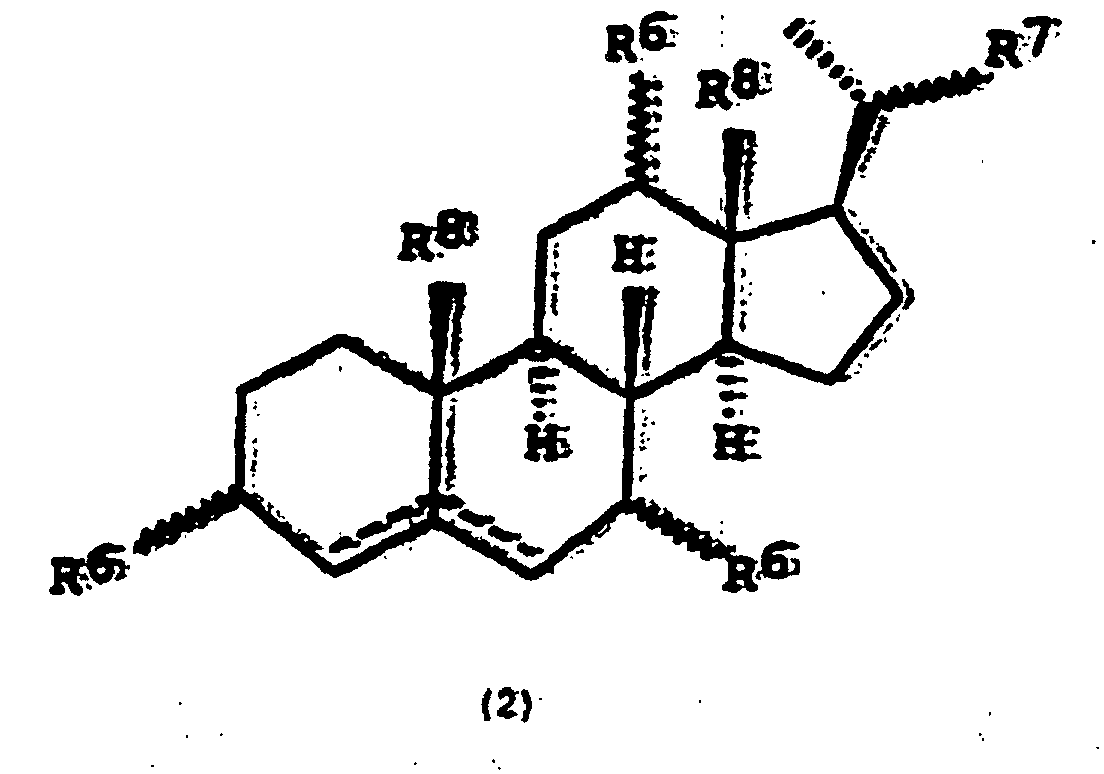 www eine Bindung unspezifizierter Stereochemie darstellt;--- eine Einzel- oder Doppelbindung darstellt, die einen gesättigten oder ungesättigten Teil des Ringsystems bildet, vorausgesetzt, dass beide Bindungen nicht ungesättigt sein können, wobei das Ringsystem entweder Δ4 oder Δ5 darstellt;R6 -H, -OH- -CO2H, -C(=O)NH2, -OC(=O)NH2, -NH2 oder -O(CH2CH2O)n·H darstellt, worin n' eine ganze Zahl von einschließlich 1 bis 6 darstellt;R7 einen Rest darstellt, der den Verknüpfungspunkt des Cholinsäurederivats bildet, umfassend eine -C1-6-Alkyl- oder -C1-6-Alkylcarbonylgruppe; undR8 eine C1-6-Alkylgruppe darstellt; und(iii) Cholesterylderivaten der Formel (3):worin:
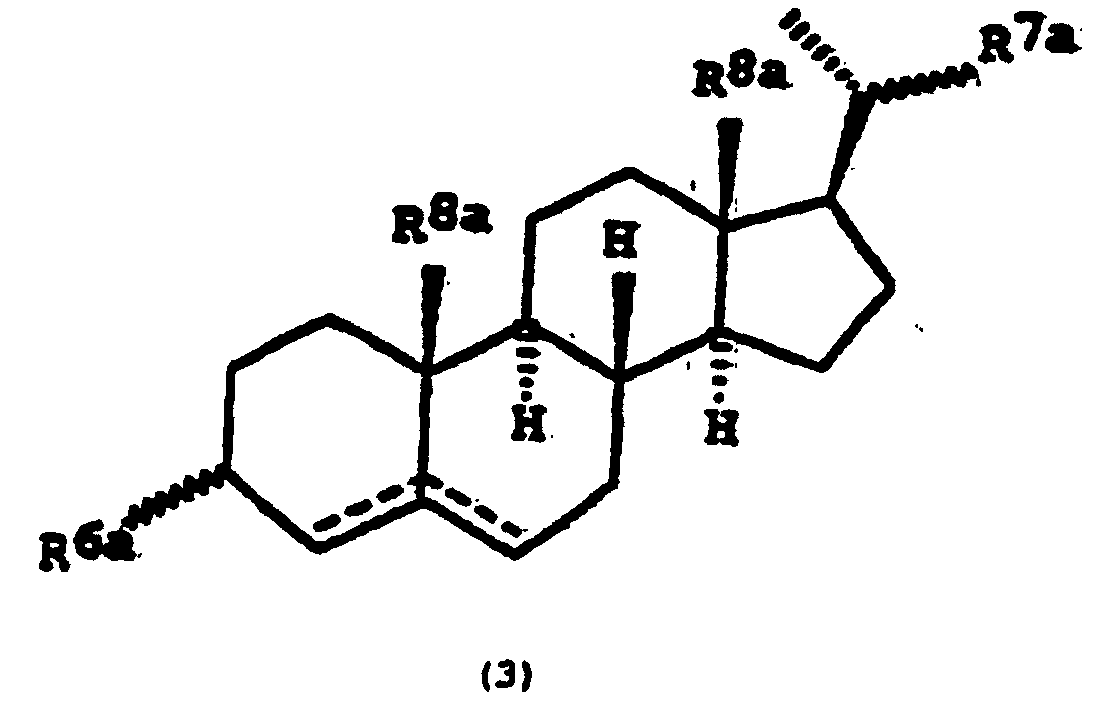 www eine Bindung unspezifizierter Stereochemie darstellt;--- eine Einzel- oder Doppelbindung darstellt, die einen gesättigten oder ungesättigten Teil des Ringsystems bildet, vorausgesetzt, dass beide Bindungen nicht ungesättigt sein können, wobei das Ringsystem entweder Δ4 oder Δ5 darstellt;R6a einen Rest darstellt; der den Verknüpfungspunkt des Cholesterylderivats bildet, umfassend eine -C1-6-Alkyl-, -OC(=O)- oder -OCH2C(=O)-Gruppe;R7a eine C1-6-Alkylgruppe darstellt; undR8a eine C1-6-Alkylgruppe darstellt.
 - Multifunktioneller molekularer Komplex naclr Anspruch 1, worin mindestens eine der R3-Gruppen die Formel -B-(CR1R2)j-C(R)3 aufweisen kann, worin B fehlt.
- Multifunktioneller molekularer Komplex nach Anspruch 2, worin j 8 bis 18 beträgt.
- Multifunktioneller molekularer Komplex nach Anspruch 2, worin j 8 bis 12 beträgt.
- Multifunktioneller molekularer Komplex nach Anspruch 1, worin mindestens eine der R3-Gruppen die Formel -(CR1R2)j'-X(R4)R darstellt, worin X N(R) ist und R4 unabhängig ausgewählt ist aus der Gruppe, bestehend aus (i) fusogenen Peptiden, umfassend Spikeglycoproteine von umhüllten Tierviren und (ii) Cholinsäure und Derivaten hiervon, ausgewählt aus der Gruppe, bestehend aus 3α, 7α, 12α-Tribydroxy-5β-cholan-24-ester und -amid.
- Multifunktioneller molekularer Komplex nach Anspruch 5, worin j' 2 bis 4 beträgt.
- Multifunktioneller molekularer Komplex nach Anspruch 1, worin mindestens eine der R3-Gruppen die Formel -(CR1R2)j'-X(R4)R aufweisen kann, worin X O oder S darstellt und R4 unabhängig ausgewählt ist aus der Gruppe, bestehend aus (i) fusogenen Peptiden, umfassend Spikeglycoproteine von umhüllten Tierviren und (ii) einer Cholesterylgruppe und Derivaten hiervon, ausgewählt aus der Gruppe, bestehend aus Cholest-5-en-3'-β-carbonat, -β-carbamat und -β-methylencarboxamid.
- Multifunktioneller molekularer Komplex nach Anspruch 7, worin R, R1 und R2 jeweils Wasserstoff darstellen, wo immer sie auftreten, m 3 oder 4 beträgt, n 1 bis 6 beträgt, j' eine ganze Zahl von einschließlich 2 bis 4 darstellt und R4 Cholest-5-en-3'-β-carbonat, -β-carbamat und -β-methylencarboxamid darstellt.
- Multifunktioneller molekularer Komplex nach irgendeinem der Ansprüche 1 bis 8, worin die Gruppe, aus der R3 ausgewählt werden kann weiterhin umfaßt: Gruppen mit der Formel -B-(R5)R und mindestens eine der R3-Gruppen die Formel -B-(R5)R aufweist;
worin B eine Brückengruppe darstellt, unabhängig ausgewählt aus den Gruppen einschließlich (i) bis (v), wie definiert in Anspruch 1;
R unabhängig ausgewählt ist aus der Gruppe, bestehend aus Wasserstoff und C1-6-Alkyl, oder fehlt; und
R5 eine rezeptorspezifische Bindungskomponente darstellt, unabhängig ausgewählt aus der Gruppe, bestehend aus:(i) D-Biotin;(ii) β-3'-Propionylgalactosyl-β1-4-thioglucosid;(iii) N2,N6-bis(β-3'-Propionylgalactosyl-β1-4-thioglucosid)lysin;(iv) N2,N6-bis(β1-3'-Propionylgalactosyl-β1-4-thioglucosid)lysyl-N6-(β-3'propionylgalactosyl-β1-4-thioglucosid)lysin;(v) 5-Methyltetrahydrofolat;(vi) Folsäure;(vii) Folinsäure;(viii) α-3'-Propionylthiomannosid; und(ix) α-3'-Propionylthiomannosid-6-phosphat. - Multifunktioneller molekularer Komplex nach Anspruch 9, worin mindestens eine der R3-Gruppen die Formel -(CR1R2)j'-N(R5)R aufweist, worin j' 1 bis 6 beträgt.
- Multifunktioneller molekularer Komplex nach Anspruch 10, worin 2 der R3-Gruppen die Formel -(CR1R2)j'-N(R5)R aufweisen.
- Multifunktioneller molekularer Komplex nach Anspruch 1, worin mindestens eine der R3-Gruppen hiervon die Formel -B-(CR1R2)j-C(R)3 aufweist, worin B fehlt, jedes R, R1 und R2, wo sie auftreten, Wasserstoff darstellt, in 3 oder 4 ist, n 1 bis 6 beträgt undj eine ganze Zahl von einschließlich 8 bis 18 darstellt.
- Multifunktioneller molekularer Komplex nach Anspruch 1, worin der Transferrest ausgewählt ist aus der Gruppe, bestehend aus:N4-Octylspermidin;N4-Dodecylspermidin;N4-Octadecylspermidin;N4-Octylspermin;N4-Dodecylapermin; undN4-Octadecylspermin.
- Multifunktioneller molekularer Komplex nach Anspruch 1, worin der Transferrest ausgewählt ist aus der Gruppe, bestehend aus:N2-Octyl-N4-(5-(β-3'-propionylgalactosyl-β1"-4'-thioglucosid)amino)pentylspermidin;N2-Dodecyl-N4-(5-(β-3'-propionylgalactosyl-β1"-4'-thioglucosid)amino)pentylspermidin;N6-Octadecyl-N4-(5-(β-3'-propionylgalactosyl-β1"-4'thioglucosid)amino)pentylspermidin;N6-Octyl-N4-(5-[N2',N6'-bis(β1-3'-propionylgalactosyl-β1-4-thioglucosid)lysyl-N6'-(β-3'propionylgalactosyl-β1-4-thioglucosid)lysyl]amino)pentylspermin;N2-Dodecyl-N4-(5-[N2',N6'-bis(β1-3'-propionylgalactosyl-β1-4-thioglucosid)lysyl-N6'-(β-3'-propionylgalactosyl-β1-4-thioglucosid)lysyl]amino)pentylspermin; undN2-Octadecyl-N4-(5-[N2',N6'-bis(β1-3'-propionylgalactosyl-β1-4-thioglucosid)lysyl-N6'-(β-3'-propionylgalactosyl-β1-4-thioglucosid)lysyl]amino)pentylspermin.
- Multifunktioneller molekularer Komplex nach Anspruch 1, worin der Transferrest ausgewählt ist aus der Gruppe, bestehend aus:N4-(Benzyl-6'-hexanoyl)-spermidintrihydrochlorid;N4-(6'-Hexanoyl)-spermidin-HA2-peptid;N4-(5'-N-(3"α,7"α,12"α-Trihydroxy-5"β-cholanamido)pentyl)-spermidintrihydrochlorid;N4-(5-N-(α-3'-Propionamidothiomannosid)pentyl)-spermidintrihydrochlorid;N4-(N-CBZ-5-aminopentyl)-spermidintrihydrochlorid;N4,N9-bis(N-CBZ-5-aminogentyl)-spermintetrahydrochlorid;N4,N9-bis(Octyl)spermintetrahydrochlorid;1,12-bis-N-Guanidino-N4,N9-bis-(octyl)-4,9-diaza-dodecantetrahydrochlorid;N4-(5-N-(Cholesten-3'β-carbamoyl)pentyl)-spermintetrahydrochlorid;N4,N9-bis(N,N-Dimethyl-12'-dodecanamid)-spermintetrahydrochlorid;N4,N9-bis(Benzyl-12'-dodecanoyl)-spermintetrahydrochlorid;N4,N9-bis(12'-dodecansäure)-spermintetrahydrochlorid;N4-(Benzyl-12'-dodecanoyl)-spermintetrahydrochlorid;N4-(12'-dodecansäure)-spermintetrahydrochlorid;N4,N9-bis(5-(α-3'-Propionylamidothiomannosid)-aminopentyl)-spermintetraacetat;N4-(5-N-(23'-N-(α-3"-Propionamidothiomannosid)-3',6',9',12'-15'-18'-hexaoxatricosanamido)aminopentyl)-spermintetraacetat;N4-(5-N-(O-(5-N-(α-3"-Propionamidothiomannosid)pentyl)-O-(2-acetamido)nonadecaethylenglycol)pentyl)-spermintetraacetat; undN4-(((23-[N2,N6-bis(β-3'-Propionylgalactosyl-β1-4-thioglucosid)lysyl-N6-(β-3'-propionylgalactosyl-β1-4-thioglucosid)lysyl]-amino-3',6',9',12'-15'-18'-hexaoxatricosanamido)aminopentyl)-spermintetraacetat.
- Multifunktioneller molekularer Komplex nach irgendeinem der Ansprüche 1 bis 15, der verschiedene kationische Polyaminkomponenten umfaßt.
- Multifunktioneller molekularer Komplex nach Anspruch 16, der eine erste kationische Polyaminkomponente aufweist mit einer damit verknüpften Endosommembran-Spaltungsförderungskomponente und eine zweite kationische Polyaminkomponente mit einer damit verknüpften rezeptorspezifischen Bindungskomponente.
- Multifunktioneller molekularer Komplex nach irgendeinem der vorangehenden Ansprüche, worin die Nukleinsäurezusammensetzung ein Nucleinsäuremolekül darstellt, das eine Nukleotidsequenz umfaßt die ein Peptid oder Protein kodiert oder als Matrize für ein Nukleinsäuremolekül dient.
- Multifunktioneller molekularer Komplex nach Anspruch 18, worin die Nukleinsäurezusammensetzung ein Plasmid darstellt.
- Pharmazeutische Zusammensetzung, umfassend einen multifunktionellen molekularen Komplex nach irgendeinem dervorangehenden Ansprüche oder ein pahrmazeutisch akzeptables Salz oder einen Ester hiervon sowie einen pharmazeutisch akzeptablen Träger.
- Verwendung eines multifunktionellen molekularen Komplexes nach irgendeinem der Ansprüche 1 bis 19 zur Herstellung einer pharmazeutischen Zusammensetzung für den Transfer der Nukleinsäurezusammensetzung im Komplex in Zielzellen eines Individuums.
- Verwendung eines multifunktionellen molekularen Komplexes, wie definiert in Anspruch 1, zur Herstellung eines sich selbst organisierenden Freisetzungssystems für den Transfer einer Nukleinsäurezusammensetzung in Zielzellen eines Individuums.
- Transferrest nach irgendeinem der Ansprüche 1 bis 22, worin der Transferrest mehr als eine kationische Polyaminkomponente umfaßt.
- Transferrest nach Anspruch 23, worin eine erste kationische Polyaminkomponente eine Endosommembran-Spaltungsförderungskomponente und eine zweite kationische Polyaminkomponente eine rezeptorspezifische Bindungskomponente umfaßt.
- Multifunktioneller molekularer Komplex, verwendbar zum Transfer einer Nukleinsäurezusammensetzung in Zellen, worin der multifunktionelle molekulare Komplex umfaßt:A) eine Nukelinsäurezusammensetzung undB) einen Transferrest nach irgendeinem der Ansprüche 1 bis 24, worin jedes kationisehe Polyamin nichtkovalent an die Nukleinsäurezusammensetzung gebunden ist.
- Multifunktioneller molekularer Komplex nach Anspruch 23, worin die Nukleinsäurezusammensetzung ein Nukleinsäuremolekül darstellt, das eine Nukleinsäuresequenz umfaßt, die ein Peptid oder Protein kodiert, oder als Matrize für ein Nukleinsäuremolekül dient.
- Multifunktioneller molekularer Komplex nach Anspruch 26, worin die Nukleinsäurezusammensetzung ein Plasmid darstellt.
- Multifunktioneller-molekularer-Komplex nach irgendeinem der Ansprüche 25 bis 27, umfassend ein mit der rezeptorspezifischen Bindungskomponente verknüpftes kationisches polyamin, umfassend eine Verbindung, ausgewählt aus der Gruppe, bestehend aus
N2,N6-bis(β-3'-Propionylgalactosyl-β1-4-thioglucosid)lysin; und
N2,N6-bis(β1-3'-Propionylgalactosyl-β1-4-thioglucosid)lysyl-N6-(β-3'propionylgalactosyl-(β-4-thioglucosid)lysin. - Pharmazeutische Zusammensetzung, umfassend einen multifunktionellen molekularen Komplex nach irgendeinem der Ansprüche 25 bis 28 oder ein pharmazeutisch akzeptables Salz oder einen Ester hiervon sowie einen pharmazeutisch akzeptablen Träger.
- Verwendung eines multifunktionellen molekularen Komplexes nach irgendeinem der Ansprüche 25 bis 28 zur Herstellung einer pharmazeutischen Zusammensetzung zum Transfer der Nukleinsäurezusammensetzung im Komplex in ein Individuum.
- Verwendung eines Transferrests nach irgendeinem der Ansprüche 1 bis 24 zur Herstellung eines sich selbst organisierenden Freisetzungssystems zum Transfer einer Nukleinsäurezusammensetzung in eine Zielzelle.
Priority Applications (1)
| Application Number | Priority Date | Filing Date | Title |
|---|---|---|---|
| DK95935213T DK0789708T3 (da) | 1995-09-28 | 1995-09-28 | Multifunktionelle molekylekomplekser til genoverförsel til celler |
Applications Claiming Priority (3)
| Application Number | Priority Date | Filing Date | Title |
|---|---|---|---|
| US08/314,060 US5837533A (en) | 1994-09-28 | 1994-09-28 | Complexes comprising a nucleic acid bound to a cationic polyamine having an endosome disruption agent |
| US314060 | 1994-09-28 | ||
| PCT/US1995/012502 WO1996010038A1 (en) | 1994-09-28 | 1995-09-28 | Multifunctional molecular complexes for gene transfer to cells |
Publications (3)
| Publication Number | Publication Date |
|---|---|
| EP0789708A1 EP0789708A1 (de) | 1997-08-20 |
| EP0789708A4 EP0789708A4 (de) | 1999-12-29 |
| EP0789708B1 true EP0789708B1 (de) | 2004-11-03 |
Family
ID=23218392
Family Applications (1)
| Application Number | Title | Priority Date | Filing Date |
|---|---|---|---|
| EP95935213A Expired - Lifetime EP0789708B1 (de) | 1994-09-28 | 1995-09-28 | Multifunktionelle molekuläre komplexe für den gen-transfer in zellen |
Country Status (9)
| Country | Link |
|---|---|
| US (5) | US5837533A (de) |
| EP (1) | EP0789708B1 (de) |
| JP (1) | JP3925815B2 (de) |
| AT (1) | ATE281468T1 (de) |
| CA (1) | CA2201396C (de) |
| DE (1) | DE69533725T2 (de) |
| ES (1) | ES2231791T3 (de) |
| PT (1) | PT789708E (de) |
| WO (1) | WO1996010038A1 (de) |
Families Citing this family (224)
| Publication number | Priority date | Publication date | Assignee | Title |
|---|---|---|---|---|
| US5795870A (en) * | 1991-12-13 | 1998-08-18 | Trustees Of Princeton University | Compositions and methods for cell transformation |
| US5670347A (en) | 1994-05-11 | 1997-09-23 | Amba Biosciences Llc | Peptide-mediated gene transfer |
| US5837533A (en) * | 1994-09-28 | 1998-11-17 | American Home Products Corporation | Complexes comprising a nucleic acid bound to a cationic polyamine having an endosome disruption agent |
| US5650096A (en) * | 1994-12-09 | 1997-07-22 | Genzyme Corporation | Cationic amphiphiles for intracellular delivery of therapeutic molecules |
| US6071890A (en) * | 1994-12-09 | 2000-06-06 | Genzyme Corporation | Organ-specific targeting of cationic amphiphile/DNA complexes for gene therapy |
| US5767099A (en) * | 1994-12-09 | 1998-06-16 | Genzyme Corporation | Cationic amphiphiles containing amino acid or dervatized amino acid groups for intracellular delivery of therapeutic molecules |
| US6331524B1 (en) | 1994-12-09 | 2001-12-18 | Genzyme Corporation | Organ-specific targeting of cationic amphiphile / DNA complexes for gene therapy |
| US6383814B1 (en) | 1994-12-09 | 2002-05-07 | Genzyme Corporation | Cationic amphiphiles for intracellular delivery of therapeutic molecules |
| US5747471A (en) * | 1994-12-09 | 1998-05-05 | Genzyme Corporation | Cationic amphiphiles containing steroid lipophilic groups for intracellular delivery of therapeutic molecules |
| US5840710A (en) * | 1994-12-09 | 1998-11-24 | Genzyme Corporation | Cationic amphiphiles containing ester or ether-linked lipophilic groups for intracellular delivery of therapeutic molecules |
| US5910487A (en) * | 1994-12-09 | 1999-06-08 | Genzyme Corporation | Cationic amphiphiles and plasmids for intracellular delivery of therapeutic molecules |
| US5948767A (en) * | 1994-12-09 | 1999-09-07 | Genzyme Corporation | Cationic amphiphile/DNA complexes |
| US5719131A (en) * | 1994-12-09 | 1998-02-17 | Genzyme Corporation | Cationic amphiphiles containing dialkylamine lipophilic groups for intracellular delivery of therapeutic molecules |
| US6008202A (en) | 1995-01-23 | 1999-12-28 | University Of Pittsburgh | Stable lipid-comprising drug delivery complexes and methods for their production |
| US5795587A (en) | 1995-01-23 | 1998-08-18 | University Of Pittsburgh | Stable lipid-comprising drug delivery complexes and methods for their production |
| US6051429A (en) | 1995-06-07 | 2000-04-18 | Life Technologies, Inc. | Peptide-enhanced cationic lipid transfections |
| EP0874910A4 (de) * | 1995-06-07 | 1999-04-21 | Life Technologies Inc | Durch peptide erhöhte kationische lipid transfektionen |
| US20030069173A1 (en) * | 1998-03-16 | 2003-04-10 | Life Technologies, Inc. | Peptide-enhanced transfections |
| FR2736642B1 (fr) * | 1995-07-10 | 1997-09-12 | Pasteur Institut | Immunovecteurs, notamment anticorps et fragments d'anticorps utilisables pour le transport intracellulaire et intranucleaire de principes biologiquement actifs notamment d'haptenes, de proteines et d'acides nucleiques |
| FR2741066B1 (fr) * | 1995-11-14 | 1997-12-12 | Rhone Poulenc Rorer Sa | Nouveaux agents de transfection et leurs applications pharmaceutiques |
| US7002027B1 (en) * | 1996-01-08 | 2006-02-21 | Canji, Inc. | Compositions and methods for therapeutic use |
| US6392069B2 (en) | 1996-01-08 | 2002-05-21 | Canji, Inc. | Compositions for enhancing delivery of nucleic acids to cells |
| FR2744453B1 (fr) * | 1996-02-05 | 1998-07-10 | Transgene Sa | Composes lipopolyamines, compositions pharmaceutiques en comprenant, vecteurs de transfert d'acide nucleique et procede de preparation |
| AU2112697A (en) * | 1996-02-09 | 1997-08-28 | Pi-Wan Cheng | Receptor ligand-facilitated delivery of biologically active molecules |
| DE69727384T2 (de) * | 1996-05-24 | 2004-11-04 | IC-VEC Ltd. | Polykatonische sterin-derivate zur transfektion |
| US5935936A (en) * | 1996-06-03 | 1999-08-10 | Genzyme Corporation | Compositions comprising cationic amphiphiles and co-lipids for intracellular delivery of therapeutic molecules |
| AU3514197A (en) | 1996-07-03 | 1998-01-21 | Genetics Institute Inc. | Protease fmh-1, an ice/ced-like protease |
| CN1181422A (zh) * | 1996-10-31 | 1998-05-13 | 上海市肿瘤研究所 | 与生长因子受体结合的多肽所构建的基因转移载体 |
| GB9623051D0 (en) * | 1996-11-06 | 1997-01-08 | Schacht Etienne H | Delivery of DNA to target cells in biological systems |
| US5980898A (en) | 1996-11-14 | 1999-11-09 | The United States Of America As Represented By The U.S. Army Medical Research & Material Command | Adjuvant for transcutaneous immunization |
| US6797276B1 (en) | 1996-11-14 | 2004-09-28 | The United States Of America As Represented By The Secretary Of The Army | Use of penetration enhancers and barrier disruption agents to enhance the transcutaneous immune response |
| US20060002949A1 (en) | 1996-11-14 | 2006-01-05 | Army Govt. Of The Usa, As Rep. By Secretary Of The Office Of The Command Judge Advocate, Hq Usamrmc. | Transcutaneous immunization without heterologous adjuvant |
| US5925628A (en) * | 1997-03-31 | 1999-07-20 | Genzyme Corporation | Cationic amphiphiles for intracellular delivery of therapeutic molecules |
| US5912239A (en) * | 1997-04-04 | 1999-06-15 | Genzyme Corporation | Imidazole-containing cationic amphiphiles for intracellular delivery of therapeutic molecules |
| US5948925A (en) * | 1997-05-06 | 1999-09-07 | Genzyme Corporation | Cationic amphiphiles containing linkers derived from neutral or positively charged amino acids |
| US5952516A (en) * | 1997-05-08 | 1999-09-14 | Genzyme Corporation | Cationic amphiphiles containing multiplesteroid lipophilic groups |
| US5942634A (en) * | 1997-05-09 | 1999-08-24 | Genzyme Corporation | Cationic amphiphiles for cell transfections |
| TW586934B (en) * | 1997-05-19 | 2004-05-11 | Sumitomo Pharma | Immunopotentiating composition |
| US6818627B1 (en) | 1997-08-14 | 2004-11-16 | The Trustees Of The University Of Pennsylvania | Functional fragments of HIV-1 Vpr protein and methods of using the same |
| EP2218731A1 (de) | 1997-11-28 | 2010-08-18 | Merck Serono Biodevelopment | Genomsequenz von Chlamydia trachomatis sowie Polypeptide, Fragmente davon und deren Verwendung, insbesondere zur Diagnose, Prävention und Behandlung einer Infektion |
| US6919076B1 (en) | 1998-01-20 | 2005-07-19 | Pericor Science, Inc. | Conjugates of agents and transglutaminase substrate linking molecules |
| US6958148B1 (en) | 1998-01-20 | 2005-10-25 | Pericor Science, Inc. | Linkage of agents to body tissue using microparticles and transglutaminase |
| JP2002501762A (ja) | 1998-01-30 | 2002-01-22 | アバンテイス・フアルマ・エス・アー | 還元性条件に感受性のトランスフェクション用組成物、該組成物を含有する医薬組成物及びそれらの用途 |
| FR2774394B1 (fr) * | 1998-01-30 | 2002-04-26 | Rhone Poulenc Rorer Sa | Composes transfectants sensibles aux conditions reductrices, compositions pharmaceutiques les contenant, et leurs applications |
| ATE512231T1 (de) | 1998-02-27 | 2011-06-15 | Univ Pennsylvania | Impfstoffe, immuntherapeutika und verfahren zur anwendung derselben |
| WO1999052858A2 (en) * | 1998-04-08 | 1999-10-21 | Celltech Therapeutics Limited | Lipids |
| AU752658B2 (en) * | 1998-05-06 | 2002-09-26 | Association Francaise Contre Les Myopathies | Use of a nuclease inhibitor or interleukin-10 (IL-10) for the preparation of a therapeutic composition for improving transfection of a polynucleotide into a cell and compositions useful in gene therapy |
| EP0963758A3 (de) * | 1998-05-07 | 2000-03-22 | Universiteit Gent | Synthetische polyamiosaure Komplexen zur Verabreichung von Nukleinsäuren zur Zielzellen |
| US6596699B2 (en) | 1998-09-22 | 2003-07-22 | Biosurface Engineering Technologies, Inc. | Nucleic acid coating compositions and methods |
| NZ512244A (en) | 1998-11-12 | 2003-12-19 | Invitrogen Corp | Polycationic transfection reagents for introducing anions into a cell |
| US7148324B1 (en) | 1998-12-14 | 2006-12-12 | Dendreon Corporation | Compositions and methods for enhancement of major histocompatibility complex class I restricted antigen presentation |
| EP1141007B1 (de) * | 1998-12-14 | 2013-05-15 | Dendreon Corporation | Zusammensetzungen und methoden zur steigerung der haupthistokompatibilitätskomplex klasse i abhängigen antigen-präsentierung |
| JP2004513059A (ja) | 1998-12-24 | 2004-04-30 | ユセベ,ソシエテ アノニム | ペプチド産物、方法及び組成物 |
| CA2361201A1 (en) * | 1999-01-28 | 2000-08-03 | Medical College Of Georgia Research Institute, Inc. | Composition and method for in vivo and in vitro attenuation of gene expression using double stranded rna |
| KR20070118315A (ko) | 1999-04-21 | 2007-12-14 | 와이어쓰 | 폴리뉴클레오티드 서열의 기능을 억제하기 위한 조성물 |
| US7446189B1 (en) | 1999-04-30 | 2008-11-04 | Institut De Recherches Cliniques De Montreal | Nucleic acids encoding mutant human CD80 and compositions comprising the same |
| AUPQ014699A0 (en) * | 1999-05-04 | 1999-05-27 | Access Pharmaceuticals Australia Pty Limited | Amplification of folate-mediated targeting to tumor cells using nanoparticles |
| AUPQ014799A0 (en) * | 1999-05-04 | 1999-05-27 | Access Pharmaceuticals Australia Pty Limited | Amplification of folate-mediated targeting to tumor cells using polymers |
| WO2000067825A1 (en) | 1999-05-07 | 2000-11-16 | Microheart, Inc. | Apparatus and method for delivering therapeutic and diagnostic agents |
| WO2000072908A1 (en) | 1999-06-02 | 2000-12-07 | Microheart, Inc. | Devices and methods for delivering a drug |
| US7147633B2 (en) | 1999-06-02 | 2006-12-12 | Boston Scientific Scimed, Inc. | Method and apparatus for treatment of atrial fibrillation |
| GB9914085D0 (en) * | 1999-06-16 | 1999-08-18 | Smithkline Beecham Plc | New use |
| GB9914045D0 (en) * | 1999-06-16 | 1999-08-18 | Smithkline Beecham Plc | Novel compounds |
| GB9918670D0 (en) | 1999-08-06 | 1999-10-13 | Celltech Therapeutics Ltd | Biological product |
| AU7105300A (en) | 1999-09-03 | 2001-04-10 | Lifebeam Technologies, Inc. | Optical system for rapid polymer analysis |
| US6312474B1 (en) | 1999-09-15 | 2001-11-06 | Bio-Vascular, Inc. | Resorbable implant materials |
| AU2256801A (en) * | 1999-12-09 | 2001-06-18 | Regents Of The University Of California, The | Methods and compositions for use in the treatment of filovirus mediated disease conditions |
| US6933108B2 (en) | 1999-12-09 | 2005-08-23 | The Regents Of The University Of California | Methods and compositions for use in the treatment of filovirus mediated disease conditions |
| JP2003518076A (ja) * | 1999-12-22 | 2003-06-03 | ザ・トラステイーズ・オブ・ザ・ユニバーシテイ・オブ・ペンシルベニア | コスミドdna構築物およびその作製および使用方法 |
| CA2395636A1 (en) * | 1999-12-30 | 2001-07-12 | Novartis Ag | Novel colloid synthetic vectors for gene therapy |
| US7355019B2 (en) * | 2000-06-06 | 2008-04-08 | Sibtech, Inc. | Cysteine-containing peptide tag for site-specific conjugation of proteins |
| KR100815888B1 (ko) * | 2000-07-14 | 2008-03-21 | 더 트러스티스 오브 더 유니버시티 오브 펜실바니아 | Hiv 보조 단백질을 암호화하는 dna 백신 |
| US7569218B2 (en) * | 2000-07-27 | 2009-08-04 | The Trustees Of The University Of Pennsylvania | Compositions for and methods of using herpes simplex virus glycoprotein D to suppress immune responses |
| AU2002211490A1 (en) * | 2000-10-04 | 2002-04-15 | The Trustees Of The University Of Pennsylvania | Compositions and methods of using capsid protein from flaviviruses and pestiviruses |
| US6897067B2 (en) * | 2000-11-03 | 2005-05-24 | Regents Of The University Of Michigan | Surface transfection and expression procedure |
| EP1330516B1 (de) * | 2000-11-03 | 2007-01-17 | The Regents Of The University Of Michigan | Oberflächentransfektion und expressionsverfahren |
| US6902933B2 (en) * | 2000-11-03 | 2005-06-07 | Regents Of The University Of Michigan | Surface transfection and expression procedure |
| US20020188023A1 (en) * | 2000-12-12 | 2002-12-12 | Michael Jorgensen | Compound |
| DK1372708T3 (da) | 2001-02-13 | 2008-10-20 | Us Gov Sec Army | Vaccine til transkutan immunisering mod rejsediarre |
| US20070128229A1 (en) * | 2002-04-12 | 2007-06-07 | Wyeth | Surface proteins of Streptococcus pyogenes |
| BR0208874A (pt) * | 2001-04-13 | 2004-06-22 | Wyeth Corp | Proteìnas superficiais de streptococcus pyogenes |
| EP2277897A1 (de) | 2001-04-16 | 2011-01-26 | Wyeth Holdings Corporation | Polypeptideantigene codierende offene Leseraster aus Streptococcus pneumoniae und Verwendungen davon |
| GB0120022D0 (en) | 2001-08-16 | 2001-10-10 | Photobiotics Ltd | Conjugate |
| MX339524B (es) | 2001-10-11 | 2016-05-30 | Wyeth Corp | Composiciones inmunogenicas novedosas para la prevencion y tratamiento de enfermedad meningococica. |
| AU2002348163A1 (en) * | 2001-11-02 | 2003-05-19 | Intradigm Corporation | Therapeutic methods for nucleic acid delivery vehicles |
| PT1456377T (pt) | 2001-12-20 | 2019-09-10 | Merck Sharp & Dohme | Composições de syn3 e processos |
| US7026166B2 (en) * | 2002-01-22 | 2006-04-11 | Chiron Corporation | Fluorogenic dyes |
| US7461046B2 (en) * | 2002-02-07 | 2008-12-02 | The University Of Utah Research Foundation | Method for creating and using a treatment protocol |
| US20050222064A1 (en) * | 2002-02-20 | 2005-10-06 | Sirna Therapeutics, Inc. | Polycationic compositions for cellular delivery of polynucleotides |
| AU2003218162B2 (en) | 2002-03-15 | 2009-10-29 | The Curators Of The University Of Missouri | Mutants of the P4 protein of nontypable haemophilus influenzae with reduced enzymatic activity |
| US20040180438A1 (en) | 2002-04-26 | 2004-09-16 | Pachuk Catherine J. | Methods and compositions for silencing genes without inducing toxicity |
| CA2385110A1 (en) * | 2002-05-06 | 2003-11-06 | University Of British Columbia | Co-expression system for large functional proteins |
| AU2003221581A1 (en) * | 2002-05-06 | 2003-11-17 | University Of British Columbia | Expression system for large functional proteins |
| CA2487274A1 (en) * | 2002-05-06 | 2003-11-13 | Nucleonics Inc. | Spermine chemically linked to lipids and cell-specific targeting molecules as a transfection agent |
| EP1540004A4 (de) * | 2002-07-31 | 2007-10-03 | Nucleonics Inc | Doppelstrang-rna-strukturen und -konstrukte sowie verfahren zur erzeugung und verwendung davon |
| US7785608B2 (en) | 2002-08-30 | 2010-08-31 | Wyeth Holdings Corporation | Immunogenic compositions for the prevention and treatment of meningococcal disease |
| US7144588B2 (en) | 2003-01-17 | 2006-12-05 | Synovis Life Technologies, Inc. | Method of preventing surgical adhesions |
| US7704756B2 (en) * | 2003-01-21 | 2010-04-27 | Novartis Vaccines And Diagnostics, Inc. | Fluorogenic dyes |
| CN101239190B (zh) * | 2003-01-27 | 2013-09-25 | 恩多塞特公司 | 维生素受体结合递药缀合物 |
| CN100429220C (zh) | 2003-06-04 | 2008-10-29 | 坎基股份有限公司 | 用于干扰素治疗的方法和组合物 |
| CA2528136A1 (en) * | 2003-06-04 | 2004-12-16 | Canji, Inc. | Transfection agents |
| EP2270162B1 (de) | 2003-06-12 | 2018-10-03 | Alnylam Pharmaceuticals Inc. | Konservierte hbv- und hcv-sequenzen zur genausschaltung |
| WO2005084158A2 (en) * | 2003-06-20 | 2005-09-15 | The Regents Of The University Of California | Polypeptide transduction and fusogenic peptides |
| WO2005040388A2 (en) * | 2003-08-22 | 2005-05-06 | Nucleonics Inc. | Eukariotic expression systems for expression of inhibitory rna in multiple intracellular compartments |
| US8507277B2 (en) | 2003-10-24 | 2013-08-13 | Gencia Corporation | Nonviral vectors for delivering polynucleotides |
| US8133733B2 (en) | 2003-10-24 | 2012-03-13 | Gencia Corporation | Nonviral vectors for delivering polynucleotides to target tissues |
| US20090208478A1 (en) * | 2003-10-24 | 2009-08-20 | Gencia Corporation | Transducible polypeptides for modifying metabolism |
| US20090123468A1 (en) | 2003-10-24 | 2009-05-14 | Gencia Corporation | Transducible polypeptides for modifying metabolism |
| CA2543257C (en) | 2003-10-24 | 2013-12-31 | Gencia Corporation | Methods and compositions for delivering polynucleotides |
| US8062891B2 (en) | 2003-10-24 | 2011-11-22 | Gencia Corporation | Nonviral vectors for delivering polynucleotides to plants |
| US7740861B2 (en) * | 2004-06-16 | 2010-06-22 | University Of Massachusetts | Drug delivery product and methods |
| TW200613554A (en) | 2004-06-17 | 2006-05-01 | Wyeth Corp | Plasmid having three complete transcriptional units and immunogenic compositions for inducing an immune response to HIV |
| DE602005024015D1 (de) | 2004-08-23 | 2010-11-18 | Alnylam Pharmaceuticals Inc | Expressionskonstrukte mit mehreren rna-polymerase-iii-promotoren |
| AU2005284727A1 (en) * | 2004-09-17 | 2006-03-23 | University Of Massachusetts | Compositions and their uses for lysosomal enzyme deficiencies |
| DE602005027479D1 (de) | 2004-09-24 | 2011-05-26 | Alnylam Pharmaceuticals Inc | Targeting von zwischenprodukten zur gegenstrangreplikation von einzelstrangigen viren durch rnai |
| EP2298341A3 (de) | 2004-10-21 | 2011-07-13 | Wyeth LLC | Immunogene zusammensetzungen von staphylococcus epidermidis polypeptide und polynucleotide antigenen |
| EP2316942B1 (de) | 2004-12-22 | 2021-04-21 | Alnylam Pharmaceuticals, Inc. | Zum gen-silencing geeignete konservierte hbv- und hcv-sequenzen |
| WO2006113606A2 (en) * | 2005-04-18 | 2006-10-26 | Johns Hopkins University | Histone deacetylase inhibitors |
| US20070087045A1 (en) * | 2005-10-14 | 2007-04-19 | Industrial Technology Research Institute | Lipid carrier and method of preparing the same |
| ATE526991T1 (de) * | 2005-10-24 | 2011-10-15 | Univ Massachusetts | Zusammensetzungen und ihre verwendungen für die gentherapeutische behandlung von knochenerkrankungen |
| US9259463B2 (en) | 2006-01-16 | 2016-02-16 | The United States Of America, As Represented By The Secretary, Department Of Health & Human Services | Chlamydia vaccine |
| AU2007234698B2 (en) | 2006-04-07 | 2013-08-01 | The Board Of Regents Of The University Of Texas System | Methods and compositions related to adenoassociated virus-phage particles |
| DK2548438T3 (en) | 2006-11-08 | 2015-10-19 | Veritas Bio LLC | IN VIVO SUBMITTING DOUBLE-STRENGTH RNA TO A CELL |
| EP1935434A1 (de) * | 2006-12-19 | 2008-06-25 | Novosom AG | Konstruktion und Verwendung von transfektionsverstärkenden Elementen |
| AU2007337897A1 (en) * | 2006-12-22 | 2008-07-03 | Imuthes Limited | Lipids and their use as non-viral delivery vehicle |
| AR064642A1 (es) | 2006-12-22 | 2009-04-15 | Wyeth Corp | Polinucleotido vector que lo comprende celula recombinante que comprende el vector polipeptido , anticuerpo , composicion que comprende el polinucleotido , vector , celula recombinante polipeptido o anticuerpo , uso de la composicion y metodo para preparar la composicion misma y preparar una composi |
| WO2008089771A1 (en) * | 2007-01-24 | 2008-07-31 | Syddansk Universitet | Dna controlled assembly of lipid membranes |
| US10265407B2 (en) | 2007-02-15 | 2019-04-23 | Yale University | Modular nanodevices for smart adaptable vaccines |
| US8889117B2 (en) * | 2007-02-15 | 2014-11-18 | Yale University | Modular nanoparticles for adaptable vaccines |
| US20100151436A1 (en) * | 2007-03-02 | 2010-06-17 | Fong Peter M | Methods for Ex Vivo Administration of Drugs to Grafts Using Polymeric Nanoparticles |
| HUE040417T2 (hu) | 2007-05-04 | 2019-03-28 | Marina Biotech Inc | Aminosavlipidek és alkalmazásuk |
| NZ581542A (en) * | 2007-05-16 | 2012-02-24 | Mat Malta Advanced Technologies Ltd | Treatment and prevention of influenza |
| US7973019B1 (en) | 2007-10-03 | 2011-07-05 | Alcon Research, Ltd. | Transferrin/transferrin receptor-mediated siRNA delivery |
| EP2222283A2 (de) * | 2007-10-29 | 2010-09-01 | University of Massachusetts | Zur freisetzung von nukleinsäuren (sirna) mit hefe-zellwandproteinen verkapselte mehrlagige nanopatikel |
| US7928189B2 (en) * | 2008-05-05 | 2011-04-19 | Ottawa Health Research Institute | PCSK9 polypeptide fragment |
| EP2650014A2 (de) | 2008-06-20 | 2013-10-16 | Wyeth LLC | Zusammensetzungen und Verfahren zur Verwendung von ORF1358 von Beta-hämolytischen Streptokokken-stämmen |
| US8815818B2 (en) | 2008-07-18 | 2014-08-26 | Rxi Pharmaceuticals Corporation | Phagocytic cell delivery of RNAI |
| TW201004658A (en) * | 2008-07-31 | 2010-02-01 | Enzon Pharmaceuticals Inc | Nanoparticle compositions for nucleic acids delivery system |
| EP2342340A1 (de) | 2008-09-22 | 2011-07-13 | Rxi Pharmaceuticals Corporation | Rna-interferenz bei hautindikationen |
| MX2011004755A (es) * | 2008-11-05 | 2011-10-10 | Wyeth Llc | Composicion inmunogenica multicomponente para la prevencion de enfermedad estreptococica beta-hemolitica (bhs). |
| WO2010078536A1 (en) | 2009-01-05 | 2010-07-08 | Rxi Pharmaceuticals Corporation | Inhibition of pcsk9 through rnai |
| US8394630B2 (en) | 2009-01-13 | 2013-03-12 | StemBios Technologies, Inc. | Producing a mammalian pluripotent cell population from mammalian blastomere-like stem cells (BLSCs) |
| JP5802195B2 (ja) | 2009-04-27 | 2015-10-28 | オタワ ホスピタル リサーチ インスティチュート | 幹細胞を調節するための組成物および方法ならびにその使用 |
| WO2010129672A1 (en) | 2009-05-05 | 2010-11-11 | Miragen Therapeutics | Lipophilic polynucleotide conjugates |
| SG176716A1 (en) | 2009-06-08 | 2012-01-30 | Miragen Therapeutics | CHEMICAL MODIFICATION MOTIFS FOR miRNA INHIBITORS AND MIMETICS |
| WO2011084721A2 (en) * | 2009-12-21 | 2011-07-14 | Agave Pharma Inc | Cationic molecule and method of use |
| SI2539451T1 (sl) * | 2010-02-24 | 2016-04-29 | Arrowhead Research Corporation | Sestavki za ciljano dostavo sirna |
| TWI465569B (zh) | 2010-08-04 | 2014-12-21 | Stembios Technologies Inc | 體幹細胞 |
| CN107913396B (zh) | 2010-08-23 | 2022-03-08 | 惠氏有限责任公司 | 脑膜炎萘瑟氏菌rLP2086抗原的稳定制剂 |
| AU2011300409B2 (en) | 2010-09-10 | 2015-03-26 | Wyeth Llc | Non-lipidated variants of Neisseria meningitidis ORF2086 antigens |
| WO2012061810A1 (en) | 2010-11-05 | 2012-05-10 | Miragen Therapeutics | Base modified oligonucleotides |
| WO2012071513A2 (en) | 2010-11-24 | 2012-05-31 | Hong Gao | Expanding hematopoietic stem cells |
| KR20140004646A (ko) | 2010-12-15 | 2014-01-13 | 미라젠 세러퓨틱스 | 잠금 뉴클레오티드를 포함하는 마이크로rna 억제제 |
| CA2832899A1 (en) | 2011-04-12 | 2012-10-18 | Beth Israel Deaconess Medical Center, Inc. | Micro-rna inhibitors and their uses in disease |
| EP2755663A4 (de) | 2011-09-13 | 2015-10-07 | Ottawa Hospital Res Inst | Microrna-inhibitoren |
| WO2013040341A2 (en) | 2011-09-16 | 2013-03-21 | Ottawa Hospital Research Institute | Wnt7a compositions and methods of using the same |
| JP2014527818A (ja) | 2011-09-16 | 2014-10-23 | フェイト セラピューティクス,インコーポレイテッド | Wnt組成物およびそのような組成物の治療的使用 |
| TWI614340B (zh) | 2011-09-28 | 2018-02-11 | 幹細胞生物科技股份有限公司 | 體幹細胞及其製備方法 |
| WO2013050048A2 (en) * | 2011-10-07 | 2013-04-11 | Skau Aps | Identification and attenuation of the immunosuppressive domains in fusion proteins of enveloped rna viruses |
| WO2013051718A1 (ja) | 2011-10-07 | 2013-04-11 | 国立大学法人三重大学 | キメラ抗原受容体 |
| SA115360586B1 (ar) | 2012-03-09 | 2017-04-12 | فايزر انك | تركيبات لعلاج الالتهاب السحائي البكتيري وطرق لتحضيرها |
| MY198910A (en) | 2012-03-09 | 2023-10-02 | Pfizer | Neisseria meningitidis compositions and methods thereof |
| US9597385B2 (en) | 2012-04-23 | 2017-03-21 | Allertein Therapeutics, Llc | Nanoparticles for treatment of allergy |
| CN107236735B (zh) | 2012-06-21 | 2019-11-08 | 米拉根医疗股份有限公司 | 包含锁核酸基序的基于寡核苷酸的抑制剂 |
| WO2014127231A1 (en) * | 2013-02-15 | 2014-08-21 | New York Blood Center, Inc. | Oligomeric influenza immunogenic compositions |
| WO2014136064A2 (en) | 2013-03-08 | 2014-09-12 | Pfizer Inc. | Immunogenic fusion polypeptides |
| DK2970968T3 (en) | 2013-03-15 | 2018-03-05 | Miragen Therapeutics Inc | CONNECTED BICYCLIC Nucleosides |
| WO2014151835A1 (en) | 2013-03-15 | 2014-09-25 | Miragen Therapeutics, Inc | Locked nucleic acid inhibitor of mir-145 and uses thereof |
| KR102233251B1 (ko) | 2013-04-03 | 2021-03-26 | 엔-폴드 엘엘씨 | 신규 나노입자 조성물 |
| US9428748B2 (en) | 2013-06-17 | 2016-08-30 | Hong Gao | Method of expanding hematopoietic stem cells |
| RU2662968C2 (ru) | 2013-09-08 | 2018-07-31 | Пфайзер Инк. | Иммуногенная композиция против neisseria meningitidis (варианты) |
| CA2930693A1 (en) | 2013-11-15 | 2015-05-21 | The Board Of Trustees Of The Leland Stanford Junior Unversity | Methods of treating heart failure with agonists of hypocretin receptor 2 |
| US10772974B2 (en) | 2013-11-18 | 2020-09-15 | Beth Israel Deaconess Medical Center, Inc. | Compositions and methods for cardiac regeneration |
| EP3169310A1 (de) | 2014-07-15 | 2017-05-24 | Life Technologies Corporation | Zusammensetzungen mit lipidaggregaten und verfahren zur effizienten bereitstellung von molekülen an zellen |
| CA2957618A1 (en) | 2014-08-04 | 2016-02-11 | MiRagen Therapeutics, Inc. | Inhibitors of myh7b and uses thereof |
| US9376681B2 (en) | 2014-09-08 | 2016-06-28 | MiRagen Therapeutics, Inc. | miR-29 mimics and uses thereof |
| EP3247716A4 (de) | 2015-01-20 | 2018-10-17 | Miragen Therapeutics, Inc. | Mir-92-inhibitoren und verwendungen davon |
| WO2016132294A1 (en) | 2015-02-19 | 2016-08-25 | Pfizer Inc. | Neisseria meningitidis compositions and methods thereof |
| WO2016179034A2 (en) | 2015-05-01 | 2016-11-10 | The Trustees Of The University Of Pennsylvania | Methods and compositions for stimulating immune response using potent immunostimulatory rna motifs |
| KR20190118688A (ko) | 2015-06-05 | 2019-10-18 | 미라젠 세러퓨틱스 인코포레이티드 | 피부 t 세포 림프종(ctcl) 치료용 mir-155 억제제 |
| WO2017024318A1 (en) | 2015-08-06 | 2017-02-09 | Dana-Farber Cancer Institute, Inc. | Targeted protein degradation to attenuate adoptive t-cell therapy associated adverse inflammatory responses |
| EP3377073A4 (de) | 2015-11-16 | 2019-06-26 | Ohio State Innovation Foundation | Verfahren und zusammensetzungen zur behandlung von störungen und krankheiten mit dem überlebensmotorneuronen (smn)-protein |
| US11052111B2 (en) | 2015-12-08 | 2021-07-06 | Chimera Bioengineering, Inc. | Smart CAR devices and DE CAR polypeptides for treating disease and methods for enhancing immune responses |
| WO2017157950A1 (en) | 2016-03-15 | 2017-09-21 | Johann Wolfgang Goethe-Universität | Light inducible antisense oligonucleotides for in vivo application |
| WO2017222911A1 (en) | 2016-06-20 | 2017-12-28 | The Board Of Trustees Of The Leland Stanford Junior University | Circular rnas and their use in immunomodulation |
| UY37376A (es) | 2016-08-26 | 2018-03-23 | Amgen Inc | Construcciones de arni para inhibir expresión de asgr1 y métodos para su uso |
| CN112481217A (zh) | 2016-09-01 | 2021-03-12 | 嵌合体生物工程公司 | Gold优化的car t-细胞 |
| ES2659845B1 (es) | 2016-09-19 | 2019-01-04 | Univ Valencia | Modulación de microRNAs contra la distrofia miotónica tipo 1 y antagonistas de microRNAs para ello |
| AU2017378427A1 (en) | 2016-12-14 | 2019-06-20 | Ligandal, Inc. | Methods and compositions for nucleic acid and protein payload delivery |
| AU2018215585B2 (en) | 2017-01-31 | 2022-03-17 | Pfizer Inc. | Neisseria meningitidis compositions and methods thereof |
| JP7227912B2 (ja) | 2017-02-08 | 2023-02-24 | ダナ-ファーバー キャンサー インスティテュート,インコーポレイテッド | キメラ抗原受容体の調節 |
| US12544344B2 (en) | 2017-04-19 | 2026-02-10 | Phio Pharmaceuticals Corp. | Topical delivery of nucleic acid compounds |
| UY38003A (es) | 2017-12-12 | 2019-06-28 | Amgen Inc | Construcciones de arni para inhibir la expresión de pnpla3 y métodos de uso de las mismas |
| KR20200131287A (ko) | 2018-03-14 | 2020-11-23 | 베스 이스라엘 데코니스 메디칼 센터 | 마이크로-rna 22의 억제제 |
| WO2019217253A1 (en) | 2018-05-07 | 2019-11-14 | Children's Hospital Medical Center | Chimeric polypeptides, nucleic acid molecules, cells, and related methods |
| CR20210371A (es) | 2018-12-10 | 2021-08-27 | Amgen Inc | Constructos de arni para inhibir la expresión de pnpla3 |
| WO2020123410A1 (en) | 2018-12-10 | 2020-06-18 | Amgen Inc. | CHEMICALLY-MODIFIED RNAi CONSTRUCTS AND USES THEREOF |
| CN114007643A (zh) | 2019-04-19 | 2022-02-01 | 中外制药株式会社 | 识别抗体改变部位的嵌合受体 |
| CA3141902A1 (en) | 2019-05-30 | 2020-12-03 | Amgen Inc. | Rnai constructs for inhibiting scap expression and methods of use thereof |
| WO2020246563A1 (ja) | 2019-06-05 | 2020-12-10 | 中外製薬株式会社 | 抗体切断部位結合分子 |
| CA3145425A1 (en) | 2019-07-03 | 2021-01-07 | Factor Bioscience Inc. | Cationic lipids and uses thereof |
| US10501404B1 (en) | 2019-07-30 | 2019-12-10 | Factor Bioscience Inc. | Cationic lipids and transfection methods |
| US20220340911A1 (en) | 2019-08-13 | 2022-10-27 | Amgen Inc. | Rnai constructs for inhibiting slc30a8 expression and methods of use thereof |
| WO2021059181A1 (en) | 2019-09-27 | 2021-04-01 | Pfizer Inc. | Neisseria meningitidis compositions and methods thereof |
| MX2022007005A (es) | 2019-12-09 | 2022-08-25 | Amgen Inc | Construcciones de iarn y metodos para inhibir la expresion de lpa. |
| WO2021234607A1 (en) | 2020-05-20 | 2021-11-25 | St. Jude Children's Research Hospital | Detection of alzheimer's disease using specific biomarkers |
| KR20240004092A (ko) | 2020-06-01 | 2024-01-11 | 암젠 인크 | Hsd17b13 발현을 억제하기 위한 rnai 작제물 및 이의 사용 방법 |
| EP3929295A1 (de) | 2020-06-26 | 2021-12-29 | Universitat Pompeu Fabra | Künstliche rnas zur modulation von rna-fragmenten |
| CN116194124A (zh) | 2020-07-31 | 2023-05-30 | 中外制药株式会社 | 包含表达嵌合受体的细胞的药物组合物 |
| KR20230046319A (ko) | 2020-08-13 | 2023-04-05 | 암젠 인크 | MARC1 발현을 억제하기 위한 RNAi 작제물 및 방법 |
| AU2021373780A1 (en) | 2020-11-05 | 2023-06-08 | Amgen Inc. | METHODS FOR TREATING ATHEROSCLEROTIC CARDIOVASCULAR DISEASE WITH LPA-TARGETED RNAi CONSTRUCTS |
| CN116997654A (zh) | 2021-03-17 | 2023-11-03 | 第一三共株式会社 | 编码抗乙酰胆碱受体自身抗体的嵌合受体的基因 |
| WO2022214887A1 (en) | 2021-04-08 | 2022-10-13 | Phosphogam, Llc | Methods and compositions for enhancing the cytotoxicity of gamma/delta-t cells |
| WO2023278295A1 (en) | 2021-06-29 | 2023-01-05 | The Broad Institute, Inc. | Compositions and methods for ameliorating anterodorsal thalamus hyperexcitability |
| US20250186619A1 (en) | 2021-07-19 | 2025-06-12 | New York University | Adeno-associated viral vector compositions and methods of promoting muscle regeneration |
| WO2023059629A1 (en) | 2021-10-05 | 2023-04-13 | Amgen Inc. | Compositions and methods for enhancing gene silencing activity of oligonucleotide compounds |
| WO2023069754A2 (en) | 2021-10-22 | 2023-04-27 | Amgen Inc. | Rnai constructs for inhibiting gpam expression and methods of use thereof |
| EP4269586A1 (de) | 2022-04-29 | 2023-11-01 | Johann-Wolfgang-Goethe-Universität Frankfurt am Main | Targeting von mikro-rna zur behandlung von herzversagen mit konservierter ejektionsfraktion (hfpef) |
| US20240084301A1 (en) | 2022-07-25 | 2024-03-14 | Amgen Inc. | Rnai constructs and methods for inhibiting fam13a expression |
| EP4353823A1 (de) | 2022-10-12 | 2024-04-17 | Resalis Therapeutics S.r.l. | Inhibitoren von mikro-rna 22 |
| JP2025541245A (ja) | 2022-12-16 | 2025-12-18 | アムジェン インコーポレイテッド | Ttr発現を阻害するためのrnaiコンストラクト及びその使用方法 |
| EP4650450A1 (de) | 2023-01-12 | 2025-11-19 | Yamaguchi University | Antikörper gegen pd-1 aus felinen |
| WO2025260042A1 (en) | 2024-06-14 | 2025-12-18 | Amgen Inc. | Rnai constructs and methods for inhibiting cnr1 expression |
| WO2026006275A2 (en) | 2024-06-26 | 2026-01-02 | Amgen Inc. | Rnai constructs and methods for inhibiting expression of inhbe |
Family Cites Families (31)
| Publication number | Priority date | Publication date | Assignee | Title |
|---|---|---|---|---|
| WO1986000930A1 (en) * | 1984-07-20 | 1986-02-13 | Worcester Foundation For Experimental Biology | Retroviral vaccines and vectors and methods for their construction |
| US5166320A (en) * | 1987-04-22 | 1992-11-24 | University Of Connecticut | Carrier system and method for the introduction of genes into mammalian cells |
| CA2489769A1 (en) * | 1989-03-21 | 1990-10-04 | Philip L. Felgner | Expression of exogenous polynucleotide sequences in a vertebrate |
| US5108921A (en) * | 1989-04-03 | 1992-04-28 | Purdue Research Foundation | Method for enhanced transmembrane transport of exogenous molecules |
| IL93982A0 (en) * | 1989-04-03 | 1991-01-31 | Purdue Research Foundation | Method for enhancing transmembrane transport of exogenous molecules |
| FR2645866B1 (fr) * | 1989-04-17 | 1991-07-05 | Centre Nat Rech Scient | Nouvelles lipopolyamines, leur preparation et leur emploi |
| US5264618A (en) * | 1990-04-19 | 1993-11-23 | Vical, Inc. | Cationic lipids for intracellular delivery of biologically active molecules |
| CA2092323A1 (en) * | 1990-10-01 | 1992-04-02 | George Y. Wu | Targeting viruses and cells for selective internalization by cells |
| US5283185A (en) * | 1991-08-28 | 1994-02-01 | University Of Tennessee Research Corporation | Method for delivering nucleic acids into cells |
| NZ244306A (en) * | 1991-09-30 | 1995-07-26 | Boehringer Ingelheim Int | Composition for introducing nucleic acid complexes into eucaryotic cells, complex containing nucleic acid and endosomolytic agent, peptide with endosomolytic domain and nucleic acid binding domain and preparation |
| US5981273A (en) * | 1991-09-30 | 1999-11-09 | Boehringer Ingelheim Int'l. Gmbh | Composition comprising an endosomolytic agent for introducing nucleic acid complexes into higher eucaryotic cells |
| WO1993019768A1 (en) * | 1992-04-03 | 1993-10-14 | The Regents Of The University Of California | Self-assembling polynucleotide delivery system |
| EP0646178A1 (de) * | 1992-06-04 | 1995-04-05 | The Regents Of The University Of California | Expression kassette mit im säugetier wirt funktionnellen regulator sequenzen |
| US5284993A (en) * | 1992-09-21 | 1994-02-08 | Phillips Petroleum Company | Alkylation catalyst regeneration |
| DK170396B1 (da) * | 1993-04-20 | 1995-08-21 | Topsoe Haldor As | Fremgangsmåde til genvinding af brugt fluoreret sulfonsyrekatalysator fra en alkyleringsproces |
| US5614503A (en) * | 1993-11-12 | 1997-03-25 | Aronex Pharmaceuticals, Inc. | Amphipathic nucleic acid transporter |
| DK171409B1 (da) * | 1994-03-10 | 1996-10-21 | Topsoe Haldor As | Fremgangsmåde til genvinding af alkyleringskatalysatorer |
| US5837533A (en) * | 1994-09-28 | 1998-11-17 | American Home Products Corporation | Complexes comprising a nucleic acid bound to a cationic polyamine having an endosome disruption agent |
| US6194625B1 (en) * | 1994-09-30 | 2001-02-27 | Stratco, Inc. | Alkylation by controlling olefin ratios |
| US5840710A (en) * | 1994-12-09 | 1998-11-24 | Genzyme Corporation | Cationic amphiphiles containing ester or ether-linked lipophilic groups for intracellular delivery of therapeutic molecules |
| US5948767A (en) * | 1994-12-09 | 1999-09-07 | Genzyme Corporation | Cationic amphiphile/DNA complexes |
| US5910487A (en) * | 1994-12-09 | 1999-06-08 | Genzyme Corporation | Cationic amphiphiles and plasmids for intracellular delivery of therapeutic molecules |
| US5719131A (en) * | 1994-12-09 | 1998-02-17 | Genzyme Corporation | Cationic amphiphiles containing dialkylamine lipophilic groups for intracellular delivery of therapeutic molecules |
| US5767099A (en) * | 1994-12-09 | 1998-06-16 | Genzyme Corporation | Cationic amphiphiles containing amino acid or dervatized amino acid groups for intracellular delivery of therapeutic molecules |
| US5650096A (en) * | 1994-12-09 | 1997-07-22 | Genzyme Corporation | Cationic amphiphiles for intracellular delivery of therapeutic molecules |
| US5747471A (en) * | 1994-12-09 | 1998-05-05 | Genzyme Corporation | Cationic amphiphiles containing steroid lipophilic groups for intracellular delivery of therapeutic molecules |
| US5935936A (en) * | 1996-06-03 | 1999-08-10 | Genzyme Corporation | Compositions comprising cationic amphiphiles and co-lipids for intracellular delivery of therapeutic molecules |
| US5925628A (en) * | 1997-03-31 | 1999-07-20 | Genzyme Corporation | Cationic amphiphiles for intracellular delivery of therapeutic molecules |
| US5912239A (en) * | 1997-04-04 | 1999-06-15 | Genzyme Corporation | Imidazole-containing cationic amphiphiles for intracellular delivery of therapeutic molecules |
| US5942634A (en) * | 1997-05-09 | 1999-08-24 | Genzyme Corporation | Cationic amphiphiles for cell transfections |
| DK26298A (da) * | 1998-02-27 | 1999-08-28 | Haldor Topsoe As | Fremgangsmåde til genvinding af sulfonsyreester ud fra carbonhydridstrøm |
-
1994
- 1994-09-28 US US08/314,060 patent/US5837533A/en not_active Expired - Lifetime
-
1995
- 1995-09-28 EP EP95935213A patent/EP0789708B1/de not_active Expired - Lifetime
- 1995-09-28 ES ES95935213T patent/ES2231791T3/es not_active Expired - Lifetime
- 1995-09-28 US US08/809,397 patent/US6127170A/en not_active Expired - Fee Related
- 1995-09-28 PT PT95935213T patent/PT789708E/pt unknown
- 1995-09-28 JP JP51205296A patent/JP3925815B2/ja not_active Expired - Fee Related
- 1995-09-28 DE DE69533725T patent/DE69533725T2/de not_active Expired - Lifetime
- 1995-09-28 CA CA2201396A patent/CA2201396C/en not_active Expired - Fee Related
- 1995-09-28 AT AT95935213T patent/ATE281468T1/de not_active IP Right Cessation
- 1995-09-28 WO PCT/US1995/012502 patent/WO1996010038A1/en not_active Ceased
-
1999
- 1999-10-22 US US09/425,597 patent/US6379965B1/en not_active Expired - Fee Related
-
2001
- 2001-11-13 US US10/010,114 patent/US7202227B2/en not_active Expired - Fee Related
-
2005
- 2005-06-29 US US11/170,539 patent/US20050239204A1/en not_active Abandoned
Also Published As
| Publication number | Publication date |
|---|---|
| EP0789708A4 (de) | 1999-12-29 |
| US20050239204A1 (en) | 2005-10-27 |
| JP3925815B2 (ja) | 2007-06-06 |
| EP0789708A1 (de) | 1997-08-20 |
| US5837533A (en) | 1998-11-17 |
| DE69533725T2 (de) | 2005-03-17 |
| CA2201396C (en) | 2010-08-24 |
| CA2201396A1 (en) | 1996-04-04 |
| JPH10506901A (ja) | 1998-07-07 |
| US20020155607A1 (en) | 2002-10-24 |
| WO1996010038A1 (en) | 1996-04-04 |
| US6127170A (en) | 2000-10-03 |
| ES2231791T3 (es) | 2005-05-16 |
| US6379965B1 (en) | 2002-04-30 |
| ATE281468T1 (de) | 2004-11-15 |
| US20040214328A9 (en) | 2004-10-28 |
| AU3731795A (en) | 1996-04-19 |
| US7202227B2 (en) | 2007-04-10 |
| DE69533725D1 (de) | 2004-12-09 |
| PT789708E (pt) | 2005-03-31 |
| AU704796B2 (en) | 1999-05-06 |
Similar Documents
| Publication | Publication Date | Title |
|---|---|---|
| EP0789708B1 (de) | Multifunktionelle molekuläre komplexe für den gen-transfer in zellen | |
| Midoux et al. | Specific gene transfer mediated by lactosylated poly-L-lysine into hepatoma cells | |
| US8304234B2 (en) | Compositions and methods for delivery of genetic material | |
| US5981505A (en) | Compositions and methods for delivery of genetic material | |
| US5962428A (en) | Compositions and methods for delivery of genetic material | |
| US6197755B1 (en) | Compositions and methods for delivery of genetic material | |
| US7662629B2 (en) | Peptide scaffolds for transfer of molecules into eukaryotic cells | |
| JPH11506935A (ja) | ペプチド増強カチオン脂質トランスフェクション | |
| US7001759B1 (en) | Compositions and methods for delivery of genetic material | |
| AU704796C (en) | Multifunctional molecular complexes for gene transfer to cells | |
| EP1155056A1 (de) | Verfahren zur immobilisierung von oligonucleotiden | |
| Raulin | Recent Developments in Lipid Drugs | |
| EP1257298B1 (de) | Kosmid-dns-konstrukte und verfahren für deren herstellung und verwendung | |
| US20050153926A1 (en) | Method for the immobilization of oligonucleotides | |
| WO2000012114A1 (en) | Peptide scaffolds for transfer of molecules into eukaryotic cells | |
| EP1473369B1 (de) | Zusammensetzung zur Verabreichung genetischen Materials | |
| AU2004212553A1 (en) | Method for the immobilization of oligonucleotides |
Legal Events
| Date | Code | Title | Description |
|---|---|---|---|
| PUAI | Public reference made under article 153(3) epc to a published international application that has entered the european phase |
Free format text: ORIGINAL CODE: 0009012 |
|
| 17P | Request for examination filed |
Effective date: 19970422 |
|
| AK | Designated contracting states |
Kind code of ref document: A1 Designated state(s): AT BE CH DE DK ES FR GB GR IE IT LI LU MC NL PT SE |
|
| RAP1 | Party data changed (applicant data changed or rights of an application transferred) |
Owner name: AMERICAN HOME PRODUCTS CORPORATION |
|
| RIC1 | Information provided on ipc code assigned before grant |
Free format text: 6C 07K 7/00 A, 6C 12N 15/00 B, 6C 12N 15/64 B, 6C 12N 15/87 B, 6C 07K 14/11 B |
|
| A4 | Supplementary search report drawn up and despatched |
Effective date: 19991116 |
|
| AK | Designated contracting states |
Kind code of ref document: A4 Designated state(s): AT BE CH DE DK ES FR GB GR IE IT LI LU MC NL PT SE |
|
| 17Q | First examination report despatched |
Effective date: 20010608 |
|
| RAP1 | Party data changed (applicant data changed or rights of an application transferred) |
Owner name: WYETH |
|
| GRAP | Despatch of communication of intention to grant a patent |
Free format text: ORIGINAL CODE: EPIDOSNIGR1 |
|
| GRAS | Grant fee paid |
Free format text: ORIGINAL CODE: EPIDOSNIGR3 |
|
| GRAA | (expected) grant |
Free format text: ORIGINAL CODE: 0009210 |
|
| AK | Designated contracting states |
Kind code of ref document: B1 Designated state(s): AT BE CH DE DK ES FR GB GR IE IT LI LU MC NL PT SE |
|
| REG | Reference to a national code |
Ref country code: GB Ref legal event code: FG4D |
|
| REG | Reference to a national code |
Ref country code: CH Ref legal event code: EP |
|
| REG | Reference to a national code |
Ref country code: SE Ref legal event code: TRGR |
|
| REF | Corresponds to: |
Ref document number: 69533725 Country of ref document: DE Date of ref document: 20041209 Kind code of ref document: P |
|
| REG | Reference to a national code |
Ref country code: IE Ref legal event code: FG4D |
|
| REG | Reference to a national code |
Ref country code: GR Ref legal event code: EP Ref document number: 20040403980 Country of ref document: GR |
|
| REG | Reference to a national code |
Ref country code: CH Ref legal event code: NV Representative=s name: R. A. EGLI & CO. PATENTANWAELTE |
|
| REG | Reference to a national code |
Ref country code: DK Ref legal event code: T3 |
|
| REG | Reference to a national code |
Ref country code: PT Ref legal event code: SC4A Free format text: AVAILABILITY OF NATIONAL TRANSLATION Effective date: 20050127 |
|
| REG | Reference to a national code |
Ref country code: ES Ref legal event code: FG2A Ref document number: 2231791 Country of ref document: ES Kind code of ref document: T3 |
|
| NLR4 | Nl: receipt of corrected translation in the netherlands language at the initiative of the proprietor of the patent | ||
| PLBE | No opposition filed within time limit |
Free format text: ORIGINAL CODE: 0009261 |
|
| STAA | Information on the status of an ep patent application or granted ep patent |
Free format text: STATUS: NO OPPOSITION FILED WITHIN TIME LIMIT |
|
| PG25 | Lapsed in a contracting state [announced via postgrant information from national office to epo] |
Ref country code: MC Free format text: LAPSE BECAUSE OF NON-PAYMENT OF DUE FEES Effective date: 20050930 |
|
| 26N | No opposition filed |
Effective date: 20050804 |
|
| ET | Fr: translation filed | ||
| PGFP | Annual fee paid to national office [announced via postgrant information from national office to epo] |
Ref country code: PT Payment date: 20080627 Year of fee payment: 14 |
|
| PGFP | Annual fee paid to national office [announced via postgrant information from national office to epo] |
Ref country code: LU Payment date: 20080731 Year of fee payment: 14 Ref country code: DK Payment date: 20080811 Year of fee payment: 14 Ref country code: CH Payment date: 20080708 Year of fee payment: 14 |
|
| PGFP | Annual fee paid to national office [announced via postgrant information from national office to epo] |
Ref country code: AT Payment date: 20080811 Year of fee payment: 14 |
|
| PGFP | Annual fee paid to national office [announced via postgrant information from national office to epo] |
Ref country code: SE Payment date: 20080905 Year of fee payment: 14 |
|
| PGFP | Annual fee paid to national office [announced via postgrant information from national office to epo] |
Ref country code: GR Payment date: 20080704 Year of fee payment: 14 |
|
| REG | Reference to a national code |
Ref country code: PT Ref legal event code: MM4A Free format text: LAPSE DUE TO NON-PAYMENT OF FEES Effective date: 20100329 |
|
| PG25 | Lapsed in a contracting state [announced via postgrant information from national office to epo] |
Ref country code: PT Free format text: LAPSE BECAUSE OF NON-PAYMENT OF DUE FEES Effective date: 20100329 |
|
| REG | Reference to a national code |
Ref country code: CH Ref legal event code: PL |
|
| EUG | Se: european patent has lapsed | ||
| REG | Reference to a national code |
Ref country code: DK Ref legal event code: EBP |
|
| PG25 | Lapsed in a contracting state [announced via postgrant information from national office to epo] |
Ref country code: AT Free format text: LAPSE BECAUSE OF NON-PAYMENT OF DUE FEES Effective date: 20090928 |
|
| PG25 | Lapsed in a contracting state [announced via postgrant information from national office to epo] |
Ref country code: LI Free format text: LAPSE BECAUSE OF NON-PAYMENT OF DUE FEES Effective date: 20090930 Ref country code: GR Free format text: LAPSE BECAUSE OF NON-PAYMENT OF DUE FEES Effective date: 20100406 Ref country code: CH Free format text: LAPSE BECAUSE OF NON-PAYMENT OF DUE FEES Effective date: 20090930 |
|
| PG25 | Lapsed in a contracting state [announced via postgrant information from national office to epo] |
Ref country code: DK Free format text: LAPSE BECAUSE OF NON-PAYMENT OF DUE FEES Effective date: 20090930 |
|
| PGFP | Annual fee paid to national office [announced via postgrant information from national office to epo] |
Ref country code: DE Payment date: 20100930 Year of fee payment: 16 |
|
| PG25 | Lapsed in a contracting state [announced via postgrant information from national office to epo] |
Ref country code: LU Free format text: LAPSE BECAUSE OF NON-PAYMENT OF DUE FEES Effective date: 20090928 |
|
| PG25 | Lapsed in a contracting state [announced via postgrant information from national office to epo] |
Ref country code: SE Free format text: LAPSE BECAUSE OF NON-PAYMENT OF DUE FEES Effective date: 20090929 |
|
| PGFP | Annual fee paid to national office [announced via postgrant information from national office to epo] |
Ref country code: IE Payment date: 20110826 Year of fee payment: 17 |
|
| PGFP | Annual fee paid to national office [announced via postgrant information from national office to epo] |
Ref country code: GB Payment date: 20110826 Year of fee payment: 17 Ref country code: FR Payment date: 20110901 Year of fee payment: 17 Ref country code: ES Payment date: 20110915 Year of fee payment: 17 |
|
| PGFP | Annual fee paid to national office [announced via postgrant information from national office to epo] |
Ref country code: NL Payment date: 20110912 Year of fee payment: 17 Ref country code: IT Payment date: 20110922 Year of fee payment: 17 |
|
| PGFP | Annual fee paid to national office [announced via postgrant information from national office to epo] |
Ref country code: BE Payment date: 20110927 Year of fee payment: 17 |
|
| BERE | Be: lapsed |
Owner name: *WYETH Effective date: 20120930 |
|
| REG | Reference to a national code |
Ref country code: NL Ref legal event code: V1 Effective date: 20130401 |
|
| GBPC | Gb: european patent ceased through non-payment of renewal fee |
Effective date: 20120928 |
|
| REG | Reference to a national code |
Ref country code: IE Ref legal event code: MM4A |
|
| REG | Reference to a national code |
Ref country code: FR Ref legal event code: ST Effective date: 20130531 |
|
| REG | Reference to a national code |
Ref country code: DE Ref legal event code: R119 Ref document number: 69533725 Country of ref document: DE Effective date: 20130403 |
|
| PG25 | Lapsed in a contracting state [announced via postgrant information from national office to epo] |
Ref country code: IE Free format text: LAPSE BECAUSE OF NON-PAYMENT OF DUE FEES Effective date: 20120928 Ref country code: BE Free format text: LAPSE BECAUSE OF NON-PAYMENT OF DUE FEES Effective date: 20120930 Ref country code: GB Free format text: LAPSE BECAUSE OF NON-PAYMENT OF DUE FEES Effective date: 20120928 Ref country code: DE Free format text: LAPSE BECAUSE OF NON-PAYMENT OF DUE FEES Effective date: 20130403 |
|
| PG25 | Lapsed in a contracting state [announced via postgrant information from national office to epo] |
Ref country code: NL Free format text: LAPSE BECAUSE OF NON-PAYMENT OF DUE FEES Effective date: 20130401 Ref country code: IT Free format text: LAPSE BECAUSE OF NON-PAYMENT OF DUE FEES Effective date: 20120928 Ref country code: FR Free format text: LAPSE BECAUSE OF NON-PAYMENT OF DUE FEES Effective date: 20121001 |
|
| REG | Reference to a national code |
Ref country code: ES Ref legal event code: FD2A Effective date: 20131018 |
|
| PG25 | Lapsed in a contracting state [announced via postgrant information from national office to epo] |
Ref country code: ES Free format text: LAPSE BECAUSE OF NON-PAYMENT OF DUE FEES Effective date: 20120929 |