EP0790204B1 - Verfahren und Vorrichtung zum Abwickeln von Druckprodukten in Schuppenformation - Google Patents
Verfahren und Vorrichtung zum Abwickeln von Druckprodukten in Schuppenformation Download PDFInfo
- Publication number
- EP0790204B1 EP0790204B1 EP97100853A EP97100853A EP0790204B1 EP 0790204 B1 EP0790204 B1 EP 0790204B1 EP 97100853 A EP97100853 A EP 97100853A EP 97100853 A EP97100853 A EP 97100853A EP 0790204 B1 EP0790204 B1 EP 0790204B1
- Authority
- EP
- European Patent Office
- Prior art keywords
- roll
- winding
- bearing surface
- plate
- unwinding
- Prior art date
- Legal status (The legal status is an assumption and is not a legal conclusion. Google has not performed a legal analysis and makes no representation as to the accuracy of the status listed.)
- Expired - Lifetime
Links
- 238000000034 method Methods 0.000 title claims description 29
- 230000015572 biosynthetic process Effects 0.000 title claims description 10
- 238000004804 winding Methods 0.000 claims description 163
- 230000002093 peripheral effect Effects 0.000 claims description 4
- 238000006073 displacement reaction Methods 0.000 claims 1
- 239000000047 product Substances 0.000 description 31
- 239000007795 chemical reaction product Substances 0.000 description 3
- 238000003860 storage Methods 0.000 description 2
- 239000013589 supplement Substances 0.000 description 2
- 238000010521 absorption reaction Methods 0.000 description 1
- 239000002313 adhesive film Substances 0.000 description 1
- 230000009286 beneficial effect Effects 0.000 description 1
- 238000005520 cutting process Methods 0.000 description 1
- 230000003247 decreasing effect Effects 0.000 description 1
- 230000006735 deficit Effects 0.000 description 1
- 230000001687 destabilization Effects 0.000 description 1
- 239000004744 fabric Substances 0.000 description 1
- 230000005484 gravity Effects 0.000 description 1
- 238000012432 intermediate storage Methods 0.000 description 1
- 238000004519 manufacturing process Methods 0.000 description 1
- 239000000463 material Substances 0.000 description 1
- 238000005096 rolling process Methods 0.000 description 1
- 230000002123 temporal effect Effects 0.000 description 1
Images

Classifications
-
- B—PERFORMING OPERATIONS; TRANSPORTING
- B65—CONVEYING; PACKING; STORING; HANDLING THIN OR FILAMENTARY MATERIAL
- B65H—HANDLING THIN OR FILAMENTARY MATERIAL, e.g. SHEETS, WEBS, CABLES
- B65H18/00—Winding webs
- B65H18/08—Web-winding mechanisms
- B65H18/14—Mechanisms in which power is applied to web roll, e.g. to effect continuous advancement of web
-
- B—PERFORMING OPERATIONS; TRANSPORTING
- B65—CONVEYING; PACKING; STORING; HANDLING THIN OR FILAMENTARY MATERIAL
- B65H—HANDLING THIN OR FILAMENTARY MATERIAL, e.g. SHEETS, WEBS, CABLES
- B65H23/00—Registering, tensioning, smoothing or guiding webs
- B65H23/04—Registering, tensioning, smoothing or guiding webs longitudinally
- B65H23/06—Registering, tensioning, smoothing or guiding webs longitudinally by retarding devices, e.g. acting on web-roll spindle
- B65H23/08—Registering, tensioning, smoothing or guiding webs longitudinally by retarding devices, e.g. acting on web-roll spindle acting on web roll being unwound
-
- B—PERFORMING OPERATIONS; TRANSPORTING
- B65—CONVEYING; PACKING; STORING; HANDLING THIN OR FILAMENTARY MATERIAL
- B65H—HANDLING THIN OR FILAMENTARY MATERIAL, e.g. SHEETS, WEBS, CABLES
- B65H29/00—Delivering or advancing articles from machines; Advancing articles to or into piles
- B65H29/006—Winding articles into rolls
-
- B—PERFORMING OPERATIONS; TRANSPORTING
- B65—CONVEYING; PACKING; STORING; HANDLING THIN OR FILAMENTARY MATERIAL
- B65H—HANDLING THIN OR FILAMENTARY MATERIAL, e.g. SHEETS, WEBS, CABLES
- B65H5/00—Feeding articles separated from piles; Feeding articles to machines
- B65H5/28—Feeding articles stored in rolled or folded bands
-
- B—PERFORMING OPERATIONS; TRANSPORTING
- B65—CONVEYING; PACKING; STORING; HANDLING THIN OR FILAMENTARY MATERIAL
- B65H—HANDLING THIN OR FILAMENTARY MATERIAL, e.g. SHEETS, WEBS, CABLES
- B65H2301/00—Handling processes for sheets or webs
- B65H2301/40—Type of handling process
- B65H2301/41—Winding, unwinding
- B65H2301/419—Winding, unwinding from or to storage, i.e. the storage integrating winding or unwinding means
- B65H2301/4192—Winding, unwinding from or to storage, i.e. the storage integrating winding or unwinding means for handling articles of limited length in shingled formation
- B65H2301/41922—Winding, unwinding from or to storage, i.e. the storage integrating winding or unwinding means for handling articles of limited length in shingled formation and wound together with single belt like members
-
- B—PERFORMING OPERATIONS; TRANSPORTING
- B65—CONVEYING; PACKING; STORING; HANDLING THIN OR FILAMENTARY MATERIAL
- B65H—HANDLING THIN OR FILAMENTARY MATERIAL, e.g. SHEETS, WEBS, CABLES
- B65H2701/00—Handled material; Storage means
- B65H2701/10—Handled articles or webs
- B65H2701/19—Specific article or web
- B65H2701/1932—Signatures, folded printed matter, newspapers or parts thereof and books
Definitions
- the invention is in the field of further processing of printed products and relates to a method according to the preamble of the first independent Claim and an apparatus for performing the method.
- the method and device are used in particular to print products, which in the form of a shingled stream with the help of a winding tape on one Winding core are wound up, that is to say from the winding again to produce a shingled stream.
- Winding and unwinding are, for example, with the known devices mentioned carried out as follows:
- an empty winding core with a Wrapping tape of which one end is attached to the winding core and that is rolled up on the winding core, on the drive shaft of the winding station applied and the winding tape is from the winding core to an intermediate roll wound. Then the winding core is driven via the drive shaft and the shingled stream is fed between the strip and the winding core and with the tape wound on the winding core, the winding tape being tensioned is. After the winding process is finished, the free winding tape ends attached to an underlying winding tape area and the The winding is taken from the winding station.
- Typical winding tapes are up to 300m long, they are usually attached at one end to the winding core and have closure means at the other end, for example Velcro fabric or heat-activated adhesive films.
- the wraps are only stable when the Orientation of the products (position of folded edges etc.) in the wrap, the distance between the scales and the belt tension are carefully coordinated.
- Interim storage of printed products is necessary wherever Products are manufactured at a time and at a distance from them Time to be processed.
- the distance between processing steps can in addition to its temporal extension also a have local expansion, that is, the printed products can during the "intermediate storage" can also be transported more or less far.
- Print products to be processed further is the production of newspapers and magazines that are not only up-to-date components less up-to-date, i.e. components that can be produced beforehand, but also also contain less current supplements.
- Such products are, for example produced by the direct from a printing press, the latest component of each product to be manufactured in collection, insert and / or collation systems that are less current, that is to say components and supplements produced earlier become.
- the products to be fed can take a wide variety of forms have additional bundles for newspapers, for additional sheets for magazines, for folded or stapled brochures, about postcards, sample bags and much more.
- the windings are with a horizontal winding axis arranged.
- publication US-4637198 there is also a winding station with a vertical one or skewed winding axis.
- the resulting roll is usually driven and the tape is kept tense by braking.
- the tape is pulled off the reel and the belt is held taut by braking the winding rotation.
- braking means are proposed which are on the winding core or on the shaft, on which the winding core is mounted. From the area of unwinding from Rolled, web-like material are also known brake means to the Attack the end faces of the rollers (as described e.g. in publications US-5174518 or US-1883222).
- a drive of a reel for winding printed products, which Drive attacking the winding end faces is described in the publication EP-0232553.
- Feed points which are served in groups by one person, are also effectively not wider. Feeding points with investors are also not much wider, since investors are staggered can be arranged. The investors are usually also supplied by people with stacks of corresponding products, whereby for the Passage of the operator does not require much space.
- the space requirement is different than for the feed points described above significantly larger if the feeding points are equipped with winding stations should be so that products can be fed from winding.
- There the windings usually with a ground vehicle (lift truck, movable Cassette) to the winding station can also be staggered barely enough space can be created by winding stations.
- feeding stations equipped with winding stations need more than their functionally indispensable space along a processing line.
- the space requirement is greater than with differently equipped feed points, because the winding must be applied to the shaft of the winding station be, that means there must be space available, at least the corresponds to double winding width or product width. This means that it is is often not possible in existing buildings with additional feed points Add winding stations to processing lines or other equipped ones Newly equip feed points with winding stations.
- an unwinding station is a very complex system, the purchase of which is justified only if it becomes very is busy to a high degree.
- the object of the invention is to demonstrate a method and to provide a device with which the disadvantages mentioned above, the known winding stations in tight spaces and with varying Bring utilization, can be avoided. That means with others Words, the inventive method and the inventive The device is intended to enable printed products to be wound into a further processing process feed such that the through the device Occupied space minimal and the device-related effort low is. Nevertheless, unproblematic and discontinuous processing should be done to be possible.
- the method according to the invention consists of the winding to be unwound to be placed on an inclined support surface, the support surface being such is designed so that when unwinding between the end face of the winding and the support surface there is sufficient friction for the braking function.
- the wrap is supported by gravity on its circumference at the same time a proppant that essentially follows the unwinding movement and that the slope-driving component of the winding weight at least partially receives.
- the proppant is essentially stationary, so the winding center during unwinding on the support surface against the proppant slips, this too is a movement that is essentially about the friction is controllable between the winding and the support surface.
- variable for easy handling of different products are: the pitch angle of the Contact surface, the coefficient of friction between the winding and the contact surface (or between the winding or the support surface and a corresponding intermediate element) and, if necessary, additional parts of the device Absorption of the slope-driving force.
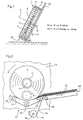
- Figures 1 and 2 show schematically the method according to the invention, in Figure 1 with a view perpendicular to the axis of a winding positioned on the support surface and in Figure 2 with a view parallel to this axis.
- Figure 1 shows as essential device components: an inclined support surface 10, which has a pitch angle ⁇ , and a support means 20, wherein the support surface 10 and support means 20 are arranged such that they can hold a winding 1 together in a defined position.
- the winding 1 with the winding axis A consists of a winding core (not visible), a winding tape 12 and a scale formation 13 of printed products which is wound onto the winding core with the aid of the winding tape.
- the support means 20 is, for example, essentially the same width as or wider than the wound printed products. Since the wrap in the area of Winding tape is denser than in the areas next to the winding tape such a proppant act primarily on the winding tape. This is beneficial for sensitive products. For cases in which the proppant 20 A couple of proppants can be left on the printed products and be provided to the right of the winding tape 12 (see for example figure 3).
- FIG. 2 shows the same device as FIG. 1, but with a viewing angle essentially parallel to the winding axis A. From this, the winding core 11 is visible at the start of the unwinding and in dash-dotted lines (position 11 ') at the end of the winding process.
- the support means 20 can be seen in more detail in this figure. It consists, for example, of a support belt 21 which runs over at least three guide rollers 22/23/24 and is longer than the shortest connection between the rollers. As a result, the band 21 between the rollers 22 and 23, where it is loaded by the winding 1, is pressed downward in an area which at least partially abuts the circumference of the winding.
- the device has a conveying means, for example one Conveyor belt 30 on which the unwanted scale stream 31 is conveyed away becomes.
- the conveyor belt 30 runs over a guide roller 26, which in the areas the periphery of the winding 1 is arranged.
- the device according to FIG. 2 also has a means for rolling up the Winding tape 12, for example one arranged on a drive shaft 40 Tape roll 41.
- a means for rolling up the Winding tape 12 for example one arranged on a drive shaft 40 Tape roll 41.
- the winding tape 12 By winding the winding tape 12, which from the winding 1 runs over the guide roller 23 on the tape roll 41, the winding processed and the printed products are brought onto the conveyor belt. Characterized in that the winding 1 rotates on the support surface 10, is he braked, which maintains the tape tension during unwinding remains.
- the unwinding process proceeds as follows: the winding 1 is leaning on the Support surface 10 deposited such that it is supported by the support means 20. The The end of the winding tape 12 is released from the winding 1 and turned of the roll is pulled from the roll so far that it passes over the guide roller 23 guided away and can be attached to the tape roll 41. Then at least the belt roll 41 and the conveyor belt 30 at the same peripheral speed driven, whereby the winding 1 rotated, the winding tape 12 rolled up on the reel 41 and the unwound stream 31 is conveyed away on the conveyor belt 30.
- the support belt 21 can also be driven during the winding process be or it can be freely movable, such that it is through the Movement of the products to be unwound or the winding tape 12 driven becomes.
- a support means must be provided that matches the unwinding movement moves in such a way that a sliding movement of the support means 20 avoided as far as possible relative to the moving parts of the winding 1 becomes, because this can lead to a congestion of winding tape and / or wound Printed products at the entrance to the support area are what to destabilization of the winding and / or damage to the product can lead.
- support means 20 shown in FIG. 2 in the form of a support band 21
- other support means are also conceivable, for example two V-shaped arranged belts or a series of support rollers.
- the force relationships in the method according to the invention are shown in FIG seen.
- the winding has a weight P, which is in a to the support surface 10th vertical normal component N and a parallel component parallel to the bearing surface F is divisible.
- the movement of the winding on the Contact surface to be overcome R is equal to ⁇ ⁇ N or ⁇ ⁇ P ⁇ sin ⁇ , where ⁇ is the coefficient of friction between the winding face and Contact surface is. This frictional force is particularly effective during rotation of the winding during unwinding as braking, through which the belt tension in Winding is maintained.
- the friction between the end face of the winding and the contact surface is due to the corresponding Choice of the surface of the support surface ( ⁇ ) and by appropriate Set the choice of ⁇ in such a way that even with a small winding weight sufficient tape tension can be maintained.
- the design of the support means 20 is to be matched to the parallel component F.
- the performance the shaft 40 is to be matched to the friction at maximum weight.
- Figures 3 to 5 show devices with such additional elements. All of these figures are Cuts through the unwinder and a winding positioned on it 1, with the winding axis A lying in the cutting plane.
- FIG. 3 shows an embodiment with an additional element in the form of an end plate 50.
- This end plate 50 has a pin 51, which extends into the inner cavity of the winding core 11 and on which a freely rotating roller can be provided. Furthermore, the end plate 50 has a guide element 52 facing away from the winding 1, which is guided in a guide slot 53 in the support surface 10, such that the end plate 50 can be moved up and down on the support surface 10, but cannot be rotated.
- the two surfaces of the plate 50 and the surface of the support surface 10 are matched to one another in such a way that a friction coefficient ⁇ 1 is produced between the winding end face and the surface of the end plate 50 facing the winding, and such that the surface of the end plate 50 facing away from the winding and the Contact surface 10 creates a coefficient of friction ⁇ 2 , where ⁇ 1 generates an optimal braking force for the rotation of the winding, ⁇ 2 an optimal braking force for the slipping of the winding. It turns out that it is advantageous to choose ⁇ 1 smaller than ⁇ 2 .
- the winding 1 rotates with respect to the face plate 50 and is prevented by the pin 51 against the end plate 50 against to slide down.
- the winding 1 slides together with the face plate 50 on the support surface 10 towards the bottom, with the design of guide element 52 and guide slot 53 a rotation of the end plate 50 is prevented relative to the contact surface 10.
- At 50 ' is a lower one Designated position of the end plate 50.
- the end plate 50 with a drive for a rotation operatively connected it is possible not only with the same device To unwind but also a scale formation on a winding core wind up or at least a just unwound part of the scale formation to wrap back on the wrap. So in such a case the pressure between the underside of the winding and the support means 20 does not become too great, it may be necessary not only the rotation of the reel but also propel its upward sliding movement accordingly.
- FIG. 4 shows a further additional element in the form of a double end plate 60 positioned between the winding 1 and the support surface 10.
- the double end plate 60 consists of a rotating plate 61 directed against the winding 1 and a sliding plate 62 directed against the supporting surface 10, the rotating plate, for example, by means of pins 63 is rotatably attached to the slide plate.
- the double end plate 60 can be moved up and down on the support surface 10, for example by means of a guide element 52 and a guide slot 53, but is secured against rotation.
- the surfaces of the rotating plate 61, the sliding plate 62 and the support surface 10 are designed in such a way that the coefficient of friction ⁇ 3 between the end face of the winding and the rotating plate 61 is large, so that the winding and the rotating plate rotate together, and the coefficient of friction ⁇ 4 between the rotating plate 61 and the sliding plate 62 has an appropriate braking force for the winding rotation and that the coefficient of friction ⁇ 5 between the slide plate 62 and the support surface 10 gives an adequate braking force for the downward slide movement.
- a winding device is advantageous for sensitive printed products, especially for products in the area of the end faces in the wrap forming edges can no longer be trimmed.
- FIG. 5 shows a further variant of an unwinding device with an additional element, which in this case consists of a spindle 70 and an axis element 71 which can be moved up and down on the spindle 70.
- the spindle 70 is arranged parallel to the support surface 10 and on its side facing away from the winding 1 and is freely rotatable.
- the axis element 71 protrudes through a corresponding slot 72 in the support surface 10 and extends slightly into the inner cavity of the winding core 11 of a winding 1 positioned on the support surface 10.
- the thread of the spindle 70 and the axis element 71 is designed such that the arrangement is not self-locking and that the weight of the, so to speak, empty winding core is still sufficient to rotate the spindle 70 and thus to move the axle element 71 with the winding 1 hanging thereon downward.
- Spindle 70 and axle element 71 not only absorb part of the slope-driving force, but also the winding is laterally stabilized, which allows a simpler configuration of the support means 20.
- Winding core 11 projecting part of the axis element 71 a freely rotating role have, which rolls during winding in the winding core.
- Spindle 70 and axle element 71 can also be used as a self-locking system designed and the spindle 70 can be driven. The wrap then moves at a speed corresponding to the spindle drive speed down, taking all of the downward force of axle element 71 and Spindle 70 is receivable. In such a case, the support means 20 possibly missing.
- a drivable spindle 70 is also applicable for a device with which not only unwound but also wound shall be.
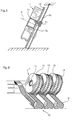
- FIG. 6 shows a group of unwinding devices with which adjacent feed points of a processing line are equipped to illustrate the space savings that can be achieved by the method according to the invention and by the device according to the invention.
- the tape rolls are not shown.
- the unwinding devices are loaded with windings from the side facing the viewer or from above.
- Another variant of the device according to the invention consists in an area of a pair of surfaces rubbing against each other, especially the on the end face of the wrap, the face plate or contact surface due to a large number of small, braked rollers (roller axes parallel to Radii) or by a star-shaped arrangement of braked tapered rollers to be replaced or partially by individual rollers or tapered rollers replace.
- a star-shaped arrangement of tapered rollers would be suitable as a device for both unwinding as well as for winding up if the tapered rollers with an appropriate Drive can be operatively connected.
Landscapes
- Engineering & Computer Science (AREA)
- Mechanical Engineering (AREA)
- Replacement Of Web Rolls (AREA)
- Unwinding Webs (AREA)
Description
- Figuren 1 und 2
- das Prinzip des erfindungsgemässen Verfahrens durch schematische Darstellungen einer beispielhaften Vorrichtung mit Blickwinkel im wesentlichen senkrecht zur Wickelachse (Figur 1) und mit Blickwinkel im wesentlichen parallel zur Wickelachse (Figur 2);
- Figuren 3 bis 5
- weitere Ausführungsformen der erfindungsgemässen Vorrichtung im Schnitt parallel zur Wickelachse;
- Figur 6
- eine perspektivische Darstellung einer Gruppe von Zuführungsstellen, die mit erfindungsgemässen Vorrichtungen ausgerüstet sind.
Claims (10)
- Verfahren zum Abwickeln einer Schuppenformation von Druckprodukten ab einem Wickel (1), in dem die Schuppenformation mit Hilfe eines Wickelbandes (12) auf einen Wickelkern (11) aufgewickelt ist und der eine erste und eine zweite Stirnseite hat, wobei das Wickelband (12) vom Wickel (1) abgezogen und dadurch der Wickel (1) gedreht wird, wobei zur Aufrechterhaltung der Bandspannung die Wickeldrehung gebremst wird und wobei der Wickel (1) während dem Abwickeln derart verschoben wird, dass ein Bereich seiner Peripherie eine stationäre Position einnimmt, dadurch gekennzeichnet, dass der Wickel (1) mit der ersten Stirnseite an eine schiefe Auflagefläche (10) angelegt wird, derart, dass diese erste Stirnseite des Wickels (1) durch eine Normalkomponente (N) des Wickelgewichts (G) gegen die Auflagefläche (10) gepresst und bei der Wickeldrehung relativ zur Auflagefläche (10) gedreht wird, wodurch eine die Wickeldrehung bremsende Reibung entsteht, und derart dass der Wickel (1) durch eine hangabtreibende Kraft (H) parallel zur Auflagefläche (10) ebenfalls durch die Reibung gebremst auf der Auflagefläche (10) gegen ein im unteren Bereich der Auflagefläche (10) angeordnetes und die stationäre Position des Peripheriebereiches definierendes Stützmittel (20) rutscht, und dass das Abziehen des Bandes derart durchgeführt wird, dass die Schuppenformation in diesem Peripheriebereich abgewickelt wird.
- Verfahren nach Anspruch 1, dadurch gekennzeichnet, dass zwischen der ersten Stirnseite des Wickels und der Auflagefläche (10) eine relativ zum Wickel (1) und/oder relativ zur Auflagefläche (10) bewegbare Stirnplatte (50, 60) eingesetzt wird, derart, dass der Wickel (1) sich gegenüber der Stirnplatte (50) oder einem Teil der Stirnplatte (60) dreht und zusammen mit der Stirnplatte (50, 60) gegenüber der Auflagefläche (10) rutscht.
- Verfahren nach einem der Ansprüche 1 oder 2, dadurch gekennzeichnet, dass die Rutschbewegung des Wickels (1) durch Zusatzelemente (70, 71) zusätzlich gebremst oder kontrolliert angetrieben wird.
- Vorrichtung zum Abwickeln einer Schuppenformation von Druckprodukten ab einem Wickel (1), in dem die Schuppenformation mit Hilfe eines Wickelbandes (12) auf einen Wickelkern (11) aufgewickelt ist und der eine erste und eine zweite Stirnseite hat, welche Vorrichtung eine antreibbare Bandrolle (41) zum Abziehen des Wickelbandes (12) vom Wickel (1), ein Mittel zur drehbaren Positionierung des Wickels (1), ein Wegfördermittel (30) zum Wegfördern der abgewickelten Schuppenformation (31) sowie ein Mittel zur Aufrechterhaltung der Bandspannung durch Bremsung der Wickeldrehung und ein Mittel zur Wickelverschiebung derart, dass ein Bereich der Wickelperipherie eine stationäre Position einnimmt, dadurch gekennzeichnet, dass das Mittel zur drehbaren Positionierung des Wickels eine schiefe Auflagefläche (10) mit einem im unteren Bereich der Auflagefläche (10) angeordneten Stützmittel (20) ist, an welche Auflagefläche (10) die erste Stirnseite des Wickels (1) anlegbar ist, derart, dass diese erste Stirnseite durch eine Normalkomponente des Wickelgewichtes gegen die Auflagefläche (10) gepresst und durch die dadurch entstehende Reibung die Wickeldrehung gebremst wird und derart, dass der Wickel durch eine hangabtreibende Kraft (H) parallel zur Auflagefläche (10) gegen das Stützmittel (20) rutschend verschoben wird und dadurch ein unterer Bereich der Wickelperipherie eine durch das Stützmittel (20) definierte stationäre Position hat, und dass die antreibbare Bandrolle (41) derart angeordnet ist, dass das Wickelband (12) von diesem unteren Peripheriebereich abgezogen wird.
- Vorrichtung nach Anspruch 4, dadurch gekennzeichnet, dass das Stützmittel (20) angetrieben oder frei beweglich angeordnet ist, derart, dass es mit der Wickeldrehung bewegbar ist.
- Vorrichtung nach Anspruch 5, dadurch gekennzeichnet, dass das Stützmittel (20) ein über mindestens drei Führungsrollen (22, 23, 24) laufendes Stützband (21) ist.
- Vorrichtung nach einem der Ansprüche 4 bis 6, dadurch gekennzeichnet, dass zwischen Wickel (1) und Auflagefläche (10) eine Stirnplatte (50, 60) vorgesehen ist.
- Vorrichtung nach Anspruch 7, dadurch gekennzeichnet, dass die Stirnplatte (50) einen gegen den Wickel (1) gerichteten Zapfen (51) aufweist und dass sie durch ein Führungselement (52), das in einem Führungsschlitz (53) der Auflagefläche (10) geführt ist, drehgesichert auf und ab bewegbar ist.
- Vorrichtung nach Anspruch 7, dadurch gekennzeichnet, dass die Stirnplatte (60) aus einer Drehplatte (61) und einer Rutschplatte (62) besteht, wobei die Drehplatte (61) drehbar auf der Rutschplatte gelagert (62) ist, und dass die Rutschplatte (62) durch ein Führungselement (52), das in einem Führungsschlitz (53) der Auflagefläche (10) geführt ist, drehgesichert auf und ab bewegbar ist.
- Vorrichtung nach einem der Ansprüche 4 bis 6, dadurch gekennzeichnet, dass die Vorrichtung eine zur Auflagefläche (10) parallel angeordnete Spindel (70) aufweist, auf der ein Achselement (71) auf und ab bewegbar angeordnet ist, welches Achselement (71) durch einen Schlitz (72) in der Auflagefläche (10) ragt.
Applications Claiming Priority (3)
| Application Number | Priority Date | Filing Date | Title |
|---|---|---|---|
| CH41496 | 1996-02-16 | ||
| CH414/96 | 1996-02-16 | ||
| CH41496 | 1996-02-16 |
Publications (2)
| Publication Number | Publication Date |
|---|---|
| EP0790204A1 EP0790204A1 (de) | 1997-08-20 |
| EP0790204B1 true EP0790204B1 (de) | 2002-05-02 |
Family
ID=4186492
Family Applications (1)
| Application Number | Title | Priority Date | Filing Date |
|---|---|---|---|
| EP97100853A Expired - Lifetime EP0790204B1 (de) | 1996-02-16 | 1997-01-21 | Verfahren und Vorrichtung zum Abwickeln von Druckprodukten in Schuppenformation |
Country Status (5)
| Country | Link |
|---|---|
| US (1) | US5772148A (de) |
| EP (1) | EP0790204B1 (de) |
| CA (1) | CA2195590A1 (de) |
| DE (1) | DE59707126D1 (de) |
| DK (1) | DK0790204T3 (de) |
Family Cites Families (14)
| Publication number | Priority date | Publication date | Assignee | Title |
|---|---|---|---|---|
| US1883222A (en) * | 1931-01-12 | 1932-10-18 | Wood Newspaper Mach Corp | Paper roll braking device |
| US2928618A (en) * | 1957-04-26 | 1960-03-15 | Peer A Locke | Paper holder |
| FR1306131A (fr) * | 1961-09-01 | 1962-10-13 | British Insulated Callenders | Appareil perfectionné destiné à contrôler la tension appliquée à des rubans |
| DE1893781U (de) * | 1962-11-26 | 1964-05-27 | Hauni Werke Koerber & Co Kg | Zufuehrungsvorrichtung in zigarettenmaschinen oder in anderen maschinen, die eine aus einem aufgewickelten streifen bestehende bobine verarbeiten. |
| US3334838A (en) * | 1964-09-05 | 1967-08-08 | Kopp & Odenwald | Apparatus for feeding wound material to a processing machine |
| US4336911A (en) * | 1980-09-22 | 1982-06-29 | Fairchild Wayne K | Frictional tensioning device |
| CH652699A5 (de) * | 1981-10-12 | 1985-11-29 | Ferag Ag | Einrichtung zum speichern von in einer schuppenformation anfallenden flaechigen erzeugnissen, insbesondere druckprodukten. |
| CH668055A5 (de) * | 1985-07-01 | 1988-11-30 | Ferag Ag | Verfahren und vorrichtung zum zwischenspeichern von in schuppenformation anfallenden druckprodukten. |
| CH668761A5 (de) * | 1986-01-27 | 1989-01-31 | Ferag Ag | Einrichtung zum aufwickeln eines kontinuierlich anfallenden schuppenstromes von biegsamen flaechengebilden zu einem wickel. |
| JP2525640B2 (ja) * | 1987-05-27 | 1996-08-21 | フェラーク アーゲー | 巻取テ―プと一緒にずれ重なり編成で巻心に巻き取られた印刷物を繰出す装置 |
| WO1991004908A1 (en) | 1989-10-03 | 1991-04-18 | Bell Helicopter Textron Inc. | Self-adjusting slide assembly for weight on gear switch |
| US5174518A (en) * | 1990-12-10 | 1992-12-29 | Kanzaki Paper Manufacturing Co., Ltd. | Paper feeding device and an application thereof |
| CH684267A5 (de) * | 1990-03-23 | 1994-08-15 | Ferag Ag | Einrichtung zum Abwickeln von flexiblen Flächengebilden ab einem Wickel. |
| DE59306228D1 (de) * | 1992-03-19 | 1997-05-28 | Ferag Ag | Verfahren und Vorrichtung zum Auf- und Abwinkeln von Druckprodukten in Schuppenformation |
-
1997
- 1997-01-21 EP EP97100853A patent/EP0790204B1/de not_active Expired - Lifetime
- 1997-01-21 DE DE59707126T patent/DE59707126D1/de not_active Expired - Fee Related
- 1997-01-21 DK DK97100853T patent/DK0790204T3/da active
- 1997-01-21 CA CA002195590A patent/CA2195590A1/en not_active Abandoned
- 1997-02-14 US US08/800,757 patent/US5772148A/en not_active Expired - Fee Related
Also Published As
| Publication number | Publication date |
|---|---|
| EP0790204A1 (de) | 1997-08-20 |
| CA2195590A1 (en) | 1997-08-17 |
| DE59707126D1 (de) | 2002-06-06 |
| DK0790204T3 (da) | 2002-08-19 |
| US5772148A (en) | 1998-06-30 |
Similar Documents
| Publication | Publication Date | Title |
|---|---|---|
| DE69421528T2 (de) | Umwickler mit Kontaktantrieb und Verfahren zur Minimalisierung des Schlupfes zwischen Antriebsrolle und Bahn | |
| DE3123888C2 (de) | Vorrichtung zum Zwischenspeichern von in Schuppenformation anfallenden Zeitungen, Zeitschriften oder dergleichen | |
| DE3236866C2 (de) | ||
| EP0968919B1 (de) | Vorrichtung zum Umwickeln von quaderförmigen Gegenständen mit einem Bahnförmigen Umwickelmaterial | |
| DE60211736T2 (de) | System und verfahren zum gleichzeitigen abwickeln mehrerer materialrollen | |
| DE3302905C2 (de) | Vorrichtung zum Aufwickeln eines Schuppenstromes aus Druckbogen od. dgl. | |
| DE19535746A1 (de) | Verfahren und Vorrichtung zum Verpacken einer Materialbahnrolle | |
| DE2325794A1 (de) | Aufwickelvorrichtung | |
| DE3421915A1 (de) | Verfahren und vorrichtung zum aufbauen und handhaben von stapeln aus bahnmaterial | |
| DE19519306A1 (de) | Verfahren und Vorrichtung zum automatischen Trennen und Anwickeln einer Papierbahn | |
| DE60017186T2 (de) | Vorrichtung zum verpacken von isolationsmaterial | |
| EP0149058A2 (de) | Einrichtung zum Zuführen von Druckprodukten an eine kontinuierlich arbeitende Verarbeitungsstrasse und Verfahren zu ihrem Betrieb | |
| EP0292891B1 (de) | Vorrichtung zum Abwickeln von zusammen mit einem Wickelband in Schuppenformation auf einem Wickelkern aufgewickelten Druckprodukten | |
| DE10213841B4 (de) | Wickelrollenanpressvorrichtung zum Aufwickeln von langen Materialien | |
| DE69108681T2 (de) | Vorrichtung zum zuführen von Sicherungsbändern. | |
| EP0352564B1 (de) | Verfahren und Vorrichtung zur Handhabung und Weiterverarbeitung eines Wabenbandes | |
| DE69900525T2 (de) | Vorrichtung und Verfahren zum Entfernen des Verpackungsmaterials von einer Materialbahnrolle | |
| EP0147528A1 (de) | Verfahren und Vorrichtung zum Bilden von mehrlagigen Wickeln aus in Schuppenformation anfallenden flächigen, biegsamen Erzeugnissen, vorzugsweise Druckprodukten | |
| DE2439212B2 (de) | Verfahren und Vorrichtung zum Steuern der Wickelgüte beim Wickeln von bahnförmigem Material | |
| EP1108669A2 (de) | Rollenwickelvorrichtung, insbesondere für eine Rollenschneidmaschine | |
| EP0384147B1 (de) | Verfahren und Vorrichtung zum Zwischenspeichern von mehrblättrigen, gefalteten Druckereierzeugnissen, wie Zeitungen, Zeitschriften und Teilen hievon | |
| EP0221524B1 (de) | Durchzugsanordnung für Folien | |
| DE69117209T2 (de) | Arretiervorrichtung, insbesondere für einzugsgeführte Wellpappe | |
| DE60118964T2 (de) | Vorrichtung und verfahren zum wickeln von bahnen | |
| EP0790204A1 (de) | Verfahren und Vorrichtung zum Wickeln von Druckprodukten in Schuppenformation |
Legal Events
| Date | Code | Title | Description |
|---|---|---|---|
| PUAI | Public reference made under article 153(3) epc to a published international application that has entered the european phase |
Free format text: ORIGINAL CODE: 0009012 |
|
| AK | Designated contracting states |
Kind code of ref document: A1 Designated state(s): CH DE DK GB LI NL |
|
| 17P | Request for examination filed |
Effective date: 19980209 |
|
| 17Q | First examination report despatched |
Effective date: 19991126 |
|
| RTI1 | Title (correction) |
Free format text: METHOD AND DEVICE FOR UNWINDING PRINTED PRODUCTS IN IMBRICATED FORMATION |
|
| GRAG | Despatch of communication of intention to grant |
Free format text: ORIGINAL CODE: EPIDOS AGRA |
|
| GRAG | Despatch of communication of intention to grant |
Free format text: ORIGINAL CODE: EPIDOS AGRA |
|
| GRAH | Despatch of communication of intention to grant a patent |
Free format text: ORIGINAL CODE: EPIDOS IGRA |
|
| GRAH | Despatch of communication of intention to grant a patent |
Free format text: ORIGINAL CODE: EPIDOS IGRA |
|
| REG | Reference to a national code |
Ref country code: GB Ref legal event code: IF02 |
|
| GRAA | (expected) grant |
Free format text: ORIGINAL CODE: 0009210 |
|
| AK | Designated contracting states |
Kind code of ref document: B1 Designated state(s): CH DE DK GB LI NL |
|
| REG | Reference to a national code |
Ref country code: GB Ref legal event code: FG4D Free format text: NOT ENGLISH |
|
| REG | Reference to a national code |
Ref country code: CH Ref legal event code: EP |
|
| GBT | Gb: translation of ep patent filed (gb section 77(6)(a)/1977) |
Effective date: 20020502 |
|
| REF | Corresponds to: |
Ref document number: 59707126 Country of ref document: DE Date of ref document: 20020606 |
|
| REG | Reference to a national code |
Ref country code: CH Ref legal event code: NV Representative=s name: FREI PATENTANWALTSBUERO |
|
| REG | Reference to a national code |
Ref country code: DK Ref legal event code: T3 |
|
| PGFP | Annual fee paid to national office [announced via postgrant information from national office to epo] |
Ref country code: NL Payment date: 20021227 Year of fee payment: 7 |
|
| PLBE | No opposition filed within time limit |
Free format text: ORIGINAL CODE: 0009261 |
|
| STAA | Information on the status of an ep patent application or granted ep patent |
Free format text: STATUS: NO OPPOSITION FILED WITHIN TIME LIMIT |
|
| 26N | No opposition filed |
Effective date: 20030204 |
|
| PGFP | Annual fee paid to national office [announced via postgrant information from national office to epo] |
Ref country code: CH Payment date: 20031209 Year of fee payment: 8 |
|
| PGFP | Annual fee paid to national office [announced via postgrant information from national office to epo] |
Ref country code: GB Payment date: 20040105 Year of fee payment: 8 |
|
| PGFP | Annual fee paid to national office [announced via postgrant information from national office to epo] |
Ref country code: DK Payment date: 20040106 Year of fee payment: 8 |
|
| PGFP | Annual fee paid to national office [announced via postgrant information from national office to epo] |
Ref country code: DE Payment date: 20040108 Year of fee payment: 8 |
|
| PG25 | Lapsed in a contracting state [announced via postgrant information from national office to epo] |
Ref country code: NL Free format text: LAPSE BECAUSE OF NON-PAYMENT OF DUE FEES Effective date: 20040801 |
|
| NLV4 | Nl: lapsed or anulled due to non-payment of the annual fee |
Effective date: 20040801 |
|
| PG25 | Lapsed in a contracting state [announced via postgrant information from national office to epo] |
Ref country code: GB Free format text: LAPSE BECAUSE OF NON-PAYMENT OF DUE FEES Effective date: 20050121 |
|
| PG25 | Lapsed in a contracting state [announced via postgrant information from national office to epo] |
Ref country code: LI Free format text: LAPSE BECAUSE OF NON-PAYMENT OF DUE FEES Effective date: 20050131 Ref country code: DK Free format text: LAPSE BECAUSE OF NON-PAYMENT OF DUE FEES Effective date: 20050131 Ref country code: CH Free format text: LAPSE BECAUSE OF NON-PAYMENT OF DUE FEES Effective date: 20050131 |
|
| REG | Reference to a national code |
Ref country code: CH Ref legal event code: PFA Owner name: FERAG AG Free format text: FERAG AG#ZUERICHSTRASSE 74#8340 HINWIL (CH) -TRANSFER TO- FERAG AG#PATENTABTEILUNG Z. H. MARKUS FELIX ZUERICHSTRASSE 74#8340 HINWIL (CH) |
|
| PG25 | Lapsed in a contracting state [announced via postgrant information from national office to epo] |
Ref country code: DE Free format text: LAPSE BECAUSE OF NON-PAYMENT OF DUE FEES Effective date: 20050802 |
|
| REG | Reference to a national code |
Ref country code: DK Ref legal event code: EBP |
|
| GBPC | Gb: european patent ceased through non-payment of renewal fee |
Effective date: 20050121 |
|
| REG | Reference to a national code |
Ref country code: CH Ref legal event code: PL |