EP0790346A2 - Tissu pour l'impression au jet d'encre, procédé d'impression par jet d'encre et imprimé - Google Patents
Tissu pour l'impression au jet d'encre, procédé d'impression par jet d'encre et imprimé Download PDFInfo
- Publication number
- EP0790346A2 EP0790346A2 EP97102330A EP97102330A EP0790346A2 EP 0790346 A2 EP0790346 A2 EP 0790346A2 EP 97102330 A EP97102330 A EP 97102330A EP 97102330 A EP97102330 A EP 97102330A EP 0790346 A2 EP0790346 A2 EP 0790346A2
- Authority
- EP
- European Patent Office
- Prior art keywords
- ink
- jet printing
- cloth
- salt
- printing
- Prior art date
- Legal status (The legal status is an assumption and is not a legal conclusion. Google has not performed a legal analysis and makes no representation as to the accuracy of the status listed.)
- Granted
Links
- 239000004744 fabric Substances 0.000 title claims abstract description 100
- 238000007641 inkjet printing Methods 0.000 title claims abstract description 56
- 238000000034 method Methods 0.000 title claims description 41
- 150000003839 salts Chemical class 0.000 claims abstract description 58
- 230000007935 neutral effect Effects 0.000 claims abstract description 10
- 239000000976 ink Substances 0.000 claims description 84
- FAPWRFPIFSIZLT-UHFFFAOYSA-M Sodium chloride Chemical group [Na+].[Cl-] FAPWRFPIFSIZLT-UHFFFAOYSA-M 0.000 claims description 26
- 229920003169 water-soluble polymer Polymers 0.000 claims description 16
- PMZURENOXWZQFD-UHFFFAOYSA-L Sodium Sulfate Chemical compound [Na+].[Na+].[O-]S([O-])(=O)=O PMZURENOXWZQFD-UHFFFAOYSA-L 0.000 claims description 13
- 239000011780 sodium chloride Substances 0.000 claims description 13
- 229910052938 sodium sulfate Inorganic materials 0.000 claims description 13
- 239000000126 substance Substances 0.000 claims description 12
- 229920003171 Poly (ethylene oxide) Polymers 0.000 claims description 8
- 238000005185 salting out Methods 0.000 claims description 8
- 239000000985 reactive dye Substances 0.000 claims description 6
- 150000001450 anions Chemical class 0.000 claims description 5
- 150000001768 cations Chemical class 0.000 claims description 2
- QTBSBXVTEAMEQO-UHFFFAOYSA-M Acetate Chemical compound CC([O-])=O QTBSBXVTEAMEQO-UHFFFAOYSA-M 0.000 claims 2
- FKNQFGJONOIPTF-UHFFFAOYSA-N Sodium cation Chemical compound [Na+] FKNQFGJONOIPTF-UHFFFAOYSA-N 0.000 claims 1
- 229910001415 sodium ion Inorganic materials 0.000 claims 1
- 235000011152 sodium sulphate Nutrition 0.000 claims 1
- 238000007639 printing Methods 0.000 description 87
- UIIMBOGNXHQVGW-UHFFFAOYSA-M Sodium bicarbonate Chemical compound [Na+].OC([O-])=O UIIMBOGNXHQVGW-UHFFFAOYSA-M 0.000 description 22
- 239000003086 colorant Substances 0.000 description 22
- 239000003795 chemical substances by application Substances 0.000 description 16
- 239000000975 dye Substances 0.000 description 16
- RTZKZFJDLAIYFH-UHFFFAOYSA-N Diethyl ether Chemical compound CCOCC RTZKZFJDLAIYFH-UHFFFAOYSA-N 0.000 description 12
- 239000007832 Na2SO4 Substances 0.000 description 12
- 229910000030 sodium bicarbonate Inorganic materials 0.000 description 11
- 239000004753 textile Substances 0.000 description 11
- 230000000740 bleeding effect Effects 0.000 description 9
- 238000010276 construction Methods 0.000 description 9
- 238000001035 drying Methods 0.000 description 9
- 230000000694 effects Effects 0.000 description 7
- 239000000835 fiber Substances 0.000 description 7
- 239000004094 surface-active agent Substances 0.000 description 7
- 239000012736 aqueous medium Substances 0.000 description 6
- 125000000484 butyl group Chemical group [H]C([*])([H])C([H])([H])C([H])([H])C([H])([H])[H] 0.000 description 6
- 125000001495 ethyl group Chemical group [H]C([H])([H])C([H])([H])* 0.000 description 6
- 239000007788 liquid Substances 0.000 description 6
- 125000001436 propyl group Chemical group [H]C([*])([H])C([H])([H])C([H])([H])[H] 0.000 description 6
- 238000003860 storage Methods 0.000 description 6
- XLYOFNOQVPJJNP-UHFFFAOYSA-N water Substances O XLYOFNOQVPJJNP-UHFFFAOYSA-N 0.000 description 6
- LYCAIKOWRPUZTN-UHFFFAOYSA-N Ethylene glycol Chemical compound OCCO LYCAIKOWRPUZTN-UHFFFAOYSA-N 0.000 description 5
- DNIAPMSPPWPWGF-UHFFFAOYSA-N Propylene glycol Chemical compound CC(O)CO DNIAPMSPPWPWGF-UHFFFAOYSA-N 0.000 description 5
- 238000004040 coloring Methods 0.000 description 5
- MTHSVFCYNBDYFN-UHFFFAOYSA-N diethylene glycol Chemical compound OCCOCCO MTHSVFCYNBDYFN-UHFFFAOYSA-N 0.000 description 5
- 150000001875 compounds Chemical class 0.000 description 4
- 239000002657 fibrous material Substances 0.000 description 4
- 238000004519 manufacturing process Methods 0.000 description 4
- -1 silk Polymers 0.000 description 4
- 229920000742 Cotton Polymers 0.000 description 3
- PEDCQBHIVMGVHV-UHFFFAOYSA-N Glycerine Chemical compound OCC(O)CO PEDCQBHIVMGVHV-UHFFFAOYSA-N 0.000 description 3
- KWYUFKZDYYNOTN-UHFFFAOYSA-M Potassium hydroxide Chemical compound [OH-].[K+] KWYUFKZDYYNOTN-UHFFFAOYSA-M 0.000 description 3
- HEMHJVSKTPXQMS-UHFFFAOYSA-M Sodium hydroxide Chemical compound [OH-].[Na+] HEMHJVSKTPXQMS-UHFFFAOYSA-M 0.000 description 3
- XSQUKJJJFZCRTK-UHFFFAOYSA-N Urea Chemical compound NC(N)=O XSQUKJJJFZCRTK-UHFFFAOYSA-N 0.000 description 3
- 239000012790 adhesive layer Substances 0.000 description 3
- 239000004202 carbamide Substances 0.000 description 3
- KRKNYBCHXYNGOX-UHFFFAOYSA-N citric acid Chemical compound OC(=O)CC(O)(C(O)=O)CC(O)=O KRKNYBCHXYNGOX-UHFFFAOYSA-N 0.000 description 3
- 230000002708 enhancing effect Effects 0.000 description 3
- 239000000463 material Substances 0.000 description 3
- 229920000728 polyester Polymers 0.000 description 3
- 238000010020 roller printing Methods 0.000 description 3
- 238000007650 screen-printing Methods 0.000 description 3
- 238000010025 steaming Methods 0.000 description 3
- 210000002268 wool Anatomy 0.000 description 3
- MHXFWEJMQVIWDH-UHFFFAOYSA-N 1-amino-4-hydroxy-2-phenoxyanthracene-9,10-dione Chemical compound C1=C(O)C=2C(=O)C3=CC=CC=C3C(=O)C=2C(N)=C1OC1=CC=CC=C1 MHXFWEJMQVIWDH-UHFFFAOYSA-N 0.000 description 2
- IXPNQXFRVYWDDI-UHFFFAOYSA-N 1-methyl-2,4-dioxo-1,3-diazinane-5-carboximidamide Chemical compound CN1CC(C(N)=N)C(=O)NC1=O IXPNQXFRVYWDDI-UHFFFAOYSA-N 0.000 description 2
- QTBSBXVTEAMEQO-UHFFFAOYSA-N Acetic acid Chemical compound CC(O)=O QTBSBXVTEAMEQO-UHFFFAOYSA-N 0.000 description 2
- TWRXJAOTZQYOKJ-UHFFFAOYSA-L Magnesium chloride Chemical compound [Mg+2].[Cl-].[Cl-] TWRXJAOTZQYOKJ-UHFFFAOYSA-L 0.000 description 2
- SECXISVLQFMRJM-UHFFFAOYSA-N N-Methylpyrrolidone Chemical compound CN1CCCC1=O SECXISVLQFMRJM-UHFFFAOYSA-N 0.000 description 2
- 239000004677 Nylon Substances 0.000 description 2
- 239000004372 Polyvinyl alcohol Substances 0.000 description 2
- WCUXLLCKKVVCTQ-UHFFFAOYSA-M Potassium chloride Chemical compound [Cl-].[K+] WCUXLLCKKVVCTQ-UHFFFAOYSA-M 0.000 description 2
- 229920000297 Rayon Polymers 0.000 description 2
- CDBYLPFSWZWCQE-UHFFFAOYSA-L Sodium Carbonate Chemical compound [Na+].[Na+].[O-]C([O-])=O CDBYLPFSWZWCQE-UHFFFAOYSA-L 0.000 description 2
- KXXFHLLUPUAVRY-UHFFFAOYSA-J [Na+].[Na+].[Na+].[Cu++].[O-]C(=O)C1=CC=C(C=C1N=N[C-](N=NC1=C([O-])C(NC2=NC(F)=NC(NCCOCCS(=O)(=O)C=C)=N2)=CC(=C1)S([O-])(=O)=O)C1=CC=CC=C1)S([O-])(=O)=O Chemical compound [Na+].[Na+].[Na+].[Cu++].[O-]C(=O)C1=CC=C(C=C1N=N[C-](N=NC1=C([O-])C(NC2=NC(F)=NC(NCCOCCS(=O)(=O)C=C)=N2)=CC(=C1)S([O-])(=O)=O)C1=CC=CC=C1)S([O-])(=O)=O KXXFHLLUPUAVRY-UHFFFAOYSA-J 0.000 description 2
- 239000000980 acid dye Substances 0.000 description 2
- TVWHTOUAJSGEKT-UHFFFAOYSA-N chlorine trioxide Chemical compound [O]Cl(=O)=O TVWHTOUAJSGEKT-UHFFFAOYSA-N 0.000 description 2
- 230000000052 comparative effect Effects 0.000 description 2
- 238000009792 diffusion process Methods 0.000 description 2
- 239000000982 direct dye Substances 0.000 description 2
- 239000000986 disperse dye Substances 0.000 description 2
- 239000002270 dispersing agent Substances 0.000 description 2
- 238000004090 dissolution Methods 0.000 description 2
- 238000011156 evaluation Methods 0.000 description 2
- PCHJSUWPFVWCPO-UHFFFAOYSA-N gold Chemical compound [Au] PCHJSUWPFVWCPO-UHFFFAOYSA-N 0.000 description 2
- 229910052737 gold Inorganic materials 0.000 description 2
- 239000010931 gold Substances 0.000 description 2
- 238000010438 heat treatment Methods 0.000 description 2
- 229920001778 nylon Polymers 0.000 description 2
- 229920002451 polyvinyl alcohol Polymers 0.000 description 2
- BWHMMNNQKKPAPP-UHFFFAOYSA-L potassium carbonate Chemical compound [K+].[K+].[O-]C([O-])=O BWHMMNNQKKPAPP-UHFFFAOYSA-L 0.000 description 2
- 238000010926 purge Methods 0.000 description 2
- 239000002964 rayon Substances 0.000 description 2
- 229910052709 silver Inorganic materials 0.000 description 2
- 239000004332 silver Substances 0.000 description 2
- 239000011734 sodium Substances 0.000 description 2
- 235000010413 sodium alginate Nutrition 0.000 description 2
- 239000000661 sodium alginate Substances 0.000 description 2
- 229940005550 sodium alginate Drugs 0.000 description 2
- KDYFGRWQOYBRFD-UHFFFAOYSA-N succinic acid Chemical compound OC(=O)CCC(O)=O KDYFGRWQOYBRFD-UHFFFAOYSA-N 0.000 description 2
- YODZTKMDCQEPHD-UHFFFAOYSA-N thiodiglycol Chemical compound OCCSCCO YODZTKMDCQEPHD-UHFFFAOYSA-N 0.000 description 2
- CYSGHNMQYZDMIA-UHFFFAOYSA-N 1,3-Dimethyl-2-imidazolidinon Chemical compound CN1CCN(C)C1=O CYSGHNMQYZDMIA-UHFFFAOYSA-N 0.000 description 1
- AZXGXVQWEUFULR-UHFFFAOYSA-N 2',4',5',7'-tetrabromofluorescein Chemical compound OC(=O)C1=CC=CC=C1C1=C2C=C(Br)C(=O)C(Br)=C2OC2=C(Br)C(O)=C(Br)C=C21 AZXGXVQWEUFULR-UHFFFAOYSA-N 0.000 description 1
- ROPYWXVRNREIQD-UHFFFAOYSA-N 2-[n-(2-cyanoethyl)-4-[(2,6-dichloro-4-nitrophenyl)diazenyl]anilino]ethyl acetate Chemical compound C1=CC(N(CCC#N)CCOC(=O)C)=CC=C1N=NC1=C(Cl)C=C([N+]([O-])=O)C=C1Cl ROPYWXVRNREIQD-UHFFFAOYSA-N 0.000 description 1
- SCLYXZFZPIKFAH-UHFFFAOYSA-N 2-[n-(2-cyanoethyl)-4-[(4-nitrophenyl)diazenyl]anilino]ethyl benzoate Chemical compound C1=CC([N+](=O)[O-])=CC=C1N=NC1=CC=C(N(CCOC(=O)C=2C=CC=CC=2)CCC#N)C=C1 SCLYXZFZPIKFAH-UHFFFAOYSA-N 0.000 description 1
- FOQABOMYTOFLPZ-UHFFFAOYSA-N 2-[n-ethyl-4-[(4-nitrophenyl)diazenyl]anilino]ethanol Chemical compound C1=CC(N(CCO)CC)=CC=C1N=NC1=CC=C([N+]([O-])=O)C=C1 FOQABOMYTOFLPZ-UHFFFAOYSA-N 0.000 description 1
- IHZXTIBMKNSJCJ-UHFFFAOYSA-N 3-{[(4-{[4-(dimethylamino)phenyl](4-{ethyl[(3-sulfophenyl)methyl]amino}phenyl)methylidene}cyclohexa-2,5-dien-1-ylidene)(ethyl)azaniumyl]methyl}benzene-1-sulfonate Chemical compound C=1C=C(C(=C2C=CC(C=C2)=[N+](C)C)C=2C=CC(=CC=2)N(CC)CC=2C=C(C=CC=2)S([O-])(=O)=O)C=CC=1N(CC)CC1=CC=CC(S(O)(=O)=O)=C1 IHZXTIBMKNSJCJ-UHFFFAOYSA-N 0.000 description 1
- AIARLPIXVMHZLJ-UHFFFAOYSA-N 4,8-diamino-2-bromo-1,5-dihydroxyanthracene-9,10-dione Chemical compound O=C1C2=C(N)C=C(Br)C(O)=C2C(=O)C2=C1C(O)=CC=C2N AIARLPIXVMHZLJ-UHFFFAOYSA-N 0.000 description 1
- QDPSGELUBXFKSB-UHFFFAOYSA-N 4-[(4-aminophenyl)diazenyl]naphthalen-1-amine Chemical compound C1=CC(N)=CC=C1N=NC1=CC=C(N)C2=CC=CC=C12 QDPSGELUBXFKSB-UHFFFAOYSA-N 0.000 description 1
- AVERNFJXXRIVQN-XSDYUOFFSA-N 5-[(4-ethoxyphenyl)diazenyl]-2-[(e)-2-[4-[(4-ethoxyphenyl)diazenyl]-2-sulfophenyl]ethenyl]benzenesulfonic acid Chemical compound C1=CC(OCC)=CC=C1N=NC(C=C1S(O)(=O)=O)=CC=C1\C=C\C1=CC=C(N=NC=2C=CC(OCC)=CC=2)C=C1S(O)(=O)=O AVERNFJXXRIVQN-XSDYUOFFSA-N 0.000 description 1
- 244000215068 Acacia senegal Species 0.000 description 1
- 229920002972 Acrylic fiber Polymers 0.000 description 1
- UXVMQQNJUSDDNG-UHFFFAOYSA-L Calcium chloride Chemical compound [Cl-].[Cl-].[Ca+2] UXVMQQNJUSDDNG-UHFFFAOYSA-L 0.000 description 1
- 229920002134 Carboxymethyl cellulose Polymers 0.000 description 1
- 108010010803 Gelatin Proteins 0.000 description 1
- 229920002907 Guar gum Polymers 0.000 description 1
- 229920000084 Gum arabic Polymers 0.000 description 1
- 239000004354 Hydroxyethyl cellulose Substances 0.000 description 1
- 229920001479 Hydroxyethyl methyl cellulose Polymers 0.000 description 1
- 239000002202 Polyethylene glycol Substances 0.000 description 1
- YIQKLZYTHXTDDT-UHFFFAOYSA-H Sirius red F3B Chemical compound C1=CC(=CC=C1N=NC2=CC(=C(C=C2)N=NC3=C(C=C4C=C(C=CC4=C3[O-])NC(=O)NC5=CC6=CC(=C(C(=C6C=C5)[O-])N=NC7=C(C=C(C=C7)N=NC8=CC=C(C=C8)S(=O)(=O)[O-])S(=O)(=O)[O-])S(=O)(=O)O)S(=O)(=O)O)S(=O)(=O)[O-])S(=O)(=O)[O-].[Na+].[Na+].[Na+].[Na+].[Na+].[Na+] YIQKLZYTHXTDDT-UHFFFAOYSA-H 0.000 description 1
- VMHLLURERBWHNL-UHFFFAOYSA-M Sodium acetate Chemical compound [Na+].CC([O-])=O VMHLLURERBWHNL-UHFFFAOYSA-M 0.000 description 1
- 229920002472 Starch Polymers 0.000 description 1
- 235000010489 acacia gum Nutrition 0.000 description 1
- 239000000205 acacia gum Substances 0.000 description 1
- 239000002253 acid Substances 0.000 description 1
- 239000000654 additive Substances 0.000 description 1
- 230000000996 additive effect Effects 0.000 description 1
- 150000001346 alkyl aryl ethers Chemical class 0.000 description 1
- 150000005215 alkyl ethers Chemical class 0.000 description 1
- 239000003963 antioxidant agent Substances 0.000 description 1
- 239000007864 aqueous solution Substances 0.000 description 1
- 238000010420 art technique Methods 0.000 description 1
- WXLFIFHRGFOVCD-UHFFFAOYSA-L azophloxine Chemical compound [Na+].[Na+].OC1=C2C(NC(=O)C)=CC(S([O-])(=O)=O)=CC2=CC(S([O-])(=O)=O)=C1N=NC1=CC=CC=C1 WXLFIFHRGFOVCD-UHFFFAOYSA-L 0.000 description 1
- VUXVWHOCQSLYRN-UHFFFAOYSA-O benzyl-[4-[[4-[benzyl(ethyl)amino]phenyl]-(2,4-disulfophenyl)methylidene]cyclohexa-2,5-dien-1-ylidene]-ethylazanium Chemical compound C=1C=C(C(=C2C=CC(C=C2)=[N+](CC)CC=2C=CC=CC=2)C=2C(=CC(=CC=2)S(O)(=O)=O)S(O)(=O)=O)C=CC=1N(CC)CC1=CC=CC=C1 VUXVWHOCQSLYRN-UHFFFAOYSA-O 0.000 description 1
- 230000015572 biosynthetic process Effects 0.000 description 1
- 239000007844 bleaching agent Substances 0.000 description 1
- 238000009835 boiling Methods 0.000 description 1
- 229910052791 calcium Inorganic materials 0.000 description 1
- 239000001110 calcium chloride Substances 0.000 description 1
- 229910001628 calcium chloride Inorganic materials 0.000 description 1
- 239000001768 carboxy methyl cellulose Substances 0.000 description 1
- 235000010948 carboxy methyl cellulose Nutrition 0.000 description 1
- 239000008112 carboxymethyl-cellulose Substances 0.000 description 1
- 239000000969 carrier Substances 0.000 description 1
- 239000003054 catalyst Substances 0.000 description 1
- ZBNARPCCDMHDDV-UHFFFAOYSA-N chembl1206040 Chemical compound C1=C(S(O)(=O)=O)C=C2C=C(S(O)(=O)=O)C(N=NC3=CC=C(C=C3C)C=3C=C(C(=CC=3)N=NC=3C(=CC4=CC(=CC(N)=C4C=3O)S(O)(=O)=O)S(O)(=O)=O)C)=C(O)C2=C1N ZBNARPCCDMHDDV-UHFFFAOYSA-N 0.000 description 1
- HFIYIRIMGZMCPC-UHFFFAOYSA-J chembl1326377 Chemical compound [Na+].[Na+].[Na+].[Na+].[O-]S(=O)(=O)C1=CC2=CC(S([O-])(=O)=O)=C(N=NC=3C=CC(=CC=3)S(=O)(=O)CCOS([O-])(=O)=O)C(O)=C2C(N)=C1N=NC1=CC=C(S(=O)(=O)CCOS([O-])(=O)=O)C=C1 HFIYIRIMGZMCPC-UHFFFAOYSA-J 0.000 description 1
- PXOZAFXVEWKXED-UHFFFAOYSA-N chembl1590721 Chemical compound C1=CC(NC(=O)C)=CC=C1N=NC1=CC(C)=CC=C1O PXOZAFXVEWKXED-UHFFFAOYSA-N 0.000 description 1
- 239000003638 chemical reducing agent Substances 0.000 description 1
- 230000000295 complement effect Effects 0.000 description 1
- 230000001276 controlling effect Effects 0.000 description 1
- 238000013461 design Methods 0.000 description 1
- 238000009990 desizing Methods 0.000 description 1
- 150000001983 dialkylethers Chemical class 0.000 description 1
- 238000007598 dipping method Methods 0.000 description 1
- 238000007599 discharging Methods 0.000 description 1
- JCGDEGCAEZOBSD-UHFFFAOYSA-L disodium 2-[4-[(2-hydroxynaphthalen-1-yl)diazenyl]-2-sulfonatophenyl]-5-[(3-methyl-5-oxo-1-phenyl-4H-pyrazol-4-yl)diazenyl]benzenesulfonate Chemical compound [Na+].[Na+].CC1=NN(C(=O)C1N=Nc1ccc(-c2ccc(cc2S([O-])(=O)=O)N=Nc2c(O)ccc3ccccc23)c(c1)S([O-])(=O)=O)c1ccccc1 JCGDEGCAEZOBSD-UHFFFAOYSA-L 0.000 description 1
- HWMSOVGCOJHRML-UHFFFAOYSA-L disodium 3-[[4-[(7-amino-1-hydroxy-3-sulfonatonaphthalen-2-yl)diazenyl]naphthalen-1-yl]diazenyl]-2,6-dihydroxybenzoate Chemical compound [Na+].[Na+].Nc1ccc2cc(c(N=Nc3ccc(N=Nc4ccc(O)c(C([O-])=O)c4O)c4ccccc34)c(O)c2c1)S([O-])(=O)=O HWMSOVGCOJHRML-UHFFFAOYSA-L 0.000 description 1
- UZZFFIUHUDOYPS-UHFFFAOYSA-L disodium 4-amino-3,6-bis[[4-[(2,4-diaminophenyl)diazenyl]phenyl]diazenyl]-5-oxido-7-sulfonaphthalene-2-sulfonate Chemical compound [Na+].[Na+].Nc1ccc(N=Nc2ccc(cc2)N=Nc2c(N)c3c(O)c(N=Nc4ccc(cc4)N=Nc4ccc(N)cc4N)c(cc3cc2S([O-])(=O)=O)S([O-])(=O)=O)c(N)c1 UZZFFIUHUDOYPS-UHFFFAOYSA-L 0.000 description 1
- DHQJMKJYFOHOSY-UHFFFAOYSA-L disodium 4-amino-3-[[4-[4-[(2,4-diaminophenyl)diazenyl]-3-methylphenyl]-2-methylphenyl]diazenyl]-5-oxido-6-phenyldiazenyl-7-sulfonaphthalene-2-sulfonate Chemical compound [Na+].[Na+].Cc1cc(ccc1N=Nc1ccc(N)cc1N)-c1ccc(N=Nc2c(N)c3c(O)c(N=Nc4ccccc4)c(cc3cc2S([O-])(=O)=O)S([O-])(=O)=O)c(C)c1 DHQJMKJYFOHOSY-UHFFFAOYSA-L 0.000 description 1
- DSARWKALPGYFTA-UHFFFAOYSA-L disodium 4-hydroxy-7-[(5-hydroxy-6-phenyldiazenyl-7-sulfonatonaphthalen-2-yl)carbamoylamino]-3-phenyldiazenylnaphthalene-2-sulfonate Chemical compound [Na+].[Na+].[O-]S(=O)(=O)C1=CC2=CC(NC(=O)NC=3C=C4C=C(C(N=NC=5C=CC=CC=5)=C(O)C4=CC=3)S([O-])(=O)=O)=CC=C2C(O)=C1N=NC1=CC=CC=C1 DSARWKALPGYFTA-UHFFFAOYSA-L 0.000 description 1
- WXUZMLVSQROLEX-UHFFFAOYSA-L disodium 5-[[4-[(4-anilino-3-sulfonatophenyl)diazenyl]naphthalen-1-yl]diazenyl]-6-hydroxynaphthalene-2-sulfonate Chemical compound [Na+].[Na+].Oc1ccc2cc(ccc2c1N=Nc1ccc(N=Nc2ccc(Nc3ccccc3)c(c2)S([O-])(=O)=O)c2ccccc12)S([O-])(=O)=O WXUZMLVSQROLEX-UHFFFAOYSA-L 0.000 description 1
- 239000003792 electrolyte Substances 0.000 description 1
- 230000001747 exhibiting effect Effects 0.000 description 1
- 239000010419 fine particle Substances 0.000 description 1
- 229920000159 gelatin Polymers 0.000 description 1
- 239000008273 gelatin Substances 0.000 description 1
- 235000019322 gelatine Nutrition 0.000 description 1
- 235000011852 gelatine desserts Nutrition 0.000 description 1
- 239000000665 guar gum Substances 0.000 description 1
- 235000010417 guar gum Nutrition 0.000 description 1
- 229960002154 guar gum Drugs 0.000 description 1
- 125000002887 hydroxy group Chemical group [H]O* 0.000 description 1
- 235000019447 hydroxyethyl cellulose Nutrition 0.000 description 1
- 239000004615 ingredient Substances 0.000 description 1
- 238000011835 investigation Methods 0.000 description 1
- 238000010409 ironing Methods 0.000 description 1
- 229910052744 lithium Inorganic materials 0.000 description 1
- 230000002535 lyotropic effect Effects 0.000 description 1
- 229910052749 magnesium Inorganic materials 0.000 description 1
- 229910001629 magnesium chloride Inorganic materials 0.000 description 1
- FPYJFEHAWHCUMM-UHFFFAOYSA-N maleic anhydride Chemical compound O=C1OC(=O)C=C1 FPYJFEHAWHCUMM-UHFFFAOYSA-N 0.000 description 1
- 239000002609 medium Substances 0.000 description 1
- 229910052751 metal Inorganic materials 0.000 description 1
- 239000002184 metal Substances 0.000 description 1
- 229910021645 metal ion Inorganic materials 0.000 description 1
- 229920000609 methyl cellulose Polymers 0.000 description 1
- 239000001923 methylcellulose Substances 0.000 description 1
- 235000010981 methylcellulose Nutrition 0.000 description 1
- CTIQLGJVGNGFEW-UHFFFAOYSA-L naphthol yellow S Chemical compound [Na+].[Na+].C1=C(S([O-])(=O)=O)C=C2C([O-])=C([N+]([O-])=O)C=C([N+]([O-])=O)C2=C1 CTIQLGJVGNGFEW-UHFFFAOYSA-L 0.000 description 1
- 239000002736 nonionic surfactant Substances 0.000 description 1
- 230000003287 optical effect Effects 0.000 description 1
- 239000007800 oxidant agent Substances 0.000 description 1
- 230000000149 penetrating effect Effects 0.000 description 1
- 230000035515 penetration Effects 0.000 description 1
- 229920003023 plastic Polymers 0.000 description 1
- 239000004033 plastic Substances 0.000 description 1
- 229920000058 polyacrylate Polymers 0.000 description 1
- 229920001515 polyalkylene glycol Polymers 0.000 description 1
- 229920001223 polyethylene glycol Polymers 0.000 description 1
- 229920000642 polymer Polymers 0.000 description 1
- 229920001451 polypropylene glycol Polymers 0.000 description 1
- 229910052700 potassium Inorganic materials 0.000 description 1
- 239000011736 potassium bicarbonate Substances 0.000 description 1
- 229910000028 potassium bicarbonate Inorganic materials 0.000 description 1
- 235000015497 potassium bicarbonate Nutrition 0.000 description 1
- 229910000027 potassium carbonate Inorganic materials 0.000 description 1
- 235000011181 potassium carbonates Nutrition 0.000 description 1
- 239000001103 potassium chloride Substances 0.000 description 1
- TYJJADVDDVDEDZ-UHFFFAOYSA-M potassium hydrogencarbonate Chemical compound [K+].OC([O-])=O TYJJADVDDVDEDZ-UHFFFAOYSA-M 0.000 description 1
- 229940086066 potassium hydrogencarbonate Drugs 0.000 description 1
- 235000011118 potassium hydroxide Nutrition 0.000 description 1
- 238000002360 preparation method Methods 0.000 description 1
- 238000002203 pretreatment Methods 0.000 description 1
- 230000002265 prevention Effects 0.000 description 1
- 238000012545 processing Methods 0.000 description 1
- KXXXUIKPSVVSAW-UHFFFAOYSA-K pyranine Chemical compound [Na+].[Na+].[Na+].C1=C2C(O)=CC(S([O-])(=O)=O)=C(C=C3)C2=C2C3=C(S([O-])(=O)=O)C=C(S([O-])(=O)=O)C2=C1 KXXXUIKPSVVSAW-UHFFFAOYSA-K 0.000 description 1
- HNJBEVLQSNELDL-UHFFFAOYSA-N pyrrolidin-2-one Chemical compound O=C1CCCN1 HNJBEVLQSNELDL-UHFFFAOYSA-N 0.000 description 1
- 230000001105 regulatory effect Effects 0.000 description 1
- 230000004043 responsiveness Effects 0.000 description 1
- 239000004065 semiconductor Substances 0.000 description 1
- 229910052708 sodium Inorganic materials 0.000 description 1
- BQHRKYUXVHKLLZ-UHFFFAOYSA-M sodium 7-amino-2-[[4-[(4-aminophenyl)diazenyl]-2-methoxy-5-methylphenyl]diazenyl]-3-sulfonaphthalen-1-olate Chemical compound [Na+].COc1cc(N=Nc2ccc(N)cc2)c(C)cc1N=Nc1c(O)c2cc(N)ccc2cc1S([O-])(=O)=O BQHRKYUXVHKLLZ-UHFFFAOYSA-M 0.000 description 1
- 229910000029 sodium carbonate Inorganic materials 0.000 description 1
- 239000001509 sodium citrate Substances 0.000 description 1
- NLJMYIDDQXHKNR-UHFFFAOYSA-K sodium citrate Chemical compound O.O.[Na+].[Na+].[Na+].[O-]C(=O)CC(O)(CC([O-])=O)C([O-])=O NLJMYIDDQXHKNR-UHFFFAOYSA-K 0.000 description 1
- 235000011121 sodium hydroxide Nutrition 0.000 description 1
- FIXVWFINKCQNFG-UHFFFAOYSA-M sodium;4-[(4-aminophenyl)diazenyl]benzenesulfonate Chemical compound [Na+].C1=CC(N)=CC=C1N=NC1=CC=C(S([O-])(=O)=O)C=C1 FIXVWFINKCQNFG-UHFFFAOYSA-M 0.000 description 1
- GNFJBURFXWYRQN-UHFFFAOYSA-M sodium;4-[3-[[2-methyl-4-(4-methylphenyl)sulfonyloxyphenyl]diazenyl]anilino]-3-nitrobenzenesulfonate Chemical compound [Na+].C1=CC(C)=CC=C1S(=O)(=O)OC(C=C1C)=CC=C1N=NC1=CC=CC(NC=2C(=CC(=CC=2)S([O-])(=O)=O)[N+]([O-])=O)=C1 GNFJBURFXWYRQN-UHFFFAOYSA-M 0.000 description 1
- 239000007787 solid Substances 0.000 description 1
- 230000003595 spectral effect Effects 0.000 description 1
- 238000005507 spraying Methods 0.000 description 1
- 239000008107 starch Substances 0.000 description 1
- 235000019698 starch Nutrition 0.000 description 1
- 239000001384 succinic acid Substances 0.000 description 1
- HXJUTPCZVOIRIF-UHFFFAOYSA-N sulfolane Chemical compound O=S1(=O)CCCC1 HXJUTPCZVOIRIF-UHFFFAOYSA-N 0.000 description 1
- 230000002195 synergetic effect Effects 0.000 description 1
- 235000018553 tannin Nutrition 0.000 description 1
- 239000001648 tannin Substances 0.000 description 1
- 229920001864 tannin Polymers 0.000 description 1
- WNQPPENQFWLADQ-UHFFFAOYSA-J tetrasodium;4-hydroxy-5-[[4-[[4-[(8-hydroxy-3,6-disulfonatonaphthalen-1-yl)diazenyl]-2-methoxy-5-methylphenyl]carbamoylamino]-5-methoxy-2-methylphenyl]diazenyl]naphthalene-2,7-disulfonate Chemical compound [Na+].[Na+].[Na+].[Na+].[O-]S(=O)(=O)C1=CC(O)=C2C(N=NC3=C(C)C=C(C(=C3)OC)NC(=O)NC3=CC(C)=C(N=NC=4C5=C(O)C=C(C=C5C=C(C=4)S([O-])(=O)=O)S([O-])(=O)=O)C=C3OC)=CC(S([O-])(=O)=O)=CC2=C1 WNQPPENQFWLADQ-UHFFFAOYSA-J 0.000 description 1
- 229950006389 thiodiglycol Drugs 0.000 description 1
- ZIBGPFATKBEMQZ-UHFFFAOYSA-N triethylene glycol Chemical compound OCCOCCOCCO ZIBGPFATKBEMQZ-UHFFFAOYSA-N 0.000 description 1
- GWAKFAUFNNPZFE-UHFFFAOYSA-K trisodium 2-[4-[(2-amino-4-oxidophenyl)diazenyl]anilino]-5-[(1-amino-8-oxido-7-phenyldiazenyl-3,6-disulfonaphthalen-2-yl)diazenyl]benzenesulfonate Chemical compound NC1=C(C(=CC2=CC(=C(C(=C12)O)N=NC1=CC=CC=C1)S(=O)(=O)[O-])S(=O)(=O)[O-])N=NC1=CC(=C(C=C1)NC1=CC=C(C=C1)N=NC1=C(C=C(C=C1)O)N)S(=O)(=O)[O-].[Na+].[Na+].[Na+] GWAKFAUFNNPZFE-UHFFFAOYSA-K 0.000 description 1
- IHVXOVVDYSKGMH-UHFFFAOYSA-K trisodium 2-[[6-[(4-amino-6-chloro-1,3,5-triazin-2-yl)-methylamino]-1-hydroxy-3-sulfonatonaphthalen-2-yl]diazenyl]naphthalene-1,5-disulfonate Chemical compound [Na+].[Na+].[Na+].CN(c1ccc2c(O)c(N=Nc3ccc4c(cccc4c3S([O-])(=O)=O)S([O-])(=O)=O)c(cc2c1)S([O-])(=O)=O)c1nc(N)nc(Cl)n1 IHVXOVVDYSKGMH-UHFFFAOYSA-K 0.000 description 1
- QTFHTNFVUCUDIR-UHFFFAOYSA-K trisodium 6-[(2,4-diaminophenyl)diazenyl]-3-[[4-[4-[[7-[(2,4-diaminophenyl)diazenyl]-1-hydroxy-3-sulfonatonaphthalen-2-yl]diazenyl]-2-sulfonatoanilino]phenyl]diazenyl]-4-hydroxynaphthalene-2-sulfonate Chemical compound C1=CC(=CC=C1NC2=C(C=C(C=C2)N=NC3=C(C=C4C=CC(=CC4=C3[O-])N=NC5=C(C=C(C=C5)N)N)S(=O)(=O)O)S(=O)(=O)[O-])N=NC6=C(C=C7C=CC(=CC7=C6[O-])N=NC8=C(C=C(C=C8)N)N)S(=O)(=O)O.[Na+].[Na+].[Na+] QTFHTNFVUCUDIR-UHFFFAOYSA-K 0.000 description 1
- MBAYVHBJJXOOIY-UHFFFAOYSA-K trisodium 7-[[4-chloro-6-(3-sulfonatoanilino)-1,3,5-triazin-2-yl]-methylamino]-4-hydroxy-3-[(2-sulfonatophenyl)diazenyl]naphthalene-2-sulfonate Chemical compound [Na+].[Na+].[Na+].CN(c1ccc2c(O)c(N=Nc3ccccc3S([O-])(=O)=O)c(cc2c1)S([O-])(=O)=O)c1nc(Cl)nc(Nc2cccc(c2)S([O-])(=O)=O)n1 MBAYVHBJJXOOIY-UHFFFAOYSA-K 0.000 description 1
- WTPOYMNMKZIOGO-UHFFFAOYSA-K trisodium;2,5-dichloro-4-[4-[[5-[[4-chloro-6-(4-sulfonatoanilino)-1,3,5-triazin-2-yl]amino]-2-sulfonatophenyl]diazenyl]-3-methyl-5-oxo-4h-pyrazol-1-yl]benzenesulfonate Chemical compound [Na+].[Na+].[Na+].CC1=NN(C=2C(=CC(=C(Cl)C=2)S([O-])(=O)=O)Cl)C(=O)C1N=NC(C(=CC=1)S([O-])(=O)=O)=CC=1NC(N=1)=NC(Cl)=NC=1NC1=CC=C(S([O-])(=O)=O)C=C1 WTPOYMNMKZIOGO-UHFFFAOYSA-K 0.000 description 1
- QODWDUXKFKJVCQ-UHFFFAOYSA-K trisodium;2-[[4-[[4-[(4-amino-6-chloro-1,3,5-triazin-2-yl)amino]-5-sulfonatonaphthalen-1-yl]diazenyl]-2,5-dimethylphenyl]diazenyl]benzene-1,4-disulfonate Chemical compound [Na+].[Na+].[Na+].CC=1C=C(N=NC=2C(=CC=C(C=2)S([O-])(=O)=O)S([O-])(=O)=O)C(C)=CC=1N=NC(C1=CC=CC(=C11)S([O-])(=O)=O)=CC=C1NC1=NC(N)=NC(Cl)=N1 QODWDUXKFKJVCQ-UHFFFAOYSA-K 0.000 description 1
- DSKGJDYCSBLEMI-UHFFFAOYSA-K trisodium;7-[[4-[(4-amino-6-chloro-1,3,5-triazin-2-yl)amino]-2-(carbamoylamino)phenyl]diazenyl]naphthalene-1,3,6-trisulfonate Chemical compound [Na+].[Na+].[Na+].C=1C=C(N=NC=2C(=CC3=CC(=CC(=C3C=2)S([O-])(=O)=O)S([O-])(=O)=O)S([O-])(=O)=O)C(NC(=O)N)=CC=1NC1=NC(N)=NC(Cl)=N1 DSKGJDYCSBLEMI-UHFFFAOYSA-K 0.000 description 1
- 238000011144 upstream manufacturing Methods 0.000 description 1
- 239000004034 viscosity adjusting agent Substances 0.000 description 1
- 238000005406 washing Methods 0.000 description 1
- 238000004804 winding Methods 0.000 description 1
Images


Classifications
-
- D—TEXTILES; PAPER
- D06—TREATMENT OF TEXTILES OR THE LIKE; LAUNDERING; FLEXIBLE MATERIALS NOT OTHERWISE PROVIDED FOR
- D06P—DYEING OR PRINTING TEXTILES; DYEING LEATHER, FURS OR SOLID MACROMOLECULAR SUBSTANCES IN ANY FORM
- D06P5/00—Other features in dyeing or printing textiles, or dyeing leather, furs, or solid macromolecular substances in any form
- D06P5/30—Ink jet printing
-
- B—PERFORMING OPERATIONS; TRANSPORTING
- B41—PRINTING; LINING MACHINES; TYPEWRITERS; STAMPS
- B41M—PRINTING, DUPLICATING, MARKING, OR COPYING PROCESSES; COLOUR PRINTING
- B41M5/00—Duplicating or marking methods; Sheet materials for use therein
- B41M5/50—Recording sheets characterised by the coating used to improve ink, dye or pigment receptivity, e.g. for ink-jet or thermal dye transfer recording
- B41M5/502—Recording sheets characterised by the coating used to improve ink, dye or pigment receptivity, e.g. for ink-jet or thermal dye transfer recording characterised by structural details, e.g. multilayer materials
- B41M5/508—Supports
-
- D—TEXTILES; PAPER
- D06—TREATMENT OF TEXTILES OR THE LIKE; LAUNDERING; FLEXIBLE MATERIALS NOT OTHERWISE PROVIDED FOR
- D06P—DYEING OR PRINTING TEXTILES; DYEING LEATHER, FURS OR SOLID MACROMOLECULAR SUBSTANCES IN ANY FORM
- D06P1/00—General processes of dyeing or printing textiles, or general processes of dyeing leather, furs, or solid macromolecular substances in any form, classified according to the dyes, pigments, or auxiliary substances employed
- D06P1/44—General processes of dyeing or printing textiles, or general processes of dyeing leather, furs, or solid macromolecular substances in any form, classified according to the dyes, pigments, or auxiliary substances employed using insoluble pigments or auxiliary substances, e.g. binders
- D06P1/60—General processes of dyeing or printing textiles, or general processes of dyeing leather, furs, or solid macromolecular substances in any form, classified according to the dyes, pigments, or auxiliary substances employed using insoluble pigments or auxiliary substances, e.g. binders using compositions containing polyethers
- D06P1/613—Polyethers without nitrogen
- D06P1/6138—Polymerisation products of glycols, e.g. Carbowax, Pluronics
-
- D—TEXTILES; PAPER
- D06—TREATMENT OF TEXTILES OR THE LIKE; LAUNDERING; FLEXIBLE MATERIALS NOT OTHERWISE PROVIDED FOR
- D06P—DYEING OR PRINTING TEXTILES; DYEING LEATHER, FURS OR SOLID MACROMOLECULAR SUBSTANCES IN ANY FORM
- D06P1/00—General processes of dyeing or printing textiles, or general processes of dyeing leather, furs, or solid macromolecular substances in any form, classified according to the dyes, pigments, or auxiliary substances employed
- D06P1/44—General processes of dyeing or printing textiles, or general processes of dyeing leather, furs, or solid macromolecular substances in any form, classified according to the dyes, pigments, or auxiliary substances employed using insoluble pigments or auxiliary substances, e.g. binders
- D06P1/673—Inorganic compounds
- D06P1/67333—Salts or hydroxides
- D06P1/6735—Salts or hydroxides of alkaline or alkaline-earth metals with anions different from those provided for in D06P1/67341
-
- D—TEXTILES; PAPER
- D06—TREATMENT OF TEXTILES OR THE LIKE; LAUNDERING; FLEXIBLE MATERIALS NOT OTHERWISE PROVIDED FOR
- D06P—DYEING OR PRINTING TEXTILES; DYEING LEATHER, FURS OR SOLID MACROMOLECULAR SUBSTANCES IN ANY FORM
- D06P1/00—General processes of dyeing or printing textiles, or general processes of dyeing leather, furs, or solid macromolecular substances in any form, classified according to the dyes, pigments, or auxiliary substances employed
- D06P1/44—General processes of dyeing or printing textiles, or general processes of dyeing leather, furs, or solid macromolecular substances in any form, classified according to the dyes, pigments, or auxiliary substances employed using insoluble pigments or auxiliary substances, e.g. binders
- D06P1/673—Inorganic compounds
- D06P1/67333—Salts or hydroxides
- D06P1/6735—Salts or hydroxides of alkaline or alkaline-earth metals with anions different from those provided for in D06P1/67341
- D06P1/67358—Halides or oxyhalides
-
- B—PERFORMING OPERATIONS; TRANSPORTING
- B41—PRINTING; LINING MACHINES; TYPEWRITERS; STAMPS
- B41M—PRINTING, DUPLICATING, MARKING, OR COPYING PROCESSES; COLOUR PRINTING
- B41M5/00—Duplicating or marking methods; Sheet materials for use therein
- B41M5/50—Recording sheets characterised by the coating used to improve ink, dye or pigment receptivity, e.g. for ink-jet or thermal dye transfer recording
- B41M5/52—Macromolecular coatings
- B41M5/5218—Macromolecular coatings characterised by inorganic additives, e.g. pigments, clays
-
- Y—GENERAL TAGGING OF NEW TECHNOLOGICAL DEVELOPMENTS; GENERAL TAGGING OF CROSS-SECTIONAL TECHNOLOGIES SPANNING OVER SEVERAL SECTIONS OF THE IPC; TECHNICAL SUBJECTS COVERED BY FORMER USPC CROSS-REFERENCE ART COLLECTIONS [XRACs] AND DIGESTS
- Y10—TECHNICAL SUBJECTS COVERED BY FORMER USPC
- Y10T—TECHNICAL SUBJECTS COVERED BY FORMER US CLASSIFICATION
- Y10T442/00—Fabric [woven, knitted, or nonwoven textile or cloth, etc.]
- Y10T442/20—Coated or impregnated woven, knit, or nonwoven fabric which is not [a] associated with another preformed layer or fiber layer or, [b] with respect to woven and knit, characterized, respectively, by a particular or differential weave or knit, wherein the coating or impregnation is neither a foamed material nor a free metal or alloy layer
- Y10T442/2139—Coating or impregnation specified as porous or permeable to a specific substance [e.g., water vapor, air, etc.]
-
- Y—GENERAL TAGGING OF NEW TECHNOLOGICAL DEVELOPMENTS; GENERAL TAGGING OF CROSS-SECTIONAL TECHNOLOGIES SPANNING OVER SEVERAL SECTIONS OF THE IPC; TECHNICAL SUBJECTS COVERED BY FORMER USPC CROSS-REFERENCE ART COLLECTIONS [XRACs] AND DIGESTS
- Y10—TECHNICAL SUBJECTS COVERED BY FORMER USPC
- Y10T—TECHNICAL SUBJECTS COVERED BY FORMER US CLASSIFICATION
- Y10T442/00—Fabric [woven, knitted, or nonwoven textile or cloth, etc.]
- Y10T442/20—Coated or impregnated woven, knit, or nonwoven fabric which is not [a] associated with another preformed layer or fiber layer or, [b] with respect to woven and knit, characterized, respectively, by a particular or differential weave or knit, wherein the coating or impregnation is neither a foamed material nor a free metal or alloy layer
- Y10T442/2762—Coated or impregnated natural fiber fabric [e.g., cotton, wool, silk, linen, etc.]
Definitions
- the present invention relates to an ink-jet printing cloth, an ink-jet printing process and a print obtained by the ink-jet printing process.
- ink-jet printing has heretofore been known as a process of printing on cloth formed of cotton, silk, polyester or the like.
- This ink-jet printing is conducted by means of an ink-jet printing apparatus obtained by improving an image-forming apparatus of an ink-jet system for forming images on recording media such as plastics and recording paper so as to be fitted for textile printing and the kind of a cloth to be used.
- the ink-jet system is a non-impact printing system, which ejects an ink or the like to directly apply the ink to cloth or the like and produces little noise.
- a textile printing apparatus equipped with an ink-jet system printing head permits high-density printing operation at high speed.
- the textile printing processes using a plate such as a screen or a design roller are unfit for multi-kind small-quantity production, whereas the ink-jet textile printing process is a system making no use of any plate, and is fit for multi-kind small-quantity production and can perform textile printing in a short period of time because data for printing can be formed with ease by a host system or the like.
- the textile printing apparatus of the ink-jet system is generally equipped with a printing means (printing head) mounted on a carriage, a feeding means for feeding a cloth and a control means for controlling these means.
- the printing head by which ink droplets are ejected through a plurality of ejection orifices serially scans in a conveying direction (a secondary scanning direction) of the cloth and a direction perpendicular to it (a main scanning direction), while the cloth is intermittently fed by a predetermined length at the time printing is stopped.
- a secondary scanning direction a conveying direction
- a main scanning direction a direction perpendicular to it
- color printing In the case of multi-color textile printing (color printing), a color image is formed by overlapping ink droplets of plural colors ejected from respective printing heads.
- color printing requires three or four printing heads and ink tanks corresponding to three primary colors of yellow (Y), magenta (M) and cyan (C) or four colors including black (B) in addition to these primary colors.
- ink-jet printing Since such devices are used, the techniques required of ink-jet printing are greatly different from those of screen and roller printing. More specifically, this is caused by such differences in system that since the optimum value of viscosity of inks used in ink-jet printing is far lower than that of inks used in screen printing or roller printing, a large amount of inks cannot be applied at once from the viewpoint of occurrence of bleeding, that strike-through of the resulting print becomes poor due to this application of the inks in the small amount, that the ink-jet printing requires attention to reliability such as clogging of the head, that the so-called additive color process, in which a few inks of different colors are shot on the same position so as to overlap each other, is conducted, and that the dots of inks are very small.
- Japanese Patent Publication No. 63-31594 discloses a method in which textile printing is conducted on a cloth containing a water-soluble polymer, a water-soluble salt and water-insoluble inorganic fine particles
- Japanese Patent Publication No. 63-31593 discloses a textile printing method in which inks each having a viscosity of 200 cP or lower and a surface tension of 30 to 70 dyn/cm, and a cloth having a water repellency of 50 marks or more as measured in accordance with JIS L 1079 are used.
- Japanese Patent Application Laid-Open No. 4-59282 discloses an ink-jet printing cloth obtained by incorporating 0.1 to 3 % by weight of a surfactant into a cloth formed of a hydrophilic fiber material. According to the cloth subjected to such a treatment, inks are absorbed in the interior of the fiber by diffusion, and so the tendency to strike-through is enhanced. However, such a cloth is unfavorable with respect to improvement in coloring ability because dyes penetrate into the interior of the fiber.
- the prior art techniques have been able to satisfy individual performance characteristics required of the ink-jet printing process for obtaining excellent prints to some extent, but have been unable to satisfy the various performance characteristics at the same time.
- an ink-jet printing cloth comprising at least two water-soluble neutral salts in a proportion of 0.1 to 30 % by weight.
- an ink-jet printing process comprising ejecting inks from an ink-jet printing apparatus to print a cloth, wherein the cloth described above is used as said cloth.
- Fig. 1A is a typical sectional side elevation schematically illustrating the construction of an ink-jet printing apparatus to which the present invention is applied.
- Fig. 1B is an enlarged view of a portion of a conveyor belt in Fig. 1A.
- Fig. 2 is a perspective view typically illustrating a printer section and a conveyance section in the apparatus shown in Fig. 1A.
- Fig. 3 is a typical perspective view of an ink-feeding system in the apparatus shown in Fig. 1A.
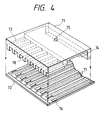
- Fig. 4 is a perspective view schematically illustrating the construction of a printing head to be mounted on the apparatus shown in Fig. 1A.
- a fiber material for the ink-jet printing cloth includes various fiber materials such as cotton, silk, wool, nylon, polyester, rayon and acrylic fibers.
- the cloth used may be a blended fabric or union cloth thereof.
- the present invention is particularly effective when, above all, silk is used as the fiber material, and in this case bleeding can be effectively prevented, color yield can be enhanced, and color depth can be improved.
- water-soluble neutral salt means a salt exhibiting neutrality when dissolved in water.
- a salt is a low molecular weight salt having a molecular weight of preferably 1,000 or lower, more preferably 500 or lower.
- Na, K, Ca, Li and Mg are preferred, with Na being particularly preferred.
- water-soluble neutral salts include NaCl, Na 2 SO 4 , KCl, CaCl 2 and MgCl 2 , with Na 2 SO 4 and NaCl being particularly preferred.
- Said at least two water-soluble neutral salts incorporated into the cloth are preferably composed of a salt A in which its anion has salting-out ability greater than that of CH 3 COO - and a salt B in which its anion has salting-out ability equal to or smaller than that of CH 3 COO - .
- salting-out ability means lyotropic series in accordance with the following definition: citric acid > succinic acid > SO 4 > CH 3 COOH > Cl > Br > ClO 3 > I > SCN.
- the salt A is dissolved in an ink at the time the ink has been impacted on the cloth.
- a water-soluble dye dissolved or a dispersing agent by which water-insoluble dye is dispersed in the ink is salted out. Therefore, the ink is aggregated, so that ink bleeding in fiber is prevented.
- the salt B has an effect of enhancing the color depth of the resulting print by similarly dissolving in the ink impacted on the cloth.
- the details thereof are not yet known, but considered to be due to the fact that electrostatic force is enhanced by the dissolution of the electrolyte in the ink, so that the affinity of the dye in the ink for the fiber is increased. Namely, the dye is made liable to be fitted for the fiber by the salt B, and color yield is hence increased, whereby the color depth is enhanced.
- salt A is Na 2 SO 4 and the salt B is NaCl.
- the weight ratio of the salt A to the salt B to be contained desirably satisfies the relationship of the expression: 0.2 ⁇ (content of salt A/content of salt B) ⁇ 5, more preferably 0.3 ⁇ (content of salt A/content of salt B) ⁇ 3.
- the weight ratio of the content of salt A to the content of salt B is not higher than 0.2, the effect of preventing bleed tends to lower because the proportion of the salt great in salting-out ability is too low. If the weight ratio thereof is not lower than 5 on the other hand, the tendency of the resulting printing cloth to strike through inks is deteriorated because the proportion of the salt great in salting-out ability is too high, and it may be difficult in some cases to manifest the effect of the salt having small salting-out ability for enhancing the color depth.
- the total amount of the salt A and the salt B to be incorporated in the cloth is preferably from 0.1 to 30 % by weight, more preferably from 1 to 10 % by weight. If the total amount to be incorporated is less than 0.1 % by weight, the resulting printing cloth has a tendency to be hard to sufficiently achieve the effects of preventing bleed and enhancing the color depth. On the other hand, any total amount exceeding 30 % by weight results in a printing cloth showing a tendency to lower the color yield.
- the cloth further contains a water-soluble polymer in addition to the salt A and the salt B.
- a water-soluble polymer include various kinds of starch, cellulosic substances such as carboxymethyl cellulose, methyl cellulose and hydroxyethyl cellulose, sodium alginate, gum arabic, guar gum, gelatin, tannin and derivatives thereof, polyvinyl alcohol and derivatives thereof, polyethylene oxide and derivatives thereof, water-soluble acrylic polymers, and water-soluble maleic anhydride polymers.
- polyethylene oxide is particularly preferred from the view point that bleed can be effectively prevented.
- the polyethylene oxide preferably has a weight average molecular weight of from 100,000 to 4,000,000, more preferably from 500,000 to 2,500,000 from the viewpoint of viscosity and the like.
- the content of the water-soluble polymer is preferably 0.1 to 30 % by weight, more preferably 0.2 to 5 % by weight based on the cloth. Any amount of the water-soluble polymer exceeding 30 % by weight results in a cloth markedly deteriorated in a desizing ability. It is also not preferred from the viewpoint of economy to contain the water-soluble polymer in such a great amount. On the other hand, if the content is lower than 0.1 % by weight, the effect of such an agent is not sufficiently exhibited.
- the cloth further contains an alkaline substance in addition to the salt A, the salt B and the water-soluble polymer.
- the alkaline substance is preferably a salt of a weak acid with a strong base.
- the alkaline substance may include NaHCO 3 , Na 2 CO 3 , potassium hydroxide, sodium hydroxide, potassium carbonate and potassium hydrogencarbonate.
- the content of the alkaline substance is preferably 0.1 to 10 % by weight, more preferably 0.5 to 5 % by weight based on the cloth.
- the addition of the alkaline substance brings an effect that in textile printing with inks using reactive dyes, the inks escape containing any alkaline substance therein.
- the cloth according to the present invention may also contain other compounds than the above compounds, which are routinely added in conventional printing cloths.
- Examples of the compounds usable include urea, catalysts, antireductants, antioxidants, level dyeing agents, deep dyeing agents, carriers, reducing agents, oxidizing agents and metal ions.
- Urea is also very effective in prevention of bleed and improvement of a coloring ability.
- its combined use with a water-soluble salt has a synergistic effect and is hence preferred.
- any method for incorporating the above-described substances into the cloth any method such as padding, spraying, dipping, printing or ink-jet may be used.
- the thus-treated cloth is finally dried and optionally cut into sizes feedable in an ink-jet printing apparatus, thereby providing these cut pieces as ink-jet printing cloths.
- inks used for the ink-jet printing cloths according to the present invention are not limited.
- inks composed of a reactive dye and an aqueous medium are preferably used.
- the cloth is formed of a material such as nylon, wool, silk or rayon, inks composed of an acid or direct dye and an aqueous medium are preferably used.
- inks composed of a disperse dye and an aqueous medium are preferably used.
- the reactive dyes include C.I. Reactive Yellow 2, 15, 37, 42, 76, 95, 168 and 175; C.I. Reactive Red 21, 22, 24, 33, 45, 111, 112, 114, 180, 218, 226, 228 and 235; C.I. Reactive Blue 15, 19, 21, 38, 49, 72, 77, 176, 203, 220, 230 and 235; C.I. Reactive Orange 5, 12, 13, 35 and 95; C.I. Reactive Brown 7, 11, 33, 37 and 46; C.I. Reactive Green 8 and 19; C.I. Reactive Violet 2, 6 and 22; C.I. Reactive Black 5, 8, 31 and 39; and the like.
- the acid and direct dyes include C.I. Acid Yellow 1, 7, 11, 17, 23, 25, 36, 38, 49, 72, 110 and 127; C.I. Acid Red 1, 27, 35, 37, 57, 114, 138, 254, 257 and 274; C.I. Acid Blue 7, 9, 62, 83, 90, 112 and 185; C.I. Acid Black 26, 107, 109 and 155; C.I. Acid Orange 56, 67 and 149; C.I. Direct Yellow 12, 44, 50, 86, 106 and 142; C.I. Direct Red 79 and 80; C.I. Direct Blue 86, 106, 189 and 199; C.I. Direct Black 17, 19, 22, 51, 154, 168 and 173; C.I. Direct Orange 26 and 39; and the like.
- the disperse dyes include C.I. Disperse Yellow 3, 5, 7, 33, 42, 60, 64, 79, 104, 160, 163 and 237; C.I. Disperse Red 1, 60, 135, 145, 146 and 191; C.I. Disperse Blue 56, 60, 73, 143, 158, 198, 354, 365 and 366; C.I. Disperse Black 1 and 10; C.I. Disperse orange 30 and 73; Teraprint Red 3GN Liquid and Teraprint Black 2R; and the like.
- the amount (in terms of solids) of these dyes to be used is preferably within a range of from 1 to 30 % by weight, more preferably from 1 to 20 % by weight based on the total weight of the ink.
- aqueous medium used together with the dyes there may be used any aqueous medium generally used in inks.
- aqueous medium generally used in inks.
- Preferable examples thereof include lower alkylene glycols such as ethylene glycol, diethylene glycol, triethylene glycol and propylene glycol; lower alkyl ethers of alkylene glycols, such as ethylene glycol methyl (ethyl, propyl or butyl) ether, diethylene glycol methyl (ethyl, propyl or butyl) ether, triethylene glycol methyl (ethyl, propyl or butyl) ether, propylene glycol methyl (ethyl, propyl or butyl) ether, dipropylene glycol methyl (ethyl, propyl or butyl) ether and tripropylene glycol methyl (ethyl, propyl or butyl) ether; polyalkylene glycols such as polyethylene glycol and
- the content of water as a principal component is preferably within a range of from 30 to 95 % by weight, more preferably from 50 to 95 % by weight based on the total weight of the ink.
- anti-clogging agents such as urea and derivatives thereof, dispersants, surfactants, viscosity modifiers such as polyvinyl alcohol, cellulosic compounds and sodium alginate, pH adjustors, optical whitening agents, mildewproofing agents, and the like may be added as other ingredients for inks as needed.
- an ink-jet recording method and apparatus there may be used any method and apparatus conventionally known. Examples thereof include a method and an apparatus in which thermal energy corresponding to recording signals is applied to an ink within a recording head, and ink droplets are generated by this thermal energy.
- the inks applied onto the ink-jet printing cloth of the present invention in accordance with the process of the present invention in the above-described manner is only attached to the cloth in this state. Accordingly, it is preferable to subsequently subject the cloth to a process for fixing the dyes in the inks to fiber and a process for removing unfixed dyes.
- a fixing process may be conducted in accordance with any conventionally-known method. Examples thereof include a steaming process, an HT steaming process and a thermofix process.
- the removal of the unreacted dyes may be performed by any washing process conventionally known.
- the cloth After conducting the ink-jet printing and the post-treatment of the cloth in the above-described manner, the cloth is dried to provide a print according to the present invention.
- Fig. 1A is a typical sectional side elevation schematically illustrating the construction of a printing apparatus.
- Reference numeral 1 designates a cloth as a printing medium.
- the cloth 1 is unwound according to the rotation of a rewind roller 11, fed in a substantially horizontal direction by a conveyance section 100, which is provided at a position opposite to a printer section 1000, through intermediate rollers 13 and 15, and then wound up on a take-up roller 21 through a feed roller 17 and an intermediate roller 19.
- the conveyance section 100 roughly includes conveyance rollers 110 and 120 respectively provided on the upstream and downstream sides of the printer section 1000 viewing from the feeding direction of the cloth 1, a conveyor belt 130 in the form of an endless belt, which is extended between and around these rollers, and a pair of platen rollers 140 provided so as to extend the conveyor belt 130 under an appropriate tension in a predetermined range to enhance its evenness, thereby evenly regulating the surface of the cloth 1 to be printed upon printing by the printer section 1000.
- the conveyor belt 130 is made of a metal as disclosed in Japanese Patent Application Laid-Open No. 5-212851.
- an adhesive layer (sheet) 133 is provided on its surface. The cloth 1 is adhered to the conveyor belt 130 through the adhesive layer 133 by an attaching roller 150, thereby ensuring the evenness of the cloth 1 upon printing.
- a printing agent in the region between the platen rollers 140 by the printer section 1000.
- the thus-printed cloth 1 is separated from the conveyor belt 130, or the adhesive layer 133 at the position of the conveyance roller 120 and wound up on the take-up roller 21.
- the cloth 1 is subjected to a drying treatment by a drying heater 600.
- this drying heater 600 is effective when a liquid agent is used as the printing agent.
- the form of the drying heater 600 may be suitably selected from a heater by which hot air is blown on the cloth 1, a heater by which infrared rays are applied to the cloth 1, and the like.
- Fig. 2 is a perspective view typically illustrating the printer section 1000 and the feed system of the cloth 1. The construction of the printer section 1000 will be described with reference to this drawing and Fig. 1A.
- the printer section 1000 includes a carriage 1010 which scans in a direction different from the conveying direction (a secondary scanning direction) f of the cloth 1, for example, the width direction S of the cloth 1 perpendicular to the conveying direction f.
- Reference numeral 1020 designates a support rail extending in the S direction (a main scanning direction) and supporting a slide rail 1022 which supports and guides a slider 1012 fixed to the carriage 1010.
- Reference numeral 1030 indicates a motor as a drive source for conducting the main scanning of the carriage 1010. The driving power thereof is transmitted to the carriage 1010 through a belt 1032 to which the carriage 1010 has been fixed, or another suitable drive mechanism.
- the carriage 1010 On the carriage 1010, are mounted sets of printing heads 1100 each having many printing agent-applying elements arranged in a predetermined direction (in this case, the conveying direction f), said sets each being composed of a plurality of the printing heads 1100 arranged in a direction (in this case, the main scanning direction S) different from said predetermined direction.
- two sets of the printing heads 1100 are held in the conveying direction.
- the printing heads 1100 are provided in a number corresponding to the number of printing agents of different colors, thereby permitting color printing. Colors of the printing agents and the number of the printing heads in each set may be suitably selected according to an image intended to be formed on the cloth 1, and the like.
- yellow (Y), magenta (M) and cyan (C), or the three primary colors for printing, or black (Bk) in addition to these colors may make one set.
- special colors metallic colors such as gold and silver, and bright red, blue, etc.
- a plurality of printing agents may be used according to their color depth even if they have the same colors as each other.
- two sets of the printing heads 1100 which each are composed of plural printing heads arranged in the main scanning direction S, are provided one by one in the conveying direction f.
- the colors, arranging number, arranging order and the like of the printing agents used in the printing heads in the respective sets may be the same or different from each other according to the image intended to be printed, and the like.
- printing may be made again by the printing heads of the second set on a region printed by main scanning of the printing heads of the first set (either complementary thinning-out printing or overlap printing may be conducted by the respective sets of the printing heads).
- a printing region may be allotted to each set to perform high-speed printing.
- the number of sets of the printing heads is not limited to two and may also be defined as one or more than two.
- ink-jet heads for example, bubble jet heads proposed by Canon Inc., each having a heating element which generates thermal energy causing film boiling of ink as energy used for ejecting the ink, are used as the printing heads 1100.
- Each of the printing heads is used in a state that ink ejection orifices as the printing agent-applying elements have been disposed downward toward the cloth 1 substantially horizontally conveyed by the conveyance section 100, thereby ironing out the difference in water head between the individual ejection orifices and hence making ejection conditions uniform to permit both formation of good images and even purging operation for all the ejection orifices.
- a flexible cable 1110 is connected to each of the printing heads 1100 in such a manner that it follows the movement of the carriage 1010, so that various signals such as drive signals and state signals for the head are transferred between the head and control means not illustrated.
- Inks are fed from an ink-feeding system 1130, in which respective inks of different colors are contained, to the printing heads 1100 through flexible tubes 1120.
- Fig. 3 is a perspective view typically illustrating the ink-feeding system in this embodiment.
- the ink-feeding system 1130 is composed of two lines. More specifically, in the first line, first ink-feeding tubes 1120 respectively connected to the first set of ink-storage tanks 1131 are connected to a head joint 1150 through the flexible tube 1110. In the second line, similarly, second ink-feeding tubes 1121 respectively connected to the second set of ink-storage tanks 1132 are connected to the head joint 1150 through the flexible tube 1110.
- Each ink-feeding tube 1120 or 1121 forms a circulation path composed of an outward ink-feeding tube 1120a or 1121a and an inward ink-feeding tube 1120b or 1121b.
- the ink-storage tanks 1131 and 1132 each have a pressure pump (not illustrated).
- the ink in the tank 1131 or 1132 is pressurized by this pressure pump so as to pass through the outward ink-feeding tube 1120a or 1121a as illustrated in Fig. 3, circulate through the printing head 1100 and then pass through the inward ink-feeding tube 1120b or 1121b, thereby returning to the ink-storage tank 1131 or 1132.
- the ink-storage tanks 1131 and 1132 may be provided respectively by a number corresponding to the number of the printing agents of different colors, thereby permitting color printing.
- the number of the ink-storage tanks in each set may be suitably selected according to an image intended to be formed on the cloth 1, and the like. For example, three tanks for yellow (Y), magenta (M) and cyan (C) colors, or the three primary colors for printing, or four tanks with a tank for a black (Bk) color added to these tanks may be provided. Alternatively, tanks for special colors (metallic colors such as gold and silver, and bright red, blue, etc.), which are impossible or difficult to be expressed by the three primary colors, may be used in place of or in addition to the above tanks. Further, a plurality of tanks may be used according to the color depth even if printing agents used have the same colors as each other.
- the head joint 1150 is composed of a head joint 1151 for the first set indicated by a full line, a head joint 1152 for the second set indicated by a broken line and a joint cover 1160 as illustrated in Fig. 3.
- Fig. 4 is a sectional perspective view schematically illustrating the construction of an ink-jet head to be mounted on the ink-jet printing apparatus used in the present invention.
- the printing head is constructed by overlapping a top plate 71 and a base plate 72.
- the top plate 71 has a plurality of grooves 73, which are to define nozzles passing an ink therethrough, a groove 74, which is to define a common liquid chamber communicating with these grooves, and a feed opening 75 for feeding the ink to the common liquid chamber.
- the base plate 72 includes electrothermal converters 76 corresponding to the individual nozzles and electrodes 77 for supplying electric power to the electrothermal converters 76, respectively, said electrothermal converters 76 and electrodes 77 being formed integrally by a film-forming technique.
- Plural ejection openings (orifices) 78 through which the ink is ejected are defined by overlapping the top plate 71 and the base plate 72 as described above.
- a heating resistor heats a predetermined temperature
- a filmy bubble as covers a heater surface
- the internal pressure of this bubble is very high, and so an ink within a nozzle is forced out.
- the ink is moved toward the outside of the nozzle and the interior of the common liquid chamber, which is situated in an opposite direction to the nozzle, by inertia force by this forcing out.
- the moving speed of the ink within the nozzle becomes slow because the internal pressure of the bubble turns negative pressure, and flow path resistance also arises in addition.
- the ink portion ejected out of the ejection opening is faster in moving speed than the ink within the nozzle, it is constricted by the balance among inertia force, flow path resistance, shrinkage of the bubble and surface tension of the ink, whereby the ink portion is separated into a droplet.
- the ink is fed to the nozzle from the common liquid chamber by capillary force to wait for the next pulse.
- the printing head (hereinafter may be referred to as an ink-jet head), in which the electrothermal converter is used as an energy-generating means (hereinafter may be referred to as an energy-generating element), can generate a bubble in the ink within the flow path in one-to-one correspondence in accordance with a driving electrical pulse signal and also immediately and appropriately cause the growth/shrinkage of the bubble, and so the ejection of ink droplets can be achieved with excellent responsiveness in particular.
- the electrothermal converter is used as an energy-generating means
- an energy-generating element can generate a bubble in the ink within the flow path in one-to-one correspondence in accordance with a driving electrical pulse signal and also immediately and appropriately cause the growth/shrinkage of the bubble, and so the ejection of ink droplets can be achieved with excellent responsiveness in particular.
- the printing head is advantageous in that it can also be made compact with ease, merits of IC techniques and macro processing techniques in the recent semiconductor field, which are remarkable for advances in technique and enhancement in reliability, can be fully applied thereto, high-density mounting can be achieved with ease, and production costs are also low.
- pretreatments using their corresponding pretreatment agents shown in Table 1 were conducted by the padding process.
- the thus-pretreated fabrics were then squeezed to a pickup of 90 % by a mangle and dried at a drying temperature of 120°C for 2 minutes.
- Reactive dye inks were prepared in the following manner. The total amounts of the inks are all 100 parts.
- Dyes used were C.I. Reactive Yellow 95, C.I. Reactive Red 226, C.I. Reactive Blue 15 and C.I. Reactive Black 39.
- the printed fabrics were subjected to a steaming treatment at 100°C for 8 minutes.
- the thus-treated cloths were washed and then dried.
- a minimum spectral reflectance of a 20 x 20 mm square printed portion in each print sample was measured by a Minolta Spectrocolorimeter CM-2022 (trade name). A K/S value was found from this reflectance. The color depth of each print sample was ranked in terms of this K/S value in accordance with the following standard:
- Printing was conducted by the BJC-820J printer, and the printed area was rubbed with a cloth upon elapsed time of 90 seconds after the printing.
- the drying property was evaluated by whether ink smearing occurred or not and ranked in accordance with the following standard:
- a color depth on a back surface of a cloth was compared with that on a printed surface of the cloth visually to evaluate a strike-through property.
- the strike-through property was ranked in accordance with the following standard:
- the ink-jet printing cloths according to the present invention have been constituted in the above-described manner, ink bleeding on the cloths when inks are applied to the cloths can be surely prevented. Therefore, the amount of the inks to be applied to the cloths can be increased.
- the ink-jet printing cloths according to the present invention can increase the amount of inks penetrating in the interiors of the cloths (good in tendency to strike-through). Therefore, bleeding is prevented even if a great amount of inks is applied to the cloths. As a result, deep textile printing can be performed with high color depth, and moreover high-quality prints with little difference in coloring between both sides can be provided.
- an ink-jet printing cloth comprising at least two water-soluble neutral salts in a proportion of 0.1 to 30 % by weight.
Landscapes
- Engineering & Computer Science (AREA)
- Textile Engineering (AREA)
- Chemical & Material Sciences (AREA)
- Inorganic Chemistry (AREA)
- Coloring (AREA)
- Ink Jet (AREA)
- Inks, Pencil-Leads, Or Crayons (AREA)
Applications Claiming Priority (6)
| Application Number | Priority Date | Filing Date | Title |
|---|---|---|---|
| JP2824296 | 1996-02-15 | ||
| JP2824296 | 1996-02-15 | ||
| JP28242/96 | 1996-02-15 | ||
| JP2258197 | 1997-02-05 | ||
| JP2258197A JP3673610B2 (ja) | 1996-02-15 | 1997-02-05 | インクジェット捺染用布帛、インクジェット捺染方法および捺染物 |
| JP22581/97 | 1997-02-05 |
Publications (3)
| Publication Number | Publication Date |
|---|---|
| EP0790346A2 true EP0790346A2 (fr) | 1997-08-20 |
| EP0790346A3 EP0790346A3 (fr) | 1998-08-19 |
| EP0790346B1 EP0790346B1 (fr) | 2005-12-07 |
Family
ID=26359830
Family Applications (1)
| Application Number | Title | Priority Date | Filing Date |
|---|---|---|---|
| EP19970102330 Expired - Lifetime EP0790346B1 (fr) | 1996-02-15 | 1997-02-13 | Tissu pour l'impression au jet d'encre, procédé d'impression par jet d'encre et imprimé |
Country Status (4)
| Country | Link |
|---|---|
| US (1) | US6203888B1 (fr) |
| EP (1) | EP0790346B1 (fr) |
| JP (1) | JP3673610B2 (fr) |
| DE (1) | DE69734793T2 (fr) |
Cited By (1)
| Publication number | Priority date | Publication date | Assignee | Title |
|---|---|---|---|---|
| CN105696380A (zh) * | 2016-03-21 | 2016-06-22 | 山东黄河三角洲纺织科技研究院有限公司 | 一种可识别喷墨印花织物预处理均匀性的方法 |
Families Citing this family (5)
| Publication number | Priority date | Publication date | Assignee | Title |
|---|---|---|---|---|
| JP3413112B2 (ja) * | 1998-10-05 | 2003-06-03 | キヤノン株式会社 | インクジェット染色用布帛処理剤、インクジェット染色用布帛処理液、インクジェット染色用布帛、捺染方法及び捺染物 |
| ATE513024T1 (de) * | 2003-05-02 | 2011-07-15 | Canon Kk | Wässrige fluoreszenztinte, damit aufgenommenes bild sowie beurteilungsverfahren |
| WO2006001546A1 (fr) * | 2004-06-28 | 2006-01-05 | Canon Kabushiki Kaisha | Procédé de fabrication d’un colorant dispersible et encre pour enregistrement à jet d’encre |
| US10259961B2 (en) | 2016-03-24 | 2019-04-16 | Seiko Epson Corporation | Ink jet textile printing ink composition, ink set, and printing method |
| JP2018048244A (ja) | 2016-09-21 | 2018-03-29 | コニカミノルタ株式会社 | インクジェット捺染インク及びインクジェット捺染方法 |
Family Cites Families (11)
| Publication number | Priority date | Publication date | Assignee | Title |
|---|---|---|---|---|
| JPS6331594A (ja) | 1986-07-24 | 1988-02-10 | Koichiro Okabe | 汚水浄化蒸発装置 |
| JPS6331593A (ja) | 1986-07-25 | 1988-02-10 | Ataka Kogyo Kk | 水中リン酸イオンの除去方法 |
| JP2932621B2 (ja) | 1990-06-28 | 1999-08-09 | 東レ株式会社 | インクジェット染色用布帛ならびにそれを用いてなるインクジェット染色方法 |
| JP2952128B2 (ja) * | 1992-01-27 | 1999-09-20 | キヤノン株式会社 | インクジェット捺染用布帛、インクジェット捺染方法及び捺染物 |
| JP2895697B2 (ja) | 1992-01-27 | 1999-05-24 | キヤノン株式会社 | 捺染用布帛、それを用いたインクジェット捺染方法及び捺染物 |
| JP2736484B2 (ja) | 1992-02-05 | 1998-04-02 | 鐘紡株式会社 | 捺染装置 |
| JP3021240B2 (ja) * | 1993-07-09 | 2000-03-15 | キヤノン株式会社 | インクジェットプリント方法、及び、プリント物 |
| JP3270598B2 (ja) | 1993-11-08 | 2002-04-02 | キヤノン株式会社 | インクジェット捺染用布帛並びにインクジェット捺染方法並びに捺染物 |
| JP3391922B2 (ja) | 1994-02-08 | 2003-03-31 | キヤノン株式会社 | インクジェット捺染用布帛の製造方法、布帛の処理方法及びインクジェット捺染方法 |
| JP3478597B2 (ja) | 1994-06-13 | 2003-12-15 | キヤノン株式会社 | インクジェット捺染用布帛、インクジェット捺染方法および捺染物 |
| US5867197A (en) | 1994-07-21 | 1999-02-02 | Canon Kabushiki Kaisha | Ink-jet printing cloth, ink-jet printing process and production process of print |
-
1997
- 1997-02-05 JP JP2258197A patent/JP3673610B2/ja not_active Expired - Fee Related
- 1997-02-11 US US08/797,710 patent/US6203888B1/en not_active Expired - Fee Related
- 1997-02-13 EP EP19970102330 patent/EP0790346B1/fr not_active Expired - Lifetime
- 1997-02-13 DE DE1997634793 patent/DE69734793T2/de not_active Expired - Fee Related
Cited By (2)
| Publication number | Priority date | Publication date | Assignee | Title |
|---|---|---|---|---|
| CN105696380A (zh) * | 2016-03-21 | 2016-06-22 | 山东黄河三角洲纺织科技研究院有限公司 | 一种可识别喷墨印花织物预处理均匀性的方法 |
| CN105696380B (zh) * | 2016-03-21 | 2018-03-06 | 山东黄河三角洲纺织科技研究院有限公司 | 一种可识别喷墨印花织物预处理均匀性的方法 |
Also Published As
| Publication number | Publication date |
|---|---|
| DE69734793T2 (de) | 2006-07-27 |
| DE69734793D1 (de) | 2006-01-12 |
| EP0790346A3 (fr) | 1998-08-19 |
| EP0790346B1 (fr) | 2005-12-07 |
| JP3673610B2 (ja) | 2005-07-20 |
| US6203888B1 (en) | 2001-03-20 |
| JPH09279488A (ja) | 1997-10-28 |
Similar Documents
| Publication | Publication Date | Title |
|---|---|---|
| EP0693587B1 (fr) | Tissu pour impression par jet d'encre, procédé d'impression par jet d'encre et procédé de production d'imprimés | |
| EP0790347B1 (fr) | Tissu pour l'impression par jet d'encre, procédé d'impression par jet d'encre et imprimé | |
| EP0709519B1 (fr) | Procédé d'impression par jet d'encre et imprimé | |
| JP3011830B2 (ja) | インクジェットプリント方法及びプリント物 | |
| KR0153308B1 (ko) | 잉크 제트 날염용 직물, 잉크 제트 날염 방법 및 그 날염용 직물을 사용하는 날염물 생산 방법 | |
| US6153263A (en) | Ink jet textile printing and printing textile article | |
| US6613821B2 (en) | Cloth treating agent, cloth, textile printing process and print | |
| EP0682147B1 (fr) | Tissu pour impression pour jet d'encre, procédé d'impression et imprimé obtenu par ce procédé | |
| EP0693588B1 (fr) | Procédé d'impression textile et imprimés texiles obtenu par ce procédé | |
| US6203888B1 (en) | Ink-jet printing cloth, ink-jet printing process and print | |
| US6200667B1 (en) | Cloth for textile printing, and textile printing process using the cloth and print obtained thereby | |
| EP0693586B1 (fr) | Procédé d'impression textile, textiles imprimés obtenus, et encre | |
| JP3315532B2 (ja) | インクジェット捺染用布帛およびその製造方法、インクジェット捺染方法、インクジェット捺染物および捺染記録物 | |
| JP2004169248A (ja) | インクジェット捺染方法、インクジェット捺染装置 | |
| JP2000110084A (ja) | インクジェット染色用布帛処理剤、インクジェット染色用布帛処理液、インクジェット染色用布帛、捺染方法及び捺染物 | |
| JP3244600B2 (ja) | インクジェット捺染用布帛、及び捺染方法 | |
| JP3234719B2 (ja) | インクジェット捺染用布帛、その製造方法およびその布帛を用いる捺染方法 | |
| JP3501519B2 (ja) | インクジェット捺染用布帛、インクジェット捺染方法およびインクジェット捺染物 | |
| JP3234643B2 (ja) | 捺染方法および捺染物 | |
| JPH10331078A (ja) | インクジェット染色用布帛、それを用いたインクジェット染色方法およびインクジェット染色物 | |
| JPH1053973A (ja) | インクジェット捺染用編物、その製造方法、インクジェット捺染方法、および、インクジェット捺染物 | |
| JP3554052B2 (ja) | インクジェット染色用布帛、捺染方法及び捺染物 | |
| JP3252132B2 (ja) | 布帛処理剤、布帛処理液、布帛、捺染方法、捺染物及び高品位の捺染物を安定して提供する方法 | |
| JPH08127980A (ja) | インクジェット捺染用布帛、インクジェット捺染方法およびインクジェット捺染物 | |
| JPH10331079A (ja) | 染色用布帛、この布帛を用いた染色方法及び染色物 |
Legal Events
| Date | Code | Title | Description |
|---|---|---|---|
| PUAI | Public reference made under article 153(3) epc to a published international application that has entered the european phase |
Free format text: ORIGINAL CODE: 0009012 |
|
| AK | Designated contracting states |
Kind code of ref document: A2 Designated state(s): CH DE FR GB IT LI NL |
|
| PUAL | Search report despatched |
Free format text: ORIGINAL CODE: 0009013 |
|
| AK | Designated contracting states |
Kind code of ref document: A3 Designated state(s): CH DE FR GB IT LI NL |
|
| 17P | Request for examination filed |
Effective date: 19990104 |
|
| 17Q | First examination report despatched |
Effective date: 20040408 |
|
| GRAP | Despatch of communication of intention to grant a patent |
Free format text: ORIGINAL CODE: EPIDOSNIGR1 |
|
| GRAS | Grant fee paid |
Free format text: ORIGINAL CODE: EPIDOSNIGR3 |
|
| GRAA | (expected) grant |
Free format text: ORIGINAL CODE: 0009210 |
|
| AK | Designated contracting states |
Kind code of ref document: B1 Designated state(s): CH DE FR GB IT LI NL |
|
| PG25 | Lapsed in a contracting state [announced via postgrant information from national office to epo] |
Ref country code: NL Free format text: LAPSE BECAUSE OF FAILURE TO SUBMIT A TRANSLATION OF THE DESCRIPTION OR TO PAY THE FEE WITHIN THE PRESCRIBED TIME-LIMIT Effective date: 20051207 Ref country code: LI Free format text: LAPSE BECAUSE OF FAILURE TO SUBMIT A TRANSLATION OF THE DESCRIPTION OR TO PAY THE FEE WITHIN THE PRESCRIBED TIME-LIMIT Effective date: 20051207 Ref country code: CH Free format text: LAPSE BECAUSE OF FAILURE TO SUBMIT A TRANSLATION OF THE DESCRIPTION OR TO PAY THE FEE WITHIN THE PRESCRIBED TIME-LIMIT Effective date: 20051207 |
|
| REG | Reference to a national code |
Ref country code: GB Ref legal event code: FG4D |
|
| REG | Reference to a national code |
Ref country code: CH Ref legal event code: EP |
|
| REF | Corresponds to: |
Ref document number: 69734793 Country of ref document: DE Date of ref document: 20060112 Kind code of ref document: P |
|
| PG25 | Lapsed in a contracting state [announced via postgrant information from national office to epo] |
Ref country code: GB Free format text: LAPSE BECAUSE OF NON-PAYMENT OF DUE FEES Effective date: 20060307 |
|
| NLV1 | Nl: lapsed or annulled due to failure to fulfill the requirements of art. 29p and 29m of the patents act | ||
| REG | Reference to a national code |
Ref country code: CH Ref legal event code: PL |
|
| ET | Fr: translation filed | ||
| PLBE | No opposition filed within time limit |
Free format text: ORIGINAL CODE: 0009261 |
|
| STAA | Information on the status of an ep patent application or granted ep patent |
Free format text: STATUS: NO OPPOSITION FILED WITHIN TIME LIMIT |
|
| 26N | No opposition filed |
Effective date: 20060908 |
|
| GBPC | Gb: european patent ceased through non-payment of renewal fee |
Effective date: 20060307 |
|
| PGFP | Annual fee paid to national office [announced via postgrant information from national office to epo] |
Ref country code: IT Payment date: 20080222 Year of fee payment: 12 Ref country code: DE Payment date: 20080229 Year of fee payment: 12 |
|
| PGFP | Annual fee paid to national office [announced via postgrant information from national office to epo] |
Ref country code: FR Payment date: 20080221 Year of fee payment: 12 |
|
| REG | Reference to a national code |
Ref country code: FR Ref legal event code: ST Effective date: 20091030 |
|
| PG25 | Lapsed in a contracting state [announced via postgrant information from national office to epo] |
Ref country code: DE Free format text: LAPSE BECAUSE OF NON-PAYMENT OF DUE FEES Effective date: 20090901 |
|
| PG25 | Lapsed in a contracting state [announced via postgrant information from national office to epo] |
Ref country code: FR Free format text: LAPSE BECAUSE OF NON-PAYMENT OF DUE FEES Effective date: 20090302 |
|
| PG25 | Lapsed in a contracting state [announced via postgrant information from national office to epo] |
Ref country code: IT Free format text: LAPSE BECAUSE OF NON-PAYMENT OF DUE FEES Effective date: 20090213 |