EP0790391A2 - Conversion de la chaleur en énergie utile - Google Patents
Conversion de la chaleur en énergie utile Download PDFInfo
- Publication number
- EP0790391A2 EP0790391A2 EP97300810A EP97300810A EP0790391A2 EP 0790391 A2 EP0790391 A2 EP 0790391A2 EP 97300810 A EP97300810 A EP 97300810A EP 97300810 A EP97300810 A EP 97300810A EP 0790391 A2 EP0790391 A2 EP 0790391A2
- Authority
- EP
- European Patent Office
- Prior art keywords
- stream
- working fluid
- primary
- heat
- heat exchanger
- Prior art date
- Legal status (The legal status is an assumption and is not a legal conclusion. Google has not performed a legal analysis and makes no representation as to the accuracy of the status listed.)
- Withdrawn
Links
Images
Classifications
-
- F—MECHANICAL ENGINEERING; LIGHTING; HEATING; WEAPONS; BLASTING
- F01—MACHINES OR ENGINES IN GENERAL; ENGINE PLANTS IN GENERAL; STEAM ENGINES
- F01K—STEAM ENGINE PLANTS; STEAM ACCUMULATORS; ENGINE PLANTS NOT OTHERWISE PROVIDED FOR; ENGINES USING SPECIAL WORKING FLUIDS OR CYCLES
- F01K23/00—Plants characterised by more than one engine delivering power external to the plant, the engines being driven by different fluids
- F01K23/02—Plants characterised by more than one engine delivering power external to the plant, the engines being driven by different fluids the engine cycles being thermally coupled
- F01K23/04—Plants characterised by more than one engine delivering power external to the plant, the engines being driven by different fluids the engine cycles being thermally coupled condensation heat from one cycle heating the fluid in another cycle
-
- F—MECHANICAL ENGINEERING; LIGHTING; HEATING; WEAPONS; BLASTING
- F03—MACHINES OR ENGINES FOR LIQUIDS; WIND, SPRING, OR WEIGHT MOTORS; PRODUCING MECHANICAL POWER OR A REACTIVE PROPULSIVE THRUST, NOT OTHERWISE PROVIDED FOR
- F03G—SPRING, WEIGHT, INERTIA OR LIKE MOTORS; MECHANICAL-POWER PRODUCING DEVICES OR MECHANISMS, NOT OTHERWISE PROVIDED FOR OR USING ENERGY SOURCES NOT OTHERWISE PROVIDED FOR
- F03G7/00—Mechanical-power-producing mechanisms, not otherwise provided for or using energy sources not otherwise provided for
- F03G7/06—Mechanical-power-producing mechanisms, not otherwise provided for or using energy sources not otherwise provided for using expansion or contraction of bodies due to heating, cooling, moistening, drying or the like
-
- F—MECHANICAL ENGINEERING; LIGHTING; HEATING; WEAPONS; BLASTING
- F01—MACHINES OR ENGINES IN GENERAL; ENGINE PLANTS IN GENERAL; STEAM ENGINES
- F01K—STEAM ENGINE PLANTS; STEAM ACCUMULATORS; ENGINE PLANTS NOT OTHERWISE PROVIDED FOR; ENGINES USING SPECIAL WORKING FLUIDS OR CYCLES
- F01K25/00—Plants or engines characterised by use of special working fluids, not otherwise provided for; Plants operating in closed cycles and not otherwise provided for
- F01K25/06—Plants or engines characterised by use of special working fluids, not otherwise provided for; Plants operating in closed cycles and not otherwise provided for using mixtures of different fluids
-
- F—MECHANICAL ENGINEERING; LIGHTING; HEATING; WEAPONS; BLASTING
- F03—MACHINES OR ENGINES FOR LIQUIDS; WIND, SPRING, OR WEIGHT MOTORS; PRODUCING MECHANICAL POWER OR A REACTIVE PROPULSIVE THRUST, NOT OTHERWISE PROVIDED FOR
- F03G—SPRING, WEIGHT, INERTIA OR LIKE MOTORS; MECHANICAL-POWER PRODUCING DEVICES OR MECHANISMS, NOT OTHERWISE PROVIDED FOR OR USING ENERGY SOURCES NOT OTHERWISE PROVIDED FOR
- F03G4/00—Devices for producing mechanical power from geothermal energy
- F03G4/074—Safety arrangements
-
- Y—GENERAL TAGGING OF NEW TECHNOLOGICAL DEVELOPMENTS; GENERAL TAGGING OF CROSS-SECTIONAL TECHNOLOGIES SPANNING OVER SEVERAL SECTIONS OF THE IPC; TECHNICAL SUBJECTS COVERED BY FORMER USPC CROSS-REFERENCE ART COLLECTIONS [XRACs] AND DIGESTS
- Y02—TECHNOLOGIES OR APPLICATIONS FOR MITIGATION OR ADAPTATION AGAINST CLIMATE CHANGE
- Y02E—REDUCTION OF GREENHOUSE GAS [GHG] EMISSIONS, RELATED TO ENERGY GENERATION, TRANSMISSION OR DISTRIBUTION
- Y02E20/00—Combustion technologies with mitigation potential
- Y02E20/12—Heat utilisation in combustion or incineration of waste
Definitions
- the invention relates to converting thermal energy (e.g., heat produced by the combustion of toxic and/or corrosive fuels such as municipal waste or heat from geofluid) into useful (e.g., mechanical and electrical) energy.
- thermal energy e.g., heat produced by the combustion of toxic and/or corrosive fuels such as municipal waste or heat from geofluid
- useful energy e.g., mechanical and electrical
- Useful energy can also be obtained from geofluid containing steam and brine, as described, e.g., in U.S. Patent No. 5,440,882.
- the invention features, in general, converting heat in a primary fluid (e.g., steam) to useful energy by multistage expansion of the primary fluid, heating of a multicomponent working fluid in a separate closed loop using heat of the primary fluid, and expansion of the multicomponent working fluid.
- the primary fluid in a vapor state is expanded in a first stage expander to obtain useful energy and to produce a partially expanded primary fluid stream.
- the partially expanded primary fluid stream is then separated into liquid and vapor components and split into a vapor stream (which is expanded in a second stage expander) and a further primary stream (which used to heat the multicomponent working fluid).
- spent multicomponent working fluid (that has been expanded) is condensed at a condenser and passed through a recuperative heat exchanger in which heat from the spent multicomponent working fluid is used to recuperatively heat the condensed multicomponent wording fluid.
- the primary fluid can be heated in a boiler or can be steam from a geofluid.
- the invention features, in general, converting heat to useful energy by using two closed loops.
- One closed loop contains a primary working fluid that is heated by an external source of heat (e.g., in a boiler combusting corrosive or toxic fuel) and then split into two streams.
- the first stream is expanded to obtain useful energy (e.g., in a turbine), and the second stream is used at a first heat exchanger to heat a multicomponent working fluid in the second closed loop.
- the heated multicomponent working fluid is then also expanded to obtain further useful energy (e.g., in a second turbine).
- the first stream is split into two streams, one of which is a vapor stream that is expanded to obtain useful energy, and both of the additional streams are used to also heat the multicomponent working fluid at two further heat exchangers.
- the invention features, in general, a power system for converting heat in a geofluid containing steam and brine to useful energy.
- the steam is separated from the brine and expanded, and heat in the steam is used to heat a multicomponent working fluid in a separate closed loop at a first heat exchanger.
- the separated brine is used to further heat the multicomponent working fluid at a second heat exchanger, and is then discharged from the system.
- the multicomponent working fluid is then expanded to obtain further useful energy.
- the spent multicomponent working fluid is condensed at a condenser and passed through a recuperative heat exchanger in which heat from the spent multicomponent working fluid is used to recuperatively heat the multicomponent working fluid after being condensed at the condenser.
- the heat used to heat the multicomponent working fluid in the first heat exchanger is obtained from steam that has been expanded and then split into two streams. One stream is a vapor that is expanded to obtain useful energy, and the other stream passes through the first heat exchanger, and is thereafter throttled and recombined with the expanded stream.
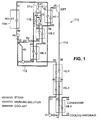
- Fig. 1 is a schematic representation of one embodiment of the invention in which heat is obtained from combustion of fuel.
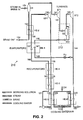
- Fig. 2 is a schematic representation of a second embodiment of the invention in which heat is obtained from geofluid containing steam and brine.
- Apparatus 110 for converting heat into mechanical energy.
- Apparatus 110 includes first and second closed loops 112, 114.
- Loop 112 includes water as a primary working fluid.
- Loop 114 includes a water/ammonia mixture as a multicomponent working fluid.
- Systems with multicomponent working fluids are described in Alexander I. Kalina's U.S. Patents Nos. 4,346,561; 4,489,563; 4,548,043; 4,586,340; 4,604,867; 4,732,005; 4,763,480; 4,899,545; 4,982,568; 5,029,444; 5,095,708; 5,440,882; 5,450,821, and applications serial nos. 08/283,091, 08/546,419 which are hereby incorporated by reference.
- closed loop 112 condensed liquid water with parameters as at point 56 is sent through tubes into boiler 116, which combusts corrosive and/or toxic fuels.
- boiler 116 In the tubes in boiler 116, water boils, producing dry, saturated steam with parameters as at point 51.
- Steam with parameters as at point 51 is divided into first and second primary streams having parameters as at points 41 and 52, respectively.
- the stream of steam with parameters as at point 41 is sent into the first stage of steam turbine ST-1, which is a first expander where the steam expands to an intermediate pressure, producing power and leaving ST-1 with parameters as at point 42.
- This steam, already wet, is sent into separator S in separator/splitter 118, where the liquid in the expanded first primary stream is separated from the vapor.
- Part of the separated vapor having parameters as at point 43 makes up a third primary stream that is sent into the second stage, ST-2 (a second expander) of the steam turbine.
- ST-2 a second expander
- the remainder of the steam and all of the liquid leaving separator S are combined to create a fourth primary stream with parameters as at point 45.
- the third primary stream of steam having parameters as at point 43 (see above) is expanded in the second stage of steam turbine ST-2, producing power and obtaining parameters as at point 44.
- second, third, and fourth primary streams of saturated or wet steam are created having parameters as at points 52, 44, and 45, respectively.
- the second primary stream with parameters as at point 52 has the highest pressure and temperature.
- the fourth primary stream with parameters as at point 45 has intermediate pressure and temperature, and the third primary stream with parameters as at point 44 has the lowest pressure and temperature, respectively.
- Steam in the second primary stream with parameters as at point 52 is sent into heat exchanger HE-1 where it is condensed and then subcooled, releasing heat and leaving HE-1 with parameters as at point 54.
- Steam in the fourth primary stream with parameters as at point 45 is sent into second heat exchanger HE-2 where it is condensed and subcooled, releasing heat and leaving third HE-2 with parameters as at point 46.
- This fourth primary stream is then pumped by pump P-2 up to a pressure equal to that of steam in the second primary stream having parameters as at point 54 (see above) and obtains parameters as at point 50.
- a fully-condensed multicomponent working fluid having parameters as at point 14 is pumped to the required high pressure by pump P-1 and obtains parameters as at point 21. Thereafter, a stream of multicomponent working fluid with parameters as at point 21 passes through fourth heat exchanger HE-4 where it is heated and obtains parameters as at point 60. Preferably the state of the working fluid at point 60 is a saturated liquid. Thereafter, the stream of multicomponent working fluid with parameters as at point 60 is passed through recuperative fifth heat exchanger HE-5 where it is partially vaporized, obtaining parameters as at point 62.
- a stream with parameters as at point 62, thereafter, is sent into third heat exchanger HE-3 (see above) where it is further heated and vaporized by heat released in third heat exchanger HE-3 and obtains parameters as at point 66. Thereafter, a stream of working fluid having parameters as at point 66 is sent into second heat exchanger HE-2 where it is further heated and fully vaporized by heat released in second heat exchanger HE-2.
- a stream of multicomponent working fluid leaving heat exchanger HE-2 with parameters as at point 68 enters first heat exchanger HE-1 where it is superheated by heat released in heat exchanger HE-1 and leaves with parameters as at point 30.
- a stream of multicomponent working fluid with parameters as at point 30 passes through working fluid turbine WFT (a second expander) where it is expanded, producing power and leaving WFT as a spent multicomponent working fluid with parameters as at point 36.
- the spent multicomponent working fluid with parameters as at point 36 passes through recuperative heat exchanger HE-5 where it is cooled and partially condensed, releasing heat (see above) and leaves HE-5 with parameters as at point 38.
- a stream of multicomponent working fluid with parameters as at point 38 enters recuperative heat exchanger HE-4 where it is further cooled and condensed, releasing heat (see above) and leaves HE-4 with parameters as at point 29.
- a stream of a partially condensed multicomponent working fluid having parameters as at point 29 passes through a condenser HE-6 where it is fully condensed by a stream of cooling water or cooling air 23-24 and obtains, as a result, parameters as at point 14.
- Apparatus 110 provides effective conversion of heat produced by combustion of toxic and corrosive fuels.
- a summary of performance of the proposed Fig. 1 system is presented in Table 2 and shows a net thermal efficiency of 28.14%.
- steam leaving the boiler with the identical parameters as at point 51 would produce a net efficiency of 21%.
- the Fig. 1 system increases efficiency of heat conversion and power generation by 33%.
- FIG. 2 there is shown power system 210 designed for utilization of heat from geofluid consisting of steam and brine.
- the high mineralization of brine limits the extent to which it can be practically cooled and results in conditions that are similar in some respects to the Fig. 1 system designed for utilization of corrosive and toxic fuels.
- the similarity of conditions permits some of the same principles to be utilized in geofluid power system 210.
- geofluid comprising steam and mineralized brine having parameters as at point 151 enters separator S-1 where it is separated into a stream of saturated steam having parameters as at point 141 and stream of mineralized liquid brine having parameters as at point 152.
- Stream of steam having parameters as at point 141 enters into the high pressure steam turbine ST-1, where it is expanded to intermediate pressure obtaining parameters as at point 142.
- Steam with parameters as at point 142 is wet and enters into separator S-2 in separator/splitter 212, where the liquid in the expanded steam is separated from the vapor and split into a first stream with parameters as at point 143 and a second stream with parameters as at point 146.
- Steam exiting separator S-2 is divided into two substreams with parameters as at point 143 and point 145, respectively. Thereafter, the first stream (steam with parameters as at point 143) is sent into the low pressure steam turbine ST-2 where it is expanded to a low pressure and produces useful energy.
- High pressure steam turbine ST-1 and low pressure steam turbine ST-2 are first and second stage expanders, respectively, for the steam. After expansion at low pressure turbine ST-2, the first stream obtains parameters as at point 144.
- Stream of steam with parameters as at point 145 is mixed with the liquid removed from separator S-2 and creates the second stream with parameters as at point 146.
- the second stream passes through first heat exchanger HE-1, where it is condensed and subcooled, exiting this heat exchanger with parameters as at point 148.
- stream of condensate with parameters as at point 148 is throttled at throttle valve TV to the pressure equal to the pressure of the stream from ST-2 having parameters as at point 144 and is mixed with this stream.
- stream of a partially condensed steam having parameters as at point 149 is created.
- the stream having parameters as at point 149 passes through steam condenser HE-6, where it is cooled by cooling water or air, and fully condenses, obtaining the parameters as at point 150.
- the condensed stream is then discharged from system 210.
- Liquid brine removed from separator S-1 and having parameters as at point 152 (see above) passes through second heat exchanger HE-2, where it is cooled and obtains parameters as at point 154. Heat released from the brine in heat exchanger HE-2 is transferred to a working fluid of the binary cycle which is described below. The cooled brine is thereafter discharged from system 210 at an acceptable temperature.
- Working fluid of a binary cycle which is fully condensed and having parameters as at point 114 is pumped by pump P-1 and obtains parameters as at point 121. Thereafter, the stream of working fluid with parameters as at point 121 passes through recuperative heat exchanger HE-3, where it is heated and obtains parameters as at point 160. The state of working fluid with parameters as at point 160 preferably is saturated liquid. Thereafter, the stream with parameters as at point 160 passes through heat exchanger HE-4 where it is partially boiled and obtains parameters as at point 166.
- the stream of working fluid having parameters as at point 166 passes through first heat exchanger HE-1, where it is heated by heat from the second stream from separator/splitter 212 and is fully vaporized, leaving heat exchanger HE-1 with parameters as at point 168.
- Multicomponent working fluid having parameters as at point 168 passes through second heat exchanger HE-2 where it is superheated by heat released in the process of cooling liquid geothermal brine.
- working fluid obtains parameters as at point 130 with which it enters the working fluid turbine WFT.
- turbine WFT working fluid is expanded producing work and obtaining parameters as at point 136.
- spent multicomponent working fluid having parameters as at point 136 passes through recuperative heat exchanger HE-4 where it is partially condensed and leaves this heat exchanger with parameters as at point 138.
- Heat released in heat exchanger HE-4 is utilized for initial evaporation of the working fluid (between points 160 and 166).
- working fluid having parameters as at point 138 passes through heat exchanger HE-3 where it is further condensed obtaining parameters as at point 129.
- Heat released in heat exchanger HE-3 is utilized for preheating of an oncoming stream of working fluid (between points 121 and 160) as described above.
- Stream of working fluid having parameters as at point 129 is further sent into condenser HE-5, where it is fully condensed by cooling water or air obtaining parameters as at point 114. The cycle of the working fluid is closed.
- Power system 210 shown on Fig. 2 being applied to the utilization of geothermal energy, provides increased efficiency of approximately 30% compared with the conventional systems in which steam is expanded fully to the lowest possible pressure, and liquid is throttled to produce additional steam which, as well, is expanded to the lowest possible pressure.
- Both described systems 110, 210 employ multi-stage expansion of steam which is used as a heat source with utilization of heat of condensation for heating and vaporizing a multicomponent working fluid in the closed binary cycle.
- the multicomponent working fluid in the binary cycle is a mixture of at least two components.
- the composition of components in the multicomponent working fluid is chosen in such a way as to provide that the initial temperature of condensation of a working fluid, after expansion, is higher than the initial temperature of boiling of the same working fluid before expansion. This, in turn, provides for recuperative initial boiling of oncoming working fluid.
Landscapes
- Engineering & Computer Science (AREA)
- Chemical & Material Sciences (AREA)
- Combustion & Propulsion (AREA)
- Mechanical Engineering (AREA)
- General Engineering & Computer Science (AREA)
- Life Sciences & Earth Sciences (AREA)
- Sustainable Energy (AREA)
- Engine Equipment That Uses Special Cycles (AREA)
- Separation By Low-Temperature Treatments (AREA)
- Heat-Exchange Devices With Radiators And Conduit Assemblies (AREA)
- Physical Or Chemical Processes And Apparatus (AREA)
Applications Claiming Priority (2)
| Application Number | Priority Date | Filing Date | Title |
|---|---|---|---|
| US598950 | 1996-02-09 | ||
| US08/598,950 US5822990A (en) | 1996-02-09 | 1996-02-09 | Converting heat into useful energy using separate closed loops |
Publications (2)
| Publication Number | Publication Date |
|---|---|
| EP0790391A2 true EP0790391A2 (fr) | 1997-08-20 |
| EP0790391A3 EP0790391A3 (fr) | 2000-07-19 |
Family
ID=24397596
Family Applications (1)
| Application Number | Title | Priority Date | Filing Date |
|---|---|---|---|
| EP97300810A Withdrawn EP0790391A3 (fr) | 1996-02-09 | 1997-02-07 | Conversion de la chaleur en énergie utile |
Country Status (19)
| Country | Link |
|---|---|
| US (1) | US5822990A (fr) |
| EP (1) | EP0790391A3 (fr) |
| JP (3) | JP3961058B2 (fr) |
| KR (1) | KR970062323A (fr) |
| CN (1) | CN1100933C (fr) |
| AR (1) | AR005755A1 (fr) |
| AU (1) | AU723964B2 (fr) |
| BR (1) | BR9700926A (fr) |
| CA (1) | CA2197038C (fr) |
| CO (1) | CO4560511A1 (fr) |
| EA (1) | EA000058B1 (fr) |
| GT (1) | GT199700021A (fr) |
| IL (1) | IL120178A (fr) |
| IS (1) | IS1792B (fr) |
| NO (1) | NO307225B1 (fr) |
| NZ (1) | NZ314206A (fr) |
| TR (1) | TR199700105A2 (fr) |
| TW (1) | TW330234B (fr) |
| ZA (1) | ZA971039B (fr) |
Cited By (2)
| Publication number | Priority date | Publication date | Assignee | Title |
|---|---|---|---|---|
| WO2004009964A1 (fr) * | 2002-07-22 | 2004-01-29 | Douglas Wilbert Paul Smith | Procede de conversion d'energie |
| WO2008124868A1 (fr) * | 2007-04-13 | 2008-10-23 | Renewable Energy Systems Limited | Procédés et systèmes de production d'énergie et de récupération d'énergie |
Families Citing this family (39)
| Publication number | Priority date | Publication date | Assignee | Title |
|---|---|---|---|---|
| WO2004027221A1 (fr) | 1997-04-02 | 2004-04-01 | Electric Power Research Institute, Inc. | Procede et systeme pour un processus thermodynamique permettant de produire une energie utilisable |
| US5953918A (en) * | 1998-02-05 | 1999-09-21 | Exergy, Inc. | Method and apparatus of converting heat to useful energy |
| KR100302586B1 (ko) * | 1998-03-27 | 2001-10-19 | 김영환 | 피씨 카드 에이티에이 카드의 파워다운 및 슬립모드 전환 방법 |
| US6924781B1 (en) * | 1998-09-11 | 2005-08-02 | Visible Tech-Knowledgy, Inc. | Smart electronic label employing electronic ink |
| US6170263B1 (en) | 1999-05-13 | 2001-01-09 | General Electric Co. | Method and apparatus for converting low grade heat to cooling load in an integrated gasification system |
| US6347520B1 (en) | 2001-02-06 | 2002-02-19 | General Electric Company | Method for Kalina combined cycle power plant with district heating capability |
| US6829895B2 (en) | 2002-09-12 | 2004-12-14 | Kalex, Llc | Geothermal system |
| US6820421B2 (en) | 2002-09-23 | 2004-11-23 | Kalex, Llc | Low temperature geothermal system |
| US6735948B1 (en) | 2002-12-16 | 2004-05-18 | Icalox, Inc. | Dual pressure geothermal system |
| US6769256B1 (en) | 2003-02-03 | 2004-08-03 | Kalex, Inc. | Power cycle and system for utilizing moderate and low temperature heat sources |
| MXPA05008120A (es) * | 2003-02-03 | 2006-02-17 | Kalex Llc | Ciclo de trabajo y sistema para utilizar fuentes de calor con temperatura moderada y baja. |
| US7305829B2 (en) * | 2003-05-09 | 2007-12-11 | Recurrent Engineering, Llc | Method and apparatus for acquiring heat from multiple heat sources |
| US7264654B2 (en) * | 2003-09-23 | 2007-09-04 | Kalex, Llc | Process and system for the condensation of multi-component working fluids |
| US7065967B2 (en) * | 2003-09-29 | 2006-06-27 | Kalex Llc | Process and apparatus for boiling and vaporizing multi-component fluids |
| WO2005043037A1 (fr) * | 2003-10-21 | 2005-05-12 | Petroleum Analyzer Company, Lp | Appareil de combustion ameliore et procedes de fabrication et d'utilisation correspondants |
| US8117844B2 (en) * | 2004-05-07 | 2012-02-21 | Recurrent Engineering, Llc | Method and apparatus for acquiring heat from multiple heat sources |
| GB2450754B8 (en) * | 2007-07-06 | 2013-02-06 | Greenfield Energy Ltd | Geothermal energy system and method of operation |
| GB2450755B (en) | 2007-07-06 | 2012-02-29 | Greenfield Energy Ltd | Geothermal energy system and method of operation |
| GB2461029B (en) * | 2008-06-16 | 2011-10-26 | Greenfield Energy Ltd | Thermal energy system and method of operation |
| EP2204553A1 (fr) | 2008-06-23 | 2010-07-07 | Siemens Aktiengesellschaft | Centrale à vapeur |
| US8087248B2 (en) | 2008-10-06 | 2012-01-03 | Kalex, Llc | Method and apparatus for the utilization of waste heat from gaseous heat sources carrying substantial quantities of dust |
| US8695344B2 (en) * | 2008-10-27 | 2014-04-15 | Kalex, Llc | Systems, methods and apparatuses for converting thermal energy into mechanical and electrical power |
| US8176738B2 (en) | 2008-11-20 | 2012-05-15 | Kalex Llc | Method and system for converting waste heat from cement plant into a usable form of energy |
| CN102365499B (zh) | 2009-04-01 | 2014-11-05 | 莱内姆系统有限公司 | 余热空调系统 |
| US8474263B2 (en) | 2010-04-21 | 2013-07-02 | Kalex, Llc | Heat conversion system simultaneously utilizing two separate heat source stream and method for making and using same |
| GB2488797A (en) | 2011-03-08 | 2012-09-12 | Greenfield Master Ipco Ltd | Thermal Energy System and Method of Operation |
| JP5999322B2 (ja) * | 2011-06-03 | 2016-09-28 | 戸田工業株式会社 | 発電システム |
| US20120324885A1 (en) * | 2011-06-27 | 2012-12-27 | Turbine Air Systems Ltd. | Geothermal power plant utilizing hot geothermal fluid in a cascade heat recovery apparatus |
| CN102305113A (zh) * | 2011-09-13 | 2012-01-04 | 上海盛合新能源科技有限公司 | 一种石化行业中使用的低温余热回收设备 |
| CN102338047A (zh) * | 2011-09-13 | 2012-02-01 | 上海盛合新能源科技有限公司 | 一种地热发电设备 |
| DE102012100967A1 (de) * | 2012-02-07 | 2013-08-08 | Levitec Gmbh | Anordnung zur Vorwärmung eines Fluids in einem Kraftwerk, insbesondere in einem Dampfkraftwerk |
| US8833077B2 (en) | 2012-05-18 | 2014-09-16 | Kalex, Llc | Systems and methods for low temperature heat sources with relatively high temperature cooling media |
| US9638175B2 (en) * | 2012-10-18 | 2017-05-02 | Alexander I. Kalina | Power systems utilizing two or more heat source streams and methods for making and using same |
| JP6013140B2 (ja) * | 2012-11-01 | 2016-10-25 | 株式会社東芝 | 発電システム |
| WO2015165477A1 (fr) | 2014-04-28 | 2015-11-05 | El-Monayer Ahmed El-Sayed Mohamed Abd El-Fatah | Centrales électriques à haut rendement |
| WO2016067225A2 (fr) * | 2014-10-31 | 2016-05-06 | Subodh Verma | Système pour cycle de conversion d'énergie de haute efficacité par recyclage de la chaleur latente de vaporisation |
| JP6526432B2 (ja) * | 2015-02-09 | 2019-06-05 | 日野自動車株式会社 | 廃熱回収装置 |
| RU187281U1 (ru) * | 2018-10-17 | 2019-02-28 | Общество с ограниченной ответственностью "Геотерм-М" | Геотермальная турбоустановка |
| RU2747894C1 (ru) * | 2020-11-24 | 2021-05-17 | Общество с ограниченной ответственностью "Новый цикл" | Замкнутый энергетический цикл |
Citations (13)
| Publication number | Priority date | Publication date | Assignee | Title |
|---|---|---|---|---|
| US4346561A (en) | 1979-11-08 | 1982-08-31 | Kalina Alexander Ifaevich | Generation of energy by means of a working fluid, and regeneration of a working fluid |
| US4489563A (en) | 1982-08-06 | 1984-12-25 | Kalina Alexander Ifaevich | Generation of energy |
| US4548043A (en) | 1984-10-26 | 1985-10-22 | Kalina Alexander Ifaevich | Method of generating energy |
| US4586340A (en) | 1985-01-22 | 1986-05-06 | Kalina Alexander Ifaevich | Method and apparatus for implementing a thermodynamic cycle using a fluid of changing concentration |
| US4604867A (en) | 1985-02-26 | 1986-08-12 | Kalina Alexander Ifaevich | Method and apparatus for implementing a thermodynamic cycle with intercooling |
| US4732005A (en) | 1987-02-17 | 1988-03-22 | Kalina Alexander Ifaevich | Direct fired power cycle |
| US4763480A (en) | 1986-10-17 | 1988-08-16 | Kalina Alexander Ifaevich | Method and apparatus for implementing a thermodynamic cycle with recuperative preheating |
| US4899545A (en) | 1989-01-11 | 1990-02-13 | Kalina Alexander Ifaevich | Method and apparatus for thermodynamic cycle |
| US4982568A (en) | 1989-01-11 | 1991-01-08 | Kalina Alexander Ifaevich | Method and apparatus for converting heat from geothermal fluid to electric power |
| US5029444A (en) | 1990-08-15 | 1991-07-09 | Kalina Alexander Ifaevich | Method and apparatus for converting low temperature heat to electric power |
| US5095708A (en) | 1991-03-28 | 1992-03-17 | Kalina Alexander Ifaevich | Method and apparatus for converting thermal energy into electric power |
| US5440882A (en) | 1993-11-03 | 1995-08-15 | Exergy, Inc. | Method and apparatus for converting heat from geothermal liquid and geothermal steam to electric power |
| US5450821A (en) | 1993-09-27 | 1995-09-19 | Exergy, Inc. | Multi-stage combustion system for externally fired power plants |
Family Cites Families (15)
| Publication number | Priority date | Publication date | Assignee | Title |
|---|---|---|---|---|
| GB528254A (en) * | 1939-05-01 | 1940-10-25 | British Thomson Houston Co Ltd | Improvements in and relating to steam or like turbines |
| CH451209A (de) * | 1966-08-15 | 1968-05-15 | Escher Wyss Ag | Im Zweistoffverfahren arbeitende Dampfkraftanlage |
| FR2283309A1 (fr) * | 1974-08-26 | 1976-03-26 | Delas Condenseurs | Dispositif de condensation par l'air ambiant pour fluide d'installation thermique de production d'energie |
| JPS5427640A (en) * | 1977-07-30 | 1979-03-01 | Kawasaki Heavy Ind Ltd | Compound generating facility |
| US4578953A (en) * | 1984-07-16 | 1986-04-01 | Ormat Systems Inc. | Cascaded power plant using low and medium temperature source fluid |
| US4542625A (en) * | 1984-07-20 | 1985-09-24 | Bronicki Lucien Y | Geothermal power plant and method for operating the same |
| JPS6226304A (ja) * | 1985-07-29 | 1987-02-04 | Mitsubishi Heavy Ind Ltd | 蒸気−バイナリ−複合地熱発電システム |
| JPS6297203U (fr) * | 1985-12-10 | 1987-06-20 | ||
| IL88571A (en) * | 1988-12-02 | 1998-06-15 | Ormat Turbines 1965 Ltd | Method of and apparatus for producing power using steam |
| NZ248146A (en) * | 1992-07-24 | 1995-04-27 | Ormat Ind Ltd | Rankine cycle power plant with two turbine stages; second turbine stage of higher efficiency than first |
| NZ248729A (en) * | 1992-10-02 | 1996-03-26 | Ormat Ind Ltd | High pressure geothermal power plant with secondary low pressure turbogenerator |
| NZ247880A (en) * | 1993-01-01 | 1995-08-28 | Ormat Turbines 1965 Ltd | Producing power from geothermal fluid; use of steam turbine associated with closed organic rankine cycle turbine |
| US5598706A (en) * | 1993-02-25 | 1997-02-04 | Ormat Industries Ltd. | Method of and means for producing power from geothermal fluid |
| US5572871A (en) * | 1994-07-29 | 1996-11-12 | Exergy, Inc. | System and apparatus for conversion of thermal energy into mechanical and electrical power |
| US5588298A (en) * | 1995-10-20 | 1996-12-31 | Exergy, Inc. | Supplying heat to an externally fired power system |
-
1996
- 1996-02-09 US US08/598,950 patent/US5822990A/en not_active Expired - Lifetime
-
1997
- 1997-02-06 KR KR1019970003834A patent/KR970062323A/ko not_active Ceased
- 1997-02-07 EA EA199700016A patent/EA000058B1/ru not_active IP Right Cessation
- 1997-02-07 BR BR9700926A patent/BR9700926A/pt not_active IP Right Cessation
- 1997-02-07 EP EP97300810A patent/EP0790391A3/fr not_active Withdrawn
- 1997-02-07 AU AU12599/97A patent/AU723964B2/en not_active Ceased
- 1997-02-07 CA CA002197038A patent/CA2197038C/fr not_active Expired - Fee Related
- 1997-02-07 ZA ZA9701039A patent/ZA971039B/xx unknown
- 1997-02-07 IL IL12017897A patent/IL120178A/xx not_active IP Right Cessation
- 1997-02-07 IS IS4427A patent/IS1792B/is unknown
- 1997-02-07 AR ARP970100499A patent/AR005755A1/es unknown
- 1997-02-09 CN CN97104976A patent/CN1100933C/zh not_active Expired - Fee Related
- 1997-02-10 GT GT199700021A patent/GT199700021A/es unknown
- 1997-02-10 NO NO19970598A patent/NO307225B1/no not_active IP Right Cessation
- 1997-02-10 CO CO97006713A patent/CO4560511A1/es unknown
- 1997-02-10 NZ NZ314206A patent/NZ314206A/en not_active IP Right Cessation
- 1997-02-10 JP JP02698097A patent/JP3961058B2/ja not_active Expired - Lifetime
- 1997-02-12 TW TW086101571A patent/TW330234B/zh active
- 1997-02-12 TR TR97/00105A patent/TR199700105A2/xx unknown
-
2007
- 2007-01-25 JP JP2007015548A patent/JP4523948B2/ja not_active Expired - Fee Related
- 2007-01-25 JP JP2007015540A patent/JP4566204B2/ja not_active Expired - Fee Related
Patent Citations (13)
| Publication number | Priority date | Publication date | Assignee | Title |
|---|---|---|---|---|
| US4346561A (en) | 1979-11-08 | 1982-08-31 | Kalina Alexander Ifaevich | Generation of energy by means of a working fluid, and regeneration of a working fluid |
| US4489563A (en) | 1982-08-06 | 1984-12-25 | Kalina Alexander Ifaevich | Generation of energy |
| US4548043A (en) | 1984-10-26 | 1985-10-22 | Kalina Alexander Ifaevich | Method of generating energy |
| US4586340A (en) | 1985-01-22 | 1986-05-06 | Kalina Alexander Ifaevich | Method and apparatus for implementing a thermodynamic cycle using a fluid of changing concentration |
| US4604867A (en) | 1985-02-26 | 1986-08-12 | Kalina Alexander Ifaevich | Method and apparatus for implementing a thermodynamic cycle with intercooling |
| US4763480A (en) | 1986-10-17 | 1988-08-16 | Kalina Alexander Ifaevich | Method and apparatus for implementing a thermodynamic cycle with recuperative preheating |
| US4732005A (en) | 1987-02-17 | 1988-03-22 | Kalina Alexander Ifaevich | Direct fired power cycle |
| US4899545A (en) | 1989-01-11 | 1990-02-13 | Kalina Alexander Ifaevich | Method and apparatus for thermodynamic cycle |
| US4982568A (en) | 1989-01-11 | 1991-01-08 | Kalina Alexander Ifaevich | Method and apparatus for converting heat from geothermal fluid to electric power |
| US5029444A (en) | 1990-08-15 | 1991-07-09 | Kalina Alexander Ifaevich | Method and apparatus for converting low temperature heat to electric power |
| US5095708A (en) | 1991-03-28 | 1992-03-17 | Kalina Alexander Ifaevich | Method and apparatus for converting thermal energy into electric power |
| US5450821A (en) | 1993-09-27 | 1995-09-19 | Exergy, Inc. | Multi-stage combustion system for externally fired power plants |
| US5440882A (en) | 1993-11-03 | 1995-08-15 | Exergy, Inc. | Method and apparatus for converting heat from geothermal liquid and geothermal steam to electric power |
Cited By (2)
| Publication number | Priority date | Publication date | Assignee | Title |
|---|---|---|---|---|
| WO2004009964A1 (fr) * | 2002-07-22 | 2004-01-29 | Douglas Wilbert Paul Smith | Procede de conversion d'energie |
| WO2008124868A1 (fr) * | 2007-04-13 | 2008-10-23 | Renewable Energy Systems Limited | Procédés et systèmes de production d'énergie et de récupération d'énergie |
Also Published As
| Publication number | Publication date |
|---|---|
| TW330234B (en) | 1998-04-21 |
| IL120178A (en) | 2000-06-29 |
| EA199700016A1 (ru) | 1997-09-30 |
| JPH112106A (ja) | 1999-01-06 |
| US5822990A (en) | 1998-10-20 |
| NO970598D0 (no) | 1997-02-10 |
| JP4566204B2 (ja) | 2010-10-20 |
| NO307225B1 (no) | 2000-02-28 |
| CN1165909A (zh) | 1997-11-26 |
| ZA971039B (en) | 1997-08-25 |
| CA2197038C (fr) | 2000-04-25 |
| JP2007127131A (ja) | 2007-05-24 |
| GT199700021A (es) | 1999-01-14 |
| IL120178A0 (en) | 1997-06-10 |
| AR005755A1 (es) | 1999-07-14 |
| JP3961058B2 (ja) | 2007-08-15 |
| CO4560511A1 (es) | 1998-02-10 |
| IS1792B (is) | 2001-12-12 |
| IS4427A (is) | 1997-08-10 |
| TR199700105A2 (tr) | 1997-08-21 |
| JP2007146853A (ja) | 2007-06-14 |
| EA000058B1 (ru) | 1998-04-30 |
| AU723964B2 (en) | 2000-09-07 |
| CN1100933C (zh) | 2003-02-05 |
| KR970062323A (ko) | 1997-09-12 |
| BR9700926A (pt) | 1998-09-01 |
| EP0790391A3 (fr) | 2000-07-19 |
| AU1259997A (en) | 1997-08-14 |
| NO970598L (no) | 1997-08-11 |
| NZ314206A (en) | 1998-09-24 |
| CA2197038A1 (fr) | 1997-08-10 |
| JP4523948B2 (ja) | 2010-08-11 |
Similar Documents
| Publication | Publication Date | Title |
|---|---|---|
| EP0790391A2 (fr) | Conversion de la chaleur en énergie utile | |
| KR940002718B1 (ko) | 직접 연소식(direct fired)동력 사이클을 수행하는 장치 및 방법 | |
| EP0652368B1 (fr) | Méthode et procédé pour une conversion de la chaleur de liquide géothermique et de vapeur géothermique en énergie électrique | |
| US6968690B2 (en) | Power system and apparatus for utilizing waste heat | |
| US4763480A (en) | Method and apparatus for implementing a thermodynamic cycle with recuperative preheating | |
| US7458217B2 (en) | System and method for utilization of waste heat from internal combustion engines | |
| US7891189B2 (en) | Method and device for carrying out a thermodynamic cycle | |
| US7021060B1 (en) | Power cycle and system for utilizing moderate temperature heat sources | |
| US4982568A (en) | Method and apparatus for converting heat from geothermal fluid to electric power | |
| CA2562836C (fr) | Methode et dispositif pour executer un procede a cycle thermodynamique | |
| KR100628597B1 (ko) | 가스 터빈 복합 사이클 발전장치로 유입되는 공기의 냉각 방법 및 변형 보토밍 사이클 | |
| US7356993B2 (en) | Method of converting energy | |
| EP2024610B1 (fr) | Système et procédé pour génération d'énergie de charge de base | |
| MX2007005443A (es) | Sistema de energia en cascada. | |
| US4729226A (en) | Process for mechanical power generation | |
| MXPA97000995A (en) | Conversion of heat in energy u | |
| EP0664377A1 (fr) | Procede d'amelioration de la combinaison entre une turbine a gaz et un cycle de vapeur avec une autre source non fossile d'energie primaire |
Legal Events
| Date | Code | Title | Description |
|---|---|---|---|
| PUAI | Public reference made under article 153(3) epc to a published international application that has entered the european phase |
Free format text: ORIGINAL CODE: 0009012 |
|
| AK | Designated contracting states |
Kind code of ref document: A2 Designated state(s): AT BE CH DE DK ES FI FR GB GR IE IT LI LU MC NL PT SE |
|
| RIC1 | Information provided on ipc code assigned before grant |
Free format text: 7F 01K 25/06 A, 7F 01K 23/04 B, 7F 03G 7/04 B |
|
| PUAL | Search report despatched |
Free format text: ORIGINAL CODE: 0009013 |
|
| AK | Designated contracting states |
Kind code of ref document: A3 Designated state(s): AT BE CH DE DK ES FI FR GB GR IE IT LI LU MC NL PT SE |
|
| 17P | Request for examination filed |
Effective date: 20001027 |
|
| 17Q | First examination report despatched |
Effective date: 20020212 |
|
| STAA | Information on the status of an ep patent application or granted ep patent |
Free format text: STATUS: THE APPLICATION IS DEEMED TO BE WITHDRAWN |
|
| 18D | Application deemed to be withdrawn |
Effective date: 20020823 |