EP0790433A2 - Plattenelement für eine Dämpfungsscheibeneinheit welche sich mit radial erstreckenden unterstützenden Teilen befasst - Google Patents
Plattenelement für eine Dämpfungsscheibeneinheit welche sich mit radial erstreckenden unterstützenden Teilen befasst Download PDFInfo
- Publication number
- EP0790433A2 EP0790433A2 EP97101226A EP97101226A EP0790433A2 EP 0790433 A2 EP0790433 A2 EP 0790433A2 EP 97101226 A EP97101226 A EP 97101226A EP 97101226 A EP97101226 A EP 97101226A EP 0790433 A2 EP0790433 A2 EP 0790433A2
- Authority
- EP
- European Patent Office
- Prior art keywords
- plate body
- plate
- plate member
- window
- apertures
- Prior art date
- Legal status (The legal status is an assumption and is not a legal conclusion. Google has not performed a legal analysis and makes no representation as to the accuracy of the status listed.)
- Granted
Links
Images
Classifications
-
- F—MECHANICAL ENGINEERING; LIGHTING; HEATING; WEAPONS; BLASTING
- F16—ENGINEERING ELEMENTS AND UNITS; GENERAL MEASURES FOR PRODUCING AND MAINTAINING EFFECTIVE FUNCTIONING OF MACHINES OR INSTALLATIONS; THERMAL INSULATION IN GENERAL
- F16F—SPRINGS; SHOCK-ABSORBERS; MEANS FOR DAMPING VIBRATION
- F16F15/00—Suppression of vibrations in systems; Means or arrangements for avoiding or reducing out-of-balance forces, e.g. due to motion
- F16F15/10—Suppression of vibrations in rotating systems by making use of members moving with the system
- F16F15/12—Suppression of vibrations in rotating systems by making use of members moving with the system using elastic members or friction-damping members, e.g. between a rotating shaft and a gyratory mass mounted thereon
- F16F15/121—Suppression of vibrations in rotating systems by making use of members moving with the system using elastic members or friction-damping members, e.g. between a rotating shaft and a gyratory mass mounted thereon using springs as elastic members, e.g. metallic springs
- F16F15/123—Wound springs
- F16F15/12353—Combinations of dampers, e.g. with multiple plates, multiple spring sets, i.e. complex configurations
- F16F15/1236—Combinations of dampers, e.g. with multiple plates, multiple spring sets, i.e. complex configurations resulting in a staged spring characteristic, e.g. with multiple intermediate plates
- F16F15/12366—Combinations of dampers, e.g. with multiple plates, multiple spring sets, i.e. complex configurations resulting in a staged spring characteristic, e.g. with multiple intermediate plates acting on multiple sets of springs
-
- F—MECHANICAL ENGINEERING; LIGHTING; HEATING; WEAPONS; BLASTING
- F16—ENGINEERING ELEMENTS AND UNITS; GENERAL MEASURES FOR PRODUCING AND MAINTAINING EFFECTIVE FUNCTIONING OF MACHINES OR INSTALLATIONS; THERMAL INSULATION IN GENERAL
- F16F—SPRINGS; SHOCK-ABSORBERS; MEANS FOR DAMPING VIBRATION
- F16F15/00—Suppression of vibrations in systems; Means or arrangements for avoiding or reducing out-of-balance forces, e.g. due to motion
- F16F15/10—Suppression of vibrations in rotating systems by making use of members moving with the system
- F16F15/12—Suppression of vibrations in rotating systems by making use of members moving with the system using elastic members or friction-damping members, e.g. between a rotating shaft and a gyratory mass mounted thereon
- F16F15/121—Suppression of vibrations in rotating systems by making use of members moving with the system using elastic members or friction-damping members, e.g. between a rotating shaft and a gyratory mass mounted thereon using springs as elastic members, e.g. metallic springs
- F16F15/123—Wound springs
- F16F15/12313—Wound springs characterised by the dimension or shape of spring-containing windows
-
- F—MECHANICAL ENGINEERING; LIGHTING; HEATING; WEAPONS; BLASTING
- F16—ENGINEERING ELEMENTS AND UNITS; GENERAL MEASURES FOR PRODUCING AND MAINTAINING EFFECTIVE FUNCTIONING OF MACHINES OR INSTALLATIONS; THERMAL INSULATION IN GENERAL
- F16F—SPRINGS; SHOCK-ABSORBERS; MEANS FOR DAMPING VIBRATION
- F16F15/00—Suppression of vibrations in systems; Means or arrangements for avoiding or reducing out-of-balance forces, e.g. due to motion
- F16F15/10—Suppression of vibrations in rotating systems by making use of members moving with the system
- F16F15/12—Suppression of vibrations in rotating systems by making use of members moving with the system using elastic members or friction-damping members, e.g. between a rotating shaft and a gyratory mass mounted thereon
- F16F15/121—Suppression of vibrations in rotating systems by making use of members moving with the system using elastic members or friction-damping members, e.g. between a rotating shaft and a gyratory mass mounted thereon using springs as elastic members, e.g. metallic springs
- F16F15/123—Wound springs
- F16F15/1238—Wound springs with pre-damper, i.e. additional set of springs between flange of main damper and hub
Definitions
- the present invention relates to a plate member for a damper disc assembly. Specifically, the invention relates to a convex portion of the plate member which is configured to partially house a coil spring which dampens vibration within the damper disc assembly, the convex portion further providing radial strength to the plate member.
- a clutch disc assembly used in an automotive clutch or the like typically includes an input member which is selectively coupled to a flywheel of an engine for transmission of torque.
- Such a clutch disc assembly further includes a spline hub connected to the input member via a vibration damper mechanism.
- the input member is constructed with friction facings which engage the flywheel, and a pair of disc-like plates.
- the disc-like plates confine and form part of the vibration damper mechanism.
- the spline hub is usually configured to connect to an input shaft extending from a transmission for rotation therewith.
- the spline hub is provided with a boss portion to be spline-engaged with a transmission input shaft and a flange extending radially outward from the boss portion.
- the flange extends between the disc-like plates.
- Windows are formed in the flange, and spring members such as coil springs are disposed in the windows.
- the pair of plates are formed with window portions that extend in axial directions and correspond to the windows in the flange.
- the window portions formed in the pair of plates are typically formed by making circumferentially extending cuts in the plates and then deforming the plates in the area adjacent to the cuts forming the axially extending window portions.
- the coil springs are disposed in the flange windows and the window portions formed in the pair of plates, thus elastically connecting the plates and the flange.
- the circumferential ends of the windows and the window portions contact corresponding ends of each of the coil springs to effect torque transmission between the flange and the plates.
- each of the window portions typically include raised portions that may be curved to correspond generally to the shape of the coil springs.
- the raised portions are not formed so as to be continuous in the radial direction due to the cutting process utilized for forming the window portions. Therefore, the overall mechanical strength of the plate is diminished.
- the area about each window portion in the plate undergoes frictional wear in response to movement of the coil springs. The degree of the frictional wear around the raised portions is considerable because the area that contacts the coil springs is small.
- An object of the present invention is to provide a plate member of the damper disc assembly in which the location of the window portions remain in the radially outward portion, with maintaining the mechanical strength and the wear-resistance of the window portions of the plate member satisfactory.
- a plate member for use in a damper disc assembly includes a plate body configured for connection to a torque input member, the plate body formed with at least one window portion configured to at least partially cover and retain a coil spring within a damper disc assembly, the window portion being radially homogeneously formed with the plate body.
- the window portion has a tunnel portion having a convex shape that protrudes in an axial direction which conforms generally to the coil spring of the damper disc assembly, the window portion further includes circumferential support portions formed on circumferentially opposite sides of the tunnel portion.
- the window portion is provided with two stress releiving apertures formed on circumferentially opposite sides thereof.
- the two stress relieving apertures are formed in the circumferential support portions.
- the two stress relieving apertures are formed in the tunnel portion.
- the two stress relieving apertures are formed in the tunnel portion adjacent to the circumferential support portions.
- the two stress relieving apertures are formed toward a radially inner side of the tunnel portion.
- the two stress relieving apertures are formed toward a radially outer side of the tunnel portion.
- each of the circumferential support portions is formed with circumferentially opposed openings.
- the tunnel portion is formed with a generally trapezoidal shaped opening.
- the plate body is further formed with a plurality of apertures for receiving stop pins which fix the plate body to a second plate body.
- the plate body is further formed with a plurality of the window portions.
- the plate body is further formed with a plurality of second window portions, the second window portions being smaller than the window portions, the second window portions being generally homogeneously formed with the plate body.
- the plate body is further formed with a plurality of apertures for receiving stop pins which fix the plate body to a second plate body.
- the plate body and the second plate body are further configured to engage a plurality of friction generating members such that the plate body and the second plate body are disposed on opposite sides of a hub flange and first and second side plates.
- the first and second side plates are disposed on opposite sides of the hub flange between the plate body and the second plate body, and one of the friction generating members is disposed between the first side plate and the plate body and another one of the friction generating members is disposed between the second side plate and the second plate body.
- the friction generating members are configured to generate friction in response to relative rotary displacement between the plate body and the second plate body and the first and second side plates.
- the plate body is formed with apertures on a radially outward portion thereof which are configured to support a clutch coupling portion.
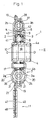
- a clutch disc assembly 1 manufactured in accordance with one embodiment of the present invention.
- the clutch disc assembly 1 may be used for transmitting a torque from a flywheel (not shown) of an engine to a transmission (not shown).
- the flywheel and the engine would typically be oriented such that they would be to the left side of the clutch disc in Fig. 1, and the transmission to the right side of the clutch disc assembly 1 in Fig. 1.
- the left side of Fig. 1 will be referred to as the engine side and the right side of Fig. 1 will be referred to as the transmission side.
- line O-O denotes a central axial line about which the clutch disc assembly 1 may rotate.
- the clutch disc assembly 1 includes a clutch plate 2 and a retaining plate 3 which are input members since torque is inputed into the clutch disc assembly 1 via the plates 2 and 3.
- the clutch disc assembly also includes a spline hub 4, a first side plate 5 and a second side plate 6, a first elastic coupling mechanism 7, a first frictional resistance generating mechanism 8, a second elastic coupling mechanism 9, a second frictional resistance generating mechanism 10 and a clutch coupling portion 11.
- the clutch plate 2 and the retaining plate 3 are generally annular plates formed with central holes through which the spline hub 4 extends.
- the clutch plate 2 and the retaining plate 3 are fixed to each other at radially inward positions by first stop pins 17 and at outer radial positions by second stop pins 18 so that the plates 2 and 3 are not rotatable relative to each other.
- the plates 2 and 3 are made of, for instance, carbon steel material (S35C) or similar materials to provide mechanical strength, and may also be hardened by, for instance, induction hardening and quenching.
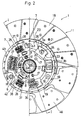
- First window portions 2a and 3a are formed equidistantly in the circumferential direction at three positions of each plate 2 and 3.
- One pair of second window portions 2b and 3b is formed between each adjacent pair of the first window portions 2a and 3a, respectively, as is shown in Fig. 2.
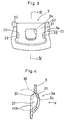
- Fig. 3 only shows the first window portion 2a.
- the first window portions 2a and 3a are generally the same and are formed using generally the same process and method. The following description of Fig. 3 is applicable to both first window portions 2a and 3a.
- An annular slanting portion 20 is formed with a radial slant such that the slanting portion 20 is not perpendicular to the line 0-0 in Fig. 1.
- the slanting portion 20 extends on circumferential intermediate portions of each plate 2 and 3, as is described further below.
- the first window portions 2a and 3a and the second window portions 2b and 3b are integrally formed from the slanting portion 20 to the outer circumferential side.
- first window portions 2a and 3a are formed by drawing so that they project outward from the clutch disk assembly 1.
- Each of the first window portions 2a and 3a includes a tunnel portion 21 which integrally extends in the radial directions and a circumferential support portion 22 which is formed on the opposite sides of the tunnel portions 21.
- the tunnel portion 21 restricts the axial movement of a first coil spring 36 (described below).
- a first hole 24 having a generally rectangular shape is formed at the center portion in each of the tunnel portions 21.
- a side edge of the first hole 24 on the inner circumferential side is longer than a side edge on the outer circumferential side.
- Second holes 23 which elongate in the radial direction as shown in Fig.
- each circumferential support portion 22 supports the opposite ends of the first coil spring 36 (described below). The inner side of each circumferential support portions are engaged by springs 36. The springs 36 therefore impart a force on the circumferential support portions 22 which creates a stress concentration in the tunnel portions 21.
- the second holes 23 provide stress relief in the tunnel portion 21.
- An amount of axial projection of the second window portions 3b is smaller than that of the first window portion 3a. There are no holes or the like formed in the second window portion 3b.
- a clutch coupling portion 11 is fixed to the outer periphery of the clutch plate 2 by rivets 19.
- the clutch coupling portion 11 includes a plurality of cushioning plates 46 fixed to the outer peripheral portion of the clutch plate 2 by rivets 19 and frictional facings 47 and 48 fixed on both sides of the cushioning plates 46.
- the spline hub 4 includes a main boss 4a and a flange 4b integral with the outer periphery of the boss 4a.
- the boss 4a is inserted into the central holes of the plates 2, 3.
- the flange 4b is interposed between the plates 2 and 3.
- a spline hole 26 to be splined with the input shaft (not shown) extending from a transmission side is formed in the central portion of the boss 4a.
- Three first windows 27 extending in the circumferential direction are formed in the flange 4b at the positions corresponding to the first window portions 2a and 3b of the plates 2 and 3.
- three second windows 28 which are smaller than the first windows 27 are formed in the flange 4b at the positions corresponding to the second window portions 2b and 3b of the plates 2 and 3.
- three third windows 29 which are further smaller than the second windows 28 are formed in the flange 4b on the inner circumferential side of the second windows 28.
- Oblong holes 30, through which the first stop pins 17 extend, and short holes 31, through which third stop pins 41 extend are formed in the inner circumferential side of the third windows 29.
- Cutaways 32 through which the second stop pins 18 are to pass are formed in the outer circumferential portion of the flange 4b.
- a predetermined gap is kept in the circumferential direction between each cutaway 32 and the associated second stop pin 18 so that the plates 2 and 3 and the spline hub 4 may undergo limited relative rotation with respect to each other.
- Each first elastic coupling mechanism 7 includes three first coil springs 36 and three second coil springs 37.
- Each of the first coil springs 36 is received in the first window portions 2a and 3a of the plates 2 and 3 and the first window 27 of the flange 4b.
- the circumferential ends of the first coil spring 36 are supported in the circumferential support portions 22 in the first window portions 2a and 3a. However, a predetermined gap is maintained in the circumferential direction between the first coil spring 36 and the first window 27 of the flange 4b.
- the second coil spring 37 is smaller than the first coil spring 36 and is received within the space defined by the second window portions 2b and 3b of the plates 2 and 3 and the second window 28 of the flange 4b.
- Each of the first and second side plates 5 and 6 is a plate member in the form of a disc with a central hole.
- the first side plate 5 is arranged between the clutch plate 2 and the flange 4b with its central hole engaging the boss 4a.
- the second side plate 6 is arranged between the retaining plate 3 and the flange 4b with its central hole engaging with the boss 4a.
- the first side plate 5 and the second side plate 6 are securely fixed to each other without any relative rotation by the three third stop pins 41 in the inner circumferential portions thereof.
- the third stop pins 41 pass through the short holes 31 of the flange 4b.
- the outer circumferential portions of the first side plate 5 and the second side plate 6 may be brought into contact with both ends of the first coil springs 36.
- the second elastic coupling mechanism 9 is used for elastically coupling the first side plate 5, the second side plate 6 and the flange 4b in the circumferential direction and includes three third coil springs 42.
- the third coil springs 42 are disposed within the third windows 29 of the flange 4b.
- Seat members 43 disposed on opposite sides of the third coil springs 42 extend in the axial direction to engage with the first side plate 5 and the second side plate 6.
- the first frictional resistance generating mechanism 8 is composed of a plurality of plate members disposed between the first side plate 5 and second side plate 6 and the plates 2 and 3.
- the second frictional resistance generating mechanism 10 is composed of a plurality of plates disposed between the first side plate 5 and second side plate 6 and the flange 4b.
- the clutch disc assembly 1 having such a structure, when the twist vibration is transmitted from the engine, the first coil springs 36, the second coil springs 37 and the third coil springs 42 are compressed in the rotational direction, and the hysteresis torque due to the friction is generated in the first frictional resistance generating mechanism 8 and the second frictional resistance generation mechanism 10, thereby attenuating the twist vibration.
- the first coil springs 36 and the second coil springs 37 are expanded on the outer circumferential side during the compression operation by the centrifugal force and slide along the inside of the first window portions 2a and 3a and the second window portions 3b and 2b of the plates 2 and 3.
- the first coil springs 36 slide along the inside of the first window portions 2a and 3a of the plates 2 and 3 since the sliding area between the tunnel portions 21 of the first windows 2a and 3a and the first coil spring 36 is larger compared to the prior art, so that the surface pressure per square unit of measurement is also less than that in the prior art and thus the wear due to friction is minimized.
- the disc are previously bored to form the first holes 24 and the second holes 23. Since the circumferential length on the inner circumferential side of the second holes 24 is larger than the circumferential length on the outer circumferential side of the second holes 24, the reduction in the plate thickness on the outer circumferential side of the tunnel portions 21 may be suppressed during the drawing process. Since the outer circumferential sides of the tunnel portions 21 are parts where the first coil springs 36 are most likely to slide, the durability may be enhanced by the suppression of the plate thickness reduction.
- the stress concentration is hardly caused on the outer circumferential side of the first window portions 21. Since the position of the second holes 23 is radially further inner side compared to that in the prior art, the mechanical strength of the outer circumferential portion of the plate body is not degraded when the first window portions 21 are conventionally located on the outer circumferential side of the plate. Further, the material is fully extended due to the second holes 23, thereby restraining the crack occurrence.
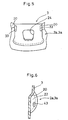
- the second holes 33 may be located on further inner side in the radial direction compared to that in the first embodiment. Furthermore, the number, the position and the shape of the second holes are not limited to the one shown in Fig. 3 or Fig. 5.
- the second holes 43 may be formed on the circumferential support portion 22. In this case, the same effect as in the previous preferred embodiment is attained.
- the number, the position and the shape of the second holes formed on the circumferential support portion are not limited to the one shown in Fig. 6.
- the stress concentration is hardly caused in the outer circumferential side of the window portion. Further, the holes are located on further inner side in the radial direction compared to that in the prior art, the mechanical strength of the outer circumferential portion of the plate body is not degraded when the window portions are conventionally located on the outer circumferential side of the plate.
Landscapes
- Engineering & Computer Science (AREA)
- General Engineering & Computer Science (AREA)
- Physics & Mathematics (AREA)
- Acoustics & Sound (AREA)
- Aviation & Aerospace Engineering (AREA)
- Mechanical Engineering (AREA)
- Mechanical Operated Clutches (AREA)
Applications Claiming Priority (3)
| Application Number | Priority Date | Filing Date | Title |
|---|---|---|---|
| JP02954896A JP3363302B2 (ja) | 1996-02-16 | 1996-02-16 | ダンパーディスク組立体のプレート部材 |
| JP29548/96 | 1996-02-16 | ||
| JP2954896 | 1996-02-16 |
Publications (3)
| Publication Number | Publication Date |
|---|---|
| EP0790433A2 true EP0790433A2 (de) | 1997-08-20 |
| EP0790433A3 EP0790433A3 (de) | 1999-06-23 |
| EP0790433B1 EP0790433B1 (de) | 2001-10-31 |
Family
ID=12279197
Family Applications (1)
| Application Number | Title | Priority Date | Filing Date |
|---|---|---|---|
| EP97101226A Expired - Lifetime EP0790433B1 (de) | 1996-02-16 | 1997-01-27 | Plattenelement für eine Dämpfungsscheibeneinheit welche sich mit radial erstreckenden unterstützenden Teilen befasst |
Country Status (4)
| Country | Link |
|---|---|
| US (1) | US5857552A (de) |
| EP (1) | EP0790433B1 (de) |
| JP (1) | JP3363302B2 (de) |
| DE (1) | DE69707729T2 (de) |
Cited By (2)
| Publication number | Priority date | Publication date | Assignee | Title |
|---|---|---|---|---|
| DE19917307B4 (de) * | 1998-04-17 | 2006-08-10 | Exedy Corp., Neyagawa | Dämpfungsplattenanordnung mit Federhalteplatte |
| DE19917371B4 (de) * | 1998-04-17 | 2006-08-17 | Exedy Corp., Neyagawa | Federhalteplatte zur Verwendung mit einer Dämpfungsscheibenanordnung, sowie Dämpfungsscheibenanordnung hiermit |
Families Citing this family (12)
| Publication number | Priority date | Publication date | Assignee | Title |
|---|---|---|---|---|
| US6029793A (en) * | 1997-12-12 | 2000-02-29 | Exedy Corporation | Damper disk assembly |
| JP3645710B2 (ja) * | 1998-05-25 | 2005-05-11 | 株式会社エクセディ | スプラインハブの製造方法 |
| US6267213B1 (en) | 1998-12-18 | 2001-07-31 | Exedy Corporation | Lock-up damper of torque converter |
| US6247568B1 (en) | 1998-12-25 | 2001-06-19 | Exedy Corporation | Friction member for disk assembly, especially for torque converter |
| US6896111B2 (en) * | 2002-04-05 | 2005-05-24 | Exp, L.P. | One-way drive device with reduced engagement impact |
| US6863167B2 (en) * | 2003-02-11 | 2005-03-08 | Eaton Corporation | Dual formed spring cover |
| CN103502682B (zh) * | 2011-03-08 | 2016-03-30 | 离合器实业有限公司 | 具有阻尼弹簧的摩擦离合器盘 |
| FR3023599B1 (fr) * | 2014-07-11 | 2016-07-01 | Valeo Embrayages | Amortisseur pour dispositif de transmission de couple de vehicule automobile |
| FR3039235B1 (fr) * | 2015-07-24 | 2019-04-12 | Valeo Embrayages | Dispositif d’amortissement de vibration |
| FR3039237B1 (fr) * | 2015-07-24 | 2018-03-02 | Valeo Embrayages | Dispositif de transmission de couple pour un vehicule automobile |
| DE102016201508A1 (de) * | 2016-02-02 | 2017-08-03 | Schaeffler Technologies AG & Co. KG | Reibteil |
| JP7252711B2 (ja) * | 2018-02-06 | 2023-04-05 | 株式会社エクセディ | プレート、及びダンパーディスク組立体 |
Family Cites Families (8)
| Publication number | Priority date | Publication date | Assignee | Title |
|---|---|---|---|---|
| US2274174A (en) * | 1939-07-21 | 1942-02-24 | Ernest E Wemp | Clutch member |
| US2293781A (en) * | 1939-07-22 | 1942-08-25 | Thelander W Vincent | Friction clutch plate |
| US2321941A (en) * | 1941-11-05 | 1943-06-15 | Ira Saks | Clutch plate |
| EP0087524A1 (de) * | 1981-02-26 | 1983-09-07 | Automotive Products Public Limited Company | Kupplungsscheibe |
| US4493408A (en) * | 1981-09-21 | 1985-01-15 | Kabushiki Kaisha Daikin Seisakusho | Damper disc |
| JPS60118029U (ja) * | 1984-01-19 | 1985-08-09 | 株式会社 大金製作所 | 捩りダンパ−デイスク |
| DE3624496C2 (de) * | 1986-07-19 | 1996-04-18 | Fichtel & Sachs Ag | Torsionsschwingungsdämpfer mit dichtem Aufbau |
| EP0732527B1 (de) * | 1995-03-17 | 2002-06-12 | Toyota Jidosha Kabushiki Kaisha | Hydrodynamischer Drehmomentwandler mit Ueberbrückungskupplung und eingebautem Schwingungsdämpfer |
-
1996
- 1996-02-16 JP JP02954896A patent/JP3363302B2/ja not_active Expired - Lifetime
-
1997
- 1997-01-23 US US08/788,868 patent/US5857552A/en not_active Expired - Lifetime
- 1997-01-27 EP EP97101226A patent/EP0790433B1/de not_active Expired - Lifetime
- 1997-01-27 DE DE69707729T patent/DE69707729T2/de not_active Expired - Fee Related
Cited By (2)
| Publication number | Priority date | Publication date | Assignee | Title |
|---|---|---|---|---|
| DE19917307B4 (de) * | 1998-04-17 | 2006-08-10 | Exedy Corp., Neyagawa | Dämpfungsplattenanordnung mit Federhalteplatte |
| DE19917371B4 (de) * | 1998-04-17 | 2006-08-17 | Exedy Corp., Neyagawa | Federhalteplatte zur Verwendung mit einer Dämpfungsscheibenanordnung, sowie Dämpfungsscheibenanordnung hiermit |
Also Published As
| Publication number | Publication date |
|---|---|
| DE69707729T2 (de) | 2002-05-16 |
| JPH09222131A (ja) | 1997-08-26 |
| EP0790433A3 (de) | 1999-06-23 |
| DE69707729D1 (de) | 2001-12-06 |
| EP0790433B1 (de) | 2001-10-31 |
| JP3363302B2 (ja) | 2003-01-08 |
| US5857552A (en) | 1999-01-12 |
Similar Documents
| Publication | Publication Date | Title |
|---|---|---|
| US4663983A (en) | Torque variation absorbing device | |
| EP0790433B1 (de) | Plattenelement für eine Dämpfungsscheibeneinheit welche sich mit radial erstreckenden unterstützenden Teilen befasst | |
| US6209701B1 (en) | Damper disk assembly | |
| US5169357A (en) | Torsion damping device, in particular for a clutch friction disc for a motor vehicle | |
| GB2085552A (en) | Damper Disc | |
| US4493408A (en) | Damper disc | |
| EP0696694B1 (de) | Drehmoment-absorbierende Scheibe | |
| US5937989A (en) | Clutch disk assembly having cushioning plates and paired friction pads riveted together | |
| EP0784164B2 (de) | Dämpfungsscheibeneinheit mit Befestigung für integrale Halteplatten | |
| US5762558A (en) | Damper disc assemby and balance weight therefor | |
| US4269296A (en) | Two-stage coaxial spring damper | |
| US6062103A (en) | Motor vehicle double damping flywheel, comprising improved means for friction damping of vibrations | |
| US6332843B1 (en) | Damper disk assembly | |
| JP2769735B2 (ja) | 粘性緩衝装置を有するねじり緩衝装置 | |
| US7159703B2 (en) | Clutch device having an elastic coupling for a flywheel | |
| US5059155A (en) | Friction device of damper disc | |
| US6257089B1 (en) | Dampening disk assembly with spring retaining plate | |
| JP3052279B2 (ja) | クラッチディスク組立体およびそのプレート部材 | |
| JPH0139492B2 (de) | ||
| US6006884A (en) | Clutch disk assembly | |
| US6482093B1 (en) | Damper disk assembly | |
| GB2284462A (en) | Torsion damper | |
| EP1427947B1 (de) | Kupplungsscheibe | |
| GB2315315A (en) | Friction clutch predamper. | |
| US6199675B1 (en) | Lock-up piston in a torque converter |
Legal Events
| Date | Code | Title | Description |
|---|---|---|---|
| PUAI | Public reference made under article 153(3) epc to a published international application that has entered the european phase |
Free format text: ORIGINAL CODE: 0009012 |
|
| 17P | Request for examination filed |
Effective date: 19970127 |
|
| AK | Designated contracting states |
Kind code of ref document: A2 Designated state(s): DE FR GB |
|
| PUAL | Search report despatched |
Free format text: ORIGINAL CODE: 0009013 |
|
| AK | Designated contracting states |
Kind code of ref document: A3 Designated state(s): DE FR GB |
|
| GRAG | Despatch of communication of intention to grant |
Free format text: ORIGINAL CODE: EPIDOS AGRA |
|
| GRAG | Despatch of communication of intention to grant |
Free format text: ORIGINAL CODE: EPIDOS AGRA |
|
| GRAG | Despatch of communication of intention to grant |
Free format text: ORIGINAL CODE: EPIDOS AGRA |
|
| GRAH | Despatch of communication of intention to grant a patent |
Free format text: ORIGINAL CODE: EPIDOS IGRA |
|
| 17Q | First examination report despatched |
Effective date: 20010315 |
|
| GRAH | Despatch of communication of intention to grant a patent |
Free format text: ORIGINAL CODE: EPIDOS IGRA |
|
| GRAA | (expected) grant |
Free format text: ORIGINAL CODE: 0009210 |
|
| AK | Designated contracting states |
Kind code of ref document: B1 Designated state(s): DE FR GB |
|
| REF | Corresponds to: |
Ref document number: 69707729 Country of ref document: DE Date of ref document: 20011206 |
|
| REG | Reference to a national code |
Ref country code: GB Ref legal event code: IF02 |
|
| ET | Fr: translation filed | ||
| PLBE | No opposition filed within time limit |
Free format text: ORIGINAL CODE: 0009261 |
|
| STAA | Information on the status of an ep patent application or granted ep patent |
Free format text: STATUS: NO OPPOSITION FILED WITHIN TIME LIMIT |
|
| 26N | No opposition filed | ||
| PGFP | Annual fee paid to national office [announced via postgrant information from national office to epo] |
Ref country code: GB Payment date: 20040107 Year of fee payment: 8 |
|
| PGFP | Annual fee paid to national office [announced via postgrant information from national office to epo] |
Ref country code: FR Payment date: 20040120 Year of fee payment: 8 |
|
| PGFP | Annual fee paid to national office [announced via postgrant information from national office to epo] |
Ref country code: DE Payment date: 20040126 Year of fee payment: 8 |
|
| PG25 | Lapsed in a contracting state [announced via postgrant information from national office to epo] |
Ref country code: GB Free format text: LAPSE BECAUSE OF NON-PAYMENT OF DUE FEES Effective date: 20050127 |
|
| PG25 | Lapsed in a contracting state [announced via postgrant information from national office to epo] |
Ref country code: DE Free format text: LAPSE BECAUSE OF NON-PAYMENT OF DUE FEES Effective date: 20050802 |
|
| GBPC | Gb: european patent ceased through non-payment of renewal fee |
Effective date: 20050127 |
|
| PG25 | Lapsed in a contracting state [announced via postgrant information from national office to epo] |
Ref country code: FR Free format text: LAPSE BECAUSE OF NON-PAYMENT OF DUE FEES Effective date: 20050930 |
|
| REG | Reference to a national code |
Ref country code: FR Ref legal event code: ST |