EP0791900A2 - Sprechendes Pfand oder Pfandschloss - Google Patents
Sprechendes Pfand oder Pfandschloss Download PDFInfo
- Publication number
- EP0791900A2 EP0791900A2 EP97102955A EP97102955A EP0791900A2 EP 0791900 A2 EP0791900 A2 EP 0791900A2 EP 97102955 A EP97102955 A EP 97102955A EP 97102955 A EP97102955 A EP 97102955A EP 0791900 A2 EP0791900 A2 EP 0791900A2
- Authority
- EP
- European Patent Office
- Prior art keywords
- deposit
- lock according
- deposit lock
- memory
- text
- Prior art date
- Legal status (The legal status is an assumption and is not a legal conclusion. Google has not performed a legal analysis and makes no representation as to the accuracy of the status listed.)
- Withdrawn
Links
Images
Classifications
-
- G—PHYSICS
- G07—CHECKING-DEVICES
- G07F—COIN-FREED OR LIKE APPARATUS
- G07F7/00—Mechanisms actuated by objects other than coins to free or to actuate vending, hiring, coin or paper currency dispensing or refunding apparatus
- G07F7/08—Mechanisms actuated by objects other than coins to free or to actuate vending, hiring, coin or paper currency dispensing or refunding apparatus by coded identity card or credit card or other personal identification means
- G07F7/10—Mechanisms actuated by objects other than coins to free or to actuate vending, hiring, coin or paper currency dispensing or refunding apparatus by coded identity card or credit card or other personal identification means together with a coded signal, e.g. in the form of personal identification information, like personal identification number [PIN] or biometric data
- G07F7/1008—Active credit-cards provided with means to personalise their use, e.g. with PIN-introduction/comparison system
-
- G—PHYSICS
- G06—COMPUTING OR CALCULATING; COUNTING
- G06Q—INFORMATION AND COMMUNICATION TECHNOLOGY [ICT] SPECIALLY ADAPTED FOR ADMINISTRATIVE, COMMERCIAL, FINANCIAL, MANAGERIAL OR SUPERVISORY PURPOSES; SYSTEMS OR METHODS SPECIALLY ADAPTED FOR ADMINISTRATIVE, COMMERCIAL, FINANCIAL, MANAGERIAL OR SUPERVISORY PURPOSES, NOT OTHERWISE PROVIDED FOR
- G06Q20/00—Payment architectures, schemes or protocols
- G06Q20/30—Payment architectures, schemes or protocols characterised by the use of specific devices or networks
- G06Q20/34—Payment architectures, schemes or protocols characterised by the use of specific devices or networks using cards, e.g. integrated circuit [IC] cards or magnetic cards
- G06Q20/346—Cards serving only as information carrier of service
-
- G—PHYSICS
- G07—CHECKING-DEVICES
- G07F—COIN-FREED OR LIKE APPARATUS
- G07F1/00—Coin inlet arrangements; Coins specially adapted to operate coin-freed mechanisms
- G07F1/06—Coins specially adapted to operate coin-freed mechanisms
-
- G—PHYSICS
- G07—CHECKING-DEVICES
- G07F—COIN-FREED OR LIKE APPARATUS
- G07F7/00—Mechanisms actuated by objects other than coins to free or to actuate vending, hiring, coin or paper currency dispensing or refunding apparatus
- G07F7/06—Mechanisms actuated by objects other than coins to free or to actuate vending, hiring, coin or paper currency dispensing or refunding apparatus by returnable containers, i.e. reverse vending systems in which a user is rewarded for returning a container that serves as a token of value, e.g. bottles
- G07F7/0618—Mechanisms actuated by objects other than coins to free or to actuate vending, hiring, coin or paper currency dispensing or refunding apparatus by returnable containers, i.e. reverse vending systems in which a user is rewarded for returning a container that serves as a token of value, e.g. bottles by carts
- G07F7/0663—Constructional details of the housing of the coin or token activated lock, or of mounting of the coin-lock on the trolley or cart
-
- G—PHYSICS
- G07—CHECKING-DEVICES
- G07F—COIN-FREED OR LIKE APPARATUS
- G07F7/00—Mechanisms actuated by objects other than coins to free or to actuate vending, hiring, coin or paper currency dispensing or refunding apparatus
- G07F7/06—Mechanisms actuated by objects other than coins to free or to actuate vending, hiring, coin or paper currency dispensing or refunding apparatus by returnable containers, i.e. reverse vending systems in which a user is rewarded for returning a container that serves as a token of value, e.g. bottles
- G07F7/0618—Mechanisms actuated by objects other than coins to free or to actuate vending, hiring, coin or paper currency dispensing or refunding apparatus by returnable containers, i.e. reverse vending systems in which a user is rewarded for returning a container that serves as a token of value, e.g. bottles by carts
- G07F7/0672—Special lock-activating tokens, serving as replacement of a payment or of a coin
-
- G—PHYSICS
- G07—CHECKING-DEVICES
- G07F—COIN-FREED OR LIKE APPARATUS
- G07F7/00—Mechanisms actuated by objects other than coins to free or to actuate vending, hiring, coin or paper currency dispensing or refunding apparatus
- G07F7/08—Mechanisms actuated by objects other than coins to free or to actuate vending, hiring, coin or paper currency dispensing or refunding apparatus by coded identity card or credit card or other personal identification means
- G07F7/0866—Mechanisms actuated by objects other than coins to free or to actuate vending, hiring, coin or paper currency dispensing or refunding apparatus by coded identity card or credit card or other personal identification means by active credit-cards adapted therefor
-
- G—PHYSICS
- G07—CHECKING-DEVICES
- G07F—COIN-FREED OR LIKE APPARATUS
- G07F7/00—Mechanisms actuated by objects other than coins to free or to actuate vending, hiring, coin or paper currency dispensing or refunding apparatus
- G07F7/08—Mechanisms actuated by objects other than coins to free or to actuate vending, hiring, coin or paper currency dispensing or refunding apparatus by coded identity card or credit card or other personal identification means
- G07F7/0873—Details of the card reader
-
- G—PHYSICS
- G07—CHECKING-DEVICES
- G07F—COIN-FREED OR LIKE APPARATUS
- G07F7/00—Mechanisms actuated by objects other than coins to free or to actuate vending, hiring, coin or paper currency dispensing or refunding apparatus
- G07F7/06—Mechanisms actuated by objects other than coins to free or to actuate vending, hiring, coin or paper currency dispensing or refunding apparatus by returnable containers, i.e. reverse vending systems in which a user is rewarded for returning a container that serves as a token of value, e.g. bottles
- G07F7/0618—Mechanisms actuated by objects other than coins to free or to actuate vending, hiring, coin or paper currency dispensing or refunding apparatus by returnable containers, i.e. reverse vending systems in which a user is rewarded for returning a container that serves as a token of value, e.g. bottles by carts
Definitions
- the invention relates to a deposit lock for parts to be detachably fastened to one another, such as shopping trolleys or luggage trolleys, which has a housing with an opening into which a deposit can be inserted in order to detach the parts from one another.
- Such deposit locks are often viewed by the user of a car, in particular by the customer of a supermarket, as a harassment or curtailment. Especially when cash has to be put into the deposit lock, many customers react with rejection of this supposed expenditure, which they have to make before the purchase.
- the object of the invention is to provide a deposit lock which reduces the reluctance of the user to give up a deposit, and which can also be included in the advertising strategy of a supermarket and thereby contributes to strengthening the customer's loyalty to a supermarket.
- a major advantage of the "talking" deposit lock according to the invention is first of all that the user of the car immediately receives a consideration for his deposit as soon as he hands it over.
- This consideration can be a sound sequence, in particular a text such as a simple "thank you” or a simple greeting or a sound sequence in the form of a pleasant melody. This attention gives the individual customer the feeling of being noticed and received in the supermarket.
- the speaking function is based on the deposit.
- the deposit or a device connected to the deposit in particular the deposit lock, has a sound source, in particular a loudspeaker.
- a sound source in particular a loudspeaker.
- the deposit can be a card, a coin-like disc, a pen or a key. So that the deposit can "speak" independently, it is advantageous to attach the loudspeaker, which can in particular be a very small and flat piezo loudspeaker, in or on the deposit. Spoken text with information is given over the loudspeaker.
- the text is stored in a memory, wherein the memory can be designed as a magnetic stripe on the deposit, which stores the text in analog or digital form.
- the store is on deposit attached microchip in which the information is stored digitally.
- the stored text can be called up via triggering signals, for example from ultrasound or infrared transmitters which are distributed in the supermarket.
- the memory can be written with a different text via such transmitters.
- the memory can be exchanged in a simpler embodiment, and the information can thus be updated.
- the exchange can take place by means of an attachable chip or an insertable magnetic strip applied to a carrier.
- the pledge can act as a recipient. I.e. in or on the deposit there is a receiving part which receives signals from an external transmitter.
- the amplification electronics and the loudspeaker are advantageously also attached to the deposit so that received text is immediately audible.
- the insertion of the deposit which can be an ordinary coin, has the effect that a text or a melody can be heard via the sound source, for example via a loudspeaker.
- the insertion of a deposit via electromagnetic pulses can stimulate the electronics of a tape device that is located near the base station of the car to reproduce the text or the melody through a loudspeaker that is also located near the base station.
- a card, a coin-like disc, a pen or a key can also be used as a deposit.
- the loudspeaker is attached to the trolley or to the deposit lock, so that the announcement is addressed individually to the user.
- the text is advantageously deposited in an electronic storage medium, in particular a magnetic strip or a microchip, which is located in or on the deposit lock or in or on the deposit.
- the text contains information such as special shopping aids, which can be customer-specific. It is advantageous if the deposit is distributed individually to the customer. It is thus possible to distinguish between a bachelor and a housewife who undoubtedly places different demands on advice.
- the text can refer to special offers or can be used in general as an advertising medium.
- the text can be called up as the goods pass, if in particular ultrasound or infrared transmitters are attached to the shelves and interact with corresponding receivers in the deposit locks. It is also possible to store the text in the transmission units and to transmit it to a speech generator which is attached to the deposit lock.
- the loudspeaker is mounted in the deposit lock, it is also advantageous to integrate the amplification electronics, which processes the text between the memory or the speech generator and the loudspeaker, into the deposit lock.
- the power supply can be provided by batteries which are located in the deposit lock and which are charged from a voltage source at the base station via the connecting links from car to car.
- the text is stored in a memory located in the deposit lock, it is advantageous to design the electronics in such a way that the text is sent via a central device is changeable in particular in the form of a transmitter. So the text can be updated at any time.
- the memory can be exchanged in a simple manner, so that the memory is discussed in a central office and then exchanged in the deposit locks.
- the memory in the deposit is in particular attached to a deposit card or in a deposit key.
- the customer's shopping behavior can be recorded in his individual memory and the advice can be customized.
- the shopping behavior is registered, for example, on the basis of electromagnetic pulses emitted by transmitters on shelves, by a receiving unit in the deposit lock and written to the memory. If it turns out over a certain period that the customer prefers a special product, he will be informed of the storage space or the special price of this product in the future as soon as he puts his deposit card in the opening in the castle. This deposit card is therefore a "listening" and a speaking "deposit". Such a hearing
- the customer Before shopping or after inserting the deposit, the customer discusses its memory with his wishes and a speech recognition electronics in the deposit lock reads out the memory content and the customer the information about the special goods via a speech generator, which is located in the housing, returns.
- the memory is advantageously discussed using a microphone which is introduced into the housing.
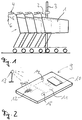
- FIG. 1 shows nested shopping carts 1, hereinafter referred to as trolleys 1, the first of which is connected to a base station 3 via a connecting link, in particular via a chain 2.
- Each of the carriages 1 is equipped with a deposit lock 4 on the handle 8, to which a chain 5 with a plug-in part 6 is attached.
- the chain 2 of the one carriage 1 is inserted into the deposit lock 4 of the inserted carriage 1, so that several carriages 1 are secured against one another.
- the deposit lock 4 is unlocked so that the plug-in part 6 of the front carriage 1 pops out. The deposit remains in the slot 7 until the carriage 1 is coupled with another one.
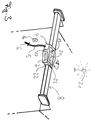
- a card 9 (FIG. 2) is used as the deposit, which has approximately the dimensions of a telephone card.
- the card 9 shown in this exemplary embodiment is provided with a digital storage medium in the form of a microchip 10 which is detachably placed on the card. Information is stored in the form of a text on the microchip.
- the card 9 is equipped with a receiving and amplifier unit 11 which is connected to the integrated loudspeaker 12 and is embedded in the card 9. The receiving and amplifier unit 11 is supplied by a battery 15. If the card is radioed by an external transmitter 13, the text announcement begins.
- this particular card 9 has a switch 14, in particular a membrane switch, which is actuated as soon as the card 9 is pushed into the slot 7 of the deposit lock 4.
- the deposit lock 4 shown in FIG. 3 is an embodiment which can be triggered both with a card 9 and with a conventional coin 16.
- the coin 16 is pushed into the slot 17 and remains therein until a plug-in part 6 is inserted into the opening 18.
- the plugging in of a deposit triggers an amplifier electronics 23 in the deposit lock which is comparable to the electronics shown in connection with the card according to FIG is.
- the memory 20 is located in the deposit lock 4 and can be assigned text via an external transmitter 21.
Landscapes
- Physics & Mathematics (AREA)
- General Physics & Mathematics (AREA)
- Engineering & Computer Science (AREA)
- Business, Economics & Management (AREA)
- Microelectronics & Electronic Packaging (AREA)
- Computer Networks & Wireless Communication (AREA)
- Accounting & Taxation (AREA)
- Strategic Management (AREA)
- General Business, Economics & Management (AREA)
- Theoretical Computer Science (AREA)
- Lock And Its Accessories (AREA)
- Handcart (AREA)
Abstract
Description
- Die Erfindung betrifft ein Pfandschloß für lösbar aneinander zu befestigende Teile wie Einkaufswagen oder Gepäckwagen, das ein Gehäuse mit einer Öffnung aufweist, in die ein Pfand einsteckbar ist, um die Teile voneinander zu lösen.
- Es ist bekannt, insbesondere Einkaufs- oder Gepäckwagen mit einem Pfandschloß zu versehen, das beim Einstecken eines Pfandes in Form einer Münze, einer Karte oder eines Schlüssels ein meist kettenförmiges Verbindungsteil zu einem anderen Wagen freigibt, so daß der Wagen benutzt werden kann. Sobald er wieder an seine Basisstation zurück gebracht und über das Verbindungsteil an einen anderen Wagen gekoppelt ist, wird das Pfand freigegeben.
- Derartige Pfandschlösser werden vom Benutzer eines Wagens insbesondere vom Kunden eines Supermarktes oft als Schikane oder Gängelung angesehen. Gerade wenn in das Pfandschloß bares Geld eingelegt werden muß reagieren viele Kunden mit Ablehnung gegenüber dieser vermeintlichen Ausgabe, die sie schon vor dem Einkauf leisten müssen.
- Aufgabe der Erfindung ist es, ein Pfandschloß zu schaffen, das beim Benutzer die Abneigung mindert, ein Pfand abzugeben, und das sich zudem in die Werbestrategie eines Supermarktes einbeziehen läßt und dabei zur Stärkung der Bindung des Kunden an einen Supermarkt beiträgt.
- Die Aufgabe wird erfindungsgemäß durch Pfandschlösser nach den Ansprüchen 1 oder 10 gelöst.
- Vorteilhafte Ausführungsformen der erfindungsgemäßen Pfandschlösser sind in den jeweiligen Unteransprüchen aufgeführt.
- Wesentlicher Vorteil des erfindungsgemäßen "sprechenden" Pfandschlosses ist zunächst, daß der Benutzer des Wagens sofort eine Gegenleistung für sein Pfand bekommt, sobald er dieses abgibt. Diese Gegenleistung kann eine Lautfolge insbesondere ein Text wie ein schlichtes "Dankeschön" oder eine einfache Begrüßung oder eine Tonfolge in Form einer angenehmen Melodie sein. Der einzelne Kunde erhält durch diese Aufmerksamkeit das Gefühl im Supermarkt wahrgenommen und empfangen worden zu sein.
- In einer besonderen ersten Ausführungsform der Erfindung geht die sprechende Funktion von dem Pfand aus. Dazu weist das Pfand oder eine mit dem Pfand verbundene Vorrichtung insbesondere das Pfandschloß eine Schallquelle insbesondere einen Lautsprecher auf. Über diesen wird entweder die auf dem Pfand direkt gespeicherte Information verlautbar oder es werden von dem Pfand, das die Funktion eines Empfängers hat, Signale von einer entfernten Quelle aufgenommen und dadurch der Lautsprecher zur Abgabe von Lauten oder Tönen angeregt.
- Das Pfand kann eine Karte, eine münzähnliche Scheibe, ein Stift oder ein Schlüssel sein. Damit das Pfand unabhängig "sprechen" kann ist es vorteilhaft den Lautsprecher, der insbesondere ein sehr kleiner und flacher Piezo-Lautsprecher sein kann, im oder am Pfand anzubringen. Über den Lautsprecher wird gesprochener Text mit Information verlautbar. In einer besonderen Ausführungsform ist der Text in einem Speicher niedergelegt, wobei der Speicher als Magnetstreifen auf dem Pfand ausgebildet sein kann, der den Text analog oder digital speichert. In einer anderen Ausführungsform ist der Speicher ein auf dem Pfand angebrachter Mikrochip, in dem die Information digital niedergelegt wird. Der gespeicherte Text kann über auslösende Signale, beispielsweise von Ultraschall- oder Infrarotsendern, die im Supermarkt verteilt sind, abgerufen werden. Über derartige Sender kann in einer anderen Ausführungsform des Pfandschlosses der Speicher mit einem anderen Text beschrieben werden. Statt einer solchen Modifikation des Textes kann in einfacherer Ausführungsform der Speicher ausgetauscht, und damit die Information aktualisiert werden. Der Austausch kann mittels eines aufsetzbaren Chip oder eines einschiebbaren auf einen Träger aufgebrachten Magnetstreifen geschehen.
- Wie dargestellt kann das Pfand als Empfänger fungieren. D.h. in oder an dem Pfand ist ein Empfangsteil angebracht, das Signale von einem externen Sender empfängt. Die Verstärkungselektronik und der Lautsprecher sind vorteilhafterweise ebenfalls auf dem Pfand angebracht, so daß empfangener Text sofort hörbar ist. In dieser Ausführungsform ist es möglich, das Pfand wie ein Radio zu benutzen, über das vom Supermarkt gesendete Informationen hörbar werden.
- In einer besonderen zweiten Ausführungsform der Erfindung bewirkt das Einstecken des Pfandes, das eine gewöhnliche Münze sein kann, daß über die Schallquelle, beispielsweise über einen Lautsprecher ein Text oder eine Melodie vernehmbar ist. Im einfachsten Falle kann das Einstecken eines Pfandes über elektromagnetische Impulse die Elektronik eines Bandgerätes, das sich in der Nähe der Basisstation des Wagens befindet, zur Wiedergabe des Textes oder der Melodie durch einen ebenfalls in der Nähe der Basisstation befindlichen Lautsprechers anregen. Als Pfand können auch eine Karte, eine münzähnliche Scheibe, ein Stift oder ein Schlüssel dienen.
- In einer besonderen Ausführungsform ist der Lautsprecher am Wagen oder am Pfandschloß angebracht, so daß die Ansage individuell an den Benutzer gerichtet ist. Der Text ist vorteilhafterweise in einem elektronischen Speichermedium insbesondere einem Magnetstreifen oder einem Mikrochip niedergelegt, das sich im oder am Pfandschloß bzw. in oder am Pfand befindet. Der Text enthält in einer besonderen Ausführungsform Informationen wie spezielle Einkaufshilfen, die kundenspezifisch sein können. Dabei ist es vorteilhaft, wenn das Pfand individuell an den Kunden verteilt wird. So ist es möglich, zwischen einem Junggesellen und einer Hausfrau, die zweifellos andere Ansprüche an die Beratung stellt, zu unterscheiden. Der Text kann dabei auf Sonderangebote hinweisen, oder allgemein als Werbeträger benutzt werden.
- Wie in der ersten Ausführungsform der Erfindung ist es auch hier möglich, durch individuell verteilte Pfänder den Kunden in seiner ihm eigenen Sprache anzureden, wenn sich der Text verschiedensprachig in dem Speicher befindet. In einer weiteren Ausführungsform kann der Text im Vorbeigehen an den Waren aufgerufen werden, wenn an den Regalen Sender insbesondere Ultraschall- oder Infrarotsender angebracht sind, die mit entsprechenden Empfängern in den Pfandschlössern wechselwirken. Es ist ebenfalls möglich, den Text in den Sendeeinheiten zu speichern und an einen Sprachgenerator, der im Pfandschloß angebracht ist, zu übertragen.
- Wenn der Lautsprecher im Pfandschloß angebracht ist, so ist es vorteilhaft auch die Verstärkungselektronik, welche die Aufbereitung des Textes zwischen dem Speicher bzw. dem Sprachgenerator und dem Lautsprecher vornimmt ebenfalls in dem Pfandschloß zu integrieren. Die Stromversorgung kann von Akkus bewerkstelligt werden, die sich im Pfandschloß befinden und die von einer Spannungsquelle an der Basisstation über die Verbindungsglieder von Wagen zu Wagen aufgeladen werden.
- Ist der Text in einem im Pfandschloß befindlichen Speicher gespeichert, so ist es vorteilhaft, die Elektronik derart auszulegen, daß der Text über eine zentrale Einrichtung insbesondere in Form eines Senders veränderbar ist. So kann der Text jederzeit aktualisiert werden. Bei einer anderen Ausführungsform kann der Speicher mit einfachen Handgriffen ausgetauscht werden, so daß die Speicher in einer Zentrale besprochen und dann in den Pfandschlössern ausgetauscht werden.
- Bei einer anderen vorteilhaften Ausführungsform ist der Speicher im Pfand insbesondere auf einer Pfandkarte bzw. in einem Pfandschlüssel angebracht. In diesem Fall ist es möglich, den Text auf die Bedürfnisse des einzelnen Kunden auszurichten. So kann beispielsweise das Einkaufsverhalten des Kunden in seinem individuellen Speicher festgehalten und die Beratung kundenspezifisch ausgerichtet werden. Das Einkaufsverhalten wird beispielsweise anhand elektromagnetischer Impulse, die von Sendern an Regalen ausgehen, von einer Empfangseinheit im Pfandschloß registriert und auf den Speicher geschrieben. Stellt sich über eine gewisse Zeit heraus, daß der Kunde eine spezielle Ware bevorzugt, so wird er in Zukunft auf den Lagerplatz oder den Sonderpreis dieser Ware gesondert hingewiesen sobald er seine Pfandkarte in die Öffnung im Schloß steckt. Bei diesei Pfandkarte handelt es sich also um ein "hörendes" und ein sprechendes "Pfand". Ein derart hörendes
- Pfand kann auch in der ersten Ausführungsform der Erfindung verwendet werden.
- Es ist sogar denkbar, daß der Kunde vor dem Einkauf oder nach dem Einstecken des Pfandes dessen Speicher mit seinen Wünschen bespricht und eine Spracherkennungselektronik im Pfandschloß den Speicherinhalt ausliest und dem Kunden die Information über die speziellen Waren über einen Sprachgenerator, der dich im Gehäuse befindet, zurückgibt. Das Besprechen des Speichers geschieht vorteilhafterweise über ein Mikrophon, das in das Gehäuse eingebracht ist.
- Ein Ausführungsbeispiel des Pfandschlosses ist in den Zeichnungen dargestellt und wird im folgenden näher beschrieben.
- Es zeigen:
- Fig. 1
- Einkaufswagen an einer Basisstation,
- Fig. 2
- eine Pfandkarte mit Speicher,
- Fig. 3
- ein Pfandschloß am Griff eines Einkaufswagens.
- In Figur 1 sind ineinandergeschobene Einkaufswagen 1 im folgenden Wagen 1 genannt dargestellt, von denen der erste über ein Verbindungsglied insbesondere über eine Kette 2 an einer Basisstation 3 angeschlossen ist. Jeder der Wagen 1 ist mit einem Pfandschloß 4 am Griff 8 ausgestattet, an dem eine Kette 5 mit einem Steckteil 6 angebracht ist. In an sich bekannter Weise ist die Kette 2 des einen Wagens 1 in das Pfandschloß 4 des eingeschobenen Wagens 1 eingesteckt, so daß mehrere Wagen 1 gegeneinander gesichert sind. Beim Einschieben eines Pfandes in den Schlitz 7 (Figur 3) im Gehäuse 22 wird das Pfandschloß 4 aufgesperrt, so daß das Steckteil 6 des vorderen Wagens 1 herausspringt. Das Pfand verbleibt im Schlitz 7 bis der Wagen 1 wieder mit einem anderen gekoppelt wird.
- Als Pfand wird in diesem besonderen Ausführungsbeispiel eine Karte 9 (Figur 2) verwendet, die etwa die Abmessungen einer Telefonkarte hat. Die in diesem Ausführungsbeispiel gezeigte Karte 9 ist mit einem digitalen Speichermedium in Form eines Mikrochip 10 versehen, der abnehmbar auf die Karte aufgesetzt ist. Auf dem Mikrochip ist Information in Form eines Textes niedergelegt. Außerdem ist die Karte 9 mit einer Empfangs- und Verstärkereinheit 11 ausgestattet die in Verbindung mit dem integrierten Lautsprecher 12 steht und in die Karte 9 eingelassen ist. Die Empfangs- und Verstärkereinheit 11 wird von einer Batterie 15 versorgt. Wird die Karte von einem externen Sender 13 angefunkt, so beginnt die Text Ansage. Außerdem verfügt diese besondere Karte 9 über einen Schalter 14 insbesondere einen Folienschalter, der betätigt wird, sobald die Karte 9 in den Schlitz 7 des Pfandschlosses 4 geschoben wird.
- Bei dem in Figur 3 dargestellten Pfandschloß 4 handelt es sich um eine Ausführungsform, die sowohl mit einer Karte 9 als auch mit einer herkömmlichen Münze 16 ausgelöst werden kann. Dazu wird die Münze 16 in den Schlitz 17 geschoben und verbleibt darin bis zum Einstecken eines Steckteiles 6 in die Öffnung 18. Das Eistecken eines Pfandes löst im Pfandschloß eine Verstärkerelektronik 23 aus, die mit der im Zusammenhang mit der Karte nach Figur 2 dargestellten Elektronik vergleichbar ist. Die Information, d.h. der Werbetext oder die Einkaufshilfe ertönt aus dem Lautsprecher 19 am Pfandschloß. Der Speicher 20 befindet sich im Pfandschloß 4 und kann über einen externen Sender 21 mit Text belegt werden.
Claims (24)
- Pfandschloß (4) für lösbar aneinander zu befestigende Teile (1) wie Einkaufswagen oder Gepäckwagen, das ein Gehäuse (21) mit einer Öffnung (7,17) aufweist, in die ein Pfand (9,16) einsteckbar ist, um die Teile (1) voneinander zu lösen,
dadurch gekennzeichnet, daß das Pfand oder eine mit dem Pfand (9,16) verbundene Vorrichtung insbesondere das Pfandschloß (4) eine Schallquelle (12,19) aufweist, die durch auf dem Pfand (9,16) gespeicherte Information oder von dem Pfand (9,16) empfangene Signale zur Abgabe von Lauten/Tönen anregbar ist. - Pfandschloß nach Anspruch 1 ,
dadurch gekennzeichnet, daß das Pfand eine Karte (9), eine münzähnliche Scheibe, ein Stift oder ein Schlüssel ist. - Pfandschloß nach Anspruch 1 oder 2,
dadurch gekennzeichnet, daß die Schallquelle ein Lautsprecher (12) ist, der im oder am Pfand (9) angebracht ist. - Pfandschloß nach einem der vorherigen Ansprüche,
dadurch gekennzeichnet, daß die Laute/Töne einen gesprochene Text bilden. - Pfandschloß nach einem der vorherigen Ansprüche,
dadurch gekennzeichnet, daß der gesprochene Text in einem Speicher (10) insbesondere einem Magnetstreifen oder einem digitalen Chip auf dem Pfand (9) gespeichert ist. - Pfandschloß nach einem der vorherigen Ansprüche,
dadurch gekennzeichnet, daß der Text über einen Sender (13) insbesondere einen Infrarot- oder Ultraschallsender abrufbar ist. - Pfandschloß nach einem der vorherigen Ansprüche,
dadurch gekennzeichnet, daß der Text von einem Sender (13) gesendet und von einem Empfänger (11) auf dem Pfand empfangen wird. - Pfandschloß nach einem der vorherigen Ansprüche,
dadurch gekennzeichnet, daß der Speicher (10) über einen Sender (11) beschreibbar ist. - Pfandschloß nach einem der vorherigen Ansprüche,
dadurch gekennzeichnet, daß der Speicher (10) auswechselbar ist. - Pfandschloß (4) für lösbar aneinander zu befestigende Teile (1) wie Einkaufswagen oder Gepäckwagen, das ein Gehäuse (21) mit einer Öffnung (7,17) aufweist, in die ein Pfand (9,16) einsteckbar ist, um die Teile (1) voneinander zu lösen,
dadurch gekennzeichnet, daß das Einstecken des Pfandes (9,16) eine Schallquelle (19) zur Abgabe von Lauten/Tönen erregt. - Pfandschloß nach Anspruch 10,
dadurch gekennzeichnet, daß die Laute/Töne einen gesprochene Text bilden. - Pfandschloß nach Anspruch 10 oder 11,
dadurch gekennzeichnet, die Schallquelle ein Lautsprecher (19) ist, der im bzw. am Gehäuse (22) oder im bzw. am Pfand (9) angebracht ist. - Pfandschloß nach einem der Ansprüche 10 bis 12,
dadurch gekennzeichnet, daß das Pfand eine Münze (16), eine Karte (9), eine münzähnliche Scheibe, ein Stift oder ein Schlüssel ist. - Pfandschloß nach einem der Ansprüche 10 bis 13,
dadurch gekennzeichnet, daß der gesprochene Text in einem Speicher (20) insbesondere einem Magnetstreifen oder einem digitalen Chip gespeichert ist. - Pfandschloß nach einem der Ansprüche 10 bis 14,
dadurch gekennzeichnet, daß der Speicher (20) im Gehäuse (22) angeordnet und über eine Verstärkerelektronik (23) mit dem Lautsprecher (19) verbunden ist. - Pfandschloß nach einem der Ansprüche 10 bis 15,
dadurch gekennzeichnet, daß die Verstärkerelektronik (23) über Akkus mit Strom versorgt wird, die über Verbindungsglieder (5) zwischen den Wagen aufgeladen werden. - Pfandschloß nach einem der Ansprüche 10 bis 16,
dadurch gekennzeichnet, daß im Speicher (20) verschiedene oder verschiedensprachige Texte gepeichert sind, die je nach Art des Pfandes aufgerufen werden. - Pfandschloß nach einem der Ansprüche 10 bis 17,
dadurch gekennzeichnet, daß der Text im Speicher (20) über einen Sender (21) veränderbar ist. - Pfandschloß nach einem der Ansprüche 10 bis 18,
dadurch gekennzeichnet, daß der Text im Speicher (20) über einen Sender (21) insbesondere einen Ultraschall- oder Infrarotsender abrufbar ist, der sich am Warenregal befindet. - Pfandschloß nach einem der Ansprüche 10 bis 19,
dadurch gekennzeichnet, daß der Speicher (20) auswechselbar ist. - Pfandschloß nach einem der Ansprüche 10 bis 20
dadurch gekennzeichnet, daß der Speicher (20) über Sender(21), die insbesondere an den Warenregalen angebracht sind, beschreibbar ist. - Pfandschloß nach einem der Ansprüche 10 bis 21,
dadurch gekennzeichnet, daß der Speicher (29) über ein Mikrophon vom Kunden beschreibbar ist. - Pfandschloß nach einem der Ansprüche 10 bis 22,
dadurch gekennzeichnet, daß sich im Gehäuse (22) ein Sprachgenerator befindet. - Pfandschloß nach einem der Ansprüche 10 bis 23,
dadurch gekennzeichnet, daß sich im Gehäuse (22) eine Spracherkennungselektronik befindet.
Applications Claiming Priority (2)
| Application Number | Priority Date | Filing Date | Title |
|---|---|---|---|
| DE19606660 | 1996-02-23 | ||
| DE1996106660 DE19606660B4 (de) | 1996-02-23 | 1996-02-23 | Sprechendes Pfand |
Publications (2)
| Publication Number | Publication Date |
|---|---|
| EP0791900A2 true EP0791900A2 (de) | 1997-08-27 |
| EP0791900A3 EP0791900A3 (de) | 1997-09-03 |
Family
ID=7786140
Family Applications (1)
| Application Number | Title | Priority Date | Filing Date |
|---|---|---|---|
| EP97102955A Withdrawn EP0791900A3 (de) | 1996-02-23 | 1997-02-24 | Sprechendes Pfand oder Pfandschloss |
Country Status (2)
| Country | Link |
|---|---|
| EP (1) | EP0791900A3 (de) |
| DE (1) | DE19606660B4 (de) |
Families Citing this family (1)
| Publication number | Priority date | Publication date | Assignee | Title |
|---|---|---|---|---|
| DE19924869A1 (de) * | 1999-05-29 | 2000-11-30 | Wanzl Metallwarenfabrik Kg | Transportwagen |
Family Cites Families (12)
| Publication number | Priority date | Publication date | Assignee | Title |
|---|---|---|---|---|
| FR2501396B1 (fr) * | 1981-03-05 | 1985-10-11 | Dassault Electronique | Systeme de controle d'acces, notamment pour le passage de points de peage |
| JPS6141262A (ja) * | 1984-07-31 | 1986-02-27 | Omron Tateisi Electronics Co | 音声記録可能なカ−ド |
| DE3532259A1 (de) * | 1985-09-10 | 1987-03-12 | Robert Dipl Ing Weigl | Grusskarte mit integriertem microprocessor und digitalspeicher als tontraeger |
| DE3600307A1 (de) * | 1986-01-08 | 1987-07-09 | Horst Merchel | Transportwagen fuer einkaufsgut oder reisegepaeck |
| JP2630769B2 (ja) * | 1987-01-19 | 1997-07-16 | 株式会社トリオ電子 | 録音再生装置を備えたカード及びメール |
| US4995077A (en) * | 1989-10-30 | 1991-02-19 | Malinowski Igor P | Card-like device having a microprocessor and speaker for communicating with a telephone line |
| FR2660776B1 (fr) * | 1990-04-05 | 1994-06-17 | Alain Bernard | Dispositif electronique telephonique. |
| DE9106132U1 (de) * | 1990-06-01 | 1991-07-18 | Biolchini, Jean-Claude, 6393 Wehrheim | Vorrichtung für Einkaufswagen |
| FR2670594B1 (fr) * | 1990-12-17 | 1995-06-16 | Telecom Systemes Mobiles Sa | Carte portative de reception de messages personnels. |
| DE4341791A1 (de) * | 1993-06-04 | 1994-12-08 | Vendoret Holding Sa | Karte für ein Pfandschloß |
| DE4319584A1 (de) * | 1993-06-14 | 1994-12-15 | Wanzl Entwicklung Gmbh | Einrichtung zur Aufnahme und Abgabe von Informationen |
| DE4400338A1 (de) * | 1994-01-07 | 1995-07-13 | Ferdinand Dipl Ing Huber | Pfandmarke und Pfandmarken-Halter insbesondere als Auslöser für Einkaufswagen oder dergleichen |
-
1996
- 1996-02-23 DE DE1996106660 patent/DE19606660B4/de not_active Expired - Fee Related
-
1997
- 1997-02-24 EP EP97102955A patent/EP0791900A3/de not_active Withdrawn
Also Published As
| Publication number | Publication date |
|---|---|
| DE19606660B4 (de) | 2005-09-29 |
| EP0791900A3 (de) | 1997-09-03 |
| DE19606660A1 (de) | 1997-08-28 |
Similar Documents
| Publication | Publication Date | Title |
|---|---|---|
| DE69511710T2 (de) | Handgriff für einkaufswagen | |
| DE3932550C2 (de) | Leitsystem zur drahtlosen Übermittlung von individuellen Informationen | |
| EP1667074A1 (de) | Verfahren zur automatisierten Erfassung der Benutzung kostenpflichtiger Transportmittel und zur Abrechnung des Fahrpreises | |
| DE3922677A1 (de) | Geraet und verfahren zum vermitteln von informationen | |
| DE2001010A1 (de) | Rechneranschluesse | |
| DE202018003172U1 (de) | Verriegelbarer Einkaufswagen | |
| DE19606660B4 (de) | Sprechendes Pfand | |
| DE3410619A1 (de) | Verfahren zum senden von nachrichten mit hilfe einer textkarte von einer oeffentlichen fernsprechstation aus | |
| EP0254170A1 (de) | Verfahren zum Versorgen verschiedener Abteilungen eines Grossmarktes mit abteilungsspezifischen Informationen | |
| DE19935537A1 (de) | Einkaufswagen mit einer Werbeeinrichtung | |
| DE69821753T2 (de) | Mobiles funktelefonsystem und -verfahren und dazu verwendbares endgerät | |
| EP1044427A1 (de) | Digitaler datenträger | |
| DE2852320A1 (de) | Geraet zur anregung des nervensystems durch durch musikkompositionen hervorgerufene mechanische schwingungen | |
| DE10061507C2 (de) | Verfahren zur aktuellen, standortbezogenen Information von Personen durch akustische und/oder optische Informationen | |
| DE69126988T2 (de) | Grusskarte mit elektronischer schallaufzeichnung | |
| DE102018114313B3 (de) | Digitaler Klingelbeutel | |
| DE29601036U1 (de) | Werbe- und Informationsanlage | |
| DE9304673U1 (de) | Elektronisches Kleingerät | |
| WO2000074005A1 (de) | Transportwagen | |
| DE9316734U1 (de) | Elektronisches Kleingerät | |
| DE3715203A1 (de) | Verfahren zum versorgen verschiedener abteilungen eines grossmarktes mit abteilungsspezifischen informationen | |
| WO1994022113A1 (de) | Elektronisches kleingerät | |
| DE20208621U1 (de) | Einkaufswagen | |
| DE10328501B4 (de) | Elektrisches Installationsgerät mit digitalem Sprachchip | |
| Remender | Death or Glory Prestige Edition |
Legal Events
| Date | Code | Title | Description |
|---|---|---|---|
| PUAI | Public reference made under article 153(3) epc to a published international application that has entered the european phase |
Free format text: ORIGINAL CODE: 0009012 |
|
| PUAL | Search report despatched |
Free format text: ORIGINAL CODE: 0009013 |
|
| AK | Designated contracting states |
Kind code of ref document: A2 Designated state(s): DE ES FR GB IT |
|
| AK | Designated contracting states |
Kind code of ref document: A3 Designated state(s): DE ES FR GB IT |
|
| 17P | Request for examination filed |
Effective date: 19970927 |
|
| 17Q | First examination report despatched |
Effective date: 19990714 |
|
| GRAG | Despatch of communication of intention to grant |
Free format text: ORIGINAL CODE: EPIDOS AGRA |
|
| GRAG | Despatch of communication of intention to grant |
Free format text: ORIGINAL CODE: EPIDOS AGRA |
|
| GRAH | Despatch of communication of intention to grant a patent |
Free format text: ORIGINAL CODE: EPIDOS IGRA |
|
| STAA | Information on the status of an ep patent application or granted ep patent |
Free format text: STATUS: THE APPLICATION IS DEEMED TO BE WITHDRAWN |
|
| 18D | Application deemed to be withdrawn |
Effective date: 20020625 |