EP0792045A2 - Procédé et dispositif de l'authentification utilisant des signatures numériques - Google Patents
Procédé et dispositif de l'authentification utilisant des signatures numériques Download PDFInfo
- Publication number
- EP0792045A2 EP0792045A2 EP97102858A EP97102858A EP0792045A2 EP 0792045 A2 EP0792045 A2 EP 0792045A2 EP 97102858 A EP97102858 A EP 97102858A EP 97102858 A EP97102858 A EP 97102858A EP 0792045 A2 EP0792045 A2 EP 0792045A2
- Authority
- EP
- European Patent Office
- Prior art keywords
- character string
- public key
- character
- key
- sender
- Prior art date
- Legal status (The legal status is an assumption and is not a legal conclusion. Google has not performed a legal analysis and makes no representation as to the accuracy of the status listed.)
- Withdrawn
Links
- 238000000034 method Methods 0.000 title claims description 26
- 238000004891 communication Methods 0.000 claims description 35
- 238000004364 calculation method Methods 0.000 description 4
- 238000012986 modification Methods 0.000 description 2
- 230000004048 modification Effects 0.000 description 2
Images



Classifications
-
- H—ELECTRICITY
- H04—ELECTRIC COMMUNICATION TECHNIQUE
- H04L—TRANSMISSION OF DIGITAL INFORMATION, e.g. TELEGRAPHIC COMMUNICATION
- H04L9/00—Cryptographic mechanisms or cryptographic arrangements for secret or secure communications; Network security protocols
- H04L9/32—Cryptographic mechanisms or cryptographic arrangements for secret or secure communications; Network security protocols including means for verifying the identity or authority of a user of the system or for message authentication, e.g. authorization, entity authentication, data integrity or data verification, non-repudiation, key authentication or verification of credentials
- H04L9/3247—Cryptographic mechanisms or cryptographic arrangements for secret or secure communications; Network security protocols including means for verifying the identity or authority of a user of the system or for message authentication, e.g. authorization, entity authentication, data integrity or data verification, non-repudiation, key authentication or verification of credentials involving digital signatures
- H04L9/3249—Cryptographic mechanisms or cryptographic arrangements for secret or secure communications; Network security protocols including means for verifying the identity or authority of a user of the system or for message authentication, e.g. authorization, entity authentication, data integrity or data verification, non-repudiation, key authentication or verification of credentials involving digital signatures using RSA or related signature schemes, e.g. Rabin scheme
-
- H—ELECTRICITY
- H04—ELECTRIC COMMUNICATION TECHNIQUE
- H04L—TRANSMISSION OF DIGITAL INFORMATION, e.g. TELEGRAPHIC COMMUNICATION
- H04L9/00—Cryptographic mechanisms or cryptographic arrangements for secret or secure communications; Network security protocols
- H04L9/30—Public key, i.e. encryption algorithm being computationally infeasible to invert or user's encryption keys not requiring secrecy
- H04L9/3006—Public key, i.e. encryption algorithm being computationally infeasible to invert or user's encryption keys not requiring secrecy underlying computational problems or public-key parameters
- H04L9/302—Public key, i.e. encryption algorithm being computationally infeasible to invert or user's encryption keys not requiring secrecy underlying computational problems or public-key parameters involving the integer factorization problem, e.g. RSA or quadratic sieve [QS] schemes
Definitions
- the present invention relates to an electronic authentication system for giving a digital signature to data by using a cryptography technique.
- This electronic authentication uses a cryptography technique to prevent a third party from stealing or counterfeiting communication data.
- a common-key cryptography scheme or a secret-key cryptographic scheme hereinafter called a common-key cryptography scheme
- a public-key cryptographic scheme are known.
- a key used for encryption of data (plaintext) is the same as a key used for decryption (return to plaintext) of a ciphertext. Therefore, in the common-key cryptography scheme, a ciphertext can be communicated exclusively among specific persons who know the key.
- the third party When a person sends a ciphertext to a third party, the third party must know the key of the person in advance.
- the key means a unique bit string having a proper length and assigned to each person.
- a character string represented by an ASCII code or the like may be assigned to the person as a key, the ASCII code will be converted into a bit string corresponding to the character string in a processing apparatus, and the bit string may be used for encryption or decryption.
- a key for encryption is different from a key for decryption.
- One is disclosed, to be referred to as a "public key” or an “open key” hereinafter, and the other is secret, to be referred to as a "secret key”.
- the secret key and the public key are set to satisfy a predetermined mathematical rule.
- one of the secret key and the public key is determined first, and the other is formed according to this rule. Only a person in question is secretly informed of the secret key, and the others are not informed of the secret key.
- the public key is electrically stored in a dictionary file of a system. A third party can know the public key. As a matter of course, a generation process of these keys is systematically secret, and outsiders cannot know the generation process.
- Encryption in the public-key cryptographic scheme is performed when a third party communicates with a person.
- the third party wants to encrypt a communication text
- the third party searches a dictionary file for the public key of the person and encrypts the communication text by using the searched public key to sends the ciphertext.
- the receiver decrypts the ciphertext by using his/her secret key.
- a person who does not know the secret key cannot decode the encrypted communication text (ciphertext), and communication from a third party to the person is kept secret.
- the third party encrypts a communication text by using a public key of a person at a communication destination. Therefore, the person can receive communication data from an unspecified number of persons in secret.
- electronic authentication may be performed as follows. Electronic authentication is performed when a certain person sends data to a third party. Unlike cryptographic communication, the certain person encrypts signature data by using his/her secret key. Document data with signature (plaintext) and encrypted signature data are sent to the third party. The third party decrypts the encrypted signature data by using a public key of the certain person and compares the sent signature data (plaintext) with the decrypted signature data to determine whether the signature data is genuine (electronic authentication).
- an RSA scheme (Rivest-Shamir-Adleman scheme) is mainly used.
- the principle of the RSA scheme uses a power calculation and a modulo (mod) calculation in which a remainder of division is computed. More specifically, in encryption, a remainder Y of the plaintext X powered by Ko (XKo) the divisor N is computed. In this case, Ko (and N) is a public key, and Y is a ciphertext. In decryption, a remainder of Y powered by Kp (YKp) by the disivor N is computed. This remainder coincides with the original plaintext X. Therefore, Kp serves as a secret key.
- the public keys of all persons are electronically stored in a dictionary file or the like such that anybody can freely search for the public keys. Each public key can be read by using a name or an ID number of the person.
- This false authentication may be also established in a communication system using the public-key cryptographic scheme.
- an electronic authentication system in which signature data in communication data is encrypted by using a secret key of a sender in an RSA scheme, the encrypted signature data is sent together with the communication data, a third party decrypts the encrypted signature data by using public key of the sender, and genuineness of the decrypted signature data is determined to assert the validity of the signature, in which the public key is a character string obtained by adding a character or a character string whose code is an odd number to the end of a character string which can specify a sender.
- the public key is a character string obtained by adding a character or a character string whose code is an odd number to the end of a character string including at least one of the name, address, and E-mail address of the sender.
- a communication system in which a third party encrypts communication data by using a public key of a certain person in an RSA scheme, and the person decrypts the communication data by using his/her secret key, in which the public key is a character string obtained by adding a character or a character string whose code is an odd number to the end of a character string which can specify the person.
- a public key constituted by a character string which can be easily memorized by a third party. Therefore, the public key need not be electronically stored in an electronic file or the like, and the system can be simplified, and illegal authentication performed by falsifying the public key can be prevented from being established.
- a person forms document data D.
- the document data also includes signature data S.
- Kp is a secret key of the sender
- N is the product between large prime numbers p and q
- mod is a modulo operator (remainder calculation).
- the secret key Kp and the product N of the prime numbers are determined for each person by a system operator.
- the system operator secretly informs the person of his/her secret key Kp and the product N of the prime numbers. However, it is not necessary to secretly inform the person of the product N.
- the secret key is computed by a predetermined arithmetic operation from a public key which is determined for each person by the system operator.
- the prime numbers p and q are secret.
- the document data D (plaintext also including signature data S), encrypted signature data X, and product N (plaintext) are sent to a third party (Mr. ABC) through a network.
- a third party Mr. ABC
- the third party performs a decryption process as follows by using a public key Ko of the sender and sent N.
- S' XKo mod N
- the decrypted signature data S' coincides with signature data S included in the document data D (plaintext). If the secret key corresponds to the public key (i.e., when encryption is performed by using a true secret key formed from the public key), the decrypted signature data S' necessarily coincides with the signature data S. If encryption is not performed by a true secret key of the sender, when decryption is performed by the public key of the sender, the decrypted signature data S' does not coincide with the signature data S. In this manner, the third party can authenticate that the signature of the sent data is performed by a true sender by comparing the decrypted signature data S' with the signature data S. The truth/falseness of the signature may be checked by another method.
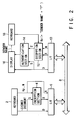
- the electronic authentication system of the present invention will be described below with reference to FIG. 2.
- the sender side is constituted by a keyboard 2, an RSA encryption section 4, and an interface 6, and the reception side is constituted by an interface 10, an RSA decryption section 12, an authentication section 14, a display 16, and a keyboard 18.
- the signature data S in the singed document D input from the keyboard 2 is input to the RSA encryption section 4, and the signature data S is RSA-encrypted by using the secret key Kp and the product N of large prime numbers p and q which are also input from the keyboard 2.
- the encrypted signature data X, product N (plaintext), and singed document data (also including signature data S) D (plaintext) are sent to a network 8.
- the system operator secretly informs the person of his/her secret key Kp and the product N of the prime numbers. However, it is not necessary to secretly inform the person of the product N.
- the document data (plaintext) D is displayed by the display 16, and the signature data X and product N are supplied to the RSA decryption section 12.
- Signature data S' decrypted by the RSA decryption section 12 is supplied to the authentication section 14 and compared with the signature data S included in the document data D.
- the authentication result is displayed by the display 16.
- the public key Ko required by the decryption section 12 is not obtained by searching the electronic file or the like, but the public key Ko is input from the keyboard 18.
- the public key is a character string which can specify the name, address, E-mail address, and the like of the sender such that the public key is easily memorized by a third party, and which is/are included in the sent document data D. More specifically, since a character string which can be easily reasoned from the property of the sender is used as the public key Ko, an electronic storage device such as a dictionary file in which a public key is electronically stored is not required. The system operator determines which one of the name, the address, E-mail address, and the like is used, in advance.
- a character string which can simply specify a sender name is not directly used as the public key Ko, but a character string obtained by adding a character or a character string whose code is an odd number to the end of a character string which specifies the sender name is used as the public key.
- the lowermost bit of the character at the end of the character or character string to be added must be an odd number.
- the public key can be easily reasoned by a property of the sender, and the public key has a character string which can be easily memorized by a third party.
- a predetermined character or character string to be added is determined by a system operator. In this case, it is determined that "?" is added. More specifically, a third party finds a sender name from the document data D displayed by the display 16, and inputs a character string obtained by adding "?" to the sender name to the RSA decryption section 12 as the public key Ko.
- an E-mail address or the like plus the predetermined character or character string is preferably used as the public key Ko in place of a character string (ASCII code) obtained by adding a predetermined character or character string to a "sender name (although family and given names are preferably used, only a family name may be used)". It is assumed that the number of digits of the public key Ko is determined in advance. When the number of digits of the character string is smaller than the predetermined number of the digits, a proper character, e.g., "0" is preferably added to the end of the character string.
- FIG. 3 is a flow chart showing a process of generating a secret key Kp performed by a system operator side.
- step S4 Upon accept of the public key Ko from the sender, in step S4, large prime numbers p and q are generated.
- step S6 values N and ⁇ (N) from the prime numbers p and q are computed.
- step S14 the system operator secretly informs a sender of the secret key Kp and the value N. However, it is not necessary to secretly inform the sender of the product N.
- the secret key Kp is generated by the equation in step S12.
- the equation in step S12 is the sufficient condition of the above modified equation. Since the greatest common divisor is not computed in the equation in step S12, the secret key Kp can be easily generated by the equation in step S12.
- step S14 the system operator secretly informs a sender of the secret key Kp and the value N. However, it is not necessary to secretly inform the sender of the product N.
- step S26 it is determined in step S26 whether p - 1 and the public key Ko are relatively prime. If No in step S26, the prime number p is altered in step S28, and step S26 is performed again. If Yes in step S26, it is determined in step S30 whether q - 1 and the public key Ko are relatively prime. If No in step S30, q is altered in step S32, and step S30 is performed again.
- step S38 the system operator secretly informs a sender of the secret key Kp and the value N. However, it is not necessary to secretly inform the sender of the product N.
- a character string which can be easily reasoned from a sender name e.g., a character string obtained by adding a specific character of which code is an odd number, such as "?" to the end of the sender name or by adding a character string whose end character of which code is an odd number
- a third party decrypts signature data of a sender for authentication which is encrypted by using a secret key of the sender, the third party can know the public key of the sender without using an electronic dictionary file, and an electronic dictionary in which the public key is stored is not required.
- illegal authentication cannot be established by falsifying the public key in the electronic dictionary file, and the system is simplified.
- the above description has been made with respect to an electronic authentication system in which a certain person adds a digital signature to communication data, and a third party authenticates the communication data with digital signature.
- the present invention can be also applied to a communication system in which a third party encrypts communication data in an RSA scheme by using a public key of a certain person and the certain person decrypts the communication data by using his/her secret key.
- Authentication performed when data is sent through an on-line network has been described.
- the present invention can be also applied to a system in which a signature is given to data on a recording medium, and a third party authenticates the data with signature.
- an electronic authentication system which can prevent illegal authentication from being established.
Landscapes
- Engineering & Computer Science (AREA)
- Computer Security & Cryptography (AREA)
- Computer Networks & Wireless Communication (AREA)
- Signal Processing (AREA)
- Computing Systems (AREA)
- Theoretical Computer Science (AREA)
- Storage Device Security (AREA)
- Information Transfer Between Computers (AREA)
- Computer And Data Communications (AREA)
Applications Claiming Priority (3)
| Application Number | Priority Date | Filing Date | Title |
|---|---|---|---|
| JP36658/96 | 1996-02-23 | ||
| JP3665896 | 1996-02-23 | ||
| JP8036658A JPH09233068A (ja) | 1996-02-23 | 1996-02-23 | 電子認証システム |
Publications (2)
| Publication Number | Publication Date |
|---|---|
| EP0792045A2 true EP0792045A2 (fr) | 1997-08-27 |
| EP0792045A3 EP0792045A3 (fr) | 1999-11-03 |
Family
ID=12475966
Family Applications (1)
| Application Number | Title | Priority Date | Filing Date |
|---|---|---|---|
| EP97102858A Withdrawn EP0792045A3 (fr) | 1996-02-23 | 1997-02-21 | Procédé et dispositif de l'authentification utilisant des signatures numériques |
Country Status (3)
| Country | Link |
|---|---|
| US (1) | US5987133A (fr) |
| EP (1) | EP0792045A3 (fr) |
| JP (1) | JPH09233068A (fr) |
Families Citing this family (21)
| Publication number | Priority date | Publication date | Assignee | Title |
|---|---|---|---|---|
| JPH10307799A (ja) * | 1997-02-28 | 1998-11-17 | Media Konekuto:Kk | コンピュータ通信網における身元確認方法及び身元確認装置 |
| US6356753B1 (en) * | 1998-04-24 | 2002-03-12 | Ericsson Inc | Management of authentication and encryption user information in digital user terminals |
| JP4284867B2 (ja) * | 2001-01-18 | 2009-06-24 | 株式会社日立製作所 | 標準モデル上で適応的選択暗号文攻撃に対して安全な公開鍵暗号方法 |
| GB2389688A (en) * | 2001-01-26 | 2003-12-17 | Shearman & Sterling Llp | Methods and systems for electronically representing records ofobligations |
| US7194618B1 (en) | 2001-03-05 | 2007-03-20 | Suominen Edwin A | Encryption and authentication systems and methods |
| US20030014631A1 (en) * | 2001-07-16 | 2003-01-16 | Steven Sprague | Method and system for user and group authentication with pseudo-anonymity over a public network |
| US8117450B2 (en) * | 2001-10-11 | 2012-02-14 | Hewlett-Packard Development Company, L.P. | System and method for secure data transmission |
| KR100425589B1 (ko) * | 2002-05-20 | 2004-04-01 | 학교법인 포항공과대학교 | 케이씨디에스에이를 이용한 서명 암호화 방법 |
| US7240200B2 (en) * | 2002-09-26 | 2007-07-03 | International Business Machines Corporation | System and method for guaranteeing software integrity via combined hardware and software authentication |
| US8140824B2 (en) | 2002-11-21 | 2012-03-20 | International Business Machines Corporation | Secure code authentication |
| US7194626B2 (en) * | 2002-11-21 | 2007-03-20 | International Business Machines Corporation | Hardware-based secure code authentication |
| US7171563B2 (en) * | 2003-05-15 | 2007-01-30 | International Business Machines Corporation | Method and system for ensuring security of code in a system on a chip |
| US7366299B2 (en) * | 2003-09-26 | 2008-04-29 | International Business Machines Corporation | Method for encrypting and decrypting data using derivative equations and factors |
| KR100709758B1 (ko) * | 2005-06-04 | 2007-04-19 | 원광대학교산학협력단 | 혼합형 암호화 시스템 |
| US7895651B2 (en) | 2005-07-29 | 2011-02-22 | Bit 9, Inc. | Content tracking in a network security system |
| US8984636B2 (en) | 2005-07-29 | 2015-03-17 | Bit9, Inc. | Content extractor and analysis system |
| US8272058B2 (en) | 2005-07-29 | 2012-09-18 | Bit 9, Inc. | Centralized timed analysis in a network security system |
| US8245307B1 (en) * | 2006-12-18 | 2012-08-14 | Nvidia Corporation | Providing secure access to a secret |
| US20150100795A1 (en) * | 2013-10-07 | 2015-04-09 | Microsemi Corporation | Secure Storage Devices, Authentication Devices, and Methods Thereof |
| JP6365076B2 (ja) * | 2014-07-31 | 2018-08-01 | 大日本印刷株式会社 | データ変換装置 |
| CN108200063B (zh) * | 2017-12-29 | 2020-01-03 | 华中科技大学 | 一种可搜索公钥加密方法、采用该方法的系统和服务器 |
Family Cites Families (5)
| Publication number | Priority date | Publication date | Assignee | Title |
|---|---|---|---|---|
| US4893338A (en) * | 1987-12-31 | 1990-01-09 | Pitney Bowes Inc. | System for conveying information for the reliable authentification of a plurality of documents |
| US4868877A (en) * | 1988-02-12 | 1989-09-19 | Fischer Addison M | Public key/signature cryptosystem with enhanced digital signature certification |
| US5016274A (en) * | 1988-11-08 | 1991-05-14 | Silvio Micali | On-line/off-line digital signing |
| US5537475A (en) * | 1994-02-01 | 1996-07-16 | Micali; Silvio | Efficient digital signature algorithm and use thereof technical field |
| US5506905A (en) * | 1994-06-10 | 1996-04-09 | Delco Electronics Corp. | Authentication method for keyless entry system |
-
1996
- 1996-02-23 JP JP8036658A patent/JPH09233068A/ja active Pending
-
1997
- 1997-02-20 US US08/802,754 patent/US5987133A/en not_active Expired - Fee Related
- 1997-02-21 EP EP97102858A patent/EP0792045A3/fr not_active Withdrawn
Non-Patent Citations (4)
| Title |
|---|
| CHI SUNG LAIH ET AL.: "A new scheme for ID-based cryptosystem and signature" EIGHTH ANNUAL JOINT CONFERENCE OF THE IEEE COMPUTER AND COMMUNICATIONS SOCIETIES, 23 - 27 April 1989, pages 998-1002, XP000076756 New York, US * |
| CHIN-CHEN CHANG, REN-JUNN HWANG: "A strategy for transforming public-key cryptosystems into identity-based cryptosystems" ANNUAL INTERNATIONAL CARNAHAN CONFERENCE ON SECURITY TECHNOLOGY, TAIPEI, OCT. 1 - 3, 1991, 1 - 3 October 1991, pages 68-72, XP000300409 New York, USISBN: 0-7803-0120-X * |
| CHI-SUNG LAIH ET AL.: "A new scheme for ID-based cryptosystems and signatures" JOURNAL OF THE CHINESE INSTITUTE OF ENGINEERS,, vol. 15, no. 4, July 1992 (1992-07), pages 605-610, XP002114434 Taiwan ISSN: 0253-3839 * |
| HUNG-MIN SUN, TZONELIH HWANG: "Public-key ID-based cryptosystem" ANNUAL INTERNATIONAL CARNAHAN CONFERENCE ON SECURITY TECHNOLOGY, 1 - 3 October 1991, pages 142-144, XP000300423 New York, USISBN: 0-7803-0120-X * |
Also Published As
| Publication number | Publication date |
|---|---|
| EP0792045A3 (fr) | 1999-11-03 |
| JPH09233068A (ja) | 1997-09-05 |
| US5987133A (en) | 1999-11-16 |
Similar Documents
| Publication | Publication Date | Title |
|---|---|---|
| US5987133A (en) | Electronic authentication system | |
| US6061791A (en) | Initial secret key establishment including facilities for verification of identity | |
| US5142577A (en) | Method and apparatus for authenticating messages | |
| US8595508B2 (en) | Method of secure encryption | |
| US6269445B1 (en) | Electronic shopping method, electronic shopping system and document authenticating method relating thereto | |
| US4453074A (en) | Protection system for intelligent cards | |
| US8831214B2 (en) | Password self encryption method and system and encryption by keys generated from personal secret information | |
| US6370250B1 (en) | Method of authentication and storage of private keys in a public key cryptography system (PKCS) | |
| US4944007A (en) | Public key diversification method | |
| US6307938B1 (en) | Method, system and apparatus for generating self-validating prime numbers | |
| US20060195402A1 (en) | Secure data transmission using undiscoverable or black data | |
| US20110058673A1 (en) | Public key encryption for groups | |
| US10089627B2 (en) | Cryptographic authentication and identification method using real-time encryption | |
| US7020776B2 (en) | Cryptosystem based on a Jacobian of a curve | |
| KR100396740B1 (ko) | 계산적 디피-헬만 가정에 기반하는 안전성 증명 가능한공개키 암호화 방법 | |
| US20070101140A1 (en) | Generation and validation of diffie-hellman digital signatures | |
| GB2264423A (en) | Devices for implementing public key cryptography and digital signatures | |
| WO2000067447A1 (fr) | Ameliorations apportees a la transmission de donnees securisee | |
| US20040264702A1 (en) | Method and apparatus for producing cryptographic keys | |
| JPH07121107A (ja) | 鍵生成方法および装置 | |
| EP1560362B1 (fr) | Procédé et système de cryptage basé sur l'utilisation d'un vecteur de données de référence | |
| JPH0556037A (ja) | データ処理方式 | |
| Girard | Secure personalization using proxy cryptography | |
| KR20050028720A (ko) | 사람이 기억할 수 있는 비밀정보와 공개 키 암호 시스템을 이용한 인증 기술 | |
| KR20060063918A (ko) | 디피-헬만 디지털 서명의 생성 및 확인 |
Legal Events
| Date | Code | Title | Description |
|---|---|---|---|
| PUAI | Public reference made under article 153(3) epc to a published international application that has entered the european phase |
Free format text: ORIGINAL CODE: 0009012 |
|
| 17P | Request for examination filed |
Effective date: 19970221 |
|
| AK | Designated contracting states |
Kind code of ref document: A2 Designated state(s): DE FR GB |
|
| PUAL | Search report despatched |
Free format text: ORIGINAL CODE: 0009013 |
|
| AK | Designated contracting states |
Kind code of ref document: A3 Designated state(s): DE FR GB |
|
| RIC1 | Information provided on ipc code assigned before grant |
Free format text: 6H 04L 9/32 A, 6H 04L 9/30 B |
|
| STAA | Information on the status of an ep patent application or granted ep patent |
Free format text: STATUS: THE APPLICATION HAS BEEN WITHDRAWN |
|
| 18W | Application withdrawn |
Withdrawal date: 20020528 |