EP0792301B1 - Verfahren zur herstellung von kautschukmodifizierten formmassen aus derivate von acrylamiden oder -methacrylamiden enthaltenden reaktionsgemischen - Google Patents
Verfahren zur herstellung von kautschukmodifizierten formmassen aus derivate von acrylamiden oder -methacrylamiden enthaltenden reaktionsgemischen Download PDFInfo
- Publication number
- EP0792301B1 EP0792301B1 EP95940175A EP95940175A EP0792301B1 EP 0792301 B1 EP0792301 B1 EP 0792301B1 EP 95940175 A EP95940175 A EP 95940175A EP 95940175 A EP95940175 A EP 95940175A EP 0792301 B1 EP0792301 B1 EP 0792301B1
- Authority
- EP
- European Patent Office
- Prior art keywords
- rubber
- hydrogen
- alkyl
- mixture
- carbon atoms
- Prior art date
- Legal status (The legal status is an assumption and is not a legal conclusion. Google has not performed a legal analysis and makes no representation as to the accuracy of the status listed.)
- Expired - Lifetime
Links
Classifications
-
- C—CHEMISTRY; METALLURGY
- C08—ORGANIC MACROMOLECULAR COMPOUNDS; THEIR PREPARATION OR CHEMICAL WORKING-UP; COMPOSITIONS BASED THEREON
- C08F—MACROMOLECULAR COMPOUNDS OBTAINED BY REACTIONS ONLY INVOLVING CARBON-TO-CARBON UNSATURATED BONDS
- C08F265/00—Macromolecular compounds obtained by polymerising monomers on to polymers of unsaturated monocarboxylic acids or derivatives thereof as defined in group C08F20/00
- C08F265/04—Macromolecular compounds obtained by polymerising monomers on to polymers of unsaturated monocarboxylic acids or derivatives thereof as defined in group C08F20/00 on to polymers of esters
- C08F265/06—Polymerisation of acrylate or methacrylate esters on to polymers thereof
-
- C—CHEMISTRY; METALLURGY
- C08—ORGANIC MACROMOLECULAR COMPOUNDS; THEIR PREPARATION OR CHEMICAL WORKING-UP; COMPOSITIONS BASED THEREON
- C08F—MACROMOLECULAR COMPOUNDS OBTAINED BY REACTIONS ONLY INVOLVING CARBON-TO-CARBON UNSATURATED BONDS
- C08F265/00—Macromolecular compounds obtained by polymerising monomers on to polymers of unsaturated monocarboxylic acids or derivatives thereof as defined in group C08F20/00
- C08F265/04—Macromolecular compounds obtained by polymerising monomers on to polymers of unsaturated monocarboxylic acids or derivatives thereof as defined in group C08F20/00 on to polymers of esters
-
- C—CHEMISTRY; METALLURGY
- C08—ORGANIC MACROMOLECULAR COMPOUNDS; THEIR PREPARATION OR CHEMICAL WORKING-UP; COMPOSITIONS BASED THEREON
- C08F—MACROMOLECULAR COMPOUNDS OBTAINED BY REACTIONS ONLY INVOLVING CARBON-TO-CARBON UNSATURATED BONDS
- C08F2/00—Processes of polymerisation
- C08F2/12—Polymerisation in non-solvents
- C08F2/16—Aqueous medium
- C08F2/18—Suspension polymerisation
-
- C—CHEMISTRY; METALLURGY
- C08—ORGANIC MACROMOLECULAR COMPOUNDS; THEIR PREPARATION OR CHEMICAL WORKING-UP; COMPOSITIONS BASED THEREON
- C08F—MACROMOLECULAR COMPOUNDS OBTAINED BY REACTIONS ONLY INVOLVING CARBON-TO-CARBON UNSATURATED BONDS
- C08F212/00—Copolymers of compounds having one or more unsaturated aliphatic radicals, each having only one carbon-to-carbon double bond, and at least one being terminated by an aromatic carbocyclic ring
- C08F212/02—Monomers containing only one unsaturated aliphatic radical
- C08F212/04—Monomers containing only one unsaturated aliphatic radical containing one ring
- C08F212/06—Hydrocarbons
- C08F212/08—Styrene
-
- C—CHEMISTRY; METALLURGY
- C08—ORGANIC MACROMOLECULAR COMPOUNDS; THEIR PREPARATION OR CHEMICAL WORKING-UP; COMPOSITIONS BASED THEREON
- C08F—MACROMOLECULAR COMPOUNDS OBTAINED BY REACTIONS ONLY INVOLVING CARBON-TO-CARBON UNSATURATED BONDS
- C08F220/00—Copolymers of compounds having one or more unsaturated aliphatic radicals, each having only one carbon-to-carbon double bond, and only one being terminated by only one carboxyl radical or a salt, anhydride ester, amide, imide or nitrile thereof
- C08F220/02—Monocarboxylic acids having less than ten carbon atoms; Derivatives thereof
- C08F220/42—Nitriles
- C08F220/44—Acrylonitrile
-
- C—CHEMISTRY; METALLURGY
- C08—ORGANIC MACROMOLECULAR COMPOUNDS; THEIR PREPARATION OR CHEMICAL WORKING-UP; COMPOSITIONS BASED THEREON
- C08F—MACROMOLECULAR COMPOUNDS OBTAINED BY REACTIONS ONLY INVOLVING CARBON-TO-CARBON UNSATURATED BONDS
- C08F220/00—Copolymers of compounds having one or more unsaturated aliphatic radicals, each having only one carbon-to-carbon double bond, and only one being terminated by only one carboxyl radical or a salt, anhydride ester, amide, imide or nitrile thereof
- C08F220/02—Monocarboxylic acids having less than ten carbon atoms; Derivatives thereof
- C08F220/52—Amides or imides
- C08F220/54—Amides, e.g. N,N-dimethylacrylamide or N-isopropylacrylamide
- C08F220/56—Acrylamide; Methacrylamide
-
- C—CHEMISTRY; METALLURGY
- C08—ORGANIC MACROMOLECULAR COMPOUNDS; THEIR PREPARATION OR CHEMICAL WORKING-UP; COMPOSITIONS BASED THEREON
- C08F—MACROMOLECULAR COMPOUNDS OBTAINED BY REACTIONS ONLY INVOLVING CARBON-TO-CARBON UNSATURATED BONDS
- C08F222/00—Copolymers of compounds having one or more unsaturated aliphatic radicals, each having only one carbon-to-carbon double bond, and at least one being terminated by a carboxyl radical and containing at least one other carboxyl radical in the molecule; Salts, anhydrides, esters, amides, imides, or nitriles thereof
- C08F222/04—Anhydrides, e.g. cyclic anhydrides
- C08F222/06—Maleic anhydride
-
- C—CHEMISTRY; METALLURGY
- C08—ORGANIC MACROMOLECULAR COMPOUNDS; THEIR PREPARATION OR CHEMICAL WORKING-UP; COMPOSITIONS BASED THEREON
- C08F—MACROMOLECULAR COMPOUNDS OBTAINED BY REACTIONS ONLY INVOLVING CARBON-TO-CARBON UNSATURATED BONDS
- C08F222/00—Copolymers of compounds having one or more unsaturated aliphatic radicals, each having only one carbon-to-carbon double bond, and at least one being terminated by a carboxyl radical and containing at least one other carboxyl radical in the molecule; Salts, anhydrides, esters, amides, imides, or nitriles thereof
- C08F222/36—Amides or imides
- C08F222/40—Imides, e.g. cyclic imides
-
- C—CHEMISTRY; METALLURGY
- C08—ORGANIC MACROMOLECULAR COMPOUNDS; THEIR PREPARATION OR CHEMICAL WORKING-UP; COMPOSITIONS BASED THEREON
- C08L—COMPOSITIONS OF MACROMOLECULAR COMPOUNDS
- C08L51/00—Compositions of graft polymers in which the grafted component is obtained by reactions only involving carbon-to-carbon unsaturated bonds; Compositions of derivatives of such polymers
- C08L51/04—Compositions of graft polymers in which the grafted component is obtained by reactions only involving carbon-to-carbon unsaturated bonds; Compositions of derivatives of such polymers grafted on to rubbers
-
- C—CHEMISTRY; METALLURGY
- C08—ORGANIC MACROMOLECULAR COMPOUNDS; THEIR PREPARATION OR CHEMICAL WORKING-UP; COMPOSITIONS BASED THEREON
- C08L—COMPOSITIONS OF MACROMOLECULAR COMPOUNDS
- C08L51/00—Compositions of graft polymers in which the grafted component is obtained by reactions only involving carbon-to-carbon unsaturated bonds; Compositions of derivatives of such polymers
- C08L51/06—Compositions of graft polymers in which the grafted component is obtained by reactions only involving carbon-to-carbon unsaturated bonds; Compositions of derivatives of such polymers grafted on to homopolymers or copolymers of aliphatic hydrocarbons containing only one carbon-to-carbon double bond
Definitions
- the invention relates to a method for producing rubber-modified Molding compositions and rubber-modified manufactured by the process Molding compositions, in the process derivatives of acrylamides or methacrylamides can be used.
- Rubber-modified molding compositions are compositions in which domains of Elastomers, e.g. Rubbers, in a matrix of a thermoplastic are embedded. There is a great need for rubber modified Molding compounds, surface gloss, impact resistance and tear resistance exhibit. The characteristic domain structure is the one desired mechanical properties responsible.
- the multi-phase and thus also the domain structure of rubber-modified Molding compounds are based on the fact that these consist of different Polymer components are built up, which are not or only partially with each other are miscible.
- the impact strength of the same results from a increased energy absorption during deformation until breakage.
- the Energy becomes the formation of micro-voids or the introduction consumed by sliding processes of the matrix polymer chains.
- the Multi-phase is therefore a necessary prerequisite for achieving this high impact strength.
- phase coupling at the interfaces of the elastomer particles is achieved by graft copolymerization.
- E.g. is at the Production of acrylonitrile-styrene-acrylate (ASA) molding compounds as a rule proceed in such a way that an acrylate rubber is placed on the following by polymerization with a monomer mixture of styrene and Acrylonitrile copolymers based on the latter two monomers be grafted on.
- ASA acrylonitrile-styrene-acrylate
- ASA molding compounds in emulsion is for example described in DE 32 06 136, 31 49 046, 31 49 358, 32 27 555, 31 29 378, 31 29 472, 29 40 804, 28 26 925 and 19 11 882.
- the Rubber made from n-butyl acrylate and small amounts of two double bonds containing monomers produced in emulsion.
- the after The molding materials produced by the process do not have one for all Applications sufficient impact strength, rigidity and tear resistance on, and the gloss of the moldings made from it is not over a wide range can be varied.
- the rubber is made from n-butyl acrylate with 0.5 to 10% by weight. % of a comonomer with two free-radically polymerizable double bonds produced.
- the polymerization of the styrene-acrylonitrile (SAN) monomer mixture with a rubber turnover of 10 to 80% started.
- the grafted portion of the rubber does not have the same composition as the polymer matrix, which leads to leads to poorer mechanical properties of the molding compositions.
- Farther leads the polymerization of rubber units into the graft shell, d. H. the graft branches, to lower the Vicat softening temperature of the products.
- the invention is therefore based on the object of a method for Production of rubber-modified molding compositions with improved mechanical properties, especially increased impact strength, Notched impact strength and perforated notched impact strength.
- a solvent can be added in the second stage be added.
- an improved rubber-modified molding composition by the process according to the invention is based on the fact that in the first stage the acrylate or methacrylate is copolymerized with an acrylamide or methacrylamide of the general formula (II).
- Crosslinking occurs in the course of the copolymerization, in which the rubber molecules are connected via the following structure (III): in which R 3 , R 4 and R 5 have the same meaning as above.
- a graft copolymerization takes place, where the backbone of the resulting graft copolymer from the rubber (B) is formed and the graft branches from the second monomer (d) are built up. Because there is no 100% grafting, part remains of the rubber ungrafted and it becomes a chain polymer at the same time formed from the third monomer (d), so that three in the molding composition
- alkyl groups having 1 to 32 carbon atoms are Methyl, ethyl, n-propyl, iso-propyl, n-butyl, iso-butyl, tert-butyl, n-pentyl, iso-pentyl, n-hexyl, n-heptyl, n-octyl, ethylhexyl, n-nonyl, n-decyl, n-dodecyl, n-tetradecyl, n-hexadecyl, n-octadecyl, n-eicosyl, n-docosyl, n-tetracosyl, n-hexacosyl, n-octacosyl, n-triacontyl, n-hentriacontyl and dotriacontyl group.
- carboxylate groups with 1 to 10 carbon atoms are Formyl, acetyl, n-propionyl, iso-propionyl, n-butanoyl, iso-butanoyl, tert-butanoyl, n-pentanoyl, n-hexanoyl, n-heptanoyl, n-octanoyl, n-nonanoyl and n-decanoyl group.
- R 2 is an alkyl group with 1 to 18 carbon atoms.
- the rubber (B) preferably has a glass transition temperature of less than 0 ° C., preferably less than -10 ° C., the glass temperature being determined by means of DSC according to ASTM 3418.
- the rubber therefore has the required softness.
- the glass transition temperature can be adjusted either by using an acrylate or methacrylate, the polymer of which has the desired glass transition temperature, or by using a mixture of acrylates or methacrylates which have different lengths of the side chains (R 2 , in formula I). This setting of the glass temperature is based on the fact that the glass temperature of acrylate and methacrylate polymers initially decreases with increasing length of the side chain, then passes through a minimum and finally increases again.
- the minimum is a side chain of about 7 carbon atoms for polyacrylates and 10 for polymethacrylates. This general range for the length of the side chains R 2 is therefore preferred.
- the rubber-modified molding composition (D) produced contains 1 to 60% by weight, preferably 5 to 40% by weight, of the rubber (B). The upper limit results from the fact that the molding compound must have sufficient strength in spite of the embedded domains of the rubber. The lower limit is essentially determined by the fact that sufficient energy must be absorbed during the deformation.
- alkyl acrylate or methacrylate (a) n-butyl acrylate or ethylhexyl acrylate used.
- Examples of compounds (b) of the formula (II) are acrylamide-N-alkylol and methacrylamide-N-alkylol compounds, such as acrylamide methylol methyl ether, N-methylol-acrylamide, methacrylamide-methylol methyl ether, N-methylol-methacrylamide, Methacrylamide N-methylol butyl ether and methacrylamide N-methyl acetate.
- first monomers (c) are compounds with two double bonds, such as divinylbenzene, allyl methacrylate and butanediol diacrylate, Compounds with only one double bond, such as substituted or unsubstituted styrene, ethylene and methacrylic acid derivatives such as methacrylamide, as well as compounds containing groups that are thermal Decompose to form radicals, i.e. Connections with peroxy groups, Diazo groups or labile C-C bonds.
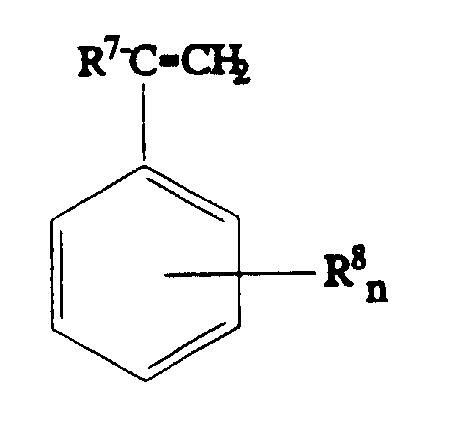
- second monomers (d) are styrene, ⁇ -methylstyrene, nucleus-substituted styrenes with halogen and / or aliphatic hydrocarbon groups, acrylonitrile, methacrylamide, methyl methacrylate, maleic anhydride, N-phenyl maleimide and N-vinyl maleimide, preferably styrene of the formula in which R 7 and R 8 , which can be the same and different, denote hydrogen and alkyl having 1-8 C atoms and n values from 0 to 4, and acrylonitrile. Accordingly, ASA molding compositions in particular are produced by the process according to the invention.
- the polymerization carried out either continuously in solution or in bulk or after a conversion of at least 15% as suspension polymerization to be continued.
- the polymerization is preferred at a temperature of 0 ° C to 200 ° C 50 ° C to 160 ° C carried out. All common polymerization processes can be used, however the polymerization is with free Radicals preferred.
- the blends can contain additives such as lubricants, antioxidants, Contain dyes, glass fibers and / or fillers.
- the rubbers come in the molding compound as particles with one Diameter between 0.1 and 20 ⁇ m, preferably between 0.1 and 10 ⁇ m, in the polymer matrix. Bi- or trimodal are preferred Distributions.
- the rubber particles are in the form of capsules, sticks, Drops, labyrinths, cells, balls, bowls, stick clusters or drop clusters. However, particles are also made up of several spherical particles exist, observed. To be favoured Cells or the latter type. The particle shapes mentioned are in A. Echte, Advances in Chemical Serials, 222, p. 29, 1989.
- the rubbers can be mixed with other plastics are produced that contain up to 65 wt .-% of these plastics.
- suitable plastics are polycarbonates, polyphenylene ethers, Polymethyl methacrylate, polyester and polyamide.
- Cyclohexane, n-butyl acrylate, N-methylol methacrylamide (M-AMOL), acrylonitrile and styrene are products from BASF and are manufactured without further purification used.
- Luviskol® K 90 is also a product of BASF and is a Polyvinylpyrrolidone with a K value of 90, measured 1% in water at 25 ° C. The measurement of the K value is in Cellulose Chemie, 13, 1932, Pp. 358 to 364.
- Allyl methacrylate was made by Fluka, tetra sodium di-phosphate from Merk, Azobisisobutyronitril from Akzo Chemicals and dicumyl peroxide from Peroxid Chemie.
- the cyclohexane was removed in vacuo in a rotary evaporator removed and replaced with styrene and then replenished with acrylonitrile, a mixture of 69.2% by weight of styrene, 23% by weight of acrylonitrile and 7.8 wt% rubber.
- Test 1 was repeated, with 0.5% by weight (test 2) or 1.0% by weight (experiment 3) of N-methylol methacrylamide were.
- the N-methylol methacrylamide became the Feed of the mixture of n-butyl acrylate and allyl methacrylate was added.
- the molding compositions obtained in experiments 1 to 3 were at 240 ° C. Melting temperature and 60 ° C mold temperature to small standard sticks sprayed.
- the impact strength of these molded parts was in accordance with DIN 53453-n, edition 5/75, the impact strength according to DIN 53453-k, Edition 5/75, and the notched impact strength according to DIN 53753-L-3-0, Issue 4/81, measured.
- N-methalol methacrylamide brings one Improvement of the mechanical properties of the molding compounds.
Landscapes
- Chemical & Material Sciences (AREA)
- Health & Medical Sciences (AREA)
- Chemical Kinetics & Catalysis (AREA)
- Medicinal Chemistry (AREA)
- Polymers & Plastics (AREA)
- Organic Chemistry (AREA)
- Graft Or Block Polymers (AREA)
- Compositions Of Macromolecular Compounds (AREA)
- Addition Polymer Or Copolymer, Post-Treatments, Or Chemical Modifications (AREA)
Abstract
Description


- 36 bis 99,9 Gew.-% (a),
- 0,1 bis 4 Gew.-% (b), und
- 0 bis 60 Gew.-% (c),

Claims (13)
- Verfahren zur Herstellung von kautschukmodifizierten Formmassen,
dadurch gekennzeichnet, daß in einer ersten Stufe ein erstes Gemisch (A), das zumindest ein Alkylacrylat oder -methacrylat (a) der allgemeinen Formel (I)in der R1 ein Wasserstoffatom oder eine Methylgruppe und R2 eine Alkylgruppe mit 1 bis 32 Kohlenstoff-Atomen bedeutet, eine Verbindung (b) der allgemeinen Formel (II) in der R3 ein Wasserstoffatom oder eine Methylgruppe, R4 ein Wasserstoffatom oder eine Alkylgruppe mit 1 bis 8 Kohlenstoff-Atomen, R5 ein Wasserstoffatom oder eine Methylgruppe und R6 ein Wasserstoffatom, eine Alkylgruppe mit 1 bis 10 Kohlenstoff-atomen, vorzugsweise Wasserstoff bedeutet, und ggf. ein erstes Monomeres (c) oder mehrere enthält, mit freien Radikalen zu einem Kautschuk (B) polymerisiert wird,
in einer zweiten Stufe der entstandene Kautschuk (B) unter Zugabe eines oder mehrerer zweiter Monomere (d) in diesen unter Bildung eines zweiten Gemischs (C) gelöst oder gequollen wird und
in einer dritten Stufe das gebildete zweite Gemisch (C) mit freien Radikalen zu der kautschukmodifizierten Formmasse (D) polymerisiert wird. - Verfahren nach Anspruch 1, dadurch gekennzeichnet, daß ein Alkylacrylat oder -methacrylat (a) der allgemeinen Formel (I) nach Anspruch 1 verwendet wird, bei dem R2 eine Alkylgruppe mit 1 bis 18 Kohlenstoff-Atomen bedeutet.
- Verfahren nach Anspruch 1 oder 2, dadurch gekennzeichnet, daß das Gemisch (A) folgende Zusammensetzung aufweist:wobei alle Angaben in Gew.-% auf die Gesamtmenge des Gemischs (A) bezogen sind.30 bis 99,8 Gew.-% des Alkylacrylat oder -methacrylats (a),0,2 bis 10 Gew.-% der Verbindung (b) und0 bis 60 Gew.-% des ersten Monomeren (c),
- Verfahren nach einem der Ansprüche 1 bis 3, dadurch gekennzeichnet, daß Kautschukformmassen (D) hergestellt werden, die 1 bis 60 Gew.- %, vorzugsweise 5 bis 40 Gew.-%, des Kautschuks (B), enthalten.
- Verfahren nach einem der Ansprüche 1 bis 4, dadurch gekennzeichnet, daß als Alkylacrylat oder -methacrylat (a) n-Butylacrylat oder Ethylhexylacrylat verwendet wird.
- Verfahren nach einem der Ansprüche 1 bis 5, dadurch gekennzeichnet, daß in der ersten Stufe eine Verbindung (b) der allgemeinen Formel (II) nach Anspruch 1 verwendet wird, in der R3 ein Wasserstoffatom oder eine Methylgruppe, R4 ein Wasserstoffatom, R5 ein Wasserstoffatom und R6 ein Wasserstoffatom oder eine Alkylgruppe mit 1-10, vorzugsweise 1-6 C-Atomen bedeutet, insbesondere in der R6 ein Wasserstoffatom ist.
- Verfahren nach einem der Ansprüche 1 bis 6, dadurch gekennzeichnet, daß als zweite Monomere (d) Styrol, Acrylnitril, Methacrylamid, Maleinsäureanhydrid oder N-Phenylmaleinimid verwendet werden.
- Verfahren nach einem der Ansprüche 1 bis 7, dadurch gekennzeichnet, daß als erstes Monomeres (c) ein solches, das zwei oder mehr polymerisierbare Doppelbindungen enthält, verwendet wird.
- Verfahren nach einem der Ansprüche 1 bis 8, dadurch gekennzeichnet, daß ein weiteres Monomeres (c) verwendet wird, das Gruppen enthält, die bei thermischer Zersetzung Radikale bilden.
- Verfahren nach einem der Ansprüche 1 bis 9, dadurch gekennzeichnet, daß in der dritten Stufe die Polymerisation nach einem Umsatz von mindestens 15% als Suspensionspolymerisation weiter geführt wird.
- Kautschukmodifizierte Formmasse, dadurch gekennzeichnet, daß sie nach einem der Verfahrensansprüche 1 bis 10 hergestellt ist und in einer Matrix eingebettete Teilchen des Kautschuks (B) enthält.
- Kautschukmodifizierte Formmasse nach Anspruch 11, dadurch gekennzeichnet, daß die Kautschukteilchen in Form von Kapseln, Stäbchen, Tropfen, Labyrinthen, Zellen, Knäueln, Schalen, Stäbchenclustern oder Tropfenclustern vorliegen.
- Kautschukmodifizierte Formmasse nach Anspruch 11 oder 12, dadurch gekennzeichnet, daß die Kautschukteilchen einen Durchmesser von 0,1 bis 20 µm aufweisen.
Applications Claiming Priority (3)
| Application Number | Priority Date | Filing Date | Title |
|---|---|---|---|
| DE4440673A DE4440673A1 (de) | 1994-11-14 | 1994-11-14 | Verfahren zur Herstellung von kautschukmodifizierten Formmassen aus Derivate von Acrylamiden oder Methacrylamiden enthaltenden Reaktionsgemischen |
| DE4440673 | 1994-11-14 | ||
| PCT/EP1995/004477 WO1996015168A1 (de) | 1994-11-14 | 1995-11-14 | Verfahren zur herstellung von kautschukmodifizierten formmassen aus derivate von acrylamiden oder -methacrylamiden enthaltenden reaktionsgemischen |
Publications (2)
| Publication Number | Publication Date |
|---|---|
| EP0792301A1 EP0792301A1 (de) | 1997-09-03 |
| EP0792301B1 true EP0792301B1 (de) | 1998-10-14 |
Family
ID=6533304
Family Applications (1)
| Application Number | Title | Priority Date | Filing Date |
|---|---|---|---|
| EP95940175A Expired - Lifetime EP0792301B1 (de) | 1994-11-14 | 1995-11-14 | Verfahren zur herstellung von kautschukmodifizierten formmassen aus derivate von acrylamiden oder -methacrylamiden enthaltenden reaktionsgemischen |
Country Status (8)
| Country | Link |
|---|---|
| US (1) | US5886105A (de) |
| EP (1) | EP0792301B1 (de) |
| JP (1) | JPH10508654A (de) |
| KR (1) | KR970707186A (de) |
| CN (1) | CN1066458C (de) |
| DE (2) | DE4440673A1 (de) |
| ES (1) | ES2123295T3 (de) |
| WO (1) | WO1996015168A1 (de) |
Families Citing this family (2)
| Publication number | Priority date | Publication date | Assignee | Title |
|---|---|---|---|---|
| AUPO581197A0 (en) | 1997-03-21 | 1997-04-17 | University Of Sydney, The | Modified rubber polymer latex |
| US7342065B2 (en) * | 2003-09-18 | 2008-03-11 | The Goodyear Tire & Rubber Company | Preparation of nanocomposite of elastomer and exfoliated clay platelets, rubber compositions comprised of said nanocomposite and articles of manufacture, including tires |
Family Cites Families (14)
| Publication number | Priority date | Publication date | Assignee | Title |
|---|---|---|---|---|
| DE1182811B (de) * | 1962-02-01 | 1964-12-03 | Basf Ag | Thermoplastische Formmassen auf der Basis von Styrol und Acrylnitril |
| DE1911882B2 (de) * | 1969-03-08 | 1975-04-17 | Basf Ag, 6700 Ludwigshafen | Schlagfeste thermoplastische Massen |
| DE2126151A1 (de) * | 1971-05-26 | 1972-12-07 | Bayer | Verfahren zur Herstellung thermoplastisch-elastischer Formmassen |
| JPS5053492A (de) * | 1973-09-13 | 1975-05-12 | ||
| FR2328004A1 (fr) * | 1975-10-14 | 1977-05-13 | Ivanchev Sergei | Procede de preparation de copolymeres acrylate d'alcoyle-styrene-acrylonitrile |
| DE2826925A1 (de) * | 1978-06-20 | 1980-01-17 | Basf Ag | Witterungsbestaendige, schlagzaehe thermoplastische massen mit guter einfaerbbarkeit |
| DE2940804A1 (de) * | 1979-10-09 | 1981-04-23 | Basf Ag, 6700 Ludwigshafen | Thermoplastische formmasse und formteile aus dieser |
| DE3129472A1 (de) * | 1981-07-25 | 1983-02-10 | Basf Ag, 6700 Ludwigshafen | Thermoplastische formmasse |
| DE3129378A1 (de) * | 1981-07-25 | 1983-02-10 | Basf Ag, 6700 Ludwigshafen | Thermoplastische formmasse |
| DE3149046A1 (de) * | 1981-12-11 | 1983-06-16 | Basf Ag, 6700 Ludwigshafen | Witterungsbestaendige thermoplastische formmassen |
| DE3149358A1 (de) * | 1981-12-12 | 1983-06-16 | Basf Ag, 6700 Ludwigshafen | Thermoplastische formmasse |
| DE3206136A1 (de) * | 1982-02-20 | 1983-09-01 | Basf Ag, 6700 Ludwigshafen | Verfahren zur herstellung thermoplastischer formmassen |
| IT1157308B (it) * | 1982-06-01 | 1987-02-11 | Montedison Spa | Procedimento per preparare miscele di gomme acriliche con copolimeri stirene/acrilonitrile, dotate di migliorate caratteristiche di resistenza all'urto |
| FR2637899B1 (fr) * | 1988-10-17 | 1992-07-17 | Atochem | Copolymeres sequences et greffes, leur procede de fabrication et utilisation de ces copolymeres |
-
1994
- 1994-11-14 DE DE4440673A patent/DE4440673A1/de not_active Withdrawn
-
1995
- 1995-11-14 ES ES95940175T patent/ES2123295T3/es not_active Expired - Lifetime
- 1995-11-14 CN CN95196223A patent/CN1066458C/zh not_active Expired - Fee Related
- 1995-11-14 WO PCT/EP1995/004477 patent/WO1996015168A1/de not_active Ceased
- 1995-11-14 US US08/836,318 patent/US5886105A/en not_active Expired - Fee Related
- 1995-11-14 DE DE59503947T patent/DE59503947D1/de not_active Expired - Lifetime
- 1995-11-14 EP EP95940175A patent/EP0792301B1/de not_active Expired - Lifetime
- 1995-11-14 KR KR1019970703219A patent/KR970707186A/ko not_active Ceased
- 1995-11-14 JP JP8515738A patent/JPH10508654A/ja active Pending
Also Published As
| Publication number | Publication date |
|---|---|
| CN1066458C (zh) | 2001-05-30 |
| US5886105A (en) | 1999-03-23 |
| CN1163624A (zh) | 1997-10-29 |
| EP0792301A1 (de) | 1997-09-03 |
| KR970707186A (ko) | 1997-12-01 |
| WO1996015168A1 (de) | 1996-05-23 |
| JPH10508654A (ja) | 1998-08-25 |
| DE4440673A1 (de) | 1996-05-15 |
| DE59503947D1 (de) | 1998-11-19 |
| ES2123295T3 (es) | 1999-01-01 |
Similar Documents
| Publication | Publication Date | Title |
|---|---|---|
| DE1911882C3 (de) | ||
| DE2705656C3 (de) | Pfropfcopolymerisate und Verfahren zu ihrer Herstellung | |
| DE69922651T2 (de) | Ein polymethacrylatharz mit darin eingekapseltem schlagzäh-modifizierer sowie ein verfahren zu dessen herstellung | |
| DE1260135B (de) | Schlagfeste thermoplastische Formmassen | |
| EP0450485A2 (de) | Thermoplastische Formmasse | |
| DE2927572A1 (de) | Themoplastische formmassen | |
| DE2249023C3 (de) | Thermoplastische Formmassen | |
| DE19614845A1 (de) | Verfahren zur Herstellung von mit Acrylkautschuk modifizierten Formmassen und so erhältliche Formmassen | |
| DE69123341T2 (de) | Kern-Schale-Polymer | |
| EP0792298B1 (de) | Verfahren zur herstellung von kautschukmodifizierten formmassen mittels in den kautschuk eingebauten, bei thermischer zersetzung radikale bildenden gruppen | |
| DE1595343B2 (de) | Verfahren zum Herstellen schlagfester Styrol Acrylnitrilmischpolymensate | |
| EP0258741A2 (de) | Thermoplastische Formmasse auf Basis von ABS | |
| EP0161452A1 (de) | Thermoplastische Formmassen | |
| EP0792300B1 (de) | Verfahren zur herstellung von kautschukmodifizierten formmassen unter verwendung von peroxygruppen aufweisenden verbindungen | |
| EP0725094A2 (de) | Teilchenförmige Pfropfcopolymerisate und diese enthaltende thermoplastische Formmassen mit verbesserter Einfärbbarkeit | |
| EP0792299B1 (de) | Verfahren zur herstellung von kautschukformmassen | |
| DE4440673A1 (de) | Verfahren zur Herstellung von kautschukmodifizierten Formmassen aus Derivate von Acrylamiden oder Methacrylamiden enthaltenden Reaktionsgemischen | |
| EP0735063A2 (de) | Teilchenförmige Pfropfpolymerisate und diese enthaltende thermoplastische Formmassen mit verbesserter Kältezähigkeit | |
| DE1296802B (de) | Thermoplastische Formmassen | |
| EP0534244A1 (de) | Thermoplastische Formmassen | |
| EP0261396B1 (de) | Thermoplastische Formmasse auf Basis von ABS | |
| EP1108732A1 (de) | Verfahren zur Herstellung von thermoplastischen Formmassen | |
| EP0904306B1 (de) | Verfahren zur herstellung von mit acrylkautschuk modifizierten formmassen mittels in den acrylkautschuk eingebauten gruppen, die mit einer redoxkomponente zu radikalen zersetzt werden | |
| AT259865B (de) | Verfahren zur Herstellung von neuen Copolymerisaten | |
| DE2309590B2 (de) | Thermoplastische Masse |
Legal Events
| Date | Code | Title | Description |
|---|---|---|---|
| PUAI | Public reference made under article 153(3) epc to a published international application that has entered the european phase |
Free format text: ORIGINAL CODE: 0009012 |
|
| 17P | Request for examination filed |
Effective date: 19970610 |
|
| AK | Designated contracting states |
Kind code of ref document: A1 Designated state(s): BE DE ES FR GB IT NL |
|
| GRAG | Despatch of communication of intention to grant |
Free format text: ORIGINAL CODE: EPIDOS AGRA |
|
| 17Q | First examination report despatched |
Effective date: 19971204 |
|
| GRAG | Despatch of communication of intention to grant |
Free format text: ORIGINAL CODE: EPIDOS AGRA |
|
| GRAG | Despatch of communication of intention to grant |
Free format text: ORIGINAL CODE: EPIDOS AGRA |
|
| GRAH | Despatch of communication of intention to grant a patent |
Free format text: ORIGINAL CODE: EPIDOS IGRA |
|
| GRAH | Despatch of communication of intention to grant a patent |
Free format text: ORIGINAL CODE: EPIDOS IGRA |
|
| GRAA | (expected) grant |
Free format text: ORIGINAL CODE: 0009210 |
|
| AK | Designated contracting states |
Kind code of ref document: B1 Designated state(s): BE DE ES FR GB IT NL |
|
| REF | Corresponds to: |
Ref document number: 59503947 Country of ref document: DE Date of ref document: 19981119 |
|
| GBT | Gb: translation of ep patent filed (gb section 77(6)(a)/1977) |
Effective date: 19981111 |
|
| REG | Reference to a national code |
Ref country code: ES Ref legal event code: FG2A Ref document number: 2123295 Country of ref document: ES Kind code of ref document: T3 |
|
| ET | Fr: translation filed | ||
| PLBE | No opposition filed within time limit |
Free format text: ORIGINAL CODE: 0009261 |
|
| STAA | Information on the status of an ep patent application or granted ep patent |
Free format text: STATUS: NO OPPOSITION FILED WITHIN TIME LIMIT |
|
| 26N | No opposition filed | ||
| PGFP | Annual fee paid to national office [announced via postgrant information from national office to epo] |
Ref country code: FR Payment date: 20001013 Year of fee payment: 6 |
|
| PGFP | Annual fee paid to national office [announced via postgrant information from national office to epo] |
Ref country code: NL Payment date: 20001020 Year of fee payment: 6 |
|
| PGFP | Annual fee paid to national office [announced via postgrant information from national office to epo] |
Ref country code: GB Payment date: 20001101 Year of fee payment: 6 |
|
| PGFP | Annual fee paid to national office [announced via postgrant information from national office to epo] |
Ref country code: BE Payment date: 20001103 Year of fee payment: 6 |
|
| PGFP | Annual fee paid to national office [announced via postgrant information from national office to epo] |
Ref country code: ES Payment date: 20001113 Year of fee payment: 6 |
|
| PGFP | Annual fee paid to national office [announced via postgrant information from national office to epo] |
Ref country code: DE Payment date: 20001118 Year of fee payment: 6 |
|
| PG25 | Lapsed in a contracting state [announced via postgrant information from national office to epo] |
Ref country code: GB Free format text: LAPSE BECAUSE OF NON-PAYMENT OF DUE FEES Effective date: 20011114 |
|
| PG25 | Lapsed in a contracting state [announced via postgrant information from national office to epo] |
Ref country code: ES Free format text: LAPSE BECAUSE OF NON-PAYMENT OF DUE FEES Effective date: 20011115 |
|
| PG25 | Lapsed in a contracting state [announced via postgrant information from national office to epo] |
Ref country code: DE Free format text: LAPSE BECAUSE OF THE APPLICANT RENOUNCES Effective date: 20011121 |
|
| PG25 | Lapsed in a contracting state [announced via postgrant information from national office to epo] |
Ref country code: BE Free format text: LAPSE BECAUSE OF NON-PAYMENT OF DUE FEES Effective date: 20011130 |
|
| REG | Reference to a national code |
Ref country code: GB Ref legal event code: IF02 |
|
| BERE | Be: lapsed |
Owner name: BASF A.G. Effective date: 20011130 |
|
| PG25 | Lapsed in a contracting state [announced via postgrant information from national office to epo] |
Ref country code: NL Free format text: LAPSE BECAUSE OF NON-PAYMENT OF DUE FEES Effective date: 20020601 |
|
| PG25 | Lapsed in a contracting state [announced via postgrant information from national office to epo] |
Ref country code: FR Free format text: LAPSE BECAUSE OF NON-PAYMENT OF DUE FEES Effective date: 20020730 |
|
| NLV4 | Nl: lapsed or anulled due to non-payment of the annual fee |
Effective date: 20020601 |
|
| REG | Reference to a national code |
Ref country code: FR Ref legal event code: ST |
|
| REG | Reference to a national code |
Ref country code: FR Ref legal event code: ST |
|
| REG | Reference to a national code |
Ref country code: ES Ref legal event code: FD2A Effective date: 20021213 |
|
| PG25 | Lapsed in a contracting state [announced via postgrant information from national office to epo] |
Ref country code: IT Free format text: LAPSE BECAUSE OF NON-PAYMENT OF DUE FEES Effective date: 20051114 |