EP0792965A1 - Procédé pour le satinage du papier et calandre pour l'application du procédé - Google Patents
Procédé pour le satinage du papier et calandre pour l'application du procédé Download PDFInfo
- Publication number
- EP0792965A1 EP0792965A1 EP97100564A EP97100564A EP0792965A1 EP 0792965 A1 EP0792965 A1 EP 0792965A1 EP 97100564 A EP97100564 A EP 97100564A EP 97100564 A EP97100564 A EP 97100564A EP 0792965 A1 EP0792965 A1 EP 0792965A1
- Authority
- EP
- European Patent Office
- Prior art keywords
- web
- roller
- width
- rollers
- calender
- Prior art date
- Legal status (The legal status is an assumption and is not a legal conclusion. Google has not performed a legal analysis and makes no representation as to the accuracy of the status listed.)
- Granted
Links
- 238000000034 method Methods 0.000 title claims abstract description 15
- 238000001514 detection method Methods 0.000 claims description 10
- 229920002430 Fibre-reinforced plastic Polymers 0.000 claims description 3
- 239000011151 fibre-reinforced plastic Substances 0.000 claims description 3
- 238000004804 winding Methods 0.000 claims description 3
- 238000001816 cooling Methods 0.000 abstract description 5
- 230000002349 favourable effect Effects 0.000 description 3
- 238000013021 overheating Methods 0.000 description 3
- 238000010438 heat treatment Methods 0.000 description 2
- 238000003825 pressing Methods 0.000 description 2
- WNEODWDFDXWOLU-QHCPKHFHSA-N 3-[3-(hydroxymethyl)-4-[1-methyl-5-[[5-[(2s)-2-methyl-4-(oxetan-3-yl)piperazin-1-yl]pyridin-2-yl]amino]-6-oxopyridin-3-yl]pyridin-2-yl]-7,7-dimethyl-1,2,6,8-tetrahydrocyclopenta[3,4]pyrrolo[3,5-b]pyrazin-4-one Chemical compound C([C@@H](N(CC1)C=2C=NC(NC=3C(N(C)C=C(C=3)C=3C(=C(N4C(C5=CC=6CC(C)(C)CC=6N5CC4)=O)N=CC=3)CO)=O)=CC=2)C)N1C1COC1 WNEODWDFDXWOLU-QHCPKHFHSA-N 0.000 description 1
- 230000006978 adaptation Effects 0.000 description 1
- 238000003490 calendering Methods 0.000 description 1
- 238000010276 construction Methods 0.000 description 1
- 238000006073 displacement reaction Methods 0.000 description 1
- 238000005485 electric heating Methods 0.000 description 1
- 230000002706 hydrostatic effect Effects 0.000 description 1
- 239000000463 material Substances 0.000 description 1
- 238000012544 monitoring process Methods 0.000 description 1
- 239000004033 plastic Substances 0.000 description 1
- 229920003023 plastic Polymers 0.000 description 1
- 230000002265 prevention Effects 0.000 description 1
- 238000011144 upstream manufacturing Methods 0.000 description 1
- XLYOFNOQVPJJNP-UHFFFAOYSA-N water Substances O XLYOFNOQVPJJNP-UHFFFAOYSA-N 0.000 description 1
Images

Classifications
-
- F—MECHANICAL ENGINEERING; LIGHTING; HEATING; WEAPONS; BLASTING
- F26—DRYING
- F26B—DRYING SOLID MATERIALS OR OBJECTS BY REMOVING LIQUID THEREFROM
- F26B13/00—Machines and apparatus for drying fabrics, fibres, yarns, or other materials in long lengths, with progressive movement
- F26B13/10—Arrangements for feeding, heating or supporting materials; Controlling movement, tension or position of materials
- F26B13/14—Rollers, drums, cylinders; Arrangement of drives, supports, bearings, cleaning
-
- D—TEXTILES; PAPER
- D21—PAPER-MAKING; PRODUCTION OF CELLULOSE
- D21G—CALENDERS; ACCESSORIES FOR PAPER-MAKING MACHINES
- D21G1/00—Calenders; Smoothing apparatus
Definitions
- the invention relates to a method for satinizing paper which is passed as a web through at least one nip, which is delimited by a heatable hard roller and a soft roller provided with an elastic cover, and to a calender for carrying out this method with at least a nip delimited by a heatable hard roller and a soft roller provided with a cover.
- the invention is therefore based on the object of demonstrating a way in which, despite insufficient cooling or even without cooling, effective protection of the cover against overheating can be achieved even with different web widths.
- the web width is chosen to be smaller than the width of the cylindrical part of both the cover and the hard roller, and that the two rollers are axially adjusted relative to each other depending on the web width in such a way that on one web edge the cylindrical part of the cover and on the other web edge the cylindrical part of the hard roller protrude at most by a predetermined permissible edge width over the web edge.
- one web edge has a fixed target position regardless of the web width and only one of the two rollers is axially adjusted. Since the other roller can be held axially fixed, the construction is particularly simple.
- the other web edge is advantageously scanned for the purpose of recognizing the web width and the one of the two rollers is axially adjusted as a function thereof. This allows automatic adjustment when changing or when the web width fluctuates.
- At least one web edge be scanned for the purpose of recognizing the web width and the two rollers adjusted as a function thereof. This also allows automatic adaptation to changes and fluctuations in the web width.
- the soft roller is a zone-controlled deflection adjustment roller, in which the pressure in the zones outside the web is reduced compared to other zones.
- a desired profile of the compressive stress can be set by means of the deflection adjusting roller.
- the axial offset of the rollers is taken into account in terms of pressure.
- a calender for carrying out the method is characterized according to the invention in that the two rollers are axially adjustable relative to one another, and in that the position of one roller can be determined by the position of one web edge and the position of the other roller by the position of the other web edge.
- a web guiding device which holds the one web edge in a fixed desired position
- a recognition device is provided which detects the position of the other web edge
- only one of the two rollers is axially adjustable and its position is determined with the aid of the detection device.
- the hard roller is particularly axially adjustable.
- the axially non-adjustable soft roller then has a fixed assignment to the target position of the one web edge.
- the hard roller forms two nips together with two soft rollers.
- the hard roller therefore heats two nips.
- the axial adjustment of a roller is sufficient to adjust the web width in both columns.
- a web guiding device which feeds the web in the center
- a recognition device is provided which detects the position of at least one web edge
- both rollers are axially equal amounts which are determined with the aid of the recognition device are adjustable against each other.
- the axially adjustable roller is held in a bearing block which can be displaced along a guide on a support element which carries the actuating device for the drive by means of an adjusting drive.
- the additional effort for the axial adjustability is low.
- the adjustment drive can have, for example, an adjustment spindle or a piston motor.
- the roll neck can be moved with or without a bearing in the bearing block.
- the support element can be connected to a calender stand via swivel levers.
- the cover consists of a fiber-reinforced plastic with higher temperature resistance.
- the temperature resistance in conjunction with the roller displacement, allows the surface temperature of the hard roller to be kept at a high level, for example 130 to 200 ° C., because the plastic can withstand the radiant heat in the uncovered area.
- An unwinding device is advantageously provided for the web, the winding of which is axially adjustable relative to the rollers.
- an unwinding device required for off-line operation can be used at the same time to determine the position of the one web edge with respect to one of the two rollers.
- the calender is part of a paper machine. It can easily be used in in-line operation even if the web just created should have sections of different widths.
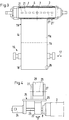
- the 3-roll calender 1 illustrated in FIGS. 1 to 3 has a hard roll 2 and two soft rolls 3 and 4 arranged on opposite sides.
- the hard roller 2 is heated approximately uniformly over its cylindrical part 5, which has a width A, for example by heating oil, which is passed through axially parallel bores near the surface, by an electric heating device or the like.
- the soft rollers 3 carry a cover 6, the cylindrical one Part 7 has a width B.
- This cover 6 consists for example of a fiber-reinforced plastic with high temperature resistance, for example up to 130 ° C.
- the rollers are held with their indicated pins 8 in bearings, not shown. They form roller gaps 9 and 10 between them, in which paper 11 tapering as web 11 is satined. This is done by applying pressure by pressing the soft rollers 3 and 4 against the hard roller 2 and by the influence of heat which is transferred from the hard roller 2 to the web 11.
- the web 11 has a maximum width C which is slightly smaller than the width A of the cylindrical part 5 of the hard roller 2 and the width B of the cylindrical part 7 of the cover 6.
- the widths A and B are mutually equal.
- Fig. 2 the same calender 1 is used to satinize a web 11a of paper with a smaller width C1.
- the hard roller 2 has been adjusted to the left by an amount b, as can be seen from the arrow 13.
- Outside the left web edge 14 there is again an area 12 with the width a, which is still in the permissible area.
- Outside the right-hand web edge 15, on the other hand there is a much wider area of the cylindrical part 7 of the cover 6. However, this is only covered by the cylindrical part 5 of the hard roller 2 over the edge width a, so that only the area 12a, which also has the width a, faces the heated surface of the hard roller 2 in an admissible manner.
- the web 11a is fed from an unwinding device 16 which has a roll 18 applied to a core.
- the core is axially adjustable back and forth, as indicated by arrow 17.
- the winding device 16 can therefore be adjusted so that the left web edge 14 assumes a desired position 19, which has the distance a shown in FIG. 2 from the end of the cylindrical part 7 of the cover 6 or is smaller.
- the opposite web edge 15 is detected by a detection device 20.
- the hard roller 2 is shifted to the left, as illustrated in FIG. 2.
- the elastic roller 6 is a deflection adjustment roller, in which a jacket is loaded in individual zones 21 in such a way that the desired compressive stress profile in the nip 9 is established. It is assumed that a hydrostatic support element corresponds to each zone 21. The zones 21 ′ lying outside the web 11a are then subjected to a lower pressure than the other zones 21.
- the hard roller 2 is mounted with its pin 8 in a bearing block 22 which is axially adjustable in the direction of arrow 13 with the aid of a spindle 23.
- the spindle 23 can be rotated manually or automatically by an actuating device 24, for example by a motor.
- a support element 25 has an axial Guide 26 for the bearing block 22 and carries the actuating device 24.
- the support element 25 is fastened to levers 27 which are held on the calender stand 28, pivotable about an axis 29.
- the actuation device 24 can be adjusted depending on the detection device 20.
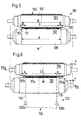
- FIGS. 5 and 6 reference numerals increased by 100 are used for corresponding parts.
- a two-roll calender is shown with a hard roll 102 and a soft roll 103.
- the latter in turn carries an elastic cover 106 with a cylindrical part 107, which projects on both sides with an area 112 over the web 111.
- the width of the regions 112 is again a, that is to say corresponds to the predetermined permissible edge width, or is less.
- the width A of the cylindrical section 105, the width B of the cylindrical part 107 of the cover 106 and the maximum width C of the paper web 111 correspond to the exemplary embodiment in FIG. 1.
- a narrower paper web 111a with the web width C1 is satinized. This is fed symmetrically to the center line M.
- the upstream part of a paper machine serves as web guiding device 118 during in-line operation. So that there are again only two narrow regions 112a and 112b with a width equal to or smaller than a, which face the heated surface of the hard roller 102, the hard roller 102 is to the left in the direction of the arrow 113 by an amount, for example the amount c and the soft roller 103 is shifted to the right in the opposite direction according to the arrow 113a by an amount, for example the same amount c.
- a detection device 120 has two detection points 120a and 120b, which detect the position of the left web edge 114 and the right web edge 115.
- the adjustment path c of the soft roller 103 in the direction of the arrow 113a depends on the determined position of the left web edge 114.
- the adjustment path c of the hard roller 102 in the direction of arrow 113 depends on the determined position of the right web edge 115.
- a detection point on a web edge is sufficient if it is ensured that the web always runs in the center, that is to say symmetrically to the center line M. This is of particular interest for in-line calenders.
- the exemplary embodiments deal with 2- and 3-roll calenders, which are operated in the form of so-called soft calenders.
- calenders with more than three rolls can also be considered, in particular in the form of supercalenders which have a roll stack loaded from one end.
- the rolls can be axially displaced to different extents in order to compensate for the increasing width of the web from roll nip to roll nip.
Landscapes
- Engineering & Computer Science (AREA)
- Textile Engineering (AREA)
- Mechanical Engineering (AREA)
- General Engineering & Computer Science (AREA)
- Paper (AREA)
Applications Claiming Priority (2)
| Application Number | Priority Date | Filing Date | Title |
|---|---|---|---|
| DE19607476 | 1996-02-28 | ||
| DE19607476A DE19607476C1 (de) | 1996-02-28 | 1996-02-28 | Verfahren zum Satinieren von Papier und Kalander zur Durchführung des Verfahrens |
Publications (2)
| Publication Number | Publication Date |
|---|---|
| EP0792965A1 true EP0792965A1 (fr) | 1997-09-03 |
| EP0792965B1 EP0792965B1 (fr) | 1999-09-22 |
Family
ID=7786653
Family Applications (1)
| Application Number | Title | Priority Date | Filing Date |
|---|---|---|---|
| EP97100564A Expired - Lifetime EP0792965B1 (fr) | 1996-02-28 | 1997-01-16 | Procédé pour le satinage du papier et calandre pour l'application du procédé |
Country Status (5)
| Country | Link |
|---|---|
| US (1) | US5816143A (fr) |
| EP (1) | EP0792965B1 (fr) |
| JP (1) | JP2818749B2 (fr) |
| CA (1) | CA2198302C (fr) |
| DE (2) | DE19607476C1 (fr) |
Families Citing this family (4)
| Publication number | Priority date | Publication date | Assignee | Title |
|---|---|---|---|---|
| DE19941334A1 (de) * | 1999-08-31 | 2001-03-01 | Voith Paper Patent Gmbh | Maschine zur Herstellung und/oder Behandlung einer Materialbahn |
| DE10204286B4 (de) * | 2002-02-02 | 2006-02-02 | Voith Paper Patent Gmbh | Kalander und Verfahren zum Betreiben eines Kalanders |
| CN110926177A (zh) * | 2019-12-11 | 2020-03-27 | 山东中塑泰富科技有限公司 | 一种张力可调的包装膜加工用烘干装置 |
| CN112393569B (zh) * | 2020-11-09 | 2022-09-27 | 桐乡市法赛欧服饰有限公司 | 一种纺织布料洗涤用初步脱水装置 |
Citations (3)
| Publication number | Priority date | Publication date | Assignee | Title |
|---|---|---|---|---|
| DE1046470B (de) * | 1956-08-04 | 1958-12-11 | Eck & Soehne Joseph | Verfahren und Vorrichtung zum Verhindern scharfer Laufspurkanten an elastischen Walzen von Kalandern, insbesondere Papierkalandern |
| DE3907216A1 (de) | 1988-03-15 | 1989-09-28 | Valmet Paper Machinery Inc | Kalandrierverfahren und kalander dafuer |
| DE4121381C1 (fr) | 1991-06-28 | 1992-06-04 | Sulzer-Escher Wyss Gmbh, 7980 Ravensburg, De |
-
1996
- 1996-02-28 DE DE19607476A patent/DE19607476C1/de not_active Expired - Fee Related
-
1997
- 1997-01-16 DE DE59700455T patent/DE59700455D1/de not_active Expired - Fee Related
- 1997-01-16 EP EP97100564A patent/EP0792965B1/fr not_active Expired - Lifetime
- 1997-02-24 CA CA002198302A patent/CA2198302C/fr not_active Expired - Fee Related
- 1997-02-25 US US08/805,778 patent/US5816143A/en not_active Expired - Fee Related
- 1997-02-27 JP JP9043889A patent/JP2818749B2/ja not_active Expired - Fee Related
Patent Citations (3)
| Publication number | Priority date | Publication date | Assignee | Title |
|---|---|---|---|---|
| DE1046470B (de) * | 1956-08-04 | 1958-12-11 | Eck & Soehne Joseph | Verfahren und Vorrichtung zum Verhindern scharfer Laufspurkanten an elastischen Walzen von Kalandern, insbesondere Papierkalandern |
| DE3907216A1 (de) | 1988-03-15 | 1989-09-28 | Valmet Paper Machinery Inc | Kalandrierverfahren und kalander dafuer |
| DE4121381C1 (fr) | 1991-06-28 | 1992-06-04 | Sulzer-Escher Wyss Gmbh, 7980 Ravensburg, De |
Also Published As
| Publication number | Publication date |
|---|---|
| DE19607476C1 (de) | 1997-04-10 |
| CA2198302A1 (fr) | 1997-08-28 |
| DE59700455D1 (de) | 1999-10-28 |
| EP0792965B1 (fr) | 1999-09-22 |
| US5816143A (en) | 1998-10-06 |
| CA2198302C (fr) | 2003-04-08 |
| JP2818749B2 (ja) | 1998-10-30 |
| JPH09324387A (ja) | 1997-12-16 |
Similar Documents
| Publication | Publication Date | Title |
|---|---|---|
| DE2843743C2 (fr) | ||
| DE2837913C2 (de) | Walze mit steuerbarer Durchbiegung, insbesondere für Maschinen zur Erzeugung und Verarbeitung von Bahnen aus Papier oder Kunststoff | |
| EP0675224B1 (fr) | Presse pour matériau en bande | |
| CH657396A5 (de) | Walzenaggregat fuer papier- und andere materialbahnen. | |
| DE3216182C2 (de) | Kalander für Papier- und andere Materialbahnen | |
| WO1999014147A1 (fr) | Dispositif de guidage d'une bande de papier sans fin | |
| DE3920176A1 (de) | Walze und verfahren zu deren betrieb | |
| DE19519011C1 (de) | Kalander | |
| EP0773104B1 (fr) | Procédé pour l'ennoblissement et l'impression d'une bande et machine d'impression pour la mise en oeuvre de ce procédé | |
| DE4343173A1 (de) | Kalander und nachgeschaltete Wickelvorrichtung | |
| DE19607476C1 (de) | Verfahren zum Satinieren von Papier und Kalander zur Durchführung des Verfahrens | |
| DE19824542B4 (de) | Walze, Kalander und Verfahren zum Betrieb einer Walze | |
| DE3338625C2 (de) | Kalander | |
| DE4121381C1 (fr) | ||
| DE10055827A1 (de) | Farbdosiersystem in einer Druckmaschine | |
| EP0792966B1 (fr) | Calandre pour le satinage du papier | |
| DE4321061B4 (de) | Verfahren und Vorrichtung zur Beeinflussung von Dicke und Glanz und/oder Glätte bei der Behandlung von Faserstoffbahnen | |
| EP0799933B1 (fr) | Calandre pour papier ou similaire | |
| DE9306448U1 (de) | Glättwerksanordnung | |
| DE19826063B4 (de) | Kühleinrichtung für eine Materialbahn | |
| DE19710124A1 (de) | Verfahren und Vorrichtung zur Temperierung von Kühlwalzen | |
| DE3533210C2 (fr) | ||
| DE19508352A1 (de) | Kalander für die Behandlung einer Papierbahn | |
| DE19955903C2 (de) | Kaschier-Vorrichtung | |
| DE10217910A1 (de) | Verfahren zum Behandeln einer Materialbahn und Kalander |
Legal Events
| Date | Code | Title | Description |
|---|---|---|---|
| PUAI | Public reference made under article 153(3) epc to a published international application that has entered the european phase |
Free format text: ORIGINAL CODE: 0009012 |
|
| AK | Designated contracting states |
Kind code of ref document: A1 Designated state(s): DE FI FR GB |
|
| 17P | Request for examination filed |
Effective date: 19970725 |
|
| GRAG | Despatch of communication of intention to grant |
Free format text: ORIGINAL CODE: EPIDOS AGRA |
|
| GRAG | Despatch of communication of intention to grant |
Free format text: ORIGINAL CODE: EPIDOS AGRA |
|
| GRAH | Despatch of communication of intention to grant a patent |
Free format text: ORIGINAL CODE: EPIDOS IGRA |
|
| 17Q | First examination report despatched |
Effective date: 19990305 |
|
| GRAH | Despatch of communication of intention to grant a patent |
Free format text: ORIGINAL CODE: EPIDOS IGRA |
|
| GRAA | (expected) grant |
Free format text: ORIGINAL CODE: 0009210 |
|
| AK | Designated contracting states |
Kind code of ref document: B1 Designated state(s): DE FI FR GB |
|
| GBT | Gb: translation of ep patent filed (gb section 77(6)(a)/1977) |
Effective date: 19990923 |
|
| REF | Corresponds to: |
Ref document number: 59700455 Country of ref document: DE Date of ref document: 19991028 |
|
| ET | Fr: translation filed | ||
| PLBE | No opposition filed within time limit |
Free format text: ORIGINAL CODE: 0009261 |
|
| STAA | Information on the status of an ep patent application or granted ep patent |
Free format text: STATUS: NO OPPOSITION FILED WITHIN TIME LIMIT |
|
| 26N | No opposition filed | ||
| REG | Reference to a national code |
Ref country code: GB Ref legal event code: IF02 |
|
| PGFP | Annual fee paid to national office [announced via postgrant information from national office to epo] |
Ref country code: GB Payment date: 20021224 Year of fee payment: 7 |
|
| PGFP | Annual fee paid to national office [announced via postgrant information from national office to epo] |
Ref country code: FR Payment date: 20030116 Year of fee payment: 7 |
|
| PG25 | Lapsed in a contracting state [announced via postgrant information from national office to epo] |
Ref country code: GB Free format text: LAPSE BECAUSE OF NON-PAYMENT OF DUE FEES Effective date: 20040116 |
|
| GBPC | Gb: european patent ceased through non-payment of renewal fee |
Effective date: 20040116 |
|
| PG25 | Lapsed in a contracting state [announced via postgrant information from national office to epo] |
Ref country code: FR Free format text: LAPSE BECAUSE OF NON-PAYMENT OF DUE FEES Effective date: 20040930 |
|
| REG | Reference to a national code |
Ref country code: FR Ref legal event code: ST |
|
| PGFP | Annual fee paid to national office [announced via postgrant information from national office to epo] |
Ref country code: DE Payment date: 20060112 Year of fee payment: 10 |
|
| PGFP | Annual fee paid to national office [announced via postgrant information from national office to epo] |
Ref country code: FI Payment date: 20060113 Year of fee payment: 10 |
|
| PG25 | Lapsed in a contracting state [announced via postgrant information from national office to epo] |
Ref country code: FI Free format text: LAPSE BECAUSE OF NON-PAYMENT OF DUE FEES Effective date: 20070116 |
|
| PG25 | Lapsed in a contracting state [announced via postgrant information from national office to epo] |
Ref country code: DE Free format text: LAPSE BECAUSE OF NON-PAYMENT OF DUE FEES Effective date: 20070801 |