EP0793087A2 - Méthode et dispositif d'échantillonnage de métaux dans des gaz non-hydrolysables - Google Patents
Méthode et dispositif d'échantillonnage de métaux dans des gaz non-hydrolysables Download PDFInfo
- Publication number
- EP0793087A2 EP0793087A2 EP97400393A EP97400393A EP0793087A2 EP 0793087 A2 EP0793087 A2 EP 0793087A2 EP 97400393 A EP97400393 A EP 97400393A EP 97400393 A EP97400393 A EP 97400393A EP 0793087 A2 EP0793087 A2 EP 0793087A2
- Authority
- EP
- European Patent Office
- Prior art keywords
- valve means
- gas
- filter
- filter means
- sampling
- Prior art date
- Legal status (The legal status is an assumption and is not a legal conclusion. Google has not performed a legal analysis and makes no representation as to the accuracy of the status listed.)
- Withdrawn
Links
- 239000007789 gas Substances 0.000 title claims abstract description 79
- 238000005070 sampling Methods 0.000 title claims abstract description 39
- 229910052751 metal Inorganic materials 0.000 title claims description 25
- 239000002184 metal Substances 0.000 title claims description 25
- 238000000034 method Methods 0.000 title claims description 24
- 239000012535 impurity Substances 0.000 claims abstract description 51
- 238000004458 analytical method Methods 0.000 claims abstract description 16
- 239000012808 vapor phase Substances 0.000 claims abstract description 15
- 239000012528 membrane Substances 0.000 claims description 10
- IJGRMHOSHXDMSA-UHFFFAOYSA-N Atomic nitrogen Chemical compound N#N IJGRMHOSHXDMSA-UHFFFAOYSA-N 0.000 claims description 9
- OKKJLVBELUTLKV-UHFFFAOYSA-N Methanol Chemical compound OC OKKJLVBELUTLKV-UHFFFAOYSA-N 0.000 claims description 9
- 239000007788 liquid Substances 0.000 claims description 8
- 238000011144 upstream manufacturing Methods 0.000 claims description 6
- CURLTUGMZLYLDI-UHFFFAOYSA-N Carbon dioxide Chemical compound O=C=O CURLTUGMZLYLDI-UHFFFAOYSA-N 0.000 claims description 5
- 239000000919 ceramic Substances 0.000 claims description 5
- 229910052757 nitrogen Inorganic materials 0.000 claims description 4
- 229910001220 stainless steel Inorganic materials 0.000 claims description 4
- 239000010935 stainless steel Substances 0.000 claims description 4
- 239000004809 Teflon Substances 0.000 claims description 3
- 229920006362 Teflon® Polymers 0.000 claims description 3
- 235000011089 carbon dioxide Nutrition 0.000 claims description 3
- 238000007710 freezing Methods 0.000 claims description 3
- 230000008014 freezing Effects 0.000 claims description 3
- OKTJSMMVPCPJKN-UHFFFAOYSA-N Carbon Chemical compound [C] OKTJSMMVPCPJKN-UHFFFAOYSA-N 0.000 claims description 2
- 238000010521 absorption reaction Methods 0.000 claims description 2
- 229910002804 graphite Inorganic materials 0.000 claims description 2
- 239000010439 graphite Substances 0.000 claims description 2
- 238000009616 inductively coupled plasma Methods 0.000 claims description 2
- 239000011148 porous material Substances 0.000 claims description 2
- 238000004519 manufacturing process Methods 0.000 description 8
- 150000002739 metals Chemical class 0.000 description 8
- 239000004065 semiconductor Substances 0.000 description 7
- PQLAYKMGZDUDLQ-UHFFFAOYSA-K aluminium bromide Chemical compound Br[Al](Br)Br PQLAYKMGZDUDLQ-UHFFFAOYSA-K 0.000 description 5
- 238000001514 detection method Methods 0.000 description 5
- 239000002245 particle Substances 0.000 description 5
- 238000001914 filtration Methods 0.000 description 3
- VEXZGXHMUGYJMC-UHFFFAOYSA-N Hydrochloric acid Chemical compound Cl VEXZGXHMUGYJMC-UHFFFAOYSA-N 0.000 description 2
- XEEYBQQBJWHFJM-UHFFFAOYSA-N Iron Chemical compound [Fe] XEEYBQQBJWHFJM-UHFFFAOYSA-N 0.000 description 2
- BLRPTPMANUNPDV-UHFFFAOYSA-N Silane Chemical compound [SiH4] BLRPTPMANUNPDV-UHFFFAOYSA-N 0.000 description 2
- 239000002253 acid Substances 0.000 description 2
- VSCWAEJMTAWNJL-UHFFFAOYSA-K aluminium trichloride Chemical compound Cl[Al](Cl)Cl VSCWAEJMTAWNJL-UHFFFAOYSA-K 0.000 description 2
- ILAHWRKJUDSMFH-UHFFFAOYSA-N boron tribromide Chemical compound BrB(Br)Br ILAHWRKJUDSMFH-UHFFFAOYSA-N 0.000 description 2
- 238000004364 calculation method Methods 0.000 description 2
- 230000007797 corrosion Effects 0.000 description 2
- 238000005260 corrosion Methods 0.000 description 2
- 239000000463 material Substances 0.000 description 2
- 238000012986 modification Methods 0.000 description 2
- 230000004048 modification Effects 0.000 description 2
- 238000012544 monitoring process Methods 0.000 description 2
- 230000035945 sensitivity Effects 0.000 description 2
- TXEYQDLBPFQVAA-UHFFFAOYSA-N tetrafluoromethane Chemical compound FC(F)(F)F TXEYQDLBPFQVAA-UHFFFAOYSA-N 0.000 description 2
- XLYOFNOQVPJJNP-UHFFFAOYSA-N water Substances O XLYOFNOQVPJJNP-UHFFFAOYSA-N 0.000 description 2
- 229910017011 AsBr3 Inorganic materials 0.000 description 1
- 229910017009 AsCl3 Inorganic materials 0.000 description 1
- 229910017050 AsF3 Inorganic materials 0.000 description 1
- 229910015845 BBr3 Inorganic materials 0.000 description 1
- 229910015844 BCl3 Inorganic materials 0.000 description 1
- VYZAMTAEIAYCRO-UHFFFAOYSA-N Chromium Chemical compound [Cr] VYZAMTAEIAYCRO-UHFFFAOYSA-N 0.000 description 1
- 229910021592 Copper(II) chloride Inorganic materials 0.000 description 1
- 229910019929 CrO2Cl2 Inorganic materials 0.000 description 1
- FYYHWMGAXLPEAU-UHFFFAOYSA-N Magnesium Chemical compound [Mg] FYYHWMGAXLPEAU-UHFFFAOYSA-N 0.000 description 1
- PWHULOQIROXLJO-UHFFFAOYSA-N Manganese Chemical compound [Mn] PWHULOQIROXLJO-UHFFFAOYSA-N 0.000 description 1
- ZOKXTWBITQBERF-UHFFFAOYSA-N Molybdenum Chemical compound [Mo] ZOKXTWBITQBERF-UHFFFAOYSA-N 0.000 description 1
- 229910021586 Nickel(II) chloride Inorganic materials 0.000 description 1
- GRYLNZFGIOXLOG-UHFFFAOYSA-N Nitric acid Chemical compound O[N+]([O-])=O GRYLNZFGIOXLOG-UHFFFAOYSA-N 0.000 description 1
- 229910003910 SiCl4 Inorganic materials 0.000 description 1
- 229910004014 SiF4 Inorganic materials 0.000 description 1
- 229910021623 Tin(IV) bromide Inorganic materials 0.000 description 1
- 229910021627 Tin(IV) chloride Inorganic materials 0.000 description 1
- 229910007938 ZrBr4 Inorganic materials 0.000 description 1
- 229910007932 ZrCl4 Inorganic materials 0.000 description 1
- MUBKMWFYVHYZAI-UHFFFAOYSA-N [Al].[Cu].[Zn] Chemical compound [Al].[Cu].[Zn] MUBKMWFYVHYZAI-UHFFFAOYSA-N 0.000 description 1
- 239000003463 adsorbent Substances 0.000 description 1
- 229910052782 aluminium Inorganic materials 0.000 description 1
- XAGFODPZIPBFFR-UHFFFAOYSA-N aluminium Chemical compound [Al] XAGFODPZIPBFFR-UHFFFAOYSA-N 0.000 description 1
- JMBNQWNFNACVCB-UHFFFAOYSA-N arsenic tribromide Chemical compound Br[As](Br)Br JMBNQWNFNACVCB-UHFFFAOYSA-N 0.000 description 1
- OEYOHULQRFXULB-UHFFFAOYSA-N arsenic trichloride Chemical compound Cl[As](Cl)Cl OEYOHULQRFXULB-UHFFFAOYSA-N 0.000 description 1
- JCMGUODNZMETBM-UHFFFAOYSA-N arsenic trifluoride Chemical compound F[As](F)F JCMGUODNZMETBM-UHFFFAOYSA-N 0.000 description 1
- 239000001569 carbon dioxide Substances 0.000 description 1
- 229910002092 carbon dioxide Inorganic materials 0.000 description 1
- 229910052804 chromium Inorganic materials 0.000 description 1
- 239000011651 chromium Substances 0.000 description 1
- 229910017052 cobalt Inorganic materials 0.000 description 1
- 239000010941 cobalt Substances 0.000 description 1
- GUTLYIVDDKVIGB-UHFFFAOYSA-N cobalt atom Chemical compound [Co] GUTLYIVDDKVIGB-UHFFFAOYSA-N 0.000 description 1
- 229940125810 compound 20 Drugs 0.000 description 1
- 239000002826 coolant Substances 0.000 description 1
- 238000001816 cooling Methods 0.000 description 1
- 239000010949 copper Substances 0.000 description 1
- ORTQZVOHEJQUHG-UHFFFAOYSA-L copper(II) chloride Chemical compound Cl[Cu]Cl ORTQZVOHEJQUHG-UHFFFAOYSA-L 0.000 description 1
- 230000007423 decrease Effects 0.000 description 1
- 230000001419 dependent effect Effects 0.000 description 1
- 230000001627 detrimental effect Effects 0.000 description 1
- JAXFJECJQZDFJS-XHEPKHHKSA-N gtpl8555 Chemical compound OC(=O)C[C@H](N)C(=O)N[C@@H](CCC(O)=O)C(=O)N[C@@H](C(C)C)C(=O)N[C@@H](C(C)C)C(=O)N1CCC[C@@H]1C(=O)N[C@H](B1O[C@@]2(C)[C@H]3C[C@H](C3(C)C)C[C@H]2O1)CCC1=CC=C(F)C=C1 JAXFJECJQZDFJS-XHEPKHHKSA-N 0.000 description 1
- 230000007062 hydrolysis Effects 0.000 description 1
- 238000006460 hydrolysis reaction Methods 0.000 description 1
- 239000005457 ice water Substances 0.000 description 1
- 229910000765 intermetallic Inorganic materials 0.000 description 1
- 229910052742 iron Inorganic materials 0.000 description 1
- 239000011777 magnesium Substances 0.000 description 1
- 229910052749 magnesium Inorganic materials 0.000 description 1
- 229910052748 manganese Inorganic materials 0.000 description 1
- 239000011572 manganese Substances 0.000 description 1
- 238000005259 measurement Methods 0.000 description 1
- NGYIMTKLQULBOO-UHFFFAOYSA-L mercury dibromide Chemical compound Br[Hg]Br NGYIMTKLQULBOO-UHFFFAOYSA-L 0.000 description 1
- LWJROJCJINYWOX-UHFFFAOYSA-L mercury dichloride Chemical compound Cl[Hg]Cl LWJROJCJINYWOX-UHFFFAOYSA-L 0.000 description 1
- 239000000203 mixture Substances 0.000 description 1
- 229910052750 molybdenum Inorganic materials 0.000 description 1
- 239000011733 molybdenum Substances 0.000 description 1
- QMMRZOWCJAIUJA-UHFFFAOYSA-L nickel dichloride Chemical compound Cl[Ni]Cl QMMRZOWCJAIUJA-UHFFFAOYSA-L 0.000 description 1
- 229910017604 nitric acid Inorganic materials 0.000 description 1
- TWNQGVIAIRXVLR-UHFFFAOYSA-N oxo(oxoalumanyloxy)alumane Chemical compound O=[Al]O[Al]=O TWNQGVIAIRXVLR-UHFFFAOYSA-N 0.000 description 1
- 238000011867 re-evaluation Methods 0.000 description 1
- 238000012552 review Methods 0.000 description 1
- 229910052594 sapphire Inorganic materials 0.000 description 1
- 239000010980 sapphire Substances 0.000 description 1
- 229910000077 silane Inorganic materials 0.000 description 1
- FDNAPBUWERUEDA-UHFFFAOYSA-N silicon tetrachloride Chemical compound Cl[Si](Cl)(Cl)Cl FDNAPBUWERUEDA-UHFFFAOYSA-N 0.000 description 1
- ABTOQLMXBSRXSM-UHFFFAOYSA-N silicon tetrafluoride Chemical compound F[Si](F)(F)F ABTOQLMXBSRXSM-UHFFFAOYSA-N 0.000 description 1
- 239000007787 solid Substances 0.000 description 1
- LTSUHJWLSNQKIP-UHFFFAOYSA-J tin(iv) bromide Chemical compound Br[Sn](Br)(Br)Br LTSUHJWLSNQKIP-UHFFFAOYSA-J 0.000 description 1
- HPGGPRDJHPYFRM-UHFFFAOYSA-J tin(iv) chloride Chemical compound Cl[Sn](Cl)(Cl)Cl HPGGPRDJHPYFRM-UHFFFAOYSA-J 0.000 description 1
- FAQYAMRNWDIXMY-UHFFFAOYSA-N trichloroborane Chemical compound ClB(Cl)Cl FAQYAMRNWDIXMY-UHFFFAOYSA-N 0.000 description 1
- 238000009834 vaporization Methods 0.000 description 1
- 230000008016 vaporization Effects 0.000 description 1
- DUNKXUFBGCUVQW-UHFFFAOYSA-J zirconium tetrachloride Chemical compound Cl[Zr](Cl)(Cl)Cl DUNKXUFBGCUVQW-UHFFFAOYSA-J 0.000 description 1
- LSWWNKUULMMMIL-UHFFFAOYSA-J zirconium(iv) bromide Chemical compound Br[Zr](Br)(Br)Br LSWWNKUULMMMIL-UHFFFAOYSA-J 0.000 description 1
Images
Classifications
-
- G—PHYSICS
- G01—MEASURING; TESTING
- G01N—INVESTIGATING OR ANALYSING MATERIALS BY DETERMINING THEIR CHEMICAL OR PHYSICAL PROPERTIES
- G01N1/00—Sampling; Preparing specimens for investigation
- G01N1/02—Devices for withdrawing samples
- G01N1/22—Devices for withdrawing samples in the gaseous state
- G01N1/2202—Devices for withdrawing samples in the gaseous state involving separation of sample components during sampling
- G01N1/2205—Devices for withdrawing samples in the gaseous state involving separation of sample components during sampling with filters
-
- G—PHYSICS
- G01—MEASURING; TESTING
- G01N—INVESTIGATING OR ANALYSING MATERIALS BY DETERMINING THEIR CHEMICAL OR PHYSICAL PROPERTIES
- G01N1/00—Sampling; Preparing specimens for investigation
- G01N1/02—Devices for withdrawing samples
- G01N1/22—Devices for withdrawing samples in the gaseous state
- G01N1/2202—Devices for withdrawing samples in the gaseous state involving separation of sample components during sampling
- G01N2001/222—Other features
- G01N2001/2223—Other features aerosol sampling devices
-
- G—PHYSICS
- G01—MEASURING; TESTING
- G01N—INVESTIGATING OR ANALYSING MATERIALS BY DETERMINING THEIR CHEMICAL OR PHYSICAL PROPERTIES
- G01N1/00—Sampling; Preparing specimens for investigation
- G01N1/02—Devices for withdrawing samples
- G01N1/22—Devices for withdrawing samples in the gaseous state
- G01N2001/2282—Devices for withdrawing samples in the gaseous state with cooling means
Definitions
- the present invention relates to a method and a system for sampling a gas for both particulate and vapor phase metal impurities.
- the system of the present invention is preferably portable in that it can be easily removed from the site of the gas being sampled and returned to a laboratory for an accurate analysis of the metal impurities trapped in the filters of the system.
- a very important and crucial aspect in semiconductor manufacturing is the constant control of metallic impurities in process gases.
- Such metallic impurities can exist in the vapor phase at room temperature and atmospheric pressure up to very high concentrations, for example, up to 100ppm. Such levels can be detrimental to the semiconductor devices formed.
- the impurities are present due to corrosion, shedding from valves and the like.
- the gases flowing through the system must be sampled. Analysis of the gases can indicate whether metallic impurities, being introduced from outside the system or being created inside the system, are contaminating the manufacturing process.
- the level of detection for metallic impurities in semiconductor manufacturing processes must reach the parts per trillion level, and therefore requires very sophisticated equipment for analysis and detection.
- gases are hydrolyzable, i.e., dissolvable in water, and therefore hydrolysis is commonly used for sampling the metals in the gases.
- gases such as nitrogen (N 2 ), silane (SiH 4 ), and tetrafluoromethane (CF 4 ), some of which are commonly used in semiconductor manufacturing processes, are not hydrolyzable. Therefore, in order to sample the gases and detect metal impurities in such gases, a filtering system must be used.
- a portable system useful for sampling both particulate and vapor phase metallic impurities from gases that cannot be hydrolyzed is presented, as well as a method of using same.
- the system preferably comprises a first valve means for introducing the gas to be sampled to the system.
- a first filter means is located downstream of the first valve means, which first filter means is used to remove particulate metallic impurities, preferably at ambient temperature (about 20-25°C).
- a second filter means in series with the first filter means is used to remove vapor phase metallic impurities. This second filter means is preferably operated at a temperature below ambient temperature but above the freezing point of the gas being sampled.
- a third filter means is also located downstream of the first and second filter means for removing substantially any impurities in the gas.
- the system further comprises a second valve means downstream from the first valve means but upstream from the first filter means.
- Third and fourth valve means are also included in the system, with the fourth valve means being located downstream of all of the filter means and is used for controlling the exhaust of the gas from the system.
- the third valve means allows for the gas to be conducted in parallel with respect to the filters in the system to the fourth valve means.
- a critical orifice is also located between the third filter means and the fourth valve means for back-filling the gas being sampled through the filters in the system until there is a pressure equilibrium across the second valve means for reasons that will become apparent.
- the system of the invention is most preferably portable and can be transported quite easily, generally using a system pressure of less than 20 psig (238 KPa). Due to the portability of the inventive system, the filters can be transported to a laboratory which can analyze the filters for particulate and vapor phase metallic impurities.
- a preferred method of using the system comprises first opening the first and third valve means, while keeping the second and fourth valve means closed.
- This allows the gas being sampled to back-fill through the critical orifice and the third filter means, which is an absolute filter to ensure that the system is filled first with only clean (i.e., metal impurity-free) gas.
- This back-filling allows a pressure equilibrium to be established across the second valve means. This pressure equilibrium is important as it substantially reduces, and preferably prevents particle shedding from the second valve when it is opened.
- the third valve means is closed, and the second and fourth valve means are opened to allow sampling to begin. Metallic impurities are trapped in the first and second filter means.
- the first and fourth valve means are closed in order to close the entire system. The system can then be disconnected from the customer's process and sent to a laboratory for analysis of the filters.
- the system of the present invention is preferably portable and allows for the efficient and effective sampling of gases which are non-hydrolyzable in order to determine the extent of any metallic impurities in said gases.
- "portable" means the system can be disconnected from the gas supply being sampled and sent to the location of the analysis equipment.
- the location of the analysis equipment may be removed from the sampling site, or on-site.
- the portability of the present system allows its use in many different locations, yet further allows analysis of the gases sampled to be conducted with the most sophisticated equipment possible in the most efficient and effective manner.
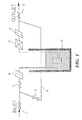
- a first valve means 1 is generally connected to the system from which the gas is to be sampled.
- the connection may be any type of connection means commonly used in gas systems.
- First valve means 1 allows the gas to be sampled to be introduced into the sampling system illustrated.
- a fourth valve means 4 of the sampling system controls the exhaust of the gas from the system.
- a second valve means 2 of the system is located downstream from first valve means 1 but upstream from a first filter 11.
- First filter means 11 is used to remove particulate impurities at ambient temperature.
- the filter is generally and preferably a membrane filter and has an effective pore size of about 0.2 micrometer.
- Membrane filter 11 can be any appropriate membrane filter, but is most preferably a teflon membrane filter, such as those commercially available.
- Filter means 12 is generally composed of the same media as filter means 11, but can be maintained at a lower than ambient temperature, and at a temperature greater than the freezing point of the gas being sampled. This lower than ambient temperature is utilized in order to have vaporous metal impurities nucleate or condense onto the membrane filter.
- the temperature of filter means 12 is variable, and is selected dependent upon the particular vaporous metal impurity to be measured. More specifically, the desired temperature of filter means 12 will depend on the vapor pressure of the metallic impurity to be measured.
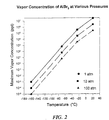
- FIG. 2 A sample vapor concentration curve is provided in FIG. 2, which illustrates maximum vapor concentration as a function of temperature for AlBr 3 for pressures of 1, 10 and 100 atmospheres. As can be seen in FIG. 2, maximum vapor concentration increases with increased temperature. Conversely, the maximum vapor concentration decreases with increases in pressure.
- the maximum allowable concentration of vapor which can exist at a given pressure can be determined.
- the metallic compound is present at a concentration in excess of the maximum allowable concentration, the metal vapor will condense, thereby forming a solid which is trapped on filter means 12.
- the vapor pressure of AlBr 3 at 20°C and a pressure of one atmosphere (ambient conditions) is 0.0198torr. This corresponds to an AlBr 3 concentration of 26ppm (0.0198torr/760torr).
- sensitivity of the system can be increased considerably over the levels shown in the above table, since the sampling can be performed at pressures in excess of atmospheric pressure.
- a suitable sampling pressure can be selected based on the concentration level of interest for a given impurity.
- the sampling pressure often corresponds to the pressure of the gas in the distribution system.
- the sampling pressure is generally about 20 psig.
- higher pressures of, for example, up to 3000 psig can be used.
- the filter 12 can be maintained at temperatures in the range of from about -170°C to 0°C, depending on the metallic impurity of interest. Temperatures in the range of -80°C to 0°C are preferred. Liquid nitrogen can be used for cooling filter means 12 to a temperature in the range of from about -170°C to -160°C. For higher temperatures in the range of from about -80°C to -60°C, dry ice together with a suitable liquid can be used. The liquid functions primarily to increase the contact area of the bath with the filter to ensure uniform temperature. In a preferred embodiment, a carbon dioxide ice/methanol liquid bath can be used to maintain the temperature of filter 12 at about - 600C. Other combinations of coolants and temperature baths can be used in order to vary the temperature of second filter means 12. Ice water can be used to attain a temperature of about 0°C, while a temperature controlled water bath can be used for higher temperatures.
- An important aspect of the present system is that it allows back-filling of the system with clean gas to create an equal pressure on both sides of second valve means 2.
- This pressure equilibrium allows one to avoid particle shedding when valve means 2 is opened.
- Shedding is basically a mechanical friction and corrosion problem. It involves the release of particles from internal wetted surfaces, i.e., anything the gas comes into contact with in the system. The release of the particles is caused generally by pressure pulses or flow pulses, which provide the energy to pull the particle into the gas.
- the back-filling is accomplished by use of a conduit 6 which is in parallel flow arrangement with the filters in the system. Gas flowing through conduit 6 is controlled by a third valve means 3 in the system. When valve means 3 is open, gas will flow parallel to the filters in the system directly to valve means 4, where it will be exhausted from the system when valve means 4 is open. However, when valve means 4 is closed, the gas conducted via means of conduit 6 will back-fill through the filters in the system.
- the back-filling takes place through an orifice 8 and absolute filter 9.
- Orifice 8 is preferably a critical orifice, and is used to control the flow of gas through the system.
- the critical orifice can be stainless steel disk, for example, with one hole which is sized to correspond to the pressure one plans on working with in the system. The hole is sized appropriately based on the desired pressure in order to give the desired flow rate.
- the orifice can be made out of sapphire or other suitable materials besides stainless steel.
- the absolute filter 9 is generally a ceramic or metal filter which removes substantially all impurities which may be contained in the gas to be sampled.
- the filter is preferably a ceramic filter which has a rating of 0,01 micrometer or lower. The use of this filter ensures that clean gas is back-filled through the system.
- the amount of time that back-filling takes place generally ranges from about one - two minutes.
- critical orifice 8 controls the flow, and therefore the choice of the critical orifice size can control the amount of time it would take to back-fill the entire system. In general, however, about two minutes is all that is necessary to slowly fill the system and create the same pressure on both sides of second valve means 2.
- the system is closed, generally by closing valve means 1 and 4.
- the closed system is then disconnected from the customer's facility and, due to its portability, then can be simply transported from the system from which the sampled gas has been taken to the analysis location.
- the portable system is preferably transported to a laboratory where analysis of the filters can take place in order to indicate the extent of metal impurities in the sampled gas.
- an acid solution preferably a mixture of nitric acid and hydrochloric acid, is used to remove the metals from filters 11 and 12.
- This acid solution containing the metal impurities is then injected into an instrument such as ICP-MS (Inductively Coupled Plasma Mass Spectrometer) or a GFAA (Graphite Furnace Atomic Absorption) instrument. Both of these types of instruments are extremely sophisticated, but the operation of the instruments is known to skilled artisans and the instruments are commercially available, for example from Perkin-Elmer.
- ICP-MS Inductively Coupled Plasma Mass Spectrometer
- GFAA Graphite Furnace Atomic Absorption
- impurities which can be entrapped include aluminum, copper, zinc, iron, chromium, cobalt, manganese or magnesium, as well as molybdenum.
- the aluminum can often be generated from aluminum oxide used in adsorbents. Even small quantities in parts per trillion of such metals can do damage in very sensitive processes such as semiconductor manufacturing processes. Thus, detection of such metals, particularly in the vapor phase, would allow a re-evaluation of the manufacturing process, and would permit one to detect leaks and/or sources of the impurities more conveniently by moving the sample system from sample port to sample port.
- a calculation of the concentration of metals in the gas can be made by continuously monitoring the pressure across first filter means 11 in the system.
- the measurement of the pressure can be monitored by a transducer on a continuous basis with the data being fed into a computer.
- Orifice 8 and its size together with the pressure information can be used to calculate the mass of gas sampled.
- the metals analysis can provide the mass of the metal. Therefore, using the mass of the gas and metal allows one to calculate the concentration of the metals in the gas sampled. It is often important to continuously monitor the pressure across the first filter means 11 because the pressure in many plants or systems can vary quite a bit over time. Thus, continuous monitoring of the pressure is often necessary for an accurate calculation.
- valves 1 and 3 Prior to beginning sampling, valves 1 and 3 are opened so that pressure can be equalized on both sides of valve means 2.
- the gas is allowed into the system and the sampled gas back-fills the system through the various filters.
- the back-fill of the gas goes through orifice 8 and absolute filter 9, as well as filters 12 and 11.
- valve means 3 After pressure has been equalized on both sides of valve means 2, which generally takes about one to three minutes, valve means 3 is closed, and valve means 2 and 4 are opened.
- valve means 4 is opened slowly in order to ensure there are no pressure fluctuations throughout the system. Once the necessary sampling has been completed, the pressure is reduced to a predetermined safe level for transport, and then valve means 1 and 4 are closed in order to close down the system. To prevent vaporization and loss of material accumulated on filter means 12 during transport of the sampling system, the temperature of filter means 12 should be maintained at substantially the same temperature during sampling and transport.
Landscapes
- Health & Medical Sciences (AREA)
- Life Sciences & Earth Sciences (AREA)
- Engineering & Computer Science (AREA)
- Biomedical Technology (AREA)
- Molecular Biology (AREA)
- Physics & Mathematics (AREA)
- Chemical & Material Sciences (AREA)
- Analytical Chemistry (AREA)
- Biochemistry (AREA)
- General Health & Medical Sciences (AREA)
- General Physics & Mathematics (AREA)
- Immunology (AREA)
- Pathology (AREA)
- Sampling And Sample Adjustment (AREA)
- Investigating Or Analysing Materials By Optical Means (AREA)
Applications Claiming Priority (4)
| Application Number | Priority Date | Filing Date | Title |
|---|---|---|---|
| US609836 | 1996-03-01 | ||
| US08/609,836 US5618996A (en) | 1996-03-01 | 1996-03-01 | Metal sampling method and system for non-hydrolyzable gases |
| US08/709,875 US5814741A (en) | 1996-03-01 | 1996-09-09 | Metal sampling method and system for non-hydrolyzable gases |
| US709875 | 1996-09-09 |
Publications (2)
| Publication Number | Publication Date |
|---|---|
| EP0793087A2 true EP0793087A2 (fr) | 1997-09-03 |
| EP0793087A3 EP0793087A3 (fr) | 1998-07-08 |
Family
ID=27086136
Family Applications (1)
| Application Number | Title | Priority Date | Filing Date |
|---|---|---|---|
| EP97400393A Withdrawn EP0793087A3 (fr) | 1996-03-01 | 1997-02-21 | Méthode et dispositif d'échantillonnage de métaux dans des gaz non-hydrolysables |
Country Status (3)
| Country | Link |
|---|---|
| US (1) | US5814741A (fr) |
| EP (1) | EP0793087A3 (fr) |
| JP (1) | JPH09329533A (fr) |
Families Citing this family (10)
| Publication number | Priority date | Publication date | Assignee | Title |
|---|---|---|---|---|
| US6701794B2 (en) * | 1996-08-22 | 2004-03-09 | Donald P. Mayeaux | System for retrieving a gas phase sample from a gas stream containing entrained liquid, and sample conditioner assembly therefore |
| US7472615B2 (en) | 1996-08-22 | 2009-01-06 | A+Manufacturing, Llc | Portable insertable probe assembly |
| US7481125B2 (en) * | 1996-08-22 | 2009-01-27 | Mayeaux Donald P | Devices for obtaining cylinder samples of natural gas or process gas, and methods therefore |
| US7874221B1 (en) * | 1996-08-22 | 2011-01-25 | A+ Manufacturing, Llc | Devices for obtaining cylinder samples of natural gas or process gas, and methods therefore |
| US8904886B1 (en) | 1996-08-22 | 2014-12-09 | A+ Manufacturing LLC | Devices for obtaining cylinder samples of natural gas or process gas and methods therefore |
| US7617745B1 (en) | 2005-01-24 | 2009-11-17 | A+ Manufacturing, Llc | Portable insertable probe assembly |
| US7886624B1 (en) | 2005-01-24 | 2011-02-15 | A+ Manufacturing, Llc | Portable insertable probe assembly including hazardous operations capability |
| US7867779B2 (en) | 2005-02-03 | 2011-01-11 | Air Products And Chemicals, Inc. | System and method comprising same for measurement and/or analysis of particles in gas stream |
| US20080233010A1 (en) * | 2007-03-19 | 2008-09-25 | Hydrogen Discoveries, Inc. | Testing Hydrogen Flux Through Solid and Liquid Barrier Materials |
| US9506478B2 (en) * | 2012-01-13 | 2016-11-29 | Edwards Limited | Vacuum system |
Family Cites Families (15)
| Publication number | Priority date | Publication date | Assignee | Title |
|---|---|---|---|---|
| US2322018A (en) * | 1941-01-16 | 1943-06-15 | Standard Oil Dev Co | Sampling and metering device |
| US3429186A (en) * | 1966-10-11 | 1969-02-25 | Monsanto Co | Gas sample compositor |
| US3933431A (en) * | 1974-07-23 | 1976-01-20 | The United States Of America As Represented By The United States Energy Research And Development Administration | Method and apparatus for sampling atmospheric mercury |
| US4004882A (en) * | 1975-08-14 | 1977-01-25 | Monitor Labs, Incorporated | Gas analysis diluter |
| DD148172A3 (de) * | 1979-01-08 | 1981-05-13 | Gerhard Oberlaender | Verfahren und anordnung zur kontinuierlichen probenahme von rohgasen |
| US5027642A (en) * | 1987-10-13 | 1991-07-02 | American Air Liquide | Method of detecting and or removing trace amounts of condensible vapors from compressed gas |
| US4964278A (en) * | 1989-03-06 | 1990-10-23 | American Air Liquide | Method of separating condensible vapors from particles in highly compressed gases |
| US4979403A (en) * | 1989-08-28 | 1990-12-25 | Pike Daniel E | Procedure for the quantification of dust collectability |
| US5142143A (en) * | 1990-10-31 | 1992-08-25 | Extrel Corporation | Method and apparatus for preconcentration for analysis purposes of trace constitutes in gases |
| US5261452A (en) * | 1991-03-01 | 1993-11-16 | American Air Liquide | Critical orifice dilution system and method |
| US5209102A (en) * | 1992-01-31 | 1993-05-11 | American Air Liquide | Method of introducing and controlling compressed gases for impurity analysis |
| US5595709A (en) * | 1992-09-01 | 1997-01-21 | Chromatofast | Instrument for measuring non-methane organic gases in gas samples |
| US5567887A (en) * | 1994-03-10 | 1996-10-22 | Texas Instruments Incorporated | Anhydrous ammonia gas sampler and concentration system |
| US5665902A (en) * | 1994-05-10 | 1997-09-09 | American Air Liquide, Inc. | Method to analyze particle contaminants in compressed gases |
| JP3471446B2 (ja) * | 1994-11-14 | 2003-12-02 | 日本酸素株式会社 | ガス中の金属不純物検出法 |
-
1996
- 1996-09-09 US US08/709,875 patent/US5814741A/en not_active Expired - Fee Related
-
1997
- 1997-02-21 EP EP97400393A patent/EP0793087A3/fr not_active Withdrawn
- 1997-03-03 JP JP9048088A patent/JPH09329533A/ja active Pending
Non-Patent Citations (1)
| Title |
|---|
| None |
Also Published As
| Publication number | Publication date |
|---|---|
| US5814741A (en) | 1998-09-29 |
| EP0793087A3 (fr) | 1998-07-08 |
| JPH09329533A (ja) | 1997-12-22 |
Similar Documents
| Publication | Publication Date | Title |
|---|---|---|
| Gorman et al. | Hydrogen permeation through metals | |
| Swets et al. | Diffusion coefficients of helium in fused quartz | |
| US5992216A (en) | Method to analyze particle contaminants in compressed gases | |
| US7867779B2 (en) | System and method comprising same for measurement and/or analysis of particles in gas stream | |
| EP1688731A1 (fr) | Système et procédé pour la mesure et/ou l'analyse de particules dans un flux gazeux | |
| EP0793087A2 (fr) | Méthode et dispositif d'échantillonnage de métaux dans des gaz non-hydrolysables | |
| RU2074389C1 (ru) | Способ непрерывного контроля потока, состоящего из смеси пара, дисперсных частиц и газов, потенциально содержащих хлористый водород, и проходящего в вытяжных трубах, и система для его осуществления | |
| US4974453A (en) | Method and apparatus for nitrogen oxide determination | |
| EP1854906A2 (fr) | Analyse de gaz réactifs comme le silane concernant les particules générant des impuretés | |
| EP0438036B1 (fr) | Méthode pour déterminer la fin de la vie utile d'un purificateur d'un gaz inerte et son appareil | |
| US4786473A (en) | Apparatus for measuring impurities in pure water | |
| CN110487771A (zh) | 用于原位拉曼分析的气体水合物生成/分解系统及方法 | |
| EP0388252B1 (fr) | Procédé pour séparer des vapeurs condensables et des particules solides dans des gaz à haute compression | |
| Simmonds et al. | Detection of aluminum particles during the chemical vapor deposition of aluminum films using tertiaryamine complexes of alane (AlH3) | |
| US5618996A (en) | Metal sampling method and system for non-hydrolyzable gases | |
| EP0345164A2 (fr) | Procédé et dispositif de prise d'échantillon d'un liquide cryogénique | |
| US5882378A (en) | Method to detect metal impurities in the semiconductor process gases | |
| US20080202261A1 (en) | Apparatus and method for maintaining multi-component sample gas constituents in vapor phase during sample extraction and cooling | |
| EP0517576B1 (fr) | Procédé pour emmagasiner un mélange gazeux dans des containers en metal passivé pour améliorer la stabilité de mélanges gazeux à faible concentration en hydrides, en contact avec ces surfaces | |
| EP1830173A1 (fr) | Système de mesure et/ou d'analyse de particules dans un flux gazeux et procédé le comprenant | |
| CN205815167U (zh) | 一种气体净化装置 | |
| CN111256790A (zh) | 流量计量器件或大气采样设备的高温流量测试方法及装置 | |
| Yu et al. | “Long” and “short” range electronic effects in the bonding of CO and H2 on Cu Ni alloy | |
| JPH01215343A (ja) | ガス精製装置の精製能力評価方法及びその装置 | |
| JP2971646B2 (ja) | ガス分析装置 |
Legal Events
| Date | Code | Title | Description |
|---|---|---|---|
| PUAI | Public reference made under article 153(3) epc to a published international application that has entered the european phase |
Free format text: ORIGINAL CODE: 0009012 |
|
| AK | Designated contracting states |
Kind code of ref document: A2 Designated state(s): DE FR GB NL |
|
| PUAL | Search report despatched |
Free format text: ORIGINAL CODE: 0009013 |
|
| AK | Designated contracting states |
Kind code of ref document: A3 Designated state(s): DE FR GB NL |
|
| 17P | Request for examination filed |
Effective date: 19990108 |
|
| RAP1 | Party data changed (applicant data changed or rights of an application transferred) |
Owner name: L'AIR LIQUIDE, S.A. A DIRECTOIRE ET CONSEIL DE SUR |
|
| STAA | Information on the status of an ep patent application or granted ep patent |
Free format text: STATUS: THE APPLICATION HAS BEEN WITHDRAWN |
|
| 17Q | First examination report despatched |
Effective date: 20021018 |
|
| 18W | Application withdrawn |
Withdrawal date: 20021028 |