EP0793974A2 - Implantierbares Elektrostimulationsgerät und Elektrodenleitung - Google Patents
Implantierbares Elektrostimulationsgerät und Elektrodenleitung Download PDFInfo
- Publication number
- EP0793974A2 EP0793974A2 EP97250058A EP97250058A EP0793974A2 EP 0793974 A2 EP0793974 A2 EP 0793974A2 EP 97250058 A EP97250058 A EP 97250058A EP 97250058 A EP97250058 A EP 97250058A EP 0793974 A2 EP0793974 A2 EP 0793974A2
- Authority
- EP
- European Patent Office
- Prior art keywords
- contact
- electrode line
- electrostimulation device
- socket
- cam
- Prior art date
- Legal status (The legal status is an assumption and is not a legal conclusion. Google has not performed a legal analysis and makes no representation as to the accuracy of the status listed.)
- Granted
Links
Images






Classifications
-
- A—HUMAN NECESSITIES
- A61—MEDICAL OR VETERINARY SCIENCE; HYGIENE
- A61N—ELECTROTHERAPY; MAGNETOTHERAPY; RADIATION THERAPY; ULTRASOUND THERAPY
- A61N1/00—Electrotherapy; Circuits therefor
- A61N1/02—Details
- A61N1/04—Electrodes
- A61N1/05—Electrodes for implantation or insertion into the body, e.g. heart electrode
-
- A—HUMAN NECESSITIES
- A61—MEDICAL OR VETERINARY SCIENCE; HYGIENE
- A61N—ELECTROTHERAPY; MAGNETOTHERAPY; RADIATION THERAPY; ULTRASOUND THERAPY
- A61N1/00—Electrotherapy; Circuits therefor
- A61N1/18—Applying electric currents by contact electrodes
- A61N1/32—Applying electric currents by contact electrodes alternating or intermittent currents
- A61N1/36—Applying electric currents by contact electrodes alternating or intermittent currents for stimulation
- A61N1/372—Arrangements in connection with the implantation of stimulators
- A61N1/375—Constructional arrangements, e.g. casings
- A61N1/3752—Details of casing-lead connections
Definitions
- the invention relates to an implantable electrostimulation device, for example a pacemaker or defibrillator, of the type specified in the preamble of claim 1 and an electrode line according to the preamble of claim 10.
- an implantable electrostimulation device for example a pacemaker or defibrillator, of the type specified in the preamble of claim 1 and an electrode line according to the preamble of claim 10.
- DE-A-3 311 510 discloses an arrangement for connecting the proximal end of a bipolar electrode line to a cardiac pacemaker, the electrode line having a front pin contact and a ring contact behind it in the distal direction.
- the proximal pin contacts of the electrode lead are inserted into a hollow cylindrical, so-called end block and fixed in position there with a screw.
- the stud screw in the end block is intended on the one hand to ensure adequate electrical contacting and on the other hand to offer protection against undesired axial displacement of the line contact within the end block so that the proximal end of the bipolar electrode line cannot detach from the pacemaker.
- the second connection of the electrode line which is provided in the distal direction behind the pin contact and is designed as a ring contact, is inserted for the purpose of contacting into a socket which has three notches on its inner surface.
- a socket which has three notches on its inner surface.
- an essentially circularly curved wire is inserted under a mechanical prestress such that the ring contact is electrically connected to the wire at three points when the pin contact of the electrode line is in the end block provided for it.
- US-A-4 583 543 proposes an arrangement for connecting a bipolar electrode lead to a pacemaker, in which an adapter is provided in the head part of the pacemaker to connect a thinner electrode lead than that originally provided.
- the connection between the adapter and the electrode line is established via a frictional connection, which is created solely by a multiple, essentially only punctiform contact on a single circumferential line of the contact of the electrode line. Securing against loosening of the connection in the event of an axial load on the electrode line appears to be inadequate.
- connection system for a pacemaker is known from EP-A-0 339 877, in which two metal cylinders with internal spring wires for contacting the connections of the electrode line are provided in the head part of the pacemaker. Securing against loosening of the electrical connection between the electrode lead and pacemaker under mechanical load in the axial direction is also insufficient here, since this only counteracts a frictional engagement in essentially linear contact areas.
- the object of the invention is an electrical stimulation device of the type mentioned at the outset and to create an electrode line which can be connected to the electrostimulation device and which can be connected to one another in a simple and quick manner and whose connection at the same time has a high degree of security against axial tension on the electrode line.
- the invention includes the idea of providing a plurality of engagement areas for relatively large-area electrical contacting and producing a positive connection or at least a highly effective frictional connection, firmly attached to the connection socket of the electrostimulation device and / or to at least one of the contacts on the electrode line plug, as a result of which one is essentially axially directed Tractive force is opposed to a high resistance.
- contact and holding means in the form of cam or projection areas are preferably arranged in groups in a plurality of planes which extend parallel to one another and in axial order.
- a sleeve inserted into the socket with bridge-like, elastic projection areas is provided, which is specially formed by stamping and bending from a flat, spring properties and prefers high conductivity having material is made.
- This sleeve tightly and elastically encloses an inserted conventional pin or ring contact of an electrode line and, due to the relatively large effective contact area and adequate contact pressure, provides both good electrical contact and high resistance to axial tensile forces.
- recesses are provided between a plurality of projections of the connecting socket which are grouped in the circumferential direction and engage in projections of a ring contact (or the pin contact or both) of the electrode line which correspond in shape and arrangement to the recesses when the electrode line is inserted. Subsequent rotation of the inserted electrode line causes the projections of the electrode line contact to engage behind those of the connection socket. If several contact and holding means are provided in each case, in particular in axial order, these alternately engage in the recesses between them. The interlocking of the projections creates an enlarged electrical contact area and a positive connection between the two, which prevents the electrode line from being pulled out of the connection socket.
- cam or projection areas are arranged and their engagement surfaces are designed in such a way that they come into active contact with the generation of a surface pressure.
- this surface pressure advantageously prevents an unwanted rotational movement of the electrode line into an angular position in which the axial locking would be released, and advantageously provides a high contact pressure.
- connection socket or the ring contact - i.e. with an angular distance of their central planes of 120 ° or 90 °.
- the side surfaces forming the flanks of the cam-shaped contact and holding means are each arranged slightly inclined in the circumferential direction, so that the cams have a slightly wedge-shaped cross-sectional profile.
- a high surface pressure is achieved in a simple manner and, moreover, the screwing in of the electrode line can also easily take place from an insertion position in which the angular position of the plug is not optimal relative to the socket.
- the wedge-shaped cross-sectional profiles of the contact and holding means provide security against inadvertent overturning of the electrode line into an angular position in which the contact and holding means would not or only with insufficient contact would be in action.
- the center plane of the cams or projections of the electrode line is pivoted by an angle of a few degrees relative to the longitudinal axis of the plug pin (similar to the blades of a fan wheel).
- the corresponding cams or projections of the connection socket are - viewed in the circumferential direction - chamfered on both sides. This also advantageously allows the electrode line to be screwed in, even if the projections and recesses are not exactly aligned after insertion.
- spring elements extending in the circumferential direction are provided on the wall of the connection socket, each of which has a fastening point on the sleeve.
- the spring elements are subject to elastic elongation when the pin or ring contact of the electrode line is inserted into the connection socket. This in turn provides the surface pressure required to achieve a high pull-out security with the electrode line contact.
- connection socket With such a design of the connection socket, no profiling of the surface of the ring contact at the proximal end of the electrode line is provided by additional contact means.
- the diameter of the ring contact is only larger than the inside diameter of the connection socket (between the elongated spring elements).
- FIG. 1 shows a sketch of the head part 3 of a pacemaker 2 to which a bipolar electrode line 4 is connected.
- the contacts 5 and 6 located at the proximal end of the electrode line are separated from one another by insulation 8.
- a ring contact 6 of the electrode line 4 is provided coaxially to the pin contact 5.
- connection sockets 1, 9 are provided and each assigned to one of the contacts 5, 6 of the electrode line 4.
- the electrical connection between the connection sockets 1, 9 and the (not shown) electronic components of the pacemaker 2 is established via internal lines 12, 13.
- two sealing rings 11 are provided, which prevent the penetration of body fluid through the insertion opening of the head part in the case of an implanted pacemaker.
- the proximal end of the electrode line 4 is shown in perspective in FIG. While the pin contact 5 has a smooth surface, on the surface of the ring contact 6 of the line 4, which is separated from the pin contact 5 by insulation 8, a plurality of plug cams 6.1 designed as a truncated pyramid and extending in the radial direction are provided.
- the connector cams 6.1 arranged uniformly distributed on a circumferential line of the ring contact form a cam group which represents a first segmentation of the ring contact in the circumferential direction.
- several cam groups are provided, which are arranged at the same distance in a row with the same distance in the axial direction of the electrode line 4.
- the outer insulation 7 of the electrode line 4 carries two sealing rings 11, which close the insertion opening in the head part of the pacemaker in a moisture-tight manner.
- FIG. 3 shows a connection arrangement formed from the connection socket 1 in the head part of the pacemaker and the electrode line 4 in the form of a section along the line A ...
- the connection socket 1 consists of an outer sleeve 10, in which an inner sleeve 10.2 is inserted.
- the inner sleeve 10.2 has on its inner surface a plurality of radially inwardly directed socket cams 10.1, between which recesses of equal size are provided by tangential segmentation. By grouping socket cams 10.1 at a certain distance from one another in the axial direction There are recesses (see FIGS.
- the extent of which in the circumferential direction is matched to the dimensions of the plug cams 6.1 on the periphery of the ring contact 6 such that the connector cams 6.1 axially when the electrode line 4 is inserted into the connection socket 1 can be moved in the recesses.
- the connector cams 6.1 are pivoted into the recesses present in the axial direction between the socket cams 10.1 of the connection socket 1.
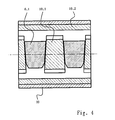
- FIG. 4 and 5 Advantageous embodiments for the plug and socket cams are shown in Figures 4 and 5 as a view of a section along the line B ... B according to Figure 3.
- the flanks (side surfaces) of the individual cams 6.1, 6.1 ', 10.1 and 10.1' are basically arranged or designed such that, on the one hand, the plug cams 6.1, 6.1 'of the ring contact easily penetrate into the axial direction between the socket cams 10.1, 10.1 'on the inside of the inner sleeve 10.2, 10.2' of the connecting socket existing recesses when turning the electrode line is made possible.
- this rotary movement is limited while locking the connector cams 6.1, 6.1 'and thus offers protection against overtightening who is no longer guaranteed contact.
- the maximum angle of rotation is 90 °.
- both the flanks of the plug cams 6.1 and the flanks of the socket cams 10.1 are each inclined in the tangential direction, so that an essentially wedge-shaped cross-sectional profile results.
- the individual wedges have an equally large opening angle when viewed in the tangential direction. After rotation of the electrode line, this advantageously results in a non-positive and positive connection between the contact means with large-area contacting and sufficient surface pressure on the flanks of the cams.
- the sectional view according to FIG. 5 shows connector cams 6.1 'of the ring contact of the electrode line, which have a cross-sectional profile in the form of a parallelogram and at the same time are pivoted to a small extent about their radially extending longitudinal axis.
- the flanks of the socket cams 10.1 'of the socket parts 10, 10.2' of the connection socket in the head part of the pacemaker (compare positions 1, 2 and 3 according to FIG. 1) have a chamfer on both sides in the tangential direction, which prevents the plug cams 6.1 from penetrating 'into the recesses located in the axial direction between the socket cams 10.1' if the connector cams 6.1 'are not exactly aligned with the corresponding recesses.
- connection socket 1 or 9 show a partial longitudinal section through a connection socket 1 or 9 or a cross-sectional view of this socket (section along the line C ... C according to FIG. 6).
- the connection socket points in a closed outer sleeve 10 has an inner sleeve 14 on which strip-shaped contact spring sections 14.1 are provided, which both extend radially inwards and have an axial extension.
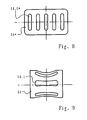
- FIGS. 8 and 9 show the inner sleeve 14 in two processing stages.
- the sleeve 14 is made of a resilient flat material 14 ⁇ and is brought into the required cylindrical shape by means of a stamping and shaping process, the surface areas 14.1 ⁇ being formed at the same time as the contact means 14.1.
- the inner sleeve 14 is connected at one end to the inner edge of the outer sleeve 10 by a plurality of welding spots 15 produced by laser welding.
- This one-sided attachment ensures in a simple manner that the sleeve can lengthen in the axial direction when the smooth pin contact or a (deviating from the above-described embodiments) smooth contact ring contact of the proximal end of the electrode line is inserted into the connection socket.
- the spring action of the contact spring sections 14.1 of the sleeve 14 required for contacting is constantly maintained.
- FIGS. 10 and 11 show, as a further embodiment, a connection socket 1 in a partial longitudinal section or as a cross-sectional representation along the line D ... D according to FIG. 10.
- the proximal end of the electrode line 4 is inserted into the connection socket 1.
- the inner sleeve 14 ' which is positioned in the outer sleeve 10 and made of spring sheet metal, has a plurality of annular beads 16 which point radially outward and which ensure a firm fit of the inner sleeve 14'.
- the four in the sectional plane according to Figure 11 evenly on the sleeve circumference Distributed contact springs 14.1 'are strip-shaped and fastened on one side to the sleeve wall.
- connection socket 1 They point into the socket interior, with their free end being essentially hemispherical and resiliently supported on the ring contact 6.
- the hemispherical shape facilitates the insertion of the cylindrical ring contact 6 of the electrode line 4.
- the arrangement of the contact springs described above in the axial direction of the connection socket 1 enables the ring contact to be securely contacted by the corresponding number of electrical contact surfaces and non-positive connection areas and ensures a secure fit of the proximal end the electrode lead in the head part of the pacemaker.
- the embodiment of the invention is not limited to the preferred exemplary embodiments specified above. Rather, a large number of variants are conceivable, which make use of the solution shown even with a different design.
Landscapes
- Health & Medical Sciences (AREA)
- Radiology & Medical Imaging (AREA)
- Engineering & Computer Science (AREA)
- Biomedical Technology (AREA)
- Nuclear Medicine, Radiotherapy & Molecular Imaging (AREA)
- Life Sciences & Earth Sciences (AREA)
- Animal Behavior & Ethology (AREA)
- General Health & Medical Sciences (AREA)
- Public Health (AREA)
- Veterinary Medicine (AREA)
- Heart & Thoracic Surgery (AREA)
- Cardiology (AREA)
- Electrotherapy Devices (AREA)
Abstract
Description
- Die Erfindung betrifft ein implantierbares Elektrostimulationsgerät, beispielsweise einen Herzschrittmacher oder Defibrillator, der im Oberbegriff des Anspruchs 1 angegebenen Art und eine Elektrodenleitung gemäß dem Oberbegriff des Anspruchs 10.
- Aus der DE-A-3 311 510 ist eine Anordnung zum Verbinden des proximalen Endes einer bipolaren Elektrodenleitung mit einem Herzschrittmacher bekannt, wobei die Elektrodenleitung einen vorderen Stiftkontakt und einen in distaler Richtung dahinterliegenden Ringkontakt aufweist. Die proximalen Stiftkontakte der Elektrodenleitung werden bei der Verbindung mit dem Herzschrittmacher in einen hohlzylindrischen, sogenannten Endblock eingebracht und dort mit einer Schraube in seiner Position fixiert. Die Stiftschraube in dem Endblock soll einerseits eine ausreichende elektrische Kontaktierung sichern und andererseits einen Schutz vor einer unerwünschten axialen Verschiebung des Leitungskontakts innerhalb des Endblocks bieten, damit sich das proximale Ende der bipolaren Elektrodenleitung nicht von dem Herzschrittmacher lösen kann. Der in distaler Richtung hinter dem Stiftkontakt vorgesehene zweite, als Ringkontakt ausgebildete Anschluß der Elektrodenleitung ist zwecks Kontaktierung in eine Buchse eingeschoben, welche an ihrer inneren Oberfläche drei Einschnitte aufweist. In diesen Einschnitten ist ein im wesentlichen kreisförmig gebogener Draht unter einer mechanischen Vorspannung derart eingesetzt, daß der Ringkontakt an drei Punkten elektrisch mit dem Draht verbunden ist, wenn sich der Stiftkontakt der Elektrodenleitung in dem für ihn vorgesehenen Endblock befindet.
- Diese Lösung weist den Nachteil auf, daß die Verschraubung und die Verwendung eines in eine Buchse eingesetzten, ringförmig gebogenen Drahtes keine großflächige Kontaktierung sichern kann und zudem nur eine ungenügende Sicherheit gegen unbeabsichtigtes Lösen der Verbindung bei einer axialen Belastung der Elektrodenleitung bietet.
- In US-A-4 583 543 wird eine Anordnung zur Verbindung einer bipolaren Elektrodenleitung mit einem Herzschrittmacher vorgeschlagen, bei der zum Anschluß einer dünneren als der ursprünglich vorgesehenen Elektrodenleitung im Kopfteil des Herzschrittmachers ein Adapter vorgesehen ist. Die Verbindung zwischen Adapter und Elektrodenleitung wird über einen Reibschluß hergestellt, welcher allein durch eine mehrfache, im wesentlichen lediglich punktförmige Kontaktierung auf einer einzigen Umfangslinie des Kontakts der Elektrodenleitung entsteht. Die Sicherung gegen ein Lösen der Verbindung bei einer axialen Belastung der Elektrodenleitung erscheint als unzureichend.
- Des weiteren ist aus EP-A-0 339 877 ein Anschlußsystem für einen Herzschrittmacher bekannt, bei welchem im Kopfteil des Schrittmachers zwei Metallzylinder mit innenliegenden Federdrähten zur Kontaktierung der Anschlüsse der Elektrodenleitung vorgesehen sind. Die Sicherung gegen Lösen der elektrischen Verbindung zwischen Elektrodenleitung und Herzschrittmacher bei mechanischer Belastung in axialer Richtung ist auch hier ungenügend, da dieser lediglich ein Reibschluß in im wesentlichen linienförmigen Kontaktbereichen entgegenwirkt.
- Ausgehend von den Mängeln des Standes der Technik liegt der Erfindung die Aufgabe zugrunde, ein Elektrostimulationsgerät der eingangs genannten Gattung und eine mit dem Elektrostimulationsgerät verbindbare Elektrodenleitung zu schaffen, die in einfacher Weise und schnell miteinander verbindbar sind und deren Verbindung zugleich eine hohe Sicherheit gegenüber axialem Zug an der Elektrodenleitung aufweist.
- Diese Aufgabe wird hinsichtlich des Elektrostimulationsgerätes mit den Merkmalen des Anspruchs 1 und hinsichtlich der Elektrodenleitung mit den Merkmalen gemäß Anspruch 10 gelöst.
- Die Erfindung schließt den Gedanken ein, an der Anschlußbuchse des Elektrostimulationsgerätes und/oder an mindestens einem der Kontakte am Elektrodenleitungsstecker fest angebracht eine Mehrzahl von Eingriffsbereichen zur relativ großflächigen elektrischen Kontaktierung und Erzeugung eines Formschlusses oder zumindest eines hochwirksamen Kraftschlusses vorzusehen, wodurch einer im wesentlichen axial gerichteten Zugkraft ein hoher Widerstand entgegengesetzt wird.
- Diese Kontakt- und Haltemittel in Form von Nocken- oder Vorsprungsbereichen sind bevorzugt gruppenweise in mehreren sich zueinander parallel und in axialer Reihung erstreckenden Ebenen angeordnet.
- Zur Bildung der radial nach innen gerichteten Kontakt- und Haltemittel der Anschlußbuchse im Kopfteil des Herzschrittmachers ist entsprechend einer technologisch vorteilhaften Variante der Erfindung eine in die Buchse eingesetzte Hülse mit brückenartigen, elastischen Vorsprungsbereichen vorgesehen, die speziell durch Prägen und Biegen aus einem flächigen, Federeigenschaften und bevorzugt hohe Leitfähigkeit aufweisenden Material gefertigt ist. Diese Hülse umschließt straff elastisch einen eingeführten herkömmlichen Stiftoder Ringkontakt einer Elektrodenleitung und erbringt durch die relativ große effektive Kontaktfläche und angemessenen Anpreßdruck sowohl einen guten elektrischen Kontakt als auch eine hohen Widerstand gegen axiale Zugkräfte.
- Bei einer weiteren bevorzugten Ausführung sind zwischen mehreren in Umfangsrichtung gruppierten Vorsprüngen der Anschlußbuchse jeweils Ausnehmungen vorhanden, in die beim Einstecken der Elektrodenleitung in Form und Anordnung mit den Ausnehmungen korrespondierende Vorsprünge eines Ringkontakts (oder des Stiftkontaktes oder beider) der Elektrodenleitung eingreifen. Durch eine nachfolgende Drehung der eingeführten Elektrodenleitung wird bewirkt, daß die Vorsprünge des Elektrodenleitungskontakts diejenigen der Anschlußbuchse hintergreifen. Sind insbesondere in axialer Reihung jeweils mehrere Kontakt- und Haltemittel vorgesehen, so greifen diese wechselweise in die zwischen ihnen vorhandenen Ausnehmungen ein. Das Ineinandergreifen der Vorsprünge schafft eine vergrößerte elektrische Kontaktfläche und einen ein Ausziehen der Elektrodenleitung aus der Anschlußbuchse sicher verhindernden Formschluß zwischen beiden. Die elektrischen und mechanischen Eigenschaften sind weiter verbessert, wenn die Nocken- bzw. Vorsprungsbereiche so angeordnet und ihre Eingriffsflächen so gestaltet sind, daß sie unter Erzeugung einer Flächenpressung in Wirkkontakt gelangen. Diese Flächenpressung verhindert einerseits in vorteilhafter Weise eine ungewollte Drehbewegung der Elektrodenleitung in eine Winkelstellung, in der die axiale Verriegelung aufgehoben wäre, und erbringt in vorteilhafter Weise einen hohen Kontaktdruck.
- In einer einfachen, aber wirkungsvollen Ausführung sind je drei oder vier, jeweils gleichartig ausgebildete, Kontakt- und Haltemittel gleichmäßig am Umfang der Anschlußbuchse bzw. des Ringkontakts verteilt - d.h. mit einem Winkelabstand ihrer Mittelebenen von 120° bzw. 90° - angeordnet.
- In einer speziellen Gestaltung sind die die Flanken der nockenförmig ausgebildeten Kontakt- und Haltemittel bildenden Seitenflächen jeweils in Umfangsrichtung gegeneinander geringfügig geneigt angeordnet, so daß die Nocken ein leicht keilförmiges Querschnittsprofil aufweisen. Dadurch wird auf einfache Weise einen hohe Flächenpressung erreicht und darüberhinaus bewirkt, daß das Eindrehen der Elektrodenleitung leicht auch aus einer Einsteckposition heraus erfolgen kann, in der die Winkellage des Steckers relativ zr Buchse nicht optimal ist. Des weiteren wird durch die keilförmigen Querschnittsprofile der Kontakt- und Haltemittel eine Sicherheit gegen ein unbeabsichtigtes Überdrehen der Elektrodenleitung in eine Winkellage erreicht, in der die Kontakt- und Haltemittel nicht oder nur mit unzureichender Kontaktierung in Wirkungseingriff stehen würden.
- Entsprechend einer günstigen Weiterbildung ist die Mittenebene der Nocken bzw. Vorsprünge der Elektrodenleitung relativ zur Längsache des Steckerstiftes (ähnlich den Schaufeln eines Lüfterrades) um einen Winkel von wenigen Grad geschwenkt. Die korrespondierenden Nocken bzw. Vorsprünge der Anschlußbuchse sind - in Umfangsrichtung betrachtet - beidseitig angefast. Auch dies ermöglicht in günstiger Weise ein Eindrehen der Elektrodenleitung auch bei nach dem Einstecken nicht exakt fluchtenden Vorsprüngen und Ausnehmungen.
- Entsprechend einer Variante der Erfindung sind an der Wandung der Anschlußbuchse sich in Umfangsrichtung erstreckende Federelemente vorgesehen, die jeweils einen Befestigungspunkt an der Hülse aufweisen. Die Federelemente unterliegen einer elastische Längung, wenn der Stift- oder Ringkontakt der Elektrodenleitung in die Anschlußbuchse eingeführt wird. Diese erbringt wiederum die zur Erreichung einer hohen Auszugsicherheit gewünschte Flächenpressung mit dem Elektrodenleitungskontakt.
- Bei einer derartigen Ausbildung der Anschlußbuchse ist keine Profilierung der Oberfläche des Ringkontakts am proximalen Ende der Elektrodenleitung durch zusätzliche Kontaktmittel vorgesehen. Der Durchmesser des Ringkontakts ist lediglich größer als der lichte Durchmesser der Anschlußbuchse (zwischen den ungelängten Federelementen) gewählt.
- Vorteilhafte Weiterbildungen der Erfindung sind in den Unteransprüchen gekennzeichnet bzw. werden nachstehend zusammen mit der Beschreibung der bevorzugten Ausführung der Erfindung anhand der Figuren näher dargestellt.
- Es zeigen:
- Figur 1 eine schematische Darstellung des Kopfteils eines Herzschrittmachers mit angeschlossener Elektrodenleitung,
- Figur 2 eine perspektivische Darstellung einer bevorzugten Ausführungsform der Erfindung,
- Figur 3 die Darstellung eines Schnittes längs der Linie A...A gemäß Figur 1,
- Figur 4 die Darstellung eines Schnittes längs der Linie B...B gemäß Figur 3,
- Figur 5 die Schnittdarstellung einer gegenüber Figur 4 modifizierten Weiterbildung der Erfindung,
- Figur 6 einen Teil-Längsschnitt durch eine andere Ausführungsform der Erfindung,
- Figur 7 die Darstellung eines Schnittes längs der Linie C...C gemäß Figur 6,
- Figuren 8 und 9 die in den Figuren 6 und 7 gezeigte Hülse in zwei verschiedenen Herstellungsstufen,
- Figur 10 einen Teil-Längsschnitt durch eine weitere Ausführungsform der Erfindung und
- Figur 11 die Darstellung eines Schnittes längs der Linie D...D gemäß Figur 10.
- Figur 1 zeigt skizzenartig das Kopfteil 3 eines Herzschrittmachers 2, an den eine bipolare Elektrodenleitung 4 angeschlossen ist. Die am proximalen Ende der Elektrodenleitung befindlichen Kontakte 5 und 6 sind durch eine Isolierung 8 voneinander getrennt. Koaxial zum Stiftkontakt 5 ist ein Ringkontakt 6 der Elektrodenleitung 4 vorgesehen. Im Kopfteil 3 des Herzschrittmachers sind Anschlußbuchsen 1, 9 vorgesehen und jeweils einem der Kontakte 5, 6 der Elektrodenleitung 4 zugeordnet. Die elektrische Verbindung zwischen den Anschlußbuchsen 1, 9 und den (nicht dargestellten) Elekronik-Bausteinen des Schrittmachers 2 wird über interne Leitungen 12, 13 hergestellt. An der Außenisolation 7 der Elektrodenleitung 4 sind zwei Dichtringe 11 vorgesehen, welche bei implantiertem Herzschrittmacher ein Eindringen von Körperflüssigkeit über die Einstecköffnung des Kopfteils verhindern.
- In Figur 2 ist das proximale Ende der Elektrodenleitung 4 in perspektivischer Darstellung gezeigt. Während der Stiftkontakt 5 eine glatte Oberfläche aufweist, sind an der Oberfläche des von dem Stiftkontakt 5 durch eine Isolierung 8 separierten Ringkontakts 6 der Leitung 4 eine Mehrzahl von als Pyramidenstumpf ausgebildeten und sich in radialer Richtung nach außen erstreckenden Stecker-Nocken 6.1 vorgesehen. Die auf einer Umfangslinie des Ringkontaktes gleichmäßig verteilt angeordneten Stecker-Nocken 6.1 bilden eine Nockengruppe, welche eine erste Segmentierung des Ringkontakts in Umfangsrichtung darstellt. Für eine zweite Segmentierung des Ringkontaktes 6 sind mehrere Nockengruppen vorgesehen, welche bei gleichem Abstand eine Reihung mit gleichen Abständen in axialer Richtung der Elektrodenleitung 4 aufweisen.
- Die äußere Isolation 7 der Elektrodenleitung 4 trägt zwei Dichtungsringe 11, die die Einstecköffnung im Kopfteil des Schrittmachers feuchtigkeitsdicht verschließen.
- In Figur 3 ist eine aus der Anschlußbuchse 1 im Kopfteil des Herzschrittmachers und der Elektrodenleitung 4 gebildete Verbindungsanordnung in Form eines Schnittes längs der Linie A...A gemäß Figur 1 dargestellt, wobei die Elektrodenleitung 4 nach axialem Einschub in die Buchse 1 um 90° im Uhrzeigersinn um ihre Längsachse gedreht worden ist. Die Anschlußbuchse 1 besteht aus einer Außenhülse 10, in welche eine Innenhülse 10.2 eingesetzt ist. Die Innenhülse 10.2 weist an ihrer inneren Oberfläche eine Mehrzahl radial nach innen gerichteter Buchsennocken 10.1 auf, zwischen denen durch tangentiale Segmentierung gleichgroße Ausnehmungen vorgesehen sind. Durch eine Gruppierung von Buchsennocken 10.1 bei bestimmten Abstand zueinander in axialer Richtung ergeben sich Ausnehmungen (s. Figuren 4 und 5), deren Erstreckung in Umfangsrichtung auf die Abmessungen der Stekker-Nocken 6.1 an der Peripherie des Ringkontaktes 6 derart abgestimmt ist, daß die Stecker-Nocken 6.1 beim Einschieben der Elektrodenleitung 4 in die Anschlußbuchse 1 axial in den Ausnehmungen bewegt werden können. Bei der nach dem Einschieben in die Anschlußbuchse auszuführenden Drehung der Elektrodenleitung 4 werden die Stecker-Nocken 6.1 in die in axialer Richtung vorhandenen Ausnehmungen zwischen den Buchsen-Nocken 10.1 der Anschlußbuchse 1 geschwenkt.
- Hierdurch entsteht in günstiger Weise beim Eindrehen der Elektrodenleitung eine bajonettverschlußartige Verbindung zwischen den Stecker- und Buchsen-Nocken, welche einen ausreichenden Flächenkontakt bei gleichzeitig erhöhter Flächenpressung an den Randbereichen (vergleiche die Position 13 gemäß Figur 5) der Nockenflanken sichert. Dies sichert die Verbindungsanordnung gegen ein Lösen der Elektrodenleitung 4 bei mechanischen Belastung in axialer Richtung.
- Vorteilhafte Ausführungsformen für die Stecker- und Buchsen-Nocken sind in den Figuren 4 und 5 als Ansicht eines Schnittes längs der Linie B...B gemäß Figur 3 dargestellt. Die Flanken (Seitenflächen) der einzelnen Nocken 6.1, 6.1', 10.1 und 10.1' sind grundsätzlich derart angeordnet bzw. ausgebildet, daß einerseits ein leichtes Eindringen der Stecker-Nocken 6.1, 6.1' des Ringkontaktes in die in axialer Richtung zwischen den Buchsen-Nocken 10.1, 10.1' an der Innenseite der Innenhülse 10.2, 10.2' der Anschlußbuchse vorhandenen Ausnehmungen beim Drehen der Elektrodenleitung ermöglicht wird. Andererseits wird diese Drehbewegung bei gleichzeitiger Arretierung der Stecker-Nocken 6.1, 6.1' begrenzt und bietet damit Schutz vor einem Überdrehen, bei dem die Kontaktierung nicht mehr gesichert ist. Der maximale Drehwinkel weist einen Wert von 90° auf.
- Entsprechend Figur 4 sind sowohl die Flanken der Stecker-Nocken 6.1 als auch die Flanken der Buchsen-Nocken 10.1 in tangentialer Richtung jeweils gegeneinander geneigt, so daß sich ein im wesentlichen keilförmiges Querschnittsprofil ergibt. Die einzelnen Keile weisen in tangentialer Richtung gesehen einen gleichgroßen Öffnungswinkel auf. Dadurch ergibt sich nach erfolgter Drehung der Elektrodenleitung in vorteilhafter Weise eine kraft- und formschlüssige Verbindung zwischen den Kontaktmitteln bei großflächiger Kontaktierung und ausreichender Flächenpressung an den Flanken der Nocken.
- Die Schnittdarstellung gemäß Figur 5 zeigt Stecker-Nocken 6.1' des Ringkontaktes der Elektrodenleitung, welche ein Querschnittsprofil in Form eines Parallelogramms aufweisen und gleichzeitig um ein geringes Maß um ihre sich radial erstreckende Längsachse geschwenkt sind. Die Flanken der Buchsen-Nocken 10.1' der Buchsenteile 10, 10.2' der Anschlußbuchse im Kopfteil des Herzschrittmachers (vergleiche die Positionen 1, 2 und 3 gemäß Figur 1) weisen beidseitig in tangentialer Richtung eine Anfasung auf, welche das Eindringen der Stecker-Nocken 6.1' in die zwischen den Buchsen-Nocken 10.1' in axialer Richtung befindlichen Ausnehmungen erleichtert, wenn die Stecker-Nocken 6.1' nicht genau mit den entsprechenden Ausnehmungen fluchten.
- Die Darstellungen entsprechend den Figuren 6 und 7 zeigen einen Teil-Längsschnitt durch eine Anschlußbuchse 1 oder 9 bzw. eine Querschnittsansicht dieser Buchse (Schnitt längs der Linie C...C gemäß Figur 6). Die Anschlußbuchse weist in einer geschlossenen Außenhülse 10 eine Innenhülse 14 auf, an der streifenförmige Kontaktfederabschnitte 14.1 vorgesehen sind, die sich sowohl radial nach innen erstrecken als auch eine axiale Erstreckung aufweisen.
- Die Figuren 8 und 9 zeigen die Innenhülse 14 in zwei Bearbeitungsstufen. Die Hülse 14 ist aus einem federnden Flachmaterial 14∗ gefertigt und wird durch einen Stanz- und Formgebungsvorgang in die erforderliche zylindrische Form gebracht, wobei gleichzeitig die Flächenbereiche 14.1∗ zu den Kontaktmitteln 14.1 ausgeprägt werden.
- Die Innenhülse 14 ist - wie in Figur 6 gezeigt - durch mehrere, durch Laser-Schweißen erzeugte Schweißpunkte 15 an einem ihrer Enden mit dem inneren Rand der Außenhülse 10 verbunden. Diese einseitige Befestigung sichert auf einfache Weise, daß sich die Hülse in axialer Richtung längen kann, wenn der glatte Stiftkontakt bzw. ein (abweichend von den vorstehend beschriebenen Ausführungen) glatt ausgeführter Ringkontakt des proximalen Endes der Elektrodenleitung in die Anschlußbuchse eingeführt wird. Dadurch wird die zur Kontaktierung erforderliche Federwirkung der Kontaktfederabschnitte 14.1 der Hülse 14 ständig aufrechterhalten.
- Die Figuren 10 und 11 zeigen als weitere Ausführungsform eine Anschlußbuchse 1 in Teil-Längsschnitt- bzw. als Querschnittsdarstellung längs der Linie D...D gemäß Figur 10. Das proximale Ende der Elektrodenleitung 4 ist in die Anschlußbuchse 1 eingeführt. Die in der Außenhülse 10 positionierte, aus Federblech gefertigte Innenhülse 14' weist mehrere radial nach außen weisende Ringwülste 16 auf, welche einen festen Sitz der Innenhülse 14' sichern. Die vier in der Schnittebene gemäß Figur 11 gleichmäßig am Hülsenumfang verteilten Kontaktfedern 14.1' sind streifenförmig ausgebildet und einseitig an der Hülsenwandung befestigt. Sie weisen in den Buchseninnenraum, wobei ihr freies Ende im wesentlichen halbkuglig ausgebildet ist und sie sich federnd auf dem Ringkontakt 6 abstützen. Die halbkuglige Form erleichert das Einschieben des zylindrischen Ringkontakts 6 der Elektrodenleitung 4. Die gereihte Anordnung der vorstehend beschriebenen Kontaktfedern in axialer Richtung der Anschlußbuchse 1 ermöglicht durch die entsprechende Anzahl von elektrischen Kontaktflächen und Kraftschlußbereichen eine sichere Kontaktierung des Ringkontakts und sichert einen festen Sitz des proximalen Endes der Elektrodenleitung im Kopfteil des Herzschrittmachers.
- Die Erfindung beschränkt sich in ihrer Ausführung nicht auf die vorstehend angegebenen bevorzugten Ausführungsbeispiele. Vielmehr ist eine Vielzahl von Varianten denkbar, welche von der dargestellten Lösung auch bei abweichender Ausführung Gebrauch machen.
Claims (12)
- Implantierbares Elektrostimulationsgerät (2) mit einem Kopfteil (3) zum elektrischen Anschluß einer Elektrodenleitung (4), das eine fest installierte Anschlußbuchse (1, 9) aufweist, an deren Innenwandung radial nach innen weisende Kontakt- und Haltemittel (10.1, 10.1', 14.1, 14.1') zum Eingriff mit einem Elektrodenleitungskontakt (5, 6) vorgesehen sind,
dadurch gekennzeichnet, daß
die Kontakt- und Haltemittel durch eine Mehrzahl von fest mit der Innenwandung verbundenen oder aus dieser ausgeformten, jeweils einen fest vorbestimmten Winkelabstand in Umfangsrichtung der Buchse und/oder axialen Abstand aufweisenden, Nocken- oder Vorsprungsbereichen gebildet sind. - Elektrostimulationsgerät nach Anspruch 1, dadurch gekennzeichnet, daß die Kontakt- und Haltemittel im wesentlichen kufenartig oder in Form eines Pyramidenstumpfes (10.1; 10.1') zum form- und vorzugsweise zusätzlich kraftschlüssigen Eingriff mit entsprechend angeordneten und geformten Bereichen (6.1) an einem Stift- oder Ringkontakt (6) einer Elektrodenleitung (4) ausgebildet sind.
- Elektrostimulationsgerät nach Anspruch 1, dadurch gekennzeichnet, daß die Kontakt- und Haltemittel mit Formund/oder Materialelastizität, insbesondere einen sich in axialer Richtung der Buches erstreckenden radial und/oder axial deformierbaren Vorsprung (14.1) aufweisend, zur im wesentlichen kraftschlüssigen Verbindung mit einem Stift- oder Ringkontakt (5) einer Elektrodenleitung (4) ausgebildet sind.
- Elektrostimulationsgerät nach einem der vorangehenden Ansprüche, dadurch gekennzeichnet, daß mindestens zwei Nokken- oder Vorsprungsbereiche (10.1; 10.1') bei übereinstimmender Lage in Umfangsrichtung in axialer Richtung gereiht sind.
- Elektrostimulationsgerät nach einem der vorangehenden Ansprüche, dadurch gekennzeichnet, daß die Nocken- oder Vorsprungsbereiche (10.1; 10.1') sich im wesentlichen radial erstreckende vordere und hintere Seitenflächen aufweisen, welche gegeneinander geneigt sind.
- Elektrostimulationsgerät nach einem der vorhergenenden Ansprüche, dadurch gekennzeichnet, daß mindestens drei Nocken- oder Vorsprungsbereiche (14.1, 14.1') jeweils in einer sich quer zur Längsachse der Anschlußbuchse (1) erstreckenden Ebene, insbesondere in gleichem Winkelabstand zueinander, angeordnet sind.
- Elektrostimulationsgerät nach einem der vorangehenden Ansprüche, dadurch gekennzeichnet, daß die Anschlußbuchse (1) eine insgesamt aus einem leitfähigen Federmaterialblech geformte Innenhülse (10.2, 10.2', 14, 14') aufweist, die als Nocken- oder Vorsprungsbereiche insbesondere symmetrisch angeordnete Federbrücken (14.1, 14.1') trägt.
- Elektrodenleitung (4) für ein implantierbares Elektrostimulationsgerät (2), die einen Stift- oder Ringkontakt (5, 6) zur Einführung in eine Anschlußbuchse (1, 9) des Elektrostimulationsgerät aufweist,
dadurch gekennzeichnet,
daß an der Oberfläche des Stift- oder Ringkontaktes radial nach außen weisende Kontakt- und Haltemittel (6.1, 6.1') vorgesehen sind, die durch eine Mehrzahl von fest mit der Oberfläche verbundenen oder aus dieser ausgeformten, jeweils einen fest vorbestimmten Winkelabstand in Umfangsrichtung des Stift- oder Ringkontaktes und/oder axialen Abstand aufweisenden, Nocken- oder Vorsprungsbereichen gebildet sind. - Elektrodenleitung nach Anspruch 8, dadurch gekennzeichnet, daß die Kontakt- und Haltemittel (6.1, 6.1') im wesentlichen kufenförmig oder in Form eines Pyramidenstumpfes zum form- und vorzugsweise zusätzlich kraftschlüssigen Eingriff mit entsprechend angeordneten und geformten Bereichen (10.1, 10.1') der Anschlußbuchse (1) des Elektrostimulationsgerätes (2) ausgebildet sind.
- Elektrodenleitung nach Anspruch 8 oder 9, dadurch gekennzeichnet, daß mindestens zwei Nocken- oder Vorsprungsbereiche (6.1, 6.1') bei übereinstimmender Lage in Umfangsrichtung in axialer Richtung gereiht sind.
- Elektrodenleitung nach einem der Ansprüche 8 bis 10, dadurch gekennzeichnet, daß die Nocken- oder Vorsprungsbereiche (6.1, 6.1') sich im wesentlichen radial erstreckende Seitenflächen aufweisen, welche gegeneinander geneigt sind.
- Elektrodenleitung nach einem der Ansprüche 8 bis 11, gekennzeichnet durch eine Ausbildung ihres proximales Endes derart, daß sie in der Anschlußbuchse (3) des Elektrostimulationsgerätes (2) mittels eines durch vorbestimmte Axialverschiebung und Drehung des Endes um einen vorbestimmten Winkel erzeugten Kraft- und/oder Formschlusses zwischen ihren Kontakt- und Haltemitteln (6.1, 6.1') mit solchen in der Buchse (3), insbesondere durch Flächenpressung an deren jeweils benachbarten Seitenflächen, verbindbar ist.
Applications Claiming Priority (2)
| Application Number | Priority Date | Filing Date | Title |
|---|---|---|---|
| DE19609367 | 1996-03-04 | ||
| DE19609367A DE19609367A1 (de) | 1996-03-04 | 1996-03-04 | Herzschrittmacher |
Publications (3)
| Publication Number | Publication Date |
|---|---|
| EP0793974A2 true EP0793974A2 (de) | 1997-09-10 |
| EP0793974A3 EP0793974A3 (de) | 1999-04-21 |
| EP0793974B1 EP0793974B1 (de) | 2004-09-15 |
Family
ID=7787851
Family Applications (1)
| Application Number | Title | Priority Date | Filing Date |
|---|---|---|---|
| EP97250058A Expired - Lifetime EP0793974B1 (de) | 1996-03-04 | 1997-03-04 | Implantierbares Elektrostimulationsgerät und Elektrodenleitung |
Country Status (3)
| Country | Link |
|---|---|
| US (1) | US5968082A (de) |
| EP (1) | EP0793974B1 (de) |
| DE (2) | DE19609367A1 (de) |
Cited By (1)
| Publication number | Priority date | Publication date | Assignee | Title |
|---|---|---|---|---|
| EP2027886A1 (de) * | 2007-08-22 | 2009-02-25 | Peter Osypka | Herzschrittmacher-Elektrode mit Schraubwendel und Zuleitungswendel |
Families Citing this family (48)
| Publication number | Priority date | Publication date | Assignee | Title |
|---|---|---|---|---|
| US20050004642A1 (en) * | 1998-11-09 | 2005-01-06 | Medtronic, Inc. | Implantable medical lead including overlay |
| US6183305B1 (en) * | 1998-12-04 | 2001-02-06 | Pacesetter, Inc. | High strength connector design for passive fixation pacing lead |
| US6741892B1 (en) | 2000-03-10 | 2004-05-25 | Advanced Bionics Corporation | Movable contact locking mechanism for spinal cord stimulator lead connector |
| US6498952B2 (en) * | 2001-03-08 | 2002-12-24 | Pacesetter, Inc. | Hermetically sealed feedthrough connector using shape memory alloy for implantable medical device |
| US6895276B2 (en) * | 2002-02-28 | 2005-05-17 | Medtronic, Inc. | In-line lead header for an implantable medical device |
| US7130700B2 (en) * | 2002-11-19 | 2006-10-31 | Medtronic, Inc. | Multilumen body for an implantable medical device |
| US7539542B1 (en) | 2003-01-09 | 2009-05-26 | Boston Scientific Neuromodulation Corporation | Lead connector, lead adapter, and lead insertion apparatus |
| US7003351B2 (en) * | 2003-02-25 | 2006-02-21 | Cardiac Pacemakers, Inc. | Ring connector for implantable medical devices |
| US20050107859A1 (en) * | 2003-11-14 | 2005-05-19 | Terry Daglow | System and method of establishing an electrical connection between an implanted lead and an electrical contact |
| DE102004017659A1 (de) | 2004-04-05 | 2005-10-27 | Biotronik Vi Patent Ag | Federkontaktelement |
| DE102004053332B3 (de) * | 2004-11-04 | 2006-06-01 | Odu-Steckverbindungssysteme Gmbh & Co. Kg | Buchse eines elektrischen Steckverbinders |
| JP4801416B2 (ja) | 2004-11-04 | 2011-10-26 | オーデェウ ステッキフェルビンドゥングスシステエメ ゲゼルシャフト ミット ベシュレンクテル ハフツング ウント コンパニー コマンデイトゲゼルシャフト | 電気プラグ・コネクタのソケットおよびそのようなソケットを備えたプラグ・コネクタ |
| US7583999B2 (en) | 2006-07-31 | 2009-09-01 | Cranial Medical Systems, Inc. | Multi-channel connector for brain stimulation system |
| US20080262585A1 (en) * | 2007-04-20 | 2008-10-23 | Medtronic, Inc. | Implantable medical electrical lead and connector assembly |
| US9220889B2 (en) * | 2008-02-11 | 2015-12-29 | Intelect Medical, Inc. | Directional electrode devices with locating features |
| US8731670B2 (en) * | 2010-04-27 | 2014-05-20 | Oscor Inc. | Passive electrical connector |
| US8897876B2 (en) * | 2010-09-22 | 2014-11-25 | Boston Scientific Neuromodulation Corporation | Systems and methods for making and using connectors for electrical stimulation systems |
| US9421362B2 (en) * | 2011-10-28 | 2016-08-23 | Medtronic, Inc. | Modular lead end |
| US9017341B2 (en) * | 2011-10-31 | 2015-04-28 | Pacesetter, Inc. | Multi-piece dual-chamber leadless intra-cardiac medical device and method of implanting same |
| US9956394B2 (en) | 2015-09-10 | 2018-05-01 | Boston Scientific Neuromodulation Corporation | Connectors for electrical stimulation systems and methods of making and using |
| US10342983B2 (en) | 2016-01-14 | 2019-07-09 | Boston Scientific Neuromodulation Corporation | Systems and methods for making and using connector contact arrays for electrical stimulation systems |
| CN109069841B (zh) * | 2016-04-18 | 2022-06-14 | 心脏起搏器股份公司 | 具有抗迁移和装置提取特征的imd |
| US10201713B2 (en) | 2016-06-20 | 2019-02-12 | Boston Scientific Neuromodulation Corporation | Threaded connector assembly and methods of making and using the same |
| US10307602B2 (en) | 2016-07-08 | 2019-06-04 | Boston Scientific Neuromodulation Corporation | Threaded connector assembly and methods of making and using the same |
| EP3458154B1 (de) * | 2016-07-29 | 2025-11-12 | Boston Scientific Neuromodulation Corporation | Steckereinheit mit kontaktringen mit vorgespannten federkontakten mit jeweils einer kugel |
| US10543374B2 (en) | 2016-09-30 | 2020-01-28 | Boston Scientific Neuromodulation Corporation | Connector assemblies with bending limiters for electrical stimulation systems and methods of making and using same |
| US10905871B2 (en) | 2017-01-27 | 2021-02-02 | Boston Scientific Neuromodulation Corporation | Lead assemblies with arrangements to confirm alignment between terminals and contacts |
| US10814136B2 (en) | 2017-02-28 | 2020-10-27 | Boston Scientific Neuromodulation Corporation | Toolless connector for latching stimulation leads and methods of making and using |
| US10603499B2 (en) | 2017-04-07 | 2020-03-31 | Boston Scientific Neuromodulation Corporation | Tapered implantable lead and connector interface and methods of making and using |
| US10918873B2 (en) | 2017-07-25 | 2021-02-16 | Boston Scientific Neuromodulation Corporation | Systems and methods for making and using an enhanced connector of an electrical stimulation system |
| WO2019055837A1 (en) | 2017-09-15 | 2019-03-21 | Boston Scientific Neuromodulation Corporation | ACTIONABLE WIRE CONNECTOR FOR OPERATING ROOM CABLE ASSEMBLY AND METHODS OF MANUFACTURE AND USE |
| CN111629778B (zh) | 2017-09-15 | 2024-07-26 | 波士顿科学神经调制公司 | 手术室线缆组件的偏置引线连接器及其制造和使用方法 |
| US11139603B2 (en) | 2017-10-03 | 2021-10-05 | Boston Scientific Neuromodulation Corporation | Connectors with spring contacts for electrical stimulation systems and methods of making and using same |
| US11103712B2 (en) | 2018-01-16 | 2021-08-31 | Boston Scientific Neuromodulation Corporation | Connector assemblies with novel spacers for electrical stimulation systems and methods of making and using same |
| WO2019148201A1 (en) | 2018-01-29 | 2019-08-01 | Bard Access Systems, Inc. | Connection system for establishing an electrical connection through a drape and methods thereof |
| EP3790623B1 (de) | 2018-05-11 | 2023-07-05 | Boston Scientific Neuromodulation Corporation | Verbinderanordnung für ein system zur elektrischen stimulation |
| CN112135577B (zh) | 2018-05-18 | 2024-10-15 | 巴德阿克塞斯系统股份有限公司 | 用于建立通过盖布的电连接的连接系统及其方法 |
| CN109149202B (zh) * | 2018-07-20 | 2023-10-13 | 江苏农林职业技术学院 | 一种插座 |
| US11357992B2 (en) | 2019-05-03 | 2022-06-14 | Boston Scientific Neuromodulation Corporation | Connector assembly for an electrical stimulation system and methods of making and using |
| US11737848B2 (en) | 2019-07-29 | 2023-08-29 | Bard Access Systems, Inc. | Connection systems and methods for establishing optical and electrical connections through a drape |
| CA3150924A1 (en) | 2019-08-08 | 2021-02-11 | Bard Access Systems, Inc. | Optical-fiber connector modules including shape-sensing systems and methods thereof |
| US20230126905A1 (en) * | 2020-03-30 | 2023-04-27 | Incube Labs, Llc | Lead locking system and method for implantable stimulators |
| US20230144070A1 (en) * | 2020-04-21 | 2023-05-11 | Biotronik Se & Co. Kg | Connector of an implantable medical device |
| WO2021225920A1 (en) | 2020-05-04 | 2021-11-11 | Heartware, Inc. | Toolless vad sewing ring |
| US11896814B2 (en) | 2020-05-04 | 2024-02-13 | Heartware, Inc. | Toolless quick connect sewing ring |
| US12596232B2 (en) | 2020-10-28 | 2026-04-07 | Bard Access Systems, Inc. | Systems and methods including procedural barrier-breaching connectors and connection-establishing devices |
| US12343547B2 (en) | 2021-08-19 | 2025-07-01 | Boston Scientific Neuromodulation Corporation | Connectors for an electrical stimulation system and methods of making and using |
| US12589252B2 (en) | 2021-08-19 | 2026-03-31 | Boston Scientific Neuromodulation Corporation | Connector assembly with capacitive contacts for an electrical stimulation system and methods of making and using |
Family Cites Families (15)
| Publication number | Priority date | Publication date | Assignee | Title |
|---|---|---|---|---|
| US3760332A (en) * | 1972-03-09 | 1973-09-18 | American Optical Corp | Pacer connector |
| US4112953A (en) * | 1977-03-11 | 1978-09-12 | Medcor, Inc. | Pacer stimulator with improved lead connector |
| DE2845175A1 (de) * | 1977-04-14 | 1980-04-24 | Biotronik Mess & Therapieg | Steckeraufnahme fuer den elektrodenanschluss eines implantierbaren herzschrittmachers |
| US4445511A (en) * | 1982-06-24 | 1984-05-01 | Telectronics Pty. Ltd. | Pacer electrode connector assembly |
| US4583543A (en) * | 1983-05-04 | 1986-04-22 | Cordis Corporation | Upsizing adapter |
| US4764132A (en) * | 1986-03-28 | 1988-08-16 | Siemens-Pacesetter, Inc. | Pacemaker connector block for proximal ring electrode |
| US4934367A (en) * | 1988-04-22 | 1990-06-19 | Medtronic, Inc. | In-line pacemaker connector system |
| US5070605A (en) * | 1988-04-22 | 1991-12-10 | Medtronic, Inc. | Method for making an in-line pacemaker connector system |
| US5088942A (en) * | 1990-09-07 | 1992-02-18 | Itt Corporation | Closed entry socket contact assembly |
| JP3235852B2 (ja) * | 1990-10-30 | 2001-12-04 | ジーイー・マーケット・メディカル・システムズ・インコーポレイテッド | 電極を支持体に対して電気的に接続するための装置 |
| US5261395A (en) * | 1992-03-02 | 1993-11-16 | Cardiac Pacemaker, Inc. | Tooless pulse generator to lead connection |
| US5252090A (en) * | 1992-09-30 | 1993-10-12 | Telectronics Pacing Systems, Inc. | Self-locking implantable stimulating lead connector |
| US5413595A (en) * | 1993-10-15 | 1995-05-09 | Pacesetter, Inc. | Lead retention and seal for implantable medical device |
| SE9600311D0 (sv) * | 1996-01-29 | 1996-01-29 | Pacesetter Ab | Fixeringsanordning |
| US5730628A (en) * | 1996-09-25 | 1998-03-24 | Pacesetter, Inc. | Multi-contact connector for an implantable medical device |
-
1996
- 1996-03-04 DE DE19609367A patent/DE19609367A1/de not_active Ceased
-
1997
- 1997-03-03 US US08/808,994 patent/US5968082A/en not_active Expired - Fee Related
- 1997-03-04 EP EP97250058A patent/EP0793974B1/de not_active Expired - Lifetime
- 1997-03-04 DE DE59711903T patent/DE59711903D1/de not_active Expired - Fee Related
Cited By (1)
| Publication number | Priority date | Publication date | Assignee | Title |
|---|---|---|---|---|
| EP2027886A1 (de) * | 2007-08-22 | 2009-02-25 | Peter Osypka | Herzschrittmacher-Elektrode mit Schraubwendel und Zuleitungswendel |
Also Published As
| Publication number | Publication date |
|---|---|
| DE19609367A1 (de) | 1997-09-11 |
| EP0793974B1 (de) | 2004-09-15 |
| DE59711903D1 (de) | 2004-10-21 |
| US5968082A (en) | 1999-10-19 |
| EP0793974A3 (de) | 1999-04-21 |
Similar Documents
| Publication | Publication Date | Title |
|---|---|---|
| EP0793974B1 (de) | Implantierbares Elektrostimulationsgerät und Elektrodenleitung | |
| DE3016497C2 (de) | Herzkatheter | |
| EP1275173B1 (de) | Stecker mit einer hülse | |
| DE8508465U1 (de) | Verbinder mit einem drehbaren Einsatz zum Festhalten von Anschlüssen | |
| DE10054698A1 (de) | Elektrischer Steckverbinder, Kupplung und darin verwendbares Bauteil | |
| DE19804625C2 (de) | Gummipfropfen für wasserdichte Verbinder | |
| DE68915655T2 (de) | Anschlussklemme zur Verbindung von Elektrodenkabeln mit einem Herzschrittmacher. | |
| DE2802060A1 (de) | Abgedichtetes, elektrisches anschlussgeraet | |
| DE69917983T2 (de) | Kontaktstift | |
| DE2359425A1 (de) | Kabelklemme und zugehoerige verbindungseinheit | |
| DE2914660A1 (de) | Anschlussvorrichtung fuer die anodenkapsel einer kathodenstrahlroehre | |
| DE2136022C3 (de) | Mehrfachsteckvorrichtung | |
| EP3630266B1 (de) | Elektromedizinischer adapter, elektromedizinische elektrode und elektromedizinischer impulsgeber | |
| EP1923967A2 (de) | Kontaktanordnung, Kontaktbaugruppe, implantierbare Vorrichtung und Elektrodenleitung | |
| EP0681343A2 (de) | Einrichtung zum Massenanschluss von elektrischen Kabeln, insbesondere an einer Kraftfahrzeug-Karosserie | |
| DE19936508C2 (de) | Steckverbinder | |
| DE10351099B3 (de) | Elektrischer Steckverbinder | |
| DE69700766T2 (de) | Elektrischer Verbinder zum Verbinden von elektrischen Leitungen | |
| DE102011089978B4 (de) | Elektrischer Steckverbinder sowie elektrische Steckverbindung | |
| DE69808127T2 (de) | Vorrichtung zur befestigung eines kabels | |
| EP0306443B1 (de) | Koaxialstecker für Herzschrittmacher | |
| DE102005041922B4 (de) | Elektrische Steckverbindung mit federnden Brücken | |
| DE3637626C2 (de) | Verfahren zum Festlegen eines Metallstifts innerhalb eines keramischen Isolierkörpers | |
| EP1520324A1 (de) | Kontakt mit festgeschweissten federkäfig | |
| DE69314854T2 (de) | Elektrischer Steckverbinder mit Anschlusselementverrieglung |
Legal Events
| Date | Code | Title | Description |
|---|---|---|---|
| PUAI | Public reference made under article 153(3) epc to a published international application that has entered the european phase |
Free format text: ORIGINAL CODE: 0009012 |
|
| AK | Designated contracting states |
Kind code of ref document: A2 Designated state(s): DE FR GB IT NL SE |
|
| PUAL | Search report despatched |
Free format text: ORIGINAL CODE: 0009013 |
|
| AK | Designated contracting states |
Kind code of ref document: A3 Designated state(s): DE FR GB IT NL SE |
|
| 17P | Request for examination filed |
Effective date: 19991014 |
|
| 17Q | First examination report despatched |
Effective date: 20010824 |
|
| GRAP | Despatch of communication of intention to grant a patent |
Free format text: ORIGINAL CODE: EPIDOSNIGR1 |
|
| GRAS | Grant fee paid |
Free format text: ORIGINAL CODE: EPIDOSNIGR3 |
|
| GRAA | (expected) grant |
Free format text: ORIGINAL CODE: 0009210 |
|
| AK | Designated contracting states |
Kind code of ref document: B1 Designated state(s): DE FR GB IT NL SE |
|
| REG | Reference to a national code |
Ref country code: GB Ref legal event code: FG4D Free format text: NOT ENGLISH |
|
| REG | Reference to a national code |
Ref country code: SE Ref legal event code: TRGR |
|
| GBT | Gb: translation of ep patent filed (gb section 77(6)(a)/1977) |
Effective date: 20040915 |
|
| REF | Corresponds to: |
Ref document number: 59711903 Country of ref document: DE Date of ref document: 20041021 Kind code of ref document: P |
|
| PLBE | No opposition filed within time limit |
Free format text: ORIGINAL CODE: 0009261 |
|
| STAA | Information on the status of an ep patent application or granted ep patent |
Free format text: STATUS: NO OPPOSITION FILED WITHIN TIME LIMIT |
|
| ET | Fr: translation filed | ||
| 26N | No opposition filed |
Effective date: 20050616 |
|
| PGFP | Annual fee paid to national office [announced via postgrant information from national office to epo] |
Ref country code: DE Payment date: 20060222 Year of fee payment: 10 |
|
| PGFP | Annual fee paid to national office [announced via postgrant information from national office to epo] |
Ref country code: NL Payment date: 20060320 Year of fee payment: 10 |
|
| PGFP | Annual fee paid to national office [announced via postgrant information from national office to epo] |
Ref country code: FR Payment date: 20060322 Year of fee payment: 10 |
|
| PGFP | Annual fee paid to national office [announced via postgrant information from national office to epo] |
Ref country code: IT Payment date: 20060331 Year of fee payment: 10 |
|
| PG25 | Lapsed in a contracting state [announced via postgrant information from national office to epo] |
Ref country code: SE Free format text: LAPSE BECAUSE OF NON-PAYMENT OF DUE FEES Effective date: 20070305 |
|
| EUG | Se: european patent has lapsed | ||
| GBPC | Gb: european patent ceased through non-payment of renewal fee |
Effective date: 20070304 |
|
| NLV4 | Nl: lapsed or anulled due to non-payment of the annual fee |
Effective date: 20071001 |
|
| REG | Reference to a national code |
Ref country code: FR Ref legal event code: ST Effective date: 20071130 |
|
| PG25 | Lapsed in a contracting state [announced via postgrant information from national office to epo] |
Ref country code: NL Free format text: LAPSE BECAUSE OF NON-PAYMENT OF DUE FEES Effective date: 20071001 Ref country code: DE Free format text: LAPSE BECAUSE OF NON-PAYMENT OF DUE FEES Effective date: 20071002 |
|
| PGFP | Annual fee paid to national office [announced via postgrant information from national office to epo] |
Ref country code: SE Payment date: 20060324 Year of fee payment: 10 |
|
| PG25 | Lapsed in a contracting state [announced via postgrant information from national office to epo] |
Ref country code: GB Free format text: LAPSE BECAUSE OF NON-PAYMENT OF DUE FEES Effective date: 20070304 |
|
| PG25 | Lapsed in a contracting state [announced via postgrant information from national office to epo] |
Ref country code: FR Free format text: LAPSE BECAUSE OF NON-PAYMENT OF DUE FEES Effective date: 20070402 |
|
| PGFP | Annual fee paid to national office [announced via postgrant information from national office to epo] |
Ref country code: GB Payment date: 20060323 Year of fee payment: 10 |
|
| PG25 | Lapsed in a contracting state [announced via postgrant information from national office to epo] |
Ref country code: IT Free format text: LAPSE BECAUSE OF NON-PAYMENT OF DUE FEES Effective date: 20070304 |