EP0794038A2 - Handwerkzeug mit Anordnung zum Kühlen - Google Patents
Handwerkzeug mit Anordnung zum Kühlen Download PDFInfo
- Publication number
- EP0794038A2 EP0794038A2 EP96120970A EP96120970A EP0794038A2 EP 0794038 A2 EP0794038 A2 EP 0794038A2 EP 96120970 A EP96120970 A EP 96120970A EP 96120970 A EP96120970 A EP 96120970A EP 0794038 A2 EP0794038 A2 EP 0794038A2
- Authority
- EP
- European Patent Office
- Prior art keywords
- motor
- transmission
- cooling
- hand tool
- housing
- Prior art date
- Legal status (The legal status is an assumption and is not a legal conclusion. Google has not performed a legal analysis and makes no representation as to the accuracy of the status listed.)
- Granted
Links
- 238000001816 cooling Methods 0.000 title claims abstract description 61
- 230000005540 biological transmission Effects 0.000 claims abstract description 35
- 238000005192 partition Methods 0.000 claims description 4
- 229910052751 metal Inorganic materials 0.000 claims description 2
- 239000002184 metal Substances 0.000 claims description 2
- 230000006698 induction Effects 0.000 abstract 1
- 238000005553 drilling Methods 0.000 description 2
- 239000000428 dust Substances 0.000 description 2
- 238000009423 ventilation Methods 0.000 description 2
- 229910052782 aluminium Inorganic materials 0.000 description 1
- XAGFODPZIPBFFR-UHFFFAOYSA-N aluminium Chemical compound [Al] XAGFODPZIPBFFR-UHFFFAOYSA-N 0.000 description 1
- 239000004020 conductor Substances 0.000 description 1
- 238000011109 contamination Methods 0.000 description 1
- 238000010438 heat treatment Methods 0.000 description 1
- 239000000314 lubricant Substances 0.000 description 1
- 239000002245 particle Substances 0.000 description 1
- 238000000926 separation method Methods 0.000 description 1
Images

Classifications
-
- H—ELECTRICITY
- H02—GENERATION; CONVERSION OR DISTRIBUTION OF ELECTRIC POWER
- H02K—DYNAMO-ELECTRIC MACHINES
- H02K9/00—Arrangements for cooling or ventilating
- H02K9/02—Arrangements for cooling or ventilating by ambient air flowing through the machine
- H02K9/04—Arrangements for cooling or ventilating by ambient air flowing through the machine having means for generating a flow of cooling medium
- H02K9/06—Arrangements for cooling or ventilating by ambient air flowing through the machine having means for generating a flow of cooling medium with fans or impellers driven by the machine shaft
-
- H—ELECTRICITY
- H02—GENERATION; CONVERSION OR DISTRIBUTION OF ELECTRIC POWER
- H02K—DYNAMO-ELECTRIC MACHINES
- H02K5/00—Casings; Enclosures; Supports
- H02K5/04—Casings or enclosures characterised by the shape, form or construction thereof
- H02K5/20—Casings or enclosures characterised by the shape, form or construction thereof with channels or ducts for flow of cooling medium
- H02K5/207—Casings or enclosures characterised by the shape, form or construction thereof with channels or ducts for flow of cooling medium with openings in the casing specially adapted for ambient air
-
- B—PERFORMING OPERATIONS; TRANSPORTING
- B25—HAND TOOLS; PORTABLE POWER-DRIVEN TOOLS; MANIPULATORS
- B25D—PERCUSSIVE TOOLS
- B25D17/00—Details of, or accessories for, portable power-driven percussive tools
-
- B—PERFORMING OPERATIONS; TRANSPORTING
- B25—HAND TOOLS; PORTABLE POWER-DRIVEN TOOLS; MANIPULATORS
- B25F—COMBINATION OR MULTI-PURPOSE TOOLS NOT OTHERWISE PROVIDED FOR; DETAILS OR COMPONENTS OF PORTABLE POWER-DRIVEN TOOLS NOT PARTICULARLY RELATED TO THE OPERATIONS PERFORMED AND NOT OTHERWISE PROVIDED FOR
- B25F5/00—Details or components of portable power-driven tools not particularly related to the operations performed and not otherwise provided for
- B25F5/008—Cooling means
-
- H—ELECTRICITY
- H02—GENERATION; CONVERSION OR DISTRIBUTION OF ELECTRIC POWER
- H02K—DYNAMO-ELECTRIC MACHINES
- H02K7/00—Arrangements for handling mechanical energy structurally associated with dynamo-electric machines, e.g. structural association with mechanical driving motors or auxiliary dynamo-electric machines
- H02K7/10—Structural association with clutches, brakes, gears, pulleys or mechanical starters
- H02K7/116—Structural association with clutches, brakes, gears, pulleys or mechanical starters with gears
- H02K7/1163—Structural association with clutches, brakes, gears, pulleys or mechanical starters with gears where at least two gears have non-parallel axes without having orbital motion
Definitions
- the invention relates to a hand tool with a housing in which a motor, a transmission arranged downstream thereof and a fan means are arranged, the fan means sucking cooling air through at least one suction opening in the housing, passing it over the motor and transmission and via at least one blow-out opening in the housing blows out again.
- cooling hand tools in particular rotary hammers and impact drills
- the air is preheated by the motor, which is loaded depending on the application, whereby the temperatures of the cooling air can vary between 40 ° C and 100 ° C. This air is partly blown out for gearbox cooling via gear parts.
- either the fan must be dimensioned very large so that a corresponding suction cooling flow is achieved, and / or the motor must be dimensioned so large that the cooling current generated in this arrangement still Adequate cooling of the motor is guaranteed.
- gear intake opening is usually located near the (drilling) tool, so that dust particles generated during operation of the hand tool are sucked through the entire motor and can damage the motor.
- the object of the invention is therefore to improve a hand tool of the generic type in such a way that the best possible cooling of the engine and transmission, in particular also optimal cooling of highly stressed transmission components, is achieved.
- the fan means comprises at least two partial fan means, each of which cools the motor and the transmission separately and independently of one another via separate air ducts.
- the independent and separate cooling of the engine and transmission by the two partial fan means has the great advantage that there are two separate cooling air flows for each motor and transmission, so that the cooling air flow for cooling the engine is not heated by the heated transmission and vice versa Cooling air flow for cooling the transmission is not heated by the loaded engine. This ensures optimal cooling of the engine and gearbox.
- the fan means is preferably a double fan wheel, the two partial fan means of which are each a fan wheel facing the transmission and the motor.
- the double fan wheel is advantageously arranged between the motor and the transmission.
- suction and the discharge openings are advantageously separated from one another. This allows a complete separation of the two cooling circuits in each case achieve for engine and transmission, so that there is no undesirable "mixing" of the two cooling air flows by turbulence and the like. and thus, at different operating temperatures of the engine and transmission, heating of one cooling air flow through the other may occur.
- a first air duct provided for engine cooling leads directly over the engine and a second air duct provided for gearbox cooling runs directly over the transmission.
- the second air duct is advantageously arranged in such a way that the cooling air flow is guided past at least one, heat-conductive, flange made of metal, which accommodates the bearings, and is directed at at least one gearbox shaft bearing.
- partition walls between the first and the second air duct in the housing could be dispensed with, since the two cooling air flows are already guided separately in the housing by the double fan wheel.
- partition walls arranged in the housing In order to achieve particularly effective cooling of the engine and transmission, however, it is advantageous to completely separate the two cooling circuits from one another by partition walls arranged in the housing.
- the intake openings are directly opposite the double fan wheel.
- the suction of dust, chips and the like is effective. prevents that arise during drilling.
- a hand tool is shown in the figures by way of example in the form of a rotary hammer. It is understood that the invention is not, however is limited to a hammer drill, but rather can be used with any type of hand tool.
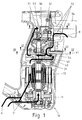
- a hammer drill 10 comprises a housing 11 in which a motor 20 and a gear 30 connected downstream thereof are arranged. Both the motor 20 and the transmission 30 generate heat during operation of the hammer drill 10, which must be dissipated in order to overload the motor and / or the transmission, in particular an overload of the motor and / or transmission bearings and other sliding points, for example due to to avoid a lubricant film tear caused by the heat.
- a double fan wheel 40 is arranged, which in particular comprises fan wheels 41, 42 which are integrally connected to one another (see FIG. 6).
- This double fan wheel 40 is set in rotation by the output shaft 21 of the motor and generated by a cooling air flow, as is shown schematically in FIG. 6 with the aid of arrows A for the motor-side air flow and B for the gear-side air flow.
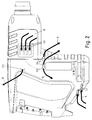
- suction openings 51 for suction of the cooling air flow A used for engine cooling and suction openings 52 for suction of the cooling air flow B used for gearbox cooling are provided in the housing 11.
- blow-out openings 53, 54 are provided in the housing, through which the cooling air flow A used for engine cooling and the cooling air flow B used for gearbox cooling are blown out.
- the cooling air duct in the housing 11 is illustrated in particular in FIGS. 1 to 5.
- the fan wheel 42 facing the motor 20 generates the cooling air flow A which, after being sucked in, is passed through the openings 51 over the motor 20 and then blown out again through the blow-out opening 54.
- the fan wheel 41 of the double fan 40 facing the transmission 30 generates the cooling air flow B, which is sucked in through the suction opening 52, passed through the transmission 30 and blown out again through the outlet opening 53.
- the second air duct is arranged such that the cooling air flow B is also guided past a receiving flange 34, which is a good heat conductor, preferably made of aluminum, and onto at least one bearing 31 Gear shaft 32 is directed, whereby a particularly effective cooling of this gear shaft bearing 31 is achieved.
- first ventilation duct is completely separated from the second ventilation duct by partition walls (not shown) which are separated in the housing, so that mixing of the two cooling air streams, which usually have different temperatures, and thereby an adjustment of the two cooling air streams to a mixing temperature, is prevented becomes.
- the great advantage of the hand tool described above is that with a single double fan 40 two separate cooling air circuits in the housing 11 for separate cooling of motor 20 and gear 30 is made possible in a simple and inexpensive manner.
Landscapes
- Engineering & Computer Science (AREA)
- Power Engineering (AREA)
- Mechanical Engineering (AREA)
- Percussive Tools And Related Accessories (AREA)
- Thermotherapy And Cooling Therapy Devices (AREA)
- Grinding-Machine Dressing And Accessory Apparatuses (AREA)
- Gloves (AREA)
- Professional, Industrial, Or Sporting Protective Garments (AREA)
Abstract
Description
- Die Erfindung betrifft ein Handwerkzeug mit einem Gehäuse, in dem ein Motor, ein diesem nachgeordnetes Getriebe und ein Lüftermittel angeordnet sind, wobei das Lüftermittel Kühlluft durch wenigstens eine Ansaugöffnung in dem Gehäuse ansaugt, über Motor und Getriebe leitet und über wenigstens eine Ausblasöffnung in dem Gehäuse wieder ausbläst.
- Zur Kühlung von Handwerkzeugen, insbesondere Bohrhämmern und Schlagbohrmaschinen, ist es bekannt, Kühlluft über ein einseitig wirkendes Lüfterrad über den Motor anzusaugen. Die Luft wird dabei durch den je nach Arbeitseinsatz belasteten Motor vorgewärmt, wobei die Temperaturen der Kühlluft zwischen 40° C und 100° C variieren können. Diese Luft wird teilweise zur Getriebekühlung über Getriebeteile ausgeblasen.
- Nachteilig bei dieser Art der Getriebekühlung ist es nun, daß die "Kühlluft" durch den betriebswarmen Motor erwärmt wird und hierdurch an dem Getriebe nur noch eine verminderte Kühlleistung erzielt wird.
- Des weiteren ist es bekannt, Luft über ein großdimensioniertes Lüfterrad, welches in der Regel an einem Ende des Motors, d.h. an dem Ende der gesamten Anordnung aus Getriebe und Motor, positioniert ist. Auch in diesem Falle ist die Kühlleistung an dem Motor verringert, da die Kühlluft bereits durch das belastete und dadurch erwärmte Getriebe erwärmt wird und sich dadurch auch große Luftansaugwiderstände ergeben.
- Um bei dieser Anordnung noch eine befriedigende Kühlleistung erzielen zu können, muß entweder der Lüfter sehr groß dimensioniert werden, damit noch ein entsprechender Saugkühlstrom erreicht wird, und/oder es muß der Motor so groß dimensioniert werden, daß durch den bei dieser Anordnung erzeugten Kühlstrom noch eine ausreichende Kühlung des Motors gewährleistet ist.
- Ein weiterer Nachteil besteht darin, daß die Getriebeansaugöffnung meistens nahe des (Bohr)Werkzeugs angeordnet ist, so daß beim Betrieb des Handwerkzeugs entstehende Staubpartikel durch den ganzen Motor gesaugt werden und so den Motor beschädigen können.
- Aufgabe der Erfindung ist es daher, ein Handwerkzeug der gattungsgemäßen Art derart zu verbessern, daß eine möglichst optimale Kühlung von Motor und Getriebe, insbesondere auch eine optimale Kühlung hochbelasteter Getriebekomponenten, erreicht wird.
- Diese Aufgabe wird bei einem Handwerkzeug der eingangs beschriebenen Art erfindungsgemäß dadurch gelöst, daß das Lüftermittel wenigstens zwei Teillüftermittel umfaßt, die jeweils über getrennte Luftkanäle wenigstens den Motor und das Getriebe getrennt und unabhängig voneinander kühlen.
- Die unabhängige und getrennt voneinander vorgenommene Kühlung von Motor und Getriebe durch die beiden Teillüftermittel hat den großen Vorteil, daß zwei getrennte Kühlluftströme jeweils für Motor und Getriebe vorhanden sind, so daß der Kühlluftstrom zur Kühlung des Motors nicht durch das erwärmte Getriebe erwärmt wird und umgekehrt der Kühlluftstrom zur Kühlung des Getriebes nicht durch den belasteten Motor erwärmt wird. Hierdurch wird eine optimale Kühlung des Motors und des Getriebes erreicht.
- Grundsätzlich können die unterschiedlichsten Lüftermittel zum Einsatz kommen. Vorzugsweise ist bei der erfindungsgemäßen Lösung das Lüftermittel jedoch ein Doppellüfterrad, dessen beide Teillüftermittel jeweils ein dem Getriebe und dem Motor zugewandtes Lüfterrad sind. Hierdurch kann mit einem einzigen Bauteil auf einfache und damit kostengünstige Weise jeweils ein getrennter Kühlluftstrom für Motor und Getriebe erreicht werden.
- Das Doppellüfterrad ist dabei vorteilhafterweise zwischen dem Motor und dem Getriebe angeordnet.
- Vorteilhafterweise sind die Ansaug- und die Ausblasöffnungen voneinander getrennt. Hierdurch läßt sich eine vollständige Trennung der beiden Kühlkreisläufe jeweils für Motor und Getriebe erzielen, so daß es zu keinerlei unerwünschter "Vermischung" der beiden Kühlluftströme durch Turbulenzen u.dgl. und dadurch bei unterschiedlichen Betriebstemperaturen von Motor und Getriebe gegebenenfalls zu einer Erwärmung jeweils eines Kühlluftstromes durch den anderen kommen kann.
- Insbesondere um eine besonders effektive Kühlung des Motors und des Getriebes zu erzielen, führt ein zur Motorkühlung vorgesehener erster Luftkanal direkt über den Motor und ein zur Getriebekühlung vorgesehener zweiter Luftkanal direkt über das Getriebe.
- Dabei ist zur unmittelbaren Kühlung der Getriebelagerung der zweite Luftkanal vorteilhafterweise so angeordnet, daß der Kühlluftstrom an wenigstens einem die Lager aufnehmenden, gut wärmeleitenden, vorzugsweise aus Metall bestehenden Aufnahmeflansch vorbeibeführt wird und auf wenigstens ein Lager der Getriebewelle gerichtet ist.
- Grundsätzlich könnte auf Trennwände zwischen dem ersten und dem zweiten Luftkanal im Gehäuse verzichtet werden, da die beiden Kühlluftströme durch das Doppellüfterrad an sich schon getrennt in dem Gehäuse geführt werden. Um eine besonders effektive Kühlung von Motor und Getriebe zu erzielen ist es aber von Vorteil, die beiden Kühlkreisläufe durch in dem Gehäuse angeordnete Trennwände vollständig voneinander zu trennen sind.
- Von besonders großem Vorteil ist es, daß die Ansaugöffnungen direkt dem Doppellüfterrad gegenüberliegen. Hierdurch wird nicht nur eine äußerst wirkungsvolle Ansaugung der Kühlluft erreicht, sondern es ist insbesondere auch sichergestellt, daß keine Verunreinigung sowohl in den Motor als auch in das Getriebe gelangt, die bei der Arbeit mit dem Handwerkzeug entsteht, da die Ansaugöffnungen hinreichend weit von dem Werkzeug entfernt sind. So wird beispielsweise im Falle eines Bohrhammers oder einer Schlagbohrmaschine wirkungsvoll die Ansaugung von Staub, Spänen u.dgl. verhindert, die beim Bohren entstehen.
- Weitere Merkmale und Vorteile der Erfindung sind Gegenstand der nachfolgenden Beschreibung sowie der zeichnerischen Darstellung eines Ausführungsbeispiels.
- In der Zeichnung zeigen:
- Fig. 1
- eine teilweise weggebrochene und geschnittene Darstellung eines Gehäuses eines erfindungsgemäßen Handwerkzeugs;
- Fig. 2
- die Seitenansicht eines Gehäuses eines erfindungsgemäßen Handwerkzeugs;
- Fig. 3
- eine Schnittdarstellung entlang der Linie III-III der Fig. 1;
- Fig. 4
- eine Schnittdarstellung entlang der Linie IV-IV der Fig. 1;
- Fig. 5
- eine Schnittdarstellung entlang der Linie V-V der Fig. 1 und
- Fig. 6
- Seitenansichten eines Doppellüfterrads sowie schematisch den durch das Doppellüfterrad erzeugten Luftstrom.
- Ein Ausführungsbeispiel eines Handwerkzeugs ist in den Figuren exemplarisch in Form eines Bohrhammers dargestellt. Es versteht sich, daß die Erfindung jedoch nicht auf einen Bohrhammer beschränkt ist, sondern vielmehr bei jeglicher Art von Handwerkzeug eingesetzt werden kann.
- Wie aus Fig. 1 hervorgeht, umfaßt ein Bohrhammer 10 ein Gehäuse 11, in dem ein Motor 20 sowie ein diesem nachgeschaltetes Getriebe 30 angeordnet sind. Sowohl der Motor 20 als auch das Getriebe 30 erzeugen beim Betrieb des Bohrhammers 10 Wärme, die abgeleitet werden muß, um eine Überlastung des Motors und/oder des Getriebes, insbesondere eine Überlastung der Motor- und/oder Getriebelager und weiterer Gleitstellen, die beispielsweise durch einen aufgrund der Wärme erzeugten Schmierfilmabriss entstehen kann, zu vermeiden.
- Zwischen dem Motor 20 und dem Getriebe 30 ist ein Doppellüfterrad 40 angeordnet, welches insbesondere einstückig miteinander verbundene Lüfterräder 41, 42 umfaßt (vergl. Fig. 6). Dieses Doppellüfterrad 40 wird durch die Ausgangswelle 21 des Motors in Rotation versetzt und erzeugt durch einen Kühlluftstrom, wie er schematisch in Fig. 6 anhand der Pfeile A für den motorseitigen Luftstrom und B für den getriebeseitigen Luftstrom dargestellt ist.
- Wie aus Fig. 1 und 2 hervorgeht, sind in dem Gehäuse 11 Ansaugöffnungen 51 zur Ansaugung des zur Motorkühlung verwendeten Kühlluftstromes A sowie Ansaugöffönungen 52 zur Ansaugung des zur Getriebekühlung verwendeten Kühlluftstromes B vorgesehen. Des weiteren sind in dem Gehäuse Ausblasöffnungen 53, 54 vorgesehen, durch die jeweils der zur Motorkühlung verwendete Kühlluftstrom A und der zur Getriebekühlung verwendete Kühlluftstrom B ausgeblasen werden.
- Die Kühlluftführung in dem Gehäuse 11 ist insbesondere in den Fig. 1 bis 5 veranschaulicht. Wie aus Fig. 1 hervorgeht, erzeugt das dem Motor 20 zugewandte Lüfterrad 42 den Kühlluftstrom A, der nach Ansaugen durch die Öffnungen 51 über den Motor 20 geführt wird und sodann durch die Ausblasöffnung 54 wieder ausgeblasen wird.
- Das dem Getriebe 30 zugewandte Lüfterrad 41 des Doppellüfters 40 erzeugt den Kühlluftstrom B, der durch die Ansaugöffnung 52 angesaugt, über das Getriebe 30 geleitet und durch die Ausblasöffnung 53 wieder ausgeblasen wird.
- Wie aus Fig. 1, 3 und 5 zu ersehen ist, ist der zweite Luftkanal so angeordnet, daß der Kühlluftstrom B darüber hinaus an einem die Lager aufnehmenden, gut wärmeleitenden, vorzugsweise aus Aluminium bestehenden Aufnahmeflansch 34 vorbeigeführt wird und auf wenigstens ein Lager 31 einer Getriebewelle 32 gerichtet ist, wodurch eine besonders effektive Kühlung dieses Getriebewellenlagers 31 erzielt wird.
- Besonders vorteilhaft ist es, wenn der erste Lüftungskanal von dem zweiten Lüftungskanal durch in dem Gehäuse abgetrennte Trennwände (nicht dargestellt) vollständig getrennt ist, so daß eine Vermischung der beiden, gewöhnlich unterschiedliche Temperaturen aufweisenden Kühlluftströme und hierdurch eine Angleichung der beiden Kühlluftströme auf eine Mischungstemperatur verhindert wird.
- Der große Vorteil oben beschriebenen Handwerkzeugs besteht darin, daß mit einem einzigen Doppellüfter 40 zwei getrennte Kühlluftkreisläufe in dem Gehäuse 11 zur getrennten Kühlung von Motor 20 und Getriebe 30 auf einfache und kostengünstige Weise ermöglicht wird.
Claims (7)
- Handwerkzeug mit einem Gehäuse (11), in dem ein Motor (20), ein diesem nachgeordnetes Getriebe (30) und ein Lüftermittel angeordnet sind, wobei das Lüftermittel Kühlluft durch wenigstens eine Ansaugöffnung (51, 52) in dem Gehäuse (11) ansaugt, über Motor (20) und Getriebe (30) leitet und über wenigstens eine Ausblasöffnung (53, 54) in dem Gehäuse (11) wieder ausbläst, dadurch gekennzeichnet, daß das Lüftermittel wenigstens zwei Teillüftermittel umfaßt, die jeweils über getrennte Luftkanäle wenigstens den Motor (20) und das Getriebe (30) getrennt und unabhängig voneinander kühlen.
- Handwerkzeug nach Anspruch 1, dadurch gekennzeichnet, daß das Lüftermittel ein Doppellüfterrad (40) ist, dessen beide Teillüftermittel jeweils ein dem Getriebe (30) und dem Motor (20) zugewandtes Lüfterrad (41, 42) sind.
- Handwerkzeug nach Anspruch 2, dadurch gekennzeichnet, daß das Doppellüfterrad (40) zwischen dem Motor (20) und dem Getriebe (30) angeordnet und von der Motorwelle (21) angetrieben wird.
- Handwerkzeug nach Anspruch 2 oder 3, dadurch gekennzeichnet, daß zur getrennten Kühlung von Motor (20) und Getriebe (30) in dem Gehäuse (11) jeweils getrennte Ansaug- und Ausblasöffnungen (51, 52; 53, 54) angeordnet sind.
- Handwerkzeug nach einem der Ansprüche 2 bis 4, dadurch gekennzeichnet, daß ein zur Motorkühlung vorgesehener erster Luftkanal über den Motor (20) und ein zur Getriebekühlung vorgesehener zweiter Luftkanal über das Getriebe (30) führt.
- Handwerkzeug nach Anspruch 5, dadurch gekennzeichnet, daR der zweite Luftkanal so angeordnet ist, daß der Kühlluftstrom (B) an wenigstens einem die Lager aufnehmenden, gut wärmeleitenden, vorzugsweise aus Metall bestehenden Aufnahmeflansch (34) vorbeigeführt wird und auf wenigstens ein Lager (31) der Getriebewelle (32) gerichtet ist.
- Handwerkzeug nach Anspruch 5 oder 6, dadurch gekennzeichnet, daß der erste Luftkanal von dem Zweiten Luftkanal durch in dem Gehäuse (11) angeordnete Trennwände vollständig getrennt ist.
Applications Claiming Priority (4)
| Application Number | Priority Date | Filing Date | Title |
|---|---|---|---|
| DE29600191U | 1996-01-08 | ||
| DE19600339A DE19600339C1 (de) | 1996-01-08 | 1996-01-08 | Handwerkzeug |
| DE19600339 | 1996-01-08 | ||
| DE29600191U DE29600191U1 (de) | 1996-01-08 | 1996-01-08 | Handwerkzeug |
Publications (3)
| Publication Number | Publication Date |
|---|---|
| EP0794038A2 true EP0794038A2 (de) | 1997-09-10 |
| EP0794038A3 EP0794038A3 (de) | 1997-12-29 |
| EP0794038B1 EP0794038B1 (de) | 1998-11-04 |
Family
ID=26021918
Family Applications (1)
| Application Number | Title | Priority Date | Filing Date |
|---|---|---|---|
| EP96120970A Expired - Lifetime EP0794038B1 (de) | 1996-01-08 | 1996-12-28 | Handwerkzeug mit Anordnung zum Kühlen |
Country Status (3)
| Country | Link |
|---|---|
| EP (1) | EP0794038B1 (de) |
| AT (1) | ATE172906T1 (de) |
| DE (1) | DE59600774D1 (de) |
Cited By (16)
| Publication number | Priority date | Publication date | Assignee | Title |
|---|---|---|---|---|
| EP1491290A1 (de) * | 2003-06-27 | 2004-12-29 | Festool GmbH | Handwerkzeugmaschine |
| EP1584423A3 (de) * | 2004-03-25 | 2005-10-19 | Positec Power Tools (Suzhou) Co., Ltd | Kraftbetriebenes Werkzeug |
| EP1674213A1 (de) * | 2004-12-23 | 2006-06-28 | BLACK & DECKER INC. | Kraftwerkzeug mit Kühlvorrichtung |
| EP1398864A3 (de) * | 2002-09-10 | 2006-07-12 | Matsushita Electric Works, Ltd. | Elektrowerkzeug |
| WO2006053794A3 (de) * | 2004-11-17 | 2006-07-20 | Bosch Gmbh Robert | Handwerkzeugmaschine |
| CN100406208C (zh) * | 2004-12-23 | 2008-07-30 | 百得有限公司 | 动力工具冷却系统 |
| EP2191940A1 (de) * | 2008-11-28 | 2010-06-02 | AEG Electric Tools GmbH | Elektrowerkzeug |
| WO2010102846A1 (de) * | 2009-03-12 | 2010-09-16 | Robert Bosch Gmbh | Handwerkzeugmaschine |
| WO2011160871A1 (de) * | 2010-06-23 | 2011-12-29 | Robert Bosch Gmbh | Handwerkzeugmaschine |
| US8292001B2 (en) | 2007-11-21 | 2012-10-23 | Black & Decker Inc. | Multi-mode drill with an electronic switching arrangement |
| EP2923802A1 (de) * | 2014-03-25 | 2015-09-30 | HILTI Aktiengesellschaft | Riemenkühlung |
| EP2754535A3 (de) * | 2013-01-11 | 2018-02-14 | Festool GmbH | Hand-Werkzeugmaschine mit einem Ventilator |
| EP3685945A1 (de) * | 2018-12-19 | 2020-07-29 | C. & E. Fein GmbH | Gehäuse für eine elektrowerkzeugmaschine |
| EP3778130A1 (de) * | 2019-08-12 | 2021-02-17 | Metabowerke GmbH | Gehäuse für ein elektrohandwerkzeuggerät |
| SE546805C2 (en) * | 2023-11-17 | 2025-02-25 | Husqvarna Ab | Handheld Power Tool with a Fan for Air Cooling |
| US12533785B2 (en) | 2022-11-21 | 2026-01-27 | Milwaukee Electric Tool Corporation | Power tool with integrated gear case |
Families Citing this family (7)
| Publication number | Priority date | Publication date | Assignee | Title |
|---|---|---|---|---|
| JP2006528477A (ja) | 2003-06-17 | 2006-12-14 | ブラック アンド デッカー インコーポレーテッド | 二重経路空気流冷却構造を有する発電機およびそのための方法 |
| US7717192B2 (en) | 2007-11-21 | 2010-05-18 | Black & Decker Inc. | Multi-mode drill with mode collar |
| US7735575B2 (en) | 2007-11-21 | 2010-06-15 | Black & Decker Inc. | Hammer drill with hard hammer support structure |
| US7854274B2 (en) | 2007-11-21 | 2010-12-21 | Black & Decker Inc. | Multi-mode drill and transmission sub-assembly including a gear case cover supporting biasing |
| US7770660B2 (en) | 2007-11-21 | 2010-08-10 | Black & Decker Inc. | Mid-handle drill construction and assembly process |
| US7762349B2 (en) | 2007-11-21 | 2010-07-27 | Black & Decker Inc. | Multi-speed drill and transmission with low gear only clutch |
| US7717191B2 (en) | 2007-11-21 | 2010-05-18 | Black & Decker Inc. | Multi-mode hammer drill with shift lock |
Family Cites Families (9)
| Publication number | Priority date | Publication date | Assignee | Title |
|---|---|---|---|---|
| DE1006950B (de) * | 1956-02-06 | 1957-04-25 | Alb Urbahn & Comp Werkzeug Und | Mittels Drehstrommotor angetriebenes Elektrowerkzeug |
| US3413498A (en) * | 1965-08-09 | 1968-11-26 | Rockwell Mfg Co | Electrically powered hand tool |
| JPS5795150A (en) * | 1980-12-04 | 1982-06-12 | Mitsubishi Electric Corp | Ac generator for vehicle use |
| SE454199B (sv) * | 1986-03-14 | 1988-04-11 | Electrolux Ab | Anordning vid luftkyld forbrenningsmotor |
| US4876797A (en) * | 1989-01-17 | 1989-10-31 | Alvaro Zapata | Reduced vibration portable gas operated hand saw |
| DE4019894A1 (de) * | 1989-07-15 | 1991-04-11 | Ceka Elektrowerkzeuge Ag & Co | Elektrohandwerkzeug |
| US4961016A (en) * | 1989-08-09 | 1990-10-02 | General Motors Corporation | Dual-face cooling fan for a dynamoelectric machine |
| US5006740A (en) * | 1990-06-13 | 1991-04-09 | Milwaukee Electric Tool Corporation | Insulated cooling boot for power tool |
| DE4238564C2 (de) * | 1992-11-14 | 1995-02-23 | Fein C & E | Elektrowerkzeug |
-
1996
- 1996-12-28 AT AT96120970T patent/ATE172906T1/de not_active IP Right Cessation
- 1996-12-28 EP EP96120970A patent/EP0794038B1/de not_active Expired - Lifetime
- 1996-12-28 DE DE59600774T patent/DE59600774D1/de not_active Expired - Lifetime
Non-Patent Citations (1)
| Title |
|---|
| None |
Cited By (22)
| Publication number | Priority date | Publication date | Assignee | Title |
|---|---|---|---|---|
| EP1398864A3 (de) * | 2002-09-10 | 2006-07-12 | Matsushita Electric Works, Ltd. | Elektrowerkzeug |
| EP1491290A1 (de) * | 2003-06-27 | 2004-12-29 | Festool GmbH | Handwerkzeugmaschine |
| EP1584423A3 (de) * | 2004-03-25 | 2005-10-19 | Positec Power Tools (Suzhou) Co., Ltd | Kraftbetriebenes Werkzeug |
| WO2006053794A3 (de) * | 2004-11-17 | 2006-07-20 | Bosch Gmbh Robert | Handwerkzeugmaschine |
| EP1674213A1 (de) * | 2004-12-23 | 2006-06-28 | BLACK & DECKER INC. | Kraftwerkzeug mit Kühlvorrichtung |
| CN100406208C (zh) * | 2004-12-23 | 2008-07-30 | 百得有限公司 | 动力工具冷却系统 |
| US7705497B2 (en) | 2004-12-23 | 2010-04-27 | Black & Decker Inc. | Power tool cooling |
| US8292001B2 (en) | 2007-11-21 | 2012-10-23 | Black & Decker Inc. | Multi-mode drill with an electronic switching arrangement |
| EP2191940A1 (de) * | 2008-11-28 | 2010-06-02 | AEG Electric Tools GmbH | Elektrowerkzeug |
| US8479840B2 (en) | 2008-11-28 | 2013-07-09 | Aeg Electric Tools Gmbh | Electric tool |
| WO2010102846A1 (de) * | 2009-03-12 | 2010-09-16 | Robert Bosch Gmbh | Handwerkzeugmaschine |
| WO2011160871A1 (de) * | 2010-06-23 | 2011-12-29 | Robert Bosch Gmbh | Handwerkzeugmaschine |
| CN102947036A (zh) * | 2010-06-23 | 2013-02-27 | 罗伯特·博世有限公司 | 手持式工具机 |
| EP2754535A3 (de) * | 2013-01-11 | 2018-02-14 | Festool GmbH | Hand-Werkzeugmaschine mit einem Ventilator |
| WO2015144664A1 (de) * | 2014-03-25 | 2015-10-01 | Hilti Aktiengesellschaft | Riemenkühlung |
| EP2923802A1 (de) * | 2014-03-25 | 2015-09-30 | HILTI Aktiengesellschaft | Riemenkühlung |
| EP3685945A1 (de) * | 2018-12-19 | 2020-07-29 | C. & E. Fein GmbH | Gehäuse für eine elektrowerkzeugmaschine |
| US11465266B2 (en) | 2018-12-19 | 2022-10-11 | C. & E. Fein Gmbh | Housing for an electric machine tool |
| EP3778130A1 (de) * | 2019-08-12 | 2021-02-17 | Metabowerke GmbH | Gehäuse für ein elektrohandwerkzeuggerät |
| US12533785B2 (en) | 2022-11-21 | 2026-01-27 | Milwaukee Electric Tool Corporation | Power tool with integrated gear case |
| SE546805C2 (en) * | 2023-11-17 | 2025-02-25 | Husqvarna Ab | Handheld Power Tool with a Fan for Air Cooling |
| SE2351314A1 (en) * | 2023-11-17 | 2025-02-25 | Husqvarna Ab | Handheld Power Tool with a Fan for Air Cooling |
Also Published As
| Publication number | Publication date |
|---|---|
| DE59600774D1 (de) | 1998-12-10 |
| ATE172906T1 (de) | 1998-11-15 |
| EP0794038B1 (de) | 1998-11-04 |
| EP0794038A3 (de) | 1997-12-29 |
Similar Documents
| Publication | Publication Date | Title |
|---|---|---|
| EP0794038B1 (de) | Handwerkzeug mit Anordnung zum Kühlen | |
| EP0984545B1 (de) | Elektrowerkzeug | |
| DE4238564C2 (de) | Elektrowerkzeug | |
| DE102004029220B4 (de) | Handwerkzeuggerät mit Staubabsaugmodul | |
| DE19955591B4 (de) | Schlagwerkzeug mit einem verbesserten Kühlmechanismus | |
| EP1703140B1 (de) | Kühleinrichtung für ein elektromotorisch angetriebenes Radialgebläse | |
| EP1332020B1 (de) | Handwerkzeugmaschine mit einer staubabsaugeinrichtung | |
| EP2474387B1 (de) | Absaugvorrichtung einer Elektrohandwerkzeugmaschine sowie Elektrohandwerkzeugmaschine mit Absaugvorrichtung | |
| DE19600339C1 (de) | Handwerkzeug | |
| EP1666213B1 (de) | Elektrowerkzeuggerät | |
| EP2191940A1 (de) | Elektrowerkzeug | |
| EP1398865A2 (de) | Elektrowerkzeugmaschine mit Gebläse | |
| EP1016504A2 (de) | Elektrowerkzeug, insbesondere Winkelschleifer | |
| DE102016210853A1 (de) | Handwerkzeugmaschine mit einer Kühleinheit | |
| EP1872916B1 (de) | Elektrohandwerkzeugmaschine mit Saugmodul für eine Staubabscheidevorrichtung | |
| EP0325972A2 (de) | Kühleranordnung, insbesondere für einen Fahrzeugantrieb | |
| DE69708768T2 (de) | Pneumatisch angetriebenes Werkzeug | |
| EP2476520A2 (de) | Elektrowerkzeugmaschine, insbesondere eine Schleif- oder Poliermaschine | |
| DE3340799A1 (de) | Elektrowerkzeug | |
| DE69912548T2 (de) | Tragbares kraftbetriebenes Werkzeug mit wärmeabsorbierendem Schild | |
| DE102004055268A1 (de) | Handwerkzeugmaschine | |
| EP1700672B1 (de) | Vorsatzgerät | |
| DE102007043916A1 (de) | Elektrohandwerkzeugmaschine | |
| DE102005062697A1 (de) | Handgeführtes Elektrowerkzeug | |
| DE29600191U1 (de) | Handwerkzeug |
Legal Events
| Date | Code | Title | Description |
|---|---|---|---|
| PUAI | Public reference made under article 153(3) epc to a published international application that has entered the european phase |
Free format text: ORIGINAL CODE: 0009012 |
|
| AK | Designated contracting states |
Kind code of ref document: A2 Designated state(s): AT CH DE FR GB IT LI |
|
| PUAL | Search report despatched |
Free format text: ORIGINAL CODE: 0009013 |
|
| AK | Designated contracting states |
Kind code of ref document: A3 Designated state(s): AT CH DE FR GB IT LI |
|
| 17P | Request for examination filed |
Effective date: 19980131 |
|
| GRAG | Despatch of communication of intention to grant |
Free format text: ORIGINAL CODE: EPIDOS AGRA |
|
| 17Q | First examination report despatched |
Effective date: 19980610 |
|
| GRAG | Despatch of communication of intention to grant |
Free format text: ORIGINAL CODE: EPIDOS AGRA |
|
| GRAH | Despatch of communication of intention to grant a patent |
Free format text: ORIGINAL CODE: EPIDOS IGRA |
|
| GRAH | Despatch of communication of intention to grant a patent |
Free format text: ORIGINAL CODE: EPIDOS IGRA |
|
| GRAA | (expected) grant |
Free format text: ORIGINAL CODE: 0009210 |
|
| AK | Designated contracting states |
Kind code of ref document: B1 Designated state(s): AT CH DE FR GB IT LI |
|
| REF | Corresponds to: |
Ref document number: 172906 Country of ref document: AT Date of ref document: 19981115 Kind code of ref document: T |
|
| REG | Reference to a national code |
Ref country code: CH Ref legal event code: EP |
|
| REF | Corresponds to: |
Ref document number: 59600774 Country of ref document: DE Date of ref document: 19981210 |
|
| ITF | It: translation for a ep patent filed | ||
| REG | Reference to a national code |
Ref country code: CH Ref legal event code: NV Representative=s name: ISLER & PEDRAZZINI AG |
|
| GBT | Gb: translation of ep patent filed (gb section 77(6)(a)/1977) |
Effective date: 19990118 |
|
| ET | Fr: translation filed | ||
| PLBE | No opposition filed within time limit |
Free format text: ORIGINAL CODE: 0009261 |
|
| STAA | Information on the status of an ep patent application or granted ep patent |
Free format text: STATUS: NO OPPOSITION FILED WITHIN TIME LIMIT |
|
| 26N | No opposition filed | ||
| REG | Reference to a national code |
Ref country code: GB Ref legal event code: IF02 |
|
| REG | Reference to a national code |
Ref country code: CH Ref legal event code: PCAR Free format text: ISLER & PEDRAZZINI AG;POSTFACH 1772;8027 ZUERICH (CH) |
|
| PGFP | Annual fee paid to national office [announced via postgrant information from national office to epo] |
Ref country code: CH Payment date: 20081229 Year of fee payment: 13 |
|
| PGFP | Annual fee paid to national office [announced via postgrant information from national office to epo] |
Ref country code: AT Payment date: 20090122 Year of fee payment: 13 |
|
| REG | Reference to a national code |
Ref country code: CH Ref legal event code: PL |
|
| PG25 | Lapsed in a contracting state [announced via postgrant information from national office to epo] |
Ref country code: AT Free format text: LAPSE BECAUSE OF NON-PAYMENT OF DUE FEES Effective date: 20091228 |
|
| PG25 | Lapsed in a contracting state [announced via postgrant information from national office to epo] |
Ref country code: LI Free format text: LAPSE BECAUSE OF NON-PAYMENT OF DUE FEES Effective date: 20091231 Ref country code: CH Free format text: LAPSE BECAUSE OF NON-PAYMENT OF DUE FEES Effective date: 20091231 |
|
| PGFP | Annual fee paid to national office [announced via postgrant information from national office to epo] |
Ref country code: GB Payment date: 20101221 Year of fee payment: 15 |
|
| PGFP | Annual fee paid to national office [announced via postgrant information from national office to epo] |
Ref country code: IT Payment date: 20101229 Year of fee payment: 15 |
|
| PGFP | Annual fee paid to national office [announced via postgrant information from national office to epo] |
Ref country code: FR Payment date: 20120103 Year of fee payment: 16 |
|
| PGFP | Annual fee paid to national office [announced via postgrant information from national office to epo] |
Ref country code: DE Payment date: 20111224 Year of fee payment: 16 |
|
| GBPC | Gb: european patent ceased through non-payment of renewal fee |
Effective date: 20121228 |
|
| REG | Reference to a national code |
Ref country code: FR Ref legal event code: ST Effective date: 20130830 |
|
| PG25 | Lapsed in a contracting state [announced via postgrant information from national office to epo] |
Ref country code: DE Free format text: LAPSE BECAUSE OF NON-PAYMENT OF DUE FEES Effective date: 20130702 |
|
| REG | Reference to a national code |
Ref country code: DE Ref legal event code: R119 Ref document number: 59600774 Country of ref document: DE Effective date: 20130702 |
|
| PG25 | Lapsed in a contracting state [announced via postgrant information from national office to epo] |
Ref country code: GB Free format text: LAPSE BECAUSE OF NON-PAYMENT OF DUE FEES Effective date: 20121228 Ref country code: FR Free format text: LAPSE BECAUSE OF NON-PAYMENT OF DUE FEES Effective date: 20130102 |
|
| PG25 | Lapsed in a contracting state [announced via postgrant information from national office to epo] |
Ref country code: IT Free format text: LAPSE BECAUSE OF NON-PAYMENT OF DUE FEES Effective date: 20121228 |