EP0794089A2 - Bediensystem, insbesondere für Komponenten in einem Kraftfahrzeug - Google Patents
Bediensystem, insbesondere für Komponenten in einem Kraftfahrzeug Download PDFInfo
- Publication number
- EP0794089A2 EP0794089A2 EP97101179A EP97101179A EP0794089A2 EP 0794089 A2 EP0794089 A2 EP 0794089A2 EP 97101179 A EP97101179 A EP 97101179A EP 97101179 A EP97101179 A EP 97101179A EP 0794089 A2 EP0794089 A2 EP 0794089A2
- Authority
- EP
- European Patent Office
- Prior art keywords
- operating
- assigned
- actuating means
- function
- user
- Prior art date
- Legal status (The legal status is an assumption and is not a legal conclusion. Google has not performed a legal analysis and makes no representation as to the accuracy of the status listed.)
- Granted
Links
Images
Classifications
-
- B—PERFORMING OPERATIONS; TRANSPORTING
- B60—VEHICLES IN GENERAL
- B60K—ARRANGEMENT OR MOUNTING OF PROPULSION UNITS OR OF TRANSMISSIONS IN VEHICLES; ARRANGEMENT OR MOUNTING OF PLURAL DIVERSE PRIME-MOVERS IN VEHICLES; AUXILIARY DRIVES FOR VEHICLES; INSTRUMENTATION OR DASHBOARDS FOR VEHICLES; ARRANGEMENTS IN CONNECTION WITH COOLING, AIR INTAKE, GAS EXHAUST OR FUEL SUPPLY OF PROPULSION UNITS IN VEHICLES
- B60K35/00—Instruments specially adapted for vehicles; Arrangement of instruments in or on vehicles
- B60K35/10—Input arrangements, i.e. from user to vehicle, associated with vehicle functions or specially adapted therefor
-
- B—PERFORMING OPERATIONS; TRANSPORTING
- B60—VEHICLES IN GENERAL
- B60K—ARRANGEMENT OR MOUNTING OF PROPULSION UNITS OR OF TRANSMISSIONS IN VEHICLES; ARRANGEMENT OR MOUNTING OF PLURAL DIVERSE PRIME-MOVERS IN VEHICLES; AUXILIARY DRIVES FOR VEHICLES; INSTRUMENTATION OR DASHBOARDS FOR VEHICLES; ARRANGEMENTS IN CONNECTION WITH COOLING, AIR INTAKE, GAS EXHAUST OR FUEL SUPPLY OF PROPULSION UNITS IN VEHICLES
- B60K35/00—Instruments specially adapted for vehicles; Arrangement of instruments in or on vehicles
- B60K35/20—Output arrangements, i.e. from vehicle to user, associated with vehicle functions or specially adapted therefor
- B60K35/21—Output arrangements, i.e. from vehicle to user, associated with vehicle functions or specially adapted therefor using visual output, e.g. blinking lights or matrix displays
-
- B—PERFORMING OPERATIONS; TRANSPORTING
- B60—VEHICLES IN GENERAL
- B60K—ARRANGEMENT OR MOUNTING OF PROPULSION UNITS OR OF TRANSMISSIONS IN VEHICLES; ARRANGEMENT OR MOUNTING OF PLURAL DIVERSE PRIME-MOVERS IN VEHICLES; AUXILIARY DRIVES FOR VEHICLES; INSTRUMENTATION OR DASHBOARDS FOR VEHICLES; ARRANGEMENTS IN CONNECTION WITH COOLING, AIR INTAKE, GAS EXHAUST OR FUEL SUPPLY OF PROPULSION UNITS IN VEHICLES
- B60K35/00—Instruments specially adapted for vehicles; Arrangement of instruments in or on vehicles
- B60K35/20—Output arrangements, i.e. from vehicle to user, associated with vehicle functions or specially adapted therefor
- B60K35/25—Output arrangements, i.e. from vehicle to user, associated with vehicle functions or specially adapted therefor using haptic output
-
- B—PERFORMING OPERATIONS; TRANSPORTING
- B60—VEHICLES IN GENERAL
- B60K—ARRANGEMENT OR MOUNTING OF PROPULSION UNITS OR OF TRANSMISSIONS IN VEHICLES; ARRANGEMENT OR MOUNTING OF PLURAL DIVERSE PRIME-MOVERS IN VEHICLES; AUXILIARY DRIVES FOR VEHICLES; INSTRUMENTATION OR DASHBOARDS FOR VEHICLES; ARRANGEMENTS IN CONNECTION WITH COOLING, AIR INTAKE, GAS EXHAUST OR FUEL SUPPLY OF PROPULSION UNITS IN VEHICLES
- B60K35/00—Instruments specially adapted for vehicles; Arrangement of instruments in or on vehicles
- B60K35/20—Output arrangements, i.e. from vehicle to user, associated with vehicle functions or specially adapted therefor
- B60K35/26—Output arrangements, i.e. from vehicle to user, associated with vehicle functions or specially adapted therefor using acoustic output
- B60K35/265—Voice
-
- H—ELECTRICITY
- H01—ELECTRIC ELEMENTS
- H01H—ELECTRIC SWITCHES; RELAYS; SELECTORS; EMERGENCY PROTECTIVE DEVICES
- H01H3/00—Mechanisms for operating contacts
- H01H2003/008—Mechanisms for operating contacts with a haptic or a tactile feedback controlled by electrical means, e.g. a motor or magnetofriction
-
- H—ELECTRICITY
- H01—ELECTRIC ELEMENTS
- H01H—ELECTRIC SWITCHES; RELAYS; SELECTORS; EMERGENCY PROTECTIVE DEVICES
- H01H25/00—Switches with compound movement of handle or other operating part
Definitions
- the invention relates to an operating system according to the preamble of patent claim 1 or 3.
- An operating system of the generic type which comprises a voice control device and an actuating means, is already known from EP 0 078 016 B1.
- Various operating functions are assigned to the actuating means, which is designed as a push button switch, via the voice control device.
- an operating system with an actuating means to which various operating functions can be assigned by an overtravel function and which is designed as a rotary actuator, is known.
- the actuating means provides the user with various programmable haptic feedback signals.
- the object of the invention is to improve a generic operating system in terms of its ergonomic properties.
- the object is achieved in that various operating functions are assigned to an actuating means by a voice control device, the actuating means having a plurality of degrees of freedom of adjustment which can be set as a function of the assigned operating function.
- a user can receive haptic feedback about the set value and the value range of the assigned operating function, the type of haptic feedback also being set by the assigned operating function.
- Voice output means and / or optical display means can be provided as an additional possibility of feedback to the user.
- a central actuating means to which a desired operating function can be assigned by voice command, the user can dose any desired manipulated variable with any speed and sensitivity and yet only has to reach for a single button.
- a look around is practically not necessary after a short familiarization phase and with an ergonomically sensible design.
- the user can be optimally informed of the selected settings via the possibilities of haptic and / or acoustic and / or visual feedback.
- the actuator can have the following degrees of freedom to perform the assigned operating functions: Translation along the x-axis (pushing forwards or backwards), along the y-axis (pushing to the right or left) and along the z-axis (pushing down or pulling up); Rotation around the x-axis (tilt left or right), around the y-axis (tilt forward or backward) and around the z-axis (turn left or right).
- the actuating means can have the following types of haptic feedback: Stop (limitation of the movement in any position), for example to convey a maximum and / or minimum function value or a noticeable pressure and / or pull point, various freely selectable friction moments, for example to convey a mean function value, simulation of a detent with variable detent forces, Detent positions and detent widths, for example for conveying a latching incremental encoder and returning the actuating means to a neutral position against the force of a user, for example for conveying a joystick function.
- Stop limitation of the movement in any position
- various freely selectable friction moments for example to convey a mean function value
- simulation of a detent with variable detent forces for example for conveying a latching incremental encoder and returning the actuating means to a neutral position against the force of a user, for example for conveying a joystick function.
- the operating system 1 shown comprises a voice control device 2 with a voice input means 2.1 and a voice output means 2.2, and an actuating means 4 which has means for setting at least one degree of freedom of adjustment 4.1 and means for setting at least one type of haptic feedback 4.2.
- the voice control device 2 By pressing the actuating means 4 (translation in the z direction), the voice control device 2 is activated and the user can speak a predefined voice command, which is converted into electrical signals by the voice input means 2.1.
- the voice control device 2 interprets the electrical signals corresponding to the user's voice command so that the actuating means 4 is now and permanently occupied with an operating function which is assigned to the user's voice command.
- the voice control device 2 sends control signals via the electrical connections 5.2 and 5.3 to the means for setting the degrees of freedom 4.1 and the types of haptic feedback 4.2.
- These means 4.1 and 4.2 are designed, for example, as electromechanical and / or electromagnetic actuators, with which it is possible to exert forces on the actuating means 4.
- About the electrical Connection 5.1 provides the actuating means 4 with the generated control signals for the selected operating function via the voice control device 2 and via the electrical connection 6.1 to the corresponding device 7 to be operated.
- the device 7 to be operated supplies certain signals via the electrical connection 6.2 (for example signals from sensors or Limit switches) back to the voice control device 2.
- the voice control device 2 supplies the corresponding control signals via the electrical connections 5.2 and 5.3 to the actuating means 4 in order to change the setting of the degrees of freedom of adjustment and / or the types of haptic feedback accordingly if necessary.
- the electrical connections 5.1 to 5.3 between the voice control device 2 and the actuating means 4 and the electrical connections 6.1 and 6.2 between the voice control device 2 and the devices 7 to be operated can be implemented as a data bus.
- FIG. 2 shows a schematic representation of an advantageous embodiment of the actuating means 4.
- the operating means 4 described below can be assigned to the represented actuating means 4 with the corresponding degrees of freedom of adjustment and types of haptic feedback.
- This operating function is e.g. B. volume, bass, treble, balance, blower, etc.
- the actuating means is blocked for further turning in the corresponding direction when the respective end value is reached.
- Functions such as balance, fader, bass, treble and fan have a well-defined mean value, about which the user would like to be informed frequently without having to rely solely on their visual and / or acoustic perception.
- mean value When the mean value is reached, the turning of the actuating means is made somewhat more difficult, so that the mean value can be felt.
- rest stops can be created Make (increments) palpable. The number of rest areas depends on the operating function.
- the user When adjusting mechanical components (seat, mirror, etc.), the user usually only recognizes that the end position has been reached optically (e.g. the seat stops). The user is therefore informed of the end position reached by the fact that suddenly an increased restoring force comes into effect or that a vibration acts on the actuating element. If the user releases the actuating element, it goes back to the middle position. The corresponding degree of freedom of adjustment is then blocked.
- the middle position is often the starting point for a final adjustment and is even more difficult to identify. The passing of the middle position could be indicated by initiating a short impulse.
- All adjustment degrees of freedom and types of haptic feedback that are not relevant for the assigned operating function can be blocked by electromagnetic and / or electromechanical devices. In this way, the user can be informed about the degrees of adjustment freedom and types of haptic feedback set for the selected operating function (e.g. mirror adjustment via rotary movements around the x and y axis, volume via rotary movement around the z axis).
- voice output means 2.2 for example a loudspeaker
- optical display means for example light-emitting diodes and / or a screen.
- the means are particularly suitable for conducting dialogues in a motor vehicle for a list of names on a telephone, the temperature setting of an air conditioning system or the station search on a radio.
Landscapes
- Engineering & Computer Science (AREA)
- Chemical & Material Sciences (AREA)
- Combustion & Propulsion (AREA)
- Transportation (AREA)
- Mechanical Engineering (AREA)
- Mechanical Control Devices (AREA)
- Selective Calling Equipment (AREA)
- Control Of Position Or Direction (AREA)
- Control Of Multiple Motors (AREA)
- Control Of Electric Motors In General (AREA)
- Control Of Eletrric Generators (AREA)
Abstract
Description
- Die Erfindung betrifft ein Bediensystem nach dem Oberbegriff des Patentanspruchs 1 oder 3.
- Es ist bereits ein gattungsgemäßes Bediensystem, welches eine Sprachbedieneinrichtung und ein Betätigungsmittel umfaßt, aus der EP 0 078 016 B1 bekannt. Dabei werden dem Betätigungsmittel, welches als Tastschalter ausgeführt ist, über die Sprachbedieneinrichtung verschiedene Bedienfunktionen zugewiesen.
- Als nachteilig wird hierbei erachtet, daß der Benutzer keine Rückmeldung über den eingestellten Wert und den Wertebereich der zugewiesenen Bedienfunktion erhält.
- Aus der DE 36 05 088 C2 ist ein Bediensystem mit einem Betätigungsmittel, welchem durch eine Überhubfunktion verschiedene Bedienfunktionen zugewiesen werden können und welches als Drehsteller ausgeführt ist, bekannt. Das Betätigungsmittel liefert in Abhängigkeit der zugewiesenen Bedienfunktion dem Benutzer verschiedene, programmierbare haptische Rückmeldungen.
- Aus der DE 42 05 875 A1 ist ein Bediensystem, insbesondere ein Drehsteller bekannt, bei welchem die Art einer haptischen Rückmeldung ebenfalls frei veränderbar ist.
- Gemeinsam ist dem angeführten Stand der Technik, daß dem Betätigungsmittel nur Bedienfunktionen zugewiesen werden können, welche durch ähnliche Verstellfreiheitsgrade, insbesondere durch Drehen oder Drücken, eingestellt werden. Mechanische Stellgrößen zur Bedienung von Spiegeln, Sitzen, usw. werden hingegen nicht durch analoge Drehsteller, sondern durch reine Schaltfunktionen (vor/zurück bzw. links/rechts) akiviert.
- Aufgabe der Erfindung ist es, ein gattungsgemäßes Bediensystem hinsichtlich seiner ergonomischen Eigenschaften zu verbessern.
- Diese Aufgabe wird erfindungsgemäß mit den Merkmalen des Anspruchs 1 oder 3 gelöst, wobei die Merkmale der Unteransprüche vorteilhafte Ausgestaltungen und Weiterbildungen kennzeichnen.
- Erfindungsgemäß wird die gestellte Aufgabe dadurch gelöst, daß einem Betätigungsmittel durch eine Sprachbedieneinrichtung verschiedene Bedienfunktionen zugewiesen werden, wobei das Betätigungsmittel über mehrere Verstellfreiheitsgrade verfügt, welche in Abhängigkeit von der zugewiesenen Bedienfunktion einstellbar sind. Zusätzlich kann ein Benutzer eine haptische Rückmeldung über den eingestellten Wert und den Wertebereich der zugewiesenen Bedienfunktion erhalten, wobei die Art der haptischen Rückmeldung ebenfalls durch die zugewiesene Bedienfunktion eingestellt wird. Desweiteren besteht die Möglichkeit nur die Art der haptischen Rückmeldung durch die über die Sprachbedieneinrichtung zugewiesene Bedienfunktion einzustellen. Als zusätzliche Möglichkeit der Rückmeldung an den Benutzer können Sprachausgabemittel und/oder optische Anzeigemittel vorgesehen werden.
- Führt man verschiedene Bedienfunktionen vollständig per Sprachbedienung aus, so zeigt sich, daß nicht alle analogen Stellfunktionen vorteilhaft per Sprache zu bedienen sind. Ein Beispiel hierfür ist die Lautstärkeregelung.
Man kann zwar sehr einfach die Lautstärke per Sprachbefehl "lauter", "leiser", "ganz laut" oder "ganz leise" einstellen, stößt aber spätestens dann auf Probleme, wenn größere Lautstärkebereiche durchfahren werden müssen. Es gibt zwar die Möglichkeit, obige Sprachbefehle mehrfach zu wiederholen, oder mehrfach den Sprachbefehl "weiter" zu sprechen, ganz so komfortabel wie ein analoger Drehsteller kann dieses System jedoch nicht sein. Der konsequente Einsatz von Drehstellern für diese Zwecke ist jedoch aufgrund häufig schon überladener Bedienfronten nicht mehr möglich. - Mit einem zentralen Betätigungsmittel, welchem per Sprachbefehl eine jeweils gewünschte Bedienfunktion zugewiesen werden kann, kann der Benutzer mit beliebiger Geschwindigkeit und Feinfühligkeit jede gewünschte Stellgröße dosieren und muß doch nur nach einem einzigen Knopf greifen. Eine Blickwendung ist nach kurzer Eingewöhnungsphase und bei ergonomisch sinnvoller Auslegung praktisch nicht notwendig. Über die Möglichkeiten der haptischen und/oder der akustischen und/oder der optischen Rückmeldung kann der Benutzer optimal über die gewählten Einstellungen informiert werden.
- Zur Ausführung der zugewiesenen Bedienfunktionen kann das Betätigungsmittel über folgende Verstellfreiheitsgrade verfügen:
Translation entlang der x-Achse (Schieben nach vorne bzw. hinten), entlang der y-Achse (Schieben nach rechts bzw. links) und entlang der z-Achse (Drücken nach unten bzw. ziehen nach oben); Drehung um die x-Achse (Kippen nach links bzw. rechts), um die y-Achse (Kippen nach vorne bzw. nach hinten) und um die z-Achse (Drehen nach links bzw. rechts). - Zudem kann das Betätigungsmittel über folgende Arten der haptischen Rückmeldung verfügen:
Anschlag (Begrenzung der Bewegung in jeder beliebigen Stellung), beispielsweise zur Vermittlung eines Funktionsmaximal- und/oder Funktionsminimalwertes bzw. eines spürbaren Druck- und/oder Zugpunktes, verschiedene frei wählbare Reibmomente, beispielsweise zur Vermittlung eines Funktionsmittelwertes, Simulation einer Rastung mit variablen Rastkräften, Raststellungen und Rastweiten, beispielsweise zur Vermittlung eines rastenden Inkrementalgebers und Rückstellung des Betätigungsmittels in eine Neutralposition entgegen der Kraft eines Benutzers, beispielsweise zur Vermittlung einer Joystickfunktion. - Alle für die zugewiesene Bedienfunktion nicht relevanten Verstellfreiheitsgrade und Arten der haptischen Rückmeldung werden durch entsprechende Mittel gesperrt, so kann der Benutzer allein aus den eingestellten Freiheitsgraden und Arten der haptischen Rückmeldung erkennen mit welcher Bedienfunktion das Betätigungsmittel im Augenblick belegt ist.
- Die Erfindung wird im Folgenden anhand von Ausführungsbeispielen in Verbindung mit den Figuren der Zeichnung näher beschrieben. Es zeigen:
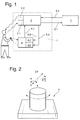
- Fig. 1: eine schematische Darstellung einer Ausführungsform des Bediensystems und
- Fig. 2: eine schematische Darstellung einer Ausführungsform des Betätigungsmittels.
- Die Fig. 1 zeigt eine schematische Darstellung einer ersten Ausführungsform des Bediensystems. Das dargestellte Bediensystem 1 umfaßt eine Sprachbedieneinrichtung 2 mit einem Spracheingabemittel 2.1 und einem Sprachausgabemittel 2.2, und ein Betätigungsmittel 4, welches über Mittel zum Einstellen von mindestens einem Verstellfreiheitsgrad 4.1 und über Mittel zum Einstellen von mindestens einer Art einer haptischen Rückmeldung 4.2 verfügt. Durch Drücken des Betätigungsmittels 4 (Translation in z-Richtung) wird die Sprachbedieneinrichtung 2 aktiviert und der Benutzer kann einen vordefinierten Sprachbefehl, welcher durch das Spracheingabemittel 2.1 in elektrische Signale umgewandelt wird, sprechen. Die Sprachbedieneinrichtung 2 interpretiert die dem Sprachbefehl des Benutzers entsprechenden elektrischen Signale so, daß das Betätigungsmittel 4 fortan und dauerhaft mit einer Bedienfunktion, welche dem Sprachbefehl des Benutzers zugeordnet ist, belegt ist. Drückt der Benutzer das Betätigungsmittel 4 erneut, und spricht er einen anderen Sprachbefehl, so steht ihm von diesem Zeitpunkt an eine andere Bedienfunktion am Betätigungsmittel 4 zur Verfügung. Entsprechend der ausgewählten Bedienfunktion sendet die Sprachbedieneinrichtung 2 über die elektrischen Verbindungen 5.2 und 5.3 Steuersignale an die Mittel zur Einstellung der Verstellfreiheitsgrade 4.1 und die Arten der haptischen Rückmeldung 4.2. Diese Mittel 4.1 und 4.2 sind beispielsweise als elektromechanische und/oder elektromagnetische Aktuatoren ausgeführt, mit welchen es möglich ist Kräfte auf das Betätigungsmittel 4 wirken zu lassen. Über die elektrische Verbindung 5.1 liefert das Betätigungsmittel 4 die erzeugten Stellsignale für die ausgewählte Bedienfunktion über die Sprachbedieneinrichtung 2 und über die elektrische Verbindung 6.1 an das entsprechende zu bedienende Gerät 7. Das zu bedienende Gerät 7 liefert über die elektrische Verbindung 6.2 bestimmte Signale (beispielsweise Signale von Sensoren oder Endschaltern) zurück an die Sprachbedieneinrichtung 2. Die Sprachbedieneinrichtung 2 liefert nach Auswertung dieser Signale die entsprechenden Steuersignale über die elektrischen Verbindungen 5.2 und 5.3 an das Betätigungsmittel 4, um die Einstellung der Verstellfreiheitsgrade und/oder der Arten der haptischen Rückmeldung wenn notwendig entsprechend zu verändern. Dabei können die elektrischen Verbindungen 5.1 bis 5.3 zwischen Sprachbedieneinrichtung 2 und Betätigungsmittel 4 sowie die elektrischen Verbindungen 6.1 und 6.2 zwischen der Sprachbedieneinrichtung 2 und den zu bedienenden Geräten 7 als Datenbus ausgeführt sein.
- Die Fig. 2 zeigt eine schematische Darstellung einer vorteilhaften Ausgestaltung des Betätigungsmittels 4. Dabei können dem dargestellten Betätigungsmittel 4 die nachfolgend beschriebenen Bedienfunktionen mit den entsprechenden Verstellfreiheitsgraden und Arten der haptischen Rückmeldung zugewiesen werden.
- Vermittlung des Funktionsmaximal- und Funktionsminimalwertes:
- Vertreter dieser Bedienfunktion sind z. B. Lautstärke, Baß, Höhen, Balance, Gebläse usw.. Das Betätigungsmittel wird bei Erreichen des jeweiligen Endwertes für das Weiterdrehen in die entsprechende Richtung gesperrt.
- Vermittlung des Funktionsmittelwertes, bzw. von Raststellen:
- Funktionen wie Balance, Fader, Baß, Höhen und Gebläse besitzen einen wohldefinierten Mittelwert, über den der Benutzer häufig informiert sein möchte, ohne sich allein auf seine optische und/oder akustische Wahrnehmung verlassen zu müssen. Beim Erreichen des Mittelwertes wird das Weiterdrehen des Betätigungsmittels etwas erschwert, damit ist der Mittelwert erfühlbar. Auf die gleiche Art und Weise lassen sich auch Raststellen (Inkremente) fühlbar machen. Die Anzahl der Raststellen ist dabei von der Bedienfunktion abhängig.
- Meldung der Mittel- und Endposition durch veränderte Krafteinleitung:
- Bei der Verstellung von mechanischen Komponenten (Sitz, Spiegel, usw.) erkennt der Benutzer das Erreichen der Endposition meist nur auf optischem Wege (z. B. der Sitz bleibt stehen). Der Benutzer wird deshalb über die erreichte Endposition dadurch informiert, daß schlagartig eine erhöhte Rückstellkraft zur Wirkung kommt, oder daß eine Vibration auf das Betätigungselement wirkt. Läßt der Benutzer das Betätigungselement los, so geht es in die Mittelstellung zurück. Danach wird der entsprechende Verstellfreiheitsgrad gesperrt. Die Mittelposition ist oft Ausgangspunkt für eine endgültige Einstellung und noch schwieriger zu erkennen. Das Überfahren der Mittelposition könnte durch Einleiten eines kurzen Impulses angedeutet werden.
- Alle für die zugewiesene Bedienfunktion nicht relevanten Verstellfreiheitsgrade und Arten der haptischen Rückmeldung lassen sich durch elektromagnetische und/oder elektromechanische Vorrichtungen sperren. So kann der Benutzer darüber informiert werden, welche Verstellfreiheitsgrade und Arten der haptischen Rückmeldung für die ausgewählte Bedienfunktion eingestellt sind (z. B. Spiegelverstellung über Drehbewegungen um die x- und y-Achse, Lautstärke über Drehbewegung um die z-Achse).
- Zusätzliche Möglichkeiten für die Rückmeldung an den Benutzer ergeben sich, wenn das Bediensystem 4 um Sprachausgabemittel 2.2, beispielsweise ein Lautsprecher, und/oder um optische Anzeigemittel, beispielsweise Leuchtdioden und/oder ein Bildschirm, erweitert wird. Durch diese Mittel kann der Benutzer zusätzlich oder statt der haptischen Rückmeldung über die ausgewählten Bedienfunktionen und die entsprechenden eingestellten Funktionswerte informiert werden. Die Mittel eignen sich besonders zur Dialogführung in einem Kraftfahrzeug für eine Namensliste bei einem Telefon, die Temperatureinstellung einer Klimaanlage oder den Sendersuchlauf bei einem Radio.
- Außer für die Anwendung in einem Kraftfahrzeug ist es vorstellbar, die Erfindung in anderen Bereichen, wie zum Beispiel zur Steuerung einer Werkzeugmaschine oder anderen komplexen Einrichtungen, zu verwenden, bei welchen es notwendig ist, den Benutzer so wenig wie möglich von Kontrollaufgaben abzulenken.
Claims (5)
- Bediensystem, insbesondere für Komponenten in einem Kraftfahrzeug, umfassend eine Sprachbedieneinrichtung (2) und ein Betätigungsmittel (4), wobei dem Betätigungsmittel (4) durch die Sprachbedieneinrichtung (2) verschiedene Bedienfunktionen zugewiesen werden,
dadurch gekennzeichnet,
daß das Betätigungsmittel (4) über mehrere Verstellfreiheitsgrade (x, y, z) verfügt, welche in Abhängigkeit von der zugewiesenen Bedienfunktion einstellbar sind. - Bediensystem nach Anspruch 1,
dadurch gekennzeichnet,
daß das Betätigungsmittel über verschiedene Arten einer haptischen Rückmeldung an den Benutzer verfügt, welche in Abhängigkeit von der zugewiesenen Bedienfunktion einstellbar sind. - Bediensystem, insbesondere für Komponenten in einem Kraftfahrzeug, umfassend eine Sprachbedieneinrichtung (2) und ein Betätigungsmittel (4), wobei dem Betätigungsmittel durch die Sprachbedieneinrichtung (2) verschiedene Bedienfunktionen zugewiesen werden,
dadurch gekennzeichnet,
daß das Betätigungsmittel (4) über verschiedene Arten einer haptischen Rückmeldung an den Benutzer verfügt, welche in Abhängigkeit von der Zugewiesenen Bedienfunktion einstellbar sind. - Bediensystem nach einem der Ansprüche 1 oder 3
dadurch gekennzeichnet,
daß ein Sprachausgabemittel (2.2) vorgesehen ist, welches dem Benutzer eine akustische Rückmeldung in Abhängigkeit von der zugewiesenen Bedienfunktion gibt. - Bediensystem nach einem der Ansprüche 1 oder 3
dadurch gekennzeichnet,
daß mindestens ein optisches Anzeigemittel vorgesehen ist, welches dem Benutzer eine optische Rückmeldung in Abhängigkeit von der zugewiesenen Bedienfunktion gibt.
Applications Claiming Priority (2)
| Application Number | Priority Date | Filing Date | Title |
|---|---|---|---|
| DE19608869A DE19608869C2 (de) | 1996-03-07 | 1996-03-07 | Bediensystem, insbesondere für Komponenten in einem Kraftfahrzeug |
| DE19608869 | 1996-03-07 |
Publications (3)
| Publication Number | Publication Date |
|---|---|
| EP0794089A2 true EP0794089A2 (de) | 1997-09-10 |
| EP0794089A3 EP0794089A3 (de) | 1998-05-13 |
| EP0794089B1 EP0794089B1 (de) | 2002-06-05 |
Family
ID=7787531
Family Applications (1)
| Application Number | Title | Priority Date | Filing Date |
|---|---|---|---|
| EP97101179A Expired - Lifetime EP0794089B1 (de) | 1996-03-07 | 1997-01-25 | Bediensystem, insbesondere für Komponenten in einem Kraftfahrzeug |
Country Status (5)
| Country | Link |
|---|---|
| US (1) | US6411934B1 (de) |
| EP (1) | EP0794089B1 (de) |
| JP (1) | JP3312372B2 (de) |
| AT (1) | ATE218455T1 (de) |
| DE (2) | DE19608869C2 (de) |
Cited By (9)
| Publication number | Priority date | Publication date | Assignee | Title |
|---|---|---|---|---|
| FR2787916A1 (fr) * | 1998-12-29 | 2000-06-30 | Renault | Dispositif de commande multifonctions pour vehicule |
| EP0961305A3 (de) * | 1998-05-29 | 2000-09-27 | Nokia Mobile Phones Ltd. | Drehsteller für elektrische oder elektronische Geräte |
| WO2002009978A1 (de) * | 2000-07-29 | 2002-02-07 | Robert Bosch Gmbh | Verfahren und system zur akustischen funktionssteuerung im kraftfahrzeug |
| EP0796766B1 (de) * | 1996-03-18 | 2004-09-22 | Siemens Aktiengesellschaft | Multifunktions-Bedieneinrichtung für ein Fahrzeug, z.B. für ein Kraftfahrzeug |
| EP0893750B2 (de) † | 1997-07-26 | 2007-06-20 | Bayerische Motoren Werke Aktiengesellschaft, Patentabteilung AJ-3 | Multifunktions-Bedieneinrichtung |
| WO2008089802A1 (de) * | 2007-01-25 | 2008-07-31 | Daimler Ag | Multifunktionsbedienvorrichtung insbesondere für ein zentrales steuerungssystem in einem kraftfahrzeug |
| WO2009040643A3 (en) * | 2007-09-26 | 2009-06-11 | Ferrari Spa | Infotelematic system for a road vehicle |
| CH699586A1 (de) * | 2008-09-16 | 2010-03-31 | Saia Burgess Murten Ag | Vorrichtung für einen Joystick. |
| EP2246770A3 (de) * | 1998-03-26 | 2011-09-14 | Immersion Corporation | Kraftrückgekoppelte steuerungsräder und -knöpfe |
Families Citing this family (30)
| Publication number | Priority date | Publication date | Assignee | Title |
|---|---|---|---|---|
| DE19735017A1 (de) * | 1997-08-13 | 1999-02-18 | Volkswagen Ag | Vorrichtung zur Diagnose und Behebung von sicherheitsrelevanten Kraftfahrzeugzuständen |
| DE19812697A1 (de) | 1998-03-23 | 1999-09-30 | Volkswagen Ag | Verfahren und Einrichtung zum Betrieb einer Mikrofonanordnung, insbesondere in einem Kraftfahrzeug |
| DE19818262A1 (de) * | 1998-04-23 | 1999-10-28 | Volkswagen Ag | Verfahren und Einrichtung zum Betrieb bzw. zum Bedienen verschiedener Geräte in einem Fahrzeug |
| DE19821899C2 (de) * | 1998-05-15 | 2001-06-13 | Siemens Ag | Drehschalter, insbesondere Zündanlaßschalter |
| DE19825760A1 (de) | 1998-06-09 | 1999-12-16 | Nokia Mobile Phones Ltd | Verfahren zum Zuweisen einer auswählbaren Möglichkeit zu einem Stellmittel |
| DE19832677A1 (de) * | 1998-07-21 | 2000-02-03 | Mannesmann Vdo Ag | Bedienvorrichtung |
| DE19839466A1 (de) * | 1998-08-29 | 2000-03-09 | Volkswagen Ag | Verfahren und Steuereinrichtung zur Bedienung technischer Einrichtungen eines Fahrzeugs |
| DE19937463B4 (de) * | 1999-08-07 | 2004-12-02 | Volkswagen Ag | Verfahren zum Betrieb einer Multifunktionsbedieneinrichtung bei Kraftfahrzeugen, sowie Multifunktionsbedieneinrichtung selbst |
| DE10041178A1 (de) * | 2000-08-23 | 2002-03-07 | Volkswagen Ag | Bedieneinrichtung zur Steuerung eines Kraftfahrzeuges |
| JP3748052B2 (ja) * | 2001-06-06 | 2006-02-22 | 三菱電機株式会社 | コンテンツ配信サーバ及びコンテンツ受信端末及び暗号鍵通信装置及びコンテンツ通信システム及びコンテンツ通信方法及び暗号鍵通信方法及びプログラム及びプログラムを記録したコンピュータ読み取り可能な記録媒体 |
| DE10212764B4 (de) * | 2002-03-22 | 2007-08-09 | Audi Ag | Fahrerassistenzsystem |
| JP4347703B2 (ja) * | 2002-04-03 | 2009-10-21 | ソニー エリクソン モバイル コミュニケーションズ, エービー | 仮想的な三次元環境内をナビゲートする方法および当該方法を採用する電子装置。 |
| DE10245354A1 (de) * | 2002-09-27 | 2004-04-08 | Philips Intellectual Property & Standards Gmbh | Fernsteuerung |
| JP4314810B2 (ja) | 2002-11-18 | 2009-08-19 | 富士ゼロックス株式会社 | 触覚インタフェース装置 |
| US6961644B2 (en) | 2002-12-12 | 2005-11-01 | Alps Automotive, Inc. | Dual haptic vehicle control and display system |
| JP3988646B2 (ja) * | 2003-01-17 | 2007-10-10 | 日産自動車株式会社 | 車両用操作装置 |
| DE10331776B3 (de) * | 2003-07-11 | 2005-05-04 | Siemens Ag | Bedienvorrichtung |
| US7555533B2 (en) * | 2003-10-15 | 2009-06-30 | Harman Becker Automotive Systems Gmbh | System for communicating information from a server via a mobile communication device |
| DE602004010054T2 (de) * | 2004-01-19 | 2008-03-06 | Harman Becker Automotive Systems Gmbh | Betätigung eines Sprachdialogsystems |
| ATE400871T1 (de) * | 2004-01-29 | 2008-07-15 | Harman Becker Automotive Sys | Multimodale dateneingabe |
| EP1560200B8 (de) * | 2004-01-29 | 2009-08-05 | Harman Becker Automotive Systems GmbH | Verfahren und System zur Sprachdialogschnittstelle |
| EP1562180B1 (de) * | 2004-02-06 | 2015-04-01 | Nuance Communications, Inc. | Sprachdialogsystem und Verfahren zum Steuern eines elektronischen Gerätes |
| DE102004008084A1 (de) * | 2004-02-19 | 2005-09-08 | Adam Opel Ag | Bedienelement für ein Kraftfahrzeug |
| DE102005002900A1 (de) * | 2005-01-21 | 2006-07-27 | Bayerische Motoren Werke Ag | Bedienvorrichtung für ein Fahrzeug |
| DE102005007317A1 (de) * | 2005-02-17 | 2006-08-24 | Robert Bosch Gmbh | Verfahren und Vorrichtung zur Sprachsteuerung eines Gerätes oder eines Systems in einem Kraftfahrzeug |
| JP4899685B2 (ja) * | 2005-09-02 | 2012-03-21 | 株式会社デンソー | 手動操作システム |
| DE102007026542A1 (de) * | 2007-06-08 | 2008-12-11 | Volkswagen Ag | Vorrichtung und Verfahren zum Einstellen eines Klangortes eines Audiosystems im Innenraum eines Kraftfahrzeugs |
| US8279052B2 (en) * | 2009-11-04 | 2012-10-02 | Immersion Corporation | Systems and methods for haptic confirmation of commands |
| US20140256212A1 (en) * | 2013-03-11 | 2014-09-11 | Avi Agarwal | Music of movement: the manipulation of mechanical objects through sound |
| US10752257B2 (en) * | 2016-02-19 | 2020-08-25 | A Truly Electric Car Company | Car operating system that controls the car's direction and speed |
Family Cites Families (27)
| Publication number | Priority date | Publication date | Assignee | Title |
|---|---|---|---|---|
| DE2744057A1 (de) | 1977-09-30 | 1979-04-05 | Loewe Opta Gmbh | Fernsteuerung zum steuern, ein- und umschalten von variablen und festen geraetefunktionen und funktionsgroessen in nachrichtentechnischen geraeten |
| JPS5870289A (ja) * | 1981-10-22 | 1983-04-26 | 日産自動車株式会社 | 車載負荷の音声制御装置 |
| JPS6045448A (ja) | 1984-07-10 | 1985-03-11 | Matsushita Electric Ind Co Ltd | 自動車用音声制御装置 |
| DE3524439A1 (de) | 1985-07-09 | 1987-01-22 | Kirsten Elektrotech | Schalter fuer das einstellen von mindestens zwei spiegeln eines kraftfahrzeuges |
| US4797924A (en) * | 1985-10-25 | 1989-01-10 | Nartron Corporation | Vehicle voice recognition method and apparatus |
| JPS6281142U (de) | 1985-10-31 | 1987-05-23 | ||
| DE3605088A1 (de) * | 1986-02-18 | 1987-11-05 | Bosch Gmbh Robert | Bedieneinrichtung |
| DE3636678A1 (de) * | 1986-10-28 | 1988-05-11 | Siemens Ag | Roentgendiagnostikeinrichtung |
| US4827520A (en) | 1987-01-16 | 1989-05-02 | Prince Corporation | Voice actuated control system for use in a vehicle |
| US4897630A (en) * | 1987-01-21 | 1990-01-30 | Electronic Security Products Of California, Inc. | Programmable alarm system having proximity detection with vocal alarm and reporting features |
| US5239586A (en) * | 1987-05-29 | 1993-08-24 | Kabushiki Kaisha Toshiba | Voice recognition system used in telephone apparatus |
| US5267323A (en) * | 1989-12-29 | 1993-11-30 | Pioneer Electronic Corporation | Voice-operated remote control system |
| US5223776A (en) * | 1990-12-31 | 1993-06-29 | Honeywell Inc. | Six-degree virtual pivot controller |
| US5287109A (en) * | 1991-07-05 | 1994-02-15 | David Hesse | Programmable remote control |
| DE4205875A1 (de) * | 1992-02-26 | 1993-09-02 | Vdo Schindling | Bedienvorrichtung |
| DE4214668A1 (de) * | 1992-05-02 | 1993-11-04 | Telekommunikationstechnik Seem | Verfahren zur sprachgesteuerten fernbedienung von elektrischen vorrichtungen |
| US5450525A (en) * | 1992-11-12 | 1995-09-12 | Russell; Donald P. | Vehicle accessory control with manual and voice response |
| JPH06274190A (ja) | 1993-03-18 | 1994-09-30 | Sony Corp | ナビゲーションシステムおよび音声認識装置 |
| US5805140A (en) * | 1993-07-16 | 1998-09-08 | Immersion Corporation | High bandwidth force feedback interface using voice coils and flexures |
| ES2125505T3 (es) * | 1994-06-06 | 1999-03-01 | Volkswagen Ag | Instalacion multifuncional para la activacion de diferentes miembros de ajuste en un vehiculo y vehiculo con una instalacion multifuncional de este tipo. |
| GB9414373D0 (en) * | 1994-07-15 | 1994-09-07 | Virtuality Ip Ltd | Haptic computer input device |
| WO1996021185A1 (en) * | 1995-01-04 | 1996-07-11 | Philips Electronics N.V. | A speech-actuated control system for use with a consumer product |
| US5644627A (en) * | 1995-03-29 | 1997-07-01 | Motorola, Inc. | Method and apparatus for processing a voice message intended for a selective call transceiver |
| US5774841A (en) * | 1995-09-20 | 1998-06-30 | The United States Of America As Represented By The Adminstrator Of The National Aeronautics And Space Administration | Real-time reconfigurable adaptive speech recognition command and control apparatus and method |
| US5878395A (en) * | 1995-12-08 | 1999-03-02 | Intermec Ip Corp. | Code reading terminal with integrated vehicular head-up display capability |
| US6009355A (en) * | 1997-01-28 | 1999-12-28 | American Calcar Inc. | Multimedia information and control system for automobiles |
| US6184868B1 (en) * | 1998-09-17 | 2001-02-06 | Immersion Corp. | Haptic feedback control devices |
-
1996
- 1996-03-07 DE DE19608869A patent/DE19608869C2/de not_active Revoked
-
1997
- 1997-01-25 EP EP97101179A patent/EP0794089B1/de not_active Expired - Lifetime
- 1997-01-25 DE DE59707381T patent/DE59707381D1/de not_active Expired - Lifetime
- 1997-01-25 AT AT97101179T patent/ATE218455T1/de not_active IP Right Cessation
- 1997-02-25 US US08/804,693 patent/US6411934B1/en not_active Expired - Fee Related
- 1997-03-07 JP JP06894197A patent/JP3312372B2/ja not_active Expired - Fee Related
Cited By (13)
| Publication number | Priority date | Publication date | Assignee | Title |
|---|---|---|---|---|
| EP0796766B1 (de) * | 1996-03-18 | 2004-09-22 | Siemens Aktiengesellschaft | Multifunktions-Bedieneinrichtung für ein Fahrzeug, z.B. für ein Kraftfahrzeug |
| EP0893750B2 (de) † | 1997-07-26 | 2007-06-20 | Bayerische Motoren Werke Aktiengesellschaft, Patentabteilung AJ-3 | Multifunktions-Bedieneinrichtung |
| EP2246770A3 (de) * | 1998-03-26 | 2011-09-14 | Immersion Corporation | Kraftrückgekoppelte steuerungsräder und -knöpfe |
| EP0961305A3 (de) * | 1998-05-29 | 2000-09-27 | Nokia Mobile Phones Ltd. | Drehsteller für elektrische oder elektronische Geräte |
| US6404354B1 (en) | 1998-05-29 | 2002-06-11 | Nokia Mobile Phones Limited | Rotary controller for electrical or electronic apparatuses |
| EP1016566A1 (de) * | 1998-12-29 | 2000-07-05 | Renault | Kraftfahrzeug-Multifunktionssteurungsvorrichtung |
| FR2787916A1 (fr) * | 1998-12-29 | 2000-06-30 | Renault | Dispositif de commande multifonctions pour vehicule |
| US6930265B2 (en) | 2000-07-29 | 2005-08-16 | Robert Bosch Gmbh | Method and system for acoustic function control in motor vehicles |
| WO2002009978A1 (de) * | 2000-07-29 | 2002-02-07 | Robert Bosch Gmbh | Verfahren und system zur akustischen funktionssteuerung im kraftfahrzeug |
| WO2008089802A1 (de) * | 2007-01-25 | 2008-07-31 | Daimler Ag | Multifunktionsbedienvorrichtung insbesondere für ein zentrales steuerungssystem in einem kraftfahrzeug |
| WO2009040643A3 (en) * | 2007-09-26 | 2009-06-11 | Ferrari Spa | Infotelematic system for a road vehicle |
| US9120381B2 (en) | 2007-09-26 | 2015-09-01 | Ferrari S.P.A. | Interface system for a road vehicle provided with a liquid-crystal display and a control device for controlling the information appearing on the display |
| CH699586A1 (de) * | 2008-09-16 | 2010-03-31 | Saia Burgess Murten Ag | Vorrichtung für einen Joystick. |
Also Published As
| Publication number | Publication date |
|---|---|
| DE19608869C2 (de) | 1998-03-26 |
| US6411934B1 (en) | 2002-06-25 |
| JPH09244866A (ja) | 1997-09-19 |
| EP0794089B1 (de) | 2002-06-05 |
| JP3312372B2 (ja) | 2002-08-05 |
| EP0794089A3 (de) | 1998-05-13 |
| DE59707381D1 (de) | 2002-07-11 |
| DE19608869A1 (de) | 1997-09-11 |
| ATE218455T1 (de) | 2002-06-15 |
Similar Documents
| Publication | Publication Date | Title |
|---|---|---|
| EP0794089B1 (de) | Bediensystem, insbesondere für Komponenten in einem Kraftfahrzeug | |
| DE19843421B4 (de) | Vorrichtung zur Auswahl von Punkten einer aus Menüs und/oder Untermenüs und/oder Funktionen und/oder Funktionswerten bestehenden Menüstruktur | |
| DE19937463B4 (de) | Verfahren zum Betrieb einer Multifunktionsbedieneinrichtung bei Kraftfahrzeugen, sowie Multifunktionsbedieneinrichtung selbst | |
| DE10121909B4 (de) | Belüftungsvorrichtung für Fahrzeuge | |
| EP0686525B1 (de) | Multifunktionseinrichtung zur Betätigung unterschiedlicher Stellglieder in einem Kraftfahrzeug und Kraftfahrzeug mit einer derartigen Multifunktionseinrichtung | |
| WO2009033523A2 (de) | Bediensystem für ein kraftfahrzeug | |
| WO2005035299A1 (de) | Bedien- und anzeigeeinheit | |
| EP0608771A1 (de) | Verfahren und Vorrichtung zum Betätigen von Einbaukomponenten in Kraftfahrzeugen | |
| EP3388276B1 (de) | Bedienanordnung zum bedienen von zumindest einem elektrischen gerät mit einem kraftsensor, fahrerassistenzsystem, kraftfahrzeug sowie verfahren zum bedienen einer bedienanordnung | |
| DE10347318B4 (de) | Vorrichtung zur Feinpositionierung von verstellbaren Öffnungen in Kraftfahrzeugen | |
| WO2023099126A1 (de) | Multifunktionale bedienvorrichtung für ein kraftfahrzeug und kraftfahrzeug | |
| DE102005060605A1 (de) | Bedieneinrichtung für ein Fahrzeug und Set von Bedieneinrichtungen | |
| EP2095384B1 (de) | Schaltelement zum betätigen einer einstellgrösse | |
| DE19920162C2 (de) | Verfahren zur Steuerung von Geräten mittels einer Fernbedienung | |
| EP0349835A1 (de) | Hörgerät | |
| DE102008028381B4 (de) | Multifunktionsschalter zur Ansteuerung der Außenrückspiegel eines Kraftfahrzeugs und Kraftfahrzeug | |
| DE10036394B4 (de) | Bedieneinrichtung für ein elektrisch betriebenes Schiebedach eines Kraftfahrzeuges | |
| WO2008046659A1 (de) | Vorrichtung und verfahren zur bedienung eines kraftfahrzeuges | |
| DE102023125187B3 (de) | Quantenschalter sowie Verfahren zum Steuern eines Aktors mit einem solchen | |
| EP0818945A2 (de) | Elektronisches Stellgerät zum Steuern eines Laststromes | |
| EP1213188A2 (de) | Bedienvorrichtung | |
| DE102018129239A1 (de) | Bedieneinrichtung | |
| DE102005025887A1 (de) | Bedieneinrichtung für ein Kraftfahrzeug | |
| DE102012206793B4 (de) | Papierstapelschneidemaschine mit Ein- oder Zweihandbedienung | |
| DE10060396A1 (de) | Bedienschalter für Aggregate in einem Kraftfahrzeug |
Legal Events
| Date | Code | Title | Description |
|---|---|---|---|
| PUAI | Public reference made under article 153(3) epc to a published international application that has entered the european phase |
Free format text: ORIGINAL CODE: 0009012 |
|
| AK | Designated contracting states |
Kind code of ref document: A2 Designated state(s): AT BE CH DE FR GB IT LI NL |
|
| PUAL | Search report despatched |
Free format text: ORIGINAL CODE: 0009013 |
|
| AK | Designated contracting states |
Kind code of ref document: A3 Designated state(s): AT BE CH DE FR GB IT LI NL |
|
| 17P | Request for examination filed |
Effective date: 19980425 |
|
| RAP1 | Party data changed (applicant data changed or rights of an application transferred) |
Owner name: DAIMLERCHRYSLER AG |
|
| 17Q | First examination report despatched |
Effective date: 20010130 |
|
| GRAG | Despatch of communication of intention to grant |
Free format text: ORIGINAL CODE: EPIDOS AGRA |
|
| GRAG | Despatch of communication of intention to grant |
Free format text: ORIGINAL CODE: EPIDOS AGRA |
|
| GRAH | Despatch of communication of intention to grant a patent |
Free format text: ORIGINAL CODE: EPIDOS IGRA |
|
| GRAH | Despatch of communication of intention to grant a patent |
Free format text: ORIGINAL CODE: EPIDOS IGRA |
|
| GRAA | (expected) grant |
Free format text: ORIGINAL CODE: 0009210 |
|
| AK | Designated contracting states |
Kind code of ref document: B1 Designated state(s): AT BE CH DE FR GB IT LI NL |
|
| REF | Corresponds to: |
Ref document number: 218455 Country of ref document: AT Date of ref document: 20020615 Kind code of ref document: T |
|
| REG | Reference to a national code |
Ref country code: GB Ref legal event code: FG4D Free format text: NOT ENGLISH |
|
| REG | Reference to a national code |
Ref country code: CH Ref legal event code: NV Representative=s name: ISLER & PEDRAZZINI AG Ref country code: CH Ref legal event code: EP |
|
| REF | Corresponds to: |
Ref document number: 59707381 Country of ref document: DE Date of ref document: 20020711 |
|
| GBT | Gb: translation of ep patent filed (gb section 77(6)(a)/1977) |
Effective date: 20020721 |
|
| ET | Fr: translation filed | ||
| PLBQ | Unpublished change to opponent data |
Free format text: ORIGINAL CODE: EPIDOS OPPO |
|
| PLBI | Opposition filed |
Free format text: ORIGINAL CODE: 0009260 |
|
| PLBQ | Unpublished change to opponent data |
Free format text: ORIGINAL CODE: EPIDOS OPPO |
|
| PLBI | Opposition filed |
Free format text: ORIGINAL CODE: 0009260 |
|
| PLBF | Reply of patent proprietor to notice(s) of opposition |
Free format text: ORIGINAL CODE: EPIDOS OBSO |
|
| 26 | Opposition filed |
Opponent name: VOLKSWAGEN AG Effective date: 20030224 |
|
| 26 | Opposition filed |
Opponent name: INTERESSENGEMEINSCHAFTFUER RUNDFUNKSCHUTZRECHTE E. Effective date: 20030305 Opponent name: VOLKSWAGEN AG Effective date: 20030224 |
|
| NLR1 | Nl: opposition has been filed with the epo |
Opponent name: INTERESSENGEMEINSCHAFT FUER RUNDFUNKSCHUTZRECHTE E Opponent name: VOLKSWAGEN AG |
|
| PLBB | Reply of patent proprietor to notice(s) of opposition received |
Free format text: ORIGINAL CODE: EPIDOSNOBS3 |
|
| PLBQ | Unpublished change to opponent data |
Free format text: ORIGINAL CODE: EPIDOS OPPO |
|
| PLAB | Opposition data, opponent's data or that of the opponent's representative modified |
Free format text: ORIGINAL CODE: 0009299OPPO |
|
| PLBQ | Unpublished change to opponent data |
Free format text: ORIGINAL CODE: EPIDOS OPPO |
|
| PLAB | Opposition data, opponent's data or that of the opponent's representative modified |
Free format text: ORIGINAL CODE: 0009299OPPO |
|
| R26 | Opposition filed (corrected) |
Opponent name: INTERESSENGEMEINSCHAFTFUER RUNDFUNKSCHUTZRECHTE E. Effective date: 20030305 Opponent name: VOLKSWAGEN AG Effective date: 20030224 |
|
| R26 | Opposition filed (corrected) |
Opponent name: INTERESSENGEMEINSCHAFTFUER RUNDFUNKSCHUTZRECHTE E. Effective date: 20030305 Opponent name: VOLKSWAGEN AG Effective date: 20030224 |
|
| NLR1 | Nl: opposition has been filed with the epo |
Opponent name: INTERESSENGEMEINSCHAFT FUER RUNDFUNKSCHUTZRECHTE E Opponent name: VOLKSWAGEN AG |
|
| PLAB | Opposition data, opponent's data or that of the opponent's representative modified |
Free format text: ORIGINAL CODE: 0009299OPPO |
|
| PLBQ | Unpublished change to opponent data |
Free format text: ORIGINAL CODE: EPIDOS OPPO |
|
| PLCK | Communication despatched that opposition was rejected |
Free format text: ORIGINAL CODE: EPIDOSNREJ1 |
|
| NLR1 | Nl: opposition has been filed with the epo |
Opponent name: INTERESSENGEMEINSCHAFT FUER RUNDFUNKSCHUTZRECHTE E Opponent name: VOLKSWAGEN AG |
|
| R26 | Opposition filed (corrected) |
Opponent name: INTERESSENGEMEINSCHAFTFUER RUNDFUNKSCHUTZRECHTE E. Effective date: 20030305 Opponent name: VOLKSWAGEN AG Effective date: 20030224 |
|
| NLR1 | Nl: opposition has been filed with the epo |
Opponent name: INTERESSENGEMEINSCHAFT FUER RUNDFUNKSCHUTZRECHTE E Opponent name: VOLKSWAGEN AG |
|
| PLBN | Opposition rejected |
Free format text: ORIGINAL CODE: 0009273 |
|
| STAA | Information on the status of an ep patent application or granted ep patent |
Free format text: STATUS: OPPOSITION REJECTED |
|
| 27O | Opposition rejected |
Effective date: 20041110 |
|
| NLR2 | Nl: decision of opposition |
Effective date: 20041110 |
|
| REG | Reference to a national code |
Ref country code: CH Ref legal event code: PCAR Free format text: ISLER & PEDRAZZINI AG;POSTFACH 1772;8027 ZUERICH (CH) |
|
| REG | Reference to a national code |
Ref country code: CH Ref legal event code: PFA Owner name: DAIMLER AG Free format text: DAIMLERCHRYSLER AG#MERCEDESSTRASSE 137#70327 STUTTGART (DE) -TRANSFER TO- DAIMLER AG#MERCEDESSTRASSE 137#70327 STUTTGART (DE) |
|
| NLT1 | Nl: modifications of names registered in virtue of documents presented to the patent office pursuant to art. 16 a, paragraph 1 |
Owner name: DAIMLER AG |
|
| PGFP | Annual fee paid to national office [announced via postgrant information from national office to epo] |
Ref country code: AT Payment date: 20090115 Year of fee payment: 13 |
|
| PGFP | Annual fee paid to national office [announced via postgrant information from national office to epo] |
Ref country code: NL Payment date: 20090114 Year of fee payment: 13 |
|
| PGFP | Annual fee paid to national office [announced via postgrant information from national office to epo] |
Ref country code: GB Payment date: 20090122 Year of fee payment: 13 Ref country code: CH Payment date: 20090115 Year of fee payment: 13 |
|
| PGFP | Annual fee paid to national office [announced via postgrant information from national office to epo] |
Ref country code: BE Payment date: 20090219 Year of fee payment: 13 |
|
| PGFP | Annual fee paid to national office [announced via postgrant information from national office to epo] |
Ref country code: IT Payment date: 20090128 Year of fee payment: 13 |
|
| PGFP | Annual fee paid to national office [announced via postgrant information from national office to epo] |
Ref country code: FR Payment date: 20090115 Year of fee payment: 13 |
|
| REG | Reference to a national code |
Ref country code: FR Ref legal event code: CD Ref country code: FR Ref legal event code: CA |
|
| PGFP | Annual fee paid to national office [announced via postgrant information from national office to epo] |
Ref country code: DE Payment date: 20100121 Year of fee payment: 14 |
|
| BERE | Be: lapsed |
Owner name: *DAIMLER A.G. Effective date: 20100131 |
|
| REG | Reference to a national code |
Ref country code: NL Ref legal event code: V1 Effective date: 20100801 |
|
| REG | Reference to a national code |
Ref country code: CH Ref legal event code: PL |
|
| GBPC | Gb: european patent ceased through non-payment of renewal fee |
Effective date: 20100125 |
|
| REG | Reference to a national code |
Ref country code: FR Ref legal event code: ST Effective date: 20100930 |
|
| PG25 | Lapsed in a contracting state [announced via postgrant information from national office to epo] |
Ref country code: NL Free format text: LAPSE BECAUSE OF NON-PAYMENT OF DUE FEES Effective date: 20100801 Ref country code: LI Free format text: LAPSE BECAUSE OF NON-PAYMENT OF DUE FEES Effective date: 20100131 Ref country code: FR Free format text: LAPSE BECAUSE OF NON-PAYMENT OF DUE FEES Effective date: 20100201 Ref country code: CH Free format text: LAPSE BECAUSE OF NON-PAYMENT OF DUE FEES Effective date: 20100131 |
|
| PG25 | Lapsed in a contracting state [announced via postgrant information from national office to epo] |
Ref country code: AT Free format text: LAPSE BECAUSE OF NON-PAYMENT OF DUE FEES Effective date: 20100125 |
|
| PG25 | Lapsed in a contracting state [announced via postgrant information from national office to epo] |
Ref country code: GB Free format text: LAPSE BECAUSE OF NON-PAYMENT OF DUE FEES Effective date: 20100125 |
|
| PG25 | Lapsed in a contracting state [announced via postgrant information from national office to epo] |
Ref country code: BE Free format text: LAPSE BECAUSE OF NON-PAYMENT OF DUE FEES Effective date: 20100131 |
|
| PG25 | Lapsed in a contracting state [announced via postgrant information from national office to epo] |
Ref country code: IT Free format text: LAPSE BECAUSE OF NON-PAYMENT OF DUE FEES Effective date: 20100125 |
|
| REG | Reference to a national code |
Ref country code: DE Ref legal event code: R119 Ref document number: 59707381 Country of ref document: DE Effective date: 20110802 |
|
| PG25 | Lapsed in a contracting state [announced via postgrant information from national office to epo] |
Ref country code: DE Free format text: LAPSE BECAUSE OF NON-PAYMENT OF DUE FEES Effective date: 20110802 |