EP0794220A1 - Formteile aus schwerentflammbarer Polyesterformmasse - Google Patents
Formteile aus schwerentflammbarer Polyesterformmasse Download PDFInfo
- Publication number
- EP0794220A1 EP0794220A1 EP97102609A EP97102609A EP0794220A1 EP 0794220 A1 EP0794220 A1 EP 0794220A1 EP 97102609 A EP97102609 A EP 97102609A EP 97102609 A EP97102609 A EP 97102609A EP 0794220 A1 EP0794220 A1 EP 0794220A1
- Authority
- EP
- European Patent Office
- Prior art keywords
- acid
- tert
- calcium
- naphthylene
- butyl
- Prior art date
- Legal status (The legal status is an assumption and is not a legal conclusion. Google has not performed a legal analysis and makes no representation as to the accuracy of the status listed.)
- Granted
Links
- 229920000728 polyester Polymers 0.000 title claims abstract description 21
- 238000000465 moulding Methods 0.000 title claims abstract description 20
- RNFJDJUURJAICM-UHFFFAOYSA-N 2,2,4,4,6,6-hexaphenoxy-1,3,5-triaza-2$l^{5},4$l^{5},6$l^{5}-triphosphacyclohexa-1,3,5-triene Chemical compound N=1P(OC=2C=CC=CC=2)(OC=2C=CC=CC=2)=NP(OC=2C=CC=CC=2)(OC=2C=CC=CC=2)=NP=1(OC=1C=CC=CC=1)OC1=CC=CC=C1 RNFJDJUURJAICM-UHFFFAOYSA-N 0.000 title description 8
- 239000003063 flame retardant Substances 0.000 title description 7
- 229920000642 polymer Polymers 0.000 claims abstract description 21
- OYPRJOBELJOOCE-UHFFFAOYSA-N Calcium Chemical group [Ca] OYPRJOBELJOOCE-UHFFFAOYSA-N 0.000 claims abstract description 10
- ACVYVLVWPXVTIT-UHFFFAOYSA-N phosphinic acid Chemical compound O[PH2]=O ACVYVLVWPXVTIT-UHFFFAOYSA-N 0.000 claims abstract description 10
- 239000011575 calcium Substances 0.000 claims abstract description 9
- 229910052791 calcium Inorganic materials 0.000 claims abstract description 9
- -1 n- Pentyl Chemical group 0.000 claims description 20
- 239000000203 mixture Substances 0.000 claims description 15
- 239000002253 acid Substances 0.000 claims description 14
- AZDRQVAHHNSJOQ-UHFFFAOYSA-N alumane Chemical class [AlH3] AZDRQVAHHNSJOQ-UHFFFAOYSA-N 0.000 claims description 10
- 150000001875 compounds Chemical class 0.000 claims description 7
- 238000004519 manufacturing process Methods 0.000 claims description 6
- 150000003839 salts Chemical class 0.000 claims description 6
- 125000000217 alkyl group Chemical group 0.000 claims description 4
- 239000003990 capacitor Substances 0.000 claims description 4
- IYABWNGZIDDRAK-UHFFFAOYSA-N allene Chemical group C=C=C IYABWNGZIDDRAK-UHFFFAOYSA-N 0.000 claims description 3
- 125000001495 ethyl group Chemical group [H]C([H])([H])C([H])([H])* 0.000 claims description 3
- 125000001449 isopropyl group Chemical group [H]C([H])([H])C([H])(*)C([H])([H])[H] 0.000 claims description 3
- 125000002496 methyl group Chemical group [H]C([H])([H])* 0.000 claims description 3
- 125000004108 n-butyl group Chemical group [H]C([H])([H])C([H])([H])C([H])([H])C([H])([H])* 0.000 claims description 3
- 125000004123 n-propyl group Chemical group [H]C([H])([H])C([H])([H])C([H])([H])* 0.000 claims description 3
- 125000001997 phenyl group Chemical group [H]C1=C([H])C([H])=C(*)C([H])=C1[H] 0.000 claims description 3
- 125000006832 (C1-C10) alkylene group Chemical group 0.000 claims description 2
- VXNZUUAINFGPBY-UHFFFAOYSA-N 1-Butene Chemical group CCC=C VXNZUUAINFGPBY-UHFFFAOYSA-N 0.000 claims description 2
- 229910052782 aluminium Inorganic materials 0.000 claims description 2
- 125000000732 arylene group Chemical group 0.000 claims description 2
- 239000004020 conductor Substances 0.000 claims description 2
- 125000004957 naphthylene group Chemical group 0.000 claims description 2
- 125000000843 phenylene group Chemical group C1(=C(C=CC=C1)*)* 0.000 claims description 2
- 125000004805 propylene group Chemical group [H]C([H])([H])C([H])([*:1])C([H])([H])[*:2] 0.000 claims description 2
- 125000006850 spacer group Chemical group 0.000 claims description 2
- 125000000999 tert-butyl group Chemical group [H]C([H])([H])C(*)(C([H])([H])[H])C([H])([H])[H] 0.000 claims description 2
- 239000000463 material Substances 0.000 abstract description 3
- 159000000013 aluminium salts Chemical group 0.000 abstract 1
- 229910000329 aluminium sulfate Chemical group 0.000 abstract 1
- XLYOFNOQVPJJNP-UHFFFAOYSA-N water Substances O XLYOFNOQVPJJNP-UHFFFAOYSA-N 0.000 description 8
- 238000002360 preparation method Methods 0.000 description 7
- 238000003756 stirring Methods 0.000 description 7
- 238000001035 drying Methods 0.000 description 6
- NXHKQBCTZHECQF-UHFFFAOYSA-N ethyl(methyl)phosphinic acid Chemical compound CCP(C)(O)=O NXHKQBCTZHECQF-UHFFFAOYSA-N 0.000 description 6
- 239000003365 glass fiber Substances 0.000 description 6
- 230000000052 comparative effect Effects 0.000 description 5
- SZTJCIYEOQYVED-UHFFFAOYSA-N methyl(propyl)phosphinic acid Chemical compound CCCP(C)(O)=O SZTJCIYEOQYVED-UHFFFAOYSA-N 0.000 description 5
- ACVYVLVWPXVTIT-UHFFFAOYSA-M phosphinate Chemical compound [O-][PH2]=O ACVYVLVWPXVTIT-UHFFFAOYSA-M 0.000 description 5
- 239000000843 powder Substances 0.000 description 5
- 238000012360 testing method Methods 0.000 description 5
- 238000001291 vacuum drying Methods 0.000 description 5
- WKBOTKDWSSQWDR-UHFFFAOYSA-N Bromine atom Chemical compound [Br] WKBOTKDWSSQWDR-UHFFFAOYSA-N 0.000 description 4
- 150000007513 acids Chemical class 0.000 description 4
- WNROFYMDJYEPJX-UHFFFAOYSA-K aluminium hydroxide Chemical compound [OH-].[OH-].[OH-].[Al+3] WNROFYMDJYEPJX-UHFFFAOYSA-K 0.000 description 4
- GDTBXPJZTBHREO-UHFFFAOYSA-N bromine Substances BrBr GDTBXPJZTBHREO-UHFFFAOYSA-N 0.000 description 4
- 229910052794 bromium Inorganic materials 0.000 description 4
- 229920001707 polybutylene terephthalate Polymers 0.000 description 4
- 230000015572 biosynthetic process Effects 0.000 description 3
- BRPQOXSCLDDYGP-UHFFFAOYSA-N calcium oxide Chemical compound [O-2].[Ca+2] BRPQOXSCLDDYGP-UHFFFAOYSA-N 0.000 description 3
- 239000000292 calcium oxide Substances 0.000 description 3
- ODINCKMPIJJUCX-UHFFFAOYSA-N calcium oxide Inorganic materials [Ca]=O ODINCKMPIJJUCX-UHFFFAOYSA-N 0.000 description 3
- 159000000007 calcium salts Chemical class 0.000 description 3
- 238000013329 compounding Methods 0.000 description 3
- GOJNABIZVJCYFL-UHFFFAOYSA-N dimethylphosphinic acid Chemical compound CP(C)(O)=O GOJNABIZVJCYFL-UHFFFAOYSA-N 0.000 description 3
- 238000001746 injection moulding Methods 0.000 description 3
- 239000000155 melt Substances 0.000 description 3
- 238000000034 method Methods 0.000 description 3
- 239000004033 plastic Substances 0.000 description 3
- 229920003023 plastic Polymers 0.000 description 3
- OKTJSMMVPCPJKN-UHFFFAOYSA-N Carbon Chemical compound [C] OKTJSMMVPCPJKN-UHFFFAOYSA-N 0.000 description 2
- ADCOVFLJGNWWNZ-UHFFFAOYSA-N antimony trioxide Chemical compound O=[Sb]O[Sb]=O ADCOVFLJGNWWNZ-UHFFFAOYSA-N 0.000 description 2
- 239000011521 glass Substances 0.000 description 2
- 239000008187 granular material Substances 0.000 description 2
- 229910052751 metal Inorganic materials 0.000 description 2
- 239000002184 metal Substances 0.000 description 2
- GKAMSGCCXBMNBH-UHFFFAOYSA-N methyl(octyl)phosphinic acid Chemical compound CCCCCCCCP(C)(O)=O GKAMSGCCXBMNBH-UHFFFAOYSA-N 0.000 description 2
- BCDIWLCKOCHCIH-UHFFFAOYSA-N methylphosphinic acid Chemical compound CP(O)=O BCDIWLCKOCHCIH-UHFFFAOYSA-N 0.000 description 2
- 125000000740 n-pentyl group Chemical group [H]C([H])([H])C([H])([H])C([H])([H])C([H])([H])C([H])([H])* 0.000 description 2
- 238000012545 processing Methods 0.000 description 2
- 239000000243 solution Substances 0.000 description 2
- ZWVMLYRJXORSEP-LURJTMIESA-N (2s)-hexane-1,2,6-triol Chemical compound OCCCC[C@H](O)CO ZWVMLYRJXORSEP-LURJTMIESA-N 0.000 description 1
- 125000004209 (C1-C8) alkyl group Chemical group 0.000 description 1
- 229920000049 Carbon (fiber) Polymers 0.000 description 1
- 235000008733 Citrus aurantifolia Nutrition 0.000 description 1
- OAICVXFJPJFONN-UHFFFAOYSA-N Phosphorus Chemical compound [P] OAICVXFJPJFONN-UHFFFAOYSA-N 0.000 description 1
- 235000011941 Tilia x europaea Nutrition 0.000 description 1
- 239000012963 UV stabilizer Substances 0.000 description 1
- 239000000654 additive Substances 0.000 description 1
- ZJKCITHLCNCAHA-UHFFFAOYSA-K aluminum dioxidophosphanium Chemical class [Al+3].[O-][PH2]=O.[O-][PH2]=O.[O-][PH2]=O ZJKCITHLCNCAHA-UHFFFAOYSA-K 0.000 description 1
- 239000002216 antistatic agent Substances 0.000 description 1
- 239000012736 aqueous medium Substances 0.000 description 1
- 239000007864 aqueous solution Substances 0.000 description 1
- AXCZMVOFGPJBDE-UHFFFAOYSA-L calcium dihydroxide Chemical compound [OH-].[OH-].[Ca+2] AXCZMVOFGPJBDE-UHFFFAOYSA-L 0.000 description 1
- 239000000920 calcium hydroxide Substances 0.000 description 1
- 229910001861 calcium hydroxide Inorganic materials 0.000 description 1
- 239000006229 carbon black Substances 0.000 description 1
- 239000004917 carbon fiber Substances 0.000 description 1
- 150000004649 carbonic acid derivatives Chemical class 0.000 description 1
- KTLIMPGQZDZPSB-UHFFFAOYSA-N diethylphosphinic acid Chemical compound CCP(O)(=O)CC KTLIMPGQZDZPSB-UHFFFAOYSA-N 0.000 description 1
- BEQVQKJCLJBTKZ-UHFFFAOYSA-N diphenylphosphinic acid Chemical compound C=1C=CC=CC=1P(=O)(O)C1=CC=CC=C1 BEQVQKJCLJBTKZ-UHFFFAOYSA-N 0.000 description 1
- 239000006185 dispersion Substances 0.000 description 1
- 239000000975 dye Substances 0.000 description 1
- 230000000694 effects Effects 0.000 description 1
- 125000004185 ester group Chemical group 0.000 description 1
- 238000011156 evaluation Methods 0.000 description 1
- 238000002474 experimental method Methods 0.000 description 1
- 238000001125 extrusion Methods 0.000 description 1
- 230000002349 favourable effect Effects 0.000 description 1
- 239000000945 filler Substances 0.000 description 1
- 239000000706 filtrate Substances 0.000 description 1
- 229910003439 heavy metal oxide Inorganic materials 0.000 description 1
- 239000004571 lime Substances 0.000 description 1
- 239000000314 lubricant Substances 0.000 description 1
- 238000002844 melting Methods 0.000 description 1
- 230000008018 melting Effects 0.000 description 1
- 229910000000 metal hydroxide Inorganic materials 0.000 description 1
- 150000004692 metal hydroxides Chemical class 0.000 description 1
- 229910044991 metal oxide Inorganic materials 0.000 description 1
- 150000004706 metal oxides Chemical class 0.000 description 1
- 150000002739 metals Chemical class 0.000 description 1
- QVTDANOPJKJDER-UHFFFAOYSA-N methyl(2-methylpropyl)phosphinic acid Chemical compound CC(C)CP(C)(O)=O QVTDANOPJKJDER-UHFFFAOYSA-N 0.000 description 1
- RMJCJLHZCBFPDN-UHFFFAOYSA-N methyl(phenyl)phosphinic acid Chemical compound CP(O)(=O)C1=CC=CC=C1 RMJCJLHZCBFPDN-UHFFFAOYSA-N 0.000 description 1
- 239000010445 mica Substances 0.000 description 1
- 229910052618 mica group Inorganic materials 0.000 description 1
- 239000002557 mineral fiber Substances 0.000 description 1
- 238000002156 mixing Methods 0.000 description 1
- 239000006082 mold release agent Substances 0.000 description 1
- 239000002667 nucleating agent Substances 0.000 description 1
- 150000002894 organic compounds Chemical class 0.000 description 1
- NFBAXHOPROOJAW-UHFFFAOYSA-N phenindione Chemical class O=C1C2=CC=CC=C2C(=O)C1C1=CC=CC=C1 NFBAXHOPROOJAW-UHFFFAOYSA-N 0.000 description 1
- 229910052698 phosphorus Inorganic materials 0.000 description 1
- 239000011574 phosphorus Substances 0.000 description 1
- 239000000049 pigment Substances 0.000 description 1
- 239000004014 plasticizer Substances 0.000 description 1
- 229920000515 polycarbonate Polymers 0.000 description 1
- 239000004417 polycarbonate Substances 0.000 description 1
- 238000003825 pressing Methods 0.000 description 1
- 239000000047 product Substances 0.000 description 1
- 238000010992 reflux Methods 0.000 description 1
- 239000012779 reinforcing material Substances 0.000 description 1
- 239000003381 stabilizer Substances 0.000 description 1
- 239000000454 talc Substances 0.000 description 1
- 229910052623 talc Inorganic materials 0.000 description 1
- 239000010456 wollastonite Substances 0.000 description 1
- 229910052882 wollastonite Inorganic materials 0.000 description 1
Classifications
-
- C—CHEMISTRY; METALLURGY
- C08—ORGANIC MACROMOLECULAR COMPOUNDS; THEIR PREPARATION OR CHEMICAL WORKING-UP; COMPOSITIONS BASED THEREON
- C08K—Use of inorganic or non-macromolecular organic substances as compounding ingredients
- C08K5/00—Use of organic ingredients
- C08K5/49—Phosphorus-containing compounds
- C08K5/51—Phosphorus bound to oxygen
- C08K5/53—Phosphorus bound to oxygen bound to oxygen and to carbon only
- C08K5/5313—Phosphinic compounds, e.g. R2=P(:O)OR'
Definitions
- the invention relates to molded parts made of flame-retardant polyester molding composition which contain calcium or aluminum phosphinates.
- Polyester molding compounds are used in many applications in which, for safety reasons, special requirements are placed on flame retardancy or self-extinguishing after the ignition source has been removed.
- UL 94 Standard Tests For Flammability of Plastic Materials For Parts in Devices and Appliances
- phosphinates denotes calcium and aluminum salts of phosphinic and diphosphinic acids and their polymers.
- the invention thus relates to moldings made from a polyester molding composition which contains at least one calcium or aluminum salt of a phosphinic acid, diphosphinic acid or their polymers.
- Polyesters are polymers that contain repeating units connected via an ester group in the polymer chain. Polyesters which can be used according to the invention are, for example, in “Ullmann's encyclopedia of industrial chemistry, ed. Barbara Elvers, vol. 21 A, chapter 'Polyesters' (pp. 227-251), VCH, Weinheim-Basel-Cambridge-New York 1992 ", to which reference is made. Polyesters are also referred to below as polymers.
- the molded parts have good tracking resistance (higher CTI) and are therefore particularly suitable for the following applications:
- MID integrated conductor structures
- sockets eg SIMM sockets
- mechanical components in electrical and household appliances e.g. B. gears, levers, camshafts, spacers, hinges, plain bearings
- Housings, covers and jackets of electrical components and devices e.g. B. capacitor housing, relay housing, capacitor cover, cable sheathing.
- the molded parts can preferably be produced by injection molding, but in some cases they are also produced by extrusion or pressing.
- the phosphinates which are prepared in an aqueous medium, are essentially monomeric compounds. Depending on the reaction conditions, polymeric phosphinic acid salts can also arise under certain circumstances.
- Suitable phosphinic acids as components of the phosphinates are, for example: isobutylmethylphosphinic acid, octylmethylphosphinic acid, dimethylphosphinic acid, ethylmethylphosphinic acid, diethylphosphinic acid, methyl n-propylphosphinic acid, methane-1,2-di (methylphosphinic acid), ethane-1, 2- (dimethylphosphinic acid), hexane-1,6-di (methylphosphinic acid), benzene-1,4- (dimethylphosphinic acid), methylphenylphosphinic acid, diphenylphosphinic acid.
- the phosphinates can be prepared by known methods.
- the phosphinic acids are reacted in aqueous solution with metal carbonates, metal hydroxides or metal oxides of the metals in question.
- the amount of the phosphinate to be added to the polymers can vary within wide limits. In general, 5 to 35% by weight, based on the polymer, preferably 10 to 25% by weight, in particular 15 to 20% by weight, of the phosphinic acid salt are used. The optimal amount of phosphinate depends on the nature of the polymer and the type of phosphinate used and can easily be determined by experiment.
- the phosphinates can be used in various physical forms. So the phosphinates z. B. to achieve a better dispersion in the polymer to a finely divided form. If desired, mixtures of different phosphinates can also be used.
- the phosphinates are generally thermally stable and do not decompose the polymers during processing or influence the manufacturing process of the polyester molding composition.
- the phosphinates are not volatile under manufacturing and processing conditions for polymers.
- the phosphinate can be incorporated into the polymer by mixing the two and then melting the polymer in a compounding unit (e.g. twin-screw extruder) and homogenizing the phosphinic acid salt in the polymer melt.
- the melt can be drawn off as a strand, cooled and granulated.
- the phosphinic acid salt can also be metered directly into the compounding unit.
- the phosphinates can also be added during the manufacturing process of the polyester.
- the polyester molding compositions can contain fillers (for example talc, mica, wollastonite, chalk, glass balls), reinforcing materials (such as glass fibers, glass flakes, mineral fibers, carbon fibers), carbon black, dyes, pigments, stabilizers, UV stabilizers, lubricants and mold release agents Contain nucleating agents, antistatic agents, plasticizers or other additives.
- fillers for example talc, mica, wollastonite, chalk, glass balls
- reinforcing materials such as glass fibers, glass flakes, mineral fibers, carbon fibers
- carbon black dyes, pigments, stabilizers, UV stabilizers, lubricants and mold release agents Contain nucleating agents, antistatic agents, plasticizers or other additives.
- Moldings made from molding compositions which contain polyester, a phosphinate and glass fiber are particularly preferred. Molded parts made from such molding compositions have particularly favorable flame-retardant properties.
- the phosphorus-containing compound was mixed with the polymer and incorporated on a commercially available two-shaft compounder. In the case of settings reinforced with glass fibers, commercially available glass fibers were metered into the melt for polyester. Comparative samples 3 and 4 with bromine-containing flame retardant components were produced in the same way.
- melt temperatures during compounding were approx. 250 ° C.
- test specimens were produced on an injection molding machine according to ISO 7792-2. Multipurpose test specimens according to ISO 3167 were used.
- MEP-Al salt aluminum salt of ethyl methylphosphinic acid
- Brominated flame retardant components brominated polycarbonate (Great Lakes BC 58), antimony trioxide in a ratio of 2: 1
Landscapes
- Chemical & Material Sciences (AREA)
- Health & Medical Sciences (AREA)
- Chemical Kinetics & Catalysis (AREA)
- Medicinal Chemistry (AREA)
- Polymers & Plastics (AREA)
- Organic Chemistry (AREA)
- Compositions Of Macromolecular Compounds (AREA)
- Manufacture Of Macromolecular Shaped Articles (AREA)
- Inorganic Insulating Materials (AREA)
- Organic Insulating Materials (AREA)
- Reinforced Plastic Materials (AREA)
Abstract
Description
- Die Erfindung betrifft Formteile aus flammgeschützter Polyesterformmasse, die Calcium- oder Aluminiumphosphinate enthalten.
- Polyesterformmassen werden in vielen Anwendungen eingesetzt, in denen aus Sicherheitsgründen besondere Anforderungen an die Schwerentflammbarkeit oder das Selbstverlöschen nach Entfernen der Zündquelle gestellt werden. Weltweit verbreitet und zum internationalen Standard gehörend sind zum Beispiel die Vorschriften von Underwriter Laboratories (UL) geworden ("Standard Tests For Flammability of Plastic Materials For Parts in Devices and Appliances, UL 94"). Für Anwendungen mit besonders hohen Ansprüchen wird die Klassifikation 94 V-O gefordert.
- Diese Forderung wird bei Verwendung von Polyesterformmassen meistens durch den Zusatz von bromhaltigen organischen Verbindungen und von Schwermetalloxiden erreicht. Ein Nachteil derartiger Formmassen ist die relativ geringe Kriechstromfestigkeit. Auch dies ist ein Sicherheitsmerkmal, das z.B. von UL geprüft wird (Comparative Tracking Index, CTI, festgelegt im "Standard for Polymeric Materials - Short Term Properties Evaluation, UL 746A"). Je höher der Wert, desto größer die Sicherheit gegen Kriechstrombildung.
- Es wurde nun überraschenderweise gefunden, daß Calcium- und Aluminiumsalze von Phosphin- oder Diphosphinsäuren eine ausgezeichnete flammhemmende Wirkung in Polyester-Kunststoffen zeigen und Formteile aus diesen Polyester-Kunststoffen eine hohe Kriechstromfestigkeit aufweisen. Im folgenden bezeichnet der Begriff "Phosphinate" Calcium- und Aluminium-Salze der Phosphin- und Diphosphinsäuren und deren Polymere.
- Die Erfindung betrifft somit Formteile aus einer Polyesterformmasse, die mindestens ein Calcium- oder Aluminiumsalz von einer Phosphinsäure, Diphosphinsäure oder deren Polymere enthält.
- Bevorzugte Phosphinate sind Phosphinsäuresalze gemäß Formel (I) und Diphosphinsäuresalze gemäß Formel (II) und/oder deren Polymere
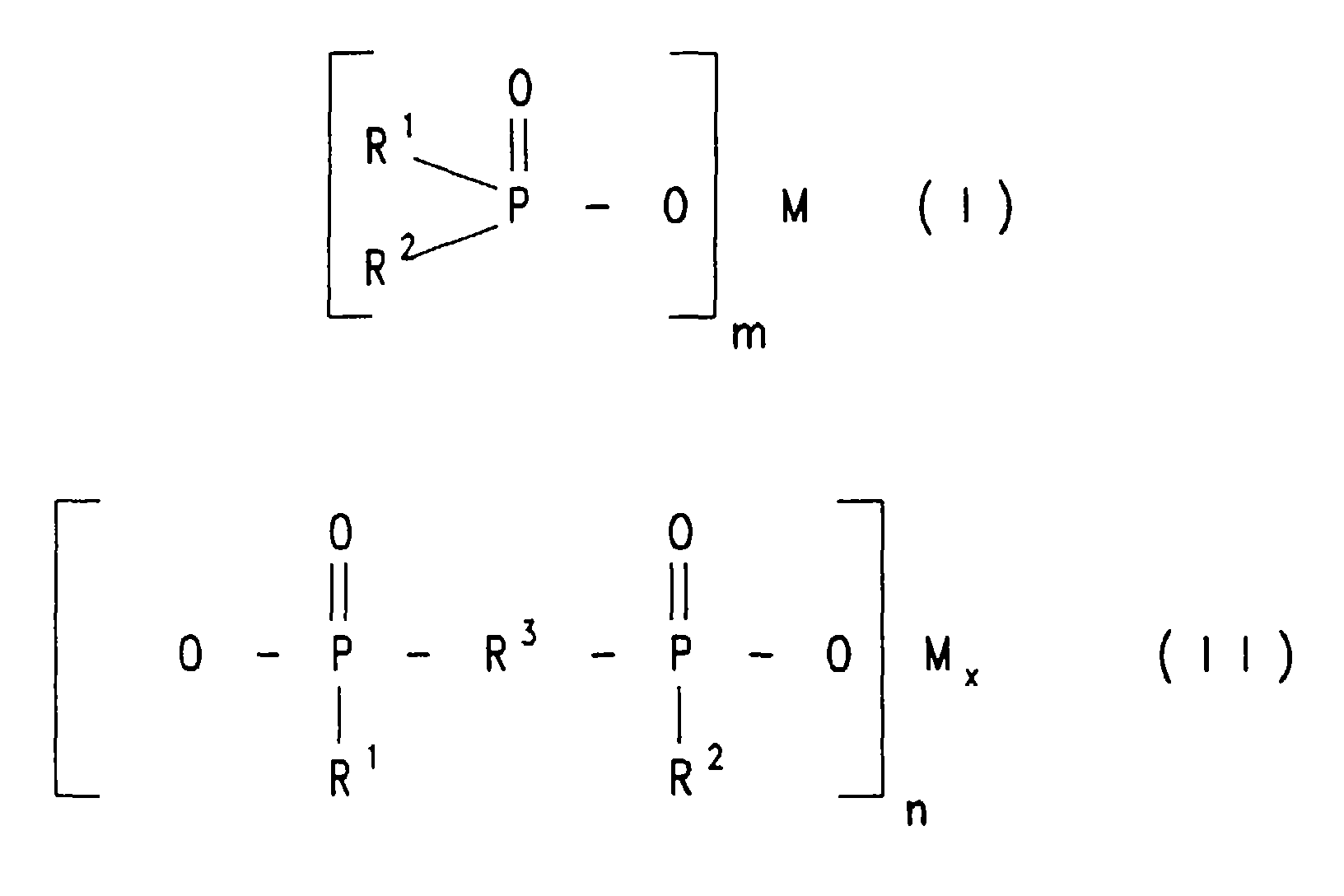
- R1, R2
- C1-C16-Alkyl, vorzugsweise C1-C8-Alkyl, linear oder verzweigt, z.B. Methyl, Ethyl, n-Propyl, iso-Propyl, n-Butyl, tert.-Butyl, n-Pentyl, n-Octyl, Phenyl;
- R3
- C1-C10-Alkylen, linear oder verzweigt, z.B. Methylen, Ethylen, n-Propylen, iso-Propylen, n-Butylen, tert.-Butylen, n-Pentylen, n-Octylen, n-Dodecylen;
Arylen, z.B. Phenylen, Naphthylen;
Alkylarylen, z.B. Methyl-phenylen, Ethyl-phenylen, tert.-Butyl-phenylen, Methyl-naphthylen, Ethyl-naphthylen, tert.-Butyl-naphthylen;
Arylalkylen, z.B. Phenyl-methylen, Phenyl-ethylen, Phenyl-propylen, Phenyl-butylen; - M
- Calcium-, Aluminium-Ionen;
- m
- 2 oder 3;
- n
- 1 oder 3;
- x
- 1 oder 2
- Polyester sind Polymere, die wiederholende, über eine Estergruppe verbundene Einheiten in der Polymerkette enthalten. Polyester, die erfindungsgemäß eingesetzt werden können, sind beispielsweise in "Ullmann's encyclopedia of industrial chemistry, ed. Barbara Elvers, Vol. 21 A, Kapitel 'Polyesters' (S. 227-251), VCH, Weinheim-Basel-Cambridge-New York 1992" beschrieben, worauf Bezug genommen wird. Polyester werden im folgenden auch als Polymere bezeichnet.
- Die Formteile weisen eine gute Kriechstromfestigkeit (höherem CTI) auf und eignen sich daher besonders für folgende Anwendungen:
- Elektrische Bauteile, wie Spulenkörper, Transformatoren, Relais, Schalter, Steckverbindung, Motoren und Motorenteile (Rotoren, Lagerschilde etc.), dreidimensionale Teile mit integrierten Leiterstrukturen ("Molded Interconnection Devices" = MID), Sockel (z.B. SIMM-Sockel);
mechanische Bauteile in Elektro- und Haushaltsgeräten, z. B. Zahnräder, Hebel, Nockenwellen, Abstandhalter, Scharniere, Gleitlager;
Gehäuse, Abdeckungen und Ummantelungen von elektrischen Bauteilen und Geräten, z. B. Kondensatorgehäuse, Relaisgehäuse, Kondensatordeckel, Kabelummantelungen. - Die Formteile lassen sich vorzugsweise durch Spritzgießen herstellen, zum Teil werden sie aber auch durch Extrudieren oder Pressen gefertigt.
- Die Phosphinate, die in wäßrigem Medium hergestellt werden, sind im wesentlichen monomere Verbindungen. In Abhängigkeit von den Reaktionsbedingungen können unter Umständen auch polymere Phosphinsäuresalze entstehen.
- Geeignete Phosphinsäuren als Bestandteil der Phosphinate sind beispielsweise: Isobutyl-methyl-phosphinsäure, Octyl-methylphosphinsäure, Dimethylphosphinsäure, Ethyl-methylphosphinsäure, Diethylphosphinsäure, Methyl-n-propyl-phosphinsäure, Methan-1,2-di(methylphosphinsäure), Ethan-1,2-(dimethylphosphinsäure), Hexan-1,6-di(methylphosphinsäure), Benzol-1,4-(dimethylphosphinsäure), Methyl-phenyl-phosphinsäure, Diphenylphosphinsäure.
- Die Phosphinate können nach bekannten Methoden hergestellt werden. Die Phosphinsäuren werden dabei in wäßriger Lösung mit Metallcarbonaten, Metallhydroxiden oder Metalloxiden der betreffenden Metalle umgesetzt.
- Die Menge des den Polymeren zuzusetzenden Phosphinates kann innerhalb weiter Grenzen variieren. Im allgemeinen verwendet man 5 bis 35 Gew.-%, bezogen auf das Polymer, bevorzugt 10 bis 25 Gew.-%, insbesondere 15 bis 20 Gew.-% des Phosphinsäuresalzes. Die optimale Menge des Phosphinates hängt von der Natur des Polymeren und der Art des eingesetzten Phosphinates ab und kann durch Versuche leicht bestimmt werden.
- Die Phosphinate können je nach Art des verwendeten Polymeren und der gewünschten Eigenschaften in verschiedener physikalischer Form angewendet werden. So können die Phosphinate z. B. zur Erzielung einer besseren Dispersion im Polymeren zu einer feinteiligen Form vermahlen werden. Falls erwünscht können auch Gemische verschiedener Phosphinate eingesetzt werden.
- Die Phosphinate sind im allgemeinen thermisch stabil, zersetzen die Polymeren weder bei der Verarbeitung noch beeinflußen sie den Herstellprozess der Polyesterformmasse. Die Phosphinate sind unter Herstellungs- und Verarbeitungsbedingungen für Polymere nicht flüchtig.
- Das Phosphinat kann in das Polymer eingearbeitet werden, indem beides vermischt und anschließend in einem Compoundieraggregat (z. B. Zweischneckenextruder) das Polymer aufgeschmolzen und das Phosphinsäuresalz in der Polymerschmelze homogenisiert wird. Die Schmelze kann als Strang abgezogen, gekühlt und granuliert werden. Das Phosphinsäuresalz kann auch direkt in das Compoundieraggregat dosiert werden.
- Es ist ebenso möglich, die Phosphinate einem fertigen Polyestergranulat beizumischen und direkt auf einer Spritzgießmaschine zu verarbeiten oder vorher in einem Extruder aufzuschmelzen, zu granulieren und nach einem Trocknungsprozeß zu verarbeiten.
- Die Phosphinate können auch während des Herstellprozesses des Polyesters zugegeben werden.
- Die Polyesterformmassen können außer den Phosphinaten Füllstoffe (zum Beispiel Talkum, Glimmer, Wollastonit, Kreide, Glaskugeln), Verstärkungsstoffe (wie Glasfasern, Glasflocken, mineralische Fasern, Kohlenstoffaser), Ruß, Farbstoffe, Pigmente, Stabilisatoren, UV-Stabilisatoren, Gleit- und Entformungshilfsmittel, Nukleierungsmittel, Antistatika, Weichmacher oder sonstige Additive enthalten.
- Besonders bevorzugt werden Formteile aus Formmassen, die Polyester, ein Phosphinat und Glasfaser enthalten. Formteile aus solchen Formmassen zeigen besonders günstige flammhemmende Eigenschaften.
- 1630 g (15,1 Mol) Ethyl-methylphosphinsäure werden in 3 l Wasser gelöst und 422,8 g (7,55 Mol) Calciumoxid (ungelöschter Kalk) portionsweise unter lebhaftem Rühren eingetragen in 1,5 Stunden, die Temperatur steigt auf 75°C. Dann wird weiter Calciumoxid eingetragen, bis eine in die Lösung eingeführte pH-Elektrode pH = 7 anzeigt. Nun wird etwas Aktivkohle zugegeben und 1,5 Stunden am Rückfluß gerührt und dann filtriert. Das Filtrat wird zur Trockene eingedampft und bei 120°C bis zu Gewichtskonstanz im Vakuum-Trockenschrank getrocknet. Man erhält 1920 g eines weißen Pulvers, das bis 300°C nicht schmilzt. Ausbeute 100 % der Theorie.
- 2106 g (19,5 Mol) Ethyl-methylphosphinsäure werden in 6,5 l Wasser gelöst und 507 g (6,5 Mol) Aluminiumhydroxid unter lebhaftem Rühren zugegeben, dabei wird auf 85°C erwärmt. Insgesamt wird 65 Stunden bei 80 - 90°C gerührt, dann wird auf 60°C abgekühlt und abgesaugt. Man erhält nach Trocknung im Vakuum-Trockenschrank bei 120°C bis zur Gewichtskonstanz 2140 g eines feinkörnigen Pulvers, das bis 300°C nicht schmilzt. Ausbeute: 95 % der Theorie.
- 325,5 g (1,75 Mol) Ethan-1,2-bismethylphosphinsäure werden in 500 ml Wasser gelöst und 129,5 g (1,75 Mol) Calciumhydroxid portionsweise unter lebhaftem Rühren in einer Stunde eingetragen. Dann wird einige Stunden bei 90 bis 95°C gerührt, abgekühlt und abgesaugt. Man erhält 335 g nach Trocknung im Vakuum-Trockenschrank bei 150°C. Das Produkt schmilzt bis 380°C nicht. Ausbeute: 85 % der Theorie.
- 334,8 g (1,8 Mol) Ethan-1,2-bismethylphosphinsäure werden in 600 ml Wasser gelöst und 93,6 g (1,2 Mol) Aluminiumhydroxid portionsweise unter lebhaftem Rühren in einer Stunde eingetragen. Dann wird 24 Stunden unter Rückfluß gehalten und anschließend heiß abgesaugt und mit Wasser gewaschen. Man erhält nach Trocknung 364 g eines weißen Pulvers, das bis 380°C nicht schmilzt. Ausbeute: 100 % der Theorie.
- 366 g (3,0 Mol) Methyl-propylphosphinsäure werden in 600 ml Wasser gelöst und 84 g (1,5 Mol) Calciumoxid portionsweise unter lebhaftem Rühren eingetragen, dabei steigt die Temperatur auf 65°C. Nun wird bei dieser Temperatur gehalten, bis eine klare Lösung entsteht. Nun wird zur Trockene im Vakuum eingedampft. Man erhält nach Trocknung des Rückstandes bei 120°C im Vakuum-Trockenschrank 364 g. Ausbeute: ca. 85 % der Theorie.
- 115 g (0,943 Mol) Methyl-propylphosphinsäure werden in 310 g Wasser gelöst und 24,5 g (0,314 Mol) Aluminiumhydroxyd zugegeben. Dann wird 23 Stunden unter Rühren bei 98°C gehalten. Anschliessend wird abgesaugt und im Vakuumtrockenschrank getrocknet. Man erhält 113 g eines weißen Pulvers, das bis 380°C nicht schmilzt. Ausbeute: 90 % der Theorie.
- 115,2 g (0,6 Mol) Methyl-octylphospinsäure werden mit 250 ml Wasser auf 60°C erhitzt. Nun werden 15,6 g (0,2 Mol) Aluminiumhydroxyd zugegeben und auf 80°C erwärmt bei ständigem Rühren. Insgesamt wird der Ansatz bei 80 bis 90°C 15 Stunden gerührt, dann wird abgesaugt. Nach dem Trocknen erhält man 115 g eines weißen Pulvers, das bis 360°C nicht schmilzt. Ausbeute: 96 % der Theorie.
- Die phosphorhaltige Verbindung wurde mit dem Polymeren vermischt und auf einem handelsüblichen Zweiwellen-Compounder eingearbeitet. Bei glaserfaserverstärkten Einstellungen wurden für Polyester handelsübliche Glasfasern in die Schmelze dosiert. Die Vergleichsproben 3 und 4 mit bromhaltigen Flammschutzkomponenten wurden auf dem gleichen Wege hergestellt.
- Die Massetemperaturen bei der Compoundierung betrugen ca. 250°C.
- Die Probekörper wurden auf einer Spritzgießmaschine nach ISO 7792-2 hergestellt. Verwendet wurden Vielzweckprobekörper nach ISO 3167.
- Folgende Proben wurden hergestellt und geprüft:
- 1. Polybutylenterephthalat, unverstärkt mit 15 % MEP-Al-Salz
- 2. Polybutylenterephthalat, verstärkt mit 30 % Glasfasern, mit 20 % MEP-Al-Salz
- 3. Polybutylenterephthalat, unverstärkt mit 18 % bromhaltige Flammschutzkomponenten (Vergleichsbeispiel)
- 4. Polybutylenterephtalat, verstärkt mit 30 % Glasfasern, mit 13 % bromhaltige Flammschutzkomponenten (Vergleichsbeispiel)
- MEP-Al-Salz: Aluminiumsalz der Ethylmethylphosphinsäure
Bromhaltige Flammschutzkomponenten: bromiertes Polycarbonat (Great Lakes BC 58), Antimontrioxid im Verhältnis 2:1 - Die Ergenisse sind in der folgenden Tabelle zusammengestellt:
Probe Brandklasse UL 94, Probekörperdicke 0,8 mm Kriechwegbildung CTI IEC 112 1 V-O 525 2 V-O 500 3 V-O 225 4 V-O 225 - Die Tabelle zeigt deutlich die Überlegenheit der Einstellungen mit MEP-Al-Salz.
Claims (3)
- Formteil aus einer Polyesterformmasse, die mindestens ein Calcium- oder Aluminiumsalz von einer Phosphinsäure, Diphosphinsäure oder deren Polymere enthält.
- Formteil gemäß Anspruch 1, dadurch gekennzeichnet, daß die Polyesterformmasee mindestens ein Phosphinsäuresalze gemäß Formel (I) oder ein Diphosphinsäuresalze gemäß Formel (II) und/oder deren Polymere enthält
 R1, R2 C1-C16-Alkyl, vorzugsweise C1-C8-Alkyl, linear oder verzweigt, z.B. Methyl, Ethyl, n-Propyl, iso-Propyl, n-Butyl, tert.-Butyl, n-Pentyl, n-Octyl, Phenyl;R3 C1-C10-Alkylen, linear oder verzweigt, z.B. Methylen, Ethylen, n-Propylen, iso-Propylen, n-Butylen, tert.-Butylen, n-Pentylen, n-Octylen, n-Dodecylen;
Arylen, z.B. Phenylen, Naphthylen;
Alkylarylen, z.B. Methyl-phenylen, Ethyl-phenylen, tert.-Butyl-phenylen, Methyl-naphthylen, Ethyl-naphthylen, tert.-Butyl-naphthylen;
Arylalkylen, z.B. Phenyl-methylen, Phenyl-ethylen, Phenyl-propylen, Phenyl-butylen;M Calcium-, Aluminium-Ionen;m 2 oder 3;n 1 oder 3;x 1 oder 2bedeuten. - Verwendung einer Polyesterformmasse, die mindestens ein Calcium- oder Aluminiumsalze von einer Phosphin-, Diphosphinsäure oder deren Polymere enthält, zur Herstellung von elektronischen oder elektrischen Bauteilen, insbesondere Spulenkörper, Transformatoren, Relais, Schalter, Steckverbindungen, Motoren und Motorenteile), dreidimensionale Teile mit integrierten Leiterstrukturen, Sockel; mechanische Bauteile in Elektro- und Haushaltsgeräten, insbesondere Zahnräder, Hebel, Nockenwellen, Abstandhalter, Scharniere, Gleitlager; Gehäuse, Abdeckungen und Ummantelungen von elektrischen Bauteilen und Geräten, insbesondere Kondensatorgehäuse, Relaisgehäuse, Kondensatordeckel, Kabelummantelungen.
Applications Claiming Priority (2)
| Application Number | Priority Date | Filing Date | Title |
|---|---|---|---|
| DE19608008 | 1996-03-04 | ||
| DE19608008A DE19608008A1 (de) | 1996-03-04 | 1996-03-04 | Formteile aus schwerentflammbarer Polyesterformmasse |
Publications (2)
| Publication Number | Publication Date |
|---|---|
| EP0794220A1 true EP0794220A1 (de) | 1997-09-10 |
| EP0794220B1 EP0794220B1 (de) | 2002-05-29 |
Family
ID=7786991
Family Applications (1)
| Application Number | Title | Priority Date | Filing Date |
|---|---|---|---|
| EP97102609A Expired - Lifetime EP0794220B1 (de) | 1996-03-04 | 1997-02-19 | Erhöhung der Kriechstromfestigkeit in Formteilen aus schwerentflammbaren Polyesterformmassen |
Country Status (3)
| Country | Link |
|---|---|
| EP (1) | EP0794220B1 (de) |
| JP (2) | JPH09241395A (de) |
| DE (2) | DE19608008A1 (de) |
Cited By (1)
| Publication number | Priority date | Publication date | Assignee | Title |
|---|---|---|---|---|
| WO2006009983A1 (en) * | 2004-06-22 | 2006-01-26 | Supresta Llc | Phosphorus-containing flame retardant for thermoplastic polymers |
Families Citing this family (11)
| Publication number | Priority date | Publication date | Assignee | Title |
|---|---|---|---|---|
| MY117653A (en) * | 1997-06-13 | 2004-07-31 | Polyplastics Co | Flame-retardant thermoplastic polyester resin composition |
| EP1024167B1 (de) * | 1999-01-30 | 2005-12-21 | Clariant GmbH | Flammschutzmittel-Kombination für thermoplastische Polymere I |
| JP2001247751A (ja) * | 1999-12-28 | 2001-09-11 | Daicel Chem Ind Ltd | 難燃性樹脂組成物 |
| DE10002625B4 (de) * | 2000-01-22 | 2010-03-11 | E.G.O. Elektro-Gerätebau GmbH | Verfahren zur Herstellung eines Schaltgerätesockels |
| TWI278481B (en) * | 2002-04-16 | 2007-04-11 | Hitachi Chemical Co Ltd | Thermosetting resin composition, prepreg and laminate using the same |
| DE10331887A1 (de) * | 2003-07-14 | 2005-02-17 | Clariant Gmbh | Flammschutzmittel-Zubereitung |
| WO2006090751A1 (ja) * | 2005-02-23 | 2006-08-31 | Polyplastics Co., Ltd. | 難燃性樹脂組成物 |
| JP4870412B2 (ja) * | 2005-10-31 | 2012-02-08 | 小松精練株式会社 | 繊維・ウレタン樹脂積層物およびその製造方法 |
| JP2008019400A (ja) * | 2006-07-14 | 2008-01-31 | Wintech Polymer Ltd | 難燃性ポリブチレンテレフタレート樹脂組成物 |
| JP5059706B2 (ja) * | 2008-07-15 | 2012-10-31 | 三菱エンジニアリングプラスチックス株式会社 | 難燃性熱可塑性樹脂組成物 |
| DE102021124359A1 (de) | 2021-09-21 | 2023-03-23 | Lisa Dräxlmaier GmbH | Aufnahmeanordnung und verfahren zur aufnahme von einer elektrischen komponente und verfahren |
Citations (5)
| Publication number | Priority date | Publication date | Assignee | Title |
|---|---|---|---|---|
| US3594347A (en) * | 1968-09-05 | 1971-07-20 | Allied Chem | Polyesters containing aryl phosphinates |
| DE2252258A1 (de) * | 1972-10-25 | 1974-05-09 | Hoechst Ag | Schwerentflammbare thermoplastische polyester |
| GB1466154A (en) * | 1974-03-27 | 1977-03-02 | Teijin Ltd | Polyester compositions |
| DE2915116A1 (de) * | 1978-04-13 | 1979-10-25 | Pennwalt Corp | Flammwidrig gemachte polyester- und polyamidharze |
| EP0699708A2 (de) * | 1994-08-31 | 1996-03-06 | Hoechst Aktiengesellschaft | Flammengeschützte Polyesterformmassen |
Family Cites Families (2)
| Publication number | Priority date | Publication date | Assignee | Title |
|---|---|---|---|---|
| DE2447727A1 (de) * | 1974-10-07 | 1976-04-08 | Hoechst Ag | Schwerentflammbare polyamidformmassen |
| JPH0723448B2 (ja) * | 1986-10-03 | 1995-03-15 | 旭化成工業株式会社 | ポリアミド樹脂組成物 |
-
1996
- 1996-03-04 DE DE19608008A patent/DE19608008A1/de not_active Withdrawn
-
1997
- 1997-02-19 DE DE59707347T patent/DE59707347D1/de not_active Expired - Lifetime
- 1997-02-19 EP EP97102609A patent/EP0794220B1/de not_active Expired - Lifetime
- 1997-03-03 JP JP9047536A patent/JPH09241395A/ja not_active Withdrawn
-
2006
- 2006-11-27 JP JP2006318562A patent/JP4875471B2/ja not_active Expired - Lifetime
Patent Citations (5)
| Publication number | Priority date | Publication date | Assignee | Title |
|---|---|---|---|---|
| US3594347A (en) * | 1968-09-05 | 1971-07-20 | Allied Chem | Polyesters containing aryl phosphinates |
| DE2252258A1 (de) * | 1972-10-25 | 1974-05-09 | Hoechst Ag | Schwerentflammbare thermoplastische polyester |
| GB1466154A (en) * | 1974-03-27 | 1977-03-02 | Teijin Ltd | Polyester compositions |
| DE2915116A1 (de) * | 1978-04-13 | 1979-10-25 | Pennwalt Corp | Flammwidrig gemachte polyester- und polyamidharze |
| EP0699708A2 (de) * | 1994-08-31 | 1996-03-06 | Hoechst Aktiengesellschaft | Flammengeschützte Polyesterformmassen |
Cited By (3)
| Publication number | Priority date | Publication date | Assignee | Title |
|---|---|---|---|---|
| WO2006009983A1 (en) * | 2004-06-22 | 2006-01-26 | Supresta Llc | Phosphorus-containing flame retardant for thermoplastic polymers |
| US7807737B2 (en) | 2004-06-22 | 2010-10-05 | Icl-Ip America Inc. | Phosphorus-containing flame retardant for thermoplastic polymers |
| CN101010372B (zh) * | 2004-06-22 | 2012-10-03 | 苏普雷斯塔有限责任公司 | 用于热塑性聚合物的含磷阻燃剂 |
Also Published As
| Publication number | Publication date |
|---|---|
| JP4875471B2 (ja) | 2012-02-15 |
| JP2007113015A (ja) | 2007-05-10 |
| DE19608008A1 (de) | 1997-09-11 |
| EP0794220B1 (de) | 2002-05-29 |
| DE59707347D1 (de) | 2002-07-04 |
| JPH09241395A (ja) | 1997-09-16 |
Similar Documents
| Publication | Publication Date | Title |
|---|---|---|
| EP0792912B1 (de) | Schwerentflammbare Polyamidformmassen | |
| EP0699708B1 (de) | Flammgeschützte Polyesterformmassen | |
| EP0794189B1 (de) | Salze von phosphonigen Säuren und deren Verwendung als Flammschutzmittel in Kunststoffen | |
| DE69818611T2 (de) | Flammhemmende Thermoplaste | |
| EP0896023B1 (de) | Synergistiche Flammschutzmittel-Kombination für Polymere | |
| EP1396524B1 (de) | Oberflächenmodifizierte Phosphinsäuresalze | |
| EP0794191B1 (de) | Salze von 1-Hydroxy-dihydrophospholoxiden und 1-Hydroxy-phospholanoxiden und ihre Verwendung als Flammschutzmittel | |
| EP1024167A1 (de) | Flammschutzmittel-Kombination für thermoplastische Polymere I | |
| EP0794220B1 (de) | Erhöhung der Kriechstromfestigkeit in Formteilen aus schwerentflammbaren Polyesterformmassen | |
| EP1479718A2 (de) | Titanhaltige Phosphinat-Flammschutzmittel | |
| DE19960671A1 (de) | Flammschutzmittel-Kombination für thermoplastische Polymere I | |
| DE112014002978B4 (de) | Schwer entflammbare thermoplastische Harzmischung mit geringer Korrosionswirkung | |
| EP0970093B1 (de) | Aluminiumsalze von alkylhydroxymethylphosphinsäuren | |
| EP0551850A1 (de) | Flammgeschützte thermoplastische Polyesterformmasse und ihre Verwendung | |
| EP0971936B1 (de) | Aluminiumsalze von alkyl-1-alkoxyethylphosphinsäuren | |
| EP0031792B1 (de) | Polyesterformmassen verminderter Korrosionswirkung gegenüber Metallen und deren Verwendung |
Legal Events
| Date | Code | Title | Description |
|---|---|---|---|
| PUAI | Public reference made under article 153(3) epc to a published international application that has entered the european phase |
Free format text: ORIGINAL CODE: 0009012 |
|
| AK | Designated contracting states |
Kind code of ref document: A1 Designated state(s): DE FR GB |
|
| RAP1 | Party data changed (applicant data changed or rights of an application transferred) |
Owner name: TICONA GMBH |
|
| 17P | Request for examination filed |
Effective date: 19980310 |
|
| RAP1 | Party data changed (applicant data changed or rights of an application transferred) |
Owner name: TICONA GMBH |
|
| 17Q | First examination report despatched |
Effective date: 19990118 |
|
| RBV | Designated contracting states (corrected) |
Designated state(s): DE FR GB NL |
|
| RTI1 | Title (correction) |
Free format text: PROCESS FOR INCREASING THE TRACKING INDEX IN MOULDINGS OF FLAME-RETARDANT POLYESTERS |
|
| RBV | Designated contracting states (corrected) |
Designated state(s): DE FR GB |
|
| RTI1 | Title (correction) |
Free format text: INCREASING THE TRACKING INDEX IN MOULDINGS OF FLAME-RETARDANT POLYESTERS |
|
| GRAG | Despatch of communication of intention to grant |
Free format text: ORIGINAL CODE: EPIDOS AGRA |
|
| GRAG | Despatch of communication of intention to grant |
Free format text: ORIGINAL CODE: EPIDOS AGRA |
|
| GRAH | Despatch of communication of intention to grant a patent |
Free format text: ORIGINAL CODE: EPIDOS IGRA |
|
| GRAH | Despatch of communication of intention to grant a patent |
Free format text: ORIGINAL CODE: EPIDOS IGRA |
|
| GRAA | (expected) grant |
Free format text: ORIGINAL CODE: 0009210 |
|
| AK | Designated contracting states |
Kind code of ref document: B1 Designated state(s): DE FR GB |
|
| REG | Reference to a national code |
Ref country code: GB Ref legal event code: FG4D Free format text: NOT ENGLISH |
|
| REF | Corresponds to: |
Ref document number: 59707347 Country of ref document: DE Date of ref document: 20020704 |
|
| GBT | Gb: translation of ep patent filed (gb section 77(6)(a)/1977) |
Effective date: 20020720 |
|
| RAP2 | Party data changed (patent owner data changed or rights of a patent transferred) |
Owner name: TICONA GMBH |
|
| ET | Fr: translation filed | ||
| PLBE | No opposition filed within time limit |
Free format text: ORIGINAL CODE: 0009261 |
|
| STAA | Information on the status of an ep patent application or granted ep patent |
Free format text: STATUS: NO OPPOSITION FILED WITHIN TIME LIMIT |
|
| 26N | No opposition filed |
Effective date: 20030303 |
|
| REG | Reference to a national code |
Ref country code: FR Ref legal event code: PLFP Year of fee payment: 20 |
|
| PGFP | Annual fee paid to national office [announced via postgrant information from national office to epo] |
Ref country code: DE Payment date: 20160216 Year of fee payment: 20 |
|
| REG | Reference to a national code |
Ref country code: DE Ref legal event code: R081 Ref document number: 59707347 Country of ref document: DE Owner name: CELANESE SALES GERMANY GMBH, DE Free format text: FORMER OWNER: TICONA GMBH, 65451 KELSTERBACH, DE |
|
| PGFP | Annual fee paid to national office [announced via postgrant information from national office to epo] |
Ref country code: GB Payment date: 20160217 Year of fee payment: 20 Ref country code: FR Payment date: 20160108 Year of fee payment: 20 |
|
| REG | Reference to a national code |
Ref country code: GB Ref legal event code: 732E Free format text: REGISTERED BETWEEN 20160616 AND 20160622 |
|
| REG | Reference to a national code |
Ref country code: FR Ref legal event code: TP Owner name: CELANESE SALES GERMANY GMBH, DE Effective date: 20160818 Ref country code: FR Ref legal event code: CD Owner name: CELANESE SALES GERMANY GMBH, DE Effective date: 20160818 Ref country code: FR Ref legal event code: CA Effective date: 20160818 |
|
| REG | Reference to a national code |
Ref country code: DE Ref legal event code: R071 Ref document number: 59707347 Country of ref document: DE |
|
| REG | Reference to a national code |
Ref country code: GB Ref legal event code: PE20 Expiry date: 20170218 |
|
| PG25 | Lapsed in a contracting state [announced via postgrant information from national office to epo] |
Ref country code: GB Free format text: LAPSE BECAUSE OF EXPIRATION OF PROTECTION Effective date: 20170218 |