EP0794505A2 - Procédure et dispositif basé sur un logiciel pour l'amélioration d'une image à tonalités de gris - Google Patents
Procédure et dispositif basé sur un logiciel pour l'amélioration d'une image à tonalités de gris Download PDFInfo
- Publication number
- EP0794505A2 EP0794505A2 EP96116701A EP96116701A EP0794505A2 EP 0794505 A2 EP0794505 A2 EP 0794505A2 EP 96116701 A EP96116701 A EP 96116701A EP 96116701 A EP96116701 A EP 96116701A EP 0794505 A2 EP0794505 A2 EP 0794505A2
- Authority
- EP
- European Patent Office
- Prior art keywords
- template
- pixel
- image
- pixel value
- value
- Prior art date
- Legal status (The legal status is an assumption and is not a legal conclusion. Google has not performed a legal analysis and makes no representation as to the accuracy of the status listed.)
- Granted
Links
Images



Classifications
-
- G—PHYSICS
- G06—COMPUTING OR CALCULATING; COUNTING
- G06K—GRAPHICAL DATA READING; PRESENTATION OF DATA; RECORD CARRIERS; HANDLING RECORD CARRIERS
- G06K15/00—Arrangements for producing a permanent visual presentation of the output data, e.g. computer output printers
- G06K15/02—Arrangements for producing a permanent visual presentation of the output data, e.g. computer output printers using printers
-
- G—PHYSICS
- G06—COMPUTING OR CALCULATING; COUNTING
- G06K—GRAPHICAL DATA READING; PRESENTATION OF DATA; RECORD CARRIERS; HANDLING RECORD CARRIERS
- G06K15/00—Arrangements for producing a permanent visual presentation of the output data, e.g. computer output printers
- G06K15/02—Arrangements for producing a permanent visual presentation of the output data, e.g. computer output printers using printers
- G06K15/12—Arrangements for producing a permanent visual presentation of the output data, e.g. computer output printers using printers by photographic printing, e.g. by laser printers
- G06K15/128—Arrangements for producing a permanent visual presentation of the output data, e.g. computer output printers using printers by photographic printing, e.g. by laser printers generating or processing printable items, e.g. characters
-
- G—PHYSICS
- G06—COMPUTING OR CALCULATING; COUNTING
- G06K—GRAPHICAL DATA READING; PRESENTATION OF DATA; RECORD CARRIERS; HANDLING RECORD CARRIERS
- G06K2215/00—Arrangements for producing a permanent visual presentation of the output data
- G06K2215/0002—Handling the output data
- G06K2215/0062—Handling the output data combining generic and host data, e.g. filling a raster
- G06K2215/0071—Post-treatment of the composed image, e.g. compression, rotation
Definitions
- This invention relates to print image enhancement techniques and, more specifically, to a method and apparatus for creating a gray level representation of a binary value dot matrix image.
- a gray level image comprises a multiplicity of pixels, each pixel represented by a digital value indicative of a gray level or a color value. Each gray level corresponds to a color tone between 0% and 100%.
- the gray level values are converted to binary pixel values through use of dither procedures or other approximation methods in an attempt to faithfully reproduce the gray level image.
- the prior art binary laser printer has been succeeded by gray level laser printers which modulate a laser beam intensity or duration to achieve a variation in charge state at each pixel location on a photoconductor which, when subsequently toned, produces a highly faithful gray level reproduction.
- Edge definition is a problem in binary pixel images due to the stepped pixel arrangement employed to represent boundaries of characters and images.
- the prior art has employed a procedure, generally called "Resolution Enhancement technology,” (REt) to smooth edges by modulating pixels in accordance with comparisons made to pre-stored template arrangements.
- REt Resolution Enhancement technology
- U. S. Patents 5,005,139 and 4,847,641 both to C. C. Tung and assigned to the same Assignee as this application, describe a hardware-based method for accomplishing such REt edge enhancement.
- the disclosure of the Tung patents is incorporated herein by reference. Briefly stated, the Tung procedure logically tiles "windows" over successive bit patterns of an image, each image pixel window comprising a center pixel and surrounding neighbor pixels. Each image pixel window is thus a pattern of pixels from the original binary image.
- Each image pixel window is compared, in parallel, against hundreds of templates, each template defining an expected edge pixel arrangement which can be improved by modification of the central pixel in the image pixel window.
- Each template is associated with a correction pixel value for the central pixel of an image pixel window.
- the central pixel and neighbor pixels within the image pixel window are compared against the templates, in parallel, via a gate array so as to determine in one or very few clock cycles which template, if any, matches the pixel arrangement within the image pixel window. If a template is found to match the image pixel window pattern, the associated correction pixel value is output and is substituted for the central pixel in the image pixel window.
- the image pixel window is stepped across the image, corrections are made to any pixel arrangement therein which matches a template so as to improve edge presentation of the binary image. REt has proved successful in improving print quality of binary pixel value images.
- a scalable font includes characters that are defined as a series of contours (i.e., functions) that, when provided with a desired point size, produce a precise character of the desired shape and point size.
- Bitmapped fonts differ from a scalable font in that they cannot be changed in point size. While bitmapped font characters are slowly becoming obsolete, many host processors include software (and resident fonts) which are fed to a connected printer in bitmapped form. Thus, even the new gray level laser printers must continue to support both bitmapped and scalable fonts.
- Laser printers that utilize gray level pixel values may employ four, six or eight bits to define each pixel's gray value. Those bits are generally fed directly to the print engine and bypass the hardware REt module, which is retained to process bitmapped font characters. Inclusion of a REt module adds expense to the laser printer. To avoid such added expense, software or firmware-implemented edge smoothing has been considered. However, to replicate the hardware-based Ret procedure requires that thousands of values be serially compared to every pixel of a bitmapped image. Clearly, this slows the operation of the printer and is not user-acceptable.
- a software/firmware based method for determining gray level values to be assigned to a binary pixel image initially creates a linked list of templates, each template associated with a gray level value to be assigned to a binary image pixel.
- Each template may include a central pixel value and plural neighbor pixel values or just plural neighbor values.
- each template is a listing of entries of template pixel values that are generally arranged in increasing concentric circles about the central pixel value.
- Each template entry includes a field for a template pixel value, a field for a template pixel address and a link field for a next template entry, in the event of a non-match determination between the associated template pixel value and an image pixel value.
- the method selects an image pixel window from the binary image and compares a central image pixel in the window with a logically, correspondingly located template pixel value. If a match is found, a next image pixel is compared against a next template entry to determine if a match occurs. This procedure continues, assuming matches are found, until all entries in the template have been tested and found to match, in which case, the central pixel of the image pixel window is changed in accordance with the gray level value associated with the matching template. If, at any time, a non-match occurs, the procedure moves to a linked template entry and the comparison procedure continues in another template.
- the invention enables a binary search to be executed which identifies a matching template (if any) after considering, on the average, between 5 to 10 entries.
- Fig. 1 is a block diagram of a laser printer particularly adapted to implementing the invention.
- Fig. 2 is a schematic illustrating a prior art resolution enhancement data flow.
- Fig. 3 is a schematic illustrating the data flow that is implemented by the system of Fig. 1.
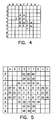
- Fig. 4 is a schematic showing of an edge enhancement template.
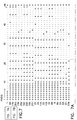
- Fig. 5 is a schematic of an edge enhancement template, showing the sequence in which the template pixels are compared with pixels in an image pixel window.
- Figs. 6a-6d illustrate representative edge enhancement templates.
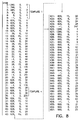
- Fig. 7 is a listing of templates, ordered in accord with numbers of white and black dots.
- Fig. 8 is a linked search list of the templates of Fig. 7.
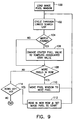
- Fig. 9 is a flow diagram illustrating the overall operation of the invention.
- laser printer 10 includes a central processing unit (CPU) 12, a print engine 14 and a bus 16 which connects the various modules within printer 10.
- Printer 10 receives bitmapped font characters from a host processor via input/output (I/O) module 18.
- Printer 10 may also receive, or have locally stored, scalable font characters. However, as this invention is particularly directed to the handling of bitmapped characters, further description will not be given of the handling of scalable font characters.
- a bitmapped, binary pixel font image is initially buffered in a random access memory (RAM) 20.
- RAM random access memory
- the host processor has downloaded a full character font of bitmapped characters which are stored, temporarily, in RAM area 20.
- a further RAM area 22 is reserved to store gray level image data after resolution enhancement has been accomplished.
- each pixel of the gray level image comprises a four bit gray value.
- the gray level representation can be chosen to be any number of bits, depending upon the number of desired gray levels to be reproduced.
- a read-only memory (ROM) 24 includes a linked list of REt templates; a REt firmware procedure; and a listing of gray values that are associated with each template in the linked list.
- Fig. 2 illustrates data flow used by the hardware-based REt technique described in the referenced Tung patents.
- a one-bit per pixel character is received from a host processor and is inserted into a one-bit per pixel image plane 32 in accordance with image command data.
- image plane 32 is passed to a hardware REt module 34 which performs edge smoothing in accordance with a parallel template comparison procedure.
- REt module 34 outputs, in dependence upon the template comparison action, a corresponding four-bit gray level value to substitute for the input single bit pixel value.
- the four-bit value is then fed to a laser modulator 36 and the print action occurs. If no match occurs, the image pixel value remains as is (i.e., either all white or all black).
- a one-bit per pixel (i.e., bitmapped) character 38 is downloaded from the host processor and is stored in RAM area 20 (Fig. 1). Thereafter, the bitmapped character is subjected to a firmware-controlled REt procedure 40 in accordance with code stored in ROM 24.
- the output of the REt procedure 40 is a four-bit per pixel, enhanced-edge character which is stored as part of font 42. Thereafter, the edge enhanced character is selected in accordance with required image data and is placed in a four-bit per pixel image plane 44 for application to a laser modulator 46.
- a central pixel 5E (defined by the intersecting coordinates) is the central pixel of the template and is where a comparison action commences.
- a capital letter resident at a pixel position means that a black dot should be matched and a lower case letter means that a white dot should be matched. No letter means that the pixel position is a "don't care”.
- pixel position 5E includes an "e" which means that further comparisons will be carried with respect to a corresponding pixel in an image pixel window only if that pixel is a white dot.
- a starting template is "tiled” over a corresponding "window” of image pixels and a comparison is made between the logically correspondingly positioned pixel values.
- logical correspondence refers to a positional correspondence which is present from the viewer's point of view, but which does not, per se, exist during processing. Nevertheless, it is useful in enabling an understanding of the invention. Further, one skilled in the art can derive the necessary timing relationships to enable operation of the invention, given the "logical correspondence" description.
- the next pixel of the template to be compared to the corresponding window pixel is the one positioned immediately to the right (i.e., 5F).
- a template which illustrates the sequence of comparisons that occurs subsequent to a central pixel comparison.
- the sequence of comparisons is in the sequence indicated by the increasing values in the template pixel positions.
- comparisons 2, 3, 4 and 5 form a smallest possible concentric circle around the central pixel.
- pixel sites 6, 7, 8 and 9 are compared, and comprise pixels centered on a circle that is next larger in size and concentric with the central pixel.
- the arrangement of sequential comparisons of template pixel positions with correspondingly positioned image pixels has been chosen because, in many if not most of the templates, the positions of interest are clustered near the center of the template. Further, pixel position near the edges of the template are generally don't cares which are skipped.
- the comparison procedure moves in a quasi-spiral fashion, starting with the central pixel and moving out to pixels positioned on succeedingly larger concentric circles about the central pixel.
- the search procedure of the invention enables implementation of a highly efficient binary search action which rapidly determines whether or not a template matches an image pixel window. If the template matches, a value is output which is indicative of a pulse width that is to be output by the printer's laser to provide a proper gray level substitute pixel in place of the central binary image pixel.
- a comparison result can cause an output of one of six pulse-widths to control the modulation of the printer laser.
- Table 1 below illustrates the code value N which is output in accordance with a template compare.
- Table 1 N Pulse-Width (PW) 0 White dot 1 PW level 1 (smallest black dot) 2 PW level 2 3 PW level 3 4 PW level 4 5 PW level 5 (full black dot) -1 No match -- do not modify PW
- FIGs. 6a-6d each thereof shows a different template which provides a code output indicative of the pulse-width modulation -- assuming a match occurs --.
- the template shown in Fig. 4 is reproduced and if a match is found of all pixels therein with corresponding pixels in an image pixel window, a code 1 (smallest black dot) is output.
- Fig. 6b illustrates a template which, if a match occurs with corresponding pixels in an image pixel window, causes a code 0 (white dot) to be output.
- the template illustrated in Fig. 6c will output a code 5 (full black dot) upon a match being found with corresponding pixels in an image pixel window.
- Fig. 6d illustrates a template which, if found to match with corresponding pixels in an image pixel window, causes output of a code 2 value.
- each code value output causes the central pixel in an image pixel window to be replaced with a gray level pixel in accordance with the code output.
- hundreds of templates are used (many of which are rotations of each other to accommodate variously oriented font characteristics) to assure appropriate edge enhancement of the binary bitmap font arrangements.
- each template is then represented as a list of black/white pixels, ordered in the spiral manner shown in Fig. 5. Accordingly, the templates are sorted with white pixels given the highest priority. All templates having n sequential white pixels, starting with the central pixel, are listed first, followed by templates having n-1 white pixels, templates having n-2 white pixels, etc.
- FIG. 7 A partial result of the template sort is shown in Fig. 7 wherein the number at the beginning of each line is the template number; a capital letter means the pixel should be checked; a small letter o or x means that a comparison has been made in a previous template and can be skipped; the letter "O” means a white pixel; and the letter "X” means a black pixel. If the comparison action reaches the letter "S”, a template has been successfully matched and the search procedure can stop. All "don't cares" (evidenced by dots) are skipped.
- Fig. 7 illustrates a portion of the beginning of the sort of templates which begin with a white pixel and a portion of the templates which begin with a black pixel.
- the linked search list includes many entries (e.g., thousands), each of which indicates a pixel comparison to be performed.
- the linked search list essentially comprises many strings of linked templates. If an indicated template pixel entry finds a no-match condition with a logically corresponding image pixel, the linked search list entry indicates which next entry in the string is to be tried. So long as matches are found, a string of linked templates in the linked search list is traversed serially until a full template is matched (at which point the relevant indication is a -1, indicating that the search is over) and that the code value associated with the matching template can be output.
- the first field in each entry of the linked search list contains the entry value to go to if the current comparison fails. For example, if a central pixel is not white, the first entry in the linked search list indicates that entry 1392 is next.
- the second field in each entry indicates whether the template pixel is white (0) or black (15). In the case of a template match, the second number is a code value from 0 to 5, indicating the pulse-width level for that pixel, as described above. If the value in the first entry column is a (-1), then a template has been successfully matched and the search can exit from the linked search list.
- the third field in each entry contains the address of the template pixel which is being compared, in this case a number from 0 to 48. In the case of a template match, the third number indicates which template is matched. This value is not used, but provides valuable statistical information for later analysis.
- each template in a string in the linked list includes only template entries for which a match has not been found in a previous compare action in the string.
- that template includes only template pixel values starting from the linked pixel value and proceeding further outward in the generally spiral manner described above.
- the linked search list enables the search to be rapidly accomplished and, in general, only an average of 5-10 entries are accessed.
- n pixels from a template are found to match with corresponding pixels from an image pixel window.
- the procedure moves down the linked search list, from entry to entry in a serial manner.
- the procedure examines the value in the first field of the entry to find an address (i.e., an entry in the linked search list) in another template where a match will be found for the n + 1st pixel - it already being known that the "another" template will have identical first n pixel values which, as stated above, are not included in the entries of the "another" template .
- the method proceeds through the linked search list until a (-1) value is found in the first field of an entry, indicating a successful template match and further providing the code value to be used to modulate the pulse width of the laser.
- the procedure accepts the existing image pixel value, i.e., either black or white.
- Fig. 9 is a logical flow diagram that describes the overall method of the invention.
- the procedure is applied to received bitmapped font data which, after processing is stored to be later used when called upon to produce documents.
- an image window of, for example, 9x9 pixels is loaded with image pixels (box 100), starting at the top of the image.
- the central pixel of the image window is compared with the first entry in the linked search list (which is the central pixel in "white area" template illustrated in Fig. 6b)(box 102). If the template pixel matches the central image pixel, the procedure moves to the next entry in the linked search list.
- the procedure moves to the linked search list entry that is indicated in the first field of the entry where the match failed. This procedure continues until a (-1) is encountered in the first field (indicating that a template match has been found) (decision box 104). At that point, the code value associated with the matching template is output so as to enable substitution of an appropriate gray level value for the central image pixel (box 106).
- the procedure skips box 106 and moves directly to consideration of remaining pixels in the row (decision box 108). If there is another image pixel in the row, the procedure moves the image pixel window to the next row (box 110) and the process is repeated until all pixels in the image have been compared. At such point, if there are no further rows of the image left (decision box 114), the procedure is at an end. If one or more rows are left, a new row is read in, the image pixel window is reset to the beginning of the row (box 112), and the procedure recycles.
- Table 2 below indicates statistics which have been accumulated when the above-noted procedure is run on a typical test page which has a high percentage of white area.
- bitmapped font cell has much less white space than an entire text image plane. In such case, statistical analysis indicates that an average of about 10 comparisons per pixel are required before it is determined whether or not a match exists. Further, once a bitmapped font character has been smoothed by this procedure, it is cached, and can be placed anywhere on the page without re-running the procedure.
Landscapes
- Engineering & Computer Science (AREA)
- Physics & Mathematics (AREA)
- General Engineering & Computer Science (AREA)
- General Physics & Mathematics (AREA)
- Theoretical Computer Science (AREA)
- Optics & Photonics (AREA)
- Facsimile Image Signal Circuits (AREA)
- Image Analysis (AREA)
- Dot-Matrix Printers And Others (AREA)
- Color, Gradation (AREA)
Applications Claiming Priority (2)
| Application Number | Priority Date | Filing Date | Title |
|---|---|---|---|
| US612377 | 1996-03-07 | ||
| US08/612,377 US5754751A (en) | 1996-03-07 | 1996-03-07 | Software-based procedure and apparatus for enhancement of a gray level image |
Publications (3)
| Publication Number | Publication Date |
|---|---|
| EP0794505A2 true EP0794505A2 (fr) | 1997-09-10 |
| EP0794505A3 EP0794505A3 (fr) | 1999-01-07 |
| EP0794505B1 EP0794505B1 (fr) | 2003-03-19 |
Family
ID=24452904
Family Applications (1)
| Application Number | Title | Priority Date | Filing Date |
|---|---|---|---|
| EP96116701A Expired - Lifetime EP0794505B1 (fr) | 1996-03-07 | 1996-10-17 | Procédure et dispositif basé sur un logiciel pour l'amélioration d'une image à tonalités de gris |
Country Status (4)
| Country | Link |
|---|---|
| US (1) | US5754751A (fr) |
| EP (1) | EP0794505B1 (fr) |
| JP (1) | JPH106561A (fr) |
| DE (1) | DE69626780T2 (fr) |
Cited By (1)
| Publication number | Priority date | Publication date | Assignee | Title |
|---|---|---|---|---|
| CN101169828B (zh) * | 2006-10-27 | 2011-11-30 | 鸿富锦精密工业(深圳)有限公司 | 同心圆智能分类系统及方法 |
Families Citing this family (4)
| Publication number | Priority date | Publication date | Assignee | Title |
|---|---|---|---|---|
| US6473524B1 (en) | 1999-04-14 | 2002-10-29 | Videk, Inc. | Optical object recognition method and system |
| JP2000343756A (ja) * | 1999-06-09 | 2000-12-12 | Sharp Corp | 画像形成装置および画像形成方法 |
| US7245779B2 (en) * | 2003-07-23 | 2007-07-17 | Marvell International Technology Ltd. | Image enhancement employing partial template matching |
| US7570835B2 (en) * | 2004-02-17 | 2009-08-04 | International Business Machines Corporation | Edge smoothing filter for character recognition |
Citations (2)
| Publication number | Priority date | Publication date | Assignee | Title |
|---|---|---|---|---|
| US4847641A (en) | 1988-08-16 | 1989-07-11 | Hewlett-Packard Company | Piece-wise print image enhancement for dot matrix printers |
| US5005139A (en) | 1988-08-16 | 1991-04-02 | Hewlett-Packard Company | Piece-wise print image enhancement for dot matrix printers |
Family Cites Families (15)
| Publication number | Priority date | Publication date | Assignee | Title |
|---|---|---|---|---|
| US3573789A (en) * | 1968-12-13 | 1971-04-06 | Ibm | Method and apparatus for increasing image resolution |
| US4032977A (en) * | 1976-06-03 | 1977-06-28 | Xerox Corporation | Gray scale interpolation technique |
| US4150400A (en) * | 1977-03-31 | 1979-04-17 | International Business Machines Corporation | Methods of a coarse-scan/fine-print character reproduction with compression |
| US4143401A (en) * | 1977-07-07 | 1979-03-06 | Westinghouse Electric Corp. | System for generating line drawing of a scanned image |
| JPS55112076A (en) * | 1979-02-22 | 1980-08-29 | Ricoh Co Ltd | Predictive restoration method for high-density picture element |
| JPS55120265A (en) * | 1979-03-07 | 1980-09-16 | Ricoh Co Ltd | Picture forecasting restoring method |
| JPS5734286A (en) * | 1980-08-11 | 1982-02-24 | Canon Inc | Information outputting device |
| US4450483A (en) * | 1981-09-02 | 1984-05-22 | Westinghouse Electric Corp. | Circuit for improving the quality of digitized line images |
| US4437122A (en) * | 1981-09-12 | 1984-03-13 | Xerox Corporation | Low resolution raster images |
| US5321430A (en) * | 1991-05-08 | 1994-06-14 | Acer Incorporated | Apparatus and method for gray and edge enhancement |
| JP3490729B2 (ja) * | 1991-12-20 | 2004-01-26 | ゼロックス・コーポレーション | 階層的テンプレート突合せによる画像の忠実性強化再生 |
| EP0569657B1 (fr) * | 1992-05-15 | 1997-09-03 | COMPUPRINT S.p.A. | Dispositif pour détection et correction d'imperfections dans des images digitalisées |
| US5479584A (en) * | 1992-08-28 | 1995-12-26 | Xerox Corporation | Enhanced fidelity reproduction of images with device independent numerical sample output |
| US5237646A (en) * | 1992-10-13 | 1993-08-17 | Hewlett-Packard Company | Pixel image enhancement employing a reduced template memory store |
| DE19502997B4 (de) * | 1994-02-01 | 2005-06-30 | Ricoh Co., Ltd. | Einrichtung und Verfahren zum Verarbeiten von Zweiton-Bilddaten |
-
1996
- 1996-03-07 US US08/612,377 patent/US5754751A/en not_active Expired - Lifetime
- 1996-10-17 EP EP96116701A patent/EP0794505B1/fr not_active Expired - Lifetime
- 1996-10-17 DE DE69626780T patent/DE69626780T2/de not_active Expired - Fee Related
-
1997
- 1997-02-28 JP JP9045761A patent/JPH106561A/ja not_active Withdrawn
Patent Citations (2)
| Publication number | Priority date | Publication date | Assignee | Title |
|---|---|---|---|---|
| US4847641A (en) | 1988-08-16 | 1989-07-11 | Hewlett-Packard Company | Piece-wise print image enhancement for dot matrix printers |
| US5005139A (en) | 1988-08-16 | 1991-04-02 | Hewlett-Packard Company | Piece-wise print image enhancement for dot matrix printers |
Cited By (1)
| Publication number | Priority date | Publication date | Assignee | Title |
|---|---|---|---|---|
| CN101169828B (zh) * | 2006-10-27 | 2011-11-30 | 鸿富锦精密工业(深圳)有限公司 | 同心圆智能分类系统及方法 |
Also Published As
| Publication number | Publication date |
|---|---|
| US5754751A (en) | 1998-05-19 |
| EP0794505B1 (fr) | 2003-03-19 |
| DE69626780D1 (de) | 2003-04-24 |
| JPH106561A (ja) | 1998-01-13 |
| DE69626780T2 (de) | 2004-03-25 |
| EP0794505A3 (fr) | 1999-01-07 |
Similar Documents
| Publication | Publication Date | Title |
|---|---|---|
| US5237646A (en) | Pixel image enhancement employing a reduced template memory store | |
| US6944341B2 (en) | Loose gray-scale template matching for image processing of anti-aliased lines | |
| EP0388833B1 (fr) | Système d'enregistrement optique | |
| US4985930A (en) | Image data filing system and image data correcting method | |
| US5250934A (en) | Method and apparatus for thinning printed images | |
| JP3359433B2 (ja) | 文書イメージ品質改善方法 | |
| US6782142B2 (en) | Method and apparatus for using rotatable templates within look-up tables to enhance image reproduction | |
| US5394484A (en) | Image recognition apparatus | |
| JPH0778819B2 (ja) | 空間的に周期的なセルフクロッキング記号形状コードを復号するための適合縮尺方法 | |
| JPH0778818B2 (ja) | セルフクロッキング記号形状コードを復号するための二値画像処理方法 | |
| US7412108B2 (en) | Image enhancement employing partial template matching | |
| US4524454A (en) | Method of assigning direction code to boundary picture element in character recognition system | |
| US5724455A (en) | Automated template design method for print enhancement | |
| KR960002693B1 (ko) | 화상형성장치 | |
| JP5779603B2 (ja) | プリント装置、プリントシステムおよびトナー飛散補償を行う方法 | |
| US5657430A (en) | Software-based procedure for conversion of a scalable font character bitmap to a gray level bitmap | |
| EP0794505B1 (fr) | Procédure et dispositif basé sur un logiciel pour l'amélioration d'une image à tonalités de gris | |
| US5697712A (en) | Image processing method and apparatus | |
| US5360277A (en) | Label printer with selective memory update | |
| JP3825134B2 (ja) | 画像補正装置及び画像補正方法 | |
| JP2972516B2 (ja) | インクジェットプリンタの印刷パターン検査装置 | |
| HK1091556A (en) | Laser print apparatus with toner explosion compensation | |
| JPH1117946A (ja) | 画像処理方法および装置 | |
| JP2000011169A (ja) | 画像処理装置および画像処理方法 | |
| JPH05336351A (ja) | 印刷装置 |
Legal Events
| Date | Code | Title | Description |
|---|---|---|---|
| PUAI | Public reference made under article 153(3) epc to a published international application that has entered the european phase |
Free format text: ORIGINAL CODE: 0009012 |
|
| AK | Designated contracting states |
Kind code of ref document: A2 Designated state(s): DE FR GB |
|
| PUAL | Search report despatched |
Free format text: ORIGINAL CODE: 0009013 |
|
| AK | Designated contracting states |
Kind code of ref document: A3 Designated state(s): DE FR GB |
|
| 17P | Request for examination filed |
Effective date: 19990304 |
|
| RAP1 | Party data changed (applicant data changed or rights of an application transferred) |
Owner name: HEWLETT-PACKARD COMPANY, A DELAWARE CORPORATION |
|
| GRAH | Despatch of communication of intention to grant a patent |
Free format text: ORIGINAL CODE: EPIDOS IGRA |
|
| GRAH | Despatch of communication of intention to grant a patent |
Free format text: ORIGINAL CODE: EPIDOS IGRA |
|
| GRAA | (expected) grant |
Free format text: ORIGINAL CODE: 0009210 |
|
| AK | Designated contracting states |
Designated state(s): DE FR GB |
|
| REG | Reference to a national code |
Ref country code: GB Ref legal event code: FG4D |
|
| REF | Corresponds to: |
Ref document number: 69626780 Country of ref document: DE Date of ref document: 20030424 Kind code of ref document: P |
|
| ET | Fr: translation filed | ||
| PLBE | No opposition filed within time limit |
Free format text: ORIGINAL CODE: 0009261 |
|
| STAA | Information on the status of an ep patent application or granted ep patent |
Free format text: STATUS: NO OPPOSITION FILED WITHIN TIME LIMIT |
|
| 26N | No opposition filed |
Effective date: 20031222 |
|
| PGFP | Annual fee paid to national office [announced via postgrant information from national office to epo] |
Ref country code: DE Payment date: 20071130 Year of fee payment: 12 |
|
| PGFP | Annual fee paid to national office [announced via postgrant information from national office to epo] |
Ref country code: GB Payment date: 20071029 Year of fee payment: 12 Ref country code: FR Payment date: 20071017 Year of fee payment: 12 |
|
| GBPC | Gb: european patent ceased through non-payment of renewal fee |
Effective date: 20081017 |
|
| REG | Reference to a national code |
Ref country code: FR Ref legal event code: ST Effective date: 20090630 |
|
| PG25 | Lapsed in a contracting state [announced via postgrant information from national office to epo] |
Ref country code: DE Free format text: LAPSE BECAUSE OF NON-PAYMENT OF DUE FEES Effective date: 20090501 |
|
| PG25 | Lapsed in a contracting state [announced via postgrant information from national office to epo] |
Ref country code: FR Free format text: LAPSE BECAUSE OF NON-PAYMENT OF DUE FEES Effective date: 20081031 |
|
| PG25 | Lapsed in a contracting state [announced via postgrant information from national office to epo] |
Ref country code: GB Free format text: LAPSE BECAUSE OF NON-PAYMENT OF DUE FEES Effective date: 20081017 |