EP0795335A2 - Medizinisches Instrument und Verfahren zu seiner Schmierung und Sterilisation - Google Patents
Medizinisches Instrument und Verfahren zu seiner Schmierung und Sterilisation Download PDFInfo
- Publication number
- EP0795335A2 EP0795335A2 EP97301641A EP97301641A EP0795335A2 EP 0795335 A2 EP0795335 A2 EP 0795335A2 EP 97301641 A EP97301641 A EP 97301641A EP 97301641 A EP97301641 A EP 97301641A EP 0795335 A2 EP0795335 A2 EP 0795335A2
- Authority
- EP
- European Patent Office
- Prior art keywords
- medical instrument
- lubricant
- molybdenum disulfide
- hydrogen peroxide
- oxidizing chemical
- Prior art date
- Legal status (The legal status is an assumption and is not a legal conclusion. Google has not performed a legal analysis and makes no representation as to the accuracy of the status listed.)
- Ceased
Links
Images
Classifications
-
- A—HUMAN NECESSITIES
- A61—MEDICAL OR VETERINARY SCIENCE; HYGIENE
- A61L—METHODS OR APPARATUS FOR STERILISING MATERIALS OR OBJECTS IN GENERAL; DISINFECTION, STERILISATION OR DEODORISATION OF AIR; CHEMICAL ASPECTS OF BANDAGES, DRESSINGS, ABSORBENT PADS OR SURGICAL ARTICLES; MATERIALS FOR BANDAGES, DRESSINGS, ABSORBENT PADS OR SURGICAL ARTICLES
- A61L27/00—Materials for grafts or prostheses or for coating grafts or prostheses
- A61L27/50—Materials characterised by their function or physical properties, e.g. injectable or lubricating compositions, shape-memory materials, surface modified materials
-
- A—HUMAN NECESSITIES
- A61—MEDICAL OR VETERINARY SCIENCE; HYGIENE
- A61L—METHODS OR APPARATUS FOR STERILISING MATERIALS OR OBJECTS IN GENERAL; DISINFECTION, STERILISATION OR DEODORISATION OF AIR; CHEMICAL ASPECTS OF BANDAGES, DRESSINGS, ABSORBENT PADS OR SURGICAL ARTICLES; MATERIALS FOR BANDAGES, DRESSINGS, ABSORBENT PADS OR SURGICAL ARTICLES
- A61L2/00—Disinfection or sterilisation of materials or objects, in general; Accessories therefor
- A61L2/16—Disinfection or sterilisation of materials or objects, in general; Accessories therefor using chemical substances
- A61L2/20—Gaseous substances, e.g. vapours
-
- A—HUMAN NECESSITIES
- A61—MEDICAL OR VETERINARY SCIENCE; HYGIENE
- A61L—METHODS OR APPARATUS FOR STERILISING MATERIALS OR OBJECTS IN GENERAL; DISINFECTION, STERILISATION OR DEODORISATION OF AIR; CHEMICAL ASPECTS OF BANDAGES, DRESSINGS, ABSORBENT PADS OR SURGICAL ARTICLES; MATERIALS FOR BANDAGES, DRESSINGS, ABSORBENT PADS OR SURGICAL ARTICLES
- A61L27/00—Materials for grafts or prostheses or for coating grafts or prostheses
- A61L27/28—Materials for coating prostheses
- A61L27/30—Inorganic materials
- A61L27/303—Carbon
-
- A—HUMAN NECESSITIES
- A61—MEDICAL OR VETERINARY SCIENCE; HYGIENE
- A61L—METHODS OR APPARATUS FOR STERILISING MATERIALS OR OBJECTS IN GENERAL; DISINFECTION, STERILISATION OR DEODORISATION OF AIR; CHEMICAL ASPECTS OF BANDAGES, DRESSINGS, ABSORBENT PADS OR SURGICAL ARTICLES; MATERIALS FOR BANDAGES, DRESSINGS, ABSORBENT PADS OR SURGICAL ARTICLES
- A61L27/00—Materials for grafts or prostheses or for coating grafts or prostheses
- A61L27/28—Materials for coating prostheses
- A61L27/30—Inorganic materials
- A61L27/306—Other specific inorganic materials not covered by A61L27/303 - A61L27/32
-
- A—HUMAN NECESSITIES
- A61—MEDICAL OR VETERINARY SCIENCE; HYGIENE
- A61L—METHODS OR APPARATUS FOR STERILISING MATERIALS OR OBJECTS IN GENERAL; DISINFECTION, STERILISATION OR DEODORISATION OF AIR; CHEMICAL ASPECTS OF BANDAGES, DRESSINGS, ABSORBENT PADS OR SURGICAL ARTICLES; MATERIALS FOR BANDAGES, DRESSINGS, ABSORBENT PADS OR SURGICAL ARTICLES
- A61L27/00—Materials for grafts or prostheses or for coating grafts or prostheses
- A61L27/28—Materials for coating prostheses
- A61L27/34—Macromolecular materials
-
- A—HUMAN NECESSITIES
- A61—MEDICAL OR VETERINARY SCIENCE; HYGIENE
- A61F—FILTERS IMPLANTABLE INTO BLOOD VESSELS; PROSTHESES; DEVICES PROVIDING PATENCY TO, OR PREVENTING COLLAPSING OF, TUBULAR STRUCTURES OF THE BODY, e.g. STENTS; ORTHOPAEDIC, NURSING OR CONTRACEPTIVE DEVICES; FOMENTATION; TREATMENT OR PROTECTION OF EYES OR EARS; BANDAGES, DRESSINGS OR ABSORBENT PADS; FIRST-AID KITS
- A61F2310/00—Prostheses classified in A61F2/28 or A61F2/30 - A61F2/44 being constructed from or coated with a particular material
- A61F2310/00389—The prosthesis being coated or covered with a particular material
- A61F2310/00574—Coating or prosthesis-covering structure made of carbon, e.g. of pyrocarbon
Definitions
- the present invention relates generally to medical instruments having lubricated surfaces thereon and to a method for lubricating such surfaces and sterilizing the instruments.
- Ethylene oxide (EtO) gas is one such sterilant. However, it must be handled carefully as it is extremely toxic.
- One particularly effective technology is hydrogen peroxide gas plasma sterilization such as that provided by the STERRAD systems of Advanced Sterilization Products division of Johnson & Johnson Medical, Inc. In this type of system, instruments are placed into a sealed chamber and exposed to an atmosphere containing hydrogen peroxide in the gaseous phase. The chamber is placed under a vacuum to encourage the hydrogen peroxide vapor to reach all areas of the instrument.
- an electromagnetic field is applied to the chamber driving the hydrogen peroxide into the plasma phase of matter. This enhances the sterilizing effect of the hydrogen peroxide. Further, when the field is released, the free radicals in the plasma recombine to form water and oxygen, thereby leaving no harmful residuals.
- lubricants found in endoscopes and other instruments breakdown in the oxidizing environment of the hydrogen peroxide vapor to form acids which can damage the elastomeric parts of delicate medical instruments.
- the lubricants are members of the class of metal dichalcogenides, such as molybdenum disulfide. These lubricants are also sometimes incorporated into nylon materials which are also employed in certain medical instruments.
- the present invention is based upon the finding that by removing metal dichalcogenides from a medical instrument and replacing them with another suitable lubricant, one can both lubricate the instrument and sterilize the instrument in an oxidizing atmosphere without degrading the lubricant or creating low pH substances capable of damaging the instrument.
- a method for lubricating and sterilizing a medical instrument comprises lubricating a surface on the medical instrument with a solid lubricant free from disulfide compounds.
- the instrument, the surface thereon and the lubricant are then repeatedly sterilized by exposure to an oxidizing chemical atmosphere.
- the medical instrument is protected from corrosive acids by keeping the medical instrument surface free from disulfide compounds whereby the absence of disulfide compounds limits the formation of corrosive acids in the oxidizing chemical atmosphere to protect the medical instrument.
- the lubricant comprises PTFE, powdered graphite or boron nitride.
- the oxidizing chemical preferably comprises hydrogen peroxide.
- the medical instrument may comprise a flexible endoscope having a fiber optic bundle lubricated with the lubricant and an elastomeric cover surrounding the fiber optic bundle.
- the instrument is also kept free of diselenide compounds.
- a medical instrument according to the invention comprises a surface to be lubricated, and a solid lubricant, free from disulfide compounds, on the surface, wherein the medical instrument is free of disulfide compounds.
- the medical instrument can be repeatedly exposed to an oxidizing chemical atmosphere without damage thereto as the absence of disulfide compounds prevents the formation of corrosive acids in the oxidizing chemical atmosphere to protect the medical instrument.
- the medical instrument further comprises a fiber optic bundle and an elastomeric covering thereabout with the lubricant on the fiber optic bundle.
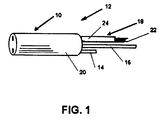
- FIG. 1 is a perspective view of a flexible endoscope insertion portion having a fiber optic bundle within a flexible elastomeric coating.
- Solid Lubricants Typical Examples 1. Layered solids - Dichalcogenides (MoS 2 , WS 2 , WSe 2 , etc.) - Graphite - Boron nitride - CdCl 2 , PbCl 2 - Pthalocyanines 2. Polymers - PTFE (Teflon) - FEP - Polyacetal - Polyimide - UHMWPE - Phenolic and epoxy resins 3. Soft metals - Au, Ag, Pb, In, Ba 4. Low shear strength solids - Oxides: Cd, Co, Zn - Sulfides: Bi, Cd - Fluorides: Ca, Li, Ba, rare earths
- molybdenum disulfide As a lubricant material, molybdenum disulfide (MoS 2 ) is used in a variety of industrial applications. Molybdenum disulfide is found as a naturally occurring mineral ( molybdenite ), and belongs to a class of layered structure or lamellar compounds, a number of which may have useful lubrication properties. Molybdenum disulfide owes its lubricant properties to its hexagonal crystal structure with layers of Mo sandwiched between layers of S on each side. The bonding of Mo and S atoms within the sandwich layers is strong compared to the bonding between the S layers in adjacent sandwich layers. This weak bonding between layers allows for easy slippage and accounts for the lubricating properties.
- MoS 2 molybdenum disulfide
- Molybdenum disulfide is used in many applications because it has a low coefficient of friction and negligible vapor pressure, and consequently it does not evaporate over a long period of time. It is also insensitive to temperature, so that its lubricating and other properties do not vary significantly at different temperatures. It is stable at elevated temperature in nonoxidizing conditions, and can resist oxidation in air up to approximately 500 °C. Molybdenum disulfide can be applied by burnishing (rubbing) a powder or solid piece of lubricant material onto a component surface. The lubricant is loosely adhered to the surface. One disadvantage is that it can become nonuniformly distributed.
- Molybdenum disulfide is moisture sensitive, and should preferably be used in a low moisture, low humidity environment. Molybdenum disulfide carries significant toxicity hazards, including potentially harmful effects if swallowed, inhaled and/or absorbed through the skin. It causes eye irritation, skin irritation, mucous membrane and respiratory tract irritation, and it has mutagenic effects. Because it works best in a dry environment, it is a good solid lubricant for vacuum applications.
- solid lubricant molybdenum disulfide is used as an additive to nylon 6/6 in NYLATRON (a commercial grade of nylon) available from the Polymer Corporation of Reading, Pennsylvania. Many bearings are formed of NYLATRON and it is used in the manufacture of the body of some diathermy probes for ophthalmic applications.
- FIG. 1 depicts an insertion portion 10 of a flexible endoscope 12.
- a lumen 14, a steering mechanism 16 and a fiber optic bundle 18 are encased in an airtight elastomeric outer covering 20.
- the fiber optic bundle 18 comprises a large number of individual optical fibers 22 and a sheath 24 surrounding the fibers 22.
- the sheath 24 is formed of silicone.
- Molybdenum disulfide lubricates the fiber optic bundle 18 to reduce friction between the individual optical fibers 22 as they slide against each other during the maneuvering of the insertion portion 10.
- Molybdenum disulfide is generally dispersed throughout the interior of the insertion portion 10 so that it also lubricates the steering mechanism 16, the lumen 14 and the covering 20 as they slide against each other.
- a leak detection port is opened to place the interior of the endoscope insertion portion 10 into pressure communication with the outside atmosphere. This prevents the air trapped within the outer covering 20 from exerting excessive pressure against the outer covering 20. However, this also allows the sterilizing gas to inter the interior of the endoscope insertion portion 10 and react with the molybdenum disulfide lubricant.
- the material choice is critical.
- the material must be flexible and biocompatible.
- Polyurethanes are commonly used for the thin outer covering 20 the insertion tube. These materials offer a good combination of flexibility, strength, durability, and stability, as well as biocompatibility.
- the outer covering 20 is formed of polyurethane vastly greater amounts of hydrogen peroxide enter the interior of the insertion portion 10 by diffusion through the covering 20 than would enter through the pressure equalization port.
- Hydrogen peroxide gas plasma sterilization systems such as the STERRAD System, use hydrogen peroxide in vapor form at low pressure (less than 14 Torr pressure of 59% hydrogen peroxide) at a nominal operating temperature of 45 °C in the sterilization process. Under these conditions metal dichalcogenides, such as molybdenum disulfide, will react with hydrogen peroxide.
- the reaction is illustrated by the following equation: MoS 2 + (4+x) H 2 O 2 ⁇ MoO x + (4+x) H 2 O + 2 SO 2 ⁇
- samples of molybdenum disulfide powder exposed to gas plasma hydrogen peroxide sterilization for several cycles change rapidly from their normal gray color to a mixture of yellow and blue (probably corresponding to various oxidation states of molybdenum). Samples may begin to emit a sharp, pungent odor, possibly corresponding to traces of sulfur oxides.
- sulfur oxides are potential by-products of chemical oxidation of molybdenum disulfide by hydrogen peroxide.
- the oxides may react with excess water to form sulfurous acid: SO 2 + H 2 O ⁇ H 2 SO 3
- the sulfur may be further oxidized, giving rise to SO 3 and sulfuric acid.
- the exact stoichiometry for reaction of the solid lubricants is not known, but samples of powdered disulfide lubricants processed in open containers for five cycles have shown measured pH levels of less than 1.0, which is highly acidic.
- the acid by-products in particular can act to degrade certain materials.
- materials which have been observed to degrade in combination with molybdenum disulfide after hydrogen peroxide gas plasma processing are polyurethane and silicone elastomers and molybdenum disulfide-filled nylon (such as the tradename NYLATRON mentioned earlier).
- the lubricant powder has been applied as a dry powder or alcohol slurry and allowed to dry onto the surface.
- NYLATRON the material is a nylon 6/6 formulation blended together with a few percent of molybdenum disulfide. NYLATRON was observed to undergo slow surface degradation, with discoloration from dark gray to a light brownish-yellow or tan, and gradual pitting, powdering and chipping of the surface.
- the effects include embrittlement, loss of strength and elongation, blistering, and formation of liquid residues.
- Silicone tubing breaking strengths were observed to decrease from 1400 psi to 600 psi after two cycles (over 50% reduction in strength) on close contact with molybdenum disulfide.
- Polyurethane tubing has been observed to undergo degradation and cracking as a result of close contact with molybdenum disulfide during processing.
- FIG. 1 where hydrogen peroxide first diffused through the polyurethane outer cover 20 leading to reaction with molybdenum disulfide, causing eventual failure of the outer cover 20.
- oxidizing sterilants and methods include ozone (O 3 ), chlorine dioxide (ClO 2 ), EtO, hydrogen peroxide vapor without plasma, and peracetic acid. These oxidizing sterilants are expected to react similarly with molybdenum disulfide and cause material degradation.
- lubricant materials for compatibility with some particular polymers which are used in medical devices (polyurethane and silicone). These lubricants included PTFE, boron nitride, and graphite. They fall under the categories of polymer and layered structure lubricants, and are all readily available in powered form. The layered compounds all function similarly, having a weak bond between the planar layers which allows easy slippage in the two directions parallel to the layers.
- Graphite lubricant contains a thin layer of absorbed moisture on its surface which gives reduced sthear strength between the molecular layers and a low friction coefficient. At low pressure (below 10 -2 Pa or 0.1 millitorr) the absorbed moisture desorbs from the graphite and its friction coefficient rises significantly. However, with short vacuum exposure, or vacuum above 0.1 millitorr (consistent with the STERRAD hydrogen peroxide gas plasma type system), graphite friction properties should be unaffected. Further, powdered PTFE may experience a small degree of clumping which will not significantly affect its performance.
- lubricants in the same category as molybdenum disulfide were investigated. This was done to compare them with molybdenum disulfide, according to whether they also react in a hydrogen peroxide gas plasma system and whether they cause similar degradation effects on polymers. Testing was done on mechanical strength of silicone tubing (Dow Coming SILASTIC) after contamination with solid lubricants and STERRAD hydrogen peroxide gas plasma system processing. Pieces of 3/16 in. diameter tubing were slurry coated and dried with coatings of MOS 2 , WS 2 , WSe 2 and NbSe 2 lubricants.
- layered dichalcogenides such as WS 2 , WSe 2 and NbSe 2
- molybdenum disulfide solid lubricants in devices for sterilization by oxidizing processes or agents such as hydrogen peroxide may lead to degradation of the molybdenum disulfide, which can lead to loss of lubrication properties and possible degradation of associated materials. It is recommended that molybdenum disulfide be avoided where a) the molybdenum disulfide can be directly or indirectly exposed to hydrogen peroxide (even in very small amounts) and b) molybdenum disulfide is in close contact with materials which will be susceptible to degradation.
Landscapes
- Health & Medical Sciences (AREA)
- Chemical & Material Sciences (AREA)
- Animal Behavior & Ethology (AREA)
- Veterinary Medicine (AREA)
- Public Health (AREA)
- General Health & Medical Sciences (AREA)
- Epidemiology (AREA)
- Life Sciences & Earth Sciences (AREA)
- Oral & Maxillofacial Surgery (AREA)
- Transplantation (AREA)
- Medicinal Chemistry (AREA)
- Dermatology (AREA)
- Inorganic Chemistry (AREA)
- Chemical Kinetics & Catalysis (AREA)
- General Chemical & Material Sciences (AREA)
- Lubricants (AREA)
- Endoscopes (AREA)
- Apparatus For Disinfection Or Sterilisation (AREA)
Applications Claiming Priority (2)
| Application Number | Priority Date | Filing Date | Title |
|---|---|---|---|
| US08/614,706 US5716322A (en) | 1996-03-13 | 1996-03-13 | Medical instrument and method for lubrication and sterilization thereof |
| US614706 | 1996-03-13 |
Publications (2)
| Publication Number | Publication Date |
|---|---|
| EP0795335A2 true EP0795335A2 (de) | 1997-09-17 |
| EP0795335A3 EP0795335A3 (de) | 1999-07-14 |
Family
ID=24462387
Family Applications (1)
| Application Number | Title | Priority Date | Filing Date |
|---|---|---|---|
| EP97301641A Ceased EP0795335A3 (de) | 1996-03-13 | 1997-03-12 | Medizinisches Instrument und Verfahren zu seiner Schmierung und Sterilisation |
Country Status (4)
| Country | Link |
|---|---|
| US (1) | US5716322A (de) |
| EP (1) | EP0795335A3 (de) |
| JP (1) | JPH105317A (de) |
| CA (1) | CA2199697C (de) |
Families Citing this family (14)
| Publication number | Priority date | Publication date | Assignee | Title |
|---|---|---|---|---|
| US6171235B1 (en) * | 1998-05-29 | 2001-01-09 | Circon Corporation | Flexible pressure resistant cover for the articulation system of a medical instrument |
| WO2000030690A1 (en) | 1998-11-23 | 2000-06-02 | Ecolab Inc. | Non-corrosive sterilant composition |
| US6464693B1 (en) | 2000-03-06 | 2002-10-15 | Plc Medical Systems, Inc. | Myocardial revascularization |
| US7308807B2 (en) * | 2000-11-16 | 2007-12-18 | Scott Glas | Method of manufacturing a leached fiber bundle |
| GB2402896B (en) * | 2001-04-27 | 2005-09-07 | Sterilox Tech Int Ltd | Oxidation-resistant coatings |
| JP2002345724A (ja) * | 2001-05-22 | 2002-12-03 | Asahi Optical Co Ltd | 内視鏡 |
| US6884393B2 (en) * | 2001-07-13 | 2005-04-26 | Ethicon, Inc. | Surface treatment of aluminum alloys to improve sterilization process compatibility |
| WO2005058139A2 (en) * | 2003-12-16 | 2005-06-30 | Levey John M | Endoscope lubricating and gripping device |
| JPWO2006088058A1 (ja) * | 2005-02-15 | 2008-07-03 | オリンパス株式会社 | 内視鏡 |
| JP2010131153A (ja) * | 2008-12-04 | 2010-06-17 | Fujifilm Corp | 内視鏡軟性部及び内視鏡 |
| JP2010136834A (ja) * | 2008-12-10 | 2010-06-24 | Fujifilm Corp | 内視鏡軟性部及び内視鏡 |
| US10214827B2 (en) | 2010-05-19 | 2019-02-26 | Sanford Process Corporation | Microcrystalline anodic coatings and related methods therefor |
| CN109475288A (zh) * | 2016-08-01 | 2019-03-15 | 坎特尔(英国)有限公司 | 通用内窥镜干燥箱 |
| US12048419B2 (en) | 2022-07-07 | 2024-07-30 | Hoya Corporation | Peroxide-resistant flexible endoscope, and methods of reprocessing or sterilizing such endoscope |
Citations (3)
| Publication number | Priority date | Publication date | Assignee | Title |
|---|---|---|---|---|
| FR2545943A1 (fr) * | 1983-05-12 | 1984-11-16 | Sumitomo Electric Industries | Fibre optique |
| WO1993015781A1 (en) * | 1992-02-10 | 1993-08-19 | Advanced Cardiovascular Systems, Inc. | Composite material having a lubricous surface for catheter use |
| EP0679407A2 (de) * | 1994-04-28 | 1995-11-02 | JOHNSON & JOHNSON MEDICAL, INC. | Dampfsterilisation unter Verwendung eines nichtwässriger Wasserstoffperoxidquelle |
Family Cites Families (8)
| Publication number | Priority date | Publication date | Assignee | Title |
|---|---|---|---|---|
| JPS5647528B2 (de) * | 1974-03-30 | 1981-11-10 | ||
| JPS58159720A (ja) * | 1982-03-19 | 1983-09-22 | オリンパス光学工業株式会社 | 内視鏡用水漏検出装置 |
| JPH0785129B2 (ja) * | 1986-02-04 | 1995-09-13 | 旭光学工業株式会社 | 内視鏡用光学繊維束 |
| DE3822885C2 (de) * | 1987-07-06 | 1994-06-01 | Asahi Optical Co Ltd | Optisches Kabel und Verfahren zu dessen Herstellung |
| US4943414A (en) * | 1987-07-30 | 1990-07-24 | Johnson & Johnson Medical, Inc. | Method for vapor sterilizaton of articles having lumens |
| US5026607A (en) * | 1989-06-23 | 1991-06-25 | C. R. Bard, Inc. | Medical apparatus having protective, lubricious coating |
| DE4103641C1 (de) * | 1991-02-07 | 1992-03-12 | Schott Glaswerke, 6500 Mainz, De | |
| JP3149219B2 (ja) * | 1991-10-15 | 2001-03-26 | 旭光学工業株式会社 | 内視鏡の湾曲部の被覆構造 |
-
1996
- 1996-03-13 US US08/614,706 patent/US5716322A/en not_active Expired - Lifetime
-
1997
- 1997-03-11 CA CA002199697A patent/CA2199697C/en not_active Expired - Lifetime
- 1997-03-12 JP JP9074630A patent/JPH105317A/ja active Pending
- 1997-03-12 EP EP97301641A patent/EP0795335A3/de not_active Ceased
Patent Citations (3)
| Publication number | Priority date | Publication date | Assignee | Title |
|---|---|---|---|---|
| FR2545943A1 (fr) * | 1983-05-12 | 1984-11-16 | Sumitomo Electric Industries | Fibre optique |
| WO1993015781A1 (en) * | 1992-02-10 | 1993-08-19 | Advanced Cardiovascular Systems, Inc. | Composite material having a lubricous surface for catheter use |
| EP0679407A2 (de) * | 1994-04-28 | 1995-11-02 | JOHNSON & JOHNSON MEDICAL, INC. | Dampfsterilisation unter Verwendung eines nichtwässriger Wasserstoffperoxidquelle |
Non-Patent Citations (1)
| Title |
|---|
| CHEMICAL ABSTRACTS, vol. 121, no. 4, 8 August 1994, Columbus, Ohio, US; abstract no. 61014, WANG, JUN'AN; YU, DEYANG; OUYANG, JINLIN: "Study on the mechanism of lubrication degradation and failure of MoS2 sputtered films stored in the moist air" page 224; column RIGHT; * |
Also Published As
| Publication number | Publication date |
|---|---|
| US5716322A (en) | 1998-02-10 |
| JPH105317A (ja) | 1998-01-13 |
| CA2199697A1 (en) | 1997-09-13 |
| EP0795335A3 (de) | 1999-07-14 |
| CA2199697C (en) | 2005-08-16 |
Similar Documents
| Publication | Publication Date | Title |
|---|---|---|
| US5716322A (en) | Medical instrument and method for lubrication and sterilization thereof | |
| KR100449349B1 (ko) | 개선된유연성삽입튜브를갖는내시경 | |
| EP0777502B1 (de) | Lebensdauerindikator bezüglich der sterilisierbarkeit von instrumenten | |
| US4712681A (en) | Method of packaging artificial implants in sterile and contamination-free manner and a package therefor | |
| Wheelis et al. | Surface characterization of titanium implant healing abutments before and after placement | |
| Alfa et al. | Simulated-use polytetrafluorethylene biofilm model: repeated rounds of complete reprocessing lead to accumulation of organic debris and viable bacteria | |
| JP2009500514A (ja) | 放射線耐性シリコーン調合物およびそれで生成された医療機器 | |
| JP4948692B2 (ja) | 接触面を有する物品へ殺菌薬剤を供給する装置および方法 | |
| Tucker et al. | Surface analysis of clinically used expanded PTFE endoscopic tubing treated by the STERIS PROCESS | |
| WO2006088058A1 (ja) | 内視鏡 | |
| Bernbom et al. | Bacterial adhesion to stainless steel is reduced by aqueous fish extract coatings | |
| US12048419B2 (en) | Peroxide-resistant flexible endoscope, and methods of reprocessing or sterilizing such endoscope | |
| US20230129570A1 (en) | Apparatus, method, and system for indication of an oxidative treatment | |
| Chamberlain et al. | Sterilization effects | |
| EP1066839A1 (de) | Oxidationsbeständige Beschichtungen für Endoskope | |
| Baier et al. | Surface phenomena in in vivo environments | |
| JP2000005128A (ja) | 内視鏡 | |
| Tabrizian et al. | New sterilization technologies alternative to ethylene oxide | |
| Ohkawa et al. | High-grade disinfection using high-density ozone | |
| FR2827777A1 (fr) | Procede et machine de sterilisation par plasma | |
| Miller Naranjo et al. | Treatment with Plasma Activated (Salt) Water Sterilizes Macromolecular Coatings While Maintaining Their Integrity and Functionality | |
| Ohkawa et al. | Material Conformity and Bactericidal Characteristics of High-Density Ozone Disinfection in Vinyl Polysiloxane Impression and PMMA Dentistry Fillings | |
| CN121195048A (zh) | 滚动轴承和致动器 | |
| Trigwell et al. | Use of atmospheric glow discharge plasma to modify spaceport materials | |
| Aramayo et al. | SWELLING EFFECTS OF USING DISINFECTANTS IN THE OUTER POLYMERIC LAYER OF UPPER-DIGESTIVE-TRACT ENDOSCOPE TUBE |
Legal Events
| Date | Code | Title | Description |
|---|---|---|---|
| PUAI | Public reference made under article 153(3) epc to a published international application that has entered the european phase |
Free format text: ORIGINAL CODE: 0009012 |
|
| AK | Designated contracting states |
Kind code of ref document: A2 Designated state(s): DE FR GB IT |
|
| PUAL | Search report despatched |
Free format text: ORIGINAL CODE: 0009013 |
|
| AK | Designated contracting states |
Kind code of ref document: A3 Designated state(s): DE FR GB IT |
|
| RIC1 | Information provided on ipc code assigned before grant |
Free format text: 6A 61L 2/20 A, 6A 61L 29/00 B |
|
| 17P | Request for examination filed |
Effective date: 19991221 |
|
| 17Q | First examination report despatched |
Effective date: 20010215 |
|
| APBN | Date of receipt of notice of appeal recorded |
Free format text: ORIGINAL CODE: EPIDOSNNOA2E |
|
| APBR | Date of receipt of statement of grounds of appeal recorded |
Free format text: ORIGINAL CODE: EPIDOSNNOA3E |
|
| APAA | Appeal reference recorded |
Free format text: ORIGINAL CODE: EPIDOS REFN |
|
| APAF | Appeal reference modified |
Free format text: ORIGINAL CODE: EPIDOSCREFNE |
|
| APAF | Appeal reference modified |
Free format text: ORIGINAL CODE: EPIDOSCREFNE |
|
| APBT | Appeal procedure closed |
Free format text: ORIGINAL CODE: EPIDOSNNOA9E |
|
| STAA | Information on the status of an ep patent application or granted ep patent |
Free format text: STATUS: THE APPLICATION HAS BEEN REFUSED |
|
| 18R | Application refused |
Effective date: 20061212 |