EP0795749A2 - Spectrométrie à mobilité d'ions par photoionisation - Google Patents
Spectrométrie à mobilité d'ions par photoionisation Download PDFInfo
- Publication number
- EP0795749A2 EP0795749A2 EP97103324A EP97103324A EP0795749A2 EP 0795749 A2 EP0795749 A2 EP 0795749A2 EP 97103324 A EP97103324 A EP 97103324A EP 97103324 A EP97103324 A EP 97103324A EP 0795749 A2 EP0795749 A2 EP 0795749A2
- Authority
- EP
- European Patent Office
- Prior art keywords
- molecules
- ionization
- gas
- reagent gas
- reagent
- Prior art date
- Legal status (The legal status is an assumption and is not a legal conclusion. Google has not performed a legal analysis and makes no representation as to the accuracy of the status listed.)
- Granted
Links
Images




Classifications
-
- H—ELECTRICITY
- H01—ELECTRIC ELEMENTS
- H01J—ELECTRIC DISCHARGE TUBES OR DISCHARGE LAMPS
- H01J49/00—Particle spectrometers or separator tubes
- H01J49/02—Details
- H01J49/10—Ion sources; Ion guns
- H01J49/16—Ion sources; Ion guns using surface ionisation, e.g. field-, thermionic- or photo-emission
- H01J49/161—Ion sources; Ion guns using surface ionisation, e.g. field-, thermionic- or photo-emission using photoionisation, e.g. by laser
- H01J49/162—Direct photo-ionisation, e.g. single photon or multi-photon ionisation
-
- G—PHYSICS
- G01—MEASURING; TESTING
- G01N—INVESTIGATING OR ANALYSING MATERIALS BY DETERMINING THEIR CHEMICAL OR PHYSICAL PROPERTIES
- G01N27/00—Investigating or analysing materials by the use of electric, electrochemical, or magnetic means
- G01N27/62—Investigating or analysing materials by the use of electric, electrochemical, or magnetic means by investigating the ionisation of gases, e.g. aerosols; by investigating electric discharges, e.g. emission of cathode
- G01N27/622—Ion mobility spectrometry
-
- Y—GENERAL TAGGING OF NEW TECHNOLOGICAL DEVELOPMENTS; GENERAL TAGGING OF CROSS-SECTIONAL TECHNOLOGIES SPANNING OVER SEVERAL SECTIONS OF THE IPC; TECHNICAL SUBJECTS COVERED BY FORMER USPC CROSS-REFERENCE ART COLLECTIONS [XRACs] AND DIGESTS
- Y10—TECHNICAL SUBJECTS COVERED BY FORMER USPC
- Y10T—TECHNICAL SUBJECTS COVERED BY FORMER US CLASSIFICATION
- Y10T436/00—Chemistry: analytical and immunological testing
- Y10T436/16—Phosphorus containing
- Y10T436/163333—Organic [e.g., chemical warfare agents, insecticides, etc.]
-
- Y—GENERAL TAGGING OF NEW TECHNOLOGICAL DEVELOPMENTS; GENERAL TAGGING OF CROSS-SECTIONAL TECHNOLOGIES SPANNING OVER SEVERAL SECTIONS OF THE IPC; TECHNICAL SUBJECTS COVERED BY FORMER USPC CROSS-REFERENCE ART COLLECTIONS [XRACs] AND DIGESTS
- Y10—TECHNICAL SUBJECTS COVERED BY FORMER USPC
- Y10T—TECHNICAL SUBJECTS COVERED BY FORMER US CLASSIFICATION
- Y10T436/00—Chemistry: analytical and immunological testing
- Y10T436/17—Nitrogen containing
- Y10T436/173845—Amine and quaternary ammonium
-
- Y—GENERAL TAGGING OF NEW TECHNOLOGICAL DEVELOPMENTS; GENERAL TAGGING OF CROSS-SECTIONAL TECHNOLOGIES SPANNING OVER SEVERAL SECTIONS OF THE IPC; TECHNICAL SUBJECTS COVERED BY FORMER USPC CROSS-REFERENCE ART COLLECTIONS [XRACs] AND DIGESTS
- Y10—TECHNICAL SUBJECTS COVERED BY FORMER USPC
- Y10T—TECHNICAL SUBJECTS COVERED BY FORMER US CLASSIFICATION
- Y10T436/00—Chemistry: analytical and immunological testing
- Y10T436/18—Sulfur containing
- Y10T436/182—Organic or sulfhydryl containing [e.g., mercaptan, hydrogen, sulfide, etc.]
-
- Y—GENERAL TAGGING OF NEW TECHNOLOGICAL DEVELOPMENTS; GENERAL TAGGING OF CROSS-SECTIONAL TECHNOLOGIES SPANNING OVER SEVERAL SECTIONS OF THE IPC; TECHNICAL SUBJECTS COVERED BY FORMER USPC CROSS-REFERENCE ART COLLECTIONS [XRACs] AND DIGESTS
- Y10—TECHNICAL SUBJECTS COVERED BY FORMER USPC
- Y10T—TECHNICAL SUBJECTS COVERED BY FORMER US CLASSIFICATION
- Y10T436/00—Chemistry: analytical and immunological testing
- Y10T436/21—Hydrocarbon
-
- Y—GENERAL TAGGING OF NEW TECHNOLOGICAL DEVELOPMENTS; GENERAL TAGGING OF CROSS-SECTIONAL TECHNOLOGIES SPANNING OVER SEVERAL SECTIONS OF THE IPC; TECHNICAL SUBJECTS COVERED BY FORMER USPC CROSS-REFERENCE ART COLLECTIONS [XRACs] AND DIGESTS
- Y10—TECHNICAL SUBJECTS COVERED BY FORMER USPC
- Y10T—TECHNICAL SUBJECTS COVERED BY FORMER US CLASSIFICATION
- Y10T436/00—Chemistry: analytical and immunological testing
- Y10T436/24—Nuclear magnetic resonance, electron spin resonance or other spin effects or mass spectrometry
Definitions
- the invention relates to a method for the detection of gas traces in air with the aid of a photoionization ion mobility spectrometer, a sample gas being passed into a photoionization chamber and the sample molecules present in the sample gas being ionized by the VUV radiation of a lamp, and this ionization by adding a reagent gas is reinforced.
- Ion mobility spectrometers work similarly to time-of-flight mass spectrometers, but not under vacuum but at atmospheric pressure.
- IMS Ion mobility spectrometers
- Typical IMS have an ionization source, a reaction cell, a drift cell, for example in the form of a tube, an entry grille between the reaction and the drift area and an ion detector.
- the spectrometers work at atmospheric pressure, where the mean free path of the gas molecules in the drift cell is small compared to their dimensions.
- a carrier gas generally dry air, is usually introduced into the spectrometer together with the sample gas or vapor.
- the carrier gas containing the sample is applied to the ionization source via an inlet, which results in carrier gas and sample molecules being partially ionized.
- the ionization source usually consists of 241-Am or 63-Ni.
- the arrival time of the ions in relation to the pulse-like opening of the injection grid depends on the mobility of the detected ions. Light ions are more mobile than heavy ones and reach the detector earlier. This effect is used to characterize the ions.
- the pulse-like opening of the grating can be repeated periodically in order to increase the signal-to-noise ratio or to carry out a quasi-continuous measurement.
- radioactive ionization source limits the application to the detection of those pollutants that are strongly proton-affine or electronegative (these are mostly only chemical warfare agents and explosives) and is particularly useful in the non-military sector some risk.
- a corona discharge ionization source for an IMS is presented in international patent application WO 93/11554 A1. Even with such an ionization source, electronegative pollutants are not detectable, since the nitrous gases generated in the discharge are very strong electronegative and thus a charge transfer to the i.a. weaker electronegative pollutant molecules is not possible.
- VUV light is generated by lasers, inert gas-filled low or high pressure lamps, constant current and flash lamps.
- a flash lamp is proposed as particularly advantageous. Irradiation with VUV light permits the ionization of a large number of pollutant molecules, but only those whose ionization potentials are less than the energy hv of the light, and only if the pollutant molecules can absorb the light.
- the molecules of the fuel 1,1 - dimethylhydrazine despite their low ionization potential of 7.3 eV, hardly ionize with the light of a 10.6 eV lamp in the ppm range.
- No. 5,338,931 states that the addition of acetone not only increases the selectivity but also the sensitivity of detection. It is said that it is not necessary that the reagent has an ionization energy which is lower than the photoenergy, since excited reagent molecules could be formed which are ionized by subsequent reactions. An "effective" ionization potential is therefore essential. Without further explanations, in particular without any example, it is mentioned that the addition of a reagent gas can improve the sensitivity of an IMS in positive and in negative mode.
- the object is achieved in that the reagent gas molecules in the spectral range of the VUV radiation have a large cross-section for the formation of positive molecular ions and a relatively small probability for the formation of protonated quasi-molecular ions.
- ions are formed directly during the irradiation and not protonated quasi-molecular ions, as a result of which a sufficient concentration of reagent gas ions is formed and the ionization potentials and not the proton affinities are decisive for the further ionization transfer to the target molecules.
- the ionization potential of the reagent gas molecules is preferably equal to or less than the energy hv of the light quanta of the VUV radiation but greater than the ionization potential of the sample molecules.
- the ionization potential of the reagent gas molecules is slightly less than hv, which ensures particularly effective ionization by the VUV radiation.
- the ionization potential is significantly smaller than hv, which suppresses the detection of such interfering gas molecules whose ionization potentials lie between hv and the ionization potential of the reagent gas molecules.
- the method according to the invention is particularly advantageous if the sample gas molecules have a small absorption cross section in the spectral range of the VUV radiation, since in this case the direct ionization of the sample gas molecules is practically not affected and the amplification via the ionization of the reagent gas molecules is particularly large.
- the ionization of the sample gas molecules preferably takes place in that a direct charge transfer takes place between the positive reagent gas molecule ions and the sample gas molecules, whereby the latter become molecular ions which are detected with the aid of the ion mobility spectrometer.
- the reagent gas By selecting the reagent gas, its ionization potential can be matched to that of the target substance. If, for example, it is only insignificantly higher, the desired charge transfer takes place and, moreover, the detection of interfering gases with higher ionization energy is "deleted", i.e. these, even if they were ionized by the VUV light, pass on their charge to the reagent gas molecules.
- the direct ionization of the reagent gas molecules with a large ionization cross section by the VUV light releases electrons, the number of which can significantly exceed that of the electrons emerging from metallic structures of the cell by photoeffect, so that the negative operating mode is also considerably increased.
- the electrons released during the ionization of the reagent gas molecules form with the atmospheric oxygen O 2 - ions, which associative or dissociative attach to electronegative target substance molecules and in this way enable or reinforce the negative operating mode of the IMS. Accordingly, in a negative operating mode of the IMS, a charge transfer takes place, the electrons formed during the ionization of the reagent gas molecules first attaching themselves to atmospheric oxygen molecules and then being adopted associatively or dissociatively by more electronegative sample molecules, which become negative molecule ions, which are detected with the aid of the ion mobility spectrometer .
- the reagent gas is a hydrocarbon, in particular with double bonds, preferably an aromatic, which has a greater ionization energy than the target substance and which does not ionize or only ionizes to a negligibly small extent in air when irradiated by the VUV lamp with the emission of electrons protonated.
- hydrocarbon molecules are first positively ionized by the VUV light. Since they have a good ionization cross section and a higher ionization potential than the target molecules, they pass on their charge directly to them.
- the decisive factor in this process is the difference in ionization potentials, not that of proton affinities.
- the reagent gases benzene, toluene and xylene have proven to be particularly advantageous. They have good ionization cross sections, their ionization potentials are well matched to the spectral ranges of common VUV lamps and to the potentials of target substances of interest in the military and non-military sector, in particular also to those with low proton affinities, and they also show negative effects Operating mode convincing enhancements of selectivity and sensitivity.
- the reagent gas contains one of these three substances.
- the reagent gas is preferably added together with the sample gas and not, as in the prior art, with the carrier gas of the spectrometer.
- the spectrometer can easily be operated with or without reagent gas and also with different reagent gases.
- the presence of the reagent gas in the carrier gas would mean a permanent load on the circuit filter.
- the hermetic circuit had to be opened, which also means a great strain on the filters due to the penetrating air humidity.
- a reagent gas R is placed in the ionization space of the IMS, which is ionized there by the VUV light of the lamp. This creates positive ions R + and electrons e - which are deposited by atmospheric oxygen, ie negative ions of the type (H 2 O) n O 2 - are formed . These two types of ions represent ionizing collision partners for the pollutant molecules to be detected.
- the pollutant molecules M ia are ionized in accordance with M + h ⁇ ⁇ M + + e - .
- this reaction requires that the molecule M can absorb the VUV light from the lamp.
- the ionization of the pollutant molecules M can also take place indirectly via the impact with the reagent gas molecule ions R + in accordance with R + + M ⁇ R + M + .
- the prerequisite for this is that the ionization potential of the pollutant molecule is less than or equal to that of the reagent gas molecule.
- the extent of the pollutants to be detected can be determined via the level of the ionization potential of the reagent gas molecules: Such pollutants, whose ionization potential lies between the light quantum energy hv and the potential of the reagent gas molecule, are ionized by the light, but are neutralized again by the reagent gas molecules and thus removed from detection .
- the method according to the invention can also be combined with methods from the prior art, in particular the detection of proton-affine target substances as usual, e.g. with the addition of acetone, the detection of substances with low proton affinity and / or strong electronegativity with the method according to the invention.
- An ion mobility spectrometer which is set up to carry out the method according to the invention, also falls within the scope of the invention.
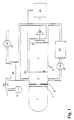
- the DC-operated VUV lamp 1 is axially attached to the measuring cell 2 of the IMS. Their effective spectral range is 10 to 10.6 eV.
- the UV light from the lamp 1 enters the ionization chamber 5 of the measuring cell 2 through a VUV-permeable window 3 made of magnesium fluoride, on which there is a high-voltage electrode 4.
- a VUV-permeable window 3 made of magnesium fluoride, on which there is a high-voltage electrode 4.
- the drift chamber 7 which contains a screen grid 8 and the ion detector electrode 9 at its axially distal end.
- This electrode 9 is electrically connected to the input of a measuring amplifier 10.
- the amplifier signals enter the micro-controller 11 and are digitized and processed there.
- the circuit pump 12 and circuit filter 13 for pumping around the carrier gas and the membrane inlet system 14 for the measuring gas are also located on the measuring cell 2.
- the reagent gas metering 16 is placed in front of the inlet system 14 in the area of the measuring air inlet 15, and the measuring air pump 17 is arranged after the inlet system 14.
- Pump 17 sucks the measuring air, which contains the pollutant molecules to be detected, past the reagent gas metering 16, the reagent gas or the steam being mixed into the measuring air, and then through the primary side of the membrane inlet system 14. A part permeates through the membrane of the inlet system 14 the pollutant and reagent gas molecules in the secondary side of the inlet system 14. There they are captured by the carrier gas stream and transported into the ionization chamber 5, where they can be ionized by the VUV light of the lamp 1.
- the pump 12 transports the air with the non-ionized molecules out of the measuring cell 2 and pushes it through the filter 13, where it is cleaned and dried.
- the air flow divides into the drift gas flow, which enters the drift chamber in the vicinity of the electrode 9 and in the carrier gas stream which flushes out the secondary side of the membrane inlet system 14.
- the positive pollutant and reagent gas ions formed in the ionization chamber 5 are repelled by the high-voltage electrode 4 attached to the lamp window 3 in the direction of the ion switching grid 6.
- this grid 6 is impermeable to the ion current, but e.g. Open every 30 to 50 ms for 0.3 ms to let a cloud of pollutant and reagent gas ions into drift space 7.
- the ion cloud separates on its way through drift space 7.
- the lighter and therefore faster ions reach the electrode 9 earlier than the heavier ions.
- the ions neutralize and cause a pulse-shaped measurement signal in the amplifier 10, the size of which corresponds to the number of ions and thus the concentration of pollutant or reagent gas in the intake air.
- the time it takes for one type of ion to pass through the drift space 7, i.e. the so-called drift time, from which the characteristic "mobility" for the ions is calculated, is determined by the micro-controller 11, which also controls the entire measuring process, in particular the high voltage at the switching grid, the pumps, etc.
- the micro-controller 11 Apart from the flushing of the reagent gas on the primary side of the inlet system 14, the basic mode of operation of a photoionization IMS is known per se from the prior art.
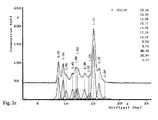
- IMS spectra are shown, which were obtained with a photo ionization IMS of the type described in FIG. 1.
- the abscissa is the running or drift time axis and the ordinate is the measuring current axis.
- the peaks correspond to the individual ion types of different mobility present in the measuring gas, which are formed in the ionization space 5 and pass through the drift space at different speeds.
- the numbers at the peaks correspond to the normalized mobility of the ions in the cm 2 / Vs dimension.
- the areas under these peaks in absolute units are listed in the upper right area of the spectra display, with the assignment that the uppermost number corresponds to the first peak seen from the left.
- the number to the left of the list represents the area under the entire curve of the spectrum and characterizes the total ion current.
- the samples 2a to 2c show the spectra of the chemical warfare agent sulfur mustard (HD) in the positive mode of operation of the IMS.
- the concentration of warfare agents is 1.5 ppm each.
- the sample also contains characteristic chemical stabilizers, accompanying substances from technical synthesis and hydrolysis products of the weapon.
- the ionization cross section of benzene at 9.25 eV is quite large and the ionization energy of benzene is higher than that of sulfur mustard, so that a charge transfer from the benzene ions to the warfare agent and sometimes also to the characteristic accompanying substances takes place, i.e. the benzene peak in the spectrum largely disappears again and the characteristic peaks are amplified accordingly.
- 3a and 3b show the spectra of the lung warfare agent chlorpikrin (trichlomitromethane).
- chlorpikrin trichlomitromethane
- no warfare agent ions can be determined with this substance, even when a reagent gas such as acetone or benzene vapor is added.
- chloropicrin is not proton-affine, but strongly electronegative and has an ionization potential greater than 11 eV. It can neither be protonated nor ionized directly or indirectly by charge transfer from a reagent substance with lower ionization energy.
- this warfare agent succeeds in the negative mode of operation of the IMS. Due to the high electronegativity of the warfare agent molecules, there is a dissociative charge transfer from the few negative ions of the measuring gas air to the warfare agent molecules, whereby Cl - ions are formed. This can be seen from Fig. 3a, where about 2 ppm chloropicrin was measured in air without a reagent gas. The negative ionization of the atmospheric oxygen takes place predominantly through photoelectrons from metal structures (switching grid) of the ionization cell 5, which are illuminated by the VUV light of the lamp.
- the same ionization mechanism can also be used to detect chlorine.
- the Cl 2 molecules have an ionization potential of 11.5 eV, and consequently cannot be ionized with the light quantum energies of 10 - 10.6 eV of the commercially available VUV lamps.
- Fig. 4 shows the spectrum of 2 ppm chlorine with the addition of about 250 ppm benzene, recorded in the negative operating mode of the IMS. The peak of the chloride ions resulting from dissociative charge transfer can be clearly seen at 2.88 cm 2 / Vs.
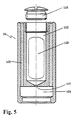
- FIG. 5 shows in detail a section through a device 16 for metering the reagent gases, which represents a preferred embodiment of the metering device 16 indicated schematically in FIG. 1.
- the device 16 is cylindrical and consists of a material which meets the analytical requirements with regard to adsorption and desorption of gas traces, e.g. made of steel or high quality plastics. It includes a first cavity 102 for receiving a reagent container 103, a second cavity 104 for mixing the reagent vapor with the measurement air and one or more channels 105 between the front end face and the second cavity 104.
- the reagent selected for the operation of the photoionization IMS is enclosed in the reagent container 103, the walls of which are made of polymeric material or which has at least one window made of such a material.
- the reagent molecules permeate into the cavity 102 through this material.
- One end of the cavity 102 is sealed by the closure 106, and at the other end there is a passage 107 in the form of a bore 107 to the cavity 104.
- the measurement air which is drawn in by a pump (pump 17 in FIG. 1), flows through the channels 105 into the cavity 104, into which the reagent gas molecules also diffuse out of the cavity 102 through the bore 107, so that they are in the space 104 mix with the measuring air. From there, the measuring air / reagent gas mixture reaches the primary side of the membrane inlet system (14 in FIGS. 1 and 6).
- FIG. 6 shows the arrangement of the metering device 16 at the measuring air inlet 15 of a photo ionization IMS. Identical and equivalent components of the fig. 5 and 6 or 1 and 6 are provided with the same reference numerals.
- the outlet of the cavity 104 is connected to the measuring air inlet 15 via a sealing element 201. This connection is designed to be easily detachable, so that the metering device 16 can be replaced quickly, and consequently the range of applications of the photoionization IMS described here is increased in a simple manner.
- the metering device 16 can be heated electrically.
Landscapes
- Physics & Mathematics (AREA)
- Chemical & Material Sciences (AREA)
- Analytical Chemistry (AREA)
- Biochemistry (AREA)
- General Physics & Mathematics (AREA)
- Health & Medical Sciences (AREA)
- Life Sciences & Earth Sciences (AREA)
- Chemical Kinetics & Catalysis (AREA)
- Spectroscopy & Molecular Physics (AREA)
- General Health & Medical Sciences (AREA)
- Electrochemistry (AREA)
- Immunology (AREA)
- Pathology (AREA)
- Optics & Photonics (AREA)
- Engineering & Computer Science (AREA)
- Plasma & Fusion (AREA)
- Other Investigation Or Analysis Of Materials By Electrical Means (AREA)
Applications Claiming Priority (2)
| Application Number | Priority Date | Filing Date | Title |
|---|---|---|---|
| DE19609582 | 1996-03-12 | ||
| DE19609582A DE19609582C1 (de) | 1996-03-12 | 1996-03-12 | Photoionisations-Ionenmobilitätsspektrometrie |
Publications (4)
| Publication Number | Publication Date |
|---|---|
| EP0795749A2 true EP0795749A2 (fr) | 1997-09-17 |
| EP0795749A3 EP0795749A3 (fr) | 1998-08-19 |
| EP0795749B1 EP0795749B1 (fr) | 2009-04-08 |
| EP0795749B9 EP0795749B9 (fr) | 2010-10-13 |
Family
ID=7787990
Family Applications (1)
| Application Number | Title | Priority Date | Filing Date |
|---|---|---|---|
| EP97103324A Expired - Lifetime EP0795749B9 (fr) | 1996-03-12 | 1997-02-28 | Spectrométrie à mobilité d'ions par photoionisation |
Country Status (3)
| Country | Link |
|---|---|
| US (1) | US5968837A (fr) |
| EP (1) | EP0795749B9 (fr) |
| DE (2) | DE19609582C1 (fr) |
Cited By (4)
| Publication number | Priority date | Publication date | Assignee | Title |
|---|---|---|---|---|
| WO2000045354A1 (fr) * | 1999-01-28 | 2000-08-03 | The Secretary Of State For Defence | Procede de detection d'incendie |
| EP1229995A4 (fr) * | 1999-09-16 | 2003-04-16 | Rae Systems Inc | Detecteur a photoionisation selective faisant intervenir une spectrometrie a mobilite ionique |
| US7385210B2 (en) | 2005-06-22 | 2008-06-10 | Technische Universitaet Muenchen | Device for spectroscopy using charged analytes |
| WO2010012642A2 (fr) | 2008-07-31 | 2010-02-04 | Eads Deutschland Gmbh | Procédé et dispositif d'ionisation, ainsi que dispositif de détection de gaz qui en est pourvu |
Families Citing this family (42)
| Publication number | Priority date | Publication date | Assignee | Title |
|---|---|---|---|---|
| US6225633B1 (en) * | 1998-10-22 | 2001-05-01 | Rae Systems, Inc. | Photo-ionization detector for volatile gas measurement and a method for self-cleaning the same |
| US6320388B1 (en) * | 1999-06-11 | 2001-11-20 | Rae Systems, Inc. | Multiple channel photo-ionization detector for simultaneous and selective measurement of volatile organic compound |
| DE19933650C1 (de) * | 1999-07-17 | 2001-03-08 | Bruker Saxonia Analytik Gmbh | Ionisationskammer mit einer nicht- radioaktiven Ionisationsquelle |
| WO2001033605A2 (fr) | 1999-10-29 | 2001-05-10 | Rijksuniversiteit Groningen | Photoionisation sous pression atmospherique, nouveau procede d"ionisiation pour spectrometrie de masse avec chromatographie en phase liquide |
| US6639214B1 (en) * | 2000-05-09 | 2003-10-28 | Air Products And Chemicals, Inc. | Method of improving the performance of an ion mobility spectrometer used to detect trace atmospheric impurities in gases |
| US6815671B2 (en) | 2000-06-09 | 2004-11-09 | The University Of Delaware | System and method for chemical analysis using laser ablation |
| DE10120335C2 (de) * | 2001-04-26 | 2003-08-07 | Bruker Daltonik Gmbh | Ionenmobilitätsspektrometer mit nicht-radioaktiver Ionenquelle |
| US6734435B2 (en) | 2001-05-29 | 2004-05-11 | Rae Systems, Inc. | Photo-ionization detector and method for continuous operation and real-time self-cleaning |
| AU2003201232A1 (en) * | 2002-02-08 | 2003-09-02 | Ionalytics Corporation | Faims with non-destructive detection of selectively transmitted ions |
| US6828795B2 (en) * | 2002-02-15 | 2004-12-07 | Implant Sciences Corporation | Explosive detection system |
| US20030155504A1 (en) * | 2002-02-15 | 2003-08-21 | Motchkine Viatcheslav S. | Radiative sample warming for an ion mobility spectrometer |
| US6861646B2 (en) * | 2002-02-15 | 2005-03-01 | Implant Sciences Corporation | Cyclone sampling nozzle for an ion mobility spectrometer |
| US6797943B2 (en) | 2002-05-07 | 2004-09-28 | Siemens Ag | Method and apparatus for ion mobility spectrometry |
| DE10258974A1 (de) * | 2002-12-16 | 2004-06-24 | Axel Semrau Gmbh & Co. Kg | Verfahren zur Detektion und Konzentrationsbestimmung von schwefelfreien Odoriermitteln in Erd- und Brenngas |
| DE10310394A1 (de) * | 2003-03-07 | 2004-09-23 | Wma Airsense Analysentechnik Gmbh | Verfahren und Meßsystem zur Erfassung von Gefahrstoffen |
| CN101014857B (zh) * | 2004-03-12 | 2012-06-13 | 维吉尼亚大学专利基金会 | 用于生物多聚体序列分析的电子转移解离 |
| US8754366B2 (en) | 2005-01-11 | 2014-06-17 | Hamilton Sundstrand Corporation | Tandem differential mobility ion mobility spectrometer for chemical vapor detection |
| DE102005004325A1 (de) * | 2005-01-31 | 2006-08-10 | Bruker Daltonik Gmbh | Ionenmobilitätsspektrometer und Verfahren zu seinem Betrieb |
| US7196325B2 (en) * | 2005-05-25 | 2007-03-27 | Syagen Technology | Glow discharge and photoionizaiton source |
| DE102007052801B4 (de) * | 2007-11-06 | 2010-10-07 | Bruker Daltonik Gmbh | Ionenmobilitätsspektrometer mit Substanzsammler |
| DE102007052802B4 (de) * | 2007-11-06 | 2012-06-14 | Bruker Daltonik Gmbh | Ionenmobilitätsspektrometer und Verfahren zu seinem Betrieb |
| EP2112683A1 (fr) | 2008-04-22 | 2009-10-28 | IEE INTERNATIONAL ELECTRONICS & ENGINEERING S.A. | Spectromètre à mobilité différentielle et son procédé de fonctionnement |
| DE102009004278A1 (de) | 2009-01-05 | 2010-07-15 | Synthesechemie Dr. Penth Gmbh | Messgerät für geringe Kohlenwasserstoffkonzentrationen |
| CN102495128B (zh) * | 2009-06-30 | 2015-08-19 | 同方威视技术股份有限公司 | 一种适于掺杂气发生装置的加热控温装置 |
| CN102033100B (zh) | 2009-09-25 | 2013-03-13 | 同方威视技术股份有限公司 | 使用掺杂剂的离子迁移谱仪(ims)的检测系统及检测方法 |
| CN102074448B (zh) * | 2009-11-20 | 2014-09-24 | 同方威视技术股份有限公司 | 离子迁移谱仪以及提高其检测灵敏度的方法 |
| DE102010020110A1 (de) * | 2010-05-10 | 2012-11-22 | Synthesechemie Gmbh | Gerät zum Erfassen und Verdünnen für geringe Kohlenwasserstoffkonzentrationen in Druckluft |
| CN102478544A (zh) * | 2010-11-30 | 2012-05-30 | 中国科学院大连化学物理研究所 | 一种识别和检测爆炸物的新方法 |
| DE102011013262A1 (de) | 2011-03-07 | 2012-09-13 | Adlantis Dortmund Gmbh | Ionisationsquelle und Nachweisgerät für Spurengase |
| US20120298856A1 (en) | 2011-05-27 | 2012-11-29 | Dsa Detection Llc | Multi-dopant permeation tube |
| US8723111B2 (en) | 2011-09-29 | 2014-05-13 | Morpho Detection, Llc | Apparatus for chemical sampling and method of assembling the same |
| CN102592916B (zh) * | 2012-02-28 | 2015-07-01 | 公安部第三研究所 | 一种离子迁移谱设备中紫外灯的装配方法以及离子迁移谱设备 |
| US9153427B2 (en) | 2012-12-18 | 2015-10-06 | Agilent Technologies, Inc. | Vacuum ultraviolet photon source, ionization apparatus, and related methods |
| WO2014149847A2 (fr) * | 2013-03-15 | 2014-09-25 | Riaz Abrar | Ionisation dans un piège à ions par photo-ionisation et ionisation électronique |
| CN105092689A (zh) * | 2014-05-20 | 2015-11-25 | 中国科学院大连化学物理研究所 | 一种实时在线的呼出气监测仪 |
| CN105548327A (zh) * | 2014-10-28 | 2016-05-04 | 中国科学院大连化学物理研究所 | 一种提高离子迁移谱灵敏度的快速检测方法 |
| EP3106867B1 (fr) * | 2015-06-19 | 2017-12-27 | Airsense Analytics GmbH | Procede et dispositif destines a l'identification de gaz |
| US20170213715A1 (en) * | 2015-12-18 | 2017-07-27 | Morpho Detection, Llc | Detection of compounds through dopant-assisted photoionization |
| CN107014892B (zh) * | 2017-05-15 | 2019-06-18 | 清华大学 | 一种基于真空紫外激光的微米级空间分辨质谱成像系统 |
| CN110074132A (zh) * | 2019-06-11 | 2019-08-02 | 安徽省四达农药化工有限公司 | 一种含有草铵膦的除草组合物 |
| CN112924529A (zh) * | 2019-12-06 | 2021-06-08 | 中国科学院大连化学物理研究所 | 一种基于离子迁移谱仪的氧化三甲胺检测方法及其应用 |
| CN114609231B (zh) * | 2020-12-09 | 2024-07-30 | 中国科学院大连化学物理研究所 | 一种方便缓冲气充装的碱金属蒸汽电离度测量用碱金属池 |
Family Cites Families (8)
| Publication number | Priority date | Publication date | Assignee | Title |
|---|---|---|---|---|
| US3621239A (en) * | 1969-01-28 | 1971-11-16 | Franklin Gro Corp | Detecting a trace substance in a sample gas comprising reacting the sample with different species of reactant ions |
| GB2052750B (en) * | 1979-06-21 | 1983-03-16 | Pye Ltd | Trace material detector |
| US4551624A (en) * | 1983-09-23 | 1985-11-05 | Allied Corporation | Ion mobility spectrometer system with improved specificity |
| US4839143A (en) * | 1985-02-15 | 1989-06-13 | Allied-Signal Inc. | Selective ionization of gas constituents using electrolytic reactions |
| US4928033A (en) * | 1988-11-15 | 1990-05-22 | Environmental Technologies Group, Inc. | Thermionic ionization source |
| US5032721A (en) * | 1990-06-01 | 1991-07-16 | Environmental Technologies Group, Inc. | Acid gas monitor based on ion mobility spectrometry |
| WO1993011554A1 (fr) * | 1991-12-03 | 1993-06-10 | Graseby Dynamics Limited | Source d'ionisation a decharge lumineuse |
| US5338931A (en) * | 1992-04-23 | 1994-08-16 | Environmental Technologies Group, Inc. | Photoionization ion mobility spectrometer |
-
1996
- 1996-03-12 DE DE19609582A patent/DE19609582C1/de not_active Expired - Lifetime
-
1997
- 1997-02-28 DE DE59712999T patent/DE59712999D1/de not_active Expired - Lifetime
- 1997-02-28 EP EP97103324A patent/EP0795749B9/fr not_active Expired - Lifetime
- 1997-03-11 US US08/815,421 patent/US5968837A/en not_active Expired - Lifetime
Cited By (8)
| Publication number | Priority date | Publication date | Assignee | Title |
|---|---|---|---|---|
| WO2000045354A1 (fr) * | 1999-01-28 | 2000-08-03 | The Secretary Of State For Defence | Procede de detection d'incendie |
| US6900432B1 (en) | 1999-01-28 | 2005-05-31 | The Secretary Of State For Defence | Fire detection method |
| EP1229995A4 (fr) * | 1999-09-16 | 2003-04-16 | Rae Systems Inc | Detecteur a photoionisation selective faisant intervenir une spectrometrie a mobilite ionique |
| US7385210B2 (en) | 2005-06-22 | 2008-06-10 | Technische Universitaet Muenchen | Device for spectroscopy using charged analytes |
| WO2010012642A2 (fr) | 2008-07-31 | 2010-02-04 | Eads Deutschland Gmbh | Procédé et dispositif d'ionisation, ainsi que dispositif de détection de gaz qui en est pourvu |
| WO2010012642A3 (fr) * | 2008-07-31 | 2010-04-01 | Eads Deutschland Gmbh | Procédé et dispositif d'ionisation, ainsi que dispositif de détection de gaz qui en est pourvu |
| EP2482066A1 (fr) * | 2008-07-31 | 2012-08-01 | EADS Deutschland GmbH | Procédé et dispositif d'ionisation, ainsi que dispositif de détection de gaz qui en est pourvu |
| EP2584350A1 (fr) * | 2008-07-31 | 2013-04-24 | EADS Deutschland GmbH | Procédé et dispositif d'ionisation ainsi que dispositif de détection de gaz en étant équipé |
Also Published As
| Publication number | Publication date |
|---|---|
| EP0795749B1 (fr) | 2009-04-08 |
| EP0795749A3 (fr) | 1998-08-19 |
| US5968837A (en) | 1999-10-19 |
| DE59712999D1 (de) | 2009-05-20 |
| EP0795749B9 (fr) | 2010-10-13 |
| DE19609582C1 (de) | 1997-05-28 |
Similar Documents
| Publication | Publication Date | Title |
|---|---|---|
| EP0795749B1 (fr) | Spectrométrie à mobilité d'ions par photoionisation | |
| DE69312471T2 (de) | Photoionisationsionenmobilitätsspektrometer | |
| EP2428796B1 (fr) | Dispositif et procédé d'ionisation et d'identification de gaz moyennant rayonnement à UV et électrons | |
| DE69720419T2 (de) | Verfahren zur kontrolle eines analytischen instruments mit einer koronaentladungsionenquelle | |
| DE3510378C2 (fr) | ||
| EP3084412B1 (fr) | Système et procédé d'analyse de gaz | |
| DE3787281T2 (de) | Verfahren zum nachweis von fremdstoffgehalten in gasen. | |
| DE1912533A1 (de) | Verfahren und Vorrichtung zur Durchfuehrung von Massenspektrometrie | |
| DE60202753T2 (de) | Corona ionenquelle | |
| DE19608963A1 (de) | Verfahren zur Ionisierung schwerer Moleküle bei Atmosphärendruck | |
| DE69226778T2 (de) | Vorrichtung und verfahren zum gasnachweis | |
| DE102004051785B4 (de) | Proteinprofile mit Luft-MALDI | |
| DE102015122155B4 (de) | Verwendung einer Ionisierungsvorrichtung | |
| DE69418063T2 (de) | Zykloidisches massenspektrometer | |
| DE69208242T2 (de) | Verbesserungen für Ionenbeweglichkeitsspektrometer | |
| DE19627621A1 (de) | Ionenmobilitätsspektrometer | |
| DE2439711A1 (de) | Ionenquelle | |
| DE69530189T2 (de) | Verbessertes gepulstes Entladungssystem | |
| DE3887922T2 (de) | Entladungsionisierungsquelle zum Analysieren der Atmosphäre. | |
| DE102005007746B4 (de) | Ionenmobilitätsspektrometer mit parallel verlaufender Driftgas- und Ionenträgergasströmung | |
| EP0533682B1 (fr) | Procede et dispositif pour detecter des substances dans une substance ambiante, en particulier pour detecter des agents de combat chimiques | |
| DE3422053A1 (de) | Verfahren zur quantitativen und/oder qualitativen erfassung von substanzen | |
| DE2346422A1 (de) | Verfahren und system zur feststellung von explosivstoffen | |
| AT403214B (de) | Verfahren zur analyse von gasgemischen | |
| EP3457125A1 (fr) | Dispositif et procédé destinés à la détection de substances toxiques gazeuses |
Legal Events
| Date | Code | Title | Description |
|---|---|---|---|
| PUAI | Public reference made under article 153(3) epc to a published international application that has entered the european phase |
Free format text: ORIGINAL CODE: 0009012 |
|
| 17P | Request for examination filed |
Effective date: 19970527 |
|
| AK | Designated contracting states |
Kind code of ref document: A2 Designated state(s): CH DE FI FR GB LI SE |
|
| PUAL | Search report despatched |
Free format text: ORIGINAL CODE: 0009013 |
|
| AK | Designated contracting states |
Kind code of ref document: A3 Designated state(s): CH DE FI FR GB LI SE |
|
| RAP1 | Party data changed (applicant data changed or rights of an application transferred) |
Owner name: BRUKER DALTONIK GMBH |
|
| 17Q | First examination report despatched |
Effective date: 20060804 |
|
| GRAP | Despatch of communication of intention to grant a patent |
Free format text: ORIGINAL CODE: EPIDOSNIGR1 |
|
| GRAS | Grant fee paid |
Free format text: ORIGINAL CODE: EPIDOSNIGR3 |
|
| GRAA | (expected) grant |
Free format text: ORIGINAL CODE: 0009210 |
|
| AK | Designated contracting states |
Kind code of ref document: B1 Designated state(s): CH DE FI FR GB LI SE |
|
| REG | Reference to a national code |
Ref country code: GB Ref legal event code: FG4D Free format text: NOT ENGLISH |
|
| REG | Reference to a national code |
Ref country code: CH Ref legal event code: EP |
|
| REF | Corresponds to: |
Ref document number: 59712999 Country of ref document: DE Date of ref document: 20090520 Kind code of ref document: P |
|
| REG | Reference to a national code |
Ref country code: SE Ref legal event code: TRGR |
|
| PLBE | No opposition filed within time limit |
Free format text: ORIGINAL CODE: 0009261 |
|
| STAA | Information on the status of an ep patent application or granted ep patent |
Free format text: STATUS: NO OPPOSITION FILED WITHIN TIME LIMIT |
|
| 26N | No opposition filed |
Effective date: 20100111 |
|
| REG | Reference to a national code |
Ref country code: CH Ref legal event code: PL |
|
| PG25 | Lapsed in a contracting state [announced via postgrant information from national office to epo] |
Ref country code: LI Free format text: LAPSE BECAUSE OF NON-PAYMENT OF DUE FEES Effective date: 20100228 Ref country code: CH Free format text: LAPSE BECAUSE OF NON-PAYMENT OF DUE FEES Effective date: 20100228 |
|
| REG | Reference to a national code |
Ref country code: FR Ref legal event code: PLFP Year of fee payment: 20 |
|
| PGFP | Annual fee paid to national office [announced via postgrant information from national office to epo] |
Ref country code: DE Payment date: 20160218 Year of fee payment: 20 |
|
| PGFP | Annual fee paid to national office [announced via postgrant information from national office to epo] |
Ref country code: FR Payment date: 20160218 Year of fee payment: 20 Ref country code: GB Payment date: 20160217 Year of fee payment: 20 Ref country code: FI Payment date: 20160211 Year of fee payment: 20 Ref country code: SE Payment date: 20160217 Year of fee payment: 20 |
|
| REG | Reference to a national code |
Ref country code: DE Ref legal event code: R071 Ref document number: 59712999 Country of ref document: DE |
|
| REG | Reference to a national code |
Ref country code: GB Ref legal event code: PE20 Expiry date: 20170227 |
|
| REG | Reference to a national code |
Ref country code: SE Ref legal event code: EUG |
|
| PG25 | Lapsed in a contracting state [announced via postgrant information from national office to epo] |
Ref country code: GB Free format text: LAPSE BECAUSE OF EXPIRATION OF PROTECTION Effective date: 20170227 |