EP0795918A2 - Bleisäurebatterie mit Elektrodenstruktur und Verfahren zur Herstellung - Google Patents
Bleisäurebatterie mit Elektrodenstruktur und Verfahren zur Herstellung Download PDFInfo
- Publication number
- EP0795918A2 EP0795918A2 EP97301454A EP97301454A EP0795918A2 EP 0795918 A2 EP0795918 A2 EP 0795918A2 EP 97301454 A EP97301454 A EP 97301454A EP 97301454 A EP97301454 A EP 97301454A EP 0795918 A2 EP0795918 A2 EP 0795918A2
- Authority
- EP
- European Patent Office
- Prior art keywords
- lead
- dispersion
- dispersoid
- particles
- hardened
- Prior art date
- Legal status (The legal status is an assumption and is not a legal conclusion. Google has not performed a legal analysis and makes no representation as to the accuracy of the status listed.)
- Withdrawn
Links
Images

Classifications
-
- C—CHEMISTRY; METALLURGY
- C22—METALLURGY; FERROUS OR NON-FERROUS ALLOYS; TREATMENT OF ALLOYS OR NON-FERROUS METALS
- C22C—ALLOYS
- C22C1/00—Making non-ferrous alloys
- C22C1/10—Alloys containing non-metals
- C22C1/1094—Alloys containing non-metals comprising an after-treatment
-
- C—CHEMISTRY; METALLURGY
- C22—METALLURGY; FERROUS OR NON-FERROUS ALLOYS; TREATMENT OF ALLOYS OR NON-FERROUS METALS
- C22C—ALLOYS
- C22C1/00—Making non-ferrous alloys
- C22C1/04—Making non-ferrous alloys by powder metallurgy
- C22C1/05—Mixtures of metal powder with non-metallic powder
- C22C1/059—Making alloys comprising less than 5% by weight of dispersed reinforcing phases
-
- C—CHEMISTRY; METALLURGY
- C22—METALLURGY; FERROUS OR NON-FERROUS ALLOYS; TREATMENT OF ALLOYS OR NON-FERROUS METALS
- C22C—ALLOYS
- C22C32/00—Non-ferrous alloys containing at least 5% by weight but less than 50% by weight of oxides, carbides, borides, nitrides, silicides or other metal compounds, e.g. oxynitrides, sulfides, whether added as such or formed in situ
-
- H—ELECTRICITY
- H01—ELECTRIC ELEMENTS
- H01M—PROCESSES OR MEANS, e.g. BATTERIES, FOR THE DIRECT CONVERSION OF CHEMICAL ENERGY INTO ELECTRICAL ENERGY
- H01M4/00—Electrodes
- H01M4/02—Electrodes composed of, or comprising, active material
- H01M4/14—Electrodes for lead-acid accumulators
- H01M4/16—Processes of manufacture
-
- H—ELECTRICITY
- H01—ELECTRIC ELEMENTS
- H01M—PROCESSES OR MEANS, e.g. BATTERIES, FOR THE DIRECT CONVERSION OF CHEMICAL ENERGY INTO ELECTRICAL ENERGY
- H01M4/00—Electrodes
- H01M4/02—Electrodes composed of, or comprising, active material
- H01M4/36—Selection of substances as active materials, active masses, active liquids
- H01M4/48—Selection of substances as active materials, active masses, active liquids of inorganic oxides or hydroxides
- H01M4/56—Selection of substances as active materials, active masses, active liquids of inorganic oxides or hydroxides of lead
-
- H—ELECTRICITY
- H01—ELECTRIC ELEMENTS
- H01M—PROCESSES OR MEANS, e.g. BATTERIES, FOR THE DIRECT CONVERSION OF CHEMICAL ENERGY INTO ELECTRICAL ENERGY
- H01M4/00—Electrodes
- H01M4/02—Electrodes composed of, or comprising, active material
- H01M4/64—Carriers or collectors
- H01M4/66—Selection of materials
- H01M4/68—Selection of materials for use in lead-acid accumulators
-
- H—ELECTRICITY
- H01—ELECTRIC ELEMENTS
- H01M—PROCESSES OR MEANS, e.g. BATTERIES, FOR THE DIRECT CONVERSION OF CHEMICAL ENERGY INTO ELECTRICAL ENERGY
- H01M4/00—Electrodes
- H01M4/02—Electrodes composed of, or comprising, active material
- H01M4/64—Carriers or collectors
- H01M4/70—Carriers or collectors characterised by shape or form
- H01M4/72—Grids
- H01M4/73—Grids for lead-acid accumulators, e.g. frame plates
-
- H—ELECTRICITY
- H01—ELECTRIC ELEMENTS
- H01M—PROCESSES OR MEANS, e.g. BATTERIES, FOR THE DIRECT CONVERSION OF CHEMICAL ENERGY INTO ELECTRICAL ENERGY
- H01M4/00—Electrodes
- H01M4/02—Electrodes composed of, or comprising, active material
- H01M4/64—Carriers or collectors
- H01M4/82—Multi-step processes for manufacturing carriers for lead-acid accumulators
-
- C—CHEMISTRY; METALLURGY
- C22—METALLURGY; FERROUS OR NON-FERROUS ALLOYS; TREATMENT OF ALLOYS OR NON-FERROUS METALS
- C22C—ALLOYS
- C22C2204/00—End product comprising different layers, coatings or parts of cermet
-
- H—ELECTRICITY
- H01—ELECTRIC ELEMENTS
- H01M—PROCESSES OR MEANS, e.g. BATTERIES, FOR THE DIRECT CONVERSION OF CHEMICAL ENERGY INTO ELECTRICAL ENERGY
- H01M4/00—Electrodes
- H01M4/02—Electrodes composed of, or comprising, active material
- H01M4/64—Carriers or collectors
- H01M4/70—Carriers or collectors characterised by shape or form
- H01M4/72—Grids
-
- Y—GENERAL TAGGING OF NEW TECHNOLOGICAL DEVELOPMENTS; GENERAL TAGGING OF CROSS-SECTIONAL TECHNOLOGIES SPANNING OVER SEVERAL SECTIONS OF THE IPC; TECHNICAL SUBJECTS COVERED BY FORMER USPC CROSS-REFERENCE ART COLLECTIONS [XRACs] AND DIGESTS
- Y02—TECHNOLOGIES OR APPLICATIONS FOR MITIGATION OR ADAPTATION AGAINST CLIMATE CHANGE
- Y02E—REDUCTION OF GREENHOUSE GAS [GHG] EMISSIONS, RELATED TO ENERGY GENERATION, TRANSMISSION OR DISTRIBUTION
- Y02E60/00—Enabling technologies; Technologies with a potential or indirect contribution to GHG emissions mitigation
- Y02E60/10—Energy storage using batteries
-
- Y—GENERAL TAGGING OF NEW TECHNOLOGICAL DEVELOPMENTS; GENERAL TAGGING OF CROSS-SECTIONAL TECHNOLOGIES SPANNING OVER SEVERAL SECTIONS OF THE IPC; TECHNICAL SUBJECTS COVERED BY FORMER USPC CROSS-REFERENCE ART COLLECTIONS [XRACs] AND DIGESTS
- Y10—TECHNICAL SUBJECTS COVERED BY FORMER USPC
- Y10T—TECHNICAL SUBJECTS COVERED BY FORMER US CLASSIFICATION
- Y10T29/00—Metal working
- Y10T29/10—Battery-grid making
-
- Y—GENERAL TAGGING OF NEW TECHNOLOGICAL DEVELOPMENTS; GENERAL TAGGING OF CROSS-SECTIONAL TECHNOLOGIES SPANNING OVER SEVERAL SECTIONS OF THE IPC; TECHNICAL SUBJECTS COVERED BY FORMER USPC CROSS-REFERENCE ART COLLECTIONS [XRACs] AND DIGESTS
- Y10—TECHNICAL SUBJECTS COVERED BY FORMER USPC
- Y10T—TECHNICAL SUBJECTS COVERED BY FORMER US CLASSIFICATION
- Y10T29/00—Metal working
- Y10T29/30—Foil or other thin sheet-metal making or treating
- Y10T29/301—Method
-
- Y—GENERAL TAGGING OF NEW TECHNOLOGICAL DEVELOPMENTS; GENERAL TAGGING OF CROSS-SECTIONAL TECHNOLOGIES SPANNING OVER SEVERAL SECTIONS OF THE IPC; TECHNICAL SUBJECTS COVERED BY FORMER USPC CROSS-REFERENCE ART COLLECTIONS [XRACs] AND DIGESTS
- Y10—TECHNICAL SUBJECTS COVERED BY FORMER USPC
- Y10T—TECHNICAL SUBJECTS COVERED BY FORMER US CLASSIFICATION
- Y10T29/00—Metal working
- Y10T29/49—Method of mechanical manufacture
- Y10T29/49002—Electrical device making
- Y10T29/49108—Electric battery cell making
- Y10T29/49115—Electric battery cell making including coating or impregnating
-
- Y—GENERAL TAGGING OF NEW TECHNOLOGICAL DEVELOPMENTS; GENERAL TAGGING OF CROSS-SECTIONAL TECHNOLOGIES SPANNING OVER SEVERAL SECTIONS OF THE IPC; TECHNICAL SUBJECTS COVERED BY FORMER USPC CROSS-REFERENCE ART COLLECTIONS [XRACs] AND DIGESTS
- Y10—TECHNICAL SUBJECTS COVERED BY FORMER USPC
- Y10T—TECHNICAL SUBJECTS COVERED BY FORMER US CLASSIFICATION
- Y10T29/00—Metal working
- Y10T29/49—Method of mechanical manufacture
- Y10T29/49826—Assembling or joining
- Y10T29/49908—Joining by deforming
- Y10T29/49924—Joining by deforming of parallel side-by-side elongated members
Definitions
- This invention pertains to lead-acid batteries, more specifically, to electrode grid structures for such batteries, and to methods of making the structures.
- lead alloys can have substantially greater strength than pure lead, and lead-acid batteries with lead alloy (e.g., precipitation hardened Pb-Ca-Sn) electrode grid structures are also widely used. These batteries typically have a higher value of stored energy per unit weight, compared to the above discussed battery type.
- lead alloy electrode grid structures typically have relatively low corrosion resistance, and batteries that comprise lead alloy electrode grid structures consequently typically have relatively short life time.
- the invention is defined by the claims. It is embodied in an article (typically a lead-acid storage battery) that comprises a body (typically an electrode grid structure) that comprises dispersion-hardened lead.
- the dispersion-hardened lead comprises dispersoid particles (exemplarily substantially spherical, but not excluding flake-or fiber-shaped particles or generally irregularly-shaped particles) selected from the inorganic materials that are substantially insoluble in Pb and in sulfuric acid, both at temperatures (and, where applicable, concentrations), encountered during normal operation of conventional lead-acid batteries.
- the temperature range typically is -20 to +70°C, and the concentration range typically is 15-45% by weight.
- the inorganic materials are substantially insoluble in Pb at 70°C, and in 45% by weight sulfuric acid at 70°C.
- the particles are selected from the oxides, nitrides and carbides, with the oxides including such Pb-containing complex (i.e., containing more than one metallic element) oxides as PbSnO 3 , PbTiO 3 , and BaPbO 3 .
- Pb-containing complex i.e., containing more than one metallic element oxides
- PbSnO 3 i.e., containing more than one metallic element oxides
- PbTiO 3 containing more than one metallic element oxides
- BaPbO 3 metallic element oxides
- the simple Pb-oxides e.g., PbO
- the dispersoid particles generally are distributed throughout the dispersion-hardened lead.
- the dispersion-hardened lead has an average grain size of at least 20 ⁇ m, preferably greater than 50 ⁇ m.
- substantially insoluble in a given medium we mean herein solid or liquid solubility less than 0.5 atomic %, preferably less than 0.1 atomic %.
- the relatively large grain size is obtained by a heat treatment, and results in increased corrosion resistance of the dispersion-hardened lead according to the invention, as compared to prior art lead composites.
- the invention is also embodied in a method of making an article that comprises a dispersion-hardened grid lead member, typically an electrode structure.
- the method comprises forming a mass that comprises the above-specified dispersoid particles and lead, mechanically deforming the mass such that the dispersoid particles are distributed throughout at least a portion of the mass, heat treating at least said portion such that at least the portion comprises dispersion-hardened lead with average grain size of at least 20 ⁇ m, forming the dispersion-hardened lead member from at least the portion, and carrying out one or more further steps towards completion of the article (typically a lead-acid battery).
- the one or more further steps can be conventional, e.g., attaching active material (e.g., PbO 2 , PbSO 4 , Pb) to the electrode grid structure, assembling electrodes in a housing, providing electrical connections, and providing electrolyte.
- active material e.g., PbO 2 , PbSO 4 , Pb
- the inventive dispersion-hardened lead is made by a process that comprises forming a substantially uniform distribution of the dispersoid particles in substantially pure (typically >98%, preferably 99.5 or better) lead.
- the volume fraction of dispersoid particles typically is in the range 0.5-20%, preferably 1-10%.
- Exemplary of particles that can be used in the practice of the invention are TiO 2 , ZrO 2 , Al 2 O 3 , PbSnO 3 , PbTiO 3 , BaPbO 3 , TiN, ZrN, AlN, TiC, ZrC, HfC, diamond and rare earth (atomic numbers 57-71) oxides, nitrides and carbides.
- the lead with substantially uniformly distributed dispersoid particles therein can be produced by any suitable method.
- An exemplary method comprises provision of Pb powder, and mixing the Pb powder with the dispersoid particles.
- the lead particle size typically is in the range 10-1000 ⁇ m, preferably 20 - 200 ⁇ m. Substantially larger particle size requires undesirably extensive plastic deformation, and substantially smaller particle size makes safe handling more difficult.
- particle size of substantially three-dimensional particles we mean the diameter of a sphere of equal volume as the particle, whereas the particle size of substantially two-dimensional particles (e.g., flakes) and substantially one-dimensional particles (e.g., fibers) is the width of the particles.
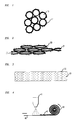
- the particle size of the dispersoid material advantageously is chosen to be substantially smaller (typically less than 10%) than the Pb powder size, such that, after mixing of the powders, the lead particles will be coated with dispersoid particles, as is schematically depicted in FIG. 1.
- the powders can be mixed by any appropriate technique, including dry mixing.
- a volatile liquid such as alcohol, acetone or, less preferably, water
- the volume fraction of liquid is in the range 10-40%, to provide for sufficient inter-particle friction to avoid substantial gravity-induced segregation.
- FIG. 1 schematically respectively, to Pb and dispersoid particles.
- the powder aggregate is dried, exemplarily in ambient air, in an inert atmosphere or under vacuum.
- the dry powder mixture is densified into a coherent porous body, exemplarily by compaction with, e.g., a hydraulic press, by cold rolling or forging.
- FIG. 2 The resulting material is schematically shown in FIG. 2, wherein numerals 20 and 21 refer, respectively to the deformed Pb particles and the dispersoid particles.
- Densification (at least the early stage thereof) is desirably carried out such that the pores in the material are substantially free of air, to avoid oxidation of internal surfaces and bubbling or expansion of trapped gas during subsequent heat treatment.
- densification in vacuum is currently preferred, although densification in an inert atmosphere may be acceptable in some cases.
- Densification will typically involve a substantial amount of plastic deformation (at least 50% cross section reduction, preferably at least 90 or 95%).
- the amount of deformation desirably is selected to yield an average distance between dispersoid particles in the thickness direction of at most 10 (preferably at most 3) times the average dispersoid particle size.
- the deformation need not be uniaxial, but could involve a repeated pressing/expanding process in any direction, analogous to kneading of dough.
- FIG. 3 schematically depicts highly densified material, with numerals 30 and 31 referring, respectively, to the lead matrix and the dispersoid particles.
- the thus produced dispersion-hardened lead according to the invention can be shaped as required, e.g., into plates or strips. This can be accomplished by conventional techniques, e.g., cold or warm rolling, swaging into rods, followed by roll flattening, or by shearing into short sections, stacking and further rolling.
- a further exemplary method of making dispersion-hardened lead according to the invention comprises providing a quantity of substantially pure (>98%, typically >99.5%) solid lead in sheet-form (thickness exemplarily in the range 0.005-0.25 inches, preferably 0.01-0.1 inches). Because of the mechanical softness of substantially pure lead, it may be desirable to use work-hardened sheets. Thus, an initial cold rolling treatment may be desirable. In order to facilitate the subsequent processing, cleaning of the surface of the lead sheet will also be desirable.
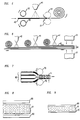
- FIG. 4 schematically shows coating of lead sheet 40 with dispersoid particle layer 42 by means of spray coater 41. The coated sheet is wound into coil ingot 43.
- FIG. 5 schematically depicts a further exemplary coating technique, wherein metal shavers or grinders 50 create fresh surfaces of lead sheet 40, and rollers 51 serve to attach the dispersoid layer (not shown) to the lead sheet.
- a still further exemplary technique is illustrated in FIG. 6, wherein a stack (60) of coated lead sheets is formed, and is bonded together by press 61.
- the ingot-like or stack-like composite preform that results from the coating step is then processed to form a material having a coherent lead matrix with a substantially uniform distribution of dispersoid particles.
- the processing exemplarily involves cold or warm rolling to reduce the inter-layer distance and to make the dispersoid particles to come closeer in the thickness direction of the resulting composite sheet. This is schematically illustrated in FIG. 7, wherein rollers 70 serve to compact stack 60 of dispersoid-coated lead sheets into material 71, a lamination-bonded lead-dispersoid composite.
- the preform typically comprises many (e.g., 10-10,000) layers of coated lead sheet.
- a smaller number of layers can be stacked or wound up, rolled, and restacked, with many repetitions.
- the lamination-bonded lead-dispersoid composite will be worked, in any appropriate manner, until composite material having a substantially uniform distribution of dispersoid particles in a lead matrix results. It may be desirable to carry out at least one or more early working steps in vacuum, or to evacuate pores and back-fill them with inert gas.
- a roughly 10 inch high stack of 500 layers of 0.02 inch thick Pb sheets, each coated with a 0.001-0.002 inches thick layer of 2 ⁇ m TiO 2 particles (about 5% by volume) is worked to yield a 0.020 inch thick sheet of material (about 99.8% reduction in area, or 1/500 reduction in thickness).
- the thickness of each initial sheet (and hence the inter-particle spacing in the thickness direction) is reduced to about 1 ⁇ m, which is of the same order of magnitude as the size of the dispersoid particles.
- an ideal, uniform, three-dimensional distribution of 5% by volume of 2 ⁇ m particles gives rise to a calculated inter-particle distance of 5 - 6 ⁇ m.
- the above example shows that a substantially uniform dispersoid distribution is readily attainable by a lamination/dispersion technique.
- FIG. 8 schematically illustrates an exemplary technique for applying the surface layers.
- Dispersion-hardened lead plate 81 is placed between thin sheets of lead 80, and a unitary structure is produced by conventional pressing or rolling. Those skilled in the art will appreciate that all bonding surfaces desirably are clean and free of oxide etc.
- FIG. 9 schematically depicts the resulting unitary structure.
- the dispersion-hardened material is formed by the above-described multi-layer process then it may be desirable to provide the lead surface material at an intermediate stage of the process. For instance, in the process illustrated by FIG. 6, the process could be arranged such that the outermost sheets remain uncoated.
- the preferred use of the dispersion-hardened lead according to the invention is in electrode grid structures for lead-acid batteries.
- Such grid structures typically take the shape of a rectangular outer "picture frame” and a grid adapted for holding quantities of active material (e.g., PbO 2 and Pb, respectively) substantially as shown, for instance, in "Handbook of Batteries", D. Linden, editor, 2nd edition, McGraw-Hill, Chapter 24.
- Electrode grid structures are made from dispersoid-containing lead by any appropriate process, e.g., by stamping from sheet produced as described above. Because of the much increased mechanical strength of the dispersoid-containing lead, the electrode thickness typically can be substantially reduced, as compared to prior art elemental Pb electrode grids or alloy grids. Since the dispersion-hardened Pb of the present invention can be made to be at least 30% stronger than the elemental Pb, and preferably at least 50% stonger and even more preferably at least 100% stronger, the electrode grid dimension can be reduced by essentially the same ratio of at least 30-100%, thus resulting in an improved battery energy density and a reduction in the amount of Pb.
- The, typically conventional, step of making the electrode grid structure from the dispersion-hardened material according to the invention is followed by a heat treatment
- This heat treatment is a significant aspect of the invention and can substantially increase the corrosion resistance of the electrode structure.
- the as-produced dispersion-hardened material according to the invention typically has, prior to the heat treatment, relatively small grain size, and consequently relatively low corrosion resistance.
- grain sizes are typically in the approximate range 0.5-10 ⁇ m for a dispersoid volume fraction in the range 2-10%, and an average dispersoid particle size of a few microns.
- the heat treatment is selected to result in substantial grain growth in the dispersion-hardened material, typically such that average grain size in the material is at least 20 ⁇ m, preferably at least 50 ⁇ m or 100 ⁇ m.
- average grain size is determined by the well known linear interception method.
- the meaningful grain dimension is the average grain diameter in the surface of the material, since it determines the total length of grain boundaries exposed to the corroding medium, i.e., to the sulfuric acid.
- the “grain size” is the diameter of a circle of equal area as the grain in the surface, and the “average” grain size is the average of the diameters.
- the heat treatment for grain growth is carried out at a temperature relatively close to the melting temperature of Pb, typically in the range 150 - 300°C, preferably 200 - 250°C.
- the heat treating time is at least 0.1 hour, preferably at least 1 hour, but in any case long enough to result in the desired average grain size of at least 20 ⁇ m.
- the heat treatment is carried out in an inert atmosphere, (e.g., N 2 , Ar) or in vacuum.
- the surface layer will typically provide primary protection against corrosion.
- the presence of pinholes in the Pb surface layer can result in contact of the electrolyte with the underlying material, and could lead to corrosion of the underlying material, unless that material is itself corrosion resistant.
- the heat treated dispersoid containing Pb according to this invention is such material.
- the heat treatment not only results in desirable grain growth but typically also improves the bonding of (optionally) lead surface sheets to the dispersion-hardened sheet.
- the electrode structures are allowed to cool to room temperature, and are then ready for incorporation into lead-acid batteries.
- These batteries can be conventional, aside from the use of one or more electrode grid structures according to the invention.
- the electrode grid structure holds Pb powder in the negative electrodes and PbO 2 powder in the positive electrodes. Spacers are provided to maintain the spacing between the various electrodes, and the electrodes are placed into a housing. Means for making electrical contact with the electrodes are provided, as is sulfuric acid electrolyte. Assembly can be conventional.
- Elemental Pb powder (>99.9% purity) with an average particle size of 200 mesh ( ⁇ 74 ⁇ m) was mixed with 5 volume % of TiO 2 particles with an average particle size of ⁇ 2 ⁇ m. A small amount of acetone was used as a wet lubricant. After gentle but thorough mixing so that most of the Pb particles were coated with the TiO 2 particles, the mixture was dried overnight, press-deformed using a hydraulic press at a pressure of about 10,000 psi into a strip form, cut into four pieces, stacked up and press-deformed again (by ⁇ 75% reduction in overall thickness). This stack-up and deformation processing was repeated 8 times with the final strip thickness of ⁇ 1 mm.
- the TiO 2 particles were initially separated from the next layer of TiO 2 by a distance equivalent to the Pb powder diameter ( ⁇ 74 ⁇ m), but this distance was reduced, through the repeated processing steps described above, by a calculated factor of (1/4) 8 or roughly 1/65000, which is much less than the average interparticle distance (about 5 -6 ⁇ m) in an ideally uniform distribution of 5 volume % of 2 ⁇ m particles. This implies that an essentially complete mixing and uniform distribution of the dispersoid particles in Pb was achieved.
- the deformation-processed composite strip was then subjected to a grain growth heat treatment at ⁇ 250°C for 48 hrs in an argon atmosphere.
- the degree of mechanical strengthening by the addition of TiO 2 dispersoid particles was measured by using a Vickers Hardness Tester, and compared with that of prior art Pb and a commercial Pb-Ca-Sn alloy as shown in Table 1.
- the inventive TiO 2 dispersion-strengthened Pb exhibit significantly improved mechanical hardness, about twice that of Pb or the Pb-Ca-Sn alloy. Table 1.
- each Pb layer in the lamination composite structure (which is the inter-particle distance in the thickness direction) is reduced by a similar factor from ⁇ 0.008" (200 ⁇ m) to ⁇ 1.25 ⁇ m.
- the latter dimension, ⁇ 1.25 ⁇ m is even smaller than the size of the TiO 2 particles, and is certainly smaller than the average inter-particle distance (5-6 ⁇ m) in an ideally uniform distribution of 5 volume % of 2 ⁇ m particles in the Pb matrix.
- the mechanical hardness of the so-processed dispersion hardened Pb is compared with that of pure Pb in Table II. Table II. Mechanical Hardness of Pb and Dispersion-hardened Pb Sheet Prepared by Lamination Rolling (After 250°C/16th Grain Growth Heat Treatment) Material Vicker's Hardness Pure Pb (prior art) 5.2 Pb-5% TiO 2 9.4
- the lamination-rolled, dispersion-hardened Pb exhibits substantial greater mechanical strength than the elemental Pb.
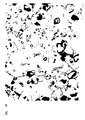
- FIG. 10 Shown in FIG. 10 is an optical micrograph of the dispersion-hardeded Pb exhibits substantial greater mechancial strength than the elemental Pb.
- FIG. 10 Shown in FIG. 10 is an optical micrograph of the dispersion-hardened and grain-growth annealed Pb of Example 3, taken at a magnification of x500. It shows a relatively uniform distribution of the TiO 2 particles and an average grain size of about 20 ⁇ m grain size.
- FIGS. 1a) and b) are cross-sectional photomicrographs of the same sample at x500 and x1000, showing the distribution of the TiO 2 dispersoid and a relatively large grain width of Pb.
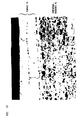
- Shown in FIG. 12 is a cross-sectional photomicrograph of TiO 2 dispersion-hardened Pb with an additional surface lamination layer of corrosion-resistant pure Pb. The sample was produced by a technique substantially like that of Example 3.
Landscapes
- Chemical & Material Sciences (AREA)
- Chemical Kinetics & Catalysis (AREA)
- General Chemical & Material Sciences (AREA)
- Engineering & Computer Science (AREA)
- Electrochemistry (AREA)
- Materials Engineering (AREA)
- Organic Chemistry (AREA)
- Metallurgy (AREA)
- Mechanical Engineering (AREA)
- Dispersion Chemistry (AREA)
- Inorganic Chemistry (AREA)
- Manufacturing & Machinery (AREA)
- Cell Electrode Carriers And Collectors (AREA)
- Battery Electrode And Active Subsutance (AREA)
- Secondary Cells (AREA)
Applications Claiming Priority (2)
| Application Number | Priority Date | Filing Date | Title |
|---|---|---|---|
| US61442596A | 1996-03-12 | 1996-03-12 | |
| US614425 | 1996-03-12 |
Publications (2)
| Publication Number | Publication Date |
|---|---|
| EP0795918A2 true EP0795918A2 (de) | 1997-09-17 |
| EP0795918A3 EP0795918A3 (de) | 2000-08-23 |
Family
ID=24461220
Family Applications (1)
| Application Number | Title | Priority Date | Filing Date |
|---|---|---|---|
| EP97301454A Withdrawn EP0795918A3 (de) | 1996-03-12 | 1997-03-04 | Bleisäurebatterie mit Elektrodenstruktur und Verfahren zur Herstellung |
Country Status (3)
| Country | Link |
|---|---|
| US (1) | US5964904A (de) |
| EP (1) | EP0795918A3 (de) |
| JP (1) | JP3521106B2 (de) |
Cited By (3)
| Publication number | Priority date | Publication date | Assignee | Title |
|---|---|---|---|---|
| EP0926751A3 (de) * | 1997-12-18 | 1999-12-08 | Texas Instruments Incorporated | Verfahren zur Herstellung von Verbundwerkstoffen unter Verwendung von Blei-Legierungen und nach diesem Verfahren hergestellte Kompositbänder |
| FR2796495A1 (fr) * | 1999-07-12 | 2001-01-19 | Conseil Et De Prospective Scie | Electrodes d'accumulateurs au plomb |
| US6797403B2 (en) * | 2001-02-26 | 2004-09-28 | Teck Cominco Metals Ltd. | Continuous extruded lead alloy strip for battery electrodes |
Families Citing this family (7)
| Publication number | Priority date | Publication date | Assignee | Title |
|---|---|---|---|---|
| US7174626B2 (en) * | 1999-06-30 | 2007-02-13 | Intersil Americas, Inc. | Method of manufacturing a plated electronic termination |
| US7131768B2 (en) * | 2003-12-16 | 2006-11-07 | Harco Laboratories, Inc. | Extended temperature range EMF device |
| JP4899467B2 (ja) * | 2005-12-21 | 2012-03-21 | 新神戸電機株式会社 | 鉛蓄電池 |
| JP5642694B2 (ja) * | 2008-11-10 | 2014-12-17 | クライロン・グローバル・エルエルシー | 改善された物理的および電気的特性を有する固体組成物 |
| CN104805432A (zh) * | 2015-04-01 | 2015-07-29 | 苏州第一元素纳米技术有限公司 | 一种金属/纳米碳复合材料的制备方法 |
| JP7045505B1 (ja) * | 2021-03-26 | 2022-03-31 | 古河電池株式会社 | 鉛蓄電池用集電シート、鉛蓄電池、双極型鉛蓄電池 |
| US20240072256A1 (en) * | 2022-08-25 | 2024-02-29 | Uchicago Argonne, Llc | Well-defined lead-acid battery active materials |
Family Cites Families (5)
| Publication number | Priority date | Publication date | Assignee | Title |
|---|---|---|---|---|
| US4003755A (en) * | 1975-08-22 | 1977-01-18 | Robert Lawrence Gustison | Dispersion-hardened lead alloy |
| US4282922A (en) * | 1980-05-16 | 1981-08-11 | E. I. Du Pont De Nemours And Company | Lead coated alumina fiber and lead matrix composites thereof |
| US4463058A (en) * | 1981-06-16 | 1984-07-31 | Atlantic Richfield Company | Silicon carbide whisker composites |
| JPS62193062A (ja) * | 1986-02-19 | 1987-08-24 | Mitsubishi Heavy Ind Ltd | 蓄電池電極 |
| IT1219702B (it) * | 1988-06-01 | 1990-05-24 | Nuova Samin Spa | Materiali compositi di piombo o sue leghe rinforzati con polveri e/o fibre ceramiche e usi degli stessi |
-
1997
- 1997-03-04 EP EP97301454A patent/EP0795918A3/de not_active Withdrawn
- 1997-03-11 JP JP05591597A patent/JP3521106B2/ja not_active Expired - Fee Related
-
1998
- 1998-12-23 US US09/219,466 patent/US5964904A/en not_active Expired - Lifetime
Cited By (5)
| Publication number | Priority date | Publication date | Assignee | Title |
|---|---|---|---|---|
| EP0926751A3 (de) * | 1997-12-18 | 1999-12-08 | Texas Instruments Incorporated | Verfahren zur Herstellung von Verbundwerkstoffen unter Verwendung von Blei-Legierungen und nach diesem Verfahren hergestellte Kompositbänder |
| US6096145A (en) * | 1997-12-18 | 2000-08-01 | Texas Instruments Incorporated | Method of making clad materials using lead alloys and composite strips made by such method |
| US6475675B1 (en) | 1997-12-18 | 2002-11-05 | Engineered Materials Solutions, Inc. | Method of making clad materials using lead alloys and composite strips made by such method |
| FR2796495A1 (fr) * | 1999-07-12 | 2001-01-19 | Conseil Et De Prospective Scie | Electrodes d'accumulateurs au plomb |
| US6797403B2 (en) * | 2001-02-26 | 2004-09-28 | Teck Cominco Metals Ltd. | Continuous extruded lead alloy strip for battery electrodes |
Also Published As
| Publication number | Publication date |
|---|---|
| JPH09330709A (ja) | 1997-12-22 |
| EP0795918A3 (de) | 2000-08-23 |
| US5964904A (en) | 1999-10-12 |
| JP3521106B2 (ja) | 2004-04-19 |
Similar Documents
| Publication | Publication Date | Title |
|---|---|---|
| CA1327956C (en) | Method and apparatus for coating a core material with metal | |
| US4939051A (en) | Grid for use in lead acid batteries and process for producing same | |
| US5964904A (en) | Method of making an article that comprises dispersion-hardened lead | |
| DE10122366B4 (de) | Verfahren zum Herstellen einer Batteriezelle | |
| CN100365851C (zh) | 薄锂膜电池 | |
| JP2010177212A (ja) | 固体高分子型燃料電池材料とその製造方法、ならびにそれを用いた燃料電池用金属部材及び燃料電池 | |
| EP0795917A2 (de) | Bleisaürebatterie mit korrosionsbeständiger Elektrodenstruktur und Verfahren zur Herstellung | |
| EP0270670A1 (de) | Lagermetallschicht und verfahren zu deren herstellung. | |
| EP0301279B1 (de) | Leiter, der aus einem Verbundwerkstoff besteht | |
| CA2493792C (en) | Lead-based alloy for lead-acid battery grid | |
| DE69802733T2 (de) | Verfahren zur Herstellung eines porösen Metallblechs | |
| EP0305820B1 (de) | Verfahren zur Herstellung eines Supraleiters | |
| US6749950B2 (en) | Expanded grid | |
| US20220285692A1 (en) | Multilayered anode and associated methods and systems | |
| WO2008105559A1 (ja) | 鉛蓄電池 | |
| US6475675B1 (en) | Method of making clad materials using lead alloys and composite strips made by such method | |
| CA1114898A (en) | Bipolar electrode support structure with leadless sealable rim portion | |
| EP1278256A2 (de) | Oberflächenbeschichtung von einer Bleilegierung für Bleisäurebatterie-Gitter und Verfahren zu seiner Anwendung | |
| US4178216A (en) | Process for bipolar electrode support structures | |
| EP0440799B1 (de) | Supraleitfähiges drahtmaterial und verfahren zur herstellung | |
| EP0361268B1 (de) | Verfahren zur Formgebung schwierig zu bearbeitender legierter Gegenstände | |
| EP0579574A1 (de) | Neues aktives Material von einer Elektrode aus Wasserstoffspeicherlegierung | |
| WO1986003343A1 (en) | Laminated lead alloy strip for battery grid application and electrochemical cells utilizing same | |
| EP0402514B1 (de) | Sinterfolien-Elektrode für Nickel-Cadmium-Akkumulatoren und Verfahren zur Herstellung der Elektrode | |
| US5660943A (en) | Integrated primary-auxiliary electrodes formed on catalytic mesh-matrix-plaque with single-side-active-surface |
Legal Events
| Date | Code | Title | Description |
|---|---|---|---|
| PUAI | Public reference made under article 153(3) epc to a published international application that has entered the european phase |
Free format text: ORIGINAL CODE: 0009012 |
|
| AK | Designated contracting states |
Kind code of ref document: A2 Designated state(s): DE FR GB |
|
| PUAL | Search report despatched |
Free format text: ORIGINAL CODE: 0009013 |
|
| AK | Designated contracting states |
Kind code of ref document: A3 Designated state(s): DE FR GB |
|
| RIC1 | Information provided on ipc code assigned before grant |
Free format text: 7H 01M 4/73 A, 7C 22C 32/00 B, 7C 22C 1/10 B |
|
| 17P | Request for examination filed |
Effective date: 20010208 |
|
| STAA | Information on the status of an ep patent application or granted ep patent |
Free format text: STATUS: THE APPLICATION HAS BEEN WITHDRAWN |
|
| 18W | Application withdrawn |
Withdrawal date: 20021120 |