EP0796607B1 - Polymère polymérisable et fonctionalisé - Google Patents
Polymère polymérisable et fonctionalisé Download PDFInfo
- Publication number
- EP0796607B1 EP0796607B1 EP97250080A EP97250080A EP0796607B1 EP 0796607 B1 EP0796607 B1 EP 0796607B1 EP 97250080 A EP97250080 A EP 97250080A EP 97250080 A EP97250080 A EP 97250080A EP 0796607 B1 EP0796607 B1 EP 0796607B1
- Authority
- EP
- European Patent Office
- Prior art keywords
- cooh
- polymer
- alkyl
- unsubstituted
- substituted
- Prior art date
- Legal status (The legal status is an assumption and is not a legal conclusion. Google has not performed a legal analysis and makes no representation as to the accuracy of the status listed.)
- Expired - Lifetime
Links
Classifications
-
- C—CHEMISTRY; METALLURGY
- C08—ORGANIC MACROMOLECULAR COMPOUNDS; THEIR PREPARATION OR CHEMICAL WORKING-UP; COMPOSITIONS BASED THEREON
- C08G—MACROMOLECULAR COMPOUNDS OBTAINED OTHERWISE THAN BY REACTIONS ONLY INVOLVING UNSATURATED CARBON-TO-CARBON BONDS
- C08G61/00—Macromolecular compounds obtained by reactions forming a carbon-to-carbon link in the main chain of the macromolecule
- C08G61/02—Macromolecular compounds containing only carbon atoms in the main chain of the macromolecule, e.g. polyxylylenes
- C08G61/04—Macromolecular compounds containing only carbon atoms in the main chain of the macromolecule, e.g. polyxylylenes only aliphatic carbon atoms
- C08G61/06—Macromolecular compounds containing only carbon atoms in the main chain of the macromolecule, e.g. polyxylylenes only aliphatic carbon atoms prepared by ring-opening of carbocyclic compounds
- C08G61/08—Macromolecular compounds containing only carbon atoms in the main chain of the macromolecule, e.g. polyxylylenes only aliphatic carbon atoms prepared by ring-opening of carbocyclic compounds of carbocyclic compounds containing one or more carbon-to-carbon double bonds in the ring
-
- A—HUMAN NECESSITIES
- A61—MEDICAL OR VETERINARY SCIENCE; HYGIENE
- A61K—PREPARATIONS FOR MEDICAL, DENTAL OR TOILETRY PURPOSES
- A61K6/00—Preparations for dentistry
- A61K6/70—Preparations for dentistry comprising inorganic additives
- A61K6/71—Fillers
- A61K6/77—Glass
-
- C—CHEMISTRY; METALLURGY
- C08—ORGANIC MACROMOLECULAR COMPOUNDS; THEIR PREPARATION OR CHEMICAL WORKING-UP; COMPOSITIONS BASED THEREON
- C08G—MACROMOLECULAR COMPOUNDS OBTAINED OTHERWISE THAN BY REACTIONS ONLY INVOLVING UNSATURATED CARBON-TO-CARBON BONDS
- C08G61/00—Macromolecular compounds obtained by reactions forming a carbon-to-carbon link in the main chain of the macromolecule
- C08G61/12—Macromolecular compounds containing atoms other than carbon in the main chain of the macromolecule
Definitions
- the invention relates to a functionalized and polymerizable Polymer, a process for its preparation, its Use and compositions containing the polymer.
- Polymers functionalized by carboxyl groups such as poly (acrylic acid) and poly (methacrylic acid) and homopolymers and copolymers based on maleic acid or fumaric acid, can be found in the Technology wide application. They are used, among other things, as or thickener, as a component of coatings or Adhesives and used as leather or textile auxiliaries (see Ullmann's Encyclopedia of Industrial Chemistry, 5th ed., Vol. A21, VCH Publisher, Weinheim 1992, p. 143 ff. And Encyclopedia of Polymer Science and Engineering, Vol. 9, Wiley & Sons, New York 1987, pp. 225 ff.).
- Polyacrylic acid is also used in the dental field as a component of so-called carboxylate cements or of Aluminosilicate-polyacrylic acid cements used (see K. Körber, K. Ludwig, Dental Materials Science and Technology, Thieme-Verlag, Stuttgart-New York 1982, pp. 57 ff.).
- glass ionomer cements have found great practical interest in recent years. They are cements made from mixtures of a Ca-Al-F silicate glass powder with an aqueous solution, for example an acrylic acid-maleic acid copolymer. They are used as fastening cements, filling materials, underfilling materials, adhesives or fissure sealants in the dental field (cf. AD Wilson, JD McLean, Glasionomerzement, Quintessens-Verlag, Berlin 1988, p. 21 ff.).
- polycarboxylic acids which carry pendant polymerizable groups.
- Such polycarboxylic acids can be obtained, for example, by polymer-analogous reaction of polyacrylic acid with allyl isocyanate or 2-isocyanatoethyl methacrylate (cf. EP-B-323 120 and SB Mitra, Amer. Chem. Soc., Polym. Div., Polym. Prep. 32 , (1991) p .
- Bicyclic methacrylates are also known.
- US Pat. No. 4,054,233 discloses the synthesis and polymerization of bicyclo [2.2.1] hept-5-en-2-ylmethyl methacrylate in connection with peroxidically crosslinkable layers.
- bicyclo [2.2.1.] Hept-5-en-2-ylmethyl methacrylate or borneol methacrylate are used in the production of PVC with improved heat stability.
- CA-A-1 013 095 discloses adhesive polymers based on reaction products of bicyclo [2.2.1] hept-5-ene-2,3-dicarboxylic acid anhydride with hydroxyalkyl (meth) acrylates, such as 2-hydroxyethyl methacrylate.
- hydroxyalkyl (meth) acrylates such as 2-hydroxyethyl methacrylate.
- free-radically crosslinkable polyimides are known which are accessible via 7-oxa-5,6-dicarboxyimid-N-yl-bicyclo [2.2.1] hept-2-enacrylate.
- products of the reaction of dicyclopentadiene with (meth) acrylic acid are also known (cf. S. Teshigahara, Y. Kano, Toso Kenkyu Hokoko, 35 (1991) p. 47 and Chem. Abstr. 116 , 84740).
- the invention is based on the object, a functionalized and to provide polymerizable polymer, made in a simple way and at room temperature can be radically polymerized, high adhesion shows different substrates, with reactive fillers cements forms and therefore in particular as a component of cements, Coating materials, adhesives or composites and preferably of dental materials can be used.
- This task is through the functionalized and polymerizable polymer solved according to claims 1 and 2.
- the present invention also relates to a A process for producing the polymer of claim 3, the Use according to claims 4 and 5 and compositions containing the polymer according to claims 6 to 9.
- A-B and X are also in the individual five-membered rings chosen independently.
- alkyl and aryl groups of Z, R 1 , R 2 , R 3 , R 4 and R 5 can optionally with one or more simple functional groups, in particular COOH, OH, C 1 - to C 6 -alkoxy or halogen , be substituted.
- preferred compounds are those in which at least one of the variables of formula (I) the one described above preferred definition.
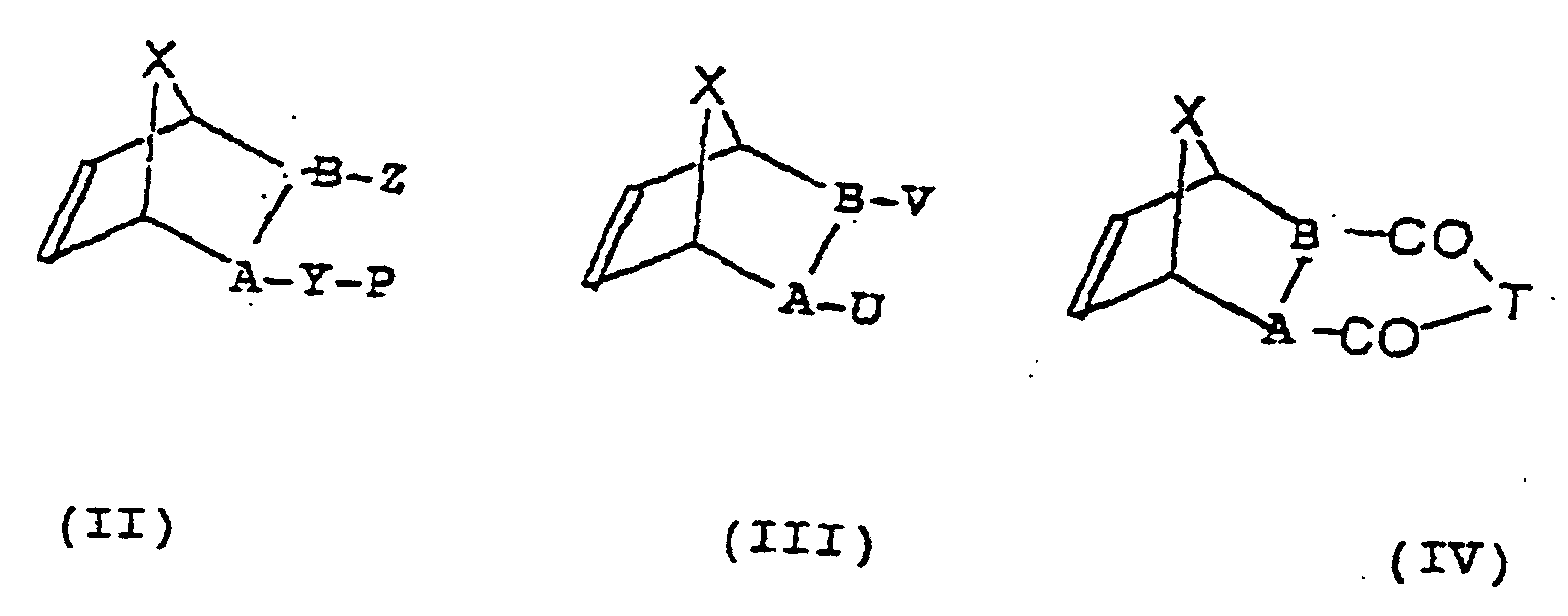
- the bicyclic compound (II) or, if appropriate, mixtures of (II) with the bicyclic compound (III) and / or the bicyclic compound (IV) is subjected to a ring-opening metathesis polymerization in the presence of a catalyst and cleaved when protected compounds are used Then reactants from existing protective groups. After the metathesis polymerization, the positions of A and B with the residues attached to them can no longer be distinguished from one another. Instead of (II), (III) and (IV), it is also possible to use those compounds as starting materials in which only the positions of A and B are interchanged with the radicals attached to them.
- Suitable protecting groups are trimethylsilyl and Tetrahydropyranyl groups.
- polymer (I) according to the invention is also accessible by polymer-analogous reaction of the polymer (V) with polymerizable starting materials P-halogen in accordance with the following reaction equation:
- the polymer (V) can be prepared by ring-opening metathesis polymerization of a mixture of the bicyclic compound (VI) with the bicyclic compound (III) and the bicyclic compound (IV) in the presence of a suitable catalyst.
- catalyst systems based on compounds of transition metals from subgroups IV to VIII can be used as catalysts for ring-opening methathesis polymerization (R ⁇ MP) (cf.Encyclopedia of Polymer Science and Engineering, Vol. 9, J. Wiley & Sons, New York 1987, pp. 648 ff.).
- R ⁇ MP ring-opening methathesis polymerization
- Compounds of Mo, W, Ru, Os and Ir are used in particular.
- Common catalysts are based on metal carbene complexes, such as Ru, W or Mo carbene complexes (cf. RR Schrock, Acc. Chem. Res. 23 (1990) 158).
- Simple salts such as K 2 RuCl 5 or the hydrates of RuCl 3 or OsCl 3 are particularly suitable for the ring-opening metathesis polymerization of polar monomers (WJ Feast, DB Harrison, Polymer 32 (1991) 558).
- Various solvents can be used, depending on the catalyst used.
- aprotic solvents such as THF, benzene, chlorobenzene, toluene, pentane or dichloromethane are used, while with RuCl 3 the ring-opening metathesis polymerization is usually carried out in an aqueous-alcoholic medium.
- the use of 1-alkenes, cis-2-butene-1,4-diol or acrylic acid is particularly suitable for regulating the molar mass of the polymers obtained.
- the temperature at which the polymerization is carried out is normally in the range from 15-60 ° C. when using metal carbenes as catalyst and in the case of RuCl 3, for example, at 40 to 70 ° C.
- bicyclic compounds of the formulas (II), (III) used, (IV) and (VI) are known or can be carried out by known processes can be produced in a simple manner.
- Representatives of the general formula (II) are, for example, bicyclo [2.2.1] hept-5-en-2-ylmethyl allyl ether (VII), bicyclo [2.2.1.] Hept-5-en-2-ylmethyl acrylate (VIII), Bicyclo [2.2.1] hept-2,5-dien-2-ylmethyl methacrylate (IX), 7-oxabicyclo [2.2.1] hept-5-en-2-ylmethyl methacrylate (X), bicyclo [2.2.1] hept- 5-en-2-ylmethyl methacrylate (XI) or the 1: 1 reaction product (XII) of bicyclo [2.2.1] hept-5-en-2,3-dicarboxylic acid anhydride and 2-hydroxyethyl methacrylate, where (XI) and (XII ) are known.
- Representatives of the general formula (III) are, for example, bicyclo [2.2.1] hept-5-en-2-carboxylic acid (XIII), bicyclo [2.2.1] hept-5-en-2,3-dicarboxylic acid monomethyl ester (XIV), bicyclo [2.2.1] hept-2,5-diene-2,3-dicarboxylic acid (XV), bicyclo [2.2.1] hept-5-ene-2,3-dicarboxylic acid (XVI) or 7-oxabicyclo [2.2.1 ] hept-5-en-2,3-dicarboxylic acid (XVII), where (XVI) and (XVII) are known.
- Representatives of the general formula (IV) are, for example, bicyclo [2.2.1] hept-5-en-2,3-dicarboximide (XVIII), bicyclo [2.2.1] hept-2,5-diene-2,3-dicarboxylic acid anhydride ( XIX), bicyclo [2.2.1] hept-2,5-diene-2,3-dicarboxylic acid-N-phenglimide (XX), bicyclo [2.2.1] hept-5-ene-2,3-dicarboxylic anhydride (XXI) or 7-oxabicyclo [2.2.1] hept-5-en-2,3-dicarboxylic anhydride (XXII), where (XXI) and (XXII) (see O. Diels, K. Alder, Chem. Ber. 62 , ( 1929) p. 557) are known.
- Representatives of the general formula (VI) are, for example, 7-oxabicyclo [2.2.1] hept-5-en-2-carboxylic acid (XXIII), 7-oxabicyclo [2.2.1] hept-2,5-diene-2-carboxylic acid ( XXIV), bicyclo [2.2.1] hept-5-en-2-carboxylic acid 2-hydroxyethyl ester (XXV), bicyclo [2.2.1] hept-5-en-2-methanol (XXVI) or bicyclo [2.2.1 ] has 5-en-2-carboxylic acid (XIII), (XXVI) and (XIII) being known.
- the bicyclic compounds of the formulas (II) to (IV) and those of the formula (VI) can be carried out in a simple manner Diels-Alder reaction (see H. Wollweber, Diels-Alder reaction, G. Thieme-Verlag 1972) of cyclopentadiene or furan suitable dienophiles, such as maleic acid, acetylenedicarboxylic acid or acrylic acids or their derivatives, and, if applicable, subsequent ones Modification, e.g. through reduction, hydrolysis, etherification or esterification of the resulting bicyclic Connections.
- Special polymers according to the invention can be used in particular by ring-opening metathesis copolymerization from the known Bicyclo [2.2.1] hept-5-en-2-ylmethyl methacrylate (XI) with a trimethylsilyl or tetrahydropyranyl protected, commercially available Bicyclo [2.2.1] hept-5-en-2,3-dicarboxylic acid in the presence of a suitable molybdenum-carbene catalyst and subsequent Establish deprotection by acid hydrolysis.
- Bicyclo [2.2.1] hept-5-en-2-ylmethyl methacrylate (XI) with a trimethylsilyl or tetrahydropyranyl protected
- Bicyclo [2.2.1] hept-5-en-2,3-dicarboxylic acid in the presence of a suitable molybdenum-carbene catalyst and subsequent Establish deprotection by acid hydrolysis.
- the polymer according to the invention is particularly suitable as constituents of cements, coating materials and composites and especially of adhesives.
- This is particularly preferred Polymer according to the invention as a dental material or part of Dental material, in particular as part of dental adhesives, used. His ability proves to be advantageous that on the one hand it has existing polymerizable groups, such as (Meth) acrylate groups a bond with the one to be fastened Material, e.g. a composite material, forms and on the other hand an interaction promoting the adhesion via carboxyl groups with the substrate, such as the hard tooth substance in particular, can train.
- polymerizable groups such as (Meth) acrylate groups
- the polymer according to the invention When using the polymer according to the invention as a component of Dental materials are usually used in an amount of 0.1 up to 60, in particular 1.0 to 40% by weight, based on the dental material, used.
- the polymer of the invention in particular with polymerizable organic binders, crosslinking monomers, fillers, reactive fillers, polymerization initiators and / or other additives, such as conventional stabilizers, e.g. hydroquinone (MEHQ) or 2,6-di-tert-butyl-4-methylphenol (BHT), UV absorbers, pigments, dyes or solvents, combined.
- conventional stabilizers e.g. hydroquinone (MEHQ) or 2,6-di-tert-butyl-4-methylphenol (BHT)
- UV absorbers e.g. hydroquinone (MEHQ) or 2,6-di-tert-butyl-4-methylphenol (BHT)
- polymerizable organic binders for a binder useful in dental material, in particular monofunctional or polyfunctional (meth) acrylates alone or can be used in mixtures.
- Preferred examples for these compounds are methyl (meth) acrylate, isobutyl (meth) acrylate, Cyclohexyl (meth) acrylate, tetraethylene glycol di (meth) acrylate, Triethylene glycol di (meth) acrylate, diethylene glycol di (meth) acrylate, Ethylene glycol di (meth) acrylate, polyethylene glycol di (meth) acrylate, Butanediol di (meth) acrylate, hexanediol di (meth) acrylate, Decanediol di (meth) acrylate, dodecanediol di (meth) acrylate, Bisphenol-A-di (meth) acrylate, trimethylolpropane tri (meth) acrylate
- Particularly preferred examples of the latter mentioned products are by reaction of 1 mole of hexamethylene diisocyanate with 2 moles of 2-hydroxyethylene methacrylate, of 1 mole Tri- (6-isocyanatohexyl) biuret with 3 moles of 2-hydroxyethyl methacrylate and 1 mole of 2,2,4-trimethylhexamethylene diisocyanate with 2 moles 2-hydroxyethyl methacrylate available.
- the organic binders are usually used in an amount from 0 to 90% by weight in the dental material according to the invention used.
- polyfunctional (meth) acrylates in particular Triethylene glycol di (meth) acrylate, polyethylene glycol di (meth) acrylate, Bis-GMA or urethane di (meth) acrylates.
- the crosslinking monomer is usually used in an amount of 0 up to 80 wt .-% used in the dental material according to the invention.
- Examples of preferred fillers are quartz, glass ceramic and Glass powder, in particular barium silicate glasses, Li / Al silicate glasses and barium glasses, aluminum or silicon oxides, very fine particles Silicas, especially pyrogenic or precipitated silicas, X-ray opaque fillers, such as ytterbium trifluoride.
- the fillers are typically used in an amount of 0 to 85 % By weight, based on the dental material, is used.
- Fluoralumosilicate glasses are the main reactive fillers and other glasses used in glass ionomer cements.
- the reactive fillers are usually used in an amount of 0 to 80 wt .-% used in the dental material according to the invention.
- Dental materials according to the invention are particularly preferred light-curing glass ionomer cements, dentine adhesives and compomers.
- the dental materials according to the invention and the inventive Polymers can be polymerized hot, cold or by light.
- the known ones can be used as initiators for the hot polymerization
- Peroxides such as dibenzoyl peroxide, dilauroyl peroxide, tert-butyl peroctoate or tert-butyl perbenzoate can be used.
- 2,2'-azoisobutyronitrile (AIBN) benzpinacol and 2,2'-dialkylbenzpinacoles are suitable.
- initiators for photopolymerization for example Benzophenone and its derivatives and benzoin and its derivatives be used.
- Other preferred photoinitiators are ⁇ -diketones such as 9,10-phenanthrenequinone, diacetyl, furil, anisil, 4,4'-dichlorobenzil and 4,4'-dialkoxybenzil. Particularly preferred camphorquinone is used.
- the Group of acylphosphine oxides good for initiating photopolymerization.
- the photoinitiators are used to accelerate the initiation preferably together with a reducing agent, particularly preferably with an amine, especially an aromatic Amine.
- Radicals are used as initiators for cold polymerization supplying redox systems, for example benzoyl or lauroyl peroxide together with amines such as N, N-dimethyl-p-toluidine, N, N-dihydroxyethyl-p-toluidine or other structurally related amines used.
- the combination of photoinitiators has been different Proven redox systems.
- Combinations are preferred from camphorquinone, benzoyl peroxide and amines such as N, N-dimethyl-ptoluidine and / or N, N-cyanoethylmethylaniline.
- the concentration of the initiators is preferably in the range of 0.05 to 2.0% by weight, particularly preferably in the range from 0.1 to 0.8% by weight, based on the dental material.
- Example 4 Synthesis of a usable as a catalyst Molybdenum carbene complex
- the catalyst described in this example has the following structural formula and is referred to below as HF catalyst.
- Ring-opening metathesis polymerization with transition metal carbene complexes is in an inert gas atmosphere in absolute aprotic solvents such as chlorobenzene, benzene, toluene, THF or dichloromethane, with 1-alkenes, e.g. 1-hexene, used as a chain transfer agent to adjust the molecular weight become.
- absolute aprotic solvents such as chlorobenzene, benzene, toluene, THF or dichloromethane
- 1-alkenes e.g. 1-hexene
- the polymer is dissolved in THF, and the solution formed is slowly dripped into a hot solution of about 50 mg of p-toluenesulfonic acid in 30 ml of stabilized ethanol, so that the turbidity which arises in each case dissolves.
- the mixture is stirred for a further 20 minutes and the ethanol-soluble polymer (4) precipitates from a mixture of pentane / diethyl ether (2/1 parts by volume).
- the polymerization solution quickly becomes highly viscous. After 2 hours, the polymerization is stopped by dropping the polymerization solution in about 100 ml of ethanol. The precipitated polymer is filtered off and dried and shows a number average molecular weight (GPC, calibration with polystyrene standards) of 31000 g / mol.
- GPC number average molecular weight
- the polymer is dissolved in 10 ml of THF and the solution is slowly added dropwise to a solution of 30 mg of p-toluenesulfonic acid in 50 ml of ethanol at 50 ° C. so slowly that the precipitate formed dissolves again and again.
- terpolymer (5) 1.3 g (68% yield) of terpolymer (5) are finally obtained by dropping the polymer solution obtained in 400 ml of diethyl ether and drying the residue obtained in vacuo.
- the number average molecular weight determined by GPC is 14000 g / mol, the 1 H-NMR spectrum showing that the composition of the terpolymer corresponds to the composition of the monomer mixture used.
- Example 7 Synthesis of polymers according to the invention by ring-opening Metathesis polymerization of monomer (3) and subsequent polymer-analogous reaction with GMA
- Example 5 Analogously to Example 5, a solution of 50 mg of HF catalyst in 2 ml of chlorobenzene is added to a solution of 23 g of monomer (3) and 153 mg of 1-hexene in 80 ml of chlorobenzene. After 2 hours, the same amount of catalyst solution is added again. The polymerization is stopped after 4 hours. The polymerization solution is diluted with 300 ml of ethanol and, after the addition of 50 mg of p-toluenesulfonic acid, is refluxed for 30 minutes to split off the protective group. The solution obtained is then evaporated to dryness in vacuo.
- Example 8 Dentine adhesive based on the copolymer (4)
- a 1-component dentin adhesive with the following composition is produced on the basis of copolymer ( 4 ): Copolymer ( 4 ) 18.0% by weight Water, deionized 32.4% by weight 2-hydroxyethyl methacrylate 44.2% by weight maleic 3.0% by weight camphorquinone 0.3% by weight MeHQ 0.1% by weight ammonium fluoride 1.0% by weight diphenyliodonium 1.0% by weight
- Example 9 Light-curing glass ionomer cement on the base from the copolymer (4)
- Liquid 1 urethane 56.5% by weight 2-hydroxyethyl methacrylate 18.8% by weight PEG 600 dimethacrylate 18.8% by weight 1% aqueous solution of p-toluenesulfonic acid 5.1% by weight 2-cyanoethylmethylaniline 0.5% by weight camphorquinone 0.3% by weight
- Powder 2 Reactive glass powder 92.5% by weight Copolymer ( 4 ) 6.0% by weight L (+) - tartaric acid 1.5% by weight
- a mixture is produced from one part by weight of the liquid 1 and the powder 2.
- Test specimens are produced with the material, which are stored in H 2 O at 37 ° C. for 2 hours and then irradiated twice for 90 seconds using a dental radiation source, Spectramat (Vivadent).
- the compressive strength determined according to ISO standard 9917 is 128.4 MPa, compared to 117.1 MPa for a material in which the copolymer ( 4 ) in the powder is made up of the same proportion of Plex 4779 polyacrylic acid was replaced.
Landscapes
- Health & Medical Sciences (AREA)
- Chemical & Material Sciences (AREA)
- Chemical Kinetics & Catalysis (AREA)
- Medicinal Chemistry (AREA)
- Polymers & Plastics (AREA)
- Organic Chemistry (AREA)
- Animal Behavior & Ethology (AREA)
- Veterinary Medicine (AREA)
- Epidemiology (AREA)
- Life Sciences & Earth Sciences (AREA)
- Inorganic Chemistry (AREA)
- General Health & Medical Sciences (AREA)
- Public Health (AREA)
- Oral & Maxillofacial Surgery (AREA)
- Addition Polymer Or Copolymer, Post-Treatments, Or Chemical Modifications (AREA)
- Polyoxymethylene Polymers And Polymers With Carbon-To-Carbon Bonds (AREA)
- Dental Preparations (AREA)
- Compositions Of Macromolecular Compounds (AREA)
- Paints Or Removers (AREA)
- Adhesives Or Adhesive Processes (AREA)
Claims (9)
- Polymère fonctionnalisé et polymérisable, caractérisé en ce qu'il comporte les motifs répétitifs (IA), (IB) et (IC) suivants :dans lesquels X, A-B, Y, P, Z, U, V, T, R1, R2, R3, R4 et R5 ont indépendamment les uns des autres les significations suivantes :

- X
- = CH2 ou O ;
- A-B
- = C-C- ou C=C ;
- Y =
- CH2O, CO-O ou COO-R1-O,
R1 représentant un groupe alkylène ou oxyalkylène en C1-C5 substitué ou non substitué ; - P =
- un groupe polymérisable, à savoir CH2=CH-CO-, CH2=C(CH3)-CO-, CH2=CH-CH2- ou CH2=CH-C6H5-CH2- ;
- Z =
- H, COOH, un groupe alkyle en C1-C12 substitué ou non substitué ou
COOR4,
R4 représentant un groupe alkyle en C1-C12 ou aryle en C6-C14 substitué ou non substitué ; - U =
- COOH ou COOR5,
R5 représentant un groupe alkyle en C1-C12 ou aryle en C6-C14 substitué ou non substitué ; - V =
- H, COOH, CH2-OH, OR2 ou CO-OR2,
R2 représentant un groupe alkyle en C1-C12 ou aryle en C6-C14 substitué ou non substitué ; et - T =
- O, NH ou NHR3,
R3 représentant un groupe alkyle en C1-C12 ou aryle en C6-C14 substitué ou non substitué ;
la fraction molaire a du motif (IA), la fraction molaire b du motif (IB) et la fraction molaire c du motif (IC) étant comme suit :- a =
- 0,05 à 1,0 ;
- b =
- 0 à 0,95 et
- c =
- 0 à 0,90.
- Polymère selon la revendication 1, caractérisé en ce que les variables ont indépendamment les unes des autres les significations suivantes :
- X =
- CH2 ou O ;
- A-B =
- C-C ;
- Y =
- CH2O ou CO-O-R1-O ;
- R1 =
- CH2CH2 ou CH2-CHOH-CH2 ;
- P =
- CH2=C(CH3)-CO ;
- Z =
- H ou COOH ;
- R4 =
- CH3, C2H5 ou phényle ;
- U =
- COOH ;
- R5 =
- CH3, C2H5 ou phényle ;
- V =
- H ou COOH ;
- R2 =
- CH3 ou C2H5 ;
- T =
- O ;
- R3 =
- CH3 ou phényle ;
- a =
- 0,10 à 0,80 ;
- b =
- 0 à 0,80 et/ou
- c =
- 0 à 0,60.
- Procédé pour la préparation du polymère selon la revendication 1 ou 2, caractérisé en ce qu'on soumet des mélanges de composés bicycliques éventuellement protégés à une polymérisation par métathèse avec ouverture de cycle, en présence d'un catalyseur, et que l'on élimine ensuite les groupes protecteurs éventuellement présents, les mélanges contenant(a) le composé bicyclique de formule générale (II) et(b) éventuellement le composé bicyclique de formule générale (III) et(c) éventuellement le composé bicydique de formule générale (IV)
- Utilisation du polymère selon la revendication 1 ou 2, comme composant de ciments, matériaux de revêtement, composites et adhésifs.
- Utilisation du polymère selon la revendication 1 ou 2, comme matériau dentaire ou composant de matériau dentaire, en particulier comme composant d'adhésifs dentaires.
- Composition ayant une teneur en polymère polymérisable selon la revendication 1 ou 2.
- Composition selon la revendication 6, caractérisée en ce qu'elle est un ciment, un matériau de revêtement, un composite ou un adhésif.
- Composition selon la revendication 6, caractérisée en ce qu'elle est un matériau dentaire et en particulier un adhésif dentaire.
- Composition selon l'une quelconque des revendications 6 à 8, caractérisée en ce qu'elle contient le polymère polymérisable sous forme au moins partiellement polymérisée.
Applications Claiming Priority (4)
| Application Number | Priority Date | Filing Date | Title |
|---|---|---|---|
| DE19613017 | 1996-03-20 | ||
| DE19613017 | 1996-03-20 | ||
| DE19616183A DE19616183C2 (de) | 1996-03-20 | 1996-04-12 | Funktionalisiertes und polymerisierbares Polymer |
| DE19616183 | 1996-04-12 |
Publications (3)
| Publication Number | Publication Date |
|---|---|
| EP0796607A2 EP0796607A2 (fr) | 1997-09-24 |
| EP0796607A3 EP0796607A3 (fr) | 1997-12-10 |
| EP0796607B1 true EP0796607B1 (fr) | 2003-02-12 |
Family
ID=26024375
Family Applications (1)
| Application Number | Title | Priority Date | Filing Date |
|---|---|---|---|
| EP97250080A Expired - Lifetime EP0796607B1 (fr) | 1996-03-20 | 1997-03-17 | Polymère polymérisable et fonctionalisé |
Country Status (4)
| Country | Link |
|---|---|
| EP (1) | EP0796607B1 (fr) |
| JP (1) | JP3106111B2 (fr) |
| AT (1) | ATE232377T1 (fr) |
| CA (1) | CA2199567C (fr) |
Cited By (1)
| Publication number | Priority date | Publication date | Assignee | Title |
|---|---|---|---|---|
| EP3120827A1 (fr) | 2015-07-22 | 2017-01-25 | Ivoclar Vivadent AG | Matieres dentaires adhesive presentant des polymeres adhesifs tres acides |
Families Citing this family (27)
| Publication number | Priority date | Publication date | Assignee | Title |
|---|---|---|---|---|
| DE19742980A1 (de) * | 1997-09-29 | 1999-04-01 | Espe Dental Ag | Dentalmassen auf der Basis von ROMP-Oligomeren oder -Polymeren |
| DE19742981B4 (de) * | 1997-09-29 | 2013-07-25 | 3M Deutschland Gmbh | Durch ROMP härtbare Dentalmassen |
| JP4562819B2 (ja) * | 1997-12-26 | 2010-10-13 | サンメディカル株式会社 | コーティング材組成物 |
| US6153714A (en) * | 1998-03-31 | 2000-11-28 | Cryovac, Inc. | Regio-regular copolymer and methods of forming same |
| JP3587743B2 (ja) * | 1998-08-26 | 2004-11-10 | 株式会社ハイニックスセミコンダクター | フォトレジスト単量体とその製造方法、フォトレジスト共重合体とその製造方法、フォトレジスト組成物、フォトレジストパターン形成方法、および、半導体素子。 |
| US6203923B1 (en) | 1998-09-29 | 2001-03-20 | Cryovac, Inc. | Regio-regular functionalized polymeric packaging material |
| TW593406B (en) * | 1999-12-07 | 2004-06-21 | Zeon Corp | Copolymer formed by ring-opening polymerization, hydrogenation product of copolymer formed by ring-opening polymerization, and process for producing these |
| TWI300429B (en) * | 2000-04-18 | 2008-09-01 | Zeon Corp | Photosensitive resin composition |
| US6455029B1 (en) * | 2000-10-17 | 2002-09-24 | Kerr Corporation | Dental impression material utilizing ruthenium catalyst |
| US6649146B2 (en) | 2000-10-17 | 2003-11-18 | Kerr Corporation | Dental impression material utilizing ruthenium metathesis catalyst |
| DE60205444T2 (de) | 2001-12-06 | 2006-06-01 | Kerr Corp., Orange | Beschleuniger für Metathesekatalysator |
| WO2003093351A1 (fr) | 2002-05-06 | 2003-11-13 | Kerr Corporation | Composition durcissable par metathese |
| JP2008069358A (ja) * | 2002-11-14 | 2008-03-27 | Jsr Corp | 光学フィルム |
| CN1298762C (zh) * | 2002-11-14 | 2007-02-07 | Jsr株式会社 | 降冰片烯系开环聚合物 |
| US7060770B2 (en) | 2003-05-06 | 2006-06-13 | Kerr Corporation | Metathesis-curable composition with a reaction control agent |
| US7173097B2 (en) | 2003-05-06 | 2007-02-06 | Kerr Corporation | Metathesis-curable composition with a reaction control agent |
| US7060769B2 (en) | 2003-05-06 | 2006-06-13 | Kerr Corporation | Method of curing composition by metathesis reaction using reaction control agent |
| US7683148B2 (en) | 2003-05-06 | 2010-03-23 | Kerr Corporation | Metathesis-curable composition with a reaction control agent |
| JP2005171234A (ja) * | 2003-11-18 | 2005-06-30 | Jsr Corp | 新規な(共)重合体およびその製造方法並びにカルボキシル基含有(共)重合体の製造方法 |
| DE102004002178A1 (de) | 2004-01-15 | 2005-08-11 | Ivoclar Vivadent Ag | Dentalmeterialien auf der Basis von RÖMP-Kompositen |
| ATE519473T1 (de) | 2004-06-30 | 2011-08-15 | Ivoclar Vivadent Ag | Dentalmaterialien, erhalten durch photoinduzierte ring-öffnungs-metathese-polymerisation von cyclischen olefinen |
| US7625551B2 (en) | 2004-11-15 | 2009-12-01 | Kerr Corporation | Polyether-based dental impression material curable by metathesis reaction |
| US7645443B2 (en) | 2004-11-15 | 2010-01-12 | Kerr Corporation | Polyether-based composition curable by metathesis reaction |
| US7001590B1 (en) | 2004-11-15 | 2006-02-21 | Kerr Corporation | Metathesis-curable composition |
| JP4944787B2 (ja) * | 2005-10-20 | 2012-06-06 | 三井化学株式会社 | 有機遷移金属錯体化合物およびメタセシス触媒の製造方法 |
| JP2007246900A (ja) | 2006-02-21 | 2007-09-27 | Kerr Corp | 官能性オレフィン基で末端封止されたアルコキシ−シロキサンポリエーテルカルボキシレートの製造方法 |
| EP3995525A1 (fr) * | 2020-11-10 | 2022-05-11 | Hilti Aktiengesellschaft | Monomère à deux groupes polymérisables (pour romp et pour polymérisation radicalaire) et son utilisation |
Family Cites Families (2)
| Publication number | Priority date | Publication date | Assignee | Title |
|---|---|---|---|---|
| US4054233A (en) * | 1976-05-05 | 1977-10-18 | Eastman Kodak Company | Fluid container for photographic processing material |
| DE3536076A1 (de) * | 1985-10-09 | 1987-04-09 | Muehlbauer Ernst Kg | Polymerisierbare zementmischungen |
-
1997
- 1997-03-10 CA CA002199567A patent/CA2199567C/fr not_active Expired - Fee Related
- 1997-03-17 EP EP97250080A patent/EP0796607B1/fr not_active Expired - Lifetime
- 1997-03-17 AT AT97250080T patent/ATE232377T1/de not_active IP Right Cessation
- 1997-03-18 JP JP09065063A patent/JP3106111B2/ja not_active Expired - Fee Related
Cited By (1)
| Publication number | Priority date | Publication date | Assignee | Title |
|---|---|---|---|---|
| EP3120827A1 (fr) | 2015-07-22 | 2017-01-25 | Ivoclar Vivadent AG | Matieres dentaires adhesive presentant des polymeres adhesifs tres acides |
Also Published As
| Publication number | Publication date |
|---|---|
| EP0796607A3 (fr) | 1997-12-10 |
| ATE232377T1 (de) | 2003-02-15 |
| JP3106111B2 (ja) | 2000-11-06 |
| JPH1030018A (ja) | 1998-02-03 |
| CA2199567C (fr) | 2003-01-14 |
| CA2199567A1 (fr) | 1997-09-20 |
| EP0796607A2 (fr) | 1997-09-24 |
Similar Documents
| Publication | Publication Date | Title |
|---|---|---|
| DE19616183C2 (de) | Funktionalisiertes und polymerisierbares Polymer | |
| EP0796607A2 (fr) | Polymère polymérisable et fonctionalisé | |
| DE19608316C2 (de) | Funktionalisierte bicyclische (Meth)acrylate, Verfahren zu deren Herstellung und deren Verwendung #### | |
| DE19608313C2 (de) | Polymerisierbare Hybridmonomere, Verfahren zu deren Herstellung und deren Verwendung | |
| EP3150641B1 (fr) | Photo-initiateurs d'acyl-germanium et procede de fabrication correspondant | |
| EP1413569B1 (fr) | Dérivés polymérisables du cyclopropane et leur utilisation dans la préparation de materiaux dentaires | |
| EP2436365B1 (fr) | Matériau composite comprenant un monomère doté d'un élément structurel polyalicyclique | |
| EP2436668B1 (fr) | Composés polymérisables comprenant un élément structurel polyalicyclique | |
| EP0206074A2 (fr) | Esters de l'acide méthacrylique et leur application | |
| EP2753290A2 (fr) | Matériaux dentaires à base de monomères présentant des propriétés de décohésion sur demande | |
| EP0798286B1 (fr) | Dérivés multifonctionnels du vinylcyclopropane | |
| DE102016214389B4 (de) | Dentalmaterialien auf der Basis von monofunktionellen Vinylcyclopropan-Derivaten | |
| EP1688125B1 (fr) | Composition comprenant des cyclopropylacrylates polymérisables | |
| EP3278786B1 (fr) | Materiaux dentaires a base de derives de vinylcyclopropane contenant des groupes urethane | |
| EP0709387B1 (fr) | 2-Méthylène-1,3-dioxépanes bicycloaliphatiques | |
| EP1879544B1 (fr) | Matieres et composites dentaires faits de ces matieres | |
| EP0943601A1 (fr) | (Méth)-acrylates du vinylcyclopropane ainsi que leur utilisation |
Legal Events
| Date | Code | Title | Description |
|---|---|---|---|
| PUAI | Public reference made under article 153(3) epc to a published international application that has entered the european phase |
Free format text: ORIGINAL CODE: 0009012 |
|
| AK | Designated contracting states |
Kind code of ref document: A2 Designated state(s): AT CH DE FR GB IT LI SE |
|
| PUAL | Search report despatched |
Free format text: ORIGINAL CODE: 0009013 |
|
| AK | Designated contracting states |
Kind code of ref document: A3 Designated state(s): AT CH DE FR GB IT LI SE |
|
| 17P | Request for examination filed |
Effective date: 19980204 |
|
| 17Q | First examination report despatched |
Effective date: 20010118 |
|
| RAP1 | Party data changed (applicant data changed or rights of an application transferred) |
Owner name: IVOCLAR VIVADENT AG |
|
| GRAG | Despatch of communication of intention to grant |
Free format text: ORIGINAL CODE: EPIDOS AGRA |
|
| GRAG | Despatch of communication of intention to grant |
Free format text: ORIGINAL CODE: EPIDOS AGRA |
|
| GRAH | Despatch of communication of intention to grant a patent |
Free format text: ORIGINAL CODE: EPIDOS IGRA |
|
| GRAH | Despatch of communication of intention to grant a patent |
Free format text: ORIGINAL CODE: EPIDOS IGRA |
|
| GRAA | (expected) grant |
Free format text: ORIGINAL CODE: 0009210 |
|
| AK | Designated contracting states |
Designated state(s): AT CH DE FR GB IT LI SE |
|
| REG | Reference to a national code |
Ref country code: GB Ref legal event code: FG4D Free format text: NOT ENGLISH |
|
| REG | Reference to a national code |
Ref country code: CH Ref legal event code: EP |
|
| REG | Reference to a national code |
Ref country code: CH Ref legal event code: NV Representative=s name: KELLER & PARTNER PATENTANWAELTE AG |
|
| GBT | Gb: translation of ep patent filed (gb section 77(6)(a)/1977) |
Effective date: 20030212 |
|
| REF | Corresponds to: |
Ref document number: 59709291 Country of ref document: DE Date of ref document: 20030320 Kind code of ref document: P |
|
| ET | Fr: translation filed | ||
| PLBE | No opposition filed within time limit |
Free format text: ORIGINAL CODE: 0009261 |
|
| STAA | Information on the status of an ep patent application or granted ep patent |
Free format text: STATUS: NO OPPOSITION FILED WITHIN TIME LIMIT |
|
| 26N | No opposition filed |
Effective date: 20031113 |
|
| PGFP | Annual fee paid to national office [announced via postgrant information from national office to epo] |
Ref country code: AT Payment date: 20070323 Year of fee payment: 11 |
|
| PGFP | Annual fee paid to national office [announced via postgrant information from national office to epo] |
Ref country code: IT Payment date: 20070605 Year of fee payment: 11 |
|
| PG25 | Lapsed in a contracting state [announced via postgrant information from national office to epo] |
Ref country code: AT Free format text: LAPSE BECAUSE OF NON-PAYMENT OF DUE FEES Effective date: 20080317 |
|
| PGFP | Annual fee paid to national office [announced via postgrant information from national office to epo] |
Ref country code: GB Payment date: 20090324 Year of fee payment: 13 Ref country code: CH Payment date: 20090325 Year of fee payment: 13 |
|
| PG25 | Lapsed in a contracting state [announced via postgrant information from national office to epo] |
Ref country code: IT Free format text: LAPSE BECAUSE OF NON-PAYMENT OF DUE FEES Effective date: 20080317 |
|
| PGFP | Annual fee paid to national office [announced via postgrant information from national office to epo] |
Ref country code: SE Payment date: 20090325 Year of fee payment: 13 |
|
| PGFP | Annual fee paid to national office [announced via postgrant information from national office to epo] |
Ref country code: FR Payment date: 20090318 Year of fee payment: 13 |
|
| REG | Reference to a national code |
Ref country code: CH Ref legal event code: PL |
|
| EUG | Se: european patent has lapsed | ||
| GBPC | Gb: european patent ceased through non-payment of renewal fee |
Effective date: 20100317 |
|
| REG | Reference to a national code |
Ref country code: FR Ref legal event code: ST Effective date: 20101130 |
|
| PG25 | Lapsed in a contracting state [announced via postgrant information from national office to epo] |
Ref country code: FR Free format text: LAPSE BECAUSE OF NON-PAYMENT OF DUE FEES Effective date: 20100331 |
|
| PG25 | Lapsed in a contracting state [announced via postgrant information from national office to epo] |
Ref country code: LI Free format text: LAPSE BECAUSE OF NON-PAYMENT OF DUE FEES Effective date: 20100331 Ref country code: CH Free format text: LAPSE BECAUSE OF NON-PAYMENT OF DUE FEES Effective date: 20100331 |
|
| PG25 | Lapsed in a contracting state [announced via postgrant information from national office to epo] |
Ref country code: GB Free format text: LAPSE BECAUSE OF NON-PAYMENT OF DUE FEES Effective date: 20100317 |
|
| PG25 | Lapsed in a contracting state [announced via postgrant information from national office to epo] |
Ref country code: SE Free format text: LAPSE BECAUSE OF NON-PAYMENT OF DUE FEES Effective date: 20100318 |
|
| PGFP | Annual fee paid to national office [announced via postgrant information from national office to epo] |
Ref country code: DE Payment date: 20140325 Year of fee payment: 18 |
|
| REG | Reference to a national code |
Ref country code: DE Ref legal event code: R119 Ref document number: 59709291 Country of ref document: DE |
|
| PG25 | Lapsed in a contracting state [announced via postgrant information from national office to epo] |
Ref country code: DE Free format text: LAPSE BECAUSE OF NON-PAYMENT OF DUE FEES Effective date: 20151001 |