EP0796837A1 - Procédé de production d'acide carboxylique aromatique - Google Patents
Procédé de production d'acide carboxylique aromatique Download PDFInfo
- Publication number
- EP0796837A1 EP0796837A1 EP97104879A EP97104879A EP0796837A1 EP 0796837 A1 EP0796837 A1 EP 0796837A1 EP 97104879 A EP97104879 A EP 97104879A EP 97104879 A EP97104879 A EP 97104879A EP 0796837 A1 EP0796837 A1 EP 0796837A1
- Authority
- EP
- European Patent Office
- Prior art keywords
- oxygen
- water
- reaction
- liquid
- solvent
- Prior art date
- Legal status (The legal status is an assumption and is not a legal conclusion. Google has not performed a legal analysis and makes no representation as to the accuracy of the status listed.)
- Withdrawn
Links
- 238000000034 method Methods 0.000 title claims abstract description 29
- 230000008569 process Effects 0.000 title claims abstract description 29
- WPYMKLBDIGXBTP-UHFFFAOYSA-N benzoic acid Chemical compound OC(=O)C1=CC=CC=C1 WPYMKLBDIGXBTP-UHFFFAOYSA-N 0.000 title claims abstract description 9
- XLYOFNOQVPJJNP-UHFFFAOYSA-N water Substances O XLYOFNOQVPJJNP-UHFFFAOYSA-N 0.000 claims abstract description 60
- 238000007254 oxidation reaction Methods 0.000 claims abstract description 21
- 230000003647 oxidation Effects 0.000 claims abstract description 16
- 238000009835 boiling Methods 0.000 claims abstract description 12
- 238000006243 chemical reaction Methods 0.000 claims description 55
- KKEYFWRCBNTPAC-UHFFFAOYSA-N Terephthalic acid Chemical compound OC(=O)C1=CC=C(C(O)=O)C=C1 KKEYFWRCBNTPAC-UHFFFAOYSA-N 0.000 claims description 46
- 239000002904 solvent Substances 0.000 claims description 23
- URLKBWYHVLBVBO-UHFFFAOYSA-N Para-Xylene Chemical group CC1=CC=C(C)C=C1 URLKBWYHVLBVBO-UHFFFAOYSA-N 0.000 claims description 22
- QTBSBXVTEAMEQO-UHFFFAOYSA-N Acetic acid Natural products CC(O)=O QTBSBXVTEAMEQO-UHFFFAOYSA-N 0.000 claims description 20
- 239000007788 liquid Substances 0.000 claims description 14
- 239000003054 catalyst Substances 0.000 claims description 11
- 239000000203 mixture Substances 0.000 claims description 11
- MYMOFIZGZYHOMD-UHFFFAOYSA-N Dioxygen Chemical compound O=O MYMOFIZGZYHOMD-UHFFFAOYSA-N 0.000 claims description 10
- 239000000376 reactant Substances 0.000 claims description 10
- 238000001816 cooling Methods 0.000 claims description 9
- QQVIHTHCMHWDBS-UHFFFAOYSA-N isophthalic acid Chemical compound OC(=O)C1=CC=CC(C(O)=O)=C1 QQVIHTHCMHWDBS-UHFFFAOYSA-N 0.000 claims description 6
- WKBOTKDWSSQWDR-UHFFFAOYSA-N Bromine atom Chemical compound [Br] WKBOTKDWSSQWDR-UHFFFAOYSA-N 0.000 claims description 4
- GDTBXPJZTBHREO-UHFFFAOYSA-N bromine Substances BrBr GDTBXPJZTBHREO-UHFFFAOYSA-N 0.000 claims description 4
- 229910052794 bromium Inorganic materials 0.000 claims description 4
- 238000001704 evaporation Methods 0.000 claims description 4
- 230000008020 evaporation Effects 0.000 claims description 4
- 229910001385 heavy metal Inorganic materials 0.000 claims description 4
- 239000011572 manganese Substances 0.000 claims description 4
- 239000003960 organic solvent Substances 0.000 claims description 4
- PWHULOQIROXLJO-UHFFFAOYSA-N Manganese Chemical compound [Mn] PWHULOQIROXLJO-UHFFFAOYSA-N 0.000 claims description 3
- 229910017052 cobalt Inorganic materials 0.000 claims description 3
- 239000010941 cobalt Substances 0.000 claims description 3
- GUTLYIVDDKVIGB-UHFFFAOYSA-N cobalt atom Chemical compound [Co] GUTLYIVDDKVIGB-UHFFFAOYSA-N 0.000 claims description 3
- 229910052748 manganese Inorganic materials 0.000 claims description 3
- 239000011368 organic material Substances 0.000 claims description 3
- 230000002378 acidificating effect Effects 0.000 claims description 2
- 239000003999 initiator Substances 0.000 claims description 2
- RXOHFPCZGPKIRD-UHFFFAOYSA-N naphthalene-2,6-dicarboxylic acid Chemical compound C1=C(C(O)=O)C=CC2=CC(C(=O)O)=CC=C21 RXOHFPCZGPKIRD-UHFFFAOYSA-N 0.000 claims description 2
- 125000000218 acetic acid group Chemical group C(C)(=O)* 0.000 claims 1
- 238000004519 manufacturing process Methods 0.000 abstract description 12
- 230000003247 decreasing effect Effects 0.000 abstract description 6
- QVGXLLKOCUKJST-UHFFFAOYSA-N atomic oxygen Chemical compound [O] QVGXLLKOCUKJST-UHFFFAOYSA-N 0.000 description 78
- 229910052760 oxygen Inorganic materials 0.000 description 78
- 239000001301 oxygen Substances 0.000 description 78
- 239000007789 gas Substances 0.000 description 21
- IJGRMHOSHXDMSA-UHFFFAOYSA-N Atomic nitrogen Chemical compound N#N IJGRMHOSHXDMSA-UHFFFAOYSA-N 0.000 description 17
- 230000000694 effects Effects 0.000 description 16
- 239000006227 byproduct Substances 0.000 description 9
- 238000012546 transfer Methods 0.000 description 9
- 239000007791 liquid phase Substances 0.000 description 8
- 229910052757 nitrogen Inorganic materials 0.000 description 8
- 239000000047 product Substances 0.000 description 8
- 239000012071 phase Substances 0.000 description 7
- 230000015572 biosynthetic process Effects 0.000 description 6
- 239000011541 reaction mixture Substances 0.000 description 6
- 230000007423 decrease Effects 0.000 description 4
- 229930195733 hydrocarbon Natural products 0.000 description 4
- 150000002430 hydrocarbons Chemical class 0.000 description 4
- 238000002347 injection Methods 0.000 description 4
- 239000007924 injection Substances 0.000 description 4
- YXFVVABEGXRONW-UHFFFAOYSA-N Toluene Chemical compound CC1=CC=CC=C1 YXFVVABEGXRONW-UHFFFAOYSA-N 0.000 description 3
- 239000000543 intermediate Substances 0.000 description 3
- 238000011068 loading method Methods 0.000 description 3
- 239000007787 solid Substances 0.000 description 3
- 239000004215 Carbon black (E152) Substances 0.000 description 2
- CURLTUGMZLYLDI-UHFFFAOYSA-N Carbon dioxide Chemical compound O=C=O CURLTUGMZLYLDI-UHFFFAOYSA-N 0.000 description 2
- CTQNGGLPUBDAKN-UHFFFAOYSA-N O-Xylene Chemical group CC1=CC=CC=C1C CTQNGGLPUBDAKN-UHFFFAOYSA-N 0.000 description 2
- GZUXJHMPEANEGY-UHFFFAOYSA-N bromomethane Chemical compound BrC GZUXJHMPEANEGY-UHFFFAOYSA-N 0.000 description 2
- 229910002092 carbon dioxide Inorganic materials 0.000 description 2
- 230000009849 deactivation Effects 0.000 description 2
- 239000003085 diluting agent Substances 0.000 description 2
- 238000010790 dilution Methods 0.000 description 2
- 239000012895 dilution Substances 0.000 description 2
- 230000003292 diminished effect Effects 0.000 description 2
- 238000004880 explosion Methods 0.000 description 2
- IVSZLXZYQVIEFR-UHFFFAOYSA-N m-xylene Chemical compound CC1=CC=CC(C)=C1 IVSZLXZYQVIEFR-UHFFFAOYSA-N 0.000 description 2
- 238000005457 optimization Methods 0.000 description 2
- 239000007800 oxidant agent Substances 0.000 description 2
- 230000001590 oxidative effect Effects 0.000 description 2
- 230000036284 oxygen consumption Effects 0.000 description 2
- 230000001737 promoting effect Effects 0.000 description 2
- 230000009467 reduction Effects 0.000 description 2
- 239000000126 substance Substances 0.000 description 2
- 238000006467 substitution reaction Methods 0.000 description 2
- 239000005711 Benzoic acid Substances 0.000 description 1
- UGFAIRIUMAVXCW-UHFFFAOYSA-N Carbon monoxide Chemical class [O+]#[C-] UGFAIRIUMAVXCW-UHFFFAOYSA-N 0.000 description 1
- XBDQKXXYIPTUBI-UHFFFAOYSA-M Propionate Chemical compound CCC([O-])=O XBDQKXXYIPTUBI-UHFFFAOYSA-M 0.000 description 1
- KXKVLQRXCPHEJC-UHFFFAOYSA-N acetic acid trimethyl ester Natural products COC(C)=O KXKVLQRXCPHEJC-UHFFFAOYSA-N 0.000 description 1
- 239000002253 acid Substances 0.000 description 1
- UJMDYLWCYJJYMO-UHFFFAOYSA-N benzene-1,2,3-tricarboxylic acid Chemical class OC(=O)C1=CC=CC(C(O)=O)=C1C(O)=O UJMDYLWCYJJYMO-UHFFFAOYSA-N 0.000 description 1
- 235000010233 benzoic acid Nutrition 0.000 description 1
- 229910002090 carbon oxide Inorganic materials 0.000 description 1
- 230000003197 catalytic effect Effects 0.000 description 1
- 239000007795 chemical reaction product Substances 0.000 description 1
- 238000002485 combustion reaction Methods 0.000 description 1
- 238000010960 commercial process Methods 0.000 description 1
- 238000004891 communication Methods 0.000 description 1
- 230000000052 comparative effect Effects 0.000 description 1
- 239000006184 cosolvent Substances 0.000 description 1
- 229910001873 dinitrogen Inorganic materials 0.000 description 1
- 238000005516 engineering process Methods 0.000 description 1
- 230000007613 environmental effect Effects 0.000 description 1
- 238000013213 extrapolation Methods 0.000 description 1
- 238000004868 gas analysis Methods 0.000 description 1
- 229940102396 methyl bromide Drugs 0.000 description 1
- 238000012986 modification Methods 0.000 description 1
- 230000004048 modification Effects 0.000 description 1
- XNGIFLGASWRNHJ-UHFFFAOYSA-N phthalic acid Chemical compound OC(=O)C1=CC=CC=C1C(O)=O XNGIFLGASWRNHJ-UHFFFAOYSA-N 0.000 description 1
- 230000000704 physical effect Effects 0.000 description 1
- 239000002244 precipitate Substances 0.000 description 1
- 238000001556 precipitation Methods 0.000 description 1
- 238000012545 processing Methods 0.000 description 1
- 239000012429 reaction media Substances 0.000 description 1
- 238000011160 research Methods 0.000 description 1
- 239000002002 slurry Substances 0.000 description 1
- 239000007790 solid phase Substances 0.000 description 1
- 239000000243 solution Substances 0.000 description 1
- 150000005199 trimethylbenzenes Chemical class 0.000 description 1
- 238000009834 vaporization Methods 0.000 description 1
- 230000008016 vaporization Effects 0.000 description 1
- 239000002912 waste gas Substances 0.000 description 1
Images
Classifications
-
- C—CHEMISTRY; METALLURGY
- C07—ORGANIC CHEMISTRY
- C07C—ACYCLIC OR CARBOCYCLIC COMPOUNDS
- C07C51/00—Preparation of carboxylic acids or their salts, halides or anhydrides
- C07C51/16—Preparation of carboxylic acids or their salts, halides or anhydrides by oxidation
- C07C51/21—Preparation of carboxylic acids or their salts, halides or anhydrides by oxidation with molecular oxygen
- C07C51/255—Preparation of carboxylic acids or their salts, halides or anhydrides by oxidation with molecular oxygen of compounds containing six-membered aromatic rings without ring-splitting
- C07C51/265—Preparation of carboxylic acids or their salts, halides or anhydrides by oxidation with molecular oxygen of compounds containing six-membered aromatic rings without ring-splitting having alkyl side chains which are oxidised to carboxyl groups
Definitions
- This invention relates to a method for producing terephthalic acid (TA) and more particularly to a method for producing TA wherein the amount of water used in the reaction is optimized so as to improve production efficiency.
- TA terephthalic acid
- Terephthalic acid is produced commercially by the catalytic oxidation of p-xylene in acetic acid. This process is known as the Amoco or Mid-Century process.
- a typical air-based process for producing TA is described in U.S. Patent 3,089,906 (1963) and more recently in U.S. Patent 5,081,290 (1992).
- the conversion of p-xylene is very high (>99%) with selectivity to TA of approximately 98%.
- the reaction is conducted in continuously stirred tank reactors.
- the ratio of solvent to reactant is typically two to six volumes of solvent per volume of reactant (2:1 to 6:1).
- the reaction product is a solid which precipitates out of solution, forming a slurry mixture with the solvent.
- the oxidation reaction is exothermic with a heat of reaction of 326 kcal/gmol.
- the heat of reaction is removed by the evaporation of solvent and by-product water.
- the pressure of the reactor is fixed such that a liquid phase is maintained in the reaction zone, approximately between 100 and 300 psig.
- the temperature of the process is set by the boiling range of the mixture, typically between 170°C and 225°C.
- the vapor is condensed and returned to the reactor. In the commercial process, the water is removed from the condensate before returning to the reactor.
- Compressed air is sparged into the bottom of the reactor. Oxygen from the air dissolves into the liquid phase and reacts with the p-xylene to produce TA. Intermediate oxidation products and by-products are also formed in quantities which depend on reaction conditions.
- the residence time is typically one hour.
- the transfer of oxygen from the bubble to the liquid is critical to the formation of high quality product.
- the overall reaction rate is controlled by the rate of oxygen mass transfer, which depends on the concentration of oxygen in the bubble and the total pressure of the process. More particularly, as solvent evaporates into the bubble, the oxygen concentration is diminished and the mass transfer rate decreases. At all conditions, any region of low oxygen concentration could cause the formation of undesirable coupled by-products.
- the oxygen concentration in the bubbles decreases as the oxygen dissolves and reacts.
- the air bubbles disengage from the liquid phase and collect in the top of the reactor to form a continuous gas phase. This waste gas must be vented in order to make room for fresh air feed and to maintain adequate gas hold-up to promote oxygen transfer from the gas to the liquid phase.
- the oxygen concentration in the gas space at the top of reactor must be maintained below the flammable limit.
- the oxygen concentration must be maintained at less than 8-9% by volume [U.S. Patent 3,092,658]. More typically, the oxygen concentration in the gas space is maintained below 5% by volume to provide a safe margin below the flammable limit.
- the average concentration of oxygen in the circulating air bubbles must be below 5% in order to insure that the average concentration of oxygen in the gas which collects in the headspace is nonflammable.
- the oxygen concentration in the gas space is a function of the rate at which air is fed into the reactor and the rate of consumption of oxygen from the air by reaction.
- the rate of reaction and, therefore, the TA production rate per unit of reactor volume increases with temperature, pressure, oxygen concentration in the gas phase, p-xylene concentration, promoter concentration and catalyst concentration. Since the concentration of dissolved oxygen in the liquid phase and, hence, the reaction rate of oxygen, is proportional to the oxygen concentration in the gas phase, for a given set of reaction conditions, the 5% oxygen restriction effectively limits the oxygen reaction rate.
- This invention comprises a process for making an aromatic carboxylic acid, said process comprising the steps of:
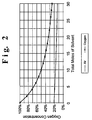
- Figure 2 illustrates the difference in the affect of dilution on the oxygen bubble and an air bubble containing the same amount of oxygen, but also including the diluent nitrogen.
- the oxygen concentration in the oxygen bubble is decreased from 100% to 25% over the range shown.
- the concentration of oxygen in the air bubble is decreased from 21% to 13%.
- the TA production reaction takes place in a manner which enables evaporative cooling to be employed, particularly through the advantageous use of a modified LOR process and system, hereinafter referred to as an evaporatively cooled LOR.
- a modified LOR process and system hereinafter referred to as an evaporatively cooled LOR.
- oxygen is added to the reactor vessel at a point of high turbulence within or just below the hollow draft tube rather than elsewhere in the body of the solvent/reactant mixture. Injection of oxygen at such a point is important to the desired consumption of oxygen.
- the initially high concentration of oxygen in the gas phase at the point of injection serves to enhance the mass transfer rate of the oxygen into this region of the liquid reactant, which would otherwise be oxygen depleted due to the rapid rate of the oxidation reaction.
- the practice of the invention enables a rapid rate of oxygen consumption to be achieved such that a very high oxygen use efficiency, i.e., at least 75% and preferably 90% or more, is obtained upon the first injection of pure or nearly pure oxygen into the reactor.
- the reaction of p-xylene with oxygen is greater than about 95%. That is, less than about 5% of the oxygen that is fed to the reactor is vented unreacted.
- vent gases are cooled and the condensibles therefrom are returned to the reactor.
- a portion of the vent flow is desirably diverted for gas analysis of carbon dioxides and oxygen.
- the advantages of the evaporative LOR will herein be described. While the TA product is obtained in the solid phase, the use of the evaporative LOR avoids the practical operating problems associated with the common use of direct cooling heat exchange surfaces for removing the heat of the oxidation reaction that result from TA and other solids precipitation on the heat transfer surfaces of cooling coils and the like. Thus, the safe and efficient use of pure or nearly pure oxygen for the p-xylene oxidation reaction can conveniently be carried out using evaporative cooling to remove the heat of reaction generated during the oxidation reaction. In the LOR process and system, as employed in the practice of the invention, pure or nearly pure oxygen is used instead of air.
- the practice of the invention enables a rapid rate of oxygen consumption to be achieved such that a very high oxygen use efficiency, i.e., at least 75% and preferably 90% or more, is obtained upon the first injection of pure or nearly pure oxygen into the reactor.
- the reaction of p-xylene with oxygen is greater than about 95%. That is, less than about 5% of the oxygen that is fed to the reactor is vented unreacted.
- the process of the invention can be carried out in conventional reactor vessels, and we believe that the optimal water concentration in the alternative reactor configuration would be identical to that required in the LOR case.
- the substitution of oxygen for air in the oxidation of hydrocarbons could be made with conventional reactor designs, and these reactors could be run at the boiling point of the reaction mixture, thus removing the heat of reaction from the mixture with evaporative cooling. Under such conditions, many of the advantages observed with oxygen based processing, i.e., increased reaction rate, decreased vent flow, reduction in byproduct formation, are realized.
- the conventional system is less oxygen efficient than the LOR embodiment.
- the impeller used in such embodiments must be efficient in oxygen use by distributing the oxygen as very small bubbles and promoting a longer mean residence time for the oxygen bubbles in the liquid phase
- a preferred solvent:reactant ratio is from about 1:1 to about 8:1 on a volume:volume basis.
- the preferred catalyst loadings should be within the following ranges: cobalt (400-700ppm), manganese (800-1700ppm), and bromine (500-1200ppm).
- the total loading should be between 500-3000ppm, and the Co:Mn ratio should be from 1:10 to 10:1.
- a preferred residence time for the liquid is about 60 minutes, though a time between 30 and 90 minutes is suitable.
- the operating temperature is generally between about 170°C and about 190°C, preferably 180°C to 190°C.
- the operating pressure is about 90-300 psig, preferably 100-125 psig, most preferably 115 psig.
- the preferred hydrocarbon reactant feed concentration varies between about 8.9% and about 14.2%.
- the oxidant should be pure or nearly pure oxygen.
- Terephthalic acid was produced by the oxidation of p-xylene in the evaporatively cooled LOR.
- the oxidation was conducted at a pressure of 115 psig and at temperatures between 170 and 190°C.
- the catalyst loadings varied within the following ranges: cobalt (450-700ppm), manganese (800-1700ppm), and bromine (500-1200ppm).
- the hydrocarbon reactant feed concentration varied between 9% and 14%.
- the oxidant was pure oxygen.
- the invention involves the use of a co-solvent (water) which has a lower boiling point than acetic acid and a comparatively high latent heat
- a substitute solvent for acetic acid could be used to achieve the same effect.
- pure water is not a suitable solvent.
- an acidic organic solvent having a latent heat which is higher than water and a boiling point which is lower than water and in which both p-xylene and water are sufficiently soluble and terephthalic acid is relatively insoluble may be used in the invention.
- the above process is suitable for the oxidation of any other organic chemical whose oxidation produces a solid as a product or by-product.
- Such chemicals include, but are not limited to toluene, meta- and ortho-xylene and trimethylbenzenes.
- the resultant products include, but are not limited to benzoic acid, orthophthalic acid, isophthalic acid and benzenetricarboxylic acids.
- TA isophthalic acid and 2,6-dicarboxynaphthalene are logical extrapolations of the technology.
Landscapes
- Chemical & Material Sciences (AREA)
- Organic Chemistry (AREA)
- Engineering & Computer Science (AREA)
- Oil, Petroleum & Natural Gas (AREA)
- Organic Low-Molecular-Weight Compounds And Preparation Thereof (AREA)
- Catalysts (AREA)
- Low-Molecular Organic Synthesis Reactions Using Catalysts (AREA)
Applications Claiming Priority (2)
| Application Number | Priority Date | Filing Date | Title |
|---|---|---|---|
| US62020196A | 1996-03-22 | 1996-03-22 | |
| US620201 | 1996-03-22 |
Publications (1)
| Publication Number | Publication Date |
|---|---|
| EP0796837A1 true EP0796837A1 (fr) | 1997-09-24 |
Family
ID=24484995
Family Applications (1)
| Application Number | Title | Priority Date | Filing Date |
|---|---|---|---|
| EP97104879A Withdrawn EP0796837A1 (fr) | 1996-03-22 | 1997-03-21 | Procédé de production d'acide carboxylique aromatique |
Country Status (8)
| Country | Link |
|---|---|
| EP (1) | EP0796837A1 (fr) |
| JP (1) | JPH09255618A (fr) |
| KR (1) | KR970065502A (fr) |
| AR (1) | AR006984A1 (fr) |
| BR (1) | BR9701423A (fr) |
| CA (1) | CA2200646A1 (fr) |
| ID (1) | ID16379A (fr) |
| MX (1) | MX9702157A (fr) |
Cited By (6)
| Publication number | Priority date | Publication date | Assignee | Title |
|---|---|---|---|---|
| US6362367B2 (en) | 1998-04-21 | 2002-03-26 | Union Carbide Chemicals & Plastics Technology Corp. | Preparation of organic acids |
| US6649773B2 (en) | 2002-03-22 | 2003-11-18 | General Electric Company | Method for the manufacture of halophthalic acids and anhydrides |
| US6657068B2 (en) | 2002-03-22 | 2003-12-02 | General Electric Company | Liquid phase oxidation of halogenated ortho-xylenes |
| US6657067B2 (en) | 2002-03-22 | 2003-12-02 | General Electric Company | Method for the manufacture of chlorophthalic anhydride |
| US7541489B2 (en) | 2004-06-30 | 2009-06-02 | Sabic Innovative Plastics Ip B.V. | Method of making halophthalic acids and halophthalic anhydrides |
| CN110573486A (zh) * | 2017-02-28 | 2019-12-13 | 奇派特石化有限公司 | 通过氧化生产芳族二羧酸的能量和环境整合方法 |
Citations (4)
| Publication number | Priority date | Publication date | Assignee | Title |
|---|---|---|---|---|
| US3089906A (en) * | 1958-04-21 | 1963-05-14 | Mid Century Corp | Oxidation chemical process |
| US5371283A (en) * | 1993-12-22 | 1994-12-06 | Praxair Technology, Inc. | Terephthalic acid production |
| EP0682005A1 (fr) * | 1994-05-11 | 1995-11-15 | Praxair Technology, Inc. | Préparation d'acide téréphtalique à l'application du refroidissement évaporatif |
| EP0682000A1 (fr) * | 1994-05-11 | 1995-11-15 | Praxair Technology, Inc. | Perfectionnements à l'oxydation de composés organiques |
-
1997
- 1997-03-20 ID IDP970919A patent/ID16379A/id unknown
- 1997-03-20 MX MX9702157A patent/MX9702157A/es unknown
- 1997-03-21 EP EP97104879A patent/EP0796837A1/fr not_active Withdrawn
- 1997-03-21 JP JP8551897A patent/JPH09255618A/ja not_active Withdrawn
- 1997-03-21 CA CA 2200646 patent/CA2200646A1/fr not_active Abandoned
- 1997-03-21 KR KR1019970009622A patent/KR970065502A/ko not_active Withdrawn
- 1997-03-21 BR BR9701423A patent/BR9701423A/pt not_active Application Discontinuation
- 1997-03-21 AR ARP970101143A patent/AR006984A1/es unknown
Patent Citations (4)
| Publication number | Priority date | Publication date | Assignee | Title |
|---|---|---|---|---|
| US3089906A (en) * | 1958-04-21 | 1963-05-14 | Mid Century Corp | Oxidation chemical process |
| US5371283A (en) * | 1993-12-22 | 1994-12-06 | Praxair Technology, Inc. | Terephthalic acid production |
| EP0682005A1 (fr) * | 1994-05-11 | 1995-11-15 | Praxair Technology, Inc. | Préparation d'acide téréphtalique à l'application du refroidissement évaporatif |
| EP0682000A1 (fr) * | 1994-05-11 | 1995-11-15 | Praxair Technology, Inc. | Perfectionnements à l'oxydation de composés organiques |
Cited By (8)
| Publication number | Priority date | Publication date | Assignee | Title |
|---|---|---|---|---|
| US6362367B2 (en) | 1998-04-21 | 2002-03-26 | Union Carbide Chemicals & Plastics Technology Corp. | Preparation of organic acids |
| US6649773B2 (en) | 2002-03-22 | 2003-11-18 | General Electric Company | Method for the manufacture of halophthalic acids and anhydrides |
| US6657068B2 (en) | 2002-03-22 | 2003-12-02 | General Electric Company | Liquid phase oxidation of halogenated ortho-xylenes |
| US6657067B2 (en) | 2002-03-22 | 2003-12-02 | General Electric Company | Method for the manufacture of chlorophthalic anhydride |
| US7541489B2 (en) | 2004-06-30 | 2009-06-02 | Sabic Innovative Plastics Ip B.V. | Method of making halophthalic acids and halophthalic anhydrides |
| US7732559B2 (en) | 2004-06-30 | 2010-06-08 | Sabic Innovative Plastics Ip B.V. | Method of making halophthalic acids and halophthalic anhydrides |
| CN110573486A (zh) * | 2017-02-28 | 2019-12-13 | 奇派特石化有限公司 | 通过氧化生产芳族二羧酸的能量和环境整合方法 |
| CN110573486B (zh) * | 2017-02-28 | 2022-06-07 | 奇派特石化有限公司 | 通过氧化生产芳族二羧酸的能量和环境整合方法 |
Also Published As
| Publication number | Publication date |
|---|---|
| CA2200646A1 (fr) | 1997-09-22 |
| MX9702157A (es) | 1998-04-30 |
| AR006984A1 (es) | 1999-10-13 |
| JPH09255618A (ja) | 1997-09-30 |
| BR9701423A (pt) | 1998-11-03 |
| ID16379A (id) | 1997-09-25 |
| KR970065502A (ko) | 1997-10-13 |
Similar Documents
| Publication | Publication Date | Title |
|---|---|---|
| JP3100309B2 (ja) | 蒸発冷却を用いたテレフタル酸製造 | |
| US5004830A (en) | Process for oxidation of alkyl aromatic compounds | |
| US5696285A (en) | Production of terephthalic acid with excellent optical properties through the use of pure or nearly pure oxygen as the oxidant in p-xylene oxidation | |
| US5099064A (en) | Method for increasing conversion efficiency for oxidation of an alkyl aromatic compound to an aromatic carboxylic acid | |
| US4855492A (en) | Process for production of aromatic polycarboxylic acids | |
| JP3383438B2 (ja) | テレフタル酸生産 | |
| US4777287A (en) | Recycle of vaporized solvent in liquid phase oxidation of an alkyl aromatic | |
| EP1073621B1 (fr) | Preparation d'acides organiques | |
| US4560793A (en) | Process for producing terephthalic acid | |
| US4992580A (en) | Production of polycarboxylic acids with a molybdenum-activated cobalt catalyst | |
| JPS6383046A (ja) | 芳香族カルボン酸の製造方法 | |
| US20010007910A1 (en) | Process for producing carboxylic acids | |
| US4792621A (en) | Method for continuous production of aromatic carboxylic acid | |
| US4820862A (en) | Process for the preparation of dimethyl terephthalate | |
| CA2200646A1 (fr) | Optimisation de la teneur en eau dans le procede d'oxydation du p-xylene par l'oxygene | |
| MXPA97002157A (es) | Optimizacion de contenido de agua en la oxidacionbasada en oxigeno de p-xileno | |
| US4853479A (en) | Process for the manufacture of aromatic dicarboxylic acids and derivatives thereof | |
| CN101184718A (zh) | 用于产生芳族二羧酸的方法 | |
| JPS5826899B2 (ja) | トリメリツト酸の製造法 | |
| US3944601A (en) | Quality of phthalic acids improved by strong inorganic acids | |
| EP1254098B1 (fr) | Oxydation de composes aromatiques d'alkyle en acides aromatiques dans un milieu aqueux | |
| KR820000459B1 (ko) | 테레프탈산의 제조 방법 | |
| US5171881A (en) | Process for producing trimellitic acid | |
| JPS6229549A (ja) | P−トルイル酸の製造法 | |
| CN1163882A (zh) | 对二甲苯的基于氧气的氧化中水含量的优化 |
Legal Events
| Date | Code | Title | Description |
|---|---|---|---|
| PUAI | Public reference made under article 153(3) epc to a published international application that has entered the european phase |
Free format text: ORIGINAL CODE: 0009012 |
|
| AK | Designated contracting states |
Kind code of ref document: A1 Designated state(s): BE DE ES FR IT NL PT |
|
| 17P | Request for examination filed |
Effective date: 19971001 |
|
| 17Q | First examination report despatched |
Effective date: 19990426 |
|
| STAA | Information on the status of an ep patent application or granted ep patent |
Free format text: STATUS: THE APPLICATION IS DEEMED TO BE WITHDRAWN |
|
| 18D | Application deemed to be withdrawn |
Effective date: 19990907 |