EP0797933B1 - Vêtement destiné à prévenir les fractures et son procédé de fabrication - Google Patents
Vêtement destiné à prévenir les fractures et son procédé de fabrication Download PDFInfo
- Publication number
- EP0797933B1 EP0797933B1 EP97201694A EP97201694A EP0797933B1 EP 0797933 B1 EP0797933 B1 EP 0797933B1 EP 97201694 A EP97201694 A EP 97201694A EP 97201694 A EP97201694 A EP 97201694A EP 0797933 B1 EP0797933 B1 EP 0797933B1
- Authority
- EP
- European Patent Office
- Prior art keywords
- hip
- pad
- femur
- greater trochanter
- energy
- Prior art date
- Legal status (The legal status is an assumption and is not a legal conclusion. Google has not performed a legal analysis and makes no representation as to the accuracy of the status listed.)
- Expired - Lifetime
Links
- 208000010392 Bone Fractures Diseases 0.000 title claims description 20
- 238000000034 method Methods 0.000 title claims description 13
- 230000002265 prevention Effects 0.000 title description 8
- 210000000689 upper leg Anatomy 0.000 claims abstract description 58
- 210000000527 greater trochanter Anatomy 0.000 claims abstract description 49
- 210000004872 soft tissue Anatomy 0.000 claims abstract description 29
- 239000000853 adhesive Substances 0.000 claims abstract description 10
- 230000001070 adhesive effect Effects 0.000 claims abstract description 10
- 239000000463 material Substances 0.000 claims description 53
- 210000000988 bone and bone Anatomy 0.000 claims description 10
- 241001465754 Metazoa Species 0.000 claims description 5
- 239000013536 elastomeric material Substances 0.000 claims description 2
- 206010061363 Skeletal injury Diseases 0.000 claims 1
- 230000001681 protective effect Effects 0.000 description 55
- 210000001624 hip Anatomy 0.000 description 54
- 206010020100 Hip fracture Diseases 0.000 description 28
- 206010017076 Fracture Diseases 0.000 description 18
- 210000004197 pelvis Anatomy 0.000 description 15
- 210000000623 ulna Anatomy 0.000 description 12
- 239000012530 fluid Substances 0.000 description 11
- 208000027418 Wounds and injury Diseases 0.000 description 10
- 230000006378 damage Effects 0.000 description 10
- 208000014674 injury Diseases 0.000 description 10
- 210000003275 diaphysis Anatomy 0.000 description 9
- 239000002245 particle Substances 0.000 description 9
- 230000000694 effects Effects 0.000 description 8
- 239000012528 membrane Substances 0.000 description 8
- 238000012360 testing method Methods 0.000 description 8
- 238000013461 design Methods 0.000 description 6
- 210000003205 muscle Anatomy 0.000 description 6
- XLYOFNOQVPJJNP-UHFFFAOYSA-N water Substances O XLYOFNOQVPJJNP-UHFFFAOYSA-N 0.000 description 6
- 239000002390 adhesive tape Substances 0.000 description 5
- 210000001217 buttock Anatomy 0.000 description 5
- 239000006260 foam Substances 0.000 description 5
- 239000010410 layer Substances 0.000 description 5
- 210000002303 tibia Anatomy 0.000 description 5
- 230000006835 compression Effects 0.000 description 4
- 238000007906 compression Methods 0.000 description 4
- 239000004744 fabric Substances 0.000 description 4
- 230000013011 mating Effects 0.000 description 4
- 229920002635 polyurethane Polymers 0.000 description 4
- 239000004814 polyurethane Substances 0.000 description 4
- 229920002472 Starch Polymers 0.000 description 3
- 240000008042 Zea mays Species 0.000 description 3
- 235000005824 Zea mays ssp. parviglumis Nutrition 0.000 description 3
- 235000002017 Zea mays subsp mays Nutrition 0.000 description 3
- 235000005822 corn Nutrition 0.000 description 3
- 229920000642 polymer Polymers 0.000 description 3
- 229920000915 polyvinyl chloride Polymers 0.000 description 3
- 239000004800 polyvinyl chloride Substances 0.000 description 3
- 238000005381 potential energy Methods 0.000 description 3
- 239000007787 solid Substances 0.000 description 3
- 235000019698 starch Nutrition 0.000 description 3
- 239000008107 starch Substances 0.000 description 3
- 230000008719 thickening Effects 0.000 description 3
- 241000196324 Embryophyta Species 0.000 description 2
- 239000004793 Polystyrene Substances 0.000 description 2
- 229920002334 Spandex Polymers 0.000 description 2
- 229910000831 Steel Inorganic materials 0.000 description 2
- 230000001154 acute effect Effects 0.000 description 2
- 239000012790 adhesive layer Substances 0.000 description 2
- 238000013459 approach Methods 0.000 description 2
- 230000005540 biological transmission Effects 0.000 description 2
- 238000006243 chemical reaction Methods 0.000 description 2
- 239000013013 elastic material Substances 0.000 description 2
- 230000003203 everyday effect Effects 0.000 description 2
- 238000002474 experimental method Methods 0.000 description 2
- 210000002436 femur neck Anatomy 0.000 description 2
- 239000008187 granular material Substances 0.000 description 2
- 210000004394 hip joint Anatomy 0.000 description 2
- 238000003780 insertion Methods 0.000 description 2
- 230000037431 insertion Effects 0.000 description 2
- 230000007774 longterm Effects 0.000 description 2
- 230000007246 mechanism Effects 0.000 description 2
- 239000000203 mixture Substances 0.000 description 2
- 229920002223 polystyrene Polymers 0.000 description 2
- 239000000047 product Substances 0.000 description 2
- 210000003314 quadriceps muscle Anatomy 0.000 description 2
- 210000002320 radius Anatomy 0.000 description 2
- 239000004759 spandex Substances 0.000 description 2
- 239000010959 steel Substances 0.000 description 2
- 238000012546 transfer Methods 0.000 description 2
- 229920002261 Corn starch Polymers 0.000 description 1
- 208000008924 Femoral Fractures Diseases 0.000 description 1
- 101000911772 Homo sapiens Hsc70-interacting protein Proteins 0.000 description 1
- 206010021639 Incontinence Diseases 0.000 description 1
- 241000489861 Maximus Species 0.000 description 1
- 208000029725 Metabolic bone disease Diseases 0.000 description 1
- 229920000881 Modified starch Polymers 0.000 description 1
- 239000004368 Modified starch Substances 0.000 description 1
- 229920005830 Polyurethane Foam Polymers 0.000 description 1
- XUIMIQQOPSSXEZ-UHFFFAOYSA-N Silicon Chemical compound [Si] XUIMIQQOPSSXEZ-UHFFFAOYSA-N 0.000 description 1
- 239000002250 absorbent Substances 0.000 description 1
- 239000011358 absorbing material Substances 0.000 description 1
- 210000000577 adipose tissue Anatomy 0.000 description 1
- 210000003484 anatomy Anatomy 0.000 description 1
- 230000037237 body shape Effects 0.000 description 1
- 230000037396 body weight Effects 0.000 description 1
- 230000000747 cardiac effect Effects 0.000 description 1
- 210000000845 cartilage Anatomy 0.000 description 1
- 230000001684 chronic effect Effects 0.000 description 1
- 238000004140 cleaning Methods 0.000 description 1
- 238000010276 construction Methods 0.000 description 1
- 230000008602 contraction Effects 0.000 description 1
- 239000008120 corn starch Substances 0.000 description 1
- 230000001419 dependent effect Effects 0.000 description 1
- 238000003745 diagnosis Methods 0.000 description 1
- 229920001971 elastomer Polymers 0.000 description 1
- 230000008030 elimination Effects 0.000 description 1
- 238000003379 elimination reaction Methods 0.000 description 1
- 239000003292 glue Substances 0.000 description 1
- 210000003128 head Anatomy 0.000 description 1
- 238000009863 impact test Methods 0.000 description 1
- 230000003116 impacting effect Effects 0.000 description 1
- 238000010348 incorporation Methods 0.000 description 1
- 238000007373 indentation Methods 0.000 description 1
- 230000010354 integration Effects 0.000 description 1
- 230000003993 interaction Effects 0.000 description 1
- 210000003127 knee Anatomy 0.000 description 1
- 229920000126 latex Polymers 0.000 description 1
- 210000002414 leg Anatomy 0.000 description 1
- 210000000528 lesser trochanter Anatomy 0.000 description 1
- 238000004519 manufacturing process Methods 0.000 description 1
- 239000002480 mineral oil Substances 0.000 description 1
- 235000010446 mineral oil Nutrition 0.000 description 1
- 235000019426 modified starch Nutrition 0.000 description 1
- 210000003739 neck Anatomy 0.000 description 1
- 230000001537 neural effect Effects 0.000 description 1
- 239000003921 oil Substances 0.000 description 1
- 210000002221 olecranon process Anatomy 0.000 description 1
- 230000000399 orthopedic effect Effects 0.000 description 1
- 229920001084 poly(chloroprene) Polymers 0.000 description 1
- 239000011496 polyurethane foam Substances 0.000 description 1
- 229920001592 potato starch Polymers 0.000 description 1
- 230000008569 process Effects 0.000 description 1
- 230000001012 protector Effects 0.000 description 1
- 230000005180 public health Effects 0.000 description 1
- 230000009467 reduction Effects 0.000 description 1
- 230000004044 response Effects 0.000 description 1
- 229910052710 silicon Inorganic materials 0.000 description 1
- 239000010703 silicon Substances 0.000 description 1
- 229920002379 silicone rubber Polymers 0.000 description 1
- 230000005808 skin problem Effects 0.000 description 1
- 239000000126 substance Substances 0.000 description 1
- 239000013589 supplement Substances 0.000 description 1
- 239000000725 suspension Substances 0.000 description 1
- 210000001519 tissue Anatomy 0.000 description 1
- 238000009423 ventilation Methods 0.000 description 1
- 239000003190 viscoelastic substance Substances 0.000 description 1
- 238000005406 washing Methods 0.000 description 1
Images







Classifications
-
- A—HUMAN NECESSITIES
- A61—MEDICAL OR VETERINARY SCIENCE; HYGIENE
- A61F—FILTERS IMPLANTABLE INTO BLOOD VESSELS; PROSTHESES; DEVICES PROVIDING PATENCY TO, OR PREVENTING COLLAPSING OF, TUBULAR STRUCTURES OF THE BODY, e.g. STENTS; ORTHOPAEDIC, NURSING OR CONTRACEPTIVE DEVICES; FOMENTATION; TREATMENT OR PROTECTION OF EYES OR EARS; BANDAGES, DRESSINGS OR ABSORBENT PADS; FIRST-AID KITS
- A61F15/00—Auxiliary appliances for wound dressings; Dispensing containers for dressings or bandages
- A61F15/008—Appliances for wound protecting, e.g. avoiding contact between wound and bandage
-
- A—HUMAN NECESSITIES
- A41—WEARING APPAREL
- A41D—OUTERWEAR; PROTECTIVE GARMENTS; ACCESSORIES
- A41D13/00—Professional, industrial or sporting protective garments, e.g. surgeons' gowns or garments protecting against blows or punches
- A41D13/015—Professional, industrial or sporting protective garments, e.g. surgeons' gowns or garments protecting against blows or punches with shock-absorbing means
- A41D13/0156—Professional, industrial or sporting protective garments, e.g. surgeons' gowns or garments protecting against blows or punches with shock-absorbing means having projecting patterns
-
- A—HUMAN NECESSITIES
- A41—WEARING APPAREL
- A41D—OUTERWEAR; PROTECTIVE GARMENTS; ACCESSORIES
- A41D13/00—Professional, industrial or sporting protective garments, e.g. surgeons' gowns or garments protecting against blows or punches
- A41D13/05—Professional, industrial or sporting protective garments, e.g. surgeons' gowns or garments protecting against blows or punches protecting only a particular body part
- A41D13/0506—Hip
-
- A—HUMAN NECESSITIES
- A41—WEARING APPAREL
- A41D—OUTERWEAR; PROTECTIVE GARMENTS; ACCESSORIES
- A41D13/00—Professional, industrial or sporting protective garments, e.g. surgeons' gowns or garments protecting against blows or punches
- A41D13/05—Professional, industrial or sporting protective garments, e.g. surgeons' gowns or garments protecting against blows or punches protecting only a particular body part
- A41D13/055—Protector fastening, e.g. on the human body
- A41D13/0556—Protector fastening, e.g. on the human body with releasable fastening means
- A41D13/0568—Protector fastening, e.g. on the human body with releasable fastening means with straps
-
- A—HUMAN NECESSITIES
- A41—WEARING APPAREL
- A41D—OUTERWEAR; PROTECTIVE GARMENTS; ACCESSORIES
- A41D31/00—Materials specially adapted for outerwear
- A41D31/04—Materials specially adapted for outerwear characterised by special function or use
- A41D31/28—Shock absorbing
- A41D31/285—Shock absorbing using layered materials
-
- A—HUMAN NECESSITIES
- A61—MEDICAL OR VETERINARY SCIENCE; HYGIENE
- A61F—FILTERS IMPLANTABLE INTO BLOOD VESSELS; PROSTHESES; DEVICES PROVIDING PATENCY TO, OR PREVENTING COLLAPSING OF, TUBULAR STRUCTURES OF THE BODY, e.g. STENTS; ORTHOPAEDIC, NURSING OR CONTRACEPTIVE DEVICES; FOMENTATION; TREATMENT OR PROTECTION OF EYES OR EARS; BANDAGES, DRESSINGS OR ABSORBENT PADS; FIRST-AID KITS
- A61F13/00—Bandages or dressings; Absorbent pads
- A61F13/06—Bandages or dressings; Absorbent pads specially adapted for feet or legs; Corn-pads; Corn-rings
-
- A—HUMAN NECESSITIES
- A61—MEDICAL OR VETERINARY SCIENCE; HYGIENE
- A61F—FILTERS IMPLANTABLE INTO BLOOD VESSELS; PROSTHESES; DEVICES PROVIDING PATENCY TO, OR PREVENTING COLLAPSING OF, TUBULAR STRUCTURES OF THE BODY, e.g. STENTS; ORTHOPAEDIC, NURSING OR CONTRACEPTIVE DEVICES; FOMENTATION; TREATMENT OR PROTECTION OF EYES OR EARS; BANDAGES, DRESSINGS OR ABSORBENT PADS; FIRST-AID KITS
- A61F5/00—Orthopaedic methods or devices for non-surgical treatment of bones or joints; Nursing devices ; Anti-rape devices
- A61F5/01—Orthopaedic devices, e.g. long-term immobilising or pressure directing devices for treating broken or deformed bones such as splints, casts or braces
- A61F5/30—Pressure pads
- A61F5/34—Pressure pads filled with air or liquid
-
- A—HUMAN NECESSITIES
- A61—MEDICAL OR VETERINARY SCIENCE; HYGIENE
- A61F—FILTERS IMPLANTABLE INTO BLOOD VESSELS; PROSTHESES; DEVICES PROVIDING PATENCY TO, OR PREVENTING COLLAPSING OF, TUBULAR STRUCTURES OF THE BODY, e.g. STENTS; ORTHOPAEDIC, NURSING OR CONTRACEPTIVE DEVICES; FOMENTATION; TREATMENT OR PROTECTION OF EYES OR EARS; BANDAGES, DRESSINGS OR ABSORBENT PADS; FIRST-AID KITS
- A61F5/00—Orthopaedic methods or devices for non-surgical treatment of bones or joints; Nursing devices ; Anti-rape devices
- A61F5/01—Orthopaedic devices, e.g. long-term immobilising or pressure directing devices for treating broken or deformed bones such as splints, casts or braces
- A61F5/0102—Orthopaedic devices, e.g. long-term immobilising or pressure directing devices for treating broken or deformed bones such as splints, casts or braces specially adapted for correcting deformities of the limbs or for supporting them; Ortheses, e.g. with articulations
- A61F2005/0181—Protectors for articulations
- A61F2005/0183—Hip protectors, e.g. for elderly people
-
- A—HUMAN NECESSITIES
- A61—MEDICAL OR VETERINARY SCIENCE; HYGIENE
- A61F—FILTERS IMPLANTABLE INTO BLOOD VESSELS; PROSTHESES; DEVICES PROVIDING PATENCY TO, OR PREVENTING COLLAPSING OF, TUBULAR STRUCTURES OF THE BODY, e.g. STENTS; ORTHOPAEDIC, NURSING OR CONTRACEPTIVE DEVICES; FOMENTATION; TREATMENT OR PROTECTION OF EYES OR EARS; BANDAGES, DRESSINGS OR ABSORBENT PADS; FIRST-AID KITS
- A61F13/00—Bandages or dressings; Absorbent pads
- A61F2013/00089—Wound bandages
- A61F2013/00272—Wound bandages protection of the body or articulation
Definitions
- the present invention relates generally to garments for bone fracture prevention, especially for the prevention of hip fracture during impact from a fall, and related methods.
- hip fractures are a major source of mortality and morbidity among the elderly. Approximately 250,000 hip fractures occur in the United States annually. Nearly 33 percent of women and more than 17 percent of men will experience a hip fracture if they live to age 90. Among patients who are functionally independent prior to a hip fracture, 15 to 25 percent remain in long-term care settings for more than a year afterward. Another 25 to 35 percent are dependent on others for their mobility. More than half of those that survive hip fracture never recover normal function. Moreover, the average mortality associated with hip fracture in elderly patients is approximately 20 percent in the first year.
- hip fractures The public health impact of hip fractures is also staggering. Recent surveys in the United Kingdom have shown that at any one time about 50 percent of acute orthopedic beds are occupied by hip fracture patients. In the U.S., the average length of hospital stay for hip fracture patient is three weeks, longer than for any other diagnosis. The annual costs associated with the acute and chronic care of hip fracture patients in the United States is estimated to exceed $7 billion. The problem can only be expected to worsen with projected increases in the average age of the world population, leading some to suggest the possibility of a nearly three-fold rise in the total number of hip fractures by the middle of the next century.
- hip fracture prevention strategies must therefore either reduce the incidence of falls, or protect the femur in the event of a fall.
- the former strategy may be accomplished by restricting mobility, although this carries associated medical risks and impairs personal autonomy and quality of life. It might also be accomplished through exercise programs in the elderly populations at greatest risk for falling, although no study to date has proven the effectiveness of such an approach. In any case, it seems unrealistic to expect the complete elimination of falls among the elderly, given the often multiple factors (cardiac, neural, musculoskeletal) and random causes of falls. It therefore appears that the most reliable method for reducing hip fracture incidence is to protect the femur during the impact stage of the fall. This essentially requires lowering the impact force applied to the femur to a value below its fracture threshold.
- Hip fracture refers to fracture of the proximal end of the femur, which is the strongest, heaviest, and longest bone in the body, accounting for approximately one-fourth of total body height.
- the proximal end of the femur consists of a head, neck, and greater and lesser trochanters.
- the neck of the femur connects the spherical head to the shaft. It is limited laterally by the greater trochanter, a large, somewhat rectangular lateral projection from the neck and shaft, which provides an insertion site for several muscles of the gluteal region.
- the greater trochanter lies laterally, just beneath a relatively thin layer of skin and adipose tissue (fat), and can be easily palpated on the lateral side of the thigh.
- the greater trochanter is the site which comes into contact with a hard surface when one lies on one's side, and the site where the majority of impact force is applied when one falls sideways onto the hip. Consequently, falls to the side resulting in impact to the greater trochanter carry a high risk for hip fracture.
- Gluteal soft tissues include the gluteal maximus, minimus, and minimus muscles, as well as the considerable layer of fat overlying the buttock.
- anterior thigh soft tissues are the quadriceps muscles, which include the three vastus muscles and the rectus femoris muscle.
- fracture of other bones such as the tibia, radius, and ulna occurs when the force applied to the bone exceeds that required to initiate fracture.
- the impact energy is high, and contact occurs to a small area directly overlying the fracturing bony structure. In such circumstances, the impact energy cannot be absorbed and/or dissipated through a large area, and high local stresses are applied to the underlying bone.
- these regions of the femur and in particular the greater trochanter, extend furthest laterally of all bony components of the hip region, and are protected by a minimum of overlying soft tissue. They thus represent the regions of lowest compliance within the total protected area, and subsequently, during impact to the protective garment, the majority of impact force is transmitted to the femur.
- a further problem with protective devices which cover the greater trochanter is the compromise that designers face between device thickness and device rigidity.
- Device thickness largely determines wearer acceptability. The more slender the device, the more acceptable to the wearer.
- Device rigidity also affects wearer acceptability, since a soft, compliant device is more comfortable to the wearer than a hard, inflexible device.
- device rigidity also determines the amount of energy absorbed and magnitude of force produced by deformation of the device. A very compliant material, while generating low stress or pressure during compression, will also absorb little energy during deformation.
- patent 4,737,994 describes a device for covering the hip region with an inflated air cushion which, if constructed to not bottom during impact, would become highly pressurized and stiff.
- U.S. patent 4,573,216 describes a fairly stiff silicon rubber pad designed to be worn over the greater trochanter. Such pad materials will absorb significant energy during deformation (or in the case of the inflatable pad, compression of the gas), allowing for a slender design. However, such deformation generates significant stresses or pressures in the pad material, resulting in high forces being transmitted to the underlying femur, and in particular the greater trochanter, which contains a minimal degree of overlying soft tissue.
- a second approach taken by inventors of hip fracture prevention devices is to incorporate a rigid dome-shaped shield into the padding system (Strock, U.S. patent 4,641,641 and 4,926,883; Kummer, U.S. patent 5,062,433).
- this shield is designed to be centered over the greater trochanter, and upon impact, transfer force away from this region.
- several design features prevent this device from significantly lowering the impact force applied to the femur during a fall. First, only a small amount of force is required to initiate contact between the skin-side surface of the shield and the skin overlying the proximal diaphysis of the femur.
- Strock system or any system incorporating a rigid shield
- problems with the Strock system include its inability to conform to changes in body shape under normal activities, thus restricting body motion and causing discomfort to the wearer.
- no method is provided for affixing the Strock pad to the body other than through the use of an adhesive to the skin, making these pads inappropriate for persons who would suffer skin problems due to long-term lack of ventilation to the skin.
- EP-A-0,999,010 discloses a garment including a protective pad for protection against fracture injuries in the area of the femur near the hip joint.
- the pad incorporates an incompressible viscous fluid integrally bonded to an outer elastic layer, thereby forming a direct energy absorbing structure.
- the precharacterising part of Claim 1 is based on the disclosure of EP-A-0,999,010. The distinguishing features of the invention are set out in the characterising part of Claim 1.
- Claim 1 provides a garment for reducing the risk of bone fracture of a human or animal subject due to impact forces on a greater trochanter disposed in a hip of the human or animal subject, said greater trochanter being at the end of a femur and wherein the hip has a soft tissue region proximate to the greater trochanter and the femur lacking a bone part near the skin surface, the garment including a pad and mounting means for removably mounting the pad on the subject, the garment being characterised in that:- the pad is an energy shunting pad including two arms defining an exposed interior area between the two arms, the interior area coinciding generally with the greater trochanter and the femur when the garment is mounted on the subject; and the mounting means removably mounts the energy shunting pad on the subject with the two arms proximate to opposing sides of the femur so that a substantial portion of impact energy directed at the hip of the subject is shunted from the greater trochanter to the soft tissue region where such energy may
- the protective device in accordance with a preferred embodiment of the present invention comprises a horseshoe-shaped garment placed over the hip region so as to contact the skin adjacent, but not overlying, the greater trochanter and proximal diaphysis of the femur.
- the garment has one or more envelopes made of a flexible material and containing within a substance which exhibits a marked increase in viscosity with increasing rate of shear deformation. This behavior, which causes the device to exhibit significantly greater flexibility and compliance at low rates of deformation, such as those occurring during everyday activities such as sitting and walking, than during the high rates of deformation surrounding impact, is known as "shear-thickening" or "dilatancy".
- the relative flexibility under everyday activity provides a degree of comfort to the wearer far exceeding previous designs which utilize a rigid dome-shaped shield or a relatively inflexible polymeric sheet.
- the ability of the pad to stiffen upon impact, combined with the horseshoe shape, allows for transmission of the energy of the body on impact into the soft tissues surrounding, but not overlying, the greater trochanter and proximal femoral diaphysis. Due to their bulk, these tissues are capable of absorbing and dissipating the impact energy without the production of large stresses. Since no part of the pad overlies the femur, force transmission to the femur is minimized, occurring at appreciable extent only after compression of the surrounding soft tissues causes the external surface of the pad to be in line with the external surface of the greater trochanter. However, the pad is constructed with a thickness sufficient to ensure this occurs, if at all, only in the most severe falls.
- the protective device is fitted bilaterally into short pants, either in the form of cloth underwear or well fitted flexible shorts similar in appearance and function to those worn by bicyclists.
- the protective device employs cloth straps which wrap around both the waist and thigh regions on the wearer, and possess a hook-and-pile fastener material such as that sold under the VELCRO trademark, to permit adjusting the position of the device to achieve optimal placement on the wearer.
- the protective device is affixed to the hip regions of the wearer through the use of adhesive strips on the inner surface of the device permitting it to secured to the skin in the optimal position over the hip region.
- the invention provides an arrangement that is more effective at reducing the force applied to the femur during impact on the hip from a fall and more comfortable to wear than prior art pads.
- Fig. 1 shows a perspective view of a protective garment embodied in accordance with the present invention and worn on the hip of a human subject.
- the garment 2 has a number of flexible and compliant envelopes 4 each containing a shear-thickening or dilatant material.
- the compliant envelopes 4 are separated by bonds, and are arranged to form an inverted "U" or horseshoe shape approximately centered about the midpoint 8 of the greater trochanter of the femur.
- the anterior portion 3 of the device is connected to the posterior portion 7 of the device a flexible but relatively non-compliant strip 6, which may be made of cloth. This cloth 6 is secured to the compliant envelopes on the superior internal border 13 of the horseshoe, the anterior internal border 16 of the horseshoe, and the posterior internal border 15 of the horseshoe by means of a bond 9.
- the horizontal distance between the posterior internal border 15 of the horseshoe and the anterior internal border 16 of the horseshoe is relatively constant over the length of the pad at a value of approximately 40 mm.
- alternative embodiments may exist involving devices where this width is constant at a value between 30 and 70 mm, or devices involving variations in this width along the length of the pad between 30 and 70 mm.
- the device is so positioned that, along a horizontal line passing through the greater trochanter, the posterior internal border 15 of the horseshoe and the anterior internal border 16 of the horseshoe are roughly an equal horizontal distance from the midpoint 8 of the greater trochanter.
- the anterior internal border 16 of the horseshoe and the posterior internal border 15 of the horseshoe are roughly an equal horizontal distance from the axis X-X of the proximal femoral diaphysis.
- the superior internal border 13 of the horseshoe is located roughly 20 mm above the midpoint 8 of the greater trochanter of the femur.
- alternative embodiments of the device may exist where the location of the superior internal border 13 of the horseshoe is constant at a value between 10-40 mm above the midpoint of the greater trochanter. Further alternative embodiments may exist where the location of the superior internal border of the horseshoe 13 varies between 10-40 mm above the midpoint of the greater trochanter.
- the external border 14 of the device 2 extends inferiorly to approximately 10 cm below the midpoint of the greater trochanter, posteriorly (at its greatest extent) to approximately 10 cm horizontal to the greater trochanter midpoint 8, superiorly to approximately 2 cm below the location 12 of the superior iliac spine, and anteriorly to approximately 7 cm horizontal to the greater trochanter midpoint.
- FIG. 2 shows an alternative embodiment of a device in accordance with the present invention.
- the dimensions and location of the internal open portion of the horseshoe are similar to that described for Fig. 1.
- the number of envelopes 4 containing the shear-thickening material 22 has been reduced to nine, each roughly forming the shape of a square with surface area of approximately 4 cm 2 .
- the surface area of the device may also extend well beyond that shown and described for Fig. 1, being limited inferiorly only by the knee, posteriorly by the anal fold or crease between the buttocks, anteriorly by the midpoint of the anterior aspect of the thigh, and superiorly by a point about 10 mm below the superior iliac spine.
- the thickness of protective device 2 is constant at approximately 30 mm.
- alternative embodiments of protective device 2 may involve a constant thickness throughout the device between 10-50 mm, or variation in thickness throughout the device between 10-50 mm.
- Fig. 3 is a sectional view of one preferred embodiment of the present invention in which a flexible and compliant membrane enclosure 18 is subdivided into several and distinct envelopes 4, each containing a shear thickening or dilatant material 22.
- membrane 18 is made of an elastomeric polymer such as polyurethane, PVC, latex rubber, or pure gum rubber, having a constant thickness between 0.1-1 mm.
- a bond 5 exists between contacting surfaces of envelopes 4 adjacent to one another. This bond 5 may be created through various means, including application of an adhesive or a process whereby a chemical reaction or the application of heat or electrical current results in bonding of the membrane material.
- Each envelope 4 is filled with shear-thickening material 22 at a pressure which causes a small degree of stretch within the membrane material.
- shear-thickening material 22 includes a suspension of relatively uniform-sized solid particles 19 (size greatly exaggerated in Fig.3) in a viscous fluid 21.
- the properties of solid particles 19 and viscous fluid 21 may vary considerably between different embodiments of the invention.
- the diameter of particles 19 may vary between 0.1-100 micrometers.
- the viscosity of the fluid 21 may vary between 1-1,000,000 cP.
- the ratio of the volume of solid particles 19 to total volume of the material 22 ranges between 20-70 percent.
- fluid 21 is water and particles 19 are untreated or modified starch granules, where the starch may be corn starch, potato starch, or any plant starch.
- particles 19 are plant starch granules, and fluid 21 is a fluid other than pure water.
- particles 19 are spheres made of a polymer such as polyurethane, polystyrene, or polyvinylchloride and of size 0.1-500 micrometers, and the fluid 21 is water.
- particles 19 are spheres made of a polymer such as polyurethane, polystyrene, or polyvinylchloride and of size 0.1-500 micrometers, and the fluid 21 is an oil such as silicon or mineral oil having a viscosity between 10 and 1000000 cP.
- shear-thickening material 22 may be formed from a wide variety of particles and fluids.
- its essential feature is an increase in viscosity as a function of shear rate.
- the viscosity of material 22 increases dramatically at a relatively well-defined value known as the critical shear rate. This behavior is shown schematically in Fig. 7, where the logarithm of the shear rate ⁇ is shown on the horizontal axis and the logarithm of viscosity ⁇ is shown on the vertical axis.
- the critical shear rate of shear-thickening material 22 is set between 1-100 s -1 , and typically between 5-30 s -1 .
- the protective device 2 of Figs. 1 and 2 may be formed into the shape of a horseshoe, and instead of incorporating shear-thickening material, the device is made of a single continuous or several and distinct adjacent members of a elastic or viscoelastic material, such as that sold under the tradename Ensolite.
- one or more thin rigid members are affixed to the external surface of protective pad 2, and form a shell which aids in transmitting loads throughout the device.
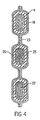
- Fig. 4 is a sectional view of an alternate preferred embodiment of the present invention in which flexible and compliant membrane enclosure 18 is subdivided into several and distinct envelopes 4, each containing shear thickening or dilatant material 22.
- envelopes 4 are not bonded together, but enclosed between a compliant and flexible internal sleeve 25 and a compliant and flexible external sleeve 26.
- internal sleeve 25 and external sleeve 26 are both constructed of an elastomeric material friendly to the skin such as sold under the SPANDEX trademark. This material preferably should not limit flexibility of the entire pad; accordingly it is sometimes desirable that the product of thickness and elastic modulus for this material be equal to or less than that described above for membrane enclosure 18.
- a bond 23 exists between internal sleeve 25 and external sleeve 26, where bond 23 is formed by an adhesive, stitching, or chemical reaction, or the application of heat or electrical current.
- the pad 2 is integrated into a pair of shorts 28 for women's or men's wear.
- Fig. 5B shows a cross section of the embodiment of Fig. 5A taken through the plane B-B in Fig. 5A.
- Shorts 28 are formed of an inner compliant and flexible material 31 and a similar outer compliant and flexible material 30. This material may be SPANDEX or a similar material.
- the shorts are sized to fit snugly around the wearer, with both inner material 31 and outer material 30 in a state of stretch during normal wear.
- Hip protective device 2 is secured into shorts 28 by a bond 29 around the parimeter of the pad 2.
- the pad has envelopes 4 containing within membrane 18 shear-thickening material 22.
- bond 29 is permanent and formed of stitching or an adhesive material, while in another embodiment all or a portion of bond 29 is easily broken and reformed, as would be provided if the bond was formed of a hook-and-pile material such as that sold under the name VELCRO.
- This latter embodiment allows easy insertion and removal of protective device 2 into short pants 28 to facilitate easy cleaning of short pants 28 or replacement of protective device 28, if required.
- short pants 28 are continuous, while in another embodiment short pants 28 are crotchless, thus facilitating use by individuals suffering from incontinence.
- Fig. 6 is a perspective view of an alternate method of affixing over the hip region a protective garment in accordance with the present invention.
- a confirmed waist belt 44 having right and left portions, mounts a pair of protective pads 41 and 43 on the right and left hips respectively.
- the right and left portions of the belt are joined by anteriorly located, mating hook-and-pile strips 45 and posteriorly located, mating hook-and-pile strips 46.
- conformed thigh belts 38 are used to affix the bottom portions of the protectors 41 and 43, and are adjusted by means of mating hook-and-pile strips 42.
- Similar hook-and-pile mating strips may be used to attach the ends of the waist and thigh belts to the external surface of the protective pads 41 and 43.
- vertical strips 47 and 49 of pile are provided on the protective pads 41 and 43 and corresponding strips of hooks are provided on the belts to properly and securely locate protective pads 41 and 43 over the hip region.
- Another method for affixing the device to the hip involves securing an adhesive layer over the internal surface of the pad which opposes the skin. This adhesive layer bonds to both the pad and the skin, and allows precise placement of the protective device over the hip. This method for affixing the device may be particularly suited to those persons at greatest risk for suffering falls and thus in need of constant protection. Depending on the properties of the adhesive, the device may be mounted for a number of days or weeks, while being removed periodically to allow washing of the underlying skin.
- Fig. 8 displays a protective device 58 embodied in accordance with the present invention and designed to protect against fracture or injury of the ulna in sporting activities such as football, where protective devices of this type are currently worn, or during any other activities where such protection is desired.
- the device may be positioned between the ulna's head 62 and the tip 60 of the ulna's olecranon process.
- the device includes a laterally and medically located strips 64 and 68 respectively of flexible envelopes containing shear-thickening material.
- a rigid shell 68 formed of a polymeric material is adhered by an adhesive so as overlie the external surface of strips 64 and 66 so that a gap is formed between shell 68 and the skin overlying the ulna.
- a sleeve 70 formed of a flexible, elastic material is adhered to shell 68 by means of a glue or adhesive, and aids in maintaining proper positioning of protective device 58 over the ulna.
- two strips of envelopes containing shear-thickening material are placed in parallel with the tibia on both medial and lateral sides.
- a rigid shell is adhered over these strips so that a gap exists between the shell and the underlying tibia.
- envelopes 4 containing shear-thickening material 22 are made available for the customized design of protective devices, either for the general prevention of injuries during sporting or other activities or for preventing further injury or pain from impact to a previously injured and therefore sensitive location.
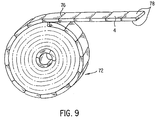
- Figs. 9 and 10 show two possible arrangements in which this product might be supplied.
- Fig. 9 shows a roll 72 of envelopes 4, each containing shear thickening material.
- Dual-sided adhesive tape 78 is adhered to both the front and back sides of the envelopes.
- a layer of waxpaper or similar matter is used to cover at least the outword facing side of adhesive tape 78.
- Scissors can be used to cut along a junction 76 between adjacent envelopes, and thus produce a strip of envelopes 4 of desired length.
- envelopes 4 can be mounted directly to the skin and a rigid shell can be mounted over envelopes 4. If required, further adhesive tape, elastic straps,or some other means may be utilized to supplement adhesive tape 78 in securing envelopes 4 to the desired location on the body.
- Fig. 10 displays an alternative method by which envelopes 4 may be supplied, including a flat sheet 80 of envelopes 4 arranged in close proximity to one another. Again, scissors may be used to cut along junctions 76 to produce a protective device of the desired shape.
- Fig. 11 shows one of the several possible customized protective devices capable of being formed from the embodiments of Figs. 9 and 10.
- a device has been constructed to protect against further injury or pain from impact to the iliac crest 88, which is often injured in sporting activities such as football, basketball, or hockey (the injury is often referred to as a "hip pointer").
- the device here includes a superior strip 82 of envelopes containing shear-thickening material, and an inferior strip 84 of envelopes containing shear-thickening material.
- a rigid shell 86 is adhered over the external surface of strips 82 and 84, and overlies iliac crest 88.
- shear-thickening material is fluid under low rates of loading, a continuous contact area is formed between the underlying skin and strips 82 and 84. Upon impact to the rigid shell, shear-thickening material stiffens, and shunts the impact energy into the soft tissues underlying strips 82 and 84, thereby protecting the vulnerable iliac crest region 88.
- hip fracture prevention garment depends on the ability of the garment to lower the peak force applied to the femur in a fall to a value significantly below the mean force required to fracture the elderly femur (2040 N).
- it In order to realistically assess the attenuation in femoral impact force provided by the device, it must be tested under conditions which simulate the interaction between the device and the underlying skeletal and soft tissues.
- a common fault in estimating the force attenuation provided by hip protective devices is to disregard the role of the soft tissues between the femur and the protective device. For example, Ferber, in U.S.
- patent 4,807,301 describes testing the force attenuating capacity of the energy-absorbing material to be placed over the greater trochanter in his preferred embodiment by dropping a steel weight onto the material from a 24-inch height. He then appears to assume the same degree of force attenuation is provided when the pad is worn over the hip in a fall. However, this will result in overestimation of the actual force attenuation provided by the protective device during a fall on the hip, since a steel weight is many times more rigid than the human hip. To obtain a reasonable estimate of this attenuation, one requires knowledge and incorporation of the compliance of the unpadded hip. Wortberg, in his U.S.
- patent 4,573,216 appears to account for the compliance of the femur, cartilage of the hip joint, and the overlying skin in estimating the force attenuation provided by the protective device. However, he does not account for the compliances of the fat and muscle overlying the trochanteric region, or the compliance of the pelvis.
- hip protective devices To evaluate and compare the protective ability of the present invention with that provided by prior art protective devices, we have measured the impact force attenuation provided by several different hip protective devices. These included the following prior art hip protective devices: (1) a commercially available device formed of an energy-absorbent foam and rigid external shell, designed to cover the greater trochanter and surrounding area, and having a maximum thickness of approximately 32 mm ("Impant" pad, Dr. L. Proshek, Edina, MN); (2) a protective appliance constructed by Strock in accordance with his U.S. patent 4,926,883 and of maximum thickness 35 mm; (3) a protective appliance constructed by Ferber in accordance with his U.S.
- prior art hip protective devices included the following prior art hip protective devices: (1) a commercially available device formed of an energy-absorbent foam and rigid external shell, designed to cover the greater trochanter and surrounding area, and having a maximum thickness of approximately 32 mm ("Impant" pad, Dr. L. Proshek, Edina, MN); (2)
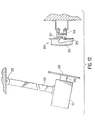
- the testing system is shown in Fig. 12, and includes an impact pendulum (including a mass 121, arm 122, pivot 123, and head 128) and surrogate pelvis 124 designed to match the typical female pelvis in surface anatomy, local soft tissue stiffness, and pelvic compliance.
- the surrogate pelvis 124 includes a surrogate femur 125 surrounded by foam 126 to simulate behaviour of soft tissue.
- a load cell 127 producing a signal to measure force on the femur 125, and a pelvic spring 128 simulates the effect of pelvic compliance.
- the surrogate pelvis allowed us to evaluate pad performance based on the combined response of the hip pad and the underlying skeletal and soft tissue structures.
- the polyurethane foams forming the soft tissues of the surrogate were selected to match the regional variation in soft tissue stiffness exhibited by females during indentation tests over the trochanteric, gluteal, and anterior thigh regions. Mean values of stiffness at 60 N (which ranged from 35 ⁇ 13.9 kN/m over the greater trochanter to 8.5 ⁇ 2.9 kN/m over the posteriolateral buttock) were matched on average to within 35% during tests at corresponding locations on the surrogate.
- Pelvic compliance was simulated by neoprene springs 128, providing the entire unit with an effective stiffness of 83 kN/m, within 18% of that measured in females undergoing simulated falls on the hip (Robinovitch, S.N., Hayes, W.C., McMahon, T.A., J Biomech Eng, 113: 366-374, 1991).
- the pendulum head was directed to impact the lateral aspect of the greater trochanter. Total externally applied force was measured by a load cell 129 on the pendulum, while the force delivered through the soft tissues to the hip was measured with the load cell 127 mounted on the femur.
- Pendulum impact velocity was 2.6 m/s, similar to the average hip impact velocity measured in human volunteers falling on their hip.
- Pendulum mass was 35 kg, matching the average effective mass of the body during impact to the hip [Robinovitch, S.N., Hayes, W.C., McMahon, T.A., J Biomech Eng, 113: 366-374, 1991].
- the kinetic energy of the pendulum at the moment of impact was therefore 120 Joules.
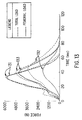
- Fig. 13 is a line graph of experimental results. Force is plotted on the vertical axis of the graph, and time is plotted on the horizontal axis of the graph. Both total externally applied force and total femoral force are shown, the former in dotted lines and the latter in solid lines. For clarity, the results from only three impact tests are shown.
- the total load is shown by a dashed line
- the femural load is shown by a solid line.
- the Wortberg pad (which provides a degree of force attenuation typical of all prior art pads tested), reduces peak externally applied force by 20% to 4770 N and peak femoral force by 22% to 4500 N.
- the horseshoe pad of 35 mm maximum thickness reduces peak externally applied force by 39% to 3590 N, while reducing peak femoral force by 68% to 1840 N.
- the results for impacts to the horseshoe pad of 49 mm maximum thickness which reduces peak externally applied force by 36% to 3800 N, and peak femoral force by 88% to 700 N.
- Fig. 14 is a bar graph which displays the peak force applied to the femur during impact to each of the systems tested.
- the horseshoe shaped device constructed of Ensolite foam and possessing a maximum thickness of 25 mm lowered peak externally applied force by 33% and peak femoral force by 55%.
- the Impant device reduced peak externally applied force by 18% and peak femoral force by 21, a device in accordance with U.S. patent 4,926,883 reduced peak externally applied force by 14% and peak femoral force by 16%, and a device in accordance U.S. patent 4,807,301 reduced peak externally applied force by 17% and peak femoral force by 27%.
- the device in accordance with the present invention provides nearly a twofold greater reduction in peak externally applied force, and a threefold greater attenuation in peak femoral impac force.
- the results also suggest that when worn during a typical fall on the hip, the horseshoe device in accordance with the present invention has the ability to lower femoral impact force to a value below the mean force required to fracture the elderly femur (2040 N).
- peak femoral force remained above twice the mean force required to fracture the elderly femur. It therefore appears that the present invention lowers the probability of suffering a hip fracture during a fall on the hip to a much greater extent than all tested prior art pads.
Landscapes
- Health & Medical Sciences (AREA)
- Engineering & Computer Science (AREA)
- General Health & Medical Sciences (AREA)
- Textile Engineering (AREA)
- Public Health (AREA)
- Physical Education & Sports Medicine (AREA)
- Vascular Medicine (AREA)
- Life Sciences & Earth Sciences (AREA)
- Animal Behavior & Ethology (AREA)
- Biomedical Technology (AREA)
- Heart & Thoracic Surgery (AREA)
- Veterinary Medicine (AREA)
- Nursing (AREA)
- Orthopedic Medicine & Surgery (AREA)
- Epidemiology (AREA)
- Professional, Industrial, Or Sporting Protective Garments (AREA)
- Orthopedics, Nursing, And Contraception (AREA)
- Pit Excavations, Shoring, Fill Or Stabilisation Of Slopes (AREA)
- Details Of Garments (AREA)
- Transition And Organic Metals Composition Catalysts For Addition Polymerization (AREA)
- Electrotherapy Devices (AREA)
- Materials For Medical Uses (AREA)
- Non-Disconnectible Joints And Screw-Threaded Joints (AREA)
Claims (11)
- Vêtement pour diminuer le risque d'une fracture osseuse d'un sujet humain ou animal par suite de forces d'impact sur un grand trochanter se trouvant dans la hanche du sujet humain ou animal, ledit grand trochanter se trouvant à l'extrémité d'un fémur, et où la hanche a une région de tissu mou à proximité du grand trochanter et où il manque au fémur une partie osseuse près de la surface de la peau, le vêtement incluant un coussinet (4) et des moyens de montage (28;38, 44, 78) pour installer amoviblement le coussinet sur le sujet, le vêtement étant caractérisé en ce que :le coussinet est un coussinet (4) dérivant l'énergie incluant deux bras (3, 7) définissant une zone intérieure exposée entre les deux bras, la zone intérieure coïncidant généralement avec le grand trochanter et le fémur lorsque le vêtement est installé sur le sujet ; etles moyens de montage (28; 38, 44, 78) installent amoviblement le coussinet dérivant l'énergie sur le sujet, avec les deux bras à proximité des côtés opposés du fémur de telle sorte qu'une portion importante de l'énergie d'impact dirigée sur la hanche du sujet est dérivée du grand trochanter à la région de tissu mou où une telle énergie peut être dissipée en toute sécurité.
- Vêtement selon la revendication 1, dans lequel le coussinet dérivant l'énergie (4) se présente sous la forme d'un fer à cheval.
- Vêtement selon les revendications 1 ou 2, dans lequel à la zone intérieure exposée entre les deux bras (3, 7), la distance entre les deux bras est entre 30 mm et 70 mm.
- Vêtement selon les revendications 1, 2 ou 3, comprenant en outre une enveloppe (4) en matière élastomère dans laquelle est disposé un matériau dérivant l'énergie.
- Vêtement selon l'une des revendications précédentes, comprenant en outre une pluralité d'enveloppes adjacentes (4), chaque enveloppe contenant une portion du matériau dérivant l'énergie.
- Vêtement selon l'une des revendications précédentes, dans lequel les moyens de montage (28; 38, 44, 78) installent le coussinet dérivant l'énergie sur le sujet de manière à reposer sur la région du tissu mou mais non pas sur le grand trochanter et le fémur.
- Vêtement selon l'une des revendications précédentes, dans lequel les moyens de montage comportent un pantalon court (28) dans lequel est disposé le coussinet dérivant l'énergie (4) .
- Vêtement selon l'une des revendications 1 à 6, dans lequel les moyens de montage comportent une pluralité de ceintures (44, 38) assemblées avec le coussinet dérivant l'énergie (4) .
- Vêtement selon l'une des revendications 1 à 6, dans lequel le moyen de montage comporte un moyen adhésif (78) pour faire adhérer le coussinet au corps d'un sujet.
- Procédé pour réduire le risque d'une lésion osseuse par suite des forces d'impact sur un grand trochanter se trouvant dans la hanche d'un sujet humain ou animal, le procédé comprenant le montage d'un vêtement défini par l'une quelconque des revendications précédentes sur le sujet de telle sorte que la zone intérieure coïncide généralement avec le grand trochanter et le fémur de telle sorte qu'une portion importante de l'énergie d'impact dirigée sur la hanche est dérivée du grand trochanter à la région du tissu mou où une telle énergie peut être dissipée en toute sécurité.
- Procédé selon la revendication 10, dans lequel l'étape de montage est effectuée de telle sorte qu'aucun des coussinets dérivant l'énergie repose sur le fémur.
Applications Claiming Priority (3)
| Application Number | Priority Date | Filing Date | Title |
|---|---|---|---|
| US979154 | 1992-11-20 | ||
| US07/979,154 US5599290A (en) | 1992-11-20 | 1992-11-20 | Bone fracture prevention garment and method |
| EP94902297A EP0669811B1 (fr) | 1992-11-20 | 1993-11-18 | Vetement destine a prevenir les fractures osseuses et procede d'utilisation dudit vetement |
Related Parent Applications (2)
| Application Number | Title | Priority Date | Filing Date |
|---|---|---|---|
| EP94902297A Division EP0669811B1 (fr) | 1992-11-20 | 1993-11-18 | Vetement destine a prevenir les fractures osseuses et procede d'utilisation dudit vetement |
| EP94902297.4 Division | 1994-06-09 |
Publications (3)
| Publication Number | Publication Date |
|---|---|
| EP0797933A2 EP0797933A2 (fr) | 1997-10-01 |
| EP0797933A3 EP0797933A3 (fr) | 1997-12-17 |
| EP0797933B1 true EP0797933B1 (fr) | 2000-10-25 |
Family
ID=25526739
Family Applications (2)
| Application Number | Title | Priority Date | Filing Date |
|---|---|---|---|
| EP97201694A Expired - Lifetime EP0797933B1 (fr) | 1992-11-20 | 1993-11-18 | Vêtement destiné à prévenir les fractures et son procédé de fabrication |
| EP94902297A Expired - Lifetime EP0669811B1 (fr) | 1992-11-20 | 1993-11-18 | Vetement destine a prevenir les fractures osseuses et procede d'utilisation dudit vetement |
Family Applications After (1)
| Application Number | Title | Priority Date | Filing Date |
|---|---|---|---|
| EP94902297A Expired - Lifetime EP0669811B1 (fr) | 1992-11-20 | 1993-11-18 | Vetement destine a prevenir les fractures osseuses et procede d'utilisation dudit vetement |
Country Status (10)
| Country | Link |
|---|---|
| US (2) | US5599290A (fr) |
| EP (2) | EP0797933B1 (fr) |
| JP (1) | JP3608621B2 (fr) |
| AT (2) | ATE197118T1 (fr) |
| AU (2) | AU679197B2 (fr) |
| CA (1) | CA2147878C (fr) |
| DE (2) | DE69316390T2 (fr) |
| DK (2) | DK0797933T3 (fr) |
| ES (2) | ES2152623T3 (fr) |
| WO (1) | WO1994012066A1 (fr) |
Cited By (1)
| Publication number | Priority date | Publication date | Assignee | Title |
|---|---|---|---|---|
| US9125787B2 (en) | 2011-09-30 | 2015-09-08 | Covidien Lp | Compression garment having a foam layer |
Families Citing this family (107)
| Publication number | Priority date | Publication date | Assignee | Title |
|---|---|---|---|---|
| US5712011A (en) * | 1995-07-27 | 1998-01-27 | Beth Israel Deaconess Medical Center, Inc. | Tug-resistant link |
| US6193914B1 (en) | 1995-11-30 | 2001-02-27 | Ubertech Texas, Inc. | Molding thermosetting polymers onto substrates |
| US5928593A (en) | 1995-11-30 | 1999-07-27 | Harrison; Donald G. | Method and apparatus for molding thermosetting polymers onto substrates |
| US6241930B1 (en) | 1995-11-30 | 2001-06-05 | Ubertech Texas, Inc. | Method of constructing a garment with a graphical design thereon |
| US5939004A (en) | 1995-11-30 | 1999-08-17 | Harrison; Donald G. | Molding thermosetting polymers onto substrates |
| US5914082A (en) | 1995-11-30 | 1999-06-22 | Harrison; Donald G. | Method and apparatus for molding thermosetting polymers onto substrates |
| US6139787A (en) | 1996-10-24 | 2000-10-31 | Ubertech Texas, Inc. | Method for applying molded silicone design elements onto substrates |
| AU7870198A (en) * | 1996-12-20 | 1998-07-17 | Gunze Limited | Waist protection member |
| US5918310A (en) * | 1997-05-09 | 1999-07-06 | Farahany; Amir H. | Body protective garment |
| US5920915A (en) * | 1998-09-22 | 1999-07-13 | Brock Usa, Llc | Protective padding for sports gear |
| US6032300A (en) | 1998-09-22 | 2000-03-07 | Brock Usa, Llc | Protective padding for sports gear |
| GB9911056D0 (en) * | 1999-05-12 | 1999-07-14 | Plant Daniel J | Active Protection |
| FR2797153B1 (fr) * | 1999-08-06 | 2001-12-14 | Inst Nat Rech Securite | Plaque de protection biface |
| US6195809B1 (en) * | 1999-12-13 | 2001-03-06 | Prevent Products, Inc. | Hip-pad for protection of greater trochanter |
| GB0000227D0 (en) * | 2000-01-07 | 2000-03-01 | Univ Leicester | Impact absorbing device |
| WO2001087102A1 (fr) * | 2000-05-19 | 2001-11-22 | Armadillo Sports Design Limited | Article chaussant de protection |
| US7662468B2 (en) | 2000-10-06 | 2010-02-16 | Brock Usa, Llc | Composite materials made from pretreated, adhesive coated beads |
| US7000616B2 (en) * | 2000-10-19 | 2006-02-21 | Diaz R Gary | Wound care suspension system |
| US6892734B1 (en) * | 2000-10-19 | 2005-05-17 | Thomas R. Schleicher | Wound care suspension system |
| US7402147B1 (en) | 2000-11-17 | 2008-07-22 | Susan Davis Allen | Body limb movement limiter |
| ES2346743T3 (es) * | 2001-09-13 | 2010-10-20 | Daniel James Plant | Material flexible absorbente de energia y procedimientos de fabricacion del mismo. |
| US7609512B2 (en) | 2001-11-19 | 2009-10-27 | Otter Products, Llc | Protective enclosure for electronic device |
| GB0130834D0 (en) * | 2001-12-22 | 2002-02-06 | Design Blue Ltd | Energy absorbing material |
| US6660882B2 (en) * | 2002-03-18 | 2003-12-09 | Council Of Scientific And Industrial Research | Process for the preparation of 2-Methyl-2-propene-1-sulfonic acid, sodium salt |
| US20060026864A1 (en) * | 2002-05-08 | 2006-02-09 | Liquicell Technologies, Inc. | Ultra-thin liquid-filled insole interface |
| AU2003257116A1 (en) * | 2002-08-01 | 2004-02-23 | E.I. Du Pont De Nemours And Company | Protective laminate structure |
| US6859948B2 (en) * | 2002-09-16 | 2005-03-01 | Michael Melts | Hip protector system |
| US6786508B2 (en) | 2002-09-30 | 2004-09-07 | Lear Corporation | Occupant protection apparatus for a vehicle |
| US20040168245A1 (en) * | 2002-10-18 | 2004-09-02 | Goodwin Edward L. | Washable, protective hip pad construction |
| US8091692B2 (en) * | 2003-03-03 | 2012-01-10 | Massachusetts Institute Of Technology | Fluid-filled cellular solids for controlled |
| FR2852790B1 (fr) * | 2003-03-26 | 2005-09-16 | Emeric Daniau | Systeme de protection individuelle a l'encontre des chocs, notamment gilet pare-balles |
| SE525107C2 (sv) * | 2003-04-11 | 2004-11-30 | Otto Bock Skandinavia Ab | Ledskydd och skyddspelott därför |
| US7244477B2 (en) | 2003-08-20 | 2007-07-17 | Brock Usa, Llc | Multi-layered sports playing field with a water draining, padding layer |
| US20050089678A1 (en) * | 2003-08-20 | 2005-04-28 | Mead Steven R. | Multi-layered floorig composite including an acoustic underlayment |
| US7425171B2 (en) * | 2004-02-13 | 2008-09-16 | Kathy Maupin | Post surgical binder |
| JP2005281936A (ja) * | 2004-03-31 | 2005-10-13 | Wacoal Corp | 腰部保護パッド |
| GB0414734D0 (en) * | 2004-07-01 | 2004-08-04 | Newcastle Upon Tyne Hospitals | Hip protector |
| US20060014008A1 (en) * | 2004-07-15 | 2006-01-19 | Akron General Medical Center | Force dispersion pad |
| US20060049950A1 (en) * | 2004-08-13 | 2006-03-09 | Lockhart Thurman E | Fall-sensing systems, hip protector systems, and other protective systems |
| WO2006029486A1 (fr) * | 2004-09-16 | 2006-03-23 | Philippe Kriwin | Vêtement |
| US7823219B2 (en) * | 2004-09-27 | 2010-11-02 | Angiosome, Inc. | Decubitus ulcer prevention and treatment |
| US7941867B2 (en) * | 2004-11-19 | 2011-05-17 | Olson Keith D | Protective device |
| DK200402020A (da) * | 2004-12-29 | 2006-06-30 | Tytex As | Beklædning, beskyttelsesindretning og fremgangsmåde til reduktion af risikoen for knoglebrud |
| FR2883469B1 (fr) * | 2005-03-23 | 2008-02-01 | Eric Georges Lucien Gilli | Necessaire et procede pour la protection de pansements et/ou de zones cutanees blessees du corps |
| US7073202B1 (en) | 2005-09-22 | 2006-07-11 | Geary John A | Wrist protector |
| GB0519710D0 (en) * | 2005-09-28 | 2005-11-02 | Progressive Sports Technologies Ltd | Protective lower leg garment |
| JP2007131990A (ja) * | 2005-10-11 | 2007-05-31 | Sumitomo Rubber Ind Ltd | 人体保護用具 |
| MA28760B1 (fr) * | 2006-01-03 | 2007-08-01 | Rxr Protect | Valve de protection gonflable |
| US20070157356A1 (en) * | 2006-01-07 | 2007-07-12 | Jigang Jin | Ski pants |
| US7941875B1 (en) * | 2006-02-27 | 2011-05-17 | Brown Medical Industries | Trabecular matrix like protectors and method |
| US7941876B2 (en) * | 2006-03-18 | 2011-05-17 | Robert C Ferber | Apparatus, method and system for protecting hips from fracture, and for providing immediate response to hip fracture events |
| FR2903579B1 (fr) * | 2006-07-17 | 2008-09-26 | Pjdo Soc Par Actions Simplifie | Coque de protection externe, notamment destinee a etre integree au sein d'une housse de protection ou d'un vetement de protection integrant une telle coque |
| US7784116B2 (en) * | 2006-07-27 | 2010-08-31 | Reebok International Ltd. | Padded garment |
| GB0617452D0 (en) * | 2006-09-05 | 2006-10-18 | Regent Medical Ltd | Surgical and medical garments and materials incorporating shear thickening fluids |
| JP2007107176A (ja) * | 2006-10-16 | 2007-04-26 | Nisshin Kikaku:Kk | スポーツ用衣服 |
| US20080127394A1 (en) * | 2006-11-27 | 2008-06-05 | Tammany Paige Atkinson | Protective garments |
| US8087101B2 (en) | 2007-01-19 | 2012-01-03 | James Riddell Ferguson | Impact shock absorbing material |
| US8151376B2 (en) * | 2008-06-13 | 2012-04-10 | ConfiHips, LLC | Compliant impact protection pad |
| US8732869B2 (en) | 2008-06-13 | 2014-05-27 | Comfihips, Llc | Compliant impact protection pad |
| GB2463712A (en) * | 2008-07-11 | 2010-03-31 | Tech21 Licensing Ltd | Casing For Protecting Portable Devices |
| US8898820B2 (en) * | 2008-08-01 | 2014-12-02 | Nike, Inc. | Layered apparel with attachable and detachable elements |
| US8597222B2 (en) * | 2009-06-12 | 2013-12-03 | Under Armour, Inc. | Garment with adjustable compression |
| NZ580201A (en) * | 2009-10-06 | 2010-10-29 | Delloch Ltd | A protective device for protecting the hip area including an impact sensor and alarm |
| US20110155141A1 (en) * | 2009-12-28 | 2011-06-30 | Sawyer Lawrence H | Wearable Article That Stiffens Upon Sudden Force |
| US9352531B2 (en) * | 2010-01-22 | 2016-05-31 | Under Armour, Inc. | Padding arrangement and method of making the same |
| US9427347B2 (en) | 2010-04-06 | 2016-08-30 | Hosso, Inc. | Limb protection device |
| US10314680B2 (en) | 2010-04-06 | 2019-06-11 | Horsepower Technologies Inc. | Limb protection device |
| US9044306B2 (en) | 2010-04-06 | 2015-06-02 | Hosso, Inc. | Limb protection device |
| US8894594B2 (en) | 2010-04-06 | 2014-11-25 | Hosso, Inc. | Limb protection device |
| US8679047B2 (en) | 2010-05-21 | 2014-03-25 | Presidium Athletics LLC | Impact resistant, torsion-reducing protective athletic gear using shear thickening fluid |
| BR112013003368A2 (pt) | 2010-08-11 | 2017-06-27 | G Form Llc | almofada de amortecimento flexíveis, itens que incorporam tais almofadas, e métodos de fabricação e utilização |
| DK2612623T3 (en) * | 2010-09-03 | 2018-03-19 | Kaneka Corp | Shock absorbing cushion, clothing provided with it and method to prevent femur fracture |
| US20120099976A1 (en) * | 2010-10-26 | 2012-04-26 | Honeywell International Inc. | Fan containment systems with improved impact structures |
| EP2649893A4 (fr) * | 2010-12-10 | 2014-09-24 | Goldwin Inc | Pantalon de ski |
| JP2012136169A (ja) * | 2010-12-27 | 2012-07-19 | Toyota Motor Corp | 自動車用シートベルト装置 |
| GB2489417B (en) * | 2011-03-25 | 2016-06-22 | Latchways Plc | Harness safety system |
| US9516910B2 (en) * | 2011-07-01 | 2016-12-13 | Intellectual Property Holdings, Llc | Helmet impact liner system |
| DE102011052970A1 (de) | 2011-08-25 | 2013-02-28 | Maxim Schro | Schienbeinschoner sowie Verfahren zur Herstellung und Verwendung |
| US12035770B2 (en) | 2012-04-18 | 2024-07-16 | Nike, Inc. | Vented garment |
| US11606992B2 (en) | 2012-04-18 | 2023-03-21 | Nike, Inc. | Vented garment |
| US9320311B2 (en) | 2012-05-02 | 2016-04-26 | Intellectual Property Holdings, Llc | Helmet impact liner system |
| US9101454B2 (en) | 2012-05-04 | 2015-08-11 | Elwha Llc | Cervical spine stabilizing system |
| EP2690126B1 (fr) | 2012-07-24 | 2016-10-12 | Impact Protection Technology AG | Procédé de production d'un fluide non newtonien notamment pour protection contre les chocs, procédé de production d'une protection contre les chocs au moyen d'un fluide non newtonien, protection contre les chocs au moyen d'un fluide non newtonien et objet avec une telle protection contre les chocs |
| US9894953B2 (en) | 2012-10-04 | 2018-02-20 | Intellectual Property Holdings, Llc | Helmet retention system |
| US20140143943A1 (en) * | 2012-11-29 | 2014-05-29 | Clay Cacas | Body Protection Robe |
| US9402779B2 (en) | 2013-03-11 | 2016-08-02 | Covidien Lp | Compression garment with perspiration relief |
| SG11201507638XA (en) * | 2013-03-16 | 2015-10-29 | Impactwear International Lllp | Hip protective undergarments |
| US9271858B2 (en) * | 2013-07-15 | 2016-03-01 | SoftArmour LLC | Variable modulus body brace and body brace system |
| WO2015065902A1 (fr) | 2013-10-28 | 2015-05-07 | Intellectual Property Holdings, Llc | Système de retenue de casque |
| EP2886573B1 (fr) | 2013-12-20 | 2016-09-28 | Impact Protection Technology AG | Matériau hybride et son procédé de production |
| US20160242476A1 (en) * | 2014-02-20 | 2016-08-25 | Robert Nutter | Hip protective disposable undergarment |
| US9486029B2 (en) | 2014-03-31 | 2016-11-08 | Raytheon Company | Solid-liquid energy dissipation system, and helmet using the same |
| US9445179B2 (en) | 2014-06-05 | 2016-09-13 | Linda Bowen | Earbuds conduit |
| US20160021947A1 (en) * | 2014-07-28 | 2016-01-28 | David Dor-el | Protective garment for an individual that maintains his "cool" look while inconspicuously protecting him |
| US10299954B2 (en) * | 2015-02-13 | 2019-05-28 | Enma Troutner | Therapeutic cushioning pants |
| DE102015107408A1 (de) * | 2015-05-12 | 2016-11-17 | Betterguards Technology Gmbh | Vorrichtung zur Stabilisierung von Körpergelenken, Muskeln und Sehnen |
| US10085870B2 (en) | 2015-06-22 | 2018-10-02 | Horsepower Technologies Inc. | Joint brace with improved range of motion stop |
| US11406148B2 (en) | 2015-10-07 | 2022-08-09 | Nike, Inc. | Vented garment |
| US10212974B1 (en) | 2015-11-19 | 2019-02-26 | Cyrus K. Joshi | Garment for protecting the human body |
| US11019865B2 (en) | 2016-10-06 | 2021-06-01 | Nike, Inc. | Insulated garment |
| US10743596B2 (en) | 2016-10-06 | 2020-08-18 | Nike, Inc. | Insulated vented garment formed using non-woven polymer sheets |
| CN110545686B (zh) * | 2016-12-13 | 2022-05-24 | 米帕斯公司 | 具有剪切力管理的头盔 |
| JP6946221B2 (ja) * | 2018-03-26 | 2021-10-06 | 京セラ株式会社 | 姿勢維持装置 |
| US12342886B2 (en) * | 2021-07-12 | 2025-07-01 | Nike, Inc. | Garments and articles incorporating recycled foam scrap |
| DE102021129767A1 (de) * | 2021-11-15 | 2023-05-17 | Autoliv Development Ab | Tragbare Schutzvorrichtung |
| DE102022201733A1 (de) | 2022-02-18 | 2023-08-24 | Carsten Engelke | Anpassbare Gamasche für Pferde |
| TWI853468B (zh) * | 2023-02-24 | 2024-08-21 | 彪仕醫技股份有限公司 | 彈性布及護具 |
Family Cites Families (138)
| Publication number | Priority date | Publication date | Assignee | Title |
|---|---|---|---|---|
| US1229947A (en) * | 1917-06-12 | Charles Izenstark | Athlete's guard. | |
| US729293A (en) * | 1902-08-21 | 1903-05-26 | Albert B Dorman | Vaccine-shield. |
| US1165669A (en) * | 1915-09-23 | 1915-12-28 | American Steel Foundries | Brake. |
| US1468072A (en) * | 1921-04-14 | 1923-09-18 | Ogle Hubert Millas | Comfort cushion |
| US1756358A (en) * | 1928-07-02 | 1930-04-29 | Rawlings Mfg Co | Combined hip and kidney pad for football players |
| US1774739A (en) * | 1928-08-22 | 1930-09-02 | Spalding & Bros Ag | Body protector |
| US1740171A (en) * | 1928-10-31 | 1929-12-17 | P Goldsmith Sons Company | Athletic protective device |
| US1786268A (en) * | 1929-06-20 | 1930-12-23 | Snavely Carl Grey | Body-protecting shield |
| US2247961A (en) * | 1939-02-15 | 1941-07-01 | Joseph A Mulvey | Athletic apparel |
| US2481291A (en) * | 1948-03-25 | 1949-09-06 | Maiden Form Brassiere Company | Hip pad |
| US2607934A (en) * | 1949-02-25 | 1952-08-26 | Bailhe George | Safety garment |
| US2663020A (en) * | 1950-12-20 | 1953-12-22 | Cecil A Cushman | Pneumatic injury pad |
| US2745106A (en) * | 1953-01-28 | 1956-05-15 | Lena O Salhus | Hip frame |
| US2851390A (en) * | 1955-06-30 | 1958-09-09 | Marc A Chavannes | Fabric and method of manufacture |
| US2935130A (en) * | 1956-04-10 | 1960-05-03 | Lawrence K Moore | Method of and apparatus for opening plugged pipe in a well bore |
| US2889830A (en) * | 1957-02-21 | 1959-06-09 | Malcolm L Raymond | Fracture preventing hip protecting means |
| US2934766A (en) * | 1957-05-06 | 1960-05-03 | Cherup Nicholas | Impact absorber |
| US2917051A (en) * | 1959-03-13 | 1959-12-15 | Clyde G White | Body contour apparel |
| US3026874A (en) * | 1959-11-06 | 1962-03-27 | Robert C Stevens | Wound shield |
| US3044075A (en) * | 1960-03-28 | 1962-07-17 | City Linen Inc | Protective device |
| GB1002955A (en) | 1960-09-16 | 1965-09-02 | Scholl Mfg Co Ltd | Improvements in or relating to pressure relieving, supporting and friction reducing surgical pads |
| US3322873A (en) * | 1963-09-30 | 1967-05-30 | Dow Corning | Method of making a resilient custom-fit body protector |
| US3185362A (en) * | 1964-01-30 | 1965-05-25 | Kenneth H Wakefield | Combination seat-pack |
| US3304938A (en) * | 1964-11-19 | 1967-02-21 | Jr John E Perkins | Bandage support |
| US3446880A (en) * | 1964-12-31 | 1969-05-27 | James H Enicks | Method of manufacturing a protective athletic pad |
| US3334626A (en) * | 1965-08-03 | 1967-08-08 | Schimmel Madalyn Miller | Injury protector |
| US3438377A (en) * | 1966-12-05 | 1969-04-15 | Joseph B Connors | Girdle type undergarments with separable leg portions |
| US3528416A (en) * | 1967-11-06 | 1970-09-15 | Lawrence J Chamberlain | Protective bandage |
| US3435946A (en) * | 1968-02-12 | 1969-04-01 | Polymir Ind Inc | Protective shock resistant package for fragile objects |
| US3577305A (en) * | 1968-08-22 | 1971-05-04 | Theodore G Hines | Thermal and air shock insulating structure |
| US3663447A (en) * | 1968-10-01 | 1972-05-16 | Hooker Chemical Corp | Composition and process for stripping paint |
| US3601923A (en) * | 1968-10-07 | 1971-08-31 | Bruce L Rosenberg | Amusement device employing dilatant suspension filler |
| US3550159A (en) * | 1968-10-10 | 1970-12-29 | Eugenio Alarco | Impact-absorbent cellular structure |
| US3526221A (en) * | 1968-12-13 | 1970-09-01 | Richard D Garber | Hip joint protective appliance |
| US3552044A (en) * | 1968-12-30 | 1971-01-05 | Sports Technology | Conformable pad filled with elastomeric particles |
| US3609764A (en) * | 1969-03-20 | 1971-10-05 | Riddell | Energy absorbing and sizing means for helmets |
| US3596972A (en) * | 1969-09-02 | 1971-08-03 | Int Harvester Co | Tree clamp structure |
| US3713640A (en) * | 1970-07-27 | 1973-01-30 | Riddell | Energy absorbing and sizing means for helmets |
| CH514299A (de) * | 1970-09-02 | 1971-10-31 | Temova Ets | Leibstütz- und Hüftgürtel |
| US3806950A (en) * | 1972-03-23 | 1974-04-30 | Curran J | Bandage shock absorbers for safety helmets |
| US3848802A (en) * | 1972-06-01 | 1974-11-19 | Allied Chem | Method and apparatus for the preparation and ejection of a viscous dilatant material |
| US3771170A (en) * | 1972-07-17 | 1973-11-13 | G Leon | Inflatable insulating material |
| US3872511A (en) * | 1974-03-11 | 1975-03-25 | Larcher Angelo C | Protective headgear |
| US3990440A (en) * | 1974-07-29 | 1976-11-09 | Medical Specialties, Inc. | Body protecting method |
| DE2535760A1 (de) * | 1974-12-05 | 1976-06-10 | Warnecke Tuwa Plastik | Vorrichtung zur versorgung von wunden |
| US3921222A (en) * | 1975-03-18 | 1975-11-25 | George A Hollman | Rib cage protector pad |
| US4067063A (en) * | 1975-03-31 | 1978-01-10 | Ettinger Donald N | Pneumatic athletic guard |
| US3991423A (en) * | 1975-09-08 | 1976-11-16 | General Aquadyne, Inc. | Helmet with actuated neck pad |
| US4000737A (en) * | 1975-10-14 | 1977-01-04 | Horn Clifford V | Surgical incision shield |
| US4116236A (en) * | 1977-02-14 | 1978-09-26 | Surgical Applicance Industries, Inc. | Knee brace with kneecap-encircling flexible resilient pad |
| US4292263A (en) * | 1977-03-04 | 1981-09-29 | Zimmer Usa, Inc. | Method of producing a foamed polyurethane body-protecting pad |
| US4134399A (en) * | 1977-06-13 | 1979-01-16 | Alfred Halderson | Skin protective device |
| US4142252A (en) * | 1977-09-29 | 1979-03-06 | John Storer | Athletic protective pad device |
| US4346525A (en) * | 1977-12-16 | 1982-08-31 | Colgate-Palmolive Company | Cushion pad for sport shoes and the like and method for fabricating same |
| US4151613A (en) * | 1978-03-09 | 1979-05-01 | Rhee Jhoon G | Protective device for the buttocks and hips of a person for use in skateboarding |
| US4185327A (en) * | 1978-07-17 | 1980-01-29 | Markve Howard J | Ventilating and insulating garment |
| US4370754A (en) * | 1978-07-27 | 1983-02-01 | American Pneumatics Co. | Variable pressure pad |
| US4308010A (en) * | 1978-08-21 | 1981-12-29 | Orthoband Company, Inc. | Neck pad material and a method for its manufacture |
| US4250882A (en) * | 1979-01-26 | 1981-02-17 | Medical Dynamics, Inc. | Wound drainage device |
| US4219892A (en) * | 1979-02-05 | 1980-09-02 | Rigdon Robert W | Knee brace for preventing injury from lateral impact |
| US4213202A (en) * | 1979-03-02 | 1980-07-22 | Larry Ronald G | Shock distributing panel |
| GB2069846A (en) * | 1980-02-19 | 1981-09-03 | Nat Res Dev | External fixation devices for orthopaedic fractures |
| US4399816A (en) * | 1980-03-17 | 1983-08-23 | Spangler George M | Wound protector with transparent cover |
| DE3025562A1 (de) * | 1980-07-05 | 1982-02-11 | Basf Ag, 6700 Ludwigshafen | Verfahren zur herstellung von copolymerdispersionen enger teilchengroessenverteilung mit breitem konzentrationsbereich dilatanten fliessverhaltens |
| GB2082919A (en) | 1980-09-04 | 1982-03-17 | Jones Leslie Bernard | Wound dressings |
| US4602384A (en) * | 1980-10-20 | 1986-07-29 | Schneider David P | Aquatic attack protection suit and material therefor |
| US4338926A (en) * | 1980-11-21 | 1982-07-13 | Howmedica, Inc. | Bone fracture prosthesis with controlled stiffness |
| ES256654Y (es) * | 1981-03-04 | 1982-04-01 | Faja anatomica-correctora perfeccionada | |
| US4472839A (en) * | 1981-11-02 | 1984-09-25 | Ginnie Johansen Designs, Inc. | Cummerbund |
| CH652005A5 (de) * | 1981-12-31 | 1985-10-31 | Dierk Filmer | Schutzvorrichtung. |
| US4390995A (en) * | 1982-03-03 | 1983-07-05 | Walck Vernon R | Shock damping face guard strap for football helmets |
| US4471538A (en) * | 1982-06-15 | 1984-09-18 | Pomeranz Mark L | Shock absorbing devices using rheopexic fluid |
| DE3305408C2 (de) | 1982-07-10 | 1986-11-20 | Walter Ewald Dr.med. 5880 Lüdenscheid Wortberg | Hüftpelotte |
| US4512037A (en) * | 1982-08-17 | 1985-04-23 | Sports Marketing, Inc. | Protective pad assembly |
| EP0103227B1 (fr) * | 1982-09-10 | 1985-11-27 | Bayer Ag | Procédé pour la préparation de polyphosphates, polyphosphates obtenus par ce procédé et leur utilisation |
| US4547919A (en) * | 1983-02-17 | 1985-10-22 | Cheng Chung Wang | Inflatable article with reforming and reinforcing structure |
| US4536539A (en) * | 1983-12-12 | 1985-08-20 | Exxon Research And Engineering Co. | Dilatant behavior of interpolymer complexes in aqueous solution |
| GB8403552D0 (en) | 1984-02-10 | 1984-03-14 | Godfrey S M V | Garment |
| US4518335A (en) * | 1984-03-14 | 1985-05-21 | Allied Corporation | Dilatant mold and dilatant molding apparatus |
| US4584339A (en) * | 1984-06-29 | 1986-04-22 | Exxon Research And Engineering Co. | Dilatant behavior of interpolymer complexes in aqueous solution |
| US5184409A (en) | 1984-08-24 | 1993-02-09 | Northwest Podiatric Laboratory, Inc. | Orthotic insert and method of making of the same |
| DE3433085A1 (de) * | 1984-09-08 | 1986-03-20 | Basf Ag, 6700 Ludwigshafen | Stark dilatante polymerdispersionen mit verminderter temperaturabhaengigkeit der kritischen schergeschwindigkeit |
| US4761834A (en) * | 1984-10-24 | 1988-08-09 | Kolb Joseph J | System for facilitating protection of an athlete's hip and pelvic area |
| US4607629A (en) * | 1985-03-21 | 1986-08-26 | Max Lerman | Dynamic post-operative hip abduction brace |
| US4641641A (en) * | 1985-09-13 | 1987-02-10 | Strock Alvin E | Protective appliance for the hip joint area |
| US4633863A (en) * | 1985-09-27 | 1987-01-06 | Filips Chester P | Arterial anchor bandage |
| DE8603019U1 (de) | 1986-02-06 | 1986-04-03 | Hildebrandt, Hans-Dietrich, Dr., 3501 Ahnatal | Hose für medizinische Zwecke |
| IE57441B1 (en) * | 1986-05-16 | 1992-09-09 | Cox Mary Sarah | A protective garment |
| US4892551A (en) * | 1986-07-03 | 1990-01-09 | Habley Medical Technology Corporation | Impact dissipating and load diverting total hip arthroplasty prosthesis |
| US4737994A (en) * | 1986-12-30 | 1988-04-19 | Galton Harry A | Garment for protecting wearer against bone fracture |
| US5139240A (en) | 1987-05-12 | 1992-08-18 | Honda Giken Kogyo Kabushiki Kaisha | Fluid-filled vibroisolating device |
| US5027801A (en) * | 1987-05-29 | 1991-07-02 | Royce Medical Company | Orthopaedic gel pad assembly |
| US4913755A (en) * | 1988-03-16 | 1990-04-03 | Royce Medical Company | Method of forming orthopaedic gel pads |
| US4807301A (en) * | 1987-09-02 | 1989-02-28 | Ferber Robert C | Protective garment for the hip area |
| US4905681A (en) * | 1987-11-02 | 1990-03-06 | The Glascock Family Trust | Skin guard apparatus |
| US5057111A (en) * | 1987-11-04 | 1991-10-15 | Park Joon B | Non-stress-shielding bone fracture healing device |
| US5122146A (en) | 1988-02-04 | 1992-06-16 | Pfizer Hospital Products Group, Inc. | Apparatus for reducing a fracture |
| US4879776A (en) | 1988-04-04 | 1989-11-14 | Farley David L | Anatomically conformable foam support pad |
| US5111542A (en) | 1988-04-04 | 1992-05-12 | Farley David L | Anatomically conformable foam support pad |
| US4821431A (en) * | 1988-05-10 | 1989-04-18 | Rieffel Donald W | Sandal with contained granular material to provide a pad for a person's foot |
| US4926503A (en) * | 1988-05-13 | 1990-05-22 | Riddell, Inc. | Athletic shock absorbing pad |
| US4926883A (en) * | 1988-06-02 | 1990-05-22 | Strock Alvin E | Protective body appliance |
| DE68909131T2 (de) | 1988-07-08 | 1994-01-13 | K & K Inc | Schutzelement und Sportbekleidung mit diesem Element. |
| US4917112A (en) * | 1988-08-22 | 1990-04-17 | Kalt Medical Corp. | Universal bandage with transparent dressing |
| US5054121A (en) * | 1988-08-30 | 1991-10-08 | Figgie International Inc. | Athletic pad |
| US4951656A (en) * | 1988-11-09 | 1990-08-28 | Polysar Financial Services S.A. | Orthopaedic structures from polymeric materials |
| US4907576A (en) * | 1989-01-18 | 1990-03-13 | Curlee James D | Orthopaedic device using non-stretch material and method for its manufacture |
| US5066296A (en) | 1989-02-02 | 1991-11-19 | Pfizer Hopsital Products Group, Inc. | Apparatus for treating a fracture |
| US5070865A (en) | 1989-03-02 | 1991-12-10 | John Iams | Soft tissue support system |
| US5062433A (en) | 1989-03-06 | 1991-11-05 | Hospital For Joint Diseases | Protector pad |
| DE3917456A1 (de) * | 1989-05-30 | 1990-12-06 | Basf Ag | Stark dilatante copolymerdispersion mit hoher dauerlastbestaendigkeit |
| JP2600382B2 (ja) | 1989-06-22 | 1997-04-16 | 日産自動車株式会社 | バンパ取付部構造 |
| US5098421A (en) | 1989-10-16 | 1992-03-24 | Zook Gerald P | Viscoelastic gel foot padding and medicating device |
| US4985931A (en) * | 1989-10-17 | 1991-01-22 | Riddell, Inc. | Shock absorbing pad structure for athletic equipment |
| US5165296A (en) | 1990-01-12 | 1992-11-24 | Ken Yanagisawa | Drive system |
| US5034998A (en) * | 1990-06-12 | 1991-07-30 | Hpi Health Protection, Inc. | Protective device for reducing injury from falls |
| US5277697A (en) | 1990-08-17 | 1994-01-11 | Hanger Orthopedic Group, Inc. | Patella-femoral brace |
| US5098124A (en) | 1990-09-06 | 1992-03-24 | Automotive Technologies International Inc. | Padding to reduce injuries in automobile accidents |
| USD341981S (en) | 1990-09-10 | 1993-12-07 | Harris Danny L | Water filled seat pad |
| FI86138C (fi) | 1990-09-10 | 1992-07-27 | Rukka Luhta Oy | Sportbeklaednad. |
| USD334063S (en) | 1990-10-22 | 1993-03-16 | Dewall Terry L | Osteoporosis vest |
| US5094238A (en) | 1990-11-16 | 1992-03-10 | Jmk International, Inc. | Moldable body pad |
| US5150767A (en) | 1991-02-19 | 1992-09-29 | Air Cruisers, Inc. | Portable self-contained impact system |
| US5252373A (en) | 1991-03-22 | 1993-10-12 | Wrs Group, Inc. | Shock absorbing pad |
| US5179792A (en) | 1991-04-05 | 1993-01-19 | Brantingham Charles R | Shoe sole with randomly varying support pattern |
| US5123407A (en) | 1991-04-09 | 1992-06-23 | Dewhurst Dennis K | Hip alignment garment |
| US5138722A (en) | 1991-07-02 | 1992-08-18 | David Clark Company Inc. | Headset ear seal |
| US5117969A (en) | 1991-07-11 | 1992-06-02 | Thermoguard Equipment, Inc. | Wide belt alignment system |
| US5284468A (en) | 1991-08-19 | 1994-02-08 | M-Pact Worldwide Management Corporation | Orthopedic splinting article |
| US5246654A (en) | 1991-10-29 | 1993-09-21 | Cylatec Corp. | Intermediate composition and process for manufacturing intermediates for lightweight inorganic particles |
| US5157789A (en) | 1991-11-08 | 1992-10-27 | Klass Joel V | Hip protective hospital garment |
| DE9115612U1 (de) * | 1991-12-17 | 1993-04-15 | Döttling, Dorothee, 7000 Stuttgart | Stoßneutralisator |
| US5191659A (en) | 1992-01-23 | 1993-03-09 | Backus Darlene F | Orthopedic access pants |
| US5257418A (en) | 1992-02-07 | 1993-11-02 | Jaskiewicz Eric M | Shock absorbing glove |
| US5161257A (en) | 1992-03-13 | 1992-11-10 | Stromgren Supports, Inc. | Football gridle |
| US5191752A (en) | 1992-05-04 | 1993-03-09 | Murphy Robert J | Elastomeric gel saddle |
| US5230947A (en) | 1992-12-14 | 1993-07-27 | Ou Jer Wen | Foam body made integrally of at least a layer of foam material having great resilience and at least a layer of foam material having great capability to absorb shock |
| US5265296A (en) | 1993-04-12 | 1993-11-30 | Ahsan Abbas | Automatic disposable under pad apparatus |
-
1992
- 1992-11-20 US US07/979,154 patent/US5599290A/en not_active Expired - Lifetime
-
1993
- 1993-11-18 AU AU56711/94A patent/AU679197B2/en not_active Expired
- 1993-11-18 ES ES97201694T patent/ES2152623T3/es not_active Expired - Lifetime
- 1993-11-18 WO PCT/US1993/011216 patent/WO1994012066A1/fr not_active Ceased
- 1993-11-18 AT AT97201694T patent/ATE197118T1/de not_active IP Right Cessation
- 1993-11-18 AT AT94902297T patent/ATE162049T1/de not_active IP Right Cessation
- 1993-11-18 JP JP51325694A patent/JP3608621B2/ja not_active Expired - Lifetime
- 1993-11-18 ES ES94902297T patent/ES2112515T3/es not_active Expired - Lifetime
- 1993-11-18 DK DK97201694T patent/DK0797933T3/da active
- 1993-11-18 DK DK94902297.4T patent/DK0669811T3/da active
- 1993-11-18 EP EP97201694A patent/EP0797933B1/fr not_active Expired - Lifetime
- 1993-11-18 EP EP94902297A patent/EP0669811B1/fr not_active Expired - Lifetime
- 1993-11-18 CA CA002147878A patent/CA2147878C/fr not_active Expired - Lifetime
- 1993-11-18 DE DE69316390T patent/DE69316390T2/de not_active Expired - Lifetime
- 1993-11-18 DE DE69329601T patent/DE69329601T2/de not_active Expired - Fee Related
-
1995
- 1995-06-05 US US08/461,414 patent/US5545128A/en not_active Expired - Lifetime
-
1997
- 1997-03-26 AU AU16666/97A patent/AU686065B2/en not_active Ceased
Cited By (1)
| Publication number | Priority date | Publication date | Assignee | Title |
|---|---|---|---|---|
| US9125787B2 (en) | 2011-09-30 | 2015-09-08 | Covidien Lp | Compression garment having a foam layer |
Also Published As
| Publication number | Publication date |
|---|---|
| JPH08503526A (ja) | 1996-04-16 |
| CA2147878A1 (fr) | 1994-06-09 |
| ATE197118T1 (de) | 2000-11-15 |
| ES2112515T3 (es) | 1998-04-01 |
| EP0669811B1 (fr) | 1998-01-14 |
| ES2152623T3 (es) | 2001-02-01 |
| DE69329601D1 (de) | 2000-11-30 |
| CA2147878C (fr) | 2007-01-09 |
| US5599290A (en) | 1997-02-04 |
| AU679197B2 (en) | 1997-06-26 |
| EP0669811A1 (fr) | 1995-09-06 |
| AU5671194A (en) | 1994-06-22 |
| DE69316390T2 (de) | 1998-06-10 |
| DE69329601T2 (de) | 2001-05-17 |
| ATE162049T1 (de) | 1998-01-15 |
| DK0669811T3 (da) | 1998-05-25 |
| EP0797933A3 (fr) | 1997-12-17 |
| DK0797933T3 (da) | 2000-12-27 |
| JP3608621B2 (ja) | 2005-01-12 |
| US5545128A (en) | 1996-08-13 |
| AU1666697A (en) | 1997-06-12 |
| WO1994012066A1 (fr) | 1994-06-09 |
| AU686065B2 (en) | 1998-01-29 |
| EP0797933A2 (fr) | 1997-10-01 |
| DE69316390D1 (de) | 1998-02-19 |
Similar Documents
| Publication | Publication Date | Title |
|---|---|---|
| EP0797933B1 (fr) | Vêtement destiné à prévenir les fractures et son procédé de fabrication | |
| CA2307936C (fr) | Coussin de hanche pour proteger le grand trochanter | |
| US5636377A (en) | Hip protection device for the elderly | |
| US8151376B2 (en) | Compliant impact protection pad | |
| US8732869B2 (en) | Compliant impact protection pad | |
| US8381320B2 (en) | Hip protection system | |
| AU718217B2 (en) | Protective garment for the hip area | |
| JP2020521891A (ja) | 保護物品とその方法 | |
| US8065753B2 (en) | Garment protection device and method for reducing the risk of bone fracture | |
| US20050234380A1 (en) | Proection pad for the trochantheric region and device comprising the pad | |
| JP5733713B2 (ja) | 衝撃吸収装具 | |
| CN213756753U (zh) | 贴合性强的老年人用髋骨保护装置 | |
| US20040250338A1 (en) | Fall guard undergear | |
| CN121422468A (zh) | 运动护具 |
Legal Events
| Date | Code | Title | Description |
|---|---|---|---|
| PUAI | Public reference made under article 153(3) epc to a published international application that has entered the european phase |
Free format text: ORIGINAL CODE: 0009012 |
|
| 17P | Request for examination filed |
Effective date: 19970702 |
|
| AC | Divisional application: reference to earlier application |
Ref document number: 669811 Country of ref document: EP |
|
| AK | Designated contracting states |
Kind code of ref document: A2 Designated state(s): AT BE CH DE DK ES FR GB GR IE IT LI LU MC NL PT SE |
|
| PUAL | Search report despatched |
Free format text: ORIGINAL CODE: 0009013 |
|
| AK | Designated contracting states |
Kind code of ref document: A3 Designated state(s): AT BE CH DE DK ES FR GB GR IE IT LI LU MC NL PT SE |
|
| 17Q | First examination report despatched |
Effective date: 19981124 |
|
| GRAG | Despatch of communication of intention to grant |
Free format text: ORIGINAL CODE: EPIDOS AGRA |
|
| GRAG | Despatch of communication of intention to grant |
Free format text: ORIGINAL CODE: EPIDOS AGRA |
|
| GRAH | Despatch of communication of intention to grant a patent |
Free format text: ORIGINAL CODE: EPIDOS IGRA |
|
| GRAH | Despatch of communication of intention to grant a patent |
Free format text: ORIGINAL CODE: EPIDOS IGRA |
|
| GRAH | Despatch of communication of intention to grant a patent |
Free format text: ORIGINAL CODE: EPIDOS IGRA |
|
| GRAA | (expected) grant |
Free format text: ORIGINAL CODE: 0009210 |
|
| AC | Divisional application: reference to earlier application |
Ref document number: 669811 Country of ref document: EP |
|
| AK | Designated contracting states |
Kind code of ref document: B1 Designated state(s): AT BE CH DE DK ES FR GB GR IE IT LI LU MC NL PT SE |
|
| PG25 | Lapsed in a contracting state [announced via postgrant information from national office to epo] |
Ref country code: GR Free format text: LAPSE BECAUSE OF NON-PAYMENT OF DUE FEES Effective date: 20001025 |
|
| REF | Corresponds to: |
Ref document number: 197118 Country of ref document: AT Date of ref document: 20001115 Kind code of ref document: T |
|
| REG | Reference to a national code |
Ref country code: CH Ref legal event code: EP |
|
| REG | Reference to a national code |
Ref country code: IE Ref legal event code: FG4D |
|
| PG25 | Lapsed in a contracting state [announced via postgrant information from national office to epo] |
Ref country code: LU Free format text: LAPSE BECAUSE OF NON-PAYMENT OF DUE FEES Effective date: 20001118 |
|
| REF | Corresponds to: |
Ref document number: 69329601 Country of ref document: DE Date of ref document: 20001130 |
|
| ITF | It: translation for a ep patent filed | ||
| REG | Reference to a national code |
Ref country code: CH Ref legal event code: NV Representative=s name: PATENTANWAELTE SCHAAD, BALASS, MENZL & PARTNER AG |
|
| PG25 | Lapsed in a contracting state [announced via postgrant information from national office to epo] |
Ref country code: MC Free format text: THE PATENT HAS BEEN ANNULLED BY A DECISION OF A NATIONAL AUTHORITY Effective date: 20001225 |
|
| REG | Reference to a national code |
Ref country code: DK Ref legal event code: T3 |
|
| ET | Fr: translation filed | ||
| PG25 | Lapsed in a contracting state [announced via postgrant information from national office to epo] |
Ref country code: PT Free format text: LAPSE BECAUSE OF FAILURE TO SUBMIT A TRANSLATION OF THE DESCRIPTION OR TO PAY THE FEE WITHIN THE PRESCRIBED TIME-LIMIT Effective date: 20010125 |
|
| REG | Reference to a national code |
Ref country code: ES Ref legal event code: FG2A Ref document number: 2152623 Country of ref document: ES Kind code of ref document: T3 |
|
| PLBE | No opposition filed within time limit |
Free format text: ORIGINAL CODE: 0009261 |
|
| STAA | Information on the status of an ep patent application or granted ep patent |
Free format text: STATUS: NO OPPOSITION FILED WITHIN TIME LIMIT |
|
| 26N | No opposition filed | ||
| REG | Reference to a national code |
Ref country code: GB Ref legal event code: IF02 |
|
| PGFP | Annual fee paid to national office [announced via postgrant information from national office to epo] |
Ref country code: NL Payment date: 20081130 Year of fee payment: 16 Ref country code: IE Payment date: 20081103 Year of fee payment: 16 Ref country code: DK Payment date: 20081128 Year of fee payment: 16 Ref country code: DE Payment date: 20081121 Year of fee payment: 16 Ref country code: CH Payment date: 20081121 Year of fee payment: 16 |
|
| PGFP | Annual fee paid to national office [announced via postgrant information from national office to epo] |
Ref country code: ES Payment date: 20081113 Year of fee payment: 16 Ref country code: AT Payment date: 20081106 Year of fee payment: 16 |
|
| PGFP | Annual fee paid to national office [announced via postgrant information from national office to epo] |
Ref country code: SE Payment date: 20081120 Year of fee payment: 16 Ref country code: IT Payment date: 20081125 Year of fee payment: 16 Ref country code: BE Payment date: 20081105 Year of fee payment: 16 |
|
| PGFP | Annual fee paid to national office [announced via postgrant information from national office to epo] |
Ref country code: FR Payment date: 20081126 Year of fee payment: 16 |
|
| PGFP | Annual fee paid to national office [announced via postgrant information from national office to epo] |
Ref country code: GB Payment date: 20081120 Year of fee payment: 16 |
|
| BERE | Be: lapsed |
Owner name: *PRESIDENT AND FELLOWS OF HARVARD COLLEGE Effective date: 20091130 Owner name: *BETH ISRAEL DEACONESS MEDICAL CENTER INC. Effective date: 20091130 |
|
| REG | Reference to a national code |
Ref country code: NL Ref legal event code: V1 Effective date: 20100601 |
|
| EUG | Se: european patent has lapsed | ||
| REG | Reference to a national code |
Ref country code: CH Ref legal event code: PL |
|
| REG | Reference to a national code |
Ref country code: DK Ref legal event code: EBP |
|
| GBPC | Gb: european patent ceased through non-payment of renewal fee |
Effective date: 20091118 |
|
| REG | Reference to a national code |
Ref country code: IE Ref legal event code: MM4A |
|
| REG | Reference to a national code |
Ref country code: FR Ref legal event code: ST Effective date: 20100730 |
|
| PG25 | Lapsed in a contracting state [announced via postgrant information from national office to epo] |
Ref country code: AT Free format text: LAPSE BECAUSE OF NON-PAYMENT OF DUE FEES Effective date: 20091118 |
|
| PG25 | Lapsed in a contracting state [announced via postgrant information from national office to epo] |
Ref country code: NL Free format text: LAPSE BECAUSE OF NON-PAYMENT OF DUE FEES Effective date: 20100601 Ref country code: LI Free format text: LAPSE BECAUSE OF NON-PAYMENT OF DUE FEES Effective date: 20091130 Ref country code: IE Free format text: LAPSE BECAUSE OF NON-PAYMENT OF DUE FEES Effective date: 20091118 Ref country code: FR Free format text: LAPSE BECAUSE OF NON-PAYMENT OF DUE FEES Effective date: 20091130 Ref country code: CH Free format text: LAPSE BECAUSE OF NON-PAYMENT OF DUE FEES Effective date: 20091130 Ref country code: BE Free format text: LAPSE BECAUSE OF NON-PAYMENT OF DUE FEES Effective date: 20091130 |
|
| PG25 | Lapsed in a contracting state [announced via postgrant information from national office to epo] |
Ref country code: DE Free format text: LAPSE BECAUSE OF NON-PAYMENT OF DUE FEES Effective date: 20100601 |
|
| PG25 | Lapsed in a contracting state [announced via postgrant information from national office to epo] |
Ref country code: GB Free format text: LAPSE BECAUSE OF NON-PAYMENT OF DUE FEES Effective date: 20091118 |
|
| PG25 | Lapsed in a contracting state [announced via postgrant information from national office to epo] |
Ref country code: DK Free format text: LAPSE BECAUSE OF NON-PAYMENT OF DUE FEES Effective date: 20091130 |
|
| REG | Reference to a national code |
Ref country code: ES Ref legal event code: FD2A Effective date: 20110324 |
|
| PG25 | Lapsed in a contracting state [announced via postgrant information from national office to epo] |
Ref country code: IT Free format text: LAPSE BECAUSE OF NON-PAYMENT OF DUE FEES Effective date: 20091118 |
|
| PG25 | Lapsed in a contracting state [announced via postgrant information from national office to epo] |
Ref country code: SE Free format text: LAPSE BECAUSE OF NON-PAYMENT OF DUE FEES Effective date: 20091119 |
|
| PG25 | Lapsed in a contracting state [announced via postgrant information from national office to epo] |
Ref country code: ES Free format text: LAPSE BECAUSE OF NON-PAYMENT OF DUE FEES Effective date: 20110310 |
|
| PG25 | Lapsed in a contracting state [announced via postgrant information from national office to epo] |
Ref country code: ES Free format text: LAPSE BECAUSE OF NON-PAYMENT OF DUE FEES Effective date: 20091119 |