EP0798897A2 - Verfahren und Anlage zur relativen Fehlerablaufplannung unter Verwendung diskreter Geschwindigkeiten und proportioneller Skalierung der Geschwindigkeit - Google Patents
Verfahren und Anlage zur relativen Fehlerablaufplannung unter Verwendung diskreter Geschwindigkeiten und proportioneller Skalierung der Geschwindigkeit Download PDFInfo
- Publication number
- EP0798897A2 EP0798897A2 EP97103184A EP97103184A EP0798897A2 EP 0798897 A2 EP0798897 A2 EP 0798897A2 EP 97103184 A EP97103184 A EP 97103184A EP 97103184 A EP97103184 A EP 97103184A EP 0798897 A2 EP0798897 A2 EP 0798897A2
- Authority
- EP
- European Patent Office
- Prior art keywords
- flow
- scheduler
- data
- rate
- data flow
- Prior art date
- Legal status (The legal status is an assumption and is not a legal conclusion. Google has not performed a legal analysis and makes no representation as to the accuracy of the status listed.)
- Withdrawn
Links
Images

Classifications
-
- H—ELECTRICITY
- H04—ELECTRIC COMMUNICATION TECHNIQUE
- H04L—TRANSMISSION OF DIGITAL INFORMATION, e.g. TELEGRAPHIC COMMUNICATION
- H04L47/00—Traffic control in data switching networks
- H04L47/10—Flow control; Congestion control
- H04L47/25—Flow control; Congestion control with rate being modified by the source upon detecting a change of network conditions
-
- H—ELECTRICITY
- H04—ELECTRIC COMMUNICATION TECHNIQUE
- H04L—TRANSMISSION OF DIGITAL INFORMATION, e.g. TELEGRAPHIC COMMUNICATION
- H04L12/00—Data switching networks
- H04L12/54—Store-and-forward switching systems
- H04L12/56—Packet switching systems
- H04L12/5601—Transfer mode dependent, e.g. ATM
- H04L12/5602—Bandwidth control in ATM Networks, e.g. leaky bucket
-
- H—ELECTRICITY
- H04—ELECTRIC COMMUNICATION TECHNIQUE
- H04L—TRANSMISSION OF DIGITAL INFORMATION, e.g. TELEGRAPHIC COMMUNICATION
- H04L47/00—Traffic control in data switching networks
- H04L47/10—Flow control; Congestion control
- H04L47/12—Avoiding congestion; Recovering from congestion
-
- H—ELECTRICITY
- H04—ELECTRIC COMMUNICATION TECHNIQUE
- H04Q—SELECTING
- H04Q11/00—Selecting arrangements for multiplex systems
- H04Q11/04—Selecting arrangements for multiplex systems for time-division multiplexing
- H04Q11/0428—Integrated services digital network, i.e. systems for transmission of different types of digitised signals, e.g. speech, data, telecentral, television signals
- H04Q11/0478—Provisions for broadband connections
-
- H—ELECTRICITY
- H04—ELECTRIC COMMUNICATION TECHNIQUE
- H04L—TRANSMISSION OF DIGITAL INFORMATION, e.g. TELEGRAPHIC COMMUNICATION
- H04L12/00—Data switching networks
- H04L12/54—Store-and-forward switching systems
- H04L12/56—Packet switching systems
- H04L12/5601—Transfer mode dependent, e.g. ATM
- H04L2012/5614—User Network Interface
- H04L2012/5616—Terminal equipment, e.g. codecs, synch.
-
- H—ELECTRICITY
- H04—ELECTRIC COMMUNICATION TECHNIQUE
- H04L—TRANSMISSION OF DIGITAL INFORMATION, e.g. TELEGRAPHIC COMMUNICATION
- H04L12/00—Data switching networks
- H04L12/54—Store-and-forward switching systems
- H04L12/56—Packet switching systems
- H04L12/5601—Transfer mode dependent, e.g. ATM
- H04L2012/5619—Network Node Interface, e.g. tandem connections, transit switching
-
- H—ELECTRICITY
- H04—ELECTRIC COMMUNICATION TECHNIQUE
- H04L—TRANSMISSION OF DIGITAL INFORMATION, e.g. TELEGRAPHIC COMMUNICATION
- H04L12/00—Data switching networks
- H04L12/54—Store-and-forward switching systems
- H04L12/56—Packet switching systems
- H04L12/5601—Transfer mode dependent, e.g. ATM
- H04L2012/5678—Traffic aspects, e.g. arbitration, load balancing, smoothing, buffer management
- H04L2012/5679—Arbitration or scheduling
Definitions
- the present invention relates to the method and apparatus for rate-based scheduling and weighted fair sharing of a common resource.
- the problem of rate-based scheduling and weighted fair sharing arises in many different contexts and relates, for example, to the field of computer networks or to processor design.
- this invention relates to any problem of scheduling jobs according to some rates in a broad context of environments and applications.
- An example of an environment where such a problem occurs is a processor which must schedule jobs competing for its cycles. If all jobs are of equal importance, then it is desirable to provide all jobs an equal share of the processor capacity. If however, the jobs have different importance, a possible strategy is to assign weights to all jobs corresponding to their importance, and provide each job a share of processor capacity proportional to the weight, i.e., importance, assigned to the job. In this case the desired service rates are determined by the weights of the jobs.
- An alternative approach might be to assign rates to jobs according to some other rule, which is specific to a particular policy and environment of the problem. For example, a rule might be to give some fixed allocation to high priority jobs and then share the remaining bandwidth among low priority jobs.
- CBR Constant Bit Rate
- ABR Available Bit Rate
- the set of rates can be either relatively static, as for long-term CBR flows, or may change quickly in response to congestion as in the case of ABR flows.
- the problem of scheduling of different flows in computer networks exists not only for the switches in the network, but in host adapters as well.
- an adapter in an ATM network must schedule different flows, each of which has a rate associated with it.
- the CBR flows are serviced at a higher priority according to a pre-computed schedule.
- One of the disadvantages of pre-computing the CBR schedule is that because it is computed without taking any non-CBR flows into account, the service of non-CBR flows may be unnecessarily adversely affected by the CBR bursts.
- Pre-computing the schedule also has the disadvantage that it is computationally expensive and is usually done in software on a slow time scale. While this may be acceptable for CBR flows which only need to perform this once a new connection is established, it is not feasible if many flows with frequently changing rates need to be scheduled.
- Another scheme that is known for rate-based scheduling is the so-called Leaky Bucket, described for example in The ATM Forum Traffic Management Specification Version 4.0.
- the scheme requires a large amount of per flow state and therefore is prohibitive for a large number of flows.
- time-wheel or “calendar queue” approach.
- An example of the calendar queue approach may be found in Brown., R, Calendar Queue : A fast O(1) priority queue implementation for the simulation even set problem , Communications of the ACM, vol.31, pp.1220-1227. Unlike the Leaky Bucket scheme, the calendar queues are simple to implement. Unfortunately, in general the calendar queue approach cannot guarantee that the long-term average rate achieved by a flow is equal to its assigned rate.
- RE Relative Error Scheduler
- the RE scheme as described in European Patent Application No. 96120819.6 required finding the maximum of n numbers (where n is the number of flows to be scheduled), all of which had to be updated at each step of the method.
- complexity of the RE scheme is O(n), where n is the number of flows to be scheduled.
- RE requires that the rates assigned to different jobs be pre-scaled so that the sum of all rates does not exceed the service capacity. Therefore, any time a change of some flow rate causes infeasibility of the total set of rates, the rates of all flows may need to be recalculated to ensure feasibility.
- Scheduling decisions (especially when scheduling flows in high-speed networks), must be made in a very short time (typically of the order of a few microseconds). A scheduler may need to support thousands of flows, which makes the task of quickly scanning and updating entries corresponding to each flow extremely difficult. Therefore, reducing the computational complexity of the scheme is very important.
- the present invention describes two ways of reducing the complexity of the RE scheme:
- the latter allows not only avoiding the extra work needed to make sure that the rates do not exceed the link bandwidth, but can be optionally used to proportionally increase the service rate of all flows if the sum of the nominal requested rates of all flows is less than the available bandwidth.
- a method of scheduling a plurality of data flows in a shared resource in a computer system, each of the data flows containing a plurality of data cells, including the steps of providing a scheduler in the shared resource, initializing the scheduler to receive the plurality of data flows, receiving a first data flow in the scheduler, said first data flow having a first flow rate, receiving a second data flow in the scheduler, said second data flow having a second flow rate, scheduling, by the scheduler, the first data flow and the second data flow such that the first flow rate and the second flow rate are less than an available bandwidth in the shared resource and a relative error is minimized between an actual scheduling time and an ideal scheduling time on a per cell basis, and repeating the steps of receiving and scheduling.
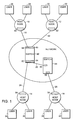
- an exemplary network is shown to include four host nodes labeled as 10, 12, 14, and 16. Each of the host nodes is also shown to be shared by a number of users. Specifically, host node 10 has users labeled as 26 and 28, host node 12 has users labeled as 30 and 32, host node 14 has users labeled as 34 and 36, and host node 16 has users labeled as 38 and 40.
- the exemplary network shown in FIG. 1 also includes two switches labeled as 42 and 44. Users communicate through the network with each other. For example, user 26 at host node 10 communicates with user 36 at host node 14, user 28 at host node 10 communicates with user 38 at host node 16, and users 30 and 32 at host node 12 communicate with users 38 and 40 at host node 16, respectively.
- the host nodes are shown connected to the switches, and the switches are shown connected to each other, by way of communication links, typically bi-directional.
- link 18 connects host node 10 to switch 42
- switches 42 and 44 are connected by a link 20.
- Link 22 connects host node 12 to switch 42
- link 24 connects switch 42 to host node 14
- link 25 connects switch 44 to host node 16.
- Each of the host nodes 10, 12, 14, and 16 is shown to include a scheduler.
- host node 10 has a scheduler 50
- host node 12 has a scheduler 52
- host node 14 has a scheduler 54
- host node 16 has a scheduler 56.
- the scheduler resides in a host adapter card (not shown).
- Each of the switches 42 and 44 is also shown as having a scheduler associated with each link connected to the switch.
- switch 42 contains a scheduler 58 associated with link 18.
- Scheduler 60 is associated with link 22
- scheduler 62 is associated with link 24
- scheduler 64 is associated with link 20.
- Switch 44 contains a scheduler 66 associated with link 20, while scheduler 68 is associated with link 25.
- Each of the schedulers shown in FIG. 1 is responsible for scheduling different flows which share common resources within the exemplary network.
- a limiting (or "bottleneck") resource is a link's capacity. For example, assume that all links in the network are of capacity 155 Mbs except link 20, which has capacity of 50 Mbs.
- any other transmission rate assignment is possible, as long as the sum of rates of user 26 and user 28 does not exceed 155 Mbs, which is the capacity of link 18, and the sum of the rates of user 28, user 30, and user 32 does not exceed 50 Mbs, which is the capacity of link 20.
- the average service rate that the scheduler provides to each user must be equal to the rate assigned to these users.
- scheduler 50 is responsible for scheduling flows submitted to host node 10 by user 26 and user 28 at rates R(1) and R(2) respectively.
- An exemplary embodiment of the present invention will be described in the context of flows in the exemplary network of FIG. 1.
- the present invention is adapted to any computer application that requires a weighted fair rate service in scheduling computer jobs.
- the exemplary embodiment will use an Asynchronous Transfer Mode (ATM) network as an example.
- ATM networks use fixed length data packets generally referred to as ATM cells.
- the present invention may be generalized to variable length data packets.
- the present invention may reside in an adapter (not shown), the adapter having a scheduler (i.e., 50, 52, 54, and 56) contained in each of the host nodes 10, 12, 14, and 16, and/or in the schedulers 58, 60, 62, 64, 66, and 68 of switches 42 and 44.
- a scheduler i.e., 50, 52, 54, and 56
- the present invention is based on the idea of the RE scheduler described in copending patent application European Patent Application No. 96120819.6.
- the Relative Error approach described herein is used to determine the scheduling order.
- flows are organized into groups according to their rates.
- a predetermined set of discrete rates R(1), R(2), ..., R(n) is chosen according to some rule. For example, with 10% rate granularity, one can chose 61 discrete rates spanning the range from 64 kbs to 155 Mbs. Once the set of discrete rates is chosen, all flows with a discrete rate R(k) assigned to them are assigned to group G(k).
- the RE scheduler is now applied to the groups rather than to individual flows.
- the rate of group G(k) is simply m(k)R(k), where m(k) is the number of flows in group k corresponding to the discrete rate R(k).
- the flows are chosen according to a simple round robin order.
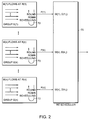
- the overall structure of the scheduler of the present invention is shown in FIG. 2.
- the scheduler consists of two parts: the RE Scheduler, which maintains per-group variables D(k,j) and W(j), and several round-robin schedulers, each operating on a group of flows corresponding to a single discrete rate.
- the RE scheduler 70 schedules a particular group G(k)
- the round robin scheduler 72 picks the next flow in its group (pointed to by variable p(k)), to be scheduled.
- the RE scheduler now needs to maintain only a reasonably small number of variables regardless how many flows need to be scheduled.
- Group G(0) corresponds to the "virtual" flow of the RE Scheduler as described in copending patent application European Patent Application No. 96120819.6.
- the virtual group does not contain any real flows. Whenever a group is scheduled, the flow within a group to be scheduled in this group opportunity is chosen using a simple round-robin sequence.
- the group G(k) with m(k) flows at rate R(k) is guaranteed the long-term average rate m(k)R(k). Due to the round-robin service within the group, any flow f within a group k is scheduled precisely every m(k) group cell opportunities, which implies that every flow inside the group is guaranteed its rate R(k).
- step 100 the scheduler conducts an initialization.
- the scheduler During the initialization, the following is executed by the scheduler.
- a link cell slot index is set equal to 0.
- a rate of flow for each flow rate i relative to the total bandwidth C is set equal to (the quotient of the rate of flow i and the total available bandwidth C) multiplied by the number of flows in the group, and an error term for each flow i at link cell slot 0 is set equal to 0.
- the round-robin pointer is initialized for all groups k to flow 1 in the group.
- the scheduler finds group G(f) with an error term D(f, j) equal to the maximum of the error terms D(k, j) for all groups.
- step 106 the scheduler checks whether the flow f is greater than zero.
- the scheduler checks if a cell of flow p(f) next to be scheduled from group G(f) is available. If not, then at step 112 an idle cell is transmitted. If so, at step 116 the next cell from the group of flow G(f ) is transmitted.
- p(f) is set equal to the next flow in the round robin of group G(f) and the link cell slot index is incremented by 1 and the error term for group f at link cell slot j is set equal to the error term for group f at link cell slot j plus the rate of group f relative to the total available bandwidth C minus 1.
- step 124 for all groups other than group G(f) the error term for flow i at link cell slot j is set equal to the error term for flow i at link cell slot j plus the rate of flow i relative to the total available bandwidth C.
- the scheduler then returns to step 104 to continue.
- V(i) R(i)/C denotes relative rates which are no longer pre-scaled .
- the remaining part of the RE algorithm remains unchanged.
- This modification can be used not only to proportionally scale the rates down to link bandwidth, but also to scale the rates up to the link bandwidth if the sum of rates is less than the link bandwidth. If up-scaling is desired, then the virtual flow should not be used. In certain cases, for example when the assigned flow rates constitute the maximum allowed rate (as in the case of rate-based feedback schemes) scaling the rates up may not be allowed, while scaling the rates down can be either desirable or acceptable. In such cases proportional scaling can be used only if the link is overbooked, while the "virtual flow" approach as described above can be used if the link is underbooked.
- R(i) be the nominal assigned rate of flow i
- r(i) be its rate proportionally scaled
- (5a,b) is also equivalent to (1a,b) since we obtained (5a,b) from (1a,b) by a series of equivalent transformations. This proves that (2a,b) can be used to compute D(i,j) in the RE scheduler using nonscaled rates to yield the same result as if flow rates had been prescaled.
Landscapes
- Engineering & Computer Science (AREA)
- Computer Networks & Wireless Communication (AREA)
- Signal Processing (AREA)
- Data Exchanges In Wide-Area Networks (AREA)
Applications Claiming Priority (2)
| Application Number | Priority Date | Filing Date | Title |
|---|---|---|---|
| US62248296A | 1996-03-26 | 1996-03-26 | |
| US622482 | 1996-03-26 |
Publications (2)
| Publication Number | Publication Date |
|---|---|
| EP0798897A2 true EP0798897A2 (de) | 1997-10-01 |
| EP0798897A3 EP0798897A3 (de) | 1999-07-14 |
Family
ID=24494339
Family Applications (1)
| Application Number | Title | Priority Date | Filing Date |
|---|---|---|---|
| EP97103184A Withdrawn EP0798897A3 (de) | 1996-03-26 | 1997-02-27 | Verfahren und Anlage zur relativen Fehlerablaufplannung unter Verwendung diskreter Geschwindigkeiten und proportioneller Skalierung der Geschwindigkeit |
Country Status (4)
| Country | Link |
|---|---|
| US (2) | US6108305A (de) |
| EP (1) | EP0798897A3 (de) |
| JP (1) | JPH1093586A (de) |
| KR (1) | KR100290190B1 (de) |
Cited By (2)
| Publication number | Priority date | Publication date | Assignee | Title |
|---|---|---|---|---|
| WO2003098883A1 (en) * | 2002-05-15 | 2003-11-27 | Mitsubishi Denki Kabushiki Kaisha | Packet scheduling system and packet scheduling method |
| EP1111858A3 (de) * | 1999-12-22 | 2004-07-07 | Alcatel USA Sourcing, L.P. | Maschine zur gewogener kreisförmigen Ablaufsteuerung |
Families Citing this family (27)
| Publication number | Priority date | Publication date | Assignee | Title |
|---|---|---|---|---|
| US6130878A (en) * | 1995-12-27 | 2000-10-10 | Compaq Computer Corporation | Method and apparatus for rate-based scheduling using a relative error approach |
| EP0798897A3 (de) * | 1996-03-26 | 1999-07-14 | Digital Equipment Corporation | Verfahren und Anlage zur relativen Fehlerablaufplannung unter Verwendung diskreter Geschwindigkeiten und proportioneller Skalierung der Geschwindigkeit |
| US6526060B1 (en) * | 1997-12-05 | 2003-02-25 | Cisco Technology, Inc. | Dynamic rate-based, weighted fair scheduler with explicit rate feedback option |
| JP3369108B2 (ja) * | 1998-06-10 | 2003-01-20 | 富士通株式会社 | パケットデータ送出装置 |
| US6999421B1 (en) * | 1998-10-26 | 2006-02-14 | Fujitsu Limited | Adjustable connection admission control method and device for packet-based switch |
| KR100317123B1 (ko) * | 1999-10-29 | 2001-12-24 | 오길록 | 선형 시스톨릭 라운드로빈 스케줄러 및 그의 스케줄링방법 |
| US7304945B1 (en) * | 2000-02-14 | 2007-12-04 | Ericsson Ab | Method and apparatus for dynamic bitmap generator scheduler |
| US6804249B1 (en) * | 2000-04-13 | 2004-10-12 | International Business Machines Corporation | Method and system for network processor scheduling based on calculation |
| US6904596B1 (en) * | 2000-05-24 | 2005-06-07 | Lucent Technologies Inc. | Method and apparatus for shared flow control of data |
| US7126969B1 (en) * | 2000-07-06 | 2006-10-24 | Cisco Technology, Inc. | Scalable system and method for reliably sequencing changes in signaling bits in multichannel telecommunication lines transmitted over a network |
| US7012889B1 (en) * | 2000-11-02 | 2006-03-14 | Cisco Technology, Inc. | Method and apparatus for controlling input rates within a packet switching system |
| US6714554B1 (en) * | 2001-02-13 | 2004-03-30 | Turin Networks | Method and system for sorting packets in a network |
| US6901052B2 (en) | 2001-05-04 | 2005-05-31 | Slt Logic Llc | System and method for policing multiple data flows and multi-protocol data flows |
| US6904057B2 (en) * | 2001-05-04 | 2005-06-07 | Slt Logic Llc | Method and apparatus for providing multi-protocol, multi-stage, real-time frame classification |
| US6944168B2 (en) * | 2001-05-04 | 2005-09-13 | Slt Logic Llc | System and method for providing transformation of multi-protocol packets in a data stream |
| US7042848B2 (en) * | 2001-05-04 | 2006-05-09 | Slt Logic Llc | System and method for hierarchical policing of flows and subflows of a data stream |
| US7151744B2 (en) * | 2001-09-21 | 2006-12-19 | Slt Logic Llc | Multi-service queuing method and apparatus that provides exhaustive arbitration, load balancing, and support for rapid port failover |
| US7099275B2 (en) * | 2001-09-21 | 2006-08-29 | Slt Logic Llc | Programmable multi-service queue scheduler |
| US20040156367A1 (en) * | 2003-02-11 | 2004-08-12 | Magis Networks, Inc. | Hierarchically distributed scheduling apparatus and method |
| US7522609B2 (en) * | 2004-01-14 | 2009-04-21 | Cisco Technology, Inc | Propagation of minimum guaranteed scheduling rates among scheduling layers in a hierarchical schedule |
| US7876763B2 (en) * | 2004-08-05 | 2011-01-25 | Cisco Technology, Inc. | Pipeline scheduler including a hierarchy of schedulers and multiple scheduling lanes |
| US7599381B2 (en) * | 2004-12-23 | 2009-10-06 | Cisco Technology, Inc. | Scheduling eligible entries using an approximated finish delay identified for an entry based on an associated speed group |
| EP1953959A1 (de) * | 2007-02-01 | 2008-08-06 | British Telecommunications Public Limited Company | Datenkommunikation |
| KR200450091Y1 (ko) * | 2008-04-19 | 2010-09-02 | 이덕순 | 착탈 가능한 한복 상의의 고름 |
| US8542608B2 (en) * | 2008-06-27 | 2013-09-24 | Telefonaktiebolaget L M Ericsson (Publ) | Method for achieving an optimal shaping rate for a new packet flow |
| US8817811B2 (en) * | 2012-06-27 | 2014-08-26 | Nxp B.V. | Communications apparatus, system and method with schedule checking |
| US20140081659A1 (en) | 2012-09-17 | 2014-03-20 | Depuy Orthopaedics, Inc. | Systems and methods for surgical and interventional planning, support, post-operative follow-up, and functional recovery tracking |
Family Cites Families (23)
| Publication number | Priority date | Publication date | Assignee | Title |
|---|---|---|---|---|
| US5301333A (en) * | 1990-06-14 | 1994-04-05 | Bell Communications Research, Inc. | Tree structured variable priority arbitration implementing a round-robin scheduling policy |
| US5367678A (en) * | 1990-12-06 | 1994-11-22 | The Regents Of The University Of California | Multiprocessor system having statically determining resource allocation schedule at compile time and the using of static schedule with processor signals to control the execution time dynamically |
| US5506969A (en) * | 1993-11-29 | 1996-04-09 | Sun Microsystems, Inc. | Method and apparatus for bus bandwidth management |
| JPH07221768A (ja) * | 1994-02-08 | 1995-08-18 | Oki Electric Ind Co Ltd | セル多重方法、セル多重装置及び交換スイッチ |
| DE69428425T2 (de) * | 1994-02-22 | 2002-06-20 | Alcatel, Paris | Verfahren zur Formung eines Zellenstromes, der Benutzer- und OAM-Zellen enthält |
| GB2288096B (en) * | 1994-03-23 | 1999-04-28 | Roke Manor Research | Apparatus and method of processing bandwidth requirements in an ATM switch |
| US5392280A (en) * | 1994-04-07 | 1995-02-21 | Mitsubishi Electric Research Laboratories, Inc. | Data transmission system and scheduling protocol for connection-oriented packet or cell switching networks |
| US5434860A (en) * | 1994-04-20 | 1995-07-18 | Apple Computer, Inc. | Flow control for real-time data streams |
| US5555244A (en) * | 1994-05-19 | 1996-09-10 | Integrated Network Corporation | Scalable multimedia network |
| EP0687120A1 (de) * | 1994-06-09 | 1995-12-13 | ALCATEL BELL Naamloze Vennootschap | Reglementierungsverfahren zur Garantierung von fairem Durchsatz und Anlage zur Durchführung des Verfahrens |
| US5619502A (en) * | 1994-09-16 | 1997-04-08 | Intel Corporation | Static and dynamic scheduling in an asynchronous transfer mode communication network |
| EP0702473A1 (de) * | 1994-09-19 | 1996-03-20 | International Business Machines Corporation | Verfahren und Vorrichtung zur Formung des Ausgangsverkehrs in einem Netzwerknoten zur Vermittung von Zellen fester Länge |
| DE4434724C1 (de) * | 1994-09-28 | 1995-11-23 | Siemens Ag | Verfahren und Schaltungsanordnung zum Weiterleiten von einer ATM-Kommunikationseinrichtung zugeführten Nachrichtenzellen |
| US5533020A (en) * | 1994-10-31 | 1996-07-02 | International Business Machines Corporation | ATM cell scheduler |
| CA2150967C (en) * | 1994-12-22 | 2001-04-03 | Jon C. R. Bennett | Method and a scheduler for controlling when a server provides service with rate control to an entity |
| US5533009A (en) * | 1995-02-03 | 1996-07-02 | Bell Communications Research, Inc. | Bandwidth management and access control for an ATM network |
| EP0748086A1 (de) * | 1995-06-09 | 1996-12-11 | Siemens Aktiengesellschaft | Planungsverfahren für ausgehende Nachrichtenzelle eines ATM-Knotens |
| JP3558429B2 (ja) * | 1995-11-06 | 2004-08-25 | 沖電気工業株式会社 | シェーピング装置 |
| US5771234A (en) * | 1995-12-06 | 1998-06-23 | Industrial Technology Research Institute | Method and system for ATM cell multiplexing under constant bit rate, variable bit rate and best-effort traffic |
| WO1997022195A1 (en) * | 1995-12-14 | 1997-06-19 | Cisco Systems, Inc. | Multi-level rate scheduler |
| US5781531A (en) * | 1995-12-27 | 1998-07-14 | Digital Equipment Corporation | Method and apparatus for hierarchical relative error scheduling |
| US5751709A (en) * | 1995-12-28 | 1998-05-12 | Lucent Technologies Inc. | Adaptive time slot scheduling apparatus and method for end-points in an ATM network |
| EP0798897A3 (de) * | 1996-03-26 | 1999-07-14 | Digital Equipment Corporation | Verfahren und Anlage zur relativen Fehlerablaufplannung unter Verwendung diskreter Geschwindigkeiten und proportioneller Skalierung der Geschwindigkeit |
-
1997
- 1997-02-27 EP EP97103184A patent/EP0798897A3/de not_active Withdrawn
- 1997-03-24 KR KR1019970010035A patent/KR100290190B1/ko not_active Expired - Fee Related
- 1997-03-26 JP JP11331197A patent/JPH1093586A/ja active Pending
-
1998
- 1998-11-20 US US09/197,137 patent/US6108305A/en not_active Expired - Lifetime
-
2000
- 2000-07-31 US US09/629,727 patent/US6337851B1/en not_active Expired - Fee Related
Cited By (2)
| Publication number | Priority date | Publication date | Assignee | Title |
|---|---|---|---|---|
| EP1111858A3 (de) * | 1999-12-22 | 2004-07-07 | Alcatel USA Sourcing, L.P. | Maschine zur gewogener kreisförmigen Ablaufsteuerung |
| WO2003098883A1 (en) * | 2002-05-15 | 2003-11-27 | Mitsubishi Denki Kabushiki Kaisha | Packet scheduling system and packet scheduling method |
Also Published As
| Publication number | Publication date |
|---|---|
| JPH1093586A (ja) | 1998-04-10 |
| US6108305A (en) | 2000-08-22 |
| EP0798897A3 (de) | 1999-07-14 |
| KR970066850A (ko) | 1997-10-13 |
| KR100290190B1 (ko) | 2001-05-15 |
| US6337851B1 (en) | 2002-01-08 |
Similar Documents
| Publication | Publication Date | Title |
|---|---|---|
| US6337851B1 (en) | Method and apparatus for relative error scheduling in a communications network using discrete rates and proportional rate scaling | |
| US6130878A (en) | Method and apparatus for rate-based scheduling using a relative error approach | |
| US5781531A (en) | Method and apparatus for hierarchical relative error scheduling | |
| US6240066B1 (en) | Dynamic bandwidth and buffer management algorithm for multi-service ATM switches | |
| US5914934A (en) | Adaptive time slot scheduling apparatus and method for end-points in an ATM network | |
| US6262986B1 (en) | Method and apparatus for packet scheduling using queue length and connection weight | |
| US6810012B1 (en) | Queue service interval based cell schedular with hierarchical queuing configurations | |
| US5818815A (en) | Method and an apparatus for shaping the output traffic in a fixed length cell switching network node | |
| US6438134B1 (en) | Two-component bandwidth scheduler having application in multi-class digital communications systems | |
| US5905730A (en) | High speed packet scheduling method and apparatus | |
| EP0901301B1 (de) | Dynamische, geschwindigkeitsbasierte Ablauffolgesteuerung für ATM-Netzwerke | |
| US6021116A (en) | Method and apparatus for controlling data transfer rate using virtual queues in asynchronous transfer mode networks | |
| US5862126A (en) | Connection admission control for ATM networks | |
| EP0874531A2 (de) | ATM-Zellenzuweisungsverfahren | |
| US6442164B1 (en) | Method and system for allocating bandwidth and buffer resources to constant bit rate (CBR) traffic | |
| US6396843B1 (en) | Method and apparatus for guaranteeing data transfer rates and delays in data packet networks using logarithmic calendar queues | |
| US20030076834A1 (en) | Adaptive service weight assingnments for ATM scheduling | |
| EP1635520A2 (de) | Verfahren und Vorrichtung zur Datenpaketübertragung | |
| Benmohamed et al. | A control-theoretic ABR explicit rate algorithm for ATM switches with per-VC queueing | |
| US6137779A (en) | Transmission rate calculation scheme using table-lookup | |
| US6003062A (en) | Iterative algorithm for performing max min fair allocation | |
| US7149185B1 (en) | Measurement-based connection admission control (MBAC) device for a packet data network | |
| EP0843499A2 (de) | Verfahren und Vorrichtung zur Verwaltung von Kommunikationsmitteln für gewichtete gerechte Warteschlangenbildungen in ATM-Technik | |
| US6990115B2 (en) | Queue control method and system | |
| US6587436B1 (en) | Method and apparatus for allocation of available bandwidth |
Legal Events
| Date | Code | Title | Description |
|---|---|---|---|
| PUAI | Public reference made under article 153(3) epc to a published international application that has entered the european phase |
Free format text: ORIGINAL CODE: 0009012 |
|
| AK | Designated contracting states |
Kind code of ref document: A2 Designated state(s): DE FR GB IT |
|
| PUAL | Search report despatched |
Free format text: ORIGINAL CODE: 0009013 |
|
| AK | Designated contracting states |
Kind code of ref document: A3 Designated state(s): DE FR GB IT |
|
| STAA | Information on the status of an ep patent application or granted ep patent |
Free format text: STATUS: THE APPLICATION IS DEEMED TO BE WITHDRAWN |
|
| 18D | Application deemed to be withdrawn |
Effective date: 19990829 |