EP0798928A2 - Procédé et dispositif pour la compression tridimensionnelle de signaux video numériques - Google Patents
Procédé et dispositif pour la compression tridimensionnelle de signaux video numériques Download PDFInfo
- Publication number
- EP0798928A2 EP0798928A2 EP97100607A EP97100607A EP0798928A2 EP 0798928 A2 EP0798928 A2 EP 0798928A2 EP 97100607 A EP97100607 A EP 97100607A EP 97100607 A EP97100607 A EP 97100607A EP 0798928 A2 EP0798928 A2 EP 0798928A2
- Authority
- EP
- European Patent Office
- Prior art keywords
- data
- video signal
- temporal
- spatial
- dimensional
- Prior art date
- Legal status (The legal status is an assumption and is not a legal conclusion. Google has not performed a legal analysis and makes no representation as to the accuracy of the status listed.)
- Withdrawn
Links
Images



Classifications
-
- H—ELECTRICITY
- H04—ELECTRIC COMMUNICATION TECHNIQUE
- H04N—PICTORIAL COMMUNICATION, e.g. TELEVISION
- H04N19/00—Methods or arrangements for coding, decoding, compressing or decompressing digital video signals
- H04N19/60—Methods or arrangements for coding, decoding, compressing or decompressing digital video signals using transform coding
- H04N19/649—Methods or arrangements for coding, decoding, compressing or decompressing digital video signals using transform coding the transform being applied to non rectangular image segments
-
- H—ELECTRICITY
- H04—ELECTRIC COMMUNICATION TECHNIQUE
- H04N—PICTORIAL COMMUNICATION, e.g. TELEVISION
- H04N19/00—Methods or arrangements for coding, decoding, compressing or decompressing digital video signals
- H04N19/10—Methods or arrangements for coding, decoding, compressing or decompressing digital video signals using adaptive coding
- H04N19/102—Methods or arrangements for coding, decoding, compressing or decompressing digital video signals using adaptive coding characterised by the element, parameter or selection affected or controlled by the adaptive coding
- H04N19/124—Quantisation
- H04N19/126—Details of normalisation or weighting functions, e.g. normalisation matrices or variable uniform quantisers
-
- H—ELECTRICITY
- H04—ELECTRIC COMMUNICATION TECHNIQUE
- H04N—PICTORIAL COMMUNICATION, e.g. TELEVISION
- H04N19/00—Methods or arrangements for coding, decoding, compressing or decompressing digital video signals
- H04N19/10—Methods or arrangements for coding, decoding, compressing or decompressing digital video signals using adaptive coding
- H04N19/134—Methods or arrangements for coding, decoding, compressing or decompressing digital video signals using adaptive coding characterised by the element, parameter or criterion affecting or controlling the adaptive coding
- H04N19/146—Data rate or code amount at the encoder output
- H04N19/147—Data rate or code amount at the encoder output according to rate distortion criteria
-
- H—ELECTRICITY
- H04—ELECTRIC COMMUNICATION TECHNIQUE
- H04N—PICTORIAL COMMUNICATION, e.g. TELEVISION
- H04N19/00—Methods or arrangements for coding, decoding, compressing or decompressing digital video signals
- H04N19/60—Methods or arrangements for coding, decoding, compressing or decompressing digital video signals using transform coding
- H04N19/61—Methods or arrangements for coding, decoding, compressing or decompressing digital video signals using transform coding in combination with predictive coding
-
- H—ELECTRICITY
- H04—ELECTRIC COMMUNICATION TECHNIQUE
- H04N—PICTORIAL COMMUNICATION, e.g. TELEVISION
- H04N19/00—Methods or arrangements for coding, decoding, compressing or decompressing digital video signals
- H04N19/60—Methods or arrangements for coding, decoding, compressing or decompressing digital video signals using transform coding
- H04N19/62—Methods or arrangements for coding, decoding, compressing or decompressing digital video signals using transform coding by frequency transforming in three dimensions [3D]
-
- H—ELECTRICITY
- H04—ELECTRIC COMMUNICATION TECHNIQUE
- H04N—PICTORIAL COMMUNICATION, e.g. TELEVISION
- H04N19/00—Methods or arrangements for coding, decoding, compressing or decompressing digital video signals
- H04N19/10—Methods or arrangements for coding, decoding, compressing or decompressing digital video signals using adaptive coding
- H04N19/102—Methods or arrangements for coding, decoding, compressing or decompressing digital video signals using adaptive coding characterised by the element, parameter or selection affected or controlled by the adaptive coding
- H04N19/124—Quantisation
Definitions
- This invention relates generally to digital video signal compression, and more particularly to methods of three-dimensional digital video signal compression that exhibit a high compression ratio, minimal signal distortion and a low transmission rate.
- the uncompressed data bit rates for monochrome digital video such as VCR-grade video (SIF), broadcast television video (CCIR-601) and high definition television (HDTV) are 16Mbps, 67Mbps, and 240Mbps, respectively.
- SIF VCR-grade video
- CCIR-601 broadcast television video
- HDTV high definition television
- these data bit rates are too high to allow such video signals to be transmitted and processed in a commercially feasible manner. Therefore, in order to process such video signals in a practical manner, such video signals must be compressed prior to being transmitted.
- MPEG has to date defined two syntaxes widely used in the digital videos industry.
- a syntax known as MPEG-1 was defined to be applicable to a wide range of bit rates and sample rates. Particularly, MPEG-1 is suitable for use in CD/ROM applications and other non-interlaced video applications having transmission rates of about 1.5 Mb/s.
- a second syntax known as MPEG-2 was defined for representation of broadcast video, and other video signal applications having coded bit rates of between 4 and 9 Mb/s. MPEG-2 syntax is also applicable to applications such as HDTV and other applications requiring efficient coding of interlaced video.
- MPEG-1 and MPEG-2 syntaxes exhibit adequate performance characteristics
- the ongoing evolution of digital video dictates the need for further advancement in the art, as the present MPEG video syntax definitions do have associated limitations.
- temporal redundancy a phenomenon which can be used to enhance video compression by minimizing data bit rate transmission for temporarily non-changing video pixels, is an efficient method of maximizing video signal compression.
- MPEG-1 and 2 data compression-based methods utilize temporal compression.
- the MPEG-1 and 2-based temporal compression is based on a frame by frame judgement basis so that the methods do not take full advantage of temporal compression.
- commercially standard MPEG-1 and MPEG-2 syntaxes partially only utilize temporal redundancy.
- present MPEG syntax requires numerous optimization options (such as predictive frame, bi-linear frame and intraframe variables) to be calculated, transmitted and then decoded by MPEG signal decompressors.
- optimization options such as predictive frame, bi-linear frame and intraframe variables
- the use of these numerous variables adds both computational time and complexity to the data compression.
- many current MPEG implemented syntaxes exhibit an associated bit rate compression of as high as 30:1, increasingly complex and data-intensive video applications require higher compression rates for real-time processing.
- data compression methods claiming compression ratios as high as 200:1 do exist, such methods subsample an array of pixels in a video frame sequence (i.e., throw away every other pixel) and utilize other shortcuts to achieve high compression.
- two methods of compressing a digital video signal are provided. Both methods exhibit higher compression ratios than current MPEG standards, while at the same time are less computationally intensive.
- the video signal compression methods of the present invention utilize a temporal dimension quantization vector in addition to the standard MPEG two-dimensional spatial quantization matrix to optimize the compression rate with an associated signal distortion that is unobservable to the human eye. Both methods may be adapted for use in an MPEG compatible format, thereby allowing the methods to be used with current digital video signal applications.
- a first method for compressing a digital video signal.
- the method includes the step of providing a compressor for performing video signal data compression operations.
- a video signal is received at the compressor and includes spatial and temporal data from a plurality of video signal frames.
- the compressor conditions the spatial and temporal data for data quantization and then quantizes the conditioned data such that the transformed spatial data is associated with the transformed temporal data.
- An optimal transmission rate and signal distortion level is then determined from the quantized data.
- the transformed spatial data is subsequently disassociated from its ordering to the transformed temporal data before the mix of transformed spatial and temporal data is formatted into a matrix in a zig-zag configuration block for data transmission.
- a second method of data compression is also provided.
- the second method provides a signal compressor for performing video compression operations.
- Video signal data including a plurality of video frames is input into the signal compressor.
- the compressor performs three-dimensional transformation of the video signal data from spatial and temporal position domains to a three-dimensional frequency domain.
- the compressor then creates a plurality of three-dimensional quantization matrices, with each matrix containing quantization coefficients corresponding to transform data from one temporal frequency in the video signal.
- Each of the plurality of quantization matrices includes a third dimension in which, for each temporal frequency, a temporal quantization vector component is associated with each of the quantization coefficients.
- the compressor calculates maximum transmission rate and optimal signal distortion parameters for the video frame from the data in the quantization matrices.
- the optimally quantized data is dequantized in the temporal dimension and inverse temporally transformed (one-dimensional transform).
- the resulting spatial transform is zig-zag ordered and transmitted per MPEG convention.
- FIGS. 1a-1b a system in which the preferred embodiment of the present invention is implemented as shown generally at 10a and 10b.
- one of the high compression data methods according to the present invention may be implemented.
- These data compression methods utilize temporal compression implemented through use of a three-dimensional quantization matrix.
- the methods of the present invention add a third temporal dimension to the two-dimensional spatial quantization matrix.
- a temporal quantization vector multiplies the coefficients in the MPEG two-dimensional spatial matrix representing a frame of data.
- the video signal is generated at a video signal source 12.
- this video signal source could be any source of a digital video signal, or an analog video signal that may be later converted to digital through means such as an analog-to-digital video frame grabber 14.
- a video signal source may include, but is not limited to, a video cassette recorder (VCR), a CD ROM, broadcast television signal generator, a high definition television signal generator, or any type of computer network application or other real-time digital video source.
- VCR video cassette recorder
- CD ROM Compact Disc
- broadcast television signal generator broadcast television signal generator
- high definition television signal generator or any type of computer network application or other real-time digital video source.
- the digital video signal generated from the video signal source 12 and/or the video frame grabber 14 is then input into a signal compressor, indicated generally at 16.
- the signal compressor includes a processor 18, a memory 20, and a power source 22.
- an external storage medium such as a central hard drive 24, may be operatively connected to the CPU to add further computation and memory capabilities
- the above described signal compressor is implemented via a Sun Sparc 10 Workstation.
- other computers such as an IBM or IBM compatible personal computer having a Intel Pentium® processor chip or any other processing unit having equivalent processing capabilities can also be utilized to implement the data compression methods of the present invention.
- the methods of the present invention may be implemented using ANSI C programming language.
- any other computer language capable of implementing the present methods may be used.
- the signal compressor also includes an application specific integrated circuit (ASIC) 30 for performing discrete cosine transforms (DCT) in accordance with the preferred methods of the present invention as will be described below. Additionally, the signal compressor 18 also includes a histogram chip 32 for forming histograms for data transmission purposes, as will also be described in detail below.
- ASIC application specific integrated circuit
- DCT discrete cosine transforms
- a signal receiver is shown generally at 10b.
- the signal receiver includes a signal decompressor, shown generally at 40.
- the decompressor may be a Sun Sparc 10 Workstation, an IBM personal computer with an Intel Pentium® processor, or any other processing unit having similar processing capabilities. It should be appreciated that the compressor and the decompressor may in fact be the same processing unit.
- the decompressor includes a processor 42 for performing inverse transforms to reconstruct the compressed video frames transmitted from the signal compressor 16. Specifically, an ASIC 44 is implemented to perform these inverse transforms.
- the processor 42 also includes a memory 46 and a power supply 48, of the type well known in the art.
- a video monitor 50 is also connected to the processor 42 for displaying the transmitted, reconstructed video frames.
- the video monitor is of the type well known in the art and may be a television, a computer display, or any other commercially available pixel-based video screen.
- a sequential group of video frames generated by the video signal source 12 is shown generally at 52.
- pixel data contained in each video frame is transformed, through a two-dimensional discrete cosine transform (DCT) function by the ASIC from a spatial position domain to a spatial frequency domain.
- DCT discrete cosine transform
- the coefficients are quantized as described below.
- the discrete cosine transform function is desirable for implementation in the methods of the present invention in that it closely approximates the ideal transform known as the Karhunen Loeve transform, which is known in the signal processing art as the ideal transform for a random process with known correlation coefficients between the terms in the random process, thereby calculating answers in a mathematical optimization manner.
- the two-dimensional spatial DCT of the plurality of video frames is indexed by the time tag " index t.
- N is the number of pixels on one side of a pixel block
- D ( u ) 2 2 N for u > o
- D ( v ) 2 2 N for v > o
- the resulting data for each video frame is quantized in a three-dimensional quantization matrix, shown generally at 58.
- Each of the resulting matrices includes eight coefficients per row, as indicated by the arrow U at 59 in FIG. 4, eight coefficients per column, as indicated by the arrow V at 60 and temporal quantization vectors associated with each spatial coefficient in the direction represented by arrow W at 61.
- the three-dimensional quantization matrix is formed by multiplying the 64 C UV quantization coefficients from the MPEG two-dimensional spatial matrix by a temporal scaling term represented by the temporal vector elements and derived from the one-dimensional discrete cosine transform.
- each matrix representing a particular video frame in the eight frame sequence includes sixty-four three-dimensional coefficients, each presented generally by the term c ⁇ uvw as shown generally in the matrix at 58.
- the DC value is the 0,0 term in the spatial domain and represents the average of intensities of pixels in the video frame in question.
- the remaining 63 coefficients, or AC values, are related to the difference between pixels in temporally successive frames.
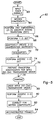
- a preferred method of implementing a first data compression method according to a first embodiment of the present invention is shown generally at 62 and will now be described.
- the original sequence of video frames is input into the compressor 16.
- the sequence of frames is then subjected to motion compensation analysis at step 64, as is done with conventional MPEG syntax and is as well known in the art.
- the general mathematical representation of the motion compensation is as follows.
- a two-dimensional discrete cosine transform as described above is performed on the data contained within the frames to transform the data from the spatial position domain to the spatial frequency domain.
- a one-dimensional discrete cosine transform is performed on the data in the video frames as described above in the temporal dimension to thereby produce coefficients in the temporal frequency domain.
- the three-dimensional discrete cosine transform group of transform coefficients are ordered as a group of eight by eight matrices, with the number of matrices equaling the number of frames used in the group of frames being processed.
- the processor at step 70 adaptively creates a three-dimensional quantization matrix for each group of frames of video data in the memory 20 by determining the temporal quantization vector component that optimizes the rate at each temporal frequency.
- the method calculates the optimal distortion, or error, for the particular sequence of video frames being transmitted.
- the optimal transmission bit rate is also calculated, as will be described in detail below.
- the method dequantizes the coefficients in the matrices formed and created at step 70 by removing the temporal scaling factor c w from the coefficients.
- the method performs an inverse one-dimensional DCT to remove the coefficients from the temporal domain, thereby reverting the matrix back to a two-dimensional MPEG matrix with coefficients representing the spatial position of signal data.
- the compression method according to the present invention dequantizes the three-dimensional matrix and performs the inverse one-dimensional DCT function on the coefficients subsequent to transmission to both take advantage of the temporal compression of the three-dimensional DCT and to transmit the data in such a manner that the signal decompressor receives the intraframe coded frames in MPEG compatible form.
- the processor determines the probability of each coefficient being zero for the particular processed group of frames and arranges the coefficients accordingly in a zig-zag transmission block order utilized in conventional MPEG data compression methods. Subsequent to the coefficients being arranged in the above-described zig-zag order transmission block, the data is transmitted at step 78 to the signal decompressor 42. Subsequent to being transmitted, the zig-zag ordered block of data is reformatted at step 80 by the signal decompressor back into the two-dimensional MPEG spatial position coefficient matrix.
- the method removes the motion compensation weighting from the data.
- the reconstructed video frames are produced and output on the video monitor 26.
- the method may be implemented with present MPEG compatible video systems to achieve a compression rate of about 40:1, which is a significant increase when compared to the typical 30:1 compression rate of present MPEG-2 syntax.
- the above described three-dimensional DCT based method temporally compresses four to eight frames of video and thus has more compression potential than the commercial standard MPEG-1 and 2 syntaxes, which typically utilize less than eight frames for optimizing temporal redundancy and uses temporal compression for only two frames at a time.
- the MPEG compatible algorithm uncompresses the temporal dimension before data transmission, leaving a two dimensional data format that is compatible with MPEG. Transmission and compression rates are thus determined after temporal uncompression, or dequantization and inverse transformation, has been performed.
- the temporal scaling parameter can be chosen either to set all temporal frequency distortions at the same value or to minimize distortion for a given target rate allocated to each temporal frequency.
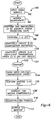
- a second method of data compression is illustrated through the flow diagram shown generally at 90.
- This second data compression method attacks the transmission order optimization after video frame coefficients have been transformed three-dimensionally, rather than use MPEG zig-zag order after the inverse temporal transformation implemented in the first data compression method DCT at step 64.
- the original video frames are input into the compressor from the video signal source 12.
- the processor 18 initially performs motion compensation the frames at step 94.
- the method performs two-dimensional spatial and one-dimensional temporal DCT transforms, respectively, on the video data, as with the above described first decompression method.
- three-dimensional quantization matrices are adaptively created, as in the earlier described first method.
- the second method differs in that at step 101, the histogram chip 32 creates a histogram of the quantized coefficients in the three-dimensional matrices such that the method may adaptively create a three-dimensional coefficient transmission order (i.e., a three-dimensional zig-zag order) block.
- the histogram chip generates a histogram that is used by the compressor to transform one three-dimensional matrix into another three-dimensional matrix based on the information the histogram collects.
- An ordering based on increasing spatio-temporal frequency, i.e., u 2 + v 2 + w 2 would be an expression of the MPEG approach to transmission order.
- the compressed bit stream thus includes an ordering with the coefficient having the least probability of being zero being first transmitted, with the coefficients having the least probability of being zero being transmitted in increasing probability order.
- the first row of the first matrix of dequantized coefficients is the column from the processed group of frames with the least number of zeros.
- the second row of the first matrix of the dequantized coefficients is the column from the processed group of frames with the second least number of zeros.
- the remaining rows of the first matrix are filled out with similar ordering regarding number of zero coefficients in a column.
- Rows of the second matrix are filled if there are any remaining columns with non-zero coefficients.
- An end of block character is transmitted after the last row in the new matrix system having a non-zero coefficient is transmitted. This minimizes the amount of data transmitted having no energy and being represented by coefficients having a zero value.
- the decompressor at the other end subsequently fills in zeros to the rest of the transmitted bit stream before the decompressor starts data decompression.
- the MPEG-like ordering with increasing spatio-temporal frequency is lost upon data transmission due to the three-dimensional zig-zag block being transmitted, as the block must be reordered before the inverse one-dimensional transform may be performed.
- the zero run length is increased in two different directions, thereby giving about a fivefold increase in compression over the MPEG compatible method.
- the matrix coefficients are transmitted at step 102.
- the method undoes the three-dimensional zig-zag transmission order block at step 104 before the inverse one-dimensional and inverse two-dimensional DCT transforms can be performed at steps 106 and 108, respectively.
- motion compensation is removed, and the video frames are reconstructed and output to the video monitor 26 at steps 110 and 112.
- the transmission rate is calculated using entropy calculations based on pseudo-probability distribution of coefficients, and not on the actual MPEG syntax calculations.
- the entropy calculations slightly overestimate the transmission rate.
- the entropy calculation accounts for all quantized coefficients, whereas the MPEG method truncates coefficients if the coefficients exceed certain minimum or maximum limits defined by the MPEG standard.
- p is the probability vector for non-zero transform coefficients
- L i is the zero run length plus one
- p i is the probability of a sum of i zeros.
- MPEG software which is publicly available on the Internet, could be used instead of the entropy calculations.
- step 122 video signal data is input. This data correlates to the three-dimensional quantization coefficients that fill the three-dimensional quantization matrices performed at steps 60 and 98, respectively, of the above described first and second methods.
- the quantizer is stepped up gradually in small increments. At each temporal frequency, a temporal quantizer scaling term is determined from optimizing rate-distortion performance at that temporal frequency.
- the distortion rate R ⁇ is calculated. The optimal R ⁇ is calculated by plotting transmission rate versus temporal quantization component q w . Such a plot results in the generation of a curve with a minimum rate value, as indicated generally at 127 in FIG. 9.
- the processor determines if the minimum value for R ⁇ has been found by successively choosing points on the generated curve 127.
- the method determines if the processor has found the minimum value of R ⁇ . If the processor has found the minimum value, the value q w is set to minimize the value R ⁇ (q w ).
- R ⁇ is an approximation to the average rate for the group of frames, which is usually the rate for the first frame of a group of frames. Use of one frame to represent the rate for a group of frames is typically sufficient for rate optimization. If the minimum value is not found, the method returns to step 128 to continue searching for the minimum value of R ⁇ .
- step 130 the method increments to step 132, where steps 124-132 are repeated for q w1 , q w2 , ... until the overall transmission rate for each R ⁇ (q w ) has been computed for q w7 .
- step 134 the method determines if the next value for q w equals q w8 . If so, the method ends until the next group of frames is compressed. If q w8 has not been computed, the method returns to step 124 for further transmission rate computations.
- the preferred method of implementing a signal distortion optimization calculation is shown at 150.
- the scaling factor q w is incremented.
- the distortion rate D is calculated in parallel to the transmission rate calculation at the processor 18, as is indicated at step 154.
- the distortion rate is the square of the difference between the coefficients with and without temporal quantization vector weighing factor. The sum of each of the individual error contributions for a particular coefficient gives the total distortion error due to quantization.
- R ⁇ is an estimate to the true compressed rate; it is a performance metric used to set the terms in the temporal quantization vector during rate optimization procedure.
- R ⁇ is calculated in the following way. A set of quantized coefficients at a q w value is made, and the three-dimensional quantized coefficients are temporally dequantized and inverse one-dimensional DCT transformed. The rate for a frame is then determined and set equal to R ⁇ . This process repeats until the minimum R ⁇ is set for each temporal frequency.
- the method determines if D (q w ) is above the threshold of the human visual system. If the distortion is above the threshold, the method returns to step 152 and the distortion is calculated until the value of D(q w ) is above the threshold of human visualization. When the value is such, the q w iteration is stopped as indicated at step 158.
- the distortion rate for the next spatial transmission matrix for the next video frame is calculated.
- the values for q w2 through q w7 could be set at default values to further simplify the above-described data compression methods. It should also be appreciated that the rate/distortion sequence of the compression methods of the present invention could be enhanced by optimizing both the DC and AC coefficients separately. The rate/distortion optimization method could also be enhanced by using the Lagrange multiplier method.
- the video signal compression methods of the present invention provide methods for compressing digital video signals in a manner that achieves high bit rate transmission with minimal detected distortion.
- the methods of the present invention maximize use of temporal compression through temporal redundancy and thereby minimize the number of quantization variables required for data compression and thus the complexity of the data compression operation.
- the data compression methods of the present invention exhibit increased compression ratios when compared to present MPEG-1 and MPEG-2 based data compression methods while at the same time minimize data compression complexity.
Landscapes
- Engineering & Computer Science (AREA)
- Multimedia (AREA)
- Signal Processing (AREA)
- Compression Or Coding Systems Of Tv Signals (AREA)
- Compression, Expansion, Code Conversion, And Decoders (AREA)
Applications Claiming Priority (2)
| Application Number | Priority Date | Filing Date | Title |
|---|---|---|---|
| US621855 | 1990-12-04 | ||
| US62185596A | 1996-03-25 | 1996-03-25 |
Publications (2)
| Publication Number | Publication Date |
|---|---|
| EP0798928A2 true EP0798928A2 (fr) | 1997-10-01 |
| EP0798928A3 EP0798928A3 (fr) | 1997-12-29 |
Family
ID=24491933
Family Applications (1)
| Application Number | Title | Priority Date | Filing Date |
|---|---|---|---|
| EP97100607A Withdrawn EP0798928A3 (fr) | 1996-03-25 | 1997-01-16 | Procédé et dispositif pour la compression tridimensionnelle de signaux video numériques |
Country Status (5)
| Country | Link |
|---|---|
| US (2) | US5936669A (fr) |
| EP (1) | EP0798928A3 (fr) |
| JP (1) | JP3445919B2 (fr) |
| KR (1) | KR100262236B1 (fr) |
| TW (1) | TW364107B (fr) |
Cited By (3)
| Publication number | Priority date | Publication date | Assignee | Title |
|---|---|---|---|---|
| WO1999025121A1 (fr) * | 1997-11-07 | 1999-05-20 | Pipe Dream, Inc. | Procede de compression et de decompression d'images video animees |
| EP0866622A3 (fr) * | 1997-03-21 | 2001-03-14 | Trw Inc. | Méthode de compression de données vidéo numériques |
| US6909746B2 (en) | 2001-03-30 | 2005-06-21 | Koninklijke Philips Electronics N.V. | Fast robust data compression method and system |
Families Citing this family (36)
| Publication number | Priority date | Publication date | Assignee | Title |
|---|---|---|---|---|
| JP3518717B2 (ja) * | 1996-09-20 | 2004-04-12 | ソニー株式会社 | 動画像符号化装置および方法、並びに動画像復号化装置および方法 |
| US6272175B1 (en) * | 1997-02-13 | 2001-08-07 | Conexant Systems, Inc. | Video signal coding systems and processes using adaptive quantization |
| US6111914A (en) * | 1997-12-01 | 2000-08-29 | Conexant Systems, Inc. | Adaptive entropy coding in adaptive quantization framework for video signal coding systems and processes |
| US6118822A (en) * | 1997-12-01 | 2000-09-12 | Conexant Systems, Inc. | Adaptive entropy coding in adaptive quantization framework for video signal coding systems and processes |
| US6728313B1 (en) * | 1998-01-08 | 2004-04-27 | Intel Corporation | Method and apparatus for performing MPEG II dequantization and IDCT |
| US7209519B2 (en) * | 2001-04-16 | 2007-04-24 | Mitsubishi Electric Research Laboratories, Inc. | Encoding a video with a variable frame-rate while minimizing total average distortion |
| US6628300B2 (en) * | 2001-11-30 | 2003-09-30 | International Business Machines Corporation | Transcoding proxy and method for transcoding encoded streams |
| US9350782B2 (en) * | 2002-01-29 | 2016-05-24 | Antonio Ortega | Method and system for delivering media data |
| US10277656B2 (en) * | 2002-01-29 | 2019-04-30 | FiveOpenBooks, LLC | Method and system for delivering media data |
| US20090064242A1 (en) * | 2004-12-23 | 2009-03-05 | Bitband Technologies Ltd. | Fast channel switching for digital tv |
| KR100703799B1 (ko) * | 2005-07-19 | 2007-04-06 | 삼성전자주식회사 | 역 양자화 방법 및 장치, 상기 방법을 이용한 비디오디코딩 방법 및 장치 |
| US8605797B2 (en) * | 2006-02-15 | 2013-12-10 | Samsung Electronics Co., Ltd. | Method and system for partitioning and encoding of uncompressed video for transmission over wireless medium |
| US20090307732A1 (en) * | 2006-03-07 | 2009-12-10 | Noam Cohen | Personalized Insertion of Advertisements in Streaming Media |
| MX2008008558A (es) * | 2007-06-29 | 2009-03-04 | Abl Ip Holding Llc | Conjuntos de iliminacion por led para cajas de exhibicion. |
| US8842739B2 (en) * | 2007-07-20 | 2014-09-23 | Samsung Electronics Co., Ltd. | Method and system for communication of uncompressed video information in wireless systems |
| US8243823B2 (en) | 2007-08-29 | 2012-08-14 | Samsung Electronics Co., Ltd. | Method and system for wireless communication of uncompressed video information |
| US8700792B2 (en) * | 2008-01-31 | 2014-04-15 | General Instrument Corporation | Method and apparatus for expediting delivery of programming content over a broadband network |
| CN101521819B (zh) * | 2008-02-27 | 2010-12-01 | 深圳市融创天下科技发展有限公司 | 一种在视频图像压缩中对率失真进行优化的方法 |
| US8752092B2 (en) * | 2008-06-27 | 2014-06-10 | General Instrument Corporation | Method and apparatus for providing low resolution images in a broadcast system |
| WO2010033151A1 (fr) * | 2008-09-18 | 2010-03-25 | Thomson Licensing | Procédés et appareil pour la coupe d’images vidéo |
| RU2375838C1 (ru) * | 2008-11-19 | 2009-12-10 | Федеральное государственное унитарное предприятие "Научно-исследовательский институт телевидения" | Способ кодирования и декодирования видеоинформации на основе трехмерного дискретного косинусного преобразования |
| US9369759B2 (en) * | 2009-04-15 | 2016-06-14 | Samsung Electronics Co., Ltd. | Method and system for progressive rate adaptation for uncompressed video communication in wireless systems |
| EP2502227A1 (fr) * | 2009-11-18 | 2012-09-26 | Nokia Corp. | Traitement de données |
| RU2420912C1 (ru) * | 2009-11-24 | 2011-06-10 | Федеральное государственное унитарное предприятие "Научно-исследовательский институт телевидения" | Способ распространения и транскодирования видеоконтента |
| US20120275510A1 (en) * | 2009-11-25 | 2012-11-01 | Massachusetts Institute Of Technology | Scaling signal quality with channel quality |
| JP5625342B2 (ja) * | 2009-12-10 | 2014-11-19 | ソニー株式会社 | 画像処理方法、画像処理装置、プログラム |
| JP5428886B2 (ja) * | 2010-01-19 | 2014-02-26 | ソニー株式会社 | 情報処理装置、情報処理方法、及びそのプログラム |
| US8525835B1 (en) | 2010-02-24 | 2013-09-03 | The Boeing Company | Spatial data compression using implicit geometry |
| US9357244B2 (en) * | 2010-03-11 | 2016-05-31 | Arris Enterprises, Inc. | Method and system for inhibiting audio-video synchronization delay |
| JP5703781B2 (ja) * | 2010-09-03 | 2015-04-22 | ソニー株式会社 | 画像処理装置および方法 |
| JP2012209673A (ja) * | 2011-03-29 | 2012-10-25 | Sony Corp | 情報処理装置及び方法、画像提供システム及び画像提供方法、並びにプログラム |
| US9554132B2 (en) | 2011-05-31 | 2017-01-24 | Dolby Laboratories Licensing Corporation | Video compression implementing resolution tradeoffs and optimization |
| US20140327737A1 (en) | 2013-05-01 | 2014-11-06 | Raymond John Westwater | Method and Apparatus to Perform Optimal Visually-Weighed Quantization of Time-Varying Visual Sequences in Transform Space |
| US20160360237A1 (en) * | 2013-12-22 | 2016-12-08 | Lg Electronics Inc. | Method and apparatus for encoding, decoding a video signal using additional control of quantizaton error |
| RU2557449C1 (ru) * | 2014-04-07 | 2015-07-20 | Федеральное государственное казенное военное образовательное учреждение высшего профессионального образования "Военная академия связи имени Маршала Советского Союза С.М. Буденного" Министерства Обороны Российской Федерации (Минобороны России) | Способ кодирования и декодирования видеоинформации на основе трехмерного дискретного косинусного преобразования |
| US10553015B2 (en) | 2017-03-31 | 2020-02-04 | Google Llc | Implicit view-dependent quantization |
Family Cites Families (9)
| Publication number | Priority date | Publication date | Assignee | Title |
|---|---|---|---|---|
| FR2627926A1 (fr) * | 1988-02-29 | 1989-09-01 | Labo Electronique Physique | Procede et dispositif de codage de signaux video numeriques, et dispositif de decodage correspondant |
| US4999705A (en) * | 1990-05-03 | 1991-03-12 | At&T Bell Laboratories | Three dimensional motion compensated video coding |
| GB2252002B (en) * | 1991-01-11 | 1995-01-04 | Sony Broadcast & Communication | Compression of video signals |
| US5293434A (en) * | 1991-04-10 | 1994-03-08 | International Business Machines Corporation | Technique for use in a transform coder for imparting robustness to compressed image data through use of global block transformations |
| US5428693A (en) * | 1991-04-12 | 1995-06-27 | Mitsubishi Denki Kabushiki Kaisha | Motion compensation predicting coding method and apparatus |
| ATE159396T1 (de) * | 1991-06-04 | 1997-11-15 | Qualcomm Inc | System zur adaptiven kompression der blockgrössen eines bildes |
| US5227878A (en) * | 1991-11-15 | 1993-07-13 | At&T Bell Laboratories | Adaptive coding and decoding of frames and fields of video |
| US5367629A (en) * | 1992-12-18 | 1994-11-22 | Sharevision Technology, Inc. | Digital video compression system utilizing vector adaptive transform |
| US5530661A (en) * | 1994-10-05 | 1996-06-25 | Winnov | Data bit-slicing apparatus and method for computing convolutions |
-
1997
- 1997-01-11 TW TW086100246A patent/TW364107B/zh not_active IP Right Cessation
- 1997-01-16 EP EP97100607A patent/EP0798928A3/fr not_active Withdrawn
- 1997-01-23 KR KR1019970001819A patent/KR100262236B1/ko not_active Expired - Fee Related
- 1997-03-21 JP JP10801497A patent/JP3445919B2/ja not_active Expired - Fee Related
- 1997-04-25 US US08/848,000 patent/US5936669A/en not_active Expired - Fee Related
- 1997-10-20 US US08/954,634 patent/US5933193A/en not_active Expired - Fee Related
Cited By (3)
| Publication number | Priority date | Publication date | Assignee | Title |
|---|---|---|---|---|
| EP0866622A3 (fr) * | 1997-03-21 | 2001-03-14 | Trw Inc. | Méthode de compression de données vidéo numériques |
| WO1999025121A1 (fr) * | 1997-11-07 | 1999-05-20 | Pipe Dream, Inc. | Procede de compression et de decompression d'images video animees |
| US6909746B2 (en) | 2001-03-30 | 2005-06-21 | Koninklijke Philips Electronics N.V. | Fast robust data compression method and system |
Also Published As
| Publication number | Publication date |
|---|---|
| JP3445919B2 (ja) | 2003-09-16 |
| EP0798928A3 (fr) | 1997-12-29 |
| US5936669A (en) | 1999-08-10 |
| KR100262236B1 (ko) | 2000-07-15 |
| US5933193A (en) | 1999-08-03 |
| JPH1075446A (ja) | 1998-03-17 |
| TW364107B (en) | 1999-07-11 |
Similar Documents
| Publication | Publication Date | Title |
|---|---|---|
| US5933193A (en) | Method and system for three-dimensional compression of digital video signals | |
| US7003168B1 (en) | Image compression and decompression based on an integer wavelet transform using a lifting scheme and a correction method | |
| US5786856A (en) | Method for adaptive quantization by multiplication of luminance pixel blocks by a modified, frequency ordered hadamard matrix | |
| US5426512A (en) | Image data compression having minimum perceptual error | |
| CN100568969C (zh) | 可逆子波变换和嵌入代码流处理方法 | |
| EP0584741A2 (fr) | Dispositif de codage du signal d'image | |
| EP0734164B1 (fr) | Procédé et appareil pour le codage du signal vidéo avec un dispositif de classification | |
| US20100008592A1 (en) | Image signal transforming and inverse-transforming method and computer program product with pre-encoding filtering features | |
| US6888891B2 (en) | Wavelet domain half-pixel motion compensation | |
| US7096245B2 (en) | Inverse discrete cosine transform supporting multiple decoding processes | |
| US6014172A (en) | Optimized video compression from a single process step | |
| US7099523B2 (en) | Method and system for scaling a signal sample rate | |
| Nicoulin et al. | Image sequence coding using motion compensated subband decomposition | |
| Elmourssi et al. | A Performance Study Of Two Jpeg Compression Approaches | |
| Kuo et al. | Multiresolution video coding based on Kalman filtering motion estimation | |
| Kumar et al. | Comparative Analysis and Performance Evaluation of Medical Image Compression Method for Telemedicine | |
| JPH0711832B2 (ja) | 高能率画像符号化装置 | |
| EP1376379A2 (fr) | Dispositif et procédé pour effectuer un transformé discrète inverse du cosinus pour plusieurs procédés de décodage | |
| Feria | Predictive transform source coding with subbands | |
| Gershikov et al. | On a Probabilistic Approach to Rate Control for Optimal Color Image Compression and Video Transmission | |
| Nadu | Removing Coding and Inter Pixel Redundancy in High Intensity Part of Image | |
| JPH05347708A (ja) | 画像変換装置 | |
| JPH0998414A (ja) | 画像符号化・復号化方法及びシステム | |
| Voukelatos et al. | An ASBVQ codec for VLBR video coding | |
| Sampson et al. | Image and video compression for multimedia applications |
Legal Events
| Date | Code | Title | Description |
|---|---|---|---|
| PUAI | Public reference made under article 153(3) epc to a published international application that has entered the european phase |
Free format text: ORIGINAL CODE: 0009012 |
|
| AK | Designated contracting states |
Kind code of ref document: A2 Designated state(s): DE FR GB |
|
| PUAL | Search report despatched |
Free format text: ORIGINAL CODE: 0009013 |
|
| AK | Designated contracting states |
Kind code of ref document: A3 Designated state(s): DE FR GB |
|
| 17P | Request for examination filed |
Effective date: 19980121 |
|
| 17Q | First examination report despatched |
Effective date: 20000316 |
|
| GRAG | Despatch of communication of intention to grant |
Free format text: ORIGINAL CODE: EPIDOS AGRA |
|
| GRAG | Despatch of communication of intention to grant |
Free format text: ORIGINAL CODE: EPIDOS AGRA |
|
| GRAH | Despatch of communication of intention to grant a patent |
Free format text: ORIGINAL CODE: EPIDOS IGRA |
|
| STAA | Information on the status of an ep patent application or granted ep patent |
Free format text: STATUS: THE APPLICATION IS DEEMED TO BE WITHDRAWN |
|
| 18D | Application deemed to be withdrawn |
Effective date: 20020426 |