EP0799122B1 - Vorform zur herstellung eines faserverstärkten kompositmaterials - Google Patents
Vorform zur herstellung eines faserverstärkten kompositmaterials Download PDFInfo
- Publication number
- EP0799122B1 EP0799122B1 EP95944503A EP95944503A EP0799122B1 EP 0799122 B1 EP0799122 B1 EP 0799122B1 EP 95944503 A EP95944503 A EP 95944503A EP 95944503 A EP95944503 A EP 95944503A EP 0799122 B1 EP0799122 B1 EP 0799122B1
- Authority
- EP
- European Patent Office
- Prior art keywords
- powder
- substrate
- tacky adhesive
- preform
- fibers
- Prior art date
- Legal status (The legal status is an assumption and is not a legal conclusion. Google has not performed a legal analysis and makes no representation as to the accuracy of the status listed.)
- Expired - Lifetime
Links
Images
Classifications
-
- C—CHEMISTRY; METALLURGY
- C22—METALLURGY; FERROUS OR NON-FERROUS ALLOYS; TREATMENT OF ALLOYS OR NON-FERROUS METALS
- C22C—ALLOYS
- C22C47/00—Making alloys containing metallic or non-metallic fibres or filaments
- C22C47/14—Making alloys containing metallic or non-metallic fibres or filaments by powder metallurgy, i.e. by processing mixtures of metal powder and fibres or filaments
-
- B—PERFORMING OPERATIONS; TRANSPORTING
- B29—WORKING OF PLASTICS; WORKING OF SUBSTANCES IN A PLASTIC STATE IN GENERAL
- B29C—SHAPING OR JOINING OF PLASTICS; SHAPING OF MATERIAL IN A PLASTIC STATE, NOT OTHERWISE PROVIDED FOR; AFTER-TREATMENT OF THE SHAPED PRODUCTS, e.g. REPAIRING
- B29C70/00—Shaping composites, i.e. plastics material comprising reinforcements, fillers or preformed parts, e.g. inserts
- B29C70/02—Shaping composites, i.e. plastics material comprising reinforcements, fillers or preformed parts, e.g. inserts comprising combinations of reinforcements, e.g. non-specified reinforcements, fibrous reinforcing inserts and fillers, e.g. particulate fillers, incorporated in matrix material, forming one or more layers and with or without non-reinforced or non-filled layers
- B29C70/021—Combinations of fibrous reinforcement and non-fibrous material
- B29C70/025—Combinations of fibrous reinforcement and non-fibrous material with particular filler
-
- B—PERFORMING OPERATIONS; TRANSPORTING
- B29—WORKING OF PLASTICS; WORKING OF SUBSTANCES IN A PLASTIC STATE IN GENERAL
- B29C—SHAPING OR JOINING OF PLASTICS; SHAPING OF MATERIAL IN A PLASTIC STATE, NOT OTHERWISE PROVIDED FOR; AFTER-TREATMENT OF THE SHAPED PRODUCTS, e.g. REPAIRING
- B29C70/00—Shaping composites, i.e. plastics material comprising reinforcements, fillers or preformed parts, e.g. inserts
- B29C70/04—Shaping composites, i.e. plastics material comprising reinforcements, fillers or preformed parts, e.g. inserts comprising reinforcements only, e.g. self-reinforcing plastics
- B29C70/06—Fibrous reinforcements only
- B29C70/08—Fibrous reinforcements only comprising combinations of different forms of fibrous reinforcements incorporated in matrix material, forming one or more layers, and with or without non-reinforced layers
- B29C70/086—Fibrous reinforcements only comprising combinations of different forms of fibrous reinforcements incorporated in matrix material, forming one or more layers, and with or without non-reinforced layers and with one or more layers of pure plastics material, e.g. foam layers
-
- B—PERFORMING OPERATIONS; TRANSPORTING
- B29—WORKING OF PLASTICS; WORKING OF SUBSTANCES IN A PLASTIC STATE IN GENERAL
- B29C—SHAPING OR JOINING OF PLASTICS; SHAPING OF MATERIAL IN A PLASTIC STATE, NOT OTHERWISE PROVIDED FOR; AFTER-TREATMENT OF THE SHAPED PRODUCTS, e.g. REPAIRING
- B29C53/00—Shaping by bending, folding, twisting, straightening or flattening; Apparatus therefor
- B29C53/56—Winding and joining, e.g. winding spirally
-
- B—PERFORMING OPERATIONS; TRANSPORTING
- B29—WORKING OF PLASTICS; WORKING OF SUBSTANCES IN A PLASTIC STATE IN GENERAL
- B29K—INDEXING SCHEME ASSOCIATED WITH SUBCLASSES B29B, B29C OR B29D, RELATING TO MOULDING MATERIALS OR TO MATERIALS FOR MOULDS, REINFORCEMENTS, FILLERS OR PREFORMED PARTS, e.g. INSERTS
- B29K2033/00—Use of polymers of unsaturated acids or derivatives thereof as moulding material
- B29K2033/04—Polymers of esters
- B29K2033/12—Polymers of methacrylic acid esters, e.g. PMMA, i.e. polymethylmethacrylate
-
- B—PERFORMING OPERATIONS; TRANSPORTING
- B29—WORKING OF PLASTICS; WORKING OF SUBSTANCES IN A PLASTIC STATE IN GENERAL
- B29K—INDEXING SCHEME ASSOCIATED WITH SUBCLASSES B29B, B29C OR B29D, RELATING TO MOULDING MATERIALS OR TO MATERIALS FOR MOULDS, REINFORCEMENTS, FILLERS OR PREFORMED PARTS, e.g. INSERTS
- B29K2105/00—Condition, form or state of moulded material or of the material to be shaped
- B29K2105/25—Solid
- B29K2105/253—Preform
- B29K2105/256—Sheets, plates, blanks or films
-
- B—PERFORMING OPERATIONS; TRANSPORTING
- B29—WORKING OF PLASTICS; WORKING OF SUBSTANCES IN A PLASTIC STATE IN GENERAL
- B29K—INDEXING SCHEME ASSOCIATED WITH SUBCLASSES B29B, B29C OR B29D, RELATING TO MOULDING MATERIALS OR TO MATERIALS FOR MOULDS, REINFORCEMENTS, FILLERS OR PREFORMED PARTS, e.g. INSERTS
- B29K2309/00—Use of inorganic materials not provided for in groups B29K2303/00 - B29K2307/00, as reinforcement
- B29K2309/02—Ceramics
- B29K2309/04—Carbides; Nitrides
Definitions
- the present invention is directed to methods of making preforms for composite material manufacture and products therefrom and, in particular, methods using titanium powder to form powder-coated fiber, non-woven mat and tape cast preforms.
- preforms or prepegs in the manufacture of composite materials is well known in the art.
- strengthening materials such as fibers, whiskers, particulates or the like are incorporated with matrix materials in a form for subsequent processing into fiber reinforced composite materials.
- European Patent Application 0 490 629 A2 to Keck et al. disclose a composite preform or module comprising a filamentary reinforcement deposited in a groove in a metal or ceramic foil. By depositing the filamentary reinforcement in the groove, its position and distribution can be readily determined and be held during consolidation of the preform. The filamentary reinforcement is temporarily held within the groove using a fugitive resin binder.
- United States Patent No. 5,279,879 to Takezawa et al. discloses a hybrid prepeg containing carbon fibers and at least one other reinforcing fiber.
- the reinforcing carbon fibers and foreign fibers are impregnated in a thermosetting matrix resin such as an epoxy.
- the sizes of the foreign fibers and reinforcing fibers are controlled to improve mechanical strength of the prepeg.
- Drawbacks associated with these prior art techniques include damage to the fibers and fiber misalignment due to the coarseness of the powders used when mixed with an organic binder.
- the coarse powders are often dragged by the blade which can interfere with the alignment and spacing of the fibers.
- using a slurry as an application media makes it difficult to control the mass per unit area for the composite material preform.
- the slurry components can break down the adhesive used to keep the fibers in place during slurry application. Breakdown of the adhesive retaining the fibers in place can cause misalignment of the fibers and an adverse effect on the mass per unit area for the preform material.
- the present invention provides a manufacturing method which permits the application of a dry powder in a controlled manner to a variety of surfaces to form various shapes, coatings or other types of composite materials.
- the inventive method eliminates the need for complicated and expensive equipment for formation of slurries or the like for powder application and is readily repeatable when producing stacked or other multiple layers or arrangements of the preforms or prepegs.
- Another object of the invention is to provide a preform making method which permits precise alignment of the fiber material during preform manufacturer.
- a still further object of the present invention is to provide preforms containing matrix and strengthening or filler materials which are held in place during subsequent processing such as curing, off-gassing or the like.
- the present invention in its broadest embodiment, provides a method for making composite materials comprising the steps of providing a substrate and applying an adhesive to the substrate. One or more composite material components are then applied to the adhesive.
- the composite material components can be either a plurality of fibers arranged on the adhesive in a spaced apart relationship with powders applied therebetween or merely powder materials.
- the powder material When fibers are utilized, the powder material is sized to fit between the spaced part fibers.
- the composite material component or components is then coated with a barrier layer which is mutually insoluble with the adhesive on the substrate. In this manner, the barrier layer does not breakdown the adhesive and cause disruption of the composite material component applied thereon.
- the substrate can be a sheet or strip material or can be cylindrical in configuration.
- the substrate material can be any material which is compatible with the adhesive. Preferred materials include aluminum, polyethylene or teflon as the sheet or strip material and silicon carbide fiber as the cylindrical material.
- the fibers are wound on a drum followed by powder application between the spaced apart fibers.
- the powder is retained by the adhesive exposed by the spaced apart fibers.
- a preform for making composite materials which comprises a substrate, an adhesive layer on the substrate, at least one composite material component on the adhesive and a barrier layer covering the composite material component, the barrier layer and adhesive layer being mutually insoluble.
- the composite material component is either a powder material or the combination of spaced apart fibers and powders arranged therebetween.
- the adhesive is a polyisobutylene in a hexane solvent with the barrier layer being made from a polymethylmethacrylate in an acetone solvent.
- the substrate can be a sheet or cylindrical structure such as a fiber or wire.
- the preferred construction is the layering of fibers with particles therebetween.
- the preform can be built up in layers of adhesive, composite material components and barrier layers in any number of layers for subsequent processing into a desired composite material shape.
- the substrate can be included in the layering process or it can be removed prior to layering depending on the desired application.
- the substrate may be used as part of the matrix material or merely as a support for the composite material components.
- the inventive method of making preforms or prepegs for the manufacture of composite materials represents a significant advance over known prior art techniques which are costly, require complex equipment and fail to provide a high quality preform having the desired strengthening component distribution and proper ratios between matrix materials and strengthening components.
- At least one composite material component is applied to an adhesive-coated substrate.
- a barrier layer is applied over the composite material component, the barrier layer being mutually insoluble with the adhesive on the substrate.
- Mutual insolubility is intended to mean that none of the components, e.g. the polymer or solvent, of the adhesive are soluble in any of the barrier layer component, e.g. its solvent or polymer, and vice versa.
- the composite material component applied to the adhesive remains in place during subsequent preform curing and/or other processing. Consequently, the orientation and positioning of a desired composite material component is unaffected in subsequent layering sequences or other composite manufacture-related processing steps.
- the composite material component includes any known strengthening element used in reinforced composite materials.
- the composite material component is a filler material such as powders, whiskers, particulate material and fibers of short or extended length.
- the composite material component comprises a first layer of fibers positioned in a spaced-apart relationship with powder material dispersed between the spaced-apart fibers, the powder material being retained in place by the adhesive on the substrate. The fibers and powders are then coated with the barrier layer. In this fashion, the fibers are maintained in their given spacing and the powders adhere to the exposed adhesive between the spaced apart fibers. Any excess powders can be merely brushed away or removed by gravitational forces without the need for expensive or complicated processing techniques.
- the composite material components of the invention can be any materials conventionally used in composite material manufacture,
- the strengthening components such as fibers, whiskers or the like can include carbon, kevlar, boron, silicon carbide, silicon nitride, alumina or the like.
- the filler material is preferably a powder material. More preferably, the powder material is a metallic powder that is the composite matrix, e.g. titanium or the like.
- the substrate receiving the adhesive can be any type which is adaptable to receive the adhesive.
- the substrate should be chemically inert to any solvents used in subsequent processing and provide a smooth, defect-free surface which will not cause perturbations in the material laid thereon such as the spaced apart fibers.
- the substrate can be a sheet or strip material such as aluminum foil or a polyethylene or teflon tape.
- the substrate material can be cylindrical in shape, e.g. a wire or fiber material such as silicon carbide or the like.
- the adhesive material used to secure the composite material components such as fibers or powders to the substrate material should have characteristics such as minimal shrinkage during drying to maintain fiber spacing, insolubility with any other solvent used in subsequent processing, sufficient adherence to the substrate to allow the preforms to be handled in a manufacturing environment, sufficient adhesive removability to allow removal of the backing or substrate material after tape casting and the ability to be completely off-gassed.
- a preferred tacking adhesive is polyisobutylene dissolved in hexane at 1.0% by weight of the polymer.
- other known adhesives following the criteria given above and providing the desirable tackiness can be utilized in the instant invention.
- Fibers or whiskers can be any diameter and length and, when used in conjunction with the powder filler material, may be applied or wound at any spacing so long as some particles in the chosen powder mesh size will fit between the fibers.
- silicon carbide fibers are selected in .127 mm (0.005") diameters.
- the mesh size of the powder material can be of any desired composition or size, depending on the powder end use. If the powder is used solely as the composite material component, the powder size does not have to meet the requirement of fitting between spaced-apart fibers. If powders are selected for use with the fibers, the powder size must sufficiently small to fit between the fibers. Preferably, the powder is sized less than 200 mesh when used with the spaced apart fibers.
- inventive preform and method of manufacture can be used in any known processes and apparatus for composite material manufacture.
- exemplary of these types of processes include diffusion bonding, liquid metal infiltration, powder metallurgy processing techniques such as hot isostatic pressing or the like. Since these techniques are well known in the art, further detailed description thereof is not deemed necessary for understanding of the invention.
- the preform made by the inventive method in its single layer form of the adhesive, composite material component and barrier coating, can be used as a single layer such as a monolithic sheet primarily as a surface material when utilized with other preforms, as a base for a tape cast preform or as a non-woven mat which can be stacked up with layers of foil for use in fabricating fiber reinforced composite materials.
- Typical of the forms of the manufactured composite materials include sheets as structural components or inserts, rings for gears and turbine rotors, tubes or shafts, actuator rods and shells, fan blades, turbine components or the like.
- the inventive method through the selection of the various variables associated with one or more selected composite material components, permits precise control of mass loading when a given preform is made. That is, if a powder material is used, the powder size, size distribution, shape and number of preform layers can be adjusted to achieve a given mass per unit area value for subsequent composite material manufacture. Since the inventive method eliminates the use of a powder-containing slurry, precise control of the powder or other composite material component can be maintained. Thus, a method is provide which is low in cost and consistently repeatable for preform manufacture.
- the powder loading can be accurately controlled with excess powder easily removed by simple mechanical step of brushing, wiping or using gravity for powder removal. Moreover, the powder material not adhered to the tacking adhesive, can be readily recycled for subsequent layering.
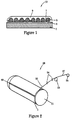
- a first embodiment of the invention is generally designated by the reference numeral 10 and is seen to include a substrate 1, adhesive layer 3 and spaced apart fibers 5 attached thereto.
- the fibers 5 are laid on the adhesive 3 in a spaced-apart relationship.
- Powder material 7 is then applied over the fibers and adhered to the adhesive 3 between the fibers 5.
- a barrier layer 9, mutually insoluble with the adhesive 3, is applied over the fibers 5 and powder 7.
- the substrate material is a 0.076mm (0.003") thick layer of O tempered type AA1100 aluminium foil.
- the adhesive is a 1% by weight polyisobutylene in a hexane solvent.
- the barrier layer is 1% by weight of polymethylmethacrylate (PMMA) dissolved in acetone.
- a schematic drum winding apparatus is generally designated by the reference numeral 20.
- the apparatus 20 includes a drum 21 which has been cleaned so that there is no dirt, powder, etc. on the drum surface that would become a bump under the substrate 1 and thereby cause a fiber spacing disturbance.
- One surface of the substrate 1 is also cleaned and the substrate is wrapped around the drum with the clean side facing the drum.
- the substrate can be adhered to the drum in any known fashion such as using an adhesive or the like.
- the substrate 1 is wrapped on the drum leaving a gap 23, preferably about one quarter inch in width.
- the gap 23, preferably located at the same location on the drum, facilitates removal of the preform material.
- the substrate 1 is applied to the drum 21, the substrate is smoothed and the outer surface is cleaned. During this cleaning, the drum operator presses down hard against the substrate so that any inclusions, bumps, etc. are defined. The bumps are then scraped with a razor blade to smooth them out.
- the polyisobutylene-hexane mix is applied to the substrate with a foam brush while the drum is rotating.
- a sufficient quantity of the polyisobutylene-hexane mix must be applied in multiple coats so that the fiber will not shift on the substrate during drum winding.
- the coats must be allowed to dry completely before the next one is applied.
- the coats also cannot have any bubbles, drips, brush strokes or any other defects which may cause fibers spacing perturbations.
- the apparatus 20 includes a fiber spool 25, the fiber spool holding the fiber 27 to be wrapped around the drum.
- the fiber 27 is fed through a tensioning wheel 29 and aligners 31.
- the fiber is then taped to the substrate near one edge of the drum.
- An aligner tip 33 is positioned next to the fiber and the drum winding is instituted.
- the winding process is stopped and the end of the fiber 27 is taped down to the substrate.
- 0.127 mm (5 mil) diameter silicon fibers are used and wound at a rate of 125 fibers per inch. This winding leaves about a 0.076 mm (3 mil) gap between fibers for receipt of the desired filler material such as powder.
- the powder 7 is sprinkled onto the drum wound mat. Any powder not positioned between the fibers is removed by lightly brushing the surface of the drum wound mat. A brush or cloth that does not fit between the fibers can also be used so that little or no powder is removed from between the fibers.
- the barrier layer of PMMA in acetone is applied over the mat.
- the tacking adhesive 3 can be first supplied to the powered mat to seal the powder in and prevent it from falling out from between the fibers.
- the barrier layer 9 would then be applied over the adhesive.
- the mat 10 is removed from the drum and can be stacked up for use in the fabrication of fiber reinforced composite materials. Alternatively, the substrate can be removed before stacking if desired.
- the fibers 5 and powders 7 can be merely coated with the adhesive 3 which seals the powder in and prevents them from falling out from between the fibers.
- This mat construction without the barrier layer, can be stacked such that layers of foil are adjacent the adhesive coated fibers and powders for subsequent fiber reinforced composite material manufacture.
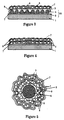
- the mat 10 can be used to fabricate tape cast silicon carbide fiber preforms as shown in Figure 3.
- Figure 3 depicts the mat 10 with an additional adhesive layer 3 applied to the barrier layer 9.
- the adhesive layer 3 provides a tacking surface to receive the sprinkled-on powder 7.
- the powder-covered mat 10 is then coated with the barrier material 3.
- the barrier coating 9 is coated with the adhesive 3, preferably two coats, followed by another sequence of powder coating followed by barrier layer application.
- the tape cast preforms of Figure 3 can then be stacked for use in the fabrication of fiber reinforced composite materials.
- a monolithic tape cast powder preform without fiber material can be formed for subsequent composite material manufacture use.
- the adhesive 3 is coated with the powder material 7.
- a barrier layer 9 is then formed over the powder material 7 followed by another application of the adhesive material 3.
- a second powder layer material 7 is applied to the adhesive 3 followed by subsequent coating by a barrier layer and adhesive layer combination. This process can be repeated to form any number of powder material layers.
- These monolithic sheets can be preferably used as a surface material when stacked up with tape cast preforms as depicted in Figure 3.
- the powder material and substrate can be any known composition for these types of monolithic tape cast powder preforms.
- the substrate is molybdenum foil.
- the inventive preforms are particularly adapted for use in titanium matrix composite materials. That is, the matrix material is titanium with or without titanium aluminides and a reinforcing material such as silicon carbide.
- a fiber 5 is utilized as the substrate. With a fiber as the substrate, the preform becomes a powder coated fiber preform which can then be assembled to form a tape cast preform as described above.
- the substrate fiber 5 is first coated with the adhesive 3. Powder material 7 is then applied to the adhesive 3 followed by coating with the barrier layer 9.
- two coats of the adhesive material are then applied over the barrier layer 9 followed by another sequencing of powder 7 application, barrier layer 9 coating and two coats of the tacky adhesive 3.
- This sequencing can continue to form any desired number of layers or can be terminated after a single layering of the powder material.
- the powder material can be sprinkled onto the adhesive layer 3 followed by fiber 5 rotation such that the entire exposed surface of the adhesive is coated with powder.
- the fiber could be mounted on a rotating device so that the fiber rotates during powder sprinkling.
- any other known techniques can be utilized to apply the powder material to a given adhesive layer.
- the tacky adhesive 3 and non-tacky barrier coating 9 can be applied using conventional techniques such as brushing, spraying or the like.
- the composite material components can be a matrix material or a combination of a matrix material and strengthening component.
- the powder material could combine both titanium and silicon carbide powders.
- the powder material could include titanium and aluminum in ratios to form a titanium matrix with sufficient aluminum to form titanium aluminides during subsequent composite material manufacture.
- the number of layers may vary depending on the type of powder, fiber or other composite material component utilized during preform manufacture. For example, if the powder size varies due to the combination of metallic and non-metallic materials, several layers of the barrier coating may be required before all the powder can be coated. Likewise, more than one adhesive layer may be required when applying additional layers of composite material components.
Landscapes
- Chemical & Material Sciences (AREA)
- Mechanical Engineering (AREA)
- Engineering & Computer Science (AREA)
- Composite Materials (AREA)
- Metallurgy (AREA)
- Organic Chemistry (AREA)
- Materials Engineering (AREA)
- Reinforced Plastic Materials (AREA)
- Manufacture Of Alloys Or Alloy Compounds (AREA)
- Laminated Bodies (AREA)
- Processing And Handling Of Plastics And Other Materials For Molding In General (AREA)
- Chemical Or Physical Treatment Of Fibers (AREA)
- Treatments For Attaching Organic Compounds To Fibrous Goods (AREA)
- Nonwoven Fabrics (AREA)
Claims (22)
- Verfahren zur Herstellung einer Vorform für die Herstellung eines Kompositmaterials, welches beinhaltet:a) Bereitstellung eines Substrats (1,5);b) Aufbringung eines klebrigen Haftmittels (3) auf das Substrat; undc) Aufbringung eines pulverförmigen Füllmaterials auf das freiliegende klebrige Haftmittel (3), so daß das pulverförmige Füllmaterial (7) an dem klebrigen Haftmittel (3) haftet; dadurch gekennzeichnet, daß das Verfahren ferner beinhaltet den Schritt derd) Aufbringung einer polymeren Sperrschicht (9) auf das pulverförmige Füllmaterial (7), wobei die polymere Sperrschicht (9) und das klebrige Haftmittel (3) gegenseitig unlöslich sind.
- Verfahren nach Anspruch 1, dadurch gekennzeichnet, daß vor der Aufbringung des pulverförmigen Füllmaterials das Verfahren ferner beinhaltet den Schritt der:e) Aufbringung einer Vielzahl von Fasern (5) auf das klebrige Haftmittel (3) mit Abständen voneinander, so daß Bereiche des klebrigen Haftmittels freiliegen; und daß Schritt d) ferner die Aufbringung der polymeren Sperrschicht (9) auf der Vielzahl von Fasern (5) und dem pulverförmigen Füllmaterial (7) beinhaltet.
- Verfahren nach Anspruch 2, wobei Schritt a) die Aufbringung von überschüssigem pulverförmigen Füllmaterial (7) und die Entfernung des überschüssigen pulverförmigen Füllmaterials (7) beinhaltet.
- Verfahren nach Anspruch 2, wobei das klebrige Haftmittel (3) ein Hexanlösungsmittel als eine Komponente von diesem aufweist und die polymere Sperrschicht (9) ein Acetonlösungsmittel als eine Komponente von dieser aufweist.
- Verfahren nach Anspruch 2, wobei das klebrige Haftmittel (3) Polyisobutylen und die polymere Sperrschicht Polymethylmethacrylat beinhaltet.
- Verfahren nach Anspruch 2, wobei das Füllmaterial aus einem Pulver besteht.
- Verfahren nach Anspruch 2, wobei ein weiteres klebriges Haftmittel (3) auf die polymere Sperrschicht (9) aufgebracht wird und dann der Schritt der Aufbringung der Vielzahl von Fasern, Schritt e) und Schritt d) mehrere Male wiederholt werden, um eine Vielzahl von Vorformen (10) zu bilden.
- Verfahren nach Anspruch 2, wobei das Substrat (1) aus Aluminium ist, die Fasern (5) aus Siliziumcarbid bestehen und das Füllmaterial (7) Titanpulver ist.
- Verfahren nach Anspruch 2, wobei das Substrat eine Bahn (1) ist.
- Verfahren nach Anspruch 2, wobei das Substrat (1) bahnenförmig ist und auf die Oberfläche einer zylindrischen Trommel (21) aufgebracht wird und die Fasern (27) um die zylindrische Trommel (21) gewunden werden.
- Verfahren nach Anspruch 10, wobei das Substrat derart bemessen ist, daß ein Zwischenraum (23) zwischen den Enden des Substrats verbleibt, wenn dieses auf die zylindrische Trommel aufgebracht wird.
- Verfahren nach Anspruch 2, wobei das Substrat (1) entfernt wird und die substratlose Vorform zur Herstellung eines Kompositmaterials gestapelt wird.
- Verfahren nach Anspruch 2, das ferner folgende Schritte aufweist:i) Aufbringung eines weiteren klebrigen Haftmittels (3) auf die polymere Sperrschicht (9);ii) Aufbringung eines pulverförmigen Füllmaterials (7) auf ein weiteres klebriges Haftmittel (3);iii) Aufbringung einer polymeren Sperrschicht (9) auf das pulverförmige Füllmaterial (7), welches auf ein weiteres klebriges Haftmittel (3) aufgebracht ist; undiv) mehrmalige Wiederholung der Schritte i), ii) und iii) zur Bildung einer Vielzahl von Vorformen (10).
- Verfahren nach Anspruch 1, wobei ein weiteres klebriges Haftmittel (3) auf die polymere Sperrschicht (9) aufgebracht wird und dann die Schritte c) und d) mehrere Male wiederholt werden, um eine Vielzahl von Vorformen (10) zu bilden.
- Vorform zur Herstellung von Kompositmaterialien mit:a) einem Substrat (1,5);b) einem klebrigen Haftmittel (3) auf dem Substrat (1,5); undc) wenigstens einer Kompositmaterial-Komponente (5,7) auf dem klebrigen Haftmittel (3); dadurch gekennzeichnet, daß die Vorform beinhaltetd) eine polymere Sperrschicht (9), die die Kompositmaterial-Komponente (5,7) bedeckt, wobei die polymere Sperrschicht (9) und das klebrige Haftmittel (3) gegenseitig unlöslich sind.
- Vorform nach Anspruch 15, wobei die wenigstens eine Kompositmaterial-Komponente ferner umfaßt:i) eine Vielzahl von Fasern (5) auf dem klebrigen Haftmittel (3), wobei die Vielzahl von Fasern (5) mit Abständen voneinander angeordnet sind; undii) ein pulverförmiges Füllmaterial (7), das zwischen den beabstandeten Fasern (5) positioniert ist.
- Vorform nach Anspruch 16, wobei das Substrat (1) aus Aluminium oder einer Aluminiumlegierungsbahn ist, die Fasern (5) aus Siliziumcarbid sind und das pulverförmige Füllmaterial (7) Titanpulver ist.
- Vorform nach Anspruch 15, wobei das klebrige Haftmittel (3) Polyisobutylen in einem Hexanlösungsmittel ist.
- Vorform nach Anspruch 15, wobei die polymere Sperrschicht (9) ein Polymethylmethacrylat in einem Acetonlösungsmittel ist.
- Vorform nach Anspruch 15, wobei das Substrat eine Faser (5) und die Kompositmaterial-Komponente ein Pulver (7) ist.
- Vorform nach Anspruch 15, die ferner wenigstens zwei Schichten aus b), c) und d) umfaßt.
- Vorform nach Anspruch 16, die ferner wenigstens zwei Schichten aus b), c) und d) umfaßt.
Applications Claiming Priority (3)
| Application Number | Priority Date | Filing Date | Title |
|---|---|---|---|
| US359388 | 1994-12-20 | ||
| US08/359,388 US5624516A (en) | 1994-12-20 | 1994-12-20 | Methods of making preforms for composite material manufacture |
| PCT/US1995/016599 WO1996019618A1 (en) | 1994-12-20 | 1995-12-20 | Preforms for composite material manufacture and methods of making |
Publications (2)
| Publication Number | Publication Date |
|---|---|
| EP0799122A2 EP0799122A2 (de) | 1997-10-08 |
| EP0799122B1 true EP0799122B1 (de) | 1999-09-22 |
Family
ID=23413596
Family Applications (1)
| Application Number | Title | Priority Date | Filing Date |
|---|---|---|---|
| EP95944503A Expired - Lifetime EP0799122B1 (de) | 1994-12-20 | 1995-12-20 | Vorform zur herstellung eines faserverstärkten kompositmaterials |
Country Status (8)
| Country | Link |
|---|---|
| US (1) | US5624516A (de) |
| EP (1) | EP0799122B1 (de) |
| JP (2) | JP3260762B2 (de) |
| KR (1) | KR100242175B1 (de) |
| AT (1) | ATE184835T1 (de) |
| DE (1) | DE69512438T2 (de) |
| ES (1) | ES2139256T3 (de) |
| WO (1) | WO1996019618A1 (de) |
Families Citing this family (7)
| Publication number | Priority date | Publication date | Assignee | Title |
|---|---|---|---|---|
| US5763079A (en) * | 1995-05-23 | 1998-06-09 | Atlantic Research Corporation | Wire preforms for composite material manufacture and methods of making |
| JP2003138354A (ja) * | 2001-10-29 | 2003-05-14 | Mitsubishi Heavy Ind Ltd | 金属基複合材料 |
| US7976930B2 (en) * | 2007-06-25 | 2011-07-12 | Bae Systems Tensylon H.P.M., Inc. | Non-fibrous high modulus ultra high molecular weight polyethylene tape for ballistic applications |
| US8747261B2 (en) * | 2009-11-23 | 2014-06-10 | Entrotech Composites, Llc | Reinforced objects |
| US8727203B2 (en) | 2010-09-16 | 2014-05-20 | Howmedica Osteonics Corp. | Methods for manufacturing porous orthopaedic implants |
| US9676151B2 (en) * | 2011-05-17 | 2017-06-13 | The Boeing Company | Bonded rework template system |
| ITMI20132154A1 (it) * | 2013-12-20 | 2015-06-21 | Adler Ortho S R L | Componente femorale per protesi di ginocchio. |
Family Cites Families (35)
| Publication number | Priority date | Publication date | Assignee | Title |
|---|---|---|---|---|
| US2951003A (en) * | 1955-01-20 | 1960-08-30 | Gustin Bacon Mfg Co | Glass fiber reinforced tape and method of making same |
| US3024152A (en) * | 1957-11-04 | 1962-03-06 | Johnson & Johnson | Stabilized polymeric strand reinforced pressure sensitive adhesive tapes |
| US3218704A (en) * | 1961-12-12 | 1965-11-23 | North American Aviation Inc | Method for fabricating high strength wall structures |
| US3391050A (en) * | 1964-04-03 | 1968-07-02 | Douglas Aircraft Co Inc | Glass filament tape |
| US3609855A (en) * | 1969-04-25 | 1971-10-05 | Us Navy | Production of beryllium ribbon reinforced composites |
| US3719538A (en) * | 1971-04-12 | 1973-03-06 | Gen Electric | Method of forming a composite metallic preform tape |
| US3930605A (en) * | 1973-08-06 | 1976-01-06 | International Harvester Company | Method of fabricating a conformable sandwich structure |
| US4110505A (en) * | 1976-12-17 | 1978-08-29 | United Technologies Corp. | Quick bond composite and process |
| US4305449A (en) * | 1980-06-20 | 1981-12-15 | Avco Corporation | Method of and apparatus for fabricating filament reinforced metal matrix structures |
| JPS5884879A (ja) * | 1981-11-16 | 1983-05-21 | Sugawara Kogyo Kk | 粘着テ−プ |
| US4705708A (en) * | 1982-03-04 | 1987-11-10 | American Can Company | Multi-laminate structure containing a scrap layer and containers made therefrom |
| JPS58162317A (ja) * | 1982-03-23 | 1983-09-27 | Mitsubishi Rayon Co Ltd | プリプレグの製法 |
| JPS60165210A (ja) * | 1984-02-08 | 1985-08-28 | Toray Ind Inc | プリプレグの製造方法 |
| JPS61114848A (ja) * | 1984-11-12 | 1986-06-02 | 工業技術院長 | 金属基複合材料の製造法 |
| US4697324A (en) * | 1984-12-06 | 1987-10-06 | Avco Corporation | Filamentary structural module for composites |
| US4655384A (en) * | 1985-10-18 | 1987-04-07 | The Babcock & Wilcox Company | Method of fabricating fiber-reinforced metal composites |
| US4907736A (en) * | 1986-06-27 | 1990-03-13 | Airfoil Textron Inc. | Method of forming articles |
| USH1162H (en) * | 1986-09-11 | 1993-04-06 | Molded composite article and process for producing the same | |
| US4782992A (en) * | 1986-11-21 | 1988-11-08 | Textron Inc. | Method of forming articles |
| US4938824A (en) * | 1987-01-23 | 1990-07-03 | Thiokol Corporation | Method for making a composite component using a transverse tape |
| US5004575A (en) * | 1987-10-08 | 1991-04-02 | The United States Of America As Represented By The Administrator Of The National Aeronautics And Space Administration | Preparing composite materials from matrices of processable aromatic polyimide thermoplastic blends |
| US4954382A (en) * | 1988-11-01 | 1990-09-04 | American Cyanamid Company | Interleaf layer in fiber reinforced resin laminate composites |
| US5094883A (en) * | 1989-04-17 | 1992-03-10 | Georgia Tech Research Corporation | Flexible multiply towpreg and method of production therefor |
| US5184769A (en) * | 1989-07-26 | 1993-02-09 | Avco Corporation | Tooling and method for consolidating a filamentary reinforced metal matrix composite |
| US5188878A (en) * | 1989-11-24 | 1993-02-23 | Tonen Corporation | Unidirectional thin glass prepreg |
| US5279879A (en) * | 1989-12-28 | 1994-01-18 | Tonen Corporation | Hybrid prepreg containing carbon fibers and at least one other reinforcing fiber in specific positions within the prepreg |
| US5253794A (en) * | 1990-07-02 | 1993-10-19 | General Electric Company | Reinforced multilayer filament reinforced ring structure |
| US5042710A (en) * | 1990-07-02 | 1991-08-27 | General Electric Company | Method of forming filament reinforced shaft |
| US5337940A (en) * | 1990-12-11 | 1994-08-16 | Woods Harlan L | Composite preform and method of manufacturing fiber reinforced composite |
| US5431984A (en) * | 1990-12-11 | 1995-07-11 | Avco Corporation | Composite preforms with groves for fibers and groves for off-gassing |
| US5181647A (en) * | 1990-12-14 | 1993-01-26 | Mcdonnell Douglas Corporation | Method and tooling for fabricating monolithic metal or metal matrix composite structures |
| US5098011A (en) * | 1990-12-14 | 1992-03-24 | Mcdonnell Douglas Corporation | Method and tooling for fabricating monolithic metal or metal matrix composite structures |
| US5271776A (en) * | 1992-02-27 | 1993-12-21 | General Electric Company | Asymmetrical method for hiping filament reinforced annular objects |
| US5259051A (en) * | 1992-08-28 | 1993-11-02 | At&T Bell Laboratories | Optical fiber interconnection apparatus and methods of making interconnections |
| EP0632087B1 (de) * | 1993-01-14 | 1999-08-18 | Toray Industries, Inc. | Prepregs, verfahren zur herstellung und verbundwerkstoffbeschichtung |
-
1994
- 1994-12-20 US US08/359,388 patent/US5624516A/en not_active Expired - Lifetime
-
1995
- 1995-12-20 DE DE69512438T patent/DE69512438T2/de not_active Expired - Lifetime
- 1995-12-20 EP EP95944503A patent/EP0799122B1/de not_active Expired - Lifetime
- 1995-12-20 JP JP51996796A patent/JP3260762B2/ja not_active Expired - Fee Related
- 1995-12-20 KR KR1019970704344A patent/KR100242175B1/ko not_active Expired - Fee Related
- 1995-12-20 ES ES95944503T patent/ES2139256T3/es not_active Expired - Lifetime
- 1995-12-20 AT AT95944503T patent/ATE184835T1/de not_active IP Right Cessation
- 1995-12-20 WO PCT/US1995/016599 patent/WO1996019618A1/en not_active Ceased
-
2001
- 2001-09-26 JP JP2001293985A patent/JP4169501B2/ja not_active Expired - Fee Related
Also Published As
| Publication number | Publication date |
|---|---|
| KR980700907A (ko) | 1998-04-30 |
| US5624516A (en) | 1997-04-29 |
| EP0799122A2 (de) | 1997-10-08 |
| DE69512438D1 (de) | 1999-10-28 |
| JP4169501B2 (ja) | 2008-10-22 |
| ES2139256T3 (es) | 2000-02-01 |
| DE69512438T2 (de) | 2000-04-27 |
| JP3260762B2 (ja) | 2002-02-25 |
| ATE184835T1 (de) | 1999-10-15 |
| JP2002180376A (ja) | 2002-06-26 |
| KR100242175B1 (ko) | 2000-02-01 |
| JPH10510775A (ja) | 1998-10-20 |
| WO1996019618A1 (en) | 1996-06-27 |
Similar Documents
| Publication | Publication Date | Title |
|---|---|---|
| CA1302798C (en) | Method for depositing a layer of abrasive material on a substrate | |
| US4908046A (en) | Multilayer abrading tool and process | |
| EP0713452B1 (de) | Gemustertes schleifmittel und verfahren | |
| US5022895A (en) | Multilayer abrading tool and process | |
| US5624516A (en) | Methods of making preforms for composite material manufacture | |
| JPH04217464A (ja) | 研磨シート及びその製造法 | |
| WO1996019618A9 (en) | Preforms for composite material manufacture and methods of making | |
| JP4212669B2 (ja) | 積層体及びその製造方法 | |
| EP1676469B1 (de) | Verfahren zum herstellen einer durchdrungenen zusammensetzung | |
| US5763079A (en) | Wire preforms for composite material manufacture and methods of making | |
| JP7163050B2 (ja) | Cmc物品を形成するための方法 | |
| CA1053085A (en) | Resin bonded composite articles and process for fabrication thereof | |
| JPH074656B2 (ja) | アルミニウム合金に耐摩耗性材料をインプレグネーションする方法 | |
| US5933703A (en) | Process for the preparation of fibre reinforced metal matrix composites and novel preforms therefor | |
| JPH05222469A (ja) | 繊維強化金属複合材料の製造方法並びにその新規予備成形物 | |
| US3234600A (en) | Preparing a liner material of ablation resistance | |
| JPS6261095B2 (de) | ||
| AU690560C (en) | Patterned abrasive material and method | |
| JP2005028253A (ja) | 粗塵除去用濾材、及びその製造方法、並びにフィルタユニット | |
| HK1069795B (en) | Method for making an abrasive material | |
| CN102416699A (zh) | 用于树脂浸渍纤维的自动化传送和叠层的系统和方法 |
Legal Events
| Date | Code | Title | Description |
|---|---|---|---|
| PUAI | Public reference made under article 153(3) epc to a published international application that has entered the european phase |
Free format text: ORIGINAL CODE: 0009012 |
|
| 17P | Request for examination filed |
Effective date: 19970630 |
|
| AK | Designated contracting states |
Kind code of ref document: A2 Designated state(s): AT BE CH DE DK ES FR GB GR IE IT LI LU MC NL PT SE |
|
| 17Q | First examination report despatched |
Effective date: 19980211 |
|
| GRAG | Despatch of communication of intention to grant |
Free format text: ORIGINAL CODE: EPIDOS AGRA |
|
| GRAG | Despatch of communication of intention to grant |
Free format text: ORIGINAL CODE: EPIDOS AGRA |
|
| GRAH | Despatch of communication of intention to grant a patent |
Free format text: ORIGINAL CODE: EPIDOS IGRA |
|
| GRAH | Despatch of communication of intention to grant a patent |
Free format text: ORIGINAL CODE: EPIDOS IGRA |
|
| GRAA | (expected) grant |
Free format text: ORIGINAL CODE: 0009210 |
|
| AK | Designated contracting states |
Kind code of ref document: B1 Designated state(s): AT BE CH DE DK ES FR GB GR IE IT LI LU MC NL PT SE |
|
| PG25 | Lapsed in a contracting state [announced via postgrant information from national office to epo] |
Ref country code: SE Free format text: THE PATENT HAS BEEN ANNULLED BY A DECISION OF A NATIONAL AUTHORITY Effective date: 19990922 Ref country code: NL Free format text: LAPSE BECAUSE OF FAILURE TO SUBMIT A TRANSLATION OF THE DESCRIPTION OR TO PAY THE FEE WITHIN THE PRESCRIBED TIME-LIMIT Effective date: 19990922 Ref country code: LI Free format text: LAPSE BECAUSE OF FAILURE TO SUBMIT A TRANSLATION OF THE DESCRIPTION OR TO PAY THE FEE WITHIN THE PRESCRIBED TIME-LIMIT Effective date: 19990922 Ref country code: GR Free format text: LAPSE BECAUSE OF NON-PAYMENT OF DUE FEES Effective date: 19990922 Ref country code: CH Free format text: LAPSE BECAUSE OF FAILURE TO SUBMIT A TRANSLATION OF THE DESCRIPTION OR TO PAY THE FEE WITHIN THE PRESCRIBED TIME-LIMIT Effective date: 19990922 Ref country code: BE Free format text: LAPSE BECAUSE OF FAILURE TO SUBMIT A TRANSLATION OF THE DESCRIPTION OR TO PAY THE FEE WITHIN THE PRESCRIBED TIME-LIMIT Effective date: 19990922 Ref country code: AT Free format text: LAPSE BECAUSE OF FAILURE TO SUBMIT A TRANSLATION OF THE DESCRIPTION OR TO PAY THE FEE WITHIN THE PRESCRIBED TIME-LIMIT Effective date: 19990922 |
|
| REF | Corresponds to: |
Ref document number: 184835 Country of ref document: AT Date of ref document: 19991015 Kind code of ref document: T |
|
| REG | Reference to a national code |
Ref country code: CH Ref legal event code: EP |
|
| REF | Corresponds to: |
Ref document number: 69512438 Country of ref document: DE Date of ref document: 19991028 |
|
| REG | Reference to a national code |
Ref country code: IE Ref legal event code: FG4D |
|
| ITF | It: translation for a ep patent filed | ||
| PG25 | Lapsed in a contracting state [announced via postgrant information from national office to epo] |
Ref country code: LU Free format text: LAPSE BECAUSE OF NON-PAYMENT OF DUE FEES Effective date: 19991220 Ref country code: IE Free format text: LAPSE BECAUSE OF NON-PAYMENT OF DUE FEES Effective date: 19991220 |
|
| PG25 | Lapsed in a contracting state [announced via postgrant information from national office to epo] |
Ref country code: PT Free format text: LAPSE BECAUSE OF FAILURE TO SUBMIT A TRANSLATION OF THE DESCRIPTION OR TO PAY THE FEE WITHIN THE PRESCRIBED TIME-LIMIT Effective date: 19991222 Ref country code: DK Free format text: LAPSE BECAUSE OF FAILURE TO SUBMIT A TRANSLATION OF THE DESCRIPTION OR TO PAY THE FEE WITHIN THE PRESCRIBED TIME-LIMIT Effective date: 19991222 |
|
| ET | Fr: translation filed | ||
| REG | Reference to a national code |
Ref country code: ES Ref legal event code: FG2A Ref document number: 2139256 Country of ref document: ES Kind code of ref document: T3 |
|
| NLV1 | Nl: lapsed or annulled due to failure to fulfill the requirements of art. 29p and 29m of the patents act | ||
| REG | Reference to a national code |
Ref country code: CH Ref legal event code: PL |
|
| PG25 | Lapsed in a contracting state [announced via postgrant information from national office to epo] |
Ref country code: MC Free format text: LAPSE BECAUSE OF NON-PAYMENT OF DUE FEES Effective date: 20000630 |
|
| PLBE | No opposition filed within time limit |
Free format text: ORIGINAL CODE: 0009261 |
|
| STAA | Information on the status of an ep patent application or granted ep patent |
Free format text: STATUS: NO OPPOSITION FILED WITHIN TIME LIMIT |
|
| 26N | No opposition filed | ||
| REG | Reference to a national code |
Ref country code: IE Ref legal event code: MM4A |
|
| REG | Reference to a national code |
Ref country code: GB Ref legal event code: IF02 |
|
| PGFP | Annual fee paid to national office [announced via postgrant information from national office to epo] |
Ref country code: ES Payment date: 20121213 Year of fee payment: 18 Ref country code: IT Payment date: 20121220 Year of fee payment: 18 Ref country code: GB Payment date: 20121128 Year of fee payment: 18 |
|
| PGFP | Annual fee paid to national office [announced via postgrant information from national office to epo] |
Ref country code: FR Payment date: 20121219 Year of fee payment: 18 |
|
| PGFP | Annual fee paid to national office [announced via postgrant information from national office to epo] |
Ref country code: DE Payment date: 20121221 Year of fee payment: 18 |
|
| REG | Reference to a national code |
Ref country code: DE Ref legal event code: R119 Ref document number: 69512438 Country of ref document: DE |
|
| GBPC | Gb: european patent ceased through non-payment of renewal fee |
Effective date: 20131220 |
|
| REG | Reference to a national code |
Ref country code: FR Ref legal event code: ST Effective date: 20140829 |
|
| REG | Reference to a national code |
Ref country code: DE Ref legal event code: R119 Ref document number: 69512438 Country of ref document: DE Effective date: 20140701 |
|
| PG25 | Lapsed in a contracting state [announced via postgrant information from national office to epo] |
Ref country code: DE Free format text: LAPSE BECAUSE OF NON-PAYMENT OF DUE FEES Effective date: 20140701 |
|
| PG25 | Lapsed in a contracting state [announced via postgrant information from national office to epo] |
Ref country code: GB Free format text: LAPSE BECAUSE OF NON-PAYMENT OF DUE FEES Effective date: 20131220 Ref country code: FR Free format text: LAPSE BECAUSE OF NON-PAYMENT OF DUE FEES Effective date: 20131231 |
|
| REG | Reference to a national code |
Ref country code: ES Ref legal event code: FD2A Effective date: 20150330 |
|
| PG25 | Lapsed in a contracting state [announced via postgrant information from national office to epo] |
Ref country code: ES Free format text: LAPSE BECAUSE OF NON-PAYMENT OF DUE FEES Effective date: 20131221 |
|
| PG25 | Lapsed in a contracting state [announced via postgrant information from national office to epo] |
Ref country code: IT Free format text: LAPSE BECAUSE OF NON-PAYMENT OF DUE FEES Effective date: 20131220 |