EP0799205B1 - Monomeres de 1,4,4-(trisubstitue)cyclohex-1-ene utilises comme inhibiteurs de pde iv et tnf - Google Patents
Monomeres de 1,4,4-(trisubstitue)cyclohex-1-ene utilises comme inhibiteurs de pde iv et tnf Download PDFInfo
- Publication number
- EP0799205B1 EP0799205B1 EP95944511A EP95944511A EP0799205B1 EP 0799205 B1 EP0799205 B1 EP 0799205B1 EP 95944511 A EP95944511 A EP 95944511A EP 95944511 A EP95944511 A EP 95944511A EP 0799205 B1 EP0799205 B1 EP 0799205B1
- Authority
- EP
- European Patent Office
- Prior art keywords
- substituted
- unsubstituted
- alkyl
- hydrogen
- cycloalkyl
- Prior art date
- Legal status (The legal status is an assumption and is not a legal conclusion. Google has not performed a legal analysis and makes no representation as to the accuracy of the status listed.)
- Expired - Lifetime
Links
- 239000002587 phosphodiesterase IV inhibitor Substances 0.000 title description 5
- 229940046728 tumor necrosis factor alpha inhibitor Drugs 0.000 title description 2
- 239000002451 tumor necrosis factor inhibitor Substances 0.000 title description 2
- 125000000596 cyclohexenyl group Chemical class C1(=CCCCC1)* 0.000 title 1
- 150000001875 compounds Chemical class 0.000 claims abstract description 93
- -1 2-tetrahydropyranyl Chemical group 0.000 claims description 115
- 125000000217 alkyl group Chemical group 0.000 claims description 32
- 239000001257 hydrogen Substances 0.000 claims description 32
- 229910052739 hydrogen Inorganic materials 0.000 claims description 32
- 125000004432 carbon atom Chemical group C* 0.000 claims description 30
- 125000001153 fluoro group Chemical group F* 0.000 claims description 30
- 125000002496 methyl group Chemical group [H]C([H])([H])* 0.000 claims description 29
- 235000019000 fluorine Nutrition 0.000 claims description 28
- 125000004435 hydrogen atom Chemical group [H]* 0.000 claims description 26
- 229910052760 oxygen Inorganic materials 0.000 claims description 19
- 125000000753 cycloalkyl group Chemical group 0.000 claims description 16
- 125000002887 hydroxy group Chemical group [H]O* 0.000 claims description 16
- 125000001072 heteroaryl group Chemical group 0.000 claims description 15
- 125000005842 heteroatom Chemical group 0.000 claims description 15
- QJGQUHMNIGDVPM-UHFFFAOYSA-N nitrogen group Chemical group [N] QJGQUHMNIGDVPM-UHFFFAOYSA-N 0.000 claims description 15
- 125000004178 (C1-C4) alkyl group Chemical group 0.000 claims description 14
- 229910052799 carbon Inorganic materials 0.000 claims description 14
- 150000003839 salts Chemical class 0.000 claims description 14
- 125000001495 ethyl group Chemical group [H]C([H])([H])C([H])([H])* 0.000 claims description 13
- 125000003118 aryl group Chemical group 0.000 claims description 12
- 229910052736 halogen Inorganic materials 0.000 claims description 12
- 229910052757 nitrogen Inorganic materials 0.000 claims description 12
- HSFWRNGVRCDJHI-UHFFFAOYSA-N alpha-acetylene Natural products C#C HSFWRNGVRCDJHI-UHFFFAOYSA-N 0.000 claims description 11
- 125000002534 ethynyl group Chemical group [H]C#C* 0.000 claims description 11
- 125000005843 halogen group Chemical group 0.000 claims description 10
- 125000003226 pyrazolyl group Chemical group 0.000 claims description 10
- 125000004169 (C1-C6) alkyl group Chemical group 0.000 claims description 9
- 125000002541 furyl group Chemical group 0.000 claims description 9
- 239000011737 fluorine Substances 0.000 claims description 8
- 229910052731 fluorine Inorganic materials 0.000 claims description 8
- 150000002367 halogens Chemical class 0.000 claims description 8
- 239000008194 pharmaceutical composition Substances 0.000 claims description 8
- 125000000714 pyrimidinyl group Chemical group 0.000 claims description 8
- PXGOKWXKJXAPGV-UHFFFAOYSA-N Fluorine Chemical compound FF PXGOKWXKJXAPGV-UHFFFAOYSA-N 0.000 claims description 7
- 125000003342 alkenyl group Chemical group 0.000 claims description 7
- 125000000623 heterocyclic group Chemical group 0.000 claims description 7
- 125000001997 phenyl group Chemical group [H]C1=C([H])C([H])=C(*)C([H])=C1[H] 0.000 claims description 7
- 125000000168 pyrrolyl group Chemical group 0.000 claims description 7
- 125000000304 alkynyl group Chemical group 0.000 claims description 6
- QVGXLLKOCUKJST-UHFFFAOYSA-N atomic oxygen Chemical group [O] QVGXLLKOCUKJST-UHFFFAOYSA-N 0.000 claims description 6
- 125000002883 imidazolyl group Chemical group 0.000 claims description 6
- 125000002757 morpholinyl group Chemical group 0.000 claims description 6
- 239000001301 oxygen Substances 0.000 claims description 6
- 125000004193 piperazinyl group Chemical group 0.000 claims description 6
- 125000005592 polycycloalkyl group Polymers 0.000 claims description 6
- 125000003107 substituted aryl group Chemical group 0.000 claims description 6
- 229910052717 sulfur Inorganic materials 0.000 claims description 6
- 125000001425 triazolyl group Chemical group 0.000 claims description 6
- 125000003349 3-pyridyl group Chemical group N1=C([H])C([*])=C([H])C([H])=C1[H] 0.000 claims description 5
- 125000000339 4-pyridyl group Chemical group N1=C([H])C([H])=C([*])C([H])=C1[H] 0.000 claims description 5
- UFHFLCQGNIYNRP-UHFFFAOYSA-N Hydrogen Chemical compound [H][H] UFHFLCQGNIYNRP-UHFFFAOYSA-N 0.000 claims description 5
- 125000003710 aryl alkyl group Chemical group 0.000 claims description 5
- 125000001246 bromo group Chemical group Br* 0.000 claims description 5
- 125000001309 chloro group Chemical group Cl* 0.000 claims description 5
- 125000001624 naphthyl group Chemical group 0.000 claims description 5
- 125000002971 oxazolyl group Chemical group 0.000 claims description 5
- 125000003831 tetrazolyl group Chemical group 0.000 claims description 5
- 125000000335 thiazolyl group Chemical group 0.000 claims description 5
- 125000001544 thienyl group Chemical group 0.000 claims description 5
- 125000000008 (C1-C10) alkyl group Chemical group 0.000 claims description 4
- 125000005913 (C3-C6) cycloalkyl group Chemical group 0.000 claims description 4
- 125000006272 (C3-C7) cycloalkyl group Chemical group 0.000 claims description 4
- YBYIRNPNPLQARY-UHFFFAOYSA-N 1H-indene Natural products C1=CC=C2CC=CC2=C1 YBYIRNPNPLQARY-UHFFFAOYSA-N 0.000 claims description 4
- 125000001541 3-thienyl group Chemical group S1C([H])=C([*])C([H])=C1[H] 0.000 claims description 4
- KDDQRKBRJSGMQE-UHFFFAOYSA-N 4-thiazolyl Chemical compound [C]1=CSC=N1 KDDQRKBRJSGMQE-UHFFFAOYSA-N 0.000 claims description 4
- 125000006374 C2-C10 alkenyl group Chemical group 0.000 claims description 4
- 229910004749 OS(O)2 Inorganic materials 0.000 claims description 4
- 125000001797 benzyl group Chemical group [H]C1=C([H])C([H])=C(C([H])=C1[H])C([H])([H])* 0.000 claims description 4
- 125000000392 cycloalkenyl group Chemical group 0.000 claims description 4
- 125000004446 heteroarylalkyl group Chemical group 0.000 claims description 4
- 125000002632 imidazolidinyl group Chemical group 0.000 claims description 4
- 125000003392 indanyl group Chemical group C1(CCC2=CC=CC=C12)* 0.000 claims description 4
- 125000003454 indenyl group Chemical group C1(C=CC2=CC=CC=C12)* 0.000 claims description 4
- 125000000842 isoxazolyl group Chemical group 0.000 claims description 4
- 125000000449 nitro group Chemical group [O-][N+](*)=O 0.000 claims description 4
- 125000001715 oxadiazolyl group Chemical group 0.000 claims description 4
- 125000000160 oxazolidinyl group Chemical group 0.000 claims description 4
- 125000003386 piperidinyl group Chemical group 0.000 claims description 4
- 125000004309 pyranyl group Chemical group O1C(C=CC=C1)* 0.000 claims description 4
- 125000002943 quinolinyl group Chemical group N1=C(C=CC2=CC=CC=C12)* 0.000 claims description 4
- 125000003718 tetrahydrofuranyl group Chemical group 0.000 claims description 4
- 125000001412 tetrahydropyranyl group Chemical group 0.000 claims description 4
- 125000005958 tetrahydrothienyl group Chemical group 0.000 claims description 4
- 125000004632 tetrahydrothiopyranyl group Chemical group S1C(CCCC1)* 0.000 claims description 4
- 125000001113 thiadiazolyl group Chemical group 0.000 claims description 4
- 125000001984 thiazolidinyl group Chemical group 0.000 claims description 4
- JMICWQNSQLQYST-UHFFFAOYSA-N 4-[2-[1-(3-cyclopentyloxy-4-methoxyphenyl)-4-methoxycyclohex-3-en-1-yl]ethynyl]pyridine Chemical compound C1CC(OC)=CCC1(C=1C=C(OC2CCCC2)C(OC)=CC=1)C#CC1=CC=NC=C1 JMICWQNSQLQYST-UHFFFAOYSA-N 0.000 claims description 3
- CWDWFSXUQODZGW-UHFFFAOYSA-N 5-thiazolyl Chemical group [C]1=CN=CS1 CWDWFSXUQODZGW-UHFFFAOYSA-N 0.000 claims description 3
- SDOBZYFVCXFMJK-UHFFFAOYSA-N [4-(3-cyclopentyloxy-4-methoxyphenyl)-4-(2-pyridin-4-ylethynyl)cyclohexen-1-yl] trifluoromethanesulfonate Chemical compound COC1=CC=C(C2(CC=C(OS(=O)(=O)C(F)(F)F)CC2)C#CC=2C=CN=CC=2)C=C1OC1CCCC1 SDOBZYFVCXFMJK-UHFFFAOYSA-N 0.000 claims description 3
- 125000004122 cyclic group Chemical group 0.000 claims description 3
- 125000001511 cyclopentyl group Chemical group [H]C1([H])C([H])([H])C([H])([H])C([H])(*)C1([H])[H] 0.000 claims description 3
- 125000006526 (C1-C2) alkyl group Chemical group 0.000 claims description 2
- 150000002431 hydrogen Chemical group 0.000 claims 2
- 239000000546 pharmaceutical excipient Substances 0.000 claims 1
- 108060008682 Tumor Necrosis Factor Proteins 0.000 abstract description 41
- 230000002401 inhibitory effect Effects 0.000 abstract description 12
- 238000004519 manufacturing process Methods 0.000 abstract description 11
- 230000000172 allergic effect Effects 0.000 abstract description 5
- 208000027866 inflammatory disease Diseases 0.000 abstract description 5
- 208000026935 allergic disease Diseases 0.000 abstract description 4
- HGCIXCUEYOPUTN-UHFFFAOYSA-N cyclohexene Chemical compound C1CCC=CC1 HGCIXCUEYOPUTN-UHFFFAOYSA-N 0.000 abstract description 2
- 239000000178 monomer Substances 0.000 abstract description 2
- 102000003390 tumor necrosis factor Human genes 0.000 abstract 2
- 102000000852 Tumor Necrosis Factor-alpha Human genes 0.000 description 39
- 238000000034 method Methods 0.000 description 20
- 201000010099 disease Diseases 0.000 description 18
- 208000037265 diseases, disorders, signs and symptoms Diseases 0.000 description 18
- 102000004861 Phosphoric Diester Hydrolases Human genes 0.000 description 17
- 108090001050 Phosphoric Diester Hydrolases Proteins 0.000 description 17
- 241000725303 Human immunodeficiency virus Species 0.000 description 16
- 230000005764 inhibitory process Effects 0.000 description 14
- 238000011282 treatment Methods 0.000 description 14
- 239000000203 mixture Substances 0.000 description 13
- OKKJLVBELUTLKV-UHFFFAOYSA-N Methanol Chemical compound OC OKKJLVBELUTLKV-UHFFFAOYSA-N 0.000 description 12
- 230000000694 effects Effects 0.000 description 12
- 210000001744 T-lymphocyte Anatomy 0.000 description 11
- 210000004027 cell Anatomy 0.000 description 11
- 210000001616 monocyte Anatomy 0.000 description 11
- 241000124008 Mammalia Species 0.000 description 10
- 230000001404 mediated effect Effects 0.000 description 10
- 102000004127 Cytokines Human genes 0.000 description 9
- 108090000695 Cytokines Proteins 0.000 description 9
- 206010017533 Fungal infection Diseases 0.000 description 9
- 241000700605 Viruses Species 0.000 description 9
- 238000001727 in vivo Methods 0.000 description 9
- 230000006433 tumor necrosis factor production Effects 0.000 description 9
- 208000006673 asthma Diseases 0.000 description 8
- 150000002576 ketones Chemical class 0.000 description 8
- OKTJSMMVPCPJKN-UHFFFAOYSA-N Carbon Chemical compound [C] OKTJSMMVPCPJKN-UHFFFAOYSA-N 0.000 description 7
- LFQSCWFLJHTTHZ-UHFFFAOYSA-N Ethanol Chemical compound CCO LFQSCWFLJHTTHZ-UHFFFAOYSA-N 0.000 description 7
- 208000031886 HIV Infections Diseases 0.000 description 7
- 230000003197 catalytic effect Effects 0.000 description 7
- PXBRQCKWGAHEHS-UHFFFAOYSA-N dichlorodifluoromethane Chemical compound FC(F)(Cl)Cl PXBRQCKWGAHEHS-UHFFFAOYSA-N 0.000 description 7
- 125000001570 methylene group Chemical group [H]C([H])([*:1])[*:2] 0.000 description 7
- IJGRMHOSHXDMSA-UHFFFAOYSA-N nitrogen Substances N#N IJGRMHOSHXDMSA-UHFFFAOYSA-N 0.000 description 7
- 239000000243 solution Substances 0.000 description 7
- 241000282412 Homo Species 0.000 description 6
- 108010002352 Interleukin-1 Proteins 0.000 description 6
- 108010044467 Isoenzymes Proteins 0.000 description 6
- 240000004808 Saccharomyces cerevisiae Species 0.000 description 6
- 206010040070 Septic Shock Diseases 0.000 description 6
- 230000004913 activation Effects 0.000 description 6
- 210000002540 macrophage Anatomy 0.000 description 6
- 208000031888 Mycoses Diseases 0.000 description 5
- 239000002253 acid Substances 0.000 description 5
- 239000003937 drug carrier Substances 0.000 description 5
- 208000015181 infectious disease Diseases 0.000 description 5
- 239000007788 liquid Substances 0.000 description 5
- 230000010076 replication Effects 0.000 description 5
- 239000007787 solid Substances 0.000 description 5
- MZOFCQQQCNRIBI-VMXHOPILSA-N (3s)-4-[[(2s)-1-[[(2s)-1-[[(1s)-1-carboxy-2-hydroxyethyl]amino]-4-methyl-1-oxopentan-2-yl]amino]-5-(diaminomethylideneamino)-1-oxopentan-2-yl]amino]-3-[[2-[[(2s)-2,6-diaminohexanoyl]amino]acetyl]amino]-4-oxobutanoic acid Chemical compound OC[C@@H](C(O)=O)NC(=O)[C@H](CC(C)C)NC(=O)[C@H](CCCN=C(N)N)NC(=O)[C@H](CC(O)=O)NC(=O)CNC(=O)[C@@H](N)CCCCN MZOFCQQQCNRIBI-VMXHOPILSA-N 0.000 description 4
- 208000030507 AIDS Diseases 0.000 description 4
- 241000701022 Cytomegalovirus Species 0.000 description 4
- 208000037357 HIV infectious disease Diseases 0.000 description 4
- VMHLLURERBWHNL-UHFFFAOYSA-M Sodium acetate Chemical compound [Na+].CC([O-])=O VMHLLURERBWHNL-UHFFFAOYSA-M 0.000 description 4
- 230000006044 T cell activation Effects 0.000 description 4
- WYURNTSHIVDZCO-UHFFFAOYSA-N Tetrahydrofuran Chemical compound C1CCOC1 WYURNTSHIVDZCO-UHFFFAOYSA-N 0.000 description 4
- 239000004480 active ingredient Substances 0.000 description 4
- 102000030621 adenylate cyclase Human genes 0.000 description 4
- 108060000200 adenylate cyclase Proteins 0.000 description 4
- 239000000443 aerosol Substances 0.000 description 4
- 230000009435 amidation Effects 0.000 description 4
- 238000007112 amidation reaction Methods 0.000 description 4
- APKFDSVGJQXUKY-INPOYWNPSA-N amphotericin B Chemical compound O[C@H]1[C@@H](N)[C@H](O)[C@@H](C)O[C@H]1O[C@H]1/C=C/C=C/C=C/C=C/C=C/C=C/C=C/[C@H](C)[C@@H](O)[C@@H](C)[C@H](C)OC(=O)C[C@H](O)C[C@H](O)CC[C@@H](O)[C@H](O)C[C@H](O)C[C@](O)(C[C@H](O)[C@H]2C(O)=O)O[C@H]2C1 APKFDSVGJQXUKY-INPOYWNPSA-N 0.000 description 4
- 150000001733 carboxylic acid esters Chemical group 0.000 description 4
- 150000001879 copper Chemical class 0.000 description 4
- 239000003814 drug Substances 0.000 description 4
- 230000014509 gene expression Effects 0.000 description 4
- 208000033519 human immunodeficiency virus infectious disease Diseases 0.000 description 4
- 229910052751 metal Inorganic materials 0.000 description 4
- 239000002184 metal Substances 0.000 description 4
- 238000005832 oxidative carbonylation reaction Methods 0.000 description 4
- 150000002940 palladium Chemical class 0.000 description 4
- 239000008024 pharmaceutical diluent Substances 0.000 description 4
- 238000002360 preparation method Methods 0.000 description 4
- 239000001632 sodium acetate Substances 0.000 description 4
- 235000017281 sodium acetate Nutrition 0.000 description 4
- 238000003786 synthesis reaction Methods 0.000 description 4
- 238000005809 transesterification reaction Methods 0.000 description 4
- RIOQSEWOXXDEQQ-UHFFFAOYSA-N triphenylphosphine Chemical compound C1=CC=CC=C1P(C=1C=CC=CC=1)C1=CC=CC=C1 RIOQSEWOXXDEQQ-UHFFFAOYSA-N 0.000 description 4
- XLYOFNOQVPJJNP-UHFFFAOYSA-N water Substances O XLYOFNOQVPJJNP-UHFFFAOYSA-N 0.000 description 4
- 206010006895 Cachexia Diseases 0.000 description 3
- IVOMOUWHDPKRLL-KQYNXXCUSA-N Cyclic adenosine monophosphate Chemical compound C([C@H]1O2)OP(O)(=O)O[C@H]1[C@@H](O)[C@@H]2N1C(N=CN=C2N)=C2N=C1 IVOMOUWHDPKRLL-KQYNXXCUSA-N 0.000 description 3
- YMWUJEATGCHHMB-UHFFFAOYSA-N Dichloromethane Chemical compound ClCCl YMWUJEATGCHHMB-UHFFFAOYSA-N 0.000 description 3
- 206010014824 Endotoxic shock Diseases 0.000 description 3
- 241000713772 Human immunodeficiency virus 1 Species 0.000 description 3
- 241000713340 Human immunodeficiency virus 2 Species 0.000 description 3
- 102000004083 Lymphotoxin-alpha Human genes 0.000 description 3
- 108090000542 Lymphotoxin-alpha Proteins 0.000 description 3
- ZMXDDKWLCZADIW-UHFFFAOYSA-N N,N-Dimethylformamide Chemical compound CN(C)C=O ZMXDDKWLCZADIW-UHFFFAOYSA-N 0.000 description 3
- DNIAPMSPPWPWGF-UHFFFAOYSA-N Propylene glycol Chemical compound CC(O)CO DNIAPMSPPWPWGF-UHFFFAOYSA-N 0.000 description 3
- 208000036142 Viral infection Diseases 0.000 description 3
- 210000005091 airway smooth muscle Anatomy 0.000 description 3
- 230000004071 biological effect Effects 0.000 description 3
- 150000001721 carbon Chemical group 0.000 description 3
- 238000004587 chromatography analysis Methods 0.000 description 3
- UAOMVDZJSHZZME-UHFFFAOYSA-N diisopropylamine Chemical compound CC(C)NC(C)C UAOMVDZJSHZZME-UHFFFAOYSA-N 0.000 description 3
- 239000003085 diluting agent Substances 0.000 description 3
- 229940079593 drug Drugs 0.000 description 3
- 230000002255 enzymatic effect Effects 0.000 description 3
- 238000000338 in vitro Methods 0.000 description 3
- 238000012423 maintenance Methods 0.000 description 3
- 210000000440 neutrophil Anatomy 0.000 description 3
- 230000008569 process Effects 0.000 description 3
- 150000003254 radicals Chemical class 0.000 description 3
- 230000004044 response Effects 0.000 description 3
- 239000002904 solvent Substances 0.000 description 3
- 239000007858 starting material Substances 0.000 description 3
- 238000006467 substitution reaction Methods 0.000 description 3
- 230000003827 upregulation Effects 0.000 description 3
- 230000029812 viral genome replication Effects 0.000 description 3
- 230000009385 viral infection Effects 0.000 description 3
- QAHSGEHBMAVVCS-UHFFFAOYSA-N 4-(3-cyclopentyloxy-4-methoxyphenyl)-4-(2-pyridin-4-ylethynyl)cyclohexan-1-one Chemical compound COC1=CC=C(C2(CCC(=O)CC2)C#CC=2C=CN=CC=2)C=C1OC1CCCC1 QAHSGEHBMAVVCS-UHFFFAOYSA-N 0.000 description 2
- 206010001513 AIDS related complex Diseases 0.000 description 2
- 206010001052 Acute respiratory distress syndrome Diseases 0.000 description 2
- NLXLAEXVIDQMFP-UHFFFAOYSA-N Ammonia chloride Chemical compound [NH4+].[Cl-] NLXLAEXVIDQMFP-UHFFFAOYSA-N 0.000 description 2
- APKFDSVGJQXUKY-KKGHZKTASA-N Amphotericin-B Natural products O[C@H]1[C@@H](N)[C@H](O)[C@@H](C)O[C@H]1O[C@H]1C=CC=CC=CC=CC=CC=CC=C[C@H](C)[C@@H](O)[C@@H](C)[C@H](C)OC(=O)C[C@H](O)C[C@H](O)CC[C@@H](O)[C@H](O)C[C@H](O)C[C@](O)(C[C@H](O)[C@H]2C(O)=O)O[C@H]2C1 APKFDSVGJQXUKY-KKGHZKTASA-N 0.000 description 2
- CURLTUGMZLYLDI-UHFFFAOYSA-N Carbon dioxide Chemical compound O=C=O CURLTUGMZLYLDI-UHFFFAOYSA-N 0.000 description 2
- 241000700199 Cavia porcellus Species 0.000 description 2
- ZAMOUSCENKQFHK-UHFFFAOYSA-N Chlorine atom Chemical compound [Cl] ZAMOUSCENKQFHK-UHFFFAOYSA-N 0.000 description 2
- 206010009900 Colitis ulcerative Diseases 0.000 description 2
- 208000035473 Communicable disease Diseases 0.000 description 2
- 206010010744 Conjunctivitis allergic Diseases 0.000 description 2
- 208000011231 Crohn disease Diseases 0.000 description 2
- RTZKZFJDLAIYFH-UHFFFAOYSA-N Diethyl ether Chemical compound CCOCC RTZKZFJDLAIYFH-UHFFFAOYSA-N 0.000 description 2
- 241000713800 Feline immunodeficiency virus Species 0.000 description 2
- 241000233866 Fungi Species 0.000 description 2
- PEDCQBHIVMGVHV-UHFFFAOYSA-N Glycerine Chemical compound OCC(O)CO PEDCQBHIVMGVHV-UHFFFAOYSA-N 0.000 description 2
- 206010020164 HIV infection CDC Group III Diseases 0.000 description 2
- CSNNHWWHGAXBCP-UHFFFAOYSA-L Magnesium sulfate Chemical compound [Mg+2].[O-][S+2]([O-])([O-])[O-] CSNNHWWHGAXBCP-UHFFFAOYSA-L 0.000 description 2
- 241001465754 Metazoa Species 0.000 description 2
- 102000013967 Monokines Human genes 0.000 description 2
- 108010050619 Monokines Proteins 0.000 description 2
- 101000909851 Mycobacterium tuberculosis (strain ATCC 25618 / H37Rv) cAMP/cGMP dual specificity phosphodiesterase Rv0805 Proteins 0.000 description 2
- MZRVEZGGRBJDDB-UHFFFAOYSA-N N-Butyllithium Chemical compound [Li]CCCC MZRVEZGGRBJDDB-UHFFFAOYSA-N 0.000 description 2
- 206010028980 Neoplasm Diseases 0.000 description 2
- 206010063837 Reperfusion injury Diseases 0.000 description 2
- 208000013616 Respiratory Distress Syndrome Diseases 0.000 description 2
- 206010040047 Sepsis Diseases 0.000 description 2
- IVOMOUWHDPKRLL-UHFFFAOYSA-N UNPD107823 Natural products O1C2COP(O)(=O)OC2C(O)C1N1C(N=CN=C2N)=C2N=C1 IVOMOUWHDPKRLL-UHFFFAOYSA-N 0.000 description 2
- 201000006704 Ulcerative Colitis Diseases 0.000 description 2
- 208000011341 adult acute respiratory distress syndrome Diseases 0.000 description 2
- 201000000028 adult respiratory distress syndrome Diseases 0.000 description 2
- 208000002205 allergic conjunctivitis Diseases 0.000 description 2
- 150000001412 amines Chemical class 0.000 description 2
- 229960003942 amphotericin b Drugs 0.000 description 2
- 238000013459 approach Methods 0.000 description 2
- 239000012300 argon atmosphere Substances 0.000 description 2
- 210000003651 basophil Anatomy 0.000 description 2
- 230000009286 beneficial effect Effects 0.000 description 2
- 230000008512 biological response Effects 0.000 description 2
- 239000003054 catalyst Substances 0.000 description 2
- 239000003795 chemical substances by application Substances 0.000 description 2
- 239000000460 chlorine Substances 0.000 description 2
- 229910052801 chlorine Inorganic materials 0.000 description 2
- 229940095074 cyclic amp Drugs 0.000 description 2
- 230000003828 downregulation Effects 0.000 description 2
- 238000003818 flash chromatography Methods 0.000 description 2
- 150000004820 halides Chemical class 0.000 description 2
- 210000003630 histaminocyte Anatomy 0.000 description 2
- 239000005556 hormone Substances 0.000 description 2
- 229940088597 hormone Drugs 0.000 description 2
- 210000004969 inflammatory cell Anatomy 0.000 description 2
- 206010022000 influenza Diseases 0.000 description 2
- 239000004615 ingredient Substances 0.000 description 2
- 208000030603 inherited susceptibility to asthma Diseases 0.000 description 2
- 230000000670 limiting effect Effects 0.000 description 2
- 150000002941 palladium compounds Chemical class 0.000 description 2
- 230000007310 pathophysiology Effects 0.000 description 2
- 230000000704 physical effect Effects 0.000 description 2
- BWHMMNNQKKPAPP-UHFFFAOYSA-L potassium carbonate Chemical compound [K+].[K+].[O-]C([O-])=O BWHMMNNQKKPAPP-UHFFFAOYSA-L 0.000 description 2
- 108090000623 proteins and genes Proteins 0.000 description 2
- 102000004169 proteins and genes Human genes 0.000 description 2
- 230000004648 relaxation of smooth muscle Effects 0.000 description 2
- 206010039073 rheumatoid arthritis Diseases 0.000 description 2
- 230000036303 septic shock Effects 0.000 description 2
- 210000002966 serum Anatomy 0.000 description 2
- 239000000725 suspension Substances 0.000 description 2
- YLQBMQCUIZJEEH-UHFFFAOYSA-N tetrahydrofuran Natural products C=1C=COC=1 YLQBMQCUIZJEEH-UHFFFAOYSA-N 0.000 description 2
- 230000001225 therapeutic effect Effects 0.000 description 2
- 231100000419 toxicity Toxicity 0.000 description 2
- 230000001988 toxicity Effects 0.000 description 2
- 241000701161 unidentified adenovirus Species 0.000 description 2
- XMAYWYJOQHXEEK-OZXSUGGESA-N (2R,4S)-ketoconazole Chemical compound C1CN(C(=O)C)CCN1C(C=C1)=CC=C1OC[C@@H]1O[C@@](CN2C=NC=C2)(C=2C(=CC(Cl)=CC=2)Cl)OC1 XMAYWYJOQHXEEK-OZXSUGGESA-N 0.000 description 1
- 125000006273 (C1-C3) alkyl group Chemical group 0.000 description 1
- 125000006017 1-propenyl group Chemical group 0.000 description 1
- LEZWWPYKPKIXLL-UHFFFAOYSA-N 1-{2-(4-chlorobenzyloxy)-2-(2,4-dichlorophenyl)ethyl}imidazole Chemical compound C1=CC(Cl)=CC=C1COC(C=1C(=CC(Cl)=CC=1)Cl)CN1C=NC=C1 LEZWWPYKPKIXLL-UHFFFAOYSA-N 0.000 description 1
- CYXIKYKBLDZZNW-UHFFFAOYSA-N 2-Chloro-1,1,1-trifluoroethane Chemical compound FC(F)(F)CCl CYXIKYKBLDZZNW-UHFFFAOYSA-N 0.000 description 1
- 125000000094 2-phenylethyl group Chemical group [H]C1=C([H])C([H])=C(C([H])=C1[H])C([H])([H])C([H])([H])* 0.000 description 1
- 125000003903 2-propenyl group Chemical group [H]C([*])([H])C([H])=C([H])[H] 0.000 description 1
- 125000001494 2-propynyl group Chemical group [H]C#CC([H])([H])* 0.000 description 1
- 125000000175 2-thienyl group Chemical group S1C([*])=C([H])C([H])=C1[H] 0.000 description 1
- GUBGYTABKSRVRQ-XLOQQCSPSA-N Alpha-Lactose Chemical compound O[C@@H]1[C@@H](O)[C@@H](O)[C@@H](CO)O[C@H]1O[C@@H]1[C@@H](CO)O[C@H](O)[C@H](O)[C@H]1O GUBGYTABKSRVRQ-XLOQQCSPSA-N 0.000 description 1
- 239000005995 Aluminium silicate Substances 0.000 description 1
- 229930183010 Amphotericin Natural products 0.000 description 1
- 206010002556 Ankylosing Spondylitis Diseases 0.000 description 1
- 208000023275 Autoimmune disease Diseases 0.000 description 1
- 206010006458 Bronchitis chronic Diseases 0.000 description 1
- 241000222122 Candida albicans Species 0.000 description 1
- 241000282465 Canis Species 0.000 description 1
- 239000004215 Carbon black (E152) Substances 0.000 description 1
- 108010001857 Cell Surface Receptors Proteins 0.000 description 1
- 206010063094 Cerebral malaria Diseases 0.000 description 1
- FBPFZTCFMRRESA-KVTDHHQDSA-N D-Mannitol Chemical compound OC[C@@H](O)[C@@H](O)[C@H](O)[C@H](O)CO FBPFZTCFMRRESA-KVTDHHQDSA-N 0.000 description 1
- 206010012438 Dermatitis atopic Diseases 0.000 description 1
- 239000004338 Dichlorodifluoromethane Substances 0.000 description 1
- 102000004190 Enzymes Human genes 0.000 description 1
- 108090000790 Enzymes Proteins 0.000 description 1
- 241000713730 Equine infectious anemia virus Species 0.000 description 1
- 206010018367 Glomerulonephritis chronic Diseases 0.000 description 1
- 102000003886 Glycoproteins Human genes 0.000 description 1
- 108090000288 Glycoproteins Proteins 0.000 description 1
- 201000005569 Gout Diseases 0.000 description 1
- 206010018634 Gouty Arthritis Diseases 0.000 description 1
- 208000009889 Herpes Simplex Diseases 0.000 description 1
- 208000007514 Herpes zoster Diseases 0.000 description 1
- XQFRJNBWHJMXHO-RRKCRQDMSA-N IDUR Chemical group C1[C@H](O)[C@@H](CO)O[C@H]1N1C(=O)NC(=O)C(I)=C1 XQFRJNBWHJMXHO-RRKCRQDMSA-N 0.000 description 1
- 108090001005 Interleukin-6 Proteins 0.000 description 1
- GUBGYTABKSRVRQ-QKKXKWKRSA-N Lactose Natural products OC[C@H]1O[C@@H](O[C@H]2[C@H](O)[C@@H](O)C(O)O[C@@H]2CO)[C@H](O)[C@@H](O)[C@H]1O GUBGYTABKSRVRQ-QKKXKWKRSA-N 0.000 description 1
- 206010069698 Langerhans' cell histiocytosis Diseases 0.000 description 1
- 241000713666 Lentivirus Species 0.000 description 1
- 102000008072 Lymphokines Human genes 0.000 description 1
- 108010074338 Lymphokines Proteins 0.000 description 1
- 229930195725 Mannitol Natural products 0.000 description 1
- 206010027236 Meningitis fungal Diseases 0.000 description 1
- BYBLEWFAAKGYCD-UHFFFAOYSA-N Miconazole Chemical compound ClC1=CC(Cl)=CC=C1COC(C=1C(=CC(Cl)=CC=1)Cl)CN1C=NC=C1 BYBLEWFAAKGYCD-UHFFFAOYSA-N 0.000 description 1
- 208000005314 Multi-Infarct Dementia Diseases 0.000 description 1
- 206010028289 Muscle atrophy Diseases 0.000 description 1
- 208000000112 Myalgia Diseases 0.000 description 1
- 208000001388 Opportunistic Infections Diseases 0.000 description 1
- 235000019483 Peanut oil Nutrition 0.000 description 1
- 229940123932 Phosphodiesterase 4 inhibitor Drugs 0.000 description 1
- 201000004681 Psoriasis Diseases 0.000 description 1
- 206010037660 Pyrexia Diseases 0.000 description 1
- 206010038997 Retroviral infections Diseases 0.000 description 1
- 206010039085 Rhinitis allergic Diseases 0.000 description 1
- 229920002684 Sepharose Polymers 0.000 description 1
- 201000010001 Silicosis Diseases 0.000 description 1
- 230000024932 T cell mediated immunity Effects 0.000 description 1
- 206010044248 Toxic shock syndrome Diseases 0.000 description 1
- 231100000650 Toxic shock syndrome Toxicity 0.000 description 1
- 206010067584 Type 1 diabetes mellitus Diseases 0.000 description 1
- 208000024780 Urticaria Diseases 0.000 description 1
- 201000004810 Vascular dementia Diseases 0.000 description 1
- 102100026383 Vasopressin-neurophysin 2-copeptin Human genes 0.000 description 1
- 241000713325 Visna/maedi virus Species 0.000 description 1
- 230000009471 action Effects 0.000 description 1
- 239000012190 activator Substances 0.000 description 1
- 230000002411 adverse Effects 0.000 description 1
- 239000000556 agonist Substances 0.000 description 1
- 210000005057 airway smooth muscle cell Anatomy 0.000 description 1
- 201000010105 allergic rhinitis Diseases 0.000 description 1
- 235000012211 aluminium silicate Nutrition 0.000 description 1
- 235000019270 ammonium chloride Nutrition 0.000 description 1
- 239000003708 ampul Substances 0.000 description 1
- 238000005349 anion exchange Methods 0.000 description 1
- 239000003242 anti bacterial agent Substances 0.000 description 1
- 230000000844 anti-bacterial effect Effects 0.000 description 1
- 230000000843 anti-fungal effect Effects 0.000 description 1
- 239000000924 antiasthmatic agent Substances 0.000 description 1
- 239000003429 antifungal agent Substances 0.000 description 1
- 239000004599 antimicrobial Substances 0.000 description 1
- 239000003963 antioxidant agent Substances 0.000 description 1
- 239000003443 antiviral agent Substances 0.000 description 1
- 210000000709 aorta Anatomy 0.000 description 1
- 230000002917 arthritic effect Effects 0.000 description 1
- 206010003246 arthritis Diseases 0.000 description 1
- 208000024998 atopic conjunctivitis Diseases 0.000 description 1
- 201000008937 atopic dermatitis Diseases 0.000 description 1
- 208000010668 atopic eczema Diseases 0.000 description 1
- 230000015572 biosynthetic process Effects 0.000 description 1
- 208000019664 bone resorption disease Diseases 0.000 description 1
- 210000004556 brain Anatomy 0.000 description 1
- 239000012267 brine Substances 0.000 description 1
- 206010006451 bronchitis Diseases 0.000 description 1
- 201000011510 cancer Diseases 0.000 description 1
- 229940095731 candida albicans Drugs 0.000 description 1
- 239000002775 capsule Substances 0.000 description 1
- 239000001569 carbon dioxide Substances 0.000 description 1
- 229910002092 carbon dioxide Inorganic materials 0.000 description 1
- 230000015556 catabolic process Effects 0.000 description 1
- 230000001413 cellular effect Effects 0.000 description 1
- 230000007248 cellular mechanism Effects 0.000 description 1
- 208000015114 central nervous system disease Diseases 0.000 description 1
- 238000006243 chemical reaction Methods 0.000 description 1
- 239000007795 chemical reaction product Substances 0.000 description 1
- 238000002512 chemotherapy Methods 0.000 description 1
- 208000023819 chronic asthma Diseases 0.000 description 1
- 208000007451 chronic bronchitis Diseases 0.000 description 1
- 230000001684 chronic effect Effects 0.000 description 1
- 229960004022 clotrimazole Drugs 0.000 description 1
- VNFPBHJOKIVQEB-UHFFFAOYSA-N clotrimazole Chemical compound ClC1=CC=CC=C1C(N1C=NC=C1)(C=1C=CC=CC=1)C1=CC=CC=C1 VNFPBHJOKIVQEB-UHFFFAOYSA-N 0.000 description 1
- 238000007796 conventional method Methods 0.000 description 1
- 239000002285 corn oil Substances 0.000 description 1
- 235000005687 corn oil Nutrition 0.000 description 1
- 235000012343 cottonseed oil Nutrition 0.000 description 1
- 239000002385 cottonseed oil Substances 0.000 description 1
- 239000006071 cream Substances 0.000 description 1
- 125000001316 cycloalkyl alkyl group Chemical group 0.000 description 1
- 125000000113 cyclohexyl group Chemical group [H]C1([H])C([H])([H])C([H])([H])C([H])(*)C([H])([H])C1([H])[H] 0.000 description 1
- 125000001559 cyclopropyl group Chemical group [H]C1([H])C([H])([H])C1([H])* 0.000 description 1
- 125000004186 cyclopropylmethyl group Chemical group [H]C([H])(*)C1([H])C([H])([H])C1([H])[H] 0.000 description 1
- 230000007423 decrease Effects 0.000 description 1
- 230000003247 decreasing effect Effects 0.000 description 1
- 125000002704 decyl group Chemical group [H]C([H])([H])C([H])([H])C([H])([H])C([H])([H])C([H])([H])C([H])([H])C([H])([H])C([H])([H])C([H])([H])C([H])([H])* 0.000 description 1
- 230000002939 deleterious effect Effects 0.000 description 1
- 230000001419 dependent effect Effects 0.000 description 1
- 230000001627 detrimental effect Effects 0.000 description 1
- 238000011161 development Methods 0.000 description 1
- 201000010064 diabetes insipidus Diseases 0.000 description 1
- 235000019404 dichlorodifluoromethane Nutrition 0.000 description 1
- 229940043279 diisopropylamine Drugs 0.000 description 1
- VAYGXNSJCAHWJZ-UHFFFAOYSA-N dimethyl sulfate Chemical compound COS(=O)(=O)OC VAYGXNSJCAHWJZ-UHFFFAOYSA-N 0.000 description 1
- XEYBRNLFEZDVAW-ARSRFYASSA-N dinoprostone Chemical compound CCCCC[C@H](O)\C=C\[C@H]1[C@H](O)CC(=O)[C@@H]1C\C=C/CCCC(O)=O XEYBRNLFEZDVAW-ARSRFYASSA-N 0.000 description 1
- 239000006196 drop Substances 0.000 description 1
- 229960003913 econazole Drugs 0.000 description 1
- 230000003028 elevating effect Effects 0.000 description 1
- 230000008030 elimination Effects 0.000 description 1
- 238000003379 elimination reaction Methods 0.000 description 1
- 239000000839 emulsion Substances 0.000 description 1
- 239000002158 endotoxin Substances 0.000 description 1
- 208000003401 eosinophilic granuloma Diseases 0.000 description 1
- KAQKFAOMNZTLHT-VVUHWYTRSA-N epoprostenol Chemical compound O1C(=CCCCC(O)=O)C[C@@H]2[C@@H](/C=C/[C@@H](O)CCCCC)[C@H](O)C[C@@H]21 KAQKFAOMNZTLHT-VVUHWYTRSA-N 0.000 description 1
- 229960001123 epoprostenol Drugs 0.000 description 1
- 235000019441 ethanol Nutrition 0.000 description 1
- 230000003090 exacerbative effect Effects 0.000 description 1
- 229960004884 fluconazole Drugs 0.000 description 1
- RFHAOTPXVQNOHP-UHFFFAOYSA-N fluconazole Chemical compound C1=NC=NN1CC(C=1C(=CC(F)=CC=1)F)(O)CN1C=NC=N1 RFHAOTPXVQNOHP-UHFFFAOYSA-N 0.000 description 1
- 201000010056 fungal meningitis Diseases 0.000 description 1
- 235000011187 glycerol Nutrition 0.000 description 1
- 230000003394 haemopoietic effect Effects 0.000 description 1
- 125000001188 haloalkyl group Chemical group 0.000 description 1
- 229930195733 hydrocarbon Natural products 0.000 description 1
- 150000002430 hydrocarbons Chemical class 0.000 description 1
- 230000007062 hydrolysis Effects 0.000 description 1
- 238000006460 hydrolysis reaction Methods 0.000 description 1
- 230000035874 hyperreactivity Effects 0.000 description 1
- 150000002460 imidazoles Chemical class 0.000 description 1
- 208000026278 immune system disease Diseases 0.000 description 1
- 230000036039 immunity Effects 0.000 description 1
- 230000001771 impaired effect Effects 0.000 description 1
- 230000002779 inactivation Effects 0.000 description 1
- 230000002757 inflammatory effect Effects 0.000 description 1
- 230000000977 initiatory effect Effects 0.000 description 1
- 238000002347 injection Methods 0.000 description 1
- 239000007924 injection Substances 0.000 description 1
- 150000007529 inorganic bases Chemical class 0.000 description 1
- 230000003993 interaction Effects 0.000 description 1
- 125000002346 iodo group Chemical group I* 0.000 description 1
- 125000000959 isobutyl group Chemical group [H]C([H])([H])C([H])(C([H])([H])[H])C([H])([H])* 0.000 description 1
- 238000002955 isolation Methods 0.000 description 1
- 125000001449 isopropyl group Chemical group [H]C([H])([H])C([H])(*)C([H])([H])[H] 0.000 description 1
- NLYAJNPCOHFWQQ-UHFFFAOYSA-N kaolin Chemical compound O.O.O=[Al]O[Si](=O)O[Si](=O)O[Al]=O NLYAJNPCOHFWQQ-UHFFFAOYSA-N 0.000 description 1
- 208000011379 keloid formation Diseases 0.000 description 1
- 229960004125 ketoconazole Drugs 0.000 description 1
- 210000001865 kupffer cell Anatomy 0.000 description 1
- 239000008101 lactose Substances 0.000 description 1
- 150000002617 leukotrienes Chemical class 0.000 description 1
- 239000000865 liniment Substances 0.000 description 1
- 229940040145 liniment Drugs 0.000 description 1
- 239000006194 liquid suspension Substances 0.000 description 1
- 239000006210 lotion Substances 0.000 description 1
- 239000007937 lozenge Substances 0.000 description 1
- 239000000314 lubricant Substances 0.000 description 1
- 210000004072 lung Anatomy 0.000 description 1
- 239000011777 magnesium Substances 0.000 description 1
- 229910052943 magnesium sulfate Inorganic materials 0.000 description 1
- 235000019341 magnesium sulphate Nutrition 0.000 description 1
- 230000036210 malignancy Effects 0.000 description 1
- 239000000594 mannitol Substances 0.000 description 1
- 235000010355 mannitol Nutrition 0.000 description 1
- 102000006240 membrane receptors Human genes 0.000 description 1
- 229960002509 miconazole Drugs 0.000 description 1
- 150000007522 mineralic acids Chemical class 0.000 description 1
- 125000000896 monocarboxylic acid group Chemical group 0.000 description 1
- 125000002950 monocyclic group Chemical group 0.000 description 1
- 125000004573 morpholin-4-yl group Chemical group N1(CCOCC1)* 0.000 description 1
- 201000006417 multiple sclerosis Diseases 0.000 description 1
- 210000004165 myocardium Anatomy 0.000 description 1
- 125000004108 n-butyl group Chemical group [H]C([H])([H])C([H])([H])C([H])([H])C([H])([H])* 0.000 description 1
- 125000004123 n-propyl group Chemical group [H]C([H])([H])C([H])([H])C([H])([H])* 0.000 description 1
- 210000000822 natural killer cell Anatomy 0.000 description 1
- 230000007302 negative regulation of cytokine production Effects 0.000 description 1
- 210000004498 neuroglial cell Anatomy 0.000 description 1
- 239000002858 neurotransmitter agent Substances 0.000 description 1
- 239000002547 new drug Substances 0.000 description 1
- 231100000252 nontoxic Toxicity 0.000 description 1
- 230000003000 nontoxic effect Effects 0.000 description 1
- 125000002347 octyl group Chemical group [H]C([*])([H])C([H])([H])C([H])([H])C([H])([H])C([H])([H])C([H])([H])C([H])([H])C([H])([H])[H] 0.000 description 1
- 239000002674 ointment Substances 0.000 description 1
- 150000007524 organic acids Chemical class 0.000 description 1
- 150000007530 organic bases Chemical class 0.000 description 1
- 201000008482 osteoarthritis Diseases 0.000 description 1
- 238000007911 parenteral administration Methods 0.000 description 1
- 239000006072 paste Substances 0.000 description 1
- 239000000312 peanut oil Substances 0.000 description 1
- 239000008188 pellet Substances 0.000 description 1
- 239000000825 pharmaceutical preparation Substances 0.000 description 1
- 238000001050 pharmacotherapy Methods 0.000 description 1
- 230000006461 physiological response Effects 0.000 description 1
- WQVJHHACXVLGBL-GOVYWFKWSA-N polymyxin B1 Polymers N1C(=O)[C@H](CCN)NC(=O)[C@@H](NC(=O)[C@H](CCN)NC(=O)[C@H]([C@@H](C)O)NC(=O)[C@H](CCN)NC(=O)CCCC[C@H](C)CC)CCNC(=O)[C@H]([C@@H](C)O)NC(=O)[C@H](CCN)NC(=O)[C@H](CCN)NC(=O)[C@H](CC(C)C)NC(=O)[C@H]1CC1=CC=CC=C1 WQVJHHACXVLGBL-GOVYWFKWSA-N 0.000 description 1
- 229920001184 polypeptide Polymers 0.000 description 1
- 229910000027 potassium carbonate Inorganic materials 0.000 description 1
- LPNYRYFBWFDTMA-UHFFFAOYSA-N potassium tert-butoxide Chemical compound [K+].CC(C)(C)[O-] LPNYRYFBWFDTMA-UHFFFAOYSA-N 0.000 description 1
- 239000000843 powder Substances 0.000 description 1
- 239000003755 preservative agent Substances 0.000 description 1
- 230000002265 prevention Effects 0.000 description 1
- 102000004196 processed proteins & peptides Human genes 0.000 description 1
- 108090000765 processed proteins & peptides Proteins 0.000 description 1
- 238000011321 prophylaxis Methods 0.000 description 1
- 235000013772 propylene glycol Nutrition 0.000 description 1
- 230000002685 pulmonary effect Effects 0.000 description 1
- 201000003651 pulmonary sarcoidosis Diseases 0.000 description 1
- 238000000746 purification Methods 0.000 description 1
- 125000004076 pyridyl group Chemical group 0.000 description 1
- 102000005962 receptors Human genes 0.000 description 1
- 230000002829 reductive effect Effects 0.000 description 1
- 238000011160 research Methods 0.000 description 1
- 210000002345 respiratory system Anatomy 0.000 description 1
- 230000002441 reversible effect Effects 0.000 description 1
- 231100000241 scar Toxicity 0.000 description 1
- 239000008159 sesame oil Substances 0.000 description 1
- 235000011803 sesame oil Nutrition 0.000 description 1
- 210000003491 skin Anatomy 0.000 description 1
- HPALAKNZSZLMCH-UHFFFAOYSA-M sodium;chloride;hydrate Chemical compound O.[Na+].[Cl-] HPALAKNZSZLMCH-UHFFFAOYSA-M 0.000 description 1
- 239000007921 spray Substances 0.000 description 1
- 239000003381 stabilizer Substances 0.000 description 1
- 230000001629 suppression Effects 0.000 description 1
- 239000000375 suspending agent Substances 0.000 description 1
- 208000024891 symptom Diseases 0.000 description 1
- 208000011580 syndromic disease Diseases 0.000 description 1
- 239000006188 syrup Substances 0.000 description 1
- 235000020357 syrup Nutrition 0.000 description 1
- 230000009885 systemic effect Effects 0.000 description 1
- 201000000596 systemic lupus erythematosus Diseases 0.000 description 1
- 239000003826 tablet Substances 0.000 description 1
- 125000000999 tert-butyl group Chemical group [H]C([H])([H])C(*)(C([H])([H])[H])C([H])([H])[H] 0.000 description 1
- 229940124597 therapeutic agent Drugs 0.000 description 1
- 210000001519 tissue Anatomy 0.000 description 1
- 230000009772 tissue formation Effects 0.000 description 1
- 238000011200 topical administration Methods 0.000 description 1
- 239000012049 topical pharmaceutical composition Substances 0.000 description 1
- 230000002110 toxicologic effect Effects 0.000 description 1
- 231100000759 toxicological effect Toxicity 0.000 description 1
- 230000002103 transcriptional effect Effects 0.000 description 1
- 150000003852 triazoles Chemical class 0.000 description 1
- 241001529453 unidentified herpesvirus Species 0.000 description 1
- 241000712461 unidentified influenza virus Species 0.000 description 1
- 201000005539 vernal conjunctivitis Diseases 0.000 description 1
- 125000000391 vinyl group Chemical group [H]C([*])=C([H])[H] 0.000 description 1
- 229920002554 vinyl polymer Polymers 0.000 description 1
- 239000004034 viscosity adjusting agent Substances 0.000 description 1
- 230000003245 working effect Effects 0.000 description 1
Classifications
-
- C—CHEMISTRY; METALLURGY
- C07—ORGANIC CHEMISTRY
- C07D—HETEROCYCLIC COMPOUNDS
- C07D213/00—Heterocyclic compounds containing six-membered rings, not condensed with other rings, with one nitrogen atom as the only ring hetero atom and three or more double bonds between ring members or between ring members and non-ring members
- C07D213/02—Heterocyclic compounds containing six-membered rings, not condensed with other rings, with one nitrogen atom as the only ring hetero atom and three or more double bonds between ring members or between ring members and non-ring members having three double bonds between ring members or between ring members and non-ring members
- C07D213/04—Heterocyclic compounds containing six-membered rings, not condensed with other rings, with one nitrogen atom as the only ring hetero atom and three or more double bonds between ring members or between ring members and non-ring members having three double bonds between ring members or between ring members and non-ring members having no bond between the ring nitrogen atom and a non-ring member or having only hydrogen or carbon atoms directly attached to the ring nitrogen atom
- C07D213/24—Heterocyclic compounds containing six-membered rings, not condensed with other rings, with one nitrogen atom as the only ring hetero atom and three or more double bonds between ring members or between ring members and non-ring members having three double bonds between ring members or between ring members and non-ring members having no bond between the ring nitrogen atom and a non-ring member or having only hydrogen or carbon atoms directly attached to the ring nitrogen atom with substituted hydrocarbon radicals attached to ring carbon atoms
- C07D213/28—Radicals substituted by singly-bound oxygen or sulphur atoms
- C07D213/30—Oxygen atoms
-
- A—HUMAN NECESSITIES
- A61—MEDICAL OR VETERINARY SCIENCE; HYGIENE
- A61P—SPECIFIC THERAPEUTIC ACTIVITY OF CHEMICAL COMPOUNDS OR MEDICINAL PREPARATIONS
- A61P29/00—Non-central analgesic, antipyretic or antiinflammatory agents, e.g. antirheumatic agents; Non-steroidal antiinflammatory drugs [NSAID]
-
- A—HUMAN NECESSITIES
- A61—MEDICAL OR VETERINARY SCIENCE; HYGIENE
- A61P—SPECIFIC THERAPEUTIC ACTIVITY OF CHEMICAL COMPOUNDS OR MEDICINAL PREPARATIONS
- A61P43/00—Drugs for specific purposes, not provided for in groups A61P1/00-A61P41/00
Definitions
- the present invention relates to novel 1,4,4-(trisubstituted)cyclohex-1-ene monomers and related compounds, pharmaceutical compositions containing these compounds, and their use in treating allergic and inflammatory diseases and for inhibiting the production of Tumor Necrosis Factor (TNF).
- TNF Tumor Necrosis Factor
- Bronchial asthma is a complex, multifactorial disease characterized by reversible narrowing of the airway and hyperreactivity of the respiratory tract to external stimuli.
- Cyclic AMP adenosine cyclic 3',5'-monophosphate
- Cyclic AMP has been shown to be a second messenger mediating the biologic responses to a wide range of hormones, neurotransmitters and drugs; [Krebs Endocrinology Proceedings of the 4th International Congress Excerpta Medica, 17-29, 1973].
- adenylate cyclase is activated, which converts Mg +2 -ATP to cAMP at an accelerated rate.
- Cyclic AMP modulates the activity of most, if not all, of the cells that contribute to the pathophysiology of extrinsic (allergic) asthma.
- an elevation of cAMP would produce beneficial effects including: 1) airway smooth muscle relaxation, 2) inhibition of mast cell mediator release, 3) suppression of neutrophil degranulation, 4) inhibition of basophil degranulation, and 5) inhibition of monocyte and macrophage activation.
- compounds that activate adenylate cyclase or inhibit phosphodiesterase should be effective in suppressing the inappropriate activation of airway smooth muscle and a wide variety of inflammatory cells.
- the principal cellular mechanism for the inactivation of cAMP is hydrolysis of the 3'-phosphodiester bond by one or more of a family of isozymes referred to as cyclic nucleotide phosphodiesterases (PDEs).
- PDE IV cyclic nucleotide phosphodiesterase
- PDE IV inhibitors are markedly potentiated when adenylate cyclase activity of target cells is elevated by appropriate hormones or autocoids, as would be the case in vivo.
- PDE IV inhibitors would be effective in the asthmatic lung, where levels of prostaglandin E 2 and prostacyclin (activators of adenylate cyclase) are elevated.
- Such compounds would offer a unique approach toward the pharmacotherapy of bronchial asthma and possess significant therapeutic advantages over agents currently on the market.
- TNF Tumor Necrosis Factor
- rheumatoid arthritis rheumatoid spondylitis
- osteoarthritis gouty arthritis and other arthritic conditions
- sepsis septic shock, endotoxic shock, gram negative sepsis
- toxic shock syndrome adult respiratory distress syndrome
- cerebral malaria chronic pulmonary inflammatory disease
- silicosis pulmonary sarcoidosis
- bone resorption diseases reperfusion injury, graft vs.
- allograft rejections fever and myalgias due to infection, such as influenza, cachexia secondary to infection or malignancy, cachexia secondary to human acquired immune deficiency syndrome (AIDS), AIDS, ARC (AIDS related complex), keloid formation, scar tissue formation, Crohn's disease, ulcerative colitis, or pyresis, in addition to a number of autoimmune diseases, such as multiple sclerosis, autoimmune diabetes and systemic lupus erythematosis.
- AIDS acquired immune deficiency syndrome
- AIDS AIDS
- ARC AIDS related complex
- keloid formation scar tissue formation
- Crohn's disease Crohn's disease
- ulcerative colitis ulcerative colitis
- pyresis in addition to a number of autoimmune diseases, such as multiple sclerosis, autoimmune diabetes and systemic lupus erythematosis.
- HIV Human Immunodeficiency Virus
- HIV-1 HIV-1
- HIV-2 HIV-2
- HIV-3 HIV-3
- HIV entry into the T lymphocyte requires T lymphocyte activation.
- Viruses such as HIV-1 or HIV-2 infect T lymphocytes after T cell activation and such virus protein expression and/or replication is mediated or maintained by such T cell activation. Once an activated T lymphocyte is infected with HIV, the T lymphocyte must continue to be maintained in an activated state to permit HIV gene expression and/or HIV replication.
- Cytokines are implicated in activated T-cell-mediated HIV protein expression and/or virus replication by playing a role in maintaining T lymphocyte activation. Therefore, interference with cytokine activity such as by inhibition of cytokine production, notably TNF, in an HIV-infected individual aids in limiting the maintenance of T cell activation, thereby reducing the progression of HIV infectivity to previously uninfected cells which results in a slowing or elimination of the progression of immune dysfunction caused by HIV infection.
- Monocytes, macrophages, and related cells such as kupffer and glial cells, have also been implicated in maintenance of the HIV infection. These cells, like T cells, are targets for viral replication and the level of viral replication is dependent upon the activation state of the cells.
- TNF has also been implicated in various roles with other viral infections, such as the cytomegalovirus (CMV), influenza virus, adenovirus, and the herpes virus for similar reasons as those noted.
- CMV cytomegalovirus
- influenza virus influenza virus
- adenovirus adenovirus
- herpes virus herpes virus
- TNF is also associated with yeast and fungal infections. Specifically Candida albicans has been shown to induce TNF production in vitro in human monocytes and natural killer cells. [See Riipi et al,, Infection and Immunity, 58(9):2750-54, 1990; and Jafari et al., Journal of Infectious Diseases, 164:389-95, 1991. See also Wasan et al., Antimicrobial Agents and Chemotherapy, 35,(10):2046-48, 1991; and Luke et al., Journal of Infectious Diseases, 162:211-214,1990].
- the first aspect of this invention relates to compounds of Formula (I) : wherein:
- This invention also relates to the pharmaceutical compositions comprising a compound of the invention and a pharmaceutically acceptable carrier or diluent.
- the invention also relates to a compound of the invention for use in the mediation or inhibition of the enzymatic activity (or catalytic activity) of PDE IV in mammals, including humans.
- the administration to a mammal in need thereof is illustrated below.
- the invention further provides to a compound of the invention for use in the treatment of allergic and inflammatory disease in a mammal, including humans.
- the invention also provides to a compound of the invention for use in a method for the treatment of asthma in a mammal, including humans, in need thereof, an effective amount of a compound of the invention.
- This invention also relates to to a compound of the invention for use in the inhibition of TNF production in a mammal, including humans. There is also provided a compound of the invention for use in the prophylactic treatment or prevention of certain TNF mediated disease states amenable thereto.
- This invention also relates to a compound of the invention for use in a method for treating a human afflicted with a human immunodeficiency virus (HIV).
- HAV human immunodeficiency virus
- Compounds of the invention are also useful in the treatment of additional viral infections, where such viruses are sensitive to upregulation by TNF or will elicit TNF production in vivo.
- compounds of the invention are useful in treating yeast and fungal infections, where such yeast and fungi are sensitive to upregulation by TNF or will elicit TNF production in vivo.
- This invention also relates to a compound of the invention for use in the mediation or inhibition of the enzymatic activity (or catalytic activity) of PDE IV in a mammal and for the inhibition of the production of TNF in a mammal.
- Phosphodiesterase IV inhibitors are useful in the treatment of a variety of allergic and inflammatory diseases including: asthma, chronic bronchitis, atopic dermatitis, urticaria, allergic rhinitis, allergic conjunctivitis, vernal conjunctivitis, eosinophilic granuloma, psoriasis, rheumatoid arthritis, septic shock, ulcerative colitis, Crohn's disease, reperfusion injury of the myocardium and brain, chronic glomerulonephritis, endotoxic shock and adult respiratory distress syndrome.
- PDE IV inhibitors are useful in the treatment of diabetes insipidus and central nervous system disorders such as depression and multi-infarct dementia.
- viruses contemplated for treatment herein are those that produce TNF as a result of infection, or those which are sensitive to inhibition, such as by decreased replication, directly or indirectly, by the TNF inhibitors of the invention.
- viruses include, but are not limited to HIV-1, HIV-2 and HIV-3, cytomegalovirus (CMV), influenza, adenovirus and the Herpes group of viruses, such as, but not limited to, Herpes zoster and Herpes simplex.
- This invention more specifically relates to a compound of the invention for use in the treatment of human immunodeficiency virus (HIV).
- HIV human immunodeficiency virus
- TNF mediated diseases for treatment, therapeutically or prophylactically, in animals include disease states such as those noted above, but in particular viral infections.
- viruses include, but are not limited to feline immunodeficiency virus (FIV) or other retroviral infection such as equine infectious anemia virus, caprine arthritis virus, visna virus, maedi virus and other lentiviruses.
- the compounds of this invention are also useful in treating yeast and fungal infections, where such yeast and fungi are sensitive to upregulation by TNF or will elicit TNF production in vivo.
- a preferred disease state for treatment is fungal meningitis.
- the compounds of the invention may be administered in conjunction with other drugs of choice for systemic yeast and fungal infections.
- Drugs of choice for fungal infections include but are not limited to the class of compounds called the polymixins, such as Polymycin B, the class of compounds called the imidazoles, such as clotrimazole, econazole, miconazole, and ketoconazole; the class of compounds called the triazoles, such as fluconazole, and itranazole, and the class of compound called the Amphotericins, in particular Amphotericin B and liposomal Amphotericin B.
- polymixins such as Polymycin B
- imidazoles such as clotrimazole, econazole, miconazole, and ketoconazole
- triazoles such as fluconazole, and itranazole
- Amphotericins in particular Amphotericin B and liposomal Amphotericin B.
- the compounds of the invention may also be used for inhibiting and/or reducing the toxicity of an anti-fungal, anti-bacterial or anti-viral agent by administering an effective amount of a compound of the invention to a mammal in need of such treatment.
- a compound of the invention is administered for inhibiting or reducing the toxicity of the Amphotericin class of compounds, in particular Amphotericin B.
- C 1-3 alkyl C 1-4 alkyl
- C 1-6 alkyl or “alkyl” groups as used herein is meant to include both straight or branched chain radicals of 1 to 10, unless the chain length is limited thereto, including, but not limited to methyl, ethyl, n-propyl, isopropyl, n-butyl, see-butyl, isobutyl, tert -butyl, and the like.
- Alkenyl means both straight or branched chain radicals of 1 to 6 carbon lengths, unless the chain length is limited thereto, including but not limited to vinyl, 1-propenyl, 2-propenyl, 2-propynyl, or 3-methyl-2-propenyl.
- cycloalkyl or "cycloalkyl alkyl” means groups of 3-7 carbon atoms, such as cyclopropyl, cyclopropylmethyl, cyclopentyl, or cyclohexyl.
- Aryl or “aralkyl”, unless specified otherwise, means an aromatic ring or ring system of 6-10 carbon atoms, such as phenyl, benzyl, phenethyl, or naphthyl.
- the aryl is monocyclic, i.e, phenyl.
- the alkyl chain is meant to include both straight or branched chain radicals of I to 4 carbon atoms.
- Heteroaryl means an aromatic ring system containing one or more heteroatoms, such as imidazolyl, triazolyl, oxazolyl, pyridyl, pyrimidyl, pyrazolyl, pyrrolyl, furanyl, or thienyl.
- Halo means all halogens, i.e., chloro, fluoro, bromo, or iodo.
- TNF mediated disease or disease states means any and all disease states in which TNF plays a role, either by production of TNF itself, or by TNF causing another cytokine to be released, such as but not limited to IL-1 or IL-6.
- TNF- ⁇ also known as lymphotoxin
- TNF- ⁇ also known as cachectin
- TNF- ⁇ also known as cachectin
- both TNF- ⁇ and TNF- ⁇ are inhibited by the compounds of the present invention and thus are herein referred to collectively as "TNF” unless specifically delineated otherwise.
- TNF- ⁇ is inhibited.
- Cytokine means any secreted polypeptide that affects the functions of cells, and is a molecule which modulates interactions between cells in immune, inflammatory, or hematopoietic responses.
- a cytokine includes, but is not limited to, monokines and lymphokines regardless of which cells produce them.
- the cytokine inhibited by the present invention for use in the treatment of a HIV-infected human must be a cytokine which is implicated in (a) the initiation and/or maintenance of T cell activation and/or activated T cell-mediated HIV gene expression and/or replication, and/or (b) any cytokine-mediated disease associated problem such as cachexia or muscle degeneration.
- his cytokine is TNF- ⁇ .
- All of the compounds of the invention are useful in the method of inhibiting the production of TNF, preferably by macrophages, monocytes or macrophages and monocytes, in a mammal, including humans, in need thereof. All of the compounds of the invention are useful in the method of inhibiting or mediating the enzymatic or catalytic activity of PDE IV and in treatment of disease states mediated thereby.
- salts of the instant compounds where they can be prepared, are also intended to be covered by this invention. These salts will be ones which are acceptable in their application to a pharmaceutical use. By that it is meant that the salt will retain the biological activity of the parent compound and the salt will not have untoward or deleterious effects in its application and use in treating diseases.
- Preferred compounds are as follows:
- R 1 is an alkyl substituted by 1 or more halogens
- the halogens are preferably fluorine and chlorine, more preferably a C 1-4 alkyl substituted by 1 or more fluorines.
- the preferred halo-substituted alkyl chain length is one or two carbons, and most preferred are the moieties -CF 3 , -CH 2 F, -CHF 2 , -CF 2 CHF 2 ,-CH 2 CF 3 , and -CH 2 CHF 2 .
- R 1 substitutents for the compounds of the invention are CH 2 -cyclopropyl, CH 2 -C 5-6 cycloalkyl, C 4-6 cycloalkyl unsubstituted or substituted with OH, C 7-11 polycycloalkyl, (3- or 4-cyclopentenyl), phenyl, tetrahydrofuran-3-yl, benzyl or C 1-2 alkyl unsubstituted or substituted by 1 or more fluorines, -(CH 2 ) 1-3 C(O)O(CH 2 ) 0-2 CH 3 , -(CH 2 ) 1-3 O(CH 2 ) 0-2 CH 3 , and -(CH 2 ) 2-4 OH.
- R 1 term contains the moiety (CR 4 R 5 )
- the R 4 and R 5 terms are independently hydrogen or alkyl. This allows for branching of the individual methylene units as (CR 4 R 5 ) n or (CR 4 R 5 ) m ; each repeating methylene unit is independent of the other, e.g., (CR 4 R 5 ) n wherein n is 2 can be -CH 2 CH(-CH 3 )-, for instance.
- the individual hydrogen atoms of the repeating methylene unit or the branching hydrocarbon can unsubstituted or be substituted by fluorine independent of each other to yield, for instance, the preferred R 1 substitutions, as noted above.
- R 1 is a C 7-11 polycycloalkyl
- examples are bicyclo[2.2.1]-heptyl, bicyclo[2.2.2]octyl, bicyclo[3.2.]octyl, tricyclo[5.2.1.0 2,6 ]decyl, etc. additional examples of which are described in Saccamano et al., WO 87/06576, published 5 November 1987.
- W is preferably alkyl, alkenyl or alkynyl of 2 to 4 carbon atoms, and where it is alkenyl or alkynyl, that one or two double or triple bonds be present. It is most preferred that W is ethynyl or 1,3-butadiynyl.
- Z is preferably OR 9 , O(S) 2 R 9 and NR 9 R 9 . Most preferred are OR 9 , O(S) 2 R 9 .
- Preferred Z' is COOR 14 .
- Preferred X groups for the invention are those wherein X is YR 2 and Y is oxygen.
- the preferred X 2 group for the invention is that wherein X 2 is oxygen.
- the preferred X 3 group for The is that wherein X 3 is hydrogen.
- Preferred R 2 groups, where applicable, is a C 1-2 alkyl unsubstituted or substituted by 1 or more halogens.
- the halogen atoms are preferably fluorine and chlorine, more preferably fluorine.
- More preferred R 2 groups are those wherein R 2 is methyl, or the fluoro-substituted alkyls, specifically a C 1-2 alkyl, such as a -CF 3 , -CHF 2 , or -CH 2 CHF 2 moiety. Most preferred are the -CHF 2 and -CH 3 moieties.
- R 15 moieties include unsubstituted or substituted -(CH 2 ) 0-2 (2-, 3-or 4-pyridyl), (CH 2 ) 1-2 (2-imidazolyl), (CH 2 ) 2 (4-morpholinyl), (CH 2 ) 2 (4-piperazinyl), (CH 2 ) 1-2 (2-thienyl), (CH 2 ) 1-2 (4-thiazolyl), unsubstituted or substituted pyrimidinyl, and substituted or unsubstituted (CH 2 ) O-2 phenyl.
- Preferred rings when R 8 and R 11 in the moiety -NR 8 R 11 and when R 9 in the mointy NR 9 R 9 together with the nitrogen to which they are attached form a 5 to 7 membered ring comprised of carbon or carbon and at least one heteroatom selected from O, N, or S include, but are not limited to 1-imidazolyl, 2-(R 8 )-1-imidazolyl, 1-pyrazolyl, 3-(R 8 )-1-pyrazolyl, 1-triazolyl, 2-triazolyl, 5-(R 8 )-1-triazolyl, 5-(R 8 )-2-triazolyl, 5-(R 8 )-1-tetrazolyl, 5-(R 8 )-2-tetrazolyl, 1-tetrazolyl, 2-tetrazloyl, morpholinyl, piperazinyl, 4-(R 8 )-1-piperazinyl, or pyrrolyl ring.
- Preferred rings when R 8 and R 14 in the moiety -NR 8 R 14 together with the nitrogen to which they are attached may form a 5 to 7 membered ring comprised of carbon or carbon and at least one heteroatom selected from O, N, or S include, but are not limited to 1-imidazolyl, 1-pyrazolyl, 1-triazolyl, 2-triazolyl, 1-tetrazolyl, 2-tetrazolyl, morpholinyl, piperazinyl, and pyrrolyl.
- the respective rings may be additionally substituted, where applicable, on an available nitrogen or carbon by the moiety R7 as described herein for Formula (I).
- Illustrations of such carbon substitutions includes, but is not limited to, 2-(R 15 )-1-imidazolyl, 4-(R 15 )-1-imidazolyl, 5-(R 15 )-1-imidazolyl, 3-(R 15 )-1-pyrazolyl, 4-(R 15 )-1-pyrazolyl, 5-(R 15 )-1-pyrazolyl, 4-(R 15 )-2-triazolyl, 5-(R 15 )-2-triazolyl, 4-(R 15 )-1-triazolyl, 5-(R 15 )-1-triazolyl, 5-(R 15 )-1-tetrazolyl, and 5-(R 15 )-2-tetrazolyl.
- R 7 Applicable nitrogen substitution by R 7 includes, but is not limited to, 1-(R 15 )-2-tetrazolyl, 2-(R 15 )-1-tetrazolyl, 4-(R 15 )-1-piperazinyl. Where applicable, the ring may be substituted one or more times by R 15 .
- Preferred groups for NR 8 R 14 which contain a heterocyclic ring are 5-(R 14 )-1-tetrazolyl, 2-(R 14 )-1-imidazolyl, 5-(R 14 )-2-tetrazolyl, 4-(R 14 )-1-piperazinyl, or 4-(R 15 )-1-piperazinyl.
- Preferred rings for R 13 include (2-, 4- or 5-imidazolyl), (3-, 4- or 5-pyrazolyl), (4- or 5-triazolyl[1,2,3]), (3- or 5-triazolyl[1,2,4]), (5-tetrazolyl), (2-, 4-or 5-oxazolyl), (3-, 4- or 5-isoxazolyl), (3- or 5-oxadiazolyl[1,2,4]), (2-oxadiazolyl[1,3,4]), (2-thiadiazolyl[1,3,4]), (2-, 4-, or 5-thiazolyl), (2-, 4-, or 5-oxazolidinyl), (2-, 4-, or 5-thiazolidinyl), or (2-, 4-, or 5-imidazolidinyl).
- the heterocyclic ring itself may be unsubstituted or substituted by R 8 either on an available nitrogen or carbon atom, such as 1-(R 8 )-2-imidazolyl, 1-(R 8 )-4-imidazolyl, 1-(R 8 )-5-imidazolyl, 1-(R 8 )-3-pyrazolyl, 1-(R 8 )-4-pyrazolyl, 1-(R 8 )-5-pyrazolyl, 1-(R 8 )-4-triazolyl, or 1-(R 8 )-5-triazolyl.
- the ring may be substituted one or more times by R 8 .
- R 1 is -CH 2 -cyclopropyl, -CH 2 -C 5-6 cycloalkyl, -C 4-6 cycloalkyl unsubstituted or substituted by OH, tetrahydrofuran-3-yl, (3- or 4-cyclopentenyl), benzyl or -C 1-2 alkyl unsubstituted or substituted by 1 or more fluorines, and -(CH 2 ) 2-4 OH;
- R 2 is methyl or fluoro-substituted alkyl, W is ethynyl or 1,3-butadiynyl;
- R 15 is an unsubstituted or substituted aryl or heteroaryl ring,
- X is YR 2
- Z is OR 9 or O(S) 2 R 9 and Z' is COOR 14 .
- R 1 is -CH 2 -cyclopropyl, cyclopentyl, 3-hydroxycyclopentyl, methyl or CF 2 H
- X is YR 2
- Y is oxygen
- X 2 is oxygen
- X 3 is hydrogen
- R 2 is CF 2 H or methyl
- W is ethynyl or 1,3-butadiynyl
- R 3 is a substituted or unsubstituted pyrimidinyl ring.
- compositions are prepared in a standard manner.
- the parent compound dissolved in a suitable solvent, is treated with an excess of an organic or inorganic acid, in the case of acid addition salts of a base, or an excess of organic or inorganic base where the molecule contains a COOH for example.
- compositions of the present invention comprise a pharmaceutical carrier or diluent and some amount of a compound of the invention.
- the compound may be present in an amount to effect a physiological response, or it may be present in a lesser amount such that the user will need to take two or more units of the composition to effect the treatment intended.
- These compositions may be made up as a solid, liquid or in a gaseous form. Or one of these three forms may be transformed to another at the time of being administered such as when a solid is delivered by aerosol means, or when a liquid is delivered as a spray or aerosol.
- compositions and the pharmaceutical carrier or diluent will, of course, depend upon the intended route of administration, for example parenterally, topically, orally or by inhalation.
- the pharmaceutical composition will be in the form of a cream, ointment, liniment, lotion, pastes, aerosols, and drops suitable for administration to the skin, eye, ear, or nose.
- the pharmaceutical composition will be in the form of a sterile injectable liquid such as an ampule or an aqueous or non-aqueous liquid suspension.
- the pharmaceutical composition will be in the form of a tablet, capsule, powder, pellet, atroche, lozenge, syrup, liquid, or emulsion.
- examples of appropriate pharmaceutical carriers or diluents include: for aqueous systems, water; for non-aqueous systems, ethanol, glycerin, propylene glycol, corn oil, cottonseed oil, peanut oil, sesame oil, liquid parafins and mixtures thereof with water; for solid systems, lactose, kaolin and mannitol; and for aerosol systems, dichlorodifluoromethane, chlorotrifluoroethane and compressed carbon dioxide.
- the instant compositions may include other ingredients such as stabilizers, antioxidants, preservatives, lubricants, suspending agents, viscosity modifiers and the like, provided that the additional ingredients do not have a detrimental effect on therapeutic action of the instant compositions.
- the amount of carrier or diluent will vary but preferably will be the major proportion of a suspension or solution of the active ingredient.
- the diluent is a solid it may be present in lesser, equal or greater amounts than the solid active ingredient.
- a compound of formula I is administered to a subject in a composition comprising a nontoxic amount sufficient to produce an inhibition of the symptoms of a disease in which leukotrienes are a factor.
- Topical formulations will contain between about 0.01 to 5.0% by weight of the active ingredient and will be applied as required as a preventative or curative agent to the affected area.
- the dosage of the composition is selected from the range of from 50 mg to 1000 mg of active ingredient for each administration. For convenience, equal doses will be administered 1 to 5 times daily with the daily dosage regimen being selected from about 50 mg to about 5000 mg.
- Compounds of the invention may be prepared by the processes disclosed herein which comprise reacting a terminal acetylene, wherein Z represents Z as defined in relation to the invention or a group convertible to Z, as, e.g., compound 1-Scheme 1, with an appropriate halide, R 3 X, wherein R 3 represents R 3 as defined in relation to the invention or a group convertible to R 3 , in the presence of a suitable catalyst, such as a copper (I) halide and a bivalent or zerovalent palladium compound in the presence of, e.g., triphenylphosphine, in a suitable solvent, such as an amine, as in the procedure of Brandsma et al. (Syn.
- compounds of the invention wherein Z and R 3 represent Z and R 3 as defined in relation to the invention or a group convertible to Z or R 3 , may be prepared from the corresponding ketones as, e.g., compound 1-Scheme 2, by the synthetic procedures described in in copending U.S. patent applications 07/862114, 07/968806, and PCT application PCT/US93/02230 which are now published as International Application, publication number WO 93/19720; syntheses of such ketone starting materials are described in prior filed co-pending U.S. applications 07/862,083, 07/968,753 and PCT/US93/01990 designating the United States and filed 05 March 1993 (WIPO publication No. WO 93/19748).
- an appropriate metal salt such as a copper salt with a catalytic amount of a palladium salt
- a suitable base such as an acid trap, such as sodium acetate
- a suitable alcohol such as methanol
- an appropriate metal salt such as a copper salt with a catalytic amount of a palladium salt
- a suitable base such as an acid trap, such as sodium acetate
- a suitable alcohol such as methanol
- compounds of Formula (II) may be prepared by the processes disclosed herein which comprise reacting a terminal acetylene, wherein Z represents Z as defined in relation to the invention or a group convertible to Z, as, e.g., compound 1-Scheme 1, with an appropriate halide, R 3 X, wherein R 3 represents R 3 as defined in relation to the invention or a group convertible to R 3 , in the presence of a suitable catalyst, such as a copper (I) halide and a bivalent or zerovalent palladium compound in the presence of, e.g., triphenylphosphine, in a suitable solvent, such as an amine, as in the procedure of Brandsma et al. (Syn.
- compounds of the Formula (II), wherein Z and R 3 represent Z and R 3 as defined in relation to Formula (II) or a group convertible to Z or R 3 may be prepared from the corresponding ketones as, e.g., compound 1-Scheme 6, by the synthetic procedures described in copending U.S. patent applications 07/862114, 07/968806, and PCT application PCT/US93/02230 which are now published as International Application publication number WO 93/19720; a process for making the ketones is disclosed in prior filed co-pending U.S. applications 07/862,083, 07/968,753 and PCT/US93/01990 designating the United States and filed 05 March 1993 (WIPO publication No. WO 93/19748).
- an appropriate metal salt such as a copper salt with a catalytic amount of a palladium salt
- a suitable base such as an acid trap, such as sodium acetate
- a suitable alcohol such as methanol
- an appropriate metal salt such as a copper salt with a catalytic amount of a palladium salt
- a suitable base such as an acid trap, such as sodium acetate
- a suitable alcohol such as m
- inhibitory effect of compounds of the invention on in vitro TNF production by human monocytes may be determined by the protocol as described in Badger et al., EPO published Application 0 411 754 A2, February 6, 1991, and in Hanna, WO 90/15534, December 27, 1990.
- Example 1 demonstrated a positive in vivo response in reducing serum levels of TNF induced by the injection of endotoxin.
- the phosphodiesterase inhibitory activity and selectivity of the compounds of the invention can be determined using a battery of five distinct PDE isozymes.
- the tissues used as sources of the different isozymes are as follows: 1) PDE Ib, porcine aorta; 2) PDE Ic, guinea-pig heart; 3) PDE III, guinea-pig heart; 4) PDE IV, human monocyte; and 5) PDE V (also called "Ia”), canine trachealis.
- PDEs Ia, Ib, Ic and III are partially purified using standard chromatographic techniques [Torphy and Cieslinski, Mol. Pharmacol., 37:206-214, 1990].
- PDE IV is purified to kinetic homogeneity by the sequential use of anion-exchange followed by heparin-Sepharose chromatography [Torphy et al., J. Biol. Chem., 267:1798-1804, 1992].
- Phosphodiesterase activity is assayed as described in the protocol of Torphy and Cieslinski, Mol. Pharmacol., 37:206-214, 1990. Positive IC 50 's in the nanomolar to ⁇ M range for compounds of the workings examples described herein for the invention have been demonstrated.
Landscapes
- Chemical & Material Sciences (AREA)
- Organic Chemistry (AREA)
- Health & Medical Sciences (AREA)
- Chemical Kinetics & Catalysis (AREA)
- Life Sciences & Earth Sciences (AREA)
- General Chemical & Material Sciences (AREA)
- Medicinal Chemistry (AREA)
- Nuclear Medicine, Radiotherapy & Molecular Imaging (AREA)
- Veterinary Medicine (AREA)
- Pharmacology & Pharmacy (AREA)
- Public Health (AREA)
- Animal Behavior & Ethology (AREA)
- General Health & Medical Sciences (AREA)
- Engineering & Computer Science (AREA)
- Bioinformatics & Cheminformatics (AREA)
- Pain & Pain Management (AREA)
- Rheumatology (AREA)
- Pharmaceuticals Containing Other Organic And Inorganic Compounds (AREA)
- Pyridine Compounds (AREA)
Abstract
Claims (6)
- Composé de formule (I)dans laquelle
 sous réserve que :R1 est un groupe -(CR4R5)nC(O)O(CR4R5)mR6, -(CR4R5)nC(O)NR4(CR4R5)mR6, -(CR4R5)nO(CR4R5)mR6 ou -(CR4R5)rR6, où les fragments alkyle sont non substitués ou substitués avec un ou plusieurs atomes d'halogènes ;m a une valeur de 0 à 2 ;n a une valeur de 0 à 4 ;r a une valeur de 0 à 6 ;R4 et R5 représentent, indépendamment, l'hydrogène ou un groupe alkyle en C1 ou C2 ;R6 est l'hydrogène, un groupe méthyle, hydroxyle, aryle, aryle à substituant halogéno, aryloxy-(alkyle en C1 à C3), aryloxy-(aryle en C1 à C3) à substituant halogéno, indanyle, indényle, polycycloalkyle en C7 à C11, tétratydrofurannyle, furannyle, tétrahydropyrannyle, pyrannyle, tétrahydrothiényle, thiényle, tétrahydrothiopyrannyle, thiopyrannyle, cycloalkyle en C3 à C6 ou un groupe cycloalkyle en C4 à C6 contenant une ou deux liaisons de non-saturation, le fragment cycloalkyle ou le fragment hétérocyclique pouvant être non substitué ou substitué par 1 à 3 groupes méthyle, un groupe éthyle ou un groupe hydroxyle ;sous réserve que :a) lorsque R6 est un groupe hydroxyle, m soit égal à 2 ; ou bienb) lorsque R6 est un groupe hydroxyle, r ait une valeur de 2 à 6 ; ouc) lorsque R6 est un groupe 2-tétrahydropyrannyle, 2-tétrahydrothiopyrannyle, 2-tétrahydrofurannyle ou 2-tétrahydrothiényie, m ait la valeur 1 ou 2 ; oud) lorsque R6 est un groupe 2-tétrahydropyrannyle, 2-tétrahydrothiopyrannyle, 2-tétrahydrofurannyle ou 2-tétrahydrothiényle, r ait une valeur de 1 à 6 ;e) lorsque n est égal à 1 et m est égal à 0, R6 représente autre chose que H dans -(CR4R5)nO(CR4R5)mR6 ;X est un groupe YR2, du fluor, un groupe NR4R5 ou formylamine ;Y représente O ou S(O)m' ;m' a la valeur 0, 1 ou 2 ;X2 représente O ou NR8 ;X3 représente l'hydrogène ou X ;R2 est un groupe -CH3 ou -CH2CH3 non substitué ou substitué par un ou plusieurs halogènes ;s a une valeur de 0 à 4 ;W est un groupe alkyle de 2 à 6 atomes de carbone, alcényle de 2 à 6 atomes de carbone ou alcynyle de 2 à 6 atomes de carbone ;R3 est un groupe COOR14, C(O)NR4R14 ou R15 ;Z est un groupe S(O)m'R9, OS(O)2R9, OR9, OC(O)NR7R7, OC(O)(O)qR7, O(CR4R5)nOR9 ou NR9R9 ;q a la valeur 0 ou 1 ;R7 est l'hydrogène ou R9 ;R8 est l'hydrogène ou un groupe alkyle en C1 à C4 non substitué ou substitué par un ou à trois atomes de fluor, ou bien lorsque R8 et R10 sont inclus dans un groupe -NR8R10, ils peuvent former conjointement avec l'azote un noyau pentagonal à heptagonal constitué uniquement d'atomes de carbone ou d'atomes de carbone et d'au moins un hétéroatome choisi entre O/N/ ou S ;R9 est un groupe alkyle en C1 à C10, alcényle en C2 à C10, cycloalkyle en C3 à C7, cycloalcényle en C4 à C6, aryle, arylalkyle, hétéroaryle, hétéroarylalkyle dont chacun peut être non substitué ou substitué par un ou plusieurs atomes de fluor, ou bien deux termes R9 apparaissant dans un groupe NR9R9 peuvent former conjointement avec l'azote un noyau pentagonal à heptagonal constitué uniquement d'atomes de carbone ou d'atomes de carbone et d'au moins un hétéroatome choisi entre O/N/ ou S ;R10 représente OR8 ou R8 ;R11 représente un groupe alkyle en C1 à C4 non substitué ou substitué par un ou deux atomes de fluor ;R12 représente R13, un groupe cycloalkyle en C3 à C7 ou un groupe aryle ou hétéroaryle non substitué ou substitué choisi entre (2-, 3- ou 4-pyridyle), pyrimidyle, pyrazolyle, (1- ou 2-imidazolyle), pyrrolyle, pipérazinyle, pipéridinyle, morpholinyle, furannyle, (2- ou 3-thiényle), quinolinyle, naphtyle et phényle ;R13 est un groupe hétéroaryle substitué ou non substitué choisi dans le groupe consistant en oxazolidinyle, oxazolyle, thiazolyle, pyrazolyle, triazolyle, tétrazolyle, imidazolyle, imidazolidinyle, thiazolidinyle, isoxazolyle, oxadiazolyle et thiadiazolyle, et lorsque R13 est substitué sur R12 ou R13, les normaux sont liés par un atome de carbone et un noyau R13 sur deux peut être non substitué ou substitué par un ou deux groupes alkyle en C1 ou C2 non substitués ou substitués sur le radical méthyle avec 1 à 3 atomes de fluor ;R14 est l'hydrogène ou R15 ; ou bien lorsque R10 et R14 apparaissent comme groupe NR10R14, ils peuvent former conjointement avec l'azote un noyau pentagonal à heptagonal constitué uniquement d'atomes de carbone ou d'atomes de carbone et d'au moins un hétéroatome choisi entre O, N ou S ;R15 est un groupe -(CR4R5)tR12 ou alkyle en C1 à C6, R12 ou le groupe alkyle en C1 à C6 étant non substitué ou substitué une ou plusieurs fois par un radical méthyle ou éthyle substitué ou non substitué par un ou trois atomes de fluor, -F, -Br, -Cl, -NO2, -Si(R4)2, -NR8R10, -C(O)R8, -C(O)OR8, -O(CH2)qR8, -CN, -C(O)NR8R10, O(CH2)qC(O)NR8R10, -O(CH2)qC(O)R8, -NR10C(O)NR8R10, -NR10C(O)R8, -NR10C(O)OR9, -NR10C(O)R13, -C(NR10)NR8R10, -C(NCN)NR8R10, -C(NCN)SR11, -NR10C(NCN)SR11, -NR10C(NCN)NR10R8, -R10S(C)2R9, -S(O)mR11, -NR10C(O)C(O)NR8R10, -NR10C(O)C(O)R10 ou R13 ;t a la valeur 0, 1 ou 2ou les sels acceptables du point de vue pharmaceutique de ce composé.f) lorsque q est égal à 1 dans OC(O) (O)qR7, R7 ne soit pas de l'hydrogène ;g) R7 ne soit pas un groupe alkyle en C1 à C4 non substitué ou substitué par un à trois atomes de fluor ;
- Composé de formule (II)dans laquelle
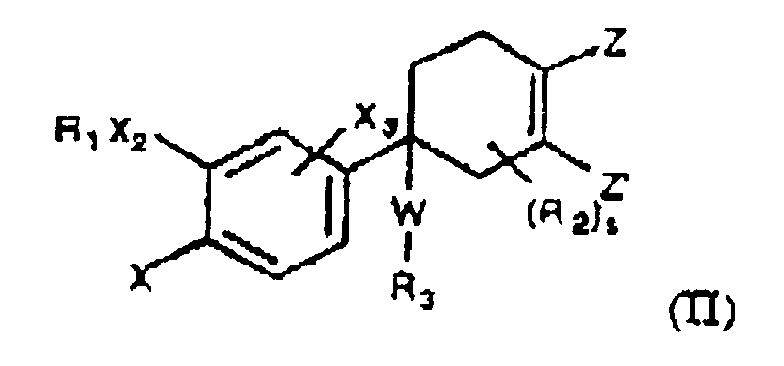 sous réserve que :R1 est un groupe (CR4R5)nC(O)O(CR4R5)mR6, -(CR4R5)nC(O)NR4(CR4R5)mR6, -(CR4R5)nO(CR4R5)mR6 ou -(CR4R5)rR6, dans lequel les fragments alkyle sont non substitués ou substitués avec un ou plusieurs atomes halogènes ;m a une valeur de 0 à 2n a une valeur de 0 à 4 ;r a une valeur de 0 à 6 ;R4 et R5 représentent, indépendamment, l'hydrogène ou un groupe alkyle en C1 ou C2 ;R6 est l'hydrogène, un groupe méthyle, hydroxyle, aryle, aryle à substituant halogéno, aryloxy-(alkyle en C1 à C3), aryloxy-(alkyle en C1 à C3) à substituant halogéno, indanyle, indényle, polycycloalkyle en C7 à C11, tétrahydrofurannyle, furannyle, tétrahydropyrannyle, pyrannyle, tétrahydrothiényle, thiényle, tétrahydrothiopyrannyle, thiopyrannyle, cycloalkyle en C3 à C6 ou un groupe cycloalkyle en C4 à C6 contenant une ou deux liaisons de non-saturation, le fragment cycloalkyle ou hétérocyclique pouvant être non substitué ou substitué par 1 à 3 groupes méthyle, un groupe éthyle ou un groupe hydroxyle ;sous réserve que :a) lorsque R6 est un groupe hydroxyle, m soit égal à 2 ; ou bienb) lorsque R6 est un groupe hydroxyle, r ait une valeur de 2 à 6 ; ou bienc) lorsque R6 est un groupe 2-tétrahydropyrannyle, 2-tétrahydrothiopyrannyle, 2-tétrahydrofurannyle ou 2-tétrahydrothiényle, m ait la valeur 1 ou 2 ; ou biend) lorsque R6 est un groupe 2-tétrahydropyrannyle, 2-tétrahydrothiopyrannyle, 2-tétrahydrofurannyle ou 2-tétrahydrothiényle, r ait une valeur de 1 à 6 ;e) lorsque n est égal à 1 et m est égal à 0, R6 représente autre chose que H dans -(CR4R5)nO(CR4R5)mR6 ;X représente un groupe YR2, le fluor, un groupe NR4R5 ou formylamine ;Y représente O ou S(O)m' ;m' a la valeur 0, 1 ou 2 ;X2 représente O ou un groupe NR8 ;X3 représente l'hydrogène ou X ;R2 représente un groupe -CH3 ou -CH2CH3 non substitué ou substitué par un ou plusieurs halogènes ;s a une valeur de 0 à 4 ;W est un groupe alkyle de 2 à 6 atomes de carbone, alcényle de 2 à 6 atomes de carbone ou alcynyle de 2 à 6 atomes de carbone ;R3 est un groupe COOR14, C(O)NR4R14 ou R15 ;Z est un groupe NHR14, S(O)m'R9, OS(O)2R9, OR9, OC(O)NR7R7, OC(O) (O)qR7, O(CR4R5)nOR9 ou NR9R9 ;Z' est un groupe C(Y')R14, C(O)OR14, C(Y')NR10R14, C(NR10)NR10R14, CN, C(NOR8)R14, C(NOR14)R8, C(NR8)NR10R14, C(NR14)NR8R8, C(NCN)NR10R14, C(NCN)SR11, (2-, 4- ou 5-imidazolyle), (3-, 4- ou 5-pyrazolyle), (4- ou 5-triazolyle[1.2.3]), (3- ou 5-triazolyle[1.2.4]), (5-tétrazole), (2-, 4- ou 5-oxazolyle), (3-, 4- ou 5-isoxazolyle), (3- ou 5-oxadiazolyle[1.2.4]), (2-oxadiazolyle[1.3.4]), (2-thiadiazolyle[1.3.4]), (2-, 4- ou 5-thiazolyle), (2-, 4- ou 5-oxazolidinyle), (2-, 4- ou 5-thiazolidinyle) ou (2-, 4- ou 5-imidazolidinyle) ; où tous les systèmes de noyaux hétérocycliques peuvent facultativement être subsitutés une ou plusieurs fois par R14 ;Y' représente O ou S ;q a la valeur 0 ou 1 ;R7 est l'hydrogène ou R9 ;R8 est l'hydrogène ou un groupe alkyle en C1 à C4 non substitué ou substitué par un à trois atomes de fluor, ou bien lorsque R8 et R10 apparaissent dans un groupe -NR8R10, ils peuvent former conjointement avec l'atome d'azote un noyau pentagonal à heptagonal constitué uniquement d'atomes de carbone ou d'atomes de carbone et d'au moins un hétéroatome choisi entre O, N ou S ;R9 est un groupe alkyle en C1 à C10, alcényle en C2 à C10, cycloalkyle en C3 à C7, cycloalcényle en C4 à C6, aryle, arylalkyle, hétéroaryle, hétéroarylalkyle dont chacun peut être non substitué ou substitué par un ou plusieurs atomes de fluor, ou bien deux termes R9 apparaissant dans un groupe NR9R9 peuvent former conjointement avec l'azote un noyau pentagonal à heptagonal constitué uniquement d'atomes de carbone ou d'atomes de carbone et d'au moins un hétéroatome choisi entre C/N/ ou S ;R10 représente OR8 ou R8 ;R11 est un groupe alkyle en C1 à C4 non substitué ou substitué par un à trois atomes de fluor ;R12 est un groupe R13, cycloalkyle en C3 à C7 ou un groupe aryle ou hétéroaryle non substitué ou substitué choisi dans le groupe consistant en (2-, 3- ou 4-pyridyle), pyrimidyle, pyrazolyle, (1- ou 2-imidazolyle), pyrrolyle, pipérazinyle, pipéridinyle, morpholinyle, furannyle, (2- ou 3-thiényle), quinolinyle, naphtyle et phényle ;R13 est un groupe hétéroaryle substitué ou non substitué choisi dans le groupe consistant en oxazolidinyle, oxazolyle, thiazolyle, pyrazolyle, triazolyle, tétrazolyle, imidazolyle, imidazolidinyle, thiazolidinyle, isoxazolyle, oxadiazolyle et thiadiazolyle, et lorsque R13 est substitué sur R12 ou R13, les noyaux sont liés par un atome de carbone et un noyau R13 sur deux peut être non substitué ou substitué par un ou deux groupes alkyle en C1 ou C2 non substitués ou substitués sur le radical méthyle avec 1 à 3 atomes de fluor ;R14 est l'hydrogène ou un groupe R15 ; ou bien lorsque R10 et R14 apparaissent sous la forme NR10R14, ils peuvent former conjointement avec l'azote un noyau pentagonal à heptagonal constitué uniquement d'atomes de carbone ou d'atomes de carbone et d'au moins un hétéroatome choisi entre O, N ou S ;R15 est un groupe (CR4R5)tR12 ou alkyle en C1 à C6, où R12 ou le groupe alkyle en C1 à C6 est non substitué ou substitué une ou plusieurs fois par un radical méthyle ou éthyle non substitué ou substitué par un à trois atomes de fluor, -F, -Br, -Cl, -NO2, -Si(R4)2, -NR8R10, -C(O)R8, -C(O)OR8, -O(CH2)qR8, -CN, -C(O)NR8R10, -O(CH2)qC(O)NR8R10, -O(CH2)qC(O)R8, -NR10C(O)NR8R10, -NR10C(O)R8, -NR10C(O)OR9, -NR10C(O)R13, -C(NR10)NR8R10, -C(NCN)NR8R10, -C(NCN)SR11, -NR10C(NCN)SR11, -NR10C(NCN)NR10R8, -NR10S(O)2R9, -S(O)mR11, -NR10C(O)C(O)NR8R10, -NR10C(O)C(O)R10 ou R13 ;t a la valeur 0, 1 ou 2 ;ou les sels pharmaceutiquement acceptables de ce composé.f) lorsque q est égal à 1 dans OC(O)(O)qR7, R7 ne soit pas de l'hydrogène ;g) R7 ne soit pas un groupe alkyle en C1 à C4 non substitué ou substitué par un à crois atomes de fluor ;
- Composé suivant la revendication 1, dans lequel R1 est un groupe -CH2-, cyclopropyle, -CH2-(cycloalkyle en C5 ou C6), -cycloalkyle en C4 à C6 non substitué ou substitué par un radical OH, tétrahydrofuranne-3-yle, (3- ou 4-cyclopentényle), benzyle ou -alkyle en C1 ou C2 non substitué ou substitué par un ou plusieurs atomes de fluor, et -(CH2)2-4OH ; R2 est un groupe méthyle ou alkyle à substituant fluoro, W est un groupe éthynyle ou 1,3-butadiynyle ; R15 est un noyau aryle ou hétéroaryle non substitué ou substitué, X représente YR2, Z représente OR9 ou O(S)2R9 et Z' représente COOR14.
- Composé suivant la revendication 3, dans lequel R1 est un groupe -CH2-cyclopropyle, cyclopentyle, 3-hydroxycyclopentyle, méthyle ou CF2H ; X représente YR2 ; Y représente l'oxygène ; X2 représente l'oxygène ; X3 représente l'hydrogène ; et R2 est un groupe CF2H ou méthyle, W est un groupe éthynyle ou 1,3-butadiynyle, et R3 est un noyau pyrimidinyle substitué ou non substitué.
- Composé suivant la revendication 3, qui estle trifluorométhylsulfonate de 4-(3-cyclopentyloxy-4-méthoxyphényl)-4-(4-pyridyléthynyl)cyclohex-1-ène-1-yle, oule 4-(3-cyclopentyloxy-4-méthoxyphényl)-4-(4-pyridyléthynyl)-1-méthoxycyclohex-1-ène.
- Composition pharmaceutique comprenant un composé de formule I suivant la revendication 1 et un excipient acceptable du point de vue pharmaceutique.
Applications Claiming Priority (3)
| Application Number | Priority Date | Filing Date | Title |
|---|---|---|---|
| US36316894A | 1994-12-23 | 1994-12-23 | |
| US363168 | 1994-12-23 | ||
| PCT/US1995/016694 WO1996020175A1 (fr) | 1994-12-23 | 1995-12-21 | Monomeres de 1,4,4-(trisubstitue)cyclohex-1-ene utilises comme inhibiteurs de pde iv et tnf |
Publications (2)
| Publication Number | Publication Date |
|---|---|
| EP0799205A1 EP0799205A1 (fr) | 1997-10-08 |
| EP0799205B1 true EP0799205B1 (fr) | 1999-09-08 |
Family
ID=23429104
Family Applications (1)
| Application Number | Title | Priority Date | Filing Date |
|---|---|---|---|
| EP95944511A Expired - Lifetime EP0799205B1 (fr) | 1994-12-23 | 1995-12-21 | Monomeres de 1,4,4-(trisubstitue)cyclohex-1-ene utilises comme inhibiteurs de pde iv et tnf |
Country Status (5)
| Country | Link |
|---|---|
| EP (1) | EP0799205B1 (fr) |
| JP (1) | JPH10513153A (fr) |
| DE (1) | DE69512086T2 (fr) |
| DK (1) | DK0799205T3 (fr) |
| WO (1) | WO1996020175A1 (fr) |
Family Cites Families (3)
| Publication number | Priority date | Publication date | Assignee | Title |
|---|---|---|---|---|
| EP0633771A4 (en) * | 1992-04-02 | 1995-02-22 | Smithkline Beecham Corporation | Compounds. |
| AU3738393A (en) * | 1992-04-02 | 1993-11-08 | Smithkline Beecham Corporation | Compounds useful for treating inflammatory diseases and for inhibiting production of tumor necrosis factor |
| GB9226830D0 (en) * | 1992-12-23 | 1993-02-17 | Celltech Ltd | Chemical compounds |
-
1995
- 1995-12-21 DE DE69512086T patent/DE69512086T2/de not_active Expired - Lifetime
- 1995-12-21 JP JP8520522A patent/JPH10513153A/ja not_active Ceased
- 1995-12-21 WO PCT/US1995/016694 patent/WO1996020175A1/fr not_active Ceased
- 1995-12-21 DK DK95944511T patent/DK0799205T3/da active
- 1995-12-21 EP EP95944511A patent/EP0799205B1/fr not_active Expired - Lifetime
Also Published As
| Publication number | Publication date |
|---|---|
| JPH10513153A (ja) | 1998-12-15 |
| EP0799205A1 (fr) | 1997-10-08 |
| DK0799205T3 (da) | 1999-12-20 |
| DE69512086T2 (de) | 2000-04-13 |
| DE69512086D1 (de) | 1999-10-14 |
| WO1996020175A1 (fr) | 1996-07-04 |
Similar Documents
| Publication | Publication Date | Title |
|---|---|---|
| EP0633775B1 (fr) | Composes utiles pour traiter des maladies inflammatoires et inhiber la production du facteur necrosant de tumeurs malignes | |
| US5863926A (en) | 4,4-(disubstituted)cyclohexan-1-carboxylate monomers and related compounds | |
| US5869677A (en) | 3,3-(disubstituted)cyclohexan-1-carboxylate monomers and related compounds | |
| US5723681A (en) | 3,3-(disubstituted)cyclohexan-1-01 dimers and related compounds | |
| US5646158A (en) | 1,3,3-(trisubstituted)cyclohex-1-ene monomers and related compounds | |
| US5990119A (en) | 1,4,4-(trisubstituted)cyclohexane monomers and related compounds | |
| US5866616A (en) | 3,3-(disubstituted) cyclohexan-1-ol monomers and related compounds | |
| US5767151A (en) | 3,3-(disubstituted) cyclohexan-1-ylidine acetate dimers and related compounds | |
| US5892098A (en) | 3,3-(disubstituted)cyclohexan-1-one monomers and related compounds | |
| US5719184A (en) | 3,3-(disubstituted)cyclohexan-1-carboxylate dimers and related compounds | |
| US5900417A (en) | 1,3,3-(Trisubstituted)cyclohexanemonomers and related compounds | |
| US5795918A (en) | 1,3,3-(Trisubstituted)cyclohex-1-ene dimers and related compounds | |
| US5777160A (en) | 1, 4, 4-(trisubstituted) cyclohex-1-ene dimers and related compounds | |
| US5777176A (en) | 4,4-(disubstituted)cyclohexan-1-ol dimers and related compounds | |
| WO1996020159A1 (fr) | Monomeres d'acetate 3,3-hexamethylene (bisubstitue)-1-ylidine et composes connexes | |
| EP0799036A1 (fr) | Dimeres d'acetate 4,4-(disubstitue)cyclohexane-1-ylidine et composes associes | |
| EP0796097A1 (fr) | Monomeres 3,3-(disubstitues) cyclohexan-1-carboxylate et composes correspondants | |
| EP0799205A1 (fr) | Monomeres de 1,4,4-(trisubstitue)cyclohex-1-ene utilises comme inhibiteurs de pde iv et tnf | |
| EP0799204A1 (fr) | Monomeres de 1,3,3-(trisubstitue)cyclohexane et composes apparentes | |
| EP0794773A1 (fr) | Monomeres de 1,4,4-(trisubstitue) cyclohexane et composes apparentes | |
| EP0801566A1 (fr) | Monomeres de 4,4-(disubstitue)cyclohexan-1-ylidine acetate et composes apparentes | |
| WO1996019985A1 (fr) | Dimeres de 3,3-(disubstitues)cyclohexan-1-ylidine acetate et composes correspondants | |
| WO1996019979A1 (fr) | Dimeres de 1,4,4-(trisubstitue)cyclohexane et composes apparentes |
Legal Events
| Date | Code | Title | Description |
|---|---|---|---|
| PUAI | Public reference made under article 153(3) epc to a published international application that has entered the european phase |
Free format text: ORIGINAL CODE: 0009012 |
|
| 17P | Request for examination filed |
Effective date: 19970718 |
|
| AK | Designated contracting states |
Kind code of ref document: A1 Designated state(s): BE CH DE DK FR GB IT LI NL |
|
| 17Q | First examination report despatched |
Effective date: 19970916 |
|
| GRAG | Despatch of communication of intention to grant |
Free format text: ORIGINAL CODE: EPIDOS AGRA |
|
| GRAG | Despatch of communication of intention to grant |
Free format text: ORIGINAL CODE: EPIDOS AGRA |
|
| GRAH | Despatch of communication of intention to grant a patent |
Free format text: ORIGINAL CODE: EPIDOS IGRA |
|
| GRAH | Despatch of communication of intention to grant a patent |
Free format text: ORIGINAL CODE: EPIDOS IGRA |
|
| GRAA | (expected) grant |
Free format text: ORIGINAL CODE: 0009210 |
|
| AK | Designated contracting states |
Kind code of ref document: B1 Designated state(s): BE CH DE DK FR GB IT LI NL |
|
| REG | Reference to a national code |
Ref country code: CH Ref legal event code: EP |
|
| REF | Corresponds to: |
Ref document number: 69512086 Country of ref document: DE Date of ref document: 19991014 |
|
| ET | Fr: translation filed | ||
| ITF | It: translation for a ep patent filed | ||
| REG | Reference to a national code |
Ref country code: CH Ref legal event code: NV Representative=s name: E. BLUM & CO. PATENTANWAELTE |
|
| REG | Reference to a national code |
Ref country code: DK Ref legal event code: T3 |
|
| PLBE | No opposition filed within time limit |
Free format text: ORIGINAL CODE: 0009261 |
|
| STAA | Information on the status of an ep patent application or granted ep patent |
Free format text: STATUS: NO OPPOSITION FILED WITHIN TIME LIMIT |
|
| 26N | No opposition filed | ||
| REG | Reference to a national code |
Ref country code: GB Ref legal event code: IF02 |
|
| REG | Reference to a national code |
Ref country code: CH Ref legal event code: PFA Owner name: SMITHKLINE BEECHAM CORPORATION Free format text: SMITHKLINE BEECHAM CORPORATION#CORPORATE INTELLECTUAL PROPERTY, UW2220, P.O. BOX 1539, 709 SWEDELAND ROAD#KING OF PRUSSIA, PA 19406-0939 (US) -TRANSFER TO- SMITHKLINE BEECHAM CORPORATION#CORPORATE INTELLECTUAL PROPERTY, UW2220, P.O. BOX 1539, 709 SWEDELAND ROAD#KING OF PRUSSIA, PA 19406-0939 (US) |
|
| PGFP | Annual fee paid to national office [announced via postgrant information from national office to epo] |
Ref country code: DK Payment date: 20091111 Year of fee payment: 15 Ref country code: CH Payment date: 20091026 Year of fee payment: 15 |
|
| PGFP | Annual fee paid to national office [announced via postgrant information from national office to epo] |
Ref country code: NL Payment date: 20091222 Year of fee payment: 15 |
|
| PGFP | Annual fee paid to national office [announced via postgrant information from national office to epo] |
Ref country code: IT Payment date: 20091218 Year of fee payment: 15 Ref country code: GB Payment date: 20091106 Year of fee payment: 15 Ref country code: FR Payment date: 20091215 Year of fee payment: 15 |
|
| PGFP | Annual fee paid to national office [announced via postgrant information from national office to epo] |
Ref country code: DE Payment date: 20091230 Year of fee payment: 15 Ref country code: BE Payment date: 20091208 Year of fee payment: 15 |
|
| BERE | Be: lapsed |
Owner name: *SMITHKLINE BEECHAM CORP. Effective date: 20101231 |
|
| REG | Reference to a national code |
Ref country code: NL Ref legal event code: V1 Effective date: 20110701 |
|
| REG | Reference to a national code |
Ref country code: CH Ref legal event code: PL |
|
| REG | Reference to a national code |
Ref country code: DK Ref legal event code: EBP |
|
| GBPC | Gb: european patent ceased through non-payment of renewal fee |
Effective date: 20101221 |
|
| REG | Reference to a national code |
Ref country code: FR Ref legal event code: ST Effective date: 20110831 |
|
| PG25 | Lapsed in a contracting state [announced via postgrant information from national office to epo] |
Ref country code: BE Free format text: LAPSE BECAUSE OF NON-PAYMENT OF DUE FEES Effective date: 20101231 |
|
| PG25 | Lapsed in a contracting state [announced via postgrant information from national office to epo] |
Ref country code: CH Free format text: LAPSE BECAUSE OF NON-PAYMENT OF DUE FEES Effective date: 20101231 Ref country code: LI Free format text: LAPSE BECAUSE OF NON-PAYMENT OF DUE FEES Effective date: 20101231 Ref country code: FR Free format text: LAPSE BECAUSE OF NON-PAYMENT OF DUE FEES Effective date: 20110103 |
|
| REG | Reference to a national code |
Ref country code: DE Ref legal event code: R119 Ref document number: 69512086 Country of ref document: DE Effective date: 20110701 |
|
| PG25 | Lapsed in a contracting state [announced via postgrant information from national office to epo] |
Ref country code: GB Free format text: LAPSE BECAUSE OF NON-PAYMENT OF DUE FEES Effective date: 20101221 Ref country code: DE Free format text: LAPSE BECAUSE OF NON-PAYMENT OF DUE FEES Effective date: 20110701 |
|
| PG25 | Lapsed in a contracting state [announced via postgrant information from national office to epo] |
Ref country code: IT Free format text: LAPSE BECAUSE OF NON-PAYMENT OF DUE FEES Effective date: 20101221 Ref country code: NL Free format text: LAPSE BECAUSE OF NON-PAYMENT OF DUE FEES Effective date: 20110701 |