EP0799767A2 - Rolet pour un compartiment de rangement - Google Patents
Rolet pour un compartiment de rangement Download PDFInfo
- Publication number
- EP0799767A2 EP0799767A2 EP97104910A EP97104910A EP0799767A2 EP 0799767 A2 EP0799767 A2 EP 0799767A2 EP 97104910 A EP97104910 A EP 97104910A EP 97104910 A EP97104910 A EP 97104910A EP 0799767 A2 EP0799767 A2 EP 0799767A2
- Authority
- EP
- European Patent Office
- Prior art keywords
- flap
- plastic
- insert
- flap according
- dowel
- Prior art date
- Legal status (The legal status is an assumption and is not a legal conclusion. Google has not performed a legal analysis and makes no representation as to the accuracy of the status listed.)
- Granted
Links
- 238000003860 storage Methods 0.000 title claims abstract description 5
- 239000004033 plastic Substances 0.000 claims abstract description 59
- 229920003023 plastic Polymers 0.000 claims abstract description 59
- 239000002991 molded plastic Substances 0.000 claims abstract description 6
- XLYOFNOQVPJJNP-UHFFFAOYSA-N water Substances O XLYOFNOQVPJJNP-UHFFFAOYSA-N 0.000 claims abstract description 4
- 238000001125 extrusion Methods 0.000 claims description 18
- 238000002347 injection Methods 0.000 claims description 14
- 239000007924 injection Substances 0.000 claims description 14
- 238000001746 injection moulding Methods 0.000 claims description 11
- 210000002105 tongue Anatomy 0.000 claims description 10
- 230000003014 reinforcing effect Effects 0.000 claims description 8
- 230000002787 reinforcement Effects 0.000 claims description 7
- 239000000853 adhesive Substances 0.000 claims description 5
- 230000001070 adhesive effect Effects 0.000 claims description 5
- 229920005989 resin Polymers 0.000 claims description 4
- 239000011347 resin Substances 0.000 claims description 4
- 229920001601 polyetherimide Polymers 0.000 claims description 2
- 229920001169 thermoplastic Polymers 0.000 claims description 2
- 239000004416 thermosoftening plastic Substances 0.000 claims description 2
- 238000004382 potting Methods 0.000 claims 1
- 238000004519 manufacturing process Methods 0.000 abstract description 9
- 239000000463 material Substances 0.000 abstract description 7
- 238000003780 insertion Methods 0.000 description 8
- 230000037431 insertion Effects 0.000 description 8
- 238000013461 design Methods 0.000 description 7
- 238000003466 welding Methods 0.000 description 5
- 238000004026 adhesive bonding Methods 0.000 description 3
- 238000005266 casting Methods 0.000 description 3
- 238000000034 method Methods 0.000 description 3
- 230000005540 biological transmission Effects 0.000 description 2
- 150000001875 compounds Chemical class 0.000 description 2
- 238000010276 construction Methods 0.000 description 2
- 238000011161 development Methods 0.000 description 2
- 230000018109 developmental process Effects 0.000 description 2
- 238000007789 sealing Methods 0.000 description 2
- RNFJDJUURJAICM-UHFFFAOYSA-N 2,2,4,4,6,6-hexaphenoxy-1,3,5-triaza-2$l^{5},4$l^{5},6$l^{5}-triphosphacyclohexa-1,3,5-triene Chemical compound N=1P(OC=2C=CC=CC=2)(OC=2C=CC=CC=2)=NP(OC=2C=CC=CC=2)(OC=2C=CC=CC=2)=NP=1(OC=1C=CC=CC=1)OC1=CC=CC=C1 RNFJDJUURJAICM-UHFFFAOYSA-N 0.000 description 1
- 229920000049 Carbon (fiber) Polymers 0.000 description 1
- 230000006978 adaptation Effects 0.000 description 1
- 230000015572 biosynthetic process Effects 0.000 description 1
- 239000004917 carbon fiber Substances 0.000 description 1
- 238000010586 diagram Methods 0.000 description 1
- 238000005516 engineering process Methods 0.000 description 1
- 239000003822 epoxy resin Substances 0.000 description 1
- 239000003000 extruded plastic Substances 0.000 description 1
- 239000000835 fiber Substances 0.000 description 1
- 239000003063 flame retardant Substances 0.000 description 1
- -1 for example Polymers 0.000 description 1
- 239000003365 glass fiber Substances 0.000 description 1
- 238000010438 heat treatment Methods 0.000 description 1
- 238000007689 inspection Methods 0.000 description 1
- 238000009434 installation Methods 0.000 description 1
- 238000012423 maintenance Methods 0.000 description 1
- 239000002184 metal Substances 0.000 description 1
- VNWKTOKETHGBQD-UHFFFAOYSA-N methane Chemical compound C VNWKTOKETHGBQD-UHFFFAOYSA-N 0.000 description 1
- 238000003801 milling Methods 0.000 description 1
- 229920000647 polyepoxide Polymers 0.000 description 1
- 239000007787 solid Substances 0.000 description 1
- 238000012549 training Methods 0.000 description 1
Images



Classifications
-
- B—PERFORMING OPERATIONS; TRANSPORTING
- B64—AIRCRAFT; AVIATION; COSMONAUTICS
- B64D—EQUIPMENT FOR FITTING IN OR TO AIRCRAFT; FLIGHT SUITS; PARACHUTES; ARRANGEMENT OR MOUNTING OF POWER PLANTS OR PROPULSION TRANSMISSIONS IN AIRCRAFT
- B64D11/00—Passenger or crew accommodation; Flight-deck installations not otherwise provided for
- B64D11/003—Stowage devices for passengers' personal luggage
-
- E—FIXED CONSTRUCTIONS
- E05—LOCKS; KEYS; WINDOW OR DOOR FITTINGS; SAFES
- E05D—HINGES OR SUSPENSION DEVICES FOR DOORS, WINDOWS OR WINGS
- E05D5/00—Construction of single parts, e.g. the parts for attachment
- E05D5/02—Parts for attachment, e.g. flaps
- E05D5/0215—Parts for attachment, e.g. flaps for attachment to profile members or the like
-
- F—MECHANICAL ENGINEERING; LIGHTING; HEATING; WEAPONS; BLASTING
- F16—ENGINEERING ELEMENTS AND UNITS; GENERAL MEASURES FOR PRODUCING AND MAINTAINING EFFECTIVE FUNCTIONING OF MACHINES OR INSTALLATIONS; THERMAL INSULATION IN GENERAL
- F16B—DEVICES FOR FASTENING OR SECURING CONSTRUCTIONAL ELEMENTS OR MACHINE PARTS TOGETHER, e.g. NAILS, BOLTS, CIRCLIPS, CLAMPS, CLIPS OR WEDGES; JOINTS OR JOINTING
- F16B12/00—Jointing of furniture or the like, e.g. hidden from exterior
- F16B12/10—Jointing of furniture or the like, e.g. hidden from exterior using pegs, bolts, tenons, clamps, clips, or the like
- F16B12/12—Jointing of furniture or the like, e.g. hidden from exterior using pegs, bolts, tenons, clamps, clips, or the like for non-metal furniture parts, e.g. made of wood, of plastics
- F16B12/26—Jointing of furniture or the like, e.g. hidden from exterior using pegs, bolts, tenons, clamps, clips, or the like for non-metal furniture parts, e.g. made of wood, of plastics using snap-action elements
-
- E—FIXED CONSTRUCTIONS
- E05—LOCKS; KEYS; WINDOW OR DOOR FITTINGS; SAFES
- E05D—HINGES OR SUSPENSION DEVICES FOR DOORS, WINDOWS OR WINGS
- E05D5/00—Construction of single parts, e.g. the parts for attachment
- E05D5/02—Parts for attachment, e.g. flaps
-
- E—FIXED CONSTRUCTIONS
- E05—LOCKS; KEYS; WINDOW OR DOOR FITTINGS; SAFES
- E05Y—INDEXING SCHEME ASSOCIATED WITH SUBCLASSES E05D AND E05F, RELATING TO CONSTRUCTION ELEMENTS, ELECTRIC CONTROL, POWER SUPPLY, POWER SIGNAL OR TRANSMISSION, USER INTERFACES, MOUNTING OR COUPLING, DETAILS, ACCESSORIES, AUXILIARY OPERATIONS NOT OTHERWISE PROVIDED FOR, APPLICATION THEREOF
- E05Y2900/00—Application of doors, windows, wings or fittings thereof
- E05Y2900/50—Application of doors, windows, wings or fittings thereof for vehicles
- E05Y2900/502—Application of doors, windows, wings or fittings thereof for vehicles for aircraft or spacecraft
-
- E—FIXED CONSTRUCTIONS
- E05—LOCKS; KEYS; WINDOW OR DOOR FITTINGS; SAFES
- E05Y—INDEXING SCHEME ASSOCIATED WITH SUBCLASSES E05D AND E05F, RELATING TO CONSTRUCTION ELEMENTS, ELECTRIC CONTROL, POWER SUPPLY, POWER SIGNAL OR TRANSMISSION, USER INTERFACES, MOUNTING OR COUPLING, DETAILS, ACCESSORIES, AUXILIARY OPERATIONS NOT OTHERWISE PROVIDED FOR, APPLICATION THEREOF
- E05Y2900/00—Application of doors, windows, wings or fittings thereof
- E05Y2900/50—Application of doors, windows, wings or fittings thereof for vehicles
- E05Y2900/53—Type of wing
- E05Y2900/538—Interior lids
-
- Y—GENERAL TAGGING OF NEW TECHNOLOGICAL DEVELOPMENTS; GENERAL TAGGING OF CROSS-SECTIONAL TECHNOLOGIES SPANNING OVER SEVERAL SECTIONS OF THE IPC; TECHNICAL SUBJECTS COVERED BY FORMER USPC CROSS-REFERENCE ART COLLECTIONS [XRACs] AND DIGESTS
- Y02—TECHNOLOGIES OR APPLICATIONS FOR MITIGATION OR ADAPTATION AGAINST CLIMATE CHANGE
- Y02T—CLIMATE CHANGE MITIGATION TECHNOLOGIES RELATED TO TRANSPORTATION
- Y02T50/00—Aeronautics or air transport
- Y02T50/40—Weight reduction
Definitions
- the invention relates to a flap for storage compartments, in particular for luggage racks (hat racks) made of plastic for land, water and aircraft; it also relates to means for attaching fittings for pivoting such flaps, which in turn have receptacles for the fastening means.
- Storage compartments are provided in land, water and aircraft, which serve to store different equipment, but also (as a hat rack) to accommodate hand luggage and outer clothing for passengers.
- Such trays are closed with flaps during travel / flight, which reliably prevent them from falling out during rough travel / flight.
- flaps are made of plastic, the honeycomb construction is used with considerable material and labor because of the stability.
- Such flaps are generally hinged to existing vehicle interior structures;
- the hinge parts are to be fixed on the one hand on these inner structures and on the other hand on the extrusion profile. Because of the structure of these damper blades made in this way, this setting is difficult.
- dowels inserted from the back of the damper blade, fixed by welding or gluing, which then receive the screws with which the hinges are attached. With this type of fastening, the dowels must be anchored in both the bottom and the top plate of the flap in order to find sufficient support.
- the extruded profile sections can be provided with receiving pockets into which hinge receptacles are inserted, which in turn have the receptacles for the fastening screws, for example in the form of screw sleeves. It has now been shown that the hinge receptacles used in receiving pockets with their receptacles for the fastening screws are also able to withstand the required loads with certainty.
- the design of the cover flap as an extruded plastic flap sheet with at least one injection-molded plastic end cap opens up the possibility of extruding the flap sheet as a multi-chamber profile in the manner of a double-wall sheet, which can be manufactured endlessly and cut to the desired size.
- the cut plastic flap blade is then at least on one side with a Injection molded part, the plastic end cap, closed, the still open free side is covered with a plastic edge cover.
- Injection-molded plastic end caps are advantageously provided on both sides, which are then preferably mirror-symmetrical to one another.
- the open edges of the plastic damper blades or also of injection-molded plastic end caps can be closed with plastic edge covers. For example, in the case of two abutting plastic flaps, the abutting edges, which are just formed, are only provided with a plastic side cover.
- Each of the plastic end caps has receptacles for the hinges which cause the articulation to the vehicle and are necessary for the flap movement.
- dowels are used from the back of the flap, which are fixed by welding or gluing. These dowels then take up the screws with which the hinges are attached.
- the extruded profile sections can be provided with receiving pockets into which hinge receptacles produced by the injection molding process are inserted, which in turn have the receptacles for the fastening screws, for example in the form of screw sleeves.
- a closure is provided to make the plastic flaps openable for the user of the shelf.
- the flap leaf preferably has a pocket-shaped recess in the center, into which an injection molded part accommodating the flap closure with handle plate and locking bolt can be inserted and fixed.
- the injection molded part is provided with appropriate means which allow the closure parts to be fastened to the plastic flap leaf.
- two frame side parts or a frame middle part made of plastic are positively inserted into the three open sides of the cutout, into which metallic inserts are inserted during manufacture, preferably during injection molding are overmolded during injection molding; these metallic inserts are used to attach the flap lock, or the like with screws, rivets. can be done.
- both are shaped in such a way that they partially overlap, the overlapping flat parts being at different heights given by the web height.
- This is achieved with the plastic damper blade in that one side surface of the multi-chamber profile is removed, for example by milling, so that only the other side surface remains with the webs.
- the injection molded part is shaped in such a way that the side surface corresponding to the recessed side springs back so far that after the assembly the recessed area is covered; the other side surface of the plastic end cap is designed so that it abuts the non-recessed side surface of the plastic damper blade; the distance between the two side surfaces corresponds to the web height.
- the plastic end caps also advantageously have webs at right angles to the side plate surfaces for stiffening, which are arranged corresponding to the webs of the plastic flap leaf so that they abut against them after being joined together.
- the top or bottom plate of the plastic flap blades are shaped so that they have a reinforcement in the form of an inserted web or an embossed groove at a distance from the end edge of the plate.
- the top or bottom side plate of the extruded profile section including the webs is provided with a groove into which the transverse reinforcement web is welded or glued.
- a groove in the rear side plate of the extruded profile section is pressed in, the material of the webs of the extruded profile being displaced in the region of the groove.
- This reinforcement causes a considerable stiffening of the multi-chamber profile, especially near the end areas.
- One of the side surfaces of the plastic end cap is advantageously provided with tongues which are arranged in such a way that they can be inserted and fixed there in at least some of the hollow chambers of the extruded and recessed plastic damper blade. These tongues increase the stability of the connection, so that the safety of the flap closure is ensured even in the case of high demands and rough operation.
- the points of contact between the plastic end cap and the damper blade are welded to connect the plastic damper blade and the plastic end cap. This welding is carried out using the welding methods known from plastics technology. Alternatively, the contact points between the plastic end cap and the damper blade are glued. Here too, suitable adhesives are known for (almost) all plastics. It goes without saying that the type and establishment of the connection take place in such a way that it meets the requirements, in particular the safety requirements.
- an amorphous thermoplastic such as, for example, polyetherimides
- plastics on this basis can be processed both by extrusion and by injection molding; they are flame-retardant and easy to process in the event of fire if they are easy to process.
- These plastics can also be provided with fiber reinforcements (glass fiber, carbon fiber) in order to increase their rigidity and dimensional stability.
- fiber reinforcements glass fiber, carbon fiber
- a trough-shaped hinge receptacle is essentially inserted in a form-fitting manner as a fastening insert into the receiving opening made in the lower side plate or the upper side plate.
- This design creates a fastening option, ie it can be used in a simple manner for installing a hinge in a double-wall sheet-like extrusion profile; all that is required is an opening in the bottom or top sheet.
- the hinge receptacle is advantageously designed as an essentially rectangular insert, the height of which corresponds approximately to the height of the longitudinal webs; this height allows the insert to be supported on the other plate.
- the receiving opening corresponds to the shape of the insert, so that a positive connection is possible at least in the area of the upper edge of the trough.
- the hinge holder can also be produced with a round cross section.
- At least the hinge receptacle is designed as a plastic insert which can preferably be produced as an injection molded part; this training allows an adaptation to the plastic of the extrusion profile, as well as a simplified and therefore inexpensive manufacture.
- locking means are provided which cooperate with locking lugs on the fastening insert in such a way that the fastening insert inserted into the trough is secured after latching.
- the fastening insert can be fixed in a simple manner, at least during assembly.
- the injection-molded dowel of the hinge receptacle contains the fastening insert as an overmolded insert.
- the fastening insert is placed in the injection mold and hosed after the mold is closed.
- the fastening insert is surrounded by the plastic and fixed in the dowel.
- the plastic insert for the hollow chamber profiles is manufactured in a simplified manner: the locking segments holding the fastening insert by means of engagement elements can be dispensed with; their function is taken over by the receiving sleeve that is formed during the injection molding.
- the hinge receptacle is fixed in the extrusion profile by means of a hardening casting resin or adhesive.
- the fastening insert which is pre-fixed by latching, is also advantageously fixed in the trough of the hinge receptacle with a sealing compound, preferably with a hardening sealing resin or adhesive.
- a two-component epoxy resin is provided as the casting resin.
- An insert with a bore receiving a locking dowel is provided as the fastening insert, and locking dowels are provided as fastening means on the hinge.
- the locking anchors are advantageously designed as expansion anchors which, according to a further development, are molded onto a side wing of the hinge formed from plastic. Installation is very easy with the proposed fastening with expansion dowels: the connection is obtained by simply plugging them together; a blow to the spreader pin secures it.
- an insert with a threaded bore receiving a screw is provided as the fastening insert, screws being provided as fastening means on the hinge.
- an insert with a bayonet receptacle for receiving a bayonet lock is provided as the fastening receptacle, with bayonet closures being provided as fastening means on the hinge. The screw and the bayonet connection create a connection that can be released again in a simple manner. This is particularly important if - for example during regular inspections - the valves have to be dismantled at maintenance intervals.
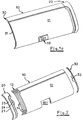
- FIG. 1 shows views of cover flaps of different designs for a hat rack of an aircraft in a perspective diagram.
- the cover flap is designed such that end caps 20 are attached to the multi-chamber profile of the center piece 10 on both sides, and that approximately A locking device 19 is provided in the center of the middle piece 10, the handle plate 19.1 of which is visible.
- FIGS. 1b and 1c show an embodiment of a cover flap, in which only one end cap 20 is attached to the middle piece 10 formed by the multi-chamber profile, left in the embodiment according to FIG. 1b and right in the embodiment according to FIG. 1c. In all cases, the side edges are closed with edge covers 30.
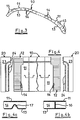
- FIG. 2 indicates (schematically) the manufacturing process of such a cover flap: First, an extruded multi-chamber profile is shown as Center piece 10 cut so that - taking into account the end caps 20 to be added on one or double sides - the length of the cover flap is reached. Then, in the area of the end caps 20 to be attached, the top plates 11 are excluded as far as the top walls 23 of the end caps 20 extend. The webs 14 (and the chambers 15 - FIG. 3 lying between the webs 13) of the multi-chamber profile are thereby exposed, and the underside plate 13 becomes visible. In addition to this recess area 12 of the top plate 11, a recess 18.1 is also provided, into which the closure device 19 with the grip plate 19.1 (FIG.
- end cap 20 can also be designed with an open side; if this is the case, this open side is closed with just such an edge cover 30. Both the end caps 20 and the edge covers 30 are injected - if necessary - in right and left versions.
- FIG. 3 shows a (broken) cross section of an extruded multi-chamber profile of a middle piece 10 of a cover flap, in which a plurality of webs 14 connect the top and bottom plates 11 and 13 thereof. Due to this design as an extrudable multi-chamber profile in the manner of a double-wall plate, a multiplicity of web chambers 15 are formed, corresponding to the number of webs. Such double wall plate-like designs are material-saving and thus economical and low in weight; nevertheless, they have a large stability which withstands even high loads.
- FIG. 4 The position of the (here) two end caps 20 in relation to the center piece 10 formed by the extruded multi-chamber profile is shown in FIG. 4 in supervision.
- the protruding top walls 23 of the end caps 20 overlap the webs which have remained in the recess area 12 of the middle piece 10, while the tongues 24 are inserted into the web chambers 15.
- an edge cover 30 completes the formation of the edge closure.
- the closure device 19 FIG. 4
- reinforcing webs 16 or reinforcing grooves 17 are provided in the extruded center piece 10, advantageously symmetrically to the center, transverse to the webs of the extruded profile.
- the underside plate 13 including the webs is slotted, so that the reinforcing web 16 can be inserted and welded or glued.
- the underside plate 13 is deformed in a groove-like manner while the material is heated, the material of the webs of the extruded profile being displaced in the groove area.
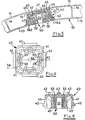
- FIGS. 5 To attach the hinges, a fastening insert with a dowel 40, into which a screw insert 50 is inserted, is shown, which is shown in FIGS. 5 and is inserted into a curved extruded multi-chamber extrusion profile 10 with a thickened edge and rounded end edge 10 '; the enlarged illustration in FIG. 5b shows the details of this.
- the base plate 62 of the hinge 60 is held on the flap by means of the screws 61 screwed into the screw inserts 50 of the dowels 40 and is pivotably articulated via the eye 63 to a counterpart fixed to the frame by means of a bolt (neither of which is shown in detail).
- a boom 64 with one Elongated hole 65 for articulating and adjusting a gas pressure spring (not shown in more detail) that completes the opening completes the hinge shoulder 60.
- the top plate 11 or the underside plate 13 of the middle piece 10 of the flap which is designed as an extruded multi-chamber extrusion profile, is provided with a Provided recess 18.2, which is so large that the base body 41 of the dowel 40 can be carried out, but the outer latching lugs 42 engage behind the edges of the top or bottom side plate 11 or 13 laterally of this recess 18.2.
- the dowel 40 is held at least after insertion.
- a fastening insert 50 - shown here without restriction to screw connection as a screw insert - is used, this insert 50 having a lower collar 53 which can be inserted approximately form-fittingly in the receiving ring 44 (FIG. 6) and of overlapping latching lugs 46 Locking segments 45 is held.
- dowels 40 and insert 50 are fixed in the extruded multi-chamber extrusion profile of the middle piece 10 by means of a hardening casting compound or a hardening adhesive 47, the upper collar 52 serving as the upper end, which lies flush with the surface of the outer side of that of the side leaves, which is provided with the recess 18.2 for inserting the dowel 40 (bottom plate 13 shown here).
- the screw sleeve 51 used is free and accessible so that a part to be attached can be connected to the extruded multi-chamber extrusion profile of the center piece 10 by screwing in a fastening screw.
- the dowel 40 itself is shown in more detail in FIGS. 6 and 7, FIG. 7 showing a section along section line III-III (FIG. 6).
- Foot cams 43 are provided under the base body 41, the height of the base body 41 with the cams 43 essentially corresponding to the depth of the chambers of the extruded hollow chamber profile of the center piece 10 (The gaps shown in FIG.
- FIG. 8 shows a dowel 40 'which can be inserted into an extruded multi-chamber extrusion profile of the center piece 10.
- This dowel 40 ' is injection molded in one piece from plastic, the fastening insert 50' designed for this purpose being inserted into the injection mold and surrounded by the plastic during injection and thus being fixed.
- the shape of this dowel 40 ' corresponds to that according to FIGS. 6 and 7, to which reference is made.
- This dowel 40 ' can easily be used instead of one of the dowels 40. With its lugs 42 it engages behind the wall of the extruded hollow chamber profile, its foot cams 43 abutting approximately on the inside of the underside plate 13.
- the locking segments 45 are here - in accordance with the production method in the injection molding process - converted to a sleeve 45 'which engages around the fastening insert 50 in a form-fitting manner.
- the fastening insert 50 'itself has only a lower collar 53, an upper collar is superfluous in this construction.
- the fastening insert 50 ' is inserted into the injection mold before injection molding, which is then closed; after closing, the shot occurs, in which the fastening insert 20 'is surrounded by the plastic.
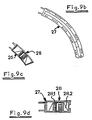
- FIG. 9 shows the fastening means of the flap closure in detail
- FIG. 9a the insertion of the frame middle part 26 and the frame side parts 27 indicated by arrows into the recess 18.1 (dashed lines: parts inserted) of the middle part of the flap leaf designed as a multi-chamber profile 10, the curvature of which is indicated laterally as a profile section 10 '
- FIGS. 9b to 9c show details of these parts.
- the solid frame middle part 26 and the frame side parts 27 are shown in the position before insertion and the dotted lines in the position after insertion.
- both the frame middle part 26 and the frame side parts 27 fit into the web chambers 15, which are cut by the recess 18.1 “closure”, the frame side parts 27 individual pairs of tongues and the frame middle part 26 a continuous tongue Have pair, according to the webs hit by the cutout.
- the pairs of tongues are designed so that they lie against the inside of the top plate 11 and the bottom plate 13 and can be welded or glued.
- Both frame middle part 26 and frame side part 27 are adapted in their curvature to the curvature of the flap leaf and provided with metallic insert 28, which with the fastening means of the flap lock 19 (not shown in more detail) with a handle plate 19.1, generally screws or rivets are screwed or pressed and fixed into the central body 28.1 of the metallic inserts 28.
- These metallic inserts are inserted into the plastic of the frame middle or side parts 26 and 27; in the production of these parts as injection molded parts, the inserts 28 are inserted into the injection mold and overmolded.
- locking wings 28.2 are formed on the central body 28.1, which in the plastic of the frame middle or -Side part 26 and 27 are anchored.
Landscapes
- Engineering & Computer Science (AREA)
- General Engineering & Computer Science (AREA)
- Mechanical Engineering (AREA)
- Aviation & Aerospace Engineering (AREA)
- Connection Of Plates (AREA)
- Injection Moulding Of Plastics Or The Like (AREA)
- Purses, Travelling Bags, Baskets, Or Suitcases (AREA)
- Packages (AREA)
- Packaging Of Annular Or Rod-Shaped Articles, Wearing Apparel, Cassettes, Or The Like (AREA)
- Bidet-Like Cleaning Device And Other Flush Toilet Accessories (AREA)
Applications Claiming Priority (4)
| Application Number | Priority Date | Filing Date | Title |
|---|---|---|---|
| DE29605942U DE29605942U1 (de) | 1996-04-03 | 1996-04-03 | Klappe für Ablagefächer |
| DE29605942U | 1996-04-03 | ||
| DE29611455U DE29611455U1 (de) | 1996-07-01 | 1996-07-01 | Befestigungseinsatz für einen Beschlag für Klappen mit einem stranggepreßten Extrusionsprofil als Klappenblatt |
| DE29611455U | 1996-07-01 |
Publications (3)
| Publication Number | Publication Date |
|---|---|
| EP0799767A2 true EP0799767A2 (fr) | 1997-10-08 |
| EP0799767A3 EP0799767A3 (fr) | 1999-06-02 |
| EP0799767B1 EP0799767B1 (fr) | 2002-05-08 |
Family
ID=26058808
Family Applications (1)
| Application Number | Title | Priority Date | Filing Date |
|---|---|---|---|
| EP97104910A Expired - Lifetime EP0799767B1 (fr) | 1996-04-03 | 1997-03-22 | Rolet pour un compartiment de rangement |
Country Status (4)
| Country | Link |
|---|---|
| US (1) | US5921029A (fr) |
| EP (1) | EP0799767B1 (fr) |
| AT (1) | ATE217271T1 (fr) |
| DE (1) | DE59707183D1 (fr) |
Cited By (3)
| Publication number | Priority date | Publication date | Assignee | Title |
|---|---|---|---|---|
| DE19806939C2 (de) * | 1998-02-19 | 2001-04-26 | Eads Airbus Gmbh | Anordnung von Platten für die Kabineninnenverkleidung in Fahrzeugen |
| DE102004053140A1 (de) * | 2004-11-03 | 2006-05-04 | Airbus Deutschland Gmbh | Gepäckfach, Flugzeug, Verfahren zum Herstellen eines Gepäckfachs und Verwendung eines Gepäckfachs in einer Personenbeförderungsvorrichtung |
| US7588211B2 (en) | 2004-11-03 | 2009-09-15 | Airbus Deutschland Gmbh | Baggage compartment in passenger transport system |
Families Citing this family (8)
| Publication number | Priority date | Publication date | Assignee | Title |
|---|---|---|---|---|
| AT404925B (de) * | 1997-07-25 | 1999-03-25 | Fischer Adv Components Gmbh | Fenstereinheit für flugzeugkabinen |
| JP2003200786A (ja) * | 2002-01-08 | 2003-07-15 | Fuji Heavy Ind Ltd | 車両用グローブボックス |
| KR100645186B1 (ko) * | 2005-07-07 | 2006-11-10 | 현대모비스 주식회사 | 센터 어퍼 트레이 |
| US7810869B2 (en) * | 2008-10-07 | 2010-10-12 | Honda Motor Co., Ltd. | Glove box knee bolster assembly for vehicle and method of manufacturing |
| DE102008051240B3 (de) * | 2008-10-10 | 2010-09-30 | Airbus Deutschland Gmbh | Vorrichtung zur Aufnahme von Gepäck in einer Passagierkabine eines Flugzeuges |
| WO2019005880A1 (fr) | 2017-06-27 | 2019-01-03 | Shanghai Yanfeng Jinqiao Automotive Trim Systems Co. Ltd. | Composant d'intérieur de véhicule |
| GB2566920A (en) * | 2017-07-12 | 2019-04-03 | Safran Nacelles Ltd | Fitting for a stiffened panel |
| US11945587B2 (en) * | 2019-10-03 | 2024-04-02 | Mhi Rj Aviation Ulc | Aircraft overhead luggage bin and method of modifying same |
Family Cites Families (7)
| Publication number | Priority date | Publication date | Assignee | Title |
|---|---|---|---|---|
| DE3029913C2 (de) * | 1980-08-07 | 1985-01-03 | Audi Nsu Auto Union Ag, 7107 Neckarsulm | Sicherheitseinrichtung für Fahrzeuge |
| GB2221109B (en) * | 1988-07-06 | 1993-04-14 | Kid Design Group Limited | Cover device for controls |
| JPH0463745A (ja) * | 1990-07-04 | 1992-02-28 | Mazda Motor Corp | 車両用グローブボックス装置 |
| AT397906B (de) * | 1992-02-20 | 1994-08-25 | Fischer Adv Components Gmbh | Kunststoffbehälter |
| US5778598A (en) * | 1992-10-27 | 1998-07-14 | U.S. Polymers, Inc. | Shutter door assembly |
| US5555923A (en) * | 1994-05-11 | 1996-09-17 | Clopay Building Products Company, Inc. | Sectional door having multiple piece panel sections |
| DE19534436A1 (de) * | 1995-09-16 | 1997-03-20 | Daimler Benz Ag | Cockpitbereich für eine Beifahrerseite eines Kraftfahrzeugs |
-
1997
- 1997-03-21 US US08/821,432 patent/US5921029A/en not_active Expired - Fee Related
- 1997-03-22 AT AT97104910T patent/ATE217271T1/de not_active IP Right Cessation
- 1997-03-22 EP EP97104910A patent/EP0799767B1/fr not_active Expired - Lifetime
- 1997-03-22 DE DE59707183T patent/DE59707183D1/de not_active Expired - Lifetime
Cited By (4)
| Publication number | Priority date | Publication date | Assignee | Title |
|---|---|---|---|---|
| DE19806939C2 (de) * | 1998-02-19 | 2001-04-26 | Eads Airbus Gmbh | Anordnung von Platten für die Kabineninnenverkleidung in Fahrzeugen |
| DE102004053140A1 (de) * | 2004-11-03 | 2006-05-04 | Airbus Deutschland Gmbh | Gepäckfach, Flugzeug, Verfahren zum Herstellen eines Gepäckfachs und Verwendung eines Gepäckfachs in einer Personenbeförderungsvorrichtung |
| DE102004053140B4 (de) * | 2004-11-03 | 2008-12-11 | Airbus Deutschland Gmbh | Gepäckfach, Verfahren zum Herstellen eines Gepäckfachs und Verwendung eines Gepäckfachs in einer Personenbeförderungsvorrichtung |
| US7588211B2 (en) | 2004-11-03 | 2009-09-15 | Airbus Deutschland Gmbh | Baggage compartment in passenger transport system |
Also Published As
| Publication number | Publication date |
|---|---|
| EP0799767B1 (fr) | 2002-05-08 |
| EP0799767A3 (fr) | 1999-06-02 |
| US5921029A (en) | 1999-07-13 |
| DE59707183D1 (de) | 2002-06-13 |
| ATE217271T1 (de) | 2002-05-15 |
Similar Documents
| Publication | Publication Date | Title |
|---|---|---|
| DE4038159C2 (fr) | ||
| EP1084655B1 (fr) | Système de fixation | |
| DE2841217A1 (de) | Buchse zur verankerung von befestigungselementen in verkleidungsplatten | |
| DE1559828A1 (de) | Scharnier zum Verbinden zweier Seitenwaende eines Schaukastens | |
| EP0799767B1 (fr) | Rolet pour un compartiment de rangement | |
| EP1379820B3 (fr) | Appareil frigorifique avec un récipient de stockage | |
| DE19839325C2 (de) | Fahrgastsitz mit Hohlräumen | |
| DE10116593B4 (de) | Fahrzeugdach | |
| EP1393653A1 (fr) | Cadre latéral en plusieurs parties pour tiroir | |
| AT401664B (de) | Möbelscharnier | |
| DE29914747U1 (de) | Dekompressionsverschluß mit zweigeteiltem Verschiebeelement | |
| DE3424432C2 (fr) | ||
| DE1553443A1 (de) | Schnappschloss mit Sperrvorrichtung | |
| DE4142598C1 (en) | Glove pocket lid hinge - has fastener plate allocated to body-fixed tap with straps allowing plate to move in two dimensions relative to support | |
| EP0526742B1 (fr) | Conteneur en plastique constitué de deux parties identiques | |
| DE2850470C2 (de) | Zu öffnende Klappe, insbesondere Tankklappe | |
| DE19712278A1 (de) | Bodenelement | |
| EP1354824B1 (fr) | Jeu d'éléments pour récipient à ordures avec des poignées enfichables | |
| DE10029544A1 (de) | Befestigungselement | |
| DE69826423T2 (de) | Befestigungselement mit Greifer, insbesondere für einen Einbaubehälter, und entsprechender Einbaubehälter | |
| DE3544042C1 (en) | Large-volume plastic container | |
| DE102005042288A1 (de) | Abdeckung für die Ladekante eines Kraftfahrzeuges und Kraftfahrzeug mit einer solchen Abdeckung | |
| DE9401456U1 (de) | Drehriegelverschluß | |
| DE10101618C1 (de) | Gehäuse, insbesondere für den Einbau elektrischer und elektronischer Bauteile | |
| DE19636298C1 (de) | Spülkasten |
Legal Events
| Date | Code | Title | Description |
|---|---|---|---|
| PUAI | Public reference made under article 153(3) epc to a published international application that has entered the european phase |
Free format text: ORIGINAL CODE: 0009012 |
|
| AK | Designated contracting states |
Kind code of ref document: A2 Designated state(s): AT DE FR GB NL SE |
|
| PUAL | Search report despatched |
Free format text: ORIGINAL CODE: 0009013 |
|
| AK | Designated contracting states |
Kind code of ref document: A3 Designated state(s): AT DE FR GB NL SE |
|
| RIC1 | Information provided on ipc code assigned before grant |
Free format text: 6B 64D 11/00 A, 6B 60R 7/06 B, 6E 05D 5/02 B, 6B 65D 43/16 B |
|
| 17P | Request for examination filed |
Effective date: 19991013 |
|
| GRAG | Despatch of communication of intention to grant |
Free format text: ORIGINAL CODE: EPIDOS AGRA |
|
| GRAG | Despatch of communication of intention to grant |
Free format text: ORIGINAL CODE: EPIDOS AGRA |
|
| GRAH | Despatch of communication of intention to grant a patent |
Free format text: ORIGINAL CODE: EPIDOS IGRA |
|
| 17Q | First examination report despatched |
Effective date: 20010920 |
|
| REG | Reference to a national code |
Ref country code: GB Ref legal event code: IF02 |
|
| GRAH | Despatch of communication of intention to grant a patent |
Free format text: ORIGINAL CODE: EPIDOS IGRA |
|
| GRAA | (expected) grant |
Free format text: ORIGINAL CODE: 0009210 |
|
| AK | Designated contracting states |
Kind code of ref document: B1 Designated state(s): AT DE FR GB NL SE |
|
| REF | Corresponds to: |
Ref document number: 217271 Country of ref document: AT Date of ref document: 20020515 Kind code of ref document: T |
|
| REF | Corresponds to: |
Ref document number: 59707183 Country of ref document: DE Date of ref document: 20020613 |
|
| GBT | Gb: translation of ep patent filed (gb section 77(6)(a)/1977) |
Effective date: 20020829 |
|
| ET | Fr: translation filed | ||
| REG | Reference to a national code |
Ref country code: GB Ref legal event code: 711B |
|
| REG | Reference to a national code |
Ref country code: GB Ref legal event code: 711G |
|
| PGFP | Annual fee paid to national office [announced via postgrant information from national office to epo] |
Ref country code: NL Payment date: 20030228 Year of fee payment: 7 |
|
| PGFP | Annual fee paid to national office [announced via postgrant information from national office to epo] |
Ref country code: SE Payment date: 20030303 Year of fee payment: 7 |
|
| PLBE | No opposition filed within time limit |
Free format text: ORIGINAL CODE: 0009261 |
|
| STAA | Information on the status of an ep patent application or granted ep patent |
Free format text: STATUS: NO OPPOSITION FILED WITHIN TIME LIMIT |
|
| PGFP | Annual fee paid to national office [announced via postgrant information from national office to epo] |
Ref country code: GB Payment date: 20030317 Year of fee payment: 7 |
|
| PGFP | Annual fee paid to national office [announced via postgrant information from national office to epo] |
Ref country code: AT Payment date: 20030324 Year of fee payment: 7 |
|
| 26N | No opposition filed |
Effective date: 20030211 |
|
| PG25 | Lapsed in a contracting state [announced via postgrant information from national office to epo] |
Ref country code: GB Free format text: LAPSE BECAUSE OF NON-PAYMENT OF DUE FEES Effective date: 20040322 Ref country code: AT Free format text: LAPSE BECAUSE OF NON-PAYMENT OF DUE FEES Effective date: 20040322 |
|
| PG25 | Lapsed in a contracting state [announced via postgrant information from national office to epo] |
Ref country code: SE Free format text: LAPSE BECAUSE OF NON-PAYMENT OF DUE FEES Effective date: 20040323 |
|
| PG25 | Lapsed in a contracting state [announced via postgrant information from national office to epo] |
Ref country code: NL Free format text: LAPSE BECAUSE OF NON-PAYMENT OF DUE FEES Effective date: 20041001 |
|
| EUG | Se: european patent has lapsed | ||
| GBPC | Gb: european patent ceased through non-payment of renewal fee |
Effective date: 20040322 |
|
| NLV4 | Nl: lapsed or anulled due to non-payment of the annual fee |
Effective date: 20041001 |
|
| PGFP | Annual fee paid to national office [announced via postgrant information from national office to epo] |
Ref country code: FR Payment date: 20050224 Year of fee payment: 9 |
|
| REG | Reference to a national code |
Ref country code: FR Ref legal event code: ST Effective date: 20061130 |
|
| PG25 | Lapsed in a contracting state [announced via postgrant information from national office to epo] |
Ref country code: FR Free format text: LAPSE BECAUSE OF NON-PAYMENT OF DUE FEES Effective date: 20060331 |
|
| PGFP | Annual fee paid to national office [announced via postgrant information from national office to epo] |
Ref country code: DE Payment date: 20100203 Year of fee payment: 14 |
|
| PG25 | Lapsed in a contracting state [announced via postgrant information from national office to epo] |
Ref country code: DE Free format text: LAPSE BECAUSE OF NON-PAYMENT OF DUE FEES Effective date: 20111001 |
|
| REG | Reference to a national code |
Ref country code: DE Ref legal event code: R119 Ref document number: 59707183 Country of ref document: DE Effective date: 20111001 |