EP0800147A2 - Restauration d'images de caractères dégradés - Google Patents
Restauration d'images de caractères dégradés Download PDFInfo
- Publication number
- EP0800147A2 EP0800147A2 EP97302277A EP97302277A EP0800147A2 EP 0800147 A2 EP0800147 A2 EP 0800147A2 EP 97302277 A EP97302277 A EP 97302277A EP 97302277 A EP97302277 A EP 97302277A EP 0800147 A2 EP0800147 A2 EP 0800147A2
- Authority
- EP
- European Patent Office
- Prior art keywords
- images
- image
- generating
- approximation
- original symbol
- Prior art date
- Legal status (The legal status is an assumption and is not a legal conclusion. Google has not performed a legal analysis and makes no representation as to the accuracy of the status listed.)
- Withdrawn
Links
Images


Classifications
-
- G—PHYSICS
- G06—COMPUTING OR CALCULATING; COUNTING
- G06V—IMAGE OR VIDEO RECOGNITION OR UNDERSTANDING
- G06V30/00—Character recognition; Recognising digital ink; Document-oriented image-based pattern recognition
- G06V30/10—Character recognition
- G06V30/16—Image preprocessing
- G06V30/168—Smoothing or thinning of the pattern; Skeletonisation
-
- G—PHYSICS
- G06—COMPUTING OR CALCULATING; COUNTING
- G06V—IMAGE OR VIDEO RECOGNITION OR UNDERSTANDING
- G06V30/00—Character recognition; Recognising digital ink; Document-oriented image-based pattern recognition
- G06V30/10—Character recognition
Definitions
- the present invention relates to document image processing, and more particularly, to recognizing images from an image source, for example, a printed document.
- a fundamental problem in the art of automatic document image processing relates to image defects, that is, imperfections in the image as compared to the original ideal artwork used to create the image.
- the sources of image defects are numerous and well known.
- the original printed document e.g., paper document
- the paper document which was the source of the image may be defective (e.g., the paper has spots of dirt, folds, or was printed from a faulty printing device).
- the paper document when the paper document was scanned, the paper may have been skewed while being placed in the scanner, resulting in a distortion of the image.
- the optics of the scanning process itself can produce defects due to, for example, vibration, pixel sensor sensitivity or noise.
- OCR optical character recognition
- image classifiers are key components of most OCR systems used for analyzing a digital representation of an image. The accuracy of such OCR system classifiers significantly decreases when the quality of the input image is degraded even slightly. Thus, a critical feature of image classifiers is the ability to operate accurately on and recognize the characters in poor representations of the image.
- One known technique for improving the image classifiers' ability to handle defective image representations is through so called training.
- automatic training is frequently employed in which certain recognition algorithms are used to train the classifier to recognize defective images.
- One approach of such training is to use document-image degradation models.
- a variety of document-image degradation models and their applications were investigated and discussed in H. Baird, "Document Image Defect Models and Their Uses", Proc ., IAPR 2nd International Conference on Document Analysis and Recognition , October 20-22, 1993.
- These document-image degradation models read a single ideal prototype image (e.g., a machine-printed symbol) and as prescribed by the particular model's degradation algorithm, generate a large number of pseudorandomly degraded images. These generated degraded images (i.e., examples of potential representations of defective symbols in an image) are then used to train the classifier for use in the image recognition process to recognize defective symbols.
- this technique requires that an image degradation model (i.e., a prediction of how the original image will degrade) is known in order to generate the degraded images for the classifier.
- image deconvolution which addresses the recovery of an input image from a blurred output image (e.g., a motion-blurred photograph of a moving object).
- a blurred output image e.g., a motion-blurred photograph of a moving object.
- the present invention provides a method useful in image recognition by employing the restoration of degraded images to produce an approximation of the original ideal artwork for the degraded image.
- a set of images e.g., defective or degraded images
- the ideal artwork is, for example, the original symbol used in the creation of the image source (e.g., printed document).
- the approximation of the original symbol then serves as input to train an image classifier thereby increasing the effectiveness of the classifier.
- the classifier can use the original symbol approximations as input to a degradation model to produce a set of degraded images useful in document classification.
- the effectiveness of the classifier is enhanced through the reduction in the classification error rate.
- a set of degraded bilevel images of single unknown characters is selected from an image source (e.g., printed document).
- the selected bilevel images are preprocessed by smoothing and adding gray level. Image averaging is then applied to the gray level images. More particularly, the resultant gray level images are superimposed, intensities are added, and the result is thresholded to produce a single bilevel image. Thereafter, a smoothing of the single bilevel image is made to provide the final output of an approximation of the image's original symbol (i.e., the original symbol used in the creation of the image source).
- the original artwork approximation can serve, for example, as input to an image classifier and is useful in the further image classification and recognition of the image source.
- Further embodiments of the invention include additional processing of the input images to account for sharp corners of the input images thereby further increasing the effective approximation of the original artwork.
- the present invention provides a method useful in image recognition by employing the restoration of degraded images to produce an approximation of the original ideal artwork for the image. That is, pursuant to the invention, a set of images (e.g., defective images) is read from an image source and an attempt is made to recover, or closely approximate, the ideal artwork (e.g., original symbol) from which the images were derived.
- this approximation of the original symbol can serve to train an image classifier thereby increasing the effectiveness of the classifier.
- the classifier can use the original symbol approximations as input to a degradation model to produce a set of degraded images useful in document classification.
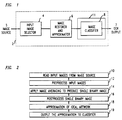
- FIG. 1 shows an OCR system employing the principles of the invention.
- OCR system 2 has an input image selector 4 which is used to select an input set of images, illustratively a set of printed characters, from image source 5.
- the input set of images serve as input to image restorer and approximator 6 which produces an approximation of the ideal artwork for the input images.
- Image classifier 8 illustratively shown as part of OCR engine 11, uses the ideal artwork approximations to classify the original image source. The classifications made by image classifier 8 are then used by OCR engine 11 which applies well known image recognition principles to image source 5 to produce well known OCR system output 7.
- FIG. 2 is a flowchart of the main operations of the preferred embodiment of the present invention.
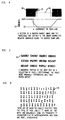
- FIG. 3 is an illustrative example of applying the process of FIG. 2 to a sample set of input images.
- a set of input images are illustratively read from an image source (block 10), for example, a page of characters from a printed document.
- the method of the present invention operates on many input images as opposed to a single image as in, for example, prior art image deconvolution techniques.
- the selected input images are bilevel (i.e., black or white, not gray or color) and may be read from the image source by well known techniques such as page layout analysis or manual selection.
- the set of input images represent images from the source which an OCR system (e.g., OCR system 2 shown in FIG. 1) would have difficulty in performing recognition on due to their defects and degradation.
- the set of degraded input images is collected in such a manner so that the set captures those images from the source thought to be representative of a single symbol (i.e., the same symbol).
- FIG. 3 shows a illustrative input character set 20 representative of the printed character "A".
- the set of input images undergoes preprocessing (block 12) prior to the application of the so called “image averaging" operations of our method as will be further discussed below.
- preprocessing operations to include, at a minimum, smoothing the input images and adding gray level to the smoothed images.
- smoothing outline technique provides superior results.
- the preferred embodiment employs the smoothing outline technique described in J. D. Hobby, "Polygonal Approximation that Minimize the Number of Inflection", Proceedings of the Fourth Annual ACM-SIAM Symposium on Discrete Algorithms , pp. 93-102, January, 1993 (hereinafter "Hobby's smoothing algorithm”).
- Hobby's smoothing algorithm by applying Hobby's smoothing algorithm during the preprocessing operations (block 12), a range of alternative outlines for a particular input is generated.
- the range of alternative outlines provide an improved estimate of the underlying shape of the input image, thereby increasing the recognition effectiveness of the preferred embodiment.
- the preprocessing of the input images also preferably includes the addition of gray scale to the resultant smoothed images to produce a set of gray level images for further processing.
- the gray scale is added at varying levels to take full advantage of the range of outlines generated by Hobby's smoothing algorithm.
- Image averaging includes the application of three main operations: (1) superimposing the inputs; (2) adding-up the inputs; and (3) thresholding.
- the gray level images 22 produced by preprocessing are superimposed using any of a number of well known techniques.
- the preferred embodiment superimposes the images by finding the centroid of each input image, to subpixel accuracy, and shifting the images so that all the centroids coincide.
- the images are added together to produce a single gray level image having a cumulative gray scale value.
- the image averaging operations of adding-up the inputs and thresholding are carried out as follows:
- the above-described operations rasterize each polygonal outline as generated by the smoothing algorithm, add up the resultant images, and threshold the result to produce a thresholded image 24 (see, FIG. 3). More particularly, in accordance with the preferred embodiment, in order to make use of the smooth-shaded edges generated by Hobby's smoothing algorithm, a generalization is made by rasterizing the images at a higher resolution and adding up the rasterizations. For example, consider a horizontal scan line passing through an image (having smooth-shaded edges). The associated darkness is a piecewise-linear function of the x coordinate along the scan line and the slope discontinues at points where the scan line crosses trapezoid boundaries. For example, FIG. 4 shows a section of a smooth-shaded image 28, the trapezoids that define it 30, and the relative darkness 32 along the dashed scan line 34.
- the trapezoids are rasterized to (x, y, d) triples (see, step (5) above) such that the darkness values represent changes in the slope of the darkness function as opposed to changes in the darkness itself.
- the total darkness function for the (x, y, d) triples is recreated on particular scan lines (see, step (8) above).
- the third component of each triple is stored as a fixed-point number. However, some accumulated error may result in the total darkness D, but this error is partially mitigated when the trapezoids generated (see, step (8) above) have a large horizontal extent.
- the thresholded image 24 is further postprocessed (see, FIG. 2, block 16) using an additional smoothing operation.
- the postprocessing smoothing is again illustratively performed in accordance with the previously discussed smoothing technique as described by J. D. Hobby.
- a more realistic image restoration output 26 is produced without any influences from underlying image wiggle or noise.
- the tolerance ⁇ used in the postprocessing smoothing is a function of the scale factor ⁇ and the total number of images averaged together.
- the first phase we employed an experimental page reader using a classifier trained on twenty fixed-pitch faces. Additional attributes of the first phase image processing, each of which will be fully understood by one skilled in the art, included: page layout, fixed-pitch processing, character classification, shape-directed segmentation and crude contextual filtering.
- the "classification error" was measured in the first phase by semi-manually identifying every pair of strings of characters (T, E) where T is from the ground truth and E is the string erroneously substituted for T by the page reader. T or E may include spaces and may be empty. Each (T, E) pair was locally minimal in that T and E shared no character.
- the input character images (the same set used as input in phase 1) by their top-choice character label.
- the top-choice label is the most likely interpretation of the input character image in terms, for example, of percentage (e.g., 90% likely the image is the character "I").
- FIG. 6 shows a set of magnified images 36 selected by their top-choice labels from a total of 1009 labeled as the character "I". As is apparent from FIG. 6, some of the images are mislabeled (i.e., not the character "I") or are fragments of characters.
- the output character images 38 generated by the invention can be used as the input to a pseudorandom generator for producing a set of degraded images representative of how the input text may appear from a classification standpoint.
- a pseudorandom generator for producing a set of degraded images representative of how the input text may appear from a classification standpoint.
- degraded images 150 for each input character image.
- degraded images 40 shown in FIG. 8 which are representative of the potential degradation patterns of this character.
Landscapes
- Engineering & Computer Science (AREA)
- Computer Vision & Pattern Recognition (AREA)
- Physics & Mathematics (AREA)
- General Physics & Mathematics (AREA)
- Multimedia (AREA)
- Theoretical Computer Science (AREA)
- Image Processing (AREA)
- Character Input (AREA)
- Information Retrieval, Db Structures And Fs Structures Therefor (AREA)
Applications Claiming Priority (2)
| Application Number | Priority Date | Filing Date | Title |
|---|---|---|---|
| US1494896P | 1996-04-05 | 1996-04-05 | |
| US14948 | 1996-04-05 |
Publications (2)
| Publication Number | Publication Date |
|---|---|
| EP0800147A2 true EP0800147A2 (fr) | 1997-10-08 |
| EP0800147A3 EP0800147A3 (fr) | 1998-07-01 |
Family
ID=21768723
Family Applications (1)
| Application Number | Title | Priority Date | Filing Date |
|---|---|---|---|
| EP97302277A Withdrawn EP0800147A3 (fr) | 1996-04-05 | 1997-04-03 | Restauration d'images de caractères dégradés |
Country Status (3)
| Country | Link |
|---|---|
| EP (1) | EP0800147A3 (fr) |
| JP (1) | JPH1031717A (fr) |
| CA (1) | CA2201557A1 (fr) |
Families Citing this family (3)
| Publication number | Priority date | Publication date | Assignee | Title |
|---|---|---|---|---|
| CN100377171C (zh) * | 2004-08-13 | 2008-03-26 | 富士通株式会社 | 生成劣化字符图像的方法和装置 |
| KR100765749B1 (ko) | 2005-04-26 | 2007-10-15 | 삼성전자주식회사 | 이진영상 압축장치 및 방법 |
| US7702182B2 (en) * | 2006-02-16 | 2010-04-20 | Adobe Systems, Incorporated | Method and apparatus for creating a high-fidelity glyph prototype from low-resolution glyph images |
Family Cites Families (3)
| Publication number | Priority date | Publication date | Assignee | Title |
|---|---|---|---|---|
| US4944022A (en) * | 1986-12-19 | 1990-07-24 | Ricoh Company, Ltd. | Method of creating dictionary for character recognition |
| US5796410A (en) * | 1990-06-12 | 1998-08-18 | Lucent Technologies Inc. | Generation and use of defective images in image analysis |
| US5121441A (en) * | 1990-09-21 | 1992-06-09 | International Business Machines Corporation | Robust prototype establishment in an on-line handwriting recognition system |
-
1997
- 1997-04-02 CA CA002201557A patent/CA2201557A1/fr not_active Abandoned
- 1997-04-03 EP EP97302277A patent/EP0800147A3/fr not_active Withdrawn
- 1997-04-07 JP JP9087835A patent/JPH1031717A/ja active Pending
Also Published As
| Publication number | Publication date |
|---|---|
| CA2201557A1 (fr) | 1997-10-05 |
| EP0800147A3 (fr) | 1998-07-01 |
| JPH1031717A (ja) | 1998-02-03 |
Similar Documents
| Publication | Publication Date | Title |
|---|---|---|
| Gatos et al. | Automatic table detection in document images | |
| US5539841A (en) | Method for comparing image sections to determine similarity therebetween | |
| US7480408B2 (en) | Degraded dictionary generation method and apparatus | |
| US6411733B1 (en) | Method and apparatus for separating document image object types | |
| US5410611A (en) | Method for identifying word bounding boxes in text | |
| EP2003600A2 (fr) | Procédé et appareil pour la reconnaissance de caractères dans une image de document | |
| CN111401372A (zh) | 一种扫描文档图文信息提取与鉴别的方法 | |
| CN107247950A (zh) | 一种基于机器学习的身份证图像文本识别方法 | |
| Nina et al. | A recursive Otsu thresholding method for scanned document binarization | |
| JP2002133426A (ja) | 多値画像から罫線を抽出する罫線抽出装置 | |
| CN113158895A (zh) | 票据识别方法、装置、电子设备及存储介质 | |
| JP2000132690A (ja) | ト―クン化によるイメ―ジ分割を用いたイメ―ジ処理方法および装置 | |
| Ntogas et al. | A binarization algorithm for historical manuscripts | |
| CA2192023C (fr) | Separation de caracteres qui se touchent en reconnaissance optique des caracteres | |
| Cinque et al. | A multiresolution approach for page segmentation | |
| IL98293A (en) | A method for distinguishing between text and graphics | |
| Aithal et al. | A fast and novel skew estimation approach using radon transform | |
| Liu et al. | An object attribute thresholding algorithm for document image binarization | |
| EP0800147A2 (fr) | Restauration d'images de caractères dégradés | |
| Halabi et al. | Modeling adaptive degraded document image binarization and optical character system | |
| Cinque et al. | Segmentation of page images having artifacts of photocopying and scanning | |
| Krupiński et al. | Improved two-step binarization of degraded document images based on Gaussian mixture model | |
| Castillo et al. | Object detection in digital documents based on machine learning algorithms | |
| Hirata et al. | Comics image processing: learning to segment text | |
| Konya et al. | Adaptive methods for robust document image understanding |
Legal Events
| Date | Code | Title | Description |
|---|---|---|---|
| PUAI | Public reference made under article 153(3) epc to a published international application that has entered the european phase |
Free format text: ORIGINAL CODE: 0009012 |
|
| AK | Designated contracting states |
Kind code of ref document: A2 Designated state(s): DE FR |
|
| PUAL | Search report despatched |
Free format text: ORIGINAL CODE: 0009013 |
|
| AK | Designated contracting states |
Kind code of ref document: A3 Designated state(s): DE FR |
|
| 17P | Request for examination filed |
Effective date: 19981204 |
|
| STAA | Information on the status of an ep patent application or granted ep patent |
Free format text: STATUS: THE APPLICATION HAS BEEN WITHDRAWN |
|
| 18W | Application withdrawn |
Withdrawal date: 19990701 |