EP0800230B1 - Absorbeur d'ondes - Google Patents
Absorbeur d'ondes Download PDFInfo
- Publication number
- EP0800230B1 EP0800230B1 EP19970105445 EP97105445A EP0800230B1 EP 0800230 B1 EP0800230 B1 EP 0800230B1 EP 19970105445 EP19970105445 EP 19970105445 EP 97105445 A EP97105445 A EP 97105445A EP 0800230 B1 EP0800230 B1 EP 0800230B1
- Authority
- EP
- European Patent Office
- Prior art keywords
- wave absorber
- foamed
- resin
- wave
- melamine
- Prior art date
- Legal status (The legal status is an assumption and is not a legal conclusion. Google has not performed a legal analysis and makes no representation as to the accuracy of the status listed.)
- Expired - Lifetime
Links
- 239000006096 absorbing agent Substances 0.000 title claims description 79
- 239000000463 material Substances 0.000 claims description 36
- 229920000877 Melamine resin Polymers 0.000 claims description 31
- 229920005989 resin Polymers 0.000 claims description 30
- 239000011347 resin Substances 0.000 claims description 30
- 239000004640 Melamine resin Substances 0.000 claims description 17
- 229910000859 α-Fe Inorganic materials 0.000 claims description 10
- IVJISJACKSSFGE-UHFFFAOYSA-N formaldehyde;1,3,5-triazine-2,4,6-triamine Chemical compound O=C.NC1=NC(N)=NC(N)=N1 IVJISJACKSSFGE-UHFFFAOYSA-N 0.000 claims description 7
- 239000004088 foaming agent Substances 0.000 claims description 6
- 239000011342 resin composition Substances 0.000 claims description 6
- 238000005187 foaming Methods 0.000 claims description 3
- 239000006229 carbon black Substances 0.000 description 17
- WSFSSNUMVMOOMR-UHFFFAOYSA-N Formaldehyde Chemical compound O=C WSFSSNUMVMOOMR-UHFFFAOYSA-N 0.000 description 14
- 239000000243 solution Substances 0.000 description 12
- 238000000034 method Methods 0.000 description 9
- 210000004027 cell Anatomy 0.000 description 8
- 229920005749 polyurethane resin Polymers 0.000 description 7
- 230000000052 comparative effect Effects 0.000 description 6
- 238000010030 laminating Methods 0.000 description 6
- JDSHMPZPIAZGSV-UHFFFAOYSA-N melamine Chemical compound NC1=NC(N)=NC(N)=N1 JDSHMPZPIAZGSV-UHFFFAOYSA-N 0.000 description 6
- 239000011230 binding agent Substances 0.000 description 5
- 239000003795 chemical substances by application Substances 0.000 description 5
- 238000005470 impregnation Methods 0.000 description 5
- 239000000203 mixture Substances 0.000 description 5
- OFBQJSOFQDEBGM-UHFFFAOYSA-N Pentane Chemical compound CCCCC OFBQJSOFQDEBGM-UHFFFAOYSA-N 0.000 description 4
- QVGXLLKOCUKJST-UHFFFAOYSA-N atomic oxygen Chemical compound [O] QVGXLLKOCUKJST-UHFFFAOYSA-N 0.000 description 4
- 238000005259 measurement Methods 0.000 description 4
- BDAGIHXWWSANSR-UHFFFAOYSA-N methanoic acid Natural products OC=O BDAGIHXWWSANSR-UHFFFAOYSA-N 0.000 description 4
- 229910052760 oxygen Inorganic materials 0.000 description 4
- 239000001301 oxygen Substances 0.000 description 4
- 229920013716 polyethylene resin Polymers 0.000 description 4
- 238000012360 testing method Methods 0.000 description 4
- MUBZPKHOEPUJKR-UHFFFAOYSA-N Oxalic acid Chemical compound OC(=O)C(O)=O MUBZPKHOEPUJKR-UHFFFAOYSA-N 0.000 description 3
- HEMHJVSKTPXQMS-UHFFFAOYSA-M Sodium hydroxide Chemical compound [OH-].[Na+] HEMHJVSKTPXQMS-UHFFFAOYSA-M 0.000 description 3
- 239000003995 emulsifying agent Substances 0.000 description 3
- 229920006248 expandable polystyrene Polymers 0.000 description 3
- 238000004519 manufacturing process Methods 0.000 description 3
- VLKZOEOYAKHREP-UHFFFAOYSA-N n-Hexane Chemical compound CCCCCC VLKZOEOYAKHREP-UHFFFAOYSA-N 0.000 description 3
- NJPPVKZQTLUDBO-UHFFFAOYSA-N novaluron Chemical compound C1=C(Cl)C(OC(F)(F)C(OC(F)(F)F)F)=CC=C1NC(=O)NC(=O)C1=C(F)C=CC=C1F NJPPVKZQTLUDBO-UHFFFAOYSA-N 0.000 description 3
- 239000002245 particle Substances 0.000 description 3
- OSWFIVFLDKOXQC-UHFFFAOYSA-N 4-(3-methoxyphenyl)aniline Chemical compound COC1=CC=CC(C=2C=CC(N)=CC=2)=C1 OSWFIVFLDKOXQC-UHFFFAOYSA-N 0.000 description 2
- NLXLAEXVIDQMFP-UHFFFAOYSA-N Ammonia chloride Chemical compound [NH4+].[Cl-] NLXLAEXVIDQMFP-UHFFFAOYSA-N 0.000 description 2
- VEXZGXHMUGYJMC-UHFFFAOYSA-N Hydrochloric acid Chemical compound Cl VEXZGXHMUGYJMC-UHFFFAOYSA-N 0.000 description 2
- 239000007864 aqueous solution Substances 0.000 description 2
- 239000003054 catalyst Substances 0.000 description 2
- 238000002485 combustion reaction Methods 0.000 description 2
- 230000006835 compression Effects 0.000 description 2
- 238000007906 compression Methods 0.000 description 2
- GVGUFUZHNYFZLC-UHFFFAOYSA-N dodecyl benzenesulfonate;sodium Chemical compound [Na].CCCCCCCCCCCCOS(=O)(=O)C1=CC=CC=C1 GVGUFUZHNYFZLC-UHFFFAOYSA-N 0.000 description 2
- 239000006260 foam Substances 0.000 description 2
- 235000019253 formic acid Nutrition 0.000 description 2
- 239000007789 gas Substances 0.000 description 2
- 238000010438 heat treatment Methods 0.000 description 2
- 229910052751 metal Inorganic materials 0.000 description 2
- 239000002184 metal Substances 0.000 description 2
- 229920005990 polystyrene resin Polymers 0.000 description 2
- 229920002635 polyurethane Polymers 0.000 description 2
- 239000004814 polyurethane Substances 0.000 description 2
- 239000012508 resin bead Substances 0.000 description 2
- 238000007493 shaping process Methods 0.000 description 2
- 229940080264 sodium dodecylbenzenesulfonate Drugs 0.000 description 2
- RNFJDJUURJAICM-UHFFFAOYSA-N 2,2,4,4,6,6-hexaphenoxy-1,3,5-triaza-2$l^{5},4$l^{5},6$l^{5}-triphosphacyclohexa-1,3,5-triene Chemical compound N=1P(OC=2C=CC=CC=2)(OC=2C=CC=CC=2)=NP(OC=2C=CC=CC=2)(OC=2C=CC=CC=2)=NP=1(OC=1C=CC=CC=1)OC1=CC=CC=C1 RNFJDJUURJAICM-UHFFFAOYSA-N 0.000 description 1
- KXGFMDJXCMQABM-UHFFFAOYSA-N 2-methoxy-6-methylphenol Chemical compound [CH]OC1=CC=CC([CH])=C1O KXGFMDJXCMQABM-UHFFFAOYSA-N 0.000 description 1
- 229920005832 Basotect® Polymers 0.000 description 1
- OKTJSMMVPCPJKN-UHFFFAOYSA-N Carbon Chemical compound [C] OKTJSMMVPCPJKN-UHFFFAOYSA-N 0.000 description 1
- 229930040373 Paraformaldehyde Natural products 0.000 description 1
- OAICVXFJPJFONN-UHFFFAOYSA-N Phosphorus Chemical compound [P] OAICVXFJPJFONN-UHFFFAOYSA-N 0.000 description 1
- 229920005830 Polyurethane Foam Polymers 0.000 description 1
- 241000276425 Xiphophorus maculatus Species 0.000 description 1
- 238000010521 absorption reaction Methods 0.000 description 1
- 230000002378 acidificating effect Effects 0.000 description 1
- 239000000654 additive Substances 0.000 description 1
- 239000000853 adhesive Substances 0.000 description 1
- 230000001070 adhesive effect Effects 0.000 description 1
- 239000004964 aerogel Substances 0.000 description 1
- 150000001335 aliphatic alkanes Chemical class 0.000 description 1
- 239000003513 alkali Substances 0.000 description 1
- 150000008055 alkyl aryl sulfonates Chemical class 0.000 description 1
- 229940045714 alkyl sulfonate alkylating agent Drugs 0.000 description 1
- 150000008052 alkyl sulfonates Chemical class 0.000 description 1
- 235000019270 ammonium chloride Nutrition 0.000 description 1
- 239000011324 bead Substances 0.000 description 1
- 238000009835 boiling Methods 0.000 description 1
- 210000002421 cell wall Anatomy 0.000 description 1
- 230000001413 cellular effect Effects 0.000 description 1
- 238000006243 chemical reaction Methods 0.000 description 1
- 239000002270 dispersing agent Substances 0.000 description 1
- 239000006185 dispersion Substances 0.000 description 1
- 239000000975 dye Substances 0.000 description 1
- 230000005672 electromagnetic field Effects 0.000 description 1
- 230000005670 electromagnetic radiation Effects 0.000 description 1
- 239000000945 filler Substances 0.000 description 1
- 239000003063 flame retardant Substances 0.000 description 1
- 229910002804 graphite Inorganic materials 0.000 description 1
- 239000010439 graphite Substances 0.000 description 1
- 229910052736 halogen Inorganic materials 0.000 description 1
- 150000002367 halogens Chemical class 0.000 description 1
- 230000020169 heat generation Effects 0.000 description 1
- 235000011167 hydrochloric acid Nutrition 0.000 description 1
- 239000010954 inorganic particle Substances 0.000 description 1
- 239000012774 insulation material Substances 0.000 description 1
- 239000004816 latex Substances 0.000 description 1
- 229920000126 latex Polymers 0.000 description 1
- 150000007974 melamines Chemical class 0.000 description 1
- 238000000465 moulding Methods 0.000 description 1
- 235000006408 oxalic acid Nutrition 0.000 description 1
- 238000012856 packing Methods 0.000 description 1
- 229920002866 paraformaldehyde Polymers 0.000 description 1
- 229920001568 phenolic resin Polymers 0.000 description 1
- 239000005011 phenolic resin Substances 0.000 description 1
- 229910052698 phosphorus Inorganic materials 0.000 description 1
- 239000011574 phosphorus Substances 0.000 description 1
- 239000000049 pigment Substances 0.000 description 1
- 229920003023 plastic Polymers 0.000 description 1
- 239000004033 plastic Substances 0.000 description 1
- 239000011496 polyurethane foam Substances 0.000 description 1
- 230000002265 prevention Effects 0.000 description 1
- 239000012779 reinforcing material Substances 0.000 description 1
- 239000007787 solid Substances 0.000 description 1
- 239000000126 substance Substances 0.000 description 1
- XLYOFNOQVPJJNP-UHFFFAOYSA-N water Substances O XLYOFNOQVPJJNP-UHFFFAOYSA-N 0.000 description 1
Images



Classifications
-
- C—CHEMISTRY; METALLURGY
- C08—ORGANIC MACROMOLECULAR COMPOUNDS; THEIR PREPARATION OR CHEMICAL WORKING-UP; COMPOSITIONS BASED THEREON
- C08J—WORKING-UP; GENERAL PROCESSES OF COMPOUNDING; AFTER-TREATMENT NOT COVERED BY SUBCLASSES C08B, C08C, C08F, C08G or C08H
- C08J9/00—Working-up of macromolecular substances to porous or cellular articles or materials; After-treatment thereof
- C08J9/04—Working-up of macromolecular substances to porous or cellular articles or materials; After-treatment thereof using blowing gases generated by a previously added blowing agent
-
- H—ELECTRICITY
- H01—ELECTRIC ELEMENTS
- H01Q—ANTENNAS, i.e. RADIO AERIALS
- H01Q17/00—Devices for absorbing waves radiated from an antenna; Combinations of such devices with active antenna elements or systems
- H01Q17/008—Devices for absorbing waves radiated from an antenna; Combinations of such devices with active antenna elements or systems with a particular shape
-
- C—CHEMISTRY; METALLURGY
- C08—ORGANIC MACROMOLECULAR COMPOUNDS; THEIR PREPARATION OR CHEMICAL WORKING-UP; COMPOSITIONS BASED THEREON
- C08J—WORKING-UP; GENERAL PROCESSES OF COMPOUNDING; AFTER-TREATMENT NOT COVERED BY SUBCLASSES C08B, C08C, C08F, C08G or C08H
- C08J2361/00—Characterised by the use of condensation polymers of aldehydes or ketones; Derivatives of such polymers
- C08J2361/20—Condensation polymers of aldehydes or ketones with only compounds containing hydrogen attached to nitrogen
- C08J2361/26—Condensation polymers of aldehydes or ketones with only compounds containing hydrogen attached to nitrogen of aldehydes with heterocyclic compounds
- C08J2361/28—Condensation polymers of aldehydes or ketones with only compounds containing hydrogen attached to nitrogen of aldehydes with heterocyclic compounds with melamine
-
- C—CHEMISTRY; METALLURGY
- C08—ORGANIC MACROMOLECULAR COMPOUNDS; THEIR PREPARATION OR CHEMICAL WORKING-UP; COMPOSITIONS BASED THEREON
- C08L—COMPOSITIONS OF MACROMOLECULAR COMPOUNDS
- C08L61/00—Compositions of condensation polymers of aldehydes or ketones; Compositions of derivatives of such polymers
- C08L61/20—Condensation polymers of aldehydes or ketones with only compounds containing hydrogen attached to nitrogen
- C08L61/26—Condensation polymers of aldehydes or ketones with only compounds containing hydrogen attached to nitrogen of aldehydes with heterocyclic compounds
- C08L61/28—Condensation polymers of aldehydes or ketones with only compounds containing hydrogen attached to nitrogen of aldehydes with heterocyclic compounds with melamine
-
- Y—GENERAL TAGGING OF NEW TECHNOLOGICAL DEVELOPMENTS; GENERAL TAGGING OF CROSS-SECTIONAL TECHNOLOGIES SPANNING OVER SEVERAL SECTIONS OF THE IPC; TECHNICAL SUBJECTS COVERED BY FORMER USPC CROSS-REFERENCE ART COLLECTIONS [XRACs] AND DIGESTS
- Y10—TECHNICAL SUBJECTS COVERED BY FORMER USPC
- Y10T—TECHNICAL SUBJECTS COVERED BY FORMER US CLASSIFICATION
- Y10T428/00—Stock material or miscellaneous articles
- Y10T428/24—Structurally defined web or sheet [e.g., overall dimension, etc.]
- Y10T428/24479—Structurally defined web or sheet [e.g., overall dimension, etc.] including variation in thickness
- Y10T428/24496—Foamed or cellular component
- Y10T428/24504—Component comprises a polymer [e.g., rubber, etc.]
-
- Y—GENERAL TAGGING OF NEW TECHNOLOGICAL DEVELOPMENTS; GENERAL TAGGING OF CROSS-SECTIONAL TECHNOLOGIES SPANNING OVER SEVERAL SECTIONS OF THE IPC; TECHNICAL SUBJECTS COVERED BY FORMER USPC CROSS-REFERENCE ART COLLECTIONS [XRACs] AND DIGESTS
- Y10—TECHNICAL SUBJECTS COVERED BY FORMER USPC
- Y10T—TECHNICAL SUBJECTS COVERED BY FORMER US CLASSIFICATION
- Y10T428/00—Stock material or miscellaneous articles
- Y10T428/249921—Web or sheet containing structurally defined element or component
- Y10T428/249953—Composite having voids in a component [e.g., porous, cellular, etc.]
- Y10T428/249981—Plural void-containing components
-
- Y—GENERAL TAGGING OF NEW TECHNOLOGICAL DEVELOPMENTS; GENERAL TAGGING OF CROSS-SECTIONAL TECHNOLOGIES SPANNING OVER SEVERAL SECTIONS OF THE IPC; TECHNICAL SUBJECTS COVERED BY FORMER USPC CROSS-REFERENCE ART COLLECTIONS [XRACs] AND DIGESTS
- Y10—TECHNICAL SUBJECTS COVERED BY FORMER USPC
- Y10T—TECHNICAL SUBJECTS COVERED BY FORMER US CLASSIFICATION
- Y10T428/00—Stock material or miscellaneous articles
- Y10T428/249921—Web or sheet containing structurally defined element or component
- Y10T428/249953—Composite having voids in a component [e.g., porous, cellular, etc.]
- Y10T428/249986—Void-containing component contains also a solid fiber or solid particle
-
- Y—GENERAL TAGGING OF NEW TECHNOLOGICAL DEVELOPMENTS; GENERAL TAGGING OF CROSS-SECTIONAL TECHNOLOGIES SPANNING OVER SEVERAL SECTIONS OF THE IPC; TECHNICAL SUBJECTS COVERED BY FORMER USPC CROSS-REFERENCE ART COLLECTIONS [XRACs] AND DIGESTS
- Y10—TECHNICAL SUBJECTS COVERED BY FORMER USPC
- Y10T—TECHNICAL SUBJECTS COVERED BY FORMER US CLASSIFICATION
- Y10T428/00—Stock material or miscellaneous articles
- Y10T428/249921—Web or sheet containing structurally defined element or component
- Y10T428/249953—Composite having voids in a component [e.g., porous, cellular, etc.]
- Y10T428/249987—With nonvoid component of specified composition
- Y10T428/24999—Inorganic
Definitions
- the present invention relates to a wave absorber. More particularly, the present invention relates to a wave absorber which is lightweight and superior in self-extinguishing property, and shows an excellent wave-absorbing property owing to a uniformly dispersed dielectric loss material.
- Anechoic chambers have been widely used for applications such as measurement of properties of antenna, testing of electromagnetic field intensity tester, measurement of jamming wave intensity, and the like.
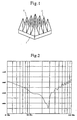
- Each anechoic chamber is provided, at the wall, ceiling, floor, etc., with a wave absorber(s) (an example thereof is shown in Fig. 1) having, at the surface, a wave-absorbing portion consisting of a plurality of projections of circular cone shape, triangular pyramid shape, square pyramid shape, wedge shape or the like.
- a wave absorber there is in general and wide use one comprising (1) a foamed resin having the above-mentioned projections, consisting of a foamed polystyrene resin, a foamed polyurethane resin, a foamed polyethylene resin or the like and (2) a dielectric loss material (e.g. carbon black) dispersed in the foamed resin (1).
- the wave absorber is used in an anechoic chamber by adhering its back side to the wall, floor and ceiling of the anechoic chamber with an adhesive or the like.
- a wave absorber comprising a foamed polystyrene resin
- This wave absorber is obtained by adding a dielectric loss material (e.g. carbon black) and a binder to prefoamed polystyrene resin beads and then molding the mixture. Since the beads are particles of relatively large diameters (about 0.1-1 mm), the resulting foamed material has large-diameter cells, which requires addition of a large amount of a dielectric loss material (e.g. carbon black) in order for the final wave absorber to exhibit sufficiently high wave absorbability.
- the wave absorber using a foamed polystyrene resin is applicable only in a relatively low-frequency zone and cannot be used in a high-frequency zone of, for example, 10 GHz or higher.
- a wave absorber comprising a foamed polyurethane resin has an advantage in that it is usable in a high-frequency zone because the foamed polyurethane resin has small cell diameters.
- this wave absorber has the following problems. That is, a foamed polyurethane resin has cells of nonuniform diameter and a large number of cell walls in skeleton of foamed resin, and this makes impossible the uniform dispersion of dielectric loss material (e.g.
- foamed resin by a process of impregnating the foamed and molded polyurethane resin with a latex containing a dielectric loss material and then dry the impregnated material, which process is necessary to produce a wave absorber comprising a foamed polyurethane resin.
- any wave absorber an electric wave entering the absorber is converted into a heat energy by dielectric loss, whereby the electric wave is absorbed by the absorber.
- a wave absorber comprising a foamed polyethylene resin
- the polyethylene resin has a low softening point
- heat build-up in resin invites deformation or collapse of foamed resin; moreover, since the polyethylene resin is flammable to inflammable, heat build-up in resin may cause fuming, fire-catching, combustion, or harmful gas generation.
- the object of the present invention is to alleviate the above-mentioned problems of the prior art and provide a wave absorber which is lightweight and superior in self-extinguishing property, and shows high wave-absorbing property owing to a uniformly dispersed dielectric loss material.
- the present inventors made a study based on a thought that since a foamed melamine resin is lightweight and has self-extinguishing property, and is very fine and uniform in cell diameters, the foamed melamine resin, which has high water absorbability and retainability, may be able to give a wave absorber which contains a dielectric loss material uniformly dispersed therein and which is lightweight and inflammable. As a result, the present invention has been completed.
- Patent document US-A-5 381 149 discloses broadband absorbers of electromagnetic radiation based on aerogel materials, e.g. a mixture of melamine and formaldehyde.
- Fig. 1 is a perspective view of an example of the conical wave absorber obtained by the present invention.
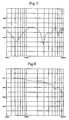
- Fig. 2 is a graph showing the wave-absorbing property of a wave absorber obtained by laminating a ferrite type wave absorber on the wave absorber obtained in Example 1.
- Fig. 3 is a graph showing the wave-absorbing property of the wave absorber obtained in Example 2.
- Fig. 4 is a graph showing the wave-absorbing property of a wave absorber obtained by laminating a ferrite type wave absorber on the wave absorber obtained in Example 3.
- Fig. 5 is a graph showing the wave-absorbing property of a wave absorber obtained by laminating a ferrite type wave absorber on the wave absorber obtained in Example 4.
- Fig. 6 is a graph showing the wave-absorbing property of a wave absorber obtained by laminating a ferrite type wave absorber on the wave absorber obtained in Example 5.
- Fig. 7 is a graph showing the wave-absorbing property of a wave absorber obtained by laminating a ferrite type wave absorber on the wave absorber obtained in Example 6.
- Fig. 8 is a graph showing the wave-absorbing property of the wave absorber obtained in Comparative Example 1.
- Fig. 9 is a graph showing the wave-absorbing property of a wave absorber obtained by laminating a ferrite type wave absorber on the wave absorber obtained in Comparative Example 2.
- the wave absorber of the present invention is obtained by dispersing a dielectric loss material (e.g. carbon black) in a known foamed melamine resin obtained by foaming a resin composition comprising a melamine-formaldehyde condensate and a foaming agent as the main components. Therefore, the foamed melamine resin used in the present invention may comprise various components used in conventional melamine-formaldehyde resins or foamed materials thereof.
- a dielectric loss material e.g. carbon black
- the melamine-formaldehyde condensate can be obtained, for example, by mixing melamine, formalin (35% aqueous solution) and paraformaldehyde and reacting them in the presence of an alkali catalyst with heating.
- the proportion of melamine and formaldehyde used can be, for example, 1 (melamine) : 3 (formaldehyde) in terms of molar ratio.
- the thus-obtained melamine-formaldehyde condensate has a viscosity of preferably 1,000-100,000 Cp, more preferably 5,000-15,000 Cp and a pH of preferably 8-9.
- the foaming agent used is, for example, a straight-chain alkane with pentane or hexane being preferred.
- the resin composition comprising a melamine-formaldehyde condensate and a foaming agent as the main components may comprise an emulsifier in order to obtain a uniform foamed material.
- the emulsifier includes, for example, metal alkyl sulfonates and metal alkylaryl sulfonates with sodium dodecylbenzene sulfonate being preferred.
- the resin composition may further comprise a curing agent for curing of foamed resin composition.
- the curing agent includes, for example, an acidic curing agent with formic acid, hydrochloric acid or oxalic acid being preferred.
- the foamed resin used in the present invention can be obtained by adding as necessary, to the above-mentioned resin composition comprising a melamine-formaldehyde condensate and a foaming agent as the main components, the above-mentioned emulsifier and curing agent and various fillers such as fibrous or powdery structure-reinforcing material, pigment, dye and the like, and then heating the resulting mixture at a temperature not lower than the boiling point of the foaming agent to give rise to foaming.
- Such a process for production of a foamed resin is described in, for example, Japanese Patent Application Laid-Open [Kokai] No. 55-142628 and Japanese Patent Application Laid-Open [Kokai] No. 56-152848.
- a foamed material of isocyanate-modified melamine resin may be used, and a process for production of such a foamed resin is described in Japanese Patent Application Laid-Open [Kokai] No. 7-157590.
- the thus-obtained foamed resin has cells which are preferred to be substantially open, because the foamed resin must disperse a dielectric loss material (e.g. carbon black) inside uniformly or almost uniformly as described later.
- a dielectric loss material e.g. carbon black
- the shape of the foamed resin may be a shape possessed by the foamed resin as produced, but may have a platy shape, a block shape, or a conical shape or a multi-conical shape.
- conical shape or multi-conical shape refers to a circular cone, a triangular pyramid, a square pyramid, a wedge-like cone, a combination of one of these cones or pyramids with a pedestal, or a plurality of such cones or pyramids connected with each other.
- the dielectric loss material used in the present wave absorber is preferably a material showing sufficient dielectric loss to a high-frequency electromagnetic wave entering the wave absorber.
- a material which is electroconductive and has relatively large particle diameters and specific surface area is particularly preferred.
- Such a dielectric loss material includes, for example, carbon black and graphite.
- the particle diameters thereof can be, for example, 15-100 ⁇ m, and the specific surface area thereof can be, for example, 100-1,500 m 2 /g.
- the dielectric loss material is dispersed in the foamed melamine resin in an amount of preferably 0.5-30 kg/m 3 .
- the amount of the dielectric loss material dispersed is less than the lower limit, the resulting wave absorber has no sufficient wave absorbability.
- the wave absorber has a dielectric loss material layer on the skeleton and, therefore, reflect part of the electric wave entering the wave absorber, resulting in reduced wave absorbability.
- the dielectric loss material can be dispersed in the foamed melamine resin in, for example, the following manner.
- the foamed melamine resin is impregnated with a treating solution comprising a dielectric loss material (e.g. carbon black), a binder and additives (e.g.
- the impregnated foamed melamine resin is taken out of the solution and the excessive solution remaining in the foamed resin is removed by natural falling or by squeezing using a roller, a press or the like; the resulting material is dried; and the dried material is as necessary shaped into a desired shape by the use of a horizontal cutter, a circular cutter, a two-dimensional processor, a saw, a cutter knife or the like, all used in ordinary shaping of foamed resin.
- the impregnation may be conducted by placing the foamed melamine resin in the treating solution for several hours, or may be conducted in a shorter time by repeating compression and release in the treating solution to forcibly remove the air inside the foamed resin.
- an impregnator generally used in impregnation of foamed polyurethane.
- the times of compression and release necessary for impregnation deep into the interior of foamed melamine can be fewer than those used in impregnation of foamed polyurethane.
- the dielectric loss material can be dispersed therein at the time of production of the foamed melamine resin.
- the thus-obtained wave absorber of the present invention can have, for example, a conventional structure shown in Fig. 1, comprising a pedestal 1 and a plurality of projections 2 of square cone shape provided on the surface of the pedestal 1 and can be applied in an anechoic chamber by itself; or can be piled up to a ferrite type wave absorber of plate shape, block shape or grille shape by, for example, adhering, fastening or assembling, and applied as a pile.
- the fastening can be made by use of a non-metallic fastener of an appropriate shape, and the assembling can be made by shaping an each contacting portion of the present wave absorber and a ferrite type wave absorber to a shape which engages each other.
- the pile can show improved wave absorbability at a low-frequency side.
- the present wave absorber may also be used for prevention of jamming in the vicinity of the outer wall of building or antenna, or in the vicinity of measurement jig or measurement apparatus.
- a commercial foamed melamine resin block having open cells [Basotect (trade name), product of BASF, bulk density: 11 kg/m 3 ] was impregnated with a treating solution in which carbon black and a binder were dispersed; was squeezed uniformly by the use of a roller; and dried at 80°C for 24 hours to obtain wave absorbers different in carbon black content, as shown in Table 1.
- the carbon black content was controlled by the concentration of the treating solution and the degree of squeezing of impregnated foamed resin.
- This foam was impregnated with a treating solution in which carbon black and a binder were dispersed; was squeezed uniformly by the use of a roller; and dried at 80°C for 24 hours to obtain a wave absorber having a carbon black content as shown in Table 1.
- the carbon black content was controlled by the concentration of the treating solution and the degree of squeezing of impregnated foamed resin.
- a commercial foamed polyurethane resin of soft type was impregnated with a treating solution in which carbon black and a binder were dispersed; was squeezed uniformly by the use of a roller; and dried at 80°C for 24 hours to obtain wave absorbers each having a carbon black content as shown in Table 1.
- the carbon black content was controlled by the concentration of the treating solution and the degree of squeezing of impregnated foamed resin.
- the wave absorbers obtained in Examples and comparative Examples were measured for bulk density, content of dielectric loss material (grams of dielectric loss material per liter of wave absorber), oxygen index and flammability. The results are shown in Table 1. Incidentally, oxygen index was measured in accordance with JIS K 7201 (Testing method for flammability of polymeric materials using the oxygen index), and flammability was determined by measuring a time from fire-catching to blowing-out of flame in accordance with JIS A 9511 (Preformed cellular plastics thermal insulation materials).
- JIS K 7201 Test method for flammability of polymeric materials using the oxygen index
- flammability was determined by measuring a time from fire-catching to blowing-out of flame in accordance with JIS A 9511 (Preformed cellular plastics thermal insulation materials).
- the wave absorber of the present invention is very lightweight and has self-extinguishing property.
- the wave absorber obtained in each Example or each Comparative Example was examined for wave-absorbing property.
- the wave-absorbing property was examined by preparing a cylindrical sample, filling the sample in a co-axial guidewave, and measuring the reflection attenuation of the sample at a 30-1,000 MHz zone by the use of a net work analyzer.
- the graphs of frequency characteristics obtained are shown in Figs. 2 to 6.
- the present wave absorber shows high wave-absorbing property, owing to a uniformly dispersed dielectric loss material.
- a self-extinguishing and very lightweight wave absorber can be obtained by the use of a foamed melamine resin.
- the wave absorber can be used in various tests without causing fire-catching, fuming, combustion, generation of harmful gas, etc. even when heat generation and temperature rise have arisen owing to the absorption of high-energy electric wave.
- the foamed melamine resin used in the present invention which has very uniform and fine cells, can be easily and uniformly impregnated with a dielectric loss material deep into the interior by the use of an impregnator conventionally used for polyurethane foam. Therefore, the wave absorber having high wave-absorbing property can be produced easily.
Landscapes
- Chemical & Material Sciences (AREA)
- Engineering & Computer Science (AREA)
- Materials Engineering (AREA)
- Health & Medical Sciences (AREA)
- Chemical Kinetics & Catalysis (AREA)
- Medicinal Chemistry (AREA)
- Polymers & Plastics (AREA)
- Organic Chemistry (AREA)
- Shielding Devices Or Components To Electric Or Magnetic Fields (AREA)
Claims (3)
- Absorbeur d'ondes comprenant une résine moussée et un matériau de perte diélectrique dispersé dans la résine moussée en une quantité de 0,5-30 kg/m3, où la résine moussée est une résine de mélamine moussée obtenue en faisant mousser une composition de résine comprenant comme composants principaux un condensat de mélamine-formaldéhyde et un agent moussant, ledit absorbeur d'ondes ayant une forme conique ou une forme à cônes multiples.
- Absorbeur d'ondes selon la revendication 1, où la résine moussée présente des alvéoles ouverts.
- Absorbeur d'ondes, qui est un laminé d'un absorbeur d'ondes en ferrite et d'un absorbeur d'ondes de la revendication 1.
Applications Claiming Priority (3)
| Application Number | Priority Date | Filing Date | Title |
|---|---|---|---|
| JP110127/96 | 1996-04-05 | ||
| JP11012796 | 1996-04-05 | ||
| JP11012796 | 1996-04-05 |
Publications (2)
| Publication Number | Publication Date |
|---|---|
| EP0800230A1 EP0800230A1 (fr) | 1997-10-08 |
| EP0800230B1 true EP0800230B1 (fr) | 2002-09-04 |
Family
ID=14527719
Family Applications (1)
| Application Number | Title | Priority Date | Filing Date |
|---|---|---|---|
| EP19970105445 Expired - Lifetime EP0800230B1 (fr) | 1996-04-05 | 1997-04-02 | Absorbeur d'ondes |
Country Status (4)
| Country | Link |
|---|---|
| US (1) | US5885692A (fr) |
| EP (1) | EP0800230B1 (fr) |
| KR (1) | KR970070065A (fr) |
| DE (1) | DE69715073T2 (fr) |
Families Citing this family (12)
| Publication number | Priority date | Publication date | Assignee | Title |
|---|---|---|---|---|
| JP2003229691A (ja) * | 2002-01-31 | 2003-08-15 | Riken Corp | 電波吸収体 |
| JP2005178839A (ja) * | 2003-12-19 | 2005-07-07 | Sharp Corp | 基板収納用トレイ |
| JP4461970B2 (ja) * | 2004-09-06 | 2010-05-12 | 三菱瓦斯化学株式会社 | 電波吸収体 |
| DE102008036500A1 (de) | 2008-08-05 | 2010-02-11 | Hans-Dieter Cornelius | Verfahren zur Herstellung eines graduierten Mikrowellenabsorbers |
| US7940204B1 (en) * | 2009-05-28 | 2011-05-10 | Orbit Advanced Technologies, Inc. | Absorber assembly for an anechoic chamber |
| JP2020150221A (ja) * | 2019-03-15 | 2020-09-17 | 日東電工株式会社 | 電波吸収体及び電波吸収体用キット |
| CN111251671A (zh) * | 2020-02-25 | 2020-06-09 | 南京航天波平电子科技有限公司 | 一种高性能复合电磁兼容吸波材料及加工方法 |
| KR102276145B1 (ko) | 2020-04-20 | 2021-07-12 | 한국항공우주산업 주식회사 | 전파흡수용 구조체 |
| CN113451783B (zh) * | 2021-06-18 | 2022-12-09 | 西安交通大学 | 一种相变可控复合材料吸波体及其制备和性能调控方法 |
| CN113745850B (zh) * | 2021-08-05 | 2024-04-09 | 江苏大学 | 一种碳基宽带太赫兹吸收器及其制备方法 |
| CN114749199B (zh) * | 2022-04-02 | 2023-08-25 | 大连海事大学 | 一种NiFe2O4-MCS复合微波催化剂的制备方法及应用 |
| CN116284985A (zh) * | 2023-03-22 | 2023-06-23 | 南京航天波平电子科技有限公司 | 一种用于海绵吸波薄片辊压浸渍的方法 |
Family Cites Families (10)
| Publication number | Priority date | Publication date | Assignee | Title |
|---|---|---|---|---|
| DE3011769A1 (de) * | 1980-03-27 | 1981-10-01 | Basf Ag, 6700 Ludwigshafen | Verfahren zur herstellung von elastischen schaumstoffen auf basis eines melamin/formaldehyd-kondensationsprodukts |
| DE3323943A1 (de) * | 1983-07-02 | 1985-01-03 | Basf Ag, 6700 Ludwigshafen | Stabilisierte melaminharz-schaumstoffe |
| JPS61111335A (ja) * | 1984-11-05 | 1986-05-29 | Dainippon Toryo Co Ltd | プラスチツク成形方法 |
| US4795763A (en) * | 1988-04-18 | 1989-01-03 | The Celotex Corporation | Carbon black-filled foam |
| DE3818114A1 (de) * | 1988-05-27 | 1989-11-30 | Gruenzweig & Hartmann Montage | Absorber fuer elektromagnetische und akustische wellen |
| EP0374795B1 (fr) * | 1988-12-19 | 1995-10-18 | Matsushita Electric Industrial Co., Ltd. | Matériau absorbant pour ondes radioélectriques |
| US5331567A (en) * | 1991-08-22 | 1994-07-19 | The University Of Colorado Foundation, Inc. | Pyramidal absorber having multiple backing layers providing improved low frequency response |
| US5381149A (en) * | 1992-04-17 | 1995-01-10 | Hughes Aircraft Company | Broadband absorbers of electromagnetic radiation based on aerogel materials, and method of making the same |
| US5373296A (en) * | 1992-08-18 | 1994-12-13 | Tdk Corporation | Electromagnetic wave absorber and wave absorption structure |
| JP3354220B2 (ja) * | 1993-07-09 | 2002-12-09 | 日清紡績株式会社 | メラミン系樹脂発泡体 |
-
1997
- 1997-03-31 US US08/829,382 patent/US5885692A/en not_active Expired - Fee Related
- 1997-04-02 EP EP19970105445 patent/EP0800230B1/fr not_active Expired - Lifetime
- 1997-04-02 DE DE69715073T patent/DE69715073T2/de not_active Expired - Fee Related
- 1997-04-03 KR KR1019970012337A patent/KR970070065A/ko not_active Withdrawn
Also Published As
| Publication number | Publication date |
|---|---|
| US5885692A (en) | 1999-03-23 |
| KR970070065A (ko) | 1997-11-07 |
| DE69715073D1 (de) | 2002-10-10 |
| DE69715073T2 (de) | 2003-01-02 |
| EP0800230A1 (fr) | 1997-10-08 |
Similar Documents
| Publication | Publication Date | Title |
|---|---|---|
| EP0800230B1 (fr) | Absorbeur d'ondes | |
| DE60132599T2 (de) | Dielektrischer harzschaum und diesen enthaltende linsenantenne | |
| US9056961B2 (en) | Melamine-resin foams comprising hollow microbeads | |
| EP0097504B1 (fr) | Matière de l'âme pour pare-chocs d'automobiles | |
| KR102012415B1 (ko) | 광대역 전자파 흡수체 및 그의 제조 방법 | |
| US5396249A (en) | Microwave absorber and process for manufacturing same | |
| US4596682A (en) | Method of manufacturing fire retardant polystyrene insulating board | |
| AU2006283919A1 (en) | Method for producing foamed slabs | |
| US20180305620A1 (en) | Flame retardant particle, manufacturing method therefor, and flame retardant styrofoam using same | |
| WO1999013697A1 (fr) | Ecran absorbant d'ondes radio non inflammable | |
| CA2151784C (fr) | Substance d'absorption d'ondes, element absorbant les ondes radio, absorbeur d'ondes radio et methode de production d'elements absorbant les ondes radio | |
| KR101515265B1 (ko) | 페놀 폼을 이용한 hvac 덕트 및 그 제조 방법 | |
| JP2019519905A (ja) | 種々の用途のための電磁波を吸収する新規材料 | |
| US5952953A (en) | Wave absorber | |
| RU2242487C1 (ru) | Композицонный материал для поглощения электромагнитного излучения и способ его получения | |
| US20030198800A1 (en) | Plastic element for the confinement of HF reflections | |
| JPH1051180A (ja) | 電波吸収体 | |
| US6007905A (en) | Wave absorber and method for production thereof | |
| JPH04229698A (ja) | 導電性部材とその製造方法 | |
| CN108948551B (zh) | 一种改性聚苯板、制备方法及用途 | |
| JPH0152920B2 (fr) | ||
| EP1749634A1 (fr) | Corps insonorisant moule en resine thermoplastique | |
| US20040115417A1 (en) | Method for the production of a fire-protection panel | |
| JP2000119424A (ja) | 無機質材料含有フェノール樹脂発泡体 | |
| EP4017907B1 (fr) | Particules de mousse à écoulement libre et moulages en mousse de particules ignifuges |
Legal Events
| Date | Code | Title | Description |
|---|---|---|---|
| PUAI | Public reference made under article 153(3) epc to a published international application that has entered the european phase |
Free format text: ORIGINAL CODE: 0009012 |
|
| AK | Designated contracting states |
Kind code of ref document: A1 Designated state(s): DE FR GB SE |
|
| 17P | Request for examination filed |
Effective date: 19971230 |
|
| 17Q | First examination report despatched |
Effective date: 19990125 |
|
| GRAG | Despatch of communication of intention to grant |
Free format text: ORIGINAL CODE: EPIDOS AGRA |
|
| GRAG | Despatch of communication of intention to grant |
Free format text: ORIGINAL CODE: EPIDOS AGRA |
|
| GRAH | Despatch of communication of intention to grant a patent |
Free format text: ORIGINAL CODE: EPIDOS IGRA |
|
| GRAH | Despatch of communication of intention to grant a patent |
Free format text: ORIGINAL CODE: EPIDOS IGRA |
|
| GRAA | (expected) grant |
Free format text: ORIGINAL CODE: 0009210 |
|
| AK | Designated contracting states |
Kind code of ref document: B1 Designated state(s): DE FR GB SE |
|
| REG | Reference to a national code |
Ref country code: GB Ref legal event code: FG4D |
|
| REF | Corresponds to: |
Ref document number: 69715073 Country of ref document: DE Date of ref document: 20021010 |
|
| PGFP | Annual fee paid to national office [announced via postgrant information from national office to epo] |
Ref country code: GB Payment date: 20030325 Year of fee payment: 7 |
|
| ET | Fr: translation filed | ||
| PGFP | Annual fee paid to national office [announced via postgrant information from national office to epo] |
Ref country code: SE Payment date: 20030417 Year of fee payment: 7 Ref country code: FR Payment date: 20030417 Year of fee payment: 7 |
|
| PGFP | Annual fee paid to national office [announced via postgrant information from national office to epo] |
Ref country code: DE Payment date: 20030430 Year of fee payment: 7 |
|
| PLBE | No opposition filed within time limit |
Free format text: ORIGINAL CODE: 0009261 |
|
| STAA | Information on the status of an ep patent application or granted ep patent |
Free format text: STATUS: NO OPPOSITION FILED WITHIN TIME LIMIT |
|
| 26N | No opposition filed |
Effective date: 20030605 |
|
| REG | Reference to a national code |
Ref country code: GB Ref legal event code: 732E |
|
| PG25 | Lapsed in a contracting state [announced via postgrant information from national office to epo] |
Ref country code: GB Free format text: LAPSE BECAUSE OF NON-PAYMENT OF DUE FEES Effective date: 20040402 |
|
| PG25 | Lapsed in a contracting state [announced via postgrant information from national office to epo] |
Ref country code: SE Free format text: LAPSE BECAUSE OF NON-PAYMENT OF DUE FEES Effective date: 20040403 |
|
| REG | Reference to a national code |
Ref country code: FR Ref legal event code: TP |
|
| PG25 | Lapsed in a contracting state [announced via postgrant information from national office to epo] |
Ref country code: DE Free format text: LAPSE BECAUSE OF NON-PAYMENT OF DUE FEES Effective date: 20041103 |
|
| GBPC | Gb: european patent ceased through non-payment of renewal fee | ||
| EUG | Se: european patent has lapsed | ||
| PG25 | Lapsed in a contracting state [announced via postgrant information from national office to epo] |
Ref country code: FR Free format text: LAPSE BECAUSE OF NON-PAYMENT OF DUE FEES Effective date: 20041231 |
|
| REG | Reference to a national code |
Ref country code: FR Ref legal event code: ST |