EP0800333A2 - Elektrisch beheizbare Windschutzscheibe - Google Patents
Elektrisch beheizbare Windschutzscheibe Download PDFInfo
- Publication number
- EP0800333A2 EP0800333A2 EP97400700A EP97400700A EP0800333A2 EP 0800333 A2 EP0800333 A2 EP 0800333A2 EP 97400700 A EP97400700 A EP 97400700A EP 97400700 A EP97400700 A EP 97400700A EP 0800333 A2 EP0800333 A2 EP 0800333A2
- Authority
- EP
- European Patent Office
- Prior art keywords
- windshield
- conductors
- loops
- heating resistance
- wires
- Prior art date
- Legal status (The legal status is an assumption and is not a legal conclusion. Google has not performed a legal analysis and makes no representation as to the accuracy of the status listed.)
- Withdrawn
Links
- 239000004020 conductor Substances 0.000 claims abstract description 51
- 238000010438 heat treatment Methods 0.000 claims abstract description 27
- 239000005340 laminated glass Substances 0.000 claims abstract description 17
- 229920001169 thermoplastic Polymers 0.000 claims abstract description 14
- 239000004416 thermosoftening plastic Substances 0.000 claims abstract description 14
- 239000011888 foil Substances 0.000 claims abstract description 9
- RYGMFSIKBFXOCR-UHFFFAOYSA-N Copper Chemical compound [Cu] RYGMFSIKBFXOCR-UHFFFAOYSA-N 0.000 claims description 16
- 238000005485 electric heating Methods 0.000 abstract 1
- 239000011889 copper foil Substances 0.000 description 11
- 239000011521 glass Substances 0.000 description 5
- 229910052802 copper Inorganic materials 0.000 description 3
- 239000010949 copper Substances 0.000 description 3
- 238000000034 method Methods 0.000 description 3
- 238000005219 brazing Methods 0.000 description 2
- 239000000463 material Substances 0.000 description 2
- WFKWXMTUELFFGS-UHFFFAOYSA-N tungsten Chemical compound [W] WFKWXMTUELFFGS-UHFFFAOYSA-N 0.000 description 2
- 229910052721 tungsten Inorganic materials 0.000 description 2
- 239000010937 tungsten Substances 0.000 description 2
- 239000002966 varnish Substances 0.000 description 2
- 239000000853 adhesive Substances 0.000 description 1
- 230000001070 adhesive effect Effects 0.000 description 1
- 230000001419 dependent effect Effects 0.000 description 1
- 238000011161 development Methods 0.000 description 1
- 230000018109 developmental process Effects 0.000 description 1
- 239000012774 insulation material Substances 0.000 description 1
- 238000004519 manufacturing process Methods 0.000 description 1
- 239000000155 melt Substances 0.000 description 1
- 239000004033 plastic Substances 0.000 description 1
- 229920003023 plastic Polymers 0.000 description 1
- 229920002037 poly(vinyl butyral) polymer Polymers 0.000 description 1
- 238000005476 soldering Methods 0.000 description 1
- 239000000126 substance Substances 0.000 description 1
Images

Classifications
-
- H—ELECTRICITY
- H05—ELECTRIC TECHNIQUES NOT OTHERWISE PROVIDED FOR
- H05B—ELECTRIC HEATING; ELECTRIC LIGHT SOURCES NOT OTHERWISE PROVIDED FOR; CIRCUIT ARRANGEMENTS FOR ELECTRIC LIGHT SOURCES, IN GENERAL
- H05B3/00—Ohmic-resistance heating
- H05B3/84—Heating arrangements specially adapted for transparent or reflecting areas, e.g. for demisting or de-icing windows, mirrors or vehicle windshields
-
- B—PERFORMING OPERATIONS; TRANSPORTING
- B32—LAYERED PRODUCTS
- B32B—LAYERED PRODUCTS, i.e. PRODUCTS BUILT-UP OF STRATA OF FLAT OR NON-FLAT, e.g. CELLULAR OR HONEYCOMB, FORM
- B32B17/00—Layered products essentially comprising sheet glass, or glass, slag, or like fibres
- B32B17/06—Layered products essentially comprising sheet glass, or glass, slag, or like fibres comprising glass as the main or only constituent of a layer, next to another layer of a specific material
- B32B17/10—Layered products essentially comprising sheet glass, or glass, slag, or like fibres comprising glass as the main or only constituent of a layer, next to another layer of a specific material of synthetic resin
- B32B17/10005—Layered products essentially comprising sheet glass, or glass, slag, or like fibres comprising glass as the main or only constituent of a layer, next to another layer of a specific material of synthetic resin laminated safety glass or glazing
- B32B17/10009—Layered products essentially comprising sheet glass, or glass, slag, or like fibres comprising glass as the main or only constituent of a layer, next to another layer of a specific material of synthetic resin laminated safety glass or glazing characterized by the number, the constitution or treatment of glass sheets
- B32B17/10036—Layered products essentially comprising sheet glass, or glass, slag, or like fibres comprising glass as the main or only constituent of a layer, next to another layer of a specific material of synthetic resin laminated safety glass or glazing characterized by the number, the constitution or treatment of glass sheets comprising two outer glass sheets
-
- B—PERFORMING OPERATIONS; TRANSPORTING
- B32—LAYERED PRODUCTS
- B32B—LAYERED PRODUCTS, i.e. PRODUCTS BUILT-UP OF STRATA OF FLAT OR NON-FLAT, e.g. CELLULAR OR HONEYCOMB, FORM
- B32B17/00—Layered products essentially comprising sheet glass, or glass, slag, or like fibres
- B32B17/06—Layered products essentially comprising sheet glass, or glass, slag, or like fibres comprising glass as the main or only constituent of a layer, next to another layer of a specific material
- B32B17/10—Layered products essentially comprising sheet glass, or glass, slag, or like fibres comprising glass as the main or only constituent of a layer, next to another layer of a specific material of synthetic resin
- B32B17/10005—Layered products essentially comprising sheet glass, or glass, slag, or like fibres comprising glass as the main or only constituent of a layer, next to another layer of a specific material of synthetic resin laminated safety glass or glazing
- B32B17/10165—Functional features of the laminated safety glass or glazing
- B32B17/10376—Laminated safety glass or glazing containing metal wires
- B32B17/10385—Laminated safety glass or glazing containing metal wires for ohmic resistance heating
-
- B—PERFORMING OPERATIONS; TRANSPORTING
- B32—LAYERED PRODUCTS
- B32B—LAYERED PRODUCTS, i.e. PRODUCTS BUILT-UP OF STRATA OF FLAT OR NON-FLAT, e.g. CELLULAR OR HONEYCOMB, FORM
- B32B17/00—Layered products essentially comprising sheet glass, or glass, slag, or like fibres
- B32B17/06—Layered products essentially comprising sheet glass, or glass, slag, or like fibres comprising glass as the main or only constituent of a layer, next to another layer of a specific material
- B32B17/10—Layered products essentially comprising sheet glass, or glass, slag, or like fibres comprising glass as the main or only constituent of a layer, next to another layer of a specific material of synthetic resin
- B32B17/10005—Layered products essentially comprising sheet glass, or glass, slag, or like fibres comprising glass as the main or only constituent of a layer, next to another layer of a specific material of synthetic resin laminated safety glass or glazing
- B32B17/1055—Layered products essentially comprising sheet glass, or glass, slag, or like fibres comprising glass as the main or only constituent of a layer, next to another layer of a specific material of synthetic resin laminated safety glass or glazing characterized by the resin layer, i.e. interlayer
- B32B17/10761—Layered products essentially comprising sheet glass, or glass, slag, or like fibres comprising glass as the main or only constituent of a layer, next to another layer of a specific material of synthetic resin laminated safety glass or glazing characterized by the resin layer, i.e. interlayer containing vinyl acetal
-
- B—PERFORMING OPERATIONS; TRANSPORTING
- B32—LAYERED PRODUCTS
- B32B—LAYERED PRODUCTS, i.e. PRODUCTS BUILT-UP OF STRATA OF FLAT OR NON-FLAT, e.g. CELLULAR OR HONEYCOMB, FORM
- B32B2367/00—Polyesters, e.g. PET, i.e. polyethylene terephthalate
-
- H—ELECTRICITY
- H05—ELECTRIC TECHNIQUES NOT OTHERWISE PROVIDED FOR
- H05B—ELECTRIC HEATING; ELECTRIC LIGHT SOURCES NOT OTHERWISE PROVIDED FOR; CIRCUIT ARRANGEMENTS FOR ELECTRIC LIGHT SOURCES, IN GENERAL
- H05B3/00—Ohmic-resistance heating
- H05B3/84—Heating arrangements specially adapted for transparent or reflecting areas, e.g. for demisting or de-icing windows, mirrors or vehicle windshields
- H05B3/86—Heating arrangements specially adapted for transparent or reflecting areas, e.g. for demisting or de-icing windows, mirrors or vehicle windshields the heating conductors being embedded in the transparent or reflecting material
-
- H—ELECTRICITY
- H05—ELECTRIC TECHNIQUES NOT OTHERWISE PROVIDED FOR
- H05B—ELECTRIC HEATING; ELECTRIC LIGHT SOURCES NOT OTHERWISE PROVIDED FOR; CIRCUIT ARRANGEMENTS FOR ELECTRIC LIGHT SOURCES, IN GENERAL
- H05B2203/00—Aspects relating to Ohmic resistive heating covered by group H05B3/00
- H05B2203/002—Heaters using a particular layout for the resistive material or resistive elements
-
- H—ELECTRICITY
- H05—ELECTRIC TECHNIQUES NOT OTHERWISE PROVIDED FOR
- H05B—ELECTRIC HEATING; ELECTRIC LIGHT SOURCES NOT OTHERWISE PROVIDED FOR; CIRCUIT ARRANGEMENTS FOR ELECTRIC LIGHT SOURCES, IN GENERAL
- H05B2203/00—Aspects relating to Ohmic resistive heating covered by group H05B3/00
- H05B2203/013—Heaters using resistive films or coatings
-
- H—ELECTRICITY
- H05—ELECTRIC TECHNIQUES NOT OTHERWISE PROVIDED FOR
- H05B—ELECTRIC HEATING; ELECTRIC LIGHT SOURCES NOT OTHERWISE PROVIDED FOR; CIRCUIT ARRANGEMENTS FOR ELECTRIC LIGHT SOURCES, IN GENERAL
- H05B2203/00—Aspects relating to Ohmic resistive heating covered by group H05B3/00
- H05B2203/016—Heaters using particular connecting means
-
- H—ELECTRICITY
- H05—ELECTRIC TECHNIQUES NOT OTHERWISE PROVIDED FOR
- H05B—ELECTRIC HEATING; ELECTRIC LIGHT SOURCES NOT OTHERWISE PROVIDED FOR; CIRCUIT ARRANGEMENTS FOR ELECTRIC LIGHT SOURCES, IN GENERAL
- H05B2203/00—Aspects relating to Ohmic resistive heating covered by group H05B3/00
- H05B2203/031—Heaters specially adapted for heating the windscreen wiper area
Definitions
- the present invention relates to a laminated glass windscreen, which is provided, in the region of the rest position of the wipers, with electric resistance heating wires mounted in parallel embedded in the thermoplastic intermediate layer, which are in contact with foil films acting as collecting conductors, also embedded in the intermediate layer and connected to current supply conductors.
- Windshields which can be heated in laminated glass, in the case of which the heated field formed by parallel heating wires is limited to the area of the wipers, are known from document EP 0 032 139 B1.
- thin strips of copper foil which are arranged on both sides of the heated field, serve as collecting conductors.
- the power supply conductors for these collector conductors usually each exit from the laminated glass glazing at one end of the collector conductors, that is to say at locations very distant from each other.
- connection conductors for the two collecting conductors which are arranged on both sides of the heated field at the end of the resistance wires extending so straight.
- a connecting conductor from the place of electrical connection at least to one of the collecting conductors, must, in this case, be provided inside the laminated glass glazing, that is to say also embedded in the thermoplastic intermediate layer.
- the same tinned copper foil strips are used for this purpose as for the collector conductors.
- the connection manifolds are arranged between the collecting conductors and the electrical connection location along the lower edge of the windshield. In this embodiment, the electrical connection is easier after mounting the windshield, since it can be achieved in this case using a single bipolar plug.
- the connecting conductors are optically disturbing because of their metallic surfaces. This is why they are covered by printing a layer of opaque ink on one of the two glass sheets of the laminated glass glazing. This again means an additional labor cost.
- the object of the invention is to provide an electrically heated windshield of the type mentioned, which is simpler in structure, and in which in particular no optically disturbing metallic connection conductor is visible.
- the new windshield must be able to be produced as a whole at a lower cost and in less time.
- the optically disturbing connecting conductors between the place of electrical connection and the actual collecting conductors are absent.
- the lengths of foil acting as collecting conductors may preferably be arranged directly at the bottom edge of the windshield, so that no disturbing tinsel strip is no longer disposed even along the side edges of the windshield. Because the lower edge of the windshield is free from long, disturbing foil strips, the impression of a cover layer can also be suppressed.
- the windshields shown in the figures are made of laminated glass and comprise two individual glass sheets, which are joined to each other by a thermoplastic intermediate layer, as a rule of polyvinyl butyral.
- a thermoplastic intermediate layer as a rule of polyvinyl butyral.
- the windshields In the lower third, namely in the area of the wiper rest position, the windshields each have a field which can be heated electrically. In this heatable field, the heating resistance wires are placed in the thermoplastic intermediate layer in the new way.
- the resistance wire is pressed into the thermoplastic film, before the manufacture of the laminated glass glazing, using a heated tool, for example a heated pressure roller.
- the resistance wires are deposited on an intermediate support film according to the desired arrangement and are fixed thereon with a layer of adhesive, which is made of the same material than the thermoplastic intermediate layer.
- the collector conductors and, where appropriate, the current supply conductors can also be already arranged on this intermediate support film and be connected to the heating resistance wires.
- the wire arrangement is transferred to the thermoplastic intermediate layer or to one of the two glass sheets. After fixing the arrangement of wires on the thermoplastic intermediate layer or on one of the glass sheets, the intermediate support film is removed. The laminated glass is then produced with the application of heat and pressure.
- heating resistance wires there are usually used in known heatable glazing thin tungsten wires having a relatively high electrical resistance.
- the use of such wires having a high electrical resistance is in this case advantageous, because the length of wire is predetermined by the distance separating the collecting conductors, which corresponds to the width dimension of the heated field in the case of embodiments known.
- the individual resistance heating wires mounted in parallel are, however, following their arrangement in the form of loops, at least twice as long as in known heatable windshields . This means that in the windshields according to the invention, it is possible to use heating wires having a higher electrical conductivity, thus for example in particular copper heating wires.
- the heating wires 2 are arranged in the windshield 1 in the form of loops nested one inside the other, axially symmetrical with respect to the midline M-M.
- the two ends 3, 4 of each wire loop are bent downward at right angles. They are brazed to lengths of copper foil 5, 6.
- the lengths of copper foil 5, 6 represent the collector conductors for the conductive loops mounted in parallel and are arranged at a short distance from each other between the two individual glass sheets of the laminated glass glazing in the thermoplastic intermediate layer, in the immediate vicinity of the edge in the middle of the lower side of the windshield.
- the lengths of copper foil 5, 6 are directly connected to flat cables 7, 8, which exit as such from the laminated glass glazing and are provided at the end with suitable connection wires or connection plugs.
- the lengths of copper foil 5, 6 may also have come in one piece with the flat cables 7, 8, in the same copper foil the flat cables 7, 8 coming out of the laminated glass glazing being suitably provided with layers insulation material of tensile-resistant plastic.
- the windshield 10 shown in FIG. 2 is again provided in the lower third with a heated field, which has the same extent as the heated field in the embodiment described above.
- the heating wires 12 extend substantially over the entire width of the windshield in an orientation parallel to the lower edge of the windshield.
- the sons The heating elements are again arranged in the form of loops nested one inside the other, the two ends of each loop of wire being however in this case bent down near a lower corner of the windshield.
- the end zones 13 of the wire loops are brazed to a length of copper foil 15, and the end zones 14 of the wire loops are brazed to a length of copper foil 16, the lengths of copper foil 15 , 16 representing the collecting conductors for the conducting loops connected in parallel.
- the lengths of copper foil 15, 16 connected to suitable flat cables 17, 18 are arranged in a position directly adjacent to the edge of the glazing in the corner area of the windshield, so that the electrical connection takes place in this case by through an appropriate plug in this corner area of the windshield.
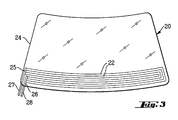
- FIG. 3 shows a windshield 20, in which the heating resistance wires 22 are again arranged in the form of U-shaped loops oriented horizontally nested one inside the other. In this case, however, the end lengths of the wire loops are not bent. On the contrary, they keep their horizontal orientation and are brazed to two current-collecting conductors 25, 26 in the form of strips. These collector conductors 25, 26 are arranged in a very close position parallel to one another along the lateral edge 24 of the windshield 20. The length of the collector conductor 26 is only about half that of the conductor collector 25 directly adjacent to the side edge 24, so that the collector conductor 25 is connected to the upper halves of the wire loops, and that the collector conductor 26 is connected to the lower halves of wire loops.
- the electrical connection conductors 27, 28 leaving the laminated glass glazing 21 can again be formed of flat cables.
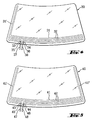
- Fig. 4 shows a windshield 30, which is again provided in the lower section, in the area of the rest position of the wipers, of wire loops 31, 32 oriented horizontally nested one inside the other.
- the ends 33, 34 of these wire loops 31, 32 are again brazed to current-collecting conductors 35, 36, which are disposed directly at the lower edge of the windshield in the thermoplastic intermediate layer and are connected to conductors of electrical connection 37, 38 in the form of flat cables.
- the wire loops 32 are formed in substance as in the embodiments described above, the wire loop 31 forms an additional branch 31 ′ in the form of a loop along a vertical lateral edge of the windshield.
- This branch 31 'of the heating loops also serves to heat the area of the windshield adjacent to the A-pillars of the vehicle body on the driver's side. This has the advantage that the snow swept to this side by the wiper melts and does not disturbfully accumulate along the A-pillar while driving the vehicle.
- the windshield 40 shown in FIG. 5 shows an embodiment in which the areas adjacent to the A-pillars on both sides are additionally heated.
- the lower zone of the rest position of the wiper is heated by loops of wires 41, 42 extending substantially horizontally.
- the wire loop 41 in this case forms along the two lateral edges in each case a branch 41 ′ and 41 ′′ in the form of a loop extending parallel to the lateral edges.
- the ends 43, 44 of the wire loops are again brazed to collector conductors 45, 46, which are for their part connected to electrical connection conductors 47, 48 in the form of flat cables.
Landscapes
- Surface Heating Bodies (AREA)
- Resistance Heating (AREA)
- Joining Of Glass To Other Materials (AREA)
- Laminated Bodies (AREA)
Applications Claiming Priority (3)
| Application Number | Priority Date | Filing Date | Title |
|---|---|---|---|
| DE19613123 | 1996-04-02 | ||
| DE29606071U DE29606071U1 (de) | 1996-04-02 | 1996-04-02 | Elektrisch beheizbare Windschutzscheibe |
| DE19613123 | 1996-04-02 |
Publications (2)
| Publication Number | Publication Date |
|---|---|
| EP0800333A2 true EP0800333A2 (de) | 1997-10-08 |
| EP0800333A3 EP0800333A3 (de) | 1998-09-02 |
Family
ID=26024404
Family Applications (1)
| Application Number | Title | Priority Date | Filing Date |
|---|---|---|---|
| EP97400700A Withdrawn EP0800333A3 (de) | 1996-04-02 | 1997-03-27 | Elektrisch beheizbare Windschutzscheibe |
Country Status (3)
| Country | Link |
|---|---|
| EP (1) | EP0800333A3 (de) |
| JP (1) | JPH1029504A (de) |
| DE (1) | DE29606071U1 (de) |
Cited By (6)
| Publication number | Priority date | Publication date | Assignee | Title |
|---|---|---|---|---|
| EP0849977A3 (de) * | 1996-12-19 | 1998-12-23 | Ppg Industries, Inc. | Heizvorrichtung für die Wischerauflagefläche einer Fahrzeugswindscheibe |
| WO2004028212A1 (en) * | 2002-09-18 | 2004-04-01 | Ppg Industries Ohio, Inc. | Heatable wiper rest area for a transparency |
| EP1605729A3 (de) * | 2004-04-15 | 2007-09-05 | Pilkington Group Limited | Elektrische beheizte Scheibe. |
| DE102008003219A1 (de) | 2008-01-04 | 2009-07-09 | Saint-Gobain Sekurit Deutschland Gmbh & Co. Kg | Glasscheibe sowie Glasscheibenanordnung |
| CZ307043B6 (cs) * | 2001-06-01 | 2017-12-13 | Saint-Gobain Glass France | Vytápěná okenní tabule |
| EP3339022A1 (de) * | 2016-12-20 | 2018-06-27 | Asahi Glass Company, Limited | Glasfenster für fahrzeug |
Families Citing this family (14)
| Publication number | Priority date | Publication date | Assignee | Title |
|---|---|---|---|---|
| DE19923496A1 (de) | 1999-05-21 | 2000-11-23 | Volkswagen Ag | Scheibenheizung für Kraftfahrzeuge |
| KR100387770B1 (ko) * | 2001-06-21 | 2003-06-18 | 기아자동차주식회사 | 차량의 와이퍼 동결방지 열선의 조립구조 |
| DE10136549A1 (de) * | 2001-07-27 | 2003-02-20 | Saint Gobain Sekurit D Gmbh | Scheibe mit einem Folien-Heizelement |
| DE10356607A1 (de) * | 2003-12-01 | 2005-06-30 | Bäumler, Peter | Beheizbare Glasscheibe |
| DE10360255A1 (de) * | 2003-12-20 | 2005-07-21 | Volkswagen Ag | Windschutzscheibe für ein Kraftfahrzeug |
| US9301343B2 (en) | 2008-02-19 | 2016-03-29 | Fuji Jukogyo Kabushiki Kaisha | Window-glass heating device |
| DE102011054645A1 (de) | 2011-10-20 | 2013-04-25 | Peter Bäumler | Beheizbare Scheibe |
| CN104924876A (zh) * | 2014-03-19 | 2015-09-23 | 观致汽车有限公司 | 一种具有加热功能的车窗 |
| EP3076753A1 (de) * | 2015-03-30 | 2016-10-05 | AGC Glass Europe | Beheizbare glasurtafel |
| DE102015210437A1 (de) * | 2015-06-08 | 2016-12-08 | Volkswagen Aktiengesellschaft | Heizvorrichtung für eine Sichtscheibe eines Kraftfahrzeugs |
| JP7299670B2 (ja) * | 2017-04-27 | 2023-06-28 | 大日本印刷株式会社 | 通電加熱パネル、及び乗物 |
| JP2021172294A (ja) * | 2020-04-30 | 2021-11-01 | 株式会社レニアス | 車両窓ガラスの加熱システム |
| CN116669243A (zh) * | 2023-05-31 | 2023-08-29 | 上汽通用汽车有限公司 | 风挡雨刮停止区加热装置及成型方法 |
| DE102023208766A1 (de) | 2023-09-11 | 2025-03-13 | Robert Bosch Gesellschaft mit beschränkter Haftung | Wischblattheizung, insbesondere für ein Kraftfahrzeug, mit einer Aufnahme für ein Wischblatt |
Family Cites Families (4)
| Publication number | Priority date | Publication date | Assignee | Title |
|---|---|---|---|---|
| DE3410117C1 (de) * | 1984-03-20 | 1985-06-13 | VEGLA Vereinigte Glaswerke GmbH, 5100 Aachen | Elektrisch beheizbare Verbundglasscheibe |
| US5434384A (en) * | 1991-07-22 | 1995-07-18 | Ppg Industries, Inc. | Coated windshield with special heating circuit for wiper arm storage area |
| AU1641692A (en) * | 1992-03-04 | 1993-10-05 | Luciano Peresano | Device obviating the snow accumulation on the windscreen-wiper motion limit in the windscreen of the motor vehicles |
| DE4316575C1 (de) * | 1993-05-18 | 1994-07-07 | Ver Glaswerke Gmbh | Verfahren zur Herstellung einer gebogenen Verbundglasscheibe, insbesondere Autoglasscheibe |
-
1996
- 1996-04-02 DE DE29606071U patent/DE29606071U1/de not_active Expired - Lifetime
-
1997
- 1997-03-27 EP EP97400700A patent/EP0800333A3/de not_active Withdrawn
- 1997-04-02 JP JP9084200A patent/JPH1029504A/ja active Pending
Cited By (9)
| Publication number | Priority date | Publication date | Assignee | Title |
|---|---|---|---|---|
| EP0849977A3 (de) * | 1996-12-19 | 1998-12-23 | Ppg Industries, Inc. | Heizvorrichtung für die Wischerauflagefläche einer Fahrzeugswindscheibe |
| CZ307043B6 (cs) * | 2001-06-01 | 2017-12-13 | Saint-Gobain Glass France | Vytápěná okenní tabule |
| WO2004028212A1 (en) * | 2002-09-18 | 2004-04-01 | Ppg Industries Ohio, Inc. | Heatable wiper rest area for a transparency |
| US6995339B2 (en) | 2002-09-18 | 2006-02-07 | Ppg Industries Ohio, Inc. | Heatable wiper rest area for a transparency |
| EP1605729A3 (de) * | 2004-04-15 | 2007-09-05 | Pilkington Group Limited | Elektrische beheizte Scheibe. |
| DE102008003219A1 (de) | 2008-01-04 | 2009-07-09 | Saint-Gobain Sekurit Deutschland Gmbh & Co. Kg | Glasscheibe sowie Glasscheibenanordnung |
| US8383988B2 (en) | 2008-01-04 | 2013-02-26 | Saint-Gobain Glass France | Glass pane and glass pane arrangement |
| EP3339022A1 (de) * | 2016-12-20 | 2018-06-27 | Asahi Glass Company, Limited | Glasfenster für fahrzeug |
| US10723318B2 (en) | 2016-12-20 | 2020-07-28 | AGC Inc. | Window glass for a vehicle |
Also Published As
| Publication number | Publication date |
|---|---|
| EP0800333A3 (de) | 1998-09-02 |
| DE29606071U1 (de) | 1996-06-13 |
| JPH1029504A (ja) | 1998-02-03 |
Similar Documents
| Publication | Publication Date | Title |
|---|---|---|
| EP1393593B1 (de) | Beheizbares glaselement | |
| EP0939580A2 (de) | Beheizbare Verbundglas Heckscheibe | |
| EP1680945B1 (de) | Heizbare verbundglasscheibe | |
| EP1454509B1 (de) | Beheizbare scheibe versehen mit einer elektroleitenden beschichtung | |
| EP2127475B1 (de) | Transparentes glas mit erwärmungsbeschichtung | |
| EP0394089B1 (de) | Elektrisch heizbare Windschutzscheibe | |
| CA2186563C (fr) | Multicontact pour vitrage antenne | |
| EP1145842B1 (de) | Verbundglasscheibe | |
| EP1623480B1 (de) | Fensterscheibenantenne für kraftfahrzeuge | |
| EP2308137B1 (de) | Kabelschuh und einen solchen Kabelshuh verwendende elektrische Verbindung | |
| EP0488878B1 (de) | Anschlussstück für elektrische Scheiben | |
| EP0070771A1 (de) | Beheizte elektrische Glasscheibe | |
| EP0711097B1 (de) | Elektrisches Verbindungselement für beheizbare Glasscheibe für Kraftfahrzeug | |
| EP1160937B1 (de) | Elektrisches lötbares Verbindungselement mit Lötstelle | |
| JPH1029504A (ja) | 電気的に加熱可能な風防 | |
| EP0193464B1 (de) | Herstellungsverfahren einer heizbaren Glasscheibe und Siebdruckschablone zum Ausführen dieses Verfahrens | |
| EP0560677B1 (de) | Heizbare Verbundglasscheibe, ausgerüstet mit in der thermoplastischen Zwischenschicht eingebetteten Widerstandsdrähten | |
| EP0506521B1 (de) | Heizbare Verbundglasscheibe | |
| FR2648088A1 (fr) | Vitrage a cordon en matiere thermofusible apte a etre colle par chauffage par induction | |
| FR2704629A1 (fr) | Film chauffant à structure modulaire, pour chauffage par rayonnement, et dispositif pour sa connexion. | |
| EP0635992B1 (de) | Heizelement | |
| EP0930807B1 (de) | Scheibenheizung | |
| BE658389A (de) | ||
| FR2519504A3 (fr) | Dispositif de connexion pour element chauffant | |
| FR3142146A1 (fr) | Balai d'essuie-glace chauffant notamment pour un véhicule automobile |
Legal Events
| Date | Code | Title | Description |
|---|---|---|---|
| PUAI | Public reference made under article 153(3) epc to a published international application that has entered the european phase |
Free format text: ORIGINAL CODE: 0009012 |
|
| AK | Designated contracting states |
Kind code of ref document: A2 Designated state(s): AT BE DE ES FR GB IT LU PT SE |
|
| PUAL | Search report despatched |
Free format text: ORIGINAL CODE: 0009013 |
|
| AK | Designated contracting states |
Kind code of ref document: A3 Designated state(s): AT BE DE ES FR GB IT LU PT SE |
|
| 17P | Request for examination filed |
Effective date: 19990120 |
|
| RAP1 | Party data changed (applicant data changed or rights of an application transferred) |
Owner name: SAINT-GOBAIN GLASS FRANCE |
|
| 17Q | First examination report despatched |
Effective date: 20030228 |
|
| STAA | Information on the status of an ep patent application or granted ep patent |
Free format text: STATUS: THE APPLICATION IS DEEMED TO BE WITHDRAWN |
|
| 18D | Application deemed to be withdrawn |
Effective date: 20030911 |