EP0800700B1 - Informationswiederauffindungssystem mit datenspeicher mit seriellem zugriff und datenwiederauffindung mit direktzugriff - Google Patents
Informationswiederauffindungssystem mit datenspeicher mit seriellem zugriff und datenwiederauffindung mit direktzugriff Download PDFInfo
- Publication number
- EP0800700B1 EP0800700B1 EP96926539A EP96926539A EP0800700B1 EP 0800700 B1 EP0800700 B1 EP 0800700B1 EP 96926539 A EP96926539 A EP 96926539A EP 96926539 A EP96926539 A EP 96926539A EP 0800700 B1 EP0800700 B1 EP 0800700B1
- Authority
- EP
- European Patent Office
- Prior art keywords
- data
- album
- track
- access device
- read
- Prior art date
- Legal status (The legal status is an assumption and is not a legal conclusion. Google has not performed a legal analysis and makes no representation as to the accuracy of the status listed.)
- Expired - Lifetime
Links
Images

Classifications
-
- G—PHYSICS
- G10—MUSICAL INSTRUMENTS; ACOUSTICS
- G10H—ELECTROPHONIC MUSICAL INSTRUMENTS; INSTRUMENTS IN WHICH THE TONES ARE GENERATED BY ELECTROMECHANICAL MEANS OR ELECTRONIC GENERATORS, OR IN WHICH THE TONES ARE SYNTHESISED FROM A DATA STORE
- G10H7/00—Instruments in which the tones are synthesised from a data store, e.g. computer organs
-
- G—PHYSICS
- G11—INFORMATION STORAGE
- G11B—INFORMATION STORAGE BASED ON RELATIVE MOVEMENT BETWEEN RECORD CARRIER AND TRANSDUCER
- G11B17/00—Guiding record carriers not specifically of filamentary or web form, or of supports therefor
- G11B17/22—Guiding record carriers not specifically of filamentary or web form, or of supports therefor from random access magazine of disc records
-
- G—PHYSICS
- G11—INFORMATION STORAGE
- G11B—INFORMATION STORAGE BASED ON RELATIVE MOVEMENT BETWEEN RECORD CARRIER AND TRANSDUCER
- G11B27/00—Editing; Indexing; Addressing; Timing or synchronising; Monitoring; Measuring tape travel
- G11B27/002—Programmed access in sequence to a plurality of record carriers or indexed parts, e.g. tracks, thereof, e.g. for editing
-
- G—PHYSICS
- G11—INFORMATION STORAGE
- G11B—INFORMATION STORAGE BASED ON RELATIVE MOVEMENT BETWEEN RECORD CARRIER AND TRANSDUCER
- G11B27/00—Editing; Indexing; Addressing; Timing or synchronising; Monitoring; Measuring tape travel
- G11B27/10—Indexing; Addressing; Timing or synchronising; Measuring tape travel
- G11B27/102—Programmed access in sequence to addressed parts of tracks of operating record carriers
- G11B27/107—Programmed access in sequence to addressed parts of tracks of operating record carriers of operating tapes
-
- G—PHYSICS
- G11—INFORMATION STORAGE
- G11B—INFORMATION STORAGE BASED ON RELATIVE MOVEMENT BETWEEN RECORD CARRIER AND TRANSDUCER
- G11B27/00—Editing; Indexing; Addressing; Timing or synchronising; Monitoring; Measuring tape travel
- G11B27/10—Indexing; Addressing; Timing or synchronising; Measuring tape travel
- G11B27/11—Indexing; Addressing; Timing or synchronising; Measuring tape travel by using information not detectable on the record carrier
-
- G—PHYSICS
- G11—INFORMATION STORAGE
- G11B—INFORMATION STORAGE BASED ON RELATIVE MOVEMENT BETWEEN RECORD CARRIER AND TRANSDUCER
- G11B31/00—Arrangements for the associated working of recording or reproducing apparatus with related apparatus
-
- G—PHYSICS
- G10—MUSICAL INSTRUMENTS; ACOUSTICS
- G10H—ELECTROPHONIC MUSICAL INSTRUMENTS; INSTRUMENTS IN WHICH THE TONES ARE GENERATED BY ELECTROMECHANICAL MEANS OR ELECTRONIC GENERATORS, OR IN WHICH THE TONES ARE SYNTHESISED FROM A DATA STORE
- G10H2240/00—Data organisation or data communication aspects, specifically adapted for electrophonic musical tools or instruments
- G10H2240/121—Musical libraries, i.e. musical databases indexed by musical parameters, wavetables, indexing schemes using musical parameters, musical rule bases or knowledge bases, e.g. for automatic composing methods
- G10H2240/131—Library retrieval, i.e. searching a database or selecting a specific musical piece, segment, pattern, rule or parameter set
-
- G—PHYSICS
- G11—INFORMATION STORAGE
- G11B—INFORMATION STORAGE BASED ON RELATIVE MOVEMENT BETWEEN RECORD CARRIER AND TRANSDUCER
- G11B20/00—Signal processing not specific to the method of recording or reproducing; Circuits therefor
- G11B20/10—Digital recording or reproducing
- G11B20/10527—Audio or video recording; Data buffering arrangements
- G11B2020/1062—Data buffering arrangements, e.g. recording or playback buffers
- G11B2020/1075—Data buffering arrangements, e.g. recording or playback buffers the usage of the buffer being restricted to a specific kind of data
- G11B2020/10759—Data buffering arrangements, e.g. recording or playback buffers the usage of the buffer being restricted to a specific kind of data content data
- G11B2020/10768—Data buffering arrangements, e.g. recording or playback buffers the usage of the buffer being restricted to a specific kind of data content data by pre-caching the initial portion of songs or other recorded or downloaded data for starting playback instantly
-
- G—PHYSICS
- G11—INFORMATION STORAGE
- G11B—INFORMATION STORAGE BASED ON RELATIVE MOVEMENT BETWEEN RECORD CARRIER AND TRANSDUCER
- G11B2220/00—Record carriers by type
- G11B2220/20—Disc-shaped record carriers
-
- G—PHYSICS
- G11—INFORMATION STORAGE
- G11B—INFORMATION STORAGE BASED ON RELATIVE MOVEMENT BETWEEN RECORD CARRIER AND TRANSDUCER
- G11B2220/00—Record carriers by type
- G11B2220/20—Disc-shaped record carriers
- G11B2220/25—Disc-shaped record carriers characterised in that the disc is based on a specific recording technology
- G11B2220/2525—Magneto-optical [MO] discs
- G11B2220/2529—Mini-discs
-
- G—PHYSICS
- G11—INFORMATION STORAGE
- G11B—INFORMATION STORAGE BASED ON RELATIVE MOVEMENT BETWEEN RECORD CARRIER AND TRANSDUCER
- G11B2220/00—Record carriers by type
- G11B2220/20—Disc-shaped record carriers
- G11B2220/25—Disc-shaped record carriers characterised in that the disc is based on a specific recording technology
- G11B2220/2537—Optical discs
- G11B2220/2545—CDs
-
- G—PHYSICS
- G11—INFORMATION STORAGE
- G11B—INFORMATION STORAGE BASED ON RELATIVE MOVEMENT BETWEEN RECORD CARRIER AND TRANSDUCER
- G11B2220/00—Record carriers by type
- G11B2220/40—Combinations of multiple record carriers
- G11B2220/41—Flat as opposed to hierarchical combination, e.g. library of tapes or discs, CD changer, or groups of record carriers that together store one title
-
- G—PHYSICS
- G11—INFORMATION STORAGE
- G11B—INFORMATION STORAGE BASED ON RELATIVE MOVEMENT BETWEEN RECORD CARRIER AND TRANSDUCER
- G11B2220/00—Record carriers by type
- G11B2220/90—Tape-like record carriers
-
- G—PHYSICS
- G11—INFORMATION STORAGE
- G11B—INFORMATION STORAGE BASED ON RELATIVE MOVEMENT BETWEEN RECORD CARRIER AND TRANSDUCER
- G11B27/00—Editing; Indexing; Addressing; Timing or synchronising; Monitoring; Measuring tape travel
- G11B27/005—Reproducing at a different information rate from the information rate of recording
Definitions
- the invention relates to the field of information storage and retrieval, and more particularly to an information retrieval system wherein information is stored in digital form in a serial access device such as a magnetic or optical tape recorder, and specified portions thereof can be retrieved by random access without having to await traversal of intervening portions of the recorded data.
- a serial access device such as a magnetic or optical tape recorder
- Such a system can, for example, provide real time random access to a specified track in a comprehensive library of albums of data tracks which represent respective audio performances or other identifiable items of information.
- a serial access data storage device such as a digital audio tape recorder operates at the normal audio data reproduction rate of 256 Kbps (kilobits per second).
- the play time for an album of 15 tracks, each track being an individual selection, is therefore 54 minutes.
- the total play time would be 360 hours. Even though the search speed of such a recorder is typically 200 times the play speed, it could take almost 2 hours to access a specified track in a specified album of such a library.
- This long retrieval time can be alleviated by employing a storage device which operates at much higher than the audio data rate, such as a consumer digital video cassette recorder or VCR.
- a storage device which operates at much higher than the audio data rate, such as a consumer digital video cassette recorder or VCR.
- Such a recorder has a playback rate of about 100 times the audio data rate, or 25 Mbps, and the search speed is about 200 times the playback rate.
- the storage capacity for 400 albums would be 41.5 Gbytes, and the maximum access time, depending on the location to be addressed, ranges between 33.2-66.4 seconds.
- the recorded data is encoded for purposes of error correction and data compression, and so it would be used with an intermediate buffer memory to convert from the recorder data rate to the audio data rate and a decoder to decode the encoded data and recover the original audio data.
- the maximum access time of about 1 minute is, of course, a major improvement over the nearly 2 hour maximum access time of an audio tape recorder, but is still too slow to be
- serial storage device of high capacity such as a digital VCR, could be provided with random access capability.
- WO 92/15.087, USP 4,508,001 and USP 5,305,155 disclose information retrieval systems with a low-speed access storage medium and a highspeed access storage medium.
- the invention provides an information retrieval system which includes a high capacity serial access device, such as a digital VCR, and a relatively lower capacity random access device, such as a compact disc player or magnetic hard disc drive. Read-out from both devices is coordinated by a programmable processor, the data so read being provided over a common bus to a buffer memory for data rate conversion.
- a complete library of albums, each including a plurality of data tracks, is stored in the serial access device.
- stored in the random access device is a portion of one preselected track from each album, as well as a brief introductory interval of each of the remaining tracks in each album, so that all tracks of all albums are represented but not actually stored in the random access recorder.
- the processor When a user indicates an album selection to the processor, the processor issues a command to both devices to access such album. Read-out by the random access device of the stored portion of the preselected track of the relevant album is initiated immediately, and before reproduction of that data (at the audio rate) has been completed, the serial access device will have reached the location therein of data from the remaining portion of the preselected track of the relevant album. The processor then switches access to the common bus over to the serial access device and read-out is continued therefrom. If the user indicates a track other than the preselected track in a previously designated album, the serial access device being already positioned at such album, the processor controls the random access recorder to read-out the brief introductory interval stored therein of the addressed track in such album.
- the serial access device During reproduction thereof (again at the audio rate) the serial access device will have reached the storage location therein of the addressed track. That is detected by the processor, since both devices are then at corresponding track addresses, and the processor then switches access to the common bus over to the serial access device and read-out is continued therefrom. The result is that, as perceived by the user, the serial access device apparently provides random access availability because there is no delay in reproduction of his selection.
- FIG. 1 conceptually shows storage in a serial access high speed device, such as a digital video cassette recorder (VCR), of a library of albums each of which includes a number of tracks, a track being an identifiable selection such as, for example, a particular audio performance, event, or subject.
- VCR digital video cassette recorder
- the length of each track corresponds to the amount of recorded digital information, or data therein. Assuming the information to be audio, the track length will be proportional to the play time of the data thereon at the normal audio data rate of 256 Kbps. That will typically be 3.6 minutes for one selection of a typical compact disc recording.
- the recorder is bidirectional, and the pickup head may be situated anywhere on the recording medium, e.g. a magnetic or optical tape, when a command is issued for the pickup head to access a specified album and/or specified track.
- the recording medium will be hereinafter referred to as a tape.
- the compilation of albums constituting the library would typically be produced by recording on the tape digital data corresponding to a collection of individual albums such as audio compact discs or audio tapes.
- the access time, or "worst case” search time, of the pickup head to a specified data location on the tape ranges from a maximum for data located at either end of the tape, since the pickup head could be at the opposite end of the entire tape, to a minimum for data located at the center of the tape, since the pickup head then cannot be more remote than half of the entire tape.
- the relevant parameters of the serial access recorder are then as shown in the following Table 1: SERIAL ACCESS (VCR) DEVICE No.
- the access time (worst case search time) to a specified album is between about one-half and one minute, and is between one-half and 1 second to a specified track in a preselected album.
- the minimum album access time would be for an album at the center of the tape, and so is half the maximum or 33.2 seconds.
- the access time would be half of that value, or 0.5 sec.
- the audio play time of a track is 3.6 minutes, which exceeds the maximum access time of 66.4 seconds to any album. This is significant because, as will be described below, it is thereby possible to complete access to an album by the serial recorder within the play time of a portion of a preselected track in such album played at the normal audio data rate.
- Fig. 2 illustrates how, by using a random access device such as, for example, a compact disc player or magnetic hard disc drive, to supplement the serial access device, it is possible by storing only a limited amount of data in the random access device to achieve apparent continuous read-out of data stored in the serial access device. That is, in accordance with the invention, the random access device only need store enough data so that the play time of a stored portion of a data track at the normal reproduction rate will at least equal the access time of the serial access device to the remaining portion of such track. Once that condition has been reached, read-out can be continued from the serial access device. Seamless transition is achieved by assembling all the data in a buffer memory which serves to convert the data therein to the normal reproduction rate, e.g. the audio rate of 256 Kbps.
- a buffer memory which serves to convert the data therein to the normal reproduction rate, e.g. the audio rate of 256 Kbps.
- an introductory portion of one preselected track from each album is stored in the random access device. This will usually be the first of such tracks since that simplifies operation, but any track could be preselected in each album.
- the portion so stored is much less than the complete track, since as noted above the maximum access time of the serial access device to any album is 66.4 secs., as compared with a play time of 3.6 minutes for the complete track.
- the random access device thus provides virtually immediate random access to the preselected track of any of the albums stored in the serial access device.
- portions of only certain of such complete tracks, one from each album are stored in Fig. 2.
- the serial access device During reproduction at the normal reproduction rate of data from the portion of a preselected track stored as shown in Fig. 2 from any particular album, the serial access device will have had time to access and continue with read-out of the remaining portion of such track of such album, and further continues with read-out of the remaining tracks of that album.
- Fig. 2 also shows storage in the random access device of an even more brief introductory portion of each of the non-preselected tracks in each album, the duration thereof corresponding to the short distance maximum access time of the serial access device from any track in such album to any other track in the same album.
- the maximum access time within an album is 1 second. Therefore, storing a portion corresponding to 1 second play time (at the audio rate)of each non-preselected track in each album would be sufficient to enable the serial access device to access any non-preselected track of an album after having already been positioned for read-out from such album.
- the access time both for a particular album and for a particular track varies from a maximum for data located at either end of the entire tape and at either end of each album, to a minimum for data located at the center of the tape and at the center of each album.
- the minimum access time is half the maximum access time. It is therefore possible, instead of recording the same portions of the tracks in each album, to use an adaptive allocation of the amount of data stored in the random access device depending on the location of the relevant album and track on the tape of the serial access device. Such an adaptive allocation is shown in Fig.
- Table 2 summarizes the relevant parameters of a random access device as described, such as a hard magnetic disc (MD) drive, for use with a serial access VCR having the parameters shown in Table 1.
- the access times of the VCR, as shown in Table 1 are repeated here because they are determinative of the amount of data required to be stored in the random access recorder. All of the other parameters applicable to Table 1, i.e., an audio data rate of 256 Kbps, a VCR data rate of 25 Mbps, and 400 albums of 15 tracks each, are also applicable in Table 2.
- RANDOM ACCESS (MD) DEVICE Album access time of VCR 33.2-66.4 sec.
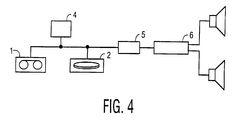
- Fig. 4 is a block diagram of an information retrieval system in accordance with the invention for operation as described above.
- the serial access device 1 is a digital VCR having the characteristics shown in Table 1, operating at 25 Mbps.
- the normal reproduction rate of the stored information is substantially slower than the operating rate of the VCR.
- the audio reproduction rate is 256 Kbps.
- the VCR 1 and a random access device 2 are both coupled to a data bus 3 to which is also coupled a programmable data processor which coordinates operation of both storage devices and access thereof to the data bus at appropriate intervals in order to provide data for continuous reproduction.
- the data provided to the bus is conveyed thereby to a digital first-in-first-out or FIFO memory 5, which is controlled by processor 3 to provide output of data at the desired reproduction rate, in the case of audio data 256 Kbps.
- Memory 5 supplies the data at the audio rate to a decoder 6 for decoding and D/A conversion.
- the resultant signal is supplied to a reproduction facility, shown in this case as a pair of stereo loud speakers.
- the storage devices are controlled by processor 3 to record in the MD device 2 the necessary portions of data tracks of the albums already recorded in the VCR 1, so that the stored data in MD device 2 will be sufficient for CPU 4 to maintain memory 4 at a filling level which assures a continuing flow of data at the audio rate to decoder 5 during intervals when VCR 1 is still searching to access a designated album or track. From the description given above it will now be apparent how that is achieved.
- An introductory portion of a selected track, preferably the first, of the first album in VCR 1 is also recorded in MD device 2.
- a lesser introductory portion of each succeeding track in the first album in VCR 1 is then also successively recorded in MD device 2, such portion linearly decreasing from the second track to the central track so that the duration of the recorded portion of the central track is approximately half that of the second track, and then linearly increasing for succeeding tracks so that the duration of the stored portion of the last track is the same is that of the second track.
- This procedure is then repeated for the second and succeeding albums, with similar provision for adaptive allocation of the stored portion of the preselected track of each album. That is, the stored portion of preselected tracks in albums succeeding the first album linearly decreases up to the predetermined track of the album at the center of the library, for which the stored portion of the predetermined track thereof is approximately half that of the predetermined track in the first album. For albums succeeding the central album this procedure is reversed, the stored portions of the predetermined tracks of the succeeding albums linearly increasing until for the last album the stored portion of the predetermined track thereof is approximately the same as for the first album.
- the data recorded in the VCR 1 may not be the original audio data to be reproduced but my have been encoded to provide for compression and error correction.
- the system is ready for operation as a random access library. It should be understood that random access is provided to any album and also to any track in an already designated album, but not to any track of any newly designated album. This is dealt with further below.
- the processor 4 controls the VCR 1, via a conventional selection unit thereof, to commence search to access the indicated choices, and simultaneously switches access to the data bus 3 to MD device 2 so that playback is commenced therefrom in accordance with the first of such choices; e.g., a chosen album.
- the MD device 2 is controlled by processor 4 to read-out via bus 3 to buffer memory 5 the stored data corresponding to a portion of the first track in the chosen album, and such data is then read-out from memory 5 to decoder 6 at the normal audio rate, subjected thereby to decoding and D/A conversion, and the resulting signal is supplied to the loudspeakers. While that is occurring, the VCR 1 accesses the chosen album and the preselected track therein. The track address of the data at the pickup head of VCR 1 is monitored by processor 4, which also monitors the address in MD device 2 of data supplied thereby to buffer memory 5.
- the first alternative is to begin with playback of the preselected track of such album, followed without any interruption by playback of the chosen track in that album. This proceeds substantially as described above, except that after completion of read-out of the preselected track of such album the processor 4 controls MD device 2 to read-out the stored introductory portion of the chosen track in such album. Once the VCR 1 is ready to access the remainder of such track the processor 4 switches access to data bus 3 over to VCR 1 and read-out of the chosen track is continued therefrom.
- the second alternative which the user can signify to processor 4, is to wait out the access time (between 1/2 and 1 minute, see Table 2) for VCR 1 to reach the album which contains the chosen track.
- the processor does not switch access to the data bus to MD device 2 until that occurs, after which MD device 2 is given access to data bus 3 to read-out the portion of the chosen track stored therein.
- VCR 1 will be in position to access that track and operation resumes as described above for the first alternative.
Landscapes
- Engineering & Computer Science (AREA)
- Multimedia (AREA)
- General Engineering & Computer Science (AREA)
- Physics & Mathematics (AREA)
- Acoustics & Sound (AREA)
- Signal Processing For Digital Recording And Reproducing (AREA)
- Indexing, Searching, Synchronizing, And The Amount Of Synchronization Travel Of Record Carriers (AREA)
- Management Or Editing Of Information On Record Carriers (AREA)
- Information Transfer Systems (AREA)
Claims (8)
- System zum Wiederauffinden von Information, wobei dieses System die nachfolgenden Elemente umfasst:eine Speicheranordnung (1) mit einem Speichermedium zum Tragen von Datenspuren, die auf dem genannten Aufzeichnungsmedium gespeichert sind, wobei jede Spur Daten aufweist, die einem identifizierbaren Informationsitem entsprechen, wobei die genannte Anordnung eine maximale Zugriffszeit auf eine Speicheradresse auf dem genannten Aufzeichnungsmedium hat, die geringer ist als die Wiedergabezeit einer der genannten Spuren, wenn die Daten darauf mit einer normalen Daten-Wiedergaberate wiedergegeben werden;eine Anordnung (2) mit beliebigem Zugriff zum Schaffen eines direkten Zugriffs auf adressierbare Datenspeicherstellen darin, wobei die genannten Datenspeicherstellen zum Speichern wenigstens eines Einleitungsteils der genannten Spuren vorgesehen sind;einen Datenbus, der mit jeder der genannten Anordnungen gemeinsam gekoppelt ist zum Empfangen von Daten, die daraus ausgelesen werden;Datenwiedergabemittel (6), die mit dem genannten Datenbus gekoppelt sind zum Empfangen von Daten daraus und zum Wiedergaben der genannten Daten mit der genannten normalen Wiedergaberate in einer Form, die repräsentativ ist für die entsprechende Information; undeinen Datenprozessor (4), der ebenfalls mit dem genannten Datenbus gekoppelt ist zur Steuerung der genannten Anordnungen entsprechend Befehlen, die von dem Benutzer dem genannten Datenprozessor gegeben werden, dadurch gekennzeichnet, dass die Speicheranordnung (1) einen Recorder mit seriellem Zugriff umfasst zum Auslesen von Datenspuren aus dem genannten Aufzeichnungsmedium in Form eines Bandes, wobei das genannte Band eine Bibliothek von Alben enthält, wobei jedes Album eine Anzahl Datenspuren umfasst, wobei alle gespeicherten Daten durch Translation des genannten Bandes seriell zugreifbar sind, bis ein Aufnahmekopf der Anordnung mit seriellem Zugriff sich an einer Speicheradresse der betreffenden Daten darauf befindet; wobei die Anordnung (2) mit direktem Zugriff dazu vorgesehen ist, Folgendes zu liefern:(i) eine Kopie der Daten in wenigstens einem Einleitungsteil einer vorgewählten. Spur jedes der genannten Alben, wobei der genannte Teil für jedes bestimmte Album ausreicht, so dass die Spielzeit bei der normalen Wiedergaberate wenigstens der Zugriffszeit der Anordnung mit seriellem Zugriff entspricht zum Zugreifen auf die genannte vorgewählte Spur des genannten bestimmten Albums; und(ii) eine Kopie der Daten in einem kürzeren Einleitungsteil jeder der nicht vorgewählten Spuren jedes der genannten Alben, wobei der genannte Teil jeder bestimmten nicht vorgewählten Spur jedes Albums ausreicht, so dass die Spielzeit derselben bei der genannten normalen Wiedergaberate der Zugriffszeit der Anordnung mit seriellem Zugriff von der vorgewählten Spur des genannten Albums zu der genannten bestimmten nicht vorgewählten Spur desselben wenigstens entspricht; wobei die genannten dem Datenprozessor (4) von einem Benutzer zugeführten Befehle Alben und Spuren bezeichnen, die in der Anordnung mit seriellem Zugriff (1) gespeichert sind und die wiedergegeben werden müssen; wobei der genannte Datenprozessor die genannten Anordnungen derart steuert, dass Daten, die aus der Anordnung (2) mit direktem Zugriff ausgelesen sind und dem genannten Bus zugeführt werden zum Beibehalten einer kontinuierlichen Wiedergabe von Daten während Suchintervalle des Recorders mit seriellem Zugriff zum Zugreifen auf ein bestimmtes Album oder eine bestimmte Spur eines vorher bestimmten Albums.
- System zum Wiederauffinden von Information nach Anspruch 1, wobei der genannte Datenprozessor das Auslesen von Daten aus jeder der genannten Anordnungen zu dem Datenbus derart steuert, dass(i) in Reaktion auf einen Befehl, der ein Album bezeichnet, die Anordnung mit dem direkten Zugriff aus dem genannten Datenbus die darin gespeicherten Daten von einem Teil einer vorgewählten Spur des genannten Albums ausliest, wobei das Auslesen des genannten Busses zu der genannten Anordnung mit seriellem Zugriff umgeschaltet wird, wenn das Band in eine Position verlagert worden ist zum fortgesetzten, kontinuierlichen Auslesen der Daten in dem restlichen Teil der vorgewählten Spur des genannten Albums; wobei das Auslesen der restlichen Spuren in dem genannten Album danach durch die Anordnung mit seriellem Zugriff fortgesetzt wird; und(ii) in Reaktion auf einen Befehl, der eine nicht vorgewählte Spur eines vorher bezeichneten Albums bezeichnet, worauf das Band der genannten Anordnung mit seriellem Zugriff bereits positioniert worden ist, die Anordnung mit direktem Zugriff die in dem genannten Datenbus gespeicherten Daten eines Teils der genannten nicht vorgewählten Spur ausliest; wobei von dem Auslesen des genannten Datenbusses auf das Auslesen der genanten Anordnung mit seriellem Zugriff umgeschaltet wird, wenn das Band die Position erreicht hat zum kontinuierlichen Auslesen der Daten in dem restlichen Teil der genannten nicht vorgewählten Spur.
- System zum Wiederauffinden von Information nach Anspruch 1, wobei die genannten Datenwiedergabemittel einen Pufferspeicher umfassen zum Speichern von Daten, empfangen von dem genannten Datenbus und gesteuert durch den genannten Prozessor zum Auslesen der gespeicherten Daten mit der genannten normalen Wiedergaberate; wobei der Prozessor das Auslesen von Daten aus den beiden genannten Anordnungen steuert, zum Beibehalten des genannten Pufferspeichers auf einem Füllpegel innerhalb eines vorbestimmten Bereichs während Suchintervalle der genannten Anordnung mit seriellem Zugriff auf ein bestimmtes Album oder auf eine bestimmte Spur eines vorher bestimmten Albums.
- System zum Wiederauffinden von Information nach Anspruch 1, wobei die Anordnung mit seriellem Zugriff eine höhere Suchgeschwindigkeit hat zum Zugreifen auf ein anderes Album und eine niedrigere Suchgeschwindigkeit hat zum Zugreifen auf eine andere Spur innerhalb des bestimmten Albums; wobei die Zugriffszeit auf eine vorbestimmte Spur jedes beliebigen Albums durch die genannte höhere Suchgeschwindigkeit bestimmt wird und die Zugriffszeit auf eine nicht vorgewählte Spur eines Albums durch die niedrigere Suchgeschwindigkeit bestimmt wird.
- System zum Wiederauffinden von Information nach Anspruch 1, wobei die Daten in jeder Datenspur Audio-Information entspricht und die normale Wiedergaberate derselben eine Audio-Datenrate ist.
- System zum Wiederauffinden von Information nach Anspruch 1, wobei die Daten-Lese- / -Schreibrate der Anordnung mit seriellem Zugriff um wenigstens eine Größenordnung die normale Wiedergaberate der darin gespeicherten Daten übersteigt.
- System zum Wiederauffinden von Information nach Anspruch 1, wobei die Anordnung mit seriellem Zugriff ein digitaler Video-Kassetenrecorder ist mit einer Daten-Lese- / Schreibrate in der Größenordnung der 100fachen normalen Wiedergaberate der darin gespeicherten Daten.
- System zum Wiederauffinden von Information nach Anspruch 1, wobei die Anordnung mit direktem Zugriff entweder ein CD-Spieler oder eine magnetische Festplatteneinheit ist.
Applications Claiming Priority (3)
| Application Number | Priority Date | Filing Date | Title |
|---|---|---|---|
| US08/521,191 US5699547A (en) | 1995-08-30 | 1995-08-30 | Information retrieval system with serial access data storage and random access data retrieval |
| US521191 | 1995-08-30 | ||
| PCT/IB1996/000852 WO1997008693A1 (en) | 1995-08-30 | 1996-08-26 | Information retrieveal system with serial access data storage and random access data retrieval |
Publications (2)
| Publication Number | Publication Date |
|---|---|
| EP0800700A1 EP0800700A1 (de) | 1997-10-15 |
| EP0800700B1 true EP0800700B1 (de) | 2001-11-07 |
Family
ID=24075746
Family Applications (1)
| Application Number | Title | Priority Date | Filing Date |
|---|---|---|---|
| EP96926539A Expired - Lifetime EP0800700B1 (de) | 1995-08-30 | 1996-08-26 | Informationswiederauffindungssystem mit datenspeicher mit seriellem zugriff und datenwiederauffindung mit direktzugriff |
Country Status (6)
| Country | Link |
|---|---|
| US (1) | US5699547A (de) |
| EP (1) | EP0800700B1 (de) |
| JP (1) | JPH10508973A (de) |
| AT (1) | ATE208532T1 (de) |
| DE (1) | DE69616748T2 (de) |
| WO (1) | WO1997008693A1 (de) |
Families Citing this family (4)
| Publication number | Priority date | Publication date | Assignee | Title |
|---|---|---|---|---|
| US6934467B1 (en) | 1999-09-13 | 2005-08-23 | Seagate Technology, Llc | Transcoding multimedia data shuttle and archive |
| US6651187B2 (en) | 2001-12-31 | 2003-11-18 | Globespanvirata Inc. | System and method for determining fault path behavior |
| US7406172B2 (en) | 2005-02-16 | 2008-07-29 | Logitech Europe S.A. | Reversible behind-the-head mounted personal audio set with pivoting earphone |
| JP2009110612A (ja) * | 2007-10-31 | 2009-05-21 | Panasonic Corp | 記録再生装置 |
Family Cites Families (6)
| Publication number | Priority date | Publication date | Assignee | Title |
|---|---|---|---|---|
| JPS55129979A (en) * | 1979-03-29 | 1980-10-08 | Sony Corp | Vtr control unit |
| JPS6029794A (ja) * | 1983-07-29 | 1985-02-15 | ヤマハ株式会社 | 電子楽器 |
| GB8710156D0 (en) * | 1987-04-29 | 1987-06-03 | Hazel Grove Music Co Ltd | Sound reproduction system |
| JPH0792995B2 (ja) * | 1990-01-16 | 1995-10-09 | ティアツク株式会社 | 記録再生装置 |
| JPH04238160A (ja) * | 1991-01-21 | 1992-08-26 | Sony Corp | 信号再生装置 |
| GB9103239D0 (en) * | 1991-02-15 | 1991-04-03 | Kemp Michael J | Improvements relating to data storage techniques |
-
1995
- 1995-08-30 US US08/521,191 patent/US5699547A/en not_active Expired - Fee Related
-
1996
- 1996-08-26 JP JP9510053A patent/JPH10508973A/ja not_active Abandoned
- 1996-08-26 AT AT96926539T patent/ATE208532T1/de not_active IP Right Cessation
- 1996-08-26 WO PCT/IB1996/000852 patent/WO1997008693A1/en not_active Ceased
- 1996-08-26 DE DE69616748T patent/DE69616748T2/de not_active Expired - Fee Related
- 1996-08-26 EP EP96926539A patent/EP0800700B1/de not_active Expired - Lifetime
Also Published As
| Publication number | Publication date |
|---|---|
| US5699547A (en) | 1997-12-16 |
| EP0800700A1 (de) | 1997-10-15 |
| DE69616748D1 (de) | 2001-12-13 |
| JPH10508973A (ja) | 1998-09-02 |
| WO1997008693A1 (en) | 1997-03-06 |
| DE69616748T2 (de) | 2002-08-01 |
| ATE208532T1 (de) | 2001-11-15 |
Similar Documents
| Publication | Publication Date | Title |
|---|---|---|
| US5721803A (en) | Information transmission system having a reduced number of stored programs and recording media playback devices | |
| JP3109363B2 (ja) | 磁気記録再生装置 | |
| US20110122759A1 (en) | Data Recording Apparatus and System Having Sustained High Transfer Rates | |
| JP4575780B2 (ja) | 対話形記録媒体再生方法及び対話形記録媒体再生装置 | |
| EP1553588A3 (de) | Informationsaufzeichnungsmedium und Systemsteuerung | |
| KR19980080750A (ko) | 정보 재생 장치 및 정보 재생 방법 | |
| JP3180542B2 (ja) | 映像再生装置 | |
| US20030210617A1 (en) | Shock protection for compressed audio on a CD player | |
| US5699547A (en) | Information retrieval system with serial access data storage and random access data retrieval | |
| US6516134B1 (en) | Data recording/reproducing method and apparatus | |
| JP4718132B2 (ja) | プログラムデータの格納にスワップ可能な記憶装置を使用するシステムおよび方法 | |
| JP3173949B2 (ja) | ディスク再生装置 | |
| KR100644734B1 (ko) | 기록/재생 장치, 기록/재생 방법 및 프리젠테이션 매체 | |
| JP3099862B2 (ja) | カラオケ情報送出装置 | |
| JPH07336640A (ja) | ディスク再生装置 | |
| JPWO2010007727A1 (ja) | 映像記録装置、映像再生装置およびその方法 | |
| JP4297002B2 (ja) | データ記録装置及び記録方法 | |
| JP2949757B2 (ja) | 情報再生装置 | |
| JPS62275369A (ja) | デ−タ記録装置 | |
| JPH10257418A (ja) | 画像データ記録・再生装置およびその方法 | |
| JPH10233059A (ja) | 画像データ記録・再生装置およびその方法 | |
| JP3867864B2 (ja) | デイスク装置の再生方法 | |
| JPS6370966A (ja) | デジタル記録再生装置 | |
| KR0176484B1 (ko) | 컴팩트 디스크의 고속 재생장치 | |
| JPH06311472A (ja) | 動画記録再生装置 |
Legal Events
| Date | Code | Title | Description |
|---|---|---|---|
| PUAI | Public reference made under article 153(3) epc to a published international application that has entered the european phase |
Free format text: ORIGINAL CODE: 0009012 |
|
| AK | Designated contracting states |
Kind code of ref document: A1 Designated state(s): AT DE FR GB |
|
| 17P | Request for examination filed |
Effective date: 19970908 |
|
| 17Q | First examination report despatched |
Effective date: 20000105 |
|
| GRAG | Despatch of communication of intention to grant |
Free format text: ORIGINAL CODE: EPIDOS AGRA |
|
| GRAG | Despatch of communication of intention to grant |
Free format text: ORIGINAL CODE: EPIDOS AGRA |
|
| GRAH | Despatch of communication of intention to grant a patent |
Free format text: ORIGINAL CODE: EPIDOS IGRA |
|
| GRAH | Despatch of communication of intention to grant a patent |
Free format text: ORIGINAL CODE: EPIDOS IGRA |
|
| GRAA | (expected) grant |
Free format text: ORIGINAL CODE: 0009210 |
|
| AK | Designated contracting states |
Kind code of ref document: B1 Designated state(s): AT DE FR GB |
|
| REF | Corresponds to: |
Ref document number: 208532 Country of ref document: AT Date of ref document: 20011115 Kind code of ref document: T |
|
| REF | Corresponds to: |
Ref document number: 69616748 Country of ref document: DE Date of ref document: 20011213 |
|
| REG | Reference to a national code |
Ref country code: GB Ref legal event code: IF02 |
|
| ET | Fr: translation filed | ||
| PG25 | Lapsed in a contracting state [announced via postgrant information from national office to epo] |
Ref country code: AT Free format text: LAPSE BECAUSE OF NON-PAYMENT OF DUE FEES Effective date: 20020826 |
|
| PLBE | No opposition filed within time limit |
Free format text: ORIGINAL CODE: 0009261 |
|
| STAA | Information on the status of an ep patent application or granted ep patent |
Free format text: STATUS: NO OPPOSITION FILED WITHIN TIME LIMIT |
|
| 26N | No opposition filed | ||
| PGFP | Annual fee paid to national office [announced via postgrant information from national office to epo] |
Ref country code: GB Payment date: 20040826 Year of fee payment: 9 |
|
| PGFP | Annual fee paid to national office [announced via postgrant information from national office to epo] |
Ref country code: FR Payment date: 20040830 Year of fee payment: 9 |
|
| PGFP | Annual fee paid to national office [announced via postgrant information from national office to epo] |
Ref country code: DE Payment date: 20041015 Year of fee payment: 9 |
|
| PG25 | Lapsed in a contracting state [announced via postgrant information from national office to epo] |
Ref country code: GB Free format text: LAPSE BECAUSE OF NON-PAYMENT OF DUE FEES Effective date: 20050826 |
|
| PG25 | Lapsed in a contracting state [announced via postgrant information from national office to epo] |
Ref country code: DE Free format text: LAPSE BECAUSE OF NON-PAYMENT OF DUE FEES Effective date: 20060301 |
|
| GBPC | Gb: european patent ceased through non-payment of renewal fee |
Effective date: 20050826 |
|
| PG25 | Lapsed in a contracting state [announced via postgrant information from national office to epo] |
Ref country code: FR Free format text: LAPSE BECAUSE OF NON-PAYMENT OF DUE FEES Effective date: 20060428 |
|
| REG | Reference to a national code |
Ref country code: FR Ref legal event code: ST Effective date: 20060428 |